Category Thinking Society EN

Thinking Society is a dynamic blog dedicated to shedding light on the pressing social issues shaping our world today. Our mission is to provide a thoughtful space where topics including politics, education, inequality, health, and culture are explored in depth. Through insightful articles and diverse perspectives, we aim to challenge assumptions, foster critical thinking, and inspire constructive dialogue. The blog isn’t just about reporting problems—it’s about understanding the root causes, raising awareness, and bringing communities together to imagine real solutions. We believe that by encouraging open conversations and sharing knowledge, we can drive positive change and promote a more equitable, just society. Visitors are invited to engage with our content, share their own insights, and become active participants in a community committed to progress. Whether you’re curious about current events or passionate about social justice, Thinking Society is your go-to platform for informed, impactful discussion.

The Turnberry Trap: Can Europe Survive Its Own Trade Deal?

EU and US chess pieces in parliament chamber

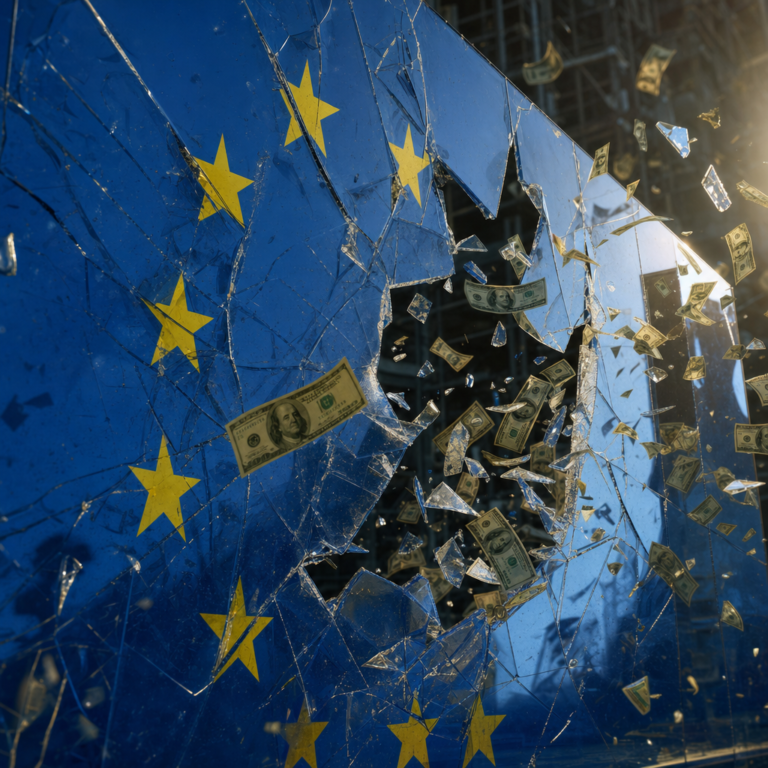
You were told this was a victory for European diplomacy. A trade deal with the United States, hailed as a pragmatic step forward in a turbulent world. But look closer. What the European Parliament approved last month is not a settlement; it is a ceasefire laden with tripwires, a pact so fragile its own architects are already planning for its collapse. The Turnberry agreement, which cuts EU tariffs on most US industrial goods to zero while maintaining a 15% US tariff on EU exports, is now law — pending a final, fraught negotiation with member states.¹ The real story isn't in the vote count of 417 in favour. It's in the 154 against and the 71 abstentions² — a silent scream from a Parliament that feels cornered. #TurnberryDeal #EUUStrade #TradeDeal #EUTrade #Tariffs #EUParliament

Can America Win a Ceasefire It Doesn’t Understand?

Oil tanker and naval ship at sunset

Do you even know what winning looks like anymore? We bomb, we sanction, we posture, and then we call a fragile pause in the violence a strategic victory. The highest-level direct U.S.-Iran talks since the Islamic Revolution of 1979 have ended, not with a peace accord, but with a plea for a second date and a ceasefire that feels more like a collective gasp for air [1]. This isn't diplomacy; it's a timeout called by exhausted referees in a game where the players have forgotten the rules. And your gas bill, your pension fund, and the stability of the global economy are all on the field. #USIranTalks #StraitOfHormuz #IranConflict #MiddleEastCrisis #OilCrisis #IslamabadSummit

The Sahel’s Silent Collapse: Europe’s Strategic Failure in Plain Sight.

Tattered EU flag in desert with military convoy

You were told Europe was a global actor, a normative power whose partnerships were built on values. So why, as you read this, does the Sahel—a region whose stability directly gates your own security—feel like a testament to Europe's strategic absence? The coups in Mali, Burkina Faso, and Niger between 2020 and 2023 did not just topple governments; they severed the thread of European influence, creating a vacuum now filled by Russian mercenaries, Chinese deals, and a transactional American pragmatism. The result, as a stark analysis from the German Institute for International and Security Affairs confirms, is not stability but a deepening quagmire of jihadist violence and regional tension [1]. We are witnessing a failure not of intention, but of architecture and nerve. #Sahel #SahelKrise #WagnerGruppe #AES #SahelAllianz #SahelPolitik

The Blank Cheque: How Germany Rewrote Its Constitution, Committed a Trillion Euros, and Remained an American Client.

Politician speaking in parliament with economic crisis imagery

On March 18, 2025, the German Bundestag voted 517 to 207 to amend the Grundgesetz — Germany's Basic Law, the foundational constitutional document that emerged from the rubble of the Second World War and has governed the republic ever since — to carve out an unlimited borrowing exemption for defence spending. Three days later, on March 21, the Bundesrat completed the constitutional process, giving the reform the force of law. Any military expenditure exceeding 1% of GDP would, from that moment forward, be entirely free of the Schuldenbremse — the debt brake — the fiscal rule that Germany had inscribed into its own constitution in 2009 and had held up to the rest of Europe as a model of budgetary discipline for a generation. Critically, the new law does not merely cover Bundeswehr procurement. It explicitly extends the borrowing exemption to cover military aid to "countries attacked in violation of international law" — a permanent, constitutionally shielded financing window for the war in Ukraine, written directly into the Basic Law. #Schuldenbremse #Grundgesetz #Zeitenwende #Verteidigungsausgaben #Bundestag

Who Controls the Megaphone? The War on Social Media and the Fight for the Digital Public Square.

Hand controlling social media sphere over shadowy figures

There is a battle underway — quiet in its legal language, but thunderous in its consequences. Governments, regulators, and the establishment interests that orbit them are systematically tightening their grip on social media, and the official justifications being offered — protecting children, combating misinformation, ensuring platform transparency — are, at best, incomplete. At worst, they are a smokescreen for something altogether more ancient and familiar: the determination of powerful people to control what other people are allowed to say, read, and believe.There is a battle underway — quiet in its legal language, but thunderous in its consequences. Governments, regulators, and the establishment interests that orbit them are systematically tightening their grip on social media, and the official justifications being offered — protecting children, combating misinformation, ensuring platform transparency — are, at best, incomplete. At worst, they are a smokescreen for something altogether more ancient and familiar: the determination of powerful people to control what other people are allowed to say, read, and believe. /#X #DSA #EUcensorship #Fediverse #Mastodon #ManufacturingConsent

Iran’s Crucible: How the US-Iran War Exposes the Crumbling Architecture of American Hegemony

Naval warship at sea during dramatic sunset

The United States has launched direct military operations against Iran, striking nuclear enrichment facilities, Revolutionary Guard command nodes, and critical energy infrastructure across the country. The campaign, which began in late March 2026, represents the most significant direct US military engagement in the Middle East since the 2003 Iraq invasion — and arguably the most consequential test of American power projection since the end of the Cold War. Tehran has retaliated with ballistic missile strikes on US bases in the Gulf, proxy activations across Iraq, Syria, Lebanon, and Yemen, and a credible threat to close the Strait of Hormuz. What was sold as a decisive strike against a weakened adversary is rapidly becoming a grinding, multi-front confrontation that reveals more about American vulnerability than American strength. / #IranWar #USIran #USStrikesIran #OperationEpicFury #StraitOfHormuz #TrumpIranWar

Brussels’ Democratic Decay: Five EU States Caught Red-Handed Eroding Rule of Law.

EU flag in parliament chamber with treaty document

The rule of law is of paramount importance and is the foundation of economic growth, social investment, and civil liberties. Economic Growth: Governments must foster competitive markets and innovation, but not by creating a race to the bottom on legal protections. Strong, independent institutions are the best guarantor of long-term business confidence and sustainable growth. Social Investment: Universal access to quality healthcare, education, and social security is a baseline obligation. Eroding the rule of law to centralize power inevitably starves these systems of accountability and resources, betraying the public trust. Civil Liberties: Freedom of speech, press, assembly, and privacy are the oxygen of a free society. Any policy that suffocates these rights, regardless of the political banner it flies under, is an attack on the very idea of Europe. The gap between this standard and the actions of the five governments is not a policy difference; it is a chasm between democracy and its opposite. #RuleOfLaw #EUPolitics #DemocracyUnderThreat #CivilLiberties #EuropeanUnion #GeopoliticalRisk

As Oil Majors Roll Back Climate Promises, Workers Confront a Crisis of Conscience.

Woman between oil industry and renewable energy

The bottom line for anyone watching this story: the energy transition is not just a matter of technology and policy — it is a human resources story. Where the most skilled, experienced workers in the global energy sector choose to invest their careers will shape how fast, how equitably, and how effectively the world moves away from fossil fuels. That choice is no longer abstract. For a growing number of oil and gas professionals, it is the most consequential career decision they will ever make. / #EnergyTransition #OilAndGas #ClimateAction #LifeAfterOil #CleanEnergyJobs #FossilFuelDivestment

Japanese Yen Collapse Triggers Worldwide Market Turmoil Amid Sliding South Korean Stocks.

Traders react to massive Nikkei stock market crash

The bottom line: the yen's collapse is not a localised currency story — it is a global liquidity event. When Japan's currency moves this sharply, it forces trillions in leveraged carry trade positions to unwind, draining capital from stocks, bonds, and crypto worldwide. If you hold any risk assets, this crisis is already touching your portfolio, whether you realise it or not.#GlobalMarkets #EconomicCrisis #JapaneseYen #CarryTrade #AsiaEnergyCrisis #YenCarryUnwind