




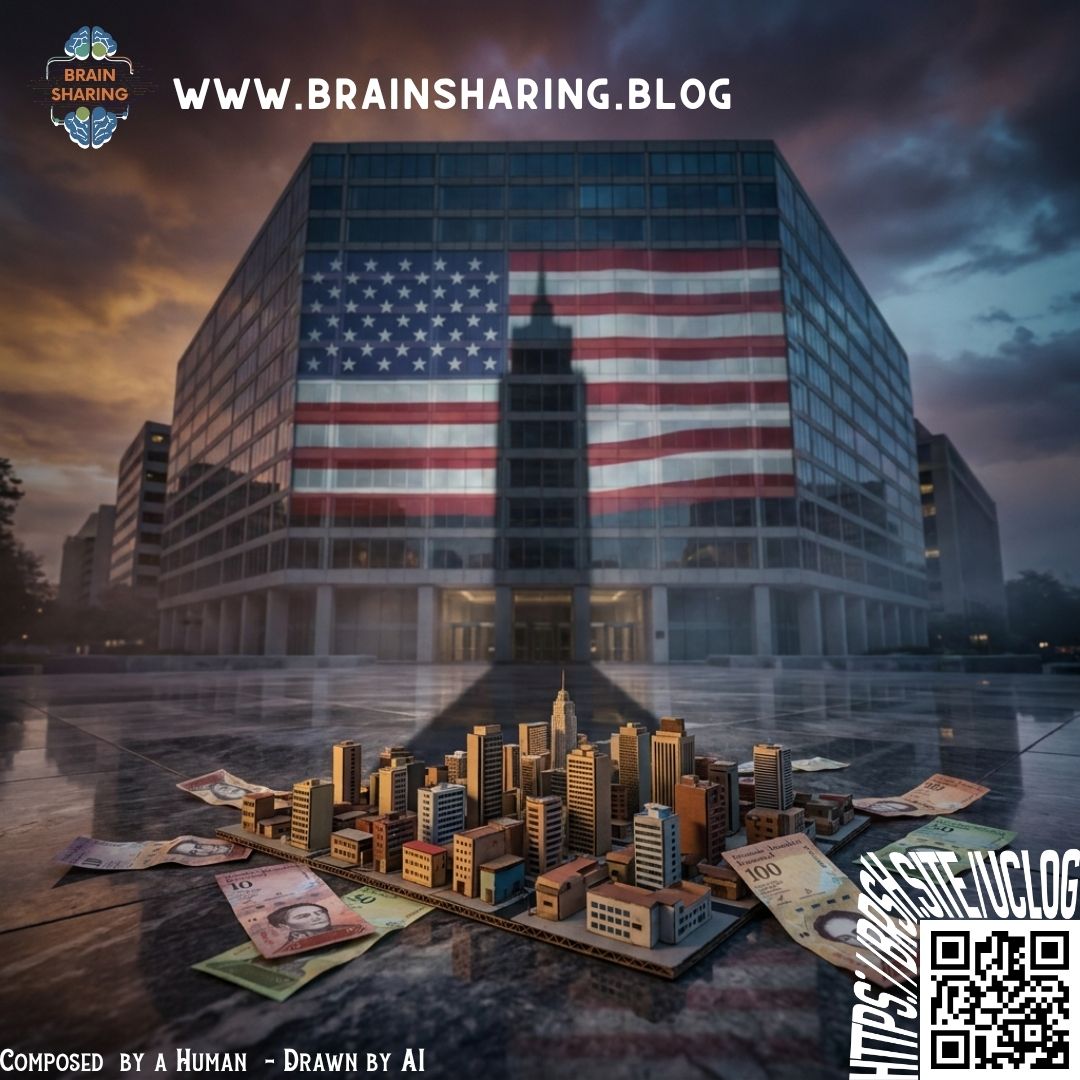


Have you ever watched a puppet show and wondered whether the strings were visible to everyone, or just to those willing to look up? On Thursday, April 16, 2026, the International Monetary Fund and the World Bank announced they had resumed formal dealings with Venezuela after a seven‑year freeze — not because Caracas suddenly fixed its shattered economy, not because a democratic miracle unfolded on the streets of Caracas, but because Washington captured President Nicolás Maduro on January 3, installed acting President Delcy Rodríguez, and then told the multilateral institutions it was time to play ball *1. The IMF polled its members, secured a majority of voting power, and Managing Director Kristalina Georgieva declared the Fund was now “dealing with the Government of Venezuela, under the administration of acting President Delcy Rodríguez” *2.
If you still believe these institutions operate on pure technocratic logic, this episode is your wake‑up call — and it is ringing loud enough to shake the walls of every capital that pretends the multilateral order is neutral *3.
The Seven‑Year Silence That Was Never About Economics
Venezuela has been a World Bank member since 1946; its last loan was issued in 2005 4. The IMF severed formal engagement in 2019 when its members could not agree on whether Maduro or opposition leader Juan Guaidó was the legitimate president *1. For seven years, the Fund’s position was effectively: we cannot determine who governs, so we will not engage. Seven years of silence while inflation spiralled into triple digits. Seven years while the bolívar evaporated into worthlessness. Seven years while millions of Venezuelans fled across borders, creating the largest displacement crisis in the Western Hemisphere’s modern history *5.
The economic catastrophe was never the obstacle — the politics were. And the politics were always about who Washington wanted seated in Miraflores Palace. The day that question was answered by force, the institutions suddenly found their voice *6.
The Strongest Case for Re‑Engagement
The argument for restoring ties runs like this: Venezuela’s macroeconomic situation is catastrophic — triple‑digit inflation, massive fiscal deficits, a currency in freefall — and the IMF cannot help a country it does not officially recognize *7. Acting President Rodríguez now controls state institutions with backing from Venezuela’s top court, and a clear majority of IMF voting power supports her government *2. Restoring relations clears the path for the first Article IV assessment in roughly two decades, technical assistance, and potentially unlocking 4.9 billion in frozen Special Drawing Rights that have sat unusable since the break in ties *7. Foreign private investors who have been paralysed by political uncertainty finally have a recognized counterpart to negotiate with *6. The World Bank can resume development programming for the first time in years *4. Rodríguez herself called it “a very important step for the Venezuelan economy,” publicly thanking US President Donald Trump and Secretary of State Marco Rubio by name *1.
The strongest case is rational, orderly, and technically sound. And yet — does anyone genuinely believe this machinery activated because the spreadsheets finally added up?
The Counter: Power, Not Procedure.
Here is what that technocratic narrative cannot explain: why now, and not three years ago, or five years ago, when Venezuelans were already starving? The answer is surgical and specific — the Trump administration conducted a military raid on Caracas on January 3, captured Maduro, and installed Rodríguez as acting president *8. Washington has since reopened its embassy, restored diplomatic relations, and begun actively seeking expanded US access to Venezuela’s oil and mining sectors *8. The IMF itself stated that re‑engagement depended on “member governments with a majority of IMF voting power” recognizing a new government *2. In practice, that majority means the United States plus its G7 and EU allies lining up behind a successor authority — a coordinated bloc that moves when Washington moves *9. The US holds approximately 16–17% of IMF voting power, and major decisions require an 85% supermajority, giving Washington a structural veto over any politically sensitive outcome *9. You do not need a leaked memo to understand who drove this decision. The timing alone is the confession.
As Lex Rieffel has observed, it is “hard to imagine the IMF” taking a controversial position “without the tacit, if not explicit, support of the United States and the other G‑7 countries” *10.
The European capitals fell in line, as they always do — their small bout hitched to the wheels and whims of Washington. That is not sovereignty. That is compliance dressed as consensus.
The People Who Always Pay.
Now ask yourself the question that matters: who benefits from this restoration, and who continues to bleed?
Over 7.7 million Venezuelans have fled the country since 2015 — the largest displacement crisis in the Western Hemisphere’s modern history *5. Inside Venezuela, more than 80% of the population lives below the poverty line; food insecurity grips millions; the health system has effectively collapsed in vast regions of the country *5. The IMF and World Bank are not restoring relations to feed Venezuelans — they are restoring relations because the political conditions for Washington’s preferred economic framework are finally in place *6. The frozen 4.9 billion in Special Drawing Rights will not arrive as humanitarian aid; it will arrive as part of a macroeconomic programme with conditions attached — fiscal austerity, privatizations, opening state assets to foreign capital *7. If you are a Venezuelan nurse earning USD30 a month, this announcement changes nothing about your life today. If you are a US oil executive eyeing the Orinoco Belt, it changes everything about your next decade *8.
The people of Venezuela are not the beneficiaries here — they are the terrain on which great powers play their games.
What Awaits?
The trajectory is unmistakable: Venezuela is being reinserted into the US‑centred financial architecture, with the IMF and World Bank serving as the institutional scaffolding for a post‑Maduro economic order *6. Expect structured programmes around the oil sector, power grid, and logistics — designed to facilitate the return of Western energy majors *8. Expect debt restructuring negotiations that lock Caracas into conditionality frameworks written in Washington and Brussels, not Caracas *7. Expect Rodríguez’s government to trade policy autonomy for liquidity, recognition, and sanctions relief — a post‑conflict stabilization package where sovereignty is the currency exchanged *10. The interim leadership is not negotiating from strength; it is negotiating from dependency. And the multilateral institutions are not neutral referees — they are instruments of the shareholders who control them, which means instruments of Washington and its closest allies *9. We have seen this playbook before — in Iraq, in Libya, in countless countries where regime change preceded financial “normalization.” The form is multilateral. The substance is unilateral.
References
- “IMF, World Bank say they are resuming dealings with Venezuela.” Reuters, April 16, 2026.
- “IMF Announces Resumption of Dealings with Venezuela.” International Monetary Fund, April 16, 2026.
- Barnett, Michael N., and Martha Finnemore. “The Politics, Power, and Pathologies of International Organizations.” International Organization 53, no. 4 (1999): 699‑732. PDF available at
- “World Bank Group Announces Resumption of Dealings with Venezuela.” World Bank, April 16, 2026.
- “The Persistence of the Venezuelan Migrant and Refugee Crisis.” Center for Strategic and International Studies, August 2023.
- “IMF needs voting majority of members to recognize Venezuela government restore ties.” Reuters, January 15, 2026.
- “IMF Reengagement with Venezuela – FAQs.” International Monetary Fund.
- “US formally reopens Caracas embassy as ties with Venezuela warm.” Reuters, March 30, 2026.
- “United States and the International Monetary Fund.” Wikipedia.
- Rieffel, Lex. The IMF and the World Bank: How to Reform the Unreformable? Peterson Institute for International Economics, 2003, pp. 28‑29. Cited in “Do the IMF and the World Bank influence voting in the UN General Assembly?” ifo Institut, PDF available at
AI Disclosure: This post was created with the assistance of artificial intelligence. The ideas, analysis, and opinions expressed are my own — AI was used to help compose, structure, and refine my personal notes and thoughts into the final written content. Images, videos and music featured in this post were also generated using AI tools, based on my own creative prompts and direction.
