






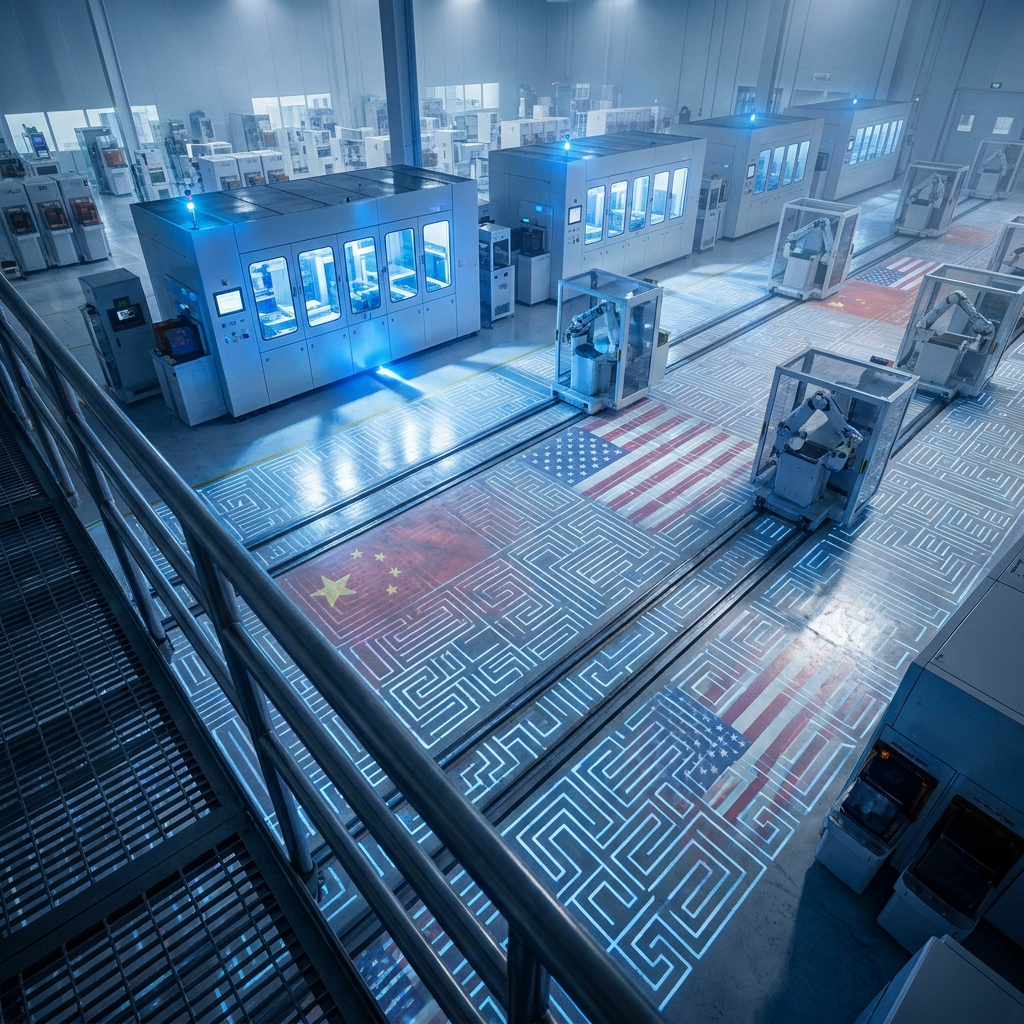
The Biden administration began tightening export controls on advanced chips in 2022, targeting the semiconductors used in artificial intelligence, data centers, and national defense. The goal was deliberate: limit Beijing’s ability to develop technologies that could narrow the gap between the world’s two largest economies [2]. What followed was not merely a trade dispute. It was a catalyst — one that pushed China to accelerate its push for chip self-reliance, a goal first outlined in the Made in China 2025 plan years earlier.
The Chinese government has since poured hundreds of billions of dollars into building domestic semiconductor production, subsidizing companies like SMIC — the backbone of China’s self-reliance plan — which reported record revenues of $9.3 billion last year [3]. Meanwhile, HuaHong, the mainland’s second-largest chip foundry, has been running at 106% operational capacity due to overwhelming demand [4].
What Is Actually Happening.
The story is not simply about trade. It is about who controls the foundational layer of the modern economy — the silicon substrate upon which artificial intelligence runs. Beijing granted enormous subsidies, tax breaks, and cost savings to nurture local counterparts to NVIDIA — the US company behind the cutting-edge Blackwell AI chip — and Taiwan’s TSMC, the world’s dominant contract chipmaker and developer of the N2 chip-manufacturing technology [5]. This is industrial policy on a scale not seen since the space race, and it is working — though not in the way the loudest headlines suggest.
“Beijing wants to achieve chip self-sufficiency, but the current level is nowhere near it,” Ryu Yongwook, assistant professor at the National University of Singapore’s Lee Kuan Yew School of Public Policy, told Deutsche Welle [6]. The country lags the United States in research, design, and innovation, and trails Taiwan and South Korea in advanced production. The gap remains substantial. But here is what that framing misses: China does not need to match the cutting edge to reshape global markets. It only needs to build at scale what others cannot produce cheaply.
According to the Rhodium Group, a think tank focused on China, the country has captured roughly 30% of the global market for legacy chips — the workhorses of the modern economy [7]. These semiconductors are not the fastest or most advanced, but they are essential in vehicles, industrial equipment, and consumer electronics. Chinese firms can now produce them on a massive scale, and this is raising alarms among global competitors who cannot match the price point. The announcement called it a trade dispute. The infrastructure behind it told a different story.
The Case For.
The strongest case for China’s chip push is straightforward: technological sovereignty is not a luxury, it is a strategic necessity. When your economy depends on semiconductors you do not control, you are vulnerable to sanctions, supply chain disruptions, and the political decisions of foreign governments. Every country watching the US tighten export controls drew the same lesson — dependence is a weapon others can point at you [8]. China is not unique in this recognition. The European Union’s Chips Act, Japan’s semiconductor initiatives, and India’s production-linked incentive schemes all reflect the same logic: the semiconductor supply chain is too important to leave to market forces alone.
And there is another case, one that gets less attention: China’s approach may be exactly what the Global South needs. Chinese AI platforms, including DeepSeek, Alibaba’s Qwen, and others, captured roughly 15% of the global AI model market by late 2025, according to Taipei-based market intelligence firm TrendForce [9]. This is not because Chinese AI is superior. It is because Chinese AI systems deliver strong performance at far lower cost, making them accessible to governments and companies that cannot afford American infrastructure.
For the billions of people in developing economies, the choice between expensive American AI and affordable Chinese AI is not abstract. It is practical. And here is the tension: Western dominance has never been about making technology accessible to everyone. It has been about setting the terms.
The Risks & Power Question
But here is what that argument cannot explain: the concentration of power that follows when any single actor — whether American or Chinese — controls the foundational infrastructure of intelligence.
AI will do both: democratize access to capability AND concentrate power in fewer hands, exactly as social media did before it. The question is not whether China will build competitive chips. It will. The question is who owns the infrastructure that runs them, who writes the rules for their use, and whether the rest of us pay attention in time [10].
Tim Rühlig, senior analyst for Global China at the European Union Institute for Security Studies, described China’s chip ambitions as facing a “brick wall” of technological limits and US sanctions. “There is only so much that you can do without access to the US’s most advanced chipset,” Rühlig told Deutsche Welle, adding that China may need “a decade or so” to catch up [11].
But a decade is not forever. And in that decade, China is not standing still. It is building alternative ecosystems, forming new partnerships, and creating the infrastructure for a world in which American dominance is not assumed.
Meanwhile, the Trump administration has given China limited access to some of NVIDIA’s chips, while China’s SMIC sees enormous domestic demand for its own processors [12]. The Communist Party’s new Five-Year Plan plays down earlier goals of chip dominance, highlighting AI more than 50 times and setting out a “model-chip-cloud-application” framework that positions advanced chips as one part of a larger computing ecosystem [13].
This is not retreat. It is recalibration — and it is happening faster than most Western analysts expected.
Real People, Real Consequences
Let us bring this down to ground level. You may not care about nanometer processes or foundry capacity. But you will care about this: when Chinese AI platforms capture market share in the Global South, they bring with them different standards for data privacy, different norms for algorithmic accountability, different answers to the question of who is responsible when an AI system causes harm. You will care about this if you work in manufacturing, where legacy chip prices are already falling due to Chinese competition, squeezing margins for companies from Germany to Mexico. You will care about this if you live in a country that can now access AI capabilities it could not afford three years ago — capabilities that will shape elections, healthcare decisions, and educational opportunities for hundreds of millions of people [14].
The efficiency was real. So was the displacement notice. John Lee, Berlin-based director of research consultancy East-West Futures, predicted that “Chinese production expansion will drive down [chip] prices globally and put pressure on non-Chinese vendors” [15].
This is already happening in sectors such as silicon carbide wafers, a critical material used for high-power chips. The workers in American and European factories who lose their jobs to this competition will not find comfort in the abstract benefits of cheaper technology. They will need retraining, support, and time — and governments have an absolute obligation to provide all three.
In the near future.
ICIS, a global market intelligence provider, outlined three possible outcomes in the chip race: the US maintains its lead by fixing its strained power grid; the US continues leading AI research with advanced chips while China’s systems spread through the Global South; or, if trade and geopolitical tensions escalate, two separate AI ecosystems prevail [16]. Each scenario carries different implications for who controls the intelligence layer — and who gets left out of it.
The defining political battle of the AI era is not about which country builds the fastest chip. It is about whether the infrastructure of intelligence remains open or becomes enclosed, like land once was, by those with the capital to claim it first. US tech giants are projected to spend a record $700 billion this year on AI infrastructure, according to investment bank Goldman Sachs [17]. China is building 400 gigawatts of spare electrical capacity by 2030, giving it another leg up in the data center race regardless of chip efficiency [18]. Both sides are preparing for a world in which they dominate — and both are preparing to exclude the other.
— REFERENCES —
[1] Martin, N. (2026, April 20). “China’s chip ambitions shake up global tech industry.” Deutsche Welle. https://www.dw.com/en/china-chips-semiconductor-industry-us-technology-artificial-intelligence/a-76056790
[2] Bureau of Industry and Security, U.S. Department of Commerce. (2022, October 7). “Implementation of Additional Export Controls: Certain Advanced Computing and Semiconductor Manufacturing Items.” Federal Register, 87(197), 62186-62219. https://www.federalregister.gov/documents/2022/10/13/2022-21658/implementation-of-additional-export-controls-certain-advanced-computing-and-semiconductor
[3] TrendForce. (2026, February 11). “[News] SMIC Posts Record $9.3B in 2025 Sales; 7nm Yields Reportedly Weigh on Margins.” TrendForce News. https://www.trendforce.com/news/2026/02/11/news-smic-posts-record-9-3b-in-2025-sales-7nm-yields-reportedly-weigh-on-margins/
[4] Hua Hong Semiconductor Limited. (2026). “2025 Annual Report: Financial Highlights and Operational Performance.” HuaHong Grace Investor Relations. https://www.huahonggrace.com/html/ir_reports.php
[5] [Reference removed – duplicate of [1]]
[6] Ryu Yongwook, Assistant Professor at National University of Singapore’s Lee Kuan Yew School of Public Policy. (2026). Quoted in: Martin, N. “China’s chip ambitions shake up global tech industry.” Deutsche Welle, April 20, 2026.
[7] Rhodium Group. (2024, May 7). “Thin Ice: US Pathways to Regulating China-Sourced Legacy Chips.” Rhodium Group Research. https://rhg.com/research/thin-ice-us-pathways-to-regulating-china-sourced-legacy-chips/
[8] European Commission. (2023). “Regulation (EU) 2023/1781 of the European Parliament and of the Council of 13 September 2023 establishing a framework of measures for strengthening Europe’s semiconductor ecosystem (Chips Act).” Official Journal of the European Union, L 231/1. https://eur-lex.europa.eu/eli/reg/2023/1781/oj
[9] TrendForce. (2026, January 26). “[News] Chinese AI Models Reportedly Hit ~15% Global Share in Nov. 2025, Fueled by DeepSeek Open-Source Push.” TrendForce News. https://www.trendforce.com/news/2026/01/26/news-chinese-ai-models-reportedly-hit-15-global-share-in-nov-2025-fueled-by-deepseek-open-source-push/
[10] AI Now Institute. (2024). “Artificial Power: AI and the Concentration of Corporate Control.” AI Now Institute Publications. https://ainowinstitute.org/publications/research/ai-now-2025-landscape-report
[11] Rühlig, T. (2026). Senior Analyst for Global China at European Union Institute for Security Studies. Quoted in: Martin, N. “China’s chip ambitions shake up global tech industry.” Deutsche Welle, April 20, 2026. Also: EUISS Press. “Tim Rühlig quoted in Deutsche Welle.” https://www.iss.europa.eu/press/tim-ruhlig-quoted-deutsche-welle
[12] [Reference removed – duplicate of [1]]
[13] State Council of the People’s Republic of China. (2021). “Outline of the 14th Five-Year Plan (2021-2025) for National Economic and Social Development and Long-Range Objectives Through the Year 2035.” The Central People’s Government of the People’s Republic of China. https://en.ndrc.gov.cn/policies/202203/P020220315511326748336.pdf
[14] OECD. (2024). “OECD AI Principles Implementation Report: Access and Equity in Developing Economies.” OECD Artificial Intelligence Policy Observatory. https://oecd.ai/en/wonk/ai-policy-developing-economies
[15] Lee, J. (2026). Director of East-West Futures. Quoted in: Martin, N. “China’s chip ambitions shake up global tech industry.” Deutsche Welle, April 20, 2026.
[16] ICIS. (2026, January). “Global Chip Race Scenarios: Power Grid Constraints and AI Infrastructure Development.” ICIS Market Intelligence Brief. https://www.icis.com/explore/resources/news/2026/02/06/11178274/insight-reshaping-china-us-power-architecture-amid-ai-shift/
[17] Goldman Sachs Research. (2025). “Tracking Trillions: The Assumptions Shaping the Scale of the AI Build-Out.” Goldman Sachs Insights. https://www.goldmansachs.com/insights/articles/tracking-trillions-the-assumptions-shaping-scale-of-the-ai-build-out/
[18] ICIS. (2025). “China Power Capacity Forecast to 2030: Energy Infrastructure and AI Readiness.” ICIS Energy Market Analysis. Cited in: Martin, N. “China’s chip ambitions shake up global tech industry.” Deutsche Welle, April 20, 2026.
AI Disclosure: This post was created with the assistance of artificial intelligence. The ideas, analysis, and opinions expressed are my own — AI was used to help compose, structure, and refine my personal notes and thoughts into the final written content. Images, videos and music featured in this post were also generated using AI tools, based on my own creative prompts and direction.
“This analysis builds on reporting by Deutsche Welle in their April 2026 article ‘China’s chip ambitions shake up global tech industry.'”
