






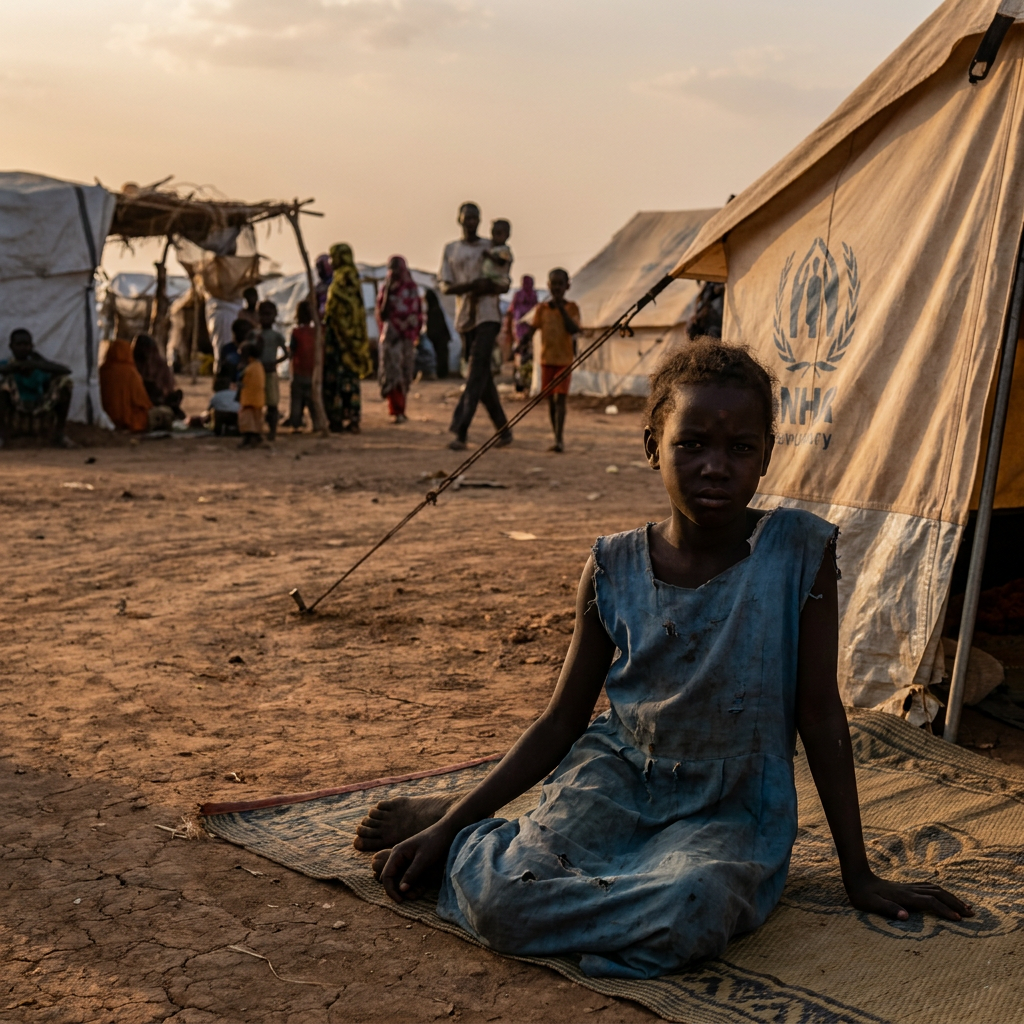
She is seven years old. She does not remember what her home looked like before the drones came. She knows the sound they make — a hum in the sky that adults call death descending. She knows markets are not safe, that schools are not safe, that the road between her shelter and the water pump is not safe. She knows this because she has watched what happens when the hum stops. She is one of thousands of children in Sudan for whom the word “childhood” has become an abstraction — a concept that exists in textbooks and television screens, not in the bombed-out neighborhoods of Darfur or the besieged streets of el-Fasher. [1]**
The reality for children in Sudan is growing darker hour by hour. That is not rhetoric. That is Eva Hinds, UNICEF’s official spokesperson, speaking to journalists with the weight of documented horror behind every syllable. The country’s civil war — now in its fourth year — has displaced more than 13 million people, killed or maimed over 4,300 children, and reduced entire communities to famine conditions that the international community continues to describe as “deeply concerning” while doing little to stop them. [1][2]
We should ask ourselves what kind of language we use when we describe a catastrophe of this scale. “Deeply concerning” is what we say about traffic congestion. “Growing darker” is what we say about winter afternoons. These are the words of institutions that have lost the capacity to shock even themselves — that have learned to metabolize atrocity into administrative language because the alternative would require them to act. [3]
What Is Actually Happening
The conflict that erupted in April 2023 between the Rapid Support Forces paramilitary and the Sudanese Armed Forces did not emerge from nowhere. It followed the collapse of a fragile transition to civilian rule after Sudan’s 2019 uprising — a moment when the world briefly celebrated what it called “Sudan’s democratic spring” before losing interest and moving on to the next news cycle. [4] What we are witnessing now is the consequence of unfinished revolutions, of geopolitical calculations that treat Africa as a theater for proxy influence rather than a continent of human beings, and of a global order that responds to suffering based on strategic interest rather than moral obligation.
Both the RSF and SAF have deployed drone technology to attack civilian infrastructure — hospitals, schools, markets, roads. These are not battlefield casualties. These are deliberate choices to weaponize everyday life, to make the places where people fetch water and buy food and send their children to learn into zones of death.
“Drones are killing and wounding girls and boys in their homes, in markets, on the roads, near schools and health facilities — all places that should never be targets,” UNICEF’s Hinds told reporters. In the first three months of this year alone, nearly 700 civilians were reportedly killed in drone strikes. [1][5]
The mechanism is clear. Both sides have concluded that terrorizing civilian populations serves their military objectives — that destroying a hospital demoralizes the opposition more effectively than engaging its fighters. This is not a failure of technology. It is a failure of the international system that was created to prevent precisely this kind of warfare, and that has instead watched it unfold with increasing resignation. [6]
The Case Being Made
The strongest argument for the world’s limited response to Sudan is not difficult to articulate: the conflict does not threaten Western strategic interests in any direct or immediate way. It does not involve nuclear proliferation, it does not disrupt global energy supplies in a significant manner, and it does not present an opportunity for great-power competition that might otherwise generate intervention. Sudan is not Ukraine. It does not sit on NATO’s eastern flank. Its war does not require Western leaders to make difficult choices about their own security. [7]
There is also the calculation — cold but real — that Sudan has never been a priority for Western public opinion. The humanitarian machinery exists, the UN agencies are present, the donor conferences are held. Germany recently hosted one such conference and announced €1.3 billion in pledges, following $1 billion raised in London last year. These are not insignificant figures. The argument is that the system is working, that resources are being mobilized, that the international community is engaged. [1]
And yet. The €1.3 billion pledged at Berlin represents a fraction of what is needed, and pledges are not deliveries. More fundamentally, money is not the same as access. Humanitarian workers cannot reach those who need help because the warring parties control territory through siege and starvation. The UN’s own top official in Sudan, Denise Brown, described a country that has been “effectively abandoned” — where systematic sexual violence, mass killings, and famines enforced through deliberate siege have been documented by UN investigators, yet the world continues to ask what more it can do while doing less than it could. [1][8]
Who Benefits and Who Pays
The beneficiaries of the world’s indifference are the armed groups perpetuating the violence. When the international community signals that atrocities in Sudan will not generate the same response as atrocities elsewhere, it reduces the political cost of committing them. Both the RSF and SAF have calculated that they can pursue military victory without meaningful international consequences. That is not a conspiracy — it is the predictable output of a system that allocates attention and intervention based on power and interest rather than need and rights. [6][9]
The costs are borne by civilians — overwhelmingly by children, by women, by the elderly, by the displaced who have nowhere left to flee. The humanitarian crisis is no longer contained within Sudan’s borders. DW’s Kenya correspondent Andrew Wasike noted that displacement, disrupted trade routes, and political tensions are weighing on neighboring countries throughout East Africa.
“The conversation is no longer only about Khartoum or Darfur. We are all feeling the impact.” [1] This is what uncontained humanitarian catastrophes do — they spread, they destabilize, they eventually reach the countries that thought they were safe observers.
We pay for our silence in ways we do not yet fully understand. Each child lost to starvation or drone strikes, each woman subjected to systematic sexual violence, each community destroyed by deliberate famine — these are not isolated tragedies. They are the raw material from which future conflicts, future refugee flows, and future instability are manufactured.
The world that thinks it can afford to ignore Sudan is building the crises it will eventually have to respond to — at far greater cost, with far less effectiveness, and after far more damage has been done. [10]
Real People, Real Consequences
Ashan Abeywardena, emergency response manager at War Child, an organization working to ensure a safer future for every child caught up in war, described what three years of conflict have done to Sudan’s minors:
“Children’s daily lives are shaped by news of death and destruction.” [1] This is not metaphor. This is developmental catastrophe — a generation of children whose neurological development, whose sense of safety, whose capacity for trust and cooperation and hope is being systematically destroyed by the adults who should be protecting them.
Think about what this means for you — for your own children, your nieces and nephews, the seven-year-olds you know who take school safety for granted, who have never heard a drone, who believe that hospitals are places where people go to get better. The structural forces destroying childhood in Sudan are not abstract. They are the same forces that shape what is possible and what is protected in every society — the decisions made by powerful actors about whose lives matter and whose suffering can be managed.
The path forward is not revolution. History has shown that revolutions do not resolve structural issues — they often transfer them to new hands while destroying the institutions that might have addressed them. [9] The path forward is transparency and accountability applied to the interests that benefit from the current dysfunction. It means asking uncomfortable questions about why certain conflicts receive certain responses while others are managed with donor conferences and carefully worded statements of concern. It means asking who benefits from a global order that treats some human lives as strategically significant and others as humanitarian afterthoughts.
What Comes Next?
The question Denise Brown asked — “What is the world waiting for?” — deserves an honest answer. We are waiting for interest. We are waiting for the political calculation to shift. We are waiting for the day when Sudan’s children become strategically relevant to the powers that could stop their suffering. This is not a failure of resources. It is a failure of a system designed to allocate attention based on power rather than need. [8]
Changing this requires more than increased funding, though funding is desperately needed. It requires a fundamental reorientation of how the international community understands its obligations — not as charity, but as accountability. The countries that have shaped global governance for the past century have a responsibility to the peoples who have been subjected to the instability, the interventions, and the neglect that this governance has produced. [10]
It also requires all of us — not just governments — to refuse the comfortable distance that allows us to know about Sudan and still look away. The structural forces shaping which crises matter are not beyond influence. They are shaped by public opinion, by political pressure, by the choices that institutions and individuals make about what to prioritize and what to ignore.
REFERENCE LIST
[1] Deutsche Welle. (2026, April). “Sudan war fuels child hunger crisis.” DW News. Retrieved from https://www.dw.com/en/sudan-war-global-food-security-humanitarian-crisis-children-hunger/a-76837481
[2] World Health Organization. (2026, January 9). “Sudan: 1000 days of war deepen the world’s worst health and humanitarian crisis.” WHO News. Retrieved from https://www.who.int/news/item/09-01-2026-sudan-1000-days-of-war-deepen-the-world-s-worst-health-and-humanitarian-crisis
[3] Herman, E. S., & Chomsky, N. (1988). Manufacturing Consent: The Political Economy of the Mass Media. Pantheon Books.
[4] de Waal, A. (2024, February). “Sudan is collapsing – here’s how to stop it.” Chatham House. Retrieved from https://www.chathamhouse.org/publications/the-world-today/2024-02/sudan-collapsing-heres-how-stop-it
[5] France 24. (2026, April 14). “Sudan drone strikes kill nearly 700 in three months as civil war reaches grim milestone.” Retrieved from https://www.france24.com/en/africa/20260414-sudan-drone-strikes-kill-nearly-700-in-three-months-as-civil-war-reaches-grim-milestone
[6] United Nations Human Rights Office. (2026, May 11). “Türk issues high alert on widening Sudan conflict amid increased use of drones.” UN Sudan. Retrieved from https://sudan.un.org/en/315325-t%C3%BCrk-issues-high-alert-widening-sudan-conflict-amid-increased-use-drones
[7] UNICEF. (2026, April 14). “At least 245 child casualties in Sudan in the first 90 days of 2026.” UNICEF Press Release. Retrieved from https://www.unicef.org/press-releases/least-245-child-casualties-sudan-first-90-days-2026
[8] Brown, D. (2026, April 15). “Statement by the United Nations Resident and Humanitarian Coordinator in Sudan: Three years too long – people of Sudan need peace.” ReliefWeb. Retrieved from https://reliefweb.int/report/sudan/statement-united-nations-resident-and-humanitarian-coordinator-sudan-denise-brown-three-years-too-long-people-sudan-need-peace-15-april-2026
[9] The Soufan Center. (2025, October 24). “War Without End: How Drone Warfare and Failed Diplomacy Are Fragmenting Sudan.” Retrieved from https://thesoufancenter.org/intelbrief-2025-october-24/
[10] United Nations. (2026, April). “Sudan: 14 million displaced; hunger and attacks on health continue as war enters fourth year.” UN News. Retrieved from https://news.un.org/en/story/2026/04/1167281
AI Disclosure: This post was created with the assistance of artificial intelligence. The ideas, analysis, and opinions expressed are my own — AI was used to help compose, structure, and refine my personal notes and thoughts into the final written content. Images, videos and music featured in this post were also generated using AI tools, based on my own creative prompts and direction.
