







Part 2 of 3 — This article is part of the Talking Crypto series: “Europe’s Digital Euro: A Nokia Moment” — The strategic consequences of Europe’s digital money strategy.
Where We Left Off
In Part 1, we established three things.
First, the digital euro — Europe’s flagship CBDC project — is a centralised, capped, geographically limited instrument that will not launch before 2029, if legislation passes on schedule [1]. It is not based on blockchain. It has a €3,000–4,000 holding limit. It cannot be used outside the eurozone. It cannot support smart contracts or programmable money.

Second, the United States has taken the opposite approach. The GENIUS Act, signed into law in July 2025, creates a comprehensive regulatory framework for privately issued stablecoins — open, programmable, borderless digital tokens pegged to the dollar [2]. USD stablecoins now account for 99% of the global stablecoin market, with a supply exceeding $300 billion [3].
Third, the Nokia analogy holds. Europe is building a proprietary platform — Symbian — while the world builds on open rails — Android. By the time the digital euro arrives, the conventions, integrations, and default infrastructure for digital money will already have been chosen by developers building on Ethereum, Solana, and other public blockchains [4].
But the damage goes deeper than a wrong technological bet. Europe is simultaneously destroying the private blockchain ecosystem that could have produced competitive euro stablecoins. And every CBDC that has launched anywhere in the world has struggled with the same pattern of low adoption that the digital euro will almost certainly face.
The Brain Drain: Europe’s Crypto Ecosystem in Collapse
The numbers from Coincub’s Europe Crypto Report 2025 are stark [5]:
- Blockchain jobs in Europe: Down 90% — from over 100,000 in 2022 to approximately 10,000 in early 2025
- EU crypto venture funding: Down 70% from its $5.7 billion peak in 2022
- Licensing compliance costs: Up 6x — from roughly €10,000 to over €60,000 under MiCA
- VASPs losing registration: 75% of Europe’s 3,167 Virtual Asset Service Providers will lose their status under MiCA’s grandfathering period
- Crypto startups that got bank accounts: Only 14% successfully opened accounts without later closures. The rest were rejected or had accounts shut down

The contrast with other regions is damning. The United States commands around 70% of global Bitcoin trading volume; Europe accounts for 7% [5]. US stablecoin share stands at 50%; Europe’s is 22% — and that figure may shrink further as MiCA forces Tether (the largest stablecoin issuer) out of the European market [5].
Meanwhile, the US has recovered from the 2022 bear market. Asia is growing. Europe continues to decline.
The human cost is real. Europe has over 600 universities offering blockchain courses — more than almost anywhere in the world [5]. But graduates are leaving. They are relocating to the US, the UAE, and Asia, lured by higher salaries, deeper venture capital pools, and more welcoming regulatory environments. Europe is, in effect, educating talent for its competitors.
The regulatory environment is the primary driver. MiCA, which came into force in June 2024, was designed to harmonise crypto regulation across the EU’s 27 member states. In theory, it offers a single license to access the entire European market. In practice, it has created a compliance wall that startups cannot scale [5].
Before MiCA, a crypto startup could register in Poland for as little as €10,000. After MiCA, the same licensing and compliance costs exceed €60,000. Licensing timelines have tripled — from weeks to six months or more. Only 12 Crypto Asset Service Providers and 10 E-Money Token issuers were licensed under MiCA by early 2025 [5].
The debanking crisis compounds the problem. The UK’s Startup Coalition Report 2025 found that major banks rejected 50% of fintech and crypto firms, or closed their accounts after initial acceptance [5]. Routine payments triggered compliance flags. Disproportionate fees were imposed on crypto-related transfers. Only 14% of crypto startups successfully maintained bank accounts.
In the United States, by contrast, Congress is actively investigating debanking practices and proposing legislation to prevent banks from denying services based solely on industry type [5].
The result is a crypto brain drain of historic proportions. Europe once led the world in blockchain employment. Today, it is a footnote.
The CBDC Track Record: A Pattern of Failure
If Europe’s bet on the digital euro were strategically sound, one might accept the brain drain as a painful but necessary trade-off. But the track record of CBDC launches worldwide suggests that the digital euro will face the same adoption struggles that have plagued every other retail CBDC.
The International Monetary Fund’s comprehensive 2024 study — “Central Bank Digital Currency Adoption: Inclusive Strategies for Intermediaries and Users” — documents the pattern in detail [6].
The Bahamas: Sand Dollar (launched October 2020)
The Sand Dollar was one of the first retail CBDCs in the world. Adoption has been disappointing. The Central Bank of the Bahamas identified several contributing factors: lack of merchant participation, lack of integration with the traditional banking system for merchant accounts, slow engagement from banks and credit unions, and insufficient customer education [6]. Users were not adequately informed about the benefits and usage of the Sand Dollar. The central bank is now preparing regulations to mandate commercial banks to offer access — two years after launch.

Nigeria: eNaira (launched October 2021)
Nigeria had one of the highest rates of crypto adoption in the world when the eNaira launched. The result was devastating for the CBDC: 98.5% of eNaira wallets were unused one year after launch [6][7]. Only 0.5% of the population had a digital wallet open. Nigerians preferred mobile money and cryptocurrency — including Bitcoin and stablecoins — over the central bank’s offering.
Jamaica: JAM-DEX (launched July 2022)
Jamaica’s CBDC struggled with insufficient public education and challenges in onboarding merchants. Merchants were required to upgrade their point-of-sale devices to accept JAM-DEX — a cost barrier that dampened adoption [6]. The government offered a JD$2,500 (approximately $16) sign-up bonus to the first 100,000 registrants and 2% cashback on purchases, but uptake remained limited [6].
China: e-CNY (largest pilot globally)
China’s e-CNY is the most advanced retail CBDC in the world, with 120 million wallets and 16.5 billion yuan in circulation as of mid-2023. But even in China — with its massive state apparatus, social credit infrastructure, and ability to mandate adoption — the e-CNY represents only 0.16% of the country’s M0 money supply [6]. It is far from competing with privately owned payment apps like AliPay and WeChat Pay, which have over a billion users each.
India: e-Rupee
India’s digital rupee pilot has yet to achieve mainstream adoption. As of May 2024, the e-rupee in circulation stood at 3.23 billion rupees — a tiny fraction of the 35.4 trillion rupees in banknotes currently in circulation [6]. The Reserve Bank of India resorted to encouraging banks to disburse employee benefits in e-Rupee to meet transaction targets.
The Eastern Caribbean: DCash
DCash was the Eastern Caribbean Currency Union’s CBDC pilot. It faced shortcomings in user education, lack of integration with merchant POS devices, and a two-month system outage that destroyed user confidence. The pilot was stopped in January 2024 to allow for transition to DCash 2.0 [6].
The pattern is consistent across every jurisdiction: insufficient merchant uptake, poor public education, resistance from banks, preference for existing payment solutions, and — in every case — the central bank resorting to mandates or incentives to force adoption.
The IMF’s conclusion is measured but clear: “Central banks should not take for granted that CBDC, once launched, will be adopted and scaled up easily” [6].
Europe’s digital euro will face every one of these challenges — plus three additional handicaps that no other CBDC has had to contend with: a €3,000–4,000 holding cap that severely limits its usefulness as a store of value; a three-year gap before launch during which stablecoin conventions will already be set; and a population that already has access to well-developed, fast, and inexpensive digital payment systems through SEPA Instant, domestic wallets, and card networks [8].
The Missed Opportunity: Euro Stablecoins for the World
Here is where Europe’s strategic error becomes most damaging.
The euro is the world’s second-largest reserve currency, accounting for roughly 20% of global reserves [9]. Euro-denominated stablecoins represent approximately 0.2% of total stablecoin value [4]. That gap is not just a market failure. It is a strategic vacuum.
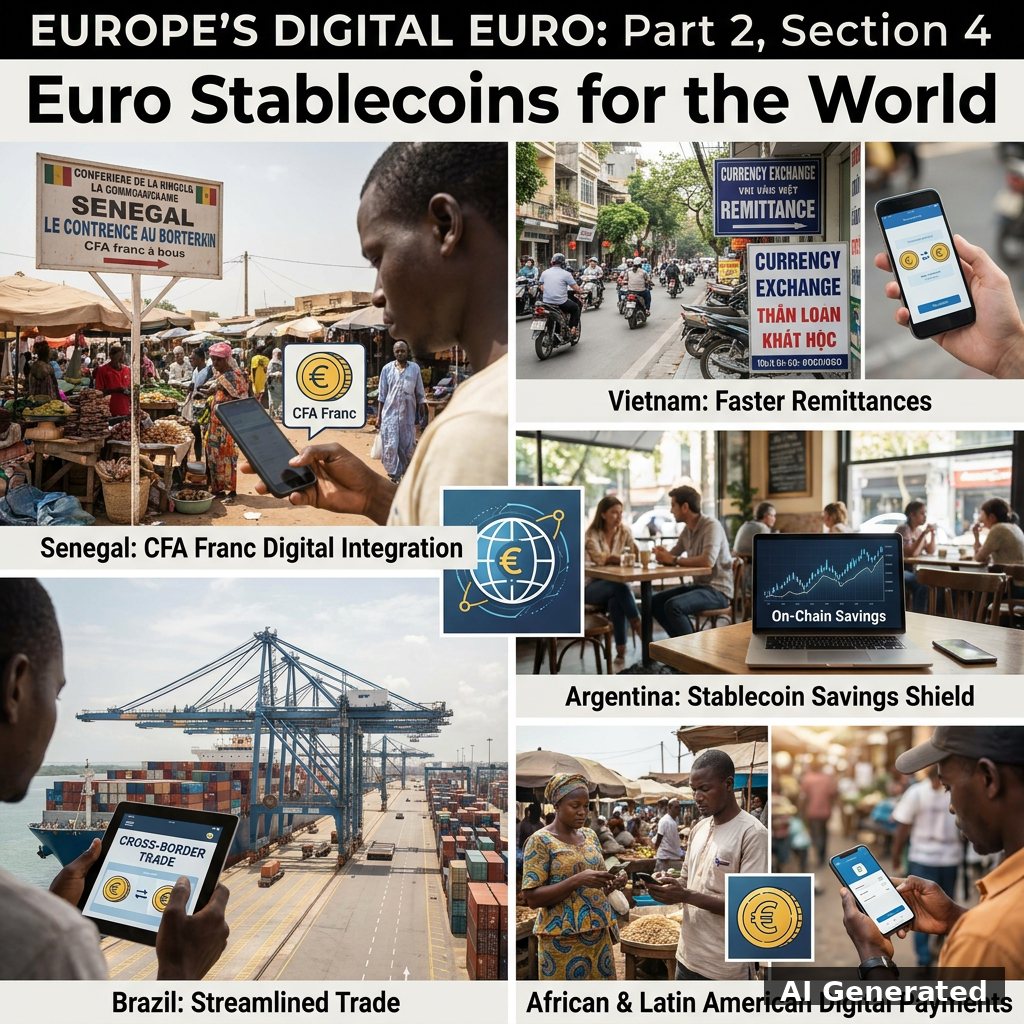
Consider what would happen if Europe promoted euro-denominated stablecoins — issued by European banks and institutions, built on open blockchain infrastructure, and designed for global adoption.
In Senegal, where the CFA franc is pegged to the euro and the banking system is closely linked to France, a euro stablecoin could become a natural digital payment instrument — strengthening the existing monetary relationship and extending European financial influence into West Africa.
In Vietnam, where remittances from Europe are significant and the banking system is developing rapidly, a euro stablecoin could offer a cheaper, faster alternative to traditional remittance channels — building economic ties and reinforcing the euro’s role in Southeast Asian commerce.
In Argentina, where citizens are already moving savings on-chain to escape peso devaluation, a euro stablecoin could offer an alternative to the dollar stablecoins that currently dominate — shifting some of that demand toward euro-denominated assets.
In Brazil, where over 90% of crypto flows are stablecoin-related [10], a euro stablecoin could facilitate cross-border trade settlement with European partners — the EU is Brazil’s second-largest trading partner — and reduce the friction of converting between reais and euros through dollar intermediaries.
Every one of these transactions would generate demand for euro-denominated assets. Every user holding a euro stablecoin is, in effect, holding a claim on euro reserves. Every business settling in euro stablecoins is reinforcing the euro’s role as a unit of account. This is precisely the mechanism through which USD stablecoins are cementing the dollar’s global dominance — and Europe is leaving it entirely to chance.
The IAI paper made this point explicitly: the EU’s earlier ambitions of promoting the euro internationally via a digital currency “have largely reduced” [9]. The current strategy is “primarily focused on containing the reach of the US Dollar” rather than competing with it.
Containing is a losing strategy. You cannot defend your way to global relevance.
Qivalis: Too Little, Too Late?
The Qivalis consortium represents the most significant private-sector response to Europe’s stablecoin gap. Launched in September 2025 by nine major European banks — including ING, UniCredit, CaixaBank, KBC, and BNP Paribas — it has since grown to over 37 financial institutions across 15 countries [11][4]. The venture is pursuing a Dutch e-money license and targeting a launch in the second half of 2026 [11].

Qivalis is building on blockchain technology — not the centralised architecture of the digital euro. Its leadership includes Sir Howard Davies, the former chairman of the UK’s Financial Services Authority, and Jan-Oliver Sell, who previously secured the first crypto custody license in Germany for Coinbase [11]. These are serious people building a serious product.
Forbes called it a “watershed moment for European digital commerce” [4]. The ECB’s own Macroprudential Bulletin acknowledged that the private euro-token market is being assembled while the public alternative waits for legislation [4].
But Qivalis faces three structural problems.
First, fragmentation. Circle’s EURC, Société Générale’s EURCV, Monerium’s EURe, and BBVA’s own planned stablecoin are all competing in the same tiny euro stablecoin market — a market worth roughly €450 million compared to $300 billion for dollar stablecoins [4]. Without consolidation or a unified European strategy, these efforts risk splitting an already minuscule market into even smaller pieces.
Second, the global adoption question. Qivalis is being built by European banks for European use cases — tokenised asset settlement, cross-border payments within Europe, and integration with European financial infrastructure. There is no evidence it is being designed for adoption in emerging markets. The CEO’s statement — “enabling European and global fintech companies, SMEs, and consumers to transact seamlessly across borders” — is encouraging but aspirational [11]. Designing for global adoption requires interoperability with multiple blockchain networks, partnerships with non-European exchanges and wallets, and a deliberate strategy for markets like Africa, Southeast Asia, and Latin America.
Third, the timing gap. Qivalis is expected to launch in late 2026. By then, USD stablecoins will have had another year of growth, another year of developer adoption, and another year of convention-setting. The Bankenverband warned that stablecoins “are already market-ready and scalable today” and that “stablecoins are already in circulation, gaining increasing acceptance, and growing dynamically, thereby creating facts on the ground that are difficult to reverse” [12].
Three years is an eternity in digital finance. The question is not whether Qivalis can launch — it almost certainly will — but whether it can matter.
What Europe Should Actually Do
The evidence across both parts of this article points to a clear conclusion: Europe needs to shift from defence to offence.

First, the ECB should actively promote euro-denominated stablecoins — not as a threat to monetary sovereignty, but as a tool for extending it. The ECB’s own economist acknowledged that “a strategic blind spot in this space could prove costly” [13]. That blind spot is now a canyon.
Second, Europe needs a unified euro stablecoin strategy — not a fragmented landscape of competing bank-issued tokens. The Qivalis consortium is a good start, but it needs state backing, global positioning, and a deliberate strategy for emerging market adoption.
Third, MiCA needs reform. The current regulation is destroying Europe’s blockchain ecosystem while doing little to promote competitive euro-denominated digital instruments. Compliance costs must come down. Debanking must be addressed. The regulatory framework should be recalibrated to support innovation, not just control risk.
Fourth, Europe should learn from the CBDC track record. Every retail CBDC launched to date has struggled with adoption. The digital euro will face the same challenges — but with the additional handicap of a €3,000 holding cap and a population that already has excellent digital payment options. The European Parliament’s own research concluded that “the holding limits need to be increased considerably for the digital euro to be a viable payment alternative to cash, bank deposits, and stablecoins” [8].
Fifth, Europe should stop educating talent for its competitors. Six hundred universities teaching blockchain courses is meaningless if graduates have to leave Europe to find work. The regulatory environment must be reformed to retain the talent it trains.
The Takeaway
Europe is not doomed. The euro remains a strong, trusted currency with deep capital markets and a sophisticated financial system. The Qivalis consortium shows that Europe’s banking sector recognises the strategic gap. MiCA, for all its flaws, gives Europe a regulatory framework that most of the world lacks.

But the window is closing. USD stablecoins are already the de facto global digital dollar — 99% market share, $300 billion in supply, adopted across Asia, Latin America, Africa, and increasingly within Europe itself. The conventions for programmable, on-chain money are being set now — not in 2029 when the digital euro might arrive.
Europe’s leaders face a choice. They can continue building a centralised CBDC that nobody outside the eurozone will adopt, that has failed everywhere it has been tried, and that arrives three years after the standards have already been set. Or they can invest in euro-denominated stablecoins — on open blockchain infrastructure, issued by European institutions, designed for global adoption — that strengthen the euro’s role in the digital economy and extend European monetary influence to every corner of the world.
The digital euro is not the answer to Europe’s digital money problem. It is, in the German Banking Association’s careful words, a distraction from “the necessary debate about how Europe can respond effectively” [12].
Nokia had the engineering talent, the brand recognition, and the market share. It lost because it chose the wrong platform. Europe has the currency, the regulatory capacity, and the institutional credibility. The question is whether it will choose the right one — before the choice is made for it.
References
[1] European Central Bank. (2026). FAQs on the digital euro. Link
[2] The White House. (2025). Fact Sheet: President Donald J. Trump Signs GENIUS Act into Law. Link
[3] Spark Money. (2026). Asia’s Stablecoin Strategy: How Singapore, Japan, and Hong Kong Are Building Dollar Alternatives. Link
[4] Kapron, Z. (2026). Euro Stablecoins Are Scaling While The Digital Euro Waits On Brussels. Forbes. Link
[5] Coincub. (2025). Europe Crypto Report 2025. Link
[6] Koonprasert, T. T., Kanada, S., Tsuda, N., & Reshidi, E. (2024). Central Bank Digital Currency Adoption: Inclusive Strategies for Intermediaries and Users. IMF Fintech Note 2024/005. Link
[7] Ree, J. (2023). Nigeria’s eNaira, One Year After. IMF Working Paper 23/104. Link
[8] Bezemer, D., Sanders, M., Kramer, B., & Simić, A. (2025). Stablecoins and digital euro: friends or foes of European monetary policy? European Parliament. Link
[9] Whitworth, A. & Bilotta, N. (2025). A GENIUS Response? EU Digital Money: Rules, Euro Stablecoins and CBDCs. Istituto Affari Internazionali (IAI). Link
[10] Chainalysis. (2025). Latin America Emerges as a Crypto Powerhouse Amid Volatile Growth. Link
[11] CaixaBank. (2025). Qivalis, joint venture of a European banking consortium, to launch euro stablecoin in the second half of 2026. Link
[12] Bundesverband deutscher Banken. (2025). The digital euro is not an answer to U.S. stablecoins. Link
[13] Schaaf, J. (2025). From hype to hazard: what stablecoins mean for Europe. ECB Blog. Link
[14] Centre for European Reform. (2026). Europe’s future: Grounds for hope? Annual Report 2025. Link
[15] StablecoinBeat. (2026). Digital Euro vs Open Stablecoins: Europe’s Digital Money Choice. Link
[16] Swiss Federal Council. (2025). Federal Council moves forward with stablecoins and crypto: consultation launched. Link
[17] Liang, N. et al. (2026). Next steps for GENIUS payment stablecoins. Brookings Institution. Link
[18] Latham & Watkins. (2025). The GENIUS Act of 2025: Stablecoin Legislation Adopted in the US. Link
🔜 Coming next in this series: Europe’s Digital Euro: The Path Forward — Sovereignty AND Influence (Part 3)
AI Disclosure: This post was created with the assistance of artificial intelligence. The ideas, analysis, and opinions expressed are my own — AI was used to help compose, structure, and refine my personal notes and thoughts into the final written content. Images and video featured in this post were also generated using AI tools, based on my own creative prompts and direction.

[…] ← Read Part 2: The Self-Inflicted Wound […]