







Part 1 of 3 — In this first part, we examine what the digital euro actually is, how it differs from the US stablecoin approach, and why Europe may be repeating the strategic mistake that destroyed Nokia. In Part 2, we dig into the brain drain crippling Europe’s crypto ecosystem, the track record of CBDC launches worldwide, and the missed opportunity that could cost Europe its global monetary influence.
The Numbers Tell the Story
In January 2026, euro-denominated stablecoins reached a market capitalisation of roughly €450 million. Over the same period, dollar-denominated stablecoins sat at approximately $300 billion [1]. That is not a gap. That is a chasm.
The European Central Bank put these two numbers side by side in its April 2026 Macroprudential Bulletin, and the juxtaposition is the whole story [1]. A nine-fold rise off a tiny base is not a threat to anything yet. But it represents something significant: a private euro-token market that is being built, licensed, and funded right now — by banks, fintechs, and blockchain companies — while the public alternative the ECB has worked on since 2021 still waits for a law to pass.
Meanwhile, the world is not waiting for Europe.

Switzerland is creating new license categories specifically for stablecoins [2]. Singapore, Japan, and Hong Kong are building live cross-border stablecoin settlement corridors [3]. Latin America recorded $1.5 trillion in crypto transaction volume between July 2022 and June 2025, with over 90% of Brazilian crypto flows now stablecoin-related [4]. USD stablecoins account for roughly 99% of the global stablecoin market [3].
And Europe? Europe is building a digital euro that, by its own designers’ admission, will not be ready before 2029 — if the legislation passes [5].
This article argues that Europe is making a strategic mistake of historic proportions. Not by wanting digital sovereignty over its currency — that goal is legitimate and necessary — but by choosing the wrong instrument to achieve it. Europe is building a centralised, capped, geographically limited central bank digital currency when it should be building euro-denominated stablecoins on open blockchain rails that the entire world can adopt.
It is, in short, a Nokia moment.
What Exactly Is the Digital Euro?
The digital euro is a Central Bank Digital Currency (CBDC) that would be issued by the European Central Bank and distributed through banks and payment service providers. It is not a cryptocurrency. It is not a stablecoin. It is, in the ECB’s own words, a “digital form of cash” [5].
Here is what that means in practice:
- It would be legal tender, always worth exactly one euro
- It would be distributed through your bank or payment service provider, not directly by the ECB
- It is not based on blockchain — it uses a centralised settlement platform with some design principles borrowed from distributed ledger technology [5]
- Individual holdings would be capped — the European Parliament has proposed limits in the range of €3,000 to €4,000 per person [6]
- Businesses could only hold it for up to 24 hours to accumulate incoming payments [6]
- It would pay no interest [5]
- It would not be programmable money — the ECB explicitly rules this out, though conditional payments (like pay-on-delivery) would be allowed [5]
- It would be free for basic consumer use [5]

The ECB emphasises privacy — offline payments would offer cash-like privacy, and the Eurosystem would not directly link transactions to specific individuals [5]. It also emphasises inclusion — free basic access, no bank account required, accessible to people with disabilities [5].
The pilot is planned for the second half of 2027, running for 12 months. The ECB aims to be ready for a potential first issuance during 2029, assuming the necessary regulation is adopted in the course of 2026 [5]. Development costs are estimated at €1.3 billion, with annual operating costs of around €320 million [5].
There is nothing inherently wrong with any of these design choices in isolation. The problem is what they add up to — and what they exclude.
What the US Is Doing Instead
On July 18, 2025, President Trump signed the GENIUS Act into law — the first comprehensive federal legislation for digital assets in the United States [7]. The contrast with Europe’s approach could not be sharper.
The GENIUS Act creates a regulatory framework for payment stablecoins — privately issued digital tokens pegged to the US dollar. Its key provisions include:
- 1:1 reserve backing with US dollars or short-term Treasuries [7][8]
- Monthly public disclosure of reserve composition [7]
- Stablecoin holders get priority in insolvency over all other creditors [7]
- Non-bank issuers can obtain federal charters through the Office of the Comptroller of the Currency [8]
- The Act explicitly bans a US CBDC — the House passed the CBDC Anti-Surveillance State Act the same week [8]
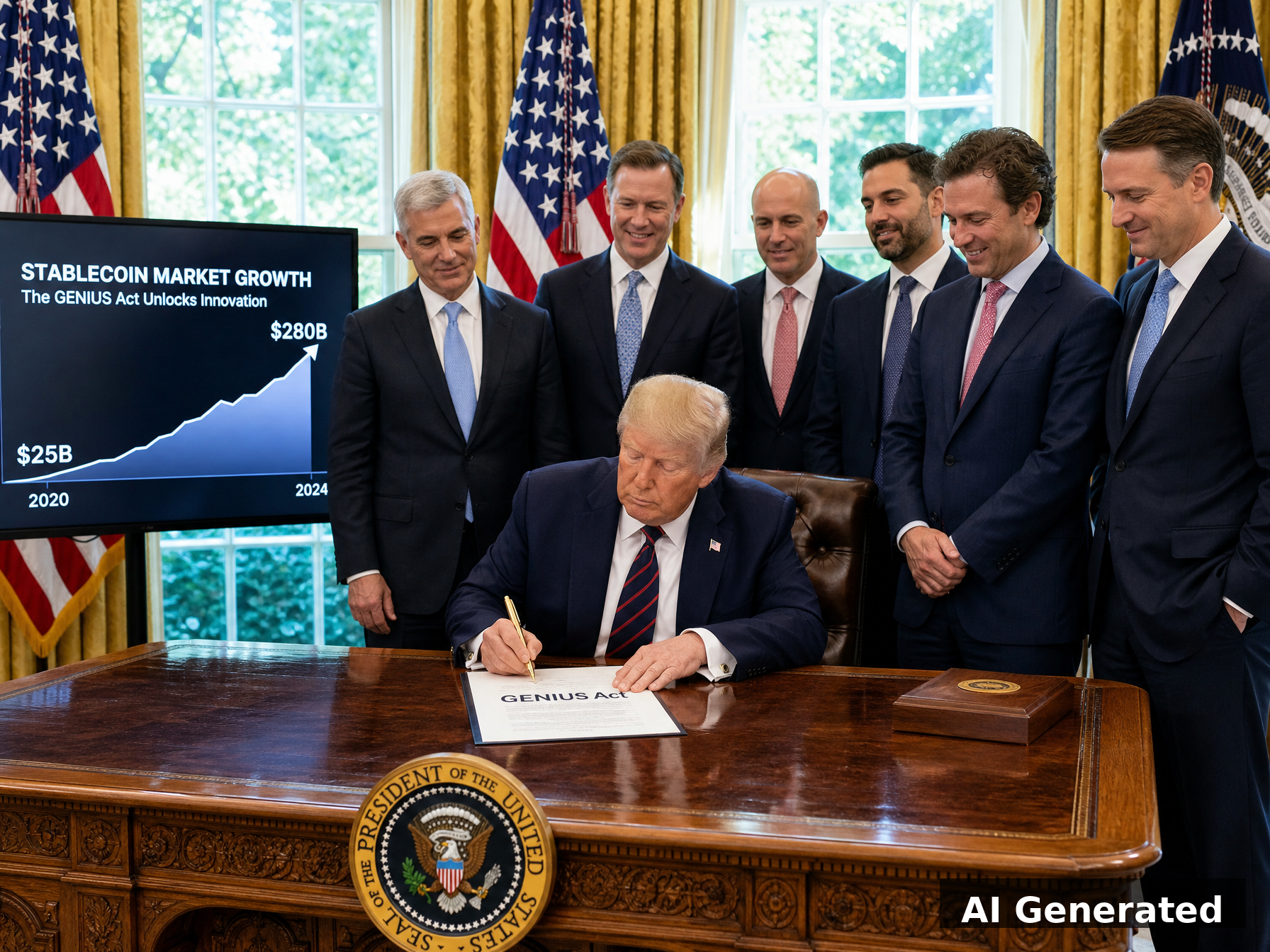
The strategic intent is explicit. The White House stated that the GENIUS Act will “generate increased demand for US debt and cement the dollar’s status as the global reserve currency” [7]. Treasury Secretary Scott Bessent projected that stablecoin supply could grow from $280 billion to $3 trillion by 2030 [9].
This is not just regulation. It is monetary statecraft.
Since the GENIUS Act was signed, activity has accelerated dramatically. The OCC granted national trust bank charters to Circle, Paxos, and other non-bank firms in December 2025 [9]. Major banks — JPMorgan, Bank of America, Citigroup — are developing their own tokenised deposits and stablecoins [9]. The Fed is considering “skinny” master accounts that would give stablecoin issuers direct access to Fed settlement [9].
The market is responding. USD stablecoin supply grew from roughly $25 billion in 2020 to $280 billion by end of 2025 [9]. Annual transaction volumes exceed $33 trillion [3].
Europe’s response? A digital euro that will not exist for at least three more years, with a €3,000 holding cap, no blockchain, no smart contracts, and no path to global adoption.
The Nokia Analogy
In the early 2000s, Nokia dominated the global mobile phone market. It had the brand, the distribution, the engineering talent, and the market share. Then Apple launched the iPhone in 2007, and Google released Android as an open-source operating system.
Nokia had its own operating system — Symbian. It was proprietary, device-centric, and tightly controlled. iOS and Android were open, application-centric platforms that attracted developers by the millions. Developers built apps for iOS and Android because the tools were better, the app stores were centralised, and the ecosystem incentives were stronger.
Nokia doubled down on Symbian. Then it switched to Microsoft’s Windows Phone — another proprietary platform. By the time Nokia tried to pivot, the network effects had already locked in. iOS and Android had won. Nokia’s market share collapsed from over 50% to irrelevance in less than five years.
The parallel to Europe’s digital euro is uncomfortable in its precision.

The digital euro is Symbian. It is a proprietary, centralised, state-controlled instrument with a capped holding limit, no blockchain, no smart contracts, and no mechanism for global adoption. It is designed for one geography (the euro area), one use case (retail payments), and one distribution model (through existing banks).
USD stablecoins are Android. They are open, programmable, composable, and borderless. They run on public blockchain infrastructure — Ethereum, Solana, Polygon, and others — where developers are building wallets, payment applications, DeFi protocols, and tokenised financial products. They are already live, already scaling, and already setting the conventions for what digital money looks like.
The “developer ecosystem” — the critical mass of builders, applications, and users that makes a platform dominant — is forming around stablecoins, not around a hypothetical digital euro. By 2029, when the digital euro might finally launch, the standards, integrations, and default rails will already have been chosen by Circle, by Tether, by the Qivalis banking consortium, and by thousands of developers building on blockchain infrastructure [1].
The German Banking Association said it plainly in December 2025: “The digital euro therefore does not offer a substantive response to the rapidly growing influence of non-European stablecoins” [10]. It differs from them “both technologically and in their areas of application.”
Europe’s Declining Global Influence
The digital euro debate does not exist in a vacuum. It is happening against a backdrop of Europe’s steadily diminishing global weight.
The Centre for European Reform’s 2025 Annual Report documents the trend starkly: the EU’s share of global GDP has shrunk this century from 21–22% to 14–15% on a purchasing power parity basis [11]. Living standards have barely risen in twenty years in many Western European countries. Productivity growth has stalled. The single market remains incomplete — the ECB estimates that non-tariff barriers are equivalent to a 65% tariff on goods and a 100% tariff on services [11].
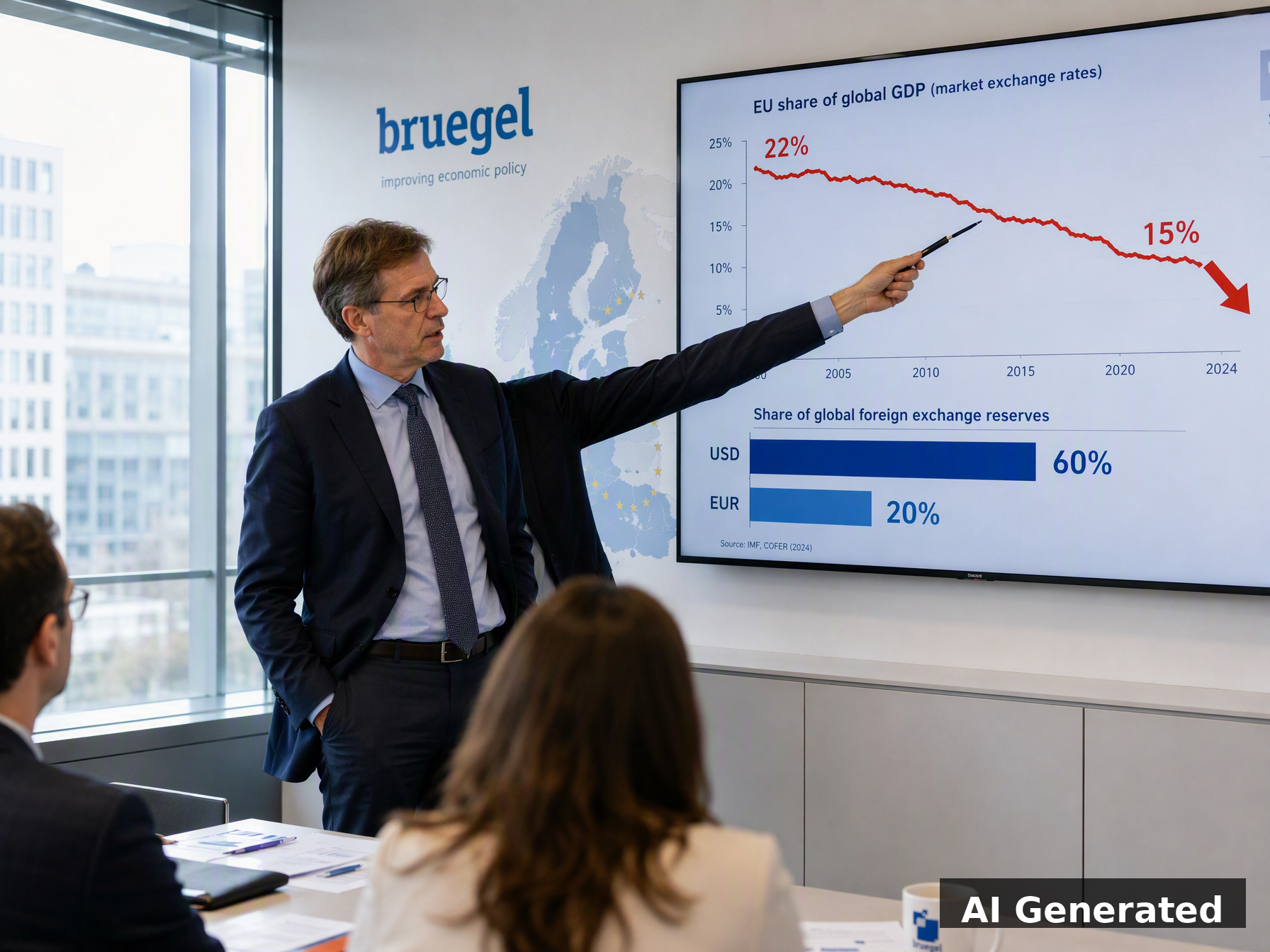
The eurozone’s share of global reserves stands at roughly 20%, compared to 60% for the US dollar [12]. But in the stablecoin market, the imbalance is closer to 99 to 1 in favour of the dollar [12]. Every eurozone business or developer that wants to hold or move value on-chain today reaches for a dollar coin by default. Each such transaction is a small vote for the dollar as the unit of account in tokenised finance — inside Europe’s own economy [1].
This is precisely the outcome the digital euro was conceived to prevent. But the instrument Europe has chosen — a capped, centralised, geographically limited CBDC — is structurally incapable of achieving it.
What Europe Should Be Doing
The Istituto Affari Internazionali (IAI) described the EU’s strategy as “reactive and protective” in a December 2025 analysis [12]. The earlier ambitions of leveraging “the Brussels effect,” achieving first-mover advantage through MiCA, or promoting the euro internationally via a digital currency “have largely reduced.” EU action, the IAI concluded, is now “primarily focused on containing the reach of the US Dollar.”
Containing is not competing.

Europe’s real choice is architectural. It can build digital money as a controlled extension of the existing banking system — which is what the digital euro amounts to. Or it can build a disciplined, competitive framework in which euro-denominated stablecoins circulate on open blockchain infrastructure, accessible to anyone in the world who wants to transact in euros [6].
Imagine, for a moment, a euro stablecoin that Senegal or Vietnam could integrate into their financial systems. Or that Argentine savers could use as a hedge against peso devaluation, denominated in euros instead of dollars. Or that Brazilian businesses could adopt for cross-border trade settlement with European partners. Every such transaction would strengthen demand for euro-denominated assets — euro bonds, euro deposits, euro-denominated products — and reinforce the euro’s global role [12].
Instead, Europe is building a digital wallet with a €3,000 cap that nobody outside the eurozone can access.
The Glimmer of Hope — and Why It May Not Be Enough
There is one development that complicates the picture. In September 2025, nine major European banks — including ING, UniCredit, CaixaBank, KBC, and BNP Paribas — announced the formation of Qivalis, a joint venture to launch a MiCA-compliant euro stablecoin on blockchain infrastructure [13]. By early 2026, the consortium had grown to over 37 financial institutions across 15 countries. The launch is targeted for the second half of 2026 — potentially three years before the digital euro [1].

This is significant. It shows that Europe’s banking sector recognises the strategic gap and is trying to fill it privately. But Qivalis is a bank consortium — not a state-backed, globally positioned strategy. It faces fragmentation risk (Circle’s EURC, Société Générale’s EURCV, Monerium’s EURe, and BBVA’s own stablecoin are all competing in the same tiny market [1]). And there is no evidence it is being designed for adoption in emerging markets like Senegal, Vietnam, or Latin America.
The ECB itself has sent mixed signals. In a July 2025 blog post, ECB economist Jürgen Schaaf acknowledged that “more support could be provided for properly regulated euro-denominated stablecoins” and that “a strategic blind spot in this space could prove costly” [14]. But the digital euro remains the ECB’s flagship project.
What Comes Next
In Part 2, we go deeper into the damage Europe is inflicting on itself.
We examine the brain drain — how MiCA regulation has destroyed 90% of Europe’s blockchain jobs, caused a 70% drop in venture funding, and forced startups to relocate to the US, UAE, and Asia [15]. We look at the track record of CBDC launches worldwide — in the Bahamas, Nigeria, Jamaica, and China — and the consistent pattern of low adoption, merchant resistance, and user indifference [16]. We explore the missed opportunity — how euro stablecoins could serve emerging markets, strengthen the euro’s global role, and generate demand for European bonds and financial products. And we ask the hard question: is Qivalis enough, or is Europe already too late?
The answer, as we will see, depends on whether Europe can change course before the standards are set — and the platforms are chosen — without it.
References
[1] Kapron, Z. (2026). Euro Stablecoins Are Scaling While The Digital Euro Waits On Brussels. Forbes. Link
[2] Swiss Federal Council. (2025). Federal Council moves forward with stablecoins and crypto: consultation launched. Link
[3] Spark Money. (2026). Asia’s Stablecoin Strategy: How Singapore, Japan, and Hong Kong Are Building Dollar Alternatives. Link
[4] Chainalysis. (2025). Latin America Emerges as a Crypto Powerhouse Amid Volatile Growth. Link
[5] European Central Bank. (2026). FAQs on the digital euro. Link
[6] StablecoinBeat. (2026). Digital Euro vs Open Stablecoins: Europe’s Digital Money Choice. Link
[7] The White House. (2025). Fact Sheet: President Donald J. Trump Signs GENIUS Act into Law. Link
[8] Latham & Watkins. (2025). The GENIUS Act of 2025: Stablecoin Legislation Adopted in the US. Link
[9] Liang, N. et al. (2026). Next steps for GENIUS payment stablecoins. Brookings Institution. Link
[10] Bundesverband deutscher Banken. (2025). The digital euro is not an answer to U.S. stablecoins. Link
[11] Centre for European Reform. (2026). Europe’s future: Grounds for hope? Annual Report 2025. Link
[12] Whitworth, A. & Bilotta, N. (2025). A GENIUS Response? EU Digital Money: Rules, Euro Stablecoins and CBDCs. Istituto Affari Internazionali (IAI). Link
[13] CaixaBank. (2025). Qivalis, joint venture of a European banking consortium, to launch euro stablecoin in the second half of 2026. Link
[14] Schaaf, J. (2025). From hype to hazard: what stablecoins mean for Europe. ECB Blog. Link
[15] Coincub. (2025). Europe Crypto Report 2025. Link
[16] Koonprasert, T. T., Kanada, S., Tsuda, N., & Reshidi, E. (2024). Central Bank Digital Currency Adoption: Inclusive Strategies for Intermediaries and Users. IMF Fintech Note 2024/005. Link
AI Disclosure: This post was created with the assistance of artificial intelligence. The ideas, analysis, and opinions expressed are my own — AI was used to help compose, structure, and refine my personal notes and thoughts into the final written content. Images and video featured in this post were also generated using AI tools, based on my own creative prompts and direction.
