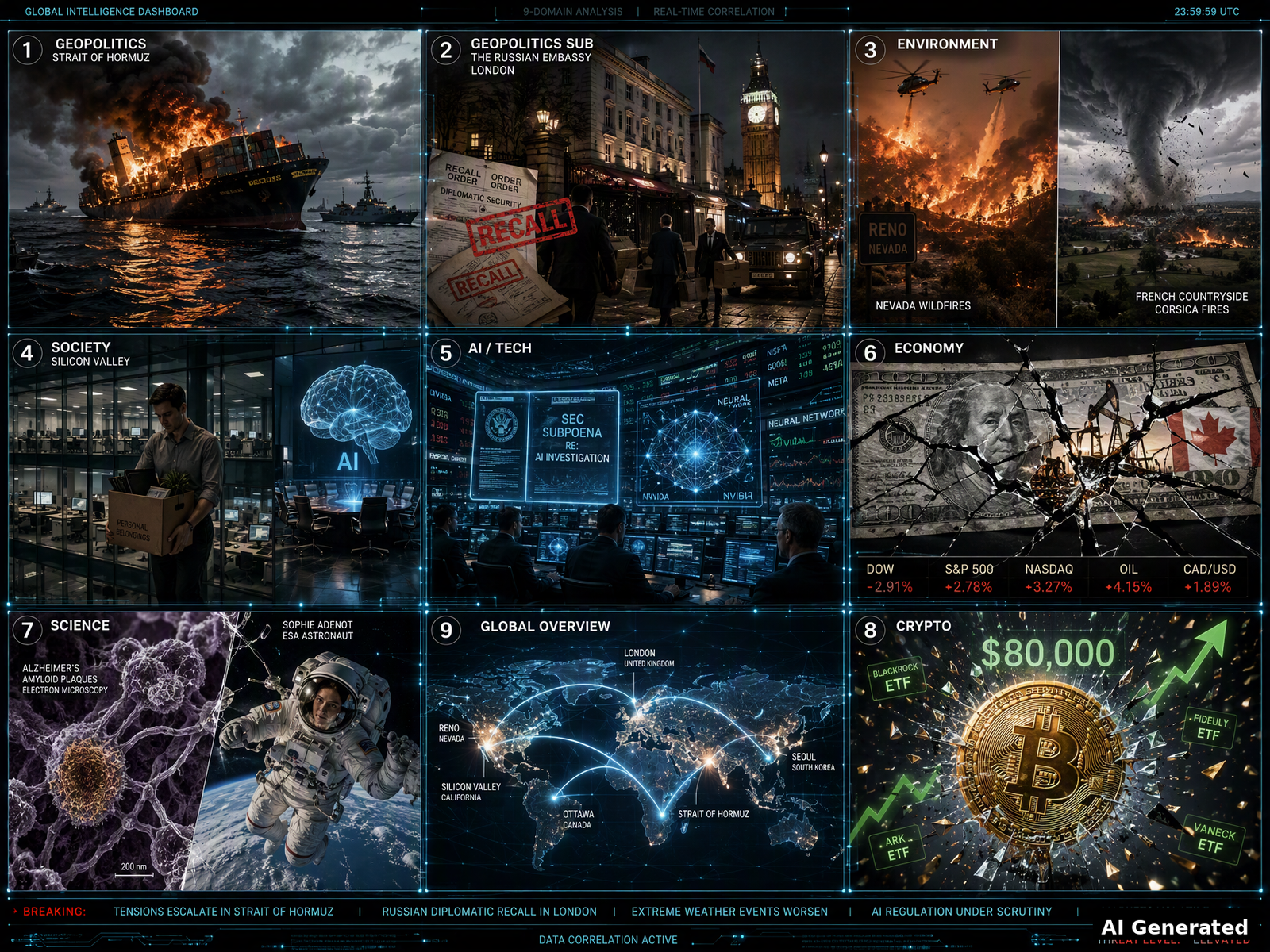


Contents
- 1. Geopolitics & Defence
- Ship Struck in Strait of Hormuz Hours After Bessent’s “Economic D-Day” Announcement
- US Removes Syria From Terrorism List as Regional Architecture Shifts
- Russia Withdraws Ambassador From London as Kremlin Threatens “Semi-Military” Action Against UK
- Turkey Sentences Five Opposition Mayors to Up to 23 Years; Ukraine Unveils Largest Naval Drone
- Haiti Gang Massacre Targets Displaced Persons; China Deploys Hypersonic Hunter
- 2. Environment & Climate
- 3. Society & Civil Issues
- 4. AI & Technology
- SEC Subpoenas Wall Street Banks Over Situational Awareness AI Hedge Fund
- IBM Unveils Dual-Architecture 2-Nanometer Processor Bringing Arm to Mainframes
- Archer Aviation Partners With AEG for Downtown LA Air Taxi Hub Before 2028 Olympics
- NANO Nuclear Targets 6 GW of Reactor Power for AI Data Centers by 2040; Collins Aerospace Tests F-35 Cooling Upgrade
- 5. Economy & Business
- 6. Science & Space
- 7. Crypto, Digital Assets & Blockchain
- 8. Correlations & Analysis
Click any heading to jump to that section. Click the section heading to return to this menu.
Daily Intelligence Briefing — 2026-08-25 (D86)
Geopolitics & Defence
↑ ContentsShip Struck in Strait of Hormuz Hours After Bessent’s “Economic D-Day” Announcement
The convergence of economic warfare and kinetic military action in the Persian Gulf reached a new level of intensity as an oil tanker was struck by an unknown projectile hours after US Treasury Secretary Scott Bessent unveiled the most comprehensive sanctions package against Iran in history. The United Kingdom Maritime Trade Operations centre reported that the master of the vessel reported the strike damaged the engine room and disabled the vessel, with crew reported safe but environmental impact unknown[1]. The incident occurred approximately nine nautical miles northeast of Ash Shishah, Oman, and appeared designed to demonstrate that Tehran retains the capability to escalate militarily even as Washington deploys its economic arsenal.
Bessent’s announcement, branded “Operation Economic Outcast,” called for every country to be given a defined timeline to shut down Iran-related business activity, with secondary sanctions threatened against non-compliant nations. The Treasury sanctioned nearly 60 entities, individuals, and vessels across multiple jurisdictions that enable Iran’s nuclear and missile technology procurement, cyber operations, and oil revenue generation networks[2]. Determinations targeted five critical sectors—digital assets, technology, gold, aviation, and shipping—that the regime uses to sustain its economy. When asked about China specifically, Bessent warned that “no one is above the reach of US sanctions” and that anyone facilitating transactions in the Iranian oil ecosystem would be targeted[3].
The absence of firm timelines in Bessent’s announcement contrasted sharply with the pre-announcement rhetoric that had described the move as an “economic D-Day.” Iran’s parliament speaker Mohammad Bagher Ghalibaf dismissed the measures, claiming Tehran had received assurances from major trading partners that they would not comply[4]. Chinese Foreign Ministry spokesman Lin Jian echoed this stance, stating Beijing would “do what is necessary to protect China’s legitimate rights and interests.” US Defense Secretary Pete Hegseth separately refused to rule out military strikes on Iran, telling reporters that “if we need to use military strikes, we will” and that the military option “remains on the table” even as economic pressure intensifies[5].
Commodity ship passage through the Strait of Hormuz dropped to its lowest level in over three months, reflecting the compounding effect of fear, insurance costs, and Iran’s unilateral routing scheme that now accounts for 46.3% of crossings[6]. The US Strategic Petroleum Reserve has fallen to 289.7 million barrels—the lowest level since November 1982—with only an estimated 41 days of crude oil inventory remaining as the Trump administration continues drawdowns to mitigate gasoline prices inflated by the conflict[7]. Barchart’s assessment that the US has “just 41 days of crude oil inventory left” underscored the domestic cost of sustaining the naval blockade and sanctions architecture simultaneously.
US Removes Syria From Terrorism List as Regional Architecture Shifts
In a significant diplomatic development, Washington removed Syria from its list of state sponsors of terrorism, simultaneously de-listing Hayat Tahrir al-Sham, the former Islamist formation of President Ahmed al-Sharaa[8]. The move represents the latest step in the progressive lifting of sanctions against Damascus and signals a fundamental reordering of regional alliances in which the post-Assad government under al-Sharaa is being brought into the international fold, precisely when Israel-Turkey tensions over Syria have escalated sharply.
Israeli forces conducted a new raid into the Syrian Golan Heights, with military vehicles entering the village of Said al-Golan in Quneitra province and conducting searches on a farm before withdrawing[9]. The operation came despite ongoing diplomatic contacts, with Syrian Foreign Minister Asaad al-Shaibani meeting Mossad Director Roman Goffman in Jordan under American sponsorship on August 23 to establish a “special operations room” aimed at preventing military confrontation between Israel and Turkey on Syrian territory[10]. Turkey announced that its national aircraft carrier MUGEM will be launched on September 27, 2027, with the vessel designed to carry up to 50 aircraft, directly extending Ankara’s operational reach across the Eastern Mediterranean and challenging both Greek and Israeli naval dominance[11]. The simultaneous de-listing of Syria and military probing in the Golan suggests that Washington’s diplomatic gestures and Israeli military operations are proceeding on parallel tracks with limited coordination.
Russia Withdraws Ambassador From London as Kremlin Threatens “Semi-Military” Action Against UK
Russia confirmed that its ambassador to London, Andrei Kelin, left the UK on July 21 without a replacement being named, marking the deepest deterioration in bilateral relations since the full-scale invasion of Ukraine[12]. Former deputy foreign minister Andrei Fedorov issued what was described as a “chilling warning” to the UK, stating he could not “100% exclude” the prospect of “semi-military” action against British factories from “unknown sources” in retaliation for Prime Minister Andy Burnham’s decision to share Storm Shadow missile blueprints with Ukraine[13].
Burnham’s August 24 visit to Kyiv on Ukrainian Independence Day—his first foreign trip as Prime Minister—confirmed a landmark deal allowing Ukraine and France to establish domestic production of Storm Shadow cruise missiles on Ukrainian soil. The agreement required British approval because of the UK-built BROACH warhead at the missile’s core, and was exchanged for UK access to Ukraine’s Avengers AI Labs, a platform providing real-time battlefield data from thousands of cameras and infrared sensors to train autonomous drone targeting systems[14]. Defence Secretary Wes Streeting stated that “by combining the UK’s world-leading scientists, engineers and tech companies with Ukraine’s unique battlefield experience and data, we will strengthen both of our nations’ defence and security.” Ukraine’s President Zelensky used the coalition meeting to request acceleration of the 2027 European financial loan to boost drone and missile production, noting that earlier spending decisions had already exhausted funds earmarked for the second half of 2026[15].
Pentagon concerns about Russian nuclear weapon use have intensified, with a former US official revealing that Washington is monitoring Moscow’s posture amid the deepening financial crisis and potential mobilisation[16]. The combination of the ambassador withdrawal, explicit threat language, and nuclear anxiety creates a risk environment in which British military support to Ukraine—now including production technology—is being met with threats that escalate from conventional to potentially existential categories.
Turkey Sentences Five Opposition Mayors to Up to 23 Years; Ukraine Unveils Largest Naval Drone
Turkey sentenced five opposition mayors belonging to the Republican People’s Party to prison terms ranging from five to twenty-three years on corruption charges, in what observers describe as a systematic campaign to dismantle the CHP’s municipal infrastructure[17]. The sentences come as the party faces mounting legal pressure through investigations and arrests that have already resulted in the removal and arrest of several prominent opposition figures, including the previously reported detention of CHP’s Izmir mayor. The judicial actions are widely interpreted as part of President Erdoğan’s strategy to consolidate power ahead of anticipated elections.
Ukraine marked its 35th Independence Day with the unveiling of the MV11, the largest unmanned surface vessel in the MAGURA family, at a Kyiv parade[18]. The Ukrainian-made drone, credited with helping push Russia’s Black Sea Fleet back from Ukrainian waters, represents the continuing evolution of the asymmetric naval warfare capability that has fundamentally altered the Black Sea balance of power. Separately, Ukrainian drone strikes disabled the Perm oil refinery in Russia’s Urals region, shutting down its CDU-4 processing unit responsible for approximately 40% of total capacity—14,000 metric tonnes per day—with repairs estimated at one to two weeks[19]. The attack follows the July 29 drone strike that already disabled the CDU-5 unit, meaning the refinery’s entire primary distillation capacity has now been neutralized in sequential strikes.
Haiti Gang Massacre Targets Displaced Persons; China Deploys Hypersonic Hunter
At least forty displaced people sheltering in a church near Haiti’s capital were killed in a gang attack on the hillside community of Kenscoff, overlooking routes into Port-au-Prince[20]. Mayor Massillon Jean described a “night of terror” with some victims still missing, marking one of the deadliest single incidents in Haiti’s escalating gang violence crisis. The attack on a humanitarian shelter in a strategically elevated position demonstrates the gangs’ expanding operational reach beyond the urban core of the capital into surrounding highland communities where displaced populations had sought refuge.
China has developed a hypersonic weapon specifically designed to target US command-and-control aircraft at ranges of thousands of miles, according to reporting that highlights Beijing’s investment in anti-access, area-denial capabilities aimed at neutralizing the platforms that coordinate coalition military operations[21]. Boeing separately announced a partnership with Kratos Defense to fit its JDAM Long-Range weapon with a J85 turbojet engine, extending the precision munition’s range beyond 300 nautical miles and representing a shift from glide-based to powered standoff weapons for US Air Force operations[22]. Collins Aerospace completed altitude testing of the Enhanced Power and Cooling System designed to give the F-35 additional thermal capacity for future technology upgrades, addressing the growing power demands of advanced electronics integrated into combat aircraft[23].
Environment & Climate
↑ ContentsNevada Hawk Fire Forces 90,000 Evacuations as Human-Caused Blaze Threatens Reno
A fast-moving wildfire near Reno, Nevada, forced approximately 90,000 people to evacuate or prepare for evacuation, with the blaze burning through more than 60,000 acres since igniting on Saturday approximately eight kilometers northwest of the city[24]. Governor Joe Lombardo declared a state of emergency for Washoe County, which includes the Reno metropolitan area of 280,000 residents. Schools across the county were closed and 800 firefighters deployed to combat the blaze, with specialist teams arriving from Australia and New Zealand to assist in the international response effort[25].
The fire, designated “Hawk Fire,” was confirmed as human-caused by fire officials, though the exact ignition mechanism remains under investigation. By Monday, containment had reached approximately 27%, but authorities warned that heat, drought conditions, and strong winds would continue to favor fire spread for at least the next 48 hours, with the blaze presenting danger to both northeast and northwest flanks[26]. Six people were injured including three firefighters, though no deaths had been reported. The incident follows the D85 report’s documentation of the Nevada wildfire crisis, and the escalation from an initial 42,000 evacuees to 90,000 within a single reporting period demonstrates how rapidly the situation deteriorated under unfavorable weather conditions. The fire’s location in the Sierra Nevada foothills near the California border places it within a broader pattern of escalating wildfire risk across the American West driven by climate change, drought, and expanding wildland-urban interface development.
France Hit by Tornado and Corsica Fires as Extreme Weather Batters Europe
A powerful tornado tore through the Aude department in southwestern France on Monday, injuring at least 26 people and damaging approximately 100 homes, with the village of Pomas hardest hit by gusts recorded at up to 117 kilometers per hour[27]. Transport infrastructure across southern France was severely disrupted, with the transport minister reporting train cancellations and delays between Narbonne and Sète, and cancellations affecting Nouvelle-Aquitaine. The tornado struck ahead of a broader severe weather system that brought violent storms to the region, with Corsica experiencing a fire that forced the spontaneous evacuation of approximately 200 people near Ajaccio after it was probably triggered by lightning[28].
Météo-France maintained orange vigilance for both Corsican departments as thunderstorms continued across the island, particularly affecting the western coast and Cap region. The simultaneous occurrence of a tornado in mainland France, lightning-triggered fires in Corsica, and continued extreme heat across southeastern Europe illustrates a pattern of compounding weather extremes that climatologists have linked to the disrupted jet stream and warming Mediterranean sea surface temperatures. The events follow the D85 report’s documentation of Greece’s “Red Code” wildfire alert across Attica and eleven regions, with more than 5.7 million hectares burned across the European Union since the start of the fire season.
WHO Calls for DRC Ebola Restrictions; Nevada Sues Over Colorado River Plan
The World Health Organization called on the Democratic Republic of the Congo to implement social distancing measures, surveillance, and movement restrictions in response to the expanding Ebola outbreak, invoking preparedness lessons from previous epidemics[29]. The WHO’s intervention represents the international health body’s attempt to prevent the outbreak from reaching the scale of the 2014-2016 West African epidemic, which killed more than 11,000 people. The restrictions, if implemented, would affect trade and movement across a vast region already struggling with armed conflict and humanitarian crisis.
Nevada filed the first legal challenge against the Trump administration’s ten-year Colorado River management plan, expressing fears of “catastrophic impacts” from water allocation changes[30]. The lawsuit, filed just three days after the plan’s announcement, represents a significant state-level resistance to federal water policy that could reshape agricultural and urban water access across seven western states. The legal action comes as the Nevada Hawk Fire simultaneously demonstrates the state’s vulnerability to climate-driven disasters, creating an ironic juxtaposition between the state’s dependence on federal water infrastructure and its challenge to federal water management priorities.
Society & Civil Issues
↑ ContentsStanford Study Reveals AI Is Disproportionately Eliminating Entry-Level Jobs for Young Workers
Updated research from Stanford University economists found that employment levels for workers aged 22 to 25 in the most “AI-exposed” occupations are now 19 percent below those of their peers in fields less exposed to AI disruption, widening from a 13 percent gap measured in the previous year’s study[31]. The August 2026 edition of “Canaries in the Coal Mine” demonstrates that the employment trends identified last year are persisting and expanding, with the gap growing by six percentage points in just twelve months. The finding suggests that rather than broadly displacing workers across age groups, AI is systematically eliminating the entry-level positions that younger workers use to establish careers in affected fields.
The study’s implications extend beyond individual employment statistics into the structure of professional development and economic mobility. If entry-level positions in AI-exposed occupations continue to contract, the traditional career pathway—starting at junior positions and advancing through accumulated experience—may become inaccessible for an entire generation of workers. The phenomenon appears concentrated in white-collar knowledge work rather than manual labor, meaning the most educated young workers may paradoxically face the greatest displacement risk. Older workers, who occupy more senior positions less susceptible to AI replacement, appear largely unaffected so far, creating an age-specific labor market distortion that existing policy frameworks do not address.
RFK Jr. Proposes Overhauling How Vaccine Recommendations Are Categorized
Health Secretary Robert F. Kennedy Jr. published a Request for Information proposing to restructure how the federal government categorizes vaccine recommendations, raising the possibility that vaccinations currently designated as “routine” or “universal” could be reclassified under designations sounding less definitive[32]. The 10-page document posted to the Federal Register poses questions about the current three-category system—routine, risk-based, and shared clinical decision-making—and asks for public comment on replacing or modifying these categories by September 20.
Under the current framework, “routine” recommendations from the Advisory Committee on Immunization Practices signal that all individuals in a population should receive a particular vaccine. Kennedy’s proposal could reclassify certain vaccines as “recommended with qualification” or based on “shared clinical decision-making,” categories that would effectively make vaccination decisions contingent on individual consultation rather than universal public health guidance. The proposal does not constitute a new rule or recommendation but opens the regulatory pathway for fundamental changes to how Americans understand which vaccines the government considers essential. Public health experts have expressed concern that recategorization could reduce vaccination rates by creating uncertainty about which vaccines are considered universally important.
Supreme Court Allows Trump Mail-In Ballot Order; US Targets 200,000 Visas for Revocation
The US Supreme Court handed the Trump administration an initial victory by allowing its executive order restricting mail-in ballot access to take effect ahead of the 2026 midterm elections, reversing a lower court’s block on the measure[33]. The order, signed March 31, establishes new conditions for mail-in ballot eligibility that critics argue could disenfranchise significant numbers of voters. The decision was issued without full briefing or oral argument, and Democratic-governed states that had obtained the initial injunction are expected to challenge the order on its merits in the coming months.
Separately, the Associated Press reported that the US State Department and Department of Homeland Security are reviewing all business and tourist visas, with the number of foreign nationals whose visas are expected to be revoked “approaching” 200,000[34]. The mass revocation would represent the largest single cancellation of visas in US history and targets individuals who entered the country on non-immigrant visas and subsequently applied for asylum. The policy represents a dramatic expansion of the Trump administration’s immigration enforcement apparatus and could affect significant numbers of workers, students, and family members currently residing in the United States.
Peru’s supreme court handed lengthy prison sentences of 15 to 35 years to four men convicted of murder-for-hire in the killing of Indigenous Kichwa leader and rainforest defender in 2023, marking a significant judicial milestone in the global struggle to protect environmental activists from targeted violence[35]. The conviction represents one of the most substantial judicial outcomes in a case involving the killing of an Indigenous environmental defender, and establishes a precedent for accountability in the persistent pattern of violence against indigenous land protectors across Latin America.
AI & Technology
↑ ContentsSEC Subpoenas Wall Street Banks Over Situational Awareness AI Hedge Fund
The US Securities and Exchange Commission sent subpoenas to major Wall Street banks regarding the hedge fund Situational Awareness, the high-profile AI-focused investment vehicle that nearly imploded last month during an AI stock rout[36]. The investigation targets the fund’s trading activity during the period when it faced a barrage of margin calls and was forced to liquidate equity positions, with Ken Griffin’s Citadel stepping in to purchase the bulk of its public stock bets. The fund, which had been “the talk of Wall Street” for its aggressive AI-linked investment thesis, is now the subject of federal scrutiny examining the circumstances of its dramatic reversal.
The SEC probe extends the regulatory attention on AI-linked financial instruments beyond the immediate market disruption to the banks that facilitated the fund’s positions and provided prime brokerage services. Situational Awareness stated it would “cooperate to the fullest extent with any regulatory request,” noting that regulatory examination of high-profile funds with significant returns or dramatic drawdowns is expected. The investigation occurs against the backdrop of broader concerns about concentration risk in AI-linked financial products and the systemic implications of AI-driven trading strategies that can amplify market volatility.
IBM Unveils Dual-Architecture 2-Nanometer Processor Bringing Arm to Mainframes
IBM announced at the Hot Chips conference a 2-nanometer processor that natively executes both Arm and IBM Z or LinuxONE instructions on the same chip, representing the first dual-architecture mainframe processor in the company’s history[37]. The processor contains 11 high-performance cores operating above 5.7 GHz and includes AI inference accelerators designed for in-transaction fraud detection workloads. Unlike previous approaches requiring separate hardware for different software environments, each core can execute both instruction sets simultaneously, allowing organizations to run Arm-native Linux alongside existing z/OS workloads on the same enterprise infrastructure.
The announcement represents IBM’s response to the growing dominance of the Arm architecture across cloud infrastructure and AI computing, bringing software compatibility from one of the industry’s fastest-growing ecosystems into systems traditionally built around proprietary IBM architecture. With the Arm ecosystem now including more than 22 million developers worldwide, IBM’s move could give its enterprise customers access to the expanding Arm software library without abandoning the security, reliability, and availability characteristics that define mainframe computing. Mohamed Awad, Executive Vice President of Cloud AI at Arm, noted that “as AI scales, more of the computing landscape is converging on Arm,” and bringing Arm compute to mission-critical enterprise infrastructure extends that momentum into regulated industries.
Archer Aviation Partners With AEG for Downtown LA Air Taxi Hub Before 2028 Olympics
Archer Aviation and entertainment conglomerate AEG announced plans to develop Los Angeles’s first vertiport at L.A. LIVE, the entertainment district adjacent to the Crypto.com Arena and Los Angeles Convention Center, as part of a broader electric air taxi network designed to operate before the 2028 Olympics[38]. The project would position Archer as the exclusive air taxi provider at L.A. LIVE under a multi-year partnership, with the company’s Midnight electric vertical takeoff and landing aircraft serving short urban trips that Archer estimates could reduce some routes to 10-20 minute flights.
The initiative represents one of the most concrete pre-Olympic infrastructure commitments for urban air mobility in the United States, combining a real venue partnership with the operational timeline demanded by a major international sporting event. The L.A. LIVE location would host BETA Technologies electric aviation chargers as part of the ACES consortium, which aims to standardize charging infrastructure across 250 aviation sites by 2030. Downtown Los Angeles will host 18 Olympic and Paralympic sports during the Games, creating a high-density transportation challenge that Archer’s network is specifically positioned to address. The project remains in planning stages, with operational plans and feasibility studies underway.
NANO Nuclear Targets 6 GW of Reactor Power for AI Data Centers by 2040; Collins Aerospace Tests F-35 Cooling Upgrade
NANO Nuclear Energy signed a non-binding commercial framework with Tillman Global Holdings to explore deploying advanced nuclear reactors across large AI data-center developments in the United States, targeting at least 2 gigawatts of advanced nuclear capacity by the mid-2030s and 6 GW or more by 2040[39]. The partnership pairs NANO Nuclear’s KRONOS MMR Energy System—a 15-megawatt high-temperature gas-cooled reactor designed for modular deployment—with Tillman’s experience developing large digital infrastructure. The framework contemplates milestone-based equity arrangements including warrants to purchase up to $100 million of NANO Nuclear stock.
The deployment pathway reflects the accelerating convergence between AI infrastructure requirements and nuclear energy development, as hyperscale computing campuses face increasingly severe power constraints. Data centers have emerged as what industry observers describe as the “killer application” for solid-state power transformer technology, which could replace the hand-assembled, 1880s-design conventional transformers that currently create bottlenecks of up to several years for utility companies seeking to upgrade grid infrastructure[40]. The rush to secure dedicated power sources for AI workloads is simultaneously driving nuclear reactor development and grid modernization innovation, creating a feedback loop where computing demand accelerates energy technology that has broader applications for climate adaptation.
Collins Aerospace completed altitude testing of its Enhanced Power and Cooling System designed to provide the F-35 with additional thermal capacity for future technology upgrades, addressing the growing power demands that advanced sensors, computing hardware, and mission systems place on combat aircraft cooling infrastructure[41]. The system tested across multiple simulated altitude conditions and near operational limits, generating performance data that moves the program further toward integration with the aircraft. Collins sees applications beyond the F-35, noting that the underlying technology could support future defense and commercial aircraft facing similar power and thermal challenges.
Economy & Business
↑ ContentsDollar Struggles Amid Iran Sanctions Uncertainty and Treasury Buyback Criticism
The US dollar faced selling pressure as markets weighed the contradictory signals of Bessent’s Iran sanctions announcement against the absence of firm implementation timelines, with Druckenmiller’s criticism of the Treasury buyback plan adding further uncertainty to the fiscal outlook[42]. Billionaire investor Stanley Druckenmiller publicly criticized Bessent’s bond buyback initiative as “price management” disguised as liquidity support, arguing that the approach risks undermining market discipline and potentially exacerbating fiscal instability. The critique from one of the most respected macroeconomic investors undermined confidence in the administration’s fiscal strategy at a moment when the government is simultaneously spending heavily on the Iran conflict, implementing sweeping sanctions, and managing a declining Strategic Petroleum Reserve.
Gold prices rose to a three-month high as investors sought safe-haven assets amid the Iran sanctions uncertainty, while oil prices fell slightly following the announcement—reflecting the paradox that additional sanctions, if they tighten supply, should increase prices, but the market interpreted the absence of immediate enforcement as potentially reducing conflict risk[43]. Rice prices have surged more than 47 percent since the onset of the Iran war, according to Hedgeye analysis, representing the most severe food commodity impact of the conflict and raising concerns about food security in import-dependent developing nations[44]. The declining dollar, rising gold, falling oil, and surging rice prices together paint a picture of a market struggling to parse whether the sanctions represent escalation or a pathway to de-escalation.
Canada Prepares Retaliatory Tariffs Against US; Australia’s RBA Debated Rate Hike
Canada prepared to impose retaliatory tariffs on the United States, with the government set to announce measures on Tuesday after President Trump threatened 50 percent tariffs on Canadian vehicles[45]. Prime Minister Mark Carney’s government opted against a “dollar-for-dollar” response to the Trump threat, instead developing a more calibrated strategy that avoids full retaliation while maintaining pressure for negotiated resolution. The trade escalation between the two largest North American economies adds another dimension to the global tariff landscape, following the administration’s earlier implementation of broad-based import duties that have already prompted legal challenges from 25 US states.
Reserve Bank of Australia minutes revealed that the board debated a rate increase at its August meeting, with members divided between maintaining the current 4.35 percent cash rate and responding to persistent inflationary pressures[46]. The minutes noted that “risks to inflation are possibly balanced, not tilted to the upside” and that “policy seems restrictive enough to bring inflation to target within a reasonable timeframe,” suggesting the board ultimately judged that patience was warranted despite internal pressure for tightening. Housing market momentum shifted as prices fell, potentially slowing the economy, while the board observed that faster inflation reduction could be “less damaging to the labor market than initially expected.” The divided vote provides a roadmap for potential future action should inflation data deteriorate.
Asia shares fell broadly on technology sector concerns and the global uncertainty surrounding Iran sanctions, with oil prices slipping as traders weighed supply-side risks against the potential for diplomatic resolution[47]. The GIFT Nifty indicated a negative open for Indian markets, reflecting the contagion effect of the geopolitical uncertainty across Asian trading sessions. The synchronized market weakness across Asia, North America, and European pre-market trading suggests that the Iran sanctions announcement has failed to resolve the fundamental uncertainty about whether the conflict will escalate militarily or transition to economic pressure leading to negotiations.
DP World Maintains India Commitment Despite Gulf War; Germany’s Kühne Dies at 89
DP World confirmed it would maintain its planned $5 billion investment commitment to India despite the ongoing Gulf conflict, with the ports and logistics major expecting its investments to materialize over a five-year timeframe as it evaluates deployment avenues[48]. The statement represents one of the first explicit confirmations from a major Gulf-based multinational that its expansion plans remain intact despite the regional instability, providing a degree of reassurance to Indian economic planners who had feared capital flight from the conflict zone.
Klaus-Michael Kühne, the German logistics billionaire who built Kühne+Nagel into one of the world’s largest shipping companies, died at age 89 in Switzerland[49]. Despite his death, plans for the new Hamburg opera house he had pledged to finance with up to €340 million remain in place, with the Kühne Foundation contract remaining binding. Kühne had also been a major patron of the Elbphilharmonie concert hall and other Hamburg cultural institutions, making his death a significant moment for Germany’s private cultural philanthropy landscape. His career spanning decades of transformation in global logistics provides a marker for the evolution of European shipping from family enterprise to global industry.
Science & Space
↑ ContentsLancet Review Warns Alzheimer’s Pathology May Be Transmissible Through Blood Transfusions
A comprehensive review published in The Lancet assessed growing evidence that amyloid-beta proteins associated with Alzheimer’s disease could potentially be transmitted between humans through blood transfusions, calling for large-scale epidemiological research to determine whether the theoretical risk requires practical safeguards[50]. The review, led by neurologist John Collinge of University College London, synthesized findings from multiple studies including a 2023 Danish-Swedish population study that found people receiving blood transfusions from donors who later developed intracerebral hemorrhages were more likely to develop similar brain bleeds years afterward.
The researchers argued that while risks are currently small and largely theoretical, the UK Infected Blood Inquiry—which documented how contaminated blood infected more than 30,000 patients between the 1970s and 1990s—provides “a cautionary tale in waiting for absolute certainty before making decisions on patient safety.” The review recommended additional monitoring of patients requiring repeated transfusions, development of blood biomarker screening to identify donors carrying amyloid-beta pathology, and large-scale epidemiological studies to quantify the actual transmission risk. The findings do not suggest that blood transfusions are dangerous—the benefits overwhelmingly outweigh the theoretical risk—but rather that a potential vulnerability exists in the blood safety framework that warrants proactive investigation.
Pacific Fusion Breaks Ground Near US Nuclear Weapons Laboratory for Energy Research
Pacific Fusion began construction of a billion-dollar inertial fusion energy facility immediately adjacent to a US nuclear-weapons laboratory, in a partnership that aims to leverage decades of weapons research for civilian energy development while potentially benefiting from classified expertise[51]. The facility represents the most ambitious attempt yet to apply the physics of nuclear weapons to peaceful energy production, targeting a fusion-energy record that would demonstrate the commercial viability of inertial confinement approaches. The proximity to the weapons laboratory provides access to specialized diagnostic equipment, computational resources, and personnel with expertise in the extreme conditions required for fusion reactions.
Lawrence Livermore National Laboratory separately reported that inertial fusion energy implosions can tolerate significant target imperfections before performance abruptly declines, a finding that could relax manufacturing tolerances and reduce costs for the fuel targets required in future fusion power plants[52]. The discovery that fusion reactions can survive flaws “up to a point” before experiencing catastrophic performance degradation provides important design parameters for the engineering of practical fusion systems. Combined with the Pacific Fusion facility, these advances suggest that the inertial approach to fusion energy may be closer to practical realization than previously estimated, though significant engineering challenges remain between laboratory demonstrations and commercial power generation.
French Astronaut Sophie Adenot Undertakes Second Spacewalk; T Cells Found to Sense Surrounding Tissues
French astronaut Sophie Adenot conducted her second spacewalk from the International Space Station to complete the replacement of an antenna that was interrupted during her first extravehicular activity a week earlier[53]. The completion of the repair task, which had been deferred when Adenot and American astronaut Anil Menon were unable to finish during their initial EVA, represents the ongoing operational maintenance required to keep the aging orbital laboratory functional as it approaches the end of its planned service life.
Researchers at McGill University published findings suggesting that T cells possess a previously unknown ability to physically sense the tissues surrounding them, a discovery that could reshape understanding of how long-lasting immune protection develops[54]. The finding adds to a growing body of evidence that the immune system operates through more sophisticated mechanical and spatial sensing mechanisms than previously recognized, with implications for both autoimmune disease treatment and cancer immunotherapy. The ability of T cells to detect tissue characteristics beyond simple chemical signaling suggests that immune responses may be far more context-dependent than current models account for.
Physicists at the University of California Los Angeles observed quantum-level heat wave behavior at room temperature, demonstrating that phonons—atomic vibrations that carry heat through materials—can travel in focused, ray-like patterns rather than spreading uniformly[55]. The phonon focusing phenomenon, previously thought to require ultra-cold cryogenic temperatures, was achieved using boron arsenide, a recently discovered semiconductor that conducts heat exceptionally well. The finding opens potential approaches to thermal management in electronics and quantum technologies where directional heat flow control could address one of the most significant bottlenecks to processing power and computational scalability.
Crypto, Digital Assets & Blockchain
↑ ContentsBitcoin Surpasses $80,000 as ETF Inflows and Short Liquidations Fuel Rally
Bitcoin broke above $80,000 for the first time since May, driven by sustained exchange-traded fund inflows and a cascade of short liquidations that amplified upward momentum across the digital asset market[56]. The rally represents a significant recovery from the turbulence that characterized crypto markets during the initial phases of the Iran conflict, when risk aversion and dollar strength depressed digital asset valuations. The advance above the $80,000 threshold invalidated key technical resistance levels and triggered algorithmic buying that extended gains beyond what spot market demand alone would have produced.
Bitwise’s XRP exchange-traded fund saw trading volume exceed $200 million across three consecutive sessions, with each session establishing a new volume record for the fund, culminating in more than $80 million on August 24[57]. The accelerating institutional demand for XRP exposure through regulated vehicles contrasts with the broader market narrative of Bitcoin dominance, suggesting growing institutional interest in altcoin diversification strategies. The volume surge occurred alongside broader market strength in the crypto sector, with trading activity expanding across multiple asset classes simultaneously.
FalconX Asks SEC to Classify Single-Stock Perpetuals as Swaps; Mabna Institute Crypto Flows Revealed
FalconX Bravo submitted a filing to the Securities and Exchange Commission and Commodity Futures Trading Commission requesting that cash-settled perpetuals tied to single securities or narrow-based security indexes be treated as security-based swaps under existing regulatory framework[58]. The filing expressly includes comparable contracts offered through decentralized finance protocols, marking one of the first formal requests to bring DeFi perpetual trading under the existing swap regulatory architecture. The proposal would trigger registration, business conduct, transaction reporting, capital, margin, and segregation requirements for affected dealers, though it would not automatically require every protocol developer or trader to register.
TRM Labs research revealed that the Mabna Institute, an entity linked to Iranian state-sponsored cyber operations, has moved $16.8 million through cryptocurrency addresses since 2018[59]. The finding adds a digital asset dimension to the broader US-Iran confrontation, demonstrating that sanctioned entities continue to exploit cryptocurrency networks for financial movement despite increasingly comprehensive sanctions architectures. The revelation underscores the intersection between digital asset enforcement and national security, particularly as Washington announces secondary sanctions targeting countries that continue transacting with Tehran.
Korean Bank Adopts Ripple for Payments; Pakistan Opens Crypto Licensing
Jeonbuk Bank in South Korea partnered with Ripple to implement cross-border payment infrastructure, marking a significant institutional adoption of Ripple’s technology in one of Asia’s most active financial markets[60]. The bank-to-bank payment arrangement represents the type of practical utility deployment that cryptocurrency advocates have long argued would eventually drive institutional value, moving beyond speculative trading toward genuine payment infrastructure applications. The partnership occurs within a broader Asian context where regulatory frameworks are rapidly evolving to accommodate digital asset integration into traditional banking systems.
Pakistan announced the opening of a formal crypto licensing regime, joining the growing number of jurisdictions that are choosing regulation over prohibition as their approach to digital asset governance[61]. The licensing framework positions Pakistan as a potential hub for crypto services serving South Asian markets, joining a regional competitive dynamic where countries like Singapore, Hong Kong, and Japan have been actively courting crypto businesses through regulatory clarity. The simultaneous developments in Korea and Pakistan illustrate the expanding geographic scope of institutional cryptocurrency adoption and regulatory accommodation across Asia.
Correlations & Analysis
↑ ContentsThe Iran-US economic confrontation has entered a qualitatively new phase with the formal announcement of Operation Economic Outcast, and the first kinetic consequences were visible within hours. The tanker struck in the Strait of Hormuz hours after Bessent’s sanctions announcement demonstrates that Iran views the economic offensive as grounds for immediate escalation rather than a signal to negotiate. This dynamic — where economic pressure produces kinetic retaliation rather than capitulation — suggests the conflict may enter a dangerous feedback loop in which each round of escalation narrows the remaining diplomatic options. The pattern mirrors the trajectory of Russia-Ukraine escalation, where initial economic measures on both sides progressively expanded the scope of direct confrontation[1][2][4].
Russia’s diplomatic withdrawal from London — with Ambassador Kelin departing without a replacement and Kremlin adviser Fedorov warning of potential “semi-military” attacks on UK factories — represents a significant deterioration in a relationship that has served as one of the last functioning diplomatic channels between Moscow and a major Western power. The warnings arrive precisely as UK Prime Minister Burnham has deepened Britain’s commitment to Ukraine through Storm Shadow technology transfers and the Avengers AI Labs partnership, creating a direct cause-and-effect between British support for Kyiv and Russian escalation threats against British territory[11][12]. The Kremlin’s posture suggests Moscow is prepared to accept near-total diplomatic isolation from the West in exchange for the perceived strategic benefit of threatening NATO allies’ domestic infrastructure.
The Stanford study documenting AI’s accelerating impact on entry-level employment — now a nineteen percent gap in the most exposed occupations — intersects with the Situational Awareness hedge fund’s collapse and the SEC investigation to reveal a broader pattern of institutional overextension in AI investment. The hedge fund’s dramatic reversal from industry darling to federal subpoena subject illustrates how concentrated bets on AI’s economic transformation have created systemic vulnerabilities in financial markets. Meanwhile, Hugging Face’s fifty percent revenue surge demonstrates that genuine commercial demand exists alongside speculative excess. The challenge for regulators, educators, and policymakers is distinguishing between productive AI investment and unsustainable speculation at precisely the moment when the technology’s employment consequences are becoming measurable[38][39][40].
The US Strategic Petroleum Reserve crisis — now at forty-one days of supply, the lowest level in half a century — creates a structural vulnerability that constrains American options in both the Iran confrontation and the broader energy market. The reserve drawdown was designed as a temporary measure to suppress gasoline prices, but its continuation has consumed the buffer that would normally provide emergency supply during a prolonged disruption. If Iran follows through on Rezaei’s threat to shut down all Persian Gulf oil exports, the US would enter a genuine energy crisis without the strategic reserves that have historically provided a cushion against supply shocks. This fiscal and strategic reality may ultimately prove more constraining than diplomatic calculations in forcing Washington toward a negotiated resolution[9][48].
France’s severe weather events — the Aude tornado, Corsican wildfires, and sustained extreme heat — alongside the Russia-Ukraine escalation, Turkey’s judicial crackdown on opposition mayors, and the Haiti massacre collectively illustrate the proliferation of overlapping crises that exceed the capacity of individual institutions to manage. No single government is equipped to simultaneously address a strategic military confrontation, a humanitarian catastrophe, extreme weather emergencies, and democratic governance challenges. The convergence of these pressures during a period of institutional stress — weakened alliances, depleted strategic reserves, political polarisation — creates the conditions for cascading failures where the resolution of one crisis is precluded by the demands of another[15][17][18].
What to watch in the next reporting period: Whether the Hormuz tanker attack triggers additional US military responses or creates political space for Pakistani-mediated negotiations; the trajectory of the SPR depletion and whether Congress authorises emergency procurement; the SEC’s next moves in the Situational Awareness investigation and any implications for AI-themed investment regulation; Russia’s response to UK technology transfers to Ukraine and whether Fedorov’s threats translate into any operational actions; and the Iran Nuclear security council’s actual response to the economic Outcast campaign — whether Rezaei’s threats to shut down all Gulf oil exports represent genuine operational planning or rhetorical escalation.
References
↑ Contents1. Ship Struck In Strait Of Hormuz Hours After Trump’s ‘Economic D-Day’ Campaign On Iran Unveiled · Source ↩
2. US unveils ‘economic D-Day’ against Iran, warns trade partners of sanctions · Source ↩
3. Bessent on China and Iran: no one is above the reach of US sanctions · Source ↩
4. Iran warns US over economic war, threatens Gulf allies · Source ↩
5. Hegseth refuses to rule out US strikes on Iran amid sanctions · Source ↩
6. Commodity ship passage through Strait of Hormuz drops to lowest in over three months · Source ↩
7. USS Abraham Lincoln carrier departure and SPR drawdown · Source ↩
8. Washington retire la Syrie de sa liste des pays accusés de soutenir le terrorisme · Source ↩
9. Συρία: Νέα ισραηλινή επιδρομή σε χωριό στα Υψίπεδα του Γκολάν · Source ↩
10. Syria-Israel conduct secret talks in Jordan under American sponsorship · Source ↩
11. Turkey’s MUGEM aircraft carrier launch date set for September 2027 · Source ↩
12. Η Ρωσία λέει ότι απέσυρε τον πρεσβευτή της από το Λονδίνο · Source ↩
13. Kremlin adviser says UK factories could face attack from ‘unknown sources’ · Source ↩
14. Ukraine Receives Storm Shadow Production License from UK in Exchange for Avenger AI Data · Source ↩
15. EN DIRECT, guerre en Ukraine : Zelensky souhaite anticiper le prêt financier européen · Source ↩
16. Ουκρανία: Το Πεντάγωνο ανησυχεί για χρήση πυρηνικών όπλων από τη Ρωσία · Source ↩
17. Τουρκία: Από 5 χρόνια φυλάκιση έως 23 κάθειρξη σε 5 δημάρχους της αντιπολίτευσης · Source ↩
18. Ukraine unveils MV11, largest naval drone in MAGURA naval family · Source ↩
19. Ρωσία: Εκτός λειτουργίας το διυλιστήριο του Περμ μετά την ουκρανική επίθεση με drones · Source ↩
20. Haiti gang members kill around 40 displaced people in church attack near capital · Source ↩
21. China develops hypersonic weapon to hunt US command aircraft thousands of miles away · Source ↩
22. Boeing taps J85 turbojet engine to push 500-pound weapon past 300 nautical miles · Source ↩
23. New cooling system for 1,200-mph F-35 jet beats altitude tests to power future upgrades · Source ↩
24. Nevada wildfire forces tens of thousands to evacuate as blaze threatens city of Reno · Source ↩
25. Πυρκαγιά στη Νεβάδα: Έχουν απομακρυνθεί περισσότεροι από 90.000 κάτοικοι · Source ↩
26. Fast-moving Hawk wildfire is about 27% contained in Reno, Nevada · Source ↩
27. Tornado tears through French village leaving dozens injured · Source ↩
28. Orages : un incendie, probablement déclenché par la foudre, a entraîné 200 évacuations spontanées en Corse · Source ↩
29. Ο ΠΟΥ κάλεσε τη ΛΔ Κονγκό να λάβει περιοριστικά μέτρα κατά της εξάπλωσης του Έμπολα · Source ↩
30. Fearing ‘Catastrophic Impacts’ From Water Cuts, Nevada Sues Feds Over Colorado River Plan · Source ↩
31. AI is hitting entry-level jobs hardest, Stanford study finds · Source ↩
32. RFK Jr. may upend how vaccine recommendations are categorized · Source ↩
33. Supreme Court allows Trump’s mail-in ballot order to go into effect · Source ↩
34. US plans to revoke business, tourism visas of 200,000 asylum seekers · Source ↩
35. Peru court hands lengthy prison terms in killing of Indigenous Amazon defender · Source ↩
36. SEC subpoenas Wall Street banks over Situational Awareness · Source ↩
37. Two-in-one: IBM’s new 2-nm processor brings dual-architecture computing to mainframes · Source ↩
38. Downtown LA’s first air taxi hub will beat brutal traffic in 10 minutes by 2028 · Source ↩
39. New nuclear plan could deliver up to 6 GW of power to data centers by 2040 · Source ↩
40. Data centers become ‘killer application’ for new power transformer tech · Source ↩
41. New cooling system for 1,200-mph F-35 jet beats altitude tests · Source ↩
42. Stanley Druckenmiller criticizes Scott Bessent’s bond buyback plan · Source ↩
43. Oil prices fall as Trump halts new Iran sanctions · Source ↩
44. Rice prices surge over 47% since Iran war onset: Hedgeye · Source ↩
45. Canada prepares to hit US with retaliatory tariffs after Trump threat · Source ↩
46. Australia central bank debated rate hike in August, with board divided · Source ↩
47. Asia shares fall on tech nerves; oil prices slip · Source ↩
48. DP World to stay firm on its $5 billion India promise despite Gulf war · Source ↩
49. Ambitioniertes Projekt: Kühne-Tod ändert nichts an Plänen für neue Hamburger Oper · Source ↩
50. Can Alzheimer’s Spread Through Blood Transfusions? Here’s What We Know. · Source ↩
51. Billion-dollar machine aims to set a fusion-energy record — and study nuclear weapons · Source ↩
52. How fusion reactions can survive flaws—up to a point · Source ↩
53. Sophie Adenot effectue, mardi, sa deuxième sortie dans l’espace pour parachever le changement d’une antenne · Source ↩
54. T Cells Have a Hidden Ability Scientists Never Knew Existed · Source ↩
55. Scientists observe quantum heat waves at room temperature for the first time · Source ↩
56. Bitcoin surpasses $80,000 for the first time since May as ETF inflows and short liquidations fuel the rally · Source ↩
57. Bitwise XRP ETF Trading Volume Tops $200M Across Three Sessions · Source ↩
58. FalconX asks SEC to bring single-stock perpetuals from DeFi under swap rules · Source ↩
59. Mabna Institute moved $16.8M through crypto addresses since 2018, TRM Labs finds · Source ↩
60. Korean bank taps Ripple for payments, Pakistan opens crypto licensing: Asia Express · Source ↩
61. Binance US integrates Apple Pay and Google Pay for crypto purchases · Source ↩
AI Disclosure: This post was created with the assistance of artificial intelligence. The ideas, analysis, and opinions expressed are my own — AI was used to help compose, structure, and refine my personal notes and thoughts into the final written content. Images, videos and music featured in this post were also generated using AI tools, based on my own creative prompts and direction.