




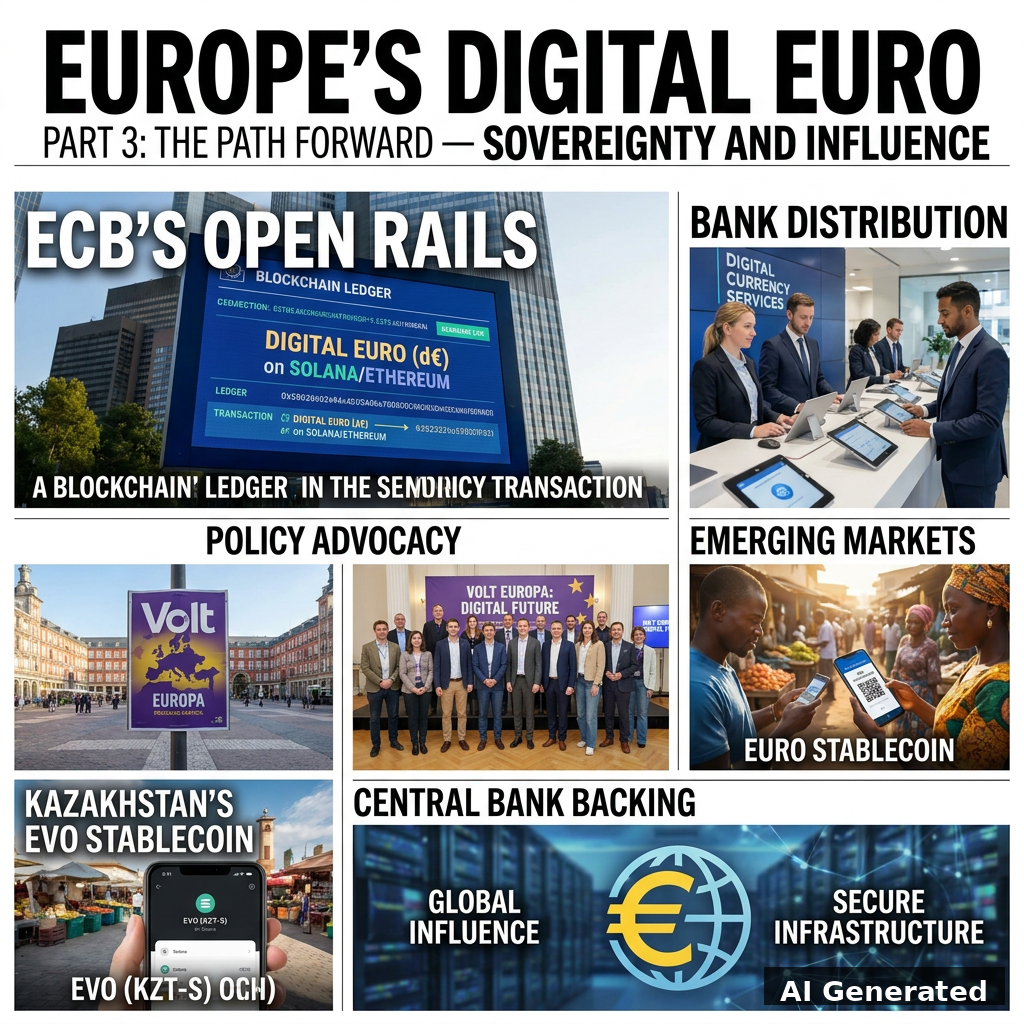

Part 3 of 3 — This article is part of the Talking Crypto series: “Europe’s Digital Euro: A Nokia Moment” — The strategic consequences of Europe’s digital money strategy.
A Country of 20 Million Figured It Out
On September 23, 2025, the National Bank of Kazakhstan launched a pilot project to issue the EVO stablecoin (KZTE) — backed by the national currency tenge — on the Solana blockchain [1].
The issuer was Intebix, a digital asset exchange registered at the Astana International Financial Centre. The key partners were the Solana Foundation, Mastercard, and Eurasian Bank. The stablecoin would be fully backed 1:1 by tenge reserves, with monthly audits confirming parity [1].

By May 2026, the Kazakhstan Stock Exchange (KASE) had become the country’s first registered digital asset platform operator — registration number 001 — with Solana Foundation as the blockchain infrastructure partner [2]. KASE received dual registration: authority to issue tokenised digital financial assets AND to operate a trading platform for them. A single entity handling the full lifecycle of a tokenised asset, from issuance to secondary trading, within a single regulated venue [2].
By July 2026, Kazakhstan had allocated $700 million from its National Bank reserves for crypto-related investments [3]. A $6 billion crypto megacity — Alatau City — was being built with Solana Company as the blockchain infrastructure partner [3]. A CryptoCity pilot zone had been announced where residents could buy, sell, hold, and pay with digital currencies without restrictions [3]. A Solana ETF had launched on the Kazakhstan Stock Exchange [2].
A country of 20 million people, with a GDP smaller than Belgium’s, had done what the European Union of 450 million people and a €15 trillion economy has not: it issued its national currency on a public blockchain, maintained central bank backing, attracted international partners, built programmable money, and positioned itself for global relevance.
Kazakhstan did not build a centralised CBDC with a holding cap. It did not create a proprietary settlement platform. It did not limit its digital currency to domestic use. It chose open rails. It chose the platform the world is already building on. And it did so while maintaining full sovereign control over its currency.
This is not a theoretical argument. It is a working model.
Part 3A: What the EU Should Do
1. Issue a Euro Stablecoin on Open Blockchain Infrastructure
The single most important change Europe can make is to shift the digital euro from a centralised CBDC to a blockchain-native euro stablecoin — issued or guaranteed by the ECB, distributed through European banks, and accessible on public blockchain networks like Ethereum, Solana, or Polygon.
This is not a radical proposal. The ECB already has the authority. MiCA already provides the regulatory framework for e-money tokens. The Qivalis consortium is already building a euro stablecoin on blockchain. The missing piece is state backing and global positioning.
- Preserve sovereignty: The ECB would guarantee the value. European banks would distribute it. European regulations would govern it.
- Gain global influence: Anyone with a blockchain wallet — in Senegal, Vietnam, Argentina, or Brazil — could hold and transact in euros. Every such transaction strengthens demand for euro-denominated assets.
- Attract developers: Smart contracts, DeFi protocols, tokenised financial products — the entire programmable money ecosystem would build around the euro, not just the dollar.
- Launch faster: No need to build a proprietary settlement platform from scratch. The infrastructure already exists.
- Compete directly with USD stablecoins: On the same rails, in the same wallets, in the same applications — not in a separate, isolated system.
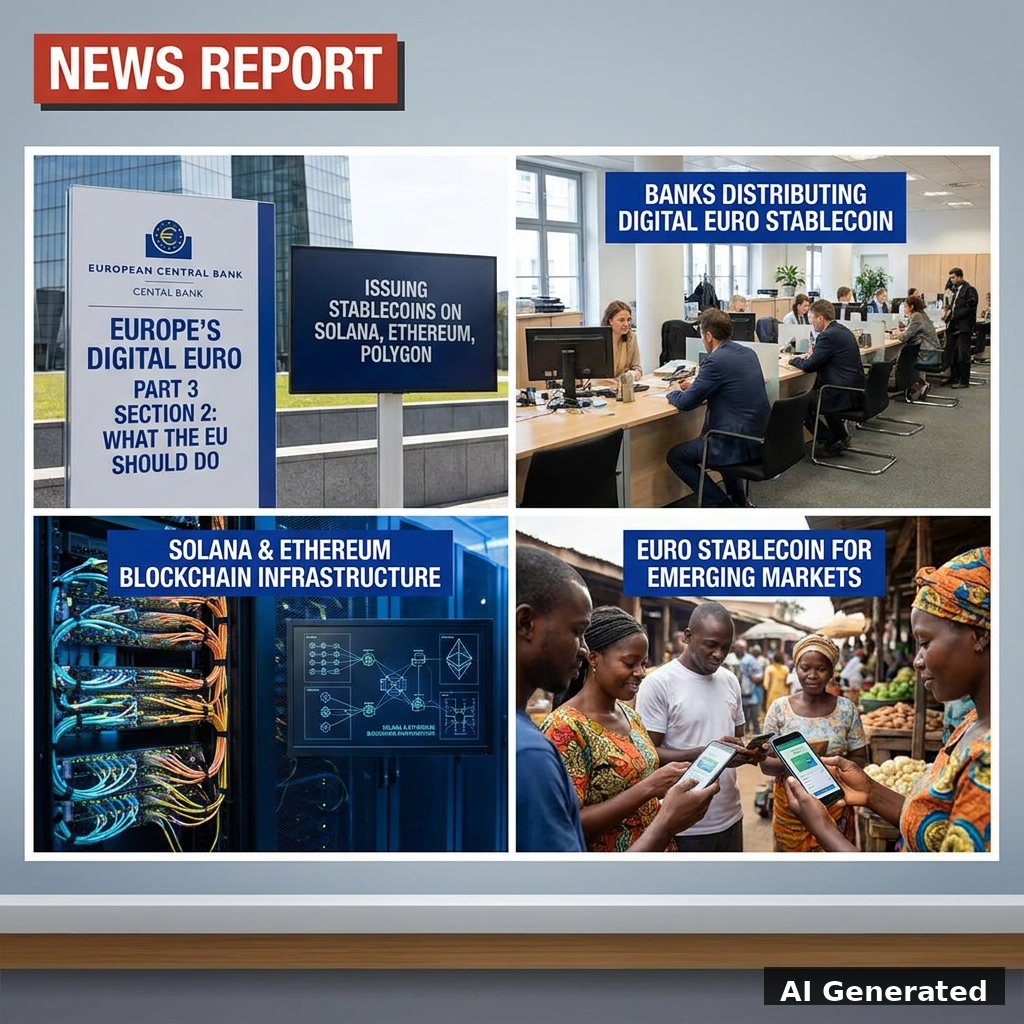
2. Reframe the Digital Euro as a Platform, Not a Product
The current digital euro is designed as a product: a specific wallet, a specific holding limit, a specific set of use cases. Products get replaced. Platforms endure.
The ECB’s own Pontes and Appia projects are already exploring distributed ledger technology for wholesale settlements [4]. The step from wholesale DLT to retail blockchain-native euro is architectural, not revolutionary.
3. Reform MiCA to Support Innovation, Not Just Control
MiCA has created a compliance wall that is destroying Europe’s blockchain ecosystem. Blockchain jobs are down 90%. Venture funding is down 70%. Compliance costs are up 6x [5]. The regulation should be recalibrated:
- Reduce licensing costs for early-stage startups — create a limited CASP license similar to the limited EMI license under PSD3
- Address debanking — crypto firms need bank accounts to operate; 86% are being rejected or closed [5]
- Allow sandbox-first entry — let innovators build and test before imposing full compliance burdens
- Harmonise enforcement — 27 member states interpreting MiCA differently creates fragmentation, not unity
4. Adopt the Kazakhstan Model for Euro Stablecoin Issuance
Europe has stronger institutions, deeper capital markets, and a more trusted currency than Kazakhstan. If Kazakhstan can do this, Europe has no excuse not to.
5. Think Globally from Day One
Every euro stablecoin held in Senegal is a demand for euro reserves. Every transaction settled in euros on a blockchain is a vote for the euro as a unit of account in the digital economy. This is how the dollar is winning. Europe should play the same game.
Part 3B: What Volt Europa Should Push to Do
Volt Europa was founded on the promise of pan-European thinking, evidence-based policy, and the courage to imagine a Europe that leads rather than follows. On digital money, Volt has chosen to champion the digital euro — a defensive, inward-looking instrument — without advocating for the open, globally competitive alternative that the evidence demands.
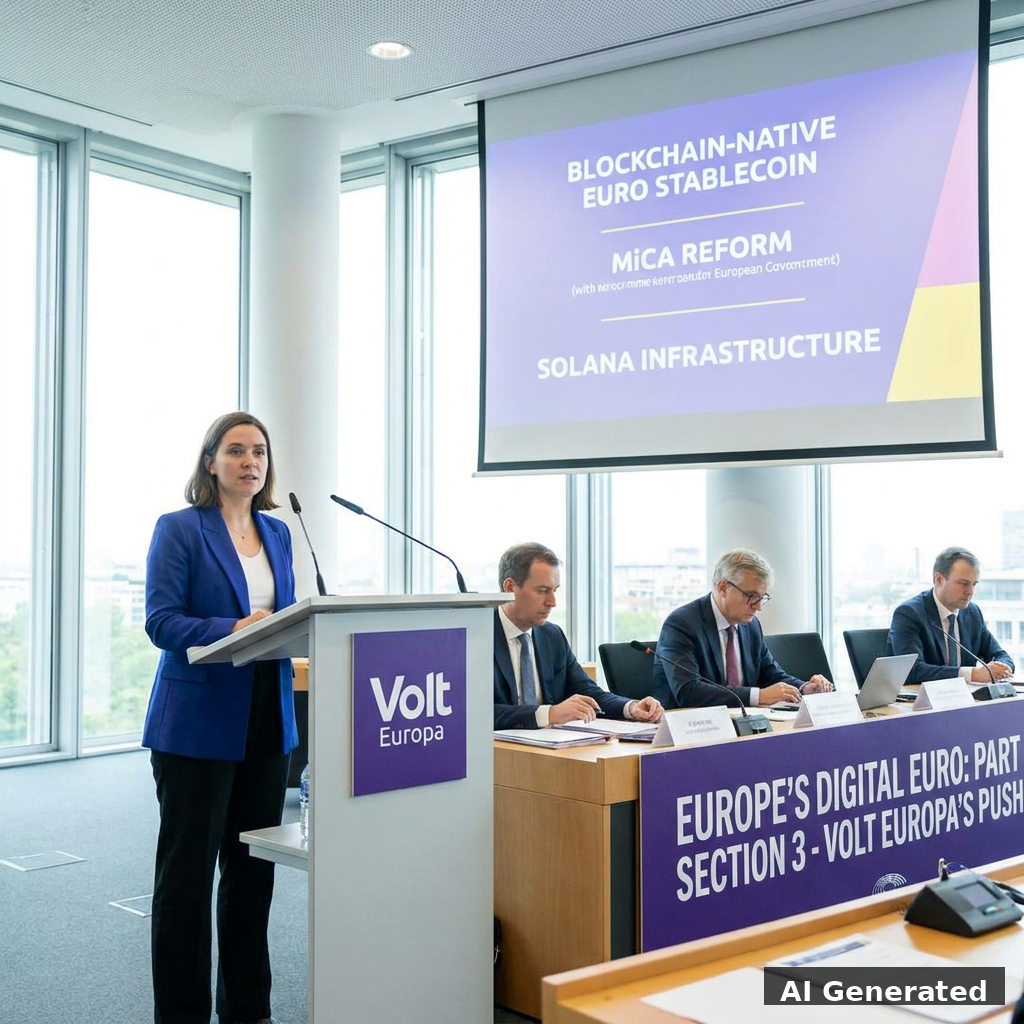
1. Adopt “Blockchain-Native Euro” as Party Policy
Volt should formally adopt a policy position supporting the issuance of euro-denominated stablecoins on public blockchain infrastructure — backed by the ECB, distributed through European banks, and designed for global adoption.
This is not a rejection of the digital euro. It is a recognition that the digital euro, as currently designed, is insufficient. A blockchain-native euro stablecoin would complement the digital euro by providing the global reach and programmability that a centralised CBDC cannot.
2. Push for MiCA Reform in the European Parliament
Volt’s MEPs should advocate for: a limited CASP license for startups (reduced compliance burden for early-stage companies), anti-debanking provisions requiring banks to justify account closures for crypto firms, a sandbox-first regulatory entry model, and harmonised MiCA enforcement across all 27 member states.
3. Call for a European Stablecoin Strategy — Not Just a Digital Euro
Volt should reframe the debate. The question is not “digital euro or no digital euro.” The question is: what is Europe’s complete digital money strategy?
Volt should be the party that says: “We need all four. Not just the one that gives us control.”
4. Use the Kazakhstan Example
Kazakhstan is a powerful rhetorical tool. When critics say “you can’t issue a national currency on a public blockchain,” the answer is: “Kazakhstan already did. In September 2025. On Solana. With Mastercard as a partner. And their stock exchange is now building on it.”
When critics say “it’s too risky,” the answer is: “Kazakhstan allocated $700 million from its national reserves for crypto investments. They’re building a $6 billion crypto megacity. They’re not afraid of the future — they’re building it.”
When critics say “the ECB would never do this,” the answer is: “The ECB is already exploring DLT for wholesale settlements through Pontes and Appia. The step to retail is architectural, not revolutionary. Kazakhstan took it in six months.”
5. Frame It as European Independence, Not Crypto Advocacy
This is sovereignty AND influence. Not sovereignty at the expense of influence.
The Takeaway
Europe does not need to choose between sovereignty and global influence. It can have both. Kazakhstan proved it.
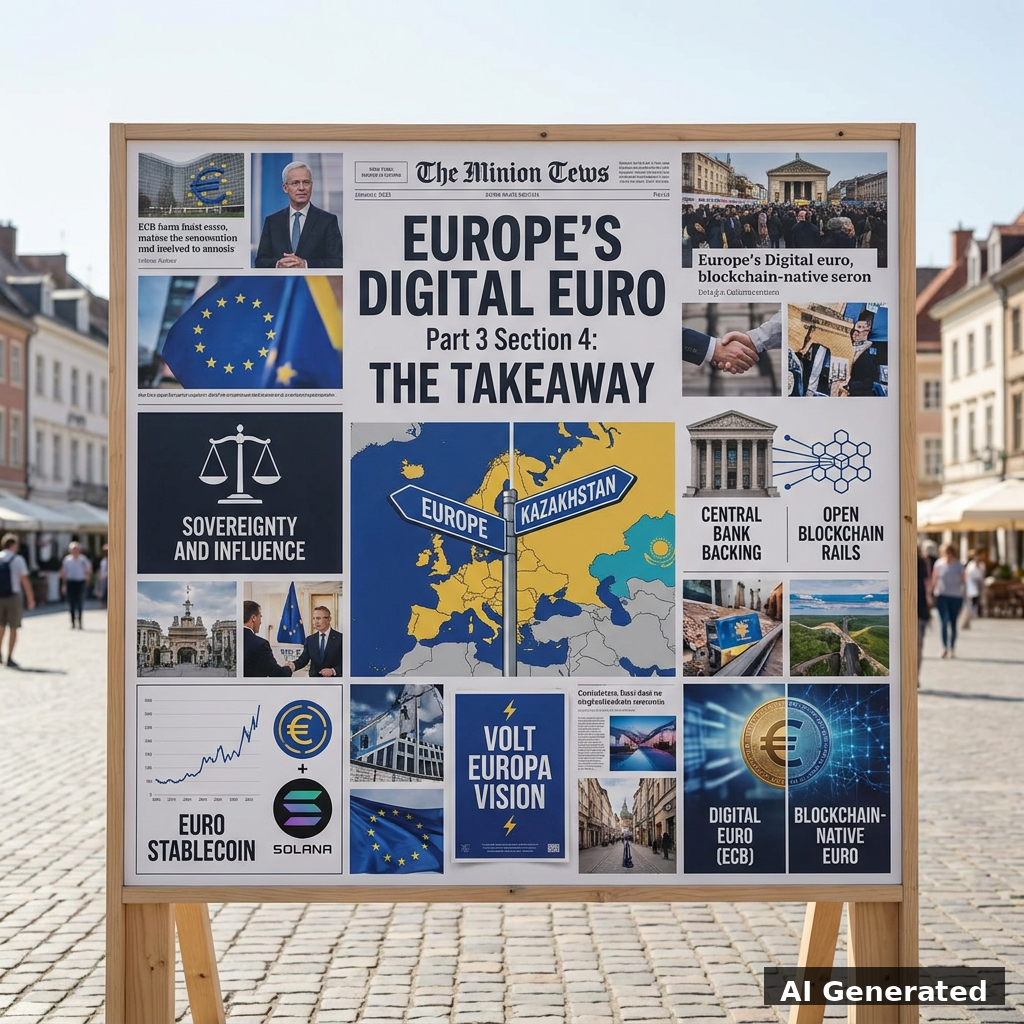
The digital euro, as currently designed, delivers sovereignty but sacrifices influence. USD stablecoins deliver global reach but strengthen the dollar, not the euro. The synthesis — a blockchain-native euro stablecoin backed by the ECB — is the path that delivers both.
Volt Europa was founded to imagine a Europe that leads. On digital money, it is currently cheering for a product that will arrive three years too late, on a platform the world has already moved past, with a holding cap that ensures it cannot compete.
The party that was built to think beyond borders should not be championing a digital wallet that cannot cross them.
Sovereignty AND influence. Open rails AND European values. Central bank backing AND global reach. This is not a compromise. It is the only strategy that can win.
Kazakhstan figured it out. The question is whether Europe — and Volt — will figure it out before the window closes.
References
[1] Superteam Kazakhstan. (2025). Kazakhstan launches first stablecoin in tenge on Solana blockchain. Link
[2] Solana Compass. (2026). Kazakhstan Stock Exchange Becomes Country’s First Registered Digital Asset Platform Operator on Solana. Link
[3] IntelliNews. (2026). Kazakhstan aims to create Central Asia’s crypto capital. Link
[4] Whitworth, A. & Bilotta, N. (2025). A GENIUS Response? EU Digital Money: Rules, Euro Stablecoins and CBDCs. IAI. Link
[5] Coincub. (2025). Europe Crypto Report 2025. Link
[6] European Central Bank. (2026). FAQs on the digital euro. Link
[7] Kapron, Z. (2026). Euro Stablecoins Are Scaling While The Digital Euro Waits On Brussels. Forbes. Link
[8] StablecoinBeat. (2026). Digital Euro vs Open Stablecoins: Europe’s Digital Money Choice. Link
[9] Bundesverband deutscher Banken. (2025). The digital euro is not an answer to U.S. stablecoins. Link
[10] Spark Money. (2026). Asia’s Stablecoin Strategy. Link
[11] Schaaf, J. (2025). From hype to hazard: what stablecoins mean for Europe. ECB Blog. Link
[12] Centre for European Reform. (2026). Europe’s future: Grounds for hope? Annual Report 2025. Link
AI Disclosure: This post was created with the assistance of artificial intelligence. The ideas, analysis, and opinions expressed are my own — AI was used to help compose, structure, and refine my personal notes and thoughts into the final written content. Images and video featured in this post were also generated using AI tools, based on my own creative prompts and direction.
