



Five Countries, Five Dreams — And a Bloc Nobody Saw Coming.
You think the only thing binding Turkey to Central Asia is kebab and a shared alphabet. You’re wrong. Five governments — led by five very different men with very different ambitions — are quietly assembling one of the most consequential geopolitical structures on the Eurasian landmass. And if you’re in Washington, Brussels, or Moscow, you’ve been ignoring it for far too long.
The Assembly
The Organisation of Turkic States didn’t fall from the sky. Its intellectual roots stretch to the 1880s, when a Crimean Tatar newspaper publisher named İsmail Gaspirali preached “unity in language, thought, and action” across the Turkic world [3]. Atatürk buried that vision — Turkey had to survive as a nation-state, not as the head of an empire. For seventy years, the idea slept.
Then the Soviet Union collapsed. Five Turkic-speaking states emerged from the wreckage — Azerbaijan, Kazakhstan, Kyrgyzstan, Turkmenistan, Uzbekistan — and Turkey was the first to knock on their door. A series of summits began in 1992. TÜRKSOY launched in 1993. But for nearly two decades, it was mostly talk. The real inflection came on 3 October 2009, when the Nakhchivan Agreement created the Cooperation Council of Turkic Speaking States — headquartered in Istanbul, with Azerbaijan, Kazakhstan, Kyrgyzstan, and Turkey as founding members [13].
Then came 12 November 2021. At the 8th summit in Istanbul, Turkish President Erdoğan announced the name change: no longer a “council,” now an “organisation.” He invoked the historic name Turkestan and declared that “the sun will once again begin to rise from the East” [3]. Uzbekistan had already joined as a full member in 2019. Hungary — an EU member — became an observer in 2018. By 2022, even Turkmenistan and the Turkish Republic of Northern Cyprus had observer seats.
💡 TIP: The name change wasn’t cosmetic. Dropping “Speaking” from the title reframed the organisation from a cultural club into a geopolitical entity. The OTS adopted a “Turkic World Vision 2040” document, established a Turkic Investment Fund, and began issuing communiqués on defence cooperation — something the old “council” never did [3][5].
A cultural forum was becoming something else. But what, exactly? That depends on which leader you ask.
The Turkic World Vision 2040 is a landmark strategic document adopted on 12 November 2021 at the 8th Summit of the Organization of Turkic States (OTS) in Istanbul — the same summit where the Turkic Council was renamed the OTS. It lays out a 20-year roadmap for deepening integration among Turkic nations [1].
The 17-page document rests on four pillars: (1) Political and Security Cooperation, (2) Economic and Sectoral Cooperation, (3) People-to-People Cooperation, and (4) Cooperation with External Parties [2].
Key commitments include reinforcing the OTS as a core multilateral platform, promoting a shared Turkic identity, and strengthening coordination with affiliated bodies like TURKSOY, the Turkic Academy, TURKPA, and the Turkic Culture and Heritage Foundation [1]. On security, it emphasizes joint action against terrorism, drug trafficking, human smuggling, and weapons proliferation [2].
Economically, the Vision sets ambitious goals: developing digital technologies and artificial intelligence, transitioning to green and smart economies and smart cities, and — critically — establishing the infrastructure for free movement of goods, capital, services, technology, and people among member states. It also prioritizes revitalizing the Middle Corridor (the Trans-Caspian transport route linking China to Europe through Central Asia and the Caucasus) [3].
The document also stresses good governance, rule of law, and institutional capacity-building. It commits to strategic road maps renewed every five years and positions the OTS as a “responsible and responsive regional actor” open to cooperation with the EU, UN, and other international organizations [1][2].
In short, Turkic World Vision 2040 transforms what was once a loose cultural forum into an ambitious framework for political, economic, and security integration across the Turkic world — stretching from the Balkans to Central Asia — with concrete targets for the next two decades.
References
[1] Organization of Turkic States. (2021). Turkic World Vision 2040. Approved at the 8th Summit of the OTS, Istanbul, 12 November 2021. https://turkicstates.org/u/d/haberler/turkic-world-vision-2040-2396-97.pdf
[2] Yaldız, F. (2023). The Political Vision of the Organization of Turkic States: An Analysis of the Turkic World Vision 2040. Eurasian Research Journal, 5(2). https://dergipark.org.tr/en/pub/erj/article/1303619
[3] Eurasian Research Institute. (2021). Weekly e-bulletin No. 331. https://www.eurasian-research.org/wp-content/uploads/2021/12/Weekly-e-bulletin-29.11.2021-05.12.2021-No-331.pdf
Five Nations, Five Gambles
The strongest case for the OTS is this: it fills a vacuum that Western institutions have been unwilling or unable to fill. As the Central Asia-Caucasus Institute assessed, “Turkic cooperation is expanding and intensifying so rapidly that it can no longer be ignored” and “OTS activities are largely complementary to Western policies, while also filling voids that Western powers themselves have proven unwilling or unable to fill” [5]. Luke Coffey of the Hudson Institute has argued that the OTS is emerging as a crucial mode of engagement in Central Asia and that Washington should take it more seriously [9].
But this isn’t a monolith. It’s five very different bets, made by five very different men.
Recep Tayyip Erdoğan (Turkey) is the architect. Turkey hosts the Secretariat in Istanbul, drives the institutional agenda, and provides the military-industrial backbone — particularly its Bayraktar drones, which proved decisive in the 2020 Karabakh War [10]. For Erdoğan, the OTS is a vehicle for projecting Turkish influence across a geography stretching from the Bosphorus to the Chinese border. His coalition partner, the nationalist MHP, treats pan-Turkism as a pillar of governance. The OTS institutionalises what was once rhetoric [1].
Ilham Aliyev (Azerbaijan) is the convert. After Turkey’s decisive military support during the 44-day war in 2020 — where Turkish drones shattered Armenian defences — Aliyev signed the Shusha Declaration in June 2021, formalising a defence alliance with Ankara [5]. At the 2023 Astana summit, he declared that “the main guarantor of security becomes defence potential” and pushed for deeper military cooperation. After his re-election in 2024, he named the OTS as “the main vector in Azerbaijani foreign policy” [5]. For Aliyev, the OTS is the security umbrella that lets Azerbaijan punch above its weight.
Kassym-Jomart Tokayev (Kazakhstan) is the balancer. Kazakhstan shares the world’s longest continuous land border with Russia and remains in the CSTO. But since Russia’s full-scale invasion of Ukraine in 2022, Tokayev has accelerated what scholars call “multi-vector” foreign policy — maintaining ties with Moscow while diversifying aggressively toward the Middle Corridor, Turkey, and the West [7][8]. At the St Petersburg International Economic Forum, Tokayev publicly rejected recognition of Russia-backed separatist regions — a remarkable act of defiance [8]. The OTS gives Astana leverage. Not a replacement for Russia, but insurance against it.
Shavkat Mirziyoyev (Uzbekistan) is the opener. When he took power in 2016, Uzbekistan was Central Asia’s hermit state — closed borders, no regional cooperation, suspicious neighbours. Mirziyoyev reversed course entirely. He reopened borders, normalised relations with Kyrgyzstan and Tajikistan, and joined the OTS in 2019 [6]. His priority is economic, not military. At the 2022 Samarkand summit, he outlined a vision for economic integration, infrastructure, and trade. A 2019 Georgetown Journal of International Affairs article described his policy as placing “Central Asia at the core of Uzbek foreign policy” [15]. The OTS, for Mirziyoyev, is a market, not a barracks.
Sadyr Zhaparov (Kyrgyzstan) is the pragmatist. Kyrgyzstan is small, landlocked, and squeezed between Russia and China. It needs what the West won’t provide: infrastructure, investment, and a seat at the table. The OTS gives Bishkek exactly that.
And then there was Viktor Orbán. Hungary holds only observer status in the OTS, but under Orbán’s 16-year premiership, Budapest punched far above its weight — hosting an informal OTS summit in May 2025, signing the Budapest Declaration, and styling Hungarians as “late descendants of Attila, of Hun-Turkic origin” [11]. His Eastern Opening strategy turned Hungary into the OTS’s European gateway — and the EU’s unlikely bridge to Central Asia.
Then, on 12 April 2026, Hungarian voters swept him out. Péter Magyar’s Tisza Party won in a landslide — 138 seats to Fidesz’s 55 — ending Orbán’s grip on power and, with it, the personal diplomacy that had driven Hungary’s Turkic engagement [16]. Magyar campaigned on re-aligning with Brussels and NATO, not on building bridges to Bishkek. As one Hungarian analyst put it, a Magyar government “might reconsider this involvement, especially if strengthening relations with Western allies becomes the top priority” [17].
And yet — Magyar also said “geography will not change as a result of the elections” [17]. Hungarian firms like MOL and Richter have real stakes in the Turkic world. The Danube Institute has urged the new government to preserve OTS ties, warning that “the trust and institutional networks built over the past decade would be difficult to rebuild if neglected” [18]. The OTS hasn’t lost Hungary. But it has lost its most passionate European advocate — and the relationship enters a period of uncertainty that the communiqués won’t mention.
The hedgehogs need each other. But they also know they can’t get too close.
The Hedgehogs
Here’s what the communiqués won’t tell you: the OTS is held together by aspiration, not by integration. Intra-OTS trade reached only $42.3 billion in 2023 — a rounding error for a combined population of over 150 million [13]. The members don’t share a customs union, a common tariff, or a mutual defence clause.
The structural contradictions run deep. Kazakhstan and Kyrgyzstan are CSTO members — Russia’s security alliance. Turkey is in NATO. Uzbekistan withdrew from the CSTO in 2012. Azerbaijan has bilateral defence treaties with Turkey but no formal alliance with the others. As the CACI Analyst noted, “defence and security cooperation remained outside the purview of the OTS” until very recently, and even now it consists of “security consultations” and joint exercises — not an integrated military command [5].
China watches with quiet unease. Pan-Turkic rhetoric raises the spectre of Xinjiang’s Uyghur population, and Beijing has made clear it will not tolerate any organisation that emboldens separatism [1]. Russia, meanwhile, has been distracted by Ukraine but not defeated. The Atlantic Council warned that Moscow “would do everything in its power to control overland trade flows” and has already begun exploiting the Caspian for military logistics [2].
The OTS is real. But it is not — yet — the bloc its advocates imagine. It is five countries playing five different games under one roof.
What You’re Not Being Told
The numbers are what matter here. Not the summit declarations — the numbers.
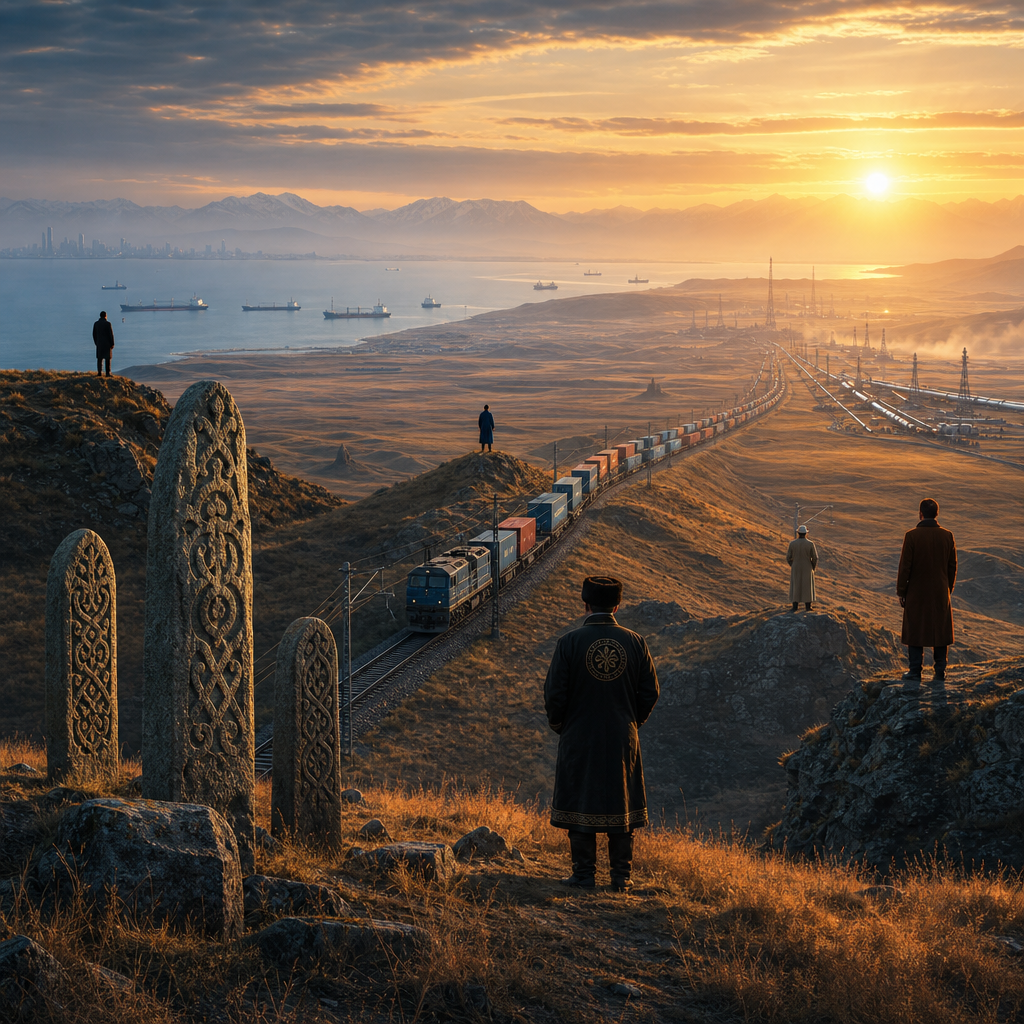
The Middle Corridor — the OTS’s flagship transport route connecting China to Europe through Kazakhstan, the Caspian Sea, Azerbaijan, Georgia, and Turkey — saw cargo volumes surge by 89% year-on-year in the first nine months of 2023, reaching 1.9 million tonnes [4]. The World Bank forecasts that freight volumes could triple by 2030 and travel times could halve, with container traffic on the Caspian segment alone projected to grow from 18,000 TEUs in 2022 to 130,000 TEUs by 2040 [4]. In 2024, cargo volume through the corridor grew another 63%, reaching approximately 4.1 million tonnes [12].
This isn’t theory. This is ships, trains, and money.
On energy, the story is even sharper. OTS member states collectively hold over 20 trillion cubic meters of natural gas, 39 billion barrels of oil, and roughly 40% of global uranium production [14]. Turkey’s Energy Minister declared in December 2025 that the Trans-Caspian Pipeline — bringing Turkmen gas across the Caspian to Azerbaijan and onward to Europe — has reached “the phase of taking concrete steps” after 30 years of being called a dream [14]. The OTS investment portfolio now surpasses $20 billion, roughly 80% of it in energy [14].
On defence, Turkey has spent a decade building military relationships across the Turkic world. The German Marshall Fund documented how “Turkey’s army-building capacity was clearly one of the leading factors contributing to Azerbaijan’s victory in the Second Nagorno-Karabakh War” — the first modern conflict decided primarily by drones [10]. By 2025, all OTS member states were developing “military education exchanges, training and exercises, a broader range of equipment and defence technologies, and development of common doctrine and operational approaches” with Turkey [5].
For the citizen of Bishkek or Samarkand, this means something tangible: a new train route, a Turkish-built factory, a visa-free flight to Istanbul. Kazakhstan’s GDP reached $260 billion in 2023. Uzbekistan’s trade with Central Asian neighbours doubled from $5.7 billion to $11 billion in six years [15]. The OTS isn’t abstract. It’s a corridor, a pipeline, a university exchange.
But you won’t read about it in your morning paper. And that’s the problem.
What Next?
The OTS will either consolidate into a genuine geopolitical bloc or fragment into bilateral relationships wearing multilateral clothing. The determining factors are not summit declarations — they’re structural.
First, Erdoğan’s political horizon is finite. The institutional architecture of the OTS is largely his creation, and its future depends on whether his successor treats it as a strategic priority or a legacy project. Second, Central Asian leaders are hedging, not committing. Kazakhstan and Kyrgyzstan remain in Russia’s CSTO. Uzbekistan under Mirziyoyev is pursuing a “Community of Central Asia” — its own regional project that may compete with, rather than complement, the OTS [6]. Third, China will not tolerate a bloc that edges toward the Uyghur question. The OTS has so far avoided this landmine, but cultural integration projects — common alphabets, shared histories, Turkic textbooks — inevitably brush against it.
And now there’s a fourth: the OTS has lost its European bridge. Viktor Orbán’s April 2026 electoral defeat removed the man who, more than any other European leader, had championed the organisation as a geopolitical player. His successor, Péter Magyar, inherits Hungary’s observer seat but not Orbán’s ideological commitment to it. Whether Magyar maintains, downgrades, or quietly abandons the relationship will be an early stress test of whether the OTS can outlast the individual leaders who built it [16][17].
The Carnegie Endowment warned that the Middle Corridor itself may have “a limited shelf life” — constrained by Georgia’s political paralysis, Caspian environmental degradation, and persistent infrastructure gaps [2]. If the corridor stalls, the OTS’s economic engine loses its fuel.
The winners? Turkey, which gains a sphere of influence without firing a shot. Azerbaijan, which gains a security umbrella. Kazakhstan, which gains options. The losers? Russia, which loses leverage every time a Kazakh oil tanker sails across the Caspian instead of through a Russian pipeline. And the West, if it continues to treat the OTS as someone else’s party.
But here’s the question nobody’s asking: is the OTS building collective sovereignty, or is it just swapping one patron for another — replacing Moscow with Istanbul?
And here’s another: can the OTS survive its architects? Orbán is already gone. Erdoğan won’t rule forever. Institutions that depend on individual leaders rarely outlive them.
Who benefits from the silence? Who’s watching while five nations build a bloc that reshapes Eurasia’s geography?
And when you finally pay attention — will it already be too late?
References
[1] Cornell, S.E. (2025). “The Rise of the Organization of Turkic States: Is Turkic Cooperation Filling a Geopolitical Vacuum?” Silk Road Paper, Central Asia-Caucasus Institute / Silk Road Studies Program. https://www.silkroadstudies.org/resources/2512-Turkicmerged.pdf
[2] Valansi, K. (2025). “Why the Middle Corridor matters amid a geopolitical resorting.” Atlantic Council Turkey Defense Journal, June 2, 2025. https://www.atlanticcouncil.org/content-series/ac-turkey-defense-journal/why-the-middle-corridor-matters-amid-a-geopolitical-resorting
[3] Ünver, D. (2021). “Turkic World on Rise: The Summit of the Organization of Turkic States.” AVIM Blog, December 6, 2021. https://avim.org.tr/Blog/TURKIC-WORLD-ON-RISE-THE-SUMMIT-OF-THE-ORGANIZATION-OF-TURKIC-STATES-06-12-2021
[4] World Bank (2023). “The Middle Trade and Transport Corridor: Policies and Investments to Triple Freight Volumes and Halve Travel Time by 2030.” November 27, 2023. https://www.worldbank.org/en/region/eca/publication/middle-trade-and-transport-corridor
[5] Cornell, S.E. (2025). “The Rise of Security and Military Cooperation among Turkic States.” Central Asia-Caucasus Analyst, December 16, 2025. https://www.cacianalyst.org/publications/analytical-articles/ [Note: URL slug on the site reads “central-asian-states-and-the-bagram-dilemma” but content is as cited.]
[6] Samadov, S. (2025). “Uzbekistan’s Leadership in the Organization of Turkic States: Mirziyoyev’s Vision.” Hungarian Conservative, May 19, 2025. https://www.hungarianconservative.com/articles/current/uzbekistan-organization-turkic-states-ots-mirziyoyev
[7] Kassenova, N. (2026). “Kazakhstan: An Aspiring Middle Power in the Heart of Eurasia.” Belfer Center for Science and International Affairs, Harvard Kennedy School, Spring 2026. https://www.belfercenter.org/research-analysis/kazakhstan-aspiring-middle-power-heart-eurasia
[8] OSCE Academy (2024). “The Middle Corridor’s Impact on Kazakhstan: Foreign Policy, Economic and Geopolitical Implications.” [Note: The URL https://osce-academy.net/upload/file/Web_version_15.pdf could not be verified as containing this document. Verify against alternative sources.]
[9] Coffey, L. (2025–2026). “Why the US Must Include the Organization of Turkic States in Its Central Asia Policy” / “Washington Should Work with the Turkic States.” Hudson Institute. https://www.hudson.org/security-alliances/why-us-must-include-organization-turkic-states-its-central-asia-policy-luke-coffey
[10] Yalçınkaya, H. (2021). “Turkey’s Overlooked Role in the Second Nagorno-Karabakh War.” German Marshall Fund of the United States, January 21, 2021. https://www.gmfus.org/news/turkeys-overlooked-role-second-nagorno-karabakh-war
[11] Internationale Politik Quarterly / DGAP (2026). “Gateway or Obstacle? Hungary and the Organization of Turkic States.” [Note: Cited via secondary source. Verify against primary DGAP publication when available.]
[12] New Lines Institute (2026). “A Booster for Economic Development and Western Investment: The Middle Corridor.” https://newlinesinstitute.org/ [Note: Verify exact URL and content.]
[13] Republic of Türkiye Ministry of Foreign Affairs. “Organization of Turkic States (OTS).” https://www.mfa.gov.tr/turk-konseyi-en.en.mfa
[14] TRT World / Daily Sabah (2025). Reporting on OTS Energy Ministers Council and Trans-Caspian Pipeline developments. [Note: Cited via aggregator. Verify against primary TRT World or Daily Sabah articles for specific statistics.]
[15] Anceschi, L. (2019). “Mirziyoyev’s Foreign Policy: Globalizing Uzbekistan in the Asian Century.” Georgetown Journal of International Affairs, April 2, 2019. https://gjia.georgetown.edu/conflict-security/mirziyoyevs-foreign-policy-globalizing-uzbekistan
AI Disclosure: This post was created with the assistance of artificial intelligence. The ideas, analysis, and opinions expressed are my own — AI was used to help compose, structure, and refine my personal notes and thoughts into the final written content. Images, videos and music featured in this post were also generated using AI tools, based on my own creative prompts and direction.
