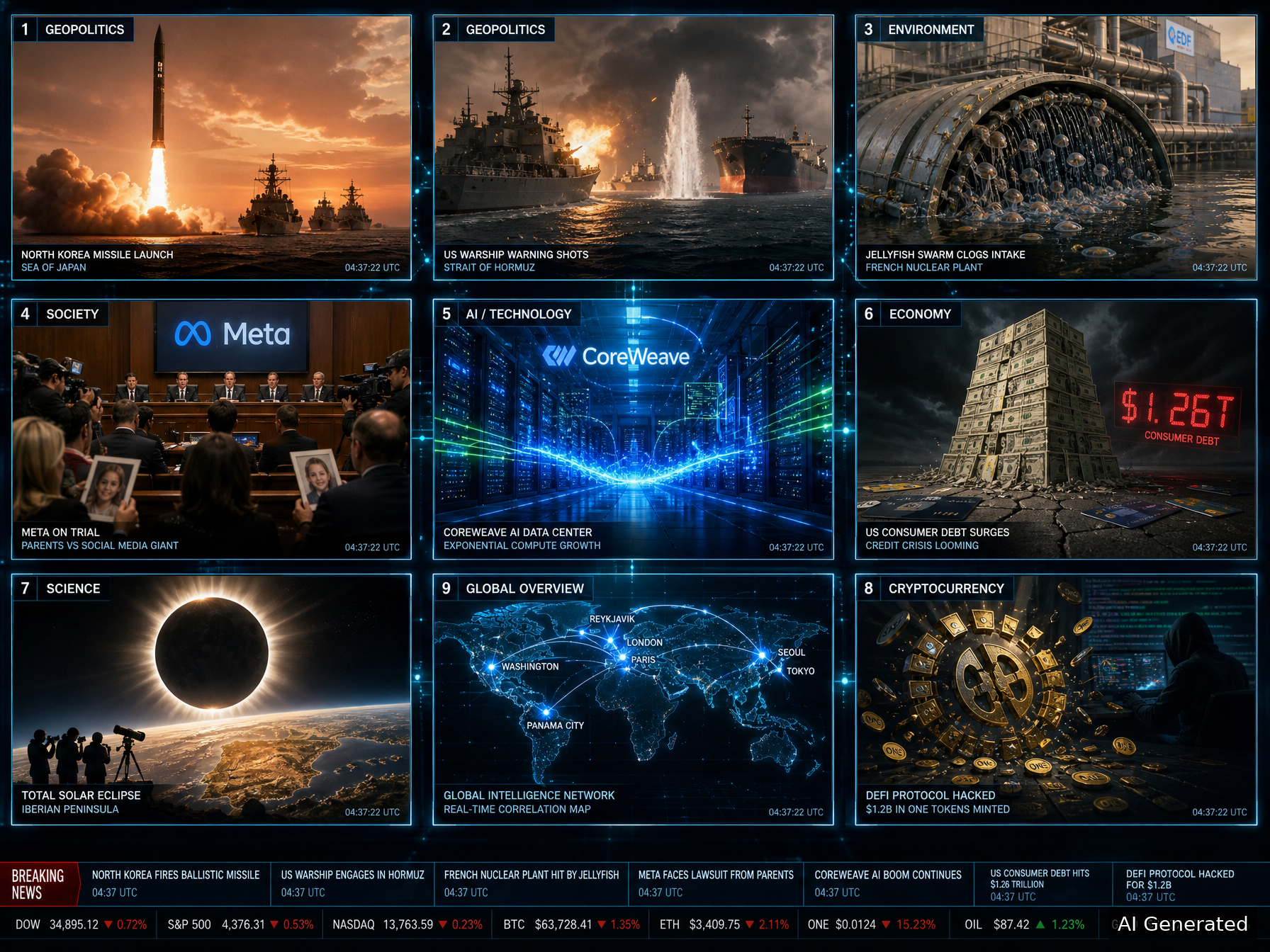


Contents
- Geopolitics & Defence
- North Korea fires ballistic missile toward Japan as US-South Korea drills loom
- Russia plans post-election mobilisation as Zelensky warns of escalation
- Trump fires on Panamanian ship, claims “total control” of Hormuz as standoff deepens
- Libya: Haftar’s intelligence chief killed in car bombing
- Syria IAEA progress and German intelligence reform reshape security landscape
- Environment & Climate
- France forced to throttle nuclear reactors as heatwave triggers jellyfish blockage and cooling failures
- UK declares heat emergency: Cobra meeting convened as temperatures forecast to hit 38C
- Amazon’s 35-turbine Texas gas plant could become America’s single largest pollution source
- Rhine low water crisis enters new phase as Germany debates rail and truck alternatives
- Amazon faces Supreme Court battle over Amazon rainforest protections
- Society & Civil Issues
- Total solar eclipse sweeps across Spain and Iceland as Europe watches partial spectacle
- Meta faces landmark US trial as four states allege social media harmed minors
- Thailand suspends all new gun permits after back-to-back mass shootings
- UK probation chief warns early release scheme risks “more serious crimes”
- London law student dies from weight-loss drug Zepbound as concerns mount
- US credit card debt nears all-time record at $1.26 trillion
- AI & Technology
- CoreWeave earnings reveal AI infrastructure demand exceeding all projections
- DEF CON attendees suspected in WiFi spoofing attack on Delta flight
- Chrome adopts device-bound session credentials against account takeover
- AI models systematically erase female characters from children’s stories
- South Korea announces national quantum and brain-computer interface strategies
- Applied Materials partners with UC Berkeley on $5B semiconductor R&D facility
- Trump vaccine executive order draws rare pharmaceutical industry pushback
- Economy & Business
- German CPI confirms 2.8% inflation as energy costs and drought compound economic pressure
- Canadian crude oil reaches Japan for first time since Hormuz crisis began
- US inflation data awaited as Boston Fed signals openness to rate increase
- European August crash pattern raises questions about market fragility
- UK PM Burnham promises business support amid “difficult” financial outlook
- German working time per capita declines as demographic pressures intensify
- Science & Space
- Total solar eclipse delivers on months of anticipation with spectacular observations from Spain and Iceland
- Debate intensifies over whether Earth’s sixth mass extinction has already begun
- Previously unknown amyloid fold type explains devastating form of Alzheimer’s
- New 3D-printed actuator achieves bidirectional shape change from single material
- British driver sets hydrogen car speed record at 406 mph
- Crypto, Digital Assets & Blockchain
- Harmony Protocol exploited: 4 billion ONE tokens minted in largest DeFi hack of 2026
- XRP Ledger bridge loses 200,000 XRP in fake-deposit exploit
- CLARITY Act faces 14-day race against Senate recess
- Erebor Bank nears $1.5 billion raise at $8 billion valuation
- Keel Infrastructure completes pivot from Bitcoin mining to AI data centres
- ASIC warns Yepbit falsely blamed regulator for frozen investor funds
- CFTC orders Kalshi to keep operating despite New York lawsuit
- Correlations & Analysis
- References
Click any heading to jump to that section. Click the section heading to return to this menu.
Daily Intelligence Briefing — 2026-08-12 (D73)
Geopolitics & Defence
↑ ContentsNorth Korea fires ballistic missile toward Japan as US-South Korea drills loom
North Korea launched a ballistic missile on Wednesday that flew more than 700 kilometres over the sea toward Japan, marking the second such test in less than a week and raising tensions days before the scheduled start of the Ulchi Freedom Shield joint military exercises between the United States and South Korea[1]. South Korea’s Joint Chiefs of Staff detected the launch from the Wonsan area at approximately 06:00 local time, prompting an emergency meeting of the National Security Council in Seoul. Japanese Defence Minister Shinjiro Koizumi called the launch “a threat to peace and security in our region” and lodged a formal protest through diplomatic channels in Beijing[2]. The timing is deliberately provocative: the Ulchi Freedom Shield exercise, involving 18,000 South Korean and 28,500 American troops, is designed to simulate defence against North Korean invasion scenarios. North Korea has historically used such exercises as justification for its own provocations, and analyst Lim Eul Chul of Kyungnam University told Stern that Pyongyang “has never let a joint military exercise pass without a reaction”[3]. The launch coincided with a joint declaration from approximately 40 nations warning against the dangers of unannounced ballistic missile tests, a diplomatic initiative that China joined — an unusual alignment given Beijing’s broader support for Pyongyang. The missile test also extends the pattern documented in D72 of escalating military posturing across the Indo-Pacific, where Chinese missile tests in July, Russian nuclear rhetoric, and now North Korean provocations are collectively testing the boundaries of the global arms control framework.
Russia plans post-election mobilisation as Zelensky warns of escalation
Ukrainian President Volodymyr Zelensky disclosed on Tuesday that Russia is preparing a major mobilisation drive to begin after the State Duma elections scheduled for September 18-20, with Moscow planning to conscript “several hundred thousand” Russians by year-end and another equal number by the end of 2027[4]. The intelligence, presented following Zelensky’s meeting with Defence Intelligence chief Oleh Ivashchenko, reveals a Kremlin strategy of using the electoral process to manufacture the appearance of public support for continued war before launching what would be Russia’s most expansive conscription since the partial mobilisation of September 2022. The disclosure builds directly on D72’s reporting of Russia’s anti-war voting ban — the Supreme Court’s decision to strip Yabloko, the only remaining opposition party, from the ballot now appears to be the opening move in a broader mobilisation sequence. Paradoxically, even some Russian lawmakers are sceptical: State Duma deputy Andrey Gurulyov acknowledged that without solving the problem of Ukrainian drone superiority, “bringing in new mobilised troops will only lead to an increase in the number of military personnel killed”[5]. The mobilisation plan arrives as Ukraine has been escalating its own offensive operations, including the disruption of Russian oil tanker logistics in the Black Sea — a campaign reportedly halted after Vice President Vance intervened to preserve the fragile diplomatic channels around the Hormuz crisis[6].
Trump fires on Panamanian ship, claims “total control” of Hormuz as standoff deepens
The United States military fired missiles into the engine room of the Panamanian-flagged MV Vela Nova on Tuesday after accusing the vessel of attempting to evade the American blockade on Iranian ports, marking the first kinetic military action against a civilian vessel in the ongoing Strait of Hormuz confrontation[7]. US Central Command said the ship ignored multiple warnings to stop before a helicopter launched the disabling strike. The escalation came hours before President Trump told reporters “we totally control the Strait of Hormuz… nobody else, only us” and warned that if Iran attempted to challenge the blockade, “they get blown away”[8]. Iran’s response was defiant: the newly appointed secretary of the Supreme National Security Council, Mohsen Rezaee, stated on social media that “the message is clear” — the strait will remain shut until Washington agrees to Tehran’s terms and withdraws[9]. This represents a significant deterioration from the diplomatic posture described in D72, where Trump had pivoted from talks back to sanctions but had not yet used military force against civilian shipping. The firing on the Vela Nova transforms the standoff from an economic blockade into an active naval confrontation, raising the risk of miscalculation. Pakistan’s interior minister Mohsin Naqvi made his sixth visit to Tehran seeking to broker resumed negotiations, but the military strike suggests Washington views diplomatic channels as secondary to enforcement[10]. Iran’s decision to join the BRICS New Development Bank, announced by central bank governor Abdolnaser Hemmati, further signals Tehran’s pivot toward an alternative financial architecture that reduces its vulnerability to American sanctions[11].
Libya: Haftar’s intelligence chief killed in car bombing
Fawsi al-Mansuri, the military intelligence chief for eastern Libya and one of the most powerful figures under Field Marshal Khalifa Haftar, was killed on Monday when unknown attackers detonated a car bomb in Benghazi[20]. The assassination represents one of the most significant direct attacks on Haftar’s inner circle in a decade, destabilising the already fragile power structure in eastern Libya at a moment when Turkey’s expanding military footprint in the region — including the deployment of F-16s to bases near the Red Sea as part of the Mecca defence pact with Saudi Arabia and Pakistan — is reshaping the broader security architecture[21]. The killing occurred against the backdrop of Israel-Turkey tensions that have intensified following the August 7 trilateral defence agreement signed in Mecca, which Turkish officials have described as a Muslim-world equivalent of NATO’s Article 5. Israeli analysts view the pact as a direct strategic threat, with one Turkish publication framing the question as whether the Mecca accord makes an Israel-Turkey war “more likely”[22].
Syria IAEA progress and German intelligence reform reshape security landscape
Syria announced that it will host an International Atomic Energy Agency delegation in the coming days to announce “significant progress” on the nuclear materials legacy of the Assad era[29]. Since Assad’s ouster, the new Syrian authorities have cooperated with the IAEA to address decades of undeclared nuclear activities — a dramatic shift that could have implications for broader Middle East security calculations. Meanwhile, Germany’s cabinet prepared to approve a more than 700-page intelligence reform package that would significantly expand the powers of the domestic Federal Office for the Protection of the Constitution (BfV) and the foreign BND, including the ability to intervene “operationally” in acute threats like sabotage and cyberattacks[30]. The reform faces opposition from the FDP, whose leader Wolfgang Kubicki called it a “historical taboo-breaking” move toward creating a “secret police,” with the Greens and Left making similar arguments about the erosion of the firewall between intelligence services and police powers.
Environment & Climate
↑ ContentsFrance forced to throttle nuclear reactors as heatwave triggers jellyfish blockage and cooling failures
France’s nuclear fleet — the backbone of European electricity supply — is being forced to reduce output or shut down reactors entirely as extreme heat, drought, and an unusual jellyfish invasion combine to disrupt cooling water systems[31]. Die Zeit reported that several reactors along the Rhône and Garonne rivers have been throttled because river temperatures have exceeded regulatory limits for cooling water discharge, while in at least one facility, jellyfish populations have physically clogged intake filters, compounding the thermal problem. The French situation illustrates the compound vulnerability of nuclear power in a warming climate: reactors depend on river water both for cooling and for thermal discharge limits, and when rivers run low and warm simultaneously, the operational margin evaporates. France, which normally exports electricity to its neighbours, is instead drawing on imported power at a moment when the broader European grid is under stress from the same heatwave conditions. The German Farmers’ Association representative described the agricultural drought situation as “alarming,” with “100 percent losses” on broccoli, artichokes, and salad crops across multiple regions[32].
UK declares heat emergency: Cobra meeting convened as temperatures forecast to hit 38C
Prime Minister Andy Burnham will chair a Cobra emergency committee meeting on Wednesday in response to what the Guardian described as Britain’s most severe heat emergency in decades, with temperatures forecast to reach 33C on Wednesday and potentially 38C on Thursday[33]. The emergency response has been triggered by a convergence of wildfires — including the New Forest blaze documented in D72 — widespread drought conditions, and the strain on health services from sustained extreme heat. Southern Water has pushed for a rare drought order that would ban the filling of non-domestic swimming pools, while 10,000 homes have been reported without water in parts of southern England[34]. The Cobra meeting represents a significant escalation from D72’s reporting, where the UK’s heat was mentioned primarily in the context of consumer confidence data; now it has become a civil emergency demanding central government coordination. Analysis from the New Economics Foundation estimated that repeated debilitating heatwaves this summer have cost the UK economy more than £4 billion in lost economic output by the end of July, a figure that will grow substantially with this week’s forecast temperatures[35].
Amazon’s 35-turbine Texas gas plant could become America’s single largest pollution source
Amazon’s planned AI data centre campus in Pecos County, Texas, is tied to a natural gas power project of extraordinary scale: 35 simple-cycle turbines permitted to emit up to 33.2 million metric tons of CO2 equivalent annually — roughly 58 percent above the highest-emitting US facility reported for 2024 and equivalent to 37 percent of Amazon’s entire 2025 corporate carbon footprint[36]. The permit, filed by Pacifico Energy’s GW Ranch Energy Center, describes an on-site power facility that cannot exchange electricity with the local utility grid, designed exclusively to serve Amazon’s computing infrastructure. Even at half the permitted ceiling, the facility would release approximately 15 million metric tons of CO2e annually, placing it near the top of US emitter rankings. The project creates a direct collision between Amazon’s 2040 net-zero pledge and the physical infrastructure requirements of its AI ambitions: the company’s own 2025 sustainability report shows corporate carbon emissions already rose 16 percent in one year, with electricity-related emissions up 34 percent, largely driven by data centre demand. Amazon maintains the facility “won’t raise electricity costs for Texas families” and plans to use non-potable water, but the company has not detailed how GW Ranch’s emissions reconcile with its stated climate targets.
Rhine low water crisis enters new phase as Germany debates rail and truck alternatives
Germany’s Rhine waterway — which carries approximately 40 percent of the country’s inland freight — faces what transport experts now describe as a structural crisis rather than a temporary disruption, as ZDF’s economic analysis revealed that neither rail nor road can substitute for barge capacity at the scale required[37]. Thomas Puls, a transport expert at the Institut der deutschen Wirtschaft, explained that roughly 100 trucks would be needed to replace a single 110-metre Rhine barge carrying 2,500 tonnes of cargo — a substitution that is “rather unrealistic” given both the vehicle shortage and the 120,000 truck driver vacancies already plaguing the German logistics sector. Rail presents a similar capacity ceiling: Rhine freight represents roughly 5 percent of Germany’s total transport volume, which would require the rail network — already operating beyond capacity — to increase throughput by a quarter on a corridor constrained by construction sites and rolling stock shortages[38]. The DIHK’s Dirk Binding warned that “if we don’t act now, every low-water period will become a risk for production, prices and supply” — a diagnosis that captures the central tension between Germany’s industrial infrastructure, designed for a stable climate, and the hydrological reality it now faces.
Amazon faces Supreme Court battle over Amazon rainforest protections
Brazil’s Supreme Court is set to decide cases that could fundamentally reshape protections for the Amazon rainforest and Indigenous communities, following congressional victories by agribusiness-aligned legislators who passed measures environmentalists say violate constitutional rights[39]. President Lula vetoed some of the measures, but lawmakers overrode the vetoes, sending the disputes to the judiciary. The cases represent the most significant legal battle over Amazon deforestation since Lula took office, and they arrive at a moment when Global Nature Watch data confirms that forest fires now burn twice as much area as they did twenty years ago, with the last three years constituting the worst on record[40]. The conjunction of Brazilian legal proceedings, French nuclear plant shutdowns, the UK heat emergency, and the Rhine crisis creates a picture of a planet where climate disruption is no longer a future projection but a present operational reality affecting energy systems, agriculture, water supply, and legal frameworks simultaneously.
Society & Civil Issues
↑ ContentsTotal solar eclipse sweeps across Spain and Iceland as Europe watches partial spectacle
The total solar eclipse — Europe’s first since 1999 — arrived on Wednesday evening, with the moon’s shadow tracing a path of totality from Greenland through Iceland and across northern Spain, where up to two minutes and eighteen seconds of darkness greeted observers in a corridor stretching from A Coruña through the Balearic Islands[41]. Madrid experienced 99.96 percent solar coverage, while London and Paris saw partial eclipses of approximately 90 and 92 percent respectively. The event triggered what authorities described as “a genuine logistical puzzle” as hundreds of thousands of tourists converged on rural Spanish areas with limited infrastructure, while wildfire smoke from the ongoing Huelva and Castellón blazes threatened to obscure views along parts of the path[42]. France experienced its first partial solar eclipse visible from the Hexagone since 1999, with up to 99 percent occultation in the south-west. The eclipse coincided with the peak of the Perseid meteor shower, creating a rare double celestial event observable in the path of totality where the darkness allowed both phenomena to be witnessed simultaneously. NASA livestreamed the event from multiple locations, while ESA positioned telescopes at the Observatorio Astrofísico de Javalambre in Teruel, directly in the path of totality. The eclipse’s passage over wildfire-affected Spain served as an unintentional metaphor for the collision between celestial mechanics and terrestrial crisis that characterises the current moment.
Meta faces landmark US trial as four states allege social media harmed minors
A federal trial against Meta began in Oakland, California, on Wednesday, with four US states — California, Massachusetts, New York, and Colorado — alleging that the company knowingly designed Instagram and Facebook to be addictive to minors and that this design choice caused widespread psychological harm[43]. The case, which combines elements of consumer protection, product liability, and public health law, represents the most significant legal challenge to social media companies’ business model to date. The trial arrives alongside a growing body of evidence linking adolescent social media use to anxiety, depression, and body image disorders, and within a political environment where both parties have expressed concern about Big Tech’s influence on children. Meta has consistently denied that its platforms are designed to be addictive and argues that parental controls and age-verification tools provide adequate protection. The trial’s outcome could establish precedents for how digital platforms are regulated in the United States, particularly regarding their obligations to minors. In a related development, courts in England and Wales joined restaurants, theatres and pubs in banning Meta’s smart glasses, which can record video footage while being worn — a sign that the company’s product ecosystem is facing resistance on multiple regulatory fronts simultaneously.
Thailand suspends all new gun permits after back-to-back mass shootings
The Thai government announced a nationwide suspension of all new firearm purchase and ownership permits following back-to-back mass shootings that have reignited calls for tighter gun controls in a country with some of the loosest firearms regulations in Southeast Asia[44]. Existing purchase permits will not be renewed during the suspension, which the government described as a measure “until further notice.” Thailand has one of the highest gun ownership rates in the region, and previous mass-casualty incidents — including the 2020 Korat massacre that killed 29 people — have prompted similar temporary moratoriums that were subsequently lifted without permanent legislative reform. The current suspension arrives amid broader regional concerns about gun violence, with the Thai government facing pressure to convert the emergency measure into lasting regulatory change.
UK probation chief warns early release scheme risks “more serious crimes”
The chief inspector of probation for England and Wales warned the BBC that the government’s early release scheme — designed to address prison overcrowding — risks triggering “more serious crimes” because probation services are already operating under “unprecedented pressure”[45]. The warning adds a new dimension to the controversy documented in D72 over PC Andrew Harper’s killers potentially being released early: now the administrative infrastructure that would supervise released prisoners is itself flagged as inadequate. The Guardian’s Wednesday briefing contextualised the prison crisis as extending far beyond the early release scheme, noting that the fundamental question of “who we lock up — and what happens when they’re set free” demands a policy rethink that goes deeper than emergency measures[46]. The crisis intersects with the heat emergency straining public services, creating a governance environment where multiple systems — criminal justice, public health, emergency response — are simultaneously under stress.
London law student dies from weight-loss drug Zepbound as concerns mount
An inquest heard that Josephine Nasr, a 19-year-old law student at King’s College London, died in her halls of residence after taking Zepbound, a weight-loss medication that doctors believe triggered a fatal heart rhythm[47]. The case has reignited concerns about the safety of GLP-1 receptor agonist drugs — including Zepbound and its predecessor Ozempic — when used by young, healthy individuals seeking cosmetic rather than medical weight loss. The drugs have been widely adopted through social media promotion, often with insufficient attention to cardiac risks that are better understood in older, clinically obese patients. Nasr’s death underscores the gap between the rapid popularisation of these medications and the clinical evidence base for their use in populations outside their original indication.
US credit card debt nears all-time record at $1.26 trillion
Americans’ credit card debt reached $1.26 trillion in the second quarter of 2026, an increase of $21 billion that brings the total perilously close to the all-time record set during the post-pandemic inflation surge[48]. The figure arrives amid rising consumer anxiety about economic prospects, with the Hormuz blockade driving energy costs higher and the Federal Reserve maintaining restrictive monetary policy. The debt accumulation pattern suggests that American households are increasingly bridging the gap between stagnant real wages and rising prices through credit — a dynamic that historically precedes consumer spending pullbacks with broader economic consequences.
AI & Technology
↑ ContentsCoreWeave earnings reveal AI infrastructure demand exceeding all projections
CoreWeave reported second-quarter revenue of $2.58 billion — more than doubling year-over-year — with a revenue backlog that surged 246 percent to $104.2 billion, excluding roughly $25 billion in net new customer commitments added in early Q3[49]. CEO Michael Intrator told analysts that “our near-term capacity remains effectively sold out” and that prices for access to Nvidia’s Blackwell and Vera Rubin chips are “setting new highs,” with even older inventory commanding premium rates. The results validate the Nvidia-led financing architecture announced in D72 — the $500 billion commitment from Apollo, Blackstone, BlackRock, Brookfield, Goldman Sachs, and KKR — by demonstrating that demand for AI compute infrastructure is not speculative but contractually committed. CoreWeave’s stock surged more than 14 percent in after-hours trading, though the company still posted a $626 million net loss driven by $640 million in net interest expense on its $46.7 billion GPU-heavy balance sheet. The key strategic question is whether these GPUs can sustain their value through the inference phase — running trained AI models for commercial applications — rather than losing value as newer chip generations arrive. Intrator dismissed concerns about local opposition to data centres in 18 states, saying it “won’t make a dent in demand” and that companies should work with communities by offering grid upgrade payments. The results extend the AI infrastructure buildout narrative from D72’s Nvidia financing story into operational reality: the demand is not just financial commitment but contracted revenue.
DEF CON attendees suspected in WiFi spoofing attack on Delta flight
Passengers aboard Delta flight 591 from Las Vegas to Atlanta on Monday allegedly jammed the aircraft’s onboard WiFi and broadcast a fraudulent hotspot signal, prompting intervention by federal law enforcement[50]. The incident occurred one day after the conclusion of DEF CON, the world’s largest cybersecurity conference, and was first described on social media accounts that track publicly available air-to-ground ACARS messages. Pilots reportedly transmitted: “NO INFO AS OF NOW WE HAVE A BUNCH OF PAX THAT WERE AT A CYBER CONFERENCE IN LAS THEY WERE ABLE TO JAM OUR WIFI AND BROADCAST THEIR SIGNAL.” The incident — whether a genuine security breach or an elaborate demonstration — highlights the vulnerability of aircraft communication systems to relatively simple spoofing techniques, and raises questions about the regulatory framework governing WiFi security on commercial flights. It also serves as a vivid illustration of the widening gap between cybersecurity capabilities and the infrastructure they can target.
Chrome adopts device-bound session credentials against account takeover
Google’s Chrome browser has introduced device-bound session credentials (DBSCs), a security measure that stores unique encryption keys in the device’s hardware security module — the Trusted Platform Module on Windows or the Secure Enclave on Apple devices[51]. The technology addresses one of the most persistent and damaging forms of cyberattack: session cookie theft, which allows attackers to hijack authenticated web sessions even when users have enabled two-factor authentication or passkeys. By binding the session credential to a specific physical device, DBSCs ensure that stolen cookies cannot be used from a different machine. The feature is particularly significant because session cookies have become the primary target for credential-stealing malware, and existing protections — including MFA — do not prevent their theft. Chrome’s implementation represents a shift from software-only security toward hardware-rooted trust, a model that could significantly reduce account takeover incidents if adopted widely.
AI models systematically erase female characters from children’s stories
A University of Washington study presented at the 2026 ACM Conference on Fairness, Accountability, and Transparency found that six leading generative AI models — including GPT-4o, GPT-5.1, Claude Sonnet 4.5, and Gemini 2.5 — produced feminine animal characters in only 2 percent of over 23,800 AI-generated children’s stories about talking animals whose gender was unspecified[52]. Male characters appeared in 41 percent of stories, while 57 percent avoided gendering characters altogether — a “neutrality” that the researchers argue functions as systematic erasure rather than bias avoidance. The study’s lead author, Imani Finkley, noted that “the neutrality of these AI models didn’t just erase female characters — it was all non-masculine identities.” Google’s Gemini and OpenAI’s GPT-5.1 had the highest proportion of male characters at 63 and 65 percent respectively, while Anthropic’s Claude generated the most female characters but still only at 4 percent. The findings carry implications beyond children’s literature: as AI-generated content increasingly shapes media consumption, the amplification of existing gender biases in training data could have compounding effects on cultural norms, particularly for audiences whose first encounters with narrative are mediated by AI.
South Korea announces national quantum and brain-computer interface strategies
The South Korean government announced a comprehensive technology roadmap targeting the development of a domestic 100-qubit quantum computer by 2029, with the goal of becoming the world’s leading quantum chip manufacturer by 2035[53]. In parallel, the government outlined plans to commercialise brain-computer interface products by 2035, positioning the country at the frontier of neuroscience-based computing applications. The dual announcements represent one of the most ambitious national technology strategies announced to date, combining near-term quantum computing capabilities with longer-term neuromorphic computing ambitions. For the broader technology landscape, South Korea’s strategy signals that the quantum computing race is no longer confined to the US, China, and Europe — mid-tier technology powers are now committing significant state resources to establishing positions in next-generation computing paradigms.
Applied Materials partners with UC Berkeley on $5B semiconductor R&D facility
Applied Materials named the University of California, Berkeley as a research collaborator at its new EPIC Center in Silicon Valley, a facility designed to bridge the gap between university research and commercial chip manufacturing[54]. Berkeley faculty and students will work alongside Applied engineers on semiconductor materials and process technologies tied to AI computing, with access to industry-scale equipment typically unavailable to academic researchers. The partnership addresses a persistent bottleneck in semiconductor development: promising materials and processes discovered in university laboratories can take years to validate under production-scale conditions. Berkeley brings decades of semiconductor research history — including contributions to SPICE circuit simulation and FinFET transistor architecture — to a facility that represents Applied Materials’ largest US investment in advanced equipment R&D. The collaboration arrives as the US semiconductor industry faces intense pressure to accelerate the timeline from laboratory discovery to production deployment, driven by AI’s insatiable demand for increasingly advanced computing hardware.
Trump vaccine executive order draws rare pharmaceutical industry pushback
Pharmaceutical companies joined public health organisations in criticising President Trump’s executive order reducing recommended childhood vaccines from 17 to 11, with industry sources describing the proposal as “idiotic” and “putting children’s health at risk”[55]. The American Academy of Pediatrics called the order “not only disheartening but dangerous,” while the American Medical Association warned it was “putting children’s health at risk.” What distinguishes this response from previous controversies is the involvement of pharmaceutical companies themselves — manufacturers who stand to lose revenue from fewer vaccine doses are opposing the order on scientific rather than commercial grounds. The executive order invokes debunked claims linking vaccines to autism, and would reshape the advisory framework guiding paediatric practice across the country, potentially leading to preventable outbreaks of measles, whooping cough, and other controlled diseases. The pharmaceutical industry pushback represents a significant escalation in the political battle over vaccine policy, as even the commercial beneficiaries of the current system join scientific institutions in opposing the administration’s agenda.
Economy & Business
↑ ContentsGerman CPI confirms 2.8% inflation as energy costs and drought compound economic pressure
Germany’s final consumer price index for July confirmed inflation at 2.8 percent year-over-year, with the month-on-month figure of 0.8 percent matching forecasts and underscoring the persistent impact of elevated energy costs on the eurozone’s largest economy[56]. The data arrives as multiple energy-system stress points converge: the Rhine low-water crisis is driving fuel prices higher in western Germany by constraining barge capacity for petroleum product distribution, while the broader Hormuz blockade continues to elevate crude oil benchmarks. The combination creates a feedback loop where geopolitical supply disruption (Hormuz), climate-driven infrastructure constraints (Rhine drought), and the end of the Tankrabatt fuel subsidy all push in the same inflationary direction. German industry is simultaneously confronting record business insolvencies, with the economic data service Dun & Bradstreet reporting the highest number of corporate failures in five years — a trend that suggests the cumulative impact of high energy costs, tight monetary policy, and weak demand is now producing real-world economic damage beyond the headline inflation figure.
Canadian crude oil reaches Japan for first time since Hormuz crisis began
Japanese Prime Minister Takaichi announced that Canadian crude oil reached Japan on Tuesday for the first time since the Middle East tensions disrupted traditional supply routes through the Strait of Hormuz[57]. The shipment represents a tangible outcome of the supply-chain diversification efforts that D72 and earlier reports have documented as a structural response to the Hormuz blockade: Japan, which has historically depended heavily on Middle Eastern crude, is now actively sourcing from the Americas to reduce its vulnerability to Gulf disruption. For the global energy market, the Japanese-Canadian crude transaction establishes a precedent for long-distance crude trade routes that bypass the contested waterway — a rerouting pattern that, if sustained, would permanently alter tanker economics and reduce the strategic leverage that Hormuz-adjacent states have historically exercised over global energy prices.
US inflation data awaited as Boston Fed signals openness to rate increase
Markets globally are bracing for Wednesday’s US Consumer Price Index release — the most consequential economic data point of the week — after Boston Federal Reserve President Susan Collins told the Financial Times she was “open to” an interest rate increase at the September meeting[58]. The Boston Fed’s hawkish pivot, combined with the RBA’s signal of further tightening in Australia and the Bank of Korea’s explicit rate hike commitment (both documented in D72), creates a coordinated global pattern of central banks responding to energy-driven inflation with monetary restriction even as economic growth decelerates. Reuters reported that US consumer prices “likely increased moderately in July as gasoline prices eased” — but the forward-looking dynamic is more significant than the backward-looking data: if Wednesday’s CPI shows persistent inflation, the case for a September rate hike strengthens, with implications for asset markets, mortgage rates, and business investment globally. The European Central Bank’s fastest monthly price increase in months, driven almost entirely by oil, provides the analytical framework for understanding why central banks are reaching for rate hikes rather than cuts.
European August crash pattern raises questions about market fragility
Euronews published analysis examining whether European stocks face their traditional August vulnerability, noting that the historical pattern of summer crashes “hides an important detail: a handful of major crises account for most of the losses”[59]. The article’s relevance is amplified by the current confluence of risks: Hormuz-driven oil prices, the AI infrastructure buildout’s capital demands, central bank hawkishness, and climate-driven agricultural losses create multiple potential triggers for market correction. South Korea’s Kospi surged more than 4 percent on renewed chip-buying — a reminder that in the current environment, sector-specific dynamics can move markets independently of macro risk — but the broader pattern of risk accumulation suggests that the traditional August vulnerability could manifest with unusual force this year.
UK PM Burnham promises business support amid “difficult” financial outlook
UK Prime Minister Andy Burnham promised business assistance within what he described as a “difficult” financial outlook, a commitment that arrives as the government faces simultaneous pressure on multiple policy fronts — the Jackdaw/Rosebank North Sea oil decision documented in D72, the heat emergency consuming emergency service capacity, and the prison overcrowding crisis[60]. The promise of business support suggests the government recognises that the economic headwinds — energy costs, drought-related infrastructure stress, and global trade disruption from the Hormuz crisis — require direct intervention beyond monetary policy, even as fiscal space remains constrained.
German working time per capita declines as demographic pressures intensify
Germany’s Federal Institute for Population Research reported that average working time per capita fell by 0.3 hours per week in 2025 from the 2023 record, with the decline concentrated among men and younger age groups (25-54), while working hours for those over 60 continued to increase[61]. The institute attributed the decline to “weak economic phases” and noted it was “equivalent to approximately 460,000 full-time jobs.” The data reveals a structural demographic challenge: as Germany’s workforce ages and shrinks, the remaining workers — particularly those in education, childcare, and healthcare where women are overrepresented — are working more to fill gaps, while the overall per-capita contribution declines. The finding directly contradicts assumptions underlying both the Bundeswehr recruitment campaign and the broader economic growth projections that depend on labour supply expansion.
Science & Space
↑ ContentsTotal solar eclipse delivers on months of anticipation with spectacular observations from Spain and Iceland
The August 12 total solar eclipse lived up to its billing as Europe’s most significant celestial event since 1999, with the moon’s shadow tracking a path of totality from the Arctic through Iceland and across northern Spain to the Mediterranean coast, delivering up to two minutes and eighteen seconds of darkness to observers positioned within the approximately 250-kilometre-wide corridor[62]. NASA’s Earth Observatory provided detailed satellite mapping of the path, noting that Snæfellsjökull — the glacier-capped volcano on Iceland’s western peninsula that served as the setting for Jules Verne’s Journey to the Center of the Earth — experienced the greatest eclipse, where the moon appeared largest relative to the sun. Spanish observers in Gijón, A Coruña, and Mallorca witnessed totality beginning between 8:26 and 8:31 PM CEST, just before sunset, creating the rare visual phenomenon of a low-horizon eclipse. The event coincided with wildfire smoke from the ongoing Huelva and Castellón blazes, adding an eerie amber haze to observations in parts of Spain. European Space Agency telescopes at the Observatorio Astrofísico de Javalambre in Teruel — positioned directly in the path — captured scientific observations during the brief totality window, while citizen scientists across the path collected data for atmospheric and solar corona research. For millions of observers across Europe who saw partial eclipses of 90 percent or more, the event served as a vivid reminder of the astronomical scales operating above daily terrestrial concerns.
Debate intensifies over whether Earth’s sixth mass extinction has already begun
A ScienceBlog analysis surveyed the ongoing scientific debate about whether human activity has triggered a sixth mass extinction event, finding “broad agreement” on a serious biodiversity crisis but fundamental disagreement on whether documented extinctions meet the technical threshold for “mass extinction” — defined as the loss of more than three-quarters of Earth’s species in a geologically short period[63]. Ceballos and Ehrlich’s 2023 study of 5,400 vertebrate genera estimated that 73 genera have gone extinct since 1500, a loss that would naturally take approximately 18,000 years — placing current extinction rates at roughly 35 times the background rate. Robert Cowie of the University of Hawaii argues that including less-studied organisms like insects and snails raises the toll to between 7.5 and 13 percent of Earth’s roughly two million known species since 1500. But John Wiens counters that less than 0.1 percent of known species have documented extinctions, suggesting the “mass extinction” framing may be premature. The debate’s significance extends beyond academic taxonomy: the speed of environmental change — driven by habitat destruction, climate change, ocean acidification, and wildlife overexploitation — means that species’ ability to adapt or migrate is being outpaced by the rate of ecosystem transformation, creating conditions qualitatively different from any of the previous five mass extinctions.
Previously unknown amyloid fold type explains devastating form of Alzheimer’s
Researchers using cryogenic electron microscopy identified a previously unseen Z-shaped fold in amyloid-beta protein filaments associated with the rare Flemish APP mutation, a genetic variant that causes Alzheimer’s disease characterised by aggressive accumulation around blood vessels rather than the diffuse plaque pattern of common Alzheimer’s[64]. The mutation removes a single methyl group from the amyloid-beta protein, encouraging the novel fold that exposes a specific amino acid residue (F20) enabling the filaments to interact with blood vessel wall components — explaining why this variant produces cerebral amyloid angiopathy and brain haemorrhages typically fatal by the late 50s. Published in Nature Structural & Molecular Biology, the findings demonstrate how a single molecular change can redirect the entire pathology of a neurodegenerative disease, and they add to growing evidence that understanding the structural diversity of amyloid folds is essential for developing targeted treatments across the spectrum of Alzheimer’s variants.
New 3D-printed actuator achieves bidirectional shape change from single material
Researchers at Pusan National University and Oak Ridge National Laboratory developed a 3D-printable liquid crystal elastomer whose molecular alignment can be switched between two perpendicular directions simply by varying the printing speed and temperature[65]. The resulting material can either stretch or contract when heated — opposite behaviours from the same single material — a capability that could simplify the creation of soft robotic actuators, artificial muscles, and adaptive surfaces. Published in Nature Communications, the work represents the first demonstration of switching molecular alignment in a single 3D-printable smectic liquid crystal elastomer ink, opening pathways toward 4D printing — the creation of objects designed to change shape or properties after fabrication. Professor Suk-kyun Ahn suggested that within five to ten years, “3D-printed objects could actively change shape and carry out specific functions” rather than remaining static.
British driver sets hydrogen car speed record at 406 mph
Former Royal Air Force fighter pilot Andy Green — who previously held the land speed record in the Thrust SSC — set the fastest time ever recorded in a hydrogen-powered vehicle, reaching 406 miles per hour (654 km/h) in the British-built car[66]. The achievement demonstrates the performance potential of hydrogen fuel cell technology in extreme applications, complementing the more modest but commercially relevant hydrogen developments documented in D72’s coverage of Germany’s hydrogen infrastructure debate. While the speed record is primarily a demonstration of engineering capability, it contributes to the broader narrative of hydrogen as a versatile energy carrier whose applications extend from heavy transport to high-performance applications.
Crypto, Digital Assets & Blockchain
↑ ContentsHarmony Protocol exploited: 4 billion ONE tokens minted in largest DeFi hack of 2026
Harmony Protocol suffered a suspected exploit that resulted in the unauthorised minting of approximately 4 billion ONE tokens — equivalent to roughly 26 percent of the token’s total supply — sending the price crashing more than 30 percent as newly minted tokens were moved through the network and into exchanges[67]. On-chain analyst Juiceberg first identified the anomaly, and the Harmony team subsequently confirmed the exploit, announcing that it was working with exchanges to freeze funds and preparing a potential blockchain rollback to reverse the fraudulent transactions. The exploit adds to Harmony’s troubled security history — the protocol was the victim of a $100 million bridge hack in 2023 — and raises fresh questions about the security of proof-of-stake consensus mechanisms when governance or validation processes can be compromised. The attack also follows the Ravencoin exploit documented in the same news cycle, where a consensus vulnerability put several days of transactions at risk and sent RVN to a record low of $0.002754, representing a 22 percent decline. Together, these incidents suggest that lesser-capitalised chains face compounding security and market-confidence challenges as the crypto market matures.
XRP Ledger bridge loses 200,000 XRP in fake-deposit exploit
A bridge connecting the XRP Ledger and Coreum (now rebranded as tx) lost approximately 198,716 XRP after an attacker discovered that the bridge’s deposit-checking system could be tricked into treating a wallet-to-wallet transfer as a genuine deposit[68]. The attacker sent the bridge’s own wrapped token between two of their wallets, attached a bridge-deposit memo, and because the token was issued by the bridge, the transfer appeared in its history and was processed as a legitimate deposit. Relayers approved the transaction, unbacked assets were minted on the Coreum side, and the attacker withdrew real XRP before converting to ETH, routing through THORChain, and sending to Tornado Cash. A later on-chain review found that 21 separate Coreum relayers each attested to the same phantom deposit, allowing the attacker to escalate amounts before cashing out. The tx team confirmed the vulnerability, halted the bridge, and filed an FBI complaint. The exploit highlights a specific weakness in cross-chain bridge architectures: when validation logic relies on transaction history rather than cryptographic proof of asset delivery, the bridge becomes vulnerable to replay and spoofing attacks.
CLARITY Act faces 14-day race against Senate recess
The Digital Asset Market Clarity Act (CLARITY Act) is heading for a make-or-break procedural moment: Senate Majority Leader John Thune filed cloture on August 8, locking in a procedural vote for September 15 — just 14 days before the Senate’s election recess begins[69]. The legislation, which passed the House and would establish the first comprehensive federal framework for digital asset regulation, faces a 60-vote threshold and unresolved disputes over stablecoin provisions — particularly whether stablecoin rewards should be treated as securities and their potential impact on community bank deposits. The CLARITY Act’s timeline intersects with the SEC’s “Regulation Crypto” rulemaking described in D72: together, the legislative and regulatory tracks would create a comprehensive framework defining which digital assets fall under which jurisdiction, how issuers must register, and what custody and trading requirements apply. If the Senate fails to advance the bill before recess, the crypto industry faces another year of regulatory uncertainty — a dynamic that continues to drive projects toward offshore jurisdictions.
Erebor Bank nears $1.5 billion raise at $8 billion valuation
Erebor Bank, the institution that received US approval earlier this year as a digital-asset-focused bank, is reportedly nearing a $1.5 billion capital raise at an $8 billion pre-money valuation after deposits reached $4.6 billion by July[70]. The valuation represents one of the highest ever assigned to a newly chartered bank and reflects investor conviction that the institutional digital asset banking model — combining traditional banking infrastructure with crypto-native services — can capture significant market share as regulatory clarity emerges. The raise comes at a moment when the crypto banking landscape is evolving rapidly: the CLARITY Act and Reg Crypto proposals would establish clear rules for custody, trading, and institutional participation, creating a framework that banks like Erebor could leverage to offer regulated services currently fragmented across multiple offshore platforms.
Keel Infrastructure completes pivot from Bitcoin mining to AI data centres
Keel Infrastructure — formerly Bitfarms — has decommissioned all of its US Bitcoin mining sites as it repurposes those locations for AI and high-performance computing workloads, reporting a $65 million net loss and $819 million in total liquidity in its August 2026 SEC filing[71]. The company still operates mining sites in Canada and holds $121 million in Bitcoin reserves, making the pivot regional and strategic rather than a full crypto exit. The move continues the mining-to-AI transition documented across D70-D72 — Marathon Digital, CleanSpark, Iris Energy, and Riot Platforms have all announced similar pivots — and reflects the growing realisation that mining infrastructure’s value is increasingly defined by power procurement and grid connectivity rather than by Bitcoin mining economics. For the crypto ecosystem, the trend is double-edged: it validates the infrastructure thesis underlying mining operations while simultaneously removing hash rate from the Bitcoin network and redirecting capital toward competing AI workloads.
ASIC warns Yepbit falsely blamed regulator for frozen investor funds
Australia’s Securities and Investments Commission issued an investor warning against Yepbit, a purported crypto and futures trading platform, after the company falsely blamed ASIC for freezing customer funds when investors attempted withdrawals[72]. ASIC confirmed it had taken no action preventing Yepbit from returning funds, noting the platform has no Australian Financial Services Licence and is absent from AUSTRAC’s Virtual Asset Service Provider Register. The Philippine Securities and Exchange Commission had previously issued a cease-and-desist order against the same entities, describing their “investment trading project” as having characteristics of a Ponzi scheme. ASIC removed several Yepbit-related websites and placed four domains on its Investor Alert List. The case illustrates a growing pattern where fraudulent platforms deflect blame onto regulators when unable to honour withdrawal requests — a tactic that exploits investor confusion about regulatory authority and creates collateral damage for legitimate regulatory bodies.
CFTC orders Kalshi to keep operating despite New York lawsuit
The US Commodity Futures Trading Commission issued an emergency order directing prediction market operator Kalshi to continue operating despite a New York lawsuit challenging its sports event contracts[73]. The regulator’s intervention — taken just weeks before the NFL season begins — represents an unusual assertion of federal regulatory authority over a state-level legal challenge, and signals the CFTC’s determination to maintain the legitimacy of prediction markets as a regulated financial product category. The order effectively provides Kalshi with temporary protection from the lawsuit’s potential disruption, allowing it to continue offering contracts on sporting events while the underlying legal questions are adjudicated.
Correlations & Analysis
↑ ContentsD73 captures a moment when the cascading crises documented across D67-D72 have produced tangible military, economic, and institutional consequences that demand immediate policy responses. The most dangerous development is the transformation of the Hormuz standoff from an economic blockade into an active naval confrontation: the firing on the MV Vela Nova converts what D72 described as “deadlocked negotiations” into the first kinetic military action against civilian shipping, dramatically raising the risk of accidental escalation or miscalculation[7][8]. The pattern — Trump escalating from sanctions to military force while simultaneously claiming “total control” of a waterway Iran demonstrably continues to contest — mirrors the escalation dynamic that led to the original conflict, suggesting that the diplomatic track has not merely stalled but has been abandoned in favour of enforcement through firepower. Iran’s simultaneous decision to join the BRICS New Development Bank and Pakistan’s sixth diplomatic mission to Tehran suggest that Tehran is building alternative financial and diplomatic architectures while maintaining its military position[11].
The European energy crisis has entered a new and more complex phase. D72 documented the Rhine drought and German fuel price increases as isolated consequences of climate-driven low water levels; D73 reveals that these symptoms are part of a systemic failure across Europe’s climate infrastructure. France’s nuclear fleet — the continent’s largest source of low-carbon electricity — is being forced offline by the same heatwave that is driving UK temperatures to 38C, triggering Cobra emergency meetings, and leaving 10,000 British homes without water[31][33]. The analysis from ZDF’s transport experts — that neither rail nor road can substitute for Rhine barge capacity at the scale required — confirms that Germany’s logistics infrastructure was designed for a stable climate that no longer exists[37]. When Amazon’s 35-turbine AI gas plant in Texas could become America’s largest single pollution source at 33 million metric tons of CO2e annually, the collision between AI’s energy demands and climate stability becomes impossible to defer[36].
The AI infrastructure narrative has reached a new inflection point. D72 documented Nvidia’s $500 billion financing commitment as an unprecedented financial architecture; D73’s CoreWeave earnings demonstrate that the demand underpinning that architecture is real and contractually committed — $104 billion in backlog, capacity “effectively sold out,” and pricing “setting new highs” for the latest chip generations[49]. Yet the same data points raise the systemic risk questions that D72 flagged: a $46.7 billion GPU-heavy balance sheet generating $626 million quarterly losses, financed through structures that depend on sustained demand growth in a sector where technological obsolescence could render specific hardware worthless within years. The Keel Infrastructure pivot from Bitcoin mining to AI data centres — the same asset reallocation pattern visible across the mining sector — confirms that power infrastructure is being repriced from cryptocurrency production to AI computation, a transition with profound implications for energy markets, grid planning, and carbon accounting[71].
The Russia-Ukraine front has shifted from a military stalemate into a political mobilisation. Zelensky’s disclosure of Russia’s post-election conscription plans — several hundred thousand by year-end, another equal number by end of 2027 — transforms the conflict from one of attrition into one of industrial-scale manpower injection[4]. The anti-war voting ban documented in D72 now appears as the opening move in a sequence: eliminate domestic opposition, hold elections to manufacture legitimacy, then mobilise the population against their expressed interests. Gurulyov’s candid admission that mobilisation “will only increase the number killed” without solving the drone problem suggests that even within Russia’s political establishment, the strategic calculus has shifted from victory to damage limitation. The concurrent incidents — Romania destroying Russian drones near a strategic gas facility, Ukraine’s oil tanker disruption campaign halted by American diplomatic intervention — paint a picture of a conflict whose geographic and strategic boundaries continue to expand even as its military dynamics remain frozen.
What to watch in the next reporting period: Wednesday’s US CPI release will determine whether central banks continue their tightening trajectory or pause — the single most consequential economic data point of the week. The CLARITY Act’s September 15 procedural vote will determine whether the US crypto industry operates under clear rules for another year or remains in regulatory limbo. The aftermath of the MV Vela Nova strike will reveal whether Iran escalates militarily or returns to Pakistan-brokered diplomacy. And the solar eclipse’s passage over wildfire-affected Spain offers a brief moment of celestial perspective on a planet whose terrestrial crises continue to compound.
References
↑ Contents1. Nordkorea schiesst wahrscheinlich ballistische Rakete Richtung Japan Stern ↩
2. La Corée du Nord a tiré un missile balistique vers la mer du Japon FranceInfo ↩
3. Abschuss Richtung Japan: Südkorea meldet neuen Raketentest Stern ↩
4. Zelensky: Russia Plans Mobilization After State Duma Elections Militarnyi ↩
5. Zelensky: Russia Plans Mobilization After State Duma Elections Militarnyi ↩
6. Ουκρανία: Σταμάτησε τα πλήγματα σε πετρελαιοφόρα μετά από παρέμβαση Τζέι Ντι Βανς OT ↩
7. Iran-US war latest: US fires on ship for violating blockade The Independent ↩
8. Trump Claims Hormuz Control as US, Iran Harden Their Positions Financial Post/Bloomberg ↩
9. Iran-US war latest The Independent ↩
10. Iran-US war latest The Independent ↩
11. Iran-US war latest: Iran to become member of BRICS bank The Independent ↩
20. Libyen: Khalifa Haftar verliert Militärgeheimdienstchef Spiegel ↩
21. Η Τουρκία στην πόρτα του Ισραήλ… Τουρκικά F-16 στην Ερυθρά Defence Point GR ↩
22. Μετά τη Μέκκα ο πόλεμος Ισραήλ – Τουρκίας είναι πιο πιθανός Defence Point GR ↩
23. Northrop reveals 50mm gun built to beat drone swarms UK Defence Journal ↩
24. Northrop reveals 50mm gun built to beat drone swarms UK Defence Journal ↩
25. Romania destroys Russian drones near vital European offshore gas site Ars Technica ↩
26. Indian Army Issues RFI For Advanced Night And Thermal Weapon Sights Indian Defence News ↩
27. Bharat Forge To Begin Trials of Indigenous 1.25 MW Gas Turbine Indian Defence News ↩
28. No Chinese Encroachment In Arunachal Pradesh Indian Defence News ↩
29. Syria says IAEA will announce significant progress on nuclear file The Independent ↩
30. CDU-Innenpolitiker Oster verteidigt Geheimdienstreform Stern ↩
31. Hitzewelle in Frankreich: Und jetzt auch noch eine Quallenplage Die Zeit ↩
32. Un représentant des maraîchers appelle à un grand plan FranceInfo ↩
33. UK extreme heat prompts Cobra emergency meeting The Guardian ↩
34. 10000 homes without water UK The Independent ↩
35. Wednesday briefing: heatwaves cost UK economy The Guardian ↩
36. Amazon builds a 35-turbine gas plant in Texas for its AI data centers Ecoticias ↩
37. Was können Straße und Schiene statt Schiffen leisten? ZDF heute ↩
38. Was können Straße und Schiene statt Schiffen leisten? ZDF heute ↩
39. Key Amazon cases reach Brazil’s Supreme Court Mongabay ↩
40. Forest fires likely to continue to burn twice as much Mongabay ↩
41. A total solar eclipse will darken the sky for millions today Space.com ↩
42. En Espagne, l’éclipse solaire représente un véritable défi logistique FranceInfo ↩
43. Social-Media-Prozess in den USA gegen Meta startet Tagesschau ↩
44. Thailand suspends new gun permits after back-to-back shootings The Independent ↩
45. Early release scheme risks more serious crimes, probation chief warns BBC ↩
46. Wednesday briefing: Why the prison crisis is about much more than early release The Guardian ↩
47. London law student died in halls of residence after taking weight loss drug Evening Standard ↩
48. Credit card debt rises to $1.26 trillion, nearing all-time record ABC News ↩
49. CoreWeave CEO Michael Intrator cites sold out capacity Fortune ↩
50. DEF CON crowd suspected in fake-hotspot attack on Delta flight Ars Technica ↩
51. Chrome adopts what may be the best protection yet against account takeovers Ars Technica ↩
52. Virtually Absent: AI Models Practically Erase Female Characters From Kids Stories ScienceAlert ↩
53. South Korea aims to develop domestic 100-qubit quantum computer by 2029 FinancialJuice ↩
54. California university gets access to $5B facility to accelerate semiconductor R&D Interesting Engineering ↩
55. Trump wants Big Pharma to split MMR vaccine; Big Pharma thinks it’s idiotic Ars Technica ↩
56. Verbraucherpreise im Juli: Inflation steigt nach Ende des Tankrabatts auf 2,8 Prozent WirtschaftsWoche ↩
57. Japan PM Takaichi: Canadian crude oil reaches Japan today FinancialJuice ↩
58. Boston Fed’s Collins open to interest rate increase in September Investing.com ↩
59. European stocks often crash in August: Is this time different? Euronews ↩
60. UK PM Burnham promises business help within difficult financial outlook Investing.com/BBC ↩
61. Konjunktur: Arbeitszeit pro Kopf sinkt leicht — Ältere arbeiten mehr Ältere arbeiten mehr” — Stern ↩
62. Stops Along the Path of Totality NASA Earth Observatory ↩
63. Five mass extinction events have swept Earth ScienceBlog ↩
64. Never-Before-Seen Type of Amyloid May Explain a Devastating Form of Alzheimer’s ScienceAlert ↩
65. New shape-shifting 3D-printed soft actuator stretches or contracts when heated Interesting Engineering ↩
66. British driver who broke sound barrier sets new speed record BBC ↩
67. Harmony Protocol Hack: 4 Billion ONE Tokens Minted, Price Crashes 30% Coinpedia ↩
68. Attacker Drains 200K XRP From Bridge Using Fake Deposit CryptoPotato ↩
69. CLARITY Act Races Clock With 14 Days Left Before Election Recess CoinGape ↩
70. Erebor Bank nears $1.5B raise at $8B pre-money valuation Crypto.news ↩
71. Keel Infrastructure Shuts US Bitcoin Mining Sites In Shift Toward AI Data Centers Bitcoinist ↩
72. ASIC Says Yepbit Falsely Blamed Regulator for Frozen Investor Funds Finance Magnates ↩
73. US CFTC Orders Kalshi to Keep Operating Despite NY Lawsuit CoinGape ↩
AI Disclosure: This post was created with the assistance of artificial intelligence. The ideas, analysis, and opinions expressed are my own — AI was used to help compose, structure, and refine my personal notes and thoughts into the final written content. Images, videos and music featured in this post were also generated using AI tools, based on my own creative prompts and direction.