

Contents
- 1. Geopolitics & Defence
- 2. Environment & Climate
- 3. Society & Civil Issues
- 4. AI & Technology
- 5. Economy & Business
- 6. Science & Space
- 7. Crypto, Digital Assets & Blockchain
- 8. Correlations & Analysis
- 9. References
Click any heading to jump to that section. Click the section heading to return to this menu.
Daily Intelligence Briefing — 2026-08-14 (D75)
Geopolitics & Defence
↑ ContentsUkraine Strikes Russia’s Ust-Luga Port Again; NATO Shoots Down Drone Over Latvia
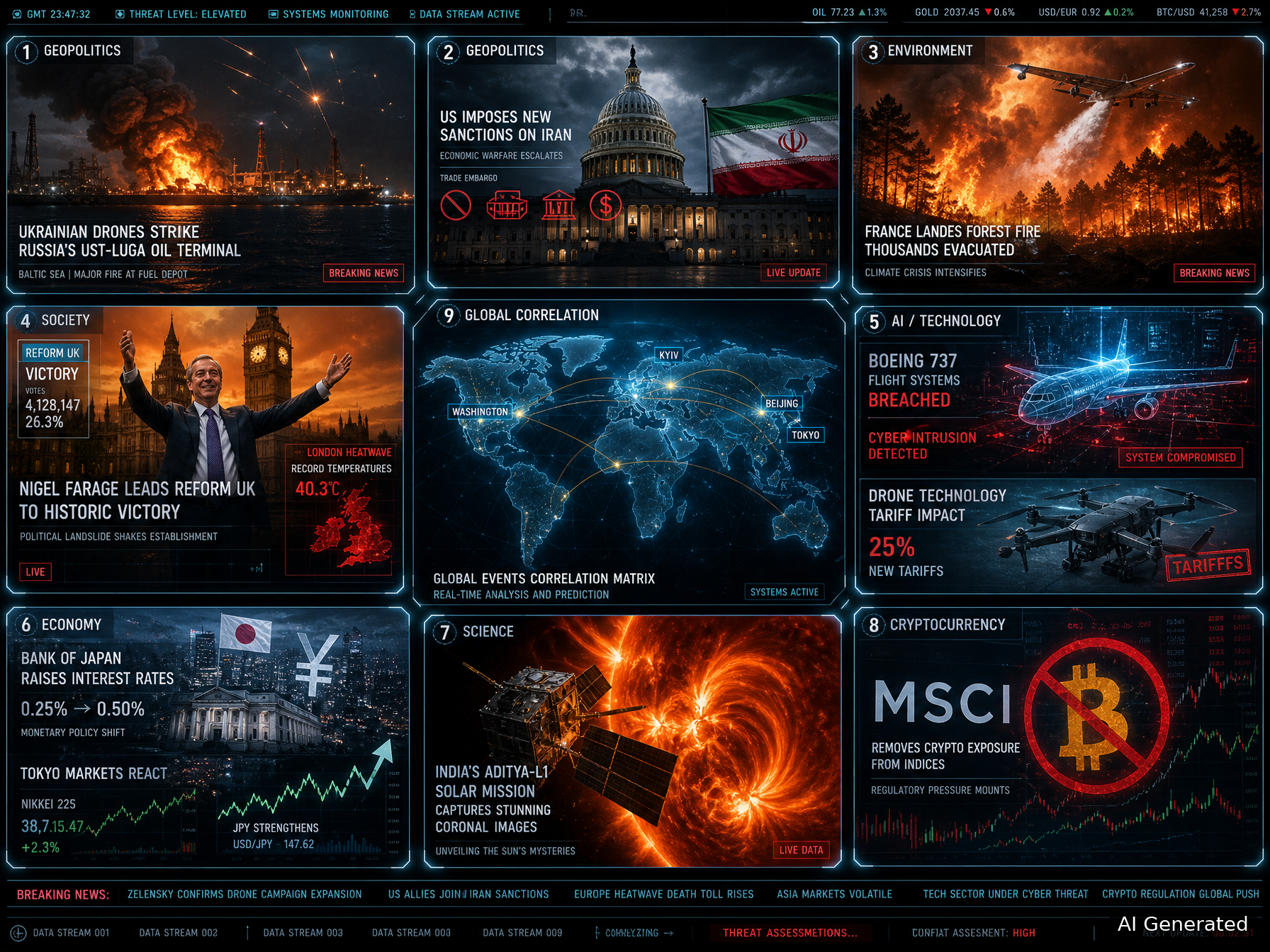
Ukraine’s campaign against Russian energy infrastructure escalated on the morning of August 14, when a fire broke out at the Russian port of Ust-Luga in the Leningrad region following a Ukrainian UAV attack. Governor Aleksandr Drozdenko confirmed the fire at 6:21 a.m., stating that air defense forces had allegedly intercepted 51 drones over the region[1]. The port — the second-largest seaport on the Baltic Sea and the terminus of the Baltic Pipeline System-2 — has now been hit multiple times since March 2026, when the first large-scale Ukrainian strike damaged oil-loading infrastructure[2]. The recurring attacks on Ust-Luga represent Ukraine’s most sustained campaign against Russian energy export infrastructure and threaten Russia’s ability to maintain its position as Europe’s primary oil supplier even as Western sanctions already constrain that trade.
Simultaneously, NATO fighter jets operating under the Baltic Air Policing mission shot down a “foreign drone” in Latvian airspace early on Friday morning. The Latvian armed forces attributed the drone’s entry to “Russian electromagnetic warfare” and confirmed it was intercepted over the Balvi region in eastern Latvia, near the Russian border[3]. The military deployed additional air defense units to eastern borders and warned that “as long as Russia’s aggression in Ukraine continues, a recurrence of cases where foreign drones enter or approach Latvian airspace is possible”[4]. The incident follows Romanian fighter jets shooting down three drones over just three days in July and a Ukrainian sea drone exploding in Romania’s Constanta port in June after electronic warfare interference — a pattern that has forced NATO to convene formal discussions about airspace security along its eastern flank[5].
US Threatens “Unprecedented Economic Isolation” Against Iran
The United States escalated its pressure campaign against Tehran on August 13-14, with Defence Secretary Pete Hegseth and Treasury Secretary Scott Bessent warning of “unprecedented economic isolation” if Iran does not reopen the Strait of Hormuz and comply with nuclear demands. The threat came as Iran rejected President Trump’s claim of “total control” over the Strait, with the Persian Gulf Strait Authority insisting that “claims don’t change reality”[6]. Washington is reportedly preparing to impose a complete ban on Iranian port access — a move that would represent the most comprehensive economic weapon deployed against a sovereign nation in modern history.
The economic pressure campaign intersects with broader energy security concerns. Russia faces renewed fuel shortages as Ukraine resumes strikes on its refineries, threatening to destabilize both global energy and food markets[7]. The compounding disruptions to both Russian and Iranian energy exports — the two largest non-OPEC supply sources facing conflict-related constraints — create a supply gap that could push oil prices significantly higher in the coming months. Vice President JD Vance characterized low fuel prices as the primary US strategic objective in the Iran conflict, revealing the domestic economic calculus underlying Washington’s military posture[8].
China and Iran Deepen Rare Earth Cooperation
In a development that could reshape critical mineral supply chains, China and Iran have selected rare earth exploration and processing as one of five areas for their latest joint scientific workshops, the National Natural Science Foundation of China announced[9]. The program comes as China faces growing international pressure over its control of rare earth mining and refining, and as Iran sits atop potentially significant but poorly understood rare earth deposits across roughly 7,000 square kilometers in central Iran. For China, the partnership expands its Belt and Road scientific links with a strategically positioned country; for Iran, it could provide access to the processing technology needed to develop domestic supply chains[10]. The timing is notable given that the US recently announced $3 billion in investments targeting critical mineral projects, and the rare earths cooperation could give China leverage over both military and civilian technology supply chains that Western manufacturers depend on.
Separately, Japan protested strongly against President Putin’s first visit to the disputed Northern Territories islands — known in Russia as the Kurils — prompting a diplomatic exchange that drew explicit US backing for Japanese sovereignty claims[11]. North Korea also reacted sharply to upcoming US-South Korea joint military drills, accusing Washington of pushing the world “to the brink of nuclear war”[12]. Turkey’s Foreign Minister Hakan Fidan threatened Israel with “harsh measures” alongside Egypt and Qatar during a meeting in El Alamein, signaling a broadening regional coalition against Israeli policies[13].
Environment & Climate
↑ ContentsFrance Under Siege: Landes Wildfire Forces 525 Evacuations; Germany’s Drought Deepens
France’s unprecedented wildfire season produced its latest emergency on August 14, when authorities evacuated 525 people from the village of Luglon in the southwestern Landes region as fire tore through pine forests, burning 1,100 hectares and advancing to within two kilometres of the village centre[14]. The blaze — located approximately 100 kilometres southeast of Arcachon Bay where megafires devastated over 50,000 hectares in late July — prompted the deployment of 500 firefighters and six aircraft. Regional official Gilles Clavreul warned that “the situation is unfavourable,” with temperatures expected to reach 36°C that afternoon[15]. The fire comes as France has already exceeded its previous record year for area burned (2022), with pine forests across the Landes — Europe’s largest planted forest — creating highly flammable conditions when dried by sustained heat. France’s tax system simultaneously suffered a confirmed cyberattack, with a malicious actor claiming responsibility for an intrusion into the Direction Générale des Finances Publiques systems, exposing taxpayer data[16]. The convergence of natural disaster and digital infrastructure compromise illustrates the compound vulnerabilities facing European states under simultaneous stress.
Germany’s drought crisis intensified as the country’s three major rivers — Rhine, Elbe, and Danube — hit historically low water levels, forcing ThyssenKrupp to reduce steel production at its Duisburg-Marxloh plant and threatening industrial output across the Rhine corridor[17]. The German Farmers’ Association warned of partial total crop failures, with wheat, potatoes and sugar beets bearing the brunt, and described the economic situation as “brutally tense”[18]. Germany’s Environment Minister Schneider pushed for immediate climate adaptation measures including solar-powered air conditioning in elderly care facilities, arguing that “Germany lies only geographically in a temperate zone”[19]. The Rhine’s low water has also disrupted barge shipping, forcing transport mode shifts to rail and truck while exposing decades of underinvestment in waterway maintenance. The policy battle over whether to re-engineer the rivers for navigation or restore them to natural flood-resilient states reflects a fundamental tension in German climate adaptation strategy that will define infrastructure spending for decades.
Greece Under Fire: West Nile Virus Surge and Wildfire Emergency
Greece’s public health system faces a dual crisis: West Nile virus infections have surged to 110 confirmed cases with nine deaths, placing the country alongside Italy as experiencing Europe’s largest outbreak of 2026[23]. The spike — 45 new cases in the past week alone — is concentrated in Attica, Thessaly, Central Macedonia, and the Peloponnese, with epidemiologists attributing the surge to milder winters and extended summers that expand mosquito breeding seasons. Simultaneously, Greek authorities declared August 13 as an extremely high fire risk day, closing public parks across Athens including Lycabettus Hill and the Field of Mars[22]. The convergence of disease outbreak and fire emergency illustrates how compound climate stress cascades across different domains simultaneously — heat amplifies both mosquito-borne disease transmission and wildfire ignition risk, while the infrastructure strain from fighting one crisis limits resources available for the other.
In the broader European context, France placed 75 departments under orange canicule (heatwave) alert, with the government estimating cumulative costs of successive extreme heat events at up to 15 billion euros[29]. The pattern extends to the UK, where the fifth heatwave of 2026 brought temperatures to 38.1°C in west London on August 13, triggering wildfires across the West Midlands and rail disruption. The compounding of drought, heat, fire, disease, and infrastructure stress across multiple European countries represents a systemic crisis that no single national framework is equipped to address — it demands coordinated European-level response mechanisms that do not yet exist.
Germany Auto Industry Employment Hits 21-Year Low; Industrial Drought Stress
Germany’s automobile industry — including manufacturers and suppliers — has shed employment to its lowest level since 2005, according to official statistics released on August 14[20]. The data reveals that the structural transformation of European automotive is accelerating as companies cut jobs in response to the electric vehicle transition, competition from Chinese manufacturers, and weakening export demand. The drought compounds these pressures by disrupting supply chains and increasing cooling water costs for energy-intensive production. Seven forest fires were reported in the Rhein-Main region near Frankfurt in a single day on August 12, with both deliberate arson and accidental ignition contributing to the surge in a landscape already primed for rapid fire spread[21]. The convergence of industrial decline, agricultural crisis, and persistent environmental stress creates what analysts are calling Germany’s most challenging economic quarter since the reunification era.
Society & Civil Issues
↑ ContentsNigel Farage Re-elected in Clacton Amid Reform UK Splits; UK Heatwave
Nigel Farage won the Clacton by-election on August 14 with 22,239 votes, defeating satirical candidate Count Binface, who received 9,455 votes — his best ever by-election performance at nearly 26% of the total[24]. The election, which Farage triggered himself after standing down amid a Parliamentary Standards investigation into his undeclared £5 million “gift” from a Thailand-based crypto billionaire, saw Labour, the Conservatives, Lib Dems, Greens and Restore Britain all boycott the contest. Reform UK immediately experienced internal recriminations after Farage failed to appear at the results declaration, citing a security threat that Essex Police subsequently contested[25]. Senior Reform figure Tim Montgomerie criticized the decision on X, calling it “puzzling” and urging Farage to be “the winsome happy warrior of old”[26].
The election occurred against a backdrop of UK infrastructure stress from the year’s fifth heatwave, which brought temperatures to 38.1°C in west London on August 13 — the hottest day of 2026. Multiple wildfires across the West Midlands burned several houses to the ground in what chief fire officer Simon Tuhill described as “one of the most significant” incidents the region’s fire service has ever dealt with[27]. A child and three firefighters were hospitalized. Rail services experienced widespread disruption with ground temperatures expected to exceed 50°C on exposed sections, prompting multiple operators to implement reduced timetables. The UK’s driest July on record means drought conditions now affect nearly three-quarters of England and all of Wales.
Nigeria and the Broader Migration Picture
The Mediterranean migration crisis continued to produce significant arrivals, with 574 migrants landing on Crete in just four days — 200 of them arriving on August 13 alone[28]. The arrivals underscore the shifting patterns of Mediterranean migration, with Greek islands increasingly becoming primary landing points. Separately, France’s ongoing extreme heat has placed 75 departments under orange vigilance, compounding the humanitarian challenges facing vulnerable populations during the summer[29]. The intersection of climate stress and migration pressures represents a compounding crisis that European states are struggling to address through existing institutional frameworks.
Meanwhile, US immigration detention facilities continue to face scrutiny, with reports of a surrogacy case that crossed state lines to circumvent Texas abortion restrictions becoming a political lightning rod. A nurse from Alaska who served as a surrogate refused to terminate a pregnancy after a fetal diagnosis of hypoplastic left heart syndrome, traveled to Texas, and gave birth — with the biological parents, the surrogate, and the Texas Attorney General all filing competing legal claims[30]. The case highlights the jurisdictional chaos created by the patchwork of US reproductive rights laws.
AI & Technology
↑ ContentsTrump Imposes 100% Tariffs on Sensitive Drones; Boeing 737 Flight System Hack Demonstrated
President Trump imposed tariffs of up to 100 percent on drones deemed “particularly sensitive” for national security on August 13, targeting imports of drones over 25 kilograms, those equipped with docking stations, and models with thermal imaging capabilities — a category that encompasses commercial models from DJI and others used in power line inspection, crop spraying and search and rescue operations[31]. Drones under 25kg will face a 25 percent tariff, with a 15 percent levy on EU, Japanese, Korean, Swiss and Taiwanese models where components are primarily made in those countries, and 10 percent on UK drones. The White House stated the aim was to encourage “on-shoring” of drone components and to close a loophole allowing companies to buy Chinese components and assemble them in the US. As with smartphone manufacturing, China’s drone industry benefits from localized supply chains, specialized factories, and engineering expertise that the US cannot replicate quickly[32].
In a separate security development, researchers from the University of California San Diego demonstrated at the USENIX Security Symposium how a small hardware device connected to a Boeing 737’s maintenance interface could alter data on the aircraft’s ARINC 429 data buses — hardwired systems that carry information between avionics components without authentication[33]. The researchers showed that the device could manipulate flight path information and weight calculations in under 60 seconds of physical access to an electronics bay. Boeing 737s account for roughly a quarter of Delta’s fleet, more than half of United’s, and all of Southwest’s fleet. The vulnerability exposes a class of physical-access threats that aviation cybersecurity has historically downplayed in favour of network-based concerns.
Apple Trains AI Model for China with Alibaba Backing; Apple Warns of Mercenary Spyware
Apple has trained an AI model specifically for the Chinese market, with Alibaba providing backing for the initiative, according to Financial Times reports on August 14[34]. The company plans to introduce a range of AI tools in China in coming months, representing a significant strategic move as Apple competes with local Chinese AI providers and navigates Beijing’s regulatory requirements for AI deployment. The development signals Apple’s willingness to make substantial concessions to Chinese regulatory demands in order to maintain access to the world’s largest smartphone market.
Separately, Apple sent notifications to targets of mercenary spyware attacks, continuing its practice of alerting users who have been identified as targets of sophisticated surveillance operations[35]. The Trump administration meanwhile announced plans to allow private firms to conduct offensive cyber operations against foreign adversaries and transnational criminal organizations, representing a significant expansion of the US cyber posture beyond government agencies[36].
The FBI expanded its cooperation with China and Russia to combat international crime, a move that generated controversy given ongoing tensions with both nations[37]. The expansion of international law enforcement cooperation during a period of strategic competition reflects the practical necessity of transnational crime-fighting even as geopolitical relationships deteriorate.
Economy & Business
↑ ContentsBOJ Eyeing September Rate Hike; Japan Intervention Continues
The Bank of Japan is preparing to raise interest rates as soon as September and is considering hiking more aggressively than its current pace of roughly twice a year, three sources familiar with the central bank’s thinking told Reuters on August 14[38]. The move would reflect growing alarm over price pressures from the Middle East conflict, strong global AI demand, and a persistent yen downtrend despite last month’s rare Japan-US joint intervention. “An early rate hike has come into sight,” one source said, signalling a strong chance the BOJ will act at its September 17-18 policy meeting. Two-year Japanese government bond yields, which are most sensitive to the BOJ’s policy outlook, rebounded after the report, while five-year yields rose to a record high. Markets are now pricing in nearly an 80% chance of a rate hike in September, with some analysts suggesting the BOJ could squeeze in another increase in December, raising the prospect of quarterly tightening.
The yen’s weekly loss has put further intervention on traders’ radar, with the currency’s weakness threatening to push import costs and inflation higher across the Japanese economy. The BOJ’s decision to accelerate tightening would represent a significant shift from the ultra-loose monetary policy that defined Japanese economic strategy for decades, and could trigger significant capital flows as the world’s third-largest economy normalizes its interest rate framework. A September rate hike would open scope for the BOJ to squeeze in another increase in December, which would heighten market views it could hike around once every quarter. This accelerated tightening would represent the most aggressive monetary policy shift in Japan since the end of Abenomics, and could trigger significant capital reallocation across Asian asset markets as the yen-carry-trade dynamic reverses.
The correlation with D61’s coverage of Japan’s yen intervention ($95.55 billion across two days in late July) is essential: the intervention bought time but did not reverse the structural yen weakness driven by rate differentials with the US. Now that the BOJ is signalling faster tightening, markets face a potential inflection point where the world’s third-largest economy begins normalizing monetary policy at a pace that could trigger significant capital reallocation across Asian asset markets. This connects to D72’s observation about the “three central bank dilemma” — the BOJ, ECB and Fed all navigating between inflation control and growth preservation simultaneously.
German Auto Industry Hits 21-Year Low; DAX Companies Post Record Results
Germany’s automobile industry — including both manufacturers and their supply chain — has shed employment to its lowest level since 2005, official statistics confirmed on August 14[39]. The data reveals the structural transformation of European automotive is accelerating as companies cut jobs in response to the EV transition, Chinese competition, and weakening export demand. Simultaneously, DAX companies have posted record combined revenue and profit figures, creating a bifurcation in the German economy between sectors benefiting from structural drivers like data centre spending and those facing secular decline. WirtschaftsWoche reported that while the largest German companies are achieving best-ever performance, the industrial manufacturing base continues to shed positions at an accelerating rate. The auto industry employment figures represent a particularly significant marker because German automotive has historically been the backbone of the country’s export-driven economic model.
German Wholesale Price Index rose 5.3% year-over-year in July, up from 4.9% in June, while the month-over-month figure shifted from -0.7% to +0.2%[40]. The data adds to evidence that inflationary pressures remain embedded in the European economy despite central bank efforts to contain them. Germany’s Farmers’ Association warned of partial total crop failures from drought conditions, describing the agricultural economic situation as “brutally tense” as wheat, potatoes and sugar beets face catastrophic yield reductions. The combination of industrial decline, agricultural crisis, and persistent inflation creates a policy trilemma for German policymakers who must simultaneously address energy costs, climate adaptation, and economic restructuring.
India’s Wholesale Inflation Eases; Global Economic Signals Mixed
India’s wholesale inflation eased to 9.78% in July as fuel price increases cooled, though food inflation rose to 6.65% from 6.14% in June[41]. The data reflects the uneven transmission of global energy price shocks across emerging market economies, where food security concerns compound energy cost pressures. The Tata Group is preparing for succession as family members and top executives emerge as contenders to lead Tata Sons, with Tata Steel’s TV Narendran, Tata Power’s Praveer Sinha, and others considered for the position[42]. Goldman Sachs is in discussions with potential investors regarding Nvidia’s $500 billion AI funding plan, while Apple has begun discussions about introducing AI tools in China with Alibaba’s backing[43]. These developments underscore the continuing divergence between AI-driven investment enthusiasm and the more measured pace of broader economic recovery, creating what some analysts describe as a “two-speed global economy” where technology-driven growth coexists with stagnation in traditional sectors.
Science & Space
↑ ContentsIndian Solar Mission Reveals New Findings on Sun’s Corona; Meditation and Brain Waste Clearance
India’s solar mission has produced new findings that illuminate enduring mysteries about the Sun’s corona — the outermost atmospheric layer that paradoxically maintains temperatures millions of degrees hotter than the solar surface[44]. The mission’s instruments are providing unprecedented data on the mechanisms that sustain this temperature inversion, which has puzzled solar physicists for decades. The research builds on the August 12 total solar eclipse observations, when NASA scientists stationed in Iceland chased the Moon’s shadow in a WB-57 high-altitude jet to image the corona in visible and infrared light. The next total solar eclipse will occur on August 2, 2027, with totality crossing southern Spain, North Africa, Saudi Arabia, and Yemen.
In neuroscience, a 2025 Vanderbilt University study has demonstrated that focused-attention meditation can produce cerebrospinal fluid dynamics remarkably similar to those observed during sleep — even while practitioners remain fully awake[45]. The study measured CSF motion through the cerebral aqueduct in 23 experienced meditators, finding that during focused attention, the average breathing rate fell from 13.0 to 10.4 breaths per minute and heart rate declined from 73.0 to 67.8 beats per minute. Crucially, the reduction in CSF motion came mainly from less regurgitant flow — the back-and-forth movement associated with aging and neurodegeneration — while low-frequency CSF fluctuations near the skull base strengthened, resembling the alternating blood-and-CSF pattern seen during non-REM sleep. The researchers stressed that the findings do not demonstrate that meditation prevents or treats Alzheimer’s disease, but they provide the first direct evidence that a deliberately maintained waking state can modulate the brain’s fluid maintenance machinery.
World’s Largest All-Electric Plane Completes Maiden Flight; CesiumAstro Acquisition
Heart Aerospace’s 25,000-pound X1 demonstrator aircraft completed its maiden flight on August 12 over Plattsburgh, New York, in a 27-minute FAA-certified test[46]. The flight marks the world’s largest all-electric airplane reaching the skies, representing a significant milestone in the electrification of aviation. Meanwhile, CesiumAstro — a phased-array antenna specialist — acquired semiconductor company Jariet Technologies to boost its in-house capabilities behind plans for a future communications constellation[47]. The acquisition reflects the continuing consolidation in the space technology sector as companies seek vertical integration to serve growing demand for satellite communications infrastructure. South Africa’s Tiyani Secondary School demonstrated a creative approach to renewable energy by using cattle dung to generate biogas for cooking meals for over 1,000 students, reducing pressure on local forests while providing a model for community-scale clean energy in rural areas[48].
Crypto, Digital Assets & Blockchain
↑ ContentsMSCI Proposes Excluding Bitcoin Treasury Firms from Global Indexes
Index provider MSCI has opened a new consultation that could exclude “non-operating companies” — a classification that would capture major bitcoin treasury firms Strategy (MSTR) and Metaplanet (3350) — from its Global Investable Market Indexes[49]. The proposed two-step screen would first check whether operating assets exceed 50 percent of total assets; companies failing this threshold face a secondary screen using five financial ratios. If applied to current data, the screen would have resulted in the removal of Strategy — which holds 840,447 BTC worth $53.18 billion — Metaplanet with 43,000 BTC, and uranium holder Yellow Cake. MSCI’s description of non-operating companies reads like a checklist of bitcoin treasury firms: companies that “create value by accumulating and holding non-operating assets,” generate little cash from operations, and depend on outside capital. Feedback runs through September 30, with any changes taking effect no earlier than the November 2026 review.
The consultation follows an earlier October 2025 proposal that specifically targeted “digital asset treasury” firms holding 50% or more in crypto — a rule that was ultimately deferred after triggering market volatility and industry backlash. This time, MSCI has broadened the classification beyond crypto-specific criteria, potentially affecting any company whose business model centres on asset accumulation rather than operational activity. For Strategy CEO Michael Saylor, who has described his company as “the central bank of bitcoin,” the proposal represents the most significant institutional structural threat since the firm began its aggressive accumulation strategy.
CFTC Sets August 20 Crypto Talks; SEC Cancels Meeting; CLARITY Act Faces September Vote
The Commodity Futures Trading Commission will convene its inaugural Innovation Advisory Committee meeting on August 20 to examine crypto regulation, AI and prediction markets, as Congress delays action on broader digital asset market structure legislation[50]. The agenda explicitly lists “opportunities to modernize existing rules using current statutory authority” and areas where regulatory action can “complement future congressional legislation” — wording that stops short of creating the CLARITY Act through regulation but signals the agency’s intent to act within existing powers. The three-hour public meeting follows the SEC’s cancellation of its August 14 crypto offering meeting without announcing a replacement date. The CLARITY Act itself faces a September 15 Senate cloture vote on the motion to proceed, with the 60-vote threshold still uncertain as Republican Senator Hawley reportedly plans to oppose the bill.
JPMorgan Chase shuttered its banking relationship with Polymarket in late 2025 over regulatory concerns, according to the Financial Times[51]. The decentralized prediction market platform had reentered the US market following the Trump administration’s loosening of federal rules, but JPMorgan told Polymarket in October 2025 that it would need to secure a different banking partner. Ironically, JPMorgan subsequently invited Polymarket CEO Shayne Coplan to address a private client conference in February 2026 and is reportedly angling to underwrite any future IPO — illustrating the tension between compliance caution and business ambition at the world’s largest bank.
Morgan Stanley Discloses XRP ETF Holdings; SEC Delays Tokenization Exemption
Morgan Stanley disclosed holdings in three XRP ETFs through its Q2 2026 SEC 13F filing — the Franklin XRP ETF (6,715 shares), REX-Osprey XRP ETF (255 shares), and Bitwise XRP ETF (67 shares)[52]. The Wall Street giant also revealed 50,540 shares in Ripple-backed Evernorth Holdings’ SPAC Armada Acquisition Corp II. While the holdings are small relative to Morgan Stanley’s $1.9 trillion portfolio, the inclusion signals growing institutional interest in XRP products. Spot XRP ETFs recorded $2.25 million in inflows on Thursday, though total assets under management dropped to $942.25 million after surpassing $1.25 billion earlier.
Meanwhile, the SEC has reportedly delayed its planned tokenization innovation exemption, with details unlikely to be released soon[53]. The delay may be linked to ongoing negotiations over Section 10505 of the CLARITY Act, which covers tokenized securities. Separately, Tether completed its long-promised “Big Four” audit with KPMG issuing an unqualified opinion on the finances behind its $180 billion USDT stablecoin — a milestone for an industry that has long struggled with trust and transparency concerns[54]. Bitcoin traded near $63,300 as regulatory delays offset the positive sentiment from the Bank of Japan’s potential September rate hike, which could boost yen-carry-trade-driven risk appetite.
Correlations & Analysis
↑ ContentsThe D75 reporting period captures a moment when the compound crises documented across D68-D74 are producing structural consequences that extend across energy security, monetary policy, financial index methodology, and NATO airspace doctrine simultaneously. The most significant geopolitical development is the dual expansion of Ukraine’s energy infrastructure campaign — with the Ust-Luga port fire marking the latest strike against Russia’s Baltic export infrastructure — combined with the US announcement of “unprecedented economic isolation” against Iran[1][6]. These two developments, occurring within hours of each other, create a scenario where global energy supply faces simultaneous constraints from both the world’s largest nuclear-armed state and one of OPEC’s most strategically positioned members. The correlation with D74’s coverage of Houthi attacks on Saudi shipping in the Red Sea is critical: the maritime security architecture that D74 described as a “standoff” has now expanded into an active multi-theatre conflict affecting both the Strait of Hormuz and the Red Sea corridor.
The NATO drone shootdown over Latvia — the second such interception over Latvian airspace in 2026, following a French Rafale interception in June — establishes a pattern of airspace violations that NATO has now formally recognized as a systemic challenge rather than isolated incidents[3][4]. D66 first identified drone incursions over German Bundeswehr facilities as an emerging threat vector; D67 documented the UK’s fifth heatwave stressing infrastructure; D74 reported unknown drones over Australia’s RAAF Williamtown. Today’s Latvian shootdown, combined with Romanian fighter jets downing three drones in three days during July and a Ukrainian sea drone exploding in Constanta, demonstrates that NATO’s eastern flank is experiencing a sustained campaign of airspace probing that tests alliance cohesion and response capabilities in real time.
The BOJ’s potential September rate hike — accelerating from twice-yearly to potentially quarterly tightening — represents the most significant monetary policy shift in Japan since the end of Abenomics[38]. The correlation with D61’s coverage of Japan’s yen intervention ($95.55 billion across two days in late July) is essential: the intervention bought time but did not reverse the structural yen weakness driven by rate differentials with the US. Now that the BOJ is signalling faster tightening, markets face a potential inflection point where the world’s third-largest economy begins normalizing monetary policy at a pace that could trigger significant capital reallocation across Asian asset markets. This connects to D72’s observation about the “three central bank dilemma” — the BOJ, ECB and Fed all navigating between inflation control and growth preservation simultaneously.
In the crypto domain, MSCI’s proposal to exclude bitcoin treasury firms from its Global Investable Market Indexes creates a new structural risk for Strategy (MSTR), Metaplanet, and similar companies whose business models centre on asset accumulation rather than operational activity[49]. The correlation with D74’s coverage of Strategy’s $8.2 billion Q2 loss is critical: if MSCI removes these firms from its indexes, passive investment vehicles that track MSCI benchmarks would be forced to liquidate positions, creating downward pressure on share prices precisely when the companies are already under financial strain. This represents a potential new chapter in the institutional adoption narrative that has driven crypto markets throughout 2026.
What to watch in the next reporting period: The CFTC’s Innovation Advisory Committee meeting on August 20 will signal whether the agency intends to act on crypto regulation through existing authority while the CLARITY Act stalls in Congress. The BOJ’s September 17-18 policy meeting will determine whether Japan accelerates monetary tightening and whether the yen responds positively to the anticipated rate hike. NATO’s response to continued drone incursions along its eastern flank will test whether the alliance can maintain operational cohesion under sustained probe conditions. And France’s wildfire season — with 1,100 hectares burned in Landes and multiple departments under orange alert — will determine whether Europe’s fire response capacity can keep pace with an accelerating crisis that shows no signs of abating.
References
↑ ContentsRussia Reports Fire at Ust-Luga Port Following UAV Attack Source ↩
Russia Reports Fire at Ust-Luga Port Following UAV Attack by Militarnyi ↩
NATO Baltic Air Policing jets shoot down drone over Latvia Source ↩
NATO Baltic Air Policing jets shoot down drone over Latvia Source ↩
NATO allies discuss drone incursions by Euronews/NATO statement ↩
Σε επ’ αόριστον αποκλεισμό των ιρανικών λιμανιών προσανατολίζονται οι ΗΠΑ Source (originally in Greek) ↩
Russia faces renewed fuel shortages as Ukraine resumes attacks on refineries Source ↩
JD Vance: Primary target in war is low fuel prices Source (originally in Greek) ↩
China, Iran team up to explore and process rare earths amid global supply race Source ↩
China, Iran team up to explore and process rare earths Source ↩
Οι ΗΠΑ στο πλευρό της Ιαπωνίας μετά την επίσκεψη Πούτιν στις Κουρίλες νήσους Source (originally in Greek) ↩
North Korea fumes over upcoming US-South Korea military drills Source ↩
Φιντάν απειλεί Ισραήλ: Σκληρά μέτρα εναντίον του μαζί με Αίγυπτο & Κατάρ Source (originally in Greek) ↩
France evacuates hundreds as new wildfire threatens southwestern Landes region Source ↩
France evacuates hundreds by France 24/Reuters ↩
Le système d’information des impôts victime d’un piratage informatique Source (originally in French) ↩
Gefahr durch Niedrigwasser: Industrie im Trockenstress Source (originally in German) ↩
Landwirtschaft: Bauernverband befürchtet teils totalen Ernteausfall Source (originally in German) ↩
Vorstoß von Umweltminister Schneider: Klimaanpassung jetzt! Source (originally in German) ↩
Beschäftigung in der Industrie: Deutsche Automobilbranche hat geringste Mitarbeiterzahl seit 2005 Source (originally in German) ↩
Rhein-Main-Gebiet: Feuerwehren kommen kaum noch zur Ruhe Source (originally in German) ↩
Αττική: Έκλεισαν για τους επισκέπτες Λυκαβηττός, Πεδίο του Άρεως και λόφος Φινοπούλου Source (originally in Greek) ↩
Συναγερμός στον ΕΟΔΥ για τον ιό του Δυτικού Νείλου: 45 κρούσματα Source (originally in Greek) ↩
Nigel Farage beats Count Binface to regain UK parliamentary seat Source ↩
Reform UK Splits Burst Into Open Despite Nigel Farage’s Clacton By-Election Victory Source ↩
Now Farage has won his by-election, we can ask: what was the point of that? Source ↩
UK firefighters out in force to tackle fires on hottest day of the year Source ↩
Μεταναστευτικό: 574 αφίξεις στην Κρήτη μέσα σε τέσσερις ημέρες Source (originally in Greek) ↩
Canicule: 75 départements toujours en vigilance orange Source (originally in French) ↩
ΗΠΑ: Παρένθετη αρνήθηκε την άμβλωση και γέννησε μωρό με σπάνια καρδιοπάθεια Source (originally in Greek) ↩
Trump slaps a 100 percent tariff on heavy and ‘sensitive’ drones Source ↩
Trump slaps a 100 percent tariff on heavy and ‘sensitive’ drones Source ↩
Tiny device hacks Boeing 737 flight systems, alters routes in under 60 seconds Source ↩
Apple to introduce range of AI tools in China in coming months Source ↩
Apple sends out warnings to targets of mercenary spyware attacks Source ↩
Trump Admin Lets Loose the Cyber Pirates Source ↩
FBI expands cooperation with China and Russia to combat international crime Source ↩
BOJ eyeing September rate hike, faster pace of tightening, sources say Source ↩
Arbeitsmarkt: Mitarbeiterzahl der deutschen Autoindustrie sinkt auf den niedrigsten Stand seit 2005 Source (originally in German) ↩
FinancialJuice: German Wholesale Price Index YoY Actual 5.3% Source ↩
Wholesale inflation eases to 9.78% in July as fuel price rise cools Source ↩
Family members, top executives, emerge as contenders to lead Tata Sons Source ↩
Goldman Sachs in discussions with potential investors on Nvidia’s $500 billion AI funding plan Source ↩
Indian solar mission’s new findings throw light on enduring Sun mysteries Source ↩
Meditation CSF Dynamics Resemble Sleep Brain Waste Clearance Source ↩
World’s largest all-electric plane completes maiden flight Source ↩
CesiumAstro buys semiconductor specialist to boost constellation plans Source ↩
South Africa school uses cattle dung to generate biogas for cooking meals Source ↩
Bitcoin holders Strategy and Metaplanet face stock-index exclusion under MSCI’s new proposal Source ↩
CFTC sets Aug. 20 crypto talks as CLARITY vote waits Source ↩
JPMorgan shuttered its banking relationship with predictions platform Polymarket: FT Source ↩
XRP News: Morgan Stanley Discloses New Holdings in XRP ETFs, Evernorth SPAC Source ↩
SEC Delays Tokenization Exemption as CLARITY Act Talks Take Priority Source ↩
Gemini Reports $107.7M Q2 Loss; Tether completes Big Four audit Source ↩
AI Disclosure: This post was created with the assistance of artificial intelligence. The ideas, analysis, and opinions expressed are my own — AI was used to help compose, structure, and refine my personal notes and thoughts into the final written content. Images, videos and music featured in this post were also generated using AI tools, based on my own creative prompts and direction.