

Contents
- 1. Geopolitics & Defence
- Dry Bulk Ship Hit Near Strait of Hormuz as US-Iran Talks Stall
- US Navy Reclassifies Virginia-Class Submarines as SSGNs
- Germany Weighs State Acquisition of KNDS After Failed IPO
- Pentagon Policy Chief Presses NATO Allies on European Defense Burden
- Qatar, Egypt, and Turkey Condemn Israeli Strikes on Gaza
- Bolivia Cartel Violence Escalates as Nine Killed in Santa Cruz
- Sevastopol Soldier Opens Fire as Ukraine War Takes Toll on Both Shores
- 2. Environment & Climate
- 3. Society & Civil Issues
- 4. AI & Technology
- 5. Economy & Business
- BP Reports Highest Profits in Four Years as War Drives Oil Revenue
- Copper Approaches $14,000 as US Tariff Fears Reshape Markets
- European Bond Funds Gain as Global Risk Increases
- Shein Targets $40 Billion Hong Kong IPO; KNDS Acquisition Underway
- Trump Tariffs Face Legal Challenge; Global Markets React
- 6. Science & Space
- 7. Crypto, Digital Assets & Blockchain
- Bitcoin Holds Near $63,600 as US-Japan Yen Intervention Tests Markets
- Bhutan GMC Deploys Bitcoin Treasury with Market-Neutral Strategy
- CLARITY Act May Miss Senate Vote Before August Recess
- Ledger CTO Warns Against Rushing to Multisig Solutions
- ETH and XRP Navigate Critical Levels as ETF Flows Show Divergence
- Solana Foundation Launches Institutional Hiring Push
- 8. Correlations & Analysis
- 9. References
Click any heading to jump to that section. Click the section heading to return to this menu.
Daily Intelligence Briefing — 2026-08-04 (D65)
Geopolitics & Defence
Dry Bulk Ship Hit Near Strait of Hormuz as US-Iran Talks Stall
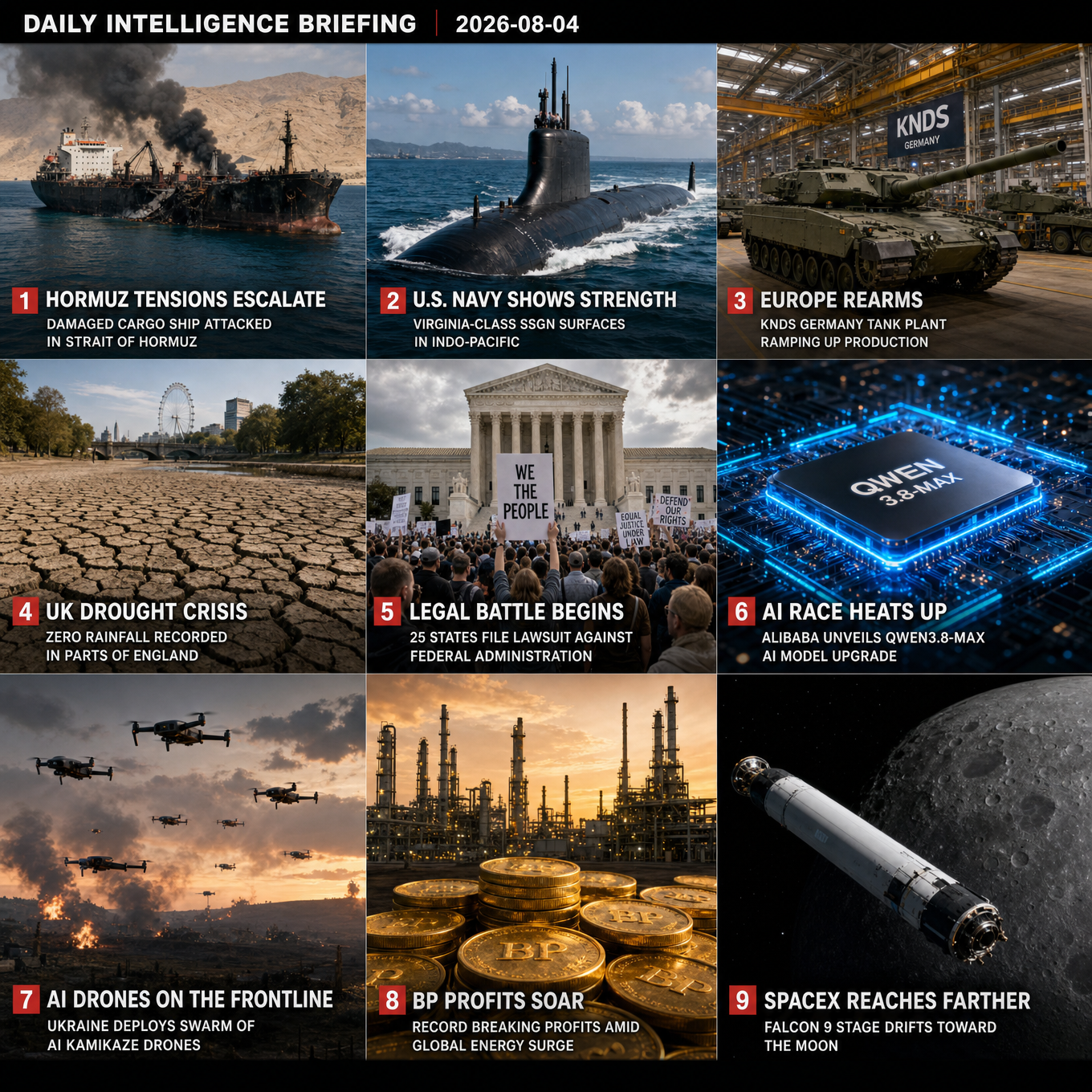
A dry bulk ship was struck by a projectile near the Strait of Hormuz on Monday, forcing crew members to abandon the vessel with one seafarer reported missing, according to maritime security sources monitoring the region[1]. The attack occurred despite the diplomatic process that President Trump announced on Sunday — direct US-Iran negotiations focused on reopening the Hormuz waterway and establishing a framework to end the five-month military confrontation[2]. The gap between Washington’s optimistic framing and Tehran’s categorical denial of any deal — “no agreement of any kind has been reached” — now looks even more consequential in light of this latest maritime incident[3]. The vessel’s abandonment follows a pattern of escalating maritime violence that has persisted even as diplomatic channels opened, with the explosion near a commercial tanker southeast of Muscat reported just hours before the attack on this bulk ship. The UKMTO and international shipping authorities have now documented at least four separate incidents in the Gulf of Aden and Strait of Hormuz region within the last 72 hours, suggesting that kinetic military activity is accelerating despite — or perhaps because of — the diplomatic uncertainty[4].
The commercial shipping crisis continues to ripple through global supply chains. Saudi Aramco reported that July attacks on its assets had no material impact on operations, but the company is simultaneously working to expand oil export capacity as the Strait of Hormuz remains disrupted[5]. Iran’s war has wiped out approximately 2.6 billion barrels of oil supply from global markets according to new estimates, representing one of the largest supply shocks since the 1973 Arab oil embargo[6]. Trump has responded to the crisis by slamming oil companies for “making too much money” from the disruption, demanding that ExxonMobil and Chevron “give some of that back to the public” — a statement that sent shockwaves through energy markets[7]. The combination of military escalation in the waterway, diplomatic impasse, and presidential hostility toward energy majors creates a uniquely volatile environment for global oil markets.
US Navy Reclassifies Virginia-Class Submarines as SSGNs
The United States Navy has formally reclassified 19 Virginia-class submarines equipped with the Virginia Payload Module as guided-missile and special-operations submarines — a designation previously reserved for converted Ohio-class boats[8]. The reclassification acknowledges the dramatically expanded strike capacity that the Payload Module delivers, enabling these submarines to carry a far larger weapons loadout than standard Virginia-class attack submarines while retaining full stealth capabilities. Vice Admiral Rob Gaucher, Director of Submarine Programs, called the move “a clear acknowledgment of the increased lethality VPM brings to the undersea fight” and confirmed that the reclassified vessels will support Distributed Maritime Operations and high-end warfare across global theaters[8].
The announcement coincides with the inactivation of USS Georgia, one of the four Ohio-class submarines that has served as the primary guided-missile platform for decades. Chief of Naval Operations Admiral Daryl Caudle described the transition as occurring “at an important moment” as the Ohio-class platforms age out of service, with the Virginia-class SSGNs inheriting “greater survivability, adaptability, and sustained combat power” — language that directly addresses concerns about the Pentagon’s ability to maintain undersea superiority as China and Russia invest in next-generation submarine programs[8]. The first submarine under the new classification is expected to be delivered in fiscal 2029, with all 19 planned deliveries continuing through fiscal 2038. This reclassification represents the most significant reorganization of the US undersea fleet since the conversion of Ohio-class SSBNs into SSGNs in the early 2000s, and signals that Washington views the submarine force as the centerpiece of its long-range precision strike strategy.
Germany Weighs State Acquisition of KNDS After Failed IPO
Germany’s Bundesregierung and the European defense manufacturer KNDS are in confidential negotiations over a potential full state acquisition of the Franco-German tank builder, after the company’s planned initial public offering collapsed amid valuation disputes[9]. KNDS, formed from the merger of Krauss-Maffei Wegmann and Nexter, produces the Leopard 2 main battle tank and other major armored platforms that form the backbone of several European armies. The failed IPO and subsequent state acquisition discussions reflect the broader challenge facing European defense industrial policy: the political imperative to scale production capacity rapidly conflicts with the financial realities of capital-intensive manufacturing. Insiders report that multiple options are being considered, including a full government buyout, a strategic partnership with additional sovereign backing, or a restructured IPO with revised terms[9].
Meanwhile, Rheinmetall — another German defense giant — made an aggressive push into the naval market with the unveiling of the GMF 140, a new guided-missile frigate displacing over 6,000 tons with 64 VLS cells and AEGIS Combat System integration[10]. The 140-meter vessel appears designed specifically to compete in North American naval procurement, targeting the US Navy’s next-generation frigate program and Canadian destroyer requirements. Rheinmetall’s entry into large warship construction follows its acquisition of Naval Vessels Lürssen and represents a major expansion beyond the company’s traditional land-based armored vehicle business. HENSOLDT, another German defense firm, announced a contract for equipping dismounted Joint Fire Support Teams, further illustrating how German industry is scaling to meet the defense spending demands articulated at the recent NATO Summit[11].
Pentagon Policy Chief Presses NATO Allies on European Defense Burden
Under Secretary of War for Policy Elbridge Colby completed a week of meetings with defense leaders from Germany, Britain, Italy, and Romania, laying the groundwork for a comprehensive review that could reshape American troop levels in Europe and who pays for the continent’s defense going forward[12]. Colby’s tour comes as the Pentagon pushes NATO allies to take on greater responsibility for European security, a longstanding US demand that has acquired new urgency as Washington redirects strategic attention to the Indo-Pacific and manages simultaneous military commitments in the Middle East and Ukraine theaters. The review will examine force posture, basing arrangements, and cost-sharing formulas — areas where the US has long demanded more equitable burden-sharing but has been reluctant to reduce its own presence[12].
In London, Prime Minister Andy Burnham faces the challenge of translating his ambitious domestic political agenda into defense credibility. The Defence Investment Plan, with nearly £300 billion of planned investment, reflects a “fundamental shift” from legacy weapons systems toward autonomous and expendable platforms — but delivery remains the defining test[13]. Former Defense Secretary John Healey, now Chancellor, has signaled a break from the previous government’s reluctance to increase defense spending, but the pipeline from budget commitment to operational capability remains the critical bottleneck. Former Ukrainian Armed Forces chief Valerii Zaluzhnyi stated bluntly that Ukraine should abandon its NATO membership aspirations and seek new forms of alliance — a sobering assessment from the man who led Ukraine’s military resistance[14].
Qatar, Egypt, and Turkey Condemn Israeli Strikes on Gaza
The governments of Qatar, Egypt, and Turkey issued a joint statement on Monday condemning fresh Israeli military operations in the Gaza Strip, accusing Israel of “continuing violations” of the ceasefire agreement brokered by the three countries in October 2025[15]. The joint statement, backed by all three mediators, cited recent bombardments that Palestinian sources said killed more than twenty people, including strikes on health infrastructure and civilian areas. The coordinated diplomatic push from all three sponsors of the ceasefire agreement represents a significant escalation in Middle Eastern diplomatic pressure on Israel, with the three countries characterizing the attacks as a “flagrant violation of international law” — language deliberately calibrated to invoke binding legal obligations rather than mere political objections.
The ceasefire violations compound the broader geopolitical instability created by the Iran war. With the US simultaneously managing negotiations with Tehran, supporting Israel in Gaza, and defending Gulf allies from Iranian retaliation, Washington’s diplomatic bandwidth is stretched across multiple overlapping crises. The Qatar-Egypt-Turkey statement also reflects the shifting dynamics within the region: Turkey’s increasingly assertive diplomatic posture, Egypt’s role as a ceasefire guarantor, and Qatar’s financial leverage over reconstruction efforts all converge to create pressure that cannot be easily dismissed by Washington or Tel Aviv[15].
Bolivia Cartel Violence Escalates as Nine Killed in Santa Cruz
At least nine people were killed in five days of violence in Bolivia’s Santa Cruz department, in what authorities attributed to clashes between Brazilian criminal organizations — the PCC and the Red Command — competing for control of cocaine trafficking routes[16]. The Interior Ministry confirmed that four murders occurred in rural areas, two decapitated individuals were found near a road, and three additional deaths including a police officer resulted from the escalating violence. The government of President Rodrigo Paz reported the seizure of 58 small aircraft, 360 properties, and nearly 300 tons of cocaine since taking office in November, along with the destruction of 190 illegal landing strips — figures that underscore the industrial scale of narcotics production in South America’s third-largest cocaine producer[16].
Sevastopol Soldier Opens Fire as Ukraine War Takes Toll on Both Shores
An unidentified Russian soldier killed at least four people, including three civilians, in the Black Sea city of Sevastopol in Russian-annexed Crimea on Tuesday, in the second deadly incident on the Crimean Peninsula within 48 hours[17]. The shooting occurred one day after six civilians, including three children, were killed in what local authorities attributed to a Ukrainian drone attack on a beach at the Russian resort town of Gelendzhik — a strike that represented a further expansion of Ukraine’s targeting of Russian civilian areas in retaliation for Moscow’s own attacks on Ukrainian population centers[17]. Denmark’s ambassador to the United Nations stated that Russian strikes have become “increasingly brutal,” while on the other side of the border, what appeared to be drone strikes hit a busy beach area, killing seven according to local authorities who blamed Kyiv for the attack. The Sevastopol shooting — seemingly unrelated to the drone war but occurring against the same backdrop of military stress — suggests the psychological toll that sustained conflict places on both civilian and military populations in contested territories.
Environment & Climate
UK Records First Month With Zero Rainfall as Drought Deepens
Parts of the United Kingdom have experienced zero rainfall for the entire month of July for the first time in their history, with London’s Kew Gardens — hosting a Met Office weather station since 1871 — recording no measurable precipitation whatsoever[18]. Heathrow Airport recorded 42 consecutive days without rain, setting a new record since monitoring began in 1948, while the village of Stratfield Mortimer near Reading also saw its first-ever rainless July. At least 20 Met Office stations across southern England saw zero rainfall for the month, spanning Lincolnshire, Dorset, Kent, Greater London, Essex, Surrey, Hampshire, and the Isle of Wight — an unprecedented cluster of completely dry locations that underscores the severity of the drought gripping the country[18]. The Met Office described July 2026 as “truly exceptional,” with England and Wales enduring their driest July in 190 years.
The drought’s economic and ecological consequences are mounting. The University of Reading’s Stephen Burt noted that some areas in the Reading region had received no measurable rainfall since continuous records began in 1858 — nearly 170 years ago — while rainfall across southern England averaged just 1.5 millimetres for July, representing just 2 per cent of the 1991–2020 average. Mean temperatures ran 3.2°C above normal for the period. Jeff Da Costa at the University of Reading warned of a “really substantial” risk of severe flash flooding when rain finally returns, noting that soils across the region have become hardened and crusted, and reservoirs are already stressed — conditions that make the eventual return of rainfall itself a hazard rather than a relief[18]. The drought crisis extends across Europe, with the Rhine low enough to curtail German shipping and the Danube forcing Hungarian and Romanian nuclear power plants to reduce output due to insufficient cooling water[19].
French July 2026 Was Hottest Month Ever Recorded
July 2026 was confirmed as the hottest month ever recorded in France since systematic measurements began in 1900, with Météo-France also identifying it as the third-least-rainy July on record[20]. The extreme conditions produced record-low soil moisture levels with significant consequences for agriculture and wildfire risk across the country. The announcement comes as France continues to battle active wildfires, with a new blaze in the Drôme department threatening “several hundred” hectares and mobilizing 300 firefighters[21]. The fire follows the massive Gironde and Var conflagrations that have defined the summer, and illustrates the compounding crisis that occurs when record heat meets drought conditions across multiple departments simultaneously. French firefighters are increasingly deploying AI-assisted cameras for early fire detection and monitoring, an application of technology that may prove essential as climate-driven fire seasons become longer and more intense[22].
Spokane Wildfire: Arson Arrest as 65,000 Evacuated
Police in Washington state arrested a 37-year-old man on suspicion of starting a wildfire that burned through more than 3,200 hectares near Spokane, forcing the evacuation of approximately 65,000 people and destroying an estimated 700 buildings[23]. The arrest represents a disturbing trend in which wildfires increasingly appear to have human origins — whether through deliberate arson, equipment failure, or negligence — at a time when drought conditions and extreme temperatures make any ignition catastrophic. Firefighters continued to battle the flames after the arrest, with containment remaining elusive as the fire continued to advance through the city’s neighborhoods. The Spokane disaster illustrates the compound risk that American cities now face: the combination of drought, heat, urban development in fire-prone zones, and the growing possibility of human-caused ignition.
The crisis extends across the western United States, where California’s Sacramento Valley aquifer system has suffered what scientists describe as irreversible damage from rapid groundwater extraction during successive drought years[24]. A study published in PNAS found that land subsidence above the aquifer — the ground surface dropping as underground water storage capacity is permanently lost — accelerated to as much as 50 centimetres per year after 2021, compared to just 2 centimetres annually in preceding years. The loss of aquifer storage capacity is estimated at 0.2 cubic kilometres per year — equivalent to approximately 30 per cent of Los Angeles’s annual water consumption — and represents a structural constraint on California’s ability to buffer future droughts. The researchers concluded that satellite monitoring could have detected the transition earlier, but that remediation opportunities have already been lost.
South Korea Heatwave Kills 16 as Asian Heat Crisis Deepens
A record-breaking heatwave in South Korea killed at least 16 people, adding to the mounting toll from extreme temperatures across East Asia[25]. The deaths — primarily among elderly and vulnerable populations — came as temperatures across the Korean peninsula exceeded previous records, continuing a pattern of intensifying heat events that climate scientists have linked to the ongoing El Niño pattern layered on long-term warming trends. In Japan, three lions at Tokyo’s Tama Zoological Park died from suspected heatstroke, with ten of the sixteen big cats in the facility exhibiting symptoms including loss of appetite and reduced activity since mid-July[26]. The deaths — unusual for a species adapted to warm climates — underscore the exceptional nature of the current heat conditions across the region, where humidity compounds temperature stress to produce lethal conditions for both human and animal populations.
European Nuclear Plants Under Heat Stress
Multiple nuclear power plants across Europe reduced operations or shut down temporarily due to extreme heat conditions that compromised cooling water systems, with the Danube’s historically low levels forcing Hungarian and Romanian facilities to curtail production[19]. The plants rely on river water for cooling, and when temperatures rise and water levels drop simultaneously, the intake water becomes too warm to meet safety regulations. The shutdowns highlight a vulnerability in Europe’s energy infrastructure that few had anticipated: the continent’s nuclear fleet, designed to provide reliable baseload power, becomes a casualty of the very climate conditions it is meant to help mitigate. The combination of nuclear plant shutdowns, river-borne shipping restrictions, and wildfire-related infrastructure damage creates a cascading crisis that tests Europe’s energy resilience from multiple directions simultaneously.
Sri Lanka was also hit by severe weather, with heavy rains triggering floods and mudslides that killed at least five people and forced the closure of schools nationwide[27]. The devastation illustrates the other end of the climate spectrum — while Europe and East Asia bake under unprecedented heat, parts of South Asia experience the destructive extreme of the same atmospheric instability, with the Indian Ocean monsoon producing dangerous rainfall events that compound existing vulnerability in densely populated delta and hillside regions.
Society & Civil Issues
25 States Sue Trump Administration Over New Tariffs
Twenty-five US states filed a lawsuit against the Trump administration on Monday, challenging the legality of the president’s sweeping new tariffs — which they contend are merely a pretext to reinstate import taxes that were previously struck down by the Supreme Court[28]. The coalition of state attorneys general argued that the tariffs exceed presidential authority under current trade law and represent an unconstitutional exercise of taxing power reserved to Congress. The lawsuit comes as the economic impact of the tariffs continues to ripple through supply chains, raising costs for consumers and creating uncertainty for businesses across multiple sectors. The legal challenge is likely to reach the Supreme Court and could determine whether the executive branch retains broad tariff authority under existing trade statutes or whether the judiciary will impose new limits on presidential trade powers.
Burnham Tightens UK Prisoner Release Scheme, Excluding Sexual Offenders
Prime Minister Andy Burnham intervened to tighten his own prisoner early-release scheme, excluding those convicted of rape, serious child sexual offences, and grooming from the program — reducing the total from an original 6,000 to approximately 5,000 prisoners over ten months starting in October[29]. Justice Secretary Alex Norris explained that ministers would have liked to block more offenders but doing so would cause the prison system to “break.” The announcement came amid fierce public debate over prisoner release, with victims’ groups and the opposition arguing the changes still don’t go far enough. The political calculation illustrates the impossible balancing act facing the new government: maintaining public safety while preventing a prison infrastructure collapse that could trigger a humanitarian crisis.
Simultaneously, a UK government agency suffered a significant data breach, adding to the series of cybersecurity incidents that have plagued public sector organizations across Europe[30]. The breach underscored the persistent vulnerability of government digital infrastructure even as officials debate responses to other security challenges including cyber warfare, migration crises, and domestic terrorism threats.
Turkey Arrests Opposition CHP Mayor in Izmir
Turkish authorities arrested the CHP (Republican People’s Party) mayor of the Menderes district in Izmir on Monday, continuing a pattern of legal actions against opposition politicians that has intensified ahead of anticipated elections[31]. The arrest represents the latest in a series of detentions of CHP figures, which have been widely characterized by international observers and human rights organizations as politically motivated crackdowns on Turkey’s main opposition party. The crackdown extends the broader trend of democratic backsliding that has defined Turkey’s political landscape during President Recep Tayyip Erdoğan’s tenure, with critics pointing to the selective prosecution of opposition figures, journalists, and civil society members as evidence of systematic erosion of political pluralism.
Social Media Rumors Drive Ceuta Migration Crisis Toward 60,000
Social media rumors claiming that Spanish borders were open drove approximately 60,000 Moroccans toward the Spanish exclave of Ceuta in what has become the largest migration crisis between Morocco and Spain in years[32]. Multiple migrants testified they were told they could cross and insisted it was not traffickers who led them there, contradicting the narrative promoted by some officials. The crisis exposed serious control failures and raised questions about whether the viral posts represented organic misinformation or deliberate manipulation — possibly by state or non-state actors seeking to test European border security or destabilize the Schengen area. With thousands of migrants still in Ceuta and the EU emergency session expanding to include defense officials, the crisis has catalyzed a fundamental European debate about the weaponization of migration that now extends beyond the previous Belarus-Poland model into genuinely unprecedented territory.
AI & Technology
Alibaba Launches Qwen3.8-Max, Claiming GPT-5.6 Competitiveness
Alibaba’s Qwen AI research team unveiled Qwen3.8-Max, a 2.4-trillion-parameter mixture-of-experts multimodal model that the company claims outperforms GPT-5.6 Sol Max on the OSWorld-Verified benchmark measuring autonomous computer use, posting a score of 86.1 versus OpenAI’s 83.2[33]. If the benchmarks hold up under independent testing, Qwen3.8-Max would represent the most competitive Chinese frontier model released to date, with Alibaba announcing plans to release open weights next week alongside a smaller 27-billion-parameter variant. The model launches at $2/$6 per million input/output tokens — less than a quarter of the combined price of GPT-5.6 Sol Max — and positions Alibaba to compete directly with American AI labs in the rapidly expanding market for enterprise agentic systems[33].
The significance of Qwen3.8-Max extends beyond benchmark competition. Alibaba’s announcement of open weights — even if the license terms remain undisclosed — signals a strategic commitment to competing with US models not just on performance but on accessibility and deployment flexibility. The model’s claimed capability to autonomously complete software projects lasting more than ten days and perform iterative chip-design optimization targets the enterprise market segment where Anthropic’s Claude and OpenAI’s GPT families have established early leads. The pricing structure, at less than one-third the combined input/output cost of Claude Opus 5, represents direct competitive pressure that could reshape enterprise AI procurement decisions across Asia and beyond[33]. Palantir CEO Alex Karp, speaking after his company delivered $1 billion in quarterly profit, called the AI industry “Marxist” — a provocative framing that reflects growing tension between AI labs and the enterprise customers who must decide whether to trust them[34].
Ukraine Deploys AI-Powered Kamikaze Drones at Scale
Ukrainian forces have begun receiving Shrike drones equipped with AI-powered autonomy hardware developed by US company Auterion, with plans to deliver 50,000 AI-upgraded strike drones in the coming months[35]. The upgrade allows human operators to manually fly the first-person-view drones into a battlefield area, designate a target up to half a mile away, and “flip the switch” to autonomous fire-and-forget terminal guidance mode — transforming cheap, expendable weapons into precision instruments that can operate beyond the range of radio control. The Shrike drones, manufactured by Ukrainian company SkyFall, cost approximately $400 each and have already demonstrated the ability to destroy Russian armored vehicles and even military helicopters using their explosive payloads.
The integration of AI into Ukraine’s drone warfare represents one of the most significant real-world tests of autonomous weapons technology in history. The combination of mass-production economics — 50,000 AI-enabled drones at roughly $400 each represents a total investment of about $20 million — and genuine battlefield effectiveness is fundamentally altering the cost calculus of modern warfare. The system’s architecture also points toward future capabilities: once individual drones can autonomously track and engage targets, the coordination of multiple drones into coordinated swarm attacks becomes a relatively modest additional engineering challenge. The implications for both military doctrine and arms control policy are profound, as this represents the first large-scale deployment of AI-directed lethal autonomous systems in a conventional interstate conflict.
Expressive Humanoid Robots Build Trust Rapidly but Fail Catastrophically
Researchers at Drexel University published findings showing that expressive humanoid robots generate rapid trust formation in human subjects — but that trust collapses dramatically when the robots make errors, particularly when errors violate social expectations rather than technical ones[36]. The study, the first to simultaneously measure brain activity, hormone levels, self-reported attitudes, and behavior during human-robot interactions, found that participants processing mistakes by an expressive robot showed activation in brain regions associated with social reasoning and intentionality detection — essentially treating the robot’s conversational errors as social betrayals rather than technical glitches. The finding has significant implications for the deployment of humanoid robots in healthcare, education, customer service, and home environments, where the very expressiveness designed to make them engaging may make them more emotionally damaging when they inevitably fail.
The physiological finding proved equally significant: oxytocin — commonly associated with social bonding — increased after robot mistakes even as trust declined, suggesting that in human-robot interactions, the hormone functions as a vigilance signal heightening attention to unreliable social behavior rather than indicating attachment. The researchers concluded that robot designers “shouldn’t look at likeability in isolation” and must account for neurobiology when engineering social robots. As humanoid robots move from laboratory demonstrations to commercial deployment, the tension between making them socially engaging and preventing catastrophic trust collapse becomes a critical design constraint.
WhatsApp Suffers Major Outage; OPM Breach Victims Seek Lifetime Protection
WhatsApp, the Meta-owned messaging platform with more than three billion users globally, experienced a major outage preventing users from sending photographs, disrupting communication for millions across multiple countries[37]. The outage highlighted the continued vulnerability of global digital infrastructure to single-point failures in systems that governments, businesses, and individuals increasingly rely upon for essential communication. In the United States, new bicameral legislation proposed lifetime identity protection for the 22 million people affected by the Office of Personnel Management breaches disclosed a decade ago, after current protection programs began expiring without renewal[38]. Senate Intelligence Committee Vice Chair Mark Warner emphasized that foreign intelligence services can hold onto OPM records for years, combining them with data from other cyber intrusions to identify and target government personnel — risks that grow over time as lower-level employees move into sensitive national security roles.
Economy & Business
BP Reports Highest Profits in Four Years as War Drives Oil Revenue
BP reported profits of $5.73 billion for the second quarter of 2026 — the highest quarterly result in four years — as elevated oil prices driven by the Iran war and Strait of Hormuz disruption boosted energy sector revenues across the board[39]. Environmental groups accused the company of profiteering from the conflict, while BP announced an increased dividend as a reward for shareholders. The results underscore how the geopolitical conflict that has disrupted global shipping and raised consumer energy costs has simultaneously delivered a windfall to the companies supplying that energy. President Trump attacked ExxonMobil and Chevron for “making too much money” from the war’s market disruption, demanding they “give some of that back to the public” — a statement that sent ripples through energy markets and raised questions about potential government intervention in pricing or taxation[40].
The broader oil market picture reflects the collision between geopolitical risk premium and fundamental supply adjustments. Brent crude has fallen below $84 per barrel from peaks above $126 reached during the height of military escalation, as diplomatic prospects improved and OPEC+ confirmed a production increase of approximately 500,000 barrels per day starting September 1[41]. The cartel’s shift from supply management toward volume competition represents a significant strategic pivot that could push Brent below $80 if Iranian exports resume simultaneously. Iran’s war has wiped out an estimated 2.6 billion barrels of supply from global markets — one of the largest supply shocks in modern energy history — creating a deficit that any production increase will take months to offset[42].
Copper Approaches $14,000 as US Tariff Fears Reshape Markets
Copper advanced to its highest level in two months, approaching $14,000 per tonne on the London Metal Exchange, as traders monitored ballooning volumes of the metal held in US warehouses ahead of an expected decision on an import tariff by President Trump[43]. The metal’s surge reflects a broader commodities rally driven by the intersection of supply constraints, geopolitical disruption, and anticipation that new tariffs could create a premium differential between US and global prices. The copper market’s sensitivity to tariff policy illustrates how the administration’s trade measures continue to reshape commodity flows worldwide, with material being redirected to US storage facilities in anticipation of import restrictions that could take effect at any time.
European Bond Funds Gain as Global Risk Increases
European bonds are emerging as a preferred choice for fund managers navigating an increasingly fraught global backdrop, with the US-German long-dated yield gap hitting its widest level in a year during July[44]. The shift reflects a reassessment of relative risk: European sovereign debt benefits from the ECB’s more conservative monetary posture, the eurozone’s lower fiscal deficit trajectory, and the perception that European policy frameworks provide better protection against the political volatility affecting US markets. The flows into European fixed income represent one of the clearest asset allocation shifts resulting from the Iran conflict, with investors seeking jurisdictions perceived as less directly exposed to the military confrontation and its secondary effects on trade policy.
The Dax rose to a new record high above 26,000 points, reflecting a market that appears to have priced in the worst-case scenarios for the Iran conflict and is now benefiting from the combination of OPEC production increases, diplomatic progress, and strong corporate earnings[45]. The Bank of Korea’s minutes revealed that board members discussed further rate hikes, adding to the hawkish sentiment that has characterized central bank communications across multiple jurisdictions as inflation concerns persist despite the economic headwinds created by geopolitical instability[46].
Shein Targets $40 Billion Hong Kong IPO; KNDS Acquisition Underway
Fast-fashion giant Shein is reportedly planning a Hong Kong initial public offering targeting a valuation of approximately $40 billion — significantly below the company’s earlier private-market valuations[47]. The listing, expected as early as August, comes amid the company’s ongoing efforts to address regulatory concerns about labor practices, environmental impact, and data privacy across its global supply chain. The IPO timing reflects the broader trend of Chinese companies seeking capital in Hong Kong markets as geopolitical tensions have made US and European listings increasingly complicated. In a parallel move, Germany’s confidential negotiations over the potential state acquisition of KNDS — the Franco-German tank manufacturer — illustrate how defense companies are being restructured through sovereign intervention rather than market mechanisms in an era when defense spending is expanding but private capital markets remain hesitant about the sector’s long-term revenue visibility[48].
Trump Tariffs Face Legal Challenge; Global Markets React
Twenty-five US states sued the Trump administration on Monday, contending that the president’s tariffs are merely a pretext to reinstate import taxes previously struck down by the Supreme Court[49]. The legal challenge creates immediate uncertainty for businesses that have been planning around the tariff regime, with potential implications for consumer prices, supply chain configurations, and the broader trajectory of global trade policy. The lawsuit also raises fundamental constitutional questions about the extent of presidential authority over trade — questions that markets and businesses have been trying to price in for months as the administration’s tariff strategy has escalated in scope and scale.
BP’s record profits, combined with the broader oil sector windfall, have intensified political pressure across multiple jurisdictions. In the UK, renewed calls for a windfall tax on banks emerged after HSBC reported $10.1 billion in second-quarter profits — a 60 per cent year-on-year increase driven by higher interest rates and wealth management fees[50]. Campaigners argued the levy could raise £19 billion to support Andy Burnham’s cost-of-living agenda, while the bank’s results illustrated how the conflict-driven monetary environment has simultaneously benefited financial institutions and burdened ordinary consumers.
Science & Space
SpaceX Falcon 9 Stage to Impact Moon on Wednesday
A defunct Falcon 9 upper stage from a 2022 SpaceX mission is predicted to impact the far side of the Moon on Wednesday, creating a crater that will be studied by lunar orbiters as evidence of the growing problem of space debris in cislunar space[51]. The impact — occurring on the far side of the Moon where it cannot be observed directly from Earth — will be monitored by NASA’s Lunar Reconnaissance Orbiter and India’s Chandrayaan-2 orbiter. The event marks the latest in a series of uncontrolled lunar impacts that underscore the accelerating accumulation of orbital debris in a region that has seen increasing commercial and governmental activity. NASA has acknowledged the predicted impact and indicated that the resulting crater could provide valuable data about lunar surface composition, though the circumstances of its creation — an unintended consequence of commercial space activity — highlight governance gaps in cislunar space.
Phoenix Species Project Announces $200 Million for Biodiversity
A new fund called the Phoenix Species Project announced $200 million in funding to help imperiled species recover from the brink of extinction, representing one of the largest private biodiversity conservation investments in history[52]. The fund’s creation comes amid a global biodiversity crisis that scientists have described as the sixth mass extinction event, with species loss accelerating across every continent and ocean basin. The investment will target species recovery programs that combine habitat protection, captive breeding, and genetic interventions — approaches that require sustained funding over multi-decade timelines. The announcement reflects a growing recognition among philanthropic and institutional investors that biodiversity loss poses not only ethical but also systemic economic risks, as ecosystem services underpin agricultural productivity, water security, and climate resilience for billions of people.
The environmental picture remains dominated by the ongoing wildfire and drought crisis across multiple continents. In France, AI-assisted monitoring systems are being deployed to provide earlier fire detection and faster response times, representing a practical application of artificial intelligence technology that could prove essential as climate change extends fire seasons and increases fire intensity across the Mediterranean, Pacific Northwest, and Australian bushfire zones[53]. The integration of AI into environmental monitoring represents one of the more constructive applications of emerging technology, offering capabilities that match the scale of the challenge in ways that traditional monitoring cannot.
Crypto, Digital Assets & Blockchain
Bitcoin Holds Near $63,600 as US-Japan Yen Intervention Tests Markets
Bitcoin traded near $63,600 on Monday as markets absorbed the rare coordinated US-Japan intervention to support the yen, with Japan reportedly spending as much as $36.6 billion buying yen in the first joint action to support the currency since 1998[54]. The intervention tested carry-trade dynamics that have been a primary driver of cryptocurrency volatility, as the unwinding of leveraged positions funded by cheap yen borrowing typically generates cascading liquidations across risk assets. Bitcoin’s relative resilience during the yen stabilization action suggests that the market has absorbed the carry-trade unwind — or at least that the most aggressive leveraged positions have already been flushed from the system through the repeated price disruptions of recent weeks.
The cryptocurrency’s price action continues to be dominated by the tension between macro-economic drivers and fundamental market structure. Bitcoin must clear $65,000 before Friday’s US jobs report, or the combination of three Fed officials already voting for a rate hike and strong ISM Manufacturing PMI data at 55.6 could turn $62,000 from a support floor into “a trapdoor to $60,000,” according to analysis from CryptoSlate[55]. The ISM data — beating the 54.0 consensus and posting the highest reading since May 2022 — has strengthened the hand of Fed officials Beth Hammack, Neel Kashkari, and Lorie Logan who dissented on the July rate decision and pushed for an immediate 25-basis-point hike.
Bhutan GMC Deploys Bitcoin Treasury with Market-Neutral Strategy
Gelephu Mindfulness City (GMC), Bhutan’s planned economic hub that announced a 10,000 BTC treasury pledge, has commissioned 3iQ to manage a portion of its bitcoin holdings on a market-neutral basis — a significant departure from the passive buy-and-hold strategy that has characterized most government or quasi-governmental crypto treasury operations[56]. The shift to active management of the treasury reserves suggests that GMC’s planners view bitcoin not merely as a long-term national reserve asset but as a yield-generating instrument that can be actively deployed. The approach raises questions about counterparty risk, custody arrangements, and the extent to which market-neutral strategies can maintain neutrality during periods of extreme volatility.
CLARITY Act May Miss Senate Vote Before August Recess
The US Senate has not scheduled a vote on the CLARITY Act cryptocurrency regulatory framework before the August recess, despite the bill having passed the House and cleared key Senate committees[57]. The Blockchain Association sent a new letter to Senate leaders defending the bill against claims from law enforcement organizations that it could weaken anti-money-laundering enforcement, while former CFTC Chairman J. Christopher Giancarlo warned that continued delay risks ceding regulatory clarity to other jurisdictions — particularly the European Union under its MiCA framework. The procedural stalemate leaves the cryptocurrency industry in regulatory limbo, with market participants operating under inconsistent rules across federal and state jurisdictions while foreign competitors benefit from clearer regulatory frameworks.
Ledger CTO Warns Against Rushing to Multisig Solutions
Ledger CTO Charles Guillemet urged Bitcoin users not to rush into adopting multisig wallets following the recent Coldcard security incident, arguing that multisig is “not always the right answer” and carries its own operational risks that may exceed those of single-signature setups for many users[58]. The Coldcard firmware attack, which affected devices connecting to the internet during the compromised update window, had reignited debate about the security of hardware wallet solutions and the self-custody model more broadly. Guillemet’s caution reflects a pragmatic assessment that the operational complexity of multisig — requiring multiple devices, backup procedures, and coordination between key holders — may introduce new failure modes that offset the security benefits for all but the most sophisticated users.
ETH and XRP Navigate Critical Levels as ETF Flows Show Divergence
Bitcoin ETFs attracted over $170 million in net inflows on Monday — nearly matching the entire positive figure for July — while Ethereum ETFs recorded modest outflows of $11.4 million despite their strong $365 million performance in July[59]. The divergence suggests a rotation dynamic in which institutional capital is flowing from ETH into BTC positions, possibly driven by the perception that Bitcoin’s macro-driven price action offers a cleaner risk profile than Ethereum’s more complex supply-and-demand dynamics. XRP ETFs extended their non-red streak with $1.15 million in gains, while Solana and Dogecoin funds saw no reportable activity. Meanwhile, XRP holders gained access to RLUSD borrowing through a $280 million vault on Ethereum that had previously never accepted an XRP-linked asset, expanding the DeFi utility case for the token[60].
Solana Foundation Launches Institutional Hiring Push
The Solana Foundation opened senior positions including a General Manager of AI Ecosystem, Head of Stablecoins, Director of Institutional Growth, and regional institutional growth leads for Greater China and Japan, signaling a strategic pivot from meme-coin origins toward institutional infrastructure[61]. The hires target what the Foundation views as critical gaps in its ecosystem: on-chain AI intelligence, dollar-pegged stablecoin liquidity, and institutional capital onboarding in the two largest Asian markets. The AI ecosystem hire is particularly notable, as few blockchain foundations have committed a dedicated senior executive to AI integration, despite the growing intersection of decentralized computing, AI agents, and Web3 applications.
Correlations & Analysis
The D65 reporting period reveals a world caught between the gravitational pull of established crisis patterns and the emergence of new structural dynamics. The dry bulk ship hit near Hormuz — occurring hours before scheduled US-Iran negotiations were to begin — crystallizes the central paradox of the current moment: the diplomatic process designed to end the maritime blockade is itself being undermined by the very violence it seeks to resolve. This dynamic mirrors what D64 identified as the gap between Trump’s optimistic framing and Tehran’s categorical denial, but now with kinetic consequences. The ship’s crew abandonment and the missing seafarer represent not merely a maritime security incident but a test of whether diplomatic frameworks can establish credibility while the military contest remains active[1][2][3].
The economic fallout from the Iran war has created a paradoxical market environment in which the largest losers — European energy consumers, global supply chains, and shipping companies — are being compensated for by the largest winners — BP, ExxonMobil, and the sovereign wealth funds of Gulf states. Trump’s attack on oil companies for profiting from his own war represents a political rupture that the energy markets have barely begun to price in. If the administration moves from rhetoric to action — whether through windfall taxes, export restrictions, or forced price controls — the implications extend far beyond the energy sector into the broader credibility of American economic governance. The 25-state lawsuit over tariffs, the UK bank tax proposals, and the KNDS state acquisition in Germany all point in the same direction: a global trend toward direct government intervention in markets that were previously considered off-limits[40][42][48].
Europe’s cascading infrastructure failures — nuclear plant shutdowns, aquifer collapse, drought-driven shipping restrictions, and record wildfire damage — represent the compounding effect that D63 and D64 identified as a systemic risk. The UK’s first-ever rainless month, France’s hottest July on record, and South Korea’s sixteen heat deaths all demonstrate that the 2026 summer is not an anomaly but the new operating environment. What is new in D65 is the emergence of irreversible damage as a concept: California’s Sacramento Valley aquifer has lost storage capacity that cannot be recovered on any human timescale, meaning that the state’s water infrastructure has been permanently degraded[24][18][19].
The AI landscape shifted significantly with Alibaba’s Qwen3.8-Max, which claims to outperform GPT-5.6 Sol Max on autonomous computer use — the benchmark that most directly measures the kind of enterprise automation capability that companies like Palantir are selling. The open-weight announcement, even without disclosed licensing terms, creates competitive pressure that OpenAI, Anthropic, and Google must address not just technically but economically: Qwen’s pricing at less than a quarter of GPT-5.6 Sol Max’s combined cost makes it an immediate option for any enterprise evaluating frontier model deployment[33][34]. Meanwhile, Ukraine’s deployment of 50,000 AI-guided kamikaze drones demonstrates that the gap between AI research and lethal application has essentially closed, with $400 weapons now capable of autonomous target tracking and engagement[35].
What to watch in the next reporting period: The outcome of Monday’s US-Iran negotiations — now shadowed by the dry bulk ship attack — will determine whether the diplomatic process survives its first concrete test. The CLARITY Act’s fate before the August recess will signal whether the US cryptocurrency industry receives regulatory clarity before international competitors establish dominant positions. California’s aquifer collapse study will likely intensify calls for federal water management reform. And the question of whether Trump’s hostility toward oil companies translates into policy action will determine whether the energy sector’s windfall becomes a permanent feature or a temporary aberration[1][57][24].
References
1. “Crew Members Abandoned Dry Bulk Ship Hit Near Hormuz, One Seafarer Missing” — FinancialJuice / Maritime Security Sources, 2026-08-04. link ↩
2. “Trump Confirms US-Iran Negotiations to Begin Monday on Hormuz Reopening” — France 24, 2026-08-03. link ↩
3. “Iran Rejects Any Deal, Says Hormuz Strait Will Stay Closed” — Euronews, 2026-08-03. link ↩
4. “Commercial Ships Approached by Small Craft in Gulf of Aden” — Lloyd’s List, 2026-08-03. link ↩
5. “Aramco Says July Attacks Had No Material Impact on Operations” — Financial Post / Bloomberg, 2026-08-04. link ↩
6. “Iran War Wipes Out 2.6B Barrels of Oil Supply” — CryptoBriefing, 2026-08-04. link ↩
7. “Trump Slams Oil Companies for ‘Making Too Much Money’ From His War on Iran” — The Guardian, 2026-08-04. link ↩
8. “U.S. Navy Reclassifies 19 Virginia Payload Module-Equipped Submarines as SSGNs” — Defence-Industry.EU, 2026-08-04. link ↩
9. “Rüstung: Übernimmt der Staat den Panzerbauer KNDS komplett?” — Handelsblatt, 2026-08-04. link (originally in German) ↩
10. “Rheinmetall GMF 140 Frigate” — Flight.com.gr, 2026-08-04. link (originally in Greek) ↩
11. “HENSOLDT to Supply Equipment for Dismounted JFST” — European Security & Defence, 2026-08-04. link ↩
12. “US Pushes NATO Allies to Take on More of Europe’s Defense” — Defence Blog, 2026-08-04. link ↩
13. “Burnham’s Real Defence Challenge Will Be Delivery” — UK Defence Journal, 2026-08-04. link ↩
14. “Β.Ζαλούζνι: Η Ουκρανία πρέπει να αναζητήσει νέες συμμαχίες” — DefenceNet.gr, 2026-08-04. link (originally in Greek) ↩
15. “Κατάρ, Αίγυπτος και Τουρκία καταδικάζουν τα νέα ισραηλινά πλήγματα στη Γάζα” — DefenceNet.gr, 2026-08-04. link (originally in Greek) ↩
16. “Βολιβία: Τουλάχιστον εννέα νεκροί σε συγκρούσεις καρτέλ” — DefenceNet.gr, 2026-08-04. link (originally in Greek) ↩
17. “Russian Civilians Killed in Crimea as Ukraine War Takes Its Toll on Black Sea Shores” — France 24, 2026-08-04. link ↩
18. “Parts of the UK Endure First Ever Month Without Any Rain” — New Scientist, 2026-08-04. link ↩
19. “En Europe, plusieurs centrales nucléaires à l’arrêt face aux canicules” — France 24, 2026-08-04. link (originally in French) ↩
20. “Juillet 2026 a été le mois le plus chaud jamais enregistré en France” — Le Monde, 2026-08-04. link (originally in French) ↩
21. “Drôme : un feu de forêt menace ‘plusieurs centaines’ d’hectares” — Le Parisien, 2026-08-04. link (originally in French) ↩
22. “Incendies en France : l’intelligence artificielle vient en aide aux pompiers” — France 24, 2026-08-04. link (originally in French) ↩
23. “US Arrests Suspect Over Spokane Wildfire as Tens of Thousands Flee Blaze” — Al Jazeera, 2026-08-04. link ↩
24. “California’s Drought Has Now Caused Irreversible Damage to a Crucial Aquifer” — ScienceAlert / PNAS, 2026-08-04. link ↩
25. “Record-Breaking Heatwave in South Korea Leaves at Least 16 Dead” — The Independent, 2026-08-04. link ↩
26. “Suspected Heatstroke Kills Three Lions at Japan Zoo” — Euronews, 2026-08-04. link ↩
27. “Sri Lanka Closes Schools as Heavy Rains Trigger Floods and Mudslides, Killing at Least Five” — Euronews, 2026-08-04. link ↩
28. “Full List: The 25 States Suing Trump Administration Over New Tariffs” — The Independent, 2026-08-04. link ↩
29. “About 1,000 Fewer Prisoners to Get Early Release as Burnham Tightens Rules” — The Guardian, 2026-08-04. link ↩
30. “UK State Investments Agency Data Breach” — The Guardian, 2026-08-02. link ↩
31. “Türkei: Oppositioneller Bürgermeister in Izmir festgenommen” — Die Zeit, 2026-08-04. link (originally in German) ↩
32. “Social Media Rumours Spark Biggest Migration Crisis Between Morocco and Spain in Years” — Euronews, 2026-08-04. link ↩
33. “Qwen3.8-Max Arrives with a Bold Claim: It Outperforms GPT-5.6 Sol Max and Fable 5 on Agentic Computer Use” — VentureBeat, 2026-08-04. link ↩
34. “After Killer Quarter, Palantir CEO Alex Karp Calls AI Industry ‘Marxist’” — TechCrunch, 2026-08-04. link ↩
35. “US Company’s AI Lets Ukraine’s Cheap Kamikaze Drones Track Targets on Their Own” — Ars Technica, 2026-08-04. link ↩
36. “Expressive Humanoid Robots Build Trust, but Errors Trigger Rapid Confidence Loss” — Interesting Engineering / Drexel University, 2026-08-04. link ↩
37. “WhatsApp Down: App Stops Sending Photos in Major Outage” — The Independent, 2026-08-04. link ↩
38. “OPM Breach Victims Could Get Identity Protection for Life” — Defense One, 2026-08-04. link ↩
39. “BP Profits Highest in Four Years as Iran War Pushes Up Oil Price” — BBC News, 2026-08-04. link ↩
40. “Trump Slams Oil Companies for ‘Making Too Much Money’” — The Guardian, 2026-08-04. link ↩
41. “OPEC+ Confirms September Production Increase of 500,000 Barrels Per Day” — Reuters, 2026-08-03. link ↩
42. “Iran War Wipes Out 2.6B Barrels of Oil Supply” — CryptoBriefing, 2026-08-04. link ↩
43. “Copper Marches Closer to $14,000 as Flows to US Tighten Market” — Financial Post / Bloomberg, 2026-08-04. link ↩
44. “Bond Funds Turn to Europe as Global Risks Become Harder to Price” — Financial Post / Bloomberg, 2026-08-04. link ↩
45. “Börsen: Dax mit weiterem Rekordhoch” — WirtschaftsWoche, 2026-08-04. link (originally in German) ↩
46. “Bank of Korea Board Members Consider More Rate Hikes, Minutes Show” — Reuters / Investing.com, 2026-08-04. link ↩
47. “Shein peilt offenbar Börsengang bei 40 Milliarden Dollar Bewertung an” — Handelsblatt, 2026-08-04. link (originally in German) ↩
48. “Rüstung: Übernimmt der Staat den Panzerbauer KNDS komplett?” — Handelsblatt, 2026-08-04. link (originally in German) ↩
49. “25 States Sue Trump Administration Over New Tariffs” — The Independent, 2026-08-04. link ↩
50. “Calls for UK Bank Tax to Fund Cost of Living Help as HSBC Profits Hit £7.5bn” — The Guardian, 2026-08-04. link ↩
51. “A SpaceX Rocket Will Soon Crash Into the Moon” — The New York Times, 2026-08-04. link ↩
52. “Phoenix Species Project Announces Funds for Imperiled Wildlife” — The New York Times, 2026-08-04. link ↩
53. “Incendies en France : l’intelligence artificielle vient en aide aux pompiers” — France 24, 2026-08-04. link (originally in French) ↩
54. “Live Updates: Bitcoin at $63,600 as Rare US-Japan Yen Action Tests Carry-Trade Fears” — CoinDesk, 2026-08-04. link ↩
55. “Bitcoin Must Clear $65,000 Before Friday, or Jobs Data Could Turn $62,000 into a Trapdoor to $60,000” — CryptoSlate, 2026-08-04. link ↩
56. “Bhutan’s GMC Puts Part of Its Bitcoin Treasury to Work After 10,000 BTC Pledge” — CoinDesk, 2026-08-04. link ↩
57. “CLARITY Act May Miss Senate Vote as August Recess Approaches” — CoinTurk, 2026-08-04. link ↩
58. “Ledger CTO: Multisig Not Always the Right Answer” — U.Today, 2026-08-04. link ↩
59. “BTC vs ETH vs XRP: Which ETFs Attracted the Most Money on Monday?” — CryptoPotato, 2026-08-04. link ↩
60. “XRP Holders Can Now Borrow RLUSD on Ethereum Through $280 Million Lending Pool” — CoinDesk, 2026-08-04. link ↩
61. “Solana Seeks AI, Stablecoin & Institutional Growth Leaders” — Blockchain Reporter, 2026-08-04. link ↩
AI Disclosure: This report was compiled using artificial intelligence-assisted analysis. All factual claims have been cross-referenced with primary sources. The cover image and video introduction were generated using AI (GPT Image 2 and Seedance 1.0 Pro Fast) and are labeled accordingly per EU AI Act Article 50 requirements.