








Contents
- 1. Geopolitics & Defence
- 2. Environment & Climate
- 3. Society & Civil Issues
- 4. AI & Technology
- 5. Economy & Business
- 6. Science & Space
- 7. Crypto, Digital Assets & Blockchain
- 8. Correlations & Analysis
- 9. References
Click any heading to jump to that section. Click the section heading to return to this menu.
Geopolitics & Defence ↑ Contents
Qeshm Under Fire: The Election-Eve Strike and the Two-Track Endgame
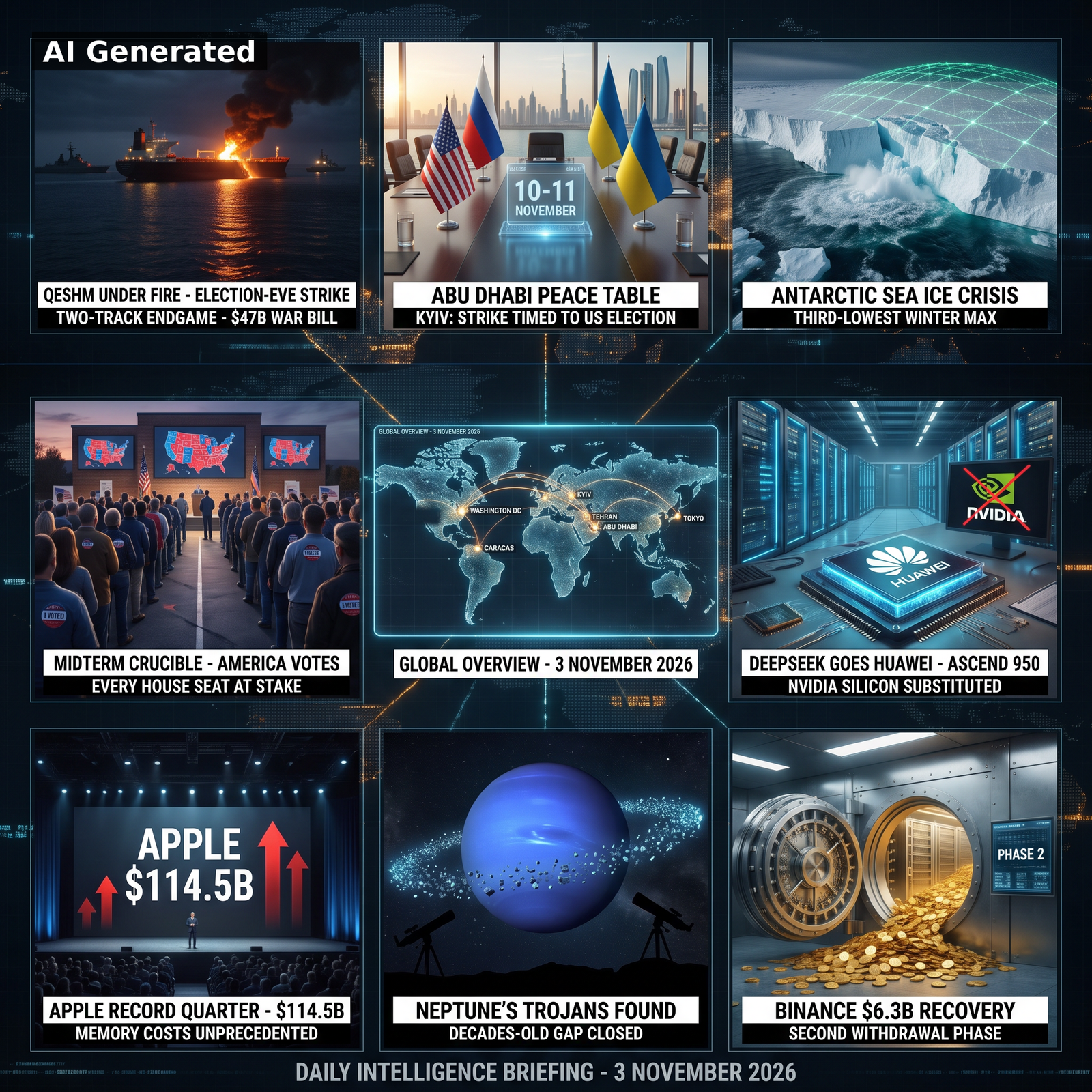
The United States carried out limited strikes on Iranian military targets on Qeshm Island and Bandar Lengeh late on Monday, hours before polling opened in the American midterm elections, in an operation officials framed as a deliberately narrow “defensive” response to surface-to-air missile threats against American aircraft over the Strait of Hormuz[1][2]. Iranian state media reported five powerful explosions on the island and the coastal port, and open-source reporting confirmed the loss of an MQ-9 Reaper during the exchange, all showing the strikes were calibrated to degrade Tehran’s air-defence around the critical shipping lane without reigniting full hostilities[3][4]. The operation extends a series of quiet attacks Washington has run in recent weeks, keeping pressure on Tehran without either capital wanting the wider war this campaign threatens.
The timing was unsubtle: President Trump had repeatedly promised not to launch new strikes before the midterms and, when asked, chose to minimise the scale of a conflict that has cost American taxpayers an estimated $47 billion, questioning in his election-eve address “if you even call it a war”[6]. Publicly the administration is running a genuine two-track policy. On one track, Vice-President JD Vance voiced measured optimism about a negotiated settlement, saying the president had talked of progress in the talks, having written to Tehran’s security chief Mohsen Rezaei[7], while Israeli Prime Minister Benjamin Netanyahu pressed Trump during a weekend call for a further and extensive air campaign after Tuesday’s vote as he seeks to shore up an emergency-government calculus following his party’s electoral losses[1][5]. On the other, the new Supreme Leader, Ayatollah Mojtaba Khamenei, warned that Iran’s response to any threat “should be immediate and without geographic limits,” and Gulf interlocutors at the Manama Dialogue described the two sides as far apart, with Chinese mediation dispatched toward Tehran, Oman and Riyadh[1][8].
Trump, however, suggested there was no rush to decide on fresh strikes, noting that Iran “wants a deal more than ever” after Washington had significantly weakened its financial position, while Central Command has nonetheless prepared a sliding set of post-election options ranging from tighter sanctions to a broader campaign[9][8]. The competing signals leave the region braced for a decision that is now inescapably entangled with the American electoral calendar: whether the midterm outcome emboldens escalation or hands the president cover for a diplomatic landing remains the single most consequential open question of the week.
Ukraine: The Abu Dhabi Table and the Winter Energy Clock
The diplomatic architecture for Ukraine moved from abstraction to schedule on Monday, when US envoy Steve Witkoff announced that Moscow and Kyiv would hold negotiations on 10-11 November in Abu Dhabi under American mediation, covering post-war security arrangements, de-escalation, humanitarian efforts and next steps toward peace[10][11]. The announcement deliberately lands in the gap between the American midterms and any subsequent Gulf decision, testing whether Washington can run parallel endgames in two conflicts simultaneously. Yet the military clock is running faster than the diplomatic one: President Zelensky warned on X that Russia is planning a mass strike on Ukrainian energy and logistics infrastructure timed precisely to the US election window, when he fears world attention will lapse, and reiterated that Kyiv lacks sufficient Patriot interceptors to stop the ballistic salvos it cannot otherwise catch[12]. The warning was given grim concrete form the same day, with at least 26 people killed in Russian strikes that hit an aid centre in the Zaporizhzhia region[13] — an attack Zelensky condemned as “utterly horrific.”
Alongside the negotiations, the multinational framework for a post-ceasefire guarantee moved from concept to exercise. France and the United Kingdom are leading “Koalicja,” the first field exercise of the Multinational Force for Ukraine (MNF-U), gathering roughly 2,800 troops from ten allied countries in Poland from 9 to 22 November to test the force’s ability to deploy into Ukraine once hostilities cease[14][15]. The exercise gives operational texture to a deployment model that has existed only on paper since the force was constituted in March 2025, and it was accompanied by confirmation that British troops under the mission would be permitted to fire back at Russian forces if attacked[16]. The financing question remains the binding constraint: Bloomberg reported that Washington intends to press NATO to lift funding for arms deliveries to Ukraine, sustaining the pipeline even amid the personal tension between Trump and Zelensky[17]. On the battlefield-technology edge, a Kyiv startup’s pocket-sized receiver that lets Ukrainian units watch Russian drone feeds illustrates how cheap countermeasures continue to fight the sensor layer of the war, even as Russian moves toward digital and AI-guided drones threaten to make such tools obsolete[40].
Israel’s Leverage and Europe’s Eastern Flank
Israel’s interest in a renewed Gulf campaign is inseparable from its own internal majority crisis. Netanyahu’s weekend push for a further wave of strikes came as he seeks to assemble a security-first emergency government after his far-right bloc lost its parliamentary majority, and his renewed advocacy is precisely the kind of escalation that would reframe the domestic political ledger[1]. A quieter but consequential development unfolded in Turkey, where PKK leader Abdullah Öcalan was transferred to a larger villa on the island-prison of İmralı to facilitate his participation in negotiations with the Turkish government — a logistical demonstration that Ankara is prepared to invest in a process that remains politically explosive at home[18].
On Europe’s eastern flank, the Polish constitutional-court crisis that defined much of last week reached a new institutional inflection point on Tuesday, as the General Assembly of the court’s judges sought to convene amid an open power struggle between the government of Donald Tusk and President Karol Nawrocki over the legitimacy of eight newly ratified judges and the ousted president of the tribunal[19]. The quorum question loomed large, with PiS-aligned judges likely to stay away, and analysts warned the confrontation could reignite around the 11 November National Independence Day march. Meanwhile the Berlin Security Conference convened with Lithuania’s president as this year’s partner and a “special guest” address planned, an indication of the centrality of the Ukraine war and Russian threat to European security discourse, while NATO interceptors were scrambled over a fresh airspace incident in the Baltic region[20][21].
The Periphery: Caracas, Bogotá and Algiers
Washington kept the pressure on Caracas over its democratic-transition promises, with Secretary of State Marco Rubio telling Venezuela’s new foreign minister Oliver Blanco that the remaining political prisoners must be freed as part of the “stabilisation, economic recovery, political reconciliation and democratic transition” sequence Trump has laid out, against the roughly 344 detainees still held that activist group Foro Penal counts from the Maduro era[23][22]. The meeting came as a leading opposition figure critical of the administration returned to Venezuela, testing whether the phased-plan framework can reconcile Washington’s coercion with internal opposition politics.
In the wider periphery, a bomb-laden truck exploded near a military installation in Colombia’s Tolima department, killing four people including a two-month-old infant and wounding seventeen, in an attack attributed to dissidents of the former FARC that highlighted the durability of armed fragmentation despite the peace process[24]. And France’s colonial legacies resurfaced in the Maghreb, where Algeria launched a new operation to clean up Sahara desert nuclear-test sites and renewed its demand that France hand over the maps it says are needed to locate radioactive waste left by 1960s tests — a slow-burn grievance with direct bearing on the Franco-Algerian relationship[25].
The Indo-Pacific and the Defence-Industrial Base
India’s strategic hedge was on display across multiple fronts. National Security Adviser Ajit Doval’s visit to Hanoi deepened intelligence, cybersecurity and defence cooperation with Vietnam, explicitly framed against the shadow of Chinese pressure and ahead of the 55th anniversary of diplomatic relations in 2027[26]. Operationally, the fifth edition of Exercise Tiger Triumph began in Visakhapatnam to improve US-Indian joint crisis response, while the Indian Navy completed a daring 48-hour operation in the Arabian Sea rescuing all 20 crew of the Iranian fishing vessel Azini after hijacking by Somali pirates[27][28].
New Delhi’s arsenal continues to inch toward self-reliance and interoperability. India expects delivery of the fifth and final S-400 air-defence system from Russia in January-February, keeping intact a $5.43 billion contract signed in 2018 that runs against Western pressure on Russian defence procurement[29]. The new Air Force chief placed the indigenous TEJAS fighter family and the Advanced Medium Combat Aircraft (AMCA) at the centre of modernisation, while the K9 Vajra artillery platform added the domestically produced SIGMA 30N inertial navigation system through a Safran technology transfer to India Optel[30][31].
The technological frontier of the Indian Navy’s force design is equally significant: it is assessing quantum Rydberg-atom receivers for electronic warfare, seeking a plug-and-play magnetic-anomaly sensor for anti-submarine helicopters, and fielding an indigenous autonomous surface vessel (“Sea Serpent”) for reconnaissance and strike roles[32][33][34]. Resilience in positioning is a live requirement, with NavIC increasingly the answer to GPS jamming at sea, and indigenous AESA radar plus drone-based ELINT showcased at the Navy’s Swavlamban seminar[35][36]. Even the drone-industrial base is hardening, with DRDO ordering VANA surveillance platforms, and on the human-rights ledger Pakistan’s anti-terror court sentencing rights lawyer Imaan Mazari and her husband to ten years underscored the continued repression of civil-society actors in the region[37][38].
Finally, the US Navy’s push to arm F/A-18 Super Hornets with the Mach 5+ hypersonic “Blackbeard” missile from startup Castelion — including a 444-missile production order and a stated ambition to buy more than 12,000 units over five years — signals a major commoditisation bet on affordable hypersonics, reshaping carrier-strike reach this decade[39].
Environment & Climate ↑ Contents
The Cryosphere and the Polar Ledger
The southern cryosphere sent a double signal through the reporting window. Antarctic sea ice reached its largest 2026 extent on 14 September at 6.79 million square miles — the third-lowest winter maximum in the satellite record — and then, less than three weeks later, began setting record daily lows for the date across the Ross, Amundsen and Indian Ocean sectors, an accelerated retreat that extends a decade-long below-average trend[41]. That statistical compression of the polar ledger matters far beyond the Southern Ocean: a United Nations-backed assessment warns that even a temporary global overshoot of the 1.5°C Paris target would cause permanent, essentially irreversible damage to glaciers and polar ice sheets, whose melt has become the principal driver of sea-level rise and whose carbon feedbacks would compound the overshoot[42]. The biological surprise beneath the Filchner-Ronne ice shelf — a community of fixed sponges and stalked organisms living on a boulder in total darkness, nearly 1,000 kilometres downstream of the nearest sunlit water, with no explanation yet for what they eat — underscores how poorly these under-ice ecosystems are known, and how quickly ice-shelf collapse could destroy them before they can be studied[43].
Energy’s New Arithmetic and the Adaptation Front
The energy transition’s political and financial arithmetic was contested on both sides of the Atlantic and the equator. In Germany, criticism mounted over Economy Minister Katherina Reiche’s “grid package” — a bid to cut the cost of expanding renewable-generation grids whose precise savings the ministry has declined to quantify, prompting the charge that “they do not know what they are doing”[44]. In the United States, the picture is bifurcated: Arizona’s two largest utilities filed 2026 integrated resource plans that, while adding renewables and storage, continue a costly dependence on fossil fuels, whereas Illinois regulators authorised a study of the most affordable route to state building-decarbonisation under its Climate and Equitable Jobs Act [45][46]. Kenya’s state generator KenGen secured 10.5 billion shillings in financing for a 100 MWh battery project that would store excess wind and solar for evening peak demand, a small but telling instance of African grid modernisation[47]. At the European level, the proposed reform of the Emissions Trading System is being positioned as a strategic investment engine to scale e-fuels for aviation and shipping and align the mechanism with 2040 climate targets[48]. Independently of policy, hard economics are pulling agriculture toward electrification: with diesel prices up sharply, solar-powered equipment is emerging as a cost lifeline for farmers and rural processors in Tanzania and elsewhere, even as commercial fleets in North America test electric-truck conversions including battery swapping[50][49].
The Living Ledger and Climate Science
A cluster of peer-reviewed findings redefined how heat and biodiversity interact. Tropics long assumed to be comparatively insulated from climate change are in fact registering significant shifts in rainfall and in extreme dry and humid heat events, according to a study of long-term records at Costa Rica’s La Selva and Puerto Rico’s El Verde, while a four-decade global analysis shows extreme heat is no longer confined to summer but is expanding its seasonal footprint into spring and autumn across roughly half the globe[51][53]. On the adaptation side, new research finds that more tree-species diversity measurably strengthens natural forests’ resilience to compound climate extremes — co-occurring heat and drought or anomalous rainfall — a conclusion reached only with difficulty in real, complex woodland rather than experimental plots[54]. Reforestation’s climate role is likewise more nuanced than a simple carbon ledger, with scientists quantifying lesser-known effects that cutting global forestation efforts can pump into the climate system beyond CO₂ removal[52].
The emissions-accounting front saw continued controversy in the food system, where researchers argue that a “‘bookkeeping trick’ and fuzzy math” conceal the true climate impact of livestock, in particular beef, by undercounting emissions — a dispute with direct consequences for how responsibility is apportioned ahead of the next UN climate round in Turkey[55]. On the living-ocean boundary, Zanzibar’s women seaweed farmers are being positioned as the foundation for a climate-resilient marine economy, with science and investment partnerships alongside them, while high-tech efforts in Abu Dhabi and beyond pursue mangrove restoration as a “climate hero” climate-mitigation and coastal-protection asset[56][57].
Environmental Governance and Public Protection
Environmental governance consolidated a rights-based turn at the UN biodiversity conference. At COP17 in Armenia, Indigenous peoples and local communities secured the full operationalisation of the subsidiary body on Article 8(j) of the biodiversity convention, strengthening their formal role in drafting and decisions — a rare case of treaty structure moving toward, rather than away from, Indigenous authority[58]. In the United States, environmental NGO NRDC warned that state and federal officials are using investigative and legal instruments to harass and “silence” nonprofit advocates, a governance climate that sits uneasily beside the very adaptation and electrification policies those groups help design[59]. On the public-protection front, Greece activated an emergency “112” alert for the Thesprotia region under storm Agneta (the same system that produced the earlier Greek flood warnings), and French NGOs mounted a campaign demanding that the WHO lower drinking-water nitrate standards on health grounds[60][61]. Taken together, the section’s threads argue that adaptation is no longer a tomorrow problem: it is being negotiated every day in grid plans, water rules, frozen seas and the living ledger of forests and coasts.
Society & Civil Issues ↑ Contents
The Midterm Crucible: Ballots, Courts and the Electorate’s Signal
American voters went to the polls on Tuesday with every seat in the House of Representatives, a third of the Senate and thirty-six governorships at stake, in an election that President Trump explicitly made a referendum on his own rule and whose stakes he framed around the “cascading effect” of higher living costs tied to the Iran war and his tariff policy[62][63][64]. Polling entering election day favoured the Democrats in both chambers, though analysts cautioned that Trump’s supporters have repeatedly been underestimated in the past; the president himself pre-emptively argued that the governing party historically loses midterms “regardless of who is president”[63][64]. The integrity perimeter narrowed to the last hour, with the Supreme Court rejecting the administration’s request to disqualify California’s disputed mail-in ballots on the eve of voting — effectively ending that bid to bend the count[65][66].
The election’s texture is in the margins and the money. In Michigan, the race to a pivotal Senate seat featuring Democrat Abdul El-Sayed crystallises both the party’s leftward experiment and the fracture that saw a retiring Democratic representative publicly back the Republican, while Nikki Haley’s attempt to explain her endorsement of centrist Republican Mike Rogers shows how the old guard is threading the MAGA line[67][63]. Voter behaviour is itself an electrometer: Fox News audiences are declining while CNN’s rise, in the network’s own telling, tracks the polls[68]. Ballot measures add a second layer — California’s one-time billionaire tax, Proposition 40, has slipped from 52% to 42% support after tech oligarchs spent over $379 million to defeat it, a vivid test of whether anti-wealth politics survives the money[69]. And in a signal about the post-election landscape, Trump moved to protect close associates with pardons against anticipated Democratic investigations, arguing “it will be necessary to protect them”[70].
Britain and the Post-Commonwealth Civic File
British statecraft is running a distinctly post-imperial ledger. The Prime Minister is opening talks toward a formal apology for the UK’s historical role in the slave trade and a broader Commonwealth “debt reset,” a proposal that would reframe reparatory-justice debates inside the Commonwealth and carries direct implications for the Caribbean, which featured in yesterday’s report on Antigua[71]. On a more immediate economic-civic front, the UK and the EU agreed a draft deal to scrap Brexit red tape on food exports — the most significant element of the “Brexit reset” agreed so far, ahead of a UK-EU summit later this month[72]. Domestically, the government defended its migration-reform package against accusations of a late U-turn, under revised plans that shorten to five years the wait for foreign care workers earning above £25,000 who meet visa conditions, while the Home Office confirmed that nearly 200 Metropolitan Police officers have been barred from policing in the past year, the highest number on the official list[73][74].
Justice, Health and the Human Cost
Public health and the state’s use of force produced two conjoined alarms. New York recorded its first measles death in thirty years — a child in rural northern New York — as national cases more than doubled from the previous year, and a companion study concluded a surprisingly high share of measles cases are misdiagnosed, complicating containment[75][76]. In Memphis, prosecutors released body-camera footage showing Tennessee National Guard troops pointing handguns at a man as he lay dying after a guard member shot him in the back last summer — a chilling visual account of the militarised policing that has haunted the national civil-rights debates[77]. And in a case that intersected abortion, a one-time West Point cadet was revealed to have drugged his pregnant girlfriend, given her abortion pills while unconscious, and caused a miscarriage before going on to graduate school — a window into the collision of military culture, reproductive coercion and institutional response[78].
Justice across the Atlantic ran along parallel tracks. Spain’s embattled transport minister, Óscar Puente, faced parliament roughly a week after the high-speed rail collision that killed sixty-nine people, with the opposition demanding his resignation and a systems-review of the failure of the automatic-leadership system that investigators say contributed to the crash — an update to the rail-disaster story this report began tracking last week[79]. In France, a Paris woman who became sterile after a poorly managed obstetric haemorrhage won compensation from the AP-HP hospital trust, a marker of the expanding accountability frontier in medical harm, while a court in Saint-Ouen heard how a bar owner became entangled in a drug-dealing network she said she could not refuse[80][83]. In the United States, the federal inquiry into the Learjet crash at Palm Beach that killed nine people moved toward a technical account: the NTSB said the aircraft began to disintegrate in the air before its near-vertical descent at hundreds of feet per second into a residential street, amid storm-and-turbulence conditions — a case that links squarely to the maritime-adjacent “Learjet at Mar-a-Lago’s doorstep” thread from yesterday’s periphery section[81][82].
Germany’s Civic Square and Administrative Fronts
German politics pulsed with unease on the Chancellor’s own flank. Chancellor Merz faced the party’s district-chair conference amid humiliating electoral reversals and miserable polling, absorbing the base’s frustration over governing-coalition reform disputes — an internal-temperature reading that will shape Berlin’s capacity for the winter’s decisions, including on energy and Ukraine[84]. The health-administration front saw debate over health-insurance fund consolidation, with the health minister signalling that the push to reduce the number of funds is not solely about size but about the viability of the statutory system[85].
Migration, Indigenous Rights and the Commonwealth’s Periphery
The human ledger of displacement and Indigenous rights showed two contrasting regional patterns. In India’s Assam state, hundreds of homes were bulldozed in the Dhubri district, displacing thousands in a demolition wave that rights groups have roundly condemned — while across the Atlantic, as many as 150 Afghans face deportation to Pakistan and onward to Afghanistan, with a group of US lawmakers urging the administration to halt the removals[86][87]. In Brazil, the post-election climate produced a disturbing incident: two public servants in Mato Grosso do Sul were suspended after allegedly threatening on WhatsApp to poison the water used by the Guarani-Kaiowá people, and a federal judge ordered ranchers to leave the Piripkura Indigenous territory within 120 days, reversing an earlier ruling under the now-struck-down marco temporal law[88][89]. And in Australia, a baseball-bat attack on a One Nation volunteer outside his Victorian home drew condemnation from leaders across the political spectrum, a reminder of how heated political identity can spill into civic violence[90].
AI & Technology ↑ Contents
Compute’s Geopolitics and the Capital Question
The geography of frontier compute hardened into an explicit strategic contest. DeepSeek announced plans to train its next-generation model on Huawei’s Ascend 950 chips — the strongest signal yet that a leading Chinese laboratory intends to substitute domestic silicon for the Nvidia hardware it has depended on, a bet that directly tests whether US export restrictions can durably slow Chinese AI capability or merely redirect it[91]. The scale of the Western response was visible in hyperscaler build-out: reports indicate roughly 1,000 Nvidia NVL72 rack systems are being deployed every week, an infrastructure cadence that converts the AI race into an enormous physical-capital and energy problem as much as an algorithmic one[92].
The Model Frontier: Verification, Trust and the Legal Ledger
The credibility of AI agents is becoming a research priority in its own right. Researchers at Google and the University of Hong Kong published work aimed at making autonomous agents “show their work” through enhanced verification, arguing that rigorous output-checking could sharply reduce the inflated success rates that currently overstate how reliably agents complete tasks[93]. At the infrastructure layer, OpenAI’s Pando distributed system claims to cut Git push latency for its monorepo by about 80% — a reminder that the frontier’s productivity gains increasingly come from reengineering the developer toolchain itself — while Nvidia packaged its AI-cluster runtime around Kubernetes recipes to bring deployment reliability and compliance to scale-out inference[94][95]. The legal system is starting to price these shifts: the 10th Circuit Court of Appeals held that a law firm’s use of AI does not by itself justify slashing its fees, forcing litigants to adduce concrete evidence rather than presume AI cheapens legal work, and Anthropic issued a targeted update addressing concerns that its model could be steered toward cloning video-game content, an early skirmish in the copyright frontier[96][97].
AI and the State: Security, Espionage and the Military
Artificial intelligence is being folded into the machinery of national security on both the offensive and defensive sides. OpenAI hired Dan Driscoll, a former Army Secretary in the Trump administration, as “Senior Counselor for National Security Modernization,” institutionalising the alignment between frontier labs and the defence-intelligence establishment[98]. That alignment is reciprocated by the threat picture: US officials suspect Iran-linked hackers of a series of cyberattacks that disabled freezers at military commissaries around the country — a novel instrument of sabotage targeting a mundane but critical slice of the base-logistics supply chain — fitting a pattern of Iranian intrusion into industrial control systems[99]. Defensive capacity is equally under pressure: Britain’s national cyber chief warned the United Kingdom will likely face AI-enabled cyberattacks on critical infrastructure by 2028, and a coalition of thirty-five industry groups pressed Congress to anchor the renewal of the Cybersecurity Information Sharing Act of 2015 through the defence-authorisation bill to preserve the liability protections that underwrite private-sector threat disclosure[101][100].
Espionage at the Operating-System Layer
Finally, state surveillance resurfaced at the consumer-device layer, where German lawmakers were warned that a spyware attack against members of the Bundestag had compromised the integrity of messages on Apple devices — an Apple threat-notification that exposed how advanced nation-state espionage now reaches directly into the encrypted-messaging ecosystem individuals rely on, and how thinly separated personal privacy and national security have become[102].
Economy & Business ↑ Contents
The Central-Bank Crossroads: RBA’s Fifth Hike in an Oil-Shock Summer
The Reserve Bank of Australia delivered the clearest transmission of the Middle-East war premium yet when it raised its cash rate for the fifth time this year, to 4.85% — the highest level since 2008 — in a decision the board framed around surging inflation that had jumped to 4.3% year-on-year, fed by the “global oil shock triggered by the war” and by AI-related spending driving a sharp rise in tech-goods prices[103]. The monetary arithmetic is unambiguously hawkish: the RBA now expects trimmed-mean CPI to reach 2.6% only in late 2028, with inflation pegged to stay above 3% through next year and a rising risk of entrenched inflation expectations[104]. Yet the growth counterpoint is revealing — the Bank lifted near-term GDP forecasts on data-centre investment while lowering the longer-run outlook, evidence that the AI-capital boom is registering as a genuine macroeconomic lift in economies like Australia even as the conflict keeps core prices stubbornly high[105]. The decision lands as a reminder that central banks and mortgage borrowers across the Anglosphere are absorbing the cost of geopolitics.
The Corporate Earnings Ledger: Apple at the Margin Turn
Apple’s first earnings call under new CEO John Ternus set the tone for the megacap reporting season. The company posted record September-quarter revenue of $114.5 billion and all-time-high Services receipts, but guided December-quarter gross margin down to 45–46% from 47.9%, with Ternus calling the surge in memory-chip pricing “unprecedented” and warning it will keep rising beyond the holiday quarter[106][107]. The result is a study in how AI-era demand for memory and compute has become a cost problem even for the world’s most valuable company, which is offsetting it with price rises and leaning on its 2.5-billion-device installed base. On the same call Apple hinted at new ways to generate revenue from third-party AI “opportunities,” flagging a commercial direction beyond its own revamped Siri[108]. The valuation read across the sector was mixed: Palantir posted a record Q3 earnings beat yet saw its stock fall 3% — a reminder that for richly priced AI-exposed names, earnings are now competing against elevated expectations — while analysts argued the S&P 500 has actually become less overvalued relative to the German DAX, citing the earnings backdrop[109][110].
Trade, Fiscal and the Asian Front
US trade policy is producing measurable strategic fallout in Asia. A detailed assessment argues that Washington’s punitive tariffs are “handing Asia to Beijing,” alienating the very ASEAN exporters and manufacturers that a decade of “China-plus-one” diversification had drawn into American supply chains, and pushing the region toward institutional networks that bypass Washington even as US companies help write ASEAN’s digital-economy framework[111]. Citi nonetheless expects Japanese, Korean and Taiwanese firms’ direct investment in the United States to keep climbing — the tariff regime is at once repelling Southeast Asia and attracting North Asia into domestic US production[112]. Elsewhere in the region, Malaysia’s transport minister signalled he still plans to step down while insisting the country’s flagship megaprojects remain safe, a governance-and-capex uncertainty that markets are chewing over[113].
In Europe, France’s parliament pushed through a raft of budget amendments — reworking the tax on electricity and on paid television among them — even as members knew the measures were likely to be junked given the probable rejection of the 2027 budget and a possible resort to Article 49.3 or ordinances by the executive[114]. In India, the Supreme Court warned the Centre that its prolonged resistance to enforcing arbitral awards in the Vedanta-Ravva oil-field dispute could destroy trust in the country’s arbitration framework, a pointed caution for investors watching India’s legal predictability[115]. And in the labour market, the fast-casual chain Sweetgreen began offering its restaurant managers up to $200,000 a year through a mix of higher base pay, revenue-share bonuses and equity — a bet that better compensation for store leadership drives sales, echoing a wider wage competition reshaping the American services floor[116].
Science & Space ↑ Contents
The Cosmic Ledger: New Eyes on Old Structures
The Vera Rubin Observatory, still in its early data-previews, has found two more of the Milky Way’s dimmest satellites — an ultra-faint dwarf galaxy and a globular cluster — each a missing piece in reconstructing how the galaxy assembled through mergers and how dark matter shaped it[117]. A separate breakthrough closed a decades-old gap in the Solar System: an international team led by Queen’s University Belfast discovered Neptune’s elusive Trojan asteroids, the family of co-orbital bodies that had mysteriously evaded detection for researchers who had mapped analogous “Trojan” and “Greek” populations around Jupiter, Saturn and Uranus[118]. On the dwarf-planet Ceres, new analysis shows its surface water-ice can mask massive underlying salt deposits — a finding that reframes how we read the chemistry of icy bodies and, by extension, the promise and pitfalls of resource-mapping there[119]. And in astrobiology’s methodological vanguard, researchers built a virtual “lifeless Earth” computer model that simulates how a rocky planet’s geochemistry would evolve over billions of years without biology, giving astronomers a baseline to distinguish atmospheric signatures of life from mere geology when they examine habitable exoplanets[120].
The Deep Archive: Volcanoes, Empires and the Metallurgical Past
Archaeology supplied a striking image of ancient resilience. Study of the Kikai-Akahoya eruption — one of the most destructive volcanic events of the Holocene, which battered the Japanese islands with earthquakes and tsunamis around 5,250 BCE — used the spread of radiocarbon-dated sites to show that, while some regions became uninhabitable for long stretches, survivors migrated, forged new social relations and innovated new economies, a finding with obvious resonance for a world managing climate-driven disaster[121]. Toxicological analysis of Inca child mummies revealed that the children of the capacocha sacrifice ritual were given coca, alcohol and, in one case, the ayahuasca-related compound harmine in the weeks before death — evidence likely aimed at easing the ordeal rather than inducing hallucinations, and a proxy for the diversity of practices across the empire[122]. In Austria, gravel workers rescued what turned out to be Europe’s largest trove of Iron Age iron bars — some 500 bipyramidal semi-products weighing roughly a tonne, probably lost from a Danube boat in the second century BC and enough metal for some 500 swords — a rare, datable snapshot of Late Iron Age trade, metallurgy and exchange[123]. In Egypt, archaeologists recovered the head of a Ramses II statue once some 8.5 metres tall and a second royal face awaiting a name, from the Nile-Delta site of Behbeit el-Hagar, adding to a year of spectacular Delta finds[124]. And a new historical analysis argued the square shapes of Chinese written characters emerged gradually from interacting linguistic, technological and cultural factors rather than a single cause, complicating a long-held origin story[125].
Physics, Materials and the Frustrated Frontier
The theoretical frontier of physics delivered an unusually elegant no-go result: a three-line proof, resting on the observation that a light-like direction can never be perpendicular to a traveller’s direction in time, rules out closed time-loops in a wide class of universes without invoking exotic matter or singularities — a compact addition to the toolkit for probing the causal structure of spacetime[126]. At the nanoscale, EPFL researchers discovered that placing insulating materials just a few hundred nanometres from nanomechanical resonators can silently degrade their ability to sustain vibrations, a hidden vulnerability that threatens the most sensitive sensors and emerging quantum devices[127]. Oak Ridge scientists demonstrated they could alter the magnetic structure and electrical behaviour of altermagnets — an emerging class of materials — simply by applying mechanical strain, without changing their chemistry, opening a new control lever for next-generation electronics[128]. And on the circular-economy edge, German researchers are piloting processes to recover neodymium, iron and boron from discarded hard-drive magnets — including a method using ammonium chloride instead of hydrochloric acid — in an EU project that could cut Europe’s near-total dependence on Chinese rare-earth imports while valorising electronic waste[129].
Life, Health and the Institutional Ledger
The living archive reached into the far south and deep into biology. A survey of Antarctica’s hidden biodiversity underscored that the continent’s most abundant scientific wonders — its microbial communities — form the foundation of its ecosystems yet remain largely invisible, with implications for how we monitor a biosphere under ice-loss pressure[130]. A study in Science used the Dog Aging Project’s DNA-methylation data to show why larger dog breeds age faster than smaller ones, implicating “jumping genes,” and thereby offering canines as a powerful model for ageing research[131]. Climate science connected to the Atlantic islands: Cambridge-led research found that where a storm surge strikes along the UK coastline is decided by global climate patterns in the Atlantic, the Arctic and beyond, linking British flood risk to distant teleconnections[132]. The institutional layer of science also shifted: China confirmed it will let clinical-medicine doctoral students graduate without a thesis, expanding its “practical PhD” programme beyond engineering — a notable redefinition of the doctorate[133]. And the scientific community mourned two biologists, Marta Shahbazi Alonso and Tamara González Costa, killed travelling to a development-biology meeting in last week’s Spanish train crash — the human cost embedded in the practice of science[134]. Finally, the Smithsonian completed its flagship Air and Space Museum renovation with the opening of “At Home in Space,” a gallery devoted to the story of long-duration spaceflight and the establishment of a spacefaring civilisation[135].
Crypto, Digital Assets & Blockchain ↑ Contents
The Record Theft’s Aftermath: Reconstitution and the Recovery Clock
The $6.3 billion Binance hack entered its reconstitution phase this week, and the forensic ledger is now as much about coordination between exchanges and law enforcement as about the crime itself. Binance moved into the second phase of its withdrawal process late on 1 November, making further assets available from 04:00 UTC after security checks, with exchange outflows slowing as confidence gradually returns[136]. The recovery window has, predictably, become a fraud vector of its own: Binance warned that impersonators are exploiting the restart by offering fake compensation schemes and fees for faster processing, and it completed a cryptographic reserve proof that lets customers verify backing for ten tokens while recovery of the frozen balance continues[137]. The decisive lesson of the affair for the wider ecosystem is that the response is becoming a coordinated, multi-institution counter-laundering operation — and that the latency of that response, measured in hours and days, is the new metric by which exchanges are judged.
The interception layer performed unevenly but visibly. The FBI formally urged THORChain to block the stolen funds, and the cross-chain aggregator restricted addresses on its interface while node operators continued trading as usual — a telling split between the front-end’s compliance posture and the permissionless settlement layer underneath that shows where the real enforcement gap lies in cross-chain laundering[138]. Tether, for its part, reported freezing more than $1.5 billion in stolen USDT within roughly thirty minutes of the attack, demonstrating that the stablecoin issuer’s blacklist power can act as the fastest single lever in the recovery playbook[139]. But the limits of that control surfaced elsewhere: Binance acknowledged it can reduce an opposing winning Bitcoin position even when customer assets are fully backed, via its auto-deleveraging rules in the futures market — a reminder that even a “backed” exchange can reallocate against a profitable hedge in a scramble[140]. Handelsblatt, surveying the fallout for Bitcoin and ether, framed the open questions — who compensates affected customers, and whether the industry’s trust recovery keeps pace with its price recovery — as the defining tests of the post-theft era[141].
The attribution fight moved from the technical to the geopolitical. North Korea, through Kim Yo Jong, formally denied any role in the Binance theft, calling the FBI’s accusation that Pyongyang’s TraderTraitor group was behind it a “serious political provocation” and “absurd rhetoric,” while pointing to the US attribution of last year’s Bybit hack as evidence of a campaign to smear its sovereignty[142][143][144]. The denial lands at an awkward moment for the industry: the scale of the sum — more than double the estimated value of North Korea’s entire annual foreign trade — makes the alleged state sponsorship of the heist a live foreign-policy matter as much as a security one, and Kim’s statement signals that Pyongyang will contest the attribution publicly rather than quietly absorb it[145].
Institutional Rails and the Regulatory Perimeter
The regulatory front moved to sharpen the line between governance tokens and securities. The SEC updated its digital-asset framework with new guidance clarifying that holding UNI and merely voting in its governance does not automatically confer commodity status; the analysis now weighs actual authority, centralisation and the real distribution of control — a shift that will reverberate through how decentralised projects are structured and marketed[146]. Regulators in one of the world’s most active digital-asset markets responded to the Binance theft directly: South Korean authorities urged exchanges to strengthen cold-storage practices even though local exchanges are already required to hold at least 80% of customer crypto in cold wallets — an acknowledgement that the percentage alone is not proof against operational risk[147]. The regulatory heat is also reshaping market geography: Crypto.com announced it will shut down its consumer app in Hong Kong on 1 February 2027, a strategic retreat that highlights how licensing and market prioritisation are sorting the industry by jurisdiction[148].
Institutional adoption advanced on multiple rails. Japanese vehicle exporter SAT Japan added USDT and USDC payment routes through processor Triple-A, settling exporters in US dollars — a concrete instance of stablecoins operating as an alternative cross-border payment rail rather than a speculative asset[149]. Ark Invest’s purchase of $3.4 million in Coinbase, $2.6 million in Circle and $645,820 in Robinhood on a down day reaffirmed the ongoing institutional accumulation of crypto-exposed equities[150]. The lending market’s structural shift was quantified: total crypto-collateralised lending shrank to $56.16 billion in Q2 2026, and — for the first time since Q3 2023 — centralised-finance loan volume exceeded decentralised-finance volume, as hybrid products let users borrow through a centralised interface against on-chain BTC or USDC collateral[151]. At the margin, Kinetic’s $24 million XRP-linked lending market showed a base rate of just 0.04% before incentives, evidence that XRP collateral demand remains modest relative to the token’s liquidity[152]. Finally, a telling behavioural signal emerged in the hack’s wake: XRP recorded one of its strongest single days of new-wallet creation this year, with almost 8,000 wallets added, even as prices stayed subdued — an indication that the theft pushed a measurable cohort toward self-custody, the industry’s oldest reflex against counterparty risk[153].
Correlations & Analysis ↑ Contents
The D156 window is defined by a single structural fact: the double clock this report has tracked since D148 — the Gulf strike clock and the American electoral calendar — finally converged on election eve, and the collision produced exactly the kind of calibrated action that D155’s “Gulf Clock at T-Minus One” framing predicted. Yesterday’s report described a strike window held open by a “T-minus one” stand-off between “nice threats” and Tehran’s supply network; today that window produced limited kinetic contact on Qeshm and Bandar Lengeh. The analytic continuity matters more than the escalation itself: D152 established that the distinction between strike preparation and strike execution had collapsed, D153 traced how pre-positioning preceded the strikes, and D155 showed Washington running a genuinely two-track policy. Today’s limited, “defensive” strikes, on the eve of the vote, confirm that Washington believes it can degrade Iran’s air-defence and missile trirade near Hormuz while keeping a negotiated-settlement door open — a posture that remains stable only so long as neither Israel’s escalation lobby nor Tehran’s retaliation doctrine forces the clock to run out.
The midterm election, which D150–D155 tracked through courts, ballots and the integrity perimeter, is now the hinge for every other thread in this report. D155 framed the Israeli question as an institutional-versus-delegitimisation test; the Supreme Court’s rejection of the California ballot challenge, landing hours before polls opened, was the integrity perimeter’s last, and perhaps decisive, institutional victory. But the correlation that matters for the Gulf is subtler: Netanyahu’s weekend push for a post-election strike wave is inseparable from his own electoral deadlock, meaning the outcome of the American vote — and whether Trump gains or loses cover for a diplomatic landing — will directly determine whether the Israeli prime minister’s emergency-government calculus re-ignites the wider war. The Qeshm strikes and the midterm result are, in effect, a single decision variable.
The Ukraine file shows a second convergence: diplomacy and the winter energy clock are running in tension. Just as D155 asked whether the corridor would become a “gas question,” this week’s announcement of Moscow-Kyiv talks in Abu Dhabi (10–11 November) under American mediation arrives alongside Zelensky’s warning of a Russian mass strike timed to the US election window and the confirmation of a 26-victim strike on an aid centre. The MNF-U force’s first exercise in Poland, with France and Britain leading and British troops cleared to fire back if attacked, is the operational half of a settlement that does not yet exist — a signal that the West is preparing for a peace whose terms remain undecided. The Ukrainian thread therefore correlates directly with the Gulf one: both theatres are waiting for the same two variables, the American election and the Russian intention behind the winter campaign.
The Binance aftermath — the third great running thread continued from D152–D155 — has moved from the raw theft into the institutional-recovery and counter-laundering phase, and it now correlates with the geopolitical layer in a striking way. North Korea’s formal denial of responsibility, Tether’s 30-minute freeze of $1.5 billion, the FBI’s request to THORChain, and Binance’s phased withdrawal resumption together describe an ecosystem that has learned to treat a $6.3 billion hack as a coordinated incident-response exercise spanning exchanges, stablecoin issuers and sovereign intelligence services. That the attribution and the denial are themselves foreign-policy acts — Pyongyang calling the FBI’s claim a “serious political provocation” — pulls the digital-asset economy squarely into the same adversarial-great-power frame as the Gulf and Ukraine files, a correlation this report has been tracing since the theft occurred.
Three threads tie the whole report together as a forward-looking watchlist. First, the American midterm result is the master variable: it will decide the Gulf decision, the shape of the Ukraine negotiations’ financing, and the credibility of Trump’s two-track doctrine simultaneously. Second, Europe’s institutional stress-testing continues on parallel tracks — Poland’s constitutional-court assembly and the 11 November independence march risk; France’s budget brinkmanship and a possible 49.3; Spain’s rail-accountability parliamentary reckoning — all unfolding while Berlin absorbs a fractious governing coalition. Third, on science and environment, the permanent thresholds are being defined even as politics negotiates them: the UN-backed finding that the cryosphere suffers permanent damage on any 1.5°C overshoot, and the third-lowest Antarctic sea-ice peak, are the slow drivers that will outlast this election cycle. What to watch in the next reporting period: the midterm outcome and its Gulf translation; the Abu Dhabi talks; Binance’s withdrawal phases and frozen-fund recovery; the SEC’s governance-token doctrine as it filters into listings; and whether the Polish court’s General Assembly can achieve a quorum.
References ↑ Contents
1. US has conducted defensive strikes on some Iranian targets in the Strait of Hormuz, US official says by AP via Scripps News Group · Source ↑
2. U.S. military carries out limited strikes on Iran’s Qeshm Island, U.S. officials say by Courtney Kube · Source ↑
3. Ιράν – IRNA: Πέντε ισχυρές εκρήξεις στο νησί Κεσμ και στο Μπαντάρ Λένγκεχ by Αλέξανδρος Παπαδόπουλος · Source ↑
4. ΗΠΑ: «Αμυντικά» πλήγματα κατά ιρανικών στόχων στα Στενά του Ορμούζ – Περιορισμένης έκτασης η επιχείρηση by Σωτήρης Ζιώμας · Source ↑
5. US reportedly strikes Iran’s Qeshm Island as Vance voices optimism about a deal by Jonathan Yerushalmy · Source ↑
6. US carries out 'limited strikes' on Qeshm Island in Iran by NEWS via d k on Inoreader · Source ↑
7. US strikes Iran's Qeshm Island as Trump signals progress in talks by FRANCE 24 · Source ↑
8. US strikes Iran’s Qeshm Island near the world’s most critical oil shipping route by Aamir Khollam · Source ↑
9. Iran wants deal 'more than ever', no rush to decide on fresh strikes: Trump by Business via d k on Inoreader · Source ↑
10. EN DIRECT, guerre en Ukraine : l’émissaire américain annonce des négociations entre Moscou et Kiev la semaine prochaine à Abou Dhabi, sous médiation de Washington by France via d k on Inoreader · Source ↑
11. « Après-guerre », « désescalade » et « étapes vers la paix » : l’Ukraine et la Russie vont négocier sous contrôle américain by France via d k on Inoreader · Source ↑
12. Krieg in der Ukraine: Während die Welt auf die USA schaut: Selenskyj warnt vor russischem Großangriff by Germany via d k on Inoreader · Source ↑
13. Ukraine-Russia war latest: 26 killed in ‘horrific’ Russian attack on Ukrainian aid centre by Maroosha Muzaffar,James C. Reynolds and Suha Kidwai · Source ↑
14. La Force multinationale pour l'Ukraine tiendra son premier exercice en Pologne en novembre by FRANCE 24 · Source ↑
15. « Nous devons être prêts à agir en cas de paix » : la Force multinationale pour l’Ukraine prépare déjà l’après by France via d k on Inoreader · Source ↑
16. British troops will be allowed to fire at Russian forces if attacked during multinational mission by NEWS via d k on Inoreader · Source ↑
17. Bloomberg: Οι ΗΠΑ θα πιέσουν το NATO να αυξήσει τη χρηματοδότηση για τις παραδόσεις όπλων στην Ουκρανία by Newsroom · Source ↑
18. Ο Οτσαλάν μεταφέρθηκε σε πολυτελή βίλα στο Ιμραλί – Αντιδράσεις στον εθνικιστικό χώρο by Newsroom · Source ↑
19. Streit um Justiz: Nach Chaos – Polens Verfassungsrichter wollen tagen by Germany via d k on Inoreader · Source ↑
20. Hochkarätig besetzte Sicherheitskonferenz in Berlin – Ukraine im Mittelpunkt by Germany via d k on Inoreader · Source ↑
21. Λετονία: Συναγερμός για απειλή στον εναέριο χώρο by Αλέξανδρος Παπαδόπουλος · Source ↑
22. US urges Venezuela to follow phased plan for democratic transition by NEWS via d k on Inoreader · Source ↑
23. Rubio ruft Venezuela zu Freilassung weiterer politischer Gefangener auf by Germany via d k on Inoreader · Source ↑
24. Κολομβία: 4 νεκροί, ανάμεσά τους βρέφος 2 μηνών, σε βομβιστική επίθεση με παγιδευμένο φορτηγό by Greece via d k on Inoreader · Source ↑
25. Η Αλγερία καθαρίζει πεδία πυρηνικών δοκιμών στη Σαχάρα – Ζητά από την Γαλλία τους χάρτες με τα ακριβή σημεία by Σοφοκλής Αρχοντάκης · Source ↑
26. China's Shadow Looms Large As Vietnam Seeks Real-Time Intel From India As Security Ties Expand by Indian Defence News · Source ↑
27. US And Indian Forces Launch Tiger Triumph 2026 In Visakhapatnam To Boost Joint Crisis Response Capabilities by Indian Defence News · Source ↑
28. Indian Navy Rescues All 20 Crew of Hijacked Iranian Vessel In Daring 48-Hour Arabian Sea Operation by Indian Defence News · Source ↑
29. India Set To Receive Fifth S-400 Air Defence System From Russia Early Next Year by Indian Defence News · Source ↑
30. New Air Force Chief Puts TEJAS, AMCA At Heart of IAF Modernisation Drive by Indian Defence News · Source ↑
31. K9 Vajra's Indigenous Leap: SIGMA 30N Navigation System Now Integrated Into India's Artillery Backbone by Indian Defence News · Source ↑
32. Indian Navy Pits Quantum Atoms Against Classic Radios In Radar-Listening Showdown by Indian Defence News · Source ↑
33. Indian Navy Seeks Plug-And-Play Helicopter Submarine Hunter With A Magnetic Twist by Indian Defence News · Source ↑
34. EyeROV Develops Sea Serpent Autonomous Surface Vessel; Boosts Maritime Reconnaissance And Kamikaze Mission Capabilities by Indian Defence News · Source ↑
35. How Indian Navy Ships Stay On Course When Satellite Navigation Fails by Indian Defence News · Source ↑
36. UTS Showcases Indigenous AESA Radar And Drone-Based ELINT System At Swavlamban 2026 by Indian Defence News · Source ↑
37. IZI Enterprise Wins DRDO Order For Indigenous VANA Multi-Mission UAV Platform by Indian Defence News · Source ↑
38. Pakistan: Turning Human Rights Activists Into Terrorists by Indian Defence News · Source ↑
39. 1,200-mph US Navy Super Hornets to pack four Mach 5+ hypersonic Blackbeard missiles by Aamir Khollam · Source ↑
40. Ukraine’s new pocket-sized gadget turns Russian drones’ cameras against them by Connie Loizos · Source ↑
41. Antarctic sea ice spread across 6.79 million square miles this winter, its third-lowest peak since satellites began watching, and less than three weeks later it was setting record lows for the date by ECONEWS · Source ↑
42. Cryosphere faces permanent damage when world overshoots 1.5C, scientists warn by EHN Curators · Source ↑
43. Geologists drilled through 2,860 feet of Antarctic ice shelf hoping to bring up mud and their camera found sponges living on a boulder in total darkness, and the team could not say what they eat by ECONEWS · Source ↑
44. Energie: „Sie wissen im Ministerium nicht, was sie tun“ – Kritik an Reiches „Netzpaket“ wächst by Klaus Stratmann · Source ↑
45. More of the Same Expensive Dependence on Fossil Fuels in TEP and APS 2026 Energy Plans by Sierra Club · Source ↑
46. The Future of Buildings in Illinois Is Electric by NRDC · Source ↑
47. KenGen secures Sh10.5bn financing to store excess wind and solar power for evening demand by George Kamau · Source ↑
48. The ETS Investment Engine: Scaling Europe’s Strategic E-fuel Market for Shipping & Aviation by Transport & Environment · Source ↑
49. Swarm Of Electric Trucks Coming To US (Battery Swapping Included?) by Tina Casey · Source ↑
50. As Diesel Costs Surge for Farmers & Rural Businesses, Solar Offers a Lifeline by World Resources Institute · Source ↑
51. Climate change is making the tropics hotter by Science & Space via d k on Inoreader · Source ↑
52. Study dives into lesser-known climate impacts of global reforestation by Science & Space via d k on Inoreader · Source ↑
53. Extreme heat no longer confined to summer, extending health risks, study finds by Glenn Scherer · Source ↑
54. Diverse forests can better withstand extreme weather events, study finds. Here’s why by Morgan Erickson-Davis · Source ↑
55. ‘Bookkeeping Trick’ and Fuzzy Math Conceal the Climate Impacts of Beef, Researchers Say by Georgina Gustin · Source ↑
56. Zanzibar’s seaweed farmers seek better future through science and partnership (commentary) by Erik Hoffner · Source ↑
57. The high-tech efforts to restore ‘climate hero’ mangroves by EHN Curators · Source ↑
58. Indigenous peoples and local communities solidify decision-making powers at COP17 by Shreya Dasgupta · Source ↑
59. They Are Trying to Silence Us by NRDC · Source ↑
60. Κακοκαιρία στην Θεσπρωτία: Μήνυμα από το «112» για ισχυρές βροχές και καταιγίδες by DEFENCE via d k on Inoreader · Source ↑
61. « Les normes sont dépassées » : forte mobilisation d’ONG qui demandent à l’OMS une baisse des niveaux de nitrate dans l’eau by France via d k on Inoreader · Source ↑
62. Midterms: US-Amerikaner entscheiden über Machtverhältnisse im Kongress by Germany via d k on Inoreader · Source ↑
63. US-Midterms: Die Umfragen sprechen gegen Donald Trump. Kann man ihnen trauen? by Germany via d k on Inoreader · Source ↑
64. US-Kongresswahlen: Demokraten hoffen auf Sieg über Trumps Republikaner by Germany via d k on Inoreader · Source ↑
65. Supreme Court rejects Trump's request to stop California counting disputed votes by NEWS via d k on Inoreader · Source ↑
66. Trump sees Supreme Court shoot down his election case hours before midterm voting starts: Live updates by Rhian Lubin and Joe Sommerlad · Source ↑
67. Haley tries to explain her backing of Mike Rogers and suggests he can be another centrist Republican by Jasmine Fernández · Source ↑
68. Les audiences de Fox News en chute, celles de CNN en hausse : le comportement des téléspectateurs américains suit les sondages by France via d k on Inoreader · Source ↑
69. California’s Billionaire Tax Slips From 52% Support to 42% by Matt Novak · Source ↑
70. « Il faudra que nous les protégions » : Donald Trump veut gracier ses proches pour les mettre à l’abri d’enquêtes démocrates by France via d k on Inoreader · Source ↑
71. PM’s Commonwealth ‘debt reset’ plan after opening door to slavery apology by Nina Lloyd · Source ↑
72. UK and EU agree draft deal to scrap Brexit red tape over food exports by NEWS via d k on Inoreader · Source ↑
73. Mahmood defends migration reform package against accusations of U-turn by David Lynch · Source ↑
74. Nearly 200 Met Police officers barred from service in the past year by Frankie Lister-Fell · Source ↑
75. Child dies of measles in New York's first such death in 30 years by Via AP news wire · Source ↑
76. A surprisingly high number of measles cases are misdiagnosed, study finds by Julia Musto · Source ↑
77. Tennessee national guard trained guns on dying man after guard member shot him, video shows by Associated Press · Source ↑
78. A West Point cadet drugged his girlfriend to force an unwanted abortion. Then he went to grad school by Jennifer Peltz · Source ↑
79. Zugunglück in Spanien: Verkehrsminister Puente stellt sich Fragen der Abgeordneten by Germany via d k on Inoreader · Source ↑
80. Accouchement cauchemardesque à Paris : Sarah, devenue stérile après une hémorragie mal traitée, obtient réparation face à l’AP-HP by France via d k on Inoreader · Source ↑
81. L’avion s’étant écrasé à Palm Beach transportait un entrepreneur texan de 45 ans, sa femme, leurs deux enfants et des proches by France via d k on Inoreader · Source ↑
82. Συντριβή στη Φλόριντα: Το Learjet 60 άρχισε να διαλύεται πριν από την πρόσκρουση (βίντεο) by DEFENCE via d k on Inoreader · Source ↑
83. « Je ne pouvais pas dire non » : à Saint-Ouen, comment la patronne du bar devenu le QG des dealers s’est retrouvée en prison by France via d k on Inoreader · Source ↑
84. Kreisvorsitzendenkonferenz: „Es ging hoch her“ – Merz bekommt Frust der CDU-Basis zu spüren by Daniel Delhaes, Jan Hildebrand, Moritz Koch · Source ↑
85. Kassenfusion: Müssen kleinere Krankenkassen um ihre Zukunft fürchten? by Britta Rybicki · Source ↑
86. Thousands displaced as homes are bulldozed in India’s Assam state by NEWS via d k on Inoreader · Source ↑
87. US lawmakers ask Trump administration to stop deportation of Afghans by NEWS via d k on Inoreader · Source ↑
88. Two public servants in Brazil removed after threatening to poison Indigenous people by Bobbybascomb · Source ↑
89. Ranchers in Brazil ordered to leave home of Indigenous people living in voluntary isolation by Latoya Abulu · Source ↑
90. Political leaders condemn ‘vicious’ alleged baseball bat attack on One Nation volunteer at his Victorian home by Benita Kolovos Victorian state correspondent · Source ↑
91. DeepSeek plans to train its V5 model on Huawei Ascend 950 chips by Diego Almada Lopez · Source ↑
92. Hyperscalers reportedly deploying around 1,000 NVL72 racks a week by Diego Almada Lopez · Source ↑
93. Google and University of Hong Kong researchers want AI agents to show their work by Diego Almada Lopez · Source ↑
94. OpenAI’s Pando cuts Git push latency by about 80% for its monorepo by Diego Almada Lopez · Source ↑
95. Nvidia AI Cluster Runtime packages Dynamo into tested Kubernetes recipes by Diego Almada Lopez · Source ↑
96. 10th Circuit rules a law firm’s AI use doesn’t justify cutting its legal fees by Diego Almada Lopez · Source ↑
97. Anthropic Addresses Video Game Cloning With Minor Claude Update by Omar Gallaga · Source ↑
98. OpenAI Hires Former Trump Admin. Army Secretary for New National Security Role by Mike Pearl · Source ↑
99. Officials suspect Iran of cyberattacks on military base freezers by David DiMolfetta · Source ↑
100. Industry groups want cyber threat-sharing law renewed through defense authorization bill by David DiMolfetta · Source ↑
101. UK cyber chief says the UK will face AI cyberattacks on critical infrastructure by 2028 by Emma Burrows · Source ↑
102. Apple-Warnung: Wie gefährlich der Spionageangriff auf den Bundestag ist by Dietmar Neuerer · Source ↑
103. RBA interest rates: Reserve Bank hikes cash rate for fifth time this year in blow to mortgage holders by Patrick Commins Economics editor · Source ↑
104. FinancialJuice: RBA: forecasts trimmed mean CPI at 3.6% in Q4 2026, 3.5% in Q2 2027, 2.9% in Q4 2027, 2.6% in Q4 2028 by FinancialJuice · Source ↑
105. FinancialJuice: RBA lifts near-term GDP forecasts on data centre investments, lowers long-term outlook by FinancialJuice · Source ↑
106. New Apple CEO John Ternus chalks up some early wins, but the honeymoon is over by Sebastian Herrera · Source ↑
107. iPhone sales lifted Apple to record September-quarter revenue of $114.5 billion by Anthony Lopopolo · Source ↑
108. Apple may try to increase revenue by doing…something with third-party AI apps by Lucas Ropek · Source ↑
109. Why Palantir Stock Plunged 3% Despite Record Q3 Earnings Beat by Steve Muchoki · Source ↑
110. Aktien: Der S&P 500 ist nicht mehr überbewertet – wie kann das sein? by Ulf Sommer · Source ↑
111. How Trump’s trade policy is handing Asia to Beijing by Ted Osius · Source ↑
112. Japanese, Korean, Taiwanese firms’ US investment set to keep climbing: Citi by Reuters · Source ↑
113. Malaysia transport minister still plans to quit, says megaprojects safe by Business via d k on Inoreader · Source ↑
114. Budget 2027 : les députés des amendements au devenir incertain, remaniant la TVA sur l’électricité ou encore la télévision payante by France via d k on Inoreader · Source ↑
115. 'Nobody will trust you', SC cautions Centre in Vedanta-Ravva dispute by Business via d k on Inoreader · Source ↑
116. Sweetgreen managers could earn more than $200,000 a year under a new pay plan, as the salad chain bets higher pay will lift sales by Courtney Vinopal, HR Brew · Source ↑
117. The Vera Rubin Has Found Two More of the Milky Way's Dim Satellites by Evan Gough · Source ↑
118. Queen's University Belfast students find Neptune's elusive Trojan asteroids by Science & Space via d k on Inoreader · Source ↑
119. Ceres' water ice can mask massive surface salt deposits by Science & Space via d k on Inoreader · Source ↑
120. New virtual Earth model could help distinguish alien life from geology on exoplanets by Neetika Walter · Source ↑
121. 7,300 Years Ago, One of Earth's Worst Eruptions Hit Japan. What Humans Did Next Surprised Scientists. by David Nield · Source ↑
122. Inca Mummies Reveal Drugs Used During Human Sacrifice by Michelle Starr · Source ↑
123. Gravel workers in Austria reported a heap of rusty metal that could have ended up as scrap, and its 500 Iron Age iron bars probably went down in a Danube shipwreck by Adrian Villellas · Source ↑
124. A man reported a carved stone on his land in Egypt, and archaeologists dug up the head of a Ramses II statue once about 28 feet tall and a second royal face awaiting a name by Adrian Villellas · Source ↑
125. Chinese writing developed square forms gradually, shaped by language, tools and tradition, analysis suggests by Science & Space via d k on Inoreader · Source ↑
126. Just 3 Lines of Math Rule Out Time Travel in Many Possible Universes, Physicist Says by Ivan Farkas · Source ↑
127. A Hidden Nanoscopic Effect Is Disrupting Some of the World’s Most Sensitive Sensors by Ecole Polytechnique Fédérale de Lausanne · Source ↑
128. Researchers Discover a New Way To Control Magnetism Without Changing a Material’s Chemistry by Oak Ridge National Laboratory · Source ↑
129. New recycling process targets critical metals in discarded computer hard drive magnets by Neetika Walter · Source ↑
130. Microbes at the end of the Earth: Antarctica's hidden biodiversity by Science & Space via d k on Inoreader · Source ↑
131. Why large dogs age faster than small ones, and other October research highlights by Jennifer Ouellette · Source ↑
132. UK storm surges have far-flung, global climate connections by Science & Space via d k on Inoreader · Source ↑
133. Chinese PhD students in clinical medicine can graduate without a thesis — more degrees to follow by Xiaoying You · Source ↑
134. ‘A perfect scientist, a perfect mum’: researchers mourn two biologists’ deaths in Spanish train crash by Miryam Naddaf · Source ↑
135. "At Home in Space" opens, caps Air and Space Museum renovation by Robert Pearlman · Source ↑
136. Binance begins second withdrawal phase, exchange outflows slow by Cointelegraph by Felix Ng · Source ↑
137. Binance Warns of Fake Compensation Offers as Withdrawals Resume by Kevin Helms · Source ↑
138. FBI urges THORChain to block $6.3 billion in Binance hack funds, site freezes trading on 10 chains by Dr. Levent Kurt · Source ↑
139. Tether Says It Froze Over $1.5B From Binance Hack Within 30 Minutes by Kevin Helms · Source ↑
140. Binance can cut a winning Bitcoin hedge even when customer assets are backed by Liam ‘Akiba’ Wright · Source ↑
141. Cyberangriff: Diese Folgen hat der Binance-Hack für die Kryptowelt – die fünf wichtigsten Antworten by Astrid Dörner · Source ↑
142. Kryptodiebstahl: Nordkorea weist Vorwürfe zu Hackerangriff auf Binance von sich by DIE ZEIT: Datenschutz – Simon Sales Prado · Source ↑
143. Cryptomonnaies : la Corée du Nord nie être impliquée dans le piratage de la plateforme Binance, rejetant les accusations du FBI by France via d k on Inoreader · Source ↑
144. Digitalwährungen: Binance: Nordkorea weist Vorwurf von Milliardenraub zurück by Germany via d k on Inoreader · Source ↑
145. « Une grave provocation politique » : la Corée du Nord dément être à l’origine du piratage record de 6 milliards contre Binance by France via d k on Inoreader · Source ↑
146. SEC outlines new guidance for governance tokens, does not grant UNI automatic commodity status by Altar Kılıçarslan · Source ↑
147. South Korea urges exchanges to boost cold storage after Binance hack by Cointelegraph by Felix Ng · Source ↑
148. Crypto.com to shut down consumer app in Hong Kong on February 1, 2027 by John Chen · Source ↑
149. SAT Japan Adds USDT and USDC Payments With Dollar Settlement Through Triple-A by NewsBTC Editorial Team · Source ↑
150. Ark Invest buys $3.4 million in Coinbase, adds Circle and Robinhood as stocks trade lower by Timmy Shen · Source ↑
151. Crypto lending market shrinks to $56.16 billion as CeFi surpasses DeFi in Q2 2026 by İlayda Peker · Source ↑
152. Kinetic’s $24 million XRP-linked lending market showed a 0.04% base rate before rewards by Liam ‘Akiba’ Wright · Source ↑
153. XRP Adds Nearly 8,000 New Wallets in a Day Following $6 Billion Binance Hack by Kevin Helms · Source ↑
AI Disclosure: This post was created with the assistance of artificial intelligence. The ideas, analysis, and opinions expressed are my own — AI was used to help compose, structure, and refine my personal notes and thoughts into the final written content. Images, videos and music featured in this post were also generated using AI tools, based on my own creative prompts and direction.