










Contents
- 1. Geopolitics & Defence
- 2. Environment & Climate
- 3. Society & Civil Issues
- 4. AI & Technology
- 5. Economy & Business
- 6. Science & Space
- 7. Crypto, Digital Assets & Blockchain
- 8. Correlations & Analysis
- 9. References
Click any heading to jump to that section. Click the section heading to return to this menu.
Geopolitics & Defence ↑ Contents
The Gulf Clock Resets: Mines, Seized Ships and the Post-Midterm Decision
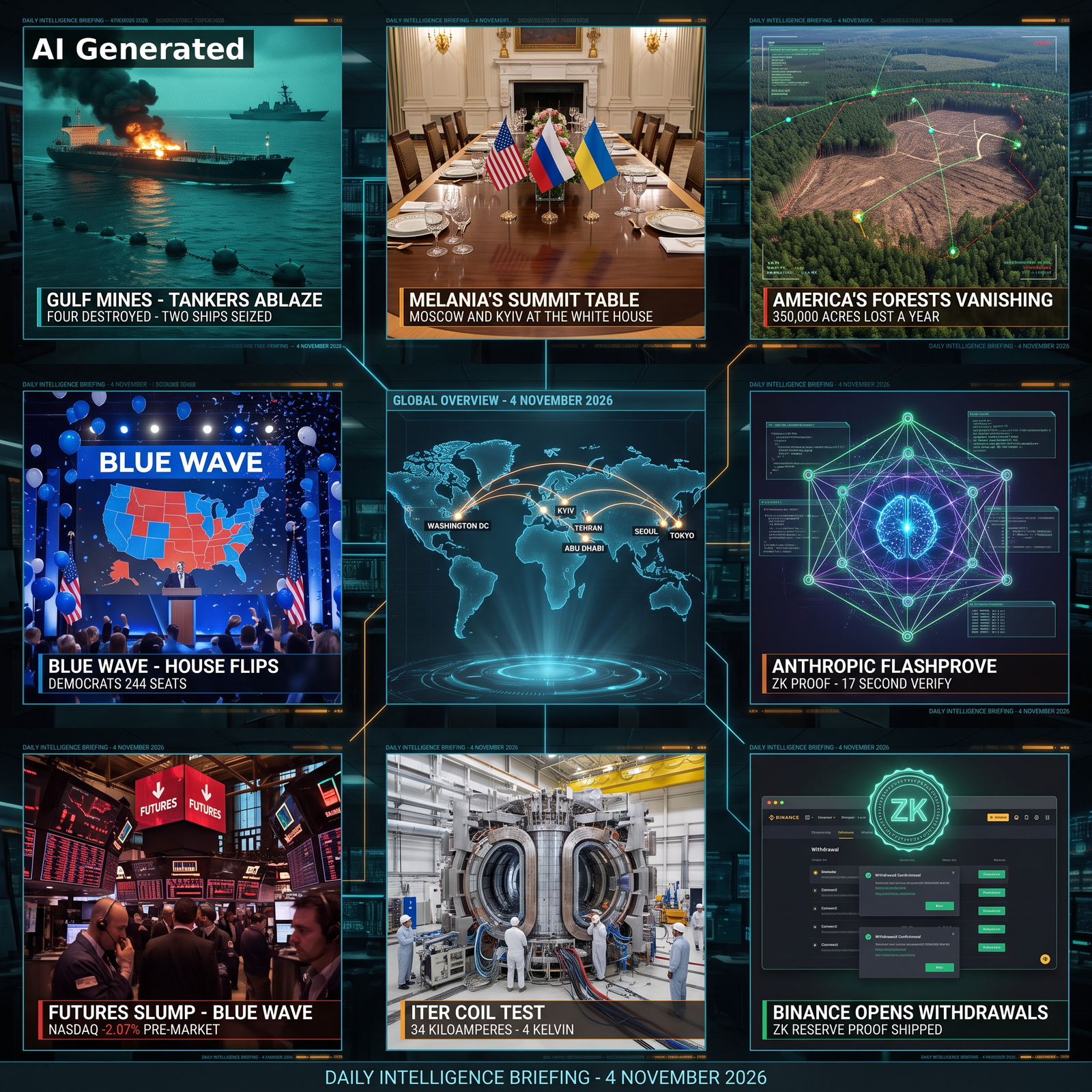
The Gulf theatre moved from calibrated pressure to a fresh kinetic escalation in the hours after the American midterm polls closed, with Iran’s Islamic Revolutionary Guard Corps announcing that four tankers had been destroyed after striking naval mines south of the Strait of Hormuz and that two other ships had been seized[1][2]. This returns the maritime layer to the very scenario D152 first documented — the mining of the shipping lane by which a sixth of global oil transits — and it does so at precisely the moment D156 flagged as the hinge: after the vote, when Washington’s freedom of action was set to be re-tested. Iranian state media, meanwhile, reported that Tehran has revised its list of potential targets “without geographic limits,” explicitly including Greece and Cyprus among the possible countries its armed forces could strike[3]. The threat targeted two EU member states hundreds of miles from the theatre, in an apparent effort to widen the battlefield’s perimeter and deter European participation in any further Gulf campaign — a direct escalation against the eastern Mediterranean flank that no previous report in this arc anticipated.
The American response has been characteristically dual-track and deliberately ambiguous. President Trump told the Financial Times he has no immediate plans to strike Iran, but left the question of future attacks open while confirming the earlier strikes on Iranian targets, and the White House reissued its warning for US government personnel to depart Saudi Arabia[4][5]. Reports citing American officials described a Central Command plan to attack Iran beginning Wednesday, once three carrier strike groups are concentrated in the region — a contingency that would constitute the largest single surge of US naval power into the Gulf since the war began. The strategic ambiguity is deliberate: Washington appears to be holding the option of a decisive post-election strike in reserve while testing whether the Democratic midterm outcome gives the administration cover for a diplomatic landing or removes it. What D156 called the “single most consequential open question of the week” — whether the electoral result emboldens escalation or hands the president a rationale for restraint — is now being answered in real time, and the fracturing of the region’s stability is measurable in the human ledger.
The human cost of the widening conflict is now enumerated in national terms. India’s Ministry of External Affairs reported that 23 Indian nationals have lost their lives in the West Asia conflict, including 15 seafarers killed in the maritime attacks that have defined this phase of the war[6]. This converts the Gulf crisis from a strategic abstraction into a concrete bilateral burden on New Delhi — the very power that has sought to balance its ties to Washington against its historic relationship with Tehran. The confirmation of Indian seafarer casualties will sharpen the diplomatic pressure on all parties to de-escalate, and it complicates India’s carefully hedged neutrality by creating a domestic constituency demanding both protection for its citizens at sea and pressure on those firing the mines.
The Ukraine Summit Clock: Melania’s Table and Europe’s Independent Force
The diplomatic architecture for Ukraine took an extraordinary new turn with reports that Melania Trump is to host Moscow and Kyiv for an “extraordinary” summit at the White House, even as Russian bombardment continued a week before the US-brokered talks are set to resume in Abu Dhabi[7]. The development is symbolically loaded — the First Lady convening both warring capitals under an American roof — and it adds a parallel diplomatic track to the Abu Dhabi table D156 described, testing whether Washington can run multiple negotiation channels simultaneously while its own electoral transition settles. The timing matters: the summit’s convening alongside the continued strikes on Ukrainian energy infrastructure signals that the diplomatic and military clocks remain decoupled, with Moscow evidently unwilling to pause its winter campaign even as it accepts the invitation to talk.
Parallel to the diplomacy, Europe is building a military guarantee structure that is self-consciously independent of American systems. Britain and the European Union are preparing a peacekeeping force for Ukraine that would be permitted to return fire if attacked by Russian forces, and which is being designed to operate largely without US technology such as Elon Musk’s Starlink[8]. This is a deliberate strategic signal: after the Koalicja exercise in Poland documented in D156, and following repeated European anxieties about dependence on American platforms and decision-making, the emerging force structure is being engineered to function on European rails alone. The implication is profound — a post-settlement security guarantee for Ukraine that does not depend on Washington’s continued goodwill would mark the most significant consolidation of European defence autonomy since the war began, even as it draws a clear line that Russian forces would be treated as a hostile intruder rather than a tolerated presence if they crossed a ceasefire.
North Korea’s Arsenal Rhythm and the Indo-Pacific Force Posture
On the other side of the Eurasian theatre, North Korea launched unidentified projectiles toward the sea — its fourth such launch within a month — with South Korea’s defence ministry confirming multiple missile launches from the Sondok area and both Seoul and Washington examining the details[9][10]. The cadence suggests Pyongyang may be nearing mass-production of a tested system, and the timing — landing as American attention is consumed by the midterm transition — fits the established North Korean pattern of exploiting Western distraction. The launches add a second Asia-Pacific flashpoint to a window in which Washington’s focus is elsewhere.
The Indo-Pacific force posture continued to deepen along parallel tracks. Satellite imagery revealed what US analysts describe as China’s mysterious “18-missile submarine,” an unusual uncrewed submarine configuration near the Huludao construction centre that could significantly expand Beijing’s anti-ship options in a Pacific contingency[11]. The development underscores the submarine-technology race at the core of the Pacific deterrence equation. Meanwhile Pakistan successfully flight-tested the Fa’az air-to-air missile, a weapon derived from Türkiye’s GÖKTUĞ family and launched from a JF-17, strengthening Islamabad’s beyond-visual-range air combat capability through deepening Turkish-Pakistani defence collaboration[12]. On the Indian side, Manila hailed its acquisition of the BrahMos supersonic cruise missile as “unmatched,” with the Philippine ambassador describing the purchase as a milestone that opens the door to deeper New Delhi-Manila defence cooperation — a concrete manifestation of India’s emerging role as an arms supplier to Southeast Asia as a hedge against Chinese influence[13].
The defence-industrial base is innovating across the missile and drone frontier. Shield AI completed the first full-scale prototype of its X-BAT autonomous combat aircraft, a runway-independent VTOL fighter with a 2,000-mile range and internal weapons bays, designed to operate from naval vessels and remote locations in GPS-denied environments[14]. And at Euronaval 2026, BAE Systems unveiled its Sea Tridon family of modular 40mm naval guns, uniting four configurations — from an electro-optical-gun adaptation to a radar-equipped close-in weapon system — around the programmable Bofors 3P ammunition to counter drones, missiles and surface threats, a naval-defence architecture built around the drone threat that increasingly defines maritime warfare in the Gulf and beyond[15]. India’s space-industrial momentum added a national-security dimension, with ISRO announcing the first rocket launch from its new Kulasekharapatnam spaceport in Tamil Nadu for March-April 2027[16]. And in a reminder that aerial geopolitics now extends to the skies over Russia, Taiwan’s airlines continued to operate flights over Russian territory, rattling European carriers whose regulators have restricted such overflights — a commercial-geopolitical asymmetry that underscores Taipei’s resilience and the failure of coordinated sanctions against Russian airspace[17].
Environment & Climate ↑ Contents
America’s Vanishing Forest and the Carbon Ledger
The environmental ledger opened with a dispiriting American metric: a newly launched satellite-tracking system, the US Forest Monitor, finds the United States is losing roughly 350,000 acres of forest land per year — a rate of approximately one football field every two minutes — equivalent to 2.3 billion metric tons of carbon dioxide once the released stored carbon and lost potential sequestration are counted[18]. The figure is a reminder that even as the climate-policy agenda at COP17 in D156 consolidated Indigenous authority, the physical erosion of one of the world’s most valuable carbon sinks continues largely unchecked. Because US forest loss is concentrated in regions where development, wildfire and agricultural conversion are accelerating, the metric constitutes a slow-running counterargument to any claim that reforestation commitments alone can offset industrial emissions.
The polar ledger continued to yield both natural archives and an accounting surprise. A Swiss glacier in the Engadin Valley has pulled back to reveal a larch trunk that stopped growing about 10,300 years ago, with its roots still attached, proving the tree grew on ground the ice later buried — a rare in-situ record showing how far the Morteratsch Glacier has retreated from its Holocene maximum, and a caution against reading any single valley’s ice history as evidence about global temperature[19]. And in a striking new entry in the methane inventory, Spanish scientists estimate that chinstrap penguin droppings across Antarctica release roughly 490,000 metric tons of methane a year — about 540,000 US tons — from guano patches whose concentrated emissions rival natural land environments per square meter, and which have never before been counted in the global methane budget[20]. The finding is an order-of-magnitude constraint rather than a precise inventory, but it underscores how much of the cryosphere’s microbial metabolism remains unmapped even as it feeds a potent greenhouse gas.
The Living Recursion: A Snail’s Return, and a Cold-Blob Nuance
In a rare conservation success, Hawaii’s state programme has returned a Hawaiian tree snail, Achatinella fuscobasis, to the wild more than 33 years after a 1955 biological-control decision — the introduction of the rosy wolfsnail to fight a garden pest — drove the native snail to the brink of extinction[21]. Eleven founding snails collected in 1991 became a captive population of more than 1,000; staff spent hundreds of hours and built predator-proof walls, and a detection dog, to carve out a small O’ahu exclosure where the first fifty were released. The story is a controlled experiment in the limits of biological control: one predator shipped in to fix a pest problem devastated an entire endemic lineage, and only human intervention of extraordinary labour could reverse the damage — a durable lesson about the unforeseen cascades embedded in “simple” ecological fixes.
Climate science added nuance to a long-standing observation. New research on the North Atlantic’s “cold blob” — the 965,000-square-mile area south of Greenland that cooled by as much as 1.8°F over the century even as other waters warmed — suggests the phenomenon may carry more climate nuance than the simple “weakened current” reading assumes[22]. The refinement matters for the Atlantic Meridional Overturning Circulation, the system whose stability underpins European and North American weather, because an overly simplistic causal story could mislead projections of how a warming Gulf Stream region will actually behave. Separately, a study confirms the tropics — long assumed relatively insulated — are registering significant shifts in rainfall and extreme temperature events, extending the D156 finding that extreme heat is no longer confined to summer[23]. And the framing for the coming adaptation decade was set by a policy analysis arguing that, with the world on track to overshoot 1.5°C, climate action must prioritise adaptation, loss-and-damage and climate justice alongside emissions cuts — a recognition that the mitigation-first paradigm is no longer sufficient[24].
The Data Centre Clash and the Energy Transition’s New Arithmetic
The AI-data-centre build-out, which D149–D156 tracked as a capital and employment story, now collides directly with public health and grid politics. A modelling report finds that the proposed Stratos data centre in Utah’s Box Elder County, if powered by on-site methane generation, would emit air pollution linked to premature deaths and health-economic damages for Utah and multiple downwind states[25]. The claim repositions the AI-capital boom as an environmental-health contested question, and it will feed the very post-midterm oversight politics D157’s democracy section describes, with a newly empowered Democratic House positioned to scrutinise data-centre siting. On the resilience side, Hawaii’s Oahu — with among the highest electricity rates in the nation — is being advanced as a laboratory for a 100% clean-energy, economically resilient future, and the US Department of Defense’s solar microgrid at the White Sands Missile Range is cited as a model the civilian grid could emulate[26][27].
The electrification arithmetic is shifting fastest in Asia. China’s heavy-truck market is now majority electric, with EV heavy trucks reaching 50.3% share in September — long-haul big-rig share at 64.5% — putting Beijing on track to reach its national 2030 EV-truck goal years early[28]. The milestone quietly redraws the global energy map: if the world’s largest freight fleet electrifies on schedule, the oil-demand curve and the associated transport-emissions ledger look very different by the decade’s end. Elsewhere in the industrial transition, a call to modernise the 140-year-old Hall-Héroult process points toward emission-free aluminium production, and Petrovietnam’s CEO publicly sketched a Vietnamese future of nuclear and wind power[29][30]. The environmental-governance counterweight landed in two enforcement stories: the Aghorn oil firm — which pleaded guilty and paid a $1 million fine after a couple died from toxic hydrogen sulfide in 2019 — continues to be found in violation at its facilities, exposing the limits of even costly penalties in changing behaviour[31]; and the debate over Eurasian wolf-livestock coexistence, following the EU’s loosening of wolf protection, was framed as requiring a holistic approach that transcends the polarised love-or-hate media narrative[32].
Society & Civil Issues ↑ Contents
The Blue Wave: Democrats Retake the House and Shake the Senate Map
America’s midterm verdict, whose eve D156 documented as the “midterm crucible,” delivered the historic result polling had promised and then some: NBC News projected that Democrats would take control of the House of Representatives, with CNN and NBC reporting the party securing a majority of at least 244 seats in the 435-member chamber[33]. The result is the single most consequential political event of the D156–D157 arc’s master variable, converting the integrity-perimeter battles D149–D156 tracked (courts, ballots, California challenges) into an actual transfer of legislative power. The wave reached into places the Democrats have not contested in a generation: Democrat James Talarico won the Texas Senate seat long held by Republicans — the first Democrat elected to that seat since the 1980s — and the party flipped Senate seats in both North and South Carolina while keeping Georgia and New Hampshire[34][35]. On the House itself, Hakeem Jeffries stands on the threshold of becoming the first Black Speaker of the House, an outcome that reframes the Democratic majority as a historic milestone in American political representation[36].
The individual races read as a repudiation of Trump’s personal brand as much as of his party. In South Carolina, pediatrician Annie Andrews defeated Darline Graham — the sister of the late Lindsey Graham whom President Trump had personally installed — winning the seat her brother had held for two decades, in a state Trump carried by eighteen points in 2024; it is the first Democratic Senate victory there since 1998[35][37]. In Georgia, Jon Ossoff won re-election in a race he turned into a fundraising juggernaut with more than $100 million, then rails against a “lame duck” Trump; the same state elected Keisha Lance Bottoms as its first Black woman governor[38][39]. In Ohio, Democrat Amy Acton defeated Vivek Ramaswamy in the governor’s race, and in Iowa and Kansas Democrats also broke through[40][41]. The pattern is a broad-based repudiation across nearly every category of the ballot — Senate, House and governorships — that goes well beyond the marginal midterm losses governing parties usually expect, and it lands with particular force given Trump’s repeated claim that voters should “pretend I’m on the ballot.”
The president’s own spin now defines the immediate political scene. The White House, adopting an “unfazed” posture, insisted the president was not a candidate and blamed the quality of Republican candidates for the losses, with an official quoting Trump as saying voters show up “when he is himself a candidate”[42][43]. Trump whined “I wasn’t on the ballot” and, in a separate signal, the administration began sketching how he intends to govern without a Congress he can no longer control, signalling heavy reliance on vetoes and executive orders[44][45]. This is the pivot D156 anticipated: with the Democratic House positioned to run hearings and subpoena answers, and with Jeffries at its head, the enforcement and oversight questions that Meta, the data-centre build-out, and Trump’s own actions raised across this reporting arc are set to become institutional battles rather than academic ones.
Platform Accountability, the European Civic Square and the Post-Election Perimeter
The platform-governance question, tracked in D156 through content moderation and AI, reached the electoral arena this cycle. Meta’s automated content-moderation systems wrongly took down the coalition account “No Kings” at the height of an early-voting day of action and a Democratic Senate candidate’s Latino-outreach page, while Brazil’s electoral court ordered the company to treat presidential candidates equally amid Lula’s complaints of algorithmic bias — incidents that together expose the risks of handing more of election-integrity policing to large language models, a shift Meta is nonetheless accelerating toward 90% automation for some violation categories[46]. The accountability perimeter now depends on who controls the House committees: a Democratic majority puts the lawmakers who demanded Meta’s records in line to subpoena answers to exactly these questions.
The European civic square ran on parallel institutional tracks. The EU Commission’s annual enlargement report delivered a likely critical assessment of Serbia’s rule-of-law backsliding even as the post-election window offered hope of new momentum — while Serbia’s new civil-society-majority government launched an “Operation Mains Propres” (Clean Hands) arrest wave evidencing the scale of corruption-remediation work ahead[47][48]. In France, the social conflict over the collective takeover of SFR by Bouygues Telecom, Free and Orange intensified with fresh strikes over job-security anxieties[49]. The EU’s cyber perimeter sharpened too: Brussels urged action as supermarkets in at least eleven countries, including Germany, Romania and the UK, reported cyberattacks that the EU called “not isolated,” even as a Romanian official suspected no state actor was behind them[50]. In Germany, the Bundestag faced a constitutional ruling on the AfD’s expulsion of an MP, the government tested its Lükex 26 crisis-management exercise under a drought-and-heat scenario, and the governing coalition wrangled over pension-reform parameters on early retirement[51][52][53]. The labour-disruption ripple of the AI transition also reached the creative economy, with design platform Canva announcing more than 1,200 staff cuts as its bosses blamed AI for the company’s “hardest year yet”[54].
AI & Technology ↑ Contents
Verified Models and the Cryptographic Trust Layer
The frontier’s trust problem — how to know an AI actually produced the output you paid for — gained a concrete technical answer. Anthropic unveiled FlashProve, an open-source cryptographic system using zero-knowledge (zk-SNARK) proofs to verify that a specific model generated given output tokens in response to a given prompt, without exposing the provider’s proprietary weights[55]. Demonstrated on a 400-billion-parameter model at roughly 110 tokens per second, with each proof about 19MB and verifiable on a CPU in about 17 seconds, FlashProve lets an auditor or regulator confirm which model a provider actually served — a direct answer to the “model substitution” and “routing” trust gap that D153 and D156 flagged as the industry’s credibility frontier. It remains a research prototype costing 70–95 times the compute of ordinary inference, and it proves an integer version of the model under greedy decoding, but as the first open implementation it converts identity-and-integrity verification from a promise into an independently checkable arithmetic problem.
Compute’s Geopolitics: Nvidia’s China Slice and AMD’s Data-Centre Ascent
Compute’s supply chain hardened around export controls and the data-centre boom. Nvidia confirmed it will allocate just 1% of its roughly $70 billion RTX chip order to China clients, a number that starkly quantifies the impact of production constraints and export restrictions on Chinese access to the frontier’s silicon[56]. The figure matters in the context of D156’s DeepSeek-Huawei-Ascend story: Beijing’s push to substitute domestic chips is happening against a backdrop of a near-total boycott of the most advanced American accelerators, which today leaves China with a vanishing slice of the most in-demand hardware. Meanwhile AMD posted its largest and most profitable quarter in history, with record $13.4 billion in revenue and a forecast of an $17-billion next quarter, driven by its data-centre business ($8.5 billion in the quarter) and growth expected above 80% in 2027[57]. AMD’s ascent alongside Nvidia’s record build-out confirms that the AI-capital boom — the driving force behind the data centres D157’s company sections and the “AI compute campuses” rebrand OpenAI is proposing — is now the single largest source of growth in the entire semiconductor industry, even as it becomes an environmental and political battleground.
At the hardware innovation edge, two photonics advances promise faster defence and better imaging. Raytheon’s optical processor, developed under DARPA’s PICASSO programme, aims to keep signal processing entirely within the optical domain, eliminating the electronic-conversion bottleneck that slows how fast military systems interpret radar and electronic-warfare data in contested environments[58]. And Stanford researchers built a programmable photonic chip that separates partially coherent light into distinct mutually incoherent modes, potentially letting cameras, microscopes and telescopes capture information conventional imaging misses — a capability proposed theoretically for decades but only now demonstrated experimentally, and one under investigation for analysing light from distant galaxies[59]. Both trails show the optical layer becoming a frontier for both performance-per-watt and for extracting information the electronic layer cannot reach.
AI in the State and the Public Square
The post-election perimeter gave the AI-accountability front a new institutional home. Meta’s accelerated shift of content moderation to large language models produced a string of election-cycle failures — the “No Kings” account takedown at the height of its early-vote day of action, a Senate candidate’s Latino-outreach page flagged as impersonation, and Brazil’s electoral-court complaint over alleged algorithmic bias against Lula — triggering calls from Democratic senators and a state attorneys-general from thirteen states for records and transparency[60]. With Democrats now controlling the House (Section 3), the lawmakers who demanded those records are poised to chair the committees empowered to subpoena answers — meaning the AI-moderation accountability fight is about to move from corporate policy to congressional oversight. Two adjacent policy fronts sharpened: OpenAI, as part of its post-midterms campaign, proposed rebranding data centres as “AI compute campuses” to combat their negative PR, and Google’s new policy is forcing schools to choose between its search engine and its AI tools, a choice that reshapes educational data flows[61][62]. Finally, in an echo of the D156 espionage-at-the-OS-layer theme, California pushed back against what it called a “preposterous” Trump-administration demand to scrap state net-neutrality and broadband laws as a condition of accepting $1.42 billion in federal BEAD grants — a state-federal fight over telecom regulation that sits at the junction of the AI data economy and the broadband foundation it depends on[63].
Economy & Business ↑ Contents
Wall Street Weighs the Blue Wave and the Debt Ceiling
The market’s first read on the midterm outcome was sharply negative, inverting the usual assumption that gridlock is good for stocks. Stock futures plunged as the “blue tsunami” hit red states, with Dow futures down 380 points (0.73%), S&P 500 futures down 1.12% and Nasdaq futures tumbling 2.07% as a Democratic sweep — whose odds briefly hit 95% — raised fears of “damaging political paralysis” over government spending and the debt ceiling rather than the gridlock Wall Street traditionally prizes[64][65]. The logic, articulated by veteran Ed Yardeni, is that a Democratic Congress complicates the very negotiations Washington must conduct to raise the debt ceiling and avoid shutdowns, potentially pushing Treasury yields higher and weighing on equity valuations — even as Trump retains executive authority over the tariffs and the Iran policy that had already rattled markets all year. Yet the forward-looking counterpoint holds that a weaker dollar and the potential for forced fiscal discipline could ultimately present a buying opportunity, given the underlying strength of corporate earnings.
The Asia-Pacific complex transmitted the shock immediately. Japanese and South Korean stocks fell more than 3% as the Democratic lead came into focus, and the dollar weakened against the yen (down 0.65% to 157.65), the euro and the Swiss franc, with Asian markets broadly lower on the political read-through[66][67]. The dollar’s slide carries a geopolitical subtext: a weaker greenback is exactly the kind of pressure that, combined with Trump’s “no rush” posture on Iran, could feed the oil-price and reserve dynamics that D156 tied to the RBA’s fifth hike. The US debt story is the thread that binds the market’s gloom to the developing world, where a Rockefeller official warned that debt-service costs are curbing growth for developing nations — a structural headwind that a dollar-depreciating, rate-sensitive world will feel unevenly[68].
Corporate and Emerging-Market Files
The corporate ledger was a mixed bag of AI-capital winners and interest-rate losers. India’s research arm of the story saw the quarterly results of Lupin (net profit down 22% to ₹1,155 crore) and Samhi Hospitality (net profit down 59% to ₹41 crore despite a 15% revenue rise) underscore that even revenue growth cannot protect earnings in a higher-rate, higher-input-cost environment[69][70]. On the telecom-infrastructure front, Jio explored tech-for-equity talks with US cable giants Comcast and Charter Communications, a model that would exchange technology or content for equity rather than cash — a novel structure with direct implications for how Indian connectivity deals are financed and how American media firms gain distribution into the world’s second-largest internet market[71]. The rate-and-capex frontier, in turn, framed how the AI data-centre build-out will be paid for: with the Democratic House set to scrutinise the very siting and electricity questions that the debt and deficit mathematics now make unavoidable, the market is pricing both the boom and its political and fiscal constraints simultaneously.
Science & Space ↑ Contents
Fusion’s Magnet, the Body’s Patterns and the Deep Archive
The fusion frontier passed a tangible engineering milestone. ITER completed a major test of one of its 330-tonne superconducting toroidal field coils, energising coil #17 to 34 kiloamperes at 4 Kelvin — half its nominal operating current — and confirming the magnet deforms as structural models predict under the electromagnetic load it will face containing superhot plasma[72]. The campaign, ending with the coil removed from its cold-test facility on 30 October and prepared for the assembly hall, provides the operational experience that will de-risk the integration of the tokamak’s eighteen D-shaped TF coils. It is a reminder that fusion, however distant its commercial date, continues to accumulate the mechanical knowledge on which a working reactor depends.
Cell and evolutionary biology delivered two elegant pattern findings. Researchers at the University of Geneva built a mathematical model showing that subtle interactions between cells and chemical signals may shape the intricate, stereotyped patterns of mammalian hair-follicle spacing — a candidate explanation for a biological structure whose geometric regularity has long defied simple account[73]. And a comparative study of the 3D genome in its neurons found that lab-grown neurons derived from induced pluripotent stem cells retain features of embryonic development, offering a tool to study how the nervous system matures in a dish[74]. On the human-health ledger, a major population-level study combining the UNITE brain bank with National Death Index records estimated that roughly 74.5% of deceased former NFL players had CTE neuropathology at death between 2008 and 2023 — a figure that corrects for the selection bias that inflated earlier autopsy-only estimates and gives the most accurate prevalence assessment yet, while its authors caution it does not mean three-quarters of players are destined for dementia[75].
The deep archive produced fresh environmental history and one new record. A complex reconstruction of two medieval catastrophes at Italy’s Lake Iseo showed that human land-use change — deforestation and pasture expansion after the fall of Rome tripled sediment flowing into the lake, steepening its underwater banks — so preconditioned the delta that the 1117 CE Verona and 1222 CE Brescia earthquakes triggered subaquatic landslides generating tsunamis with waves exceeding 50 metres and water reaching 2.7 kilometres inland, with the densest-now-developed shores making a repetition far more costly[76]. The finding is a cautionary tale about how human reshaping of a landscape can turn a natural seismic event into a manufactured disaster. Exploration also set a record but not yet an end: Czech cave explorers and a Portuguese-developed autonomous robot traced the Hranice Abyss in the Czech Republic to 1,476 feet below its water surface — a record for flooded-cave depth first set in 2016 — yet geophysical work indicates the passage may continue to 2,600–4,300 feet, and nobody has touched bottom[77].
The Sensory and Systems Frontier
Two cross-disciplinary findings reframed how animals and machines parse their worlds. In Budapest, twenty family dogs listening to non-stop strings of invented syllables while wearing EEG electrodes locked their brains onto the same consonant patterns that human brains rely on from infancy — a consonant-bias mechanism previously thought unique to humans, and one that emerged even in dogs raised on the street, challenging the idea that the bias requires early-life language wiring[78]. And a Stanford photonic chip (detailed in Section 4) demonstrates how optical processing is becoming a research and imaging tool across the sciences. On the applied side, researchers developed sensors for continuous corn-growth monitoring, an NIH Common Fund data ecosystem is making research datasets from 18 programmes more findable to accelerate cross-study connections, and a semiautomated platform now delivers consistent pharmaceutical-grade batches of extracellular vesicles, moving regenerative therapies closer to clinical application[79][80][81]. The systems layer also produced cautionary notes: a study finds digitalization front-runners are more vulnerable to cyberattacks, and estimates that one in fifteen adults has experienced AI-generated image-based abuse[82][83]. And on the human-elephant frontier, researchers warn that Southern Africa’s crop-raiding risk zone could expand by 33–100% by 2085 as farmland and dryness spread — a looming coexistence crisis with direct bearing on conservation policy[84]. The institutional ledger also turned: prosecutors moved to drop charges against the Harvard researcher Kseniia Petrova, accused of smuggling frog embryos, amid her claim of vindictive prosecution[85].
Crypto, Digital Assets & Blockchain ↑ Contents
Binance’s Recovery Accelerates: Wider Withdrawals and a User-Verifiable Proof
The $6.3 billion Binance response entered its most consequential phase yet, combining operational recovery with a cryptographic transparency milestone. At 04:00 UTC on Monday 3 November, Binance re-opened withdrawals for more than a hundred asset-and-network combinations across nine networks — the widest single step in the phased recovery that began at the end of October — while simultaneously shipping a zero-knowledge proof for the 31 October reserve snapshot[86]. The mechanism is a Merkle tree wrapped in a zk-SNARK applied to a snapshot taken at 00:00 UTC on 31 October, letting holders of ten major tokens (bitcoin, ether, USDT, BNB, Solana, USD Coin, XRP, USD1, RLUSD and Zcash) independently verify on their own machines that their balances are backed at least one-to-one. This is the difference between an auditor’s assertion and a proof a user runs herself — a substantive answer to the “is the money there” question that has shadowed the exchange all week. Binance framed the ~95% coverage as deliberate, noting the residual roughly five percent consists of less-liquid tokens it is sourcing with industry partners, and pledged it will bear the financial impact rather than pass losses to users.
The trust calculus, however, extends beyond the reserve proof. Binance’s November LUNC burn was missed, breaking its monthly streak and raising community concerns about the exchange’s reliability on tokenomics commitments even as it manages the recovery[87]. The episode is a reminder that a solvency commitment and operational follow-through are distinct documents: the reserve proof answers “are the funds there,” while a missed burn and the still-unpublished post-incident technical report leave open the “how did it happen and will commitments hold” questions. The forensic and diplomatic front also continued to harden. North Korea, through both Kim Yo Jong’s denial and official channels, again rejected the FBI’s attribution and stated it sees no need for talks with the United States[88]. The attribution dispute — in which Pyongyang calls the accusation a “serious political provocation” — cements the point D156 raised: the record $6.3 billion heist is as much a foreign-policy contest as a security one, and the laundering clock that D153–D155 tracked through THORChain is now inseparable from the diplomatic standoff.
The Exploit Chronicle and the Institutional Security Perimeter
The broader ecosystem was struck by a pair of fresh incident reports that kept the security agenda central. French bank Crédit Mutuel Arkéa was allegedly targeted in a $133 million crypto theft, identified by investigator ZachXBT — a reminder that the institutional-holdings perimeter is now a primary target for sophisticated actors, and that the response-latency metric Binance’s recovery established applies to banks holding digital assets as much as to exchanges[89]. And a flash-loan oracle attack inflated CoreVault redemptions 33-fold and drained 160.26 BNB, underscoring the persistent fragility of DeFi protocols whose pricing depends on manipulable oracles — the same structural weakness that has cost the ecosystem hundreds of millions across prior exploit cycles[90]. Together with the Binance affair, these events reinforce that the industry’s institutional credibility rests on hardening both custody and the oracle layer simultaneously.
The institutional rails advanced on several front. South Korea’s ruling party formally proposed deferring the crypto income tax to 2029, arguing the country should first enact its comprehensive Digital Asset Basic Act — a sequencing decision with real consequences for market confidence and investor behaviour in one of Asia’s most active digital-asset markets[91]. Ripple’s CEO framed XRP and its RLUSD stablecoin as complementary rather than competing, aligning their use to customer needs and reinforcing the tokenised-payment-rail thesis that D156 tied to cross-border settlement[92]. Hong Kong’s Monetary Authority and HKUST launched a post-quantum cryptography assessment toolkit for banks — a preparation programme, not a declaration that quantum machines have broken any current cryptosystem, but a sign that the banking sector is taking the migration seriously ahead of a forced-emergency scenario[93]. Coinbase published an engineering account of its move to multi-user architecture, and 1inch’s in-house lawyer argued that US regulators will keep driving crypto policy regardless of the midterm outcome — a forecast that, given the Democratic House now set to hold hearings, will be tested in the next Congress[94][95]. Institutional allocators reinforced the accumulation trend, with Ark Invest buying 12,835 Circle shares for roughly $965,000 while trimming its Bullish position — a signal that the stablecoin model is drawing increasing institutional capital against the backdrop of a sector-wide consolidation toward regulated, transparent issuers[96].
Correlations & Analysis ↑ Contents
D157 is defined by the resolution of the master variable this report has tracked since D149: the American midterm outcome finally has an answer, and it is a Democratic sweep that converts the “midterm crucible” D150–D156 described into an actual transfer of congressional power. The blue wave that delivered the House (with at least 244 seats) and flipped Senate seats in North and South Carolina, Kansas and Texas is not merely a partisan result — it is the institutional verdict D155 asked the integrity perimeter to produce, and it arrived through the very courts and ballot integrity mechanisms D152–D156 tracked. The Supreme Court’s rejection of the California counting challenge on election eve, documented in D156, now reads as the last act of a process that vindicated the integrity perimeter rather than bending it, and the Hakeem Jeffries threshold makes that institutional victory coincide with the most diverse leadership the House has ever seen.
The Gulf clock, which D150 set as “strike preparation,” D152 executed, D156 carried to election-eve strikes on Qeshm and Bandar Lengeh, and D155 held at “T-minus one,” has now produced its post-election decision environment. The IRGC’s announcement that four tankers were destroyed by mines south of Hormuz and two ships seized, Iran’s explicit inclusion of Greece and Cyprus in a “no geographic limits” target list, a US embassy departure warning from Saudi Arabia, and reports of a Central Command plan to strike beginning Wednesday once three carrier groups assemble — all frame a region braced for the exact decision D156 identified as the week’s hinge. Trump’s “no immediate plans” to the FT, set against the CENTCOM Wednesday contingency, replicates the calibrated ambiguity D152 described: Washington holding escalation in reserve while a two-track door to negotiation remains nominally open. But the addition of EU members Greece and Cyprus to Tehran’s threat map raises the stakes beyond the D150–D156 frame, pulling the eastern Mediterranean and the very European powers now building an independent Ukraine-security force into the Gulf’s retaliation calculus.
The Ukraine file and the Gulf file now share a single structural feature: both are waiting on the same American leadership transition, but each is building European autonomy that presumes continued American support even as it hedges against it. D156 described the Abu Dhabi talks (10–11 November) and the multinational Koalicja exercise; D157 adds the extraordinary prospect of Melania Trump hosting Moscow and Kyiv at the White House, and a Britain-EU peacekeeping force designed to operate without Starlink or other American systems. That “European rails only” design is the quiet strategic revolution beneath the headlines — a guarantee structure that could deploy into Ukraine without American platforms, even as American-mediated negotiations and an American aid cut (D157’s $4 billion end to Israel assistance) recalibrate the alliances Washington leads. The correlations are precise: the dollar’s post-election slide compounds the fiscal pressures on developing nations, and a Democratic House empowered to scrutinise data-centre siting and debt negotiations is positioned to reshape the very capital that funds both the AI boom D149–D157 charted and the defence-industrial expansion across the Indo-Pacific.
Three further threads tie the report together. First, the Binance arc (D152–D157) has matured from raw theft into an institutional recovery-and-counter-laundering exercise now producing user-verifiable reserve proofs, even as North Korea’s renewed denial keeps the attribution locked in a diplomatic standoff — and fresh exploits (Crédit Mutuel Arkéa, CoreVault) show the security perimeter is under continuous pressure across both centralised and DeFi surfaces. Second, the AI-accountability front has gained an institutional home: with Democrats controlling the House, the Meta-AI-moderation failures documented in D156 and D157 — from No Kings to Brazil’s electoral-court dispute — become subpoena-able matters, translating the platform-governance debate into congressional oversight. Third, the environmental ledger keeps defining permanent boundaries even as politics negotiates them: the US Forest Monitor’s football-field-every-two-minutes statistic, the Antarctic penguin methane revelation, and the Hawaii snail’s 33-year return together sketch a biosphere whose thresholds are being both measured and defended in the same reporting window.
What to watch in the next reporting period: whether the post-midterm Gulf decision produces a Wednesday strike or a negotiating landing, and how Iran’s explicit Greece-and-Cyprus threat reshapes the eastern-Mediterranean flank; the White House summit for Kyiv and Moscow and the Abu Dhabi talks; Binance’s withdrawal phase three and the wider post-incident technical report; the first actions of a Democratic House majority on oversight, data-centre siting and the debt ceiling; and whether the weaker dollar and a Democratic Congress force the fiscal discipline the markets are now pricing.
References ↑ Contents
1. Iran’s IRGC: four tankers destroyed after hitting mines south of Strait of Hormuz, two other ships seized – statement by FinancialJuice · Source ↑
2. Iran’s Revolutionary Guards say four tankers remain ablaze after hitting naval mines by FinancialJuice · Source ↑
3. Ιράν: Ελλάδα και Κύπρος ανάμεσα στους πιθανούς στόχους, σύμφωνα με ιρανικά ΜΜΕ by in.gr · Source ↑
4. Iran-Krieg: Trump lässt Frage neuer Iran-Angriffe offen by Handelsblatt · Source ↑
5. Η πρεσβεία των ΗΠΑ επανεξέδωσε προειδοποίηση για την αποχώρηση του προσωπικού της από τη Σαουδική Αραβία by Skai · Source ↑
6. West Asia Conflict Claims 23 Indian Lives As MEA Reports Maritime Casualties And Missing Nationals by Indian Defence News · Source ↑
7. Ukraine-Russia war latest: Melania Trump to host Kyiv and Moscow for ‘extraordinary’ summit at White House by Independent · Source ↑
8. Βρετανία και ΕΕ ετοιμάζουν ειρηνευτική δύναμη για την Ουκρανία by DefenceNet.gr · Source ↑
9. North Korea launches unidentified projectile toward the sea, South Korea says by AP via Independent · Source ↑
10. North Korea launches multiple missiles from Sondok area: South Korea defense ministry by FinancialJuice · Source ↑
11. China’s Mysterious ’18-Missile Submarine’ Could Give The U.S. Navy A Pacific Nightmare by Indian Defence News · Source ↑
12. Pakistan Tests Turkish GÖKTUĞ Fa’az Air-To-Air Missile, Strengthening Indigenous Air Combat Capability by Indian Defence News · Source ↑
13. Philippines Hails India-Made BrahMos As ‘Unmatched’, Signals Scope For Deeper Defence Partnerships by Indian Defence News · Source ↑
14. First full-scale X-BAT combat drone prototype packs 2,000-mile range, vertical flight by Interesting Engineering · Source ↑
15. BAE Systems has unveiled Sea Tridon – its new modular 40mm naval gun system – at Euronaval 2026 by flight.com.gr · Source ↑
16. First Rocket Launch From Tamil Nadu’s Kulasekharapatnam Spaceport Set For March-April 2027, Says ISRO Chief by Indian Defence News · Source ↑
17. Taiwan airlines continue flights over Russia, rattling Europeans by Nikkei Asia · Source ↑
18. US Loses a Football Field of Forest Every 2 Minutes by Inside Climate News · Source ↑
19. A Swiss glacier has pulled back far enough to reveal a larch that stopped growing about 10,300 years ago by ECONEWS / E&G Quaternary Science Journal · Source ↑
20. Chinstrap penguin droppings across Antarctica release an estimated 540,000 tons of methane a year by ECONEWS / npj Climate and Atmospheric Science · Source ↑
21. A Hawaiian tree snail vanished from the wild… 33 years later it is back behind walls that keep its hunters out by ECONEWS · Source ↑
22. North Atlantic’s ‘cold blob’ may contain climate nuance by Phys.org · Source ↑
23. Climate Change is Making the Tropics Hotter by ENN · Source ↑
24. Overshoot Demands a New Era of Adaptation, Loss & Damage, and Climate Justice by CleanTechnica/NRDC · Source ↑
25. Stratos Data Center Will Emit Air Pollution That’s Linked to Premature Deaths and Health Economic Damages for Utah & States Downwind by CleanTechnica/NRDC · Source ↑
26. How does Oahu get to an economically resilient, 100% clean energy future? by CleanTechnica · Source ↑
27. If The US Department Of Defense Gets Solar Power, Why Can’t We? by CleanTechnica · Source ↑
28. China Truck Sales Now Majority Electric. What’s Next? by CleanTechnica · Source ↑
29. Moving Towards Emission-Free Aluminum Production by ENN · Source ↑
30. Petrovietnam CEO sees a future of nuclear and wind power by Nikkei Asia · Source ↑
31. Few Repercussions for Oil Firm’s Continued Leaks After Couple’s Death From Toxic Gas (Aghorn H2S) by Inside Climate News / The Examination · Source ↑
32. Human-wildlife coexistence with wolves in Europe requires a holistic approach by Mongabay · Source ↑
33. Medien: US-Demokraten erobern Repräsentantenhaus von den Republikanern zurück by Stern · Source ↑
34. Ενδιάμεσες εκλογές στις ΗΠΑ: Ο Δημοκρατικός Τζέιμς Ταλαρίκο κερδίζει την έδρα του Τέξας στη Γερουσία by Efsyn · Source ↑
35. South Carolina elects Democratic senator for first time in almost three decades by BBC News · Source ↑
36. Χακίμ Τζέφρις: Στο δρόμο για να γίνει ο πρώτος μαύρος πρόεδρος της Βουλής των Αντιπροσώπων by Naftemporiki · Source ↑
37. Democrat Annie Andrews defeats GOP Sen. Darline Graham in South Carolina, a major upset by NBC News · Source ↑
38. Democrat Jon Ossoff rails against ‘lame duck’ Trump after winning Georgia Senate race by Independent · Source ↑
39. Keisha Lance Bottoms makes history as first Black woman elected Georgia governor by Independent · Source ↑
40. Democrat Amy Acton overcomes Republican Vivek Ramaswamy in contest for Ohio governor, CNN projects by FinancialJuice · Source ↑
41. Democrat Rob Sand beats Republican Zach Lahn in race for Republican-held Iowa governor’s seat: Decision Desk HQ by FinancialJuice · Source ↑
42. White House blames GOP candidates for midterm election losses by Independent · Source ↑
43. ΗΠΑ – Ενδιάμεσες εκλογές: «Ο Τραμπ δεν ήταν υποψήφιος», τονίζει ο Λευκός Οίκος by Enikos · Source ↑
44. Trump whines ‘I wasn’t on the ballot’ as his candidates are crushed in midterms one after another by Independent · Source ↑
45. How Trump plans to govern without Congress if Republicans lose control by Reuters via Independent · Source ↑
46. Meta says automation wrongly took down No Kings and a Senate candidate’s page. It’s automating more anyway by Fortune · Source ↑
47. EU legt Bericht über Fortschritte bei Erweiterung vor by Stern · Source ↑
48. Opération « mains propres » en Serbie sur fond de transition démocratique ardue by Le Monde · Source ↑
49. Le conflit se poursuit entre les salariés de SFR et Bouygues Telecom, Free et Orange sur le volet social du rachat de l’opérateur by Le Monde · Source ↑
50. EU urges action as Germany, Romania and UK report supermarket cyberattacks by Al Jazeera · Source ↑
51. Bundesverfassungsgericht verhandelt über Ausschluss aus AfD-Fraktion by Stern · Source ↑
52. „Dürre und Hitzewelle”: Bundesweite Großübung zum Krisenmanagement beginnt (Lükex 26) by Stern · Source ↑
53. Alterssicherung: Wie viele Ältere nutzen die umstrittene Frührente? by Stern · Source ↑
54. Canva cutting more than 1,200 staff as bosses blame AI for ‘hardest year yet’ by Express · Source ↑
55. Anthropic uses cryptography to verify model outputs without exposing weights (FlashProve) by Interesting Engineering · Source ↑
56. Nvidia allocates 1% of $70B RTX chip order to China clients by Crypto Briefing · Source ↑
57. AMD rides data center riches to ‘largest and most profitable’ quarter in history by The Verge · Source ↑
58. US military could get battlefield speed edge from Raytheon’s new optical processor (DARPA PICASSO) by Interesting Engineering · Source ↑
59. Photonic chip separates three modes of mixed light to reveal hidden details in imaging by Interesting Engineering · Source ↑
60. Meta says automation wrongly took down No Kings and a Senate candidate’s page by Fortune · Source ↑
61. AI Data Centers Have a PR Problem. OpenAI Is Proposing a Rebrand by CNET · Source ↑
62. Google Is Forcing Schools to Choose Between Its Search Engine and AI by CNET · Source ↑
63. California fights ‘preposterous’ Trump admin demand to scrap state broadband laws by Ars Technica · Source ↑
64. Stock futures plunge as blue tsunami hits red states and data center hot spots by Fortune · Source ↑
65. Nasdaq 100 futures slide nearly 1.5% as Democratic sweep odds hit 95% by Crypto Briefing · Source ↑
66. Japan, South Korea stocks fall over 3% as Democrats lead in US midterms by Nikkei Asia · Source ↑
67. Ενδιάμεσες εκλογές ΗΠΑ: Υποχώρηση του δολαρίου, απώλειες χρηματιστηρίων στην Ασία by Skai · Source ↑
68. Debt costs curb growth for developing nations, Rockefeller official says by Nikkei Asia · Source ↑
69. Lupin Q2 results: Net profit falls 22% to ₹1,155 cr, revenue at ₹7,827 cr by Business Standard · Source ↑
70. Samhi Hospitality Q2 net profit falls 59% to ₹41 cr despite revenue rise by Business Standard · Source ↑
71. Jio explores tech-for-equity talks with Comcast, Charter Communications by Business Standard · Source ↑
72. World’s largest fusion reactor tests 330-tonne magnet built to control superhot plasma (ITER coil #17 at 34kA) by Interesting Engineering · Source ↑
73. The Mystery of Hair Growth Patterns May Finally Have a Simple Explanation by SciTechDaily / University of Geneva · Source ↑
74. Lab-grown neurons retain features of embryonic development by Phys.org · Source ↑
75. Almost 75% of Deceased NFL Players Had Degenerative Brain Disease, Major Study Estimates (CTE 74.5%) by ScienceAlert / JAMA Network Open · Source ↑
76. Medieval Humans Partly Caused Two Catastrophic Lake Tsunamis, And We Could Easily Do It Again (Lake Iseo) by ScienceAlert / Nature Communications · Source ↑
77. Czech cave explorers and a robot have measured the Hranice Abyss to 1,476 feet underwater by ECONEWS / Environmental Earth Sciences · Source ↑
78. Twenty family dogs listened to nonstop invented words… dog brains lock onto consonant patterns of speech by ECONEWS / Science · Source ↑
79. Researchers develop sensors for continuous corn growth monitoring by Phys.org · Source ↑
80. Shared data ecosystem could help scientists explore new biological connections (NIH Common Fund) by Phys.org · Source ↑
81. Semiautomated platform delivers consistent batches of extracellular vesicles for potential regenerative therapies by Phys.org · Source ↑
82. Digitalization front-runners are more vulnerable to cyberattacks by Phys.org · Source ↑
83. One in 15 adults has experienced AI-generated image-based abuse, study finds by Phys.org · Source ↑
84. Human-Elephant Conflict Could Explode Across Southern Africa As Scientists Warn of a Growing Crisis by SciTechDaily / PNAS Nexus · Source ↑
85. Prosecutors Seek to Drop Charges Against Russian Scientist Accused of Smuggling Frog Embryos (Petrova, Harvard) by New York Times · Source ↑
86. Binance Reopens Withdrawals for More Assets as Zero-Knowledge Proof Verifies October Reserves by Blockchain Reporter · Source ↑
87. Binance misses November LUNC burn, raising community concerns about reliance by CoinTurk · Source ↑
88. North Korea denies Binance hack accusation, sees no need for US talks by Crypto Briefing · Source ↑
89. French bank Crédit Mutuel Arkéa allegedly targeted in $133M crypto theft by Crypto Briefing · Source ↑
90. Flash-loan oracle attack inflates CoreVault redemptions 33x, drains 160.26 BNB by Crypto Briefing · Source ↑
91. South Korea ruling party proposes crypto tax delay to 2029 for market readiness by Crypto Briefing / The Block · Source ↑
92. Ripple CEO Says XRP and RLUSD Work Together to Meet Customer Needs by NewsBTC · Source ↑
93. Hong Kong Launches Post-Quantum Preparation Toolkit for Banks by NewsBTC · Source ↑
94. Coinbase Explains Multi-User Architecture as Crypto Accounts Become More Complex by NewsBTC · Source ↑
95. 1inch lawyer sees agencies driving US crypto regulation as midterms unfold by Cointelegraph · Source ↑
96. Ark Invest buys 12,835 Circle shares for roughly $965K, trims Bullish by Crypto Briefing · Source ↑
AI Disclosure: This post was created with the assistance of artificial intelligence. The ideas, analysis, and opinions expressed are my own – AI was used to help compose, structure, and refine my personal notes and thoughts into the final written content. Images, videos and music featured in this post were also generated using AI tools, based on my own creative prompts and direction.