

Contents
- 1. Geopolitics & Defence
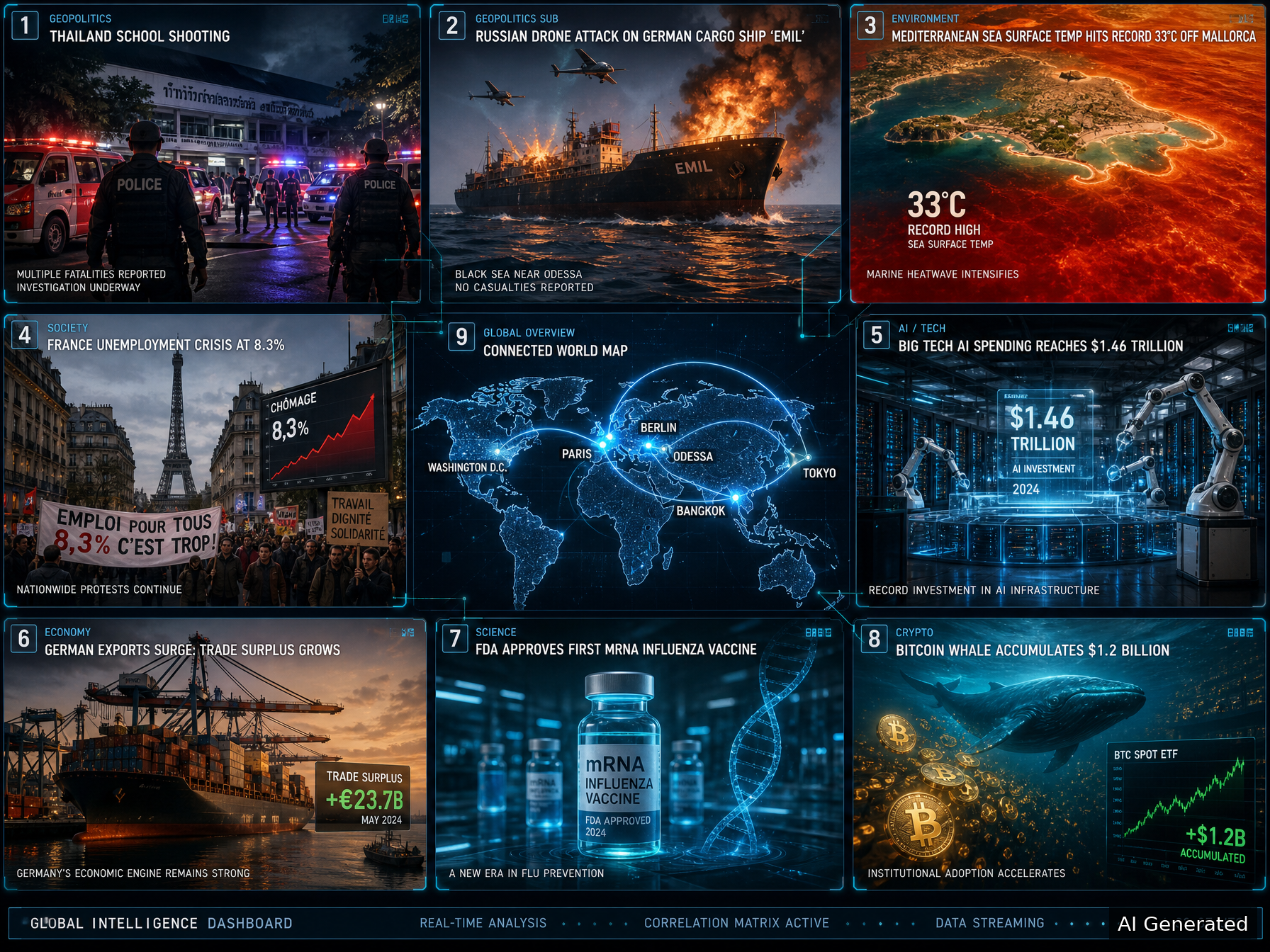
- Thai teenager kills at least eight including grandparents and six school staff in deadliest shooting since 2022 nursery massacre
- Russian drones strike German cargo ship “Emil” near Odessa, marking first direct attack on a NATO-nation commercial vessel in Black Sea
- Iran announces Hormuz blockade plans for US and Israeli ships as Trump claims strait “sort of open”
- Saudi Arabia warns of imminent coordinated attacks from north and south as Turkey-Saudi-Pakistan defence pact nears signing
- Ukraine-Poland negotiations resume for MiG-29 transfer; France finalises Rafale proposal for India’s $40 billion acquisition
- Iran announces controlled explosions in Bushehr province; India-Israel leaders review “Special Strategic Partnership”
- 2. Environment & Climate
- Mediterranean Sea surface temperature hits record 33°C off Mallorca as heatwave intensifies
- Germany’s three great rivers hit record low water levels as drought undermines logistics infrastructure
- France battles Drôme wildfire expansion as Ukrainian firefighters deploy to southwest France
- Wildfire smoke surpasses human-sourced air pollution as prenatal health threat
- South Korea declares heatwave a “national disaster” as drone threats and airport shelters compound crisis
- Spain’s largest wildfire on record burns area the size of New York City
- 3. Society & Civil Issues
- French unemployment surges to 8.3%, highest since 2020 as youth joblessness approaches crisis levels
- Court orders Meta to pay $567 million in New Mexico child safety case, adding to $375 million earlier penalty
- UK primary schools to identify children at risk of future unemployment; Scotland implements first tourist tax
- North Korea advises citizens to eat dog meat soup to combat record heatwave
- Greece’s Kefseli murder case reveals complex immigration and integration dynamics
- Ukrainian body recovery volunteer describes horrors of front-line corpse collection
- 4. AI & Technology
- US battleship program cost estimate balloons to $275 billion as CBO analysis reveals massive overruns
- Big Tech AI spending reaches $1.46 trillion in physical assets as industry surpasses global oil majors
- Google open-sources WeatherNext AI model for hurricane prediction; Ro Khanna proposes “Data Center Bill of Rights”
- Meta faces $567 million fine in New Mexico as China publishes autonomous driving safety standards
- Hadrian secures $1.37 billion for AI-driven manufacturing; OpenAI smart speaker priced at $300-$400
- 5. Economy & Business
- French unemployment reaches 8.3% as European labour markets deteriorate under compound pressures
- German exports hit record high but trade surplus shrinks as imports surge
- RWE pays $1.22 billion to cancel wind projects as Trump administration accelerates renewable energy rollback
- Singapore banks post strong results; UK house prices show first annual increase in months
- India’s Sensex falls 400 points as BRICS trade ministers meet in Jaipur
- 6. Science & Space
- FDA approves first mRNA influenza vaccine for US adults in surprise decision
- Total solar eclipse approaches on August 12 with unprecedented skywatching convergence
- Novo Nordisk heart drug fails in trial, challenging decades-old inflammation-disease theory
- Scientists capture whale heart rates during deep-sea foraging; forgotten memories persist as “ghost traces”
- Oklo achieves reactor criticality in under one year; nuclear fuel recycling consortium forms
- 7. Crypto, Digital Assets & Blockchain
- CLARITY Act officially delayed to September as Senate leaves without vote
- Bitcoin whales accumulate $1.2 billion as spot ETFs attract $750 million in weekly inflows
- Japan FSA mandates crypto withdrawal delays; Russia approves comprehensive digital currency law
- Thailand offers five-year crypto tax exemption; Hyperliquid posts $213 billion Q2 volume
- 8. Correlations & Analysis
- 9. References
Click any heading to jump to that section. Click the section heading to return to this menu.
Geopolitics & Defence
↑ ContentsThai teenager kills at least eight including grandparents and six school staff in deadliest shooting since 2022 nursery massacre
A 14-year-old student opened fire at Debsirin Nonthaburi School north of Bangkok on Friday morning, killing three teachers and three students before turning the weapon on himself, Thai police confirmed[1]. Before arriving at the school, the teenager killed his grandparents at home using a 9mm pistol belonging to his grandfather, a retired police officer, bringing the total death toll to at least eight[2]. The Royal Thai Police spokesperson Trairong Piwpan told AP that the motive was still under investigation, while Thai Prime Minister Anutin Charnvirakul described the incident as “a terrible thing that should never have happened”[1]. At least fifteen people were wounded, with two in critical condition. The shooting represents the latest in a pattern of Thai gun violence that previous legislative efforts have failed to prevent: Thailand has approximately ten million firearms in circulation, one for every seven inhabitants, and the 2022 Nakhon Ratchasima nursery massacre that killed 36 people prompted gun law promises that remain unfulfilled[1]. The incident follows February’s shooting at a school in southern Thailand, where a teenager armed with a police officer’s weapon killed a principal and wounded two students. The recurrence of school attacks in a country with among the highest regional rates of gun ownership underscores the structural failure of enforcement mechanisms that successive governments have pledged but not implemented.
Russian drones strike German cargo ship “Emil” near Odessa, marking first direct attack on a NATO-nation commercial vessel in Black Sea
Russian drones attacked the German cargo ship “Emil”, a bulk carrier sailing under Liberian flag, approximately twenty-one nautical miles from the port of Odessa on Wednesday, setting fires aboard and disabling multiple technical systems before the eleven-person crew evacuated[3]. The 292-metre vessel belongs to Hamburg-based shipping company Johann M. K. Blumenthal. The attack represents the first direct Russian strike on a commercial vessel associated with a NATO member state since the beginning of the war, marking a significant escalation in the maritime dimension of the conflict. Russia’s Defence Ministry confirmed striking two ships, claiming they carried military equipment for the Ukrainian armed forces, though no supporting evidence was presented[3]. Separately, Ukrainian forces reported attacking a second vessel, the Mera Queen, carrying grain under Guinea-Bissau flag. The strikes coincide with broader Russian attacks on logistics infrastructure connected to German commercial interests in Ukraine: Puma confirmed that its logistics centre was hit by ballistic missiles overnight on 4 August, while a Liqui Moly warehouse in Kyiv was destroyed, with damage estimated in the millions[3]. The pattern suggests that Russia is deliberately targeting commercial infrastructure linked to NATO economies as the conflict deepens.
Iran announces Hormuz blockade plans for US and Israeli ships as Trump claims strait “sort of open”
Oil prices surged above $83 per barrel after reports emerged that Iran is planning to impose a blockade through the Strait of Hormuz targeting American and Israeli-flagged vessels[4]. The announcement came as Donald Trump told reporters in the Oval Office that the strait was “sort of open” and predicted that the war with Iran would “end pretty soon”, adding that “I don’t think they can go much longer”[5]. Trump denied reports from the Washington Post that he had confronted Defence Secretary Pete Hegseth during a Cabinet meeting over depleted munitions stockpiles, insisting that the United States possessed “massive amounts” of ammunition and threatening prison sentences for leakers of what he called “treasonous statements”[5]. The contradictory claims — Trump’s public optimism about imminent peace versus Iran’s preparations for renewed naval confrontation — echo the pattern documented since D63 of diplomatic messaging fundamentally at odds with operational reality. Brent crude settled up more than $3 in the previous session to $83.55, reflecting the market’s assessment that the Hormuz risk remains elevated despite Trump’s assertions[4].
Saudi Arabia warns of imminent coordinated attacks from north and south as Turkey-Saudi-Pakistan defence pact nears signing
A senior Saudi official has revealed that intelligence reports from Saudi Arabia, the United States, and other regional countries indicate that Iraq’s Shia militias and Yemen’s Houthi rebels, operating under the supervision of Iran’s Islamic Revolutionary Guard Corps, are preparing coordinated attacks from both directions targeting civilian and economic sites including energy infrastructure, ports and airports[5]. The official, speaking anonymously, said that the planned operations could be intended to disrupt the diplomatic de-escalation efforts that have characterised recent weeks. Simultaneously, the leaders of Saudi Arabia, Turkey, and Pakistan are meeting in Jeddah on Friday for talks that will formalise a joint defence agreement, raising the prospect of a broader military alliance described in some analyses as an “Islamic NATO”[6]. Pakistan’s Prime Minister Shehbaz Sharif arrived for the meetings on his third visit to Saudi Arabia this year, with Pakistan having recently joined a Saudi-led naval coalition aimed at countering Houthi attacks in the Red Sea. The convergence of the Saudi threat intelligence and the Jeddah defence pact formalisation suggests a fundamental realignment of Gulf security architecture in response to the Iran conflict’s destabilising effects.
Ukraine-Poland negotiations resume for MiG-29 transfer; France finalises Rafale proposal for India’s $40 billion acquisition
Ukraine and Poland have resumed negotiations for the transfer of four MiG-29 Fulcrum fighter jets, following an earlier dispute that had stalled the arrangement after a failed exchange of conditions between Kyiv and Warsaw[7]. The resumption signals that both sides have found political space to move past the disagreements that had temporarily blocked the transfer, with the jets representing a critical gap-filler for Ukraine’s depleted air capabilities. Separately, France has formally submitted its final technical and commercial proposal for India’s acquisition of 114 Rafale fighter jets in a deal valued at approximately $40 billion (3.25 lakh crore rupees), marking what Manu Pubby of the Economic Times described as a decisive step toward contract signing[8]. The deal would see 94 jets manufactured in India with sovereign guarantees and technology transfer, while 20 would be delivered directly from France. Both developments reflect the accelerating global arms trade driven by concurrent conflicts in Europe and the Middle East, with major defence contracts advancing despite economic uncertainty elsewhere.
Iran announces controlled explosions in Bushehr province; India-Israel leaders review “Special Strategic Partnership”
Iranian authorities announced planned controlled explosions in the southern province of Bushehr on Friday, with blasts audible near the city of Khormoj between Friday morning and noon[5]. Dashti county officials provided no further details about the purpose of the explosions, though Bushehr province hosts Iran’s nuclear power plant, the country’s only operational facility of its kind. The controlled detonations add to the pattern of Iranian military and security operations that have characterised the period since Trump suspended strikes in early August. Separately, Indian Prime Minister Narendra Modi received a telephone call from Israeli Prime Minister Benjamin Netanyahu on Thursday, with both leaders reviewing the progress of the India-Israel Special Strategic Partnership and discussing recent West Asia developments[9]. The call reflects India’s dual positioning in the region, maintaining relations with both Israel and the Arab states while navigating the economic fallout of the Iran conflict on energy supplies and trade routes.
Environment & Climate
↑ ContentsMediterranean Sea surface temperature hits record 33°C off Mallorca as heatwave intensifies
Spain’s national meteorological agency AEMET recorded a sea surface temperature of 33.02°C off Mallorca on Wednesday, potentially the highest temperature ever measured in the Mediterranean Sea[10]. If officially confirmed, the reading would surpass the previous record of 31.96°C set off the Egyptian city of El Arish in 2024. The normal August sea temperature around Mallorca is approximately 26°C, making the deviation of over seven degrees a stark indicator of oceanic heat accumulation driven by sustained atmospheric heatwaves. Tourists at Mallorca’s beaches reported that even deep water felt warm, with one German visitor telling Mallorca Magazin that “the sea is unbelievably hot” and that swimming deeper produced no cooling effect[10]. The elevated sea temperatures compound the broader European heatwave that has sent temperatures above 40°C in several countries, placed Italy’s 27 largest cities on red alert, and triggered record temperatures of 41.2°C in Austria. Scientists warn that the warming Mediterranean functions as “fuel” for intense storms, making the combination of extreme heat, drought-driven low river levels, and wildfire conditions the new baseline for European summers rather than an exceptional event.
Germany’s three great rivers hit record low water levels as drought undermines logistics infrastructure
The Rhine, Danube, and Elbe rivers have all reached their lowest recorded water levels, triggering a cascade of logistical and economic consequences across Germany and Central Europe[11]. The Rhine, which carries approximately 300 million tonnes of cargo annually and serves as Germany’s most important inland waterway, is experiencing conditions that make navigation unreliable for large vessels, forcing transport companies to shift to road and rail at significantly higher costs. The low levels expose what the FAZ described as “decades of neglect of waterways” in infrastructure planning, where rivers were assumed to maintain navigable depths that climate change has now rendered unreliable. In Hungary, the Danube’s low levels forced the country’s only nuclear power plant to restrict cooling water intake, a pattern first documented in D67 when climate change was shown to be rewriting European nuclear cooling assumptions. Germany’s Rhine bottlenecks compound the economic pressures already weighing on European supply chains, where the Iran conflict’s disruption of maritime routes through the Strait of Hormuz has already forced rerouting of energy and commodity flows. The drought-struck rivers represent a second, independent constraint on European logistics that operates in parallel with and sometimes overlaps the geopolitical disruptions.
France battles Drôme wildfire expansion as Ukrainian firefighters deploy to southwest France
The wildfire that has been burning in France’s Drôme department advanced by thirty hectares overnight Thursday, remaining uncontrolled despite sustained firefighting efforts that have lasted several days[12]. The fire’s continued expansion against active suppression efforts illustrates the challenge that D67 documented: the EU’s decision to shift billions from firefighting to prevention, driven by the recognition that traditional suppression cannot keep pace with fire behaviour driven by climate change. Four departments remain classified at “very high” fire risk — the Var, Bouches-du-Rhône, Alpes-Maritimes, and Vaucluse — while the Var department has been elevated to the second-highest fire danger classification. In an unusual development, a team of seventy Ukrainian firefighters has been deployed to southwest France, where wildfires have scorched 42,000 hectares in the worst blazes in decades[13]. RFI reporters met the Ukrainian rescuers, who told them that “people at war have come to help” in a gesture that links the two crises — the Ukraine war and the European fire season — through the human capital of experienced emergency responders. The deployment highlights both the severity of France’s fire emergency and the solidarity that has developed between Ukraine and European partners during the broader geopolitical upheaval.
Wildfire smoke surpasses human-sourced air pollution as prenatal health threat
New research published in Inside Climate News reveals that smoke from climate-driven wildfires has become a larger prenatal health threat than human sources of air pollution from vehicles and industry[14]. The finding represents a significant reversal of decades of progress in reducing prenatal exposure to harmful emissions, as regulations targeting industrial and vehicular sources achieved meaningful reductions — only for wildfire smoke to erode those gains. The research adds a new dimension to the compound crisis that D67 identified: climate change simultaneously increases wildfire frequency and intensity while the resulting smoke creates health harms that undo regulatory achievements. The study connects to the broader pattern of European and American wildfire seasons documented across D59-D67, where each successive report has added new evidence that fire seasons are not merely extending but producing qualitatively different environmental and health outcomes. The prenatal dimension is particularly concerning because it suggests that the health costs of climate-driven wildfires will compound across generations, even as governments redirect resources toward prevention and suppression.
South Korea declares heatwave a “national disaster” as drone threats and airport shelters compound crisis
South Korean President Yoon Suk-yeol has declared the country’s historic heatwave a “national disaster” and ordered all government agencies to mobilise maximum resources to combat it[15]. The declaration accompanies a dual crisis: extreme heat that has already killed sixteen people and drone threats at airports that have forced shelter-in-place orders at multiple facilities. The combination of climate emergency and security infrastructure vulnerability creates a layered crisis in which the government must simultaneously address immediate heat-related deaths, maintain airport operations against aerial threats, and manage long-term infrastructure adaptation. The South Korean experience mirrors the compound crisis identified across D60-D67: climate stress does not occur in isolation but interacts with existing security and infrastructure vulnerabilities to produce cascading failures that single-sector responses cannot address. The heatwave itself has driven emergency measures including extended operating hours at archaeological sites, cooling systems at public gathering places, and enhanced health services for vulnerable populations.
Spain’s largest wildfire on record burns area the size of New York City
NASA Earth Observatory analysis confirms that the wildfires that swept through Spain and France in July 2026 were among the most destructive and disruptive either country has experienced in decades, with Spain’s largest wildfire on record burning an area equivalent to New York City’s five boroughs[16]. The fires created vast burn scars visible from space and generated a rare fire-powered pyrocumulonimbus cloud over France that injected smoke particles into the upper atmosphere. The analysis from NASA’s satellite imagery provides quantitative confirmation of the fire season’s severity, which previous D-reports have tracked through ground-level reporting. The cumulative evidence across the reporting cycle — from D59’s initial French and Spanish fire alerts through D67’s documentation of EU wildfire strategy reform — now includes satellite-scale verification that the 2026 European fire season represents a structural shift rather than a seasonal anomaly, with burn areas, infrastructure damage, and atmospheric impacts all reaching historically unprecedented levels.
Society & Civil Issues
↑ ContentsFrench unemployment surges to 8.3%, highest since 2020 as youth joblessness approaches crisis levels
France’s national statistics institute INSEE reported that the unemployment rate rose by 0.2 percentage points to 8.3% in the second quarter, reaching its highest level since the third quarter of 2020 when the Covid-19 crisis devastated the labour market, and since the third quarter of 2019 before that[17]. The number of unemployed persons increased by 62,000 to 2.7 million, with joblessness rising across all age groups. The most alarming figure is youth unemployment among 15-24-year-olds, which surged 0.4 percentage points to 21.6% — meaning more than one in five young people actively seeking work cannot find employment. The 25-49 age group reached 7.5%, its highest since early 2021. INSEE noted that since the implementation of the January 2025 full-employment law, beneficiaries of the RSA social welfare programme and young people aged 15-29 have accounted for nearly half of the increase, though even excluding the automatic registration effect of that reform, President Macron’s target of 5% unemployment by the end of his term in 2027 appears increasingly unachievable. Labour Minister Jean-Pierre Farandou identified three priorities — youth insertion, maintaining employment for experienced workers, and skills adaptation in nuclear energy, ecological transition, and defence — but the scale of the deterioration suggests structural factors that policy interventions alone cannot rapidly address.
Court orders Meta to pay $567 million in New Mexico child safety case, adding to $375 million earlier penalty
A New Mexico judge has ordered Meta Platforms to pay an additional $567 million in the state’s child exploitation lawsuit, ruling that the company is a public nuisance whose products harm children’s mental health online[18]. The ruling brings the total penalties in the case to over $940 million, following a March order of $375 million. Judge Bryan Biedscheid said the bulk of the money would fund treatment services for young people affected by the company’s platforms. The case represents one of the largest judicial penalties against a technology company for child safety failures, and the public nuisance finding establishes a legal precedent that could enable other states to pursue similar claims. The decision arrives at a moment when Meta faces escalating regulatory pressure globally, including the EU AI Act’s enforcement framework and the New Mexico case’s expansion of liability theory from product design to public health impact. The ruling adds to the pattern documented in D66 and D67 of technology companies facing consequences for the social effects of their products, a trend that connects to broader questions about corporate accountability in the digital age.
UK primary schools to identify children at risk of future unemployment; Scotland implements first tourist tax
Primary schools in England will be required to identify children at risk of leaving education at sixteen without finding employment, according to a government review led by former Health Secretary Alan Milburn[19]. The recommendation represents the most aggressive attempt yet to address Britain’s youth worklessness crisis, which Milburn warned could see NEET numbers hit 1.25 million by the early 2030s. The proposal requires teachers to flag at-risk students as early as primary school, creating a longitudinal tracking mechanism that connects educational performance to labour market outcomes. Milburn indicated he would call for sweeping changes in education policy alongside a benefits system overhaul. Separately, Scotland has implemented the United Kingdom’s first tourist tax, requiring overnight visitors to Edinburgh to pay a levy that readers of the Travel Insider have argued is incomplete because day trippers — who can cause comparable strain on city infrastructure — are exempt[20]. The tourist tax debate intersects with the broader European discussion of how to fund the infrastructure demands that tourism creates, a challenge that the Mediterranean heatwave documented in today’s report exacerbates as extreme temperatures reshape tourism patterns.
North Korea advises citizens to eat dog meat soup to combat record heatwave
North Korean state media has advised citizens to consume dog meat soup, known as boshintang, to combat record heatwave conditions during the annual sambok period, or “dog days of summer”[21]. The recommendation, reported by the Independent, reflects the North Korean government’s approach to the extreme heat that is simultaneously affecting countries across East Asia, including South Korea where the president has declared a national disaster. While the South Korean response involves resource mobilisation and infrastructure measures, North Korea’s guidance to citizens to consume traditional foods represents a starkly different approach to climate adaptation. The contrast between the two Korean responses to the same heatwave event illuminates the broader divergence in how states with shared geography but divergent governance models respond to climate-driven emergencies.
Greece’s Kefseli murder case reveals complex immigration and integration dynamics
The pretrial detention of a 26-year-old Afghan man for the murder of a 38-year-old British woman in Athens’s Kefseli district has revealed a complex narrative of migration, adoption and violence that connects the Ceuta migration crisis to domestic European social dynamics[22]. The accused, Sharif Ahmadzai, was “adopted” as a teenager by an American couple who took him from the Moria refugee camp on Lesbos, and whose American wife later became his spouse. The couple told the Daily Mail they were “broken” by the news, with the “foster mother” saying she felt like his mother and could not believe he was capable of such violence. The case connects to the broader Ceuta migration narrative that has dominated European coverage since D61, illustrating how individual cases within migration flows can become focal points for public anxiety about immigration and integration. The accused maintained his right to silence during questioning, with his initial statement claiming he found the victim already dead and panicked.
Ukrainian body recovery volunteer describes horrors of front-line corpse collection
Mark Zydga, a 27-year-old volunteer who runs the “On The Shield” team that recovers fallen Ukrainian soldiers from front-line areas, has spoken publicly for the first time about the psychological toll of transporting dead bodies across three-thousand-kilometre round trips[23]. Zydga, who drives a refrigerated van through active Russian “kill zones” stretching forty kilometres, told Metro that the hardest moments come with “light packages” — body bags containing only parts, or the bodies of soldiers barely eighteen years old. He has handled over one thousand bodies since the war began, serving three western Ukrainian regions: Lutsk, Rivne and Zhytomyr. The testimony provides a ground-level perspective on the human cost of the war that complements the strategic and tactical coverage that has dominated D-reports since D59. Zydga’s account of delivering a woman’s body to her husband, who had carried her for eight kilometres after a missile strike and then drove alongside the recovery van for six hundred kilometres in silence, offers an intimate window into the war’s psychological aftermath that extends far beyond the battlefield.
AI & Technology
↑ ContentsUS battleship program cost estimate balloons to $275 billion as CBO analysis reveals massive overruns
The Congressional Budget Office has estimated that the Trump administration’s nuclear-powered battleship programme will cost approximately $275 billion to build fifteen ships through 2056, with the lead vessel alone projected at $23.4 billion — an increase of more than fifty percent from the administration’s original $15.1 billion estimate[24]. The CBO analysis, requested by Senator Jeff Merkley, found that even the average per-ship cost of $18 billion over the production run would buy five Arleigh Burke-class destroyers for the same price. The programme would more than double the Navy’s annual surface warship budget, from $6.9 billion to $15.2 billion. The cost escalation comes as the Pentagon pushes for a $1.5 trillion budget while simultaneously managing existing programmes with documented cost overruns and production constraints. HII CEO Chris Kastner confirmed in last week’s earnings call that the company had begun initial design work with the Navy “on a limited basis”[24]. The battleship programme represents the latest in a series of ambitious defence modernisation initiatives whose cost trajectories have consistently exceeded initial projections, raising questions about whether the industrial base can absorb the production requirements alongside the concurrent demands of the Iran conflict’s munitions consumption.
Big Tech AI spending reaches $1.46 trillion in physical assets as industry surpasses global oil majors
A new analysis reveals that Amazon, Microsoft, Alphabet, and Meta have collectively built $1.46 trillion in physical assets through AI investments, a figure that has overtaken the asset bases of several global oil majors[25]. The comparison underscores the scale of the infrastructure buildout driven by artificial intelligence, which has transformed from a software phenomenon into one of the largest capital expenditure programmes in corporate history. The spending spree is concentrated in data centres, custom silicon, cooling systems, and power infrastructure required to train and serve increasingly large AI models. The $1.46 trillion figure represents the cumulative physical infrastructure investment, not market capitalisation, and reflects the industry’s bet that AI demand will sustain capital expenditure at current levels for the foreseeable future. The infrastructure buildout connects to the European energy and climate crises documented across the reporting cycle: data centre power demand is competing with nuclear plant cooling requirements during heatwaves, and the energy intensity of AI training is increasingly at odds with the renewable energy transition that European governments are pursuing.
Google open-sources WeatherNext AI model for hurricane prediction; Ro Khanna proposes “Data Center Bill of Rights”
Google has released WeatherNext, an AI model capable of delivering fifteen-day weather forecasts that predict hurricane track and intensity, open-sourcing the technology in what the company describes as a contribution to early warning systems for extreme weather events[26]. The release comes as climate-driven extreme weather events — European wildfires, Asian heatwaves, Atlantic hurricane threats — have underscored the gap between forecasting capability and warning system reach. Separately, US Congressman Ro Khanna has proposed a “Data Center Bill of Rights” that would protect communities’ right to oppose data centre construction in their neighbourhoods[27]. The legislative proposal responds to growing grassroots opposition to data centre proliferation, where communities argue that facilities consume enormous amounts of water and electricity while providing few jobs and degrading local infrastructure. The two developments — Google’s AI-for-climate tool and Khanna’s community-protection legislation — represent opposing faces of the same AI infrastructure tension: the technology’s potential benefits for climate adaptation versus the material costs of the physical infrastructure required to run it.
Meta faces $567 million fine in New Mexico as China publishes autonomous driving safety standards
A New Mexico judge ordered Meta to pay an additional $567 million, ruling that the company operates as a public nuisance that harms children’s mental health — bringing total penalties in the case to over $940 million[18]. The ruling establishes that the bulk of funds will fund treatment services for young people affected by the company’s platforms. Separately, China has unveiled new mandatory national standards for autonomous driving systems safety, with the standards applying to Level 3 and Level 4 autonomous vehicles and taking effect July 1, 2027[28]. The Chinese standards represent one of the first comprehensive regulatory frameworks for autonomous driving globally, potentially setting a benchmark that other countries will reference. The convergence of the Meta penalty and China’s autonomous driving standards reflects a broader pattern of technology regulation accelerating across both democratic and authoritarian governance systems, each addressing different aspects of technology’s social impact but contributing to a global environment where technology companies face increasingly prescriptive rules.
Hadrian secures $1.37 billion for AI-driven manufacturing; OpenAI smart speaker priced at $300-$400
Hadrian, an AI-driven precision manufacturing startup, has secured a $1.37 billion Series D funding round that values the company at nearly $8 billion[24]. The company plans to expand production lines for munitions and autonomous systems, addressing the manufacturing bottleneck that the Pentagon has identified as a critical constraint on weapons production. The funding arrives as the defence industrial base faces pressure from concurrent conflicts and ambitious procurement targets. Separately, OpenAI’s upcoming AI smart device will reportedly sell for between $300 and $400, placing it in the price range of premium smart speakers[29]. The pricing positions the device as a mass-market consumer product rather than an enterprise tool, suggesting that OpenAI is pursuing a direct-to-consumer hardware strategy that would complement its cloud-based AI services. The combination of Hadrian’s defence manufacturing scale-up and OpenAI’s consumer device launch illustrates the breadth of AI’s commercial expansion across both military and consumer domains.
Economy & Business
↑ ContentsFrench unemployment reaches 8.3% as European labour markets deteriorate under compound pressures
France’s unemployment rate surged to 8.3% in the second quarter — the highest since the Covid crisis of 2020 and the pre-pandemic autumn of 2019 — with 62,000 additional job seekers joining the 2.7 million already without work[17]. Youth unemployment among 15-24-year-olds reached 21.6%, while the 25-49 age bracket hit 7.5%, its worst since early 2021. The deterioration comes despite France’s GDP growth of 0.2% in Q2 and sits against a European backdrop of mixed economic signals: German exports rose 0.9% in June while imports jumped 4.4%, and industrial production met expectations at 0.2% but declined 0.1% year-on-year[30]. The French unemployment data reveals a structural divergence within the European economy where headline GDP figures mask persistent labour market weakness. Allianz reported record Q2 operating profit of €5.3 billion, exceeding analyst expectations, while Munich Re revised its insurance revenue forecast downward by €2 billion to €38 billion despite maintaining its profit target[31]. Daimler Truck’s profit halved by 48% as tariff-related cost pressures squeezed margins. The pattern across European corporate earnings reflects an economy where strong sectors coexist with structural weaknesses, and where the compound pressures of the Iran conflict’s energy costs, climate-driven infrastructure damage, and trade disruption create an environment of persistent uncertainty that depresses hiring even as profits remain elevated in select industries.
German exports hit record high but trade surplus shrinks as imports surge
Germany’s exports rose 0.9% in June to a new record, beating the 0.5% forecast and accelerating from May’s 0.3% gain[30]. However, imports surged 4.4% — nearly double the 2% forecast — causing the trade surplus to narrow to €15.4 billion from €19.1 billion, falling well short of the €17.2 billion consensus. The import surge reflects both the elevated cost of energy purchases driven by the Hormuz disruption and increased demand for raw materials and intermediate goods. Industrial production met expectations at 0.2% month-on-month but declined 0.1% year-on-year, suggesting that the manufacturing sector remains under pressure despite the headline export growth. The combination of record exports and a shrinking surplus illustrates the squeeze that European exporters face: their products remain competitive in global markets, but the input costs driven by the Iran conflict’s energy effects erode the margin gains. Allianz’s record results and Commerzbank’s record first-half profit of €1.8 billion represent pockets of strength, but the broader European economy is navigating between the competing forces of strong demand for manufactured goods and the cost pressures of disrupted supply chains.
RWE pays $1.22 billion to cancel wind projects as Trump administration accelerates renewable energy rollback
German energy company RWE has agreed to pay the Trump administration $1.22 billion in exchange for cancelling three offshore wind projects and redirecting investment toward LNG infrastructure, making it the fifth such deal in which the administration has paid energy companies to abandon renewable energy commitments[32]. The payments represent the financial mechanism through which the administration has systematically dismantled the offshore wind programme built under the Biden administration, with each deal requiring taxpayer compensation to cover companies’ sunk investment costs. The pattern has drawn criticism from environmental organisations including the Sierra Club, which has characterised the payments as a “payoff” of the fossil fuel industry. The RWE deal intersects with the European energy dynamics documented in D67: while European countries are cutting fossil fuel imports through renewable energy expansion, the US is simultaneously paying companies to reverse renewable installations, creating a divergent trajectory that will reshape the global energy mix. The $1.22 billion payment alone exceeds the cost of multiple gigawatts of offshore wind capacity, raising questions about whether the fiscal cost of the rollback matches the stated policy objectives.
Singapore banks post strong results; UK house prices show first annual increase in months
Singapore’s three major banks reported strong quarterly profits, with the combined results benefiting from the city-state’s position as a financial hub for the growing Asian capital flows that the Iran conflict has redirected away from Gulf centres[33]. The results underscore the geopolitical redistribution of financial activity that has accelerated since the Hormuz disruption forced capital and transaction flows to seek alternative routing. In the UK, Lloyds Banking Group reported that house prices rose 0.1% year-on-year in July, marking the first annual increase in several months, while quarter-on-quarter prices fell 0.3%[34]. The marginal improvement in the annual figure masks continued affordability challenges, with Lloyds noting that “affordability remains a challenge” as mortgage rates remain elevated above the levels that prevailed before the Iran conflict pushed up energy and inflation expectations. The UK housing data connects to the broader economic picture where central bank rate decisions — including the Fed’s Cook signalling willingness to support hikes — continue to weigh on mortgage affordability and consumer spending power across developed economies.
India’s Sensex falls 400 points as BRICS trade ministers meet in Jaipur
India’s benchmark Sensex index fell over 400 points in early Friday trading, with Bajaj Finance and Bajaj Finserv leading the decline as broader market sentiment deteriorated ahead of key US jobs data[35]. The Nifty fell below 24,600 while the SmallCap index snapped a five-day record run, ending a rally that had been supported by domestic institutional flows. The market weakness occurred against the backdrop of BRICS trade and industry ministers meeting in Jaipur, where India’s Commerce Minister Piyush Goyal held bilateral discussions with counterparts from Brazil and Egypt focused on deepening trade and investment cooperation. The contrast between the diplomatic optimism of the BRICS meetings and the domestic market weakness illustrates the tension that many emerging economies face: the geopolitical repositioning that benefits long-term trade relationships operates on a different timescale than the market volatility driven by immediate concerns about the Iran conflict’s energy costs and the Federal Reserve’s rate path.
Science & Space
↑ ContentsFDA approves first mRNA influenza vaccine for US adults in surprise decision
The US Food and Drug Administration has approved mFluvisa (mRNA-1010), the first influenza vaccine built on Moderna’s mRNA technology, marking a landmark extension of the platform that powered the most-administered Covid-19 shots during the pandemic[36]. The approval came on August 5 — exactly one year after Health and Human Services Secretary Robert F. Kennedy Jr. cut approximately $500 million of funding for mRNA vaccine research projects, adding a political dimension to the scientific milestone. The vaccine demonstrated 26.6% greater effectiveness compared to current influenza vaccines in Phase 3 trials, with safety thresholds met and side effects consistent with existing flu shots. Access is initially restricted to adults over 50, with those aged 65 and over receiving accelerated approval based on immune response data. The decision is notable both for its scientific significance — mRNA technology’s adaptability to emerging strains could transform seasonal flu vaccination from a reactive to a proactive exercise — and for its timing, arriving amid ongoing political controversies over vaccine policy. The approval follows the European green light for Moderna’s combined Covid-19 and influenza vaccine mCombriax in April, suggesting a global trend toward mRNA platform expansion.
Total solar eclipse approaches on August 12 with unprecedented skywatching convergence
Astronomers and skywatching enthusiasts are preparing for what may be the most significant celestial event of 2026: a total solar eclipse on August 12 that will cross eastern Greenland, western Iceland, and northern Spain, coinciding with the peak of the Perseid meteor shower on the same day[37]. The path of totality will offer up to two minutes and eighteen seconds of complete solar coverage, while a much wider partial eclipse will be visible across the UK, much of Europe, parts of North America, and northwest Africa. In the UK, the eclipse will produce a striking deep partial view, with approximately ninety percent of the sun obscured, maximum eclipse occurring around 7:05 to 7:13 PM BST when the sun sits low in the west-northwest. South Korean satellite imagery has already captured before-and-after views of the moon following SpaceX’s Falcon 9 rocket impact on the lunar surface, providing a separate but concurrent astronomical event[38]. The eclipse occurs during peak Milky Way season, creating what astronomers describe as one of the greatest combinations in skywatching — an eclipsed sun, meteor showers, and the Milky Way arching high across a moonless sky.
Novo Nordisk heart drug fails in trial, challenging decades-old inflammation-disease theory
A major heart drug targeting inflammation has failed in clinical trials, challenging the long-held theory that chronic inflammation causes cardiovascular disease — one of the most widely accepted frameworks in modern medicine[39]. The failure of the Novo Nordisk drug, which was designed to reduce cardiovascular risk by targeting inflammatory pathways, forces researchers to reconsider whether the association between inflammation and heart disease represents a causal relationship or a correlation driven by other factors. The result connects to the broader pattern of pharmaceutical disappointment documented across the reporting cycle, where therapies targeting theoretically promising pathways have repeatedly failed to deliver clinical benefits. The finding does not invalidate the observational evidence linking inflammation to cardiovascular outcomes, but it significantly weakens the interventional evidence that anti-inflammatory treatments can reduce heart attack and stroke risk, potentially redirecting billions in research funding toward alternative mechanisms.
Scientists capture whale heart rates during deep-sea foraging; forgotten memories persist as “ghost traces”
Marine biologists have recorded the heart rates of blue whales and humpback whales during deep-sea foraging dives, finding that heart rates spike to 21.9 beats per minute in blue whales immediately after lunge-feeding — and that a resting humpback’s heart rate was measured at 18.5 beats per minute, likely the closest measurement to a free-ranging whale’s resting heart rate ever obtained[40]. The research, published in PNAS, reveals that whale hearts are far more flexible than previously understood, ramping up for oxygen-demanding prey capture even during the extreme bradycardia of deep dives. The team attached suction-cup ECG tags to nine whales across California and the Western Antarctic Peninsula, recording data over twelve to thirty-six hour periods. Separately, neuroscientists at the Friedrich Miescher Institute have demonstrated that forgotten memories can persist as “silent memory traces” in fruit fly brains, remaining recoverable under the right contextual conditions but also capable of generating false memories during reconstruction[41]. The research, published in Nature Neuroscience, suggests that the brain maintains a dual memory system in which one trace drives behaviour while another preserves information in an accessible-but-dormant state.
Oklo achieves reactor criticality in under one year; nuclear fuel recycling consortium forms
Oklo, a California-based advanced nuclear company, has achieved first criticality at its Groves Isotope Test Reactor in Texas less than a year after breaking ground, setting what the company describes as a new benchmark for the Department of Energy’s Reactor Pilot Programme[42]. The low-power reactor, built on greenfield private land, was constructed, fuelled, and brought to controlled nuclear chain reaction entirely under Oklo’s management. The milestone establishes an operational foundation for Oklo’s planned isotope production business, targeting medical, industrial, research, space and national security applications. Separately, three nuclear companies — Curio, NuScale Power, and Framatome — have signed a memorandum of understanding to evaluate how materials recovered through Curio’s NuCycle recycling technology could fuel next-generation small modular reactors[43]. The consortium aims to create an integrated fuel cycle linking used nuclear fuel recycling with advanced reactor manufacturing, potentially reducing waste volumes by up to 97% while recovering strategic nuclear materials. Both developments — Oklo’s rapid reactor deployment and the fuel recycling consortium — reflect the accelerating pace of nuclear energy innovation driven by the twin pressures of decarbonisation and energy security that the Iran conflict and European heatwave have intensified.
Crypto, Digital Assets & Blockchain
↑ ContentsCLARITY Act officially delayed to September as Senate leaves without vote
The US Senate has confirmed that it will not advance the CLARITY Act before departing Washington for the month-long August recess, pushing the crypto market structure bill’s vote to September at the earliest[44]. Senate Majority Leader John Thune said through a spokesperson that Democrats remained opposed to holding a vote before recess, while the bill requires sixty votes to advance in the upper chamber — meaning it cannot pass without some Democratic support. Senator Josh Hawley’s earlier announcement of opposition — reported in D67 — had already damaged prospects, and the delay now makes passage before the end of 2026 uncertain. Democrats are pushing for stronger safeguards to prevent President Trump from benefiting financially from crypto during his time in office, a demand that Republicans have resisted. Even if the Senate eventually passes the legislation, it must return to the House for approval before reaching the president’s desk. Bitwise Chief Investment Officer Matt Hougan said missing the August vote would not derail the industry’s long-term growth but acknowledged that the surrounding uncertainty has kept institutional investors on the sidelines. Bitcoin traded around $64,100 while XRP fell 5.5% on the week — the worst performance among major tokens — as the legislative vacuum weighs most heavily on assets directly tied to the bill’s regulatory clarity provisions.
Bitcoin whales accumulate $1.2 billion as spot ETFs attract $750 million in weekly inflows
Bitcoin whale wallets accumulated approximately $1.2 billion in BTC over the past week while spot Bitcoin ETFs attracted $754 million in net inflows, suggesting that large-scale buyers are using the price consolidation around $64,000 to build positions[45]. The accumulation pattern contrasts with the selling pressure visible in MARA Holdings’ Q2 results, which showed a 29% year-over-year decline in Bitcoin holdings to 35,577 BTC as the largest publicly traded miner reduced its position amid deteriorating financial results. MARA reported a net loss of $611 million and adjusted EBITDA of negative $361 million, with revenue falling 27% to $175 million. The divergence between whale accumulation and miner liquidation reflects a broader shift in the Bitcoin market: large-scale holders are treating the current price level as an accumulation zone, while operational miners face cash-flow pressures that force selling regardless of market conditions. A dormant Bitcoin wallet from 2011 moved $3.2 million toward an address linked to FalconX, adding a vintage holding to the activity. Technical analysts note that Bitcoin’s chart is tracing a bullish setup that could target $76,000 if a key resistance level is cleared, though the formation remains unconfirmed.
Japan FSA mandates crypto withdrawal delays; Russia approves comprehensive digital currency law
Japan’s Financial Services Agency has asked cryptocurrency exchanges to implement withdrawal delays, address registration, and stronger monitoring as part of a broader push to combat the rising tide of digital asset scams in the country[46]. The regulatory measures represent one of the most prescriptive interventions by a major financial regulator into exchange operations, targeting the specific mechanisms through which scam proceeds are extracted from exchange accounts. Separately, Russia has approved a comprehensive digital currency law that enables licensed exchanges to operate and authorises cross-border crypto settlements, marking the most significant regulatory framework for cryptocurrency in the country[47]. The Russian legislation opens the door for institutional adoption of digital assets while maintaining state oversight, and reports suggest that Russian institutions had already been exploring XRP for payments before the legal framework was formalised. The two regulatory developments — Japan tightening controls and Russia opening markets — represent opposing trajectories in the global regulatory landscape, with each country pursuing policies aligned with its domestic priorities: Japan prioritising consumer protection, Russia seeking to integrate crypto into its financial infrastructure amid Western sanctions.
Thailand offers five-year crypto tax exemption; Hyperliquid posts $213 billion Q2 volume
Thailand has implemented a zero percent tax on qualifying cryptocurrency gains through 2029, but only when trades are conducted through locally licensed digital asset firms, creating a competitive advantage designed to attract crypto capital to the country[48]. The five-year exemption represents one of the most aggressive tax incentives offered by any jurisdiction for cryptocurrency trading, and the requirement to use licensed Thai firms ensures that the economic benefit flows through regulated domestic infrastructure. Separately, decentralized exchange Hyperliquid reported $213 billion in platform trading volume for the second quarter, with institutional funds now holding 7.7% of the HYPE token’s total supply[49]. The institutional accumulation suggests that decentralized exchanges are beginning to attract the type of professional capital that has traditionally concentrated on centralised platforms, potentially marking a structural shift in where trading activity occurs. XRP led major token losses this week, falling over 5.5%, as the CLARITY Act delay and reduced institutional demand weighed on the asset. The White House announced plans to cut unnecessary Bitcoin and crypto regulations, though the specific scope of cuts was not detailed.
Correlations & Analysis
↑ ContentsD68 documents the moment when the compound crisis that has been building across the reporting cycle since D60 acquires a third dimension: the simultaneous degradation of labour markets, infrastructure capacity, and institutional coordination. France’s unemployment surge to 8.3% arrives in the same week that Germany’s three great rivers hit record low water levels, the Mediterranean Sea records its highest-ever temperature, and the US battleship programme reveals cost overruns that exceed the GDP of several NATO allies. These are not separate events. They are facets of a single structural transformation in which the systems that organised post-war prosperity — stable climate, reliable energy supply, predictable labour markets, and affordable infrastructure — are degrading simultaneously, and the institutions tasked with managing that degradation are themselves under strain[17][11][10][24].
The Thailand school shooting provides a human-scale entry point into the same dynamic: a fourteen-year-old with access to a police officer’s weapon, a country with one gun for every seven citizens, and a political system that has pledged reform after each massacre but never delivered. The pattern is identical to the one D67 identified in the FEMA workforce reductions and the FBI’s unprecedented cooperation with authoritarian governments: institutions that were designed for a stable world are being asked to perform in an unstable one, and the gap between mandate and capacity widens with each crisis[1][2].
Iran’s announcement of ship-blocking plans through the Strait of Hormuz, juxtaposed with Trump’s assertion that the strait is “sort of open” and his prediction of imminent peace, captures the diplomatic dimension of this institutional erosion. The contradiction between public messaging and operational reality has been a constant since D63, when Trump first suspended strikes, and it has only deepened. Saudi intelligence warnings of coordinated north-south attacks by Iranian-supervised militias suggest that the conflict architecture is expanding even as diplomatic language contracts. The Turkey-Saudi-Pakistan defence pact formalisation represents a structural response to this expansion — the emergence of new security architectures to replace the American-led order that the contradictions are undermining[5][6].
The climate dimension continues to accelerate beyond the adaptation frameworks that governments are building. The Mediterranean’s 33°C surface temperature is not an anomaly but a confirmation: the sea has become a heat reservoir that amplifies atmospheric extremes, fuels wildfires, and disrupts the energy infrastructure designed for historical climate conditions. Germany’s record-low rivers, Austria’s 41.2°C temperature, and the South Korean presidential disaster declaration all represent the same phenomenon viewed from different national perspectives. The compound effect is visible in the economic data: the $1.46 trillion AI infrastructure buildout competes with nuclear cooling water for the same resource base, and the European wildfire season’s health costs — now including prenatal exposure that erases decades of air quality gains — add fiscal pressure to governments already struggling with climate-driven infrastructure demands[10][14][25].
What to watch in the next reporting period: First, whether the Friday US jobs report confirms the stagflationary risk signalled by the Fed’s Cook and Kashkari rate-hike signals, which would force a reassessment of market assumptions across equities, bonds, and crypto. Second, whether Iran’s Hormuz ship-blocking plans translate into operational restrictions or remain rhetorical, and whether the Saudi intelligence warnings about coordinated attacks materialise into visible military preparations. Third, whether the RWE wind project cancellation payment triggers legal or political challenges to the administration’s renewable energy rollback programme. Fourth, follow the CLARITY Act’s trajectory through September recess preparations, particularly whether any Democratic senators signal willingness to engage on the crypto market structure bill. Finally, watch the August 12 solar eclipse not merely as a celestial event but as a marker of how far climate-driven atmospheric disruption has progressed: if wildfire smoke or heatwave haze obscures the view across the path of totality, it would provide a fitting metaphor for the reporting cycle’s central finding — that the crises we can see clearly are the ones we have already failed to prevent[4][37][32].
References
↑ Contents1. Teachers, students killed in Thai school shooting near Bangkok by France 24 · Source ↩
2. Student shoots multiple people at a high school in Thailand, authorities say by NPR/Associated Press · Source ↩
3. Russen greifen deutsches Frachtschiff im Schwarzen Meer mit Drohnen an by Focus · Source ↩
4. Πετρέλαιο: Ανοδικά οι τιμές μετά τα σχέδια του Ιράν για μπλόκο πλοίων στο Ορμούζ by Naftemporiki · Source ↩
5. Iran-US war latest: Trump claims Strait of Hormuz is ‘sort of open’ by The Independent · Source ↩
6. Turkey, Saudi Arabia and Pakistan to formalise defence pact amid ‘Islamic NATO’ speculation by Indian Defence News · Source ↩
7. Ucrania y Polonia encaminan las negociaciones para acordar la transferencia de cuatro cazas MiG-29 Fulcrum by Zona Militar · Source ↩
8. France Submits Final Rafale Proposal For India’s ₹3.25 Lakh Crore Rafale Deal With Local Manufacturing by Indian Defence News · Source ↩
9. PM Modi And PM Netanyahu Review Special Strategic Partnership In A Phone Conversation by Indian Defence News · Source ↩
10. Καύσωνας: Η Μεσόγειος «βράζει» – Στους 33°C η θάλασσα στη Μαγιόρκα by iefimerida.gr · Source ↩
11. Niedrigwasser in Flüssen: Mehr Tiefgang für den Rhein by FAZ · Source ↩
12. DIRECT. Incendies : l’incendie dans la Drôme a progressé de 30 hectares dans la nuit by Le Parisien · Source ↩
13. ‘People at war have come to help’: Ukrainian firefighters battle French wildfire by RFI · Source ↩
14. Wildfire Smoke Is Now a Bigger Prenatal Threat Than Human Sources of Air Pollution by Inside Climate News · Source ↩
15. Drone warnings and sheltering in airports as South Korea battles historic heatwave by BBC News · Source ↩
16. Spain’s Largest Wildfire on Record Burned an Area the Size of New York City by SciTechDaily/NASA Earth Observatory · Source ↩
17. Chômage : le nombre de demandeurs d’emploi augmente de 0,2 point, pour atteindre 8,3 % by Le Monde · Source ↩
18. Court orders Meta to pay an additional $567 million in New Mexico child safety case by Engadget · Source ↩
19. Primary schools to be told to identify children at risk of future unemployment by The Guardian · Source ↩
20. Voices: ‘Tax the day trippers too’, say readers as UK’s first tourist tax sparks debate by The Independent · Source ↩
21. North Korea tells residents to eat dog-meat soup to tackle record heatwave by The Independent · Source ↩
22. Δολοφονία Βρετανίδας στην Κυψέλη: «Είμαστε συντετριμμένοι» λέει το ζευγάρι των Αμερικανών by enikos.gr · Source ↩
23. I drive body bags away from the front line – this is the worst thing I’ve faced by this is the worst thing I’ve faced” — Metro · Source ↩
24. Defense Business Brief: The enduring case for small USVs | Battleship costs balloon by Defense One · Source ↩
25. Inside $1.46 trn AI spending spree reshaping the world’s biggest tech firms by Business Standard · Source ↩
26. Google open-sources an AI model it says can help with earlier hurricane warnings by Engadget · Source ↩
27. Ro Khanna calls for the right to oppose data centers to be protected by Engadget · Source ↩
28. China Unveils Safety Standards for Autonomous Driving Systems by CleanTechnica · Source ↩
29. OpenAI’s new AI smart speaker will reportedly sell for between $300-$400 by TechCrunch · Source ↩
30. German exports rise more than expected in June by Investing.com/Reuters · Source ↩
31. Allianz delivers record result and is well on track to achieve its targets by Business Wire/Financial Post · Source ↩
32. Donald Trump Pays Off 5th Energy Company in Attack on Renewable Energy by Sierra Club/CleanTechnica · Source ↩
33. Singapore banks report strong profits amid interest rate uncertainty by Nikkei Asia · Source ↩
34. FinancialJuice: UK house prices rose 0.1% on the year in July – Lloyds by FinancialJuice · Source ↩
35. Stock Market LIVE: Sensex falls 400 pts; Nifty SmallCap snaps five-day record run by Business Standard · Source ↩
36. First mRNA flu vaccine has been approved for US adults by New Atlas · Source ↩
37. Why you don’t need a perfectly clear sky to enjoy the total solar eclipse on Aug. 12 by Space.com · Source ↩
38. South Korean satellite captures before and after views of SpaceX rocket’s moon crash by Phys.org · Source ↩
39. A Promising Heart Drug Fails, Challenging a Long-Held Theory of Disease by New York Times · Source ↩
40. Scientists Are Starting To Understand The ‘Largest Biomechanical Event on Earth’ by ScienceAlert · Source ↩
41. Ghosts of ‘Forgotten’ Memories May Linger in The Brain, Study Suggests by ScienceAlert/Nature Neuroscience · Source ↩
42. US nuclear startup achieves first reactor criticality in under one year at Texas site by Interesting Engineering · Source ↩
43. Three nuclear firms explore recycled materials as fuel for next-generation reactors by Interesting Engineering · Source ↩
44. CLARITY Act Stalls in Senate as Political Divisions Push Crypto Bill Into September by CryptoPotato · Source ↩
45. Bitcoin whales load up on $1.2 billion in BTC as ETFs attract $750 million by CoinDesk · Source ↩
46. Japan FSA pushes crypto withdrawal delays after scam surge by Crypto News · Source ↩
47. Russia approves digital currency law, new regulations boost XRP prospects by CoinTurk · Source ↩
48. Thailand’s 0% crypto tax raises stakes in global capital race by Crypto News · Source ↩
49. Hyperliquid posts $213 billion Q2 volume as HYPE trades at $55.79 by CoinTurk · Source ↩
AI Disclosure: This post was created with the assistance of artificial intelligence. The ideas, analysis, and opinions expressed are my own — AI was used to help compose, structure, and refine my personal notes and thoughts into the final written content. Images, videos and music featured in this post were also generated using AI tools, based on my own creative prompts and direction.