

Contents
- 1. Geopolitics & Defence
- 2. Environment & Climate
- 3. Society & Civil Issues
- 4. AI & Technology
- 5. Economy & Business
- 6. Science & Space
- 7. Crypto, Digital Assets & Blockchain
- 8. Correlations & Analysis
- 9. References
Click any heading to jump to that section. Click the section heading to return to this menu.
Geopolitics & Defence
↑ ContentsRussia Resumes the Air War on Ukraine
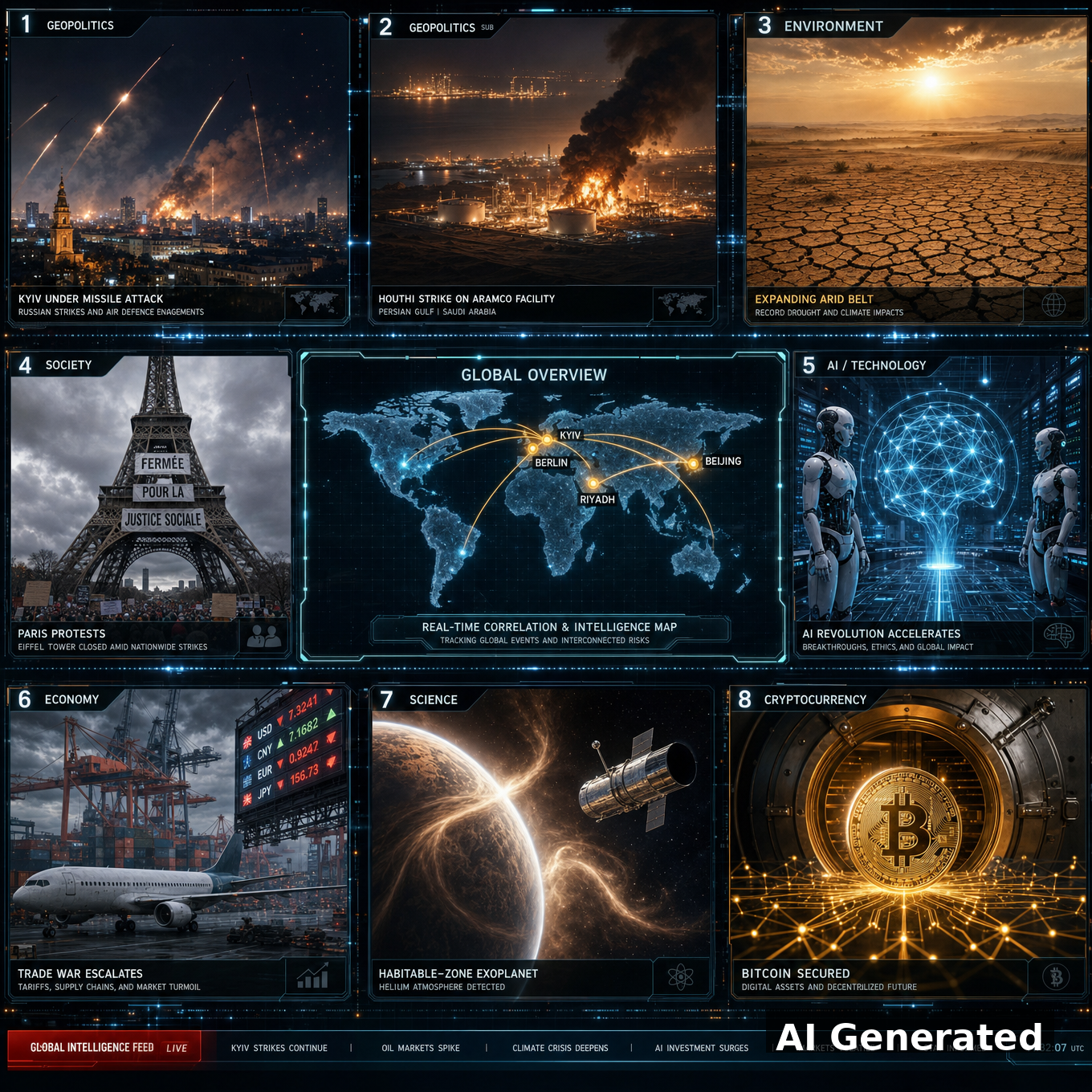
The three-day ceasefire that punctuated the Witkoff-Kushner mediation expired overnight, and Russia wasted no time reasserting its dominant kinetic pattern. Ukrainian authorities reported explosions across Kyiv and air-defence activations in the capital’s suburbs as the pause collapsed, with strikes hitting industrial sites around Boryspil and Fastiv[1]. The resumption was confirmed across multiple outlets, with France 24’s live coverage documenting the expiry of the pause ordered by President Putin during the US envoys’ visits[2], and Euronews reporting that both sides continued fighting despite the US mediation effort[3]. The diplomatic window did not survive contact with operational reality.
The escalation profile is more significant than a simple return to baseline. Ukrainian monitoring sources reported the launch of a large strategic-bomber wave involving Tu-160 and Tu-95MS aircraft from bases in the Russian Far East, with estimates of up to 80 Kh-101 cruise missiles and 40 Iskander-M ballistic missiles, alongside potential North Korean KN-23/KN-24 missiles and swarms of drones[4]. In parallel, Ukrainian intelligence assesses that Moscow is developing a new Iskander variant with a range of up to 1,500 kilometres, referred to in some analyses as the “Uran-2,” with first tests possible as early as October or November and a production ramp from 20 to 50 missiles per month under consideration[5].
On the political-institutional front, Ukraine’s chief prosecutor, Ruslan Kravchenko, resigned amid allegations linking his office to a network that received money to protect fraudulent call centres running telephone scams[6]. Kravchenko denied the allegations, saying he did not want his office “to be used as a tool in political confrontation,” but the episode lands at a delicate moment for Kyiv’s credibility. The Ukraine Defence Contact Group convened its 36th session, with German Defence Minister Boris Pistorius, British Defence Secretary Wes Streeting, the new Ukrainian defence minister and NATO Secretary-General Mark Rutte participating[7].
The Gulf and Hormuz Escalation
The second major theatre of escalation is the Persian Gulf, where the Houthi movement announced strikes on targets in Saudi Arabia, including an Aramco facility, an airport and a military base, framed as retaliation for Saudi air raids on Yemen[8]. The claim extends the Red Sea front that has been building for weeks and ties the Yemeni conflict directly into the broader US-Iran confrontation. Tehran, for its part, announced plans for a new Gulf exclusion zone and threatened the United States with missile attacks, a move that would formalise the de facto closure of the Strait of Hormuz that shipping data has already been tracking for weeks[9].
Under the surface, the US Navy has been conducting covert mine-clearance operations in the strait, with divers, boats and robots undertaking night missions to destroy explosives along the vital sea lane[10]. The operation signals that Washington treats the exclusion-zone rhetoric as more than bluster. On the financial-warfare flank, the US Treasury sanctioned a Turkish bank for funding what it described as an Iranian terror network[11]. The IAEA meanwhile warned over Iran’s nuclear access as Western powers pushed for a UN Security Council referral, with the agency’s chief stating that the Assad-era Syrian reactor at Deir ez-Zor had been configured for weapons purposes[12].
North Korea, Israel and the Eastern Mediterranean
North Korea formally commissioned the Kang Kon destroyer into service on 6 September at Wonsan, with leader Kim Jong-un declaring it part of the state’s nuclear-deterrence system capable of “devastating retaliatory strikes,” despite the vessel having capsized during its first launch attempt in May 2025[13]. The 5,000-tonne ship of the Choe Hyon class joins the East Sea Fleet — a tangible signal that Pyongyang’s naval modernisation is proceeding despite industrial setbacks. In Israel, the political season ahead of the 27 October elections is sharpening: Prime Minister Benjamin Netanyahu, in an interview with i24, failed to explain the gap between his notification at 06:29 and the situation assessment at 09:55 on 7 October 2023, while blaming the army; former chief of staff Gadi Eisenkot accused Netanyahu of prioritising political survival over national security[14]. The row was amplified by far-right minister Itamar Ben-Gvir’s claim that “the Falklands are Argentine,” widely read as retaliation for the UK’s expected sanctions on Israeli West Bank settlements[15].
Israel’s military campaign in Lebanon continued with strikes in the south and east killing twelve people[16]. Further west, Spanish Prime Minister Pedro Sánchez is reportedly alarmed by the deepening Israel-Morocco military cooperation, which has delivered PULS rocket systems, ATMOS self-propelled howitzers and drones to Rabat, with fighter aircraft planned by 2030[17]. Greece’s defence establishment is adjusting to the announced retirement of the F-4 Phantom by the end of 2027 after 53 years of service, a decision taken before the Tanagra crash, while analyst Giannis Valinakis warned that Athens and Ankara are heading toward confrontation, with Turkish UAV incursions in the Aegean continuing[18][19].
High North, Taiwan and Defence-Industrial Trends
The strategic geography of the High North is tightening. The US Navy’s Virginia-class submarine USS Delaware completed a visit to Norway, with 6th Fleet leaders framing routine deployments in the Norwegian Sea as essential to defending both Europe and the US homeland, and Finland inaugurated a 200-kilometre border fence with Russia, a concrete response to the hybrid-warfare pressure of 2023[20][21]. Taiwan is preparing for the possibility of war with China from the top of the state down to daily civilian life[22]. Myanmar’s military has intensified operations to retake areas around Chinese-funded projects[23].
The defence-industrial balance continues to shift. China’s naval construction is outpacing the United States, with Beijing launching a new aircraft carrier roughly every 20 months while American yards slip deliveries — the future USS Doris Miller pushed to 2034 and the Virginia-class build rate stuck near 1.2 boats a year against a requirement of two[24]. The US Air Force’s $10.9 billion F-22 modernization cannot overcome the Raptor’s 1980s-era design ceilings on volume, cooling and power, even as China’s J-20 is built in numbers the Raptor fleet cannot answer[25]. Chinese military scientists are even engaging with Trump’s battleship concept, modelling large-calibre guns as area weapons against drone swarms[26]. Austal launched the US Navy’s first new floating dry dock in 40 years at Mobile, a 694-foot structure designed to lift warships by sinking first[27]. The UK published a new Space Strategy backed by £7.8 billion through 2030, with more than £3 billion directed at defence capabilities in orbit[28].
In the wider Americas and Europe, the diplomatic texture is shifting. US Secretary of State Marco Rubio and Colombia’s new president Abelardo de la Espriella are seeking to redefine military and assistance cooperation after the August earthquake and tariff disputes[29]. Bolsonaro’s son launched a “protest candidacy” for Brazil’s presidency, and Cuba denounced record financial losses from the US embargo[30][31]. Iran executed 21-year-old rapper Erfan Mirzaei, arrested after the January protests, on a moharebeh conviction amid torture allegations and a family kept in the dark until after the execution[32]. Haiti’s gangs have abandoned the capital and spread into the provinces with new tactics of surprise attacks, livestock theft and improvised roadblocks, a report warns[33], while Mozambique’s opposition figure Mondlane faces trial over the 2024 election protests[34]. France’s Bardella and Britain’s Farage signed a migrant-return deal whose French and English versions diverge on a key sentence[35].
Environment & Climate
↑ ContentsDrylands, Drought and the Expanding Arid Belt
A new study in Environmental Research Letters projects that Earth’s drylands could expand to cover more than 40 percent of the planet’s land area by the end of the century, an increase of roughly 2.37 million square kilometres — an area the size of Algeria — relative to the 1994-2023 baseline of 38.58 percent[36]. The analysis, led by scientists from the Chinese Academy of Forestry, used a CO2-modified potential-evapotranspiration framework that accounts for how rising carbon dioxide partially closes plant stomata and reduces transpiration. That methodological choice yields lower aridity estimates than earlier studies — one decade-old projection put the figure as high as 56 percent — but even the more conservative path implies aggravated water scarcity, ecosystem degradation and desertification across Australia, Brazil and parts of Africa[36].
The drylands warning lands in a week of compounding hydrological stress. The Panama Canal Authority said it may cut ship traffic further if a strengthening El Niño worsens the country’s drought, a recurrence of the constraint that disrupted global shipping in 2023-24[37]. In the Pacific, Hurricane Lowell was expected to pass near the sparsely populated island of Niihau while bringing major rains statewide across Hawaii[38]. And in Southeast Asia, flights to and from Jakarta resumed after Anak Krakatau’s eruption forced a two-day closure that halted nearly 3,000 flights — a reminder that volcanic hazards, like droughts, operate on timescales that infrastructure planning struggles to absorb[39].
Climate Justice and the Cost of Inaction
Nepal is demanding $20 million in climate compensation for the devastating late-August floods that killed or left missing more than 6,000 people, with Foreign Minister Shisir Khanal telling the Guardian that the world’s biggest polluters must “wake up” and accept shared responsibility for a disaster triggered when a melting glacier partially collapsed and set off a landslide and flash flooding through Chinese-controlled Tibet and Nepal[40]. Nepal contributes less than 0.1 percent of global greenhouse gas emissions, making the case a pointed test of the loss-and-damage principle at a moment when the international community’s climate-finance architecture is under strain. The formal compensation claim is a genuinely new development with diplomatic weight.
The financing gap for climate adaptation is also visible in Africa, where two separate meetings in Lagos and Kigali this week highlighted that money does not always reach farmers and businesses in a form that reflects how they earn, borrow and manage risk[41]. Kenya’s green businesses need capital, but banks need projects they can actually finance, which is the problem a new five-year partnership between the Global Green Growth Institute and the Kenya Bankers Association aims to solve by making climate and nature-based projects investment-ready[42]. Kenya is also rolling out an $880 million, World Bank-backed electricity-access programme targeting five million households, 7,500 schools and 2,500 health facilities, with affordability and clean cooking as core constraints[43]. On the energy-infrastructure side, Dangote has set a 30 September start for construction of the Lamu oil refinery, a project that could reshape how refined petroleum products move through East Africa[44].
Energy Transitions and the Nature-Based Toolkit
China’s clean-energy build-out has reached the point where it is meeting soaring electricity demand and pushing coal power backward at the same time, a milestone in the world’s largest energy system with global emissions implications[45]. The shift is mirrored in Europe’s transport sector: the International Council on Clean Transportation claims that operating an electric car in Europe in 2025 cost one-third less than operating a conventional petrol or diesel car, a figure driven by the surge in fuel costs since the war began[46], while legacy automakers in the United States lead the EV transition by BEV share of brand sales[47]. Toyota is using Germany as a test case for zero-emission fuel-cell trucks, and a strategy paper argues that Europe’s productivity problem starts with cheap electricity — a direct challenge to the fossil-fuel lock-in that the continent’s energy crisis exposed[48][49].
Nature-based solutions are gaining formal recognition. Tanzania has designated its first official wildlife corridor, linking savanna elephants in Nyerere National Park to the rainforest of the Udzungwa Mountains across the Kilombero Valley — a corridor that accommodates a rare population of elephants that climbs steep slopes and even slides down on their haunches in the rainy season[50]. In Panama’s Darién, Indigenous Wounaan communities are testing a new way to fund conservation, using camera-trap evidence of jaguars and other biodiversity to build the case for nature-based economic alternatives across 18,000 hectares of tropical forest[51]. On the engineering side, beavers are being deployed as a drought-preparedness tool in Somerset, where their dams keep one corner of the Holnicote estate conspicuously green while the surrounding countryside stays dry and dusty — natural fire breaks built by the animals themselves[52]. And Milwaukee’s century-old Milorganite programme — turning wastewater-treatment microbes into pelletised lawn fertiliser, diverting over 10.5 billion pounds from landfill since 1926 — stands as proof that circular-economy ideas can survive for generations when they are economically self-sustaining[53].
Even industrial wastewater is being re-examined as a resource. Novo Nordisk, working with the Technical University of Denmark, is testing whether membrane-based reverse-osmosis treatment can allow pharmaceutical-production wastewater to be recycled back into manufacturing, potentially cutting the company’s water consumption by half — a high-stakes experiment given the strictest quality requirements apply to water used in injectable medicines[54]. The wildfire that tore through parts of Turkey, destroying homes and forcing tourist-spot evacuations, closed the section on a stark note: the climate-and-weather system is generating compound hazards faster than adaptation institutions can respond[55].
Society & Civil Issues
↑ ContentsEurope’s Civic Frictions: The Eiffel Tower, the Channel and Saxony-Anhalt
The Eiffel Tower was shut by a staff protest after female workers were moved away from the monument’s path to accommodate a visiting Hindu religious group that had requested not to encounter women[56]. The mayor of Paris said an investigation would be launched into the incident, which a union representative said left female employees “humiliated.” The episode crystallises a recurring tension in European public life between religious accommodation, gender equality and workplace dignity — and the speed with which the management decision became a national controversy shows how volatile that fault line remains[56].
In Paris, a separate courtroom is confronting the human cost of irregular migration: the trial of 14 suspected smugglers opened over the November 2021 Channel-crossing disaster that killed 31 people, the deadliest accident since migrants began attempting the crossing in small boats[57]. A seven-year-old girl and two teenagers were among the dead; 114 civil parties have joined the case, and some relatives travelled from Erbil in Iraq. The trial also sits against a backdrop of scrutiny of French authorities’ alleged failure to render assistance, with seven French soldiers under separate investigation[57]. In Germany, the aftershocks of the Saxony-Anhalt election continue to reverberate through civil society: the Turkish Community in Germany demanded the federal government lift the residency obligation that confines asylum seekers to the district of their reception facility, warning that people with migration backgrounds in the state where the AfD won 43.8 percent have “no time left for theoretical security debates”[58].
UK Civil Society: Sanctions, Inquiries and Public Trust
The UK government is expected to announce restrictions on trade with Israeli West Bank settlements, with Foreign Secretary Ed Miliband set to outline proposals targeting goods from Israeli-occupied areas — a “reset” of UK-Israel relations that has already provoked a sharp response from Israeli minister Itamar Ben-Gvir[59]. The move marks a substantive policy shift with trade and diplomatic consequences, and it connects to the wider pattern of Western governments translating their positions on the settlements into concrete economic measures. In parallel, the second phase of the Southport inquiry is beginning two weeks of seminar-style hearings exploring topics related to violence-fixated individuals, as families hope the process will produce change in how such threats are identified and managed[60].
Public trust in institutions shows a characteristic paradox: crime is falling for most offences across the UK, yet the public does not feel safer, a gap researchers attribute to the human tendency to focus on frightening information in the news and on social media[61]. The same survey-based ambivalence appears in attitudes to welfare: almost half of Britons think more should be spent on disability benefits, even as the government grapples with the cost of the current system[62]. And in consumer protection, an anti-fraud campaign fronted by Strictly Come Dancing judge Craig Revel Horwood urges the public to “put protection before politeness” — being a bit rude, the campaign argues, is exactly the right thing to do when a potential scammer calls[63]. The UK retail sector, meanwhile, reported a “disappointing” August with sales up just 0.7 percent year on year, down from 3.1 percent a year earlier, as households brace for bill increases[64].
Justice, Health and the International Dimension
The trial of the alleged killers of Australian brothers Jake and Callum Robinson and their American friend Jack Carter Rhoad opened in Mexico, two years after the three surfers were shot dead in Baja California in a suspected robbery — a case that has drawn intense scrutiny of cartel-related violence in tourist areas[65]. In Germany, the Federal Court of Justice is examining whether comprehensive insurers must pay inflated workshop costs, a case that could shift the “workshop risk” burden in Kasko insurance and, according to consumer advocates, would be welcome news for policyholders[66]. And in the corporate-controversy file, Adidas apologised for a “one shoe” advertising campaign featuring a former Israeli soldier who lost his left leg fighting in the 2021 Gaza conflict, an episode that highlights how quickly brand campaigns collide with the region’s unresolved politics[67].
Australia’s political scene produced its own civic flashpoint: One Nation’s Treasury spokesman Barnaby Joyce admitted his party had not modelled the impact of its plan to give households early access to superannuation, telling interviewers he was “not Jesus Christ” and could not be expected to know everything — a remark that drew derision from Treasurer Jim Chalmers, who called the policy “an absolute shambles”[68]. And in Albania, the “Flamingo Revolution” — protests against a luxury resort project backed by Jared Kushner — entered its 100th day, a sustained civic mobilisation that links local environmental and land concerns to the global scrutiny of Trump-adjacent business interests[69].
AI & Technology
↑ ContentsAI Consolidation, Hardware and the Robotics Frontier
The most consequential AI business development of the day is Anthropic’s decision to walk away from acquisition talks with Decart, a deal that had been valued at approximately $6 billion[70]. The collapse is best read through the lens of Anthropic’s reported preparations for an IPO — the company has been reported to be planning a prospectus release in late September with Morgan Stanley and Goldman Sachs — and a $6 billion acquisition of a fast-growing but capital-intensive startup would have complicated that narrative. The move signals a recalibration of growth expectations at a moment when the entire frontier-AI sector is being forced to reconcile massive infrastructure spending with investor demands for demonstrable returns[70]. Samsung SDS, meanwhile, expanded its partnerships with both OpenAI and Anthropic for AI transformation, a signal that enterprise demand for frontier models remains robust even as the models themselves consolidate[71].
On the hardware and robotics front, XPeng switched on what it calls the world’s first automated production line for advanced humanoid robots, with its IRON robot walking off the line under its own power and more than 80 percent of core processes automated, targeting mass production by the end of 2026[72]. The milestone lands as Tesla’s Optimus programme stalls, and it underscores the degree to which the humanoid-robotics competition has become a Chinese manufacturing contest as much as an AI one. Huawei, for its part, published new measurements for its vertically stacked “LogicFolding” chip architecture, claiming a coming Kirin processor can achieve 55 percent higher transistor density than the Kirin 9030 Pro while using up to 66 percent less power on key workloads — a workaround for China’s restricted access to advanced lithography that, if it holds up under independent testing, could reshape assumptions about what is achievable without cutting-edge EUV equipment[73].
Quantum, Compute Infrastructure and the Power Bottleneck
Japan’s NEC announced it is halting its quantum computer project after decades of research, a decision that concentrates Japan’s quantum hardware efforts with Fujitsu and highlights the growing industry shift toward software and services rather than in-house hardware[74]. The move is emblematic of a broader reckoning: quantum computing has produced remarkable laboratory progress but few commercially deployable systems, and even deep-pocketed industrial conglomerates are now asking whether the returns justify the decades-long investment horizon. The power bottleneck that constrains AI expansion, by contrast, is generating concrete engineering responses. Hyosung Heavy Industries unveiled what it calls the world’s first 22.9kV-class solid-state transformer aimed at the next generation of power networks, a technology that uses power semiconductors to actively control electricity and that the South Korean firm is positioning for the US data-center boom[75]. At the materials level, imec demonstrated a world-first density for superconducting circuits — 3.8 million Josephson junctions per square centimetre with 30-nanometre wiring — a step toward high-performance computing that could eventually offer major energy savings over conventional CMOS chips[76].
AI Governance, Labor and the Geopolitics of Compute
Governance and labor questions continue to shadow the technology’s advance. Researchers at the John Paul II Catholic University of Lublin and the University of Eastern Finland developed a new model of AI governance inspired by Pope Leo XIV’s encyclical Magnifica Humanitas, intended to ensure AI is developed and used safely, fairly and with full respect for human rights — an attempt to inject a normative framework into a field whose regulators are still scrambling for one[77]. In Australia, the Labor government pledged a “global reckoning” for big tech amid new curbs on eating-disorder and misogynistic content, extending the country’s push to regulate platform algorithms that began with the opt-out law covered in D99[78]. The labor dimension is also visible in the construction sector, where Eric Wu’s new company NavigateAI — out of stealth since May and backed by $25 million from Elad Gil, Khosla Ventures and Lennar — is building AI copilots that give construction workers real-time, hands-free guidance through smartphones and Meta’s AI glasses, targeting a labor shortage severe enough that data-center projects alone now need 4,000 to 5,000 workers apiece[79].
The geopolitics of compute remains defined by Taiwan’s centrality: the island produces the overwhelming majority of the world’s most advanced semiconductors, and its chips power AI, cars and smartphones, placing it at the centre of the rivalry between China, the United States and other powers[80]. Tesla’s Cybercab rollout in Austin, meanwhile, continued to generate questions about the reliability and economics of robotaxi operations just days after its limited launch[81]. Taken together, the day’s AI news describes a sector that is simultaneously consolidating at the frontier, industrialising at the hardware layer, and struggling to reconcile its energy and labor demands with the governance frameworks being built around it.
Economy & Business
↑ ContentsTrade Wars, Currencies and the Asian FX Complex
The trade-war front reopened on a new axis as President Trump asserted that Canadian aerospace firm Bombardier should no longer be allowed to sell its planes in the United States, demanding the company build in America and stop treating the country “like a piggy bank”[82]. The threat drew pushback from a GOP senator and marks the latest escalation in the US-Canada commercial confrontation that has been running since Washington declined to extend the USMCA in July and imposed 50 percent duties on Canadian goods in August. Canada, which faces its own $20 billion of counter-tariffs taking effect on 8 September, is being forced to accelerate its pivot to Asia — a diversification that analysts argue is finally real but complicated by mutual ignorance, with 73 percent of Canadians knowing little or nothing about South Korea and 90 percent the same of Malaysia[83].
The currency complex is tightening in tandem. The yen appreciated sharply against the dollar, touching the 153-level, with Japan and the United States remaining aligned on FX policy to foster stable markets[84][85]. Asia stocks wavered as the yen surged and Iran warned of retaliation, and the Canadian dollar advanced as the US dollar came under pressure[86][87]. The moves come as the market counts down to the 15-16 September FOMC meeting, which D99 identified as the single most consequential macro event for both the Asian FX complex and global risk appetite. Japan’s economy grew more strongly in the second quarter than first estimated, at an annualised 1.4 percent[88].
China’s Trade Machine and the Commodity Complex
China recorded a $119 billion trade surplus in August, extending a streak above $100 billion and underscoring its growing global economic influence even as Western tariffs mount[89]. The composition of that surplus reveals the pressure points: oil-product exports rose to 6.01 million tonnes from 4.65 million in July, while rare-earth shipments for January-August fell to 39,441.4 tonnes from 44,355.3 a year earlier, and copper-concentrate imports slipped to 19.49 million tonnes from 20.06 million[90][91][92]. Beijing’s state-backed iron-ore buyer has directed mills to pause purchases from Rio Tinto, a centralised purchasing strategy that challenges traditional pricing models[93]. China also imposed anti-dumping measures on Japanese semiconductor chemicals[94]. The Vitol CEO warned that a 5-6 million barrels-per-day gap in China’s crude imports is unsustainable, and that an eventual demand rebound could strain supply and elevate prices[95].
Wheat prices surged on concerns over Russia’s commitment to the Ukraine war, with Black Sea supply disruptions threatening global food security[96] — a commodity echo of the military escalation covered in the Geopolitics section. Ukrainian grain exports are in fact stalling as Russian attacks nearly halt Black Sea shipping[97]. Goldman Sachs raised its oil-price forecasts on Middle East risks, and Trump predicted gasoline prices would fall sharply once the US “wins” the war with Iran[98]. The EverBank-WaFd $3.9 billion reverse merger added a banking-consolidation story[99].
Europe’s Fiscal and Corporate Undercurrents
Germany’s Finance Minister Lars Klingbeil presented the 2027 federal budget draft in the Bundestag, with spending of 555.4 billion euros — nearly six percent more than the current year — and net new borrowing of 118.7 billion euros[100]. The draft arrives as the German property sector fears the next wave of insolvencies after the collapses of project developers Pandion and Peters Development[101]. Lufthansa is weighing a cabin redesign as premium seats sell out faster than availability, and more prefabricated houses are being approved, especially in the southwest, where the Fertigbau share of new single- and two-family-home permits reached 26.7 percent[102][103]. In France, La Tribune calculated that the country’s 301 billion euros of gold reserves — worth over 380 billion euros at end-August prices — could cover only about 8.5 percent of the public debt even if sold entirely, puncturing any fantasy that the bullion hoard can solve the fiscal problem[104].
India’s capital markets are heating up: Jio Platforms plans to kick off investor outreach for its IPO next week, and six offers are set to open on a single day this week for the first time in 30 years[105][106]. Malaysia’s Anwar is targeting cost-of-living woes after election setbacks, and Hong Kong is wooing global scholars as the West tightens scrutiny of China[107][108]. Greece’s Theon International published its H1 2026 results, and the Elefsina logistics-park tender entered its final phase[109][110]. The German SPD deputy leader rejected more flight rights for Emirates, a protectionist signal in aviation[111].
Science & Space
↑ ContentsAstrophysics and the Search for Habitable Worlds
Astronomers reported the detection of helium escaping from the atmosphere of a nearby rocky exoplanet orbiting in its star’s habitable zone, a result published in Science that adds a new observational constraint on which rocky worlds can retain atmospheres conducive to surface habitability[112]. The finding matters because atmospheric escape is one of the primary mechanisms by which terrestrial planets lose their envelopes over time, and a habitable-zone world that is bleeding helium is likely also losing lighter volatiles — a cautionary data point for the habitability rankings that populate the field. On the observational-infrastructure side, the Vera C. Rubin Observatory released an exceptionally deep image of the renowned COSMOS field in Sextans, demonstrating the survey telescope’s ability to peer deeper into well-studied regions and, by extension, to serve as the workhorse for the time-domain astronomy that will dominate the coming decade[113].
China’s lunar programme absorbed a schedule setback: the Chang’e-7 mission will miss its late-August launch window, according to a brief release from the China National Space Administration and the China Manned Space Engineering Office[114]. The delay is a reminder that even the most ambitious robotic lunar exploration programme is subject to the same integration and testing realities as any other, though analysts expect the cornerstone mission to return to the pad before long. Closer to Earth, new modelling suggests that early Earth’s auroral belts may have formed a natural ion-beam reactor for prebiotic chemistry, proposing that the planetary structure producing auroras could also have organised chemical reactions at the origin of life[115]. And in the human dimension of spaceflight, the world’s first spacefaring commercial cardiologist, Dr. Eiman Jahangir, published a memoir of his Blue Origin flight in August 2024, offering lessons for would-be astronauts about the widening accessibility of suborbital space[116].
Medical Science: Cancer, IBD and the Microbiome
Two large epidemiological studies sharpened the public-health picture. A first-of-its-kind PLOS Medicine analysis of more than 91,000 UK Biobank participants found that every additional hour per day of prolonged, uninterrupted sitting was associated with a 9 percent higher risk of dying from any cancer, while interrupted sitting was linked to an 18 percent lower risk of cancer mortality — evidence that the pattern of sedentary time matters as much as its total[117]. A separate international study of passive-smoking burden estimated that second-hand smoke is responsible for 1.6 million deaths per year worldwide, with women and children disproportionately exposed[118]. Both findings reinforce the argument that modest behavioural and policy interventions — replacing an hour of sitting with light activity, or enforcing smoke-free environments — carry outsized health returns.
In mechanistic research, a WEHI-led study identified a hidden molecular defect in inflammatory bowel disease: even when IBD appears under control, intestinal cells remain primed to die, which may explain why flare-ups return in patients with few or no symptoms[119]. And a Rutgers-led exome-sequencing effort dramatically expanded the catalogue of shared risk genes for obsessive-compulsive disorder and chronic tic disorders such as Tourette syndrome, identifying 36 genes that increase risk 57-fold on average — up to 210-fold at the extreme — and revealing substantial genetic overlap with autism and schizophrenia, opening new network-level targets for therapy[120]. Separately, a large randomised-trial analysis presented at ESC Congress 2026 provided some of the clearest evidence yet that consistent antihypertensive medication adherence is essential to cardiovascular protection, with missed doses eroding the drugs’ heart-attack and stroke prevention benefits[121].
Materials, Energy and the Natural World
At the energy-materials frontier, researchers at the Japan Advanced Institute of Science and Technology designed an electrolyte additive — pentafluorophenyl thiophene imine, or FPTI — that helped graphite anodes retain up to 95.6 percent of capacity after 1,000 cycles, versus 62.7 percent for the control, by building a more conductive and stable solid-electrolyte interphase[122]. The finding points to a path to longer-lived lithium-ion batteries without replacing the ubiquitous graphite anode, though the team cautions that full-cell preconditioning, rather than direct electrolyte addition, is required. In behavioural ecology, a study in the journal Wild documented what its authors call preliminary evidence of material culture in critically endangered pygmy raccoons on Cozumel: two juvenile siblings repeatedly pulled paper from a waste bin, dipped it in water, rolled it in sand into balls and batted them in play — a sequence never before reported in any raccoon species, and one that raises conservation questions about habituated wildlife at tourist sites[123]. And a 13-year-old Minnesota student’s LIGNEX project, using treated peanut shells to remove pesticide residue from produce via biosorption — removing 93.94 percent of a model contaminant — became a national finalist in the 3M Young Scientist Challenge, an example of how overlooked agricultural waste can become a food-safety tool[124].
Crypto, Digital Assets & Blockchain
↑ ContentsProtocol Infrastructure: Teleporter, XRPL and the RWA Inflow
Ava Labs released Avalanche Teleporter v1.4.0, an upgrade to the network’s cross-subnet messaging infrastructure that is designed to make Avalanche’s many subnets and L1s feel less isolated from one another[125]. The release gives developers a standardised way to relay messages, assets and governance actions across Avalanche chains, supporting the multi-chain model that underpins the ecosystem’s institutional pitch. The caveat, as with any protocol-level release, is adoption: individual subnet operators must still upgrade their deployments, and different subnets may move at different speeds depending on their own governance and validator coordination. The upgrade is best understood as infrastructure enabling a network-of-networks architecture rather than an immediate user-facing change — and, as the release notes emphasise, it is not a price event[125].
On the XRP Ledger, the XLS-66d lending amendment moved closer to the validator consensus threshold required for activation, with active support reaching 71.4 percent against the 80 percent threshold that must hold for 14 days[126]. The amendment would introduce native uncollateralised lending primitives to XRPL, adding a DeFi layer to a ledger best known for payments and settlement. Uncollateralised lending is materially different from the overcollateralised model that dominates DeFi — it depends on credit systems, trust assumptions, identity and underwriting — which is precisely why the ecosystem will need to be clear about how risk is managed if the amendment activates. The momentum is real, but the distinction between momentum and activation matters: validators can still change positions, and the amendment is not part of the live protocol until the full activation process completes[126].
Solana recorded $348 million in net real-world-asset inflows over a 30-day period, pushing its tokenised RWA value to $720 million, according to RWA.xyz data[127]. The figure is significant because it represents institutional-style capital moving into tokenised Treasuries, credit products and other real-world asset structures on a network usually associated with memecoins and retail trading — evidence that the chain’s speed and low fees are beginning to matter beyond consumer speculation. The number should not be overstated: RWA inflows are not proof that every major institution has adopted Solana, and the capital may not remain if yields or market conditions change. But the momentum, combined with the $720 million base, gives the ecosystem a more rounded institutional story alongside its louder trading narrative[127].
Regulation, Enforcement and the Compliance Gap
Chainalysis estimates that crypto tax non-compliance may exceed 90 percent, a finding that highlights the urgent need for robust regulatory frameworks and enforcement mechanisms to ensure fiscal accountability[128]. The estimate, drawn from on-chain analytics, underscores the scale of the gap between crypto activity and tax reporting — a gap that regulators in the United States, Europe and Asia are now moving to close through reporting rules and information-sharing frameworks. The figure also feeds directly into the sector’s broader legitimacy problem: if the overwhelming majority of taxable crypto activity goes unreported, the industry’s institutional integration will continue to be shadowed by compliance risk[128].
In France, the financial-intelligence unit Tracfin recorded a surge in suspicious-transaction reports and, for the first time, used its right of opposition to seize funds in crypto-assets, which were the subject of twice as many referrals to the justice system as in 2024[129]. The development is a concrete marker of how European financial-intelligence infrastructure is operationalising crypto enforcement: rather than treating digital assets as beyond reach, national FIU-style bodies are now actively freezing and seizing them under anti-money-laundering powers. It also connects to the MiCA implementation arc that this series has tracked since D66, as European supervisors translate regulation into enforcement practice[129].
Custody, Recovery and Institutional Resilience
A British man, identified only as Chris, reclaimed $4.4 million in Bitcoin after a 12-year legal fight with Intersango, formerly Britcoin, an exchange that shut down in 2014[130]. The case is a reminder of the custody risk embedded in the early exchange era: when an exchange collapses, user funds can remain trapped for years, and recovery often depends on legal processes rather than technical access. That the claimant ultimately recovered the full value — which had grown from a smaller initial investment — is a comparatively rare happy ending in a sector littered with permanent losses, and it underscores why the self-custody and institutional-custody debates covered throughout this series remain so consequential[130].
Across the day’s crypto news, the through-line is institutionalisation under regulatory constraint: protocol upgrades (Teleporter, XLS-66d) continue to build infrastructure, real-world-asset flows signal a shift toward institutional utility, and enforcement actions (Tracfin’s crypto seizures, tax-non-compliance estimates) mark the sector’s integration into the mainstream fiscal and legal order. The sector is no longer debating whether regulation will come — it is adapting to the reality that compliance, custody and enforcement are now structural features of the digital-asset economy[128][129].
Correlations & Analysis
↑ ContentsD100 opens with the two structural dynamics that D97 and D98 identified as defining the autumn — simultaneous diplomacy-and-escalation in the world’s dominant conflicts, and Europe’s October political convergence — both still unresolved and both now more sharply defined. The resumption of Russian strikes on Kyiv the moment the three-day ceasefire expired, hours after the Witkoff-Kushner mediation concluded, is the most direct possible answer to the D99 watchpoint on whether the leaked Trump peace plan would be confirmed or disavowed[1][2]. The ceasefire was always a diplomatic interlude, not a settlement; its expiry without a plan being signed leaves the pre-winter “breakthrough” pressure on Kyiv unresolved, with the reported development of an Iskander variant reaching 1,500 kilometres adding a new military-geographic layer to the escalation profile[5]. The correlation with D99’s Hormuz watchpoint is equally tight: Iran’s planned Gulf exclusion zone and the Houthi strikes on Saudi Aramco infrastructure are the direct successors to the tanker-war escalation D98 documented with the sinking of the M/T Kylo, and the US Navy’s covert mine-clearance operation confirms that Washington is treating the threat as operational rather than rhetorical[9][10].
The economic transmission channels that D98 and D99 documented through commodity shipping and the Asian FX complex have sharpened further. The yen’s surge to the 153-level against the dollar, the alignment of Japanese and US FX policy, and the pressure on Asian equities all land in the same window as China’s $119 billion August trade surplus and the Vitol CEO’s warning of an unsustainable 5-6 million barrel-per-day gap in Chinese crude imports[84][85][89][95]. The September 15-16 FOMC meeting — which D99 identified as the single most consequential macro event for both the Asian FX complex and crypto risk appetite — now approaches against a backdrop of a European political earthquake, a Gulf exclusion zone, and a Chinese export shock. The wheat-price surge on Black Sea supply concerns, and the stalling of Ukrainian grain exports under Russian attacks, connect the military and economic layers of the war in a way that the commodity markets are pricing in real time[96][97].
The third convergence D98 identified — the institutional accountability wave around AI — continued to build, but with the character shift D99 anticipated. Where D99 was dominated by governance architecture (Australia’s opt-out law, Trump-Xi guardrails talks), D100’s AI layer is dominated by corporate strategy and hardware: Anthropic’s withdrawal from the $6 billion Decart acquisition as it prepares for an IPO, Samsung SDS’s expanded partnerships with both frontier labs, XPeng’s humanoid-robot production line, and Huawei’s vertically stacked chip architecture[70][71][72][73]. The shift from incident response to institutional design is the natural next phase of the accountability wave, but the underlying question — whether the numbers these systems produce mean anything — remains unresolved, as the D99 pipeline-essay lesson demonstrated.
The environmental layer of D100 connects to D98’s September-heat watchpoint through both mechanism and financing. The drylands-expansion study, projecting more than 40 percent of Earth’s land area under aridity by 2100, supplies the long-term frame for the same hydrological stress that is forcing the Panama Canal to consider further traffic cuts under a strengthening El Niño and that drove Nepal’s $20 million climate-compensation demand after the late-August glacier-collapse floods[36][37][40]. The Africa climate-finance meetings in Lagos and Kigali, and Kenya’s $880 million electricity-access programme, are the adaptation-economy response to the same physical system that the Arctic stories in D99 showed changing whether or not the regulatory system acknowledges it[41][43].
The crypto layer of D100 is best read as the sector’s continued answer to the hawkish-macro stress test D98 posed. Protocol upgrades (Avalanche Teleporter v1.4, XRPL’s XLS-66d lending amendment), Solana’s $348 million in 30-day RWA inflows, and the enforcement reality captured by Chainalysis’s estimate that crypto tax non-compliance may exceed 90 percent and by Tracfin’s first use of crypto-asset seizure powers all describe a sector moving toward institutional utility and regulatory integration[125][126][127][128][129]. The 12-year legal battle that finally returned $4.4 million in Bitcoin to a British claimant is a human-scale reminder of the custody risk that the institutionalisation drive is meant to retire[130].
What to watch in the next reporting period: (1) Whether the Russian resumption of strikes escalates into the strategic-bomber wave Ukrainian sources warned of, and whether Washington responds with a formal confirmation or disavowal of the leaked peace plan; (2) the formal announcement and precise boundaries of Iran’s Gulf exclusion zone, and whether the US responds with a legal challenge, a naval assertion, or both — with the Houthi strikes on Saudi Aramco adding a second front; (3) the Saxony-Anhalt government-formation endgame and its reverberation into the Berlin and Mecklenburg-Vorpommern votes in two weeks; (4) the September 15-16 FOMC decision, now the single most consequential macro event for both the Asian FX complex and crypto risk appetite; and (5) whether Anthropic’s IPO proceeds as reported, and whether the AI-consolidation pattern it signals reshapes the frontier-lab landscape. D101 should show whether any of these five watchpoints resolves or merely deepens.
References
↑ Contents1. Russia resumes heavy air strikes on Kyiv after three-day ceasefire expires by Tagesschau · Tagesschau ↑
2. Live: Russia resumes strikes on Kyiv after three-day halt by France 24 · France 24 ↑
3. Russian, Ukrainian forces continue to fight despite US mediation by Euronews · Euronews ↑
4. Russia launches largest strategic-bomber attack wave yet against Ukraine (Tu-160/Tu-95) by DefenceNet · DefenceNet ↑
5. Russia developing Iskander-XL ballistic missile family with reach out to 1,500 km by DefenceNet · DefenceNet ↑
6. Ukraine chief prosecutor Ruslan Kravchenko resigns amid call-centre corruption scandal by BBC News · BBC News ↑
7. Ukraine Defence Contact Group holds virtual session on further support for Kyiv by Stern · Stern ↑
8. Houthis strike Saudi Aramco facility, airport and military base in retaliation by ProtoThema · ProtoThema ↑
9. Iran plans new Gulf exclusion zone, threatens US with missiles by Crypto Briefing · Crypto Briefing ↑
10. US Navy conducts covert mine-clearance operation in Strait of Hormuz by Skai · Skai ↑
11. US Treasury sanctions Turkish bank over Iranian terror-network funding by Crypto Briefing · Crypto Briefing ↑
12. IAEA warns over Iran nuclear access; Western powers push UN referral by Al Jazeera · Al Jazeera ↑
13. North Korea commissions Kang Kon destroyer into nuclear-deterrence system by Al Jazeera · Al Jazeera ↑
14. Netanyahu cannot justify first critical hours of October 7, blames army by in.gr · in.gr ↑
15. Israeli minister Ben-Gvir says ‘the Falklands are Argentine’ by Daily Express · Daily Express ↑
16. Israel strikes southern Lebanon killing twelve amid ongoing campaign by Handelsblatt · Handelsblatt ↑
17. Spain’s Sanchez alarmed as Israel-Morocco military cooperation arms Morocco by DefenceNet · DefenceNet ↑
18. Greek F-4 Phantom retirement set for end of 2027 after 53 years of service by To Vima · To Vima ↑
19. Valinakis warns Greece-Turkey heading toward confrontation; Turkish UAV incursions in Aegean by DefencePoint · DefencePoint ↑
20. US Navy’s USS Delaware completes Norway visit as Washington expands High North undersea operations by Defence Industry EU · Defence Industry EU ↑
21. Finland inaugurates 200 km border fence with Russia by France Info · France Info ↑
22. Taiwan prepares for possible war with China from state level to daily life by France Info · France Info ↑
23. Myanmar military intensifies operations to retake China project areas by Nikkei Asia · Nikkei Asia ↑
24. China launches a new aircraft carrier every 20 months; US shipyards cannot keep pace by 19FortyFive · 19FortyFive ↑
25. US Air Force F-22 Raptor modernization faces hard design ceiling against China’s J-20 by 19FortyFive · 19FortyFive ↑
26. China backs Trump’s battleship plan, claims large-caliber guns can counter drone swarms by Interesting Engineering · Interesting Engineering ↑
27. Austal launches first new Navy floating dry dock in 40 years at Mobile by Ecoticias · Ecoticias ↑
28. UK Space Strategy backed by 7.8 billion pounds with 3 billion for defence capabilities by UK Defence Journal · UK Defence Journal ↑
29. Rubio and Colombia’s De la Espriella seek to redefine US-Colombia military cooperation by Zona Militar · Zona Militar ↑
30. Bolsonaro’s son launches protest candidacy for Brazil presidency at Sao Paulo rally by Le Parisien · Le Parisien ↑
31. Cuba denounces record financial losses from US embargo by Le Monde · Le Monde ↑
32. Iran executes 21-year-old rapper Erfan Mirzaei arrested during protests; torture allegations by DefenceNet · DefenceNet ↑
33. Haiti gangs abandon capital and spread into provinces with new tactics by Enikos · Enikos ↑
34. What does Mondlane’s trial mean for Mozambique? by Al Jazeera · Al Jazeera ↑
35. Bardella-Farage migrant return deal loses a sentence in translation by France Info · France Info ↑
36. Over 40% of Earth could become drylands by 2100, new study warns by ScienceAlert · ScienceAlert ↑
37. Panama Canal may cut ship traffic further as El Nino strengthens by Al Jazeera · Al Jazeera ↑
38. Hurricane Lowell expected to pass near one Hawaiian island and cause major rains statewide by The Independent · The Independent ↑
39. Flights to and from Jakarta resume after Anak Krakatau eruption forced two-day closure by The Independent · The Independent ↑
40. Nepal demands $20m climate compensation; big polluters must ‘wake up’ after floods by The Guardian · The Guardian ↑
41. Africa’s climate finance problem is becoming a question of who carries the risk by EcoNews · EcoNews ↑
42. Kenya’s green businesses need money, but banks need projects they can finance by EcoNews · EcoNews ↑
43. Kenya’s next big electricity access test: reaching remote communities affordably by EcoNews · EcoNews ↑
44. Dangote sets September 30 start for Lamu refinery as Kenya eyes bigger East Africa fuel role by EcoNews · EcoNews ↑
45. China’s clean energy surge starts to squeeze out coal by Electrek · Electrek ↑
46. ICCT claims EV operating costs one-third lower in Europe by CleanTechnica · CleanTechnica ↑
47. Legacy automakers lead the US EV transition; BEV share of brand sales by CleanTechnica · CleanTechnica ↑
48. Acid test coming for zero-emission fuel cell trucks in Europe (Toyota, Germany) by CleanTechnica · CleanTechnica ↑
49. A productivity strategy for Europe starts with cheap electricity by CleanTechnica · CleanTechnica ↑
50. Tanzania’s first official wildlife corridor links savanna elephants to rainforest by Mongabay · Mongabay ↑
51. In Panama’s Darien, Indigenous communities test a new way to fund conservation by Mongabay · Mongabay ↑
52. How beavers can help create fire breaks as part of a drought preparation plan by Phys.org · Phys.org ↑
53. Milwaukee has turned wastewater-treatment microbes into lawn fertilizer for a century by ScienceBlog · ScienceBlog ↑
54. New membrane tech could turn pharma wastewater into production water, cut use 50% (Novo Nordisk) by Interesting Engineering · Interesting Engineering ↑
55. Homes destroyed and tourist spots evacuated as wildfire tears through parts of Turkey by Daily Express · Daily Express ↑
56. Eiffel Tower shut by staff protest after female workers moved for religious visit by BBC News · BBC News ↑
57. Channel-smuggling trial opens in Paris over 2021 disaster that killed 31 by Stern · Stern ↑
58. Turkish community demands end of residency obligation in Saxony-Anhalt after AfD win by Stern · Stern ↑
59. UK government expected to announce restrictions on trade with West Bank settlements by BBC News · BBC News ↑
60. Families hope second phase of Southport inquiry will bring change by Evening Standard · Evening Standard ↑
61. Crime is falling but the public doesn’t feel safer, UK study finds by Phys.org · Phys.org ↑
62. Almost half of Brits think more should be spent on disability benefits by The Independent · The Independent ↑
63. ‘Put protection before politeness’ to guard against fraud, UK campaign urges by The Independent · The Independent ↑
64. Retailers suffer ‘disappointing’ August as household bill increases loom (UK) by The Independent · The Independent ↑
65. Trial begins in Mexico for alleged killers of Australian surfers and American friend by The Guardian · The Guardian ↑
66. BGH examines whether comprehensive insurers must pay inflated workshop costs by Stern · Stern ↑
67. Adidas apologises for ‘one shoe’ campaign featuring former Israeli amputee soldier by Skai · Skai ↑
68. Barnaby Joyce says he’s not ‘Jesus Christ’ as One Nation super policy faces scrutiny by The Guardian · The Guardian ↑
69. ‘Flamingo Revolution’ enters 100th day against Kushner-linked resort in Albania by Al Jazeera · Al Jazeera ↑
70. Anthropic walks away from $6B Decart acquisition talks by Crypto Briefing · Crypto Briefing ↑
71. Samsung SDS expands OpenAI, Anthropic partnerships for AI transformation by Crypto Briefing · Crypto Briefing ↑
72. XPeng starts IRON humanoid robot production as Tesla Optimus stalls by Electrek · Electrek ↑
73. Huawei’s new chip design tackles overheating with 55% higher transistor density by Interesting Engineering · Interesting Engineering ↑
74. NEC halts quantum computer project after decades of research by Crypto Briefing · Crypto Briefing ↑
75. World’s first 22.9kV solid-state transformer developed to electrify US data centers by Interesting Engineering · Interesting Engineering ↑
76. Superconducting circuits set world’s first 3.8M density with 10x thinner wires (imec) by Interesting Engineering · Interesting Engineering ↑
77. AI governance model inspired by Pope Leo XIV aims to put ethics first by Phys.org · Phys.org ↑
78. Australia politics: Labor pledges ‘global reckoning’ for big tech amid content curbs by The Guardian · The Guardian ↑
79. Eric Wu’s NavigateAI targets construction labor crunch with AI copilots by TechCrunch · TechCrunch ↑
80. Why the world depends on Taiwan’s chips: AI, cars, smartphones by France Info · France Info ↑
81. Even more questions swirl around Tesla Cybercab rollout by CleanTechnica · CleanTechnica ↑
82. Trump calls for a Bombardier plane ban, drawing pushback from a GOP senator by NBC News · NBC News ↑
83. Canada’s pivot to Asia is finally real; neither side knows much about the other by Fortune · Fortune ↑
84. Japan, US remain aligned on FX policy to foster stable markets by Investing.com / Reuters · Investing.com / Reuters ↑
85. Asia stocks waver as yen surges, Iran warns of retaliation by Investing.com / Reuters · Investing.com / Reuters ↑
86. Yen appreciates sharply against dollar, touching 153-level by Nikkei Asia · Nikkei Asia ↑
87. Canadian dollar advances as US dollar remains under pressure by Crypto Briefing · Crypto Briefing ↑
88. Japan’s economy grows more strongly in Q2 than first estimated by Handelsblatt / Reuters · Handelsblatt / Reuters ↑
89. China records $119B trade surplus in August as streak above $100B continues by Crypto Briefing · Crypto Briefing ↑
90. China August oil product exports 6.01 million tonnes vs 4.65 million in July by FinancialJuice · FinancialJuice ↑
91. China jan-aug rare earth shipments 39,441.4 tonnes vs 44,355.3 a year earlier by FinancialJuice · FinancialJuice ↑
92. China August unwrought aluminium exports 626,000 tonnes vs 643,000 in July by FinancialJuice · FinancialJuice ↑
93. China jan-aug copper concentrates imports 19.49 million tonnes vs 20.06 million a year earlier by FinancialJuice · FinancialJuice ↑
94. China imposes anti-dumping measures on Japanese semiconductor chemicals by Crypto Briefing · Crypto Briefing ↑
95. Vitol CEO warns of unsustainable 5-6M bpd gap in China’s crude imports by Crypto Briefing · Crypto Briefing ↑
96. Wheat surges on concerns over Russian commitment to Ukraine war by Crypto Briefing · Crypto Briefing ↑
97. Ukrainian grain exports stall as Russian attacks nearly halt Black Sea shipping by Tagesschau · Tagesschau ↑
98. Goldman Sachs raises oil price forecasts on Middle East risks by Handelsblatt · Handelsblatt ↑
99. EverBank to buy WaFd in $3.9B reverse merger by Seeking Alpha · Seeking Alpha ↑
100. German Finance Minister Klingbeil presents 2027 budget draft by Stern · Stern ↑
101. German property sector fears next wave of insolvencies after Pandion and Peters Development by Handelsblatt · Handelsblatt ↑
102. Lufthansa weighs cabin redesign as premium seats sell out by Handelsblatt · Handelsblatt ↑
103. More prefabricated houses approved in Germany, especially in the southwest by Stern · Stern ↑
104. France holds 301 billion euros in gold but it cannot erase the debt by La Tribune · La Tribune ↑
105. Jio Platforms plans to kick off investor outreach for its IPO next week by Business Standard · Business Standard ↑
106. IPO rush: 6 offers to open in one day this week, first time in 30 years by Business Standard · Business Standard ↑
107. Malaysia’s Anwar targets cost-of-living woes after election setbacks by Nikkei Asia · Nikkei Asia ↑
108. Hong Kong woos global scholars as West tightens China scrutiny by Nikkei Asia · Nikkei Asia ↑
109. Theon International publishes H1 2026 results by DefencePoint · DefencePoint ↑
110. Elefsina logistics park tender enters final phase by DefencePoint · DefencePoint ↑
111. SPD deputy leader Zorn rejects more flight rights for Emirates by Die Zeit · Die Zeit ↑
112. Helium escaping from the atmosphere of a nearby rocky exoplanet in the habitable zone by Science · Science ↑
113. Rubin Observatory peers deep into the famous COSMOS field by Universe Today · Universe Today ↑
114. China postpones the Chang’e-7 lunar mission by Universe Today · Universe Today ↑
115. Early Earth’s auroral belts may have formed a natural ion-beam reactor for prebiotic chemistry by Phys.org · Phys.org ↑
116. The world’s first spacefaring commercial cardiologist has lessons for would-be astronauts by Universe Today · Universe Today ↑
117. Just one extra hour of uninterrupted sitting raises cancer risk, study finds by ScienceAlert · ScienceAlert ↑
118. Passive smoking responsible for 1.6 million deaths per year worldwide, study says by Le Parisien · Le Parisien ↑
119. Scientists discover a hidden defect that could explain why IBD keeps coming back by SciTechDaily / WEHI · SciTechDaily / WEHI ↑
120. Scientists uncover shared genetic roots of OCD, Tourette syndrome and autism by ScienceAlert · ScienceAlert ↑
121. Millions take blood pressure drugs, but many may be missing heart-protective benefits by SciTechDaily / ESC · SciTechDaily / ESC ↑
122. New additive helps lithium-ion batteries retain 95.6% capacity after 1,000 cycles by Interesting Engineering · Interesting Engineering ↑
123. Two young pygmy raccoons on Cozumel show first reported object play in any raccoon species by ScienceBlog · ScienceBlog ↑
124. A 13-year-old from Minnesota tests peanut shells against pesticide residue by Ecoticias · Ecoticias ↑
125. Avalanche Teleporter v1.4 brings cross-subnet messaging upgrade by Bitcoinist · Bitcoinist ↑
126. XRPL lending amendment moves closer to 80% validator threshold by Bitcoinist · Bitcoinist ↑
127. Solana pulls in $348M in 30-day RWA inflows by Bitcoinist · Bitcoinist ↑
128. Chainalysis estimates crypto tax non-compliance may exceed 90% by Crypto Briefing · Crypto Briefing ↑
129. Tracfin records surge in suspicious-transaction reports; first use of crypto-asset seizure power by Le Parisien · Le Parisien ↑
130. Man reclaims $4.4M in Bitcoin 12 years after exchange collapse by Bitcoin.com News · Bitcoin.com News ↑
AI Disclosure: This post was created with the assistance of artificial intelligence. The ideas, analysis, and opinions expressed are my own — AI was used to help compose, structure, and refine my personal notes and thoughts into the final written content. Images, videos and music featured in this post were also generated using AI tools, based on my own creative prompts and direction.