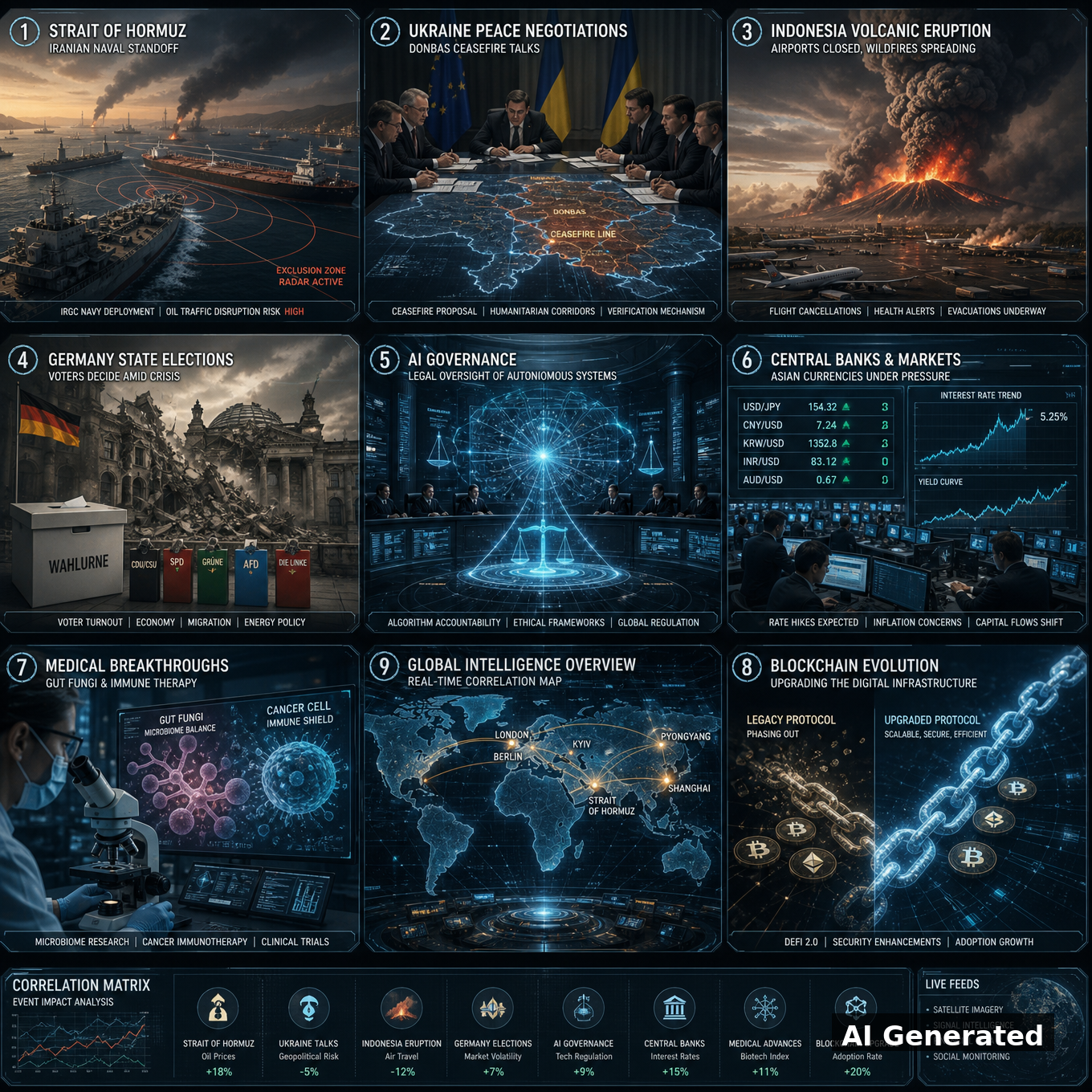


Contents
Geopolitics & Defence
↑ ContentsHormuz Escalation: Tehran’s Exclusion-Zone Gambit
The most consequential strategic development of the reporting window is Tehran’s decision to formalise the maritime confrontation around the Strait of Hormuz into a declared exclusion zone. Mohsen Rezaei, the new head of Iran’s Supreme National Security Council, told state television that the zone “will begin from the line of the U.S. naval blockade, extend toward the Strait of Hormuz, and from this side continue into the Persian Gulf,” with an announcement expected within days or weeks[1]. The move converts what had been a de facto interdiction campaign into a legally asserted claim over a waterway through which a substantial share of the world’s seaborne crude transits, landing directly on the watchpoint D98 identified when it documented the first outright sinking of an Iranian tanker, the M/T Kylo[1]. German coverage framed the same announcement as a further escalation risk[2]. The analytical significance is that Tehran is no longer merely retaliating; it is attempting to redefine the legal geography of the Gulf in a way that raises the cost of every US naval movement and every insurance decision in the region.
The psychological dimension of the escalation is equally telling. A serving Iranian Army colonel publicly petitioned Supreme Leader Khamenei for a bomb-laden speedboat and a suicide vest to ram an American warship, a request that Greek defence media interpreted as evidence that the extreme ideological fanaticism once confined to the Revolutionary Guards has now diffused into the regular armed forces[3]. Whether the petition is genuine or a propaganda artefact, its circulation serves the regime’s signalling purpose: to raise the perceived probability of asymmetric, unpredictable attacks against US naval assets, thereby amplifying war-risk premiums and deterring commercial traffic.sup>[1].
The Ukraine Peace Track: Plan Details Emerge
The US-mediated peace process moved from atmospherics to substance this window, with the first detailed contours of the Trump plan leaking into public view. Ukrainian media, relayed through Greek defence outlets, reported that the package Witkoff and Kushner carried to Kyiv includes a complete ceasefire along the line of contact, withdrawal of Ukrainian forces from the entirety of Donbas and part of Zaporizhzhia Oblast with a possible UN peacekeeping contingent, a neutrality status renouncing NATO accession, a referendum and national elections, constitutional reforms, a cap on Ukrainian armed forces, Russian-language protections, and a full peace treaty to be signed by the post-election government with UN ratification[4]. If accurate, this is a maximalist Russian-favourable framework that would effectively codify Moscow’s territorial gains while requiring Kyiv to surrender its NATO aspirations and much of its military capacity. The Ukrainian presidency, for its part, described the proposals as “more effective,” and Zelensky characterised the talks positively while pointedly warning that the war appears set to continue into the winter[5][6].
The pressure dynamic is now explicit. Axios reported that both Kushner and Witkoff strongly urged Zelensky to achieve a decisive battlefield breakthrough before winter freezes the front line, an American demand for results that sits in tension with the territorial concessions embedded in the leaked plan[7]. This is the clearest articulation yet of the strategic dilemma D98 flagged: Washington is simultaneously pressing Kyiv to fight harder and to accept a settlement that would lock in Russian control of the annexed territories. The Kremlin’s own messaging reinforces the assessment that Putin believes time is on his side; Bloomberg reported that Russian intelligence assessments conclude Putin is convinced he has the upper hand, plans continued escalation, and judges that Western support for Kyiv is nearing its limits[16]. SACEUR General Christopher Cavoli’s blunt public assessment that “much of the Russian military has not been negatively affected by the war,” and that the Russian army is today numerically larger than in 2022, provides the military foundation for that Kremlin confidence[15]. The combination of a leaked concessionary peace plan, US pressure for a pre-winter breakthrough, and NATO’s own admission of Russian military resilience describes a negotiating environment in which Kyiv’s leverage is objectively shrinking.
North Korea’s Nuclear Navy and the Pacific Balance
Pyongyang accelerated its naval nuclearisation with the formal commissioning of its second destroyer, the Kang Kon, at Wonsan Port on Sunday, in a ceremony attended by Kim Jong Un and his daughter Kim Ju Ae[9]. Named after a Korean War military leader, the Kang Kon carries the same weapons systems as the 5,000-tonne Choe Hyon launched in June, which analysts say can field missiles capable of carrying nuclear payloads[9]. Kim said the warship can deliver “annihilating retaliatory strikes on an enemy,” that “dangerous shadows must be erased,” and that another stage of the naval build-up would be demonstrated within eight months, while confirming construction of new naval bases on the east coast[9]. The commissioning coincided precisely with the start of US-South Korea-Japan military drills, a timing choice that underscores the deterrence signalling function of the programme[8]. For the Pacific balance, the emergence of a nuclear-capable North Korean surface fleet adds a new layer of complexity to the region’s maritime calculus.
Eastern Mediterranean Friction and the Aegean Front
Greek-Turkish tension re-emerged through an unusual channel: Turkish media leaks revealing a secret August 28 visit to Athens by MIT chief Ibrahim Kalin, who reportedly told Greek intelligence chief Themistoklis Demiris that the new security line Athens is building through Israel — the “Achilles Shield” air-defence umbrella — is “the wrong path,” while insisting Turkey is not a threat to Greece but will not allow developments that harm its interests[10]. The leak is significant less for its substance than for its method: Ankara chose to communicate its red lines on the Greece-Israel-Cyprus axis through the press rather than official channels, keeping deniability. The same window saw continued Israeli operations against Hezbollah in southern Lebanon, with evacuation orders issued for Deir Zahrani ahead of strikes and at least seven killed across multiple villages[29][32][33]. The Lebanese front remains the most active secondary theatre of the wider Iran-Israel confrontation, confirming the pattern D98 identified of partially autonomous escalation machines operating in parallel.
Russia’s War Machine, the Black Sea and Force-Structure Signals
On the Ukrainian front proper, the fragility of the mutual capital-strike pause was exposed almost immediately. Russian Geran-3 drones struck warehouses and points near the port of Odesa, and the Russian defence ministry announced it had hit a Ukrainian commercial ship in the Black Sea that it claimed was carrying Western military equipment[11][12]. Ukraine’s defence ministry, meanwhile, formally confirmed that Swedish Saab 340 AEW aircraft have been operating combat missions since March, a capability that provides the Erieye AESA radar’s hundreds of kilometres of surveillance and Link 16 data-sharing with Ukrainian F-16s — a qualitative force multiplier that narrows Russia’s information advantage[13]. Israeli Prime Minister Netanyahu added a further escalatory note, declaring that “the end of the Iranian regime is approaching” and warning that any Iranian attack on Israel would draw a strike “it cannot even imagine,” comments timed ahead of the Rosh Hashanah holiday period[14].
The force-structure and alliance layer of the window was dense. Denmark joined the Canada-led Nanook Tuugaalik Arctic naval drills with US and French forces in Greenland waters, the latest expression of NATO’s Arctic Sentry coordination under Joint Force Command Norfolk, and a direct counterpoint to the von der Leyen Greenland visit D98 documented[17]. A US Navy test pilot who flew Boeing’s X-32 in the Joint Strike Fighter competition offered a rare insider account of why the aircraft lost — not handling, speed or stealth, but the V/STOL exhaust-recirculation problem — while the Air Force confirmed it will keep flying its 45 retired F-117 Nighthawks until at least 2034 as red-air stealth adversaries simulating China’s J-20 and Russia’s Su-57[18][19]. Two historical analyses — the M60A3’s fire-control-led modernisation and the YF-23’s strategic prematurity — framed current procurement debates around the F-47 NGAD[20][21]. Brazil advanced a joint H145M helicopter programme, and TKMS delivered the final Dolphin-class AIP submarine, INS DRAKON, to Israel[22][23].
Diplomatic realignment continued on multiple axes. Bangladesh’s prime minister declined to attend the Delhi BRICS summit[24]. South Korean President Lee Jae-myung, visiting Paris, argued in Le Monde for values-based international cooperation[25]. Taiwan showcased its chip diplomacy amid pressure to share AI wealth, countering Chinese tech ambitions[26]. The human cost of the wider Middle East conflict remained stark: more than 300 people were killed in renewed clashes in southwestern Yemen near the strategic Bab el-Mandeb strait, and an eight-year-old girl and her father were killed by an Israeli strike on her first day of school in Gaza[27][28]. In the Balkans, the state funeral of convicted war criminal Ratko Mladic in Belgrade — with full state honours and thousands in attendance, and a Red Star Belgrade fan tifo honouring him at the derby — drew the cancellation of an EU enlargement commissioner’s visit and exposed the depth of the region’s unresolved reckoning with the 1990s wars[30][31].
Environment & Climate
↑ ContentsRegulatory Rollback and the Chemical-Plant Frontline
The most consequential environmental story of the window is the systematic dismantling of the Biden-era HON rule, the 2024 regulation that required roughly 220 petrochemical plants to cut emissions of ethylene oxide, chloroprene and four other hazardous air pollutants, install fenceline monitors, and close the start-up/shut-down loophole[39]. The Trump administration has granted more than 70 temporary exemptions invoking a Clean Air Act national-security provision that environmental lawyers say has never been used, and the EPA has said it will propose a rewrite this autumn that is all but certain to scale back protections[39]. The stakes are measured in lives: the EPA estimated the rule would prevent 6,200 tons of toxic emissions annually and reduce cancer risk near regulated plants by 96 percent, in a corridor — “Cancer Alley” along the lower Mississippi — where St. John the Baptist Parish already has nearly 50 times the national average cancer risk from air pollution, with a disproportionate burden on Black communities[39]. The same deregulatory logic is visible in the agriculture portfolio: a new report finds that as farmers struggle with soaring diesel and fertiliser prices and the USDA cuts renewable-energy support, Agriculture Secretary Brooke Rollins is carrying millions in oil and gas investments, and scientists reaffirmed that leaded aviation fuel used by small aircraft continues to pose a public-health risk around Oregon airports[41][42]. Together these items describe an administration systematically converting environmental protection into industrial-permission regimes, a direct reversal of the trajectory D98 documented in the Wyoming BLM leasing and Texas grid stories.
Urban Heat, Energy Transitions and the Infrastructure Trap
Two urban-climate stories in the window delivered a sharp lesson in the physics of heat. Los Angeles’s pioneering CoolSeal reflective-pavement programme genuinely cooled street surfaces by up to 11 degrees Fahrenheit, but Arizona State’s MaRTy instrument cart found that pedestrians standing on the coated streets felt hotter — mean radiant temperature rose more than 7 degrees at noon because the reflected sunlight bounced straight into their bodies, roughly equivalent to adding 10 percent more direct sun[37]. The field’s verdict, as the researchers put it, is that heat obeys conservation laws, not intentions: reflective coatings cool the city but tax the person standing on them at midday, while shade — a tree, an awning — wins on both scales[37]. A complementary study found urban woodlands provide the strongest cooling during extreme heat, outperforming grasslands, lakes, parks and green walls, reinforcing the same conclusion[47]. Houston’s Katy Freeway supplied the infrastructure corollary: the $2.79 billion expansion to 26 lanes failed to end congestion because of induced demand, the “fundamental law of road congestion” that Caltrans now models officially before approving new lanes, with Seoul’s Cheonggyecheon removal demonstrating the reverse — taking space away from cars shifted people to transit[36].
The energy-transition layer produced a striking paradox: China now has more solar capacity online than coal capacity, yet coal still generates far more electricity, a milestone that captures the gap between installed capacity and dispatched generation that will define the next phase of the global transition[45]. In the United States, five coastal states launched two major electric-truck accelerator programmes for clean ports, while Chinese equipment maker SANY delivered 200 heavy-duty electric haul trucks and more than 600 electric wheel loaders in a single month — a volume that underscores how far the electrification of heavy equipment has advanced outside North America[50][51]. Chinese EVs from GAC, Geely and Leapmotor aced the demanding Euro NCAP safety tests, further eroding the narrative that Chinese electric vehicles are unsafe, and a US freight-rail lobby study on $1.1 trillion of electrification was criticised for asking the wrong question — whether catenary can work at all, when it already operates at scale across enormous systems[52][53]. Even the agrivoltaics frontier is being tested honestly: a University of Massachusetts study of cranberry vines under solar panels found moderate shade improved water retention but reduced photosynthesis, with no evidence of sweeter fruit, a useful corrective to the marketing that has surrounded solar-farm agriculture[40].
Disaster Response, Ecosystems and the Arctic Warning
The disaster-response layer of the window was dominated by the Himalayan floods, where 2,300 rescuers and 8,800 machines searched for survivors in the aftermath of the Nepal-Tibet catastrophe[54]. Jakarta’s airports remained closed for a second day after Anak Krakatau’s renewed eruptions, extending the aviation-disruption story D98 documented, while volunteers in Borneo risked their lives to defuse Indonesia’s peat-fire “carbon bombs” that are releasing ancient carbon stores and sending toxic smog across South East Asia[34][35]. Maine’s drought task force warned that the state never fully recovered from last autumn’s drought and conditions are worsening again, and US farmers are turning to perennial grains like Kernza that may better withstand the extreme drought that devastated Kansas wheat[46][49].
GPS-tagged harbour seals in the North Sea were found using offshore wind-turbine foundations as hunting stops — three seals moved systematically from tower to tower, slowing to search for fish, in two different wind farms, a reminder that human infrastructure creates new ecosystems whose destruction during decommissioning would carry its own ecological cost[44]. And thirty years of satellite images of penguin guano on the Antarctic Peninsula show the birds’ diets shifting in response to warming, a visible dietary signal of climate-driven ecosystem change[48]. The Arctic warning was most starkly personified by a lone sailor, Matt Rutherford, attempting a 10,000-mile solo circumnavigation of the Arctic Ocean — a route that is only possible because retreating sea ice has cleared the way, with September sea ice declining 12.1 percent per decade since 1979 and the Arctic warming up to four times faster than the global average[38]. Pilot whales swimming alongside his boat through the fog were the beauty of the moment; the reason the journey is possible at all is the warning. Finally, Indigenous knowledge took centre stage in marine science: Bardi Jawi rangers and Traditional Owners in Western Australia co-authored a decade-long study showing reef-mangrove interconnectedness sustains fisheries, knowledge that directly guided the design of their Indigenous Protected Area and marine park — a model of co-management that the conservation community is only beginning to institutionalise[43].
Society & Civil Issues
↑ ContentsThe Saxony-Anhalt Earthquake: AfD Wins but Cannot Govern
The defining political event of the window is the AfD’s historic state-election victory in Saxony-Anhalt, the first time a far-right party has come within reach of power at German state level since the Second World War. Final results gave the AfD 43.8 percent — more than double its showing five years ago — and 39 of 83 parliamentary seats, three short of an absolute majority, while the CDU collapsed to 17.2 percent and 15 seats, losing about half its support[56][57]. The SPD took 9.3 percent, the Greens 8.9 percent, the Left 8.6 percent, and the BSW entered the Landtag with 5.3 percent and five seats, while the FDP failed to return[57][58]. The result leaves a government-formation crisis: the mainstream parties’ “firewall” against the AfD means a governing coalition would require an unprecedented five-party arrangement from CDU through to the Left, which the CDU has ruled out by party congress decision, while the BSW has said it will elect neither Siegmund nor the incumbent Schulze as minister-president but criticises the firewall itself[57][59]. Sahra Wagenknecht has floated a “non-partisan minister-president” governing with changing majorities including the AfD, and AfD leader Tino Chrupalla has raised the possibility of a minority government tolerated by the BSW, while Siegmund himself threatened new elections — “then we’ll have 50 or 55 percent”[57][59].
The international reaction was immediate and sharp. Lead candidate Ulrich Siegmund thanked Elon Musk on X for his support and welcomed “strong and constructive cooperation,” after Musk had posted “Well done!” in German to AfD co-founder Alice Weidel; Trump reposted the projection chart on Truth Social, and Russian envoy Kirill Dmitriev praised a “historic win for the pragmatic AfD”[56][86][87]. France’s Europe minister Benjamin Haddad called it “a serious moment in Europe,” and Polish Prime Minister Donald Tusk said “only idiots or traitors” could rejoice at the AfD’s triumph[56]. The German Economic Institute warned the AfD’s immigration policy would be “calamitous” for a state heavily dependent on foreign workers, and critics warned an AfD-run state could leak sensitive information to Russia[56]. The election-night scenes in Magdeburg captured the mood: AfD supporters celebrating a “Zeitenwende,” the CDU in shock, the Greens facing a “depressing success,” and the BSW tasting vindication[60]. The result is the clearest confirmation yet of the October political convergence D97-D98 identified across Europe, and it directly feeds the D98 watchpoint on the Berlin and Mecklenburg-Vorpommern votes in two weeks.
UK Migration Politics and the Portsmouth Standoff
Britain’s small-boat migration crisis produced its most explosive civic confrontation of the year. Around 140 migrants in a single dinghy — launched from the Bay of the Seine, 170 miles from the usual Calais departure points, and shadowed for ten hours by French rescue boats — were brought ashore at Eastney in Portsmouth, where hundreds of protesters, many masked and dressed in black, blocked roads in an effort to stop them being transported to the Manston processing centre in Kent[61][62][63]. It was the second major anti-migrant protest of the weekend, following Saturday’s demonstration at the Port of Dover, and the government condemned “the intimidating and thuggish behaviour” of the demonstrators[61]. Reform UK leader Nigel Farage seized on the arrival — noting it came days after Burnham and Macron agreed to deploy 45 more officers on French beaches — to argue that “only Reform will send the boats back”[61]. The underlying numbers tell the story of a changing smuggling model: 16,513 people crossed by small boat between January and September, down 43 percent year-on-year, but smugglers are loading more people onto fewer, larger “mega-dinghies” as policing around Calais tightens[61]. A Home Office whistleblower’s claim that “1 in 100” asylum claims are genuine — that most use “the same stories” — added a further incendiary element to the debate, whatever its evidentiary weight[64].
Justice, Health and Civic Institutions
The justice layer of the window was dense. A man serving life for raping ten women may face further charges after evidence of additional crimes emerged, and the victim of drug-rape killer Richard Scatchard said his killing of Kelly Faiers in 2023 could have been avoided had he never been freed[69][70]. In France, a man went on trial in the Ardennes accused of raping and killing ten-year-old Loana, and in Kinshasa twelve people died in a wedding fire blocked by a too-small emergency exit, while a fireworks explosion at a religious festival in Mexico killed at least ten and injured sixty[71][72][73]. In Greece, the Tempi train-disaster trial resumed at the Larissa appeals court, and the UK’s Joint Committee on Human Rights urged the government to consider requiring the Attorney General’s consent for Troubles prosecutions[83][78]. The assisted-dying bill returns to the Commons on Friday with a poll showing a third of the public back it only with more palliative funding[77].
Health and social-policy stories completed the picture. A new pilot will turn ultrasounds into 3D-printed moulds so parents with sight loss can trace their baby’s contours before birth, and a mother told how a nail infection led to the ultrasound diagnosis of her baby son’s brain tumour[74][75]. Research linking childhood social isolation to young people becoming NEET — a million-strong UK cohort — added evidence to the education-to-employment debate[79]. Austria’s ban on Islamic headscarves for under-14s came into force as schools reopened, a law critics say fuels anti-Muslim feeling[65]. Jamaica announced it will file a slavery-reparations petition to King Charles during the UK visit, questioning the legality of slavery under English law, and Kenya’s President Ruto moved against foreign traders, saying small businesses should be reserved for Kenyans[66][67]. The National Trust celebrated a record year with 50,000 new young members, and the HMRC’s £70 pension-tax-relief refund letters — about a million of them, mostly to women — were flagged as legitimate despite their scam-like appearance[76][68].
US Politics, the Amazon Crash and Greek Political Season
In the United States, an armed man attempted to attack the Democratic candidate for Ohio governor, wounding several people, in the latest instance of political violence shadowing the midterm campaign[80]. Marine Le Pen continues to lead French presidential voting intentions, and the Republican convention was described as “the Trump festival”[81][82]. The most consequential US civil-aviation story was the Amazon Prime Air cargo crash at Miami International Airport: the Boeing 767-300 overran the runway, struck vehicles and caught fire, killing five and injuring five more[55]. In Washington, the administration’s plan to remake the East Potomac Park golf course into a world-class venue — over a lawsuit arguing it violates the 1897 congressional act that created the park “for the recreation and the pleasure of the people” — became a symbol of the broader contest over public space in the capital, with residents noting the administration has moved to make irrevocable changes faster than courts can respond[88].
Greece’s political season opened with the Thessaloniki International Fair, where Prime Minister Mitsotakis framed the 2027 election around a “stability and security or adventures” dilemma, a strategy his critics read as weaponising fear of change[85]. In Israel, two months before the October 27 election, the candidacy of a Jewish Zionist former deputy minister on the United Arab List ticket was read as a deep systemic challenge to Netanyahu, adding an electoral dimension to the regional confrontation[84]. The cumulative picture across these stories is of a Western political landscape in which migration, security and identity are fusing into a single axis of contestation — from Saxony-Anhalt to Portsmouth to the French presidential race — precisely the convergence D97-D98 predicted would define the autumn.
AI & Technology
↑ ContentsAI Governance, Safety and the Accountability Wave
The AI-policy layer advanced on two fronts that D98’s “benchmark trust deficit” analysis anticipated. Australia’s Labor government is preparing an “opt-out” law targeting Big Tech algorithms — legislation that would give users greater control over their feeds and that the Coalition brands as giving the government too much power — extending the duty-of-care regulatory template that D98 documented as the leading anglosphere approach to algorithmic accountability[89]. In the United States, David Sacks warned that AI “doom” narratives are backed by serious funding and that a potential Anthropic IPO could expand their reach, a claim that frames the safety-versus-innovation debate as a contest of well-resourced narratives rather than disinterested analysis[92]. The same window saw Greek coverage asking whether the warnings about uncontrollable AI are becoming reality, citing a series of serious safety incidents involving the most advanced models[90]. The convergence of these items — a regulatory push in one hemisphere, a narrative war in another, and a growing incident log in between — is the accountability wave D98 described as arriving from four directions at once.
The great-power dimension of AI governance also moved. Washington and Beijing are eyeing Trump-Xi talks on AI guardrails despite the broader tech rift, a diplomatic channel that would represent the first serious attempt to establish bilateral rules for frontier-model development between the two dominant AI powers[91]. The significance is structural: if the US-China AI relationship can be governed separately from the semiconductor and trade confrontation, it would create a precedent for issue-specific de-escalation in an otherwise adversarial relationship — the same logic that has kept arms-control channels open through periods of strategic competition.
Enterprise AI, Robotics and the Reliability Frontier
At the enterprise layer, a data-engineering essay by a Salesforce engineer crystallised the reliability problem that will define the next phase of AI adoption: a pipeline ran perfectly for eleven days with green DAGs and clean loads while producing audience counts that were 40 percent wrong, because an upstream ad network had silently renamed a field and the monitoring checked whether the job ran, not whether the numbers were right[94]. The author’s prescription — schema validation at the ingestion boundary, and treating semantic correctness as a first-class monitoring dimension — is directly transferable to the agentic-AI systems now being deployed across enterprises, where the same failure mode will be amplified by autonomous action on bad data. The story is a concrete instance of the “numbers that are wrong but look right” problem that D98 identified as the defining risk of the AI-shaped economy.
The robotics layer delivered two regulatory stories with strategic weight. Tesla’s Cybercab launch in Austin — a robotaxi with no steering wheel, pedals or side mirrors — is reportedly under NHTSA investigation over whether the rollout was done appropriately or legally, testing the regulatory boundary of fully autonomous passenger vehicles[95]. Zoox, meanwhile, began robotaxi testing in Houston, having grown its user base faster than any competitor, confirming that the robotaxi race is now a multi-player contest rather than a Waymo-Tesla duopoly[96]. Apple’s App Store leadership change — Phil Schiller’s exit reportedly driven by wariness over new CEO John Ternus’s push for more recurring revenue — rounds out a window in which the technology industry’s institutional structures are being reshaped by the same forces of platform economics and regulatory pressure that dominate the policy layer[93].
Economy & Business
↑ ContentsMonetary Policy and the Asian FX Complex
The monetary-policy layer was dominated by Asia’s tightening complex and its global spillovers. South Korea’s trillion-dollar National Pension Service paused its foreign-exchange hedging as the won strengthened to its strongest level against the dollar since October 2024, a shift in the behaviour of one of the world’s largest institutional investors that has direct implications for global FX flows[97][119]. The won’s 1 percent climb against the dollar and the Bank of Korea’s 91-day monetary stabilisation bond auction at 3.040 percent yield capture the tightening bias in Seoul[118][120]. In Tokyo, an aide to Prime Minister Takaichi projected a Bank of Japan rate hike in September, extending the BOJ normalisation story that D97-D98 tracked, while Japan’s foreign reserves fell to $1,207.5 billion at end-August from $1,287.1 billion — a $79.6 billion drawdown that suggests intervention or reserve reallocation[103][121]. In Beijing, the PBOC pumped 500 million yuan via seven-day reverse repos and set the yuan midpoint 709 pips weaker than estimates — the biggest downside divergence since February — while the dollar itself got little lift from rising Fed hike expectations[115][116][117][123]. The cumulative signal is of an Asian monetary complex tightening in unison, adding new cross-currents to the D98 narrative of a hawkish global pivot.
The real-economy transmission channels were visible in the same window. The average number of commodity vessels crossing the Strait of Hormuz daily fell to ten, the lowest since May, as the exclusion-zone escalation documented in the Geopolitics section priced risk into shipping[122]. Asian shares bounced while others stayed cautious as oil rose, and Brent traded near $97, with the GIFT Nifty signalling a negative open for Indian markets[124][125]. The Reserve Bank of Australia faces inflation risks from the data-centre boom, which could prolong high interest rates, exacerbate labour shortages and raise energy costs[102]. Morgan Stanley warned that the collapse of Australian developer Bathla could ripple through consumer spending, employment and confidence beyond construction[104]. And Russia offered India unlimited oil supply amid sanctions pressure, a move that reshapes the global trade picture even as it tests the cohesion of the Western sanctions coalition[114].
UK Fiscal Policy and the Healey Growth Agenda
Britain’s fiscal agenda took centre stage ahead of the first Budget. Chancellor John Healey will say the economy is “turning a corner” despite debt concerns, and will detail plans to spread growth more widely across the UK, with an “active state” boosting investment through a £150 million fund for northern firms[105][106][107]. The growth-through-decentralisation theme — giving mayors and regions more power over investment decisions — is the substantive policy content of a Budget that faces pressure over tax after the prime minister failed to rule out rises in October[108]. The German contrast is instructive: the HDE consumer barometer shows an “upswing without trust,” with retail starting the third quarter with a record slump despite better economic data, and Hannover Re’s chief warns that cyber-insurance premiums do not reflect the risks, with rating agencies echoing the concern[109][110]. German industry’s failure to adapt electricity demand to market signals — despite the growing share of wind and solar — was identified as a missed opportunity to stabilise the grid and cut costs[111].
China’s Export Shock, Corporate Restructuring and the Global System
The structural story of the window was China’s export shock. Former US Trade Representative Michael Froman, writing in Foreign Affairs, warned that “the world’s ability to absorb Chinese overcapacity is approaching a breaking point,” noting that China posted a $1.2 trillion trade surplus in 2025 — the largest in recorded history, growing three times faster than global goods trade — and that “China Shock 2.0” now exports capital- and tech-intensive goods rather than the labour-intensive products of the early 2000s[112]. Froman’s conclusion is stark: even if the next global crisis is made in China, the cleanup is likely to fall on the United States and the institutions it anchors[112]. Goldman Sachs added that China’s housing overhaul will slash local-government land-sale revenues by 30 percent, deepening the property crisis and straining provincial finances[101]. The corporate restructuring layer was equally consequential: Volkswagen’s supervisory board approved a plan to close four German factories and eliminate 100,000 jobs by 2030, the largest single workforce reduction in the German auto industry’s history, while Hyundai Steel broke ground on a $5.8 billion electric-arc-furnace mill in Louisiana that will produce 2.7 million metric tons of steel annually with 70 percent lower CO2 emissions than blast furnaces — a direct bet on US industrial resurgence[98][113].
Point72 plans to double its Japan workforce and capital allocation, Goldman raised its Asia ex-Japan index target on tech strength, and Thai PM Anutin, one year in, is prioritising Chinese capital to buoy growth[99][100][127]. India’s market-pre-open rules changed to a three-slot auction structure, a micro-structural reform with implications for price discovery[126]. MAGA Inc. dropped $10 million into the Texas Senate race to defend Ken Paxton, with Trump vowing to spend “whatever amount of money necessary,” extending the D98-documented pattern of political money flooding contested races[128]. And in Greece, data showed half of household income now goes to housing as home ownership declines — a structural affordability crisis that the “Spiti Mou 2” programme has failed to reverse, and which connects directly to the housing-affordability theme D97-D98 tracked across Europe[129].
Science & Space
↑ ContentsMedical Science: From Gut Fungi to Cancer Shields
The medical-science layer was unusually rich in translational potential. A PNAS study found that the gut fungus Mucor racemosus protects mice from radiation through three amino acids — L-glutamic acid, L-aspartic acid and DL-lysine — that directly facilitate DNA repair, and through methylthioadenosine production that reprograms the bacterium Limosilactobacillus reuteri to boost methionine; a cheese fermented with the fungus reduced intestinal inflammation in irradiated mice, and the fungus is already FDA-approved for dietary use, though the authors caution about risks to immunocompromised individuals[132]. Researchers mapping breast tumours in striking detail found hidden pockets of dormant cancer cells surrounded by immune and connective-tissue cells that act like protective shields, allowing the cells to hibernate through chemotherapy and reactivate later — a mechanism that may explain why cancer returns after treatment[135]. A large study of more than 270,000 people linked higher blood levels of the amino acid tyrosine to a shorter male lifespan of nearly a year, with no significant effect in women, a finding with direct relevance to the popular focus-supplement market[134]. And Washington University researchers found the body can convert sorbitol — the ubiquitous sugar-free sweetener — into fructose in the liver, potentially triggering some of the same harmful metabolic effects linked to fructose[133].
The preventive and lifestyle layer added further signal. Older adults at risk of dementia who followed lifestyle programmes combining exercise, healthy eating, cognitive training and social engagement improved their memory and thinking substantially more — 55 percent more — than those given general health advice, with regular coaching the key differentiator[136]. A nationwide analysis found women with the most antioxidant-rich diets had strikingly lower prevalence of cervical cancer, adding a dietary dimension to the HPV-driven disease[137]. Research in rotifers showed a mother’s age can leave a reversible epigenetic mark that lasts for generations, with the effect depending on genetics and evolutionary pressures — a finding with broad implications for how we understand transgenerational health[138]. And new research in mice suggests that vagus-nerve signals arriving immediately after training determine whether a newly practiced skill is stabilised through memory consolidation — a mechanistic insight into why repetition alone does not guarantee learning[139]. Advanced optical imaging revealed a previously inaccessible layer of immune-cell biology, showing the metabolic activity of individual peripheral blood mononuclear cells without the fluorescent labels that can alter them during preparation[140].
Space Technology and the Biology of the Natural World
The space layer of the window was defined by two hardware stories with strategic weight. NASA’s High Performance Spaceflight Computing (HPSC) processor, built around eight 64-bit RISC-V cores, demonstrated performance 500 times faster than the radiation-hardened chips currently used in spaceflight, a result that could change how spacecraft survive far from Earth by enabling autonomous navigation, obstacle detection and on-board decision-making during the up-to-45-minute communication delays with Mars[143]. The VICTUS HAZE tactically responsive space mission — an LLNL optical payload launched on a Rocket Lab vehicle for the US Space Force — successfully demonstrated rapid on-orbit threat inspection, with payload commissioning completed within 24 hours of launch and angles-only navigation using live-feed images, a capability that directly addresses the increasingly contested orbital environment[130]. Both stories extend the D98 narrative of space as a contested and computationally demanding domain, and both connect to the force-structure analysis in the Geopolitics section.
The biology layer delivered two elegant findings about the natural world. A New Phytologist study of poplars showed that trees possess a form of proprioception — the sense of their own shape — and that when gravity sensing was disabled with a clinostat, the trees laid tension wood on whichever side they needed to pull, falsifying the textbook view that tension wood only forms on the upper side of a leaning stem; the work was funded in part by CNES, the French space agency, a reminder of how space research fertilises terrestrial biology[131]. And Deakin University researchers, who have been working for years to anticipate an avian-influenza outbreak on Australian shores, are using bird movements to track the global virus — a surveillance approach that will be critical as the highly virulent strain spreads[141]. A solid-state cooling device from Karlsruhe Institute of Technology and the University of Tsukuba, combining two nickel-titanium foils to use heat to generate cold, rounds out the window with an engineering advance that could let processors recycle their own waste heat for cooling[142].
Crypto, Digital Assets & Blockchain
↑ ContentsProtocol Lifecycles: Harmony’s Sunset and Solana’s Upgrade
The most consequential protocol story of the window is Harmony’s decision to fully sunset its Layer 1 blockchain and propose a token migration to Ethereum for a new “remix economy” initiative built around AI video creators[144]. The move is a rare admission of failure at the protocol layer: Harmony, which in D73’s reporting suffered the largest DeFi hack of 2026 when four billion ONE tokens were minted in an exploit, has concluded that maintaining an independent Layer 1 is no longer viable and that its validators should transition to the Ethereum ecosystem. The strategic significance extends beyond Harmony itself. A protocol choosing to dissolve its own chain and migrate to a competitor is the clearest possible signal of the consolidation dynamic that has been reshaping the Layer-1 landscape — the realisation that network effects, liquidity and developer mindshare are concentrated in a handful of ecosystems, and that marginal chains face a choice between integration and irrelevance. The AI-video “remix economy” framing is also notable: it is the latest attempt to graft creator-economy incentives onto blockchain infrastructure, following the tokenised-content experiments that D97-D98 documented, and it will test whether the intersection of generative AI and on-ledger value distribution can generate genuine economic activity rather than speculative volume.
Solana, by contrast, is deepening its infrastructure rather than retreating. The Transaction V1 upgrade, approaching mainnet, expands the maximum transaction size to 4,096 bytes, enabling complex zero-knowledge proofs and multisig setups that were previously impractical on-chain[146]. The upgrade is part of a broader technical roadmap that has kept Solana at the frontier of throughput and cost, and it landed alongside data showing Solana added $348 million in net distributed real-world assets in 30 days, bringing its total to $4.23 billion and outpacing growth in Ethereum, Stellar and XRP Ledger[147]. The RWA growth is the more strategically important number: it indicates that the tokenisation of real-world assets — the institutional use case that regulators and banks have most consistently endorsed — is finding a home on Solana’s high-throughput, low-cost rails. The combination of a protocol upgrade enabling more complex on-chain logic and sustained RWA inflows describes an ecosystem that is maturing along the institutional track that D98’s crypto analysis identified as the sector’s most durable growth channel.
Institutional Flows and the Network-Economics Debate
The institutional layer of the window was dominated by the continued recovery of spot bitcoin ETF demand. Spot bitcoin ETFs pulled in $987 million last week, and August saw $3.52 billion in net inflows — the largest monthly positive flows since September 2025[145]. The flows matter because they arrived against a hawkish macro backdrop: with the Federal Reserve pricing in a potential September rate hike, the fact that institutional demand for bitcoin exposure is recovering rather than retreating suggests the ETF wrapper is attracting a stickier class of investor than the retail-driven flows of earlier cycles. The lending layer reinforced the institutionalisation story: crypto-backed loans surged 74 percent in 2026 as retail and wealthy borrowers increased activity, with Zcash and XRP gaining traction as collateral, while BlackRock cut the minimum for IBIT’s Bitcoin conversion to $1 million and processed over $5 billion through the mechanism[148]. The IBIT move is particularly significant: lowering the conversion threshold for the largest bitcoin ETF is a deliberate liquidity decision that makes the fund more usable as an institutional treasury tool, and it signals that BlackRock sees the ETF not merely as a passive holding vehicle but as an active component of corporate and institutional balance sheets.
The network-economics debate that D97 documented around Robinhood Chain’s fee model expanded this window to Solana, Arbitrum and BNB Chain. BNB Chain executive Nina Rong argued that sustainable revenue and commercial structures now outweigh further transaction-cost reductions, a position that reframes the industry’s long-standing assumption that fees must trend to zero[149]. The debate is fundamental: if blockchains cannot generate sustainable revenue from their own activity, they remain dependent on external subsidies or token-price appreciation, and the Robinhood Chain experiment — a chain whose economics are explicitly designed around fee capture — is testing whether the industry can escape that dependency. Rong’s argument that commercial sustainability matters more than marginal cost reductions is the most explicit articulation yet of a view that has been building across the sector: that the “fee race to the bottom” has left even successful networks unable to fund their own development, and that the next phase of the industry will be defined by who can build economically self-sustaining infrastructure. The convergence of these stories — a Layer 1 choosing to dissolve, an upgrade enabling more complex use, record ETF inflows, expanding institutional lending, and a serious debate about network economics — describes a sector that is consolidating around institutional utility and sustainable revenue models, precisely the decoupling from the legacy boom-bust cycle that D98’s correlations identified as the sector’s best-case trajectory.
Correlations & Analysis
↑ ContentsD99 captures the moment when the two structural dynamics D97 and D98 identified as defining the autumn — simultaneous diplomacy-and-escalation in the world’s dominant conflicts, and Europe’s October political convergence — both produced their first concrete outcomes. In Germany, the Saxony-Anhalt result delivered the far-right breakthrough that D98’s election-day coverage anticipated: the AfD doubled its support to 43.8 percent and came within three seats of an absolute majority, yet finds itself unable to govern because the mainstream firewall holds and the BSW, the only party willing to discuss cooperation, refuses to elect its candidate[56][57][59]. In the Gulf, Tehran’s announcement of a formal exclusion zone from the US blockade line through Hormuz into the Persian Gulf is the direct successor to the tanker-war escalation D98 documented with the sinking of the M/T Kylo[1]. And in Ukraine, the leaked Trump peace plan — Donbas withdrawal, neutrality, elections, a military cap — is the first concrete content to emerge from the “substantive plans” that D98 reported were promised after the Witkoff-Kushner Moscow meeting[4].
The correlation between the two wars’ economic transmission channels, which D98 documented through Lloyd’s claims, WSJ’s Iranian-funds finding and Ukraine’s war-tax exploration, has sharpened further. The average of ten commodity vessels a day crossing Hormuz — the lowest since May — is the maritime real-economy consequence of the exclusion-zone escalation, landing in the same window as Russia’s offer of unlimited oil to India, a move that tests sanctions-coalition cohesion[122][114]. The Asian monetary complex — the won’s strength, the yen’s $79.6 billion reserve drawdown, the PBOC’s yuan midpoint divergence — is tightening against the same hawkish Fed that D98 identified as the global pivot[119][121][116]. The D98 watchpoint on the September 15-16 FOMC meeting now carries an additional layer: the Fed’s decision will be made against a backdrop of a European political earthquake, a Gulf exclusion zone, and a Chinese export shock that former USTR Michael Froman warns is approaching a breaking point[112].
The third convergence D98 identified — the institutional accountability wave around AI — continued to build, but with a notable shift in character. Where D98 documented the Berlin data “Super-GAU,” OpenAI’s alignment-meltdown disclosure push and the copyright suits, D99’s AI layer is dominated by governance architecture: Australia’s opt-out algorithm law, the prospective Trump-Xi AI guardrails talks, and David Sacks’s warning that AI-doom narratives are themselves a funded campaign[89][91][92]. The shift from incident response to institutional design is the natural next phase, but the governance question is not only whether the systems run, but whether the numbers they produce mean anything — the lesson of the pipeline essay that ran green while producing numbers 40 percent wrong[94].
The environmental layer of D99 connects to D98’s September-heat watchpoint through a different mechanism: the regulatory rollback. The dismantling of the HON rule — 70-plus exemptions, a promised rewrite, and a 96 percent cancer-risk-reduction benefit being discarded — is the most consequential environmental deregulation of the year, and it is happening in the same window as the LA reflective-pavement finding that heat obeys conservation laws, not intentions[39][37]. The HON exemptions redirect toxic risk onto Cancer Alley communities; the reflective pavement redirects solar energy onto pedestrians. The Arctic stories — pilot whales following a sailor whose route is only possible because the ice is gone — supply the long-term frame: the physical system is changing whether or not the regulatory system acknowledges it[38].
The crypto layer of D99 is best read as the sector’s answer to the hawkish-macro stress test D98 posed. Harmony’s decision to dissolve its Layer 1 and migrate to Ethereum is the consolidation dynamic reaching its logical endpoint, while Solana’s Transaction V1 upgrade and $348 million RWA growth, the $987 million weekly bitcoin ETF inflow, the 74 percent surge in crypto-backed loans, and the network-economics debate all describe a sector moving toward institutional utility and sustainable revenue[144][146][147][145][148][149].
What to watch in the next reporting period: (1) The Saxony-Anhalt government-formation endgame — whether the BSW’s “non-partisan minister-president” idea or AfD defector speculation produces a government, and the reverberation into the Berlin and Mecklenburg-Vorpommern votes in two weeks; (2) the formal announcement and precise boundaries of Iran’s Hormuz exclusion zone, and whether the US responds with a legal challenge, a naval assertion, or both; (3) whether the leaked Trump peace plan is confirmed or disavowed by Washington, and whether the pre-winter “breakthrough” pressure on Kyiv produces a military offensive or a negotiating capitulation; (4) the September 15-16 FOMC decision, now the single most consequential macro event for both the Asian FX complex and crypto risk appetite; and (5) the HON rule rewrite, which will test whether the 96 percent cancer-risk-reduction benefit can survive the regulatory process. D100 should show whether any of these five watchpoints resolves or merely deepens.
References
↑ Contents1. Iran plans to announce an ‘exclusion zone’ that runs from the U.S. naval blockade line through the Strait of Hormuz by The Associated Press · Source ↑
2. Iran plant offenbar Sperrzone ausserhalb der Strasse von Hormus am Persischen Golf by Germany via d k on Inoreader · Source ↑
3. Ιράν: Συνταγματάρχης ζητά από τον Χαμενεΐ ταχύπλοο με εκρηκτικά για επίθεση αυτοκτονίας σε αμερικανικό πλοίο by DEFENCE via d k on Inoreader · Source ↑
4. Αυτό είναι το σχέδιο ειρήνης Τραμπ: Πλήρης αποχώρηση των Ουκρανών από το Ντονμπάς, ουδετερότητα και εκλογές by DEFENCE via d k on Inoreader · Source ↑
5. US envoys bring ‘more effective’ Ukraine peace proposals to Kyiv, official says by FRANCE 24 · Source ↑
6. Β.Ζελένσκι: «Φαίνεται ότι ο πόλεμος στην Ουκρανία θα συνεχιστεί και τον χειμώνα» by DEFENCE via d k on Inoreader · Source ↑
7. Axios: Πιέσεις Κούσνερ και Γουίτκοφ στον Ζελένσκι για άμεσο «ρήγμα» στο μέτωπο πριν από τον χειμώνα by DEFENCE via d k on Inoreader · Source ↑
8. North Korea commissions 2nd naval destroyer as US, South Korea and Japan begin a military drill by Hyung-Jin Kim and Kim Tong-Hyung · Source ↑
9. North Korea deploys warship ‘capable of annihilating retaliatory strikes’ by NEWS via d k on Inoreader · Source ↑
10. Τουρκικές διαρροές για τη μυστική επίσκεψη Καλίν στην Αθήνα: «Λάθος δρόμος η γραμμή ασφάλειας μέσω Ισραήλ» by DEFENCE via d k on Inoreader · Source ↑
11. «Καζάνι» που βράζει η Οδησσός: Σμήνος από ρωσικά Geran-3 χτύπησαν το λιμάνι by DEFENCE via d k on Inoreader · Source ↑
12. Ρωσικό υπουργείο Άμυνας: Έπληξε εμπορικό σκάφος που μετέφερε δυτική στρατιωτική βοήθεια στην Ουκρανία by DEFENCE via d k on Inoreader · Source ↑
13. Επίσημο: Το ουκρανικό ΥΠΑΜ επιβεβαίωσε την επιχειρησιακή δράση των σουηδικών αεροσκαφών AEW Saab 340 by DEFENCE via d k on Inoreader · Source ↑
14. Μ.Νετανιάχου: «Το τέλος του ιρανικού καθεστώτος πλησιάζει» by DEFENCE via d k on Inoreader · Source ↑
15. Στρατηγός Κρις Καβόλι (ΝΑΤΟ): «Το μεγαλύτερο μέρος του ρωσικού Στρατού παραμένει ανέπαφο από τον πόλεμο» by DEFENCE via d k on Inoreader · Source ↑
16. Bloomberg: «Ανένδοτος ο Πούτιν – Πεπεισμένος για τη νίκη, ετοιμάζει νέα κλιμάκωση στην Ουκρανία» by DEFENCE via d k on Inoreader · Source ↑
17. Denmark joins Canada-led Arctic naval drills with US and French forces in Greenland waters by admin-defence · Source ↑
18. ‘I Would Take That Aircraft to the Ship Tomorrow’: The US Navy Test Pilot Who Flew Boeing’s X-32 by Steve Balestrieri · Source ↑
19. The ‘Retired’ US Air Force F-117 Nighthawk ‘Stealth Fighter’ Will Now Fly Until 2034 Thanks To China’s J-20 and Russia’s Su-57 by Steve Balestrieri · Source ↑
20. The M60A3 Patton ‘Frankenstein’ Tank Has a Message for the US Army and the M1 Abrams by Isaac Seitz · Source ↑
21. Forget the F-22 or F-35: The YF-23 Black Widow II Stealth Fighter Has Something to Say to the US Air Force and the F-47 NGAD by Andrew Latham · Source ↑
22. Brasil avanza en un nuevo programa conjunto de helicópteros para sus Fuerzas Armadas con el H145M en evaluación by Angelo Daniel Nicolaci Mota · Source ↑
23. 2,400-ton powerful submarine with air-independent propulsion set to boost US ally’s naval power by Prabhat Ranjan Mishra · Source ↑
24. Bangladesh PM spurns Delhi BRICS summit amid new diplomatic approach by Business via d k on Inoreader · Source ↑
25. Avant sa venue à Paris, le président sud-coréen, Lee Jae-myung, plaide pour une coopération internationale « fondée sur des valeurs communes » by France via d k on Inoreader · Source ↑
26. Taiwan showcases chip diplomacy amid pressure to share AI wealth by Editorial Team · Source ↑
27. Υεμένη: Πάνω από 300 νεκροί στις νέες συγκρούσεις by NEWSROOM IEFIMERIDA.GR · Source ↑
28. Eight-year-old Gaza girl killed by Israel on first day of school by NEWS via d k on Inoreader · Source ↑
29. Middle East Live: Israel army orders evacuation of zone in south Lebanon ahead of strikes by FRANCE 24 · Source ↑
30. Kriegsverbrecher Mladic wird feierlich in Belgrad beigesetzt by Germany via d k on Inoreader · Source ↑
31. Serbia’s Red Star Belgrade honour Ratko Mladic with tifo by NEWS via d k on Inoreader · Source ↑
32. Νέα ισραηλινή επιδρομή στον Λίβανο -Εντολή εκκένωσης σε κατοίκους by NEWSROOM IEFIMERIDA.GR · Source ↑
33. Λίβανος: Βομβαρδισμός του Ισραήλ μετά από επίθεση της Χεζμπολάχ by Άλκης Αποστολόπουλος · Source ↑
34. Jakarta airports remain closed for 2nd day after volcanic eruptions by Business via d k on Inoreader · Source ↑
35. The volunteers risking their lives to defuse Indonesia’s wildfire ‘carbon bombs’ by NEWS via d k on Inoreader · Source ↑
36. Houston built a 26-lane freeway to beat traffic, but the cars came back and exposed the trap behind wider roads by Adrian Villellas · Source ↑
37. Los Angeles coated its streets with a gray reflective layer to fight extreme heat, but pedestrians felt hotter by Brendan Brown · Source ↑
38. Pilot whales followed a lone sailor through Arctic fog, and the reason his 10,000-mile route is possible is the real warning by Adrian Villellas · Source ↑
39. A hard-won rule to cut chemical plant pollution is being unraveled by Beth Gardiner · Source ↑
40. A Massachusetts cranberry bog grew under solar panels, and the result shows why shade can help crops without proving sweeter fruit by ECONEWS · Source ↑
41. Farmers Are Going Broke Amid Rising Gas Prices, While the Ag Secretary Profits Off Them by By Georgina Gustin · Source ↑
42. Elevated Levels of Lead Surround Local Oregon Airports by By Claire Barber · Source ↑
43. Indigenous knowledge helps reveal the ties between reefs and mangroves by Latoya Abulu · Source ↑
44. Three harbor seals followed turbine rows in the North Sea, turning offshore wind foundations into hunting stops by Kevin Montien · Source ↑
45. Solar is now bigger than coal in China — and yet still way behind by EHN Curators · Source ↑
46. Task force warns of worsening drought on track to match last year by EHN Curators · Source ↑
47. Comparing green space for urban cooling, study by EHN Curators · Source ↑
48. Satellite images of penguin droppings reveal impact of antarctic warming by EHN Curators · Source ↑
49. Farmers are growing a new grain to combat climate change by EHN Curators · Source ↑
50. East And West Coasts Throw Electric Truck Shade At White House by Tina Casey · Source ↑
51. SANY delivered 200 electric haul trucks, 600 EV wheel loaders – LAST MONTH by Jo Borrás · Source ↑
52. Another Chinese EV myth busted as GAC, Geely, and Leapmotor ace Euro NCAP by Jo Borrás · Source ↑
53. US Lobby’s $1.1 Trillion Freight Rail Electrification Study Intentionally Asked The Wrong Question by Michael Barnard · Source ↑
54. « Les sauvetages ont redonné espoir à toute la nation » : dans l’Himalaya, 2 300 secouristes et 8 800 engins à la recherche de survivants by France via d k on Inoreader · Source ↑
55. A Miami, un avion-cargo d’Amazon sort de piste, faisant cinq morts et cinq blessés by France via d k on Inoreader · Source ↑
56. Germany’s far-right AfD thanks Elon Musk as France warns state election win a ‘serious moment’ by Staff and agencies · Source ↑
57. Landtagswahl: Viele Fragen offen – wie geht es in Sachsen-Anhalt weiter? by Germany via d k on Inoreader · Source ↑
58. Landtagswahl: AfD verpasst absolute Mehrheit knapp, BSW gelingt Einzug ins Landesparlament by Dietmar Neuerer · Source ↑
59. Landtagswahl Sachsen-Anhalt: Wagenknecht für «politischen Neubeginn» in Magdeburg by DIE ZEIT: News – · Source ↑
60. Landtagswahl: Jubel, Schock und ein bedrückender Erfolg: Das war der Wahlabend in Sachsen-Anhalt by Hannah Müller, Julian Olk, Martin Knobbe · Source ↑
61. Protesters block roads in Portsmouth as 140 migrants rescued by NEWS via d k on Inoreader · Source ↑
62. Portsmouth LIVE: Protesters clash with riot police after ‘140 migrants arrive on dinghy’ by Toby Codd,Olivia Beeson · Source ↑
63. Hundreds of protesters in standoff with police after migrant boat arrives by Press Association Reporters · Source ↑
64. Home Office whistleblower claims ‘1 in 100’ asylum claims are real by Olivia Beeson · Source ↑
65. Austria’s Islamic headscarf ban in force as under-14s go back to school by NEWS via d k on Inoreader · Source ↑
66. Jamaica to file slavery reparations petition during UK visit by NEWS via d k on Inoreader · Source ↑
67. Why is Kenya cracking down on foreign traders and small retailers? by NEWS via d k on Inoreader · Source ↑
68. The £70 refund letter that isn’t a scam by NEWS via d k on Inoreader · Source ↑
69. Rapist serving life may face more assault charges by NEWS via d k on Inoreader · Source ↑
70. Drug rape killer should never have been freed, says victim by NEWS via d k on Inoreader · Source ↑
71. Bloquées par une issue de secours trop petite, 12 personnes meurent dans un incendie lors d’un mariage à Kinshasa by France via d k on Inoreader · Source ↑
72. L’explosion de feux d’artifice devient incontrolable lors d’une fete religieuse au Mexique: au moins 10 morts et 60 blesses by France via d k on Inoreader · Source ↑
73. Accusé d’avoir violé et tué Loana, une fillette de 10 ans, un quinquagénaire jugé dans les Ardennes by France via d k on Inoreader · Source ↑
74. New pilot to turn ultrasounds into 3D-printed moulds for parents with sight loss by Storm Newton · Source ↑
75. Mother tells how nail infection led to diagnosis of baby son’s brain tumour by Ryan McDougall · Source ↑
76. National Trust celebrates record year as 50,000 young people become members by Ellie Crabbe · Source ↑
77. Third of public back assisted dying law only with more palliative funding – poll by Y. Áine Fox · Source ↑
78. Government urged to mull consent of Attorney General for Troubles prosecutions by Jonathan McCambridge · Source ↑
79. Growing up socially isolated linked to young people becoming NEET by Science & Space via d k on Inoreader · Source ↑
80. États-Unis: un homme armé essaie de s’en prendre à la candidate démocrate au poste de gouverneur de l’Ohio, plusieurs blessés by France via d k on Inoreader · Source ↑
81. Marine Le Pen en tête des intentions de vote : “Ca peut encore bouger” by FRANCE24 · Source ↑
82. « Ça va être le festival Trump » : l’étonnante convention des Républicains by France via d k on Inoreader · Source ↑
83. Επανεκκινεί η δίκη για τα Τέμπη – Ποιοι θα εξεταστούν ως πρώτοι μάρτυρες by Πάνος Τσίκαλας · Source ↑
84. Εκλογικός γρίφος, αραβικό «αίνιγμα» – Στο Ισραήλ, μια βαθιά συστημική ανατροπή κατά του Νετανιάχου by Μαργαρίτα Βεργολιά · Source ↑
85. ΔΕΘ: Πως επί ένα διήμερο ο Κυριάκος Μητσοτάκης έβαλε το πιστόλι της ασφάλειας στον κρόταφο των ψηφοφόρων by Δημήτρης Τερζής · Source ↑
86. Sachsen-Anhalt live – News zur Landtagswahl: Elon Musk gratuliert der AfD – und bekommt ein Angebot by Germany via d k on Inoreader · Source ↑
87. Landtagswahl in Sachsen-Anhalt: „Gut gemacht!“: Musk gratuliert AfD zu Wahltriumph by Redaktion Handelsblatt · Source ↑
88. Congress created this park in 1897 for the ‘pleasure of the people.’ Trump wants to remake its golf course by Gary Fields, The Associated Press · Source ↑
89. Australia’s proposed ‘opt out’ law targets Big Tech algorithms by NEWS via d k on Inoreader · Source ↑
90. AI: Γίνονται πραγματικότητα οι προειδοποιήσεις για μια ανεξέλεγκτη τεχνητή νοημοσύνη; by Σιμόνη Σωτηρέλη Παπαδοπούλου · Source ↑
91. US and China eye Trump-Xi talks on AI guardrails despite tech rift by Business via d k on Inoreader · Source ↑
92. David Sacks warns AI doom narratives backed by serious funding, Anthropic IPO could expand it by Editorial Team · Source ↑
93. Phil Schiller’s App Store exit reportedly driven by wariness over future plans by Anthony Ha · Source ↑
94. Most pipeline monitoring checks if the job ran. This one didn’t check if the numbers were right. by Technology via d k on Inoreader · Source ↑
95. Tesla Cybercab Rollout Being Investigated by Z. S. · Source ↑
96. Zoox Begins Robotaxi Testing in Houston by Z. S. · Source ↑
97. South Korea’s trillion-dollar pension fund pauses foreign exchange hedging as won strengthens by Editorial Team · Source ↑
98. Volkswagen Supervisory Board Approves Plan To Slash Models & Reduce Workforce By 100,000 by Steve Hanley · Source ↑
99. Point72 plans to double Japan workforce and capital allocation by Editorial Team · Source ↑
100. Goldman Sachs raises Asia ex-Japan index target amid tech strength by Editorial Team · Source ↑
101. Goldman Sachs warns China’s housing overhaul will slash land sale revenues by 30% by Editorial Team · Source ↑
102. Reserve Bank of Australia faces inflation risks from data center boom by Editorial Team · Source ↑
103. Takaichi’s aide projects Bank of Japan rate hike in September by Editorial Team · Source ↑
104. Morgan Stanley warns Bathla’s collapse could impact Australian economy by Editorial Team · Source ↑
105. Chancellor to say UK economy ‘turning a corner’ despite debt concerns by NEWS via d k on Inoreader · Source ↑
106. ‘I want to see wealth creation’ John Healey to say as he tries to reassure nervous markets over economy by Kate Devlin · Source ↑
107. John Healey unveils £150m fund for northern firms in push for growth by Sophie Wingate · Source ↑
108. UK finance minister Healey seeks growth through decentralising power by Reuters · Source ↑
109. HDE-Konsumbarometer: Aufschwung ohne Vertrauen – Verbraucher halten ihr Geld zusammen by Axel Schrinner · Source ↑
110. Rückversicherung: „Ein Großschadenereignis wird kommen“ – Hannover-Rück-Chef fordert höhere Prämien by Susanne Schier, Tami Holderried · Source ↑
111. Energie: Warum die Industrie ihren Stromverbrauch kaum an den Markt anpasst by Klaus Stratmann · Source ↑
112. China’s export shock is pushing the global economy to a breaking point, and the U.S. may have to clean up the mess by Jason Ma · Source ↑
113. Hyundai targets 2.7 million metric tons of steel production with US plant launch by Maria Mocerino · Source ↑
114. Russia offers unlimited oil supply to India amid sanctions pressure by Editorial Team · Source ↑
115. People’s Bank of China pumps 500M yuan via 7-day reverse repos by Editorial Team · Source ↑
116. FinancialJuice: China sets yuan midpoint 709 pips weaker than estimate by FinancialJuice · Source ↑
117. FinancialJuice: China PBOC seen setting yuan reference at 6.7086 per dollar by FinancialJuice · Source ↑
118. FinancialJuice: S.Korea’s won climbs 1% against dollar by FinancialJuice · Source ↑
119. FinancialJuice: South Korean won reaches strongest level versus dollar since October 7, 2024 by FinancialJuice · Source ↑
120. FinancialJuice: S. Korea central bank sells 91-day monetary stabilisation bonds at 3.040% yield by FinancialJuice · Source ↑
121. FinancialJuice: Japan foreign reserves $1,207.524 billion at end-August, down from $1,287.099 billion by FinancialJuice · Source ↑
122. FinancialJuice: Average of 10 commodity vessels cross Strait of Hormuz daily, lowest since May by FinancialJuice · Source ↑
123. Dollar gets little lift from boost in Fed hike expectations by Reuters · Source ↑
124. Asia shares bounce, others cautious as oil rises by Reuters · Source ↑
125. Stock Market LIVE: GIFT Nifty signals negative open; Asian markets rise; Brent near $97 by Business via d k on Inoreader · Source ↑
126. Market pre-open rules change from today by Business via d k on Inoreader · Source ↑
127. Thai PM Anutin, 1 year on, prioritizes Chinese capital to buoy growth by Business via d k on Inoreader · Source ↑
128. Trump finally turns on the faucet: MAGA PAC drops $10M to save Ken Paxton by John Bowden · Source ↑
129. ΠΑΝΣΥΠΟ: Το μισό εισόδημα για στέγη, φθίνει η ιδιοκατοίκηση by Ιωάννα Κουμπαρέλη · Source ↑
130. US boosts its on-orbit threat inspection capability with new successful demonstration by Prabhat Ranjan Mishra · Source ↑
131. A poplar tilted onto its side laid a band of pulling wood to haul itself upright by Natural History · Source ↑
132. Scientists Find a Fungus That Could Protect The Body From Radiation by Peter Dockrill · Source ↑
133. Scientists discover a hidden problem with this popular sugar substitute by Science & Space via d k on Inoreader · Source ↑
134. Popular brain supplement linked to shorter lifespan in men by Science & Space via d k on Inoreader · Source ↑
135. Scientists find breast cancer cells hiding behind protective shields by Science & Space via d k on Inoreader · Source ↑
136. This lifestyle program improved cognition 55% more than basic health advice by Science & Space via d k on Inoreader · Source ↑
137. Women Who Ate More Antioxidants Had Strikingly Lower Rates of Cervical Cancer by Wiley · Source ↑
138. Your Mother’s Age May Leave a Biological Mark That Lasts for Generations by Camille Ledoux, Marine Biological Laboratory · Source ↑
139. Vagus Nerve Stimulation Could Unlock the Brain’s Hidden Learning Potential by Tohoku University · Source ↑
140. Advanced optical imaging reveals hidden activity in blood immune cells by Science & Space via d k on Inoreader · Source ↑
141. How bird movements are helping researchers track a global virus by Science & Space via d k on Inoreader · Source ↑
142. Solid-state cooler uses heat to make things cold by Etiido Uko · Source ↑
143. NASA’s new space processor fits in a gloved hand, but its 500-times speed could change how spacecraft survive far from Earth by Sonia Ramírez · Source ↑
144. Harmony to fully sunset Layer 1, proposes token migration to Ethereum for AI video initiative by Danny Park · Source ↑
145. Spot bitcoin ETFs pull in $987 million last week as institutional demand recovers by Timmy Shen · Source ↑
146. Solana trades near $106.5 as Transaction V1 upgrade approaches mainnet by Dr. Levent Kurt · Source ↑
147. Solana leads $348 million RWA growth, SOL holds support above $98 by Dr. Levent Kurt · Source ↑
148. Crypto-backed loans surge 74%, BlackRock slashes IBIT entry to $1 million by İlayda Peker · Source ↑
149. Robinhood Chain Fee Debate Reaches Solana, Arbitrum, BNB Chain by Kevin Helms · Source ↑
AI Disclosure: This post was created with the assistance of artificial intelligence. The ideas, analysis, and opinions expressed are my own — AI was used to help compose, structure, and refine my personal notes and thoughts into the final written content. Images, videos and music featured in this post were also generated using AI tools, based on my own creative prompts and direction.