
Contents
- 1. Geopolitics & Defence
- The Hormuz Tanker War Escalates: Five Tankers Destroyed, Jordan Struck
- Ukraine’s Diplomatic Window and Russia’s Warning
- Israel, the Settlements Ban and the Diplomatic Web
- Taiwan, Defence Industry and the Indo-Pacific
- Greece–Turkey Friction and the Eastern Mediterranean
- The Americas and the Wider Front
- 2. Environment & Climate
- 3. Society & Civil Issues
- 4. AI & Technology
- 5. Economy & Business
- 6. Science & Space
- 7. Crypto, Digital Assets & Blockchain
- 8. Correlations & Analysis
- 9. References
Click any heading to jump to that section. Click the section heading to return to this menu.
Geopolitics & Defence
↑ ContentsThe Hormuz Tanker War Escalates: Five Tankers Destroyed, Jordan Struck
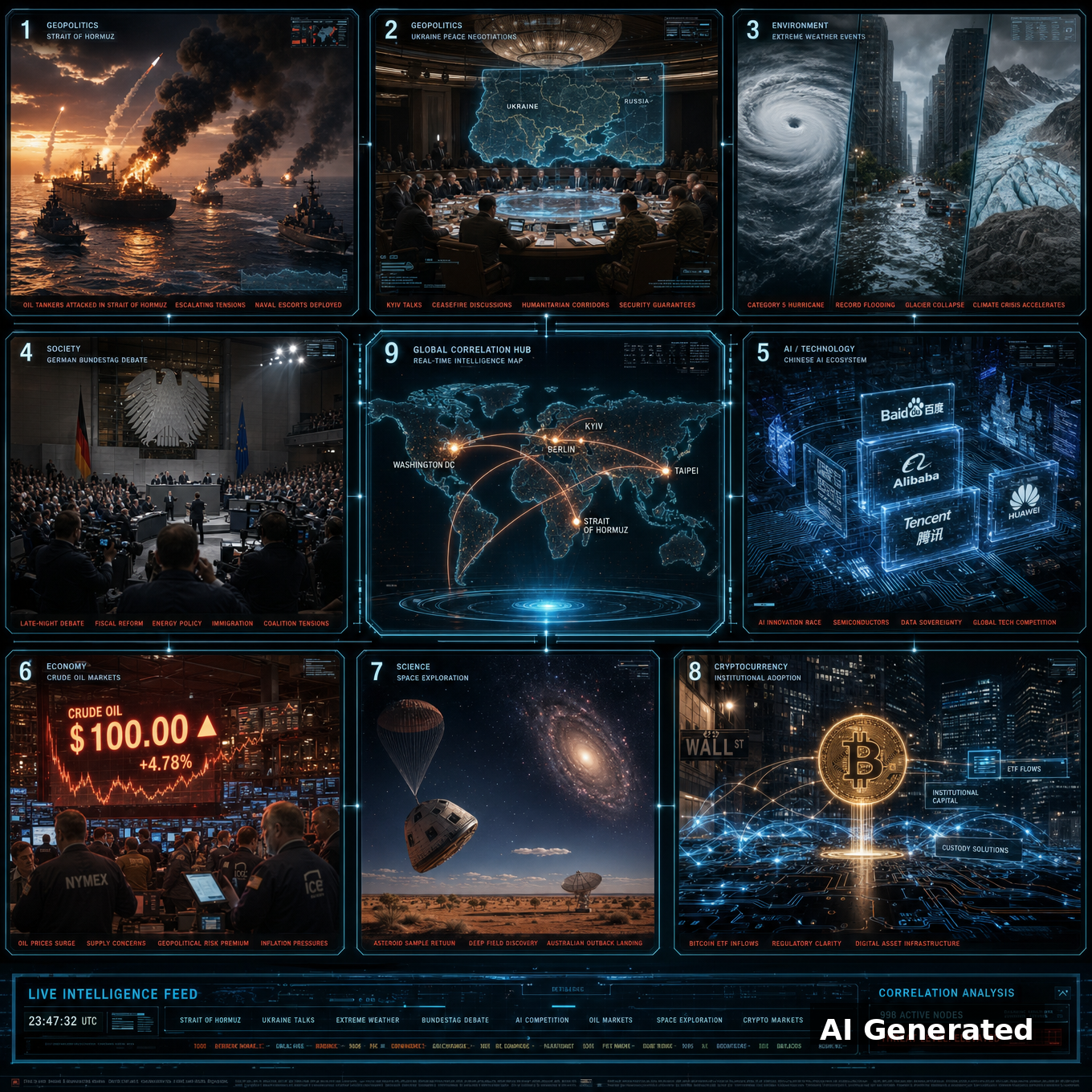
The Persian Gulf confrontation crossed a new threshold overnight when the US military announced it had destroyed five Iranian oil tankers in the Gulf, a direct retaliation for Iranian attacks on a US Navy warship over the preceding two days[1]. Iran’s Revolutionary Guards responded within hours, claiming attacks on two US ships and eight oil tankers in the Gulf, and warning crews at Kuwait and Bahrain to abandon their vessels immediately[2]. Jordanian air defences were filmed intercepting a barrage of Iranian ballistic missiles aimed at a US base on Jordanian territory, the first time the Hashemite Kingdom has been drawn directly into the exchange of fire[3][4]. Iranian chief of staff General Ali Abdollahi declared that any strike on Iranian tankers would trigger unprecedented attacks that would “destroy” American bases across the region[5].
Washington’s posture is explicitly retaliatory and open-ended. Secretary of State Marco Rubio warned that Iran “will lose tankers every time it attacks American ships,” and signalled that further strikes were likely the same day[6]. Explosions were reported near Kharg Island, Iran’s principal oil-export terminal at the mouth of the Strait of Hormuz, though no official cause was immediately confirmed[7]. The UK Maritime Trade Operations issued a fresh advisory after an incident involving a commercial vessel, urging heightened vigilance across the strait[8]. The Wall Street Journal reported a second, previously undisclosed Iranian missile attack on US warships on Monday, and that Tehran may now be receiving targeting assistance from Russia or China — a claim that, if confirmed, would transform the conflict’s geometry[9]. Iran announced it captured a US Navy Dive-LD uncrewed underwater vehicle largely intact near the strait; the Pentagon confirmed the loss of an “older model” drone that had malfunctioned, while the capture hands Tehran — and potentially Moscow and Beijing — an advanced operational system for reverse-engineering[10]. Nikkei’s assessment frames the day as Iran retaliating against US allies after the destruction of its tanker fleet, a widening of the target set beyond American forces[11].
Ukraine’s Diplomatic Window and Russia’s Warning
On the Ukraine front, President Zelensky declared himself ready for a compromise with Russia to halt the air strikes, revealing that one proposal discussed with American mediators was a full air ceasefire or at least a mutual halt to attacks on energy targets[12]. The statement is the most concrete signal yet that Kyiv is willing to trade concessions for an end to the strategic-bomber campaign D100 documented resuming when the three-day pause expired. It lands against a hardening Russian line: Foreign Minister Sergei Lavrov warned that if Europe attacks Russia, “the war will be completely different and very short”[13]. Nikkei’s five-point analysis of Russia’s hybrid war in Europe notes that the campaign’s repercussions now extend to Asia, where Moscow’s tactics are being studied and replicated in ways that complicate the Indo-Pacific security picture[14].
Israel, the Settlements Ban and the Diplomatic Web
Israel’s diplomatic calendar is tightening ahead of the UN General Assembly: Prime Minister Netanyahu will make a whirlwind 24-hour trip to New York to address the annual gathering, after New York Mayor Zohran Mamdani urged his arrest over the war in Gaza[15]. The European dimension of the settlements issue hardened further, with the EU moving to ban trade with Israeli settlements in the West Bank — a step that raises the diplomatic stakes for Washington, which has resisted such measures[16]. Australia is preparing its own round of targeted sanctions against Israeli settlers but has stopped short of joining the UK’s blanket ban on trade with settlements, with Foreign Minister Penny Wong expressing concerns about the broader measure[17]. The cumulative effect is a coordinated Western squeeze on settlement-related commerce that D100 first flagged with the UK announcement.
Taiwan, Defence Industry and the Indo-Pacific
The Taiwan Strait’s economic centrality was underscored from two directions: the top US diplomat in Taiwan argued the island has the technology and manufacturing capacity to meet its own needs and to support “global democratic supply chains,” while a separate US diplomatic warning contended that a Taiwan Strait conflict could surpass the economic impact of the Second World War[18][19]. The defence-industrial base is responding to the demand signals of two simultaneous wars. L3Harris secured a record $4.7 billion, seven-year propulsion award from Lockheed Martin for the PAC-3 MSE interceptor, with two new Arkansas plants targeted for 2027 — a concrete measure of the US missile-replenishment surge[20]. The US Army published a new biodefense plan designed to ensure a pandemic or biological event cannot stop force projection, a doctrinal response to the CBRN threat environment[21]. Russia, for its part, gave the Su-57E stealth fighter its international debut at the El Alamein airshow in Egypt, displaying new weapons and S-71 loyal-wingman drones in a clear bid to re-enter the Middle East and North Africa arms market[22]. Pakistan unveiled a layered short-range air-defence architecture combining China’s HQ-17AE missiles with Turkish ASELSAN Korkut and ŞAHİN gun systems — a template for how middle powers are integrating Chinese and Turkish technology against drone swarms[23]. At the Seoul Defense Dialogue, Philippine Defence Secretary Gilberto Teodoro read out a Chinese note handed to him mid-answer, denouncing its South China Sea position as “coercion”[24]. The UAE is seeking closer defence cooperation with Germany, including on drone defence[25]. The NIH is transferring part of its NIAID budget to fund Department of Defense medical-countermeasure research for a decade[26].
Greece–Turkey Friction and the Eastern Mediterranean
The Aegean front produced a concentrated burst of friction. Turkish media and officials reacted sharply to Prime Minister Mitsotakis’s Thessaloniki statement that Greece retains the right to extend its territorial waters to 12 nautical miles “whenever and however” it chooses, with commentators reviving the 1995 casus belli and one CNN Turk presenter asserting that Kastellorizo is Turkish[27]. A Turkish Bayraktar TB2 flew a surveillance sortie over the Aegean with the callsign “1458,” a date laden with Ottoman historical symbolism that Turkish outlets framed as a message to Athens[28]. Ankara also sought to implicate Greece and Israel in an attempted cyberattack on Turkish ministers’ phones, citing Apple spyware warnings, though officials conceded no evidence of Greek or Israeli involvement[29]. At El Alamein, Egypt’s Sisi invited only Cyprus’s leader to accompany him, prompting Turkish exhibitors to empty their pavilion in protest[30]. Athens, meanwhile, locked in the acquisition of two Italian Bergamini-class FREMM frigates and is preparing a plan for 30 percent cheaper electricity, part of a broader defence-and-energy package[31]. New video from the Tanagra F-4 Phantom crash shows the aircraft catching fire before impact, feeding the investigation into the accident that killed both pilots[32].
The Americas and the Wider Front
Beyond the core theatres, the diplomatic texture shifted on several axes. Cuba’s Miguel Díaz-Canel answered President Trump’s social-media map depicting the island under the US flag with a declaration that Cuba “will never again be a colony”[33]. Rubio’s Latin America tour continued with a promise of “unprecedented cooperation” with Colombia, before moving to Ecuador and Peru[34]. Saudi-backed Yemeni government forces intensified their counteroffensive against the Houthis on Yemen’s western coast, adding a ground dimension to the air war that has repeatedly struck Saudi infrastructure[35]. And Vice President Vance revealed that Turkey, Azerbaijan, the UAE, Saudi Arabia and Qatar are quietly assisting US pressure on Iran — an informal coalition with particular significance given Ankara’s simultaneous friction with Athens[36].
Environment & Climate
↑ ContentsCompound Extremes: Rain Records, Hurricanes and the Himalayan Cryosphere
The physical climate system delivered another day of compound extremes. Record-breaking rainfall swamped the Japanese city of Nagoya, dumping an all-time high of 105 millimetres in a single hour and disrupting daily life across the metropolitan region[37]. In the Pacific, Hurricane Lowell battered western Hawaii with downed trees and torrential rain, triggering flash-flood and mudslide concerns across the islands[38]. The Independent’s reporting from the shadow of Mont Blanc connected the dots between Nepal’s catastrophic glacier-collapse floods and the dramatic changes underway on western Europe’s highest peak — a single story that links the Himalayan cryosphere to the Alps through the same warming mechanism[39]. A new analysis of the Tibetan Plateau warns that despite an overall shift toward wetter conditions since the 1950s, compound “hot-dry” extremes are becoming a more important climate risk, driven by the interplay of ENSO and the North Atlantic — a finding that complicates the assumption that more precipitation means less drought risk[40].
The attribution gap between scientific evidence and public perception is widening even as the evidence strengthens. The BBC reported on a curious online row over this summer’s heatwaves that points to a worrying shift in climate science itself — signs that the planet may be heating faster than realised[41]. Inside Climate News examined why, with the scientific case for climate-attribution stronger than ever, so few people connect extreme weather to climate change — a communication failure with direct policy consequences[42]. The UN Environment Programme and the Climate and Clean Air Coalition provided an economic counterweight, estimating that every dollar invested in tackling climate change and air pollution together can generate around fifteen dollars in benefits[43].
Energy Infrastructure and the Regulatory Contest
The energy-infrastructure front produced a significant legal ruling: a federal court vacated the Tennessee Valley Authority’s decision to build its massive Kingston gas plant, finding “fundamental” errors in the utility’s analysis — a victory for communities at the site of the 2008 coal-ash spill and a signal that courts remain a live check on fossil-fuel expansion[44]. The same week, ONE Nuclear Energy advanced its Project Amberjack small-modular-reactor campus in Louisiana into technical and environmental evaluation, targeting up to one gigawatt of advanced nuclear capacity — a reminder that the nuclear track of the energy transition is moving forward even as gas faces legal headwinds[45]. On the demand side, Transport & Environment calculated that greater transport electrification could cut Europe’s import dependency by nearly a quarter by 2040, framing the EU’s post-2030 renewable framework as a geopolitical choice between imported oil and European electricity[46]. At the municipal scale, New Haven converted a closed landfill into a 1,900-panel solar plant generating about 1.4 million kilowatt-hours a year, with a private developer paying the city roughly $72,000 annually — a template for the more than 10,000 closed US landfills that a national analysis estimates could host 63 gigawatts of solar[47].
Fire, Haze and the Expanding Fire Season
The wildfire complex continues to expand in both geography and season. In the Indian Himalayas, women in Uttarakhand’s village forests are on the frontlines of a fire season that is no longer confined to its traditional spring window — winter fires now occur where snow season once prevailed, and the state recorded a sharp spike in activity in the first four months of 2026[48]. Indonesia’s peatland fires, described by ENN as an “apex predator” among fires, darkened skies across the archipelago, feeding the transboundary haze that Southeast Asia has breathed for decades; a Phys.org analysis asks whether ASEAN can finally do more than react to a recurrent phenomenon[49][50]. Mediterranean wildfire experts are calling for resilient-landscape approaches as fires become drastically more intense, while new research shows how climate change may amplify earthquake impacts in the Arctic — the Jan Mayen rock avalanche of March 2025 serving as the case study[51][52].
Ecosystems, Conservation and the Carbon Cycle
Ecosystem signals were mixed but instructive. Chesapeake Bay’s underwater grasses increased 7 percent in 2025, buoyed by gains in saltier waters — one of the bay’s most important indicators of ecosystem health[53]. In the Congo Basin, Indigenous peoples living near the Maiko, Salonga, Kahuzi-Biega and Virunga parks proposed diverse solutions for the future of conservation, from returning to ancestral lands to participating in environmental projects, as policymakers debate the Belém Call to Action[54]. Bavaria’s decade-long project to reintroduce the Ural owl (Habichtskauz) released another 28 juveniles, with wild breeding now confirmed since 2024 — a rare conservation success story in central Europe[55]. Germany is also hunting for climate- and pest-resistant potato varieties as staple-crop security becomes a climate issue[56]. The carbon cycle is showing unexpected sensitivities: less UV light reaching Antarctic tundra as the ozone layer recovers may mean less carbon storage, while Canada’s new national climate assessment — with two dozen University of Victoria researchers contributing — documents how warming is reshaping communities, ecosystems and coastlines[57][58]. California, meanwhile, could save $150 million a year by using improved weather and water forecasts to manage its reservoirs more intelligently — an adaptation win available without new infrastructure[59].
Society & Civil Issues
↑ ContentsGermany After Saxony-Anhalt: The Bundestag Debate and the AfD Aftermath
The aftershocks of the Saxony-Anhalt election dominated German political life. In the Bundestag’s general debate, Chancellor Merz and AfD leader Weidel faced off in a head-to-head confrontation — the first major parliamentary duel since the AfD’s 43.8 percent result — with the government seeking to frame the far-right breakthrough as a warning rather than a mandate[60]. The SPD’s internal reckoning was blunt: Juso chairman Philipp Türmer told his own party it had made “a hell of a lot of mistakes,” a self-criticism that reflects the depth of the mainstream’s post-election crisis[61]. President Trump waded into the German political debate, celebrating the AfD’s “very strong night” and blaming Germany’s “absolutely terrible” immigration rules for the result — an intervention that both legitimises the far right and complicates the German government’s attempts to isolate it[62][63]. Germany’s civil-protection apparatus, meanwhile, ran its nationwide Warntag test of sirens, cell broadcast and warning apps, with Bremen’s interior minister stressing that “danger situations can occur at any time” — a reminder of the hybrid-threat environment D94-D96 documented[64].
US Institutions: Courts, Schools, Memory and the Midterm Season
American institutional life produced a dense cluster of stories. The Supreme Court rejected Missouri’s bid to reactivate a Republican-backed voting map, though a separate federal ruling left the map’s fate uncertain — a preview of the legal turbulence surrounding the November midterms[65]. US reading scores among 15-year-olds hit a near-25-year low in the latest global assessment, dropping 14 points from 2022, even as the administration pushes “school choice”[66]. New York Mayor Zohran Mamdani released tens of thousands of previously undisclosed documents detailing what city officials knew about toxic air after the September 11 attacks, as the 25th anniversary approaches and thousands continue to suffer related illnesses[67]. The Republican Party convened its pre-midterm convention in Dallas, with voters themselves divided over whether the atypical event is an “energiser” or a “circus”[68][69]. The Lindsay Clancy mistrial produced a striking juror revelation: the foreperson said the lone holdout expressed reasonable doubt about the Massachusetts mother’s guilt in the deaths of her three children but would not agree to acquit — a case that continues to test public understanding of maternal mental illness and the insanity defence[70]. The Smithsonian Institution’s first African-American secretary, Lonnie Bunch, announced his retirement amid sustained political pressure from the Trump administration, which has accused the museum complex of promoting a “woke” worldview[71]. The NTSB’s black-box data from the Amazon cargo plane crash at Miami revealed pilots initiated a “go-around” seconds before impact, killing five people in a van on the runway — a safety investigation with immediate implications for cargo aviation[72].
UK and Commonwealth: Flight Chaos, Fraud and the Cost of Living
The UK’s air-traffic control boss was summoned to face the Transport Secretary as flight chaos from Tuesday’s cancellations continued into a second day, with airlines still managing knock-on disruption[73]. Consumer-protection stories carried a distinctly financial flavour: Which? found that fraud has a lasting impact on victims’ mental health, based on a survey of more than 1,500 people who lost money to scams[74], while the advertising regulator banned travel-firm ads from Thomas Cook, loveholidays and DialAFlight for misleading “eco” hotel claims[75]. Prime Minister Burnham made a striking U-turn on a major infrastructure project he had previously warned would “overheat the UK economy,” giving it the go-ahead — a decision with fiscal and political significance[76]. In Australia, a Liberal operative denied inventing a “pink paper” record of a $5 million agreement with a fugitive property developer at the ICAC corruption inquiry, with counsel assisting suggesting “the threads of your story pull apart very quickly”[77]. The death of Tung Chee-hwa, Hong Kong’s first postcolonial leader, at 89 closed a chapter in the territory’s history — the shipping magnate who governed through the 1997 handover, the Asian financial crisis, SARS and the 2003 mass protests[78][79]. In Canada, the trade war with the United States moved to the centre of the Quebec election campaign after federal counter-tariffs prompted reactions from party leaders across the province[80].
Europe and Beyond: Justice, Health and the Civic Sphere
France’s political-legal calendar produced a notable return: François Bayrou faced the appeals court in the MoDem European parliamentary assistants case, two years after his first-instance acquittal[81]. In education, Germany’s 15-year-olds posted their lowest PISA results since testing began 25 years ago, deepening the country’s debate about school quality and migration-linked inequality[82]. Bolivia’s coca cultivation exploded last year, according to Le Parisien’s reporting, with the government’s anti-drug effort described as largely nominal — a supply-side story with global narcotics implications[83]. In the Peruvian Amazon, the recently contacted Matsés people are suffering an epidemic of malaria and hepatitis B, exacerbated by climate-driven drought that cuts off river transit to health care — a planetary-health case study of how environmental change and state neglect compound[84]. Norway held the state funeral of King Harald V in Oslo, with European heads of state attending the burial of the 89-year-old monarch who reigned for 53 years[85]. Australia’s political day was dominated by the digital duty-of-care bill, with Prime Minister Albanese dismissing Nationals criticisms of ministerial powers as “disingenuous”[86].
AI & Technology
↑ ContentsThe Distillation War: Washington Names Chinese AI Firms
The most consequential AI story of the day is the formal US government accusation that Chinese AI companies have been systematically stealing American frontier-model capabilities. In a joint advisory, the NSA, CISA and FBI said Chinese firms DeepSeek, Moonshot AI, Alibaba, MiniMax, StepFun and Z.AI used “aggressive, malicious, and targeted distillation” tactics to extract billions of tokens from US frontier models since 2024, likely with Chinese government awareness[87]. The advisory names Anthropic’s Claude, OpenAI’s ChatGPT, Google’s Gemini and SpaceXAI’s Grok as targets, and recommends detection, response and cross-organisation intelligence sharing for US developers. The timing is pointed: the accusation lands ahead of the Trump–Xi meeting, and Crypto Briefing’s framing notes the diplomatic and market dynamics the charge introduces into the bilateral relationship[88]. The episode extends the D97-D100 arc of US-China AI competition from export controls into the domain of model weights and training data — a frontier where the US holds the technology but China holds the manufacturing and scale.
Security, Privacy and the Patch Tsunami
The security layer of the AI-and-tech complex produced two notable stories. Microsoft’s September patch release fixed a record roughly 972 vulnerabilities, 112 of them critical — the third consecutive record month, following 570 in July and 620 in August, and a direct response to the industry’s warning of an approaching “tsunami” of AI-enabled attacks that exploit vulnerabilities first[89]. Researchers at Zero Day Initiative call the spikes the “new normal,” a phrase that captures how the AI threat model has permanently raised the patching tempo. On the privacy side, security researchers demonstrated that LG’s G5 OLED television scans the local network for other devices even when ostensibly off, crawling the LAN and identifying phones and smartwatches — a reminder that consumer-electronics surveillance is expanding beyond the smartphone[90]. The Nexus identity breach, meanwhile, exposed a “blueprint for fraud”: stolen material reportedly includes faces, addresses, birth dates and hidden security features of government-issued IDs, roughly 170 million records, according to cybersecurity experts — an identity-theft event with structural implications for KYC and digital-identity systems[91].
Compute Infrastructure: ASML, Quantum and the Robot-IPO Signal
The hardware layer continues to scale at an extraordinary pace. ASML broke ground on a 350,000-square-metre industrial campus at Brainport Industries Campus North in Eindhoven, designed around a “flow factory” model for its TWINSCAN lithography systems and capable of supporting up to 20,000 workplaces — a direct response to the semiconductor-equipment demand that the AI build-out is generating[92]. The US federal government injected $100 million through the CHIPS R&D Office into Quantinuum’s trapped-ion quantum manufacturing research, with GlobalFoundries exploring 300mm wafer fabrication for ion traps and Monarch Quantum developing integrated photonics for control lasers — the first serious attempt to move quantum hardware from one-off production to repeatable semiconductor manufacturing[93]. In China, regulators are limiting humanoid-robot IPOs after Unitree’s volatile debut, a signal that Beijing is managing the capital-markets side of its robotics boom with the same caution it applies to other strategic sectors[94]. Meta’s new agentic platform Muse, reviewed by Gizmodo, offers a different kind of signal: free compute at a scale that lets users “tokenmaxx” on nothing in particular, raising questions about what agentic platforms are actually for[95]. Australia’s digital duty-of-care legislation, promoted as active governance rather than litigation-based norm-setting, rounds out a day in which the regulatory and industrial tracks of AI continued to move in parallel[96].
Economy & Business
↑ ContentsOil at $100: The War Premium Returns
The oil complex moved decisively toward the symbolic $100 barrier as the Gulf tanker war escalated. Brent rose 1.6 percent to $99.49 a barrel at the Asian open, with WTI up 1.7 percent to $94.63, extending a roughly 25 percent rally since early August as hopes for a settlement faded[97]. The US strikes on Iranian tankers and Iran’s missile attack on the US base in Jordan drove the move, with CNBC reporting that sanctions and strikes could push prices toward $100[98][99]. US oil prices have now surged 41 percent since July, and the Kobeissi Letter’s arithmetic suggests the current pace would put WTI above $100 by Friday[100]. The conflict is also inflating European natural gas, heating oil and sulfur prices, transmitting the Gulf shock into the continent’s industrial cost base[101]. The physical market is registering the disruption: only six commodity ships passed through the Strait of Hormuz on Tuesday, against a ten-day average of about twelve — a halving of traffic that confirms the de facto closure D99-D100 documented[102]. US consumers are feeling the squeeze at the pump, with Inside Climate News noting that the administration’s climate-policy rollbacks leave households more exposed to price shocks[103].
China’s Inflation Data and the Fed’s Hawkish Turn
China’s August price data showed the energy shock feeding through. Consumer prices rose 0.8 percent year-on-year, in line with forecasts and up from 0.5 percent in July, while producer prices accelerated to 3.8 percent year-on-year, above the 3.6 percent expected and up from 3.5 percent — energy prices driving the producer-side momentum[104][105]. Handelsblatt’s analysis notes that geopolitical tensions and high energy prices are increasingly squeezing Chinese consumers, a pressure point that complicates Beijing’s growth narrative[106]. The macro backdrop is turning hawkish: Fed Chair Kevin Warsh signalled a potential rate hike amid inflation concerns, shifting market expectations away from cuts[107], while the yen stood tall as the dollar wobbled and oil’s run toward $100 chilled sentiment across Asian markets[108]. Goldman Sachs argues that AI investment spending has overtaken the Fed in shaping interest rates — a structural claim about where the marginal dollar of demand now comes from[109]. Treasury Secretary Bessent, for his part, explicitly endorsed using US financial power as a foreign-policy tool, formalising the sanctions-first doctrine that D96-D100 documented in action against Iran[110].
The US–Canada Trade War Deepens
The North American trade conflict escalated sharply. Trump banned imports of Canadian alcohol, motorcycles and other goods via executive orders, with a 50 percent surtax on further merchandise from September 15 — retaliation for Canada’s counter-tariffs on $20 billion of US products[111][112]. Canada’s response, backed by public opinion, is a risky bet by Prime Minister Carney: Le Monde’s analysis notes the 15, 25 and 50 percent duties on US steel, dairy, electronics and pulp represent a deliberate escalation in a confrontation where neither side appears willing to de-escalate first[113]. The dispute is now a defining issue in the Quebec election campaign, as party leaders across the province react to the federal counter-tariffs[114].
Corporate Europe, Aviation and the State’s Reach
European corporate news carried the day’s structural undercurrents. Airbus, Thales and Leonardo are driving a mega-merger of their satellite-manufacturing businesses toward an EU filing, despite booming space revenues — a consolidation that German competitors warn could create a market giant[115]. Egypt’s AIRCAIRO signed a firm order for 15 Airbus A320neo aircraft at the El Alamein airshow, its first direct ownership deal as it targets a fleet of over 130 aircraft by 2034[116]. Apple’s new CEO John Ternus presented his first products, marking the company’s transition from the Cook era into an AI-first hardware strategy[117]. Handelsblatt’s long read on China, fifty years after Mao’s death, argues that Xi is dismantling the institutional safeguards the party erected against autocratic rule — an ideological analysis with direct implications for foreign investors’ assumptions about Chinese governance[118]. In the labour-market file, the US Labor Department suspended Cognizant’s PERM filings amid an investigation into alleged visa-programme fraud, and Coforge’s chairman resigned after an audit found concerns in board evaluation — two signals that corporate-governance and immigration-compliance scrutiny is intensifying[119][120]. Mexico’s 2027 budget draft projects up to 2.5 percent growth with a narrower deficit, and the UK’s food industry warned that inflation could reach almost 4 percent by Christmas — a £100 January-2020 grocery shop now costing £138.60[121][122]. La Tribune calculated that Trump’s imagined “Greater America” — the map he posted showing an expanded US — would represent $36 trillion of GDP but would melt per-capita wealth, puncturing the economic logic of the annexationist imagery[123]. Finally, a Fortune commentary argued that Peru’s successful monetary system could not be replicated in Venezuela, where populism and fiscal dominance preclude the institutional discipline the Peruvian model requires — a caution for anyone expecting a quick fix to the bolivar’s collapse[124].
Science & Space
↑ ContentsSpace Exploration: Hayabusa2, Viking 2 and the Deep Field
Japan’s Hayabusa2 mission achieved the first-ever successful laser-ranging experiment during an asteroid flyby on 5 July 2026, a milestone that demonstrates how optical techniques can complement radio tracking for deep-space navigation and asteroid science[125]. Half a century of Mars data continues to yield new insights: re-analysis of the frost photographed by NASA’s Viking 2 lander at Utopia Planitia in 1979, combined with a modern Mars climate model, suggests that for about 30 Martian days each year the receding frost could mix with calcium perchlorate salts to produce microscopic layers of liquid brine — a finding that reopens questions about transient liquid water on Mars, even if the brine would be too cold and reactive to support known life[126]. In astrophysics, new observations confirm that some supermassive black holes grow much faster than their host galaxies, complicating the co-evolution narrative that has dominated the field since the discovery of the black-hole–bulge correlation[127].
Biomedicine and the Molecular Frontier
The biomedical file produced several genuinely novel findings. A Danish study of about 300 infant girls found that those whose mothers took paracetamol (acetaminophen) in early pregnancy had, on average, 40 percent smaller ovaries by volume, 13 percent smaller uteruses and 23 percent fewer ovarian follicles at three months of age, with a parallel finding of reduced testicular volume in boys — associations that do not prove causation but align with animal and cellular studies, prompting cautious calls for a dialogue about when the painkiller is truly necessary[128]. A Spanish randomised crossover trial found that eating 35 grams of tomato paste daily for three months was associated with enhanced selective attention and tentative changes in functional brain connectivity linked to the antioxidant lycopene — a first-of-its-kind result, though the authors acknowledge the imaging analysis was small and statistically underpowered[129]. At the molecular level, researchers rewired ribosomes to specialise in producing a single protein, overturning the assumption that these machines must remain generalists — a step toward programmable protein factories with synthetic-biology applications[130]. MIT engineers, meanwhile, created a “living circuit board” by engineering bacteria to behave like transistors, printable onto growth material in a Petri dish — a biological analogue of electronic logic that could underpin living sensors and computation[131]. A new computational method pushes cryo-electron microscopy beyond the traditional Nyquist resolution limit, allowing researchers to extract more structural information from existing data without re-collecting at higher magnification[132]. And an Australian study found that 31 rugby league players were diagnosed with chronic traumatic encephalopathy, adding to the growing evidence base on repetitive head injury and neurodegeneration in contact sport[133].
Materials, Energy and the Natural World
The materials-and-energy track continued to blur the line between waste and resource. Researchers heated egg yolk and leftover rice into a porous carbon powder — a honeycomb structure with a specific surface area of 1,572 square metres per gram — that retained 82.26 percent of its capacitance after 10,000 charge-drain cycles in a supercapacitor test, a lab-scale demonstration of turning food waste into energy-storage material[134]. A vicarious calibration model for China’s Fengyun-3 ocean-colour satellite data addresses the on-orbit calibration uncertainty that has limited quantitative remote sensing of ocean carbon sinks and primary productivity — an infrastructure-level advance for climate monitoring[135]. In behavioural ecology, tiny backpack-mounted tags are revealing the secret, sometimes circuitous migrations of small songbirds like the yellow-rumped warbler, overturning assumptions about direct migratory routes[136]. Norway’s alpine Dryas heath is yielding an inventory of little-known fungi, with researchers surveying a diversity that may include species never before described — a reminder that basic biodiversity science still has frontiers in Europe itself[137]. And one of the oldest known three-dimensional animal fossils has been discovered in a Norwegian sheep field in the Arctic — the first new major site of its kind in Europe in decades, offering a rare window into early animal body plans[138].
Crypto, Digital Assets & Blockchain
↑ ContentsInstitutional Capital Engineering: Strategy, Robinhood and the CLARITY Act
The day’s crypto news was dominated by the intersection of institutional capital engineering and Washington politics. Strategy doubled its preferred-stock repurchase programme to $2 billion as its STRC security remained short of its $100 stated value, spending a record $176.3 million in the week to 7 September at an average price of about $97.36[139]. The move is a revealing case study in how a Bitcoin-treasury company manages its capital structure: cumulative spending since July has reached roughly $811.5 million, the buyback campaign has drawn from the same flexible liquidity pool that funds new Bitcoin purchases, and the company paused its Bitcoin accumulation entirely in the latest week to prioritise the STRC repair. The board’s decision to double the authorization signals that restoring the security to par — and thereby reopening the preferred-issuance channel that raised $2.52 billion in 2025 — requires substantially more balance-sheet support than management initially anticipated. The episode matters beyond one company because it tests whether the Bitcoin-treasury model can sustain the complex capital structures it has layered on top of a single volatile asset; the answer, so far, is that it can, but only by redirecting the very capital that would otherwise expand the treasury itself[139].
Robinhood’s prediction-markets business took a strategic step deeper into the crypto ecosystem, announcing it has begun routing selected football event contracts to OG.com, the trader-focused brand of Crypto.com’s CFTC-regulated US derivatives exchange and clearinghouse, and that it will receive equity stakes in both Crypto.com and OG.com once the latter spins off as an independent platform[140]. The equity will be priced in line with Citadel Securities’ recent investment in Crypto.com Group at a $20 billion valuation. The arrangement does not make OG.com Robinhood’s sole venue — event contracts will continue to flow to Kalshi, ForecastEx and Rothera — but it deepens the commercial and financial entanglement between the retail brokerage and the crypto-native derivatives infrastructure, and it gives Robinhood direct exposure to the counterparties executing its contracts. With more than 45 billion event contracts traded since Robinhood entered prediction markets two years ago, the multi-venue model is becoming a significant, regulated revenue channel that bridges traditional brokerage and on-chain settlement[140].
The legislative track re-entered the picture as President Trump pushed Congress to pass the CLARITY Act — the market-structure bill that D96 identified as the sector’s regulatory crossroads — even as his family’s reported $1 billion crypto stake drew fresh ethical scrutiny[141]. The juxtaposition is the defining tension of the current regulatory cycle: the same administration advancing industry-friendly legislation while its principals hold direct financial positions in the assets being regulated. The CLARITY Act’s Senate vote, flagged in D96 for 15 September, now approaches with the White House actively lobbying, which changes the political calculus for fence-sitting senators even as it sharpens the conflict-of-interest questions. The bill’s provisions on digital-asset classification and exchange oversight would reshape the compliance burden for every actor in the sector, which is precisely why its passage or failure will be the single most consequential regulatory event of the autumn for digital assets[141].
Protocol Governance and the Quantum Shadow
On the protocol side, the XRP Ledger’s new Permission Delegation amendment — part of the xrpld 3.3.0 release — is progressing toward validator voting, with the role-based authorisation system allowing account owners to delegate specific tasks to trusted operators without revealing primary-wallet keys[142]. The amendment builds on the institutional-features trajectory that D100 documented with the XLS-66d lending proposal, and its timing alongside a critical audit underscores the ledger’s deliberate move toward enterprise-grade access control. Permission delegation is a governance primitive with real security implications: it enables custody and treasury operations to separate signing authority from operational authority, a structure that institutional adopters have long demanded but that also introduces new attack surfaces if delegation rights are themselves compromised. The validator-support signal, while not yet the 80 percent threshold required for activation, indicates that the validator community is receptive to the institutional-access framing[142].
The quantum threat to digital assets moved from theoretical to engineered. IonQ published what it calls the world’s first fully compiled, end-to-end blueprint for breaking 256-bit elliptic-curve signatures with a fault-tolerant quantum computer, estimating that a machine with 19,397 physical qubits could solve Bitcoin’s secp256k1 problem in about 25.7 days[143]. The study does not demonstrate an attack on a working machine — it traces the entire computation down to error-correction primitives, giving cryptographers a concrete engineering target rather than a theoretical one. The 19,397-qubit figure sits just below the 20,000-qubit scale IonQ has highlighted in its roadmap, and the company’s Walking Cat architecture was reshaped around the specific requirements of secp256k1 to produce the estimate. For the digital-asset industry, the blueprint converts the abstract “Q-day” concern that D95’s Fidelity warning raised into a measurable engineering timeline: the sector now has a number — roughly 20,000 physical qubits — against which to calibrate its post-quantum migration, and the XRPL’s quantum-proofing work reported in D90 becomes not a precaution but a race[143].
Finally, the Bitcoin-fork ecosystem produced a governance spectacle: the minority chain BTCB2 persuaded two small trading venues to list the coin under the ticker XBT — a long-established ISO 4217-style code used for bitcoin itself on Kraken futures — drawing criticism and triggering a mining revolt within the fork’s own community[144]. The episode is small in market terms but analytically useful: it illustrates how ticker identity, exchange listing and community governance interact in the fork economy, and how quickly naming conventions that carry institutional weight (XBT) become contested when minority chains seek legitimacy through association. Taken together, the day’s crypto news describes a sector simultaneously consolidating its institutional capital structures, advancing its regulatory agenda, hardening its protocol governance, and beginning to engineer its response to the quantum timeline — institutionalisation under constraint, in the pattern D97-D100 established[144].
Correlations & Analysis
↑ ContentsD101 answers the D100 watchpoints with a decisive escalation in the Gulf. The destruction of five Iranian tankers and Iran’s missile strike on a US base in Jordan are the direct successors to the tanker-war arc that D95 opened with the “tanker-for-tanker” policy, D98 escalated with the sinking of the M/T Kylo, and D99-D100 framed through the exclusion-zone gambit and covert mine-clearance[1][2][3]. What is genuinely new is the geographic widening: Jordan’s interception of Iranian missiles brings a second Arab state directly into the exchange of fire, and the reported capture of the US Navy’s Dive-LD drone hands Tehran — and by extension Moscow and Beijing — a piece of advanced undersea technology for reverse-engineering[10]. The WSJ report that Iran may now be receiving targeting assistance from Russia or China, if confirmed, would complete the fusion of the two great-power conflicts that D97 first identified as the defining pattern of the autumn[9].
The economic transmission channel that D98 and D99 documented through commodity shipping has now reached the symbolic $100 oil threshold, with Brent at $99.49 and Hormuz traffic halved to six ships a day[97][102]. This is precisely the scenario the D100 report flagged when it identified the 15-16 September FOMC meeting as the single most consequential macro event for global risk appetite: the Fed now faces a hawkish Warsh signalling a possible rate hike into an oil-driven inflation impulse, while China’s energy-driven PPI acceleration at 3.8 percent adds a second inflationary data point from the world’s largest manufacturer[107][105]. The US-Canada trade war, which D83-D100 tracked from tariff imposition to the Bombardier threat, has now escalated to import bans on Canadian alcohol and motorcycles — a further fragmentation of the North American economic bloc that compounds the oil shock’s inflationary effect[111].
Europe’s October political convergence, the second structural dynamic D97-D100 identified, sharpened rather than resolved. The Bundestag’s Merz-Weidel duel and the SPD’s blunt self-criticism are the direct institutional aftershocks of the Saxony-Anhalt result D99 covered, and Trump’s public celebration of the AfD adds an unwelcome external validation that complicates the mainstream firewall[60][61][62]. The Berlin and Mecklenburg-Vorpommern votes that D100 flagged as the next test now approach with the German economy exposed to the same energy-price shock that is driving its PPI and threatening its industrial base — a convergence of the political and economic layers of the European crisis that the D96-D99 reports anticipated.
The AI accountability wave has entered a new phase consistent with the trajectory D97-D100 mapped. Where D99 was dominated by governance architecture and D100 by corporate strategy, D101’s defining event is the formal US intelligence-community accusation that Chinese firms have been systematically distilling American frontier models — a state-level escalation that moves the AI competition from export controls to model weights[87]. The record 972-vulnerability Microsoft patch cycle and the $100 million CHIPS award to Quantinuum both reflect the same underlying dynamic: the AI build-out is forcing simultaneous acceleration in security, compute and quantum infrastructure, each of which D100’s hardware-and-power analysis identified as a binding constraint[89][93].
The crypto layer of D101 continues the institutionalisation-under-constraint pattern D97-D100 documented, but with a new temporal pressure. Strategy’s $2 billion STRC buyback, Robinhood’s OG.com routing deal and the CLARITY Act push all describe the sector’s deepening integration with mainstream capital markets and Washington[139][140][141]. IonQ’s 19,397-qubit blueprint for breaking secp256k1 converts the quantum threat that D95’s Fidelity warning and D90’s XRPL quantum-proofing raised into a measurable engineering timeline — and the XRPL’s new permission-delegation amendment shows the ledger community responding with institutional-grade access control at the same moment[143][142]. The environmental layer, meanwhile, connects the D100 drylands study to today’s compound extremes — Nagoya’s record rain, Hurricane Lowell, the Tibetan Plateau’s hot-dry paradox — through the same attribution gap that Inside Climate News identified as a policy-relevant failure of public understanding[37][40][42].
What to watch in the next reporting period: (1) Whether the tanker war widens further — the WSJ’s Russia/China targeting-assistance claim and Iran’s threat to strike US bases are the two escalation triggers to monitor; (2) the 15-16 September FOMC decision, now arriving with oil at $100, a hawkish Warsh, and China’s PPI at 3.8 percent; (3) the CLARITY Act Senate vote on 15 September, the single most consequential crypto-regulatory event of the autumn; (4) whether the US-China AI distillation accusation produces concrete export or enforcement measures ahead of the Trump-Xi meeting; and (5) the Berlin and Mecklenburg-Vorpommern state elections as the next test of the Saxony-Anhalt aftershock. D102 should show whether any of these five watchpoints resolves or merely deepens.
References
↑ Contents1. Iran-US war latest: Trump’s military destroys five Iranian tankers in retaliation for strikes on Navy warship by The Independent The Independent ↑
2. IRGC attacked two US ships and eight oil tankers in Gulf in response to US strike on five Iranian tankers by FinancialJuice FinancialJuice ↑
3. Jordanian air defences intercept Iranian missile barrage by Al Jazeera Al Jazeera ↑
4. Téhéran cible la Jordanie après des frappes américaines contre des pétroliers iraniens by Le Monde Le Monde ↑
5. Iρανός στρατηγός Αλί Αμπντολαχί: Θα διαλύσουμε όλες τις αμερικανικές βάσεις εάν πλήξουν δεξαμενόπλοιά μας by DefenceNet DefenceNet ↑
6. Ρούμπιο: Θα χάνει πετρελαιοφόρα το Ιράν κάθε φορά που επιτίθεται σε αμερικανικά πλοία by Iefimerida Iefimerida ↑
7. Στενά του Ορμούζ: Εκρήξεις κοντά στο νησί Χαργκ by DefenceNet DefenceNet ↑
8. Στενά του Ορμούζ: Νέα προειδοποίηση της UKMTO μετά από περιστατικό με εμπορικό πλοίο by Enikos Enikos ↑
9. WSJ: Δεύτερη επίθεση του Ιράν κατά αμερικανικών πολεμικών πλοίων στον Κόλπο by DefenceNet (WSJ) DefenceNet (WSJ) ↑
10. Everything We Know About The U.S. Navy’s Submersible Drone Iran Just Captured by The War Zone The War Zone ↑
11. Iran retaliates against US allies after its oil tankers destroyed by Nikkei Asia Nikkei Asia ↑
12. O Ζελένσκι δηλώνει έτοιμος για συμβιβασμό με την Ρωσία, ώστε να σταματήσουν οι αεροπορικές επιθέσεις by in.gr in.gr ↑
13. Λαβρόφ: Αν η Ευρώπη μας επιτεθεί ο πόλεμος θα είναι διαφορετικός και πολύ σύντομος by DefenceNet DefenceNet ↑
14. Russia’s hybrid war in Europe has repercussions in Asia: 5 things to know by Nikkei Asia Nikkei Asia ↑
15. Netanyahu will make a quick trip to speak at the UN after Mamdani urged his arrest, diplomat says by The Independent The Independent ↑
16. Europe bans trade with Israeli settlements, raising US diplomatic stakes by Crypto Briefing Crypto Briefing ↑
17. Australia considers new Israel sanctions but won’t join UK in banning trade with ‘settler terrorists’ by The Guardian The Guardian ↑
18. Top U.S. diplomat in Taiwan: Taiwan has tech and manufacturing capacity to meet its needs and back development of global democratic supply chains by FinancialJuice FinancialJuice ↑
19. US diplomat warns Taiwan Strait conflict could surpass WWII economic impact by Crypto Briefing Crypto Briefing ↑
20. 22-mile PAC-3 interceptor motors record $4.7B deal to expand Arkansas plants by 2027 by Interesting Engineering Interesting Engineering ↑
21. Army sets new biodefense plan to counter pandemic, adversary threats by Breaking Defense Breaking Defense ↑
22. Διεθνής πρεμιέρα για το ρωσικό Su-57E στην Αίγυπτο: Παρουσιάστηκε με νέα όπλα και drones S-71 by DefenceNet DefenceNet ↑
23. Κίνα και Τουρκία στήνουν την α/α ασπίδα του Πακιστάν by DefenceNet DefenceNet ↑
24. Πρωτοφανές περιστατικό σε διεθνές φόρουμ: Έκρηξη του υπουργού Άμυνας των Φιλιππίνων κατά της Κίνας by DefenceNet DefenceNet ↑
25. Iran-Krieg: Emirate wollen bei Verteidigung enger mit Deutschland arbeiten by Handelsblatt Handelsblatt ↑
26. NIH to use part of its budget to pay for Department of Defense research by Ars Technica Ars Technica ↑
27. Ατέλειωτο το παραλήρημα των Τούρκων: 12 ναυτικά μίλια σημαίνει πόλεμος – Το Καστελόριζο είναι δικό μας by DefenceNet DefenceNet ↑
28. Βίντεο: Τουρκικό Bayraktar TB2 σχημάτισε πάνω από το Αιγαίο το 1458 by DefenceNet DefenceNet ↑
29. Η Άγκυρα προσπαθεί να εμπλέξει την Αθήνα σε κυβερνοεπίθεση σε κινητά τηλέφωνα Τούρκων υπουργών by DefenceNet DefenceNet ↑
30. Ελ Αλαμέιν: Ο Σίσι προσκάλεσε μόνο τον Χριστοδουλίδη, οι Τούρκοι ενοχλήθηκαν και άδειασαν το περίπτερό τους by in.gr in.gr ↑
31. 5 το πρωί: Τριμερής στο Ελ Αλαμέιν – Κλείδωσαν οι δύο Bergamini – Σχέδιο για 30% φθηνότερο ρεύμα by To Vima To Vima ↑
32. Νέο βίντεο ντοκουμέντο: Το Phantom 4 έπιασε φωτιά λίγο πριν συντριβεί και σκοτωθούν οι πιλότοι by DefenceNet DefenceNet ↑
33. Κούβα σε Τραμπ: Δεν θα γίνουμε ποτέ ξανά αποικία μετά τον χάρτη με το νησί υπό αμερικανική σημαία by ProtoThema ProtoThema ↑
34. En tournée en Amérique latine, Marco Rubio promet une coopération sans précédent avec la Colombie by Le Monde Le Monde ↑
35. Yemen’s Saudi-backed forces strike Houthis on western coast by Al Jazeera Al Jazeera ↑
36. Ποιες χώρες ανέφερε ο Τζέι Ντι Βανς ότι στηρίζουν τις ΗΠΑ στην άτυπη συμμαχία κατά του Ιράν by DefenceNet DefenceNet ↑
37. Record-breaking rain disrupts daily life in Nagoya, Japan by Al Jazeera Al Jazeera ↑
38. Watch: Downed trees and flooding as Hurricane Lowell batters western Hawaii by BBC News BBC News ↑
39. Nepal’s flood disaster and the impact of climate change loom large in the icy shadow of Mont Blanc by The Independent The Independent ↑
40. Why a wetter Tibetan Plateau still faces ‘hot-dry’ extremes: The roles of ENSO and the North Atlantic by Phys.org Phys.org ↑
41. The trail of clues that our planet might be heating faster than we realised by BBC News BBC News ↑
42. Many People Aren’t Connecting the Dots Between Climate Change and Extreme Weather by Inside Climate News Inside Climate News ↑
43. Action on climate and air pollution likely to boost economy, UN says by Phys.org / UNEP Phys.org / UNEP ↑
44. Court Rules TVA’s Decision to Build Kingston Gas Plant Broke the Law by CleanTechnica CleanTechnica ↑
45. 1 GW nuclear campus advances in Louisiana as reactor technology screening begins by Interesting Engineering Interesting Engineering ↑
46. Greater Transport Electrification Could Cut Europe’s Import Dependency By Nearly A Quarter By 2040 by CleanTechnica / T&E CleanTechnica / T&E ↑
47. New Haven turned an old trash hill into a solar plant, and 1,900 panels now power homes by Ecoticias Ecoticias ↑
48. Sickles, sarees and smoke: Women on the frontlines of Uttarakhand forest fires by Mongabay Mongabay ↑
49. Peatland Fires Darken Skies in Indonesia by ENN ENN ↑
50. Why does Southeast Asia keeps breathing the same haze—and can ASEAN do more to stop it? by and can ASEAN do more to stop it?” — Phys.org and can ASEAN do more to stop it?” — Phys.org ↑
51. Working Together to Combat Wildfires: Building Resilient Landscapes by ENN ENN ↑
52. How Climate Change May Amplify Earthquake Impacts in the Arctic by ENN ENN ↑
53. Chesapeake Bay underwater grasses increase 7%, buoyed by gains in salty waters by Phys.org / VIMS Phys.org / VIMS ↑
54. Indigenous peoples near Congo parks propose diverse solutions for the future of conservation by Mongabay Mongabay ↑
55. Naturschutzprojekt: 28 junge Habichtskäuze in Nordostbayern ausgewildert by Stern Stern ↑
56. Grundnahrungsmittel: Klimawandel und Schädlinge: Resistente Kartoffeln gesucht by Die Zeit Die Zeit ↑
57. Less UV Light May Mean Less Carbon Storage in Antarctic Tundra by ENN ENN ↑
58. How UVic Researchers Help Canada Understand a Changing Climate by ENN ENN ↑
59. Study: Reservoir Management System Could Save California $150 Million Every Year by ENN / Scripps ENN / Scripps ↑
60. Generaldebatte im Bundestag: Merz gegen Weidel: Rededuell nach dem AfD-Wahlbeben by Die Zeit Die Zeit ↑
61. Deutschland-Liveblog: Juso-Chef an SPD: Wir haben verdammt viel falsch gemacht by FAZ FAZ ↑
62. Τραμπ για τη νίκη του AfD στη Γερμανία: Μεγάλη βραδιά για το λαϊκιστικό κόμμα by ProtoThema ProtoThema ↑
63. Τραμπ: Η φρικτή μεταναστευτική πολιτική έφερε την άνοδο του AfD στη Γερμανία by Enikos Enikos ↑
64. Bundesweiter Test: Sirenen heulen, Handys schrillen – Warntag im Nordwesten by Stern Stern ↑
65. US Supreme Court rejects Missouri bid to reactivate GOP-backed voting map by Al Jazeera Al Jazeera ↑
66. US reading scores hit near-25-year low in latest global assessment by Al Jazeera Al Jazeera ↑
67. Key post-9/11 air toxicity information was kept secret for 25 years by France 24 France 24 ↑
68. Vor Kongresswahlen: Republikaner halten Parteitag in Dallas ab by Stern Stern ↑
69. ‘Energiser’ or ‘circus’: US voters weigh in on Trump’s midterm convention by Al Jazeera Al Jazeera ↑
70. Lindsay Clancy juror had reasonable doubt but would not agree to acquit, foreperson says by The Guardian The Guardian ↑
71. Etats-Unis: Le Secrétaire de la Smithsonian Institution, Lonnie Bunch, quitte son poste by Le Monde Le Monde ↑
72. Pilots tried to abort landing seconds before deadly Amazon cargo plane crash that killed five by The Guardian The Guardian ↑
73. Air traffic control boss to face Transport Secretary as flight chaos to continue by Evening Standard Evening Standard ↑
74. Fraud having lasting impact on mental health of victims, Which? warns by The Independent The Independent ↑
75. Travel firm ads banned over misleading ‘eco’ hotel claims by The Independent The Independent ↑
76. Andy Burnham makes shock U-turn on major UK project by Daily Express Daily Express ↑
77. Liberal operative denies he invented pink paper record of agreement with fugitive developer, Icac hears by The Guardian The Guardian ↑
78. Tung Chee-hwa, Hong Kong’s first postcolonial leader, dies at age 89 by Nikkei Asia Nikkei Asia ↑
79. Πέθανε σε ηλικία 89 ετών ο Τουνγκ Τσι-χουά, ο πρώτος ηγέτης του Χονγκ Κονγκ by ProtoThema ProtoThema ↑
80. Trade war takes centre stage in Quebec election campaign by Global News Global News ↑
81. Affaire des assistants du MoDem: Bayrou de retour devant la justice by France 24 France 24 ↑
82. Germany’s 15-year-olds post lowest PISA results since testing began 25 years ago by Phys.org Phys.org ↑
83. Il n’y a pas de véritable lutte contre la drogue: la culture de coca a explosé en Bolivie by Le Parisien Le Parisien ↑
84. A health crisis for Peru’s recently contacted people brings planetary health to the fore by Mongabay Mongabay ↑
85. Norwegischer König Harald V. wird in Oslo feierlich beigesetzt by Stern Stern ↑
86. Politics live: Trump administration repeats warning to Australia after social media algorithm reform by The Guardian The Guardian ↑
87. China is trying to steal US AI models’ secrets, intel agencies warn by Defense One Defense One ↑
88. US accuses Chinese AI firms of malicious copying ahead of Trump-Xi meeting by Crypto Briefing Crypto Briefing ↑
89. Why this month’s Microsoft patch release is a doozy by Ars Technica Ars Technica ↑
90. LG TV shown scanning LAN for third-party phones and other devices by Ars Technica Ars Technica ↑
91. Nexus ID Breach Exposes a Blueprint for Fraud, Experts Warn by Bitcoin.com News Bitcoin.com News ↑
92. ASML starts 350,000-square-meter campus to expand semiconductor equipment production by Interesting Engineering Interesting Engineering ↑
93. $100 million US push brings 300mm chips into the race for trapped-ion quantum hardware by Interesting Engineering Interesting Engineering ↑
94. China limits humanoid robot IPOs after Unitree’s volatile debut by FinancialJuice / The Information FinancialJuice / The Information ↑
95. Meta’s Muse Let Me Waste a Mind-Boggling Amount of Free Compute on Nothing in Particular by Gizmodo Gizmodo ↑
96. Australia Promotes Digital Duty Of Care Legislation by CleanTechnica CleanTechnica ↑
97. Πετρέλαιο: Κοντά στα 100 δολάρια το βαρέλι οι τιμές του Brent εν μέσω κλιμάκωσης του πολέμου ΗΠΑ-Ιράν by Enikos Enikos ↑
98. Sanctions and strikes could push oil prices toward $100 per barrel: CNBC by Crypto Briefing Crypto Briefing ↑
99. Iran missile launch at US bases in Jordan spikes oil prices by Crypto Briefing Crypto Briefing ↑
100. US oil prices surge 41% since July, nearing $95 per barrel by Crypto Briefing Crypto Briefing ↑
101. Iran conflict drives up European natural gas, heating oil, and sulfur prices by Crypto Briefing Crypto Briefing ↑
102. Six commodity ships pass Strait of Hormuz on Tuesday, below 10-day average of about 12 by FinancialJuice FinancialJuice ↑
103. As Hostilities Flare and Oil Prices Spike, U.S. Consumers Pay at the Pump by Inside Climate News Inside Climate News ↑
104. Chinese CPI YoY Actual 0.8% (Forecast 0.8%, Previous 0.5%) by FinancialJuice FinancialJuice ↑
105. Chinese PPI YoY Actual 3.8% (Forecast 3.6%, Previous 3.5%) by FinancialJuice FinancialJuice ↑
106. Asien: Inflation in China zieht im August an – Energiepreise treiben Erzeugerpreise by Handelsblatt Handelsblatt ↑
107. Fed’s Warsh signals potential rate hike amid inflation concerns by Crypto Briefing Crypto Briefing ↑
108. Yen stands tall as dollar wobbles, oil’s run towards $100 chills sentiment by Investing.com / Reuters Investing.com / Reuters ↑
109. Goldman: AI spending overtakes Fed in shaping interest rates by Crypto Briefing Crypto Briefing ↑
110. US treasury chief Bessent backs using US financial power as foreign policy tool by Investing.com / Reuters Investing.com / Reuters ↑
111. Trump escalates Canada trade war by banning imports of alcohol, motorcyles and other goods by The Independent The Independent ↑
112. Le conflit entre les États-Unis et le Canada s’envenime: Trump interdit des produits canadiens by France 24 France 24 ↑
113. Conflit commercial avec les Etats-Unis: le Canada riposte aux surtaxes américaines by Le Monde Le Monde ↑
114. Trade war takes centre stage in Quebec election campaign by Global News Global News ↑
115. Raumfahrt: Europas Satellitenhersteller treiben Megafusion voran by Handelsblatt Handelsblatt ↑
116. AIRCAIRO places order for 15 Airbus A320neo aircraft by Flight.com.gr Flight.com.gr ↑
117. Neuer Apple-Chef Ternus stellt erstmals Produkte vor by Stern Stern ↑
118. China: 50 Jahre nach Maos Tod: Xi wirft Lehren aus Schreckensherrschaft über Bord by Handelsblatt Handelsblatt ↑
119. US Labor Department suspends Cognizant’s PERM filings amid investigation by Business Standard Business Standard ↑
120. Coforge chairman resigns after audit finds concerns in board evaluation by Business Standard Business Standard ↑
121. Mexico sees up to 2.5% economic growth in 2027, narrower deficit in 2027 budget draft by Investing.com / Reuters Investing.com / Reuters ↑
122. Food inflation expected to reach almost 4% by Christmas, industry warns by The Independent The Independent ↑
123. Que pèserait au juste le nouvel empire économique américain imaginé par Donald Trump? by La Tribune La Tribune ↑
124. Peru’s monetary system would not work in Venezuela by Fortune Fortune ↑
125. Japan’s Hayabusa2 Achieves First-Ever Laser Ranging Experiment with an Asteroid by Universe Today Universe Today ↑
126. NASA’s Viking 2 photographed a pale frost on Mars nearly 50 years ago; scientists now think it may have created 30 days of hidden brine by Ecoticias Ecoticias ↑
127. Some black holes grow much faster than their galaxies by Phys.org Phys.org ↑
128. Common painkiller use in early pregnancy linked to smaller ovaries and testes by New Scientist New Scientist ↑
129. Scientists Had People Eat Tomato Paste For 3 Months. Their Brain Scans Looked Different. by ScienceAlert ScienceAlert ↑
130. Researchers rewire ribosomes to specialize in one protein by Phys.org Phys.org ↑
131. MIT Engineers Create a Living Circuit Board From Bacteria by SciTechDaily / MIT SciTechDaily / MIT ↑
132. New computational method pushes cryo-electron microscopy beyond traditional resolution limits by Phys.org Phys.org ↑
133. Report says Australian study finds 31 rugby league players with brain disease CTE by The Independent / AP The Independent / AP ↑
134. Researchers heated egg yolk and leftover rice into a porous carbon for supercapacitors by ScienceBlog ScienceBlog ↑
135. A vicarious calibration model enables quantitative applications of Fengyun-3 satellite ocean color data by Phys.org Phys.org ↑
136. Tiny backpacks reveal the secret, sometimes circuitous migrations of small songbirds by Phys.org Phys.org ↑
137. Searching for unknown fungi in the Norwegian mountains by Phys.org Phys.org ↑
138. One of the oldest known 3D animal fossils found in Norwegian sheep field by Phys.org Phys.org ↑
139. Strategy doubles its stock buyback to $2 billion to pull its STRC shares back to $100 by CryptoSlate CryptoSlate ↑
140. Robinhood Routes Event Contracts to Crypto.com’s OG.com by Blockchain Reporter Blockchain Reporter ↑
141. Trump pushes Congress for CLARITY Act as $1B crypto stake draws scrutiny by Crypto Briefing Crypto Briefing ↑
142. XRP Ledger New Security Amendment Gets Validator Support Amid Critical Audit by CoinGape CoinGape ↑
143. World’s first quantum blueprint could crack Bitcoin’s 256-bit security in 26 days by Interesting Engineering Interesting Engineering ↑
144. Minority Chain Meltdown: XBT Ticker Grab and Mining Revolt Grip BTCB2 by Bitcoin.com News Bitcoin.com News ↑
AI Disclosure: This post was created with the assistance of artificial intelligence. The ideas, analysis, and opinions expressed are my own — AI was used to help compose, structure, and refine my personal notes and thoughts into the final written content. Images, videos and music featured in this post were also generated using AI tools, based on my own creative prompts and direction.