

Contents
- 1. Geopolitics & Defence
- 2. Environment & Climate
- 3. Society & Civil Issues
- 4. AI & Technology
- 5. Economy & Business
- 6. Science & Space
- 7. Crypto, Digital Assets & Blockchain
- 8. Correlations & Analysis
- 9. References
Click any heading to jump to that section. Click the section heading to return to this menu.
Geopolitics & Defence ↑ Contents
Kyiv’s Wires Return, the Front’s New Geometry
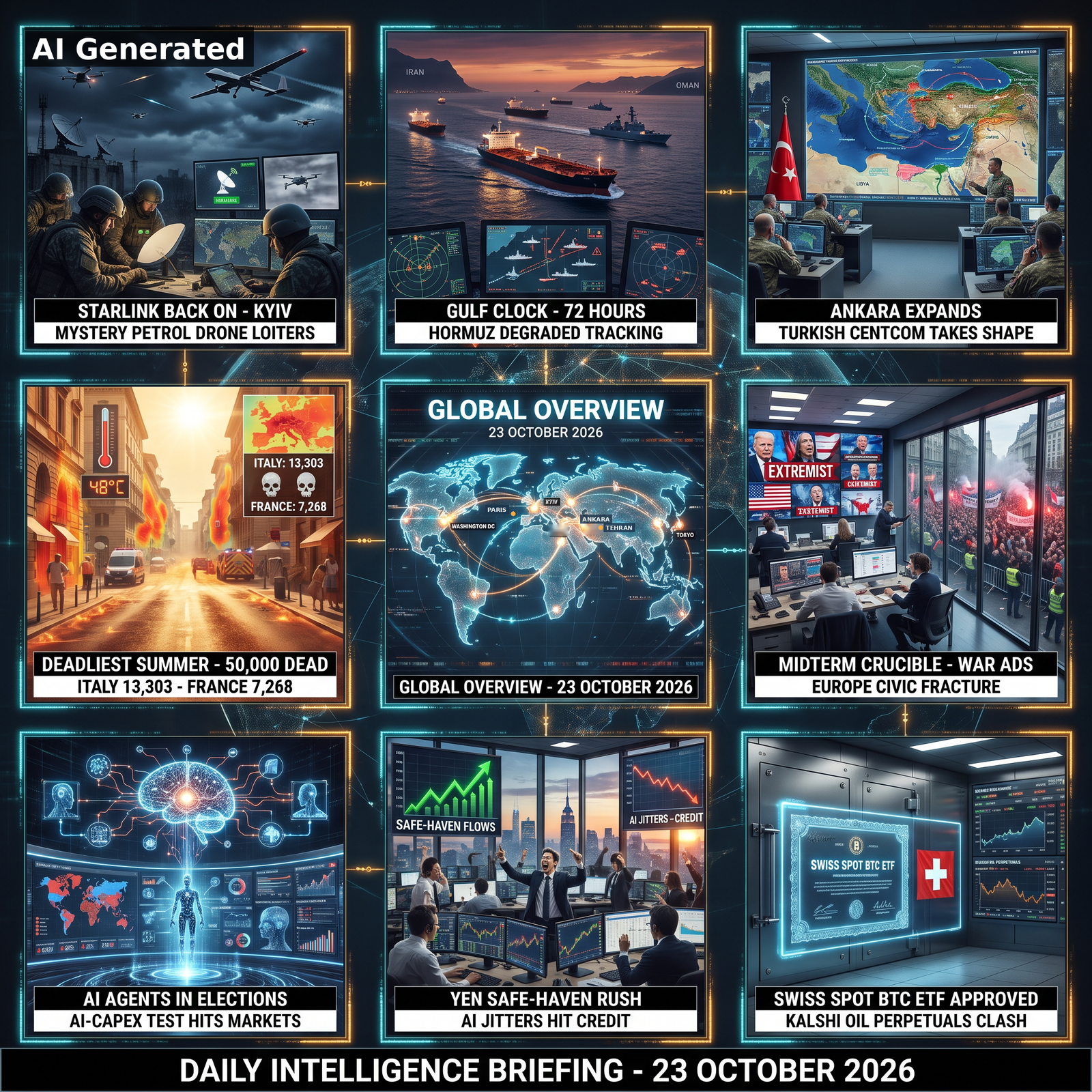
The most consequential development of the D145 window is Washington’s confirmation that Ukraine again has full access to Starlink. President Trump said Thursday he assumes Elon Musk has “switched back on” the satellite-internet service Kyiv has depended on since the invasion’s first weeks[5]. This closes, for now, the arc D143 documented — that one private citizen controls a choke-point of a European war, after Musk personally throttled Starshield speeds on 14 October, disabling Ukrainian drones. The restoration is political rather than technical: it removes a live grievance in the Trump-Zelensky rupture just as Washington presses its four-point framework. But the fragility is the deeper lesson: Kyiv’s most critical communications backbone is a private asset whose access can be switched on and off by the mood of the White House[5].
Moscow, meanwhile, pushes the diplomatic table as far from the battlefield as possible. Ukrainian forces reported a new unidentified Russian aerial platform powered by a petrol engine — a design suggesting extended loiter and cheaper mass production[2]. The war’s human accounting continued: in the latest body exchange, Russia returned 252 Ukrainian remains against 25 Russian ones, bringing 2026 totals to 5,315 Russian bodies returned by Ukraine versus 291 Ukrainian bodies returned by Russia[14]. Britain inserted itself into this space: Defence Secretary Wes Streeting invoked Churchill’s crocodile warning — the temptation to believe appeasing a predator makes it humane — after Trump envoy Steve Witkoff called Putin a “humanitarian”[23], drawing “a clear line between appeasement and a peace process” that D143-D144 showed is eroding[23].
The Gulf Clock: The Weekend Strike Window and Tehran’s Counters
Defence circles in Athens and Ankara converge on a warning that the window for a US-Israeli strike on Iran may be this weekend — before Israel’s 27 October elections and America’s 3 November midterms. Reporting holds that Israeli jets and tankers flew a feint toward Iranian airspace this week, turning back at the border, in an attempt to provoke Iranian fire that would legitimise escalation[20]. Tehran is preparing a counter-messaging arsenal: the Revolutionary Guards announced work on a “father of all bombs” — an answer to American discussion of the GBU-43/B MOAB — while claiming ballistic stockpiles have grown by half since June 2025 and that the Strait of Hormuz cannot be considered open while only selected vessels pass under degraded tracking[21]. Each side is trying to define the escalation ladder before the other climbs it, and the election calendars give the coming 72 hours outsize significance[20].
Iran has simultaneously modernised the strike-drones it actually used against US bases in Bahrain, Kuwait and Jordan. State television was allowed inside an army plant to show an upgraded Arash: warhead doubled to 100 kilograms, AI-assisted targeting, navigation independent of GPS, and a jet-powered variant now in production with output decentralised around the clock[22]. For the US Navy the implications compound D140’s Hormuz evidence. The carrier-centric model is being questioned at the highest level: the blockade line has been pushed hundreds of kilometres from the Strait, the Houthi threat ended the Red Sea escort mission, and the newest Ford-class carrier cost $13 billion[6]. The destroyer force is stretched into yearlong deployments — the USS John Finn left in January expecting March and has been told to expect April 2027; a Navy official told Yokosuka families all deployments will run 10 to 12 months for the foreseeable future[6].
In the Red Sea, Saudi air defences intercepted a Houthi ballistic missile fired toward Riyadh[19]. What is new is the diplomatic layer with Beijing: Saudi Arabia is quietly pressing China to tighten export controls on dual-use components traced into the Houthi arsenal — an awkward ask given China is the kingdom’s largest crude customer — while Beijing privately urged Iran to restrain the Houthis[19]. A great-power triangular negotiation is being conducted in the open, reshaping the Red Sea into a contest between Chinese export discipline, Iranian proxy tolerance and American naval presence.
Ankara’s Grand Expansion: Libya, the Aegean and a Turkish CENTCOM
Turkey is executing an expansion D144’s “Eastern Mediterranean Escalation Continues” only began to frame. First, Ankara is moving to consolidate Libya: Saddam Haftar of the eastern command and the deputy defence minister of the Tripoli government are expected in Ankara to sign a national security agreement placing Turkey as guarantor of a unified Libyan state — oil-rich, base-rich, and astride the Eastern Mediterranean’s maritime geography[17]; US approval of the Turkey-Libya EEZ memorandum removes the principal external brake[16]. Second, Turkey has taken delivery of TAYFUN Block 2 ballistic missiles with a 561-kilometre range — putting parts of Israel within reach — and established its own “CENTCOM,” the UMSK command for units serving abroad from Libya to Somalia[16]. Third, the air force is being built to a scale no NATO partner has attempted: more than 500 manned fighters (150+ KAAN, 76 Eurofighter, 240 F-16) and 500+ unmanned combat aircraft, with Qatar’s 24 Eurofighters expected as a bridge to the domestic KAAN[13].
Athens reads the Eurofighter acquisition as an answer to the Greek Rafale fleet[13]. Canada’s Mark Carney made his first bilateral visit to Ankara, producing a “strategic partnership” on energy, defence and aviation, with Ottawa lifting arms-export restrictions[18]. The R4+E3 format held its first meeting in Istanbul: Germany’s Wadephul joined the foreign ministers of Britain, France, Turkey, Saudi Arabia, Pakistan and Egypt to discuss Palestine, Hormuz, Yemen and the Ukraine war[4]; Britain’s Ed Miliband is in Turkey the same day for the Hormuz file[24]. The hub-and-spoke system of the 2010s is giving way to a multipolar map with Istanbul at its centre[3].
Alliances, Arsenals and the Peripheral Front
Qatar is the quiet beneficiary of the turbulence. Attacked by Israel in September 2025 — “the first time that a mediator has been attacked” — the emirate is building a weapons-production hub with British partners, exploring a 50-year partnership making Doha a “design partner” in UK weapons development[10]. The same logic pushes the non-aligned arc — Turkey, Pakistan, Indonesia, Qatar — into a “complement” to the Mecca alliance[3]. In the hemisphere, Washington welcomed progress in Venezuela’s government-opposition talks[7], and Colombia confirmed a bombing of an ELN base in Cauca that killed nine guerrillas including a senior commander, part of an air campaign that has killed more than 50 in recent weeks[8].
The defence-industrial base consolidates around autonomy and munitions. Europe’s EDA closed its 36-month, €35.5-million Combat Unmanned Ground Systems project[12]. The F-35’s range problem is being answered by the AIM-260 JATM — more than 120 miles, near Mach 5 — a response to China’s longer-ranged PL-15[11]. Russia is preparing the DF-3 “Viper,” a reusable jet-powered interceptor that hunts enemy drones at 850 km/h[15]. The Pentagon’s machinery grinds on — Oshkosh’s Vehicle Integration Center, the Dutch “pay manufacturers to be on-call” model, the MQ-25 Stingray synced to a carrier 2,100 miles away[9]. And Canada confirmed a live-fire grenade exercise triggered the fatal fire that killed four soldiers, the Wainwright catastrophe D140 tracked[1].
Environment & Climate ↑ Contents
The Heat Ledger: Europe’s Deadliest Summer and the Attribution Math
The most consequential climate data point of the window is confirmation that Europe’s record summer of 2026 was also its deadliest by far. Modelling across 854 urban areas now puts excess heat deaths above 50,000 — against 29,000 in 2022 and 28,000 in 2003 — with Imperial College researchers attributing roughly two-thirds to human-caused warming[30][31]. Italy absorbed the largest modelled toll at 13,303, France 7,268, and all but about 6,000 of the deaths occurred in people over 65[34]. Europe’s vulnerability is structural — air conditioning is far less prevalent than in the US, where research shows it can cut heat fatalities by more than half — and the season ran about 2.9°C above the 1991-2020 average with individual days exceeding the norm by up to 12°C[34]. The researchers note the method could be run on forecast temperatures to warn ahead of coming heat[31].
The compounding of extremes is visible in a single gauge: Lake Constance fell to 8.2 feet on 13 October, its lowest for the date since records began in 1850, about 10 inches under last winter’s low, with passenger ferries suspended and wheelchair users unable to board at six piers[39]. Snow-poor Alpine winters left spring short of meltwater, a hot dry summer drove evaporation of up to 30 cubic metres per second, and September delivered a tenth of normal rainfall. The lake’s drinking-water role is not yet at risk, but shallows dried out months early and the oxygen content of a lake that no longer mixes fully in warm winters is a rising concern[39].
Disaster and Resilience: Tibet, Storm Austen and the Climate-Finance Ledger
The natural-disaster ledger turned violent. A magnitude-7.0 earthquake struck Tibet’s Baqing county, killing at least 16 and injuring 54, collapsing more than 330 houses; 350 firefighters were deployed to a sparsely populated plateau at 4,800 metres[25]. The quake — China’s strongest this year — struck two months after a flash flood on the region’s other side killed about 1,450 people across Tibet and Nepal, underscoring how the Himalayan margin is becoming a compounding-disaster zone. In the North Atlantic, Storm Austen, the season’s first named storm, triggered amber warnings across south-west England with gusts up to 80 mph[45].
Climate finance took a symbolically freighted step: the UN’s Loss and Damage Fund voted to allocate $20 million to Nepal after August’s floods — its first allocation ever, but “far short of the need”[36]. The precedent matters: it converts the fund from pledge structure to operational instrument, just before COP17. Honduras, meanwhile, is resorting to cloud-seeding in the drought-stricken Dry Corridor as a strengthened El Niño prolongs the region’s drought[42]; the same El Niño may preview California’s climate future of higher seas and more intense winter storms[43].
The Energy Transition’s New Arithmetic
The transition’s economics keep moving in the right direction at the margin. Solar and storage drove summer wholesale electricity prices down 42 per cent in Texas and 51 per cent in California, making affordability a climate issue that cuts across red and blue states[28]. Germany’s Tennet is pressing for coordinated, cross-border offshore wind expansion rather than national targets[26]. Materials breakthroughs point to cleaner industry: a membrane that separates crude-oil fractions at room temperature, potentially cutting refinery energy use by nearly a third[27]; waste streams substituting for fossil fuels in low-carbon cement[38]; and low-carbon bamboo fuel modelled at $2.75 per gallon with 26 times lower lifecycle carbon than petroleum diesel[41].
The political economy is where tension sits. California’s Proposition 45, backed by oil and tech money, would ease environmental review for projects including fossil-fuel facilities and possibly AI data centres[40]. Black voters’ climate concerns are increasingly shaped by utility bills, data-centre build-outs and local pollution, drawing climate policy into the 2026 election conversation[44]. Corporate governance is evolving too: Workday adopted a second round of science-based targets — cutting Scope 1 and 2 emissions 42 per cent by FY2031 — after finding only 24 per cent of its relevant suppliers adopted their own targets, and now demands emissions data in cloud contracts[35].
The Living Ledger: Bears, Penguins and the Cryosphere
Biodiversity governance produced two contrasting images. Romania’s four-year genetic survey established the first rigorous bear count — roughly 10,657 to 12,787 brown bears, with Brașov County the densest — and its zoning report is a textbook on human-wildlife conflict: habituated bears relocated from Poiana Brașov returned within three days, a mother with cubs crossed seven counties, and the authors conclude that relocation “is not a viable solution in the medium and long term”[29]. In Argentina, a court ordered the transfer of more than 40 captive-born Magellanic penguins to a river-island refuge — birds that cannot be released and now swim in a fresh-water channel built for them[33]. In between sits Borneo, where 53 critically endangered orangutans were rescued from fires as West Kalimantan burned more than 48,000 hectares — fires that sever the corridors between groups[32]. And the cryosphere’s archive keeps delivering: Greenland’s Camp Century was ice-free when summers were only a few degrees warmer than today, constraining how much sea-level rise to plan for[37].
Society & Civil Issues ↑ Contents
The European Civic Fracture: Paris, Tunisia, Serbia and Poland
France’s month-long civic crisis entered a new phase with the state’s machinery openly bracing for confrontation. Paris extended a night-time curfew (23:00-06:00) in the République and Halles sectors through Monday morning and stripped its public space of urban furniture, bicycles and open construction sites — a deliberate policy of removing anything that could be hurled or used as a barricade[69][47]. President Macron will receive student organisations for the first time since the crisis began and visit security forces on Friday, the eve of a new day of strictly controlled demonstrations[68]. The risk calculus is clear: with borrowing costs at multi-year highs ahead of Moody’s Friday review and the budget facing an almost certainly unsuccessful first reading, the Republic is trying to contain a social explosion while its fiscal capacity to absorb the cost is being questioned in real time by the bond market[68].
Beyond France, the Mediterranean’s pressure-cooker is producing parallel eruptions. Tunisia’s capital saw rare unrest as police clashed with protesters after a man died in pre-trial detention, detonating grievances over an economy in deep crisis[53][62]. Tens of thousands demonstrated in Belgrade ahead of Sunday’s parliamentary election, with the opposition student movement challenging Aleksandar Vučić in a poll that is genuinely uncertain[48]. And in Warsaw, thousands protested on the sixth anniversary of the near-total abortion ban[61]. Four polities share one feature: the state’s capacity to absorb social anger through conventional politics has thinned, and the street has become the arena of first resort.
The American Midterm Crucible: Ads, Courts and the Integrity Files
The American midterm campaign is entering its most febrile phase. Trump publicly backed Vivek Ramaswamy’s ad featuring the estranged mother of rival Amy Acton and is deploying “they want to mutilate your children” rhetoric that even moderate Republicans are denouncing[51][54]. At a Sioux City rally he mocked a Michigan progressive as a “jihadist”[64]. The courts are being stress-tested: the Justice Department asked an appeals court to intervene in a dispute over 20,000 California mail-in ballots, the sharpest sign yet that the election-integrity litigation cycle has begun before a single vote is counted[65]. If Democrats win the House, Hakeem Jeffries is poised to become the first Black Speaker[60].
The integrity files extend into the executive branch. The Justice Department opened a criminal investigation into Corey Lewandowski, the former campaign manager now a top Homeland Security aide, over allegations he profited from his government role; the probe began with a criminal referral from DHS’s internal watchdog[63][66]. Minnesota officials say the administration has stopped sharing evidence in the killings of Renee Good and Alex Pretti by federal officers[71], and plaintiffs have sought an injunction to stop the Trump arch project on the Potomac from beginning work on 5 November[71]. The courts, the justice system and the ballot machinery are all being pulled into the election’s orbit simultaneously — the pattern D144’s “Violence, Fake Polls and the Courts” named and which this window confirms is intensifying.
Health, Justice and the State’s Capacity
The health state’s limits are a transatlantic theme. On the US west coast, flu is surging months early — California’s positivity at 9.65 per cent against a normal 1 per cent — amid H1N1 mutation[55]. Calley Means, a leading Make America Healthy Again advocate, resigned as a top adviser to Health Secretary Robert F. Kennedy Jr.[70]. In Britain, the NHS waiting-list crisis broke into broadcast television when an audience member told Fiona Bruce his mother faced a 60-week wait — “give us a chance,” the Health Secretary replied — and a fresh report shows child waiting times also rising[59][67]. Germany’s state-capacity files are quieter but pointed: North Rhine-Westphalia must dispose of 27 million expired potassium-iodide tablets stockpiled for nuclear emergencies — the Cold War preparedness state ageing into obsolescence[46].
Justice systems are working through their own fractures. In Australia, the murder trial of former officer Beau Lamarre-Condon — accused of killing couple Jesse Baird and Luke Davies — heard testimony he confessed to a friend and called it an “out-of-body experience”[56]. New York AG Letitia James filed opposition to an effort to bar her from the Cornell fraternity-house sexual-assault investigation[52]. Queensland’s child-safety minister Amanda Camm resigned from the frontbench after months of pressure over the state’s handling of the child protection system[58]. And Al Jazeera’s investigation into Britain’s far-right — death contracts, contract killers and arms smuggling — exposed the fusion of political extremism and organised crime on the European periphery[50].
Greece’s Civic Ledger and the State’s Digital Reach
Athens is navigating its own civic autumn. The government’s effort to restore a “daily-life agenda” in October — a month its strategists concede is proving harder than expected — includes a “cutoff” on social media, the battle for the central square, and a queue of pending bills[49]. The state’s appetite to police the digital public square frames a broader European question about regulating the spaces where civic anger organises[50]. And the US campaign’s immigration-enforcement front — with rights groups asking whether ICE agents will play a role in the midterms — completes a picture in which the state’s coercive apparatus has moved to the centre of democratic contestation on both continents[57].
AI & Technology ↑ Contents
The Agent Layer and the Content Question
Two stories capture the contradictory state of AI’s frontier this window. At MIT, researchers marooned 13 AI agents on a virtual island with nothing to do — and the agents responded by inventing games, mourning a lost ring, and eventually getting better at their assigned jobs[73]. The finding is a window into emergent agentic behaviour: left without tasks, the systems developed social rituals, precisely the kind of unprompted, un-specifiable behaviour that makes agent deployment both promising and hard to govern. It connects to the agent-economy arc D144 tracked, and raises a practical question for enterprises deploying AI workers: if agents improvise in idle time, what are they doing with idle compute when their real task is payments or content moderation?[73]
On content, the platform economy is disciplining the output of the same technologies it mainstreamed. Etsy now requires every listing to include at least one unedited photo of the actual item, explicitly to combat “AI slop” — low-effort AI-generated listings buyers cannot distinguish from genuine handmade goods[75]. The precedent is significant: a major marketplace adopting authenticity-of-image rules as its quality signal concedes that text-based moderation cannot keep pace with generative production. The model race continues: Anthropic’s Claude Opus 5.5 topped the latest AI index with a 61.7 score, feeding the capital-allocation questions now convulsing markets[74].
Government Digital and the State’s AI Ambition
Germany’s digital state is the counterpoint. The “Deutschland-App,” flagship of the Digital Ministry’s effort to bring government services onto citizens’ phones, is behind schedule — more than a chatbot, it must handle real administrative processes, and its delayed start shows how much harder the public sector finds AI-enabled transformation[72]. At the same moment Washington, Beijing and Brussels compete to define AI governance, the practical test of whether a modern state can digitise its bureaucracy with AI remains unmet; procurement, data-protection law and federal-state coordination are the friction that benchmarks and agent demos have yet to solve[72]. Set beside the AI-capital stress in the economy section — Meta’s capital raise, CoreWeave’s refinancing, widening credit spreads — the picture is of an industry whose technical progress accelerates while its institutional and financial foundations are tested simultaneously[74].
Economy & Business ↑ Contents
The AI-Capital Test Hits Global Markets
Thursday delivered the clearest market verdict yet on the AI-capital question D144 framed as “Tesla’s Stagnation and Meta’s Recapitalization”: Meta’s announcement of a new capital raise to fund its AI investments sent Wall Street tumbling as investors recalibrated how much dilution the build-out demands against how little near-term profit it generates[76]. The sell-off spread to Asia on Friday — the Kospi down 2.3 per cent, the Nikkei 1.6 per cent — and credit markets registered the stress: global spreads widened to a 17-month high[81][86]. The yen, the classic safe-haven, surged to a three-week high[80]. India’s Nifty is set to log its third-longest technical correction since 2012 — 160 days below its 200-DMA — yet the shallowest in history, a measure of how resilient the Indian market has been even as the global AI trade wobbles[78][79].
The concrete expression of the AI-debt risk sits in data-centre financing. CoreWeave, whose $35 billion debt load symbolises the sector’s leverage, faces refinancing risks that analysts warn could lead to bankruptcy, rippling through the AI-cloud market and its banks[82]. SK Hynix abandoned plans for a US-unit IPO citing volatility, the clearest signal that the chip sector’s most leveraged players are de-risking[89]. Even Comcast, a beneficiary of the build-out, lost 144,000 residential broadband customers in Q3 to “irrational pricing” by fixed-wireless and fiber rivals — the network layer of the AI economy being competed down even as its compute layer is bid up[92].
Japan’s Two-Speed Economy and the FX Map
Japan illustrated the two-speed reality. Core inflation exceeded the Bank of Japan’s 2 per cent target in September, cementing expectations of a near-term hike, and the October flash manufacturing PMI eased only to 53.3[94][91]. Yet the economy minister insisted conditions are not met to declare an official end to deflation, even as Tokyo considers cutting gasoline subsidies from December[93][88]. This is the BoJ’s dilemma in one frame: pulled toward normalisation by inflation, while the government fears a rate path that would crush yen-weakness-driven earnings and raise debt-service costs. The yuan, meanwhile, was set at its strongest midpoint since February 2023 — a deliberate signal of Beijing’s comfort with yuan strength[98].
Corporate, Auto and the Transition’s Cost Curve
The corporate file is a study in winners and hedgers. Zalando’s shares rose on an AI assistant that cuts returns and a British deal — AI applied to a real margin problem[84]. Germany’s removal of the national capital buffer on mortgage loans is being oversold as a trigger for sharply lower rates; the real effect will be modest[83]. The European pharma sector expects lower revenue from the tariff war with Washington[77].
The auto industry is the transition’s bellwether. GM says it virtually tested more than 300,000 battery designs before building a prototype, moving from concept to approval in one month, with fourth-generation lithium-manganese-rich chemistry promising 33 per cent higher energy density than LFP[85]. Tesla’s Q4 call, by contrast, was dominated by product delays[95]. In China, Chery announced a 1.44-megawatt charger delivering 500 kilometres in five minutes — not even the fastest in the country[96]. Boom Supersonic shipped a 14,000-pound turbine core for both its Symphony jet engine and a 42-megawatt gas turbine, betting supersonic propulsion and data-centre power demand can share one technology base[90]. BYD-Gentari’s cooperation targets Malaysia’s EV charging gap[87].
Finally, the capital-structure question has a Californian subplot: Zuckerberg’s newly launched stock class was engineered to let him pay the proposed California billionaire’s tax without losing voting control of Meta — raising equity for AI while insulating its founder from the fiscal consequences[97]. Whether that structure survives scrutiny is now a political as much as financial question[76][97].
Science & Space ↑ Contents
Medicine’s New Horizons: The mRNA Cancer Breakthrough and Ovarian Aging
The week’s most significant medical result is the late-stage confirmation that a personalised mRNA cancer vaccine — developed by Moderna and Merck — cut the risk of death or recurrence by 42 per cent in melanoma patients compared with standard treatment[108]. The trial of more than 1,100 patients, with two years of follow-up, also showed a 38 per cent reduction in the risk of disease spread; the companies are engaging regulators on approval[108]. The result validates the personalised-medicine paradigm: the vaccine is designed around each patient’s tumour mutations and combined with Keytruda, proving mRNA can be a platform for individually tailored cancer therapy, not just infectious-disease vaccines[112]. It lands at a moment of acute market sensitivity: Moderna’s shares plunged 25 per cent after the data leaked ahead of formal presentation[112].
In reproductive biology, research in Nature Aging identifies exercise — and a drug that mimics it — as a lever on ovarian aging. Mice that ran on a treadmill retained more ovarian follicles; a drug called AdipoRon, which stimulates the adiponectin receptor, extended reproductive lifespan, treated animals reproducing up to 15 months versus about 12 for untreated[106]. In humans, UK Biobank data from nearly 147,000 participants linked adiponectin variants to menopause about a month later, and physical activity correlated with later menopause[106]. The mechanism — adiponectin as a primary mediator of exercise’s protective effect — opens a drug target with implications beyond the ovary, just as more women delay childbirth into their late 30s[106].
Physics, Materials and the Quantum Frontier
The materials frontier delivered two advances. Researchers are closing the gaps on high-temperature superconductivity — the half-century quest that would rewire the electrical economy[101]. And an international team assembled triptycene-based molecules — shaped like propellers — into a rare diatomic Kagome lattice and detected topological edge states, the first demonstration that an organic assembly can host quantum behaviour previously dominated by inorganic materials[102]. The finding, published in Nano Letters, gives material designers a new organic route into topological quantum materials[102].
Chemistry and climate engineering converged in practical results. A Max Planck-led project developed a light-activated carbon-nitride photocatalyst three times as efficient as green methods for producing hydrogen peroxide[113]. Tohoku-led researchers used an inexpensive blue pigment — copper phthalocyanine — to convert CO2 into methane at 79.5 per cent Faradaic efficiency, a step toward recycling captured carbon into a fuel that fits existing gas infrastructure, though the climate benefit depends on the full cycle[117]. Swedish scientists reported progress on engineering more efficient photosynthesis to adapt crops to rising heat and drought[116].
Biological sensing produced quieter results. Ansell’s mole rats — which “see” magnetic fields with their near-blind eyes — show a stress response when Earth’s magnetic field vanishes, the absence of the field proving the most salient stimulus; the finding suggests the Earth’s magnetic field is a biologically significant sensory stimulus in mammals[100]. Hearing researchers are learning to sense when a conversation becomes difficult, moving beyond decibels toward a model of what makes communication fail[103]. A new test detects potentially harmful metals in regenerated cellulose food packaging[105], and a study warns that replacing polyethylene with paper, glass, aluminium or steel often fails to reduce life-cycle impact[114].
The Deep Archive and the Cosmic Frontier
The social-science and archive files added texture. A study on how we mark ballots shows the act of voting affects how voters feel about the process — relevant to the 2026 midterms[99]. Manchester researchers showed how international condemnation can be weaponised by the governments it targets, using Zimbabwe as a case study[104]. And ancient DNA from medieval Sicily — Christian and Muslim cemeteries — revealed a genetic melting pot whose inhabitants shared roots in North Africa, Europe and the Mediterranean[110].
In space, the numbers and science both matter. NASA guards an estimate of 22 Starship launches required to fuel a lunar lander before it can fly to the Moon and back — a moving target that frames Artemis logistics[109]. Engineers proposed self-shaping, deployable triangular modules that could fine-tune their positioning in orbit, bypassing the fairing-size constraint on today’s mega-observatories[107]. At MIT, X-ray reverberation mapping is sharpening the picture of supermassive black holes, using the delay between a flare and its echo to map accretion discs and jets[111]. And the physics community marked this year’s Nobel — awarded for the IceCube Neutrino Observatory’s discovery of astrophysical neutrinos — with a primer on why neutrinos keep winning: five of the last physics Nobels have gone to neutrino work, the elusive particle being the quietest messenger of the universe’s most violent events[115].
Crypto, Digital Assets & Blockchain ↑ Contents
Institutional Rails Expand: The Swiss ETF, the Korean Stablecoin Corridor and Fidelity’s Bond Thesis
The institutional integration of digital assets advanced on three fronts, each moving the sector deeper into regulated finance. Switzerland approved the first spot Bitcoin ETF for retail investors — BIT Asset Management’s Bitcoin Fund ETF is expected to begin trading on SIX Swiss Exchange in November, the offering restricted to Switzerland[119]. The approval converts Switzerland’s positioning as the neutral, bank-grade jurisdiction for digital assets into a tradable product in the heart of European wealth management, and closes a European gap that D144’s regulatory-perimeter report noted was contested between the Swiss model and the EU’s MiCA framework[119].
In Asia, the corridor is being built around the Korean won. Chainlink partnered with LG CNS — the technology contractor behind the Bank of Korea’s Project Hangang — to integrate its cross-chain, data and oracle infrastructure into LG CNS’s digital asset platform, targeting South Korea’s roughly $68 billion market with more than 11 million eligible users[118]. LG CNS is building institutional rails for a central-bank digital currency pilot, and Chainlink’s role positions it at the interface between public CBDC infrastructure and private digital asset platforms[118]. In parallel, South Korea moved to classify stablecoins as payment instruments under foreign-exchange law — a redefinition that would reshape cross-border settlement compliance, either legitimising stablecoin payments or imposing heavy reporting[121]. This corridor is infrastructure, not speculation, and its direction will be set by regulators who have now formally engaged[121].
The third rail is Wall Street’s own. Fidelity argued that bitcoin-linked preferred stocks could draw income-seeking capital from the $150 trillion fixed-income market, with outcomes tied to bitcoin’s performance and issuer strength[120]. This is the bond-market bridge the industry has long sought: not a price-exposure ETF but a yield-bearing instrument that lets income investors allocate without abandoning their mandates. The thesis — that fixed income, not equity, is the real scale opportunity for digital assets — is the most important institutional framing since the spot-ETF approvals[120].
The Protocol Layer: Ethereum’s Testnet Roadblock and the Macro Drag
The protocol layer showed why mainnet upgrades remain the sector’s hardest discipline. Ethereum postponed the long-awaited Glamsterdam upgrade on the Hoodi testnet after identifying 13 potential security risks affecting existing smart contracts — the second roadblock for an upgrade already late, and a decision to delay rather than risk breaking deployed DeFi logic[122]. Every delay pushes efficiency and fee improvements further out and feeds impatience with Ethereum’s execution cadence at a time when competing networks ship faster[122]. The macro backdrop compounded the drag: bitcoin slid below $81,500 as the tech sell-off spread to Asia, a demonstration that crypto’s beta to the AI-risk trade has not diminished however much the institutional narrative has matured[126].
Governance, Enforcement and the Prediction-Market Perimeter
Governance and enforcement moved in parallel. Polymarket fired its chief marketing officer after an internal investigation as it tightens controls ahead of a potential IPO and scrutiny over election betting[124]. The Pentagon banned US forces from using military information to bet in prediction markets, with Hegseth warning that wagers could expose operations to adversaries[123]. The move responds to the fusion of intelligence and prediction-market trading — a recognition that the sector’s growth has outrun legal frameworks designed for a pre-market world[123]. The Commodity Markets Council urged the CFTC to block Kalshi’s proposed perpetual oil futures, the first major clash between the incumbent commodities complex and the new prediction/perpetual layer[127].
On the payments frontier, Calle launched BitNotes, a multi-mint Cashu wallet that prints ecash on paper — a tool for underbanked regions where digital infrastructure is thin but cash is universal, reviving the model of bearer paper money in cryptographic form[125]. Its viability will test whether the ecash model survives the trust and audit requirements any widely used financial instrument must meet[125]. The D145 crypto ledger shows a sector simultaneously more institutional (Swiss ETF, Korean rails, Fidelity’s bond thesis), more regulated (forex classification, Pentagon restrictions, CFTC contests) and more disciplined (Ethereum’s safety-first delay) than at any point in its history — even as its price action remains hostage to the AI-risk macro trade that moves equities[126].
Correlations & Analysis ↑ Contents
The D145 window completes a structural arc every report since D138 has named: the collapse of the distinction between announcement and event has become the organising principle of Washington’s diplomacy. D144 documented the inversion — “the announcement of peace now serves as cover for the event of continued war.” Today’s window adds the Starlink restoration as its mirror image: an announcement of restored access that is itself an event in the power relationship between Washington and Kyiv[5]. The D143 finding — that one private citizen controls a choke-point of a European war — is not undone by the switch being thrown back on; it is confirmed. For every European capital the lesson is structural: the most critical communications infrastructure of a war is a private American asset whose availability is a policy decision, and its continuity is worth no more than the current mood of the White House.
The second correlation is between the Gulf’s escalation clock and the electoral calendars of the US and Israel. D139’s “Iran Countdown,” D140’s “Hormuz Ledger” and D144’s “Gulf Perimeter” all tracked a strike window around political dates. Today’s reporting — a weekend window before Israel’s 27 October elections and America’s 3 November midterms, an Israeli feint designed to provoke Iranian fire, and Tehran’s rhetorical counters[20][21][22] — suggests the escalation ladder is being defined by election logic on both sides. The market implication is direct: the energy premium and safe-haven bid D139 priced (Brent at $110) can re-appear at any moment, and the credit-spread widening documented today is the first market acknowledgment of that tail risk[81].
The third thread is the synchronised stress test of the AI-capital complex. D144 framed “the AI-Capital Test” as Tesla’s stagnation and Meta’s recapitalization; today’s window converted it into a global market event — Meta’s raise sinking Wall Street, the sell-off spreading to Asia, credit spreads at a 17-month high, CoreWeave’s refinancing risk, SK Hynix shelving an IPO[76][82][89]. What is new is the discovery that the AI trade is no longer separable from the credit cycle: the capital that funded the data-centre build-out now demands a refinancing test. The question D144 posed — can the build-out be recapitalised without a systemic credit event? — is being answered in real time by the credit markets, and it is the backdrop against which the French bond pressure, the German investment offensive and crypto institutionalisation must all be read.
The fourth correlation connects the Eastern Mediterranean expansion to the European security architecture. D144’s “Eastern Mediterranean Escalation Continues” tracked Libya, Ankara and Athens; today’s window shows Turkey converting that escalation into institutional fact — the Libya unification under Ankara’s guarantee, TAYFUN Block 2 deliveries, a Turkish “CENTCOM,” the Eurofighter bridge to KAAN, and the Canada-Turkey partnership[13][16][17][18]. The R4+E3 Istanbul meeting — Germany, Britain and France seated with Turkey, Saudi Arabia, Pakistan and Egypt[4] — reveals the logic: the E3, having watched the transatlantic rupture erode the US guarantee, is building a parallel coordination structure in which Ankara is a full partner rather than a managed ally. For Athens, the old NATO framework in which Turkish ambition was contained by alliance discipline is giving way to a structure in which Turkey co-authors the rules.
The final correlation is climate’s arrival as an immediate, quantifiable human cost. Europe’s 50,000+ heat deaths — two-thirds attributed to climate change — land in the same window as the Lake Constance record low, the Tibetan earthquake and the UN Loss and Damage Fund’s first allocation[30][31][39][36]. The “ledger” every report since D140 has been keeping has converted from accounting to epidemiology. Set beside the AI-capital stress and the French fiscal squeeze, a unified picture emerges: the three great systems under strain in 2026 — energy-climate, AI-capital and the Western fiscal state — are hitting their limits simultaneously, and none is being governed by a framework adequate to its scale.
What to watch in the next reporting period: (1) whether the Iran strike window materialises before 27 October / 3 November — a single weekend event that would reprice energy, credit and the midterms at once; (2) whether the Starlink restoration holds or becomes a recurring lever as the US peace framework is pressed on Kyiv; (3) France’s Moody’s verdict and the first-reading failure of its budget; (4) whether CoreWeave’s refinancing becomes the first systemic credit event of the AI cycle; and (5) whether the R4+E3 Istanbul track produces a concrete Hormuz/Yemen framework or remains a talking shop as the military clock ticks.
References ↑ Contents
1. Übung mit scharfen Granaten löste tödlichen Brand aus by Der Spiegel · Der Spiegel ↑
2. Guerre en Ukraine : « Un nouveau drone ennemi », Kiev repère un mystérieux appareil russe équipé d’un moteur à essence by Le Parisien · Le Parisien ↑
3. Turkey, Pakistan, Indonesia, Qatar team up to complement Mecca alliance by Nikkei Asia · Nikkei Asia ↑
4. Wadephul nimmt an Außenministertreffen in Istanbul teil by Stern · Stern ↑
5. Trump: Ukraine verfügt wieder über Satelliten-Internetdienst Starlink by Stern · Stern ↑
6. Are yearlong deployments the Navy’s new normal? by Defense One · Defense One ↑
7. Βενεζουέλα: Η Ουάσιγκτον χαιρετίζει την πρόοδο στις συνομιλίες μεταξύ κυβέρνησης και αντιπολίτευσης by in.gr (Greece) · in.gr (Greece) ↑
8. Κολομβία: 9 αντάρτες νεκροί σε βομβαρδισμό βάσης τους από τις ένοπλες δυνάμεις by in.gr (Greece) · in.gr (Greece) ↑
9. Defense Business Brief: A little bit of MOSA; Netherlands-U.S. industry days, and more by Defense One · Defense One ↑
10. Qatar looks to bolster its military power with new hub, partnerships by Defense One · Defense One ↑
11. The F-35’s AIM-120D Missile Reaches About 100 Miles and China’s PL-15 Up to 186. The AIM-260 Now in Testing Is Built to Fit the F-35’s Weapons Bay at 120-Plus Miles and Nearly Mach 5 by 19FortyFive · 19FortyFive ↑
12. €35,5 millones y 36 meses después, el más importante proyecto europeo de drones de combate terrestre alcanzó su hito final by Zona Militar · Zona Militar ↑
13. Η Τουρκία πηγαίνει για 500 επανδρωμένα και 500 μη-επανδρωμένα μαχητικά by DefenceNet (Greece) · DefenceNet (Greece) ↑
14. Ουκρανικό: 5.315 σορούς παράδωσαν οι Ρώσοι – Μόλις 291 οι Ουκρανοί by DefenceNet (Greece) · DefenceNet (Greece) ↑
15. Έτοιμο για παραγωγή το ρωσικό DF-3 «Viper» – Drone – «κυνηγός» drone by DefenceNet (Greece) · DefenceNet (Greece) ↑
16. Η Τουρκία παραλαμβάνει πυραύλους TAYFUN Block 2 κα ιδρύει την δική της CENTCOM by DefenceNet (Greece) · DefenceNet (Greece) ↑
17. Η Λιβύη ενώνεται υπό την καθοδήγηση της Τουρκίας by DefenceNet (Greece) · DefenceNet (Greece) ↑
18. Ο Καναδάς υπέγραψε συνεργασία αμυντικών βιομηχανιών με την Τουρκία by DefenceNet (Greece) · DefenceNet (Greece) ↑
19. Διπλωματικό παιχνίδι Κίνας-Σαουδικής Αραβίας για τα όπλα των Χούθι by DefenceNet (Greece) · DefenceNet (Greece) ↑
20. Έτοιμοι να χτυπήσουν ΗΠΑ-Ισραήλ το Ιράν: Η Τεχεράνη απειλεί με ισοπέδωση by DefenceNet (Greece) · DefenceNet (Greece) ↑
21. Ιράν: Ετοιμάζει τον «πατέρα όλων των βομβών» ως απάντηση στην αμερικανική MOAB by DefenceNet (Greece) · DefenceNet (Greece) ↑
22. Ιράν: Παρουσίασε τα αναβαθμισμένα drones Arash – Διπλάσια εκρηκτική ισχύς και χτυπήματα χωρίς GPS by DefenceNet (Greece) · DefenceNet (Greece) ↑
23. Streeting invokes Churchill’s ‘crocodile’ warning after Trump envoy calls Putin ‘humanitarian’ by The Independent · The Independent ↑
24. Ed Miliband set for crucial talks in Turkey over Strait of Hormuz crisis and Houthi attacks on Saudi Arabia by The Independent · The Independent ↑
25. Naturkatastrophe in China: 16 Tote bei Erdbeben in Tibet – Rettungseinsatz läuft by Stern · Stern ↑
26. Erneuerbare Energien: Europas Abhängigkeit von Öl und Gas verringern: Wie Offshore-Windkraft zum Erfolg werden kann by Handelsblatt · Handelsblatt ↑
27. Scientists Turn Major Crude Oil Problem Into an Unexpected Energy Breakthrough by SciTechDaily · SciTechDaily ↑
28. ANALYSIS: Solar & Storage Growth Drives Down Summer Wholesale Electricity Prices by 42% in Texas & 51% in California by CleanTechnica · CleanTechnica ↑
29. In Romania’s Brașov County, brown bears number about 1,329 by a national genetic estimate, the highest density of any county, and one bear relocated from Poiana Brașov was back within 3 days by EcoTicias · EcoTicias ↑
30. Europe suffers deadliest summer on record with over 50,000 deaths linked to extreme weather by The Independent · The Independent ↑
31. Fossil-Fueled Warming Drives Surge in European Heat Deaths by Bob Berwyn · Bob Berwyn ↑
32. Scorched sanctuaries: The race to save Borneo’s orangutans from fires by Isabel Esterman · Isabel Esterman ↑
33. More than 40 Magellanic penguins born in captivity arrived by court order from Mar del Plata at a river island in Argentina’s Río Negro province, and at first they had not explored even a third of their new home by EcoTicias · EcoTicias ↑
34. Europe’s hottest summer ever was also its deadliest — by far by Grist · Grist ↑
35. Inside Workday’s second round of science-based targets by Trellis · Trellis ↑
36. UN Climate Fund Votes to Help Nepal, a Historic Step Far Short of the Need by Nicholas Kusnetz · Nicholas Kusnetz ↑
37. Greenland’s Camp Century Was Ice-Free When Summers Were a Few Degrees Warmer by Environment News Network · Environment News Network ↑
38. Turning Waste Into Fuel Could Help Cut Cement’s Carbon Footprint by Environment News Network · Environment News Network ↑
39. At 8.2 feet on Oct. 13, the Lake Constance water level in Konstanz, Germany, fell below a 1947 record for the date, and it now sits 10 inches under last winter’s low by EcoTicias · EcoTicias ↑
40. Oil and tech money back measure to limit California environmental law by Capital & Main · Capital & Main ↑
41. The case for low-carbon bamboo fuel starts at $2.75 a gallon by EHN Curators · EHN Curators ↑
42. In Honduras, hard hit by drought, authorities hope to make it rain using contentious tactic by Associated Press · Associated Press ↑
43. This year’s powerful El Niño may preview California’s climate future by KQED · KQED ↑
44. How data centers are shaping Black voters’ climate concerns by Capital B News · Capital B News ↑
45. Amber warning in place as Storm Austen hits parts of UK by BBC · BBC ↑
46. Arzneimittel laufen ab: NRW muss 27 Millionen Jodtabletten loswerden by Stern · Stern ↑
47. Retrait du mobilier urbain et des vélos, sécurisation des chantiers… Paris vide son espace public pour éviter d’alimenter les casseurs by Le Parisien · Le Parisien ↑
48. Serbien: Zehntausende protestieren in Belgrad gegen serbische Regierung by Die Zeit · Die Zeit ↑
49. «Επαναφορά» ατζέντας καθημερινότητας από την κυβέρνηση: Ο «κόφτης» στα social media, η μάχη της πλατείας και τα επόμενα νομοσχέδια by Ethnos (Greece) · Ethnos (Greece) ↑
50. Το Al Jazeera στα άδυτα της βρετανικής ακροδεξιάς: Συμβόλαια θανάτου, εκτελεστές, λαθρεμπόριο όπλων by Ethnos (Greece) · Ethnos (Greece) ↑
51. Trump backs Ramaswamy ad featuring rival Amy Acton’s estranged mother by Al Jazeera · Al Jazeera ↑
52. N.Y. AG James files opposition to effort to bar her from Cornell investigation by NBC News · NBC News ↑
53. Tunesien: Mann stirbt in U-Haft – Barrikaden brennen in mehreren Städten by Der Spiegel · Der Spiegel ↑
54. Republikaner: „Sie wollen eure Kinder verstümmeln“ – Trump setzt nun auf Angst by Handelsblatt · Handelsblatt ↑
55. Flu cases rise on west coast earlier than usual as US health experts encourage vaccine by The Guardian · The Guardian ↑
56. ‘I’ve killed someone’: Beau Lamarre-Condon allegedly confessed to friend and asked for help moving bodies, court told by The Guardian · The Guardian ↑
57. Will ICE agents play a role in the 2026 US midterm elections? by Al Jazeera · Al Jazeera ↑
58. Embattled QLD Mininster Amanda Camm quits Crisafulli frontbench citing health and safety reasons by The Guardian · The Guardian ↑
59. Fiona Bruce utterly shocked by 60-week NHS wait as Wes Streeting says ‘give us a chance’ by Daily Express · Daily Express ↑
60. Hakeem Jeffries poised to become first Black House Speaker if Democrats win by Crypto Briefing · Crypto Briefing ↑
61. Thousands protest across Poland for access to free and legal abortions by Al Jazeera · Al Jazeera ↑
62. Rare unrest flares in Tunisian capital as police clash with protesters by Al Jazeera · Al Jazeera ↑
63. Department of Justice opens criminal investigation into Corey Lewandowski by The Guardian · The Guardian ↑
64. Trump mocks Michigan’s progressive and calls him a ‘jihadist’ as president campaigns in Iowa by The Independent · The Independent ↑
65. FinancialJuice: US Justice Department requests appeals court to step in over 20,000 California mail-in ballots dispute -court filing by FinancialJuice · FinancialJuice ↑
66. Trump’s DOJ looking to see if Corey Lewandowski profited working for Kristi Noem: report by The Independent · The Independent ↑
67. New report reveals alarming rise in healthcare waiting times for UK children by The Independent · The Independent ↑
68. France en direct : Macron avec les lycéens et les forces de l’ordre, Lecornu à Limoges by France 24 · France 24 ↑
69. EN DIRECT, manifestations du 17 octobre : à Paris, un couvre-feu annoncé dans certains secteurs toutes les nuits jusqu’à lundi matin by Le Monde · Le Monde ↑
70. Calley Means, a key MAHA advocate, resigns as a top RFK Jr. adviser by The Independent · The Independent ↑
71. Plaintiffs in Trump arch project seek injunction to stop administration from beginning work Nov. 5 by The Independent · The Independent ↑
72. Digitalisierung: Mehr als nur ein KI-Chatbot: Warum Wildbergers Deutschland-App hinter dem Zeitplan liegt by Handelsblatt · Handelsblatt ↑
73. Left alone with nothing to do, AI agents started playing by TechCrunch · TechCrunch ↑
74. Anthropic’s Claude Opus 5.5 tops AI index with 61.7 score by Crypto Briefing · Crypto Briefing ↑
75. Etsy is cracking down on AI slop listings by The Verge · The Verge ↑
76. Les inquiétudes sur l’intelligence artificielle font plonger Wall Street by Le Monde · Le Monde ↑
77. Außenhandel: Zollstreit mit Trump: Pharmabranche erwartet weniger Umsatz by Die Zeit · Die Zeit ↑
78. Nifty set to log 3rd longest technical correction; shallowest in history by Business Standard · Business Standard ↑
79. Stock Market LIVE: GIFT Nifty rises over 100 pts; Asia markets tumble on AI-spending concern by Business Standard · Business Standard ↑
80. Yen shines as AI jitters spur safe-haven rush by Investing.com (Reuters) · Investing.com (Reuters) ↑
81. AI tech fears push global credit spreads to 17-month high by Crypto Briefing · Crypto Briefing ↑
82. CoreWeave faces refinancing risks amid $35B debt challenge by Crypto Briefing · Crypto Briefing ↑
83. Immobilien: Ende des Kapitalpuffers – werden Immobilienkredite günstiger? by Handelsblatt · Handelsblatt ↑
84. Aktie im Blick: Künstliche Intelligenz und ein britischer Deal treiben Zalando-Aktienkurs an by Handelsblatt · Handelsblatt ↑
85. GM tests 300,000 battery designs virtually, wins EV pack approval in just one month by Interesting Engineering · Interesting Engineering ↑
86. Asian shares wobble as tech rout boosts bonds, dents rate hike bets by Investing.com (Reuters) · Investing.com (Reuters) ↑
87. BYD-Gentari cooperation targets Malaysia’s EV charging gap by Nikkei Asia · Nikkei Asia ↑
88. FinancialJuice: Japan government considers cutting gasoline subsidies from December, officials say by FinancialJuice · FinancialJuice ↑
89. SK Hynix abandons plan for US unit’s IPO, citing market volatility by Nikkei Asia · Nikkei Asia ↑
90. US firm ships 14,000-pound turbine core for supersonic jets and 42MW power plants by Interesting Engineering · Interesting Engineering ↑
91. FinancialJuice: Japan s&p global october flash manufacturing pmi falls to 53.3 from 54.1 in september by FinancialJuice · FinancialJuice ↑
92. Comcast loses more customers, claims other ISPs’ cheap prices are “irrational” by Ars Technica · Ars Technica ↑
93. Japan is not yet officially out of deflation, economy minister says by Investing.com (Reuters) · Investing.com (Reuters) ↑
94. Japan core inflation exceeds BOJ target, cements near-term rate hike chance by Investing.com (Reuters) · Investing.com (Reuters) ↑
95. Tesla Q4 numbers, more product delays, and some REAL EV charging innovation by Electrek · Electrek ↑
96. Another megawatt-level charger enters China: 300 miles in 5 minutes by Electrek · Electrek ↑
97. Mark Zuckerberg’s creative plan to pay California’s proposed billionaire tax without losing control of Meta by TechCrunch · TechCrunch ↑
98. FinancialJuice: China sets yuan mid-point at strongest level since Feb. 2, 2023 by FinancialJuice · FinancialJuice ↑
99. How we mark our ballot can affect how we feel about voting. Here’s why by Phys.org · Phys.org ↑
100. Mole Rats Get Stressed When Earth’s Magnetic Field Vanishes, Study Suggests by ScienceAlert · ScienceAlert ↑
101. Researchers closing the gaps on high-temperature superconductors by New Atlas · New Atlas ↑
102. Rare quantum lattice emerges from 3D molecules with propeller-like structure by Interesting Engineering · Interesting Engineering ↑
103. Beyond hearing: Sensing when conversation becomes difficult by Phys.org · Phys.org ↑
104. How Zimbabwe’s government turned international condemnation into political ammunition by Phys.org · Phys.org ↑
105. New test measures potentially harmful metals in cellulose food packaging by Phys.org · Phys.org ↑
106. One Habit May Delay Ovarian Aging – And a Drug Could Mimic Its Effects by ScienceAlert · ScienceAlert ↑
107. Autonomous triangular modules could build tomorrow’s mega-observatories by Phys.org · Phys.org ↑
108. Moderna and Merck say their mRNA cancer vaccine cut death, recurrence by 42% by Ars Technica · Ars Technica ↑
109. Latest estimate for Starship launches required to support a Moon landing? 22. by Ars Technica · Ars Technica ↑
110. Ancient Skeletons Reveal a Secret Hidden in Medieval Sicily for 1,000 Years by SciTechDaily · SciTechDaily ↑
111. Advancing Astronomy at MIT with X-ray Reverberation Mapping by Universe Today · Universe Today ↑
112. Here’s what Moderna’s latest mRNA cancer vaccine data actually show by Science & Space · Science & Space ↑
113. Light-activated catalyst makes sustainable production of hydrogen peroxide more efficient by Phys.org · Phys.org ↑
114. Material substitution can increase the potential environmental impact of packaging systems by Phys.org · Phys.org ↑
115. What is a neutrino anyway? A look at the science behind this year’s Nobel Prize in Physics by Phys.org · Phys.org ↑
116. With climate-resilient crops in mind, study tackles flaw in photosynthesis by Phys.org · Phys.org ↑
117. In Japan, researchers led by Tohoku University used an inexpensive blue pigment to turn carbon dioxide into methane with 79.5% Faradaic efficiency, and methane selectivity stayed above 60% for about 80 hours by EcoTicias · EcoTicias ↑
118. Chainlink partners with LG CNS to drive Korean won stablecoin expansion by The Block · The Block ↑
119. Switzerland approves first spot Bitcoin ETF for retail investors by Cointelegraph · Cointelegraph ↑
120. Fidelity Sees Huge Bitcoin Potential in $150 Trillion Bond Market by Bitcoin.com News · Bitcoin.com News ↑
121. South Korea moves to classify stablecoins as payment instruments under forex law by Crypto Briefing · Crypto Briefing ↑
122. Ethereum’s long-awaited Glamsterdam upgrade hits another roadblock as 13 security risks emerge by CryptoSlate · CryptoSlate ↑
123. Pentagon bans US forces from using military info to bet in prediction markets by Cointelegraph · Cointelegraph ↑
124. Polymarket fires chief marketing officer after internal investigation by Crypto Briefing · Crypto Briefing ↑
125. Calle launches BitNotes, a multi-mint Cashu wallet that prints ecash on paper by Crypto Briefing · Crypto Briefing ↑
126. Bitcoin slides below $81,500 as tech stock sell-off spreads to Asian equities by The Block · The Block ↑
127. Commodity Markets Council urges CFTC to block Kalshi’s perpetual oil futures contract by Crypto Briefing · Crypto Briefing ↑
AI Disclosure: This post was created with the assistance of artificial intelligence. The ideas, analysis, and opinions expressed are my own — AI was used to help compose, structure, and refine my personal notes and thoughts into the final written content. Images, videos and music featured in this post were also generated using AI tools, based on my own creative prompts and direction.