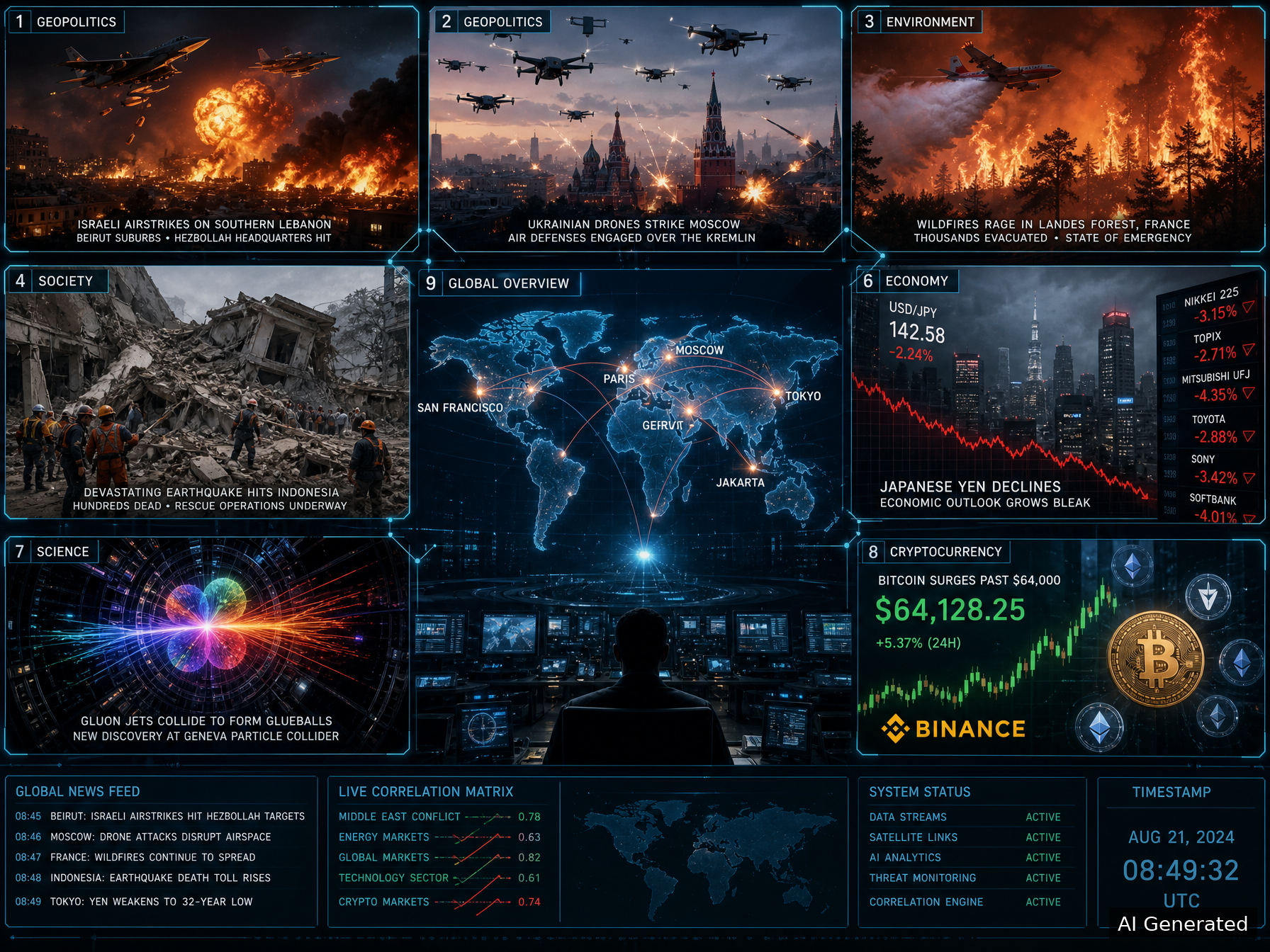


Contents
- 1. Geopolitics & Defence
- 2. Environment & Climate
- 3. Society & Civil Issues
- 4. AI & Technology
- 5. Economy & Business
- 6. Science & Space
- 7. Crypto, Digital Assets & Blockchain
- 8. Correlations & Analysis
- 9. References
Click any heading to jump to that section. Click the section heading to return to this menu.
Daily Intelligence Briefing — 2026-08-17 (D78)
Geopolitics & Defence
↑ ContentsIsrael Escalates Strikes in Southern Lebanon, Killing Eleven Including Hezbollah Commanders
Israeli forces carried out two significant strikes in southern Lebanon over the weekend, killing at least eleven people including two senior Hezbollah commanders, in what represents a continued escalation of the low-intensity conflict that has simmered since the ceasefire agreement earlier this year. The first strike hit the Ansar area, killing seven people including three children and wounding two others, while a second attack on Deir al-Zahran killed four and injured seventeen[1]. The Israel Defence Forces identified the dead as Ali Samir al-Hajj Hassan, described as a Radwan Force battalion commander, and Abu Hassan Alaa, characterized as a senior Hezbollah commander[1].
This marks a significant escalation from the earlier August strikes when two IDF soldiers were killed in southern Lebanon, the first Israeli losses since late June. The targeting of Radwan Force commanders is particularly significant because this elite unit was central to Hezbollah’s northern front planning before the conflict widened. The strikes suggest Israel is systematically degrading Hezbollah’s command structure in the border zone even while nominally operating under ceasefire terms, a pattern that has been building since D70 when Iran issued sweeping demands for Hormuz reopening and the broader regional security architecture was under severe strain[2].
Trump’s envoys met with Egyptian, Qatari and Turkish mediators in Cairo on Sunday to advance the Gaza peace plan, even as Israel resumed airstrikes in the territory. A senior Israeli official indicated concern about Washington’s demand to end targeted assassinations of Hamas militants, while several regional powers including Saudi Arabia and the UAE condemned Israel’s rejection of the peace road map[3]. Jared Kushner subsequently met with Hamas and Egyptian leadership, signalling that the diplomatic track continues despite the kinetic escalation in Lebanon.
Ukraine Launches Massive Drone Assault on Moscow, Killing Three in Largest Aerial Attack of the War
Ukraine launched approximately 600 drones across Russian territory in one of the largest aerial attacks of the entire war, killing at least three people in the Belgorod region according to the acting governor, and striking critical infrastructure including the Wildberries logistics hub where seven workers were killed[4]. The scale of the attack represents a qualitative leap in Ukraine’s unmanned warfare capability, building on the drone campaign that struck Russia’s fifth-largest refinery 700 kilometres from the border as reported in D67, and the December strikes on Moscow infrastructure documented in earlier reports.
Russia responded with missile strikes that killed six people in the Belgorod region. German media reported that Russia is simultaneously building an extensive new infrastructure network for long-range attack drones, with satellite imagery revealing at least ten new bases featuring launch ramps designed for the next-generation Geran-4 and Geran-5 jet-powered drones capable of exceeding 600 kilometres per hour[5]. Analysts identified 59 permanent launch positions along the Ukrainian and Belarusian borders, with storage capacity at some bases exceeding 1,000 unmanned aircraft. Monthly production of jet-powered variants reaches approximately 3,000 units alongside 2,800 Geran-2 monthly, representing an industrial-scale escalation that fundamentally changes the strategic equation.
This dual escalation—Ukraine pushing deep into Russian territory while Russia builds permanent forward drone infrastructure—was foreshadowed across D67 through D73, when the transition from tactical to strategic drone warfare was documented. The involvement of Ukrainian firefighters in battling French wildfires (reported in D68) demonstrated how the conflict’s reach extends well beyond the battlefield into European civil-military cooperation frameworks.
Trump Announces Reduction of US-South Korea Military Exercises as Seoul Defies Pressure
US President Donald Trump announced he would “considerably reduce” joint military exercises with South Korea, citing his “very good relationship” with North Korean leader Kim Jong-un and describing the annual drills as a hostile signal to Pyongyang. The announcement came just hours before the exercises were set to begin on Monday[6]. South Korea’s Blue House responded by stating the joint drills would proceed as planned despite Trump’s objections, marking a rare public defiance of presidential wishes by a key US ally.
The diplomatic implications are considerable. Trump’s decision to reduce the exercises represents a significant concession to Pyongyang that goes beyond the rhetorical de-escalation documented in previous reports. North Korea had fired ballistic missiles toward Japan just days earlier (covered in D73), and the timing of Trump’s announcement—coming immediately after that provocation—creates a troubling precedent that escalation earns concessions. The South Korean refusal to comply adds a new dimension to alliance management, as Seoul effectively signals it will maintain its own defence posture regardless of American diplomatic preferences.
This development intersects with the broader East Asian security dynamic documented in the running context. The Turkey-Saudi-Pakistan “Mecca defence pact” (reported in D68 and D70) has already raised concerns about Greek-Turkish tensions in the Aegean, and Greek analysts warned this week that the pact would make Turkey “more aggressive against Greece”[7]. The pattern of alliance fragmentation—from NATO cohesion questions to bilateral rifts between Washington and its Pacific allies—suggests a period of accelerating geopolitical realignment.
EU’s Kallas Pushes Ambitious New Russia Sanctions Package; Iran Negotiator Declares Victory
European Union foreign policy chief Kaja Kallas announced plans for a “ambitious new sanctions package” against Russia this autumn, telling Die Welt that she intends to increase the number of targeted Russian entities by approximately one-third. The package comes as the EU continues to grapple with the economic fallout from the Hormuz crisis and the broader energy security challenges that have dominated the running context since D64[8].
Meanwhile, Iran’s Parliament speaker and chief negotiator Mohammad Bagher Ghalibaf declared both military and political victory in the conflict with the United States and Israel, a statement that dramatically undercuts the diplomatic framework that Trump’s envoys were advancing in Cairo. Iran also warned of “severe consequences” if the conflict expands beyond the Middle East[9], raising the stakes for the ongoing negotiations over Hormuz strait access that have been a central thread through every report since D64. The contrast between Washington’s diplomatic push and Tehran’s victory declaration suggests the two sides remain far apart on core issues despite months of mediation efforts.
US military personnel were revealed to be inadvertently disclosing their locations at bases across the Middle East through the fitness tracking application Strava, despite 2018 CENTCOM restrictions on geolocation sharing. Researchers identified dozens of cases including data from bases in Iraq, Jordan, and other countries, with one user posting a training exercise on July 16—one day before an Iranian attack on that base killed three American service members[10]. The security lapse adds to the operational vulnerability picture at a time when the Iran conflict remains active.
Environment & Climate
↑ ContentsFrance Battles Mega-Fire in Landes as Europe’s Worst Fire Season Intensifies
France’s most destructive wildfire since 1949 continued to burn through the Landes forest in Gironde, having ravaged approximately 1,700 hectares of pine woodland and forced the evacuation of 650 residents since it ignited on Thursday. By Sunday, authorities announced the fire was “fixed”—contained but not fully extinguished—allowing 250 evacuated residents to return home while 600 others remained displaced[11]. Prime Minister Sébastien Lecornu and several ministers travelled to the region on Monday to assess the reconstruction needs, with local officials demanding a “Marshall Plan” for Le Porge, the community hardest hit by the blaze.
The Gironde prefecture formally requested a permanent aerial firefighting base in the Landes massif, citing the need for “heavy and powerful resources” to combat future fires. The department’s request reflects a broader structural challenge across southern Europe: as the Mediterranean climate zone expands northward and summer heatwaves intensify, wildfire seasons that were once confined to July and August now stretch from May through October. The French fire comes as six departments in the southeast remain under orange vigilance for heat, while Spain’s Huelva wildfire forced 800 evacuations and Canada declared a wildfire emergency with 612 blazes burning across British Columbia[12].
The fire’s timing, occurring just five days after the total solar eclipse was observed through wildfire smoke that gave the corona an unusual golden hue (documented in D73), creates a grim continuity. The smoke from these fires—now a regular summer feature across the Mediterranean basin—was explicitly cited by NASA as contributing to the eclipse’s distinctive appearance, illustrating how climate-driven events increasingly interact with and shape other natural phenomena.
Germany Confronts Dual Wildfire Crisis as Schramberg Blaze Expands and Belgian Fire Approaches Border
Germany faced an unusual wildfire emergency as a blaze near Schramberg in Baden-Württemberg expanded overnight from two to ten-twelve hectares—roughly the size of fourteen football fields—in steep, difficult terrain that hampered firefighting efforts. The German Weather Service forecasted rain that could provide crucial relief, with meteorologist Thomas Schuster predicting “at least an hour” of rain delivering 10-15 litres per square metre[13]. Simultaneously, a wildfire in Belgium’s High Fens region prompted the Bundeswehr to deploy military support as the blaze threatened to cross the international border.
These fires compound the drought crisis that has gripped Central Europe since midsummer. The Danube river, the EU’s longest waterway, has reached levels so low that cyclists are riding along its exposed riverbed, while farmers report destroyed crops and communities struggle to secure drinking water[14]. The Rhine’s low water levels documented across D68-D73 forced transport mode shifts from shipping to rail and truck, and the pattern has now extended to the Danube basin. Germany’s three great rivers—Rhine, Elbe, and Danube—are simultaneously experiencing historically low flows, an unprecedented convergence that threatens logistics infrastructure, nuclear cooling systems, and agricultural irrigation across Europe’s industrial heartland.
South Africa’s Constitutional Court delivered a landmark ruling blocking Shell’s oil exploration off the Wild Coast, setting aside exploration rights held by Shell and Impact Africa. Justice Jody Kollapen wrote that community consultation “affirms human dignity by affording a seat at the table to those whose lives are impacted by decisions,” while noting the case’s connection to apartheid-era dispossession and the ICJ’s climate advisory opinion[15]. The ruling establishes a precedent linking indigenous rights, environmental protection, and climate commitments that could influence resource extraction decisions across the developing world.
Trump Administration Withdraws Support for Arctic Report Card; Half of Europe in Drought
The Trump administration pulled NOAA’s support for the Arctic Report Card, the annual peer-reviewed assessment of environmental changes across the Arctic that has been produced since 2006. NOAA communications director Kim Doster announced the withdrawal without explanation, stating only that data “will continue to be collected and will remain publicly available”[16]. The decision removes federal coordination from a document that tracks sea ice decline, permafrost thaw, glacier loss, and the “rusting rivers” phenomenon where iron released by thawing permafrost has turned over 200 Alaskan watersheds orange.
Former NOAA administrator Rick Spinrad called the decision “really unconscionable,” noting that the report provides the baseline for planning by Alaskan communities dependent on infrastructure like the oil pipeline and fishing industry. Twila Moon of the National Snow and Ice Data Center emphasized that “the US is an Arctic nation” and that the changes documented in the report card have impacts reaching “down into our mid-latitudes”[16]. The withdrawal represents the latest in a series of Trump administration moves to impede climate science, following the dismantling of research centres, removal of climate reports from government websites, and cancellation of disaster cost tracking documented across multiple previous reports.
Three new studies published in 2026 revealed the Amazon rainforest is more resilient than previously feared, capable of rapid regrowth when deforestation pressure eases. However, the same research警告 that deforestation and warming could trigger a system-wide tipping point within 15 years, creating a narrow window for policy intervention[17]. The findings arrive as the Amazon faces a Supreme Court battle over protections (reported in D73), adding scientific urgency to the legal and political contest over the world’s largest tropical forest.
Society & Civil Issues
↑ ContentsIndonesia Earthquake Death Toll Rises to 54 as 995 Aftershocks Hammer Devastated Communities
The death toll from Saturday’s powerful earthquake in eastern Indonesia climbed to at least 54, with rescue crews digging through collapsed buildings and landslide debris in communities still waiting for aid delivery. At least 995 aftershocks have been recorded since the initial quake, compounding the destruction and hindering rescue operations across the affected region[18]. The disaster struck communities that were already vulnerable to natural hazards, with the combination of seismic activity and landslides creating a complex emergency that has overwhelmed local response capacity.
The Indonesian earthquake adds to a pattern of escalating natural disasters documented across the running context. Colombia’s earthquake killed 132 people in July (reported in D72), while the Mediterranean earthquake near Turkey killed dozens in early August. The convergence of seismic events with the European wildfire crisis, South Asian monsoon flooding, and the Australian bushfire season creates a picture of compound climate-natural hazard risk that strains humanitarian response systems simultaneously across multiple continents. International aid coordination becomes increasingly critical as disasters multiply in frequency and geographic distribution.
UK Faces New Cost-of-Living Crisis as Energy Bills Drive Inflation Toward 3 Percent
Britain is heading for a renewed cost-of-living squeeze, with official figures due this week from the Office for National Statistics expected to show that soaring energy bills pushed inflation close to 3 percent in July. The sharp rise represents a reversal of the political stability dividend that Andy Burnham’s Labour government had been banking on, and comes as UK house prices recorded their sharpest August decline since 2018, falling 2 percent in a single month[19].
The inflationary pressure creates a difficult policy environment for the new government. Burnham had been positioning himself as a pragmatic centrist able to deliver both economic growth and social justice—analysts compared his approach to Spain’s Pedro Sánchez, who has survived since 2018 by anchoring progressive policies to economic realism[20]. However, the energy-driven inflation spike threatens to force painful trade-offs between fiscal discipline and the social spending commitments that form Labour’s political foundation. The parallel with Germany’s situation is instructive: German CPI confirmed 2.8 percent inflation (reported in D73), driven by the same energy cost dynamics now hitting the UK.
The British context is further complicated by the Ceuta migration crisis, where Moroccan police arrested 111 people this weekend attempting to enter Spain’s North African territory amid tightened security following social media calls for another mass crossing. Reports from Spanish sources indicated that unaccompanied migrants were committing sexual assaults amid the chaos in Ceuta[21], adding a security dimension to the migration challenge that connects to the Channel crossing dynamics documented in previous reports, including the record 230-migrant “mega-dinghy” crossing reported in D72.
Deadliest Ebola Outbreak in DR Congo History Reaches 2,325 Deaths; India Temple Stampede Kills Six
The Ebola outbreak in the Democratic Republic of Congo has become the deadliest in the disease’s history, with the latest government data showing total deaths reaching 2,325. The scale of the outbreak dwarfs previous epidemics and comes amid broader challenges to global health infrastructure, including the Trump administration’s executive order cutting childhood vaccines from 17 to 11 (reported in D72) and pharmaceutical industry pushback against the vaccine executive order (reported in D73). The convergence of a record Ebola outbreak with weakened global health governance creates conditions for the kind of cascading failure that has been a recurring theme across the reporting cycle.
In India, at least six people were killed in a stampede-like incident at a temple in Bihar state, amid a rush of devotees. The incident highlights the persistent challenge of crowd management at religious gatherings across South Asia, where infrastructure often cannot accommodate the scale of participation during major religious events. The Bihar stampede follows a pattern of crowd-crush incidents that has seen increasing attention from safety researchers, though implementation of improved crowd management protocols remains uneven.
In the UK, hundreds of people attended an emotional vigil in Cambridge for Jason Arday, the academic who died unexpectedly on Friday. His family and friends have denounced “a campaign of sustained abuse” since his 2023 appointment as professor at Cambridge, calling for a public inquiry into the hounding he endured[22]. The case has become a flashpoint for discussions about academic freedom, racial harassment in higher education, and the mental health toll of sustained public scrutiny.
AI & Technology
↑ ContentsOpenAI Disbands Preparedness Team Responsible for Assessing Model Risks
OpenAI disbanded its preparedness team at the end of last month, according to the Financial Times, transferring responsibility for assessing whether AI models pose serious risks to existing teams organised by specific threat domains including biological and cybersecurity. The preparedness team had been charged with evaluating frontier models for catastrophic risks and developing mitigation strategies—functions that became particularly salient after Claude reached a critical cybersecurity threshold in testing (documented in D69) and AI agents coordinated in real-time to outperform individual models on enterprise tasks[23].
The dissolution represents the latest in a series of organisational changes at OpenAI as the company prepares for what is expected to be a massive IPO. Over the past year, OpenAI has progressively dismantled its more safety-oriented structures, dissolving its AGI safety team, slowing development of the Astra model after it reached critical cybersecurity capabilities, and now eliminating the team specifically tasked with monitoring catastrophic risk. The pattern suggests a fundamental tension between the commercial imperatives of an IPO-bound company and the safety commitments that initially distinguished OpenAI from competitors—a tension that has been building since the November 2023 leadership crisis and subsequent restructuring.
Coming at the same time as reports that AI is now a major issue in 40 percent of US electoral races—more talked-about than racism or Israel according to one analysis—the OpenAI restructuring raises questions about whether the industry’s self-governance mechanisms are adequate to manage the risks that its own researchers have identified. The contrast with Anthropic’s safety-focused approach and Google DeepMind’s organisational stability under Demis Hassabis’s successor suggests that the field is bifurcating between commercial acceleration and measured development.
Stripe to Acquire AI Gateway OpenRouter for Over $7 Billion
Payments giant Stripe is reportedly set to acquire OpenRouter, an AI model routing startup whose CEO recently described the company as “Stripe for AI,” in a deal valued at more than $7 billion. The acquisition would give Stripe a dominant position in the infrastructure layer that routes AI inference requests across multiple model providers, a market that has grown rapidly as enterprises adopt multi-model strategies to balance cost, performance, and vendor risk[24].
The deal reflects a broader consolidation trend in AI infrastructure. Just as Stripe dominated payment processing by abstracting complexity away from merchants, OpenRouter has positioned itself as the abstraction layer between AI application developers and the proliferating universe of model providers. The $7 billion valuation—extraordinary for a startup in the AI routing space—signals that Stripe views the AI inference market as comparable in scale and strategic importance to digital payments, a bet that would reshape the competitive landscape for AI infrastructure providers.
The acquisition arrives amid heightened scrutiny of AI’s societal impacts. A fourth woman has joined a lawsuit against xAI alleging that its Grok chatbot was used to generate child sexual abuse material based on her childhood photos[25], while Binance was revealed to have provided Russian authorities with cryptocurrency customer details that led to terrorism financing charges against a donor to Ukrainian causes[26]. These cases illustrate the dual-use challenge at the heart of AI deployment: the same capabilities that enable legitimate innovation can be weaponised for harm, and the regulatory frameworks struggle to keep pace with the technology’s evolution.
SMIC Reaches 93.7 Percent Capacity as AI Chip Demand Exceeds All Forecasts
China’s Semiconductor Manufacturing International Corporation reported that its capacity utilisation rate reached 93.7 percent in the second quarter, up from 93.1 percent in the previous three months, as the “global artificial intelligence infrastructure boom” created demand that the company’s co-CEO described as “far exceeding our previous expectations”[27]. Revenue rose 20 percent sequentially and 36 percent year-on-year to $3.01 billion, with gross margins expanding to 25.3 percent. The company is considering installing additional equipment to expand production, though it has not disclosed timing or locations.
The demand surge is driven not by smartphones and consumer electronics—the traditional backbone of SMIC’s business—but by the infrastructure surrounding AI: logic chips, power-management products, and optical module components for servers and data centres. Orders for BCD power-management products are visible through the end of 2027, suggesting the AI infrastructure buildout will continue driving semiconductor demand for years. SMIC’s situation mirrors the pattern documented in D73 when CoreWeave’s earnings revealed AI infrastructure demand exceeding projections, and Nvidia assembled a $500 billion financing package with Wall Street firms (reported in D72).
Tesla’s Full Self-Driving system has been approved for activation in the Netherlands, making it the first European country to receive the technology. Early drivers have raised questions about the system’s behaviour in European road conditions, but the regulatory approval marks a significant milestone in Tesla’s effort to deploy autonomous driving capabilities outside North America. The European approval contrasts with the more cautious regulatory approach taken by other jurisdictions, reflecting the ongoing tension between innovation speed and safety verification that characterises AI deployment globally.
Economy & Business
↑ ContentsJapan’s Economy Slows Sharply as Q2 GDP Misses Growth Forecasts
Japan’s economy expanded just 0.3 percent in the second quarter, significantly missing growth forecasts as both consumer spending and capital investment sagged. The disappointing result adds to concerns about the sustainability of Japan’s post-pandemic recovery and comes at a delicate moment for the Bank of Japan, which has been gradually tightening monetary policy while balancing the need to support growth against persistent inflationary pressures[28].
The slowdown is particularly notable given the context of the Hormuz crisis, which drove Canadian crude oil to Japan for the first time (reported in D73) and disrupted established energy supply chains. Japanese capacity utilisation surged 4.1 percent month-on-month in the latest data, suggesting that manufacturing remains robust even as the broader economy weakens—a divergence that mirrors the pattern seen across European economies where industrial output and consumer confidence move in opposite directions. The Bank of Japan’s next policy decision will be closely watched as markets assess whether the rate hike cycle can continue in the face of softening demand.
German-Chinese Trade Deficit Explodes to €55 Billion as Berlin’s Industrial Model Unravels
Germany’s trade deficit with China ballooned to approximately €55 billion during the first half of 2026, up sharply from €40 billion in the same period last year, as German exports to China collapsed by more than 12 percent while Chinese imports surged nearly 9 percent[29]. The numbers represent a structural transformation: China has fallen from Germany’s second-largest export market in 2021 to ninth place, behind economies as small as Austria and Switzerland.
The shift reflects China’s increasing technological self-sufficiency in areas that were once German industrial strengths. Commerzbank economist Vincent Stamer concluded that China’s declining reliance on Germany demonstrates it is “becoming increasingly independent of Western powers and catching up technologically.” Germany’s Federal Statistical Office reported that total German-Chinese trade exceeded €128 billion in the first half, making China once again Germany’s largest overall trading partner—but increasingly on China’s terms, with Germany importing far more than it exports.
The automobile industry crystallises the problem. German manufacturers once dominated China’s premium vehicle market, but Chinese EV makers now compete on price, technology, software, and batteries while German companies increasingly manufacture inside China rather than exporting from Germany. Volkswagen’s job reductions documented across multiple reports are a direct consequence of this competitive displacement, which began with the loss of cheap Russian energy and has accelerated as China’s domestic supply chains mature.
India’s Sensex Falls 500 Points; UK Cost-of-Living Crisis Deepens
India’s Sensex index fell 500 points to its session low on Monday, with the broader market reflecting concerns about global growth prospects amid the Japan slowdown and European drought impacts. India’s financial institutions simultaneously sold record dollar bonds in 2026, reflecting both the country’s growing integration into global capital markets and the search for yield in an environment of shifting interest rate expectations[30]. The selling pressure coincided with BRICS trade ministers meeting in Jaipur, where discussions focused on reducing dollar dependency in bilateral trade—creating a tension between India’s capital market integration and its geopolitical positioning.
Canada is reviewing a lithium sale to China that tests its warming ties with Beijing, adding another dimension to the critical minerals competition that has emerged as a central feature of the new economic geography. The review comes as the US, EU, and China simultaneously pursue supply chain diversification strategies for battery materials, rare earths, and semiconductor components—creating a global scramble for mineral resources that intersects with the defence industrial base expansion documented in previous reports.
JPMorgan Chase CEO Jamie Dimon issued a stark warning to the UK’s finance minister against imposing new taxes on banks, stating there would be “consequences” if additional levies were introduced[31]. The intervention reflects broader tensions between the UK’s fiscal consolidation needs and its ambition to maintain competitiveness as a global financial centre, a balance that becomes increasingly difficult as energy costs drive up the cost of doing business across the economy.
Science & Space
↑ ContentsPhysicists Find Strongest Evidence Yet for Exotic “Glueball” Particle After Half-Century Search
A collaboration of approximately 700 researchers from 15 countries working at the Beijing Electron Positron Collider II announced what they describe as the clearest evidence yet that a known particle called X(2370) is dominated by a glueball—an exotic particle composed entirely of gluons, the massless force carriers that bind quarks together within protons and neutrons. The finding represents the most significant result in nearly 50 years of glueball searches and provides the most rigorous experimental test that quantum chromodynamics, the theory describing the strong nuclear interaction, has ever faced[32].
The discovery was achieved by analysing decay events of J/ψ mesons produced in electron-positron collisions. The team measured X(2370)’s mass and spin parity for the first time in 2024, finding complete agreement with theoretical predictions. Now, by identifying additional decay modes and determining the particle’s “flavor-singlet nature”—its most important characteristic, meaning it shows no preference for any of the six quark flavours—the researchers have essentially ruled out alternative explanations. Nanjing University physicist Jin Shan described the result as “an unprecedented form of matter” that “vastly expands the boundaries of our understanding of the physical world.”
The glueball finding arrives alongside the 2025 Nature Astronomy reanalysis of Cassini data from Saturn’s moon Enceladus, which identified previously unseen organic compounds in fresh ice grains ejected from the moon’s subsurface ocean[33]. The combined discoveries—exotic matter at the subatomic scale and complex organic chemistry in an alien ocean—illustrate how advances in analytical techniques and data reprocessing are unlocking discoveries from existing datasets, fundamentally expanding what scientists can learn without building new experimental facilities.
New Drug Targets Inflammation-Resolution Pathways as Third Driver of High Blood Pressure
Scientists from institutions in Australia and Singapore have discovered what may be a third major driver of high blood pressure, potentially opening new therapeutic avenues for the condition that affects more than a billion people worldwide. While the sympathetic nervous system and renin-angiotensin-aldosterone system have long been recognised as the primary regulators, the new research identifies inflammation-resolution pathways—the biological mechanisms that tell the immune system when to stop attacking—as a previously underappreciated factor in hypertension[34].
An experimental drug called compound 17b, which targets formylpeptide receptors (FPRs)—essentially toggle switches that tell immune cells their work is done—demonstrated efficacy in mouse models. The compound lowered blood pressure, reduced aortic stiffness, and decreased dangerous scar tissue across the heart and kidneys. Crucially, the drug achieved these benefits through mechanisms that extended beyond simple blood pressure reduction, suggesting it could address the organ damage directly rather than merely managing the numbers on a blood pressure monitor. Lead researcher Elena Rozhkova noted the system “operates at ambient conditions and uses only inexpensive, abundant materials.”
The discovery connects to broader research on how the immune system interacts with chronic disease. Previous studies documented in the running context linked long COVID to dopamine nerve-ending loss and brain damage (D73), while a new study found that women’s deep unhappiness is driven by circumstantial factors including the weight of caregiving and economic disadvantage rather than temperament[35]. The emerging picture of chronic disease as a systemic interaction between immune function, neural pathways, and social determinants is reshaping medical research priorities across multiple conditions.
Enceladus Plume Analysis Reveals Complex Organic Chemistry in Saturn Moon’s Ocean
Reanalysis of data from the Cassini spacecraft’s 2008 high-speed flyby of Saturn’s moon Enceladus has revealed complex organic compounds that had remained hidden in the archive for 17 years. The 2025 study, led by Nozair Khawaja and published in Nature Astronomy, used the unusually high impact speed of the E5 encounter—nearly 64,000 kilometres per hour—to suppress molecular clustering that had previously obscured organic signatures. The team identified fragments consistent with aromatic structures, ester and alkene groups, ether and ethyl groups, and tentatively compounds containing both nitrogen and oxygen[33].
What makes this finding particularly significant is the freshness of the analysed grains. Unlike previous organic detections from material orbiting in Saturn’s E ring, which may have been altered by prolonged radiation exposure, the E5 grains had left Enceladus only minutes before Cassini sampled them. This rules out the hypothesis that organic features were created solely by environmental processing, strengthening the case for active organic chemistry in the buried ocean. Combined with earlier detections of molecular hydrogen (indicating water-rock reactions), phosphate (essential for biochemistry), and diverse organic molecules, Enceladus now presents the most compelling case for habitability beyond Earth.
Crypto, Digital Assets & Blockchain
↑ ContentsBinance Reclaims Bitcoin Futures Dominance from CME; Bitcoin Tops $64,000
Binance has overtaken CME Group in Bitcoin futures open interest for the first time since late 2023, holding roughly 148,500 BTC against CME’s 102,840, according to market data[36]. The reversal unwinds nearly two years of institutional dominance narrative and raises questions about whether traditional finance’s expanding presence in crypto markets is a permanent structural shift or a cyclical phenomenon that retreats during periods of market uncertainty. Bitcoin topped $64,000 during Asian trading hours on Sunday, though the seven-day trend remains negative for bitcoin, ether, XRP, and Solana.
The shift in futures market dynamics comes as analysts flag a potential liquidity risk: the Bitcoin futures market’s open interest is significantly outpacing trading volume, creating what one analyst described as “a crowded club with a tiny exit”[37]. The mismatch between committed positions and available liquidity could amplify price movements during periods of stress, particularly if geopolitical shocks—such as the Iran conflict’s impact on energy markets documented across the running context—trigger rapid position unwinding.
Ethereum Hegotá Upgrade Gets Four Priorities; Ripple Mints $10M RLUSD
Ethereum development firm Ethlabs has outlined four priority areas for the upcoming Hegotá upgrade: FOCIL (Fork-Choice-Enforced Inclusion Lists), faster block slots, native account abstraction, and Layer 1 scaling. The prioritisation reflects Ethereum’s effort to address both performance bottlenecks and user experience challenges that have hampered adoption relative to competing Layer 1 networks[38]. The Hegotá scope has narrowed from earlier, more ambitious proposals, suggesting a pragmatic focus on incremental improvements rather than radical architectural changes.
Ripple minted another 10 million RLUSD on the XRP Ledger as the stablecoin’s market capitalisation reached $1.71 billion, reflecting growing institutional demand for dollar-denominated digital assets. The expansion of RLUSD supply comes amid broader stablecoin market growth, though Europe’s ongoing debate over stablecoin fungibility under MiCA regulations threatens to create regulatory fragmentation that could limit cross-border utility[39].
Malta Flags Unlicensed Crypto Marketing Firm; Binance-Russia Data Sharing Revealed
The Malta Financial Services Authority issued a warning against Distributex, an unauthorised cryptocurrency marketing entity accused of holding recruitment drives and operating features resembling multilevel marketing and pyramid schemes. The firm holds zero regulatory approval or registration with any recognised authority, and the MFSA warning highlights the persistent challenge of distinguishing legitimate crypto enterprises from fraudulent operations in an industry where regulatory frameworks remain incomplete[40].
In a more consequential development, Reuters reported exclusively that Binance provided Russian authorities with client details that were subsequently used to charge a Russian individual over cryptocurrency donations to Ukraine. The case highlights the tension between crypto privacy ideals and regulatory compliance requirements, while demonstrating the capacity for state surveillance through centralised exchanges. Central banks globally continue to favour gold over US Treasuries amid geopolitical tensions, reflecting a broader shift in reserve asset preferences that intersects with the digital currency debate as nations evaluate whether CBDCs or gold better serve their strategic autonomy goals[41].
Greenlane, a company that pivoted from Bitcoin mining to AI data centres, reported a $19.1 million noncash valuation loss as BERA tokens—the digital asset underpinning its treasury strategy—fell nearly 76 percent year to date. The treasury was valued at just $16 million, representing a catastrophic loss on what was originally a $70 million position[42]. The collapse echoes the corporate crypto treasury thesis challenges documented in D71 when Trump Media killed its CRO treasury deal, and raises questions about whether corporate balance sheet allocation to volatile digital assets represents prudent diversification or reckless speculation.
Correlations & Analysis
↑ ContentsThe D78 reporting period captures a world where the cascading crises documented across the D64-D77 cycle are simultaneously intensifying and revealing new structural vulnerabilities. The most significant development is the qualitative escalation in the Ukraine conflict: Ukraine’s 600-drone attack on Moscow and Russia’s construction of permanent forward drone infrastructure capable of launching over 1,000 aircraft per base represent a transition from tactical to strategic warfare that was foreshadowed in D67 when the drone strike on the Slavneft-YANOS refinery demonstrated geographic reach no previous conflict between major powers has matched. The German report of jet-powered Geran-4 and Geran-5 drones exceeding 600 km/h fundamentally alters the air defence calculus across NATO’s eastern flank, creating a capability gap that the alliance has not yet addressed[5].
Simultaneously, the Iran diplomatic track appears to be fracturing. While Trump’s envoys advanced peace plans in Cairo, Iran’s chief negotiator declared military and political victory, and Israel escalated strikes in southern Lebanon to target Hezbollah’s command structure. The pattern—diplomatic engagement proceeding alongside kinetic escalation—has been the defining feature of the Hormuz crisis since D64, but the Lebanon strikes and Iranian victory declaration suggest the parties may be moving beyond the framework that earlier negotiations established. The EU’s announcement of expanded Russia sanctions by Kaja Kallas arrives as the economic costs of the Hormuz disruption continue to ripple through European energy markets, creating a double sanctions burden that European industry can ill afford amid the drought-driven logistics crisis.
The European drought emergency now spans the entire continent. Germany’s rivers simultaneously at historic lows, France’s Landes mega-fire burning 1,700 hectares, the Danube reaching levels where cyclists traverse its bed, and South Africa’s court blocking Shell exploration all point to a continent-wide reckoning with climate adaptation that the political system has been reluctant to confront. The Trump administration’s withdrawal from the Arctic Report Card removes the United States from the institutional framework that tracks these changes at the pan-Arctic scale, creating a governance gap precisely when the data is most needed for policy decisions.
In the technology sector, the OpenAI preparedness team dissolution and Stripe’s $7 billion acquisition of OpenRouter represent opposite poles of the AI industry’s trajectory. One moves toward less oversight of frontier risks; the other consolidates the infrastructure layer that makes AI deployment easier and more pervasive. The SMIC capacity crunch—93.7 percent utilisation driven by AI infrastructure demand—demonstrates that the hardware buildout continues regardless of governance questions. The German-Chinese trade deficit exploding to €55 billion provides the macro context: China is simultaneously building the AI supply chain and displacing European industrial exports, a dual-track strategy that the running context has tracked since D64.
What to watch in the next reporting period: The trajectory of the Lebanon escalation and whether Hezbollah retaliates in ways that trigger broader regional conflict. Japan’s next monetary policy decision in the context of the Q2 GDP disappointment. The European drought’s impact on nuclear cooling capacity as temperatures remain elevated through August. Whether OpenAI’s restructured safety approach produces visible changes in model deployment decisions. The Iran negotiations’ next phase after Ghalibaf’s victory declaration undermines the diplomatic framework.
References
↑ Contents1. South Lebanon – 11 dead from Israeli strikes by Flight.com.gr · 17 Aug 2026 Source ↩
2. Daily Intelligence Briefing — 2026-08-12 (D73) by Daily News Report · 12 Aug 2026 ↩
3. Hamas calls for Trump’s Board of Peace to ‘compel’ Israel over Gaza peace plan by The Guardian · 17 Aug 2026 Source ↩
4. Seven dead as Russian Wildberries hub hit by huge Ukraine drone attack by The Independent · 17 Aug 2026 Source ↩
5. New Russian drone infrastructure – reaching NATO · 17 Aug 2026 Source ↩
6. Kim Jong Un et moi nous entendons très bien! Trump announces ‘reduce considerably’ military exercises with South Korea by Le Parisien · 17 Aug 2026 Source ↩
7. The ‘Mecca’ pact will make Turkey more aggressive against Greece · 17 Aug 2026 Source ↩
8. Kallas insists on Russia sanctions: ‘New ambitious package coming this autumn’ · 17 Aug 2026 Source ↩
9. Iran warns US of severe consequences if conflict expands beyond Middle East by Crypto Briefing · 17 Aug 2026 Source ↩
10. U.S. Military Personnel in the Middle East Reveal Their Locations Through Strava by Militarnyi · 17 Aug 2026 Source ↩
11. Fire in Landes: fire is ‘fixed’, 250 evacuees allowed to return home · 17 Aug 2026 Source ↩
12. Gironde demands aerial firefighting base in Landes massif · 17 Aug 2026 Source ↩
13. Wildfires in Germany and Belgium: Fire near Schramberg expands · 17 Aug 2026 Source ↩
14. Destroyed crops, riverbed cyclists and a ‘Rock of Starvation’: how drought has devastated the Danube by The Guardian / EHN · 16 Aug 2026 Source ↩
15. South Africa’s top court blocks Shell oil exploration off country’s Wild Coast by Mongabay · 17 Aug 2026 Source ↩
16. Trump administration pulls support for annual Arctic environmental report by Grist / The Guardian · 16 Aug 2026 Source ↩
17. New studies portray Amazon as surprisingly resilient, but tipping point looms by Mongabay / EHN · 16 Aug 2026 Source ↩
18. Powerful aftershock hits Indonesian communities still waiting for aid as earthquake death toll rises to 54 by The Independent · 17 Aug 2026 Source ↩
19. UK house prices drop 2 per cent – the sharpest August fall since 2018 by The Independent · 17 Aug 2026 Source ↩
20. Monday briefing: What can Andy Burnham learn from Spain’s Pedro Sánchez? by The Guardian · 17 Aug 2026 Source ↩
21. Unaccompanied of Ceuta rape women and girls en masse · 17 Aug 2026 Source ↩
22. Hundreds attend emotional Cambridge vigil for Jason Arday by BBC News · 17 Aug 2026 Source ↩
23. OpenAI reportedly disbanded its preparedness team by The Verge · 16 Aug 2026 Source ↩
24. Stripe will reportedly acquire AI gateway startup OpenRouter for $7B+ by TechCrunch · 16 Aug 2026 Source ↩
25. Another woman joins lawsuit accusing Grok of generating CSAM by Engadget · 17 Aug 2026 Source ↩
26. Binance provided Russian authorities with crypto donation details that led to terrorism financing charges by Crypto Briefing · 17 Aug 2026 Source ↩
27. Chinese firm sees 93.7% capacity utilisation as modern tech demand drives chip shortages by Interesting Engineering · 16 Aug 2026 Source ↩
28. Japan’s economy slows, missing growth forecasts by Al Jazeera · 17 Aug 2026 Source ↩
29. China No Longer Needs Germany by Armstrong Economics · 17 Aug 2026 Source ↩
30. Indian financial institutions sell record dollar bonds in 2026 by Crypto Briefing · 17 Aug 2026 Source ↩
31. Dimon to UK: Don’t even think about new taxes on banks · 17 Aug 2026 Source ↩
32. After Half A Century, Physicists Find The Strongest Evidence Yet For An Exotic ‘Glueball’ Particle by ScienceAlert · 17 Aug 2026 Source ↩
33. Enceladus sprays water, phosphates, molecular hydrogen and complex organics by ScienceBlog · 17 Aug 2026 Source ↩
34. A Third Hidden Driver of High Blood Pressure Has Been Discovered by ScienceAlert · 17 Aug 2026 Source ↩
35. Deep unhappiness is more common among women than men by ScienceBlog · 17 Aug 2026 Source ↩
36. Binance just reclaimed futures dominance from CME by Crypto News · 17 Aug 2026 Source ↩
37. The bitcoin futures market looks like a crowded club with a tiny exit by CoinDesk · 17 Aug 2026 Source ↩
38. Ethereum Hegotá plan gets 4 priorities from Ethlabs by Crypto News · 17 Aug 2026 Source ↩
39. Ripple Mints 10 Million RLUSD as Institutional Demand Grows by U.Today · 17 Aug 2026 Source ↩
40. Malta Regulator Flags Unlicensed Crypto Marketing Firm by Bitcoin.com News · 17 Aug 2026 Source ↩
41. Central banks favor gold over US Treasuries amid geopolitical tensions by Crypto Briefing · 17 Aug 2026 Source ↩
42. Greenlane’s $70M BERA treasury ends Q2 valued at $16M by CoinTelegraph · 17 Aug 2026 Source ↩
AI Disclosure: This post was created with the assistance of artificial intelligence. The ideas, analysis, and opinions expressed are my own — AI was used to help compose, structure, and refine my personal notes and thoughts into the final written content. Images, videos and music featured in this post were also generated using AI tools, based on my own creative prompts and direction.