








Contents
- 1. Geopolitics & Defence
- 2. Environment & Climate
- 3. Society & Civil Issues
- 4. AI & Technology
- 5. Economy & Business
- 6. Science & Space
- 7. Crypto, Digital Assets & Blockchain
- 8. Correlations & Analysis
- 9. References
Click any heading to jump to that section. Click the section heading to return to this menu.
Geopolitics & Defence ↑ Contents
The Trilateral Door Opens: Washington, Beijing and Moscow Converge
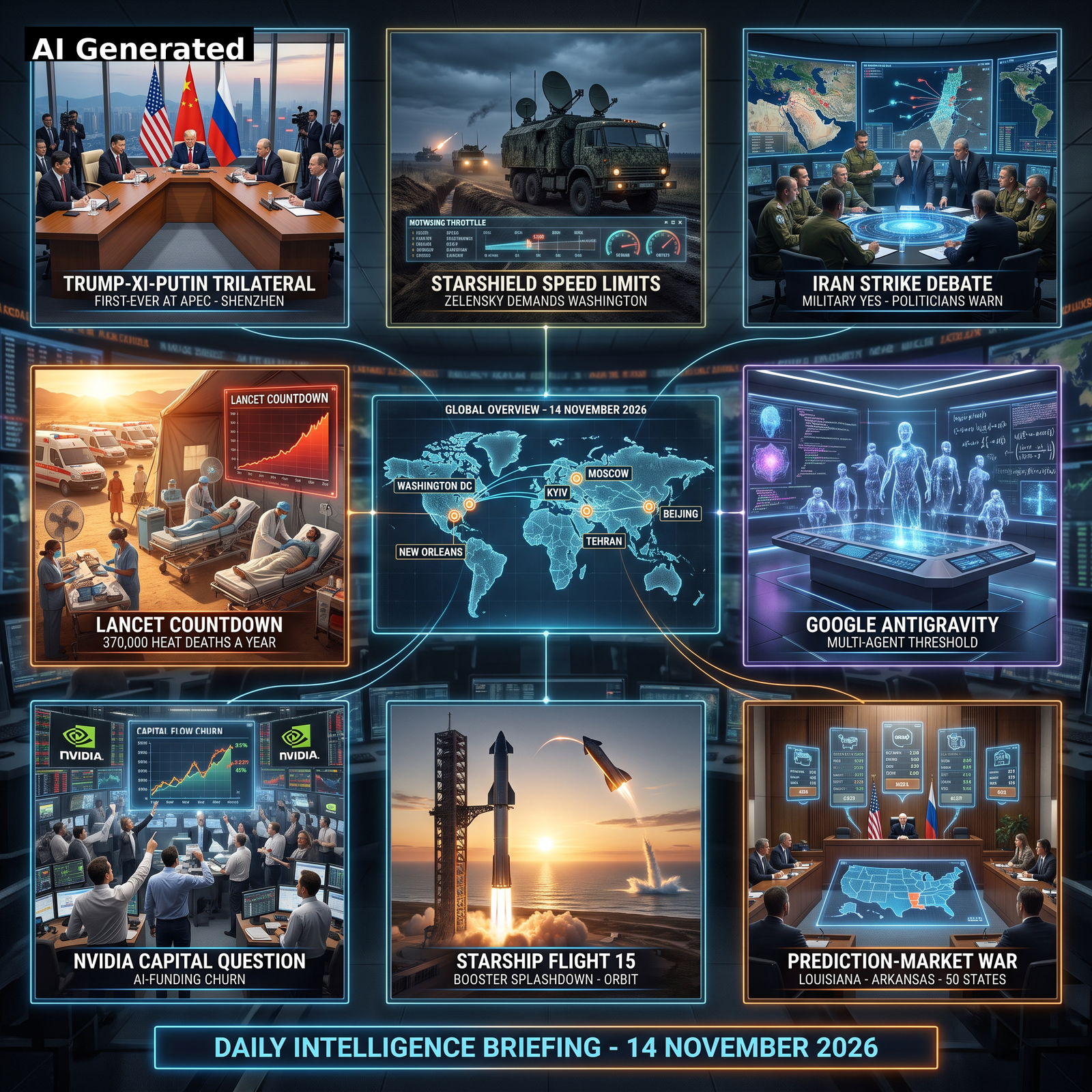
The most consequential diplomatic development in the D167 window was the confirmation that President Donald Trump, Xi Jinping and Vladimir Putin will hold an unprecedented trilateral meeting on the sidelines of next week’s APEC summit in Shenzhen, China — the first-ever gathering of the leaders of the world’s three principal nuclear powers in a single forum.[1] The White House announcement, carried across the European press, framed the encounter as an open platform for discussing nuclear non-proliferation, while US officials stressed that Ukraine would not be on the agenda for the three of them together, though the ongoing Iran conflict would be.[2] That separation is itself a signal: it suggests Washington is willing to hold a high-level security channel with both adversaries simultaneously, but wishes to reserve the most contentious front — the war in Ukraine — for bilateral tracks rather than a joint table where Moscow could use Beijing as cover. Coming after the post-midterm political turbulence in Washington, the move reads as a deliberate attempt to restore a crisis-management layer between the three capitals even as their peripheral tensions accumulate.
The institutional framing matters as much as the meeting itself. APEC, designed as an economic forum, is being repurposed into a strategic summit venue precisely because the larger powers have exhausted patience with formal arms-control architectures. By convening next to a trade gathering, the three leaders signal that economic interdependence and security competition will now be negotiated in the same room. For Europe, which was not invited, the meeting deepens the anxiety reported in the German analysis of “two irreconcilable visions of Europe” — one anchored in shared rules and the other in spheres of influence that Moscow insists were already agreed.[3] The trilateral is thus less a diplomatic breakthrough than a map of the emerging multipolar script, in which emergencies get managed bilaterally or trilaterally while the institutional periphery watches.
Ukraine’s Fragile Autumn: Starlink Pressure, Kyiv’s Alarm and President Zelensky’s Travels
Ukrainian President Volodymyr Zelensky publicised a growing dependency crisis when he used his nightly address to note that speed restrictions on the US-run Starshield satellite communications system remained in force along the entire frontline and in the temporarily occupied territories, demanding that Washington’s defence and diplomatic apparatus resolve the matter.[4] The complaint, which read as unusually pointed given that the capability belongs to the United States, is the clearest public acknowledgement yet that Kyiv’s operational reach is now partly hostage to the discretionary throttling of a commercial space service. It lands alongside sobering warnings from within Ukraine: Kyiv mayor Vitali Klitschko urged residents to find shelter, saying “something very strong may happen” amid signals that Moscow was preparing new missile strikes on the capital’s energy backbone.[5] The combination of a constricted ISR link and an imminent predicted strike wave frames Ukraine’s military position as one of managed exhaustion rather than momentum.
Compounding the military picture is an unusual political one: reports described Zelensky as having spent more than fourteen days effectively confined to European capitals — most recently Dublin — under an informal but enforced “exile” driven by security services’ fears of an assassination attempt originating from within his own apparatus, amid mounting domestic anger over corruption scandals and Russian advances on Kupiansk and Kherson.[6] Whether the portrayal is fully accurate or amplified by hostile media, it captures a real mood: that the Ukrainian leadership’s political base is eroding even as the frontline logic of the war remains unresolved. The travel pattern itself — multilateral meetings in Dublin to coordinate air-defence missiles, energy assistance and long-term security guarantees — shows that while Zelensky may be physically absent from Kyiv, he remains the indispensable broker of Western support. Yet the contrast between the scale of the external coalition-building and the fragility of the internal political situation is now the central tension of Ukraine’s autumn.
The Tehran–Tel Aviv Fulcrum: Preparations, Pre-emption and the Missile-City Gambit
In the Gulf, the D167 window saw Tehran move to convert leverage into visibly rehearsed options. Reports described an extraordinary internal debate in Israel’s military-political establishment about a strike on Iran, with the military leadership reportedly endorsing a “military operation” while political figures such as former IDF chief Gadi Eisenkot warned against dragging the country into a long attritional war.[7] The split matters because it mirrors the deeper strategic dilemma: a surgical strike risks escalation, while inaction risks allowing Iran’s nuclear programme to reach threshold status unchallenged. Against that backdrop, Iranian state media showcased a vast new underground “missile city,” with parliamentary figures warning that “whoever miscalculates will face immediate and unexpected action.” At the same time, reports circulated of renewed explosions and air-defence interceptions in southern Iran near Bandar Abbas and the Strait of Hormuz, as Tehran activated its shield against unknown drones while Washington delivered further limited strikes of its own.[8]
The Iranian media line was explicit in warning US aircraft carriers in the region, and pairing that threat with a statement that “we do not need any agreement with Iran” from the American side signals that the coercive dialogue has hardened into parallel demonstrations of capability rather than negotiation.[9] The absence of a clear de-escalation mechanism, combined with the continued movement of naval forces and the deployment of missile batteries, makes the Hormuz corridor the single most flammable point in the international system. The risk calculus is aggravated by each side reading the other’s moves through the lens of the recent US strikes on Iranian installations, so that a routine air-defence activation can be mistaken for an offensive preparation and vice versa.
Moscow’s Rewritten Perimeter and the Wider Periphery
Beyond the trilateral and the Gulf, Moscow advanced a maximalist revision of the European security map. According to a German-report-sourced account of informal talks, Russia’s demands now extend far beyond Ukraine: they reportedly include Finland leaving NATO, a prohibition on Alliance bases in the Baltic states, the demilitarisation of Odesa and Mykolaiv ports, and a sketched federalisation of Moldova with secessionist referendums in Transnistria and Gagauzia.[10] Although these are presented as leaked, unofficial proposals and not a confirmed peace plan, their circulation does strategic work in itself — normalising the idea that the price of ending the war in Ukraine is a larger reordering of NATO’s eastern flank. This is the “irreconcilable visions” argument crystallised into concrete demands.
The periphery rounds out the section with more diffuse but telling signals. Sweden followed Finland and Norway in moving toward barring Russian athletes from competing on its territory before the Nordic World Ski Championships — a sporting-policy extension of the wider European rupture with the Kremlin.[11] Diplomatically, Iran’s election to a UN committee with a mandate covering disarmament, counter-terrorism and gender equality provoked heated criticism from UN Watch and others who called it an absurdity for a government accused of executing protesters.[12] Meanwhile Taiwan reported that critics of China were subjected to violent attacks and suspected transnational repression, judging it a worrying sign of Beijing’s willingness to reach beyond its borders.[13] In the United Kingdom, US security forces responded to suspected unauthorised drone activity over RAF Lakenheath, a reminder that hybrid threats now reach into the heart of the Alliance’s basing architecture.[14]
On the defence-industrial side, the Netherlands’ minority coalition averted a breakup over tax policy — a political stabiliser in a key NATO contributor.[15] The US Senate resuscitated a Commerce Department space-tracking programme, recognising that commercial space traffic is outpacing the military’s monitoring capacity.[16] The Indo-Pacific digital battlespace was the focus of a gathering where US and allied forces examined electronic-warfare threats and coalition data-sharing.[17] European rearmament is beginning to bite at home: German analysts warn the surge in arms plans will squeeze the skilled-worker pool that the craft sector and industry both depend on.[18] And in a hemispheric complement, Argentina projected raising a fleet of up to ten Black Hawk helicopters by 2028 after signing a Letter of Offer and Acceptance for the first four.[19]
Environment & Climate ↑ Contents
Climate as a Health Ledger: The Lancet Countdown and the Vulnerability Gradient
The annual Lancet Countdown on health and climate change made its mark in this window by quantifying, for the first time, that roughly 370,000 heat-related deaths a year can be attributed to climate change, and by finding that the past eleven years were the hottest on record.[20] Across fifty-four indicators the report found that many climate-driven health threats increased or accelerated over the past decade, while the populations least responsible for warming bear the highest burdens — a pattern that reframes mitigation as a public-health intervention as much as an energy or fiscal strategy. The same editorial thesis runs through US-level analysis of “the health storm,” which notes that the states facing the greatest health damage from climate change are often the least equipped to protect their residents, citing the 2025 Texas inland flooding that killed 134 people as a baseline for how quickly compounding disasters can overwhelm public-health capacity.[21] The Countdown also credited the clean-energy transition with preventing roughly 400,000 deaths in 2023 through better indoor air quality alone, giving policymakers a concrete co-benefit case to set against the cost of transformation.
COP31 and the Energy-Policy Crossroads
Diplomatically, the window opened over the evolving dynamics of COP31, now underway, framed by the changing arithmetic on Capitol Hill: the midterm “blue wave” is expected to restore a Democratic gavel on the House Science, Space, and Technology committee, with hearings signalled into cancelled research grants and withheld funds, even as climate did not play a direct electoral role beyond voters’ anxiety over energy costs.[22] The policy space is otherwise dominated by energy-security realism. Alberta unveiled a new resource royalty programme meant to incentivise oilsands investment through guaranteed, predictable rates — a subsidy-style intervention in a sector under pressure from both price swings and industrial transition.[23] India, by contrast, restated an ambitious target to roughly triple clean-energy capacity to 900 gigawatts by 2035, acknowledging through its own framing the substantial hurdles in grid, financing and land that stand between ambition and deployment.[24]
Three jurisdictional rulings sharpened the picture. South Africa’s Supreme Court of Appeal dismissed the government’s appeal against a ruling that struck down plans for 1,500 MW of new coal-fired power, on the grounds that the build violates constitutional rights to an environment not harmful to health — putting the onus squarely on the state to justify any future coal choice in a country where coal pollution already claims thousands of lives a year.[25] In the United States, the South-west’s electricity region reported record-low hydropower generation this summer, down 19% year-on-year from April through August, as prolonged drought in the Colorado River Basin capped the resource that has historically balanced the grid.[26] And in California, state agencies admitted they had to discard nearly nine months of air-monitoring data for two cancer-causing fumigants after detecting “abnormal patterns,” leaving regulators with scant evidence to assess farmworker exposure — a transparency failure with direct health stakes.[27]
Water, Oceans and the Living Ledger
Marine and coastal science delivered several defining stories. A Scripps-led analysis of the white halos around corroded waste barrels off Los Angeles found seafloor sediment reaching a pH near 12 — so alkaline that it set into a concrete-like brucite crust — the first physical evidence of what had been dumped in the San Pedro Basin between 1961 and 1964, and a finding that reframes the legacy-waste debate away from a single DDT narrative.[28] In the Chesapeake Bay, fisheries managers agreed to lower the cap on industrial menhaden fishing but fell short of deeper coastwide cuts, drawing criticism from conservation groups who say the ecological target will almost certainly be missed.[29] On the Pacific, a Hawaii-based model warned that conventional sea-level-rise projections drastically underestimate the threat to O’ahu’s infrastructure, because the models ignore the compounding effects of groundwater and drainage.[30] France’s CNRS used the summer 2026 marine heatwaves to ask whether ocean biodiversity can adapt to temperatures that have broken global records — a reminder that the “living ledger” is not a static inventory but an adaptive system under stress.[31]
On the Colorado River’s upper basin, four upriver states (Colorado, New Mexico, Utah, Wyoming) moved toward spending $100 million in federal conservation grants, yet the federal government and the states have still not agreed on how conserved water would be credited and stored — a structural ambiguity that could blunt the entire voluntary programme.[32] Elsewhere, a striking integrity question emerged: the US Senate’s push to fast-track infrastructure permitting appears entangled with a pipeline developer, as reporting showed a top aide to a key senator retained their salary at the Williams Companies while helping advance legislation that would benefit the pipeline giant.[33] Separately, the Trump administration was accused of stalling protections for the Birmingham darter, an imperilled fish discovered just two years ago with only six known populations, one of which sits in the path of a massive Alabama data-centre development.[34] Finally, a NRDC analysis of eight residential programmes concluded that properly implemented curbside organics collection can build a more efficient and resilient solid-waste system — a municipal-scale decarbonisation lever often overlooked in national climate arithmetic.[35]
The environment section of this window is therefore best read as an audit of adaptive capacity: the Lancet Countdown measures how fast populations can adapt to heat; the Colorado River disputes measure whether institutions can adapt their water governance as fast as the hydrology changes; and the California air-monitoring failure measures what regulators can still see once their own instruments blink.[20][32][27] Until that adaptive capacity is funded and rebuilt, each new report card will keep arriving faster than the repairs it demands.
Society & Civil Issues ↑ Contents
The Airspace Standstill: America’s Night of Grounded Planes
The defining US civic story of the window was the first nationwide FAA ground stop since the January 2023 system outage, and the second such halt beyond the immediate aftermath of the 11 September 2001 attacks. A telecommunications failure affecting all 22 air-route traffic-control centres forced the agency to ground every departing flight for roughly four hours, ultimately delaying or cancelling over 11,000 flights and stranding an estimated 1.5 million passengers.[36] The human toll unfolded at hubs from JFK to Chicago O’Hare, where travellers who had already boarded were told to deplane and thousands queued for rebooking even after the stoppage was lifted, with officials warning the backlog would take days to unwind. Transportation Secretary Sean Duffy and Homeland Security Secretary Markwayne Mullin both publicly ruled out a cyberattack, attributing the cascade to overloaded legacy routers and switches that failed under the data load, and framing the episode as the cost of running a $30–50 billion air-traffic modernisation gap on hardware decades old. The event crystallises a systemic fragility: a single “extraordinary circumstances” directive can idle the entire national aviation network.
The Mississippi Collision and the Test of Emergency Response
In New Orleans, a commercial tanker collided with a docked river-cruise vessel, the American Heritage, causing it to list and take on water on the Mississippi, with 32 people hospitalised and twelve pulled from the river; authorities confirmed with relief that there were no fatalities and no one was missing.[37] The dramatic footage of passengers clambering over the railings as the boat tilted framed the rescue as a “miracle on the Mississippi,” a demonstration that even docked civilian vessels remain exposed to maritime hazards and that the quality of the port, fire and Coast Guard response was what prevented tragedy. The episode is a reminder that emergency-management preparation, not luck, converts a potentially fatal collision into a survivable one.
Public Health, Education and the Civic Ledger
Public-health data added a sobering note: measles-associated deaths in the United States reached ten after two further fatalities, against a backdrop of more than 5,400 confirmed cases in the worst national outbreak in three and a half decades.[38] In France, the education system emerged as the sharpest flashpoint of civic unrest. A university vice-president was violently attacked with a blade in his own office, an incident the higher-education minister condemned in the strongest terms; days earlier, French authorities signalled intent to systematically discipline pupils involved in lycée blockades, an executive tightening of order around a student movement that has spread nationwide.[39][40]
The US civic ledger carried its own education-policy shift: the administration cancelled a rule mandating pay increases for Head Start teachers, removing a federal floor on compensation in the pre-school programme that serves the most disadvantaged children.[41] In Germany, the “Gen Z regelt” protest movement announced fresh demonstrations in Berlin, Düsseldorf and Wuppertal, extending a youth-mobilisation wave that has drawn comparisons with French unrest, while Baden-Württemberg moved to channel more money into deportations, a signal of the tightening of migration enforcement across the republic.[42][43] Across the Atlantic, Northern Ireland’s unionist leadership argued that renewed direct rule from London would impose a “radical woke agenda,” a position that sits awkwardly beside a new poll finding a majority of Northern Irish voters would now favour rejoining the EU — two data points framing a region at an identity crossroads.[44][45]
The political realignment that this window captured most vividly was the humiliation of the US conservative flank in the midterms, symbolised by the defeat of Colorado’s Lauren Boebert after a long and disputed count — read across the Atlantic as evidence that the movement’s electoral ceiling has been breached.[46] Two quieter civic gestures rounded out the ledger: in France, a solidarity collection for Sonia — the informant whose 2015 tip helped locate the 13-November attack cell — closed at more than 500,000 euros in a rare act of collective gratitude toward a woman living under a new identity; and in Australia, the far-right One Nation party faced criticism but no internal consequence for a candidate who declared Australians were being “demographically replaced,” a remark that laid bare the mainstreaming of race-baiting rhetoric in that party.[47][48]
Trust in Systems: The Through-Line of the Week
Beneath the separate events runs a common civil-society thread: the reliability of the systems on which public life depends, and the widening gap between institutional promise and delivered resilience. The FAA ground stop and the New Orleans collision both tested emergency-response machinery built on infrastructure that has been under-invested for a generation — and the difference between the two outcomes lay almost entirely in the readiness of the response, not in the scale of the initial failure.[36][37] The measles outbreak tests the same question in the health domain, where declining vaccination confidence converts a controllable disease into a national emergency with a rising death count.[38] And on both sides of the Channel, the youth-protest wave in France and Germany signals a generation that has lost patience with institutions it perceives as captured or unresponsive — a mood that the midterm results suggest now has electoral consequences.[39][42][46] Whether the authorities respond with modernisation or with enforcement alone — Head Start pay floors cancelled, deportations reinforced, schools disciplined — will determine whether trust erodes further or begins a slow repair.
AI & Technology ↑ Contents
Multi-Agent Systems Cross New Thresholds: Google’s Antigravity and the Proof Engine
The D167 window showcased how far agentic AI has moved beyond demo stage. Google expanded its Antigravity multi-agent system, built on teams of specialised Gemini-powered agents operating independently and cross-checking one another, to formalise landmark mathematical results — notably the Weil conjectures, for which the Teamwork-LEAP system produced roughly 1.8 million lines of Lean code across 28,800 subagent invocations, and a reproduction of a finite-time blowup proof for the 3D Navier–Stokes equations, tied to one of the Millennium Prize problems.[49] Beyond pure mathematics, the same framework delivered real engineering: agents rewrote Google’s AV1 decoder into 170,000 lines of Rust that ultimately ran 20–30% faster than the C++ original, and a two-week campaign ported a microkernel into about 800,000 lines of memory-safe Rust. The significance is twofold — a demonstration that multi-agent orchestration can verify long adversarial chains of reasoning, and a pilot showing that frontier models can take a substantive role in systems-level software modernisation where safety matters.
Regulation, the Data-Centre Build and the FAA’s AI Experiment
The most consequential policy interaction of the week was the FAA’s twin timeline: the agency had grounded all US flights days after expanding an AI-assisted air-traffic advisory system, and was simultaneously rolling out that system’s congestion-management advice across all 22 centres — layering new automation onto the very legacy infrastructure that failed in the weekend’s ground stop.[50][51] The contradiction crystallises a recurring tension: even as agencies embrace AI for efficiency, they do so on networks whose switches and routers remain decades old, so the intelligence inherits a fragility ceiling. Meanwhile Amazon detailed a plan to index data on “every product sold anywhere on the internet” through a “World Product Graph,” arguing the largest retail data stockpile will become the default reference layer for AI shopping agents — effectively a bid to be the go-to index of the bot economy.[52]
Security, the Frontier Model Layer and the Global Race
Security and governance threads ran through the week. A breach at an AI startup used by Uber exposed thousands of drivers’ personal data — and drew in Notion’s records — underscoring how the proliferating layer of AI tooling has become a soft target for attackers seeking concentrated access to personal information.[53] Asked to explain China’s AI trajectory, former Google China president Kai-Fu Lee pushed back on three Western assumptions, arguing that Chinese companies are first and foremost profit-driven rather than AGI-obsessed, that their embrace of open-weight models is market-driven rather than centrally directed, and that their frugality predates US export controls — a frame that will shape how “containment” versus “co-option” is debated in the coming year.[54] In the clearest public rebuke of the week, Elon Musk said he would sign a petition to reinstate Jensen Huang as Nvidia CEO, widening an unusual grass-roots and establishment campaign that has turned Nvidia’s leadership transition into a live political and corporate question rather than a settled board decision.[55]
Finally, on the application frontier, Tesla opened orders for its Cybercab at $29,990 plus a $299 monthly “Autonomy Subscription,” but only within the geofenced Robotaxi zones of Texas and Florida — a telling reveal of how autonomy is being monetised as a service tied to a restricted operating area rather than as a universally functional vehicle.[56] And in manufacturing science, an institute demonstrated an extreme high-speed laser deposition process that could repair and strengthen aircraft landing-gear components in a single step — a practical example of advanced materials work moving from laboratory to real load-bearing aerospace parts.[57] The combination of agentic proof engines, a retail data monopoly, a frontier-lab security breach and an autonomy-as-subscription model shows the sector advancing on multiple, sometimes conflicting, fronts in this reporting window.
The Governance Gap in an Agentic Economy
The connective tissue between these stories is a governance vacuum. The FAA — and therefore the whole air-travel system — was run on decades-old hardware that an AI advisory layer could warn about but not repair, illustrating the gap between software intelligence and physical infrastructure spending that the $50 billion modernisation request now seeks to close.[50][51] Amazon’s ambition to become the reference index for autonomous shopping agents raises the same question at retail scale: who audits the accuracy, bias and freshness of the machine-readable world that agents will increasingly trust as ground truth?[52] The Nvidia leadership contest and the campaign to reinstate Jensen Huang show that when a single company stands astride the compute supply chain, its internal governance becomes a matter of global industrial policy — and that no international forum yet exists to arbitrate that dependency.[55] Until regulators catch up with agentic deployment, the week’s pattern — automation layered on brittle systems, proprietary data moats for bots, and leadership turmoil at the chokepoint firms — is likely to repeat.
Economy & Business ↑ Contents
The Nvidia Capital Question and the AI-Funding Churn
The economy of artificial intelligence remained the most consequential force in the global capital market during this window, and its centre of gravity was the unfolding transition at Nvidia. The swift downfall of Jensen Huang, hastened by an expanding catalogue of alleged affairs and public reporting about export-control entanglements, is being read in Beijing as a political hit rather than a governance failure — a framing that will colour any future US–China chip diplomacy.[58] More concretely for the venture ecosystem, Nvidia’s leadership vacuum threatens to deflate the company’s role as the single largest backer of AI startups: founders and venture capitalists now brace for smaller cheques and lower valuations in a sector that had grown to depend on the chip giant’s strategic investments.[59] Monetary policy sits alongside this in a delicate equilibrium, with Federal Reserve governor Philip Jefferson warning that the emerging AI-labour dislocation may require non-monetary solutions — a candid admission that the central bank’s conventional toolkit is blunt against structural, technology-driven shifts in employment.[60]
Fiscal Stance, Credit and the Corporate Evidence
The broader macro question — how long governments can sustain accommodative fiscal policy amid higher real yields — remains the defining constraint of the year, as the narrowing room between borrowing costs and growth increasingly dominates the federal-investment conversation.[61] Corporate disclosures reinforced the intersection of AI capex and the rates cycle. GlobalFoundries posted what it called a record gross margin, attributing the result in part to the strategic pivot toward optical networking and AI data-centre demand — a demonstration that “second-order” semiconductor plays are beginning to monetise the compute build-out even as headlines focus on the flagship GPU names.[62] In the same vein, SpaceX’s plans to invest more than $74 billion in AI computing infrastructure surfaced, alongside a dismissal of speculation that Anthropic would abandon a $120.5 billion agreement — placing the largest private-capital commitments to AI compute in the hands of infrastructure builders rather than purely software vendors.[63]
German macro-pressure flags were not far behind. A prominent set of economists warned that Germany is heading into a severe and under-appreciated fiscal crisis from 2028, citing record spending and rising new debt in the 2027 federal budget, and arguing the current consolidation is insufficient before debt-service costs compound.[64] Separately, the immediate fiscal fallout of the FAA ground stop surfaced when the Transportation Secretary pressed Congress for roughly $50 billion in air-traffic-control improvement funding, framing the “extraordinary circumstances” weekend as the cost of under-investing in network infrastructure.[65] The opening positions are now clear: the dollar, the yen and the Nvidia whiplash have become the visible symptoms of a global economy increasingly organised around the financing, and fragility, of compute, with pressure building on the Commerce Department and its leadership over the handling of the chip-export controversy.[66]
The Distributional Ledger of the Compute Economy
Read together, the week’s corporate disclosures sketch a capital cycle that rewards the owners of physical compute infrastructure while concentrating risk in a handful of balance sheets. SpaceX’s $74 billion AI-computing commitment and Nvidia’s strategic-investment franchise are two faces of the same phenomenon: enormous fixed-asset bets whose financing assumes that demand for compute will keep outrunning the supply that Washington’s export regime permits to reach Chinese customers.[63][59] The Federal Reserve’s unusual honesty about the limits of monetary tools against AI-driven job dislocation is a signal that the adjustment burden may fall on fiscal and educational institutions that are, as the German warning about post-2028 debt dynamics shows, already stretched.[60][64] The $50 billion air-traffic-control request is the most concrete example of the pattern: a society choosing to fund the intelligence layer of its economy while its physical networks age is simply deferring the repair bill into a more expensive future.[65]
Science & Space ↑ Contents
Starship’s Flight 15: Booster Splashdown, Upper Stage to Orbit
The most closely watched space event of the window was SpaceX’s 15th Starship test flight, in which the V3 Super Heavy booster — originally slated for a catch attempt by the Starbase tower’s mechanical “chopstick” arms — instead descended to a controlled splashdown in the Gulf of Mexico after the company opted against the recovery, moments before the upper stage powered into orbit for only the second time in the programme.[67] The nominal orbit insertion at roughly 275 kilometres set up an anticipated return to the launch tower about 22 hours later, a milestone that would complete the full-reusability loop for both rocket stages. Whether the first-stage splashdown was a routine contingency or a sign of hardware marginality is not yet clear, but the flight reframes the immediate challenge as one of proving booster reliability after the tower-catch era.
The Deep Archive: Tides, Amber, Fossils, Whales and Rare Fish
The section paired astrophysical and palaeontological depth. A theoretical framework from researchers at Freie Universität Berlin connected Einstein’s gravitational waves to the analysis of lunar tides, arguing that high-precision Moon measurements might reveal relativistic traces — a bridge between general relativity and planetary physics.[68] In the archive proper, researchers described a 98-million-year-old praying mantis entombed in Burmese amber, Folimantis hyalinala, whose abdomen carries leaf-like extensions mimicking the extinct clubmoss Selaginella grimaldii — the earliest clear fossil evidence of mantises mimicking plants.[69] Two Chicago museum interns identified a 309-million-year-old proto-amphibian fossil that had long sat in a “waste bin” species, naming it in honour of their two mothers, both named Jean, as one of the oldest known amphibian relatives.[70] A newly identified prehistoric whale with a skull so asymmetrical its face appeared pushed to one side was described in terms suggesting specialised seafloor-feeding adaptations.[71] In ecology, a tiny new goby discovered in the Red Sea and never seen again highlighted how much of the deep-reef biosphere remains unmapped, while a ten-day expedition off Fiji failed to find any of the near-extinct Fiji petrel, of which fewer than fifty are believed to remain.[72][73]
The Frontier of Materials, Optics and Foundations of Physics
Applied physics delivered steady advances. Researchers untangling how the crystal barium titanate interacts with light supplied data that could reduce trial-and-error in designing faster optical-communication devices.[74] A separate study of alpha-gallium oxide found that heavier-than-expected electron behaviour may explain the slower electrical flow in that wide-bandgap semiconductor.[75] In foundations, physicists derived a mathematical limit on how far back a theoretical quantum time-reversal machine could run, concluding that environmental memory constrains reversal to roughly a femtosecond.[76] On the cosmic side, an Australian-led team published evidence cross-validating the landmark M87* black-hole image, reinforcing the reliability of that technique, while separate work crossed yet another dark-matter candidate — “stupendously large” primordial black holes — off the list by finding no imprint in the cosmic microwave background.[77][78]
Biology, the Body’s Ledger and the Limits of Memory
A cluster of biomedical and behavioural studies completed the section. Brain-imaging research showed, for the first time, that the slow waves of deep sleep generate the cerebrospinal-fluid pulses that clear metabolic waste — and that both waves and fluid flow diminish markedly in people over 60.[79] A review of more than 26,000 men linked the lowest testosterone levels to an 18% higher relative risk of dying from cancer, and low levels of related hormones to even higher prostate-cancer mortality risk, suggesting sex-hormone panels may be underused biomarkers.[80] A display technology that lets sound emerge from the exact screen area where action occurs — using vibrations to place voices over the image of the speaker — pushed forward the boundary between acoustics and consumer electronics.[81] Finally, the window revisited the Moon-tree legacy: the canister of seeds astronaut Stuart Roosa carried around the Moon in 1971 burst open during decontamination, yet the trees grew anyway, and NASA has never kept a definitive list of where they all are — a poignant pairing of plant biology with the limits of institutional memory.[82]
Memory as a Scientific Through-Line
A unifying motif across this section is memory — at every scale. The M87* cross-validation is a scientific memory check, confirming that a technique trusted by the community reproduces its most celebrated result;[77] the quantum time-reversal limit quantifies how environmental memory constrains the reversibility of physical processes.[76] In biology, the sleep-wash cycle is literally the brain’s memory-maintenance routine degrading with age, with direct implications for neurodegeneration research.[79] Even the Moon trees testify to the same theme: a biological archive that outlived every attempt to catalogue it. The Starship flight adds an engineering coda — reusability is, at bottom, the industrialisation of memory, the capacity to repeat a launch profile rather than relearn it.[67]
Crypto, Digital Assets & Blockchain ↑ Contents
The Prediction-Market Preemption War: Louisiana, Arkansas and the Fifty-State Map
The regulatory geometry of prediction markets moved sharply on two fronts. In Louisiana, a state judge in Tangipahoa Parish issued a no-notice order barring 32 firms — including CFTC-registered exchanges, futures commission merchants and clearing houses — from offering any event contracts in the state, whereupon the CFTC and the Justice Department sued to void the order, arguing that the Commodity Exchange Act gives the commission exclusive jurisdiction over swaps traded on registered venues.[83] The same week the commission filed its eleventh and twelfth state lawsuits over event contracts, including against Arkansas, which had opened an enforcement case seeking penalties reaching “hundreds of millions of dollars.”[84] What makes the sequence important is the circuit split it provokes: the Sixth Circuit has held that states can regulate Kalshi’s sports prediction markets, while district courts in Illinois and Minnesota and the Third Circuit have moved the other way. Louisiana sits in the Fifth Circuit, and the commission’s calculation is that one ex parte order stops the industry cold — converting a doctrinal argument about swaps classification into an operational freeze only a federal preemption ruling can unfreeze. If state gaming statutes reach every event contract by geography, a fifty-state compliance map replaces a single federal regulator, and the cost of holding capital against fifty enforcement actions becomes prohibitive.
Institutional On-Ramp: Custody, Hyperliquid’s Ascent and the ETH Debate
Market-structure developments pointed in two directions. On the exchange-custody front, a revealing incident unfolded at India’s Unocoin, which halted all services after hackers allegedly bypassed a BitGo freeze, exploiting a disputed backup mechanism to sign transfers outside the custodian’s controlled environment.[85] The episode is a sharp reminder that even sophisticated cold-storage architectures depend on the integrity of the operational hand-off between exchange and custodian. In parallel, Hyperliquid reported surpassing Bybit, Kraken and OKX in derivatives open interest during the third quarter — a sign that the on-chain order-book model is increasingly commanding institutional liquidity.[86] On the layered-assets side, the XRP Ledger’s t54 directory surpassed 5,400 AI-agent-payable services across more than 190 merchants accepting XRP and the dollar-backed RLUSD stablecoin — an early, concrete demonstration of the machine-to-machine payments thesis that underpins tokenisation ambition.[87]
The Enforcement Ledger and the Latin-American Energy Reallocation
Two enforcement and structural stories frame the section’s periphery. The aftermath of the Binance security breach continues to ripple: authorities reported seizing roughly $1.2 billion in stolen bitcoin and other crypto linked to the record heist, which cybersecurity tracking attributes to North Korean actors tied to more than $6 billion in thefts, while Binance covered the affected assets from its corporate reserves.[88] The scale of the recovery effort illustrates both the increasingly sophisticated counter-intelligence response available to exchanges and the persistent challenge of chasing funds laundered across chains. On the resource-allocation side, bitcoin miners’ relationship with Paraguay has reached a decision point: the contracts that sell power to roughly four percent of the world’s hashrate at $44 per MWh expire at the end of 2027, and the state utility, which collects about $350 million a year from miners, has signed a fifteen-year deal to instead power a Founders Fund-backed AI campus — a microcosm of how AI data-centre demand is outbidding energy-intensive digital-asset mining for constrained new generation.[89]
Finally, the identity-and-finance layer continued to advance its reach. Google opened Gemini’s read-only bank-connection feature to all US app users, embedding an AI assistant inside consumers’ financial lives with a low-friction consent model — a technique central to the stablecoin and tokenisation onboarding rails that banks are building.[90] A founding researcher behind Anthropic offered a cautionary note on the AI-native funding cycle, saying a single IPO roadshow slide helped push him out of the lab he helped create — a reminder that the distance between fundamental research and institutional capital is growing even as both are drawn into the same tokenised balance sheet.[91] And the store-of-value debate that underlies much of the sector’s marketing resurfaced in blunt form: an asset manager challenged the claim that the leading smart-contract token is a true store of value, estimating only $50 billion of utility-based value sits inside a $236 billion market capitalisation — a question that will shadow every future valuation narrative.[92] Collectively these threads describe a sector racing to cement institutional legitimacy through regulated custody, preemption and real-world-asset tokens, while absorbing the security, reputational and energy-reallocation costs that legitimacy now demands.
Correlations & Analysis ↑ Contents
The D167 window is defined by a single systemic thread: the simultaneous, almost choreographed failure and reorganisation of the systems that the industrial age built — the national aviation network, the corporate cloud, and the semiconductor supply chain that underlies both. In the D166 report we closed on the convergence of the Gulf clock and the Nvidia files into a single risk calculus; today those arcs have been joined by a third: a transport-infrastructure outage in the United States that grounded more than 11,000 flights, and a technology-infrastructure disruption at Microsoft that had already paralysed courts, police forces and hospitals a day earlier.[36] The two failures share a structural signature: both were triggered not by a deliberate attack but by the interaction of ageing legacy hardware with newer software and automation layers — the FAA’s switches overwhelmed under data exactly as the corporate cloud’s capacity was strained by a network change. This is not a coincidence of two IT departments; it is the same fragility thesis repeating at different scales of the same technological monoculture, the “single point of failure” that India’s clean-energy planning, the German fiscal worries and the AI-infrastructure build-out are all, in different ways, labouring to escape.
The convergence deepens when we add the two diplomatic stories. The announcement of a first-ever Trump–Xi–Putin trilateral on the fringes of the APEC summit reopens a big-power security channel that had been dormant throughout the post-invasion period, with Washington explicitly carving Ukraine out of the joint agenda while reserving a place for the Iran conflict.[1] This is the same “manage the periphery, reserve the core” logic that we first identified in the D163 report as “essentially over” rhetorically while its periphery kept firing. The D167 development converts that rhetoric into structure: the three nuclear powers will sit together even as their proxies continue to trade fire in Hormuz, the Gulf, Ukraine’s east and the wider Middle East. The message to smaller allies is unambiguous — the principal powers are consolidating a crisis-management layer above the very conflicts that those allies are still fighting, and the trilateral is the mechanism by which escalation is contained even when de-escalation is not achieved. For Europe, excluded from the table, the contrast with Moscow’s maximalist demands — Finland out of NATO, no Alliance bases in the Baltics, a federalised Moldova — rings dangerously acute.[10]
The third strand is the reallocation of the world’s scarcest resource — marginal electricity — from one speculative asset class to another. The Paraguay example, where bitcoin miners’ power contracts expire in 2027 and the utility instead signed a 15-year deal to serve an AI data centre, is not an isolated contract dispute; it is the emerging template for the entire global energy market.[89] As AI infrastructure spending — whether SpaceX’s $74 billion compute push or the hyperscaler build-out — seeks increasingly large blocks of firm power, every load with a flexible, interruptible or legacy contract becomes a candidate for reallocation. This links directly to the German economists’ warning that the next fiscal crisis is being deferred rather than avoided, to the Fed’s admission that AI-driven labour disruption may need “non-monetary” solutions, and to the continued tightening of capital around traditional semiconductor and exchange names.[60] The energy, fiscal and labour consequences are no longer separate lanes; they are the same lane moving toward a single re-pricing event, and the D167 window supplied the evidence that the infrastructure is not yet ready for the transition it is being asked to power.
What to watch in the next reporting period is therefore fourfold. First, the immediate aftershocks of the FAA ground stop: whether the $30–50 billion modernisation request gains congressional momentum, and whether the FAA’s concurrent expansion of its AI-assisted SMART system is revised in light of the outage.[38] Second, the outcome of the Starship upper-stage recovery attempt and the broader message it sends about the pace of reusable-launch economics.[67] Third, the fate of the trilateral meeting itself and whether it produces any corridor for Ukraine or the Gulf that outlives the summit. Fourth, and most structurally, whether the notion of “systemic fragility” crystallises into policy: if the aviation and cloud outages, the AI-power reallocation and the fiscal warnings of the same week are read as one story rather than as isolated calls for better IT and tighter budgets, 2027 could mark the transition from an era of uninterrupted build-out to one of contested infrastructure priorities.
References ↑ Contents
1. Trump, Xi and Putin plan an unprecedented meeting on the sidelines of APEC, officials say by Megan Shannon · Source ↑
2. Trump doesn’t plan to discuss Ukraine with Xi and Putin in China but will talk about Iran war, US official says by Via AP news wire · Source ↑
3. Zwei unvereinbare Vorstellungen von Europa by Germany via d k on Inoreader · Source ↑
4. Θράσος Ζελένσκι: Κάνει παρατηρήσεις στις ΗΠΑ για το Starlink by DEFENCE via d k on Inoreader · Source ↑
5. «Τρέμει» ο Β.Κλίτσκο: «Το Κίεβο να είναι σε επιφυλακή – Κάτι ισχυρό θα συμβεί» by DEFENCE via d k on Inoreader · Source ↑
6. Θρίλερ με Ζελένσκι: 14+ μέρες «εξόριστος» στην Ευρώπη υπό τον φόβο δολοφονίας by DEFENCE via d k on Inoreader · Source ↑
7. Θρίλερ στο Τελ Αβίβ: Ο στρατός λέει «ναι» σε χτύπημα στο Ιράν ο Αϊζενκότ «όχι» by DEFENCE via d k on Inoreader · Source ↑
8. Κόλπος: Μπαράζ εκρήξεων στο νότιο Ιράν– Αναχαιτίσεις drones στπ Ορμούζ by DEFENCE via d k on Inoreader · Source ↑
9. Νέο βίντεο από Ιράν υπόγειας πόλης πυραύλων: Απειλούν τα αεροπλανοφόρα by DEFENCE via d k on Inoreader · Source ↑
10. Η Ρωσία απαιτεί την αποχώρηση της Φινλανδίας από το ΝΑΤΟ και την εγκατάλειψη των βάσεων της Συμμαχίας στα κράτη της Βαλτικής by Julia Golovan · Source ↑
11. Après la Finlande et la Norvège, la Suède veut à son tour empêcher les athlètes russes de concourir sur son sol by France via d k on Inoreader · Source ↑
12. Ο ΟΗΕ έδωσε στο Ιράν ρόλο-κλειδί για τα… Ανθρώπινα Δικαιώματα! by DEFENCE via d k on Inoreader · Source ↑
13. Violent attacks on critics of China in Taiwan raise concern over transnational repression by Johnson Lai,Huizhong Wu and Kanis Leung · Source ↑
14. L’armée américaine intervient pour une « suspicion d’activité de drone non autorisée » au-dessus d’une base militaire britannique by France via d k on Inoreader · Source ↑
15. Koalitionskrise in den Niederlanden: Regierung in den Niederlanden wendet Koalitionsbruch ab by DIE ZEIT: Ausland – Petrina Engelke · Source ↑
16. Senate appropriators resuscitate Commerce space tracking program by Theresa Hitchens · Source ↑
17. Securing the Asia-Pacific digital battlespace: TechNet Indo-Pacific 2026 by Breaking Defense · Source ↑
18. Handwerk und Industrie: Rüstungspläne: Droht dem Handwerk Konkurrenz um Fachkräfte? by DIE ZEIT: News – · Source ↑
19. El Ejército Argentino proyecta contar con una flota de 10 helicópteros Black Hawk para 2028 | Zona Militar TV by Redacción Zona Militar · Source ↑
20. Climate change is accelerating health threats worldwide by Environmental Health Sciences Staff · Source ↑
21. Who Can Weather the Health Storm? by NRDC · Source ↑
22. COP31 Kicks Off, Climate and the Changing Congress, and Democrats Look to Restore Science by World Media Foundation · Source ↑
23. Alberta changing royalty system to encourage oilsands production, new investment by Karen Bartko · Source ↑
24. India seeks to triple clean energy capacity to 900 gigawatts by 2035, but major hurdles remain by Sibi Arasu · Source ↑
25. South African court dismisses appeal over planned coal-fired power plants by Bobbybascomb · Source ↑
26. Hydropower Generation in the Southwest Fell to Record Lows This Summer by US Energy Information Administration · Source ↑
27. Mishandled Data Means No One Knows if California’s New Pesticide Regulation Protects Workers by Liza Gross · Source ↑
28. Scientists sampling white halos around waste barrels off Los Angeles found seafloor mud with a pH near 12, and the crust that stopped their coring tools had set like concrete by Adrian Villellas · Source ↑
29. Fisheries Commission Lowers Chesapeake Bay Menhaden Cap But Advocates Remain Worried by Aman Azhar · Source ↑
30. OʻAhu Infrastructure Threatened by Tipping Point in Sea-Level Rise Impacts by Environment via d k on Inoreader · Source ↑
31. La biodiversité face aux canicules marines by France via d k on Inoreader · Source ↑
32. Conservation Programs in the Colorado River’s Upper Basin Inch Forward, Despite Thorny Questions by Jake Bolster · Source ↑
33. Top Aide for a Senator Pushing a Permitting Bill Was Also on Staff at a Pipeline Company by Lauren Dalban, Nicholas Kusnetz · Source ↑
34. Trump Administration Stalling Protections for Imperiled Fish Near Massive Alabama Data Center, Groups Say by Dennis Pillion · Source ↑
35. Comparative Cost Analysis for Residential Curbside Organics Collection Programs by NRDC · Source ↑
36. ‘It’s frustrating’: chaos at US airports as stoppage grinds travel plans to a halt by Edward Helmore in New York · Source ↑
37. American Heritage cruise passenger seen clinging onto ship after tanker crash in horror vi by Paige Ingram · Source ↑
38. Measles-associated deaths reach 10 in US after two more deaths reported by NEWS via d k on Inoreader · Source ↑
39. Un vice-président d’université « violemment agressé à l’arme blanche dans son propre bureau » en Île-de-France by France via d k on Inoreader · Source ↑
40. Le gouvernement veut systématiser les sanctions disciplinaires contre les élèves impliqués dans les blocages de lycées by France via d k on Inoreader · Source ↑
41. Trump administration cancels mandatory pay hike for Head Start teachers by Moriah Balingit · Source ↑
42. Wieder Demo auf der «Kö»: Gen-Z-Proteste in Düsseldorf und Wuppertal angekündigt by DIE ZEIT: News – · Source ↑
43. Migration: Baden-Württemberg will mehr Geld in Abschiebungen stecken by DIE ZEIT: News – · Source ↑
44. Direct rule would see ‘radical woke agenda foisted’ in NI – Robinson by Rebecca Black · Source ↑
45. New poll reveals Northern Ireland’s Brexit regret as Burnham eyes ‘win-win’ EU deal by Jonathan McCambridge · Source ↑
46. La chute de Lauren Boebert, symbole de la débâcle du mouvement MAGA aux midterms by France via d k on Inoreader · Source ↑
47. La cagnotte pour Sonia, héroïne du 13-Novembre, a atteint plus de 500 000 euros au moment de sa clôture by France via d k on Inoreader · Source ↑
48. Stuart Bonds made ‘racist’ and ‘divisive’ comments. But One Nation is showing no sign of dumping the NSW candidate by Penry Buckley · Source ↑
49. Google Antigravity agents tackle 90-year-old math problem and rewrite software by Neetika Walter · Source ↑
50. FAA grounds all U.S. flights days after expanding its AI air traffic system by Science & Space via d k on Inoreader · Source ↑
51. FAA expands AI advice to manage air traffic congestion across entire US airspace by Jeremy Hsu · Source ↑
52. Amazon has a plan to index the world’s online shopping data by Stevie Bonifield · Source ↑
53. Hackers Stole Thousands of Uber Drivers’ Data Through an AI Startup by Bruce Gil · Source ↑
54. ‘Chinese companies are born to make money’: AI pioneer Kai-Fu Lee on the 3 biggest myths about China’s AI race efforts by Marco Quiroz-Gutierrez · Source ↑
55. Elon Musk backs petition urging Nvidia to bring its longtime CEO Jensen Huang back by Aamir Khollam · Source ↑
56. Tesla Cybercab orders open at $29,990 + $299/mo, only in Robotaxi zones by Fred Lambert · Source ↑
57. One-step high-speed laser process could repair and strengthen aircraft landing gear by Muskan Bhatia · Source ↑
58. China sees Nvidia chief Huang’s swift downfall as political hit by Business via d k on Inoreader · Source ↑
59. Jensen Huang’s departure blasts big hole in AI startup funding, VCs and founders say by Marina Temkin, Dominic-Madori Davis · Source ↑
60. Fed’s Jefferson: AI labor disruptions may need non-monetary solutions by Estefano Gomez · Source ↑
61. How long can fiscal policy stay accommodative amid higher yields? by Investing.com · Source ↑
62. GlobalFoundries posts record gross margin as optical networking takes center stage by Diego Almada Lopez · Source ↑
63. Elon Musk Dismisses $120B Anthropic Exit Talk as SpaceX Plans $74B AI Push by Kevin Helms · Source ↑
64. Ökonomen warnen vor schwerer Haushaltskrise ab 2028 by Germany via d k on Inoreader · Source ↑
65. FinancialJuice: US transportation secretary Duffy: seeks $50 billion for air traffic control improvements by FinancialJuice · Source ↑
66. Pressure grows on Trump’s Commerce Secretary Lutnick in fallout from Nvidia scandal by NEWS via d k on Inoreader · Source ↑
67. SpaceX launches Starship on ambitious 22-hour Flight 15 test, but aborts booster ‘chopsticks’ catch (video) by jdinner@space.com · Source ↑
68. When Einstein’s Gravitational Waves Meet Newton’s Tides by Matthew Williams · Source ↑
69. Scientists Discover a 98-Million-Year-Old Mantis With ‘Leaves’ on Its Abdomen, Trapped in Amber by Jess Cockerill · Source ↑
70. Two interns at a Chicago museum studied a 309-million-year-old fossil filed under the wrong species, and the name they gave the animal is a tribute to two women named Jean by Adrian Villellas · Source ↑
71. A 6-Million-Year-Old Whale Had a Face So Strange Scientists Thought It Was Crushed by University of Zurich · Source ↑
72. Scientists Discover Mysterious New Fish in the Red Sea – and Have Never Seen It Again by Pensoft Publishers · Source ↑
73. Fiji petrel eludes 10-day search as communities aim to protect bird’s habitat by Science & Space via d k on Inoreader · Source ↑
74. Scientists Crack a Decades-Old Mystery That Could Unlock Faster Internet by Korea Institute of Science and Technology · Source ↑
75. Heavier-than-expected electron behavior may explain slower electrical flow in alpha-gallium oxide by Science & Space via d k on Inoreader · Source ↑
76. Physicists Find a Mathematical Limit to Making Time Run Backward by Michelle Starr · Source ↑
77. Did we really see a black hole? Australian team says ‘yes’ by Business via d k on Inoreader · Source ↑
78. Astrophysicists Cross Another Dark Matter Candidate Off Their List: Stupendously Large Black Holes by Evan Gough · Source ↑
79. Scientists watched 72 people fall asleep inside an MRI scanner around midnight and found the cerebrospinal fluid waves that clean the brain shrink after 60, and a few older sleepers broke the pattern by ECONEWS · Source ↑
80. Study of 26,000 Men Links Low Testosterone to 18% Higher Risk of Dying From Cancer by Carly Cassella · Source ↑
81. Vibrating TV screen puts people’s voices where their mouths are by Etiido Uko · Source ↑
82. An astronaut carried tree seeds around the Moon in 1971 and the canister burst open back on Earth, yet Moon trees grew anyway and NASA still cannot say where they all are by ECONEWS · Source ↑
83. Louisiana Won a No-Notice Order Against 32 Prediction-Market Firms. Now the CFTC Wants It Voided by Tom Nyarunda · Source ↑
84. CFTC Sues Arkansas to Defend Kalshi’s Federal Jurisdiction, Its Eleventh State Lawsuit by Tokoni Uti · Source ↑
85. Unocoin halts all services after hackers bypass BitGo freeze by Liam ‘Akiba’ Wright · Source ↑
86. Hyperliquid surpassed Bybit, Kraken and OKX in open interest in Q3 by Estefano Gomez · Source ↑
87. XRP Ledger AI Services Exceed 5,400 Across More Than 190 Merchants by Kevin Helms · Source ↑
88. Binance hack: Authorities seize $1.2 billion, $6 billion stolen by North Korean actors by Dr. Levent Kurt · Source ↑
89. Bitcoin miners pay Paraguay $350 million a year, but AI is pushing them out by Shaurya Malwa · Source ↑
90. Google opens Gemini’s read-only bank connections to all US app users by Diego Almada Lopez · Source ↑
91. Former Anthropic researcher says an IPO roadshow slide helped push him out by Diego Almada Lopez · Source ↑
92. Arca CIO Jeff Dorman challenges Vitalik Buterin’s ETH store of value claims by Dr. Levent Kurt · Source ↑
AI Disclosure: This post was created with the assistance of artificial intelligence. The ideas, analysis, and opinions expressed are my own — AI was used to help compose, structure, and refine my personal notes and thoughts into the final written content. Images, videos and music featured in this post were also generated using AI tools, based on my own creative prompts and direction.