




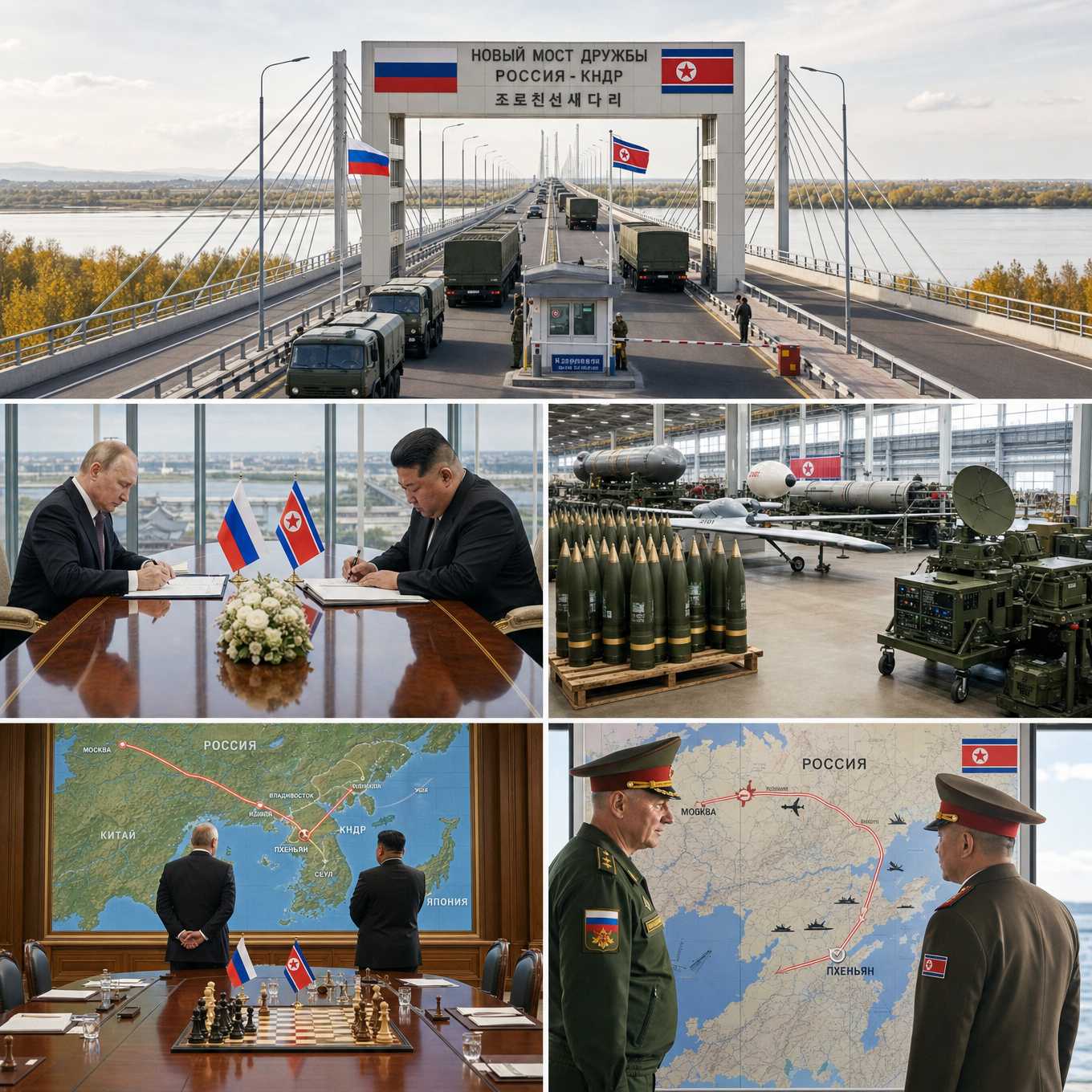


The Treaty That Rearranged the Map
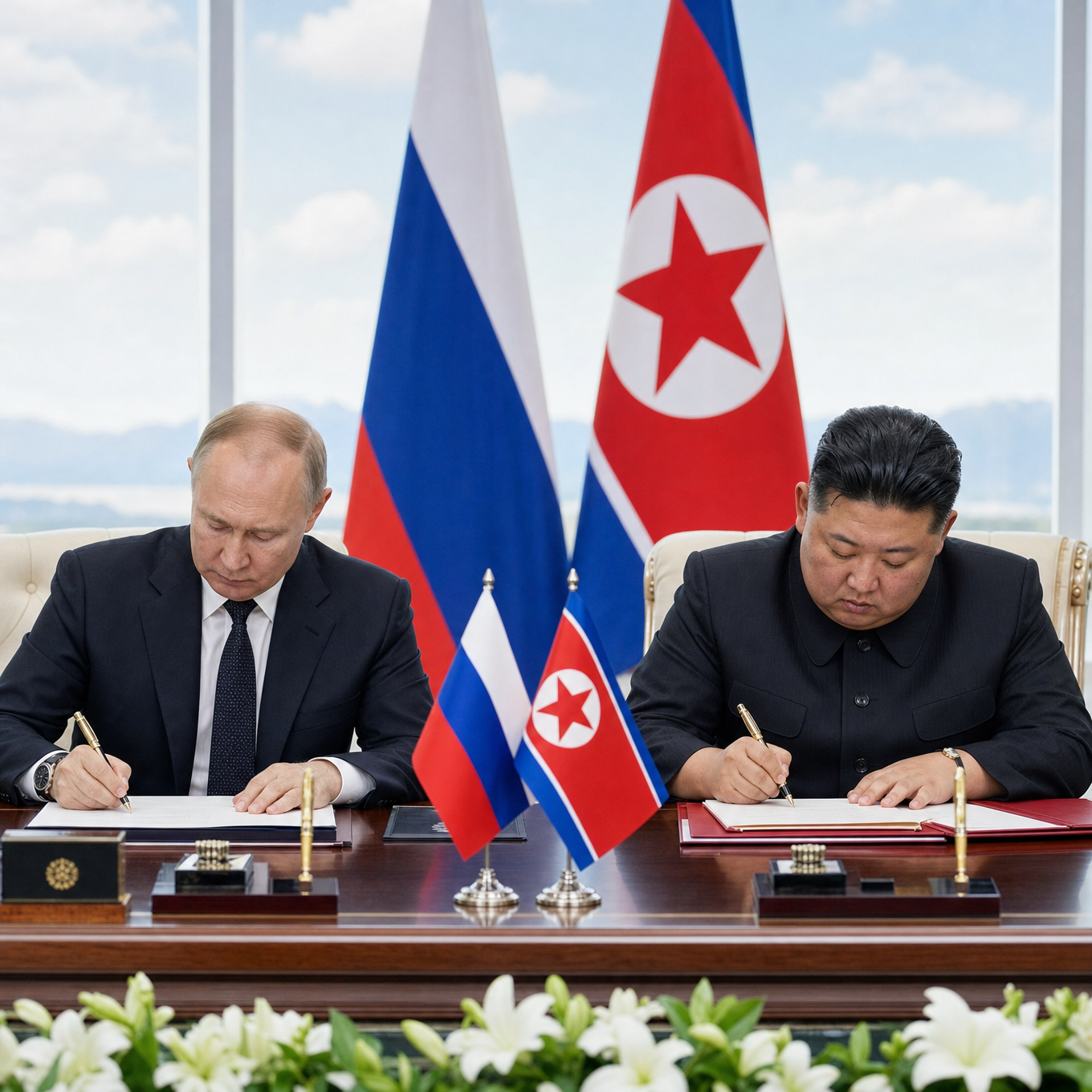
The bridge didn’t appear out of nowhere. It appeared after Vladimir Putin and Kim Jong Un signed the Treaty on Comprehensive Strategic Partnership in June 2024 — a mutual defence pact that obligates each side to “immediately provide military and other assistance by all of one’s means available” in the event of armed invasion [1][2]. That language echoes the Cold War alliance between the Soviet Union and Pyongyang that lapsed in 1991. You could call it a restoration. You could also call it the loudest geopolitical signal since the Berlin Wall fell. Either way, the bridge is the treaty made concrete — literally.
Since that treaty, more than 14,000 North Korean troops have fought alongside Russian forces in Kursk [3]. Ukrainian President Zelenskyy warns that 30,000 more are preparing to deploy [3]. At least 2,000 North Korean soldiers are believed to have died [3]. This is not symbolic cooperation. This is a wartime alliance with blood on the ledger — and a bridge designed to move more blood faster.
The strongest case for Western alarm is this: the crossing is a military logistics corridor disguised as economic infrastructure. A Ukrainian investigation by Truth Hounds found that the $100 million bridge serves a trade volume that would take decades to justify the investment — but trucks, unlike railcars, are nearly invisible in satellite imagery [3]. The Russian-side checkpoint is planned to be ten lanes wide. A helicopter landing pad is under construction [3]. You build that for armies, not tourists. Satellite imagery from March 2026 confirmed the construction from both sides of the river had met in the middle [10]. The frozen border just got a highway.
The Arsenal Nobody Predicted
Here is where the story gets uncomfortable for anyone still treating North Korea as a punchline. The Lowy Institute estimates that Russian capital flowing into North Korea’s defence industry ranges between $5.6 billion and $9.8 billion [5]. North Korean arms factories are now producing artillery shells, self-propelled guns, short-range ballistic missiles, and rocket launchers — some for export to Russia, some kept for domestic use [5]. Between 2022 and 2024, Pyongyang conducted more than a dozen ICBM flight tests [6]. North Korea has assembled roughly 60 nuclear warheads with enough fissile material for at least 30 more [7]. The International Atomic Energy Agency reports expanding uranium enrichment activity and new enrichment facilities [7]. The country’s capacity to produce weapons-grade nuclear material has more than doubled in five years [7].
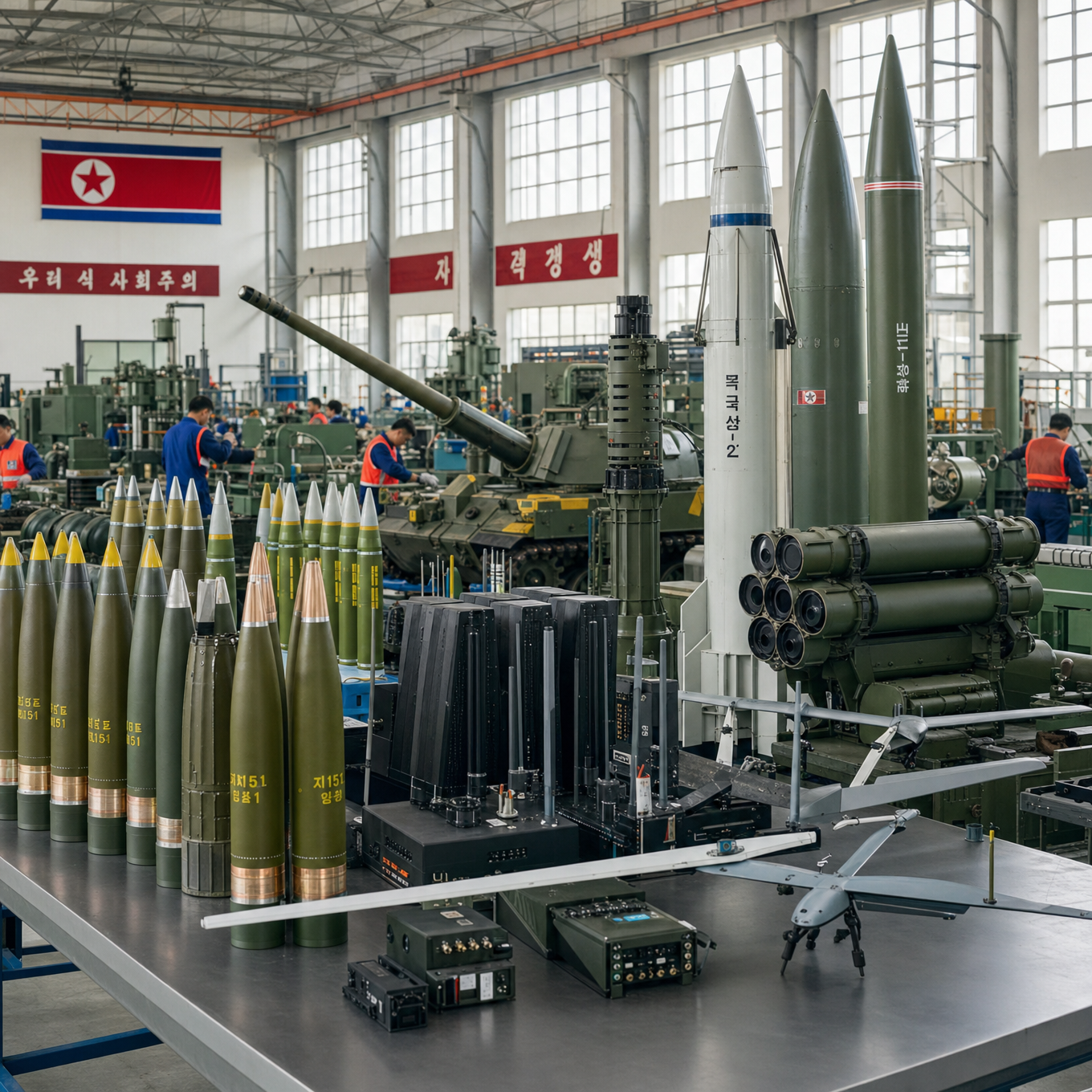
But you are missing the point if you focus only on the nuclear headline. The real transformation is conventional. Kim Jong Un declared AI military drone development a “top priority” in September 2025 [8]. The Kumsong-series tactical attack drones were unveiled that same month — capabilities analysts attribute directly to the Russia partnership [9]. North Korean troops stationed in Russia received hands-on drone training from Russian forces [11]. Russian expertise and the combat experience gained in Kursk are now guiding a conventional modernisation programme that includes new tanks with electronic warfare systems, the Choe Hyon-class destroyer capable of carrying tactical ballistic missiles, and new air defence platforms [5].
And here is the part that should keep defence planners in Seoul and Tokyo awake at night: the future of warfare is not about who has more jet fighters. It is about who has the right missiles, the right drones, the right electronic warfare systems to make traditional air power expensive and irrelevant. Russia has overwhelming air superiority on paper in Ukraine — and it still cannot dominate the battlefield, because Ukrainian missile systems and drones negate much of that advantage. North Korea learned that lesson in Kursk. It is now building the asymmetric toolkit to apply it on the Korean Peninsula. You do not need to match Western air power to neutralise it. You just need the right weapons pointed in the right direction.
The View from the Other Side
Now steelman the other position — because fairness demands it, and because you need to understand what Moscow and Pyongyang actually believe before you dismiss them.
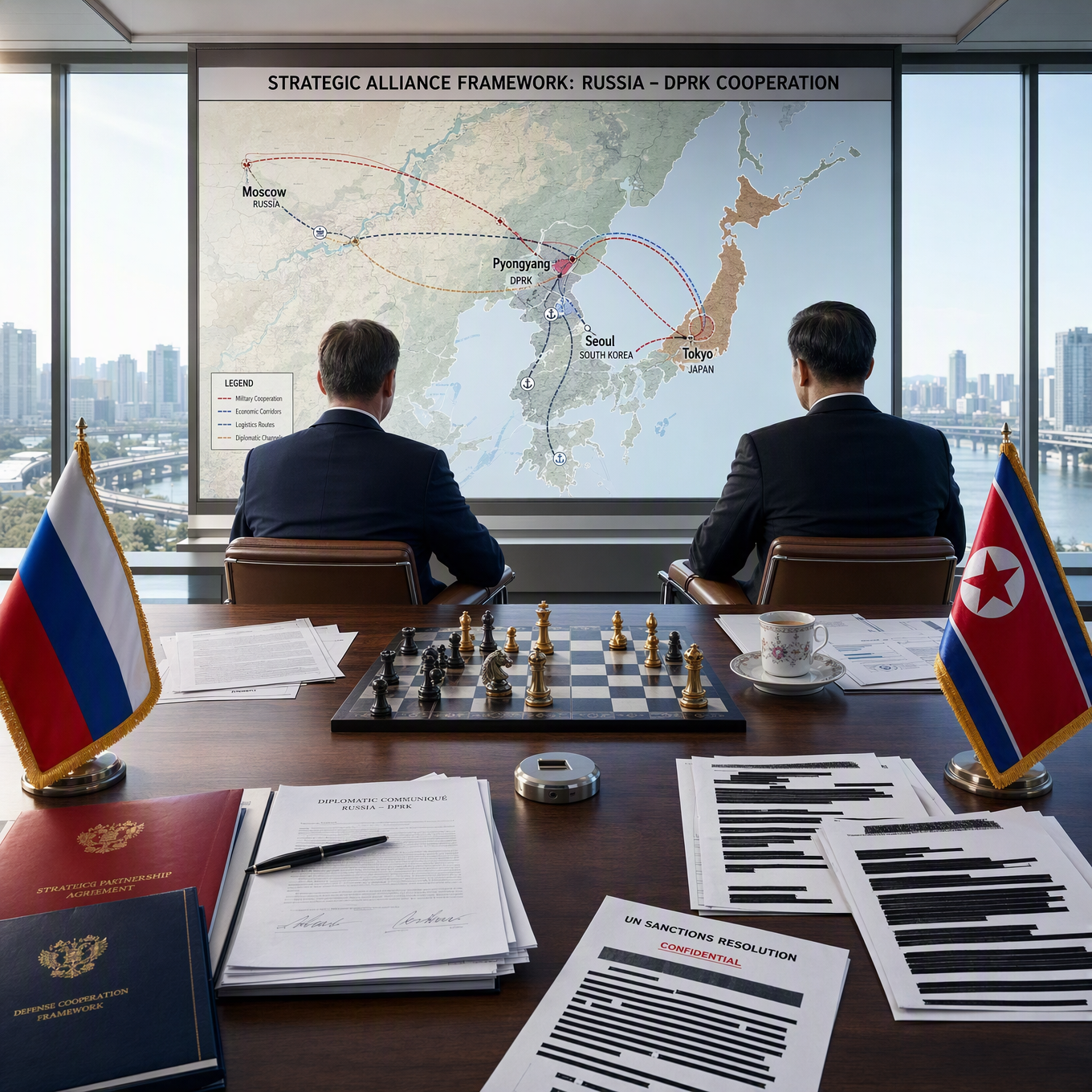
From Russia’s perspective, this alliance is brutally rational. Moscow needed artillery shells to sustain a war of attrition in Ukraine; North Korea had millions of them [4]. In return, Pyongyang received the one thing it has always wanted most: advanced military technology and diplomatic cover [4]. Russia dismantled the UN sanctions monitoring mechanism by vetoing the renewal of the Panel of Experts in March 2024, effectively blinding the one multilateral body capable of documenting weapons transfers [7]. This is not reckless adventurism. This is a calculated exchange between two states that concluded the international rules-based order was already dead — and decided to stop pretending.
From Pyongyang’s perspective, the case is sharper still. For decades, North Korea watched the West build an entire security architecture around its containment — troops in Seoul, missile defence in Guam, sanctions enforced by a UN Security Council where Russia and China once cooperated with Washington. That consensus has collapsed [7]. China and Russia vetoed a US-led resolution to tighten sanctions in 2022 [7]. In May 2025, Xi and Putin released a joint statement explicitly opposing sanctions or diplomatic isolation of North Korea [7]. The North Korean economy grew 3.7 percent in 2024 — its highest growth rate in eight years [7]. Kim Jong Un looked at the board, saw the pieces moving, and made his play. You can call it dangerous. You cannot call it stupid.
The Soldiers Who Paid the Price
Translate this into human terms, because that is where geopolitics stops being abstract and starts counting bodies.
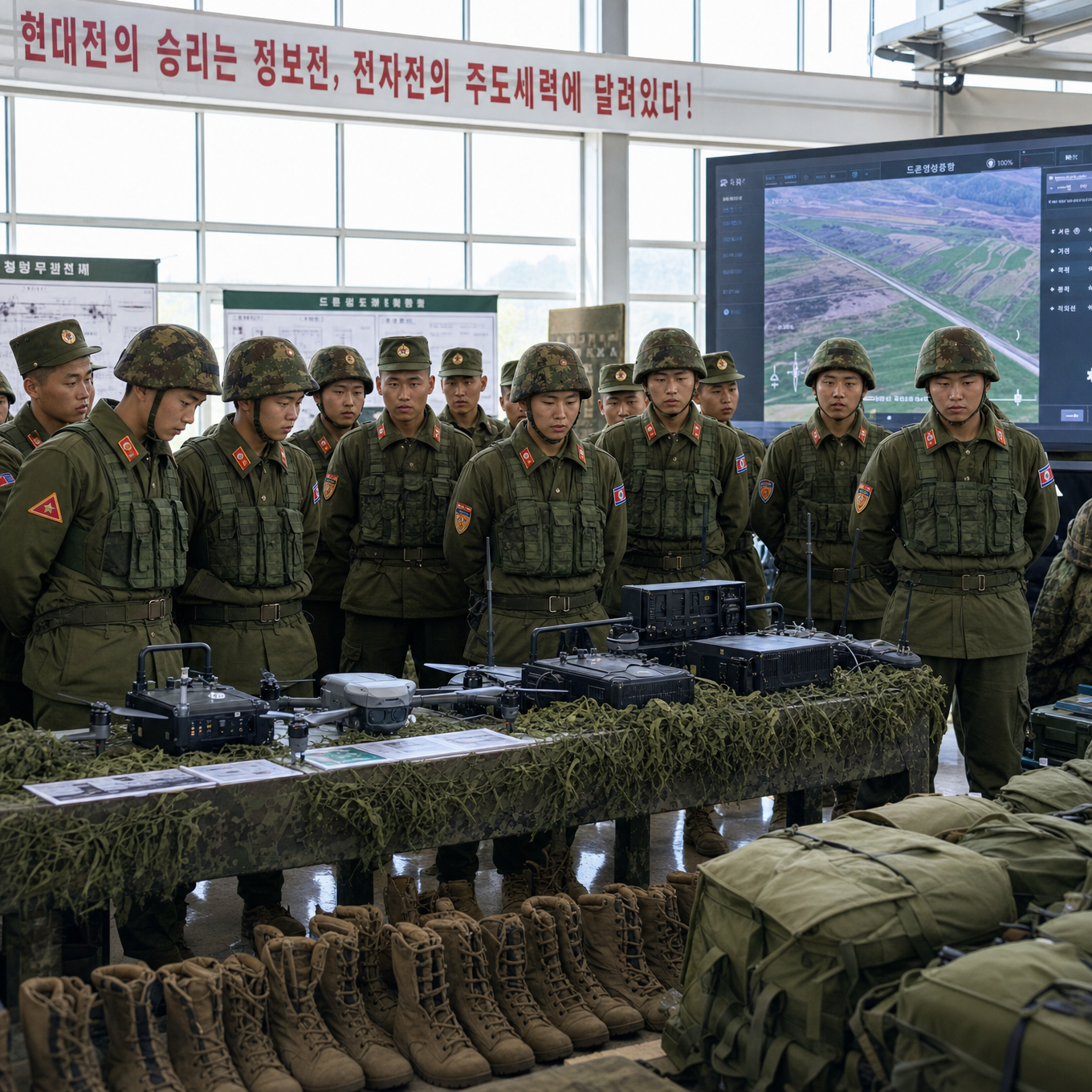
More than 14,000 North Korean soldiers were sent to Kursk. South Korean intelligence estimates at least 2,000 died [3][4]. These are men who had never seen modern combat, deployed into a warzone with weapons systems that were obsolete before they arrived, told to fight for a country most of them could not find on a map. The surviving soldiers gained something Pyongyang values more than their lives: battlefield data, modern combat tactics, and first-hand experience with drone warfare [4].
On the other side of that exchange, Ukrainian soldiers found themselves facing North Korean ballistic missiles supplied to Russia — at least 100 launched into Ukraine in 2024 alone [4]. North Korea supplied an estimated 9 to 10 million rounds of ammunition [4]. Every one of those rounds was fired at someone’s son, someone’s father, someone who did not choose this war. And every round that landed told Pyongyang: your factories work. Your alliance works. Your strategy works.
In South Korea, 51 million people now live within range of a North Korean military that is modernising at a pace nobody predicted five years ago — equipped with Russian electronic warfare systems, Russian drone technology, and the combat experience of soldiers who learned to fight in Europe [5]. The conventional military balance still favours Seoul. But the gap is closing. And the pace of that closing is accelerating.
The Dragon Is Awake. Now What?
You have been watching a frozen conflict for thirty years and assuming the ice would hold. It didn’t. North Korea is no longer a contained problem — it is an active node in a new military alliance with the world’s largest nuclear power, armed with battle-tested troops and a modernising arsenal that draws directly from Russian technology and combat experience [4][5][7].
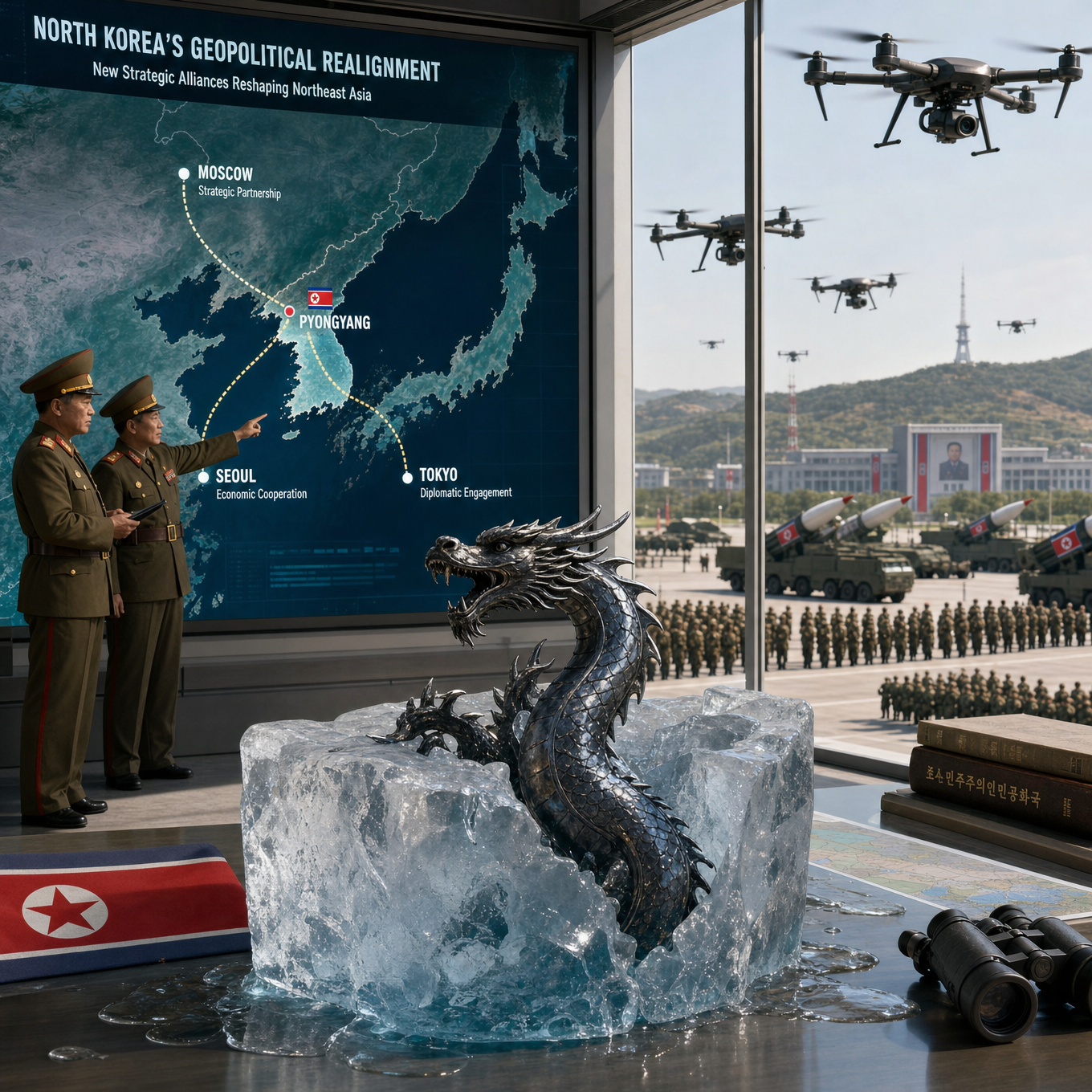
The bridge over the Tumen River is not an economic project. It is a statement of intent — a physical declaration that the era of North Korean isolation is over, not because sanctions were lifted, but because Pyongyang found partners powerful enough to ignore them.
But here is the question you should be sitting with tonight: if the military alliance with Russia gave the frozen dragon its wings, what happens when it starts looking for a nest? What happens when Pyongyang turns south — to Vietnam, to Laos, to Cambodia — and starts building the regional partnerships that make containment permanently impossible?
What happens when the dragon decides it no longer wants to be alone?
That is the subject of Part 2.
References
[1] Reuters. (2024). Russia’s Putin and North Korea’s Kim sign mutual defence pact. Reuters
[2] Ballbach, E. J. (2025). Autocratic Alliance? The North Korea–Russia Comprehensive Strategic Partnership Treaty. Völkerrechtsblog
[3] Rashid, R. & Harding, L. (2026). Russia and North Korea finalising first road crossing amid concerns it serves as Ukraine war supply route. The Guardian
[4] Yadav, S. (2026). How Moscow’s wartime alliance with Pyongyang is redrawing the map of Northeast Asian power. Modern Diplomacy
[5] Schepers, K. (2025). Why North Korea is modernising its conventional arsenal. The Interpreter, Lowy Institute
[6] Congressional Research Service. (2026). North Korea’s Nuclear Weapons and Missile Programs. Congress.gov
[7] Heo, D. (2026). A Divided World Is North Korea’s Greatest Asset. Foreign Policy
[8] Al Jazeera. (2025). Kim Jong Un declares AI military drone development a ‘top priority’. Al Jazeera
[9] 38 North. (2025). Current Status of North Korea’s Drone Program. 38 North
[10] 38 North. (2026). Russian Bridge Construction Work Meets in the Middle. 38 North
[11] CSIS Beyond Parallel. (2025). North Korean Strategic UAV Activity at Panghyon Airbase. Center for Strategic and International Studies
[12] Asia Society Policy Institute. (2026). Russia–North Korea Military Cooperation in Response to China’s Tactical Ambiguity. Asia Society
AI Disclosure: This post was created with the assistance of artificial intelligence. The ideas, analysis, and opinions expressed are my own — AI was used to help compose, structure, and refine my personal notes and thoughts into the final written content. Images and video featured in this post were also generated using AI tools, based on my own creative prompts and direction.

[…] of a three-part series on North Korea’s quiet campaign to break Western containment. Part 1: The $100 Million Bridge to a $34 Million Trade · Part 3: The New […]