









Contents
- 1. Geopolitics & Defence
- 2. Environment & Climate
- 3. Society & Civil Issues
- 4. AI & Technology
- 5. Economy & Business
- 6. Science & Space
- 7. Crypto, Digital Assets & Blockchain
- 8. Correlations & Analysis
- 9. References
Click any heading to jump to that section. Click the section heading to return to this menu.
Geopolitics & Defence ↑ Contents
The Moscow Door Opens While the Capitals Exchange Fire
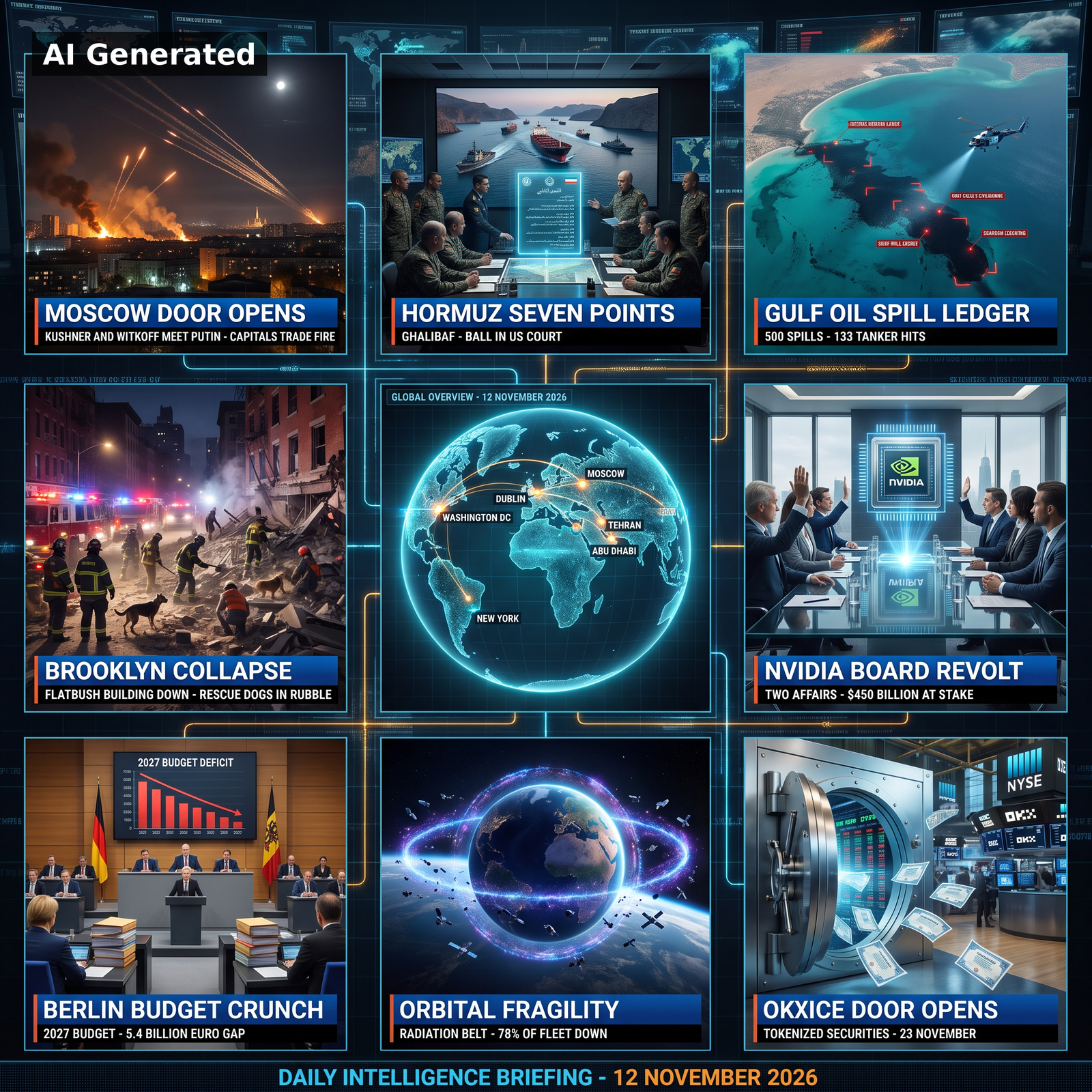
Thursday’s window delivered the sharpest paradox yet in the Ukraine peace track: even as Kyiv and Moscow traded strikes on each other’s capitals hours after the Abu Dhabi talks closed without a breakthrough, Washington’s envoys Jared Kushner and Steve Witkoff were preparing to fly to Moscow to sit down with Vladimir Putin, before crossing to Dublin to meet Volodymyr Zelensky at the European Political Community summit[1][2]. The overnight attacks — explosions across Kyiv, five drones intercepted over Moscow, and Ukraine’s confirmed strike on the Baltic oil port of Ust-Luga — are the backdrop to the first direct US–Kremlin contact of this phase[1][6]. Kyiv’s camp reports “good momentum” toward a solution before the new year and a large-scale prisoner exchange was agreed, while US mediators concede trust remains the governing variable[1].
The European flank is manoeuvring to avoid irrelevance. More than 45 heads of state are converging on Dublin for the ninth European Political Community meeting, with the explicit agenda of Ukraine financing — the EU puts Kyiv’s extra 2027 needs at roughly €70 billion, more than half covered by a fresh EU loan — and of pressing for a European seat at the table[3][4]. Berlin is pressing partners to cover the remainder; the summit’s real output may be less a new plan than proof Europe insists on a funded, seated role before any settlement is signed. Kyiv, meanwhile, is publicly managing expectations: a senior official in Zelensky’s office has instructed Ukrainians to prepare for an exceptionally hard winter of rolling blackouts and to expect no early peace, arguing that Russia is only re-arming[5].
Tehran’s Seven-Point Ball Is in Washington’s Court
The Gulf confrontation entered a distinctly political phase. Iran’s parliament speaker, Mohammad Bagher Ghalibaf, declared that the Strait of Hormuz will never return to its pre-war status and that the future of the waterway must be settled on Tehran’s proposed seven-point framework, insisting “the ball is in the Americans’ court” if they genuinely want the war to end[8]. The posture lands alongside an escalating security read in Washington: US officials describe Iranian threats against Treasury Secretary Scott Bessent’s life as “beyond the advanced stage,” with Bessent relocated to a secure military facility while the economic-isolation campaign continues[9]. The administration, for its part, used the Armistice Day platform to defend the conflict — President Trump told an 11-November audience that the war would leave “the world safer” — an unusually direct framing of the war as a completed strategic bargain[10].
The periphery keeps firing in the opposite direction. Houthi forces launched a fresh missile-and-drone barrage at Saudi Arabia — three cruise missiles aimed at Riyadh, two drones toward Mecca and the south, and an additional pair of missiles toward the west, all intercepted by the Saudi-led coalition — while claiming a drone strike on the strategic Red Sea port of Yanbu[7]. Riyadh remains a target despite the US–Iran channel, and its air defences are doing the intercepting for the entire regional order. In Jerusalem, the political machinery is publicly second-guessing the caretaker prime minister: opposition leader Gadi Eisenkot, set to inherit the premiership, issued a public letter demanding Benjamin Netanyahu show restraint on any Iran strike and not launch high-risk military operations before a government with Knesset confidence is sworn in[11]. The message from Israel’s security establishment is unambiguous: the Iran file can wait for an accountable cabinet.
Moscow Rewrites the Post-Soviet Perimeter
Russia moved to formalise the drift in its southern alliance system, stripping Armenia of its voting rights in the Collective Security Treaty Organization over unpaid dues, three years after Yerevan’s leadership blamed the bloc for failing to intervene during the Azerbaijani assault on Nagorno-Karabakh[12]. The decision, taken at the CSTO summit in Moscow, is the culmination of Nikol Pashinyan’s pivot toward the EU — Armenia has applied for membership by 2028 — and Moscow has threatened its subsidised gas price of $177 per thousand cubic metres would rise to European-level $600 if Yerevan completes the turn[12]. The Kremlin frames the sanction as a technical dues matter; the strategic content is a warning to every post-Soviet state that neutrality between Moscow and Brussels now carries a price tag. Ankara is making its own diversification move in the energy sphere, reportedly sidelining Russia’s Rosatom from the next generation of Turkish nuclear plants — the Sinop project on the Black Sea is now being contested by Canada’s AtkinsRéalis and South Korea, with Canadian pension-fund financing under discussion, after the energy minister said the two suppliers had “more or less convinced” the government[13]. A Turkey that builds its second nuclear plant without Russian technology is a quieter but real geopolitical shift in NATO’s southern tier.
The Wider Periphery: Gaza, the Colonies and the Espionage Ledger
In Gaza, an Israeli air strike on a hospital in the south killed at least five people and wounded twenty, according to Gaza’s Civil Defence, in the latest of a string of strikes on medical infrastructure[14]. France turned back a representative of West Bank settlements arriving on its soil, a measure Jerusalem denounced as “unacceptable” — a rare, concrete French enforcement gesture in the settlements file[15]. British authorities arrested a US serviceman on suspicion of spying for Russia, while Moscow lost its ambassador to Washington, Alexander Darchiev, at 66[16][2]. Darchiev was the veteran tasked with rebuilding the US channel after 2022.
The Euro-Asian Defence-Industrial Base and the Eastern Mediterranean Cable
The defence-industrial calendar remains dense. In a milestone for European air power, the MBDA Meteor beyond-visual-range missile was successfully released from the internal bay of an F-35B in a joint UK–US test[18]. Greece’s army ordered additional Shield AI V-BAT vertical-take-off drones through NATO’s NSPA procurement agency, an expansion of the Aegean ISR fleet with common training and sustainment benefits[19]. Naval Group unveiled future FDI frigate variants that could carry missiles, laser weapons and interceptor drones, a sign the French shipbuilder is designing for a contested-maritime environment in which lasers and counter-UAS payloads are assumed[21]. General Atomics AeroTec broke ground on a EUR50m+ maintenance facility at Nordholz, adding four heavy docks by 2027[22]. Canada, meanwhile, is confronting a knife-edge fighter timeline: its CF-18 Hornets, down to 71 airframes with five or six retiring per year, exit service in 2032–33 at precisely the moment its F-35A fleet reaches full operational capability, leaving zero margin if Ottawa’s long-running F-35 review slips further[20]. Ukraine’s defence-tech unicorns are hedging the same uncertainty by cultivating Taiwan and Japan supply-chain ties, a quiet industrialisation of the alliance’s drone ecosystem beyond European borders[24]. Beijing is pushing the opposite edge of military medicine: China’s Air Force Medical University demonstrated a casualty-search drone that injects medication via dart into a wounded soldier’s muscle, a capability explicitly framed for contested evacuation zones[23].
On the Eastern Mediterranean fault line, the Greek government has moved to de-escalate the domestic politics of the Great Sea Interconnector: Foreign Minister Giorgos Gerapetritis will brief all opposition leaders in person on the French demarche to Ankara, clarifying that Athens has been informed of its content but has not received the text itself, while the French survey vessel Abeille Marengo is now under way toward the survey area following its equipment trials off Heraklion — with discreet coastguard surveillance and possible Hellenic Navy presence if needed[25]. Athens’ bet that Turkey has “played all its cards” on the cable; the NAVTEX exchange will test it. Germany’s Bundeswehr has commissioned an investigation into an IT failure that affected far more reservists than the officially cited 900, a transparency gap becoming a political issue as the forces absorb record budgets[17].
Environment & Climate ↑ Contents
COP31’s Reckoning: Stalled Ambition, Shrinking Headroom
The bluntest assessment in Antalya: the five years after Paris bought the world a degree of avoided warming, and the five years since have bought nothing. The independent Climate Action Tracker reports aggregated climate action has “essentially stalled,” with positive and negative measures cancelling out, leaving the world on course for an “irrecoverable overshoot” of the 1.5°C target and roughly 2.6°C of warming even if every promise is kept[26]. Island leaders used that arithmetic directly: the Marshall Islands’ Hilda Heine warned every new oil well threatens her country’s existence, and Barbados’ Mia Mottley delivered the summit’s caustic line — “pledges are not payments,” with promised finance now running some 70% below previous levels[26]. The backdrop is equally unforgiving: WMO data show 2015–2025 as the eleven hottest years on record, with 2025 about 1.43°C above pre-industrial levels — the failure metric now reading near-certainty[27].
The summit host is a case study in contradiction. Turkey is welcoming world leaders to its climate presidency while expanding a major coal-fired plant, an expansion that independent investigations tie directly to poor air quality and elevated cancer risk in surrounding communities — the kind of lived-versus-pledged gap the tracker methodology quantifies in aggregate[28]. Former US climate envoy John Kerry drew the opposite lesson, telling the summit the US and the world must follow China’s lead on green energy — a striking transatlantic inversion acknowledging Beijing’s build-out of wind, solar and batteries is the pace-setter[29]. Europe, meanwhile, is litigating its own green architecture: Poland’s legal challenge to the Fit-for-55 package reaches judgment at the European Court of Justice, with rulings due on the 2030 emission targets, new-car CO2 standards and annual national climate obligations — a case that will effectively decide whether the EU’s headline climate law survives judicial review intact[30]. In Germany, Greenpeace has announced a constitutional challenge to Bavaria’s climate law, arguing the state’s targets are legally insufficient — the second prong of a legal escalation that is moving climate accountability from parliaments into courts across Europe[31].
The Gulf’s Generational Oil Spill and the Global Pollution Ledger
The environmental cost of the Gulf war is now quantifiable from orbit, and it is staggering. Greenpeace satellite monitoring has identified more than 500 oil spills across the Gulf, the Strait of Hormuz and the Arabian Sea since the US war on Iran began in February — a cumulative footprint of roughly 20,000 square kilometres, nearly the size of Wales — with more than 133 tanker attacks logged and October the worst month on record[33]. The strikes are hitting a shallow, enclosed basin with no cold deep water to buffer heat; biologists warn oil trapped in mangroves, seagrass beds and sediments will poison food chains for decades — a “generational” wound echoed by tar still contaminating Qatari and Saudi shores from wars thirty and forty years ago[33]. With the naval blockade making on-the-ground documentation impossible, the satellite record is the only accounting of a disaster whose full extent will not be known until the shooting stops.
Away from the war zone, the pollution ledger shows both progress and substitution effects. Levels of the two most-studied “forever chemicals,” PFOS and PFOA, have fallen 30% and 29% respectively in English rivers over the past decade, a direct result of global restriction treaties — but the monitoring also detects the arrival of replacement short-chain PFAS and fluorotelomers, including trifluoroacetic acid, at the very concentrations regulators were hoping to avoid[36]. New research in Nature confirms microplastics are accumulating in the blood of wild mammals more than 40 miles from human infrastructure, proving the exposure-to-body-load link in terrestrial wildlife at scale[35]. Even the ocean’s colour is changing — waters around the Great Pacific Garbage Patch appear measurably greener and bluer because of the plastic[37]. In the Americas the pressures are equally visible: heat and drought could shrink the suitable habitat of many cactus species, while North Carolina regulators issued a scathing critique of Chemours’ cleanup plan for PFAS contamination across at least ten counties, arguing it violates the consent order[38][39].
The Living Ledger: Fire, Biodiversity Finance and Adaptation’s Price Tag
The biosphere’s ledger for this window is dominated by fire and finance. Indonesia’s fires, driven partly by strong El Niño, have burned 2.88 million hectares this year — an area the size of Belgium[34]. At the UN biodiversity summit in Armenia the same fault line emerged: the Democratic Republic of Congo’s negotiator told Mongabay developed nations are “not honoring their commitments,” warning that without more effective finance, communities dependent on the Congo Basin forests will have no alternative but to degrade them[44]. In wildlife governance, CITES lifted its 2023 trade sanctions on Laos after finding “significant progress” against trafficking, a decision conservationists called premature given a 2025 investigation documenting 35 illegal shops still selling ivory, rhino horn and pangolin scales[32].
Adaptation economics is finally getting granular data. A study of FEMA’s disaster-buyout program — $6 billion on 53,000 properties since 1988 — finds it genuinely works: participants are about 20 points more likely to relocate within five years and it largely pays for itself in avoided damages — but the benefits are starkly unequal, with average payments of $40,583 in majority-Black tracts versus $93,977 in predominantly white ones[40]. The infrastructure front shows the same tension between need and siting: states are counting on battery farms to balance the grid while an increasing number of towns are fighting them, and Gateshead’s pioneering mine-water heat scheme — 350 homes warmed by 15°C water from flooded coal shafts, boosted by heat pumps to 80°C and cutting CO2 by 1,250 tonnes a year — is now being instrumented as a living laboratory to test whether neighbouring schemes can safely share the same underground reservoir[41][42]. Finally, the maritime chapter of human nostalgia closed: the SS United States, the 1952 speed-record holder, was scuttled off Destin, Florida, to become the world’s largest artificial reef — a $13.5m conversion of a Cold War icon into tuna, marlin and swordfish habitat[43].
Society & Civil Issues ↑ Contents
The Brooklyn Collapse and the Urban Safety Question
The deadliest single urban event in this window occurred in New York, where a three-storey building collapsed in the Flatbush section of Brooklyn, killing at least two people and injuring more than a dozen others, including seven children, with four victims in critical condition as hundreds of rescuers and search dogs worked through rubble into the night[45][46]. Fire Chief Lillian Bonsignore described an “extremely dangerous” rescue in which the fire department’s first unit, coincidentally near the scene, arrived within a minute; part of the building crashed into an adjacent excavation pit whose role in the collapse is now the central question of the investigation[46].
Housing, Labour and the State Across Europe
The right-to-housing movement produced the continent’s sharpest street conflict of the window, with Spanish demonstrations ending in clashes between protesters and police[47]. Spain’s housing crisis — rents outpacing wages for a decade, youth homelessness rising — is the visible edge of a Europe-wide squeeze. French social policy is pulled two ways: a new poll finds two-thirds of the public would reserve social minima for “the most deserving,” while the CGT warns the government’s minimum-wage revaluation, effective 1 December, will push 164 professional branches into technical illegality as their bargained base rates fall below the new floor[60][48]. A floor raised faster than sectoral agreements is not merely a budget question but a legal trigger affecting millions of workers overnight.
Global Civic Ledger: Indonesia, Chile, Colombia and Public Health
The civic ledger outside Europe records three notable institutional moments. Indonesia’s Vice-President Gibran Rakabuming Raka resigned over a dispute about his educational qualifications, removing the president’s son from office two years early and throwing the Jokowi-era succession into renewed uncertainty[49]. In Chile, a mother was reunited with the two sons taken from her under the Pinochet regime forty years ago — keeping the dictatorship’s stolen-children file alive as generational justice movements rise[50]. Colombia’s judiciary opened war-crime prosecutions against eight retired officers for crimes against the Patriotic Union, the leftist party whose members were massacred by the thousands in the 1980s — a long-delayed reckoning testing whether transitional justice will reach upward[51]. In public health, Greece’s leading pulmonologist used the national health agency platform to frame nicotine as one of the most addictive substances known — 32% addiction probability after first use, above heroin (23%) and cocaine (17%)[52].
Greek society is also producing two quieter signals of how citizens are adapting to geopolitical anxiety. Survival-kit demand is up more than 100% year-on-year in Greek retail, driven by the EU’s formal recommendation that households hold 72-hour emergency reserves — with radio-crank flashlights, long-shelf-life rations and family buckets of 60–120 meal portions now mainstream purchases rather than outdoorsman niche[53]. Domestic politics is running on a different clock: November polls show PASOK and the leftist ELAS formation locked in a second-place battle, with PASOK edging closer but unable to overtake, and analysts attributing the ceiling to structural identity rather than leadership — the first test of whether the centre-left can convert polling convergence into electoral overtake[54].
Washington’s Civic Week and Britain’s Labour Squeeze
American civic life delivered two emblematic images: In Mississippi, Democrat Scott Colom defeated Republican Senator Cindy Hyde-Smith, becoming the state’s first Democratic senator in 44 years and the first Black senator chosen by its voters in the modern era — a result analysts attribute to a localised affordability campaign built on Colom’s ad retelevising Hyde-Smith’s “so many proteins to choose from” response to rising beef prices, plus a 28-vote Holmes County margin[58]. The win pushes Senate Democrats toward 55–56 seats, reshaping filibuster and confirmation arithmetic. At Arlington National Cemetery, a Tomb of the Unknown Soldier guard publicly reprimanded Defence Secretary Pete Hegseth’s entourage for laughing before the memorial on Veterans Day — a viral frame for the administration’s friction with military tradition[59]. Germany’s Bundestag used the same day to legislate: a dozen coalition bills — language tests in nurseries, accelerated Bundeswehr construction, stronger cyber-powers for police, customs anti-money-laundering authority — a reminder the state’s machinery keeps moving while budget politics dominate headlines[57]. In Britain, the labour-market report that matters most for the next government landed with a generational sting: only half of England’s young non-graduates secure permanent contracts by age 19–20, down from 81% six years ago, with just 23% in stable work at all — a structural deterioration in the bottom half of the youth labour market that no party has yet priced into policy[55]. A smaller UK consumer ruling completes the section: watchdogs banned sunbed ads claiming safety or medical benefit, on NHS advice linking UV exposure to skin cancer[56].
AI & Technology ↑ Contents
The Nvidia Files: A Board, Two Affairs and $450 Billion
The technology story of the window hangs over Jensen Huang. The Wall Street Journal reported that Nvidia’s board is preparing to oust its founder-CEO of 33 years, with directors potentially meeting as early as Wednesday evening, after the New York Times revealed a second extramarital relationship — this one with Kimberly Powell, Nvidia’s vice-president of healthcare, who reports directly to Huang[63][65][66]. The first affair, admitted by Huang on 8 November, involved Alice Huang, an executive at Singapore-based cloud provider Megaspeed whom US officials believe to be an agent of China’s Ministry of State Security. The market verdict has been brutal: shares closed up about 3% at $173.73, then slid 8–10% after hours to the low $160s, erasing more than $450 billion of market value since the scandal broke[61][64]. For a company worth $4.1 trillion — about 6% of the S&P 500 — the volatility reaches into the index and target-date funds inside millions of American 401(k)s[61].
The espionage dimension is why this is no tabloid affair. Fortune’s reconstruction of Megaspeed’s network details how Alice Huang used her relationship with the Nvidia CEO to move at least $7.5 billion of restricted Blackwell and Rubin chips toward Chinese companies — through Megaspeed and its Malaysian subsidiary Speedmatrix, which received over 200 shipments of restricted Nvidia technology between June 2024 and June 2025, ultimately powering data centres built by Shanghai Century Litong, a firm whose founding shareholder is Alice Huang’s sister[62]. Bloomberg now reports that Alice Huang has returned to Beijing, apparently under state-security protection[69]. The political machinery is responding: Senators Elizabeth Warren and Chris Coons have written to Commerce Secretary Lutnick, Secretary of State Rubio and White House chief of staff Miller demanding preservation of all documents tied to Nvidia’s China exports, converting a corporate scandal into a congressional-records fight[68]. Succession itself has become a live dossier: some directors reportedly favour CFO Colette Kress as interim CEO, and Nvidia is understood to be working with an outside firm on replacements[67]. As of the window’s close, no board decision had been announced — the most consequential open question in global technology sits unresolved.
Frontier Models Meet the Office, and the World
Beyond Nvidia, the AI industry’s centre of gravity continued shifting from raw model capability toward workplace presence. Google DeepMind released Gemini Decision 1, a model answering up to 1,000 decision-type questions in a single API call — built for structured workflows like claims intake[72]. DeepMind also unveiled AlphaGenome 2, its upgraded DNA model, which analyses how genetic variants act in specific cell types rather than tissue averages: on the TenK10K immune-cell benchmark it identified 30% of causal variants versus 16% for its predecessor, and correctly predicted whether variants raise or lower gene activity in 43% of cases — a leap toward cell-level genomic medicine[71]. IBM announced plans to merge two Nighthawk r3 quantum processors into a 1,040-qubit system in 2027, with l-coupler interconnects achieving 99.3% state-transfer fidelity between first-generation chips[70].
The enterprise-play war heated up exactly as the aborted Anthropic IPO day approached: Databricks launched a set of “always-on” agentic tools — a Genie assistant that shadows knowledge workers and an Ontology layer that indexes entire organisations — one day after Anthropic began rolling out Claude-powered spreadsheets, whiteboards and video-call participation[73]. The two launches frame the same bet: the next valuation frontier is the always-on assistant embedded in corporate data. Trust is the counterweight. VentureBeat reported attackers breached Fireworks AI’s storage holding Notion AI chat transcripts — despite its public “Zero Data Retention by default” promise — exposing the gap between marketing and reality in the inference-security supply chain[80]. United Airlines, a bellwether for conservative enterprise adoption, restricted AI agents’ system access over security concerns, while Japan moved toward stricter penalties for AI developers — the first major Asian jurisdiction to signal that liability, not voluntary frameworks, will police frontier deployment[79][78].
Compute’s New Geography: Power Is the Constraint
The data-centre build-out is colliding with its physical limits, and the market is responding with modularity and politics. Torus launched Foundry, a prefabricated modular system putting 1–20 MW of inference capacity onto existing commercial sites with spare grid connections, compressing the build cycle to 12–16 weeks, backed by $500 million from Magnetar — an answer to the power-constrained grid’s 35%-a-year inference demand growth[74]. The backlash is equally organised: Quantum DC has halted its Australian data centre amid public opposition, and Missouri’s Josh Hawley has joined Democrats in backing a nationwide data-centre moratorium as Senate Republicans prepare their next-term agenda — the first credible federal brake on the AI build-out, and a Republican co-sponsorship that would have been unthinkable two years ago[75][76]. The legal perimeter tightened around tech’s conduct: a Ninth Circuit panel handed SpaceX its second loss in trying to force a sexual-harassment suit into private arbitration, keeping the case in open court[77].
Economy & Business ↑ Contents
Markets, Nvidia and the Central-Bank Divergence
Asian markets opened fragile with Nvidia’s board drama the pivot: the $4 trillion chipmaker’s after-hours slide set the tone for semiconductor-exposed bourses, and the unresolved board decision keeps a systemic overhang over global tech valuations[81]. Index concentration means a leadership transition at the world’s second-most-valuable company re-prices passive portfolios, not just one equity. Away from the noise, the Bank of Japan remains the quiet divergence: dovish board member Asada pushed back against market expectations of an early rate hike, arguing that with the policy rate already in neutral territory a further hike would have outsized effects, and that consumption data do not yet justify tightening — a warning that Tokyo is neither synchronised with the Fed nor eager to validate yen-funded carry positions[82]. Korea’s capital account swung from September’s $5.81 billion net outflow to $5.61 billion of net bond investment in October — foreign money returning to the region’s core bond markets[83]. Energy security is being institutionalised: ASEAN states, led by Japan, will build combined petroleum stockpiles and storage in Indonesia and Thailand by 2027 — a diversification answer to the Hormuz disruption haunting Asian import bills[84].
Europe’s Fiscal Night: Berlin’s 2027 Budget and the Rate of Money
Germany’s budget committee entered its decisive “cleansing session” for the 2027 federal budget with a multi-billion-euro gap still open — the canonical number being the coalition’s pledge to cut the electricity tax toward the European minimum, a €5.4-billion-per-year measure with no funding source, which the chancellor’s own finance ministry and treasury hawks in the Union fraktion privately deem dead on arrival[85]. The headline figures are historic: a €555 billion core budget with €118.7 billion in new borrowing, plus special funds pushing total debt past €200 billion. The closed financing gap tells the political story — the plastic tax abandoned, the sugar tax postponed to 2028, the €300 million housing-benefit cut reversed, the child supplement protected — a sequence of negotiated retreats that shows how hard new revenue is in a coalition that campaigned on tax relief. Germany’s answer to its skills shortage is now explicitly international: the IHK’s “Talentsbridge” initiative opened a training centre in Windhoek, Namibia, with 45 apprentices trained to German standards and 1,700 applicants for the first cohort — migration policy converted into workforce planning[86].
Industry’s War Exposure and the Periphery’s Bank Ledger
The war economy hit the automotive heartland from the supply side: Russian strikes on a German-owned plant in western Ukraine cut wiring-harness supply to BMW and Skoda, forcing BMW to cancel shifts and showing that kabelbaum logistics built over three decades remain vulnerable to a single contested geography[88]. Even Switzerland, the punctuality poster child, feels the squeeze: the SBB faces a €10 billion maintenance backlog and executives publicly fear the onset of “German conditions”[87]. In South America, the Paraguay banking collapse moved closer to closure: the central bank partially refunded all eligible depositors of collapsed Ueno Bank, honouring the guarantee for more than 1.8 million accounts, though the largest depositors must still wait — the denouement to the impeachment and arrest of former president Santiago Peña[89].
The Consumer and Growth Files
The consumer picture is genuinely two-speed. Greece’s price-containment machinery is back in operation — the “gentlemen’s agreement” now covers 1,107 supermarket codes with an average 6.6% cut on branded goods and 7.5% on private label, and a Christmas basket of 70 food codes with reductions up to 30% is being assembled — but October inflation data showed food prices rising 2.3% in a single month, and the market authority is preparing an algorithmic excess-profit monitor for 2027, when double-digit rises in dairy, cereals and packaged goods are expected as energy costs roll through the supply chain[91]. The EU-wide EV market, by contrast, is accelerating: Europe’s battery-electric sales jumped 49% in October while global EV sales grew 8%, and North America posted its first year-on-year increase of 2026 — evidence that the post-2025 EV slump in Europe is reversing[93]. Britain’s GDP print, due Thursday, is expected to show growth picking up on AI investment and the defence build-out, with the Iran-driven energy shock the key offsetting risk[90]. Finally, the German growth narrative is quietly turning to robotics: the Wirtschaftsweise-linked debate now centres on AI-driven industrial automation as the potential structural growth source — with ZDF highlighting Metzinger start-up Neura Robotics as the emblematic case of a mid-sized German firm betting on embodied AI[92].
Science & Space ↑ Contents
The Orbital Fragility Thesis
The most consequential science paper of the window is also the most alarming for the space economy. Researchers at the University of Wisconsin–Madison and Princeton modelled what a single 1-megaton nuclear detonation at 500 kilometres above the South Atlantic Anomaly would do to the current orbital population of 13,300 active satellites: radioactive decay products trapped in Earth’s magnetic field would form an artificial radiation belt that disables 25% of the fleet within a day, 78% within three days and 99.4% by day fifteen — with an estimated 20 collision cascades over two years and roughly 3,900 new debris fragments over a decade, even a strengthened-radiation-protection scenario still leaves 99.3% of satellites disabled within 30 days[94]. Echoing Starfish Prime in 1962, the paper reframes space arms control as a physical-infrastructure question: low Earth orbit is now so commercially populated that no power can detonate a weapon there without collapsing the global economy’s navigation, weather and communications backbone. The orbital environment’s scientific instrumentation, meanwhile, received independent validation: a CSIRO team’s new imaging technique reproduced the landmark 2019 Event Horizon Telescope image of M87*’s black-hole shadow from the same data, confirming the original reconstruction was no algorithmic artefact — a quiet credibility win for astrophysics[95].
Rovers, Rockets and the NASA Governance File
Mars operations continue to deliver patient science. Curiosity completed its 49th drill campaign at “Nazca,” sampling chip-shaped crystal formations for the SAM instrument, with ChemCam depth profiles, Phobos-eclipse imaging and a nighttime UV study before resuming its southerly traverse[96]. At the governance layer, a Senate committee took up nominations for NASA’s chief financial officer and inspector general — the first test of whether the Democratic-controlled chamber will confirm Trump administration space appointees or use them for broader budget scrutiny of Artemis and commercial LEO programs[97].
Deep Time: Droughts, Varnish, Hittite Seeds and an Atlatl
Four deep-time stories sharpen the archive. Southampton researchers propose that a devastating drought after 1,700 years of Pacific voyaging stasis pushed Polynesian navigators toward wetter islands — the environmental-crisis hypothesis for one of history’s most extraordinary expansions[98]. In France, a UV-imaging technique has revealed a natural mineral varnish that likely protected Chauvet Cave’s 37,000-year-old charcoal drawings, solving part of the mystery of their remarkable preservation[99]. In Turkey, excavators at Külhöyük recovered what may be the oldest known seeds of Ankara’s “love flower” (Centaurea tchihatcheffii) inside a 4,000-year-old Hittite jug — a species that grows nowhere else on Earth and whose survival now hinges on whether modern farmers plough after the seeds fall, the exact conservation-vs-agriculture trade-off the site’s original inhabitants navigated[100]. And in West Texas, a hunter’s cache of broken darts, foreshafts, an atlatl and a folding boomerang — some 6,200 calibrated years old — offers one of North America’s earliest complete weapon systems, even if archaeologists cannot yet say whether it was a repair station or a ritual deposit[101].
The Biomedical Ledger: TB, Mildews, Cortex and Coatings
Biomedicine delivered a workmanlike but significant set: The most detailed genomic mapping of bovine tuberculosis in Wales shows the pathogen evolving differently in different regions — direct evidence that regionalised control strategies will be needed rather than one national playbook, with implications for cattle movement policy and farm economics across the UK[102]. In plant science, NC State screening of museum specimens showed that Ampelomyces, the fungal parasite of powdery mildew, is far more common than believed — and that many specimens labelled as it are misidentified, a cautionary tale about the taxonomic foundations of biological control[103]. Neurology contributed a striking case report: a patient, after brain surgery, began seeing his cat’s eyes in the faces of people he met — a rare face-perception displacement that illuminates how cortical face networks handle familiar features and why they sometimes misfile them[104]. Finally, Flinders University demonstrated an electrically activated antibacterial coating — liquid gallium and carbon nanotubes whose drying cracks concentrate electrical hotspots — that killed more than 80% of MRSA and Pseudomonas cells within three hours after a one-minute charge from a 9-volt battery, an early-stage platform aimed at wound dressings and wearables that reduce antibiotic dependence[105].
Crypto, Digital Assets & Blockchain ↑ Contents
OKXICE Opens the Tokenized-Securities Door on 23 November
The structural event of the window is the confirmed launch of OKXICE’s Tokenized Securities Venue on 23 November — a joint venture between OKX and Intercontinental Exchange (the NYSE’s parent) letting eligible US customers trade tokenized shares around the clock inside the OKX app[106]. The launch roster is heavily skewed toward what tokenization can wrap today: securities from Better.com, BitGo, Circle, Coinbase, Robinhood, Securitize and Strategy, plus 59 Direxion ETFs — ETFs accounting for roughly 84–89% of the 70-plus assets, with Strategy additionally listing its STRC preferred series. Three design facts define its significance. First, the venue operates under the SEC’s temporary Innovation Exemption, and its own disclosure states plainly that OKXICE “is not a registered exchange or broker-dealer and is not approved by the SEC” — a permissioned on-chain trading experiment whose supervisory status is explicit, temporary and conversion-path-free as far as the announcement shows. Second, there is no order book: trades execute against Uniswap v4 automated-market-maker pools on OKX’s Ethereum Layer-2 X Layer, so fill quality depends on unquantified pool depth and the token price can drift from the last NYSE print when the market is closed — the overnight-basis question deciding whether continuous trading is a feature or a discount. Third, Securitize wraps each token as a security entitlement backed one-to-one by a US share, with dividends, voting rights and corporate-action participation attached — a materially stronger claim than the collateralised tokenized-derivatives model Binance is expanding with fiat purchases across 49 currencies. The entitlement-versus-collateral competition is now live: the first model needs issuer consent and a transfer agent (and it has already faced 67 corporate opt-outs), the second needs a risk engine and a lending desk. Until the pools are observable and the redemption path is described, the venue is a real but narrow market: 24-hour trading in a basket of crypto-adjacent names and ETFs, under an exemption with no stated conversion date.
Institutional Appetite: Fidelity, BitMine, Solana Company and On-Chain Visibility
Institutional exposure deepened on multiple fronts. Fidelity more than doubled its stake in Strategy (formerly MicroStrategy) to 1.02 million shares — a 132% increase that makes the asset manager one of the largest conventional-equity holders of the world’s premier Bitcoin treasury company, and a signal that Bitcoin-linked equity is being accumulated by index-scale money managers precisely during a drawdown[107]. Corporate digital-asset treasuries continue to produce headline volatility: BitMine’s November 10 filing reported a $2.8 billion quarterly profit driven by unrealized Ethereum gains — yet its trailing twelve-month net loss exceeds $6 billion, and operating cash flow was negative at $17.6 million, a reminder that mark-to-market accounting is flattering an operation that still burns cash[108]. At the smaller end of the treasury space, digital-asset firm Solana Company posted $3.4 million in third-quarter revenue versus $697,000 a year earlier, driven by staking rewards on its held SOL — modest in absolute terms, but evidence that yield-generation strategies are becoming a repeatable revenue line for token-holding companies[110]. On-chain transparency moved forward as well: intelligence platform Arkham labelled VanEck’s Bitcoin ETN wallets, which hold $507 million in BTC — a small but concrete step toward the public attestation of exchange-traded product reserves that institutional allocators have consistently demanded[109].
The Regulatory Perimeter: New York’s Gambling Ruling and the Nvidia Link
The regulatory and market-structure ledger has two entries worth tracking. In the courts, transaction-wagering platform Novig lost its legal shield in New York: a judge ruled that state gambling laws can apply even if its sports contracts were structured as swaps, denying Novig’s bid to pre-empt state regulation under federal commodities law and sending the case onward on appeal[111]. The ruling matters beyond sports betting — it marks one of the first judicial assertions that state gambling authority reaches into blockchain-native prediction markets, the same frontier the CFTC’s Kalshi battle has been contesting at the federal level, and it will shape how regulated prediction products are structured on-chain. Second, the Nvidia crisis reached the derivatives market in a way that ties the crypto ecosystem to the corporate-espionage story: perpetual futures on Nvidia plunged roughly 10% on Hyperliquid as the board weighed ousting Jensen Huang, a sharp reminder that crypto venues now price conventional-equity risk in real time — the tokenized-shares era these venues are building toward will only deepen that coupling between the 24/7 on-chain market and headline-driven equity events[112]. Taken together, the window’s crypto story is consolidation around institutional rails — tokenized equities under a temporary SEC exemption, ETF-treasury accumulation by Fidelity, public wallet labelling of ETP reserves — while courts and states begin defining the perimeter that will govern the next phase of tokenized finance.
Correlations & Analysis ↑ Contents
The D165 window’s defining correlation is the convergence of the two arcs tracked longest here — the Gulf clock and the Nvidia files — into a single systemic-risk calculus. Yesterday’s D164 report closed on the Gulf’s “institutionalised defiance”: a Treasury Secretary moved onto a military base, a new missile city unveiled, tanker strikes continuing in Hormuz. Today confirms defiance is being converted into bargaining positions — Ghalibaf’s seven-point framework and “ball in the US court” turn the Strait’s future into a negotiable rather than a military asset — even as the Greenpeace satellite record shows the environmental bill (500 spills, 20,000 km²) compounding into a post-war liability no ceasefire will erase[8][33]. The Nvidia crisis, first reported here at D160 as an espionage file, has matured into a $450-billion market event with 401(k)-level systemic exposure — the first time a personal-intelligence scandal at a single company has become a macro-financial variable in its own right[61].
The Ukraine track is performing its own correlation test between negotiation and coercion, and the evidence is that they are simultaneous, not sequential. Even as US envoys prepare to meet Putin in Moscow and Zelensky in Dublin — a choreography embodying the triangulation at the heart of the talks — the capitals exchanged strikes and Kyiv officially told citizens to expect nothing from the peace process before winter[2][5]. This is the pattern D163 called “coercion and diplomacy in parallel,” now harder-edged: the European Political Community’s push for a seat, and the EU’s €70-billion 2027 financing estimate, make Europe’s inclusion demand the newest unresolved variable in a negotiation Washington wants kept bilateral[3][4]. A prisoner exchange is real progress; whether it is a prelude to settlement or a face-saver before a frozen winter is the open question.
The third correlation is institutional: courts and parliaments are re-entering the executive’s policy space at once. The European Court of Justice is about to rule on Poland’s Fit-for-55 challenge, Greenpeace is suing Bavaria’s climate law, France’s smic rise is forcing 164 branches into legal review, and New York courts are defining whether state gambling law reaches blockchain prediction markets[30][31][48][111]. In the US, the Mississippi result — a Deep South Democratic senator elected on affordability — combined with the Hawley-backed data-centre moratorium signals the post-midterm Congress will contest executive policy on economic-populist grounds from both parties[58][76]. The pattern across jurisdictions: governance is moving from decrees to dockets, and AI, climate and tokenized finance must price litigation, not just regulation.
Environmentally, D165 forces a synthesis flagged in embryonic form at COP31’s opening (D162): the implementation gap is now measurable, not rhetorical. The Climate Action Tracker’s “stalled for five years” verdict, the WMO’s 2015–2025 hottest-decade record, the island states’ finance complaint and the DRC’s biodiversity-finance protest are the same phenomenon at different scales — pledged capital is failing to reach the systems that need it[26][27][44]. The FEMA buyout study adds a sharp equity lens: even where adaptation spending lands, it reproduces existing wealth gradients, with majority-Black tracts receiving less than half the average payment[40]. The forward question is whether the Gulf war’s environmental ledger — the first wartime pollution event of the satellite-monitoring era — becomes a template for pricing conflict externalities, or another forgotten toll.
What to watch in the next reporting period: (1) The Nvidia board’s decision — the single highest-conviction watch item, with succession (Kress interim?), congressional records demands and the Megaspeed export-control file as sub-threads[67][68]. (2) The Moscow meeting between Kushner, Witkoff and Putin, and whether European representation enters the formal process before or after the Dublin EPC closes. (3) The EuGH Fit-for-55 ruling and the Bundestag’s 2027 budget vote in the week of 24–27 November — both will test whether judicial and parliamentary constraints bind fiscal and climate policy. (4) The Abeille Marengo survey start and any Turkish naval reaction. (5) OKXICE’s 23 November launch — pool depth, overnight basis and first redemptions will define whether tokenized securities hold a premium or trade at a structural discount[106]. (6) COP31’s closing and whether the stalled-ambition verdict produces binding finance, and (7) the German Bundespräsident election on 30 January, previewed as a test of the republic’s institutional mood.
References ↑ Contents
1. Ukraine-Russia war latest: Explosions rock Kyiv and Moscow after peace talks end without breakthrough by The Independent · Source ↑
2. En direct : les emissaires americains vont rencontrer Vladimir Poutine, puis Volodymyr Zelensky by FRANCE 24 · Source ↑
3. Fifty heads of state gather in Dublin for major European summit by Evening Standard · Source ↑
4. Europaer beraten in Dublin ueber Ukraine-Gespraeche und weitere Unterstuetzung by Stern · Source ↑
5. H kybernese V. Zelenski anakoinonei stous Oukranous oti tha pagosoun (Ukraine tells citizens to expect a hard winter, not peace) by DefenceNet · Source ↑
6. Valtiki: Tria rosika elikoptera katarrifthikan konta sto limani Oust-Louga (Three Russian helicopters downed near Ust-Luga) by DefenceNet · Source ↑
7. Nea sfodri pyraviliki epithesi ton Xouthi kata tis Saoudikis Arabias (Houthi missile barrage at Saudi Arabia) by DefenceNet · Source ↑
8. Iran: H mpala vrisketai sto gipedo ton IPA gia ta Stena tou Ormouz (Iran: ball is in the US court on Hormuz) by DefenceNet · Source ↑
9. Pera apo to prohorimeno stadio oi apeiles tou Iran kata tis zois tou Besent (US: Iranian threats to Bessent beyond advanced stage) by ProtoThema · Source ↑
10. Le monde sera plus sur : Donald Trump profite du 11-Novembre pour defendre la guerre en Iran by Le Parisien · Source ↑
11. O G. Aizenkot proeidopoiei ton M. Netaniachou (Eisenkot warns Netanyahu against high-risk Iran moves) by DefenceNet · Source ↑
12. H Rosia thetei ektos symmaxias CSTO tin Armenia (Russia strips Armenia of CSTO voting rights) by DefenceNet · Source ↑
13. Stin Sinopi etoimazei ton epomeno pyriniko stathmo i Tourkia (Turkey eyes Sinop nuclear plant; Rosatom sidelined) by DefenceNet · Source ↑
14. Nees dolofonies amaxon apo chtypima se nosokomeio tis Gazas (Gaza hospital strike kills at least five) by in.gr · Source ↑
15. Un representant des colonies juives en Cisjordanie refoule a son arrivee en France by Le Monde · Source ↑
16. USA unter Trump: US-Soldat in Grossbritannien wegen Spionageverdachts fuer Russland festgenommen by FAZ · Source ↑
17. Sicherheit: IT-Panne bei Bundeswehr groesser als bekannt (Bundeswehr IT failure larger than disclosed) by Handelsblatt · Source ↑
18. Ensomatothike o pyravlos Meteor se maxitiko F-35 (Meteor missile integrated and released from F-35B) by DefenceNet · Source ↑
19. Nea paraggelia drones V-BAT gia ton Elliniko Strato (New V-BAT drone order for the Hellenic Army) by DefenceNet · Source ↑
20. Canada’s CF-18 Hornets Retire by 2033. Its F-35s Are Fully Operational in 2032 or 2033. Zero Margin by 19FortyFive · Source ↑
21. Naval Group says new FDI frigate variants could carry missiles, laser weapons and interceptor drones by Defence Industry Europe · Source ↑
22. Groundbreaking ceremony for new General Atomics AeroTec facility in Nordholz by PtisI · Source ↑
23. China’s new military drone uses dart-like injections to treat wounded troops remotely by Interesting Engineering · Source ↑
24. Ukraine defense tech unicorn cultivates Taiwan and Japan supply chain ties by Nikkei Asia · Source ↑
25. Kalodio: Ti tha pei o Gerapetritis stous politikoys archigoys (Cable: Gerapetritis to brief party leaders on French demarche) by iefimerida · Source ↑
26. 5 years of fighting climate change haven’t done much and stronger targets are needed, report says by The Independent / AP · Source ↑
27. Hotter World, Older Population: How Long Can Climate COPs Ignore the Obvious? by Inter Press Service / Global Issues · Source ↑
28. Coal, cancer and COP31: How Turkey’s drive to expand a major coal plant is polluting its climate push by The Daily Climate / EHN · Source ↑
29. US and rest of world must follow China’s lead on green energy, says John Kerry by The Guardian / EHN · Source ↑
30. Europaeischer Gerichtshof urteilt ueber Klimaschutzpaket Fit For 55 by Stern · Source ↑
31. Verfassungsklage: Greenpeace will gegen Bayerns Klimagesetz klagen by Die Zeit · Source ↑
32. Wildlife trade regulator CITES lifts sanctions against Laos, prompting conservation concerns by Mongabay · Source ↑
33. Oil slicks seen from space: the devastating impact of boat strikes on fragile Gulf ecosystems by The Guardian · Source ↑
34. Indonesia fires burned through nearly 2.9 million hectares: Monitor by Phys.org / AFP · Source ↑
35. Microplastics found in wild mammals’ blood more than 40 miles from human infrastructure by Phys.org · Source ↑
36. Some PFAS chemicals are declining in English rivers but others are appearing by New Scientist · Source ↑
37. Microplastics change the colour of the sea near the Great Pacific Garbage Patch by Nature · Source ↑
38. Even Cacti Are Threatened by Heat and Drought From Global Warming by Inside Climate News · Source ↑
39. North Carolina Vows to Hold Chemours Accountable for Contamination No Matter How Long It Takes by Inside Climate News · Source ↑
40. FEMA’s disaster buyout program is working – but there’s a catch by Grist · Source ↑
41. States are counting on battery farms. Some towns don’t want them by Stateline / EHN · Source ↑
42. A town in northern England is heating 350 homes with water from flooded coal mines that closed decades ago by Ecoticias · Source ↑
43. This ocean liner was the world’s fastest. It’s being sunk to make the largest artificial reef by Mongabay / AP · Source ↑
44. Developed nations are not honoring their commitments: DRC negotiator on biodiversity finance by Mongabay · Source ↑
45. Building collapse in Brooklyn kills two, injures more than a dozen by Al Jazeera · Source ↑
46. A New York, au moins deux morts dans l’effondrement d’un immeuble de Brooklyn by Le Monde · Source ↑
47. En Espagne, les manifestations pour le droit au logement se terminent par des heurts by Le Parisien · Source ↑
48. La hausse du smic mettra 164 branches professionnelles dans l’illegalite, pointe la CGT by Le Monde · Source ↑
49. Indonesian VP resigns over education qualification row by Al Jazeera · Source ↑
50. Mother reunites with sons taken under Pinochet regime 40 years ago by Al Jazeera · Source ↑
51. Kolomvia: Dioxeis kata 8 apostraton gia egklimata polemou (Colombia indicts eight retired officers for war crimes) by in.gr · Source ↑
52. Paraskevi Katsaounou: Apo tis plev ethistikes ousies i nikotini (Nicotine among the most addictive substances) by iefimerida · Source ↑
53. Sakidia epiviosis: Pano apo 100% i ayxisi tis zitisis (Survival-kit demand in Greece up over 100%) by iefimerida · Source ↑
54. Dimoskopiseis: Kollimenes oi velones PASOK kai ELAS (Polls: PASOK and ELAS locked in second-place battle) by iefimerida · Source ↑
55. Only half of England’s young workers outside higher education secure permanent contracts, down from 81% by Phys.org · Source ↑
56. Ads for sunbeds must not claim they are safe or can treat medical conditions by The Independent / PA · Source ↑
57. Bundestag entscheidet ueber zahlreiche Gesetze der Koalition by Stern · Source ↑
58. Mississippi elects first Democratic senator in 44 years as Dems finally find a winning strategy by Fortune · Source ↑
59. Frouros sto Arlington ekan paratirisi sti synodeia tou P. Hegseth (Arlington guard rebukes Hegseth entourage) by DefenceNet · Source ↑
60. Les minima sociaux reserves aux plus meritants? Deux tiers des Francais seraient pour by Le Parisien · Source ↑
61. Nvidia has lost $450 billion since Jensen Huang admitted to an affair. Millions of 401(k)s are exposed by Fortune · Source ↑
62. How Megaspeed built a network in Singapore and Malaysia to move $7.5 billion of Nvidia chips to Chinese companies by Fortune · Source ↑
63. Nvidia preparing to oust Jensen Huang after multiple extramarital affairs by Business Standard · Source ↑
64. Nvidia’s stock drops as board reportedly preps to oust CEO Jensen Huang by TechCrunch · Source ↑
65. Jensen Huang accused of having another affair – with a Nvidia exec by TechCrunch · Source ↑
66. CEO Jensen Huang’s job is suddenly on the line at Nvidia by Ars Technica / Financial Times · Source ↑
67. Some Nvidia directors reportedly favor CFO Colette Kress as interim CEO by Crypto Briefing · Source ↑
68. Senators Warren and Coons urge Trump administration to preserve Nvidia export records by Crypto Briefing · Source ↑
69. Bloomberg: Sto Pekino i feromeni Kineza kataskopos (Alleged Chinese spy lawyer Alice Huang reported back in Beijing) by enikos.gr (GR) / Bloomberg · Source ↑
70. IBM to merge two powerful quantum chips into a 1,040-qubit system for bigger workloads by Interesting Engineering · Source ↑
71. AlphaGenome 2: DeepMind’s DNA model finds nearly 2x more causal variants in cells by Interesting Engineering · Source ↑
72. Google’s Gemini Decision 1 model scores up to 1,000 questions in one API call by VentureBeat · Source ↑
73. A day after Anthropic’s office push, Databricks jumps in with AI agents that never sleep by Fortune · Source ↑
74. Torus uses spare grid connections to bring modular data centers online in 12-16 weeks by Interesting Engineering · Source ↑
75. Quantum DC halts Australia data center amid public backlash by Crypto Briefing · Source ↑
76. High Ranking Republican Joins Dems To Back Nationwide Data Center Moratorium by Gizmodo · Source ↑
77. SpaceX Loses Appeal to Force Sexual Harassment Lawsuit Into Private Arbitration by Gizmodo · Source ↑
78. Japan explores stricter penalties for AI developers over safety concerns by Crypto Briefing · Source ↑
79. United Airlines restricts AI agents’ access over security concerns by Crypto Briefing · Source ↑
80. Attackers breached the Fireworks AI storage where Notion AI chats sat outside zero data retention by VentureBeat · Source ↑
81. Asian stocks fragile, Nvidia plummets as board to decide CEO’s fate by Investing.com / Reuters · Source ↑
82. Dovish BOJ policymaker Asada pushes back against early rate hike by Investing.com / Reuters · Source ↑
83. S. Korea: Oct foreign net investment in local bonds $5.61 billion vs -$5.81 billion in Sept by FinancialJuice / Central Bank · Source ↑
84. Asean to start combined stockpile of petroleum products: Nikkei by FinancialJuice / Nikkei · Source ↑
85. Haushaltsberatung: Die Nacht der Milliarden im Bundestag by Stern · Source ↑
86. Fachkraeftemangel: IHK-Initiative: Ausbildungszentrum in Namibia eroeffnet by Stern · Source ↑
87. Sanierungsstau beim Puenktlichkeitssieger: Schweizer Bahn fuerchtet deutsche Verhaeltnisse by Handelsblatt · Source ↑
88. BMW & Skoda: Nach Angriffen in der Ukraine – Autoindustrie fehlen erneut Kabelbaeume by Handelsblatt · Source ↑
89. Paraguay partially refunds Ueno Bank depositors after collapse by FRANCE 24 · Source ↑
90. UK economic growth expected to have picked up amid AI and defence drive by The Independent / PA · Source ↑
91. Me symfonies kyrion kai kalathi eorton i sygkratisi timon (Greece: gentlemen’s agreements and Christmas basket to hold prices) by iefimerida · Source ↑
92. Deutsche Wirtschaft: Neue Potenziale durch KI-Robotik? by ZDFheute · Source ↑
93. Europe’s electric car sales jump 49% as global EV sales grow by Electrek · Source ↑
94. A Single Nuclear Explosion in Orbit Could Disable 99% of Satellites in a Matter of Days by ScienceAlert · Source ↑
95. Independent technique validates landmark M87* image by Phys.org · Source ↑
96. Curiosity Blog, Sols 5063-5069: Rocks and Chips by NASA · Source ↑
97. Senate committee takes up nominees for NASA chief financial officer and inspector general by SpaceNews · Source ↑
98. Why Did Polynesians Suddenly Sail Across the Pacific After 1,700 Years? Scientists May Have Found the Answer by SciTechDaily / University of Southampton · Source ↑
99. A Natural Varnish May Explain How 37,000-Year-Old Cave Art Survived by SciTechDaily / American Chemical Society · Source ↑
100. Archaeologists in Turkey found the oldest known seeds of a flower that grows only around one Ankara district inside a 4,000-year-old Hittite jug by Ecoticias · Source ↑
101. A hunter sorted through broken weapons in a West Texas cave more than 6,000 years ago by Ecoticias / Kansas Geological Survey · Source ↑
102. New study maps the genetic landscape of bovine TB across Wales by Phys.org · Source ↑
103. Even parasites have parasites: Fungus infects powdery mildew by Phys.org / NC State · Source ↑
104. Man sees his cat’s eyes in the faces of his friends after brain surgery by New Atlas · Source ↑
105. Tiny cracks help 9V-powered coating kill over 80% of bacteria in three hours by Interesting Engineering / Flinders University · Source ↑
106. OKXICE Opens Tokenized Stock Trading on November 23 With 70 Assets and 59 Direxion ETFs by Blockchain Reporter · Source ↑
107. Fidelity more than doubles its Strategy stake to 1.02 million shares by Crypto Briefing · Source ↑
108. BitMine posts $2.8B quarterly profit driven by Ethereum gains, but yearly net loss surpasses $6B by CryptoSlate · Source ↑
109. Arkham labels VanEck Bitcoin ETN wallets holding $507 million in BTC by Crypto Briefing · Source ↑
110. Milestone quarter: Solana Company reports Q3 revenue growth driven by staking rewards by The Block · Source ↑
111. Novig loses court shield, and New York gambling laws strike back by CryptoSlate · Source ↑
112. Nvidia perps plunge 10% on Hyperliquid as board reportedly weighs ousting Jensen Huang by The Block · Source ↑
AI Disclosure: This post was created with the assistance of artificial intelligence. The ideas, analysis, and opinions expressed are my own — AI was used to help compose, structure, and refine my personal notes and thoughts into the final written content. Images, videos and music featured in this post were also generated using AI tools, based on my own creative prompts and direction.