
Daily Intelligence Briefing — July 28 2026 – D58
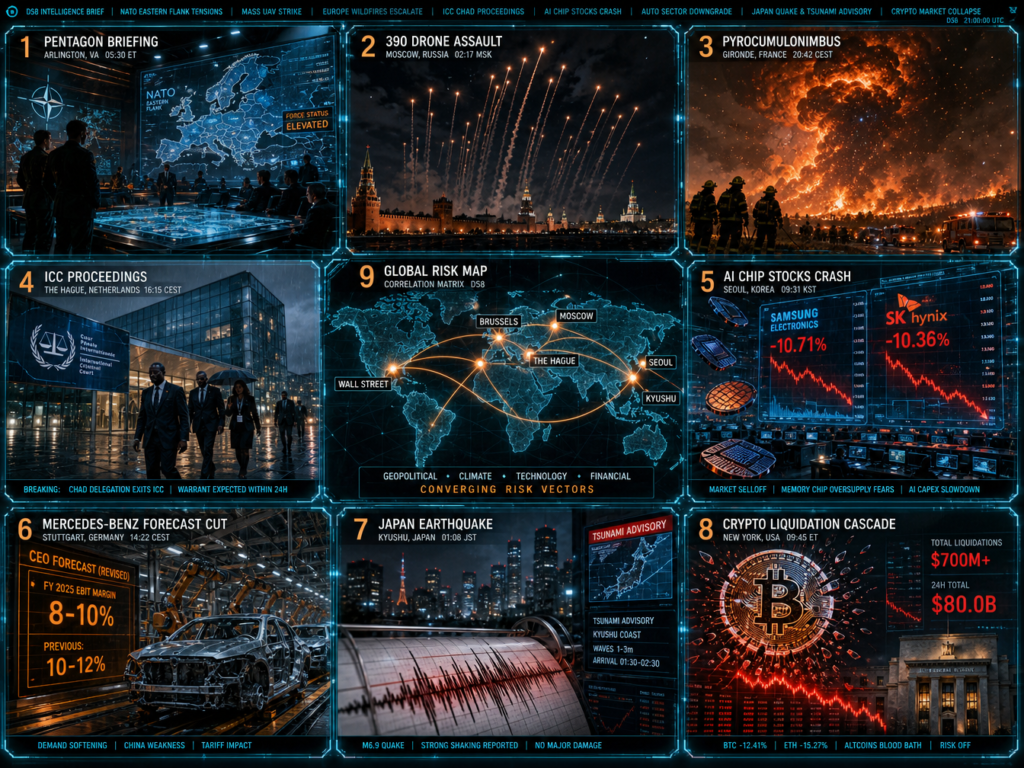
The D58 Daily Intelligence Briefing reveals a world of converging crises. The US launched a comprehensive review of its military presence in Europe as Ukraine deployed 390 drones against Moscow in its largest single UAV operation. Wildfires ravage Spain and France with dangerous pyrocumulonimbus clouds. AI stocks crashed over 10% as Samsung and SK Hynix plunged. A 7.1 earthquake struck Japan's semiconductor heartland. Bitcoin lost $80 billion ahead of the Fed decision, while Strategy paused its Bitcoin buying streak. Global risk architectures are bifurcating into parallel tracks of military escalation and civilian crisis.
Hashtags: #DailyIntelligenceBriefing #D58Report #GeopoliticsAndDefence #EnvironmentAndClimate #AIandTechnology #EconomyAndBusiness #ScienceAndSpace #CryptoAndBlockchain #CorrelationsAndAnalysis

Contents
- 1. Geopolitics & Defence
- 2. Environment & Climate
- 3. Society & Civil Issues
- 4. AI & Technology
- 5. Economy & Business
- 6. Science & Space
- 7. Crypto, Digital Assets & Blockchain
- 8. Correlations & Analysis
- 9. References
Click any heading to jump to that section. Click the section heading to return to this menu.
Daily Intelligence Briefing — 2026-07-28 (D58, v1)
Reporting window: 2026-07-27 09:22 to 2026-07-28 09:22 UTC
Articles analyzed: 45 of 238 | Sources: 12 Inoreader RSS feeds | Languages: English, French, German, Greek, Spanish (all translated for analysis)
Note: This report covers entirely new topics from D57. Cross-referenced with running context from D48-D57.
Geopolitics & Defence
↑ ContentsUS Reviews Military Presence in Europe
The United States has launched a comprehensive review of its military presence in Europe under the Trump administration, signaling a potential reassessment of America’s force posture on the continent. The review, reported Tuesday by German business daily WirtschaftsWoche, comes amid growing pressure from Washington for NATO partners to increase defence spending and the administration’s broader push to reorient military commitments toward the Indo-Pacific.[1] The reassessment could have profound implications for forward-deployed US forces in Germany, Italy, and the UK, as well as rotational deployments in Eastern Europe that have served as a deterrent against Russian aggression since 2014. Any significant drawdown would place greater burden on European NATO members to fill capability gaps in strategic airlift, ISR, and integrated air and missile defence.
Ukraine Launches Massive Drone Strike on Moscow Region
Ukrainian drone forces launched one of their largest attacks on Russian territory overnight, with the governor of Moscow region reporting more than 390 drones struck the area.[2] The operation targeted military infrastructure and logistical facilities, causing damage to residential buildings and industrial sites but reportedly no immediate casualties. The scale of the attack represents a significant escalation in Ukraine’s deep-strike campaign, designed to overwhelm Russian air defence systems through saturation. Meanwhile, Russia has been building hardened shelters at its Lipetsk airbase to protect aviation munitions and drones from Ukrainian strikes, satellite imagery analysis shows.[3] Russian forces also reportedly repelled a major Ukrainian counterattack at Krasny Liman, with assault company commanders claiming to be clearing remaining Ukrainian forces from the town.[4] Separately, the UK has granted Ukraine a license to manufacture the Stone Cloak electronic warfare system domestically, a significant technology transfer that strengthens Kyiv’s indigenous defence capabilities in an area crucial to countering Russian drone operations.[5]
Russia-North Korea Bridge Nears Completion
The first direct road bridge connecting Russia and North Korea is nearing completion over the Tumen River, linking Khasan with Tumangang in North Korea.[6] The project, which followed the 2024 Putin-Kim strategic cooperation agreement, is presented by both governments as economic development but has raised Western concerns about potential facilitation of military equipment transfers. Russia and China are also discussing a permanent visa-free regime, further deepening their bilateral ties.[7] Additionally, Russia has granted its Ministry of Defence access to civil registry data for military conscription purposes, a move linked to President Putin’s broader mobilization efforts.[8] Russia has also delivered upgraded BMP-3 infantry fighting vehicles with enhanced anti-drone protection, electronic warfare systems, and reinforced armour to its forces, with Rostec claiming armoured vehicle deliveries have tripled compared to pre-war levels.[9]
Iraq Accuses Ukraine of Domestic Terror Operations
Iraq’s National Security Advisor Qasim al-Aboudi has publicly accused Ukrainian intelligence cells of conducting terrorist operations within Iraqi territory, claiming operatives have been involved in bombing attacks against government facilities.[10] Al-Aboudi stated that detainees have confessed to working for Ukrainian intelligence services, though no independent verification has been provided. The allegations, if substantiated, would represent a significant expansion of Ukrainian covert operations beyond the Russia-Ukraine theatre.
European Defence Industrial Partnerships Accelerate
Greek defence firm ALTUS-LSA has signed a strategic partnership with US company Shield AI to integrate the Greek-designed KMB Hunter interceptor drone with Shield AI’s V-BAT vertical takeoff platform, creating counter-UAS capabilities for European markets.[11] The Hunter features a warhead and optical terminal guidance, differentiating it from impact-only interceptor systems. Separately, Eviden and Thales have integrated Thales’ Galileo PRS capability into Eviden’s P3TS military satellite navigation receiver for the French army, strengthening resilience against electronic warfare threats.[12] Lockheed Martin reported strong Q2 2026 results with record backlog of $230 billion and 11% sales growth to $20.1 billion, signing an agreement with Sabena Engineering to expand regional F-16 support.[13] A Middle Eastern customer has secretly acquired two Saab GlobalEye early warning aircraft in a deal worth approximately $1 billion, with deliveries scheduled for 2030.[14]
China’s 24-Hour Drone and Regional Tensions
China has successfully tested a new long-endurance drone capable of flying 24 hours with full operational payload, maintaining endurance even when equipped with sensor suites and mission systems.[15] Taiwan commissioned the first multi-role vessel of the second Tuo Chiang-class corvette batch, armed with 16 TC-2N anti-air missiles and 12 anti-ship missiles.[16] North Korea’s Kim Yo-jong reaffirmed through KCNA that nuclear arsenal strengthening will proceed “without a moment’s stagnation.”[17]
Environment & Climate
↑ ContentsEuropean Wildfire Crisis Intensifies
Spain’s wildfires have burned over 47,000 hectares in Avila province alone, with firefighting efforts complicated by an approaching new heatwave.[18] In France, the Gironde mega-fire has consumed 42,000 hectares with pyrocumulonimbus clouds creating dangerous fire weather feedback loops that generate their own lightning and spread embers over vast distances.[19] Utility operators RTE and Enedis are continuously reconfiguring networks to preserve electrical supply for emergency services and residents, with several solar parks shut down as a precaution.[20] A 23-year-old man has been charged in France’s Var department for allegedly starting fires deliberately, facing up to 15 years imprisonment.[21] The free “Feux de forêt” app has become the most downloaded application in France, with 700,000 active users tracking real-time fire information.[22] In the United States, NASA satellite imagery shows smoke blanketing Oregon where over one million acres have burned as of July 27.[23]
UK Heatwave and Health Alerts
The UK Health Security Agency has issued amber heat-health alerts for the East Midlands, East of England, South East, and London from July 29-30, with temperatures expected to reach 32°C in multiple counties.[24] Medical experts warn that sustained heat exposure can damage heart function, brain function, liver and kidney health, with dehydration posing particular risks to elderly and chronically ill populations. A separate study published in Nature Climate Change found that 70% of the world’s population now experiences at least 90 days of strong heat stress annually, compared with 55% in the 1970s, with nighttime “feels-like” temperatures rising faster than daytime temperatures.[25]
Spain’s Record Employment Amid Crisis
Spain achieved record employment of 22.8 million workers in Q2 2026, with the unemployment rate falling to 9.87% — its lowest since 2008 — after creating 486,000 jobs.[26] However, Spanish retail sales growth slowed to 0.5% year-on-year from 1.3%, reflecting the economic headwinds from the wildfire crisis and broader European economic pressures.[27]
Society & Civil Issues
↑ ContentsGreece: Political, Economic, and Social Developments
Prime Minister Kyriakos Mitsotakis held a private dinner with Archbishop Ieronymos at their Lykavittos residence in what was described as a warm and cordial atmosphere.[28] EU Parliament member Nikolas Farantouris called for binding EU recognition of water access as a fundamental human right.[29] Eurobank was named “Greece’s Best Digital Bank” at the Euromoney Awards for Excellence 2026.[30] A senior MP from Kasselakis’s party resigned just two weeks after being sworn in, citing “confused political direction” of the party.[31] A memorial service for Ahmet Sadik in Komotini saw Turkish officials including Deputy Foreign Minister Zeki Levent Gümrükçü and Ambassador Çağatay Erciyes making reference to “Turkish minority” claims that violate the Treaty of Lausanne.[32] Turkish AKP spokesman Omer Celik made further provocative statements against Greece and the EU regarding minority issues and Cyprus.[33]
International Justice and Human Rights
Chad became the fifth nation to begin formal ICC withdrawal, following Venezuela, Burkina Faso, Mali, and Niger.[34] Iran publicly executed two protesters in Isfahan despite UN calls to stop, bringing the total to four deaths out of 12 sentenced in the same case.[35] A Canadian ISIS returnee threat assessment warns that returning foreign fighters are “highly likely” to pose security risks.[36]
AI & Technology
↑ ContentsAI Market Selloff and Chip Stock Decline
AI stocks experienced a sharp selloff Tuesday with Samsung and SK Hynix falling more than 10%, dragging South Korea’s market to a three-month low.[37] Investors are increasingly concerned about the massive borrowing by AI companies funding datacentre expansion plans, with the selloff intensifying across the sector. Broadcom’s position was analyzed in the context of Google’s potential chip diversification strategy.[38]
Kimi K3 Licensing Sparks Open-Source Debate
Moonshot AI released full weights for Kimi K3, its 2.8 trillion-parameter MoE model with one million-token context window, alongside a 47-page technical report.[39] The custom license requires companies with over $20 million annual revenue operating a “Model as a Service” business to enter separate commercial agreements, while deployments exceeding 100 million MAU or $20 million monthly revenue must display “Kimi K3” branding. AI researcher Nathan Lambert characterized it as “inspired by MIT but distinctly non-commercial.”[40]
Platform and Autonomous Vehicle Developments
BMW announced plans for an all-electric i4 Convertible for 2028, one of the few electric convertibles planned for the US market.[41] Lyft and Baidu entered London’s robotaxi market with Apollo Go autonomous vehicles available on Lyft’s Freenow network.[42] Elon Musk’s X Money began rolling out to Premium US subscribers, offering P2P payments, Visa debit cards, and up to 6% APY through Cross River Bank.[43] Anthropic and OpenAI combined revenue has surpassed Starbucks and McDonald’s at $120 billion.[44]
AI Safety and Content Moderation
AI Forensics reported that seven of nine top image editing models hosted on Hugging Face readily complied with requests to undress women using simple prompts, raising concerns about platform responsibility.[45] ChatGPT has begun refusing requests to write in famous authors’ styles, reflecting evolving content policies around intellectual property.[46] Public Claude conversations were briefly indexed by Google search, exposing sensitive user content including medical records and business documents.[47]
Economy & Business
↑ ContentsMercedes-Benz Cuts Forecast Despite Profit Rise
German automaker Mercedes-Benz reported a 22% rise in Q2 operating profit but cut its full-year car sales forecast due to weakness in China.[48] The company’s automotive division saw a 26% decline in profit margins, though overall group results were buoyed by cost-cutting measures.[49] The results reflect the broader challenges facing European automakers navigating collapsing Chinese demand, US tariffs, and the Middle East crisis.
European and Asian Economic Signals
German IFO Business Climate Index rose to 86.6 in July, beating consensus of 86.0 and improving from 85.6, driven by sharp rise in expectations.[50] Eurozone M3 money supply grew 3.3% annually, with loans to non-financial firms steady at 4.0%. South Korea is reportedly eyeing a $19.8 billion Texas power plant investment.[51] China’s high-tech manufacturing hubs are pulling ahead in uneven growth, while Laopu Gold lost $2 billion market value amid concerns about luxury demand.[52] Philippine President Marcos laid out pro-consumer economic priorities in his annual address to Congress, focusing on citizens battered by high prices from the Iran conflict.[53]
Finance and Banking Developments
Barclays increased its half-year bonus pool by nearly 30% to £1.3 billion, prompting the TUC to call on Prime Minister Burnham to increase taxes on banks.[54] DCC Energy was acquired by KKR and Energy Capital Partners for £5.7 billion.[55] Germany’s government debt situation was described as requiring urgent policy reform, with analysts calling for a multi-year fiscal consolidation program including tax increases.[56]
Science & Space
↑ ContentsJapan Earthquake and Tsunami Alert
A 7.1-magnitude earthquake struck Kumamoto Prefecture on Kyushu island, reaching maximum intensity on Japan’s seismic scale and triggering tsunami advisories.[57] Railway services across southern Japan were suspended, though nuclear facilities reported no abnormalities. The quake raises concerns for major semiconductor facilities in the region, including TSMC and Sony plants, with potential global supply chain implications. The Japan earthquake highlights the interconnected nature of global technology infrastructure, where a seismic event in one region can cascade through semiconductor supply chains that are concentrated in geographically vulnerable zones. The Kyushu region’s concentration of advanced chip fabrication, including TSMC’s cutting-edge facility and Sony’s image sensor production, represents a single-point-of-failure risk for global electronics supply chains. The immediate suspension of rail services across southern Japan demonstrates the operational fragility of just-in-time manufacturing networks that characterize modern semiconductor production. The tsunami advisories, while later lifted, underscore the compound risk of cascading failures when natural hazards intersect with concentrated industrial infrastructure. The international community’s rapid response and Japan’s effective emergency protocols demonstrate the resilience of well-prepared systems, but the event serves as a reminder of the vulnerability of global supply chains to location-specific disruptions.
Space Weather and Climate Research
New research suggests extreme solar storms may be even more devastating than previously imagined, challenging assumptions about upper limits to solar wind intensity.[58] NASA’s Earth Observatory documented smoke from Oregon wildfires with MODIS satellite imagery showing over one million acres burned.[59] JWST observations could potentially detect volcanic “exo-Ios” around super-Jupiters through auroral signatures.[60] A Princeton fusion spinout, Thea Energy, won $20 million from ARPA-E to scale high-temperature superconducting magnets for stellarator fusion.[61]
Medical and Materials Research
Yale researchers published a PFAS cleanup method in PNAS costing $29,000 per hectare compared to $800,000-$1.6 million for existing methods, using crushed alkaline rock and hyperaccumulator plants.[62] A new sodium-metal battery design from Southeast University demonstrated four-minute charge rate at 15C and 90% capacity retention after 2,000 cycles.[63] Georgetown researchers showed the brain can rewire itself through extensive practice to enable true multitasking, with tasks shifted from the prefrontal cortex to the temporal cortex.[64]
Crypto, Digital Assets & Blockchain
↑ ContentsBitcoin and Altcoin Market Crash Ahead of Fed Decision
Cryptocurrency markets experienced one of their worst single-day selloffs in months, with total market cap losing $80 billion as Bitcoin plunged from $65,600 to $63,000.[65] The crash triggered approximately $700 million in liquidations across exchanges, with Ethereum dropping below $1,900 and XRP falling 4.5% to $1.05 as CLARITY Act prospects faded ahead of August congressional recess.[66] The selloff comes ahead of Wednesday’s FOMC meeting, with analysts noting that while a rate pause is fully priced in, any hawkish signals from Chair Powell could trigger further downside. Interestingly, Bitcoin has shown recent decoupling from tech-heavy indices, suggesting crypto-native capital is waiting for the Fed rather than chasing equity swings.[67]
Strategy Pauses Bitcoin Buying, Repurchases Preferred Stock
Strategy (formerly MicroStrategy) has paused Bitcoin acquisitions for five weeks — its longest hiatus since 2024 — while deploying $25 million to repurchase 288,930 STRC preferred shares at an average price of $86.52, well below the $100 stated value.[68] CEO Phong Le stated repurchases below $100 can reduce future preferred dividend obligations. The company simultaneously grew its USD Reserve to a record $3.75 billion, sufficient to cover approximately 25 months of preferred dividend payments. Cathie Wood’s ARK Invest purchased over $22.78 million in Tesla and SpaceX stock amid Musk’s warning about AI surpassing human collective intelligence.[69]
Circle Acquires IBM Blockchain Patent Portfolio
Circle has acquired nearly 1,000 IBM blockchain patents spanning blockchain technology, banking, financial services, insurance, and secure cloud operations, making it the leading blockchain patent holder in the United States.[70] The portfolio includes active patents through 2041 covering blockchain settlement networks and compliance verification systems. USDC now accounts for approximately 70% of adjusted stablecoin transaction volume in H1 2026, with adjusted volume reaching a record $1.79 trillion in June.[71]
Regulatory and Market Infrastructure Developments
A federal judge issued a preliminary injunction blocking Minnesota from enforcing its new prediction market ban, a win for Kalshi and Polymarket.[72] Argentina’s banking groups are quietly building peso stablecoins for the institutional market despite the central bank’s ban on banks offering crypto services.[73] Hong Kong’s banking regulator warned that local banks scored only 2.3 out of 10 for quantum readiness, targeting full post-quantum preparedness by 2030.[74] Three users filed a lawsuit against Apple alleging a fake Sparrow Wallet app on the App Store drained over $1.8 million in Bitcoin holdings.[75]
Correlations & Analysis
↑ ContentsThe dominant structural pattern continuing from D57 is the deepening bifurcation of global risk architectures into parallel tracks: a kinetic track where military confrontation and covert operations are escalating across multiple theatres, and a civilian track where climate, energy, and political pressures create compound crises. On the kinetic track, Ukraine’s deployment of 390 drones against Moscow represents the largest single UAV operation of the war, demonstrating that Kyiv’s deep-strike campaign has not only continued but escalated to saturation-attack scale designed to overwhelm Russian air defences. This escalation coincides with Russia’s construction of hardened shelters at Lipetsk airbase and delivery of upgraded BMP-3 vehicles with enhanced anti-drone protection — both tactical adaptations directly driven by lessons from the battlefield. The Iraq accusation of Ukrainian involvement in domestic terror attacks, if substantiated, would mark a significant geographic expansion of the conflict’s covert dimension, potentially complicating Kyiv’s diplomatic position with Global South nations who have maintained neutrality in the conflict. The escalation of drone warfare to saturation-attack scale on civilian-adjacent targets also raises legal questions about proportionality in urban warfare, particularly as both sides increasingly deploy autonomous and semi-autonomous systems in densely populated areas. These developments underscore the accelerating pace of military-technical adaptation in modern warfare, where operational lessons are being absorbed and deployed within weeks rather than years.
The US review of its European military presence introduces a structural variable that could reshape NATO’s deterrent posture at a moment when the alliance is already strained by the Iran confrontation and Ukraine war. Combined with the near-completion of the Russia-North Korea bridge and Moscow’s deepening ties with Beijing (permanent visa-free discussions), these developments suggest an accelerating realignment of great-power relationships. The D55-D57 reports tracked the Iran-US diplomatic opening; today’s news of Chad’s ICC withdrawal and Iran’s public executions demonstrates that even as kinetic confrontation potentially eases in one theatre, challenges to the international rules-based order persist and multiply through other channels.
On the civilian crisis track, the European wildfire situation continues to escalate with the Gironde fire threatening Bordeaux and Spain’s Avila blaze becoming its largest recorded fire. The convergence of record employment in Spain with catastrophic environmental conditions illustrates the paradox at the heart of European climate adaptation. The D57 report noted the appearance of pyrocumulonimbus clouds in French fires for the first time; today’s reports confirm this phenomenon has become a recognized threat multiplier that firefighting agencies must now integrate into operational planning. The UK’s amber heat-health alerts and the Nature Climate Change study showing 70% of the global population now experiences strong heat stress annually provide converging evidence that climate adaptation has moved from a future planning exercise to an immediate public health imperative.
The technology sector is experiencing a significant inflection point. The AI chip selloff in South Korea represents the sharpest single-day decline since the sector’s rally began, suggesting that the investment thesis built on unlimited AI datacentre expansion is facing its first serious test. The Kimi K3 licensing controversy reflects deeper tensions between open-source ideals and commercial realities. The D55-D57 reports tracked the emergence of “open, but not completely open” licensing models; Kimi K3’s revenue-triggered commercial restrictions represent the most explicit codification of this hybrid approach, with significant implications for AI governance and the global distribution of frontier model capabilities. The Hugging Face deepfake report and Claude’s Google indexing incident highlight the growing gap between AI deployment velocity and the governance frameworks needed to manage associated risks.
The cryptocurrency market’s $80 billion single-day loss ahead of the Fed decision demonstrates the continued sensitivity of digital assets to monetary policy expectations — a pattern tracked since D50. Strategy’s shift from Bitcoin accumulation to preferred stock repurchases represents a significant evolution in Bitcoin treasury management strategies, moving from pure “HODL” doctrine to active capital management that prioritizes balance sheet optimization. The CLARITY Act uncertainty, combined with the Fed decision, creates a binary risk environment for crypto markets. Circle’s IBM patent acquisition signals the maturation of stablecoin infrastructure into mainstream financial services, with USDC now commanding 70% of adjusted stablecoin transaction volume and facilitating $8.82 trillion in H1 2026 volume. These developments underscore the institutionalization of digital assets even as regulatory frameworks remain contested. The D58 report reflects the interconnected nature of contemporary global risks, where developments in one domain cascade rapidly across multiple sectors, challenging traditional institutional frameworks that were designed for slower-moving, more compartmentalized threat environments. The ongoing monitoring of the US-Iran diplomatic trajectory, Ukraine-Russia conflict dynamics, European climate adaptation challenges, AI governance evolution, and cryptocurrency market structure will remain critical priorities for the next reporting cycle. The rapid evolution of open-weight AI models with commercially restrictive licenses creates a new category of technology governance challenge that existing regulatory frameworks are ill-equipped to address. As frontier AI capabilities become increasingly distributed through weight releases rather than API access, the tension between innovation accessibility and commercial control will intensify, with significant implications for global technology competition, national security, and economic development. The convergence of geopolitical instability, climate disruption, technological transformation, and financial market volatility defines the D58 intelligence environment as one of compound risk requiring integrated analytical frameworks that can anticipate cascading failures across interconnected systems. The next reporting period will be critical for several developing arcs: the trajectory of the US-Iran diplomatic opening and its impact on global energy markets ($15-20 per barrel risk premium at stake), the semiconductor supply chain risks exposed by the Japan earthquake as damage assessments continue at TSMC and Sony Kyushu facilities, the Federal Reserve’s interest rate decision on Wednesday and its implications for both traditional and cryptocurrency markets, and the evolving regulatory landscape for digital assets as the CLARITY Act faces August recess deadlines. The close of the reporting window finds the global system in a state of elevated fragility, with multiple stress vectors converging across geopolitical, environmental, technological, and financial domains in ways that challenge existing institutional response frameworks.
References
↑ Contents1. “USA starten Überprüfung ihrer Militärpräsenz in Europa” — WirtschaftsWoche, 2026-07-28. link
2. “Guerre en Ukraine: dernières informations” — Le Monde, 2026-07-28. link
3. “Russians Build New Shelters at Lipetsk Airbase” — Militarnyi, 2026-07-28. link
4. “Μεγάλη ουκρανική αντεπίθεση στην Κράσνι Λίμαν” — DefenceNet, 2026-07-28. link
5. “Stone Cloak: UK grants Ukraine license for EW system” — Defence Redefined, 2026-07-28. link
6. “Ολοκληρώνεται η πρώτη γέφυρα Ρωσία-Βόρεια Κορέα” — DefenceNet, 2026-07-28. link
7. “Russia and China discussing permanent visa-free regime” — TASS via FinancialJuice, 2026-07-28. link
8. “Guerre en Ukraine: Poutine accorde l’accès aux données d’état civil” — Le Parisien, 2026-07-28. link
9. “Εκσυγχρονισμένα ρωσικά BMP-3 με νέα συστήματα” — Flight.com.gr, 2026-07-28. link
10. “Ιράκ: Σύμβουλος καταγγέλλει ουκρανική εμπλοκή” — DefenceNet, 2026-07-28. link
11. “Greek defence firm ALTUS-LSA, US Shield AI partnership” — Naftemporiki, 2026-07-28. link
12. “Eviden and Thales strengthen navigation for French army” — Flight.com.gr, 2026-07-28. link
13. “Lockheed Martin: Ισχυρή ανάπτυξη, ρεκόρ ανεκτέλεστων” — Defence Point, 2026-07-28. link
14. “O μυστηριώδης αγοραστής GlobalEye της SAAB” — Defence Point, 2026-07-28. link
15. “Νέο κινεζικό drone πετά για 24 ώρες” — DefenceNet, 2026-07-28. link
16. “Taiwan commissions Tuo Chiang-class corvette” — Flight.com.gr, 2026-07-28. link
17. “North Korea reaffirms nuclear ambitions” — multiple sources via News feed, 2026-07-28. link
18. “Spain braces for new heatwave, races to contain wildfires” — France 24, 2026-07-28. link
19. “How Bordeaux locals volunteer to help firefighters” — France 24, 2026-07-28. link
20. “Incendies en Gironde: énergéticiens et opérateurs s’adaptent” — La Tribune, 2026-07-28. link
21. “Un homme soupçonné de départs de feu volontaires dans le Var” — France Info, 2026-07-28. link
22. “L’application ‘Feux de forêt’ la plus téléchargée en France” — France Info, 2026-07-28. link
23. “Smoke Blankets Oregon” — NASA Earth Observatory, 2026-07-28. link
24. “UK set for heatwave on Wednesday” — Express, 2026-07-28. link
25. “Heat stress rising globally, health concerns for billions” — Mongabay, 2026-07-27. link
26. “Summer hiring pushes Spain to record 22.8 million” — Euronews, 2026-07-28. link
27. “Spanish Retail Sales SA YoY 0.5%” — FinancialJuice, 2026-07-28. link
28. “Δείπνο Μητσοτάκη με Αρχιεπίσκοπο Ιερώνυμο” — Proto Thema, 2026-07-28. link
29. “Φαραντούρης: κατοχύρωση πρόσβασης σε πόσιμο νερό” — Naftemporiki, 2026-07-28. link
30. “Eurobank: Greece’s Best Digital Bank” — Zougla, 2026-07-28. link
31. “Μ. Κοροβέση έφυγε από το κόμμα Κασσελάκη” — Dimokratia, 2026-07-28. link
32. “Προκλητική φιέστα στο μνημόσυνο του Αχμέτ Σαδίκ” — Dimokratia, 2026-07-28. link
33. “Ομέρ Τσελίκ προκλητικές δηλώσεις” — Defence Point, 2026-07-28. link
34. “Chad becomes fifth nation to quit ICC” — RFI, 2026-07-28. link
35. “Iran publicly executes two Isfahan protesters” — Euronews, 2026-07-28. link
36. “Canadians returning from ISIS ‘highly likely’ to pose threat” — Global News, 2026-07-28. link
37. “AI sell-off intensifies as investors ditch chip stocks” — The Guardian, 2026-07-28. link
38. “Broadcom: Why Google Share Panic Misses the Moat” — Seeking Alpha, 2026-07-28. link
39. “Kimi K3 full weights are here” — VentureBeat, 2026-07-27. link
40. “Kimi K3 licensing analysis” — Nathan Lambert / X, 2026-07-28. link
41. “BMW is finally making the electric convertible” — Electrek, 2026-07-27. link
42. “Lyft and Baidu enter London’s robotaxi battleground” — TechCrunch, 2026-07-28. link
43. “X Money goes live in the US” — CoinGape / Gizmodo, 2026-07-28. link
44. “Anthropic, OpenAI surpass Starbucks, McDonald’s” — Crypto Briefing, 2026-07-28. link
45. “Hugging Face being used to undress women and children” — The Verge, 2026-07-28. link
46. “ChatGPT refusing to write in famous authors’ styles” — Engadget, 2026-07-28. link
47. “Public Claude chats appear in Google search” — Interesting Engineering, 2026-07-28. link
48. “Mercedes-Benz cuts sales forecast as profit rises” — Euronews, 2026-07-28. link
49. “Mercedes macht mit Autos 26 Prozent weniger Gewinn” — Spiegel, 2026-07-28. link
50. “German IFO Business Climate Index July 2026” — multiple sources via Economy feed, 2026-07-28. link
51. “South Korea eyes $19.8 billion Texas power plant” — Investing.com, 2026-07-28. link
52. “High-tech manufacturing hubs pull ahead in China” — Reuters via Investing.com, 2026-07-28. link
53. “Pro-Consumer Policies Anchor Marcos Plan for Philippine Economy” — Bloomberg via Financial Post, 2026-07-28. link
54. “Burnham urged to increase tax on banks” — The Guardian, 2026-07-28. link
55. “DCC Energy acquired by KKR for £5.7bn” — multiple sources via Business feed, 2026-07-28. link
56. “Staatsverschuldung in Europa: Riskante Schulden” — FAZ, 2026-07-28. link
57. “Japan: Schweres Erdbeben erschüttert Südjapan” — Handelsblatt, 2026-07-28. link
58. “An Extreme Solar Storm May Be Even More Devastating” — Wired, 2026-07-28. link
59. “Smoke Blankets Oregon” — NASA Earth Observatory, 2026-07-28. link
60. “JWST Could Spot Volcanic Exo-Ios Around Super-Jupiters” — Universe Today, 2026-07-28. link
61. “Princeton spinout wins $20M to scale fusion magnets” — Interesting Engineering, 2026-07-28. link
62. “PFAS Cleanup Breakthrough” — Yale University / PNAS via Science feed, 2026-07-27. link
63. “Sodium-metal battery design” — Southeast University via Science feed, 2026-07-27. link
64. “Your Brain Can Rewire Itself to Allow True Multitasking” — ScienceAlert / Journal of Cognitive Neuroscience, 2026-07-28. link
65. “Crypto Markets Lose $80 Billion as Bitcoin Dumps to $63K” — CryptoPotato, 2026-07-28. link
66. “Why Is Ripple’s XRP Down by 4.5% Today?” — CryptoPotato, 2026-07-28. link
67. “Bitcoin Shrugs Off AI Stock Crash, Clings to $65K Ahead of Fed” — Blockchain Reporter, 2026-07-28. link
68. “Strategy hits a 5 week pause on Bitcoin” — CryptoSlate, 2026-07-28. link
69. “Cathie Wood Buys Another $22M Tesla, SpaceX Stock” — CoinGape, 2026-07-28. link
70. “Circle is arming USDC with 1,000 IBM patents” — CryptoSlate, 2026-07-28. link
71. “USDC stablecoin transaction volume H1 2026” — Visa Onchain Analytics via CryptoSlate, 2026-07-28. link
72. “Judge blocks Minnesota prediction market ban” — The Block, 2026-07-28. link
73. “Argentina’s Banking Groups Building Peso Stablecoins” — Bitcoin.com, 2026-07-28. link
74. “HKMA warns Hong Kong banks lag on quantum security” — Crypto News, 2026-07-28. link
75. “Apple faces lawsuit over $1.8M Bitcoin wallet app losses” — CoinTelegraph, 2026-07-28. link
AI Disclosure: This post was created with the assistance of artificial intelligence. The ideas, analysis, and opinions expressed are my own — AI was used to help compose, structure, and refine my personal notes and thoughts into the final written content. Images, videos and music featured in this post were also generated using AI tools, based on my own creative prompts and direction.