







America Needs This Crypto Bill. Two Poison Pills Are Killing It.
You were told the United States would lead the crypto revolution. You watched the House pass the most comprehensive digital asset bill in American history with 294 votes — 78 of them from Democrats who crossed the aisle [1]. You assumed the rest was formality. So why, a year later, are prediction markets pricing the CLARITY Act’s passage at a coin flip, and why has one senator warned that failure this year could delay everything until 2030 [1]?
Because the bill walked into a trap with two jaws. And neither side will move.

The Decentralisation Test Nobody Saw Coming
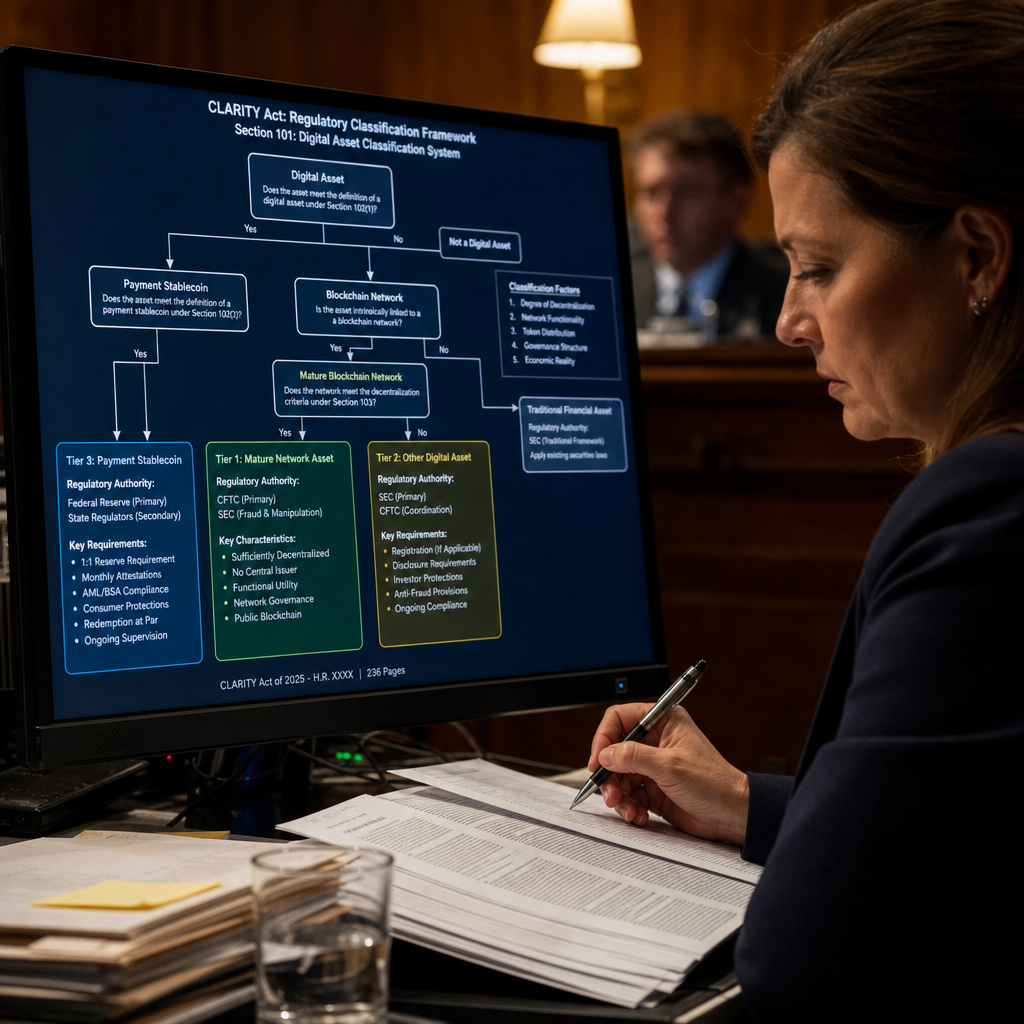
The Digital Asset Market Clarity Act does something no American legislation has ever attempted: it asks not whether a digital asset is a security, but how decentralised the system behind it actually is [3]. That single reframing — from binary classification to a spectrum of maturity — creates a three-tier regulatory architecture. Mature blockchain tokens become Digital Commodities under the CFTC. Early-stage tokens with centralised control remain Investment Contract Assets under the SEC. Stablecoins that have achieved consumer-scale adoption get their own category: Permitted Payment Stablecoins, under joint oversight [3].
If you understand what FIT21 tried to do and failed, you understand why this matters. The Financial Innovation and Technology for the 21st Century Act passed the House but died in the Senate, leaving the SEC and CFTC to fight over jurisdiction through enforcement actions and interpretive guidance — the regulatory equivalent of two referees calling fouls on the same play [3]. The CLARITY Act is its refined successor, drafted by the same House committees, but with a crucial difference: it passed with genuine bipartisan momentum and arrived in the Senate carrying the weight of an industry that spent heavily to elect crypto-friendly members in 2024 [1].
The bill also brings digital commodity intermediaries under federal registration and anti-money laundering obligations for the first time [1]. It addresses tokenised securities in Section 505, though some market participants argue that section constrains the SEC’s ability to use its exemptive and no-action relief tools [1]. It includes the Blockchain Regulatory Certainty Act as Section 604, protecting non-custodial software developers from money-transmitter classification [4].
The framework works. The question is whether the politics will let it.

$2.3 Billion Is Not a Policy Disagreement — It Is the Policy
Here is where the money stops being abstract. The CLARITY Act’s most consequential fight is not about jurisdictional boundaries. It is about stablecoin yield — and who gets to earn it.
The GENIUS Act, signed into law in 2025, prohibits stablecoin issuers from paying interest to holders directly [2]. But it does not prohibit exchanges like Coinbase from offering rewards for holding stablecoins on their platforms. The banking industry calls this a loophole threatening the $18 trillion deposit base. The crypto industry calls it innovation. The White House Council of Economic Advisers published a 21-page analysis finding that a full stablecoin yield ban would increase bank lending by only $2.1 billion — 0.02% of outstanding loans — at a consumer cost of $800 million [1].
The strongest argument against the CLARITY Act is this: the bill regulates an industry in which the signing official holds billions in personal positions. President Trump’s family has generated an estimated $2.3 billion from crypto ventures since his return to office [4]. No previous administration has held positions remotely like these while crypto legislation moved through Congress.
And yet the bill is not about one family’s portfolio. It is about whether institutional capital — the kind sitting on sidelines in New York, London, and Singapore — gets a legal framework to enter the US digital asset market, or whether it stays offshore where frameworks already exist [1]. Coinbase initially withdrew support for the Senate version in January 2026, forcing a markup postponement, then reversed course in April after Treasury Secretary Bessent publicly called for a markup [1][2]. The underlying commercial tension between exchanges and banks over stablecoin yield has not disappeared. It has metastasised.
The market priced in clarity. Clarity arrived with a different owner than advertised.
Two Fights, Zero Room to Move
The politics of the CLARITY Act are now the politics of a bill that cannot be saved by its friends. Two unrelated disputes have trapped it from opposite sides, and satisfying either one loses votes on the other [4].
The first is ethics. Democrats want provisions restricting government officials from crypto conflicts of interest. Senator Ruben Gallego, one of two Democrats whose votes carried the bill out of committee, drew the line publicly: if ethics guardrails are not resolved by the floor vote, he is prepared to vote no [4]. The White House will accept rules that apply across the board but rejects anything targeting a specific officeholder. A closed-door meeting collapsed when Republicans withdrew language that would have let state attorneys general sue the Department of Justice over enforcement failures — the enforcement teeth were simultaneously the compromise and the dealbreaker [4].

The second is Section 604. The Blockchain Regulatory Certainty Act protects open-source developers from money-transmitter classification. The crypto industry considers it sacred. The National Sheriffs’ Association, the Fraternal Order of Police, and the National District Attorneys’ Association have mobilised against it, citing $158 billion in illicit crypto volume in 2025 [4]. Senators Mark Warner and Catherine Cortez Masto have tied their support to law enforcement’s sign-off on the section [4].
You are watching a bill with majority support die from the geometry of its obstacles. Prediction markets have fallen from 74% to 48% in one month [4]. Senator Cynthia Lummis has warned that failure this year could push comprehensive market structure legislation to 2030 or beyond [1]. Senator Elizabeth Warren and former Senator Sherrod Brown — both historically hostile to the digital assets industry — would control the Senate Banking Committee if Democrats take the majority [1].
Regulation came. It just came trapped between two fights neither side can afford to lose.
If You Hold Tokens, You Hold the Bag of Someone Else’s Delay
Translate this into your portfolio, your access, your future. Every day the CLARITY Act stalls is a day the regulatory progress achieved under the current SEC and CFTC remains sub-statutory and entirely reversible by a future administration [1]. No-action letters. Interpretive guidance. OCC directives on bank crypto activities. All of it can vanish with a new chair, a new president, a new set of priorities.

For the large non-Bitcoin tokens carrying classification overhangs — XRP foremost among them — the bill’s failure means their legal status stays unsettled, their ETF access insufficient without the statutory certainty only Congress can provide [4]. For traditional finance players waiting on the sidelines, it means the framework that would allow banks to custody crypto without balance sheet liability, that would let them trade more complex digital instruments, that would bring tokenised securities into a coherent regulatory lane — none of it arrives [1][3].
The EU has MiCA. It is bureaucratic, yes. It is also operational. While America debates whether writing code makes you a criminal, Europe is building the infrastructure.
The revolution was always about access. The question is whether the delay is now the mechanism of exclusion.
The Fork America Cannot Avoid
The CLARITY Act is a strong bill on technical terms and as policy [1]. It resolves the SEC-CFTC jurisdictional war. It creates pathways for tokens to transition from securities to commodities as they decentralise. It brings intermediaries under federal AML obligations. It addresses DeFi, self-custody, and developer protections. It does what no American legislation has done: treat digital assets as a coherent asset class deserving coherent rules.
But a strong bill in a broken calendar is just a PDF. With 31 Senate session days before the August recess, no floor date scheduled, and two poison pills pulling in opposite directions, the bill’s biggest enemy is not opposition — it is time [4].
If CLARITY passes, you wake up in a market where institutional capital has legal permission to enter at scale, where tokenised securities have a regulatory lane, where the largest exchanges become registered financial intermediaries with real obligations. If it does not, you remain in a market governed by enforcement actions, interpretive guidance, and the next administration’s mood.
Is this the framework that finally lets American crypto grow up? Or is it the bill that proves Congress cannot keep pace with the technology it claims to regulate? And when the calendar runs out, will you blame the code — or the people who could not agree on what it means?
References
[1] Thorn, A. (2026). CLARITY Act Update: Final Push Ahead. Galaxy Research. https://www.galaxy.com/insights/research/clarity-act-update-final-push
[2] Vandecasteele, S. (2026). The CLARITY Crisis: Why Crypto Regulation Is Stuck in the Senate. Columbia Science and Technology Law Review. https://journals.library.columbia.edu/index.php/stlr/blog/view/771
[3] Schwartzman, L. (2025). The CLARITY Act of 2025: A Turning Point for US Crypto Regulation. Notabene. https://notabene.id/post/clarity-act-introduced
[4] Stephanie, O. (2026). Two poison pills, one bill: how CLARITY Act got stuck from both sides. crypto.news. https://crypto.news/clarity-act-two-poison-pills/
