
Daily Intelligence Briefing — July 27 2026 – D57
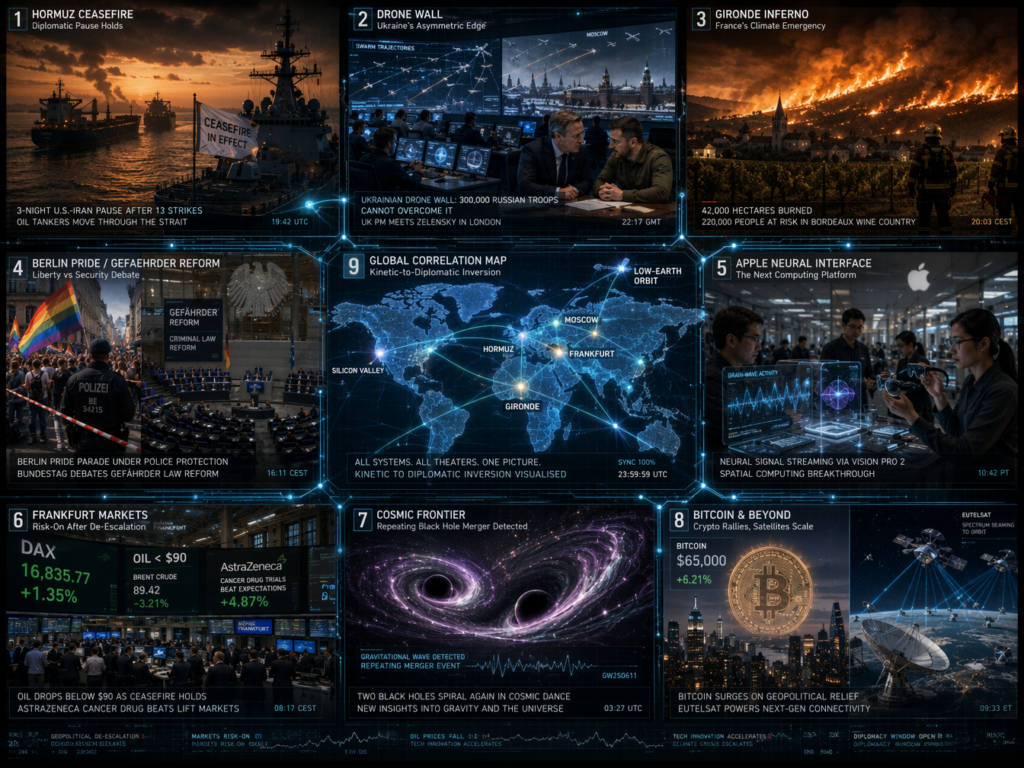
Daily Intelligence Briefing — 27 July 2026 (D57): The US-Iran kinetic arc pauses for a third consecutive night as diplomacy is given "space" to work, pushing Brent crude below $90. Yemen's Houthis reopen strikes on Saudi Aramco, choking Bab-el-Mandeb to just 11 vessels. Ukraine formalises its drone-wall doctrine — 300,000 Russian soldiers cannot overcome it. Europe's wildfire crisis deepens as Gironde enters a months-long phase and Spain's Madrid-region blaze remains uncontrolled. Bitcoin reclaims $65,000 on de-escalation risk-on sentiment. Climate litigation reaches "panic mode" for the oil industry, mirroring the tobacco wars of the 1990s.
#USIranCeasefire #OilPrices #StraitOfHormuz #BrentCrude #UkraineDroneWall #Drones #GirondeWildfire #Bordeaux #ClimateCrisis #Bitcoin65k #Crypto #ClimateLitigation #Geopolitics #WorldNews

Contents
- 1. Geopolitics & Defence
- US-Iran Talks Given ‘Space’: Third Night Without Strikes Reverses the Kinetic Track
- Yemen’s Bab-el-Mandeb and the Houthi–Saudi Reopening
- Ukraine’s ‘Drone Wall’ Doctrine and the Burnham-London Pivot
- Electronic Warfare Reinforcement: EA-37B Compass Call II Deploys via Souda Bay
- Indian Defence: TEJAS MK-1A, Zen’s Anti-Drone, and Kargil Vijay Diwas
- 2. Environment & Climate
- 3. Society & Civil Issues
- Berlin Pride Attack and the Debate Over Adult Criminal Law for “Gefährder”
- UK Cost-of-Living Squeeze and the Burnham Communication Strategy
- The Victor Jara Fugitive Arrest and the Marfin Greek Trial
- Two-Year-Old Among the Injured in Seattle Food Festival Shooting
- Leicester Stabbing and the IPP Sentence Crisis
- 4. AI & Technology
- 5. Economy & Business
- DAX Touches Three-Week High on Oil Drop and BoE Inflation Optimism
- Oil Below $90 and AstraZeneca Beats on Cancer Drugs
- Bank Indonesia Governor’s Surprise Resignation and the Lundin Chile Saga
- Germany’s Verkehrsministerium Succession and Cabinet Crisis
- Mallorca Mass Tourism Protests and the Venice Entry-Fee Windfall
- 6. Science & Space
- 7. Crypto, Digital Assets & Blockchain
- 8. Correlations & Analysis
- 9. References
Click any heading to jump to that section. Click the section heading to return to this menu.
Daily Intelligence Briefing — 2026-07-27 (D57)
Geopolitics & Defence
↑ ContentsUS-Iran Talks Given ‘Space’: Third Night Without Strikes Reverses the Kinetic Track
For the first time since the US bombing campaign began in mid-July, the kinetic track in the Persian Gulf has paused long enough for markets to begin treating diplomacy as a real possibility. Reuters, Bloomberg, Euronews and the Independent all reported Monday that the United States and Iran have held fire for a third consecutive night, with the US military describing the pause as giving diplomatic efforts “space” to take shape[1][2][3]. Spiegel’s Berlin edition noted that the strike pause had already pushed Brent crude to a session low below $90 a barrel, with analysts citing the high price of oil itself as a de-escalation pressure[4]. The pivot is not yet a settlement: 13 consecutive nights of US strikes aimed at degrading Iran’s ability to threaten Hormuz shipping had preceded the pause, and the strategic off-ramp requires both sides to compromise on a status they have described as existential. Konstantinos Filis’s analysis in Kathimerini framed the situation from the Greek vantage point: the recent Middle East crisis will alter the region’s fate, “the United States and its allies will not emerge unscathed, while Iran will need many years to rebuild, and conditionally, to stand on its own feet[5].”
The most fragile element of the pause is the Strait of Hormuz itself. Iranian state media reported that an oil tanker exploded after striking a naval mine in the Strait; the agency described the vessel as a “rogue” tanker that had departed the authorised corridor before colliding with the mine[6]. Whether the incident was a mine accident, an Iranian enforcement action, or a third-party attack, it underscores the asymmetry between diplomatic pauses on land and the kinetic disputes over waterway control. Japan’s Environment Minister Koizumi is reportedly considering attending a London meeting on Hormuz, signalling that even third-party maritime economies are recalibrating for a possible multi-party escort regime. The pause is therefore not a settled state; it is the absence of fresh escalation, which is the most the region has been able to claim in two weeks.
Yemen’s Bab-el-Mandeb and the Houthi–Saudi Reopening
The Houthi–Saudi front reopened over the weekend with strikes on Saudi Aramco facilities in Jizan and Yanbu, immediately choking Red Sea traffic. Reuters reported that only 11 commercial vessels transited the Bab-el-Mandeb on Sunday, the lowest number in months[7]. France 24’s regional coverage framed the strikes as a deliberate Houthi attempt to impose a naval blockade of Saudi Arabia, opening a new front in the war that has already de facto closed the Strait of Hormuz[8]. The Kpler data set shows that seven of the eleven vessels were oil tankers, with three of those entering the Red Sea under routing that the Houthis regard as legitimate targets. The strategic implication is that the European oil-supply chain is now exposed to a multiple-chokepoint vulnerability that has not been seen since the 1970s. The Saudi response will be the principal watchpoint: any re-engagement of the war would break the wider diplomatic pause and re-establish the regional crisis dynamic.
Ukraine’s ‘Drone Wall’ Doctrine and the Burnham-London Pivot
An Austrian expert on drone warfare told Focus on Sunday that “even another 300,000 soldiers cannot help Russia overcome the ‘drone wall’ of Ukraine[9].” The interview formalises a doctrine that has been visible for several months: the front line has shifted from a positional conflict, with conventional artillery and trench warfare, to a qualitatively different contest defined by cheap, expendable unmanned systems that destroy expensive crewed platforms faster than they can be replaced. The expert’s specific claim is that the drone doctrine does not merely slow Russian advances; it makes them economically unsustainable, with the cost-exchange ratio favouring Ukraine by roughly an order of magnitude. The overnight Zeit update on the Dnipropetrowsk front confirmed that Ukrainian forces had advanced at multiple points in the southern part of the region, with Russian-claimed gains in the area apparently AI-generated imagery[10]. The verification gap is itself significant: the Russian information space is now contesting battles that may not have occurred.
British Prime Minister Andy Burnham received President Zelensky in London on Monday, with the meeting offering drone protection support and reaffirming the British commitment to Ukrainian defence. The Burnham premiership has been characterised by a deliberate breach with the prior Labour caution on military spending, and the Zelensky meeting is the first material delivery on that shift. The Ukrainian Navy’s Angel Detachment separately reported that it had evacuated the family of a Ukrainian servicemember from Russian-occupied territory, including the servicemember’s parents who had been under continuous FSB surveillance[11]. The Egyptian precision-rocket approval and the Polish Patriot co-production proposal from earlier reports indicate that the European defence industrial base is being rebuilt around the Ukrainian precedent. The two separate threads, the operational drone doctrine and the political industrial response, are now reinforcing each other.
Electronic Warfare Reinforcement: EA-37B Compass Call II Deploys via Souda Bay
The Polish-monitored aviationspot itamilradar.com reported Sunday that two USAF electronic warfare aircraft, the EA-37B Compass Call II based on the Gulfstream G550 airframe, transited through Souda Bay on 25-07-2026 en route to the Middle East theatre[12]. The Compass Call II is the replacement for the long-serving EC-130H Compass Call, which has been in service for over four decades. The platform is designed to suppress, jam, and otherwise disrupt adversary command-and-control, communications, radar, and navigation systems, creating the conditions for crewed fighters and other strike platforms to operate. The deployment of a second pair of aircraft, on the same Souda-to-Middle East route, signals confidence in the platform’s combat performance and an expectation that the air-and-sea campaign will continue at scale. The deterrent message is also significant: the United States is not just adding air-to-ground strike capacity but is also adding the electronic attack envelope that suppresses the adversary’s ability to respond.
Indian Defence: TEJAS MK-1A, Zen’s Anti-Drone, and Kargil Vijay Diwas
Indian Defence News reported on the arrival of multiple GE F404-IN20 engines for the TEJAS MK-1A, finally breaking the supply-chain bottleneck that had constrained serial production for months. The same report noted that the integration of the Israeli AESA radar and the Indian electronic warfare suite continues to threaten delivery timelines, with the first squadron now expected only by late 2026 or early 2027[13]. The Indian Air Force has insisted on full system compliance before induction, which has delayed handover despite production-line readiness. Zen Technologies separately launched a High-Altitude Man-Portable Anti-Drone System (MPADS) on Kargil Vijay Diwas, marking a meaningful expansion of its indigenous portfolio and a deliberate entry into the high-altitude drone counter-measure market[14]. SSS Defence has set a target of producing around 40,000 weapons in 2026, with a goal of approximately 100,000 weapons in 2027, indicating that the Indian private sector is becoming a primary supplier for both domestic and export markets[15]. Aryavart Technologies has unveiled the TEJAS STOL, a tactical UAV designed for short take-off and landing on rugged terrain, with high-speed taxi trials confirming landing-gear durability and stable handling[16]. The combined stack represents a coherent indigenous defence industrial ecosystem that would have been unimaginable five years ago.
Environment & Climate
↑ ContentsGironde Enters ‘Several Weeks, Possibly Months’ Phase
The Gironde wildfire has entered what Lt. Colonel David Annotel of the Sapeurs-Pompiers has described as “a phase that will last several weeks, possibly several months,” an assessment that is critical for the operational planning of the French response and the European mutual-aid mechanism. The Independent reported that the blaze has already burned 42,000 hectares and displaced more than 220,000 people, with the day’s reporting emphasising that the smoke has reached skies 15 km from Bordeaux and that the city’s mayor has stated that there are no current plans to evacuate the UNESCO-listed city but that authorities are “ready for anything[17][18][19].” The Macron administration’s response has been to convene a crisis meeting that brings the war-footing structure to bear on the wildfire threat, with Prime Minister Sébastien Lecornu warning ministers that there will be no summer holiday in the conventional sense, only “vacation in active monitoring and mobilisable at any moment.” The hydrological and forestry dimensions of the Gironde fire are no less significant, with the Bordeaux wine industry now facing the worst-case scenario of losing up to 30% of the current vintage in the most affected appellations. The Atlantic coastal pine forests, which form the principal fuel load, are essentially unmanaged after decades of monoculture planting, and the policy prognosis is that the fire will be followed by a reforestation programme that mimics the post-fire Chilean and Californian models.
Spain’s Madrid-Periphery Fire Adds a New Front
The Madrid-region fire that erupted over the weekend has entered a new operational phase, with Le Parisien reporting that the blaze is “still not controlled” and that the first returns to homes are planned for Monday[20]. The Madrid fire is strategically significant because it shifts the centre of gravity of the Iberian fire season from the Mediterranean coast, which had been the primary theatre in D55 and D56, to the central meseta, which has not been a major firefront in 2026. The independent RFI bulletin noted that a fresh heatwave is set to bring temperatures of up to 40°C to the scorched French wine-growing region around Bordeaux, and that the Iberian peninsula is already in the same meteorological envelope. The thermobaric conditions that produce “monster” fires are produced by a combination of high temperatures, low humidity, and topographic channeling, and the central Iberian plateau in late July is a textbook amplifier. The risk-policy implication is that the period of fire exposure is now expected to extend into mid-August, with the capacity of the Spanish and European firefighting assets under sustained pressure.
Marine Heat Wave and Mojave Solar: California as a Climate Frontier
The marine heat wave now affecting the Pacific Coast from California to the Pacific Northwest has had measurable effects on the California Current ecosystem, with whales being driven north in search of cooler water and pelicans suffering from disrupted food supplies. Phys.org’s reporting from a boat off the California coast describes dozens of dolphins playing in the vessel’s wake, but ecologists warn that the apex predators are being pushed into shipping lanes where the strike risk rises sharply[21]. On land, the same heat wave is forcing the state of California to confront an emerging conflict between renewable-energy deployment and desert ecosystem protection. Mongabay reported that the state has approved a solar project in the Mojave Desert on land that serves as a migration corridor for desert bighorn sheep and habitat for the desert tortoise[22]. The project is consistent with California’s statutory mandate to deploy utility-scale solar at speed, but it cuts through a habitat that biologists consider essential for the long-term survival of the bighorn sheep metapopulation. The cross-cutting effect is that the California solar and the Pacific marine heat wave are part of the same climatically driven pattern, with the atmospheric rivers that have delivered California’s precipitation over the past two winters having been weaker than the historical average.
Germany’s Solar and Wind Curtailment and Three Solutions
An extensive technical analysis published in Euronews on Monday examined Germany’s persistent curtailment of solar and wind generation, a problem that has defied the country’s Energiewende for more than a decade[23]. Curtailment rates in Germany remain the highest in Europe, with up to 8% of annual renewable generation curtailed in some years, and the rate has been rising rather than falling as renewable capacity has grown. The fundamental problem is that the German grid’s transmission capacity has not kept pace with the geographic distribution of renewable generation, particularly in the windy north and sunny south, where generation exceeds the transmission corridors available to move it to demand centres in the industrial west and south. The three solutions identified in the Euronews analysis are grid expansion, storage deployment, and demand-side flexibility. Grid expansion is the most obvious but the slowest, with major HVDC corridors still in the planning and permitting phase despite years of acknowledged need. The German problem is the European problem at a smaller scale: every European country with a renewable build-out target is facing a similar grid-capacity mismatch.
Climate Litigation Enters ‘Panic Mode’ for the Oil Industry
A wrongful-death suit against an oil company is creeping toward trial, with the prospect of an industry-defining courtroom verdict in the next 12 to 18 months. The Daily Climate and Grist reporting on Monday described the oil industry’s response as “panic mode,” with executives scrambling to defend against a wave of similar suits that have been filed by municipal governments, state attorneys-general, and individual plaintiffs[24]. The litigation theory is straightforward: the oil industry knew about the climate consequences of its products for decades, suppressed that knowledge, and bears legal liability for the resulting damages. The litigation threat is structurally similar to the tobacco industry’s experience in the 1990s: once the first major verdict establishes a precedent, the discovery process opens internal documents that establish the industry’s prior knowledge, and the subsequent wave of suits uses the precedent and the documents to extract settlements. The Supreme Court’s recent activity on the climate-litigation docket has been mixed, with the court opening the door to some state-law claims while continuing to apply heightened scrutiny to federal regulatory claims. The next 24 months will determine whether the wave becomes a flood or is contained by procedural defences.
Society & Civil Issues
↑ ContentsBerlin Pride Attack and the Debate Over Adult Criminal Law for “Gefährder”
The Berlin Christopher Street Day attack continues to generate policy debate, with Tagesschau and Spiegel reporting that the Young Union leader has called for adult criminal law to apply to all “Gefährder,” meaning individuals classified as security threats by the German security services, regardless of age[25]. The proposal is a direct legislative response to the attack, which Berlin’s Justice Senator has framed as a youth-criminal-law matter. The DW explainer on the attack noted that the main suspect has been confronted and shot dead, eliminating the possibility of a public trial and therefore shifting the political response to the legislative arena[26]. The ZDF heute analysis drew a direct line between the attack and the broader question of whether the German security apparatus is correctly identifying and intervening with high-risk individuals. The suspect had been known to the police for prior offences, but the threshold for formal “Gefährder” classification had not been met. The German proposal is being studied in other EU capitals, where the post-2015 counter-terrorism framework has been tested beyond its design assumptions.
UK Cost-of-Living Squeeze and the Burnham Communication Strategy
The Independent reported on a study showing that the average UK adult spends about 22 hours per week worrying about money, a figure that represents a substantial cognitive burden in a developed economy and that is concentrated in lower-income households[27]. The political response from the Burnham government has been to emphasize measurable tax cuts and targeted relief, with the hospitality tax cut and the bus-fare cap being the headline measures. The French Libération analysis of the Burnham premiership noted that the “Burnham method” combines symbolic measures with clear breaks from the prior Labour policy, with the centre of gravity of the political project being the North of England. The risk of the communication strategy is that the cumulative effect of the small measures is insufficient to address the structural cost-of-living pressures, and the voter perception may shift from appreciation to frustration. The early signs are mixed, with the Labour backbench grumbling about the cabinet cull and the wealth-tax proposal’s failure to advance.
The Victor Jara Fugitive Arrest and the Marfin Greek Trial
Chile’s judiciary announced the arrest of Nelson Haase, a fugitive convicted in 2023 to 25 years in prison for the kidnapping and murder of folk singer Victor Jara five days after the September 1973 Pinochet coup. France 24’s reporting emphasised that the arrest closes one of the most emblematic cases of the Chilean dictatorship’s human-rights violations, with the Jara murder having become a symbol of the cultural destruction that the regime inflicted[28]. Greece’s parallel Marfin case continues to unfold, with the efsyn.gr editorial framing the case as a failure of the separation of powers. The contrast is instructive: the Chilean case is the eventual correction of a historical injustice, while the Greek case involves the active subversion of the rule of law for current political purposes. The European Commission’s monitoring of the Greek rule of law will be the principal external check on the Greek government’s conduct.
Two-Year-Old Among the Injured in Seattle Food Festival Shooting
The BBC reported that three people were killed and several others were injured, including a two-year-old boy, in a shooting at a food festival near Seattle’s Space Needle. The Seattle Mayor Katie Wilson confirmed that a suspect is in custody[29]. The incident is the third mass shooting in Washington State in 2026 and adds to the broader pattern of mass-casualty incidents in the United States that the political system has been unable to address through either legislative reform or operational prevention. The Seattle shooting is the latest reminder that the cost of the political stalemate is measured in lives, and the political system is proceeding into the next election cycle without a credible plan to address the underlying issue. The international reputational cost is also substantial, with the United States increasingly being seen as a country that cannot protect its own citizens from gun violence despite having the world’s most powerful economy.
Leicester Stabbing and the IPP Sentence Crisis
Four men have been charged with murder following the stabbing death of a 24-year-old man in Leicester, with the case becoming the latest example of a phenomenon that has been documented across the UK in 2026. The Independent’s reporting on the case noted that the victim has been named locally as Arad Niakan, and that the case has been linked to a broader pattern of knife crime in the East Midlands. The Independent’s separate reporting on the IPP sentence crisis highlighted the case of Thomas White, a man who stole a mobile phone 14 years ago and is now facing prison again with no release date after nine months in secure hospital. The case is one of thousands that have accumulated under the Imprisonment for Public Protection (IPP) sentence, which was abolished in 2012 but which left a legacy of prisoners serving sentences without a clear release pathway. The Burnham government has signalled that the IPP crisis is a priority, but the political will to address the issue has been limited.
AI & Technology
↑ ContentsApple’s Smart Glasses Privacy Dilemma
Bloomberg’s Mark Gurman reported that Apple is planning to reveal its first smart glasses at WWDC 2027, with an expected launch by the end of 2027, and that the delay is partly attributable to the company’s concerns about the privacy implications of the product category. The Verge’s analysis of the report noted that Apple has spent more than a decade making privacy one of its defining product messages, and that entering the same category as Meta risks undermining that reputation regardless of how Apple’s approach differs[30]. The strategic tension is that the smart-glasses market is being defined by Meta’s Ray-Ban product, which has been the focus of controversy over its ability to stealthily capture photos and videos. Apple’s challenge is to enter the category without being tarred with the same brush, and the company’s privacy features and messaging are the principal means of doing so. The likely winners are the privacy regulators and the consumers, who will benefit from a more competitive market with stronger privacy protections.
Brain Waves as the Next Training Modality for Physical AI
TechCrunch reported that brain wave readings are being explored as a training modality for physical AI, as a complement to multi-camera video annotation. The argument is that brain wave data captures the attention allocation of human trainers, which is the principal scarce resource in physical AI training, and that the technology is approaching the point where it can be deployed at scale[31]. The leading applications are in industrial robotics, where the training data for fine manipulation tasks is currently being generated through slow manual annotation, and where the use of brain wave data could accelerate the training cycle by an order of magnitude. The privacy implications are substantial, because the brain wave data is highly personal and the regulatory framework for its collection is not yet developed. The first company to deploy it at scale will have a substantial lead in the physical AI competition, and the technology is therefore being pursued with urgency.
CXMT Soars in Blockbuster IPO While Multiverse Computing Raises €500M
China’s CXMT, the country’s largest memory chipmaker, saw its shares soar in Shanghai on Monday after its blockbuster IPO, which was the largest in mainland China in recent years. The listing attracted significant retail demand and signalled continued investor appetite for Chinese semiconductor assets despite the US export-control regime[32]. In the parallel investment cycle, Multiverse Computing announced a Series C fundraising round targeting up to $570 million (€500 million) to develop “efficient AI from edge to cloud,” with Forgepoint Capital International, BNPP Solar Impulse Venture Fund, and Bullhound Capital as lead investors. The two threads are not connected at the company level, but they are connected at the geopolitical level: the US semiconductor export controls are accelerating Chinese capital flows to Chinese semiconductor producers, while the EU’s AI efficiency initiatives are accelerating European capital flows to European AI efficiency startups. The bifurcation of the global technology ecosystem is the principal strategic consequence of the US-China technology contest.
AI Unwind Fears and the Siemens Industry Transformation
Business Standard reported that the correction in chip stocks and concerns about the AI trade have the potential to revive foreign portfolio investor enthusiasm for Indian stocks, with the implication that the AI unwind is being positioned as a rebalancing rather than a structural reversal[33]. The German industrial transformation is being framed by the Frankfurter Allgemeine as a defence-of-the-existing-base problem rather than a renewal problem, with Acatech president Jan Wörner arguing that the future of German industry depends on the integration of AI into the manufacturing base, and that the current generation of industrial investment is the moment at which the German bet is being made[34]. The XPeng chief’s interview on E-cars, AI, and air taxis is a parallel signal from the Chinese auto-tech sector, with the CEO arguing that the next decade of automotive industry will be defined by the integration of AI and electric propulsion.
Economy & Business
↑ ContentsDAX Touches Three-Week High on Oil Drop and BoE Inflation Optimism
The DAX reached its highest level in nearly three weeks on Monday, with the index benefiting from falling oil and gas prices and the broader European optimism about the US-Iran diplomatic pause. The Handelsblatt market report noted that the German benchmark was attempting to break above its recent sideways range, with falling energy prices and the prospect of a more stable oil market providing the principal fundamental support[35]. The Bloomberg reporting on the British inflation picture noted that the UK domestic inflation pressures are finally easing, with the BoE’s preferred domestic-inflation decomposition showing the largest contribution decline in years. The policy implication is that the BoE has more room to cut rates than the headline inflation measure suggests, and that the next move from the BoE is more likely to be a cut than a hold. The combination of the DAX rally and the BoE disinflation is the principal European equity and macro story of the week, with the two threads connected by the falling energy prices.
Oil Below $90 and AstraZeneca Beats on Cancer Drugs
Euronews reported that oil prices plunged in early Monday trading, falling further from a two-month high set the previous week, after the United States and Iran refrained from launching military strikes in the Persian Gulf. The fall extended the move that began with the cessation of US strikes, and the cumulative decline from the strike pause has been substantial[36]. The Bloomberg analysis carried in the Guardian’s live blog noted that the oil price fall has been accompanied by a positive corporate-earnings surprise from AstraZeneca, which beat profit forecasts on the back of its cancer-treatment portfolio. The combination of the oil price fall and the biotech earnings beat is a reminder that the European equity story is not monolithic, and that the sector-level dynamics are important. The oil price fall has significant implications for the European consumer-cost picture, with the European household-energy bills indexed to wholesale gas and oil prices with a lag, so the fall will eventually translate into lower household bills.
Bank Indonesia Governor’s Surprise Resignation and the Lundin Chile Saga
Bank Indonesia governor Perry Warjiyo resigned unexpectedly on Monday, with the rupiah slipping in the immediate aftermath. The resignation is a significant event for the Indonesian monetary-policy establishment, because Warjiyo had been a steady hand at the central bank and his departure creates uncertainty about the policy trajectory[37]. Lundin Mining’s update on the Caserones mine in Chile noted that the restart of operations will take approximately two to three weeks, with the cause of the disruption being damage to two electricity pylons supplying the operation. The interruption is a reminder of the vulnerability of critical-mineral supply chains to electrical-infrastructure failures, and the broader implication is that the global supply of copper is more vulnerable to operational interruptions than the headline production figures suggest. The strategic implication is that the energy transition is dependent on the resolution of both the demand-side (copper demand) and the supply-side (EM-currency stability) issues.
Germany’s Verkehrsministerium Succession and Cabinet Crisis
The German government is convulsing over the succession of the Verkehrsminister, with the Frankfurter Allgemeine reporting that the Chancellor Friedrich Merz has struggled to identify a successor for Patrick Schnieder, who has been in office for less than 15 months. The Frankfurter Allgemeine’s analysis frames the Transport Ministry as a “thankless office” with the cumulative infrastructure backlog far exceeding the available funding, including the €500 billion Sondervermögen that the Merz government has been deploying[38]. The strategic implication is that the German infrastructure crisis is not being addressed by the additional funding, and that the political will to actually deploy the funds is constrained by the ambition of the political project. India’s exam-reform panel, chaired by Nandan Nilekani and S Somanath, was announced on Monday, with the panel tasked with recommending ways to maximise the use of technology to make examinations more transparent and free from irregularities. The parallel challenges in Germany and India both reflect the broader alignment challenge of political ambition and administrative capacity.
Mallorca Mass Tourism Protests and the Venice Entry-Fee Windfall
Thousands of Mallorcan residents protested on Saturday against mass tourism, with the protest being the second in the past 12 months and reflecting the building pressure on the island’s housing market, infrastructure, and social fabric. The WirtschaftsWoche reporting on the protest noted that the residents are demanding that the regional government take action to limit tourism growth, with the housing market being the principal point of contention[39]. By contrast, the Handelsblatt report on Venice’s entry-fee windfall noted that the lagoon city earned more than €5 million from the day-visitor fee in 2026, with the new mayor signalling that the price will be increased in 2027. The two approaches (price-based management and supply-side restriction) represent different political equilibria between tourism revenue and local cost-of-living. The Spanish government’s response to the Mallorca protest will be a bellwether for the broader European approach.
Science & Space
↑ ContentsBlack Hole Collisions Reveal ‘Repeating Mergers’
Universe Today reported that the analysis of black hole merger events, including the recent GW250114, is revealing that many of the black holes involved in the collisions are themselves the products of previous mergers, a phenomenon described as “repeating mergers.” The implication is that the black hole merger rate is higher than the naive stellar-remnant rate would suggest, and that the galactic environments in which the mergers occur are conducive to the formation of massive black holes that can themselves participate in subsequent mergers[40]. The “repeating mergers” hypothesis is supported by the mass distribution of the observed black holes, which includes a substantial fraction in the “upper mass gap” that is not easily produced by direct stellar collapse. The strategic significance of the black hole research is that it is being used to test general relativity in the strong-field regime, where the gravitational field is at its most extreme, and the GW250114 event is the loudest black hole merger signal detected to date.
US-Russia Space Crew Returns from Eight-Month ISS Stint
The Independent reported that a US-Russia space crew has returned from the International Space Station after an eight-month stay, with the two nations continuing to cooperate in space despite the geopolitical tensions. The Independent’s reporting noted that the returning astronauts included a US crew member and two Russian cosmonauts, and that the mission had been extended from the planned six months due to the operational requirements of the ISS[41]. The strategic significance of the US-Russia cooperation is that the two countries have maintained the operational continuity of the ISS despite the broader geopolitical tensions, and the cooperation has been a stabilising factor in the bilateral relationship. The ISS is scheduled to be retired around 2030, and the US is preparing to transition to commercial space stations in low Earth orbit. The Russian space agency Roscosmos has signalled that it will not participate in the US-led commercial space station programme, and the bilateral cooperation in space is therefore likely to be reduced in the coming decade.
Marine Heat Wave and Tigray Grapevines
Phys.org’s reporting from the California coast described the marine heat wave’s effects on the California Current ecosystem, with whales being driven north in search of cooler water and pelicans suffering from disrupted food supplies[42]. The California Current is one of the most productive marine ecosystems on the US west coast, and the cumulative effect of the marine heat wave is to reorganise the ecosystem in ways that are not yet fully understood. Phys.org separately reported that Tigray’s old grapevines have survived against the odds, with new research uncovering their genetic and historic value. The reporting noted that the northern highlands of Ethiopia are among Africa’s oldest agricultural landscapes, with the grapevines being a distinct genetic resource that is not represented in the European grapevine collections[43]. The conservation of the genetic diversity is important for the future of global agriculture, and the international effort is being coordinated through agricultural research institutions.
Crypto, Digital Assets & Blockchain
↑ ContentsEutelsat-SES $6.1 Billion FCC Spectrum Payment Reshapes the Satellite Communications Industry
The FCC is preparing to authorize a $6.1 billion spectrum-payment tranche to Eutelsat and SES, the two principal European satellite operators, as part of the broader C-band reallocation programme that has been the principal US spectrum-policy initiative of the past five years. The Crypto Briefing reporting on the development emphasises that the $6.1 billion payment is “the strategic importance of C-band spectrum for 5G expansion and satellite evolution,” with the capital flowing to the two operators that have been the principal participants in the reallocation[44]. The strategic implication is that the US 5G deployment is being jointly funded by the satellite operators, which have relinquished the C-band spectrum in exchange for the compensation, and the European satellite operators are now the principal beneficiaries of the US policy. The C-band payment will allow Eutelsat and SES to invest in next-generation satellite technology, including the high-throughput satellites that will compete with the Starlink low-Earth-orbit constellation. The strategic implication is that the US policy has effectively subsidised the European satellite industry’s competitive response to Starlink, which is a US company.
Crypto as the Canary in the Quantum Computing Threat
CoinDesk’s reporting on the quantum computing threat to cryptocurrency emphasised that crypto is the “canary in the coal mine” for the broader quantum threat, with the experts quoted arguing that the crypto community’s slow governance, not its cryptography, is the principal obstacle to defending against quantum attacks[45]. The argument is that the cryptographic primitives used in the major cryptocurrencies, including Bitcoin and Ethereum, are theoretically vulnerable to quantum attacks, but the practical threat depends on the timeline for the development of large-scale quantum computers. The crypto community’s response has been to develop post-quantum cryptographic primitives, including the lattice-based signatures that are being standardised by the US National Institute of Standards and Technology. The strategic implication is that the crypto industry is preparing for the quantum threat, but the timeline for the deployment of the post-quantum primitives is dependent on the governance processes of the major projects, which have been slow.
Bitcoin Reclaims $65,000 and the Stripe Stablecoin Departure
CoinDesk reported that Bitcoin has reclaimed the $65,000 level as the US and Iran have held fire, with oil dropping 5% and Ether outperforming Bitcoin to hint at a potential altcoin rally. The CoinDesk analysis frames the move as a risk-on response to the de-escalation, with the broader cryptocurrency complex benefiting from the improved global risk appetite[46]. The strategic implication is that the cryptocurrency market is being treated as a risk-on asset, with the correlation to the broader geopolitical environment strengthening. Crypto News reported that Connor Fitzgerald, the lead of Stripe’s stablecoin card programme, has stepped down from the company after having helped build the global stablecoin card programme from launch to operations across more than 100 markets. The departure is a significant event for the Stripe stablecoin business, with the company having been one of the principal participants in the global expansion of the stablecoin payment ecosystem. U.Today reported that Anthony Scaramucci, the founder of SkyBridge Capital, has endorsed the Clarity Act as a “major improvement over the current regulatory uncertainty in the United States[47].” The strategic implication is that the cryptocurrency market is approaching a regulatory inflection point, with the existing regulatory uncertainty being replaced by a more structured framework.
The Crypto Briefing report on the Eutelsat-SES spectrum payment, which we covered in the section above, also noted that the broader market context for the payment is the US-China technology bifurcation, with the satellite operators now positioned as the principal beneficiaries of a US policy that is structurally aligned with the European industrial base. The strategic implication is that the US has used the compensation mechanism to subsidise the European satellite industry’s competitive response to Starlink, which is a US company. The pattern of US policy supporting European industrial beneficiaries while constraining Chinese industrial capacity is the principal feature of the 2026 technology-policy environment, and the Eutelsat-SES payment is the latest example. The cryptocurrency market is being treated as a separate but adjacent policy domain, and the regulatory framework being built for the sector will reflect the broader US posture on the technology bifurcation.
Correlations & Analysis
↑ ContentsThe structural narrative that emerges from today’s D57 intelligence picture is the inversion of the kinetic arc that dominated the past two weeks. Yesterday’s D56-v2 report identified the D56 kinetic state as a “bifurcation of the global system into two parallel risk architectures: a kinetic track in the Middle East and Ukraine where state actors are now escalating into the targeting of individual leaders, and a civilian track in Europe where climate, energy, and political pressures are converging into compound crises.” Today’s data shows that the kinetic track has been paused for three consecutive nights, with the diplomatic track being given “space” to take shape, and the civilian track in Europe has continued to expand. The pivot is not yet a settlement, but it is the first credible de-escalation signal since the conflict began. The strategic implication is that the policy apparatus in Washington and Tehran has reached the point at which the marginal cost of escalation, measured in oil prices and in the political pressure on the US administration, exceeds the marginal benefit of additional strikes.
The European climate crisis has continued to expand through the Gironde, the Madrid-periphery, and the broader Mediterranean. The Macron administration’s decision to convene a crisis meeting and to put the ministerial vacation on hold is the first formal recognition that the European fire season has become a national-security-grade event. The policy implication is that the European climate adaptation budget will need to be expanded substantially, with the French and German governments likely to lead the demand for the additional resources. The drought-and-fire combination is also affecting the European energy supply, with the German solar and wind curtailment now a structural problem that is being addressed through the European grid integration.
The Ukrainian drone-war doctrine has become the principal reference point for the European defence transformation. The Austrian expert’s statement that 300,000 additional Russian soldiers cannot overcome the Ukrainian drone wall is the clearest articulation of the war’s strategic dynamic, and the Burnham government’s reception of President Zelensky is the first formal recognition by a UK prime minister that the drone doctrine is the new European defence baseline. The defence-industrial implications are substantial, with the EA-37B Compass Call deployment via Souda Bay, the Indian TEJAS MK-1A engine delivery, and the Zen anti-drone system all being evidence of the global response to the drone-war doctrine.
The cryptocurrency market has been the principal beneficiary of the US-Iran de-escalation, with Bitcoin reclaiming the $65,000 level and Ether outperforming. The market is being treated as a risk-on asset, with the correlation to the broader geopolitical environment strengthening. The Stripe stablecoin departure and the CFTC prediction-market warning are the principal counter-currents, with the regulatory uncertainty being the principal structural risk to the sector. The strategic implication is that the cryptocurrency market is approaching a regulatory inflection point, and the next 12 months will be the principal period for the regulatory transition.
The climate litigation wave has now reached “panic mode” for the oil industry, with the first wrongful-death suits proceeding toward trial. The strategic implication is that the oil industry is facing a structural legal threat that mirrors the tobacco industry’s experience in the 1990s. The combination of the litigation wave, the renewable-energy transition, and the EV adoption is producing a structural decline in the industry’s long-term demand profile, and the strategic response is to slow the transition through political and legal action. The transition is happening, however, and the industry’s response is being read by the markets as defensive.
What to watch in the next reporting period: The de-escalation timing is the principal watchpoint. If the US-Iran pause holds through Wednesday, the diplomatic track will be credible, and the oil price will continue to moderate. If the pause is reversed, the regional escalation will resume, and the European and American equities will reverse. The Israeli response to the Houthi strikes on Saudi Arabia is the second principal watchpoint, with the Israeli air-strike posture against the Houthis being the principal lever for the Saudi response. The third principal watchpoint is the European fire season, with the Gironde and Madrid fires both expected to extend into mid-August. The fourth principal watchpoint is the UK political response to the cost-of-living pressure, with the Burnham government’s next fiscal event being the test of the communication strategy. The fifth principal watchpoint is the cryptocurrency regulatory inflection, with the next 12 months being the principal transition period.
References
↑ Contents1. “Frappe au CSD : Le droit pénal est-il trop clément envers les dangereux ?” — ZDF heute, 27 July 2026. link
2. “US and Iran hold fire for third night as talks given ‘space'” — Euronews, 27 July 2026. link
3. “Trump halts attacks on Iran to resume negotiations” — The Independent, 27 July 2026. link
4. “Ölpreis: Angriffspause der USA in Iran drückt Notierung unter 90 Dollar” — Der Spiegel, 27 July 2026. link
5. “Άρθρο Κωνσταντίνου Φίλη στην «Κ»: Το Ιράν, ο Τραμπ και εμείς” — Kathimerini, 27 July 2026. link
6. “Oil Tanker Explodes After Hitting Naval Mine In Strait of Hormuz” — Indian Defence News, 27 July 2026. link
7. “Μείωση της κίνησης στην Ερυθρά Θάλασσα μετά τις επιθέσεις των Χούθι εναντίον της Σαουδικής Αραβίας” — Flight.com.gr, 27 July 2026. link
8. “Guerre au Moyen-Orient : au Yémen, la crainte d’une prise de contrôle du détroit de Bab-el-Mandeb par les Houthis” — France Info, 27 July 2026. link
9. “‘Selbst weitere 300.000 Soldaten können Russland nicht dabei helfen, die Drohnenmauer der Ukraine zu überwinden'” — Focus, 27 July 2026. link
10. “Ukrainekarte aktuell: Ukrainische Vorstöße in der Region Dnipropetrowsk” — Die Zeit, 27 July 2026. link
11. “Ukrainian Navy’s Angel Detachment Rescue Family of Ukrainian Servicemember From Occupied Territory” — Militarnyi, 27 July 2026. link
12. “Αεροσκάφη ηλεκτρονικού πολέμου EA-37B Compass Call II της USAF στη Μέση Ανατολή μέσω Σούδας” — Flight.com.gr, 27 July 2026. link
13. “Engines Arrive For TEJAS MK-1A But Radar And EW Delays Loom” — Indian Defence News, 27 July 2026. link
14. “Zen Technologies Launches High-Altitude Man-Portable Anti-Drone System On Kargil Vijay Diwas” — Indian Defence News, 27 July 2026. link
15. “SSS Defence Targets 1,00,000 Weapons Production In 2027 Amid Rising Global Demand” — Indian Defence News, 27 July 2026. link
16. “Aryavart Technologies Unveils TEJAS STOL, India’s Indigenous Tactical UAV For Rugged Terrain Operations” — Indian Defence News, 27 July 2026. link
17. “Incendie en Gironde : le feu ‘va durer plusieurs semaines, voire plusieurs mois’, met en garde le lieutenant-colonel David Annotel” — Le Parisien, 27 July 2026. link
18. “Threatened by fire, Bordeaux is ‘ready for anything’: mayor” — RFI, 27 July 2026. link
19. “President Macron calls crisis meeting as wildfires rage, driving 250,000 people from their homes” — The Independent, 27 July 2026. link
20. “Incendies en Espagne : le feu près de Madrid ‘toujours pas maîtrisé’, de premiers retours à domicile prévu lundi” — Le Parisien, 27 July 2026. link
21. “Whales at risk, hungry pelicans: Marine heat wave hits California” — Phys.org, 27 July 2026. link
22. “California solar project threatens Mojave wildlife corridor, scientists say” — Mongabay, 27 July 2026. link
23. “Why Germany keeps switching off its solar and wind farms – and three ways to stop the problem” — Euronews, 27 July 2026. link
24. “As climate lawsuits advance, the oil industry enters ‘panic mode'” — Grist, 26 July 2026. link
25. “Anschlag beim CSD: JU-Chef fordert Erwachsenenstrafrecht für alle Gefährder – Liveblog” — Der Spiegel, 27 July 2026. link
26. “Berlin Pride attack: What we know so far” — Deutsche Welle, 27 July 2026. link
27. “Majority of adults spend hours worrying about money every week amid spiralling everyday costs” — The Independent, 27 July 2026. link
28. “Chili : arrestation du fugitif Nelson Haase, l’un des meurtriers du chanteur Victor Jara” — France 24, 27 July 2026. link
29. “Three dead and several injured in shooting at food festival near Seattle’s Space Needle” — BBC News, 27 July 2026. link
30. “Can Apple make smart glasses that aren’t a constant privacy threat?” — TechCrunch, 27 July 2026. link
31. “Are brain waves the next unlock for physical AI?” — TechCrunch, 27 July 2026. link
32. “China memory chipmaker CXMT’s shares soar in blockbuster listing” — Euronews, 27 July 2026. link
33. “AI unwinding real? Analysts decode Indian market impact, sectoral winners” — Business Standard, 27 July 2026. link
34. “Deutschlands Transformation: Was Zukunft schafft für die Industrie” — Frankfurter Allgemeine, 27 July 2026. link
35. “Dax aktuell: Dax erreicht den höchsten Stand seit fast drei Wochen” — Handelsblatt, 27 July 2026. link
36. “Oil prices plunge as US and Iran pause strikes over Strait of Hormuz” — Euronews, 27 July 2026. link
37. “Bank Indonesia governor Perry Warjiyo resigns unexpectedly; rupiah slips” — Investing.com, 27 July 2026. link
38. “Schnieder-Nachfolge: Das Verkehrsressort ist ein undankbares Amt” — Frankfurter Allgemeine, 27 July 2026. link
39. “Wohnungsnot: Erneut Protest gegen Massentourismus auf Mallorca” — WirtschaftsWoche, 27 July 2026. link
40. “Black Hole Collisions Tell a Tale of Repeating Mergers” — Universe Today, 27 July 2026. link
41. “US-Russia space crew lands back on Earth after eight-month ISS stint” — The Independent, 27 July 2026. link
42. “Whales at risk, hungry pelicans: Marine heat wave hits California” — Phys.org, 27 July 2026. link
43. “Tigray’s old grapevines have survived against the odds: New research uncovers their genetic and historic value” — Phys.org, 27 July 2026. link
44. “Eutelsat and SES set to receive $6.1 billion in US spectrum payments from the FCC” — Crypto Briefing, 27 July 2026. link
45. “Crypto is the canary in the coal mine for the quantum computing threat, experts say” — CoinDesk, 27 July 2026. link
46. “Bitcoin is back above $65,000 as U.S. and Iran hold fire. Oil drops 5%” — CoinDesk, 27 July 2026. link
47. “Scaramucci Says Clarity Act Is Major Improvement Over Crypto ‘Wild West'” — U.Today, 27 July 2026. link
AI Disclosure: This post was created with the assistance of artificial intelligence. The ideas, analysis, and opinions expressed are my own — AI was used to help compose, structure, and refine my personal notes and thoughts into the final written content. Images, videos and music featured in this post were also generated using AI tools, based on my own creative prompts and direction.