





This article is Part 2 of the series: “The Last German Car” — The end of automotive ownership as we know it
Part 1: The Energy Collision | Part 2: The Autonomy Revolution | Part 3: Coming Soon
Everyone is arguing about whether cars should run on petrol or batteries. Meanwhile, the more radical question is already being answered on the streets: should cars have drivers at all?
On July 23, 2026, the Insurance Institute for Highway Safety — an organisation funded by the auto insurance industry, not known for technological optimism — published the first independent per-mile crash benchmark of a driverless fleet. The result: Waymo’s autonomous vehicles, operating without any human behind the wheel, were involved in 68% fewer police-reportable crashes than human drivers in the same cities, over the same years, on the same roads [1].
Eighty-five percent fewer single-vehicle crashes. Eighty-one percent fewer injury crashes. In Phoenix, 76% fewer crashes overall. In Los Angeles, 71% fewer. Even in San Francisco — a city of hills, fog, and aggressive cyclists — the reduction was 35% [1].
This is not a projection. It is not a simulation. It is fifty million miles of real-world, fully autonomous driving, measured against 222 billion human-driven miles across four American cities [1]. And it is happening while European policymakers are still debating whether to extend the deadline for phasing out combustion engines.
The Robotaxi Is Already Here
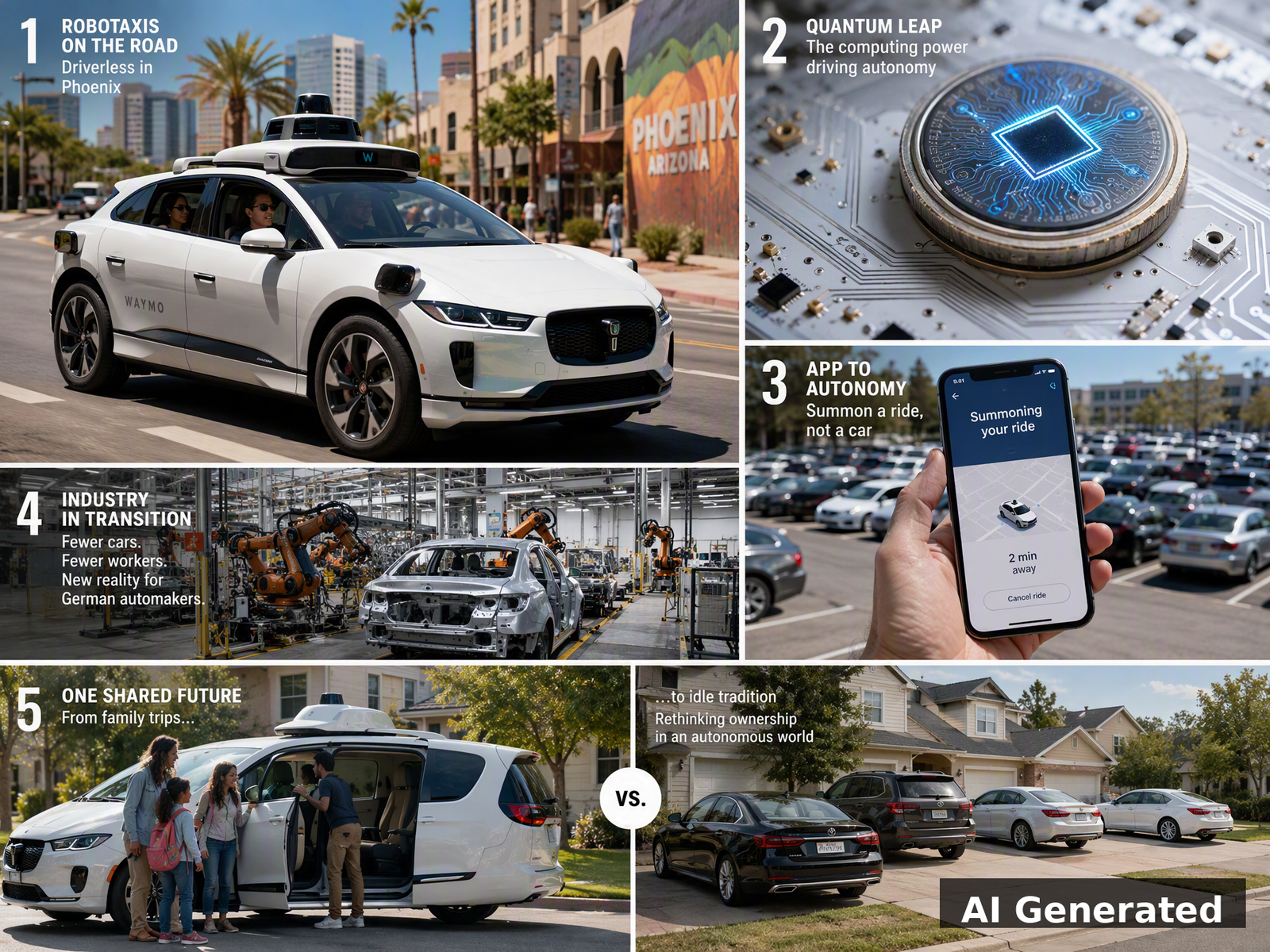
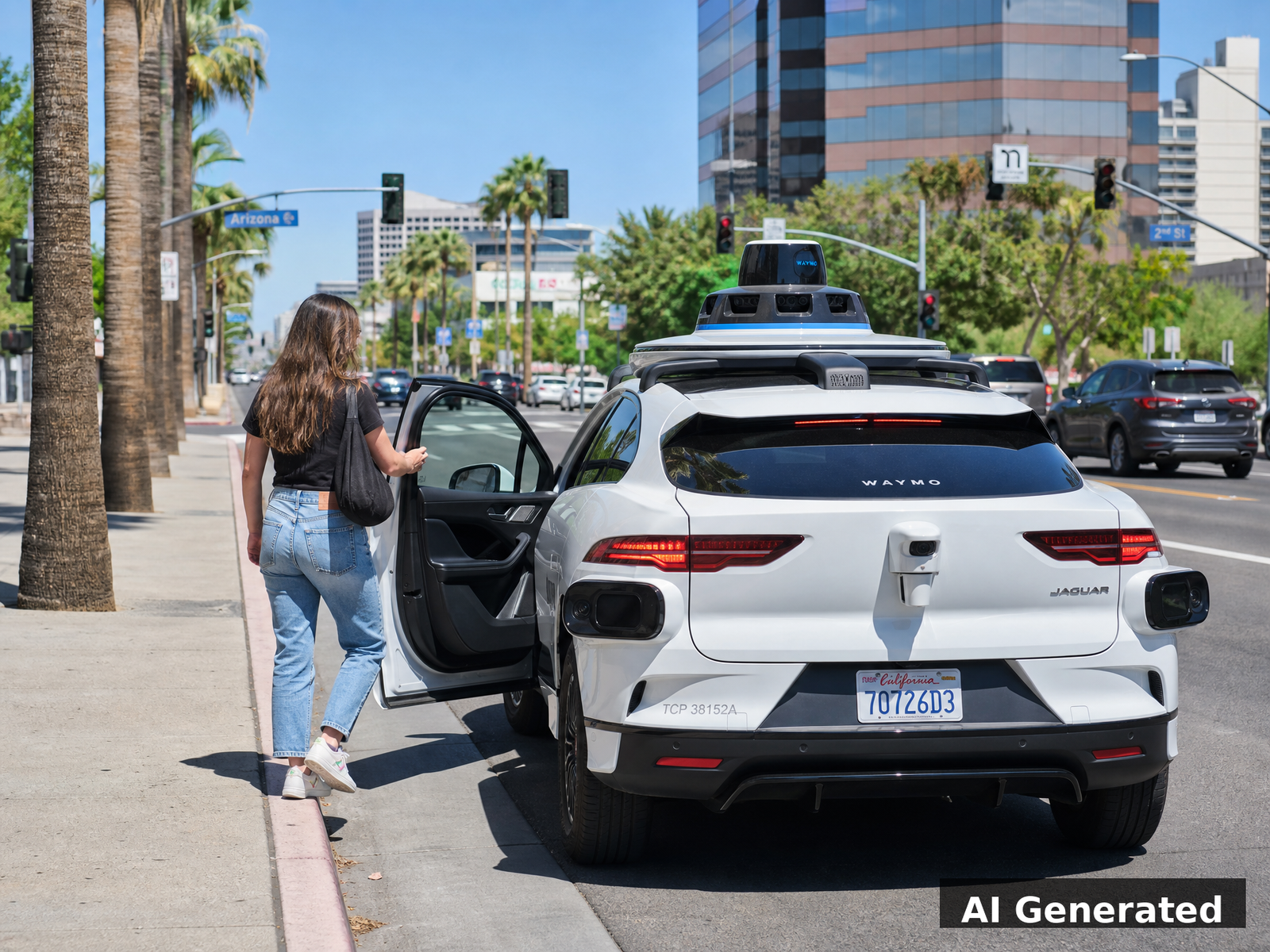
If you live in one of eleven American cities, you can already summon a driverless car with your phone. Waymo — Alphabet’s autonomous vehicle subsidiary — is conducting approximately 500,000 paid public rides per week across Phoenix, San Francisco, Los Angeles, Atlanta, Austin, Dallas, Houston, San Antonio, Orlando, Miami, and Nashville [1]. Its fleet of roughly 3,500 vehicles covers 4 million autonomous miles every week [1]. The company has completed more than 20 million lifetime paid trips and is expanding into Las Vegas, Denver, San Diego, Tampa, and London [1].
Tesla’s robotaxi service, while smaller, is operating in seven American cities — Austin, Dallas, Houston, Miami, Orlando, Tampa, and San Francisco [1]. In July 2026, Tesla launched fully driverless service in Miami, Orlando, and Tampa, each going driverless from day one without a safety-monitor phase [1]. The fleet remains small — independent trackers count roughly 20 active driverless vehicles in Texas — but Tesla’s bet is that its vision-only neural network, trained on more than 10 billion miles of consumer driving data, will scale faster than lidar-dependent competitors [1].
And then there is China. Baidu Apollo Go, the world’s largest robotaxi operation by volume, peaked above 350,000 weekly driverless rides in March 2026 across more than 27 cities [1]. It has gone international, launching in Dubai through Uber, with services in Abu Dhabi, Seoul, and a Swiss Level 4 permit. WeRide launched fully driverless, fare-charging robotaxi service in Dubai via Uber on March 31, 2026, with no onboard operator [1]. Pony.ai launched Europe’s first commercial robotaxi service in Zagreb, Croatia [1].
This is not a technology that is coming. It is a technology that has arrived. And its implications for car ownership, urban planning, and the automotive industry are more profound than the switch from petrol to electric.
The Quantum Accelerator
There is a reason autonomous driving is advancing faster than most predictions suggested, and it lies partly in a technology that receives far less public attention: quantum computing.

In May 2026, physicists at the University of Vienna achieved a breakthrough that could fundamentally alter the scale of quantum computing hardware. By extending the lifespan of magnons — tiny waves in magnetic materials — to 18 microseconds, a hundredfold increase over previous limits, they demonstrated that quantum computers could potentially be built the size of a one-cent coin [2]. “Magnons transform from lossy intermediate links into robust quantum memories and low-loss communication links on a chip,” the researchers explained [2].
This matters because autonomous driving is, at its core, an optimisation problem of staggering complexity. A self-driving vehicle must process inputs from dozens of sensors, predict the behaviour of every nearby pedestrian, cyclist, and driver, and make thousands of decisions per second — all while operating within the physical constraints of a two-ton machine travelling at speed. Quantum processors, with their ability to explore multiple solution paths simultaneously, are ideally suited to exactly this class of problem.
Israeli startup Quantum Art is developing a quantum processing unit that could fit one million physical qubits into a space of two inches by two inches [3]. The company projects quantum advantage — the point at which quantum computers solve practical problems faster than classical machines — by 2027 [3]. Its entire million-qubit system would fit in four or five standard server racks [3].
Meanwhile, China’s SpinQ is already shipping room-temperature quantum computers for education and research, with a 100-qubit superconducting system expected by the end of 2026 [4]. Its Gemini Mini, a two-qubit educational system, costs approximately $8,104 [4]. And in May 2026, China launched three operational quantum computers simultaneously — photonic, superconducting, and neutral atom — the first time any country has achieved this across three different technology routes [5].
The convergence of quantum computing and artificial intelligence will not arrive as a single dramatic moment. It will seep into the development pipelines of autonomous driving systems, accelerating the training of neural networks, improving the reliability of perception algorithms, and enabling the kind of real-time optimisation that makes fully autonomous vehicles safer than human drivers in every condition, not just the sunny, well-mapped streets of Phoenix.
How Autonomy Kills Ownership
Here is the thought experiment that the automotive industry does not want you to perform.
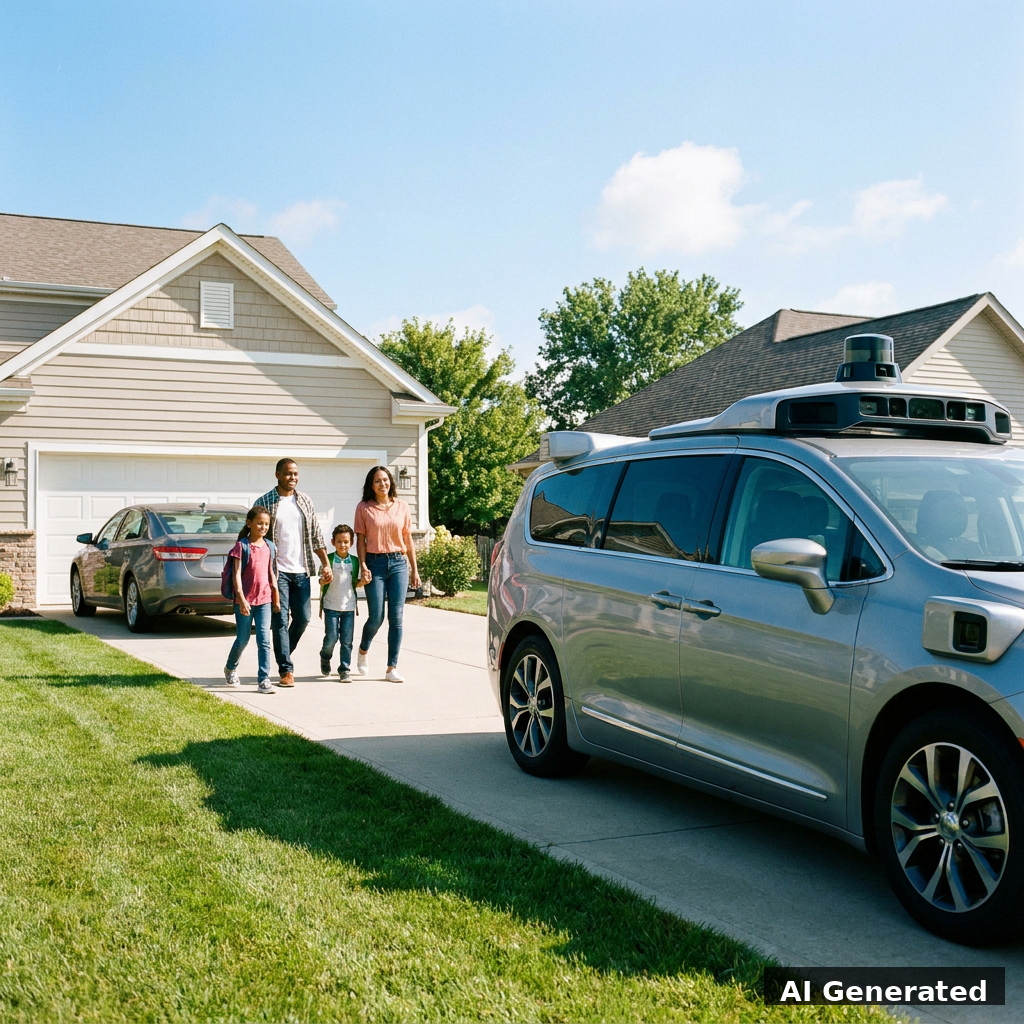
Imagine you are a two-car household. Both adults commute to work. Both cars sit in parking lots for eight to ten hours a day, doing nothing. On weekends, you use one for errands and the other stays in the driveway. This is normal. This is how car ownership has worked for decades.
Now imagine both cars can drive themselves.
One car drops you at work, then drives home to take your partner to their workplace. Then it drives your child to school. Then it returns to pick up your partner. Then it collects you. One car. The same car. All day.
The second car is no longer necessary.
For a single person living in a city, the calculus is even simpler. Why own a car at all — paying for insurance, maintenance, parking, depreciation — when you can summon an autonomous vehicle through an app that arrives in minutes and costs a fraction of what ownership costs? The parking lot at your apartment building becomes unnecessary. The parking garage at your office becomes unnecessary. The entire infrastructure of storing private vehicles — which, on average, sit idle 95% of their lives — begins to disappear.
This is not speculation. Waymo already offers a membership service — Waymo Premier at $29.99 per month — that provides priority access to its driverless fleet [1]. Zoox, Amazon’s purpose-built robotaxi, is currently offering rides for free on the Las Vegas Strip while awaiting its NHTSA exemption to charge fares [1]. Tesla’s robotaxi rides in Austin launched at a promotional flat rate of $4.20 per ride [1].
When the cost of using a car-on-demand drops below the cost of owning one, ownership becomes a lifestyle choice rather than a necessity. And that shift does not require every car to be autonomous — just enough of them, in enough cities, at a low enough price.
The Timeline Is Shorter Than You Think
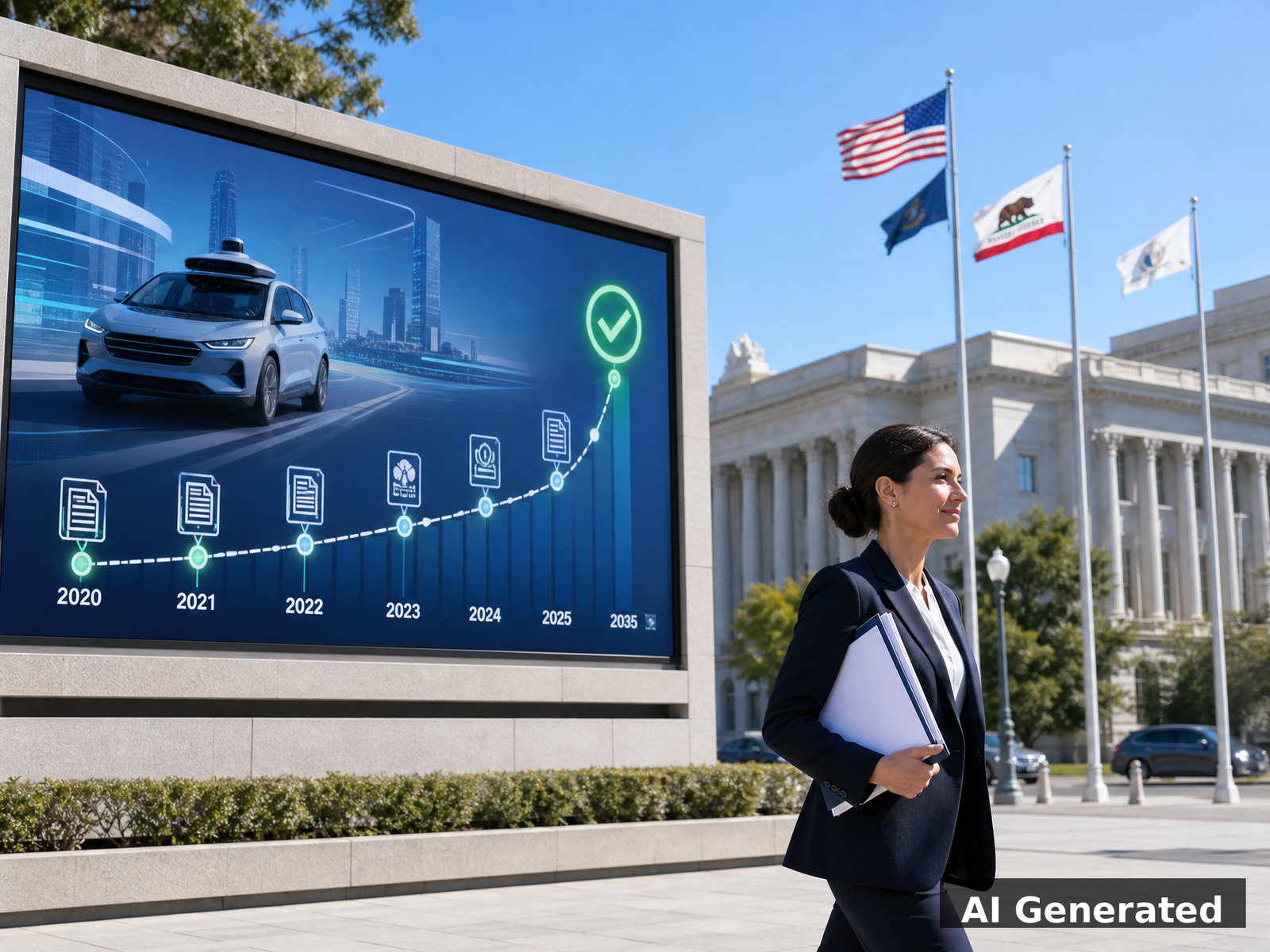
Industry projections have consistently underestimated the pace of autonomous vehicle deployment. In 2020, most analysts predicted commercially available robotaxis by 2030. By mid-2026, multiple operators are already running paid services in dozens of cities across three continents.
The bottleneck is no longer technology. It is regulation, insurance frameworks, and public trust — all of which are catching up. California finalized new autonomous vehicle rules in April 2026, allowing driverless freight trucks and adding enforcement mechanisms [1]. Texas required commercial authorisation for driverless operations starting May 2026 [1]. The U.S. Congress introduced the SELF DRIVE Act of 2026, the first dedicated federal autonomous vehicle bill of its session [1].
Elon Musk has tied Tesla’s aggressive scaling to FSD version 15, a model rewrite expanding from roughly 1 billion to 10 billion parameters, pointing to late 2026 or early 2027 for large-scale unsupervised deployment to consumer vehicles [1]. On Tesla’s Q2 2026 earnings call, the company disclosed that its robotaxi fleet is already running early v15 builds [1]. Independent safety data from Waymo — 68% fewer crashes than humans — provides the evidence base that regulators need to justify expanding permissions [1].
The most likely scenario is not a sudden transformation but an accelerating one. By 2028, autonomous ride-hailing will be available in most major American and Chinese cities. By 2030, it will be available in most major European cities, though likely a few years behind due to regulatory caution. By 2035, car ownership in urban areas will have declined significantly — not because governments banned it, but because economics made it irrational.
The German Blind Spot
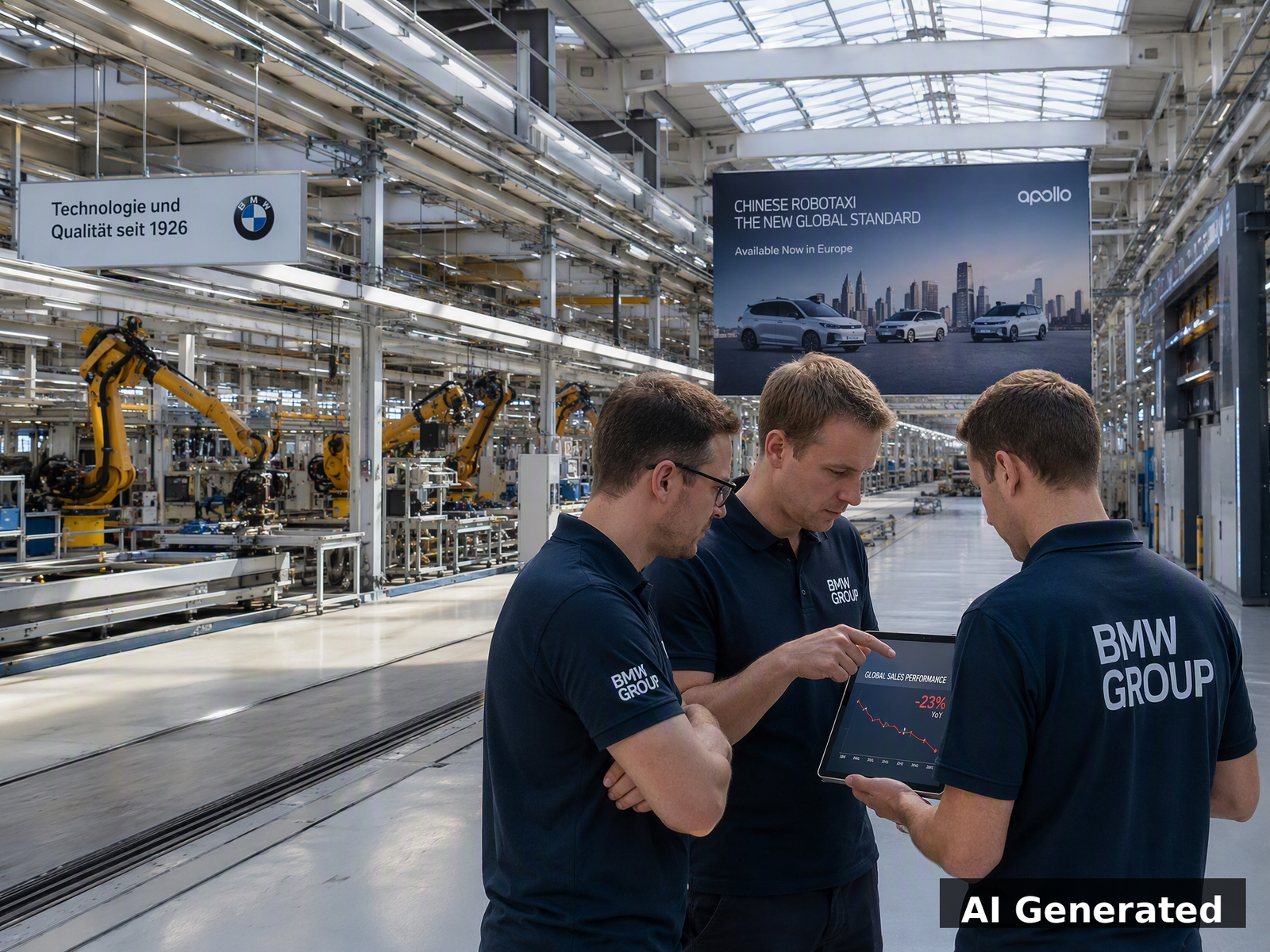
Here is where the German industrial establishment’s framing becomes problematic. Acatech president Jan Wörner, a credible and accomplished engineer, argues that the future of German industry depends on integrating AI into the manufacturing base [6]. He is not wrong about the importance of AI. But he is looking through the wrong end of the telescope.
The future of the automotive industry does not depend on building better cars — whether electric or otherwise. It depends on providing mobility. And the most efficient way to provide mobility in an urban environment is not to sell someone a €50,000 piece of metal that sits idle 95% of the time. It is to deploy autonomous vehicles that are in near-constant use, maintained centrally, and dispatched algorithmically.
This is a service model, not a manufacturing model. It favours software companies and fleet operators, not traditional automakers. It favours China, where Baidu and WeRide are already operating at scale. It favours the United States, where Waymo and Tesla are competing fiercely. It does not particularly favour Germany, where the industrial base is built around the assumption that mobility means selling individual vehicles to individual consumers.
The German auto industry’s crisis is not primarily about electric versus combustion. It is about ownership versus service. And on that question, the industry’s entire business model — its factories, its dealer networks, its financing arms, its lobbying power — is oriented toward a future that is disappearing.
🔜 Coming next in this series: Part 3 — The New Mobility Landscape — what Germany must do if it can let go of what it was.
References
[1] The Charge Port. (2026, July 24). Robotaxi tracker 2026 — US operators & live status. https://thechargeport.com/robotaxi-tracker
[2] Quantum Zeitgeist. (2026, May 4). Magnons last 100x longer, enabling mini quantum computers. https://quantumzeitgeist.com/magnons-last-longer-100x-enabling/
[3] Koetsier, J. (2025, October 30). 1 million qubits in your hand: Making smaller, faster quantum computers. Forbes. https://www.forbes.com/sites/johnkoetsier/2025/10/30/1-million-qubits-in-your-hand-making-smaller-faster-quantum-computers/
[4] SpinQ Technology. (2026). Quantum computers: The revolutionary technology transforming computing in 2026. SpinQ News. https://www.spinquanta.com/news-detail/quantum-computers-the-revolutionary-technology-transforming-computing-in-2026
[5] OriginQC. (2026, July 22). China quantum computer breakthrough 2026: 3 new machines live. OriginQC Blog. https://originqc.com/blogs/china-quantum-computers
[6] Acatech. (2024, November 19). Shaping future value creation: The influence of Industry 4.0. https://en.acatech.de/allgemein/shaping-future-value-creation/
AI Disclosure: This post was created with the assistance of artificial intelligence. The ideas, analysis, and opinions expressed are my own — AI was used to help compose, structure, and refine my personal notes and thoughts into the final written content. Images and video featured in this post were also generated using AI tools, based on my own creative prompts and direction.
