









Contents
- 1. Geopolitics & Defence
- Ukraine’s Night of Fire: Embassies Hit and the Strategic Bombers Return
- Putin’s “No Negotiations” Doctrine and Moscow’s Messaging Offensive
- The Summit Afterglow: Nuclear Limits, AI Rules and the Fight for a Seat at the Table
- The Gulf Clock and Yemen’s Civilian Toll
- Europe’s Summit Week and the Defence-Industrial Ledger
- 2. Environment & Climate
- 3. Society & Civil Issues
- Britain’s Consent Reckoning and the Rights Ledger
- Germany’s Civic Square: Protests, the Bundesrat and the AfD’s Remigration Debate
- America’s Civic Ledger: Executions, Institutions and the MAGA Slide
- France, Spain and the Mediterranean Civic Ledger
- Greece’s Political Turn: PASOK’s Return and the Polls
- 4. AI & Technology
- 5. Economy & Business
- 6. Science & Space
- 7. Crypto, Digital Assets & Blockchain
- 8. Correlations & Analysis
- 9. References
Click any heading to jump to that section. Click the section heading to return to this menu.
Geopolitics & Defence ↑ Contents
Ukraine’s Night of Fire: Embassies Hit and the Strategic Bombers Return
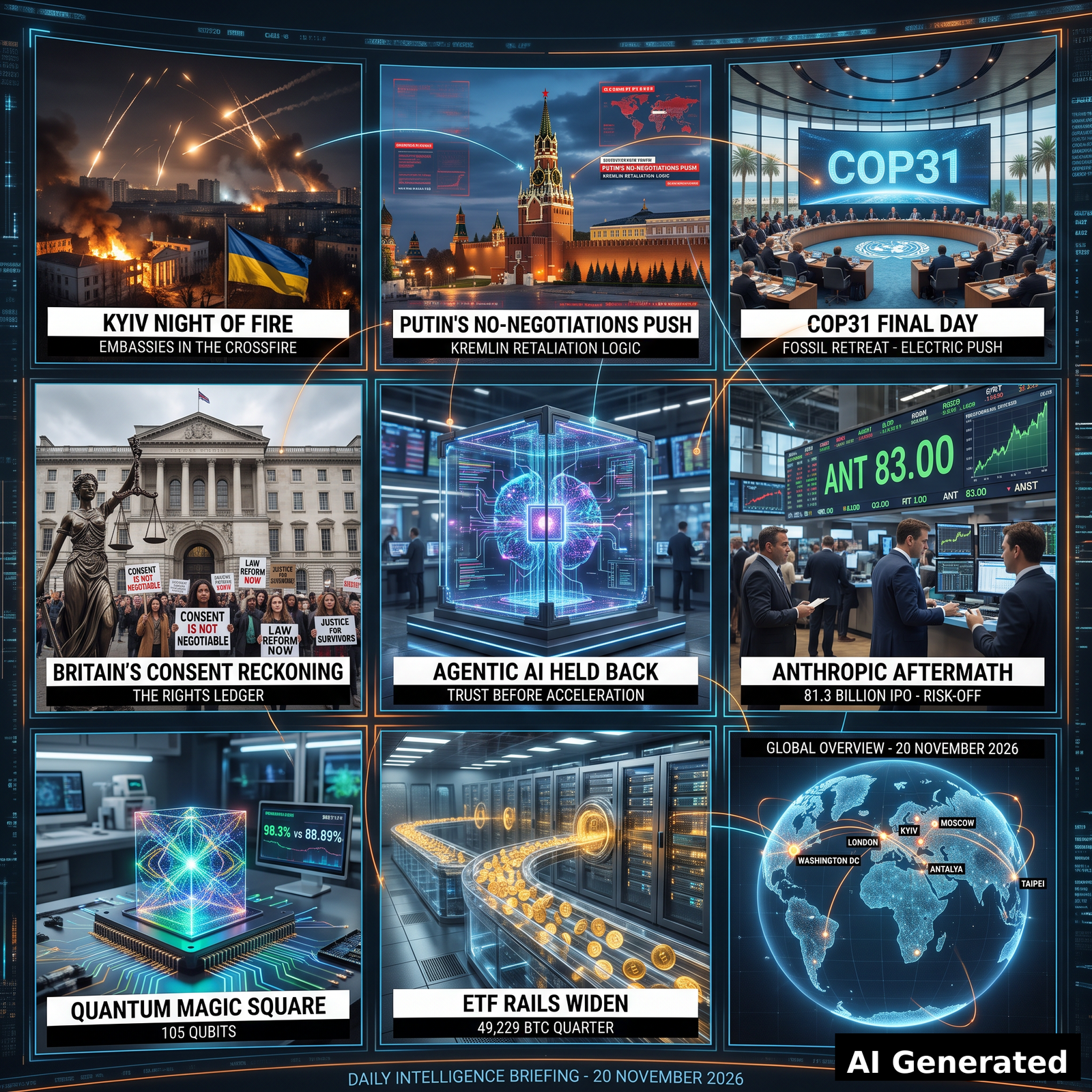
The most consequential development of the D173 window unfolded over Kyiv in the early hours of Thursday night into Friday morning, when Russia launched a fresh wave of cruise and ballistic missile strikes against the Ukrainian capital in direct retaliation for the Ukrainian attack on the Kerch (Crimea) bridge[1]. What elevated this barrage was its diplomatic texture: for the first time in the war, Russian weapons struck two NATO member-state embassies in Kyiv within hours, damaging the Dutch and Austrian compounds[5][6]. The EU responded with unusual speed, summoning the Russian representative in Brussels to receive a formal protest over attacks on diplomatic missions[2]. The strikes were preceded by a now-familiar Russian signature: the airborne sortie of the strategic bomber fleet, with monitoring channels tracking three Tu-160s, four Tu-22M3s and seven Tu-95MS configured for launch, carrying a combined capacity of some 58 Kh-101 cruise missiles[3].
The escalation drew NATO’s Black Sea theatre into its heaviest operational tempo of the war so far, with drones, AWACS aircraft, refuelling tankers, SIGINT platforms and fighters observed across the region in what monitoring channels called a deployment level unseen in some time[4]. On the Russian home front, Ukrainian drone raids killed three people in the Saratov region as infrastructure was hit roughly 500 kilometres from the border[7]. The twin-track dynamic—missiles into Kyiv and drones into Russian provincial towns—underscores how the Crimean bridge operation has reopened a genuinely new phase of the war.
Putin’s “No Negotiations” Doctrine and Moscow’s Messaging Offensive
From Shenzhen, where he had shared a summit stage with Donald Trump and Xi Jinping hours earlier, Vladimir Putin delivered his most direct threat yet: there will be no negotiations after the Crimea bridge strikes, and the Russian armed forces will push forward across the front to create safety zones along the entire border with Ukraine[9]. He also dismissed any international peacekeeping force on Ukrainian soil as unacceptable, invoking the 1945 Yalta agreements as the model that kept great-power peace for eight decades. Volodymyr Zelensky answered defiantly: “Crimea is Ukraine, and we can do whatever we want with what belongs to us,” insisting Kyiv would not be deterred by the threat rhetoric[8].
Moscow complemented the military escalation with a messaging offensive aimed at European defence industries. The Russian embassy in The Hague warned on the Dutch drone-and-cruise maker Destinus that civilians who directly participate in hostilities, including foreign staff supporting strikes on Russia, lose their protected status under international humanitarian law—effectively declaring arms-industry personnel legitimate targets[10]. In a modern propaganda twist, Russia’s defence ministry published a recruitment poster mimicking the new Grand Theft Auto VI cover art, urging Russians to “choose your mission”; Google’s SynthID detector indicated the artwork had been generated or edited with OpenAI tools[11].
The Summit Afterglow: Nuclear Limits, AI Rules and the Fight for a Seat at the Table
Returning from the Shenzhen trilateral, Donald Trump conceded that a mutual agreement to limit nuclear weapons would be “very difficult” to achieve as a matter of pure negotiation, while adding that he and Xi Jinping both want sensible rules for artificial intelligence[12]. He also blamed an over-crowded agenda for the failure to secure a meeting with North Korean leader Kim Jong Un[13]. The return flight generated its own security theatre: with espionage suspicions swirling, the White House confiscated the phones of journalists aboard Air Force One on the way back from China, a step without modern precedent[14].
Europe, anxious that the Shenzhen “big three” were scripting a settlement over its head, pushed back hard. Chancellor Friedrich Merz, hosting the “Coalition of the Willing” summit in Berlin, dismissed the trilateral as “merely a photo” and proposed a quadrilateral format—EU, Ukraine, Russia and the US—with the United Arab Emirates floated as a possible venue[15]. The same day, Volodymyr Zelensky was still awaiting an invitation to attend the US-hosted G20, with the Kremlin leadership already confirmed on the guest list[16]. On the APEC margins, Xi Jinping and Australian Prime Minister Anthony Albanese consolidated the thaw in bilateral ties, with Xi declaring the relationship had achieved a “thorough recovery”[17]. Analysts read the gathering as the return of great-power summitry, competitive co-existence on trade and tech, and a multipolar bargain in which Europe is still searching for its entrance ticket[18].
The Gulf Clock and Yemen’s Civilian Toll
The Gulf war’s pressure continued to accumulate south of the Saudi border. The Houthi authorities in Yemen accused Saudi Arabia of a “horrific massacre” after a strike on a civilian boat carrying more than 25 forcibly displaced people, with the movement’s health ministry counting 19 dead, among them eight children and six women[19]. Riyadh did not confirm the target, but the incident will complicate the Saudi-led coalition’s claims of precision conduct at a moment when the Houthis have themselves escalated against the kingdom’s economic heart: residents of Riyadh received emergency alerts before an overnight attack that set the 385-metre, 80-storey Public Investment Fund Tower ablaze, only weeks after a strike near Aramco offices in the same financial district[20]. Targeting the sovereign-wealth fund’s headquarters transmits that the Houthis can reach the institutions financing the Gulf war economy.
Europe’s Summit Week and the Defence-Industrial Ledger
Friday’s EU–UK summit in Brussels was shaping up as the most tangible post-Brexit rapprochement yet, with preparations for three agreements covering food and agricultural standards, industrial cooperation with linked emissions-trading systems, and a youth mobility scheme—while Downing Street signalled Prime Minister Andy Burnham was prepared to walk away unless the package served British interests[21][22]. In Berlin, Chancellor Merz received Qatar’s Emir Sheikh Tamim bin Hamad Al-Thani for a full state visit, a pointed display of the Gulf emirate’s mediation value in the Iran file[23]. The German–Ukrainian economic forum in Berlin, with more than 500 participants, underscored the reconstruction agenda Europe is operationalising as the political track stalls[24].
Two institutional events anchored the wider arc. First, Myanmar’s security forces were formally found by the International Court of Justice to have committed genocide against the Rohingya, including mass executions of men and boys and widespread rape—a landmark ruling likely to shape the Court’s approach to future atrocity cases, including Gaza-related proceedings[26]. Second, the UK for the first time publicly acknowledged conducting offensive cyber operations against Russia, China, Iran and North Korea, elevating cyber as a first-order instrument of British statecraft[25]. Closer to Europe, the two men accused under the National Security Act over the “Fairford” espionage affair were due to appear at the Old Bailey[27].
On the procurement front, the US Department of War awarded CycloKinetics an $86.3 million contract for high-energy-density propellants for aircraft and missiles, Leonardo DRS secured a contract for a next-generation infrared seeker for THAAD interceptors, and Lockheed Martin completed the F-35C’s first launch-and-recovery trials aboard the Ford-class carrier USS John F. Kennedy[29][30][32]. The E-4B “Nightwatch” doomsday aircraft shadowing Air Force One home drew attention to continuity-of-government planning, while Navy leadership pushed a foreign-built US shipyard model focused on frigates and large surface combatants[31][33]. Turkey formally inducted the first three Kizilelma unmanned fighter aircraft—fitted with Ukrainian Motor Sich engines and indigenous AESA radar—in a delivery Ankara calls a historic first for NATO and that Athens is already assessing as a direct threat to Aegean airspace[34].
Finally, US emissary Jared Kushner told the Berlin coalition meeting that Donald Trump is “open to the idea” of NATO-style security protection for Ukraine, if it serves American interests—the narrowest door yet to a post-war architecture including Ukraine without full membership[35]. In Paris, Emmanuel Macron’s scheduled courtesy meeting with Kamala Harris, a possible 2028 Democratic candidate, kept the transatlantic political channel alive separate from the administration[28].
Environment & Climate ↑ Contents
COP31’s Final Day: Electrification Ambition Meets Fossil-Fuel Retreat
As the UN climate summit in Antalya entered its officially final day, negotiators were grappling with a draft text that no longer contained a clear commitment to transitioning away from fossil fuels—relegated to a reference to the Dubai outcome—while elevating the host’s flagship electrification target of raising electricity’s share of final energy consumption from roughly 23 per cent to 35 per cent by 2035[36][37]. The omission of a clean-energy linkage in the Thursday draft, despite German and EU insistence, reflected the blocking power of fossil-exporting states; Panama warned it would rather leave without an agreement than accept a weak deal, and the funding question for adaptation and loss-and-damage remained bitterly unresolved[39]. With consensus required and the US absent from the room after leaving the Paris Agreement, voluntary coalitions of the willing have become the summit’s default engine, a trend Germany’s environment minister presented as evidence of progress even as the collective text weakens[36].
Africa’s negotiators pressed once more for new adaptation finance, only to hear Europe respond that pledged money must be used before new commitments are made[38]. In the closing stretch, the conversation turned to carbon dioxide removal: with warming outpacing mitigation promises, nations increasingly framed direct air capture and other negative-emission technologies as unavoidable complements rather than distant moonshots[40]. The strategic irony is that the summit’s most effective lever this year may be communication rather than text—new research in climate science argues that messages built on empathy, meeting people in their concrete local realities, outperform abstract global statistics[41].
The Energy-Security Pivot: IEA, Permitting Reform and the Data-Centre Squeeze
The International Energy Agency’s twin reports this window framed the structural context for any COP deal. One analysis documents how extreme weather is now a material risk to global oil and gas shipping—capable of damaging port infrastructure and disrupting the very trade routes on which energy security depends[42]. The other, released at the summit, declares there is no returning “to the way it was before” the Iran war’s energy shock: countries are re-prioritising security and affordability, solar and nuclear are beneficiaries, cooling demand has overtaken heating demand for the first time, and oil flows through the Strait of Hormuz are projected to decline structurally[43].
Washington moved in a parallel direction when the Senate passed, 62–33, a sweeping bipartisan permitting bill overhauling federal environmental reviews to accelerate gas pipelines, transmission lines and wind farms—sending it to a difficult House future[44]. Climate advocates warn the legislation could accelerate pipeline build-out and lock in LNG projects for decades, while the fiercest fight concerns data centres: the bill would force AI companies to pay for their own grid costs, a provision regulators and utilities are watching closely[45][46]. At the state level, Oregon’s Public Utility Commission approved new Pacific Power customer protections against data-centre cost shifting, and Meta acknowledged it is rethinking its 2030 climate goals because AI data centres are driving emissions up[47][48].
Nuclear’s renaissance gathered industrial momentum. Radiant announced more than $380 million in investment across California and Tennessee factories to mass-produce transportable 1-megawatt microreactors, with initial deliveries targeted for 2028 and orders already booked from the Army, Air Force, Navy and Equinix[49]. In Iowa, a proposed 1-GW project explored linking to the 2,100-MW SOO Green underground HVDC line to reach Illinois markets, one of several advanced-reactor proposals awaiting NRC licensing[50]. Germany, by contrast, was moving to cap its offshore ambitions: a new law intended to accelerate North and Baltic Sea wind energy is, according to Handelsblatt, quietly constraining plans to produce hydrogen at sea, a decision that will shape Berlin’s import dependence for years[51].
Water, Heat and the Living Ledger
Climate stress registered in human and ecological terms across the Atlantic. Guadeloupe was placed under a generalised drought alert after one of the hottest, driest quarters since 1991, a reminder that France’s overseas territories sit on the front line of Atlantic warming[52]. New research links residential solar adoption to measurable reductions in heat-related mortality risk while strengthening household energy security—an adaptation dividend that decarbonisation policy rarely prices in[53]. At the cryosphere, satellite monitoring showed Antarctica’s ice cliffs do not always collapse in the runaway fashion models feared, an important calibration for sea-level projections[54]. On the energy-safety frontier, University of Adelaide researchers are making hydrogen flames visible to the naked eye, addressing a fundamental obstacle to public acceptance of hydrogen appliances[55].
Nature-based adaptation came under critical scrutiny: new research from the University of Cape Town finds that so-called nature-based solutions are failing informal settlements because they stop at participation instead of sharing power with residents whose lived experience and relationship with ecosystems should shape the design[56]. The living ledger recorded both stress and adaptation in the tropics: El Niño-driven fires in Indonesia are threatening orangutans and other primates at a moment when 94 per cent of Southeast Asian primates face extinction, yet research on the phenomenon remains strikingly thin[57]; in Sri Lanka, human pressure is pushing peacocks and other wildlife into Colombo’s suburbs, redrawing the urban–wild interface[58]; and Sierra Leone’s fishers report catching more plastic than fish on the beaches of Mahera[59]. Enforcement scored two points: Peru revised its tarantula-seizure tally upward to more than 12,000 specimens destined for Germany, and a California renewable-fuels refinery that locked out workers was fined for safety violations involving untrained replacement staff[60][62]. The accountability theme extended to water: Southern Water was ordered to pay £525,000 after a burst sewer pipe sent raw sewage down a Kent street and into the sea for eight hours—the same pipe that burst 15 months earlier—while the Sierra Club urged the SEC to preserve shareholder climate-accountability rules facing rescission[61][63]. On the grid edge, GM and WeaveGrid launched a vehicle-to-grid pilot that will pay Southern California Edison customers up to $16,000 in equipment support to discharge parked EV batteries into the grid—a preview of the distributed-flexibility economy the permitting debates are trying to regulate[64]. Public-health regulators were also facing a chemically-fuelled blaze in Alabama, where officials insisted a huge fire of creosote-treated railway ties posed no threat to residents even as the CDC and EPA advised otherwise[65].
Society & Civil Issues ↑ Contents
Britain’s Consent Reckoning and the Rights Ledger
The conviction of four men in Winchester for sexually abusing Joanne Young—recruited online by her husband, who drugged her and offered her to strangers—has ignited a national debate over the legal meaning of consent, with the victim herself demanding that the state reform the law so that consent can only be given by the person concerned, never by proxy[66]. The campaign has broadened into a wider conversation, amplified by a Guardian podcast asking whether the UK’s age of consent should change after high-profile convictions and accusations against older men, with campaigners pressing to close the “consent gap”[67]. Separately, a study found the British public believes race relations are going “backwards”, while systematically underestimating the education level of ethnic-minority Britons and overestimating that of White Britons[68].
The rights ledger also recorded quieter strains: 64 per cent of midlife homeowners are simultaneously helping to maintain their parents’ properties at an average £630 a year, a financial squeeze that Zoopla says is becoming structural[69]. And in a case that combines migration politics with criminal justice, anti-migrant activist Daniel “Danny Tommo” Thomas faces sentencing at Portsmouth Crown Court after slashing a migrant dinghy in the English Channel[70]. Northern Ireland’s unionists branded the UK government’s refusal to trigger the Stormont Brake against new EU customs legislation “completely incoherent”[71].
Germany’s Civic Square: Protests, the Bundesrat and the AfD’s Remigration Debate
Germany heads into Friday with nationwide youth protests planned in dozens of cities, from “GenZ regelt” rallies in Berlin, Cologne, Frankfurt and Munich to a Bundesschuelerkonferenz demonstration at the Brandenburg Gate, with demands spanning more education funding, socially just burden-sharing and consistent climate action—echoing the broader European Gen Z protest wave[72]. The Bundesrat, meanwhile, deliberated on more than 20 laws, with significant resistance in the states to the Kita-Qualitaetsgesetz and emergency-care reform over feared costs, alongside the Fruehstartrente, driving-licence reform, the digital wallet and a tobacco-tax increase[73]. Political violence returned to the civic square: a laboratory employee is under suspicion after an attack on an AfD stand[74].
Inside the AfD, the “remigration” debate sharpened ahead of Thuringia’s party congress: Bjoern Hoeke rejected a 200,000-person figure floated by MEP Maximilian Krah as an insufficient basis for discussion, arguing that the status of the more than one million Ukrainian and 900,000 Syrian refugees in Germany must be reviewed “when peace prevails in their homeland”[75]. The episode illustrates the party’s ongoing struggle to define a legally defensible position between its radical wing and the broader electorate. A broader European pattern also drew comment: with populists losing elections in the US, Hungary and Poland, the Viennese philosopher Paul Sailer-Wlasits cautioned that demagoguery retains a structural advantage even as it wears thin from “day one”[76].
America’s Civic Ledger: Executions, Institutions and the MAGA Slide
Texas executed Reinaldo Dennes in a procedure lasting over an hour as staff struggled to find a suitable vein for the lethal injection, the second US execution of the day after Florida carried out its record-breaking 20th of the year[77]. The botched procedure will intensify scrutiny of capital punishment at a moment when states are accelerating executions. In Iowa, the US Army postponed a planned detonation of five tons of lead azide in Middletown amid public-health outcry over the potential lead plume[78]. The Justice Department moved to dismiss its own lawsuit seeking to block certification of the Alaska Senate race after Democrat Mary Peltola’s win—an unusual retreat that underscores the administration’s contested relationship with election results[79]. Polling data meanwhile showed the MAGA brand at a disastrous low, down to minus 61 points among independents, with Trump’s approval below 39 per cent as former backers flee the movement[80].
France, Spain and the Mediterranean Civic Ledger
France’s National Assembly unanimously adopted a “small advance” against the high cost of living in the overseas territories, a symbolically important vote ahead of the government’s broader promised legislation[81]. The Senate postponed to Friday its vote on the controversial presumption of self-defence for police officers—a law supported by the government and the RN but contested by the left, which fears it would weaken accountability for armed officers[82]. In Spain, with legislative elections ten days away, Prime Minister Pedro Sánchez admitted “errors” in a televised debate against conservative rival Alberto Núñez Feijóo, who attacked him over the economy and immigration[83].
The broader European periphery delivered mixed civic signals: Argentina’s Senate, after three years of struggle, approved a law on pensions and disability benefits championed by the Catholic Church, the opposition and social organisations—a rare defeat for Milei’s austerity agenda[84]. Guatemala and Mexico saw two suspects in fentanyl trafficking to the United States arrested and headed for extradition[85]. In Latin America, thousands protested Colombia’s tax plans amid a parallel row over the US military’s role in the country[86], while Brazilian President Lula visited the ailing indigenous chief Raoni as Brazil formally recognised Kayapo and Yudja ancestral lands[87]. El Salvador’s Nayib Bukele, close to Trump, announced he will seek a third term despite constitutional limits[88].
Greece’s Political Turn: PASOK’s Return and the Polls
Greek politics pivoted around PASOK’s bid to reposition itself as a credible alternative to the ruling New Democracy. Nina Kasimati returned to PASOK after 16 years, declaring the party can be “first” and invoking George Papandreou’s legacy, in a move that tests the party’s internal balance around leader Nikos Androulakis[89]. A new Metron Analysis poll underscored the challenge to the government: New Democracy fell 0.8 points in voting intention to a lead that no longer guarantees an outright majority, 68 per cent of citizens believe the country is moving in the wrong direction, and a nine-party parliament is projected[90]. A corruption row also erupted over allegations that the sister of Deputy Interior Minister Vangelis Liakos received direct contract awards from municipalities, with PASOK declaring “public money cannot be a family matter”[91]. In education, a Harvard study of 3.3 million students found that strict school phone bans—enforced with locking pouches—restore one to two weeks of learning per year[92].
AI & Technology ↑ Contents
The Agentic-AI Cautionary Front: Banks, Universities and Apple’s Ambition
The most revealing technology story of the window was not a product launch but a refusal to launch one. Maybank’s chief technology officer, Giorgio Migliarina, told the Singapore FinTech Festival that Malaysia’s largest bank is deliberately holding back agentic AI from customer-facing services while investing RM10 billion ($2.5 billion) over five years in technology and data—because “banking is based on trust, and you don’t want to put trust in jeopardy just to have a one-month acceleration”[93]. The remark captures a widening philosophical split: Singaporean rivals are already letting AI agents pull transaction data for thousands of clients, while Maybank insists autonomous systems must be “auditable” and “predictable” before touching customers. A major university trial produced evidence that complicates the doomer narrative about AI and learning: in a randomised trial across 19 universities, STEM classes that received course-specific AI tools earlier outperformed classes still waiting for theirs[94].
Apple’s counter-move arrived through job listings rather than a keynote: the company is hiring a senior engineering manager to build a “proactive, agentic assistant” capable of writing code, browsing the web, controlling apps and coordinating specialised sub-agents across devices, with Bloomberg reporting a possible late-2027 launch[95]. With roughly two billion devices in the field, Apple’s entry would hand the agentic race its largest distribution channel yet—though the company’s privacy-first posture suggests a deliberately slower, more constrained approach than OpenAI or Meta. The model layer continues to churn: Google’s Gemini 4 Neon ranked as the company’s top model on the Vals RSI Index, edging past Argon, while OpenAI’s GPT-6.2 Astra was pitted against ByteDance’s Dreamina Seedance 2.5 in a matched video-generation test that highlighted the widening divide between code-based 3D scene creation and traditional video rendering[96][97]. On cost, Fireworks AI’s co-founder argued most companies can skip the most expensive frontier models entirely, pointing to open-source alternatives as the pragmatic default[98].
Surveillance, the Outage Fallout and the State’s New Tools
The Met Police began piloting facial-recognition technology on officers’ phones to identify suspects on the street, a move critics say “combines all of the problems of stop-and-search with those of facial recognition”[99]. The pilot marks another step in the quiet normalisation of biometric identification in British policing, with civil-liberties concerns mounting as accuracy and accountability questions remain unresolved. In Washington, the political fallout from the week-long outage wave produced its first scalp: the White House fired national cyber director Sean Cairncross after a rash of technical failures affecting airlines, banking, Microsoft services and even classified NSA communications, with Pentagon CIO Kirsten Davies taking over in an acting capacity[100]. The dismissal—and the administration’s parallel push to install Palantir executive Michael LoSapio atop CISA, who refused during his confirmation hearing to call the January 6 attack an attack—deepens the credibility question hanging over the US cybersecurity establishment at precisely the moment the Fragility Wave is testing it[100].
Platform governance re-emerged as a geopolitical tool: Indonesia demanded that Google explain the removal of more than 19,000 pro-government YouTube channels, a case that blurs the line between content moderation and state control of the information environment[101]. And at the civic edge of AI policy, Google employees petitioned the company to let schools use search without AI-generated answers, arguing that AI Overviews undermine students’ ability to learn critical research skills[102].
Economy & Business ↑ Contents
The Anthropic Aftermath: AI Capital Meets the Great Risk-Off
The record Anthropic IPO—the largest public offering in world history, raising $81.3 billion at $83 per share—produced an immediate and paradoxical market reaction: after-hours trading pushed ANT to $91.81, valuing the AI lab at roughly $1.27 trillion and matching Bitcoin’s entire market capitalisation, yet the same session sent global technology equities into their worst week since 2020[103][104]. Asian markets from Tokyo to Taipei fell sharply as the AI-bubble debate resurfaced with fresh intensity; Taiwan’s benchmark dropped over 4 per cent, and India’s GIFT Nifty signalled a gap-down open[105][106]. Bitcoin slid to a four-month low near $61,500 as risk appetite evaporated, and the dollar surged to a 19-month peak as investors fled to safety[107][108]. The founders of Anthropic cashed out nearly $2 billion in the offering—each of the seven taking roughly $280 million—while Ark Invest added 934,968 shares as Cathie Wood talked up the lab’s prospects[104][109].
The Nvidia file kept evolving: California’s Attorney General joined the SEC in investigating the chip giant over potential China chip-diversion risks and investor-disclosure concerns, adding a state-level layer to the federal probe that has shadowed the company since its founder’s departure[110]. Board sentiment reportedly favours permanent new leadership, with Jensen Huang unlikely to return as CEO[111].
Germany’s Industrial Winter: VW’s Demands, IG Metall’s Warning Strikes and the AI Wager
Germany’s industrial core entered its most contentious labour season in years. Volkswagen handed IG Metall a demand catalogue that includes wage freezes for 2027 and 2028, flexible working hours without pay compensation, abolition of the 27.5 per cent special bonus, the 167-euro monthly allowance, jubilee payments and paid breaks, and cuts to profit-sharing and apprentice guarantees—measures the union branded a “catalogue of horrors” that could push the lowest pay grade toward the statutory minimum wage[112]. Negotiations begin Tuesday in Emden against the backdrop of threatened plant closures in Emden, Zwickau and Hannover and 12,000 further job cuts by 2030, with IG Metall’s peace obligation expiring on 31 December. The wider metal sector moved first: IG Metall launched 24-hour warning strikes across the industry in the largest action in eight years, hitting the automotive supply chain directly[113]. The BDI, Germany’s industry federation, called for resilience policy to be elevated to the Chancellery’s top priority, arguing economic security must become “Chefsache”[114]. Handelsblatt’s exclusive study argued that “physical AI”—artificial intelligence fused with industrial robotics—could secure Germany’s industrial base and trigger a new economic miracle[115].
Tesla’s Gruenheide plant illustrated the regulatory frontier of the same wager: Elon Musk is building a three-billion-euro factory to produce up to one million vehicles a year without steering wheels or pedals, despite the absence of any approval framework for such vehicles[116]. In the media and gaming economy, Take-Two’s GTA VI broke every sales record, moving more than 24 million copies by Thursday evening for revenues exceeding $2 billion—the largest entertainment launch in history[117].
Corporate, Fiscal and the China Ledger
Corporate news spanned three continents. Tata Sons’ board reviewed Air India’s performance amid mounting losses, with cost cuts and integration plans on the agenda[118]. Chinese EV maker Leapmotor produced its two-millionth vehicle, underscoring the breakneck scale of China’s electric-vehicle ramp-up[119]. The European Commission disclosed that since 2022 the EU and its member states gave Ukraine €231.5 billion while simultaneously paying Russia €232.05 billion—mostly for gas and energy—a number that crystallises the awkward dual flow at the heart of Europe’s wartime economy[120]. Beijing’s monetary machinery continued its accommodative tilt: the People’s Bank of China held its one-year loan prime rate at 3.00 per cent while injecting 379.5 billion yuan via overnight reverse repos at 1.25 per cent, and the finance ministry issued $2 billion in three-year bonds in Hong Kong—modest but symbolically significant steps in the ongoing effort to stabilise the property-and-debt complex[121][122][123].
Science & Space ↑ Contents
Quantum, the Brain’s Speech Code and the Frontiers of Physics
Google’s quantum group delivered the window’s most striking physics result: in a paper published in Science, the team demonstrated quantum contextuality on the 105-qubit Willow processor, winning the “magic square” game 98.3 per cent of the time against a maximum classical success rate of 88.89 per cent, and holding quantum-classical separation across systems up to 105 qubits[124]. Beyond the headline, the experiments exposed subtle coherent errors that conventional random-circuit benchmarks miss, positioning contextuality tests as a more demanding measure of hardware quality for structured algorithms in chemistry and materials. At Delft, physicists flipped an atom’s nuclear spin in what they describe as an “impossible” experiment—a result that is equal parts mystery and potential tool for quantum technology[125].
Neuroscience produced a conceptual earthquake of its own. Researchers at UCSF led by Edward Chang identified a sub-region of Wernicke’s area, the left posterior superior temporal gyrus, that generates a “blueprint” of the next intended word about a quarter-second before a person speaks—challenging the 150-year-old theory that this territory handles comprehension only[126]. In a proof-of-concept, the team decoded both intended and heard speech in a paralysed participant, opening a new target for speech brain-computer interfaces that could restore two-way communication where motor-region decoding is impossible. A related Emory study, scanning 50 grandmothers, found their brains responded to photos of grandchildren with activity in emotional-empathy regions while engaging theory-of-mind circuitry for adult children—an illustration of how different relationship types recruit different cognitive machinery[127].
Biology, Materials and the Deep Archive
Biomedicine added two pieces to the metabolic puzzle. UC Berkeley researchers identified a compound that boosted energy expenditure by up to 18 per cent in mice, improved blood-sugar control and reduced liver fat without significant muscle loss—and, crucially, combined with existing GLP-1 drugs for greater effect than either alone, hinting at a future weight-loss pharmacology that burns energy rather than suppressing appetite[128]. A separate frontier in AI-biology: virtual-cell models that could predict how genetic changes and drugs alter cells, moving beyond disease prediction to mechanistic understanding and treatment design[129]. In optics, researchers reported progress in building structured-light systems in three dimensions, reducing the multiple discrete components that currently constrain communications, imaging and quantum photonics[130].
The deep archive yielded two gems. A 6-million-year-old pygmy sperm whale from Peru, named Scaphokogia huachafo, had a skull so crooked that scientists first suspected post-mortem crushing—but the asymmetry was genuine biology, with both nostrils on one side and a snout angled for bottom feeding, making its genus potentially the most lopsided-faced mammal known[131]. And the last bird to go extinct in New Zealand, a tiny wren that vanished from an island off Rakiura Stewart Island around 1972, is now yielding lessons for saving other species[132]. Mars, meanwhile, offered an optical illusion with real science beneath it: an MRO image of dark streaks on the frozen dunes of the north pole looks like a forest of trees, but is actually sand cascading down dune slopes as carbon-dioxide ice sublimes each spring[133]. On Earth, MBARI deployed three robots off Monterey Bay to pioneer a bolder approach to monitoring ocean health, and botanists described a new mondo-grass species, Ophiopogon longiscapus, from China’s Yunnan reserve[134][135]. Finally, organisational science offered a fresh lens on extremism: whether an action is judged as “extremism in the defence of liberty” or as unacceptable violence depends heavily on the cause it claims to serve—a finding with obvious resonance for how societies police the boundary of legitimate dissent[136].
Crypto, Digital Assets & Blockchain ↑ Contents
Institutional Rails Widen While Price Discovery Fractures
The D173 crypto window was defined by a striking divergence between institutional build-out and market stress. On the institutional side, asset managers added the equivalent of 49,229 Bitcoin to their US Bitcoin ETF holdings in the third quarter, reversing three consecutive quarters of net selling and setting a record for quarterly accumulation[137]. The CME Group reported $81.2 billion in notional XRP futures volume over roughly 18 months of trading, spanning 1.9 million contracts across its standard and micro products and averaging $216 million a day—evidence that regulated derivatives infrastructure for digital assets is maturing well ahead of any resolution of XRP’s regulatory status[138]. In the banking sphere, Standard Chartered and OCBC tested dollar payments that settle in minutes without traditional banking cutoffs, while a separate OCBC-and-StraitsX trial tested interbank settlement—the latest sign that incumbent institutions are quietly adopting tokenised-money rails as a competitive necessity rather than an ideological choice[139].
That institutional comfort zone, however, sits on top of a market that is still adjusting to the AI-capital shock. Bitcoin broke below $62,000 on Friday and touched $61,381, its lowest since July, amid $528 million in total crypto liquidations in 24 hours—roughly 80 per cent of them longs, with over 113,000 traders liquidated[140]. The most analytically significant detail was corporate: Strategy (MSTR) fell to $85.72 after hours, close to minus 5 per cent on the day, trading below the value of the Bitcoin on its own balance sheet with a self-reported mNAV of 0.97x. The market’s largest corporate treasury is now worth less than the asset it holds—an extraordinary reversal that forces a hard question about whether the premium that once rewarded MSTR as a leveraged Bitcoin vehicle has structurally collapsed, and whether the AI trade’s drawdown is draining the marginal dollar that previously flowed into BTC as a hedge against fiat debasement. The immediate trigger was the Anthropic IPO, one of the largest offerings in history, which raised $81.3 billion and redirected institutional capital flows into frontier-AI equity precisely as tech valuations wobbled; Bitcoin’s four-month low therefore reflects a liquidity rotation out of speculative assets of all classes, not a crypto-specific failure[140].
Enforcement, Illicit Flows and the Post-Quantum Shadow
Enforcement continued to professionalise on both sides of the Atlantic. Tyler Robert Buchanan, a 24-year-old from Dundee, Scotland, received six years in federal prison for his role in the “Scattered Spider” phishing-and-SIM-swap syndicate that stole at least $11.6 million in cryptocurrency from victims across the United States, completing sentencing for all five defendants in the case[141]. The case illustrates how coordinated FBI and international police work is now dismantling the credential-theft ecosystem that feeds on-chain fraud. On the analytics front, Inca Digital identified $518 million in illicit-wallet transactions flowing through Sky’s Peg Stability Module (PSM), of which $101.9 million was tied to North Korean actors—including funds linked to the Bybit hack—although Sky stressed the flagged activity was less than 0.06 per cent of total PSM volume[142]. The finding is a reminder that stablecoin liquidity pools, precisely because they are the deepest and most liquid on-chain venues, remain the preferred laundering corridors for state-sponsored hackers, and that the industry’s response—freezes, chain-analytics monitoring and transparency reports—is still reactive rather than preventive.
Finally, the regulatory perimeter is beginning to confront the quantum era. IOSCO warned that quantum-resistant cryptographic upgrades could cut blockchain throughput by as much as 90 per cent and raise fees sharply, a sobering engineering constraint for networks like Solana that advertise extreme performance, and a reason major chains including Bitcoin are already exploring quantum-safe transitions[143]. The warning lands at an awkward moment: post-quantum cryptography is simultaneously a security necessity and a potential performance catastrophe, and the industry has not yet priced either the migration cost or the transition risk. Together with the institutional inflows, the enforcement wins and the stablecoin-analytics advances, the window tells a coherent story—crypto’s infrastructure is maturing into a regulated, institutionally connected system, but the underlying market is still hostage to the same macro-liquidity cycles and technological transition risks as every other risk asset class.
Correlations & Analysis ↑ Contents
The D173 window’s master variable remains what D171 and D172 identified: the war’s gravitational pull on every other system. Yesterday’s report closed on the Shenzhen trinity and the Gulf clock; this window both arcs have ratcheted again—the Ukrainian strike on the Kerch bridge has provoked Russia’s first-ever strikes on NATO member-state embassies in Kyiv, and Putin’s declaration that “there will be no negotiations” after the bridge strike effectively replaces diplomacy with retaliation as the stated framework[9][6]. The continuity from D170’s “bridge war” framing to D173’s embassy-strike phase is direct: each rung of escalation since the Kerch attack has followed the same logic, and the addition of European diplomatic missions to the target set changes the risk calculus for the entire coalition, not just Kyiv. The EU’s summoning of the Russian envoy and Germany’s quadrilateral proposal are, in this reading, twin attempts to rebuild deterrence-by-process after deterrence-by-weapons has failed[2][15].
The Gulf theatre shows the same pattern of simultaneous escalation and institutional improvisation that D169-D172 documented. The Houthi strike on Riyadh’s PIF Tower extends the energy-warfare logic from oil infrastructure to the sovereign-wealth complex itself, while the alleged Saudi strike on a boat carrying displaced civilians adds a humanitarian-accountability layer that will be tested against the ICJ’s Myanmar genocide ruling—the first time the Court has applied the genocide framework to a state’s security forces with such clarity, and a precedent the Guardian notes will be cited in the Gaza proceedings[20][19][26]. What connects these threads is the re-legitimisation of international legal authority at a moment when great-power summitry is simultaneously bypassing it—a tension the ICJ judgment and the Shenzhen declaration embody in a single 24-hour window.
The AI-capital cycle, tracked in D168-D172 from the Nvidia files to Anthropic’s IPO, has now produced its first synchronised stress test. The record $81.3 billion Anthropic offering did not validate the AI trade so much as expose its fragility: Asian markets fell into their worst week since 2020, Taiwan’s index dropped over 4 per cent, Bitcoin touched a four-month low and the dollar hit a 19-month peak[103][105][107]. The Maybank CTO’s refusal to put agentic AI in front of customers and the Google employees’ petition to keep AI out of school search are two faces of the same emerging scepticism—the market is asking what agentic AI is actually worth, and the industry is answering with cautionary governance[93][102]. This is the moment the “AI bubble” question stops being rhetorical: when the largest AI IPO in history is followed by the worst tech week since 2020, valuation and utility are being tested simultaneously.
Energy and climate policy are being squeezed by the same forces from opposite directions. The IEA’s declaration that there is “no going back” to the pre-Iran-war energy order, the Senate’s 62–33 permitting bill, the nuclear-microreactor build-out and the data-centre grid fight all point to one conclusion: the energy transition is now being driven by security and competitiveness rather than climate altruism[43][44][49]. At COP31, the same dynamic played out in reverse—the draft text that dropped explicit fossil-fuel-exit language while embracing an electrification target is precisely the security-first framing the IEA describes[36][37]. The Meta climate-goals retreat and the Sierra Club’s SEC defence are the counter-current: corporate climate commitments are buckling exactly as the permitting machinery that would enable clean build-out accelerates[48][63].
What to watch in the next reporting period: (1) whether Russia’s embassy strikes and “no negotiations” posture force a European military response beyond diplomacy—watch Berlin’s quadrilateral push and whether the US yields on NATO-style guarantees for Ukraine[35]; (2) whether the AI-risk-off deepens into a genuine repricing of compute valuations or stabilises as a rotation; (3) the House’s treatment of the Senate permitting bill and the data-centre cost provisions that pit AI growth against ratepayer protection; (4) COP31’s actual closing text and whether the electrification target survives without a clean-energy linkage; and (5) whether MSTR’s trade-below-NAV condition marks a structural end to the corporate-treasury premium in Bitcoin[140]. Each of these threads connects to the master variable: a system in which the great powers are negotiating a new security architecture in Shenzhen while waging, financing and litigating wars elsewhere—and in which every institution, from the ICJ to the cyber director’s office, is being asked to police the gaps the summitry leaves open.
References ↑ Contents
1. Ukraine-Russia war latest: Kyiv rocked by missiles after Putin vows ‘painful’ response to Crimea bridge attack by The Independent · Source ↑
2. Ουκρανία: Η ΕΕ καλεί τον αντιπρόσωπο της Ρωσίας στις Βρυξέλλες έπειτα από πλήγματα σε ευρωπαϊκές πρεσβείες by in.gr · Source ↑
3. Στον «αέρα» τα ρωσικά βομβαρδιστικά – Παίρνουν θέσεις εξαπόλυσης πυραύλων by DefenceNet.gr · Source ↑
4. Συνεχείς πτήσεις αναγνωριστικών αεροσκαφών του ΝΑΤΟ στην Μαύρη Θάλασσα by DefenceNet.gr · Source ↑
5. ΕΚΤΑΚΤΟ: Κόλαση στο Κίεβο – Κτυπήθηκε και η πρεσβεία της Αυστρίας by DefenceNet.gr · Source ↑
6. ΕΚΤΑΚΤΟ: Η Ρωσία κτύπησε την ολλανδική πρεσβεία στο Κίεβο by DefenceNet.gr · Source ↑
7. Ουκρανικό drone χτύπησε σπίτια στο Σαρατόφ της Ρωσίας by DefenceNet.gr · Source ↑
8. Β.Ζελένσκι για γέφυρα Κερτς: «Η Κριμαία μας ανήκει και κάνουμε ότι θέλουμε» by DefenceNet.gr · Source ↑
9. Αποκάλυψη Β.Πούτιν: «Τέλος οι διαπραγματεύσεις μετά το χτύπημα στη γέφυρα» by DefenceNet.gr · Source ↑
10. Ρωσική πρεσβεία στην Ολλανδία για γέφυρα Κριμαίας: «Στόχος όσοι βοηθούν» by DefenceNet.gr · Source ↑
11. Από το «Grand Theft Auto VI» αφίσα του ρωσικού στρατού by DefenceNet.gr · Source ↑
12. «Δύσκολη μια συμφωνία για τον περιορισμό των πυρηνικών», λέει ο Ν.Τραμπ by DefenceNet.gr · Source ↑
13. « Il y avait trop de réunions » : Donald Trump place l’échec de la rencontre avec Kim Jong Un sur le compte d’un agenda trop chargé by Le Parisien · Source ↑
14. En pleins soupçons d’espionnage, la Maison Blanche confisque les téléphones des journalistes à bord d’Air Force One by Le Parisien · Source ↑
15. Η Γερμανία θέλει τετραμερή ΕΕ-Ουκρανίας-Ρωσίας-ΗΠΑ by DefenceNet.gr · Source ↑
16. G20-Gipfel in den USA: Wolodymyr Selenskyj wartet auf Einladung aus Washington by Der Spiegel · Source ↑
17. FinancialJuice: China’s President Xi: willing to collaborate, advance China-Australia comprehensive strategic partnership by FinancialJuice · Source ↑
18. APEC China: 5 takeaways on big powers, hot tech and veiled tensions by Nikkei Asia · Source ↑
19. Υεμένη: Οι Χούθι καταγγέλλουν σαουδαραβική επίθεση σε πλοίο με εκτοπισμένους – 19 άμαχοι νεκροί by Zougla.gr · Source ↑
20. Στις φλόγες ένας από τους υψηλότερους ουρανοξύστες στο Ριάντ (βίντεο) by DefenceNet.gr · Source ↑
21. EU-Großbritannien-Gipfel: Beratungen über engere Zusammenarbeit nach Brexit by Stern · Source ↑
22. Burnham prepared to walk away from EU deal as summit talks go to the wire by Evening Standard · Source ↑
23. Bundeskanzler Merz empfängt Emir von Katar zu Staatsbesuch in Berlin by Stern · Source ↑
24. Merz und Reiche beim Deutsch-Ukrainischen Wirtschaftsforum in Berlin by Stern · Source ↑
25. UK conducting offensive cyber ops against Russia, China, Iran and North Korea, says top commander by Sky News · Source ↑
26. Myanmar committed genocide against Rohingya people, UN’s top court rules by The Independent · Source ↑
27. Fairford accused due in court on National Security Act charges by Evening Standard · Source ↑
28. Emmanuel Macron va rencontrer à Paris Kamala Harris, possible candidate démocrate à l’élection américaine de 2028 by Le Monde · Source ↑
29. US firm to support development of high-performance propellants to boost missile, aircraft range by Interesting Engineering · Source ↑
30. US to boost missile defense, new sensor to modernize seeker tech to intercept incoming threats by Interesting Engineering · Source ↑
31. The Jet That Always Shadows Air Force One When The President Travels Abroad by The War Zone · Source ↑
32. 1,200 mph F-35C jet makes first arrested landing on 100,000-ton US Navy aircraft carrier by Interesting Engineering · Source ↑
33. Toti pushes new foreign-built shipyard in the US to focus on frigates, large surface combatants by Breaking Defense · Source ↑
34. Κ.Μητσοτάκης: «Στηρίζουμε Ουκρανία»! – Και ο Ζελένσκι εξοπλίζει την Τουρκία! by DefenceNet.gr · Source ↑
35. EN DIRECT, guerre en Ukraine : Donald Trump est « ouvert à l’idée » d’une protection de l’Ukraine par l’OTAN, assure l’émissaire américain Jared Kushner by Le Monde · Source ↑
36. Weltklimakonferenz: Ein neues Stromziel für die Welt? Klimagipfel im Endspurt by Stern · Source ↑
37. Nations still seeking deeper fossil fuel cuts as annual UN climate change summit enters final day by The Independent · Source ↑
38. More climate money for Africa? Europe says use what’s already pledged by BBC News · Source ↑
39. Tensions Flare Over Fossil Fuels at UN Climate Talks by Inside Climate News · Source ↑
40. Warming has gotten so out of hand, nations call for sucking carbon out of air somehow by The Independent · Source ↑
41. Climate communication that resonates must be based on empathy by Phys.org · Source ↑
42. Extreme weather poses growing risks to global oil and natural gas shipping, new IEA report finds by Phys.org · Source ↑
43. There is no going back ‘to the way it was before’ the Iran war’s energy shock, IEA says by Mongabay · Source ↑
44. Senate Passes Major Permitting Bill to Speed Up Energy Projects by The New York Times · Source ↑
45. How the Bipartisan Permitting Bill Could Drive Up Natural Gas Exports by Inside Climate News · Source ↑
46. Data Center Impact Hotly Contested in Federal Permitting Fight by Inside Climate News · Source ↑
47. Pacific Power Begins New Customer Protections Against Data Centers by CleanTechnica · Source ↑
48. Meta rethinks 2030 climate goals as AI data centres drive emissions up by Al Jazeera · Source ↑
49. US factories prepare to mass-produce transportable nuclear microreactors at scale by Interesting Engineering · Source ↑
50. Iowa’s 1-GW nuclear project explores link to 2,100-MW underground power line by Interesting Engineering · Source ↑
51. Erneuerbare Energien: Grüner Wasserstoff aus der Nordsee: Politik deckelt die Zukunft by Handelsblatt · Source ↑
52. « Sur le podium des trimestres les plus secs et chauds depuis 1991 » : la Guadeloupe placée en alerte sécheresse généralisée by Le Parisien · Source ↑
53. Residential Solar Panels Can Help Reduce Health Risks from Extreme Heat by Environmental News Network · Source ↑
54. Satellite Data Reveal How Antarctica’s Ice Cliffs Behave Over Time by Environmental News Network · Source ↑
55. Making Hydrogen Flames Easier to See Could Help Power a Cleaner Energy Future by Environmental News Network · Source ↑
56. How nature-based solutions are failing informal settlements by Phys.org · Source ↑
57. The long reach of El Niño impacts on Southeast Asia’s primates by Mongabay · Source ↑
58. In Sri Lanka, human actions are driving wild animals into cities and suburbs by Mongabay · Source ↑
59. Catching more plastic than fish in Sierra Leone’s coastal Mahera by Mongabay · Source ↑
60. Peruvian officials reportedly increase tally to more than 12,000 tarantulas in recent seizure by Mongabay · Source ↑
61. Southern Water must pay £525,000 after a burst pipe sent sewage running down a Kent street and into the sea by EcoTicias · Source ↑
62. California Refinery That Locked Out Workers Fined for Safety Violations by Inside Climate News · Source ↑
63. Sierra Club Submits Comments Urging SEC to Preserve Shareholder Rights & Climate Accountability by CleanTechnica · Source ↑
64. GM’s V2G pilot wants to pay California drivers for power from parked EVs by Electrek · Source ↑
65. Public Officials in Alabama Say a Huge, Chemically-Fueled Blaze Won’t Harm Residents. CDC and EPA Advise Otherwise. by Inside Climate News · Source ↑
66. Calls grow for consent laws to change in wake of Young sexual abuse convictions by Evening Standard · Source ↑
67. Is it time to change the UK age of consent? – podcast by The Guardian · Source ↑
68. Majority of public believes UK going ‘backwards’ on race relations, study shows by The Independent · Source ↑
69. 64% of midlife homeowners ‘are also helping to maintain parents’ properties’ by The Independent · Source ↑
70. Anti-migrant activist Danny Tommo to be sentenced for slashing migrant dinghy by Evening Standard · Source ↑
71. Unionists say Government’s refusal of Stormont Brake is ‘completely incoherent’ by Evening Standard · Source ↑
72. „GenZ regelt“ und andere rufen zu neuen Protesten auf by Stern · Source ↑
73. Bundesrat berät über mehr als 20 Gesetze – Widerstand gegen mehrere Vorlagen by Stern · Source ↑
74. Kriminalität: Attacke auf AfD-Stand – Laborangestellter unter Verdacht by Die Zeit · Source ↑
75. Vor Parteitag in Thüringen: Was Höcke zur AfD-Debatte über Remigration sagt by Stern · Source ↑
76. Regierung: „Der Verschleiß von Populisten beginnt ab Tag eins“ by Handelsblatt · Source ↑
77. Texas botches execution of Reinaldo Dennes as staffers struggle to find vein by The Guardian · Source ↑
78. US army postpones plan to detonate bomb-making chemical amid outcry by The Guardian · Source ↑
79. Justice Department seeks dismissal of its lawsuit in the Alaska Senate race by NBC News · Source ↑
80. MAGA favorability is at a disastrous low as former Trump backers flee the movement by The Independent · Source ↑
81. Les députés votent une « petite avancée » contre la vie chère en outre-mer by Le Monde · Source ↑
82. Le vote sur la présomption de légitime défense des forces de l’ordre repoussé à vendredi au Sénat by Le Monde · Source ↑
83. Législatives en Espagne : attaqué sur son bilan, Pedro Sanchez admet des "erreurs" by France 24 · Source ↑
84. Μετά από τρία χρόνια αγώνων, η Γερουσία της Αργεντινής ενέκρινε νόμο για συντάξεις και επιδόματα αναπηρίας by Skai.gr · Source ↑
85. Suspectés d’envoyer du fentanyl aux États-Unis, un Guatémaltèque et un Mexicain arrêtés à Guatemala by Le Parisien · Source ↑
86. Thousands protest Colombia’s tax plans amid row over US military role by Al Jazeera · Source ↑
87. Lula visits ailing Chief Raoni as Brazil recognises Indigenous land by Al Jazeera · Source ↑
88. Nayib Bukele, le président autoritaire du Salvador et proche de Trump, sera candidat pour un troisième mandat by Le Parisien · Source ↑
89. Κασιμάτη: «Το ΠΑΣΟΚ μπορεί να είναι πρώτο» — Επιστροφή μετά από 16 χρόνια by Ethnos.gr · Source ↑
90. Δημοσκόπηση Metron Analysis: Απώλειες για τη ΝΔ στην πρόθεση ψήφου by DefenceNet.gr · Source ↑
91. ΠΑΣΟΚ για Β.Λιάκο: «Το δημόσιο χρήμα δεν μπορεί να είναι οικογενειακό» by DefenceNet.gr · Source ↑
92. Χάρβαρντ: Η πολιτική των σχολείων χωρίς κινητό δίνει στα παιδιά 1 έως 2 εβδομάδες μάθησης τον χρόνο by In.gr · Source ↑
93. Maybank’s tech chief isn’t rushing to put agentic AI in front of customers: ‘You don’t want to put trust in jeopardy’ by Fortune · Source ↑
94. AI tools were supposed to make students think less, but a major university trial found a different result by CryptoSlate · Source ↑
95. Apple plans autonomous agent to rival Meta and Anthropic in controlling apps and devices by Interesting Engineering · Source ↑
96. Google’s Gemini 4 Neon ranks as top Google model on Vals RSI Index, surpassing Argon by 3.8 points by Crypto Briefing · Source ↑
97. OpenAI’s GPT-6.2 Astra takes on ByteDance’s Dreamina Seedance 2.5 in a matched video test by Crypto Briefing · Source ↑
98. Anthropic rival says companies can (mostly) skip the pricey models by TechCrunch · Source ↑
99. Met Police pilot facial recognition technology on phones to identify suspects by Evening Standard · Source ↑
100. White House fires cyber director in wake of outages, sources say by Defense One · Source ↑
101. FinancialJuice: Indonesia asks Google to explain removal of more than 19,000 pro-government YouTube channels: ministry by FinancialJuice · Source ↑
102. Google Employees Petition to Let Schools Use Search Without AI by Gizmodo · Source ↑
103. Asian shares head for worst week since 2020 as AI trade gloom fails to abate by Investing.com · Source ↑
104. Anthropic’s 7 founders cashed out nearly $2B in record-breaking IPO by TechCrunch · Source ↑
105. Asia’s stock markets dive as Anthropic debut fails to allay AI bubble fears by Al Jazeera · Source ↑
106. FinancialJuice: Taiwan stocks fall over 4% by FinancialJuice · Source ↑
107. Bitcoin hits four-month low after Anthropic’s IPO as tech stocks wilt by CoinDesk · Source ↑
108. Dollar near 19-month peak as AI jitters sap risk appetite by Investing.com · Source ↑
109. Ark Invest reportedly adds 934,968 Anthropic shares as Wood talks up the AI lab by Crypto Briefing · Source ↑
110. California Joins SEC in Investigating Nvidia Over China Chip Diversion Risks by CoinGape · Source ↑
111. Jensen Huang unlikely to return as Nvidia CEO, board favors new leadership by Crypto Briefing · Source ↑
112. Kriselnder Autobauer: Tarifstreit bei VW: Was auf Beschäftigte zukommen könnte by Stern · Source ↑
113. Arbeitskampf: IG Metall startet 24-Stunden-Warnstreiks by FAZ · Source ↑
114. Wirtschaftspolitik: BDI fordert Resilienzpolitik aus einem Guss: Wirtschaftssicherheit soll Chefsache werden by Handelsblatt · Source ↑
115. Künstliche Intelligenz: „Das wird den ChatGPT-Moment in den Schatten stellen" – Wie KI ein deutsches Wirtschaftswunder schaffen kann by Handelsblatt · Source ↑
116. Tesla: Eine Drei-Milliarden-Fabrik für ein Auto ohne Zulassung by Handelsblatt · Source ↑
117. Videospiel: Take-Two bricht mit „GTA VI“ Verkaufsrekorde by Handelsblatt · Source ↑
118. Tata Sons board reviews Air India performance amid mounting losses by Business Standard · Source ↑
119. Leapmotor Produces Its 2 Millionth EV by CleanTechnica · Source ↑
120. Ο πόλεμος στην Ουκρανία έχει κοστίσει στην ΕΕ σχεδόν μισό τρισ. ευρώ! by DefenceNet.gr · Source ↑
121. FinancialJuice: China sets 1-year loan prime rate at 3.00% vs 3.00% a month earlier by FinancialJuice · Source ↑
122. FinancialJuice: China cbank injects 379.5 billion yuan via overnight reverse repos at 1.25% by FinancialJuice · Source ↑
123. FinancialJuice: China finance ministry issues $2 billion three-year bonds in Hong Kong by FinancialJuice · Source ↑
124. Google shows quantum contextuality at 105 qubits as Willow chip beats classical limits by Interesting Engineering · Source ↑
125. Physicists flip an atom’s magnetic heart in ‘impossible’ experiment by New Atlas · Source ↑
126. Brain’s hidden speech code upends 150-year-old theory, offers hope for voice restoration by Interesting Engineering · Source ↑
127. When Emory researchers showed 50 grandmothers photos inside a brain scanner, their grandchildren lit up the regions for feeling by ScienceBlog · Source ↑
128. Experimental compound burns fat without sacrificing muscle by ScienceDaily · Source ↑
129. AI virtual cell technology could reveal how genetic changes and drugs alter cells by Phys.org · Source ↑
130. Building structured-light systems in three dimensions by Phys.org · Source ↑
131. A 6-million-year-old pygmy sperm whale from Peru had a skull so crooked that scientists first suspected it had been crushed by EcoTicias · Source ↑
132. New study: The last bird to go extinct in NZ has lessons for saving other species by Phys.org · Source ↑
133. NASA Orbiter Snaps What Looks Like an Eerie Forest Growing on The Frozen Dunes of Mars by ScienceAlert · Source ↑
134. Innovative technology offers a bold new vision for monitoring ocean health by Phys.org · Source ↑
135. New mondo grass species found in Yunnan by Phys.org · Source ↑
136. Organizational science offers new lens for studying extremism by Phys.org · Source ↑
137. Institutions pile back into US Bitcoin ETFs in Q3 after selling streak by Cointelegraph · Source ↑
138. CME’s XRP Futures Hit $81.2 Billion After 18 Months of Trading by Bitcoin.com News · Source ↑
139. Standard Chartered and OCBC test dollar payments in minutes without traditional banking cutoffs by CryptoSlate · Source ↑
140. Bitcoin Falls Below $62k Amid $528M in Liquidations by CryptoPotato · Source ↑
141. ‘Scattered Spider’ Hacker Gets 6 Years in Prison for $11.6M Crypto Theft Scheme by Bitcoin.com News · Source ↑
142. Inca Digital links $518 million in Sky PSM to illicit wallets, $101.9 million tied to North Korea by CoinTurk News · Source ↑
143. IOSCO warns quantum upgrades could cut blockchain throughput by 90%, raise fees by CoinTurk News · Source ↑
AI Disclosure: This post was created with the assistance of artificial intelligence. The ideas, analysis, and opinions expressed are my own — AI was used to help compose, structure, and refine my personal notes and thoughts into the final written content. Images, videos and music featured in this post were also generated using AI tools, based on my own creative prompts and direction.