





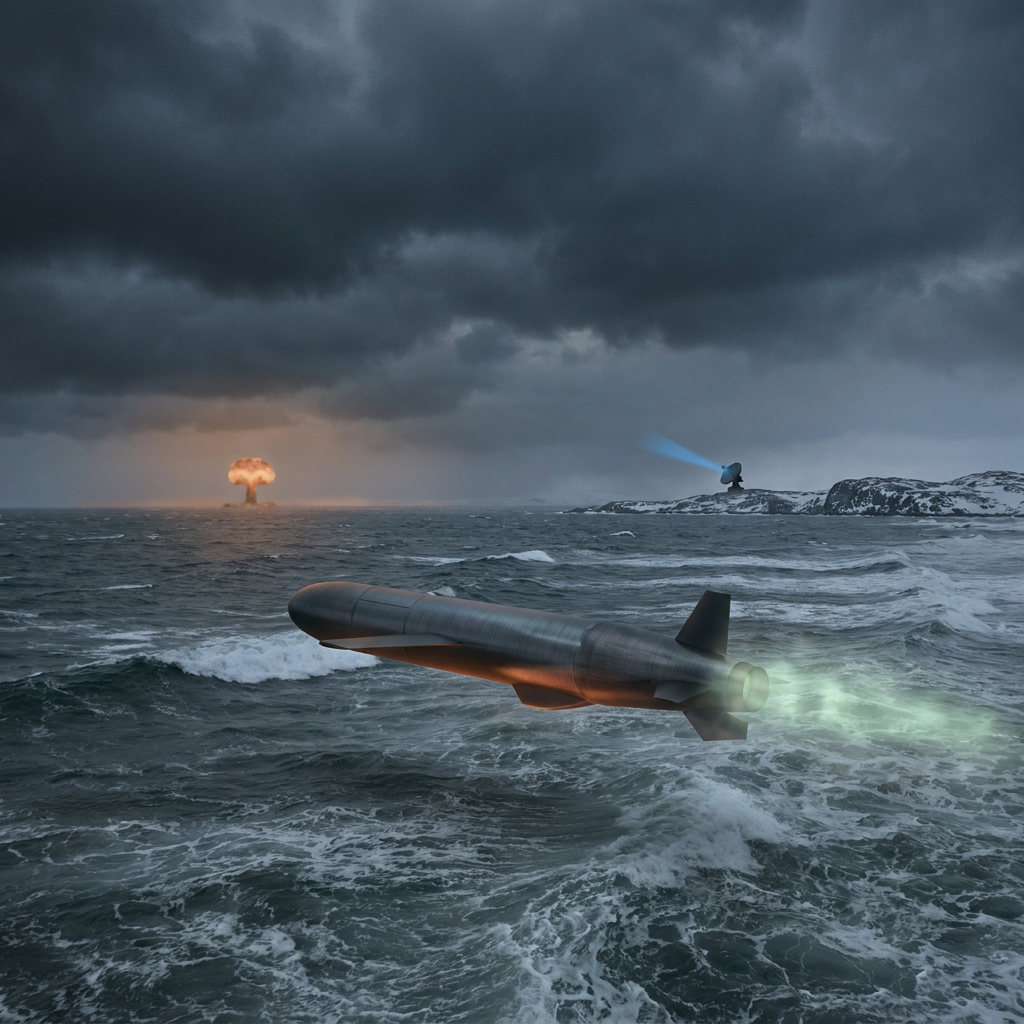
You have heard the name Skyfall. Perhaps it drifted past you in a headline, sandwiched between election polls and economic forecasts. Perhaps you dismissed it — another Russian weapons announcement, another theatrical display from the Kremlin. But you should not dismiss it. Russia’s 9M730 Burevestnik — NATO designation SSC-X-9 Skyfall — is a nuclear-powered cruise missile designed to fly for hours, even days, at low altitude with a theoretically unlimited range, evading every missile defense system ever built [1]. It is powered not by conventional fuel but by a miniature nuclear reactor.
And if it works — that remains a very large “if” — it would fundamentally alter the strategic calculus between Moscow and the West. The question we must confront is not simply whether this weapon is real. It is what it tells us about Russia’s intentions, Europe’s vulnerability, and whether the ground beneath our feet is shifting in ways we cannot yet fully measure.
The Skyfall program began its public life on March 1, 2018, when Vladimir Putin stood before the Russian Federal Assembly and unveiled six new strategic weapons systems — a presentation widely interpreted as a direct response to the United States’ withdrawal from the Anti-Ballistic Missile Treaty years earlier and the steady expansion of NATO missile defense infrastructure in Eastern Europe [2]. Among the systems announced were the Avangard hypersonic glide vehicle, the Poseidon underwater drone, and the Burevestnik cruise missile. Putin described these weapons as rendering Western missile defense obsolete — a claim calibrated to project strength domestically and instill strategic uncertainty abroad. The Burevestnik, in particular, captured Western intelligence attention because of its unprecedented propulsion concept: a nuclear thermal ramjet engine that would allow the missile to loiter for extended periods, navigate around terrain and defenses, and strike from virtually any direction [3].
What Is Actually Happening
The reality behind Skyfall is more complicated — and more dangerous — than the Kremlin’s presentation suggested. Multiple test flights between 2017 and 2019 ended in failure. The most catastrophic incident occurred in August 2019 at a test facility near Nyonoksa on the White Sea, where an explosion during a Burevestnik recovery operation killed five Russian nuclear scientists from the Sarov nuclear research center and triggered a brief spike in radiation levels detected by Norwegian monitoring stations [4]. The Russian government’s initial response — evacuating the nearby village and then denying the radiation readings — revealed both the severity of the accident and the regime’s instinct to conceal rather than inform. Western intelligence assessments, including those cited by the Federation of American Scientists and the Nuclear Threat Initiative, have concluded that the program remains years from operational deployment, if it achieves deployment at all [5]. The fundamental engineering challenges — containing radiation from an airborne nuclear reactor, managing heat dissipation, achieving reliable flight — are not trivial. They are the kind of challenges that have defeated aerospace engineers for decades.
And yet. The Kremlin has continued investing in the program. Russia’s defense budget, despite the crushing economic pressure of sanctions and the enormous cost of prosecuting the war in Ukraine, has continued to funnel resources into strategic weapons modernization [6]. This tells you something important: Skyfall is not merely a weapons program. It is a political instrument. It exists to project the idea that Russia can build weapons the West cannot counter — and that even if deployment is years away, the threat must be factored into every NATO planning document, every European defense review, every conversation about deterrence. The press conference called it a superweapon. The test range told a different story.
The Strategic Case — And Its Fractures
The strongest case for Skyfall rests on a single, powerful strategic logic: missile defense denial. The United States and its allies have spent hundreds of billions of dollars building layered missile defense systems — from Ground-Based Midcourse Defense in Alaska to Aegis Ashore installations in Romania and Poland to the Terminal High Altitude Area Defense (THAAD) system deployed across theatres [7]. These systems are designed to intercept ballistic missiles on predictable, high-arcing trajectories. A nuclear-powered cruise missile that flies at low altitude, follows unpredictable terrain-hugging paths, and can remain airborne for hours would, in theory, bypass these defenses entirely. For Moscow, which views NATO’s missile defense expansion as an existential encroachment on its second-strike capability (the ability to retaliate after a nuclear attack, which is the foundation of nuclear deterrence), Skyfall represents a credible answer to a genuine strategic problem [3].
But here is what that logic cannot explain. The environmental and radiological risk of a nuclear-powered cruise missile is enormous and uncontrollable. Every test flight carries the possibility of a reactor breach, scattering radioactive material across vast areas — over Russian territory, over international waters, potentially over allied nations’ airspace [4]. The 2019 Nyonoksa incident was not an anomaly; it was a warning. A weapon designed to defend your nation that irradiates your own population during testing is not a strategic asset — it is a strategic liability. The International Institute for Strategic Studies has noted that Russia’s pursuit of exotic delivery systems like Burevestnik reflects a deeper anxiety about the erosion of its conventional military superiority, not confidence in these systems’ operational viability [8]. Russia cannot match NATO’s combined conventional forces. Skyfall and its sibling programs are compensation — spectacular, expensive, and deeply uncertain compensation.
The Real Cost
Follow the money. Russia’s defense spending surged to approximately 6 percent of GDP in 2024, the highest level since the Soviet era, with total defense expenditure exceeding 10.8 trillion rubles [6]. A meaningful share of this flows into strategic weapons modernization — the very programs Putin unveiled in 2018. Every ruble spent on a nuclear-powered cruise missile of questionable viability is a ruble not spent on conventional forces, not spent on sustainment of the war in Ukraine, not spent on the Russian citizens whose living standards have deteriorated under sanctions pressure. You might ask: whose interests does this serve? Not the Russian soldier fighting for incremental territorial gains in Donbas. Not the Russian pensioner seeing their purchasing power erode. It serves the political logic of the Kremlin — the need to project superpower status, to remind the West that Russia possesses escalation options (the ability to raise the stakes in a conflict to levels the adversary cannot match) that cannot be ignored [1].
For Europe, the cost is equally real but more diffuse. Every credible Russian strategic weapons claim — credible or not — forces NATO allies to allocate resources toward missile defense upgrades, intelligence monitoring, and strategic planning adjustments [7]. The United States alone has spent over $40 billion on the Ground-Based Midcourse Defense system. European NATO members, already struggling to meet the alliance’s 2 percent of GDP spending guideline, face additional pressure to invest in layered air and missile defense — systems like IRIS-T, Patriot, and the nascent European Sky Shield Initiative [9]. The money is real. The question is whether it is buying genuine security or chasing a Russian propaganda narrative. When a government tells its citizens it needs to spend more on defense because of a weapon that has failed every test flight, you are entitled to ask: what exactly are we paying for?
Real People, Real Consequences
Translate the strategy into your life. If you live in Eastern Europe — in Estonia, Latvia, Lithuania, Poland, or Romania — Skyfall is not an abstract concept. It is one more reason your government is increasing defense spending, diverting funds from healthcare, education, and infrastructure toward military readiness [9]. It is one more reason NATO battlegroups are stationed on your soil, one more reason your national conscription debate has resurfaced. If you live in Western Europe — in Germany, France, or the Netherlands — the cost is less visible but no less real. It flows through your taxes into multinational defense procurement programs, into upgrades to air defense systems you will never see, into intelligence operations you will never hear about. The economic displacement is real. Every billion euros directed toward countering a theoretical Russian weapon is a billion euros not invested in your energy transition, your digital infrastructure, your children’s schools.
The war in Ukraine has made this calculus even starker. Russia’s full-scale invasion, now in its third year, has consumed enormous quantities of conventional munitions, armor, and manpower. Western intelligence assessments suggest Russia has lost over 3,000 main battle tanks, hundreds of thousands of casualties, and has been forced to draw on Soviet-era stockpiles to sustain its offensive operations [10]. And yet — and this is the detail that should keep you awake — Russia’s strategic weapons modernization has continued uninterrupted. The war has not diverted resources from Skyfall, Avangard, or the modernization of Russia’s nuclear triad (the three delivery systems — land-based missiles, submarine-launched missiles, and bombers — that constitute a full nuclear arsenal) [6]. This tells you something chilling about Russian strategic priorities. Moscow views conventional war in Ukraine and strategic nuclear deterrence as parallel, not competing, investments. The war is the present. Skyfall is the future. And you are paying for both — one through military aid to Ukraine, the other through the perpetual cost of nuclear deterrence.
For the European Union’s rearmament programme, the implications are stark. The European Commission’s proposed defense industrial strategy aims to shift toward European-made systems, reducing dependence on American arms [9]. But Skyfall and similar threats accelerate the temptation to buy off-the-shelf American missile defense systems rather than invest in the slower, more expensive path of building autonomous European capability. The result is a strategic dependency — European security outsourced to American technology, European budgets subsidizing American arms manufacturers, European sovereignty compromised by the very purchases meant to protect it. You deserve better than this. Europe’s citizens deserve defense that serves their interests, not the quarterly earnings of Lockheed Martin or Raytheon.
What Comes Next?
Skyfall is most likely not a prelude to nuclear war. It is a warning — but not the warning Moscow intends you to hear. The warning is not that Russia possesses an unstoppable weapon. The warning is that Russia’s strategic culture, under Putin, prioritizes the perception of invincibility over its actual achievement [8]. A nuclear-powered cruise missile that has failed repeatedly in testing, that has killed its own scientists, that irradiates its own territory, is not a superweapon. It is an expression of desperation dressed in the language of strength. The real danger is not that Skyfall works — it is that Western policymakers treat it as though it already does, and spend accordingly, chasing a phantom threat while neglecting the real ones: the erosion of industrial capacity, the fragmentation of European defense, the slow-motion crisis of alliance credibility under an unreliable American partner [1].
The geopolitical implications extend beyond any single weapons system. Russia’s investment in exotic strategic weapons signals that it views the post-Cold War arms control architecture as permanently dead and is building for a world of unconstrained strategic competition [2]. The New START treaty expires in 2026 with no successor in negotiation. The Intermediate-Range Nuclear Forces Treaty collapsed in 2019. The framework that kept nuclear arsenals bounded for four decades is gone. In its place, we have Skyfall — and the unanswerable question of what happens when a weapon designed to be undetectable and unstoppable finally works, or when a nation convinces itself that it does.
And here is the final, uncomfortable truth. Europe cannot counter Skyfall alone. It cannot counter Russian strategic modernization alone. It cannot guarantee its own security within the current fragmented, nation-by-nation defense structure. The only durable answer is a federation-grade European defense architecture — shared nuclear deterrence, integrated command, common procurement, and the political will to treat security as a collective European responsibility rather than a collection of national parochial interests [9]. Poland is already spending over 4 percent of GDP on defense. The Baltic states are building genuine territorial defense. Germany is restocking and calling it transformation. The gap between those who understand the threat and those who are performing understanding it is widening every month.
So you must ask yourself. Will Europe build the deterrence it needs, or the deterrence that looks good in a summit communiqué? Will the next generation of weapons be designed to protect citizens — or to enrich contractors and satisfy political vanity? And when the bill arrives — in your taxes, in your children’s futures, in the lives of soldiers fighting wars they did not choose — who will be held accountable?
The storm is not coming. It is already here. The question is whether we will meet it with clarity, with purpose, and with the courage to demand that our security serves us — not the other way around.
— REFERENCES —
Europe’s New Missiles: Strategic Autonomy or Strategic Theater?
[1] Nuclear Threat Initiative. (2024). “Burevestnik has a poor test record of at least 13 known tests, with only two partial successes, since 2016.” In 9M730 Burevestnik – Wikipedia. Retrieved from https://en.wikipedia.org/wiki/9M730_Burevestnik
[2] Putin, Vladimir. (2018, March 1). Address to the Federal Assembly. Kremlin.ru. Retrieved from http://en.kremlin.ru/events/president/news/56957
[3] CSIS Missile Defense Project. (2024). “Russia’s Nuclear‑Powered Burevestnik Missile: Implications for Missile Defense.” Center for Strategic and International Studies. Retrieved from https://www.csis.org/analysis/russias-nuclear-powered-burevestnik-missile-implications-missile-defense
[4] BBC News. (2019, August 16). “Russian nuclear accident: Medics fear ‘radioactive patients’.” BBC.com. Retrieved from https://www.bbc.com/news/world-europe-49432681
[5] Kristensen, H. M., & Korda, M. (2024). “Russian nuclear weapons, 2024.” Bulletin of the Atomic Scientists, 80(3), 174–197. https://doi.org/10.1080/00963402.2024.2314437
[6] SIPRI Military Expenditure Database. (2025). “Trends in World Military Expenditure, 2024.” Stockholm International Peace Research Institute. Retrieved from https://www.sipri.org/publications/2025/sipri-fact-sheets/trends-world-military-expenditure-2024
[7] Karako, T. (2021). “Missile Defense and Defeat: An Assessment of Challenges and Options.” Center for Strategic and International Studies. Retrieved from https://csis-website-prod.s3.amazonaws.com/s3fs-public/publication/170228_Karako_MissileDefenseDefeat_Web.pdf
[8] International Institute for Strategic Studies. (2025). The Military Balance 2025. IISS. Retrieved from https://www.iiss.org/publications/the-military-balance/2025/the-military-balance-2025
[9] European Commission. (2024). “European Defence Industrial Strategy.” European Union. Retrieved from https://defence-industry-space.ec.europa.eu/eu-defence-industry/edis-our-common-defence-industrial-strategy_en
[10] Reuters. (2024, February 13). “Russia refits old tanks after losing 3,000 in Ukraine – research centre.” Reuters.com. Retrieved from https://www.reuters.com/world/europe/russia-relying-old-stocks-after-losing-3000-tanks-ukraine-leading-military-2024-02-13
[11] U.S. Government Accountability Office. (2021). “Missile Defense: Observations on Ground‑based Midcourse Defense Acquisition and Testing.” GAO‑21‑135R. Retrieved from https://www.gao.gov/products/gao-21-135r
[12] Arms Control Center. (2016). “5 Things to Know About National Missile Defense.” Retrieved from https://armscontrolcenter.org/wp-content/uploads/2016/12/Ground-based-Midcourse-Defense-GMD-.pdf
AI Disclosure: This post was created with the assistance of artificial intelligence. The ideas, analysis, and opinions expressed are my own — AI was used to help compose, structure, and refine my personal notes and thoughts into the final written content. Images, videos and music featured in this post were also generated using AI tools, based on my own creative prompts and direction.
