






Eight Years in the Making: The Road to the EU-Australia Trade Deal
Eight years. That is how long it took the European Union and Australia to hammer out a trade agreement that both sides are now calling historic. Concluded on 24 March 2026, the EU-Australia Free Trade Agreement covers everything from cheese and beef to cloud software and lithium batteries. It is ambitious, it is sweeping — and it is not without controversy. But before we walk through what is in it, it is worth understanding how we got here — because the journey to this deal is almost as revealing as the deal itself.
Where It All Started
Formal negotiations launched on 18 June 2018, when the European Commission received a mandate from EU member states to open talks with Canberra ¹. The logic was compelling from the outset: Australia was already the EU’s third-largest trading partner without a free trade agreement — an anomaly in a world where the EU had structured arrangements with economies far smaller and less strategically significant ². The bilateral trading relationship was already worth more than €89.2 billion annually in goods and services, supporting some 460,000 jobs across the EU ³. Both sides stood to gain from formalising and deepening it.
Early rounds of negotiations moved with reasonable momentum. Between 2018 and 2021, the two sides completed fifteen rounds of talks, making progress on goods, services, investment, and intellectual property ⁴. The complementary nature of their economies seemed to make agreement natural: Australia exports raw materials and agricultural products that Europe needs; Europe exports manufactured goods, machinery, and technology that Australia buys. In theory, each side had exactly what the other wanted.

The Great Stall — and What Broke It
In practice, that complementarity was also the source of the deepest friction. On 29 October 2023, after more than five years of negotiations, the EU and Australia formally suspended talks ⁵. The breakdown was largely — though not entirely — about agriculture. Australia was pushing for substantially greater market access for its beef and sheep meat exports into the EU. The EU, facing fierce resistance from French, Irish, and German farming lobbies, refused to go as far as Canberra was demanding. Neither side could bridge the gap, and with European Parliament elections approaching in June 2024 and an Australian federal election looming not long after, the political appetite for painful compromises evaporated ⁵.
It was a significant and somewhat humbling moment for both parties. Years of work, hundreds of hours of technical negotiation across dozens of chapters, had not been enough to overcome the oldest and most stubborn barrier in international trade: agriculture. The EU’s farm lobby remained one of the most politically powerful forces in Brussels, and no European trade commissioner was going to sign away their concerns in an election year.
What changed? Several things converged in 2025 and early 2026 to make a deal not just desirable but urgent. The global trading environment had deteriorated sharply — US tariff escalation under the Trump administration was disrupting established supply chains, and China’s economic coercion of Australia throughout the early 2020s had already demonstrated precisely what weaponised trade dependency looks like in practice ². Australia and the EU both found themselves looking for trusted partners in a fractured world. Simultaneously, Europe’s desperate need for the critical raw materials — lithium, manganese, rare earths — that Australia possesses in abundance gave Canberra new leverage and Brussels new urgency ². Talks quietly resumed, both sides moderated their agricultural red lines, and by early 2026 the finishing line was finally in sight.
The Signing Moment
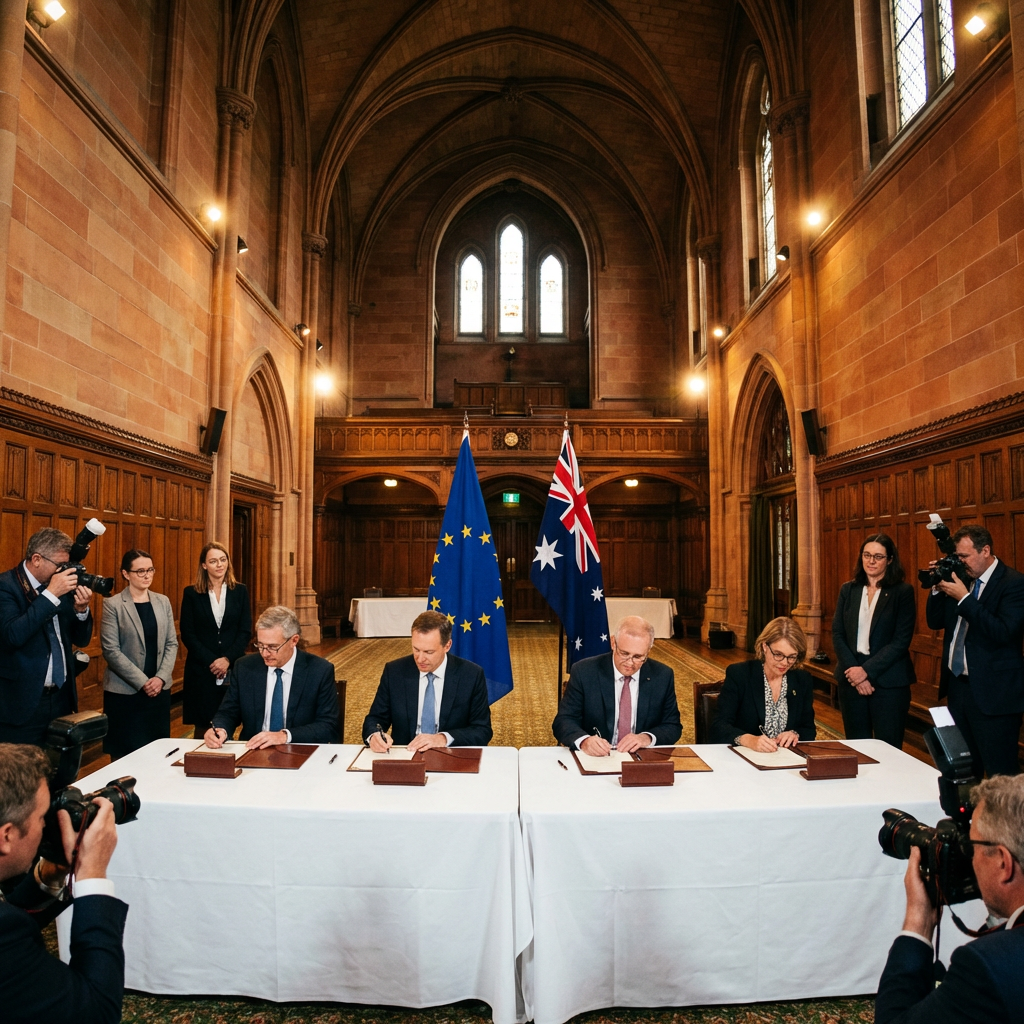
On the morning of 24 March 2026, two separate but complementary acts took place at Parliament House in Canberra — each carrying different legal weight, performed by different hands, but together constituting one of the most significant moments in the modern trading relationship between Europe and the Southern Hemisphere.
European Commission President Ursula von der Leyen and Australian Prime Minister Anthony Albanese signed a Joint Political Statement — a formal declaration welcoming the conclusion of negotiations and committing both governments to advance their respective domestic ratification processes ⁷. The two leaders, who described each other publicly as “good friends” after nearly eight years of shared diplomatic effort, lent the occasion unmistakable political gravitas ⁸. In a moment that added its own historical footnote to the day, von der Leyen became the first female foreign leader ever to address a joint sitting of the Australian federal parliament — a symbolic gesture that underlined just how much political capital both sides had invested in making this deal happen ⁹.
The operative trade agreement text itself — the document that will eventually, once ratified, have the force of international law — was signed by EU Trade Commissioner Maroš Šefčovič and Australian Trade Minister Don Farrell ⁸. This is legally conventional practice. Trade ministers execute the commercial instrument; heads of government endorse the political architecture around it. The distinction matters, because what von der Leyen and Albanese signed was a statement of intent and political commitment. The binding treaty still waits — patiently, procedurally — for the full ratification process to run its course ⁷.
The deal was announced simultaneously with a separate EU-Australia Security and Defence Partnership — a signal that this was never merely a commercial transaction, but the formalisation of a broader strategic alignment between two like-minded democracies navigating a fractured world ⁷.
The Road Ahead: Ratification Step by Step
Here is where realism must temper the excitement — because what was signed in Canberra in March 2026 is not yet law, and the path to it becoming law is long, procedurally complex, and not entirely free of political risk.
The ratification process unfolds in distinct stages, on both sides simultaneously, and none of them can be hurried. Think of it as a relay race, where each leg must be completed before the baton passes to the next.
Stage one — Legal Scrubbing (2026). Before any parliamentary body votes on anything, the entire text of the agreement must undergo a painstaking legal and linguistic review. Every provision must be checked for consistency, ambiguity, and unintended consequences. Then it must be translated into all 24 official EU languages ⁹. This process alone typically takes the better part of a year for a deal of this complexity.
Stage two — EU Council Approval (estimated late 2026 to early 2027). Once the legal scrubbing is complete, the European Commission formally submits the agreement to the Council of the European Union — the body representing EU member state governments. The Council must vote to approve the deal and authorise its signature and provisional application. A qualified majority is sufficient for most provisions, though any elements touching on areas of member state competence may require unanimity ⁹. This is the stage where individual member state concerns — French agricultural anxieties, German industrial interests — can resurface with political force.
Stage three — European Parliament (estimated mid to late 2027). The agreement then goes to the European Parliament for a consent vote. MEPs cannot amend the text — they vote yes or no on the deal as presented. But they can, and frequently do, use the vote as leverage to extract broader commitments on standards, sustainability, and human rights conditionalities ¹⁰. The Parliament has rejected or delayed trade agreements before — most famously, it held up the EU-Mercosur deal for years — and the agricultural provisions of this agreement will face scrutiny from MEPs representing farming constituencies across France, Ireland, Poland, and beyond.
Stage four — Australian Parliamentary Process (running in parallel, estimated 2026 to 2027). Simultaneously, in Australia, the deal must be reviewed by the Joint Standing Committee on Treaties (JSCOT) — a parliamentary committee that scrutinises all international agreements before they can be tabled for implementation legislation ⁹. Australia’s parliament then passes the necessary domestic legislative changes. Given that the deal has broad cross-party support in principle, this is less politically fraught than the EU side — but it is not a formality.
Stage five — Entry into Force (estimated 2027 to 2028). Once both sides have completed their ratification processes and exchanged the necessary legal instruments, the deal formally enters into force. The Australian Trade and Investment Commission has explicitly warned that this could take up to two years from the March 2026 conclusion ⁹ — meaning the earliest realistic date for tariffs to actually start being cut, data localisation rules to take effect, and pharmaceutical research cooperation to be formally activated is somewhere between late 2027 and mid-2028.

A Timeline at a Glance
June 2018 — Negotiations formally launched in Brussels ¹.
2018–2021 — Fifteen rounds of technical negotiations covering goods, services, investment, digital trade, and intellectual property ⁴.
October 2023 — Talks suspended over agricultural market access impasse; EU farming lobbies and election calendars on both sides create political deadlock ⁵.
2024–2025 — Talks quietly resume as geopolitical pressure mounts; US tariff escalation and EU critical minerals dependency reshape both sides’ strategic calculus ².
January 2026 — EU concludes trade deal with India, increasing momentum for the Australian deal ².
24 March 2026 — Deal concluded and announced at Parliament House, Canberra, by von der Leyen and Albanese ⁶ ⁷.
2026 — Legal scrubbing and translation into 24 EU languages begins ⁹.
Late 2026 / Early 2027 — Expected EU Council vote ⁹.
Mid–Late 2027 — Expected European Parliament consent vote ¹⁰.
2026–2027 (parallel) — Australian JSCOT review and domestic implementing legislation ⁹.
2027–2028 — Earliest realistic date for the agreement to enter into force and tariff cuts to begin ⁹.
There is something instructive in that timeline. A deal that took eight years to negotiate will take at least another two to become operational. That is not a flaw in the system — it reflects the genuine complexity of binding 27 sovereign EU member states plus one of the world’s most trade-exposed democratic economies into a single legal framework. But it is a reminder that the announcements made at podiums in Canberra represent a beginning, not an end. The real test of this agreement lies not in the signing ceremony, but in the months of parliamentary scrutiny, lobbying, and legal architecture that must follow before any of its promises become real.
AI Disclosure: This post was created with the assistance of artificial intelligence. The ideas, analysis, and opinions expressed are my own — AI was used to help compose, structure, and refine my personal notes and thoughts into the final written content. Images, videos and music featured in this post were also generated using AI tools, based on my own creative prompts and direction.
References :
- DFAT — Australia-European Union Free Trade Agreement: https://www.dfat.gov.au/trade/agreements/not-yet-in-force/aeufta
- European Commission — The EU-Australia Trade Agreement: https://commission.europa.eu/topics/trade/eu-australia-trade-agreement_en
- EU Trade Policy — Chapter-by-Chapter Summary: https://policy.trade.ec.europa.eu/eu-trade-relationships-country-and-region/countries-and-regions/australia/eu-australia-agreement
- Bruegel — The reason for the EU-Australia trade negotiation hiccup: https://www.bruegel.org/analysis/reason-european-union-australia-trade-negotiation-hiccup
- Bruegel — Suspension of EU-Australia talks, October 2023: https://www.bruegel.org/analysis/reason-european-union-australia-trade-negotiation-hiccup
- Reuters — EU and Australia seal trade deal: https://www.reuters.com/business/australia-eu-push-seal-trade-deal-von-der-leyen-visits-2026-03-23/
- Australian Prime Minister’s Office — Australia–European Union Free Trade Agreement: https://www.pm.gov.au/media/australia-european-union-free-trade-agreement
- Ursula von der Leyen announcement, European Commission press corner: https://ec.europa.eu/commission/presscorner/detail/en/ac_26_762
- Bird & Bird — Australia and EU enter into historic free trade agreement: https://www.twobirds.com/en/insights/2026/australia/tarrific-times-ahead-for-australian-trade–australia-and-european-union-enter-into-historic-free-trade-agreement
- PwC Australia — EU-Australia FTA explained: https://www.pwc.com.au/tax/tax-alerts/trade-impacts-and-next-steps.html

[…] Eight Years in the Making: The Road to the EU-Australia Trade Deal. […]