






Eight years. That is how long it took the European Union and Australia to hammer out a trade agreement that both sides are now calling historic. Concluded on 24 March 2026, the EU-Australia Free Trade Agreement covers everything from cheese and beef to cloud software and lithium batteries. It is ambitious, it is sweeping — and it is not without controversy. So let us walk through it, sector by sector, question by question, the way it deserves to be understood.
What Exactly Is This Deal, and Why Now?
Start with the obvious question: why does this deal matter, and why did it take nearly a decade to conclude? The EU and Australia already had a substantial trading relationship — worth more than €89.2 billion in goods and services annually and supporting around 460,000 jobs across the EU ¹. So this is not a deal that builds trade from nothing. It is a deal that dramatically resets the terms under which that trade happens.
The timing is not accidental. In a world reshaped by supply chain disruptions, the weaponisation of trade by authoritarian governments, and a technology race centred on critical raw materials, both the EU and Australia recognised that a deeper economic partnership was no longer optional — it was strategic. Australia sits on vast reserves of lithium, aluminium, and manganese. The EU needs all three to build electric vehicle batteries and renewable energy infrastructure. That alignment of interests, more than any other single factor, is what finally pushed both sides across the finish line ².
The headline numbers are bold. EU exports to Australia are projected to grow by 33% over the next decade. EU GDP is expected to rise by €4 billion by 2030. Australia’s modelling suggests gains of up to $7.8 billion to its own real GDP ³. Over 99% of tariffs on EU goods exported to Australia will be eliminated. These are not incremental adjustments — they represent a structural reordering of one of the world’s most significant bilateral trading relationships.

What Is Australia Actually Offering?
Let us be direct, because this question often gets lost in the diplomatic language. Australia is opening its market — and doing so meaningfully. From day one of the agreement entering into force, tariffs on EU motor vehicles and automotive parts, currently set at 5%, are eliminated. The same goes for machinery, electrical goods, chemicals, textiles, plastics, wood, and furniture ⁴.
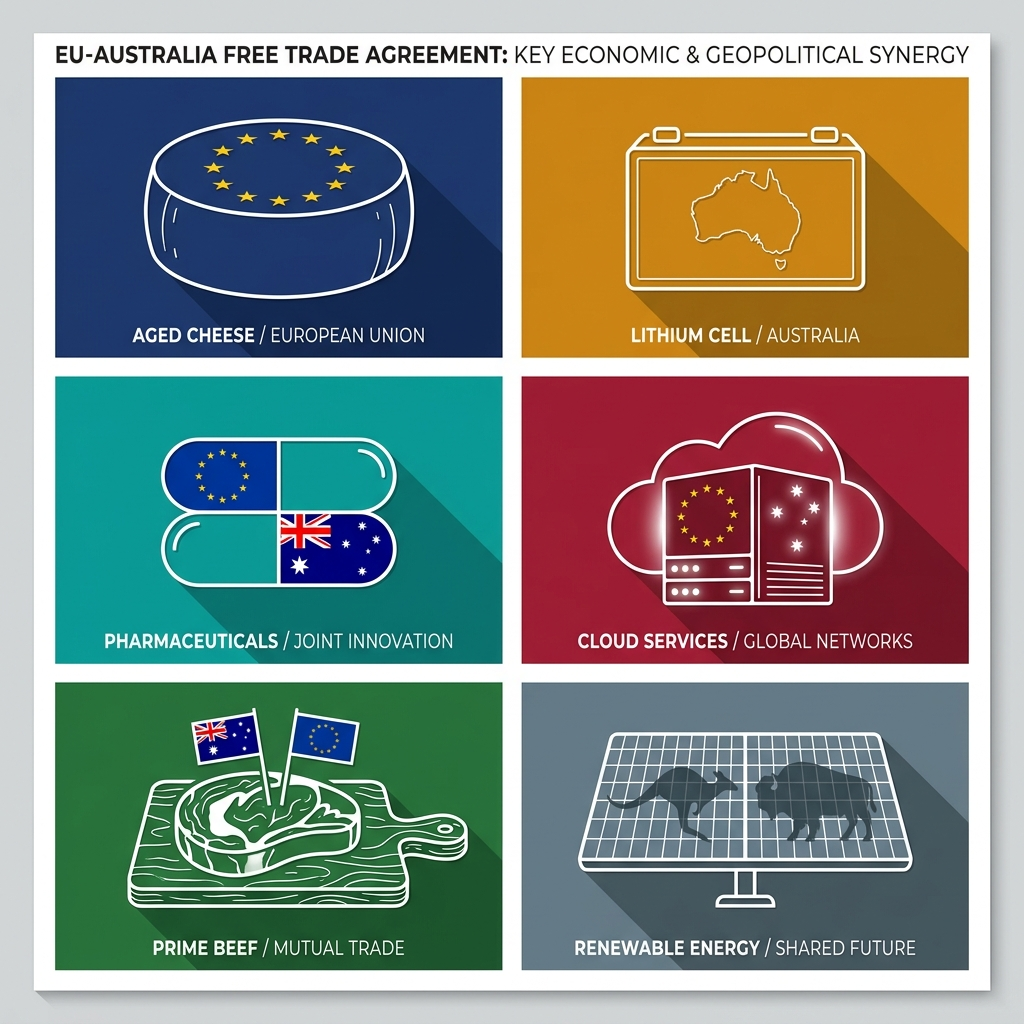
For European food and drink exporters, the gains are concrete. Australia is eliminating tariffs on EU wine and sparkling wine, spirits, chocolate, pasta, canned vegetables, and most dairy products — with cheese tariffs of over 10% phased out over a short transition period ⁴. Australia has also agreed to legally protect hundreds of EU geographical indications, meaning “Champagne,” “Prosciutto di Parma,” and “Parmigiano Reggiano” cannot be appropriated by Australian producers ⁵. That is a genuine cultural and commercial win for European producers who have spent decades fighting imitation products in foreign markets.
What Is the EU Offering in Return?
The EU is opening its single market of 450 million consumers to Australian exporters on significantly better terms ⁶. Industrial goods from Australia — machinery, aluminium, zinc, chemicals, optical products — gain tariff-free access, with the notable exception of steel. Australian pharmaceutical exports, which were subject to EU tariffs of up to 12.8%, are eliminated from day one ⁷.
The more politically charged opening is in agriculture. Australian beef, sheep meat, sugar, rice, and some dairy will gain preferential access to the EU — but through carefully managed Tariff Rate Quotas rather than unlimited free entry. Australian beef, for instance, is capped at 35,000 tonnes per year at full implementation, and is subject to sustainability conditionalities ⁸. The EU has also retained bilateral safeguard mechanisms that can be triggered if Australian agricultural imports surge to levels that threaten EU producers. This is not a fully open agricultural market — it is a calibrated, politically managed opening. Which raises the obvious question: is it enough?
So What About the Farmers?
Honestly? Farmers on both sides are unhappy, which perhaps tells you the negotiators landed somewhere roughly in the right place — or the wrong place, depending on your perspective.
European farming associations fear the quota openings on Australian beef and sheep meat do not adequately protect them from cheaper Southern Hemisphere competition ⁹. Australian farmers, conversely, have called the deal a “kick in the guts,” furious that their beef and sheep meat access remains so heavily constrained by quotas when they believe they can compete on quality and price ¹⁰. The safeguard mechanisms built into the EU side of the agreement were explicitly designed to reassure European farmers — but critics argue they create a false sense of security in sectors that will eventually face more pressure as quotas widen over time.
This is a tension worth sitting with. Free trade agreements that are genuinely free tend to create winners and losers within economies, not just between them. The question European consumers should ask is not just “does this protect our farmers?” but “does this protect them in a way that still allows us to benefit from more competition and lower food prices?” The deal attempts to balance both. Whether it succeeds is a conversation that will unfold over years, not months.
Steel, Weapons, and the Sectors Left Out
Not every sector gets liberalised, and two deserve particular attention. Steel is largely carved out of the deal. The EU maintains its right to apply anti-dumping and countervailing duties on steel independently of the FTA framework, driven by ongoing concerns about global steel overcapacity — much of it a consequence of Chinese industrial policy ¹¹. If you are in the European steel industry, this deal changes very little for you.
Defence and weapons are explicitly excluded from the trade liberalisation provisions entirely. Import and export licensing for weapons, dual-use chemicals, and controlled materials remains fully intact under national and EU security regulations ⁴. However — and this matters — the trade deal was concluded simultaneously with a separate EU-Australia Security and Defence Partnership ¹². This is a government-to-government strategic instrument covering defence cooperation, intelligence sharing, and interoperability. It operates entirely outside the commercial trade framework, but it signals a deepening of strategic alignment that goes well beyond tariff schedules.
What About Pharmaceuticals, Electronics, and the Digital Economy?
This is where the deal starts to look genuinely forward-thinking, rather than merely transactional.
On pharmaceuticals, the tariff elimination is immediate and meaningful, but the more transformative provision is Australia’s fast-tracked association with Horizon Europe — the EU’s €95+ billion research and innovation programme ¹³. Australian pharmaceutical and biotech companies gain access to EU collaborative R&D funding, joint clinical trial infrastructure, and regulatory alignment pathways they previously had no formal access to. At a moment when global medicine supply chains are under pressure, this structural research integration is far more valuable long-term than any tariff reduction.
Electronics and medical devices follow a similar logic. EU manufacturers of precision instruments, medical technology, and industrial electronics gain tariff-free access to the Australian market from day one, removing barriers that have long constrained European medtech exporters ¹⁴. The caveat — consistent across chemicals, pharma, and electronics alike — is that technical standards and conformity assessments remain separate regulatory hurdles. Eliminating tariffs does not automatically mean products certified in one market are accepted in the other without additional compliance work.
Then there is the digital economy, which deserves its own careful attention.
Does This Deal Actually Address the Digital World?
Yes — and with more ambition and legal specificity than most trade agreements manage. The deal dedicates an entire standalone chapter to digital trade, and it tackles the core barriers that have frustrated software and digital services businesses operating across both markets.
The most commercially significant provision is the prohibition on data localisation requirements ¹⁵. Previously, companies could face requirements to store user data exclusively on servers within a particular jurisdiction, forcing expensive infrastructure duplication and creating enormous legal complexity. That barrier is now removed as a legally binding obligation on both sides. For any European SaaS company, cloud provider, or fintech platform wanting to operate in Australia — or vice versa — this creates a materially more open and predictable operating environment.
The deal also permanently locks in the elimination of customs duties on electronic transmissions — software downloads, SaaS subscriptions, streaming content, digital updates — protecting bilateral digital trade from any future imposition of digital tariffs ¹⁶. Given that the WTO moratorium underpinning this norm globally has faced pressure, having it enshrined in a bilateral agreement provides a genuine legal backstop ¹⁷.
For software businesses specifically, the prohibition on forced source code disclosure is arguably the most technically significant win ¹⁵. No government on either side can demand that a company hand over its proprietary source code as a condition of market access — a practice that would effectively expropriate the core intellectual asset of any software firm.
And yet the honest limitations matter too. GDPR remains fully intact. Australia’s Privacy Act remains fully intact. The deal does not create mutual recognition of data protection frameworks or a formal adequacy arrangement. Australian companies handling EU citizen data must still independently navigate GDPR compliance. The EU’s Digital Services Act applies on its own terms to any platform with EU users, regardless of where that platform is incorporated. The deal smooths commercial infrastructure and removes discriminatory barriers — it does not harmonise the regulatory architecture. That deeper convergence, if it happens at all, will take considerably longer.
Will This Actually Help Everyday Europeans?
This is the most important question, and the most honest answer is: yes, but gradually and indirectly.
The most immediate consumer benefit flows from increased competition. As Australian wine, seafood, and agricultural products gain easier access to European shelves, competitive pressure should help moderate prices in certain categories over time. European consumers already enjoy access to some of these products, but often at higher prices due to tariffs and distribution inefficiencies that the deal begins to remove.
The more structural benefit — and the one that matters most for Europe’s long-term economic wellbeing — is supply chain security. By locking in access to Australian lithium and critical minerals through a formal legal framework, the EU protects the energy transition supply chains that will define European industrial competitiveness for the next generation ². That translates into more reliably sourced, potentially cheaper electric vehicles and batteries for European consumers over the coming decade. It means European pharmaceutical supply chains become more resilient. It means European digital companies gain cleaner access to a wealthy, English-speaking market of 27 million people with high technology adoption rates.
None of this arrives overnight. The deal is not yet in force — it still faces a lengthy ratification process involving the EU Council, the European Parliament, and Australia’s own domestic parliamentary procedures. Realistically, the FTA enters into force sometime between 2027 and 2028 ³. The tariff cuts, the data localisation rules, the pharmaceutical research cooperation — all of it waits until that moment.

The Question Worth Asking Yourself
There is a bigger frame here that the sector-by-sector analysis can obscure. This deal was concluded during a period of profound global trade disruption — US tariff escalation, Chinese economic coercion, fracturing multilateral institutions. It is not just a commercial agreement. It is a statement by two like-minded, rule-of-law democracies that they intend to deepen economic ties with partners they trust, at a moment when trust is the scarcest commodity in global trade.
Whether that bet pays off depends on factors neither Brussels nor Canberra can fully control. But the architecture of the deal — its digital chapter, its critical minerals provisions, its pharmaceutical research integration — suggests both sides are designing not just for the trade environment of today, but for the one they expect to navigate over the next twenty years.
The question worth asking is not merely what this deal delivers. It is what kind of global economic order it is trying to help build — and whether you think that order is worth having.
AI Disclosure: This post was created with the assistance of artificial intelligence. The ideas, analysis, and opinions expressed are my own — AI was used to help compose, structure, and refine my personal notes and thoughts into the final written content. Images, videos and music featured in this post were also generated using AI tools, based on my own creative prompts and direction.
References
- European Commission — The EU-Australia Trade Agreement: https://commission.europa.eu/topics/trade/eu-australia-trade-agreement_en
- Reuters — Australia and EU seal trade deal, seek to cut reliance on China: https://www.reuters.com/business/australia-eu-push-seal-trade-deal-von-der-leyen-visits-2026-03-23/
- Bird & Bird (Two Birds) — Australia and European Union enter into historic free trade agreement: https://www.twobirds.com/en/insights/2026/australia/tarrific-times-ahead-for-australian-trade–australia-and-european-union-enter-into-historic-free-trade-agreement
- EU Trade Policy — EU-Australia Free Trade Agreement: Chapter-by-Chapter Summary: https://policy.trade.ec.europa.eu/eu-trade-relationships-country-and-region/countries-and-regions/australia/eu-australia-agreement
- Allens — Feta, Ouzo, Glera: Key changes under the Australia-EU Trade Agreements: https://www.allens.com.au/insights-news/insights/2026/04/feta-ouzo-glera-key-changes-under-the-australia-eu-trade-agreements/
- SBS News — What’s in the EU-Australia free trade deal for you?: https://www.sbs.com.au/news/article/cheaper-evs-easier-job-access-whats-in-the-eu-australia-free-trade-deal-for-you/t9yt57stn
- DFAT — Benefits for manufacturers and other industrial goods producers: https://www.dfat.gov.au/trade/agreements/not-yet-in-force/aeufta/key-outcomes-and-benefits/benefits-manufacturers-and-other-industrial-goods-producers
- DFAT — A-EU FTA Key outcomes and benefits: https://www.dfat.gov.au/trade/agreements/not-yet-in-force/aeufta/key-outcomes-and-benefits
- Euronews — EU-Australia trade deal draws criticism from farmers and MEPs: https://www.facebook.com/euronews/posts/the-new-eu-australia-trade-deal-has-drawn-criticism-from-farmers-and-meps
- Yahoo Finance — EU deal ‘kick in guts’ for Aussie farmers: https://au.finance.yahoo.com/news/eu-deal-kick-guts-aussie-031311271.html
- EU Trade Policy — Chapter-by-Chapter Summary (steel provisions): https://policy.trade.ec.europa.eu/eu-trade-relationships-country-and-region/countries-and-regions/australia/eu-australia-agreement
- EU Reporter — EU and Australia strengthen relations with Security and Defence Partnership: https://www.eureporter.co/australia/2026/03/26/eu-and-australia-strengthen-relations-with-security-and-defence-partnership-and-trade-deal/
- Medicines Australia — Australia-EU agreements to benefit Australians’ health with fast-tracking of Horizon Europe: https://www.medicinesaustralia.com.au/media-release/australia-eu-agreements-to-benefit-australians-health-with-fast-tracking-of-horizon-europe/
- MedTech Europe — A strategic milestone: EU-Australia Free Trade Agreement finalised: https://www.medtecheurope.org/2026/04/07/a-strategic-milestone-eu-australia-free-trade-agreement-finalised/
- DFAT — Benefits for digital trade: https://www.dfat.gov.au/trade/agreements/not-yet-in-force/aeufta/key-outcomes-and-benefits/benefits-digital-trade
- EU Trade Policy — EU-Australia Free Trade Agreement: Main benefits factsheet: https://policy.trade.ec.europa.eu/eu-trade-relationships-country-and-region/countries-and-regions/australia/eu-australia-agreement-factsheet
- Corrs Chambers Westgarth — Digital tariffs: a 2026 trade risk for Australian businesses: https://www.corrs.com.au/insights/digital-tariffs-a-2026-trade-risk-for-australian-businesses

[…] The EU-Australia Trade Deal: Everything You Need to Know — and a Few Things Worth Wondering About. […]