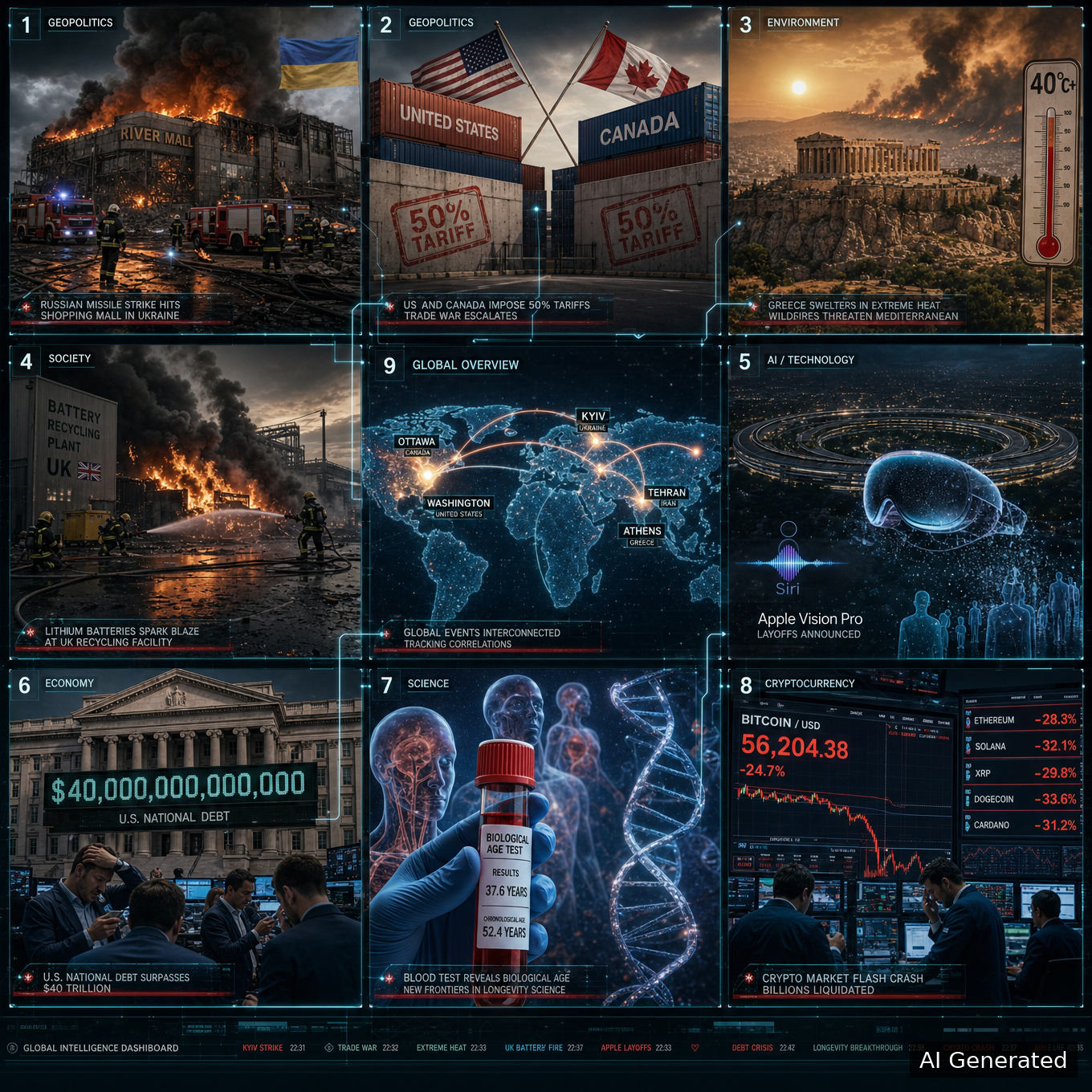


Contents
- 1. Geopolitics & Defence
- Russian Double-Tap Strike on Ukrainian Mall Kills 16; Zelensky Vows Response
- US-Canada Tariff War: 50% Duties Take Effect After Trade Talks Collapse
- Iran Allows Iraqi Oil Tankers Through Hormuz After Baghdad's Request
- German Foreign Minister Wadephul Travels to Kyiv to Condemn Civilian Killings
- India's Jaishankar to Visit Russia; Kerala Titanium Bottleneck Threatens Defence Ambitions
- US Federal Judge Overturns Trump Visa Ban; Oil Prices Surge on Iran-US Escalation
- 2. Environment & Climate
- Greece Enters Prolonged Heatwave: 40°C+ Temperatures Across the Country
- North Sea Squid Boom Linked to Rising Ocean Temperatures
- US Environmental Group Challenges Closure of Federal Climate Research Center
- Heart Aerospace Flies Largest Battery-Electric Aircraft
- China Launches Chang'e-7 Mission to Search for Lunar Ice
- 3. Society & Civil Issues
- UK Lithium Battery Fires at Recycling Centres Cost £1 Billion Annually; Crisis Escalates
- US Postal Service Announces Stricter Mail Voting Rules Despite Federal Court Block
- TikTok Reaches $400 Million Settlement With US Justice Department Over Child Data Collection
- London Council Tax Dispute: Borough Leaders Blame Burnham for Massive Bill Increases
- 4. AI & Technology
- 5. Economy & Business
- Qatar Cuts State Spending as Economy Contracts Under US-Iran Conflict Pressure
- US Debt Crosses $40 Trillion Threshold; Five Charts Explain the Scale
- Germany's Private Investment Decline Raises Questions About Economic Recovery
- Goldman Sachs Reports AI Is Reshaping Labour Markets Across Developed Economies
- 6. Science & Space
- Blood Test May Reveal Biological Age of Individual Organs; Study Published in Nature Medicine
- Shingles Vaccination Linked to 20% Reduction in Dementia Diagnoses; Natural Experiment in Wales
- 46,000-Year-Old Worm Revived From Siberian Permafrost; Enters Reproduction
- Gut Microbiome Genetic Signatures Linked to Cognitive Performance in Mendelian Randomisation Study
- 7. Crypto, Digital Assets & Blockchain
- Crypto Flash Crash Wipes Out $500 Million in Long Positions; Market Stress Rises
- Zcash Surges 48 Percent to Over $800 as Grayscale ETF Filing Advances
- Bitcoin Weekly: $2.6 Billion ETF Inflows, Best Week Since October 2025
- Justin Sun Wins Procedural Battle Against World Liberty Financial
- Arbitrum Proposes ZK Settlement Integration to Reduce Withdrawal Times From Days to Hours
- 8. Correlations & Analysis
- 9. References
Click any heading to jump to that section. Click the section heading to return to this menu.
Geopolitics & Defence
↑ ContentsRussian Double-Tap Strike on Ukrainian Mall Kills 16; Zelensky Vows Response
Russian forces launched a devastating double-tap strike on a shopping centre in Kryvyi Rih — President Zelensky’s hometown — killing at least 16 people and injuring more than 130, including a significant number of children. Nine people, including two children, remained missing following the attack[1]. The double-tap tactic — striking the same location twice in quick succession to maximise casualties among first responders and civilians fleeing the initial blast — represents one of the deadliest attacks on Ukrainian civilian infrastructure in recent months. Zelensky vowed a forceful response, calling the assault a “terrorist attack” that demanded a direct military answer[2].
The strike’s significance extends beyond its immediate death toll. Kryvyi Rih is an inland industrial city far from the front lines, suggesting that Russia’s long-range precision strike capability continues to expand the geographic scope of its attacks on Ukrainian civilian infrastructure. Ukrainian air defences had previously been deployed to protect critical energy and military sites, leaving commercial centres more vulnerable. The attack pattern — targeting civilians during daylight hours in a busy shopping area — follows the same strategy Russia employed in the Kharkiv market attack of April 2023, suggesting a deliberate doctrine of terror bombardment aimed at breaking civilian morale rather than achieving military objectives[3].
In retaliation, Ukrainian forces struck for the first time a logistics facility belonging to Ozon, Russia’s largest online retailer, in the Samara region. The company confirmed its warehouse caught fire and that 500 workers were evacuated, though injuries were also reported[4]. Ukraine has previously targeted Wildberries, Russia’s other major e-commerce platform, with repeated drone strikes inflicting billions in damage according to industry estimates. The escalation into targeting civilian economic infrastructure on both sides marks a dangerous broadening of the war’s economic dimension. Overnight, Russia also launched additional strikes on Kyiv, where at least one person was killed and a warehouse caught fire[5].
US-Canada Tariff War: 50% Duties Take Effect After Trade Talks Collapse
The United States imposed 50 percent tariffs on approximately $20 billion worth of Canadian products at midnight, after bilateral trade talks collapsed without agreement. The new duties represent the most punitive measure in the ongoing trade dispute and extend to goods covered by the existing USMCA (formerly NAFTA) framework — a first that threatens the broader North American free trade architecture[6].
US Trade Representative Jamieson Greer announced the failure, blaming Canada for “refusing to conclude a deal on terms that had been previously agreed.” Canadian Prime Minister Mark Carney countered that the American proposals were “unfair” and immediately announced matching retaliatory tariffs: “Canada will match tariffs dollar for dollar to protect workers and businesses”[7]. The breakdown follows three additional days of negotiations after Trump initially postponed the tariffs to allow last-ditch talks.
The 50 percent tariff rate applies to Canadian exports worth roughly 5.5 percent of total Canadian shipments to the US — relatively modest in volume but symbolically explosive. More critically, the tariffs now extend to goods under the existing USMCA framework, testing whether the trade agreement Trump himself negotiated in 2018 can survive his current administration’s protectionist agenda. With no further negotiation talks planned, the dispute threatens to escalate into a full-blown trade war between the world’s two largest North American economies[8].
Iran Allows Iraqi Oil Tankers Through Hormuz After Baghdad’s Request
In a potentially significant diplomatic shift, Iran permitted several Iraqi oil tankers to transit the Strait of Hormuz following a direct request from Baghdad, according to Iran’s official news agency IRNA[9]. The move breaks from the blanket naval interdictions that have suppressed commercial shipping through the waterway since the US-Iran conflict intensified. The exception for Iraqi vessels suggests that Baghdad’s diplomatic outreach to Tehran has achieved at least a tactical concession — one that could serve as a template for other countries seeking to negotiate passage through the strait.
The development arrives as Brent crude prices continue to hover above $90 per barrel, driven by supply fears from the Hormuz disruptions[10]. The Iraqi exception demonstrates that Iran’s naval blockade is not absolute but rather calibrated — designed to maintain pressure on the United States while allowing allies and dependent economies limited access. This pattern mirrors the broader Iran strategy documented throughout this reporting cycle: maintaining enough economic disruption to extract concessions while avoiding the complete shutdown that would unite the international community against Tehran. For Iraq specifically, the concession reflects Baghdad’s precarious position as a neighbour to both warring parties, dependent on Iranian goodwill for energy transit while hosting substantial US military infrastructure.
German Foreign Minister Wadephul Travels to Kyiv to Condemn Civilian Killings
German Foreign Minister Johann Wadephul travelled to Kyiv by special train during ongoing Russian air raids to attend Ukraine’s 35th Independence Day celebrations and deliver a direct condemnation of Russia’s attacks on civilians. “I condemn the indiscriminate murder of civilians by Russia,” Wadephul stated, marking one of the most physically risky diplomatic visits by a European foreign minister since the war’s escalation[11]. The visit, undertaken during active air raid conditions, signals Berlin’s intent to demonstrate solidarity beyond rhetoric.
Wadephul’s presence in Kyiv on Independence Day carries both symbolic and strategic weight. Germany has historically maintained a more cautious approach to Ukraine support compared to the UK or France, but the minister’s willingness to travel under fire suggests a recalibration. The visit follows the pattern documented in D82 where NATO’s unprecedented air concentration near Kaliningrad demonstrated that European nations are increasingly willing to accept physical risk in their Russia policy. The train journey from Poland — avoiding airspace that might be targeted — itself becomes a statement about the logistics of European engagement with a country under active bombardment[12].
India’s Jaishankar to Visit Russia; Kerala Titanium Bottleneck Threatens Defence Ambitions
India’s External Affairs Ministry announced that Foreign Minister S Jaishankar will make an official visit to Russia on 23-24 August, where he will meet his Russian counterpart Sergei Lavrov[13]. The visit, coming amid the US-Iran war and intensifying India-Pakistan tensions over the US ambassador’s Kashmir remarks, highlights New Delhi’s increasingly complex diplomatic balancing act. India continues to purchase discounted Russian oil while simultaneously deepening security partnerships with the United States and Japan — a dual-track approach that has drawn criticism from Washington but reflects India’s pragmatic assessment of its strategic interests.
Meanwhile, a detailed investigation into India’s sole titanium sponge facility in Kerala reveals a critical bottleneck threatening the country’s defence manufacturing ambitions. The Kerala Minerals and Metals Limited plant on the Malabar coast — India’s only facility for producing the titanium alloy essential for modern fighters, submarines, and missiles — faces production constraints that directly impact the Tejas fighter jet and the Advanced Medium Combat Aircraft programmes[14]. The titanium shortage illustrates the gap between India’s ambitious defence indigenisation targets under the Aatmanirbhar Bharat initiative and the physical infrastructure constraints that could delay critical military capabilities by years. Separately, India announced plans to approve a $1.2 billion incentive scheme to boost domestic production of construction and infrastructure equipment, designed to reduce dependence on Chinese machinery[15].
US Federal Judge Overturns Trump Visa Ban; Oil Prices Surge on Iran-US Escalation
A US federal judge issued an emergency order blocking the Trump administration’s visa restrictions affecting citizens from 75 countries, ruling that the executive action exceeded presidential authority[16]. The ruling represents another judicial check on the administration’s immigration policies, though the government indicated it would appeal. The visa ban had already disrupted travel for students, workers, and family reunification cases across the affected countries.
Oil prices continued their upward trajectory, with Brent crude trading steadily above $90 per barrel — up from $88 on August 17 — as the US-Iran conflict showed no signs of de-escalation. The price surge reflects not only the direct Hormuz disruption documented above but also the broader uncertainty about whether Washington’s planned “toughest sanctions in history” will succeed in forcing Tehran to negotiate or instead harden Iran’s position. Greek Defence Point analysis characterised the oil market dynamics as generating “shock and awe” for economies dependent on affordable energy, with the compound effects of Hormuz disruption and the El Niño-driven Panama Canal restrictions documented in D82 creating a dual chokepoint crisis for global shipping[17].
Environment & Climate
↑ ContentsGreece Enters Prolonged Heatwave: 40°C+ Temperatures Across the Country
Greece entered what meteorologists described as the season’s first prolonged heatwave, with temperatures locally exceeding 40°C across multiple regions and expected to persist for six to seven days[18]. The Greek National Meteorological Service warned that air masses 6 to 8 degrees warmer than seasonal averages would keep conditions hazardous through mid-week, with maximum temperatures of 38-40°C and local peaks of 41-42°C in Thessaly, Western Greece, and Central Macedonia. The heatwave arrives in a context of extreme vulnerability: Greece has already experienced severe wildfires this summer, including the devastating fires on Lemnos that forced village evacuations, and the prolonged drought has left vegetation highly combustible.
The Greek heatwave illustrates the broader pattern documented across the summer of 2026 — what the D82 Met Office analysis described as a structural shift rather than a single anomalous event. The forecast carries compound risks: hardened, hydrophobic soils from previous drought are maximally susceptible to flash flooding when rain finally arrives, while the fire danger index is expected to spike significantly from Monday onward with strengthening winds. Night-time temperatures of 29-30°C in the Athens basin and other urban centres prevent recovery, creating cumulative heat stress that disproportionately affects elderly residents and outdoor workers. The pattern mirrors the experience documented across southern Europe this summer — France, Italy, and Spain have all recorded their own heat extremes — and represents the Mediterranean basin’s emergence as a climate change hotspot where adaptation infrastructure is being tested to its limits.
North Sea Squid Boom Linked to Rising Ocean Temperatures
Marine scientists confirmed that cephalopod populations in the North Sea are expanding significantly, with fishermen landing increasing quantities of squid and octopus in a trend directly linked to rising sea temperatures. The North Sea, historically too cold to support large squid populations, has warmed enough to create viable habitat for species that were previously confined to warmer Atlantic waters[19]. The expansion represents one of the most visible marine ecosystem shifts driven by climate change in European waters.
The squid migration carries cascading implications for North Sea fisheries and ecosystems. Squid are voracious predators that compete with traditional commercial species for food resources, potentially disrupting established fishing economies. They also attract new predator species — including tuna, which have been increasingly sighted in North Sea waters — further altering the ecological balance. For European policymakers, the cephalopod boom presents a paradox: while some fishing communities may benefit from new catch opportunities, the underlying driver — ocean warming — threatens the long-term viability of the fisheries systems that North Sea economies depend on. The phenomenon also provides a visible, tangible metric of ocean temperature change that complements the more abstract climate data typically discussed in policy contexts.
US Environmental Group Challenges Closure of Federal Climate Research Center
One of America’s largest environmental organisations filed a lawsuit in federal court seeking to block the Trump administration’s closure of a leading climate research institute, alleging the move was “politically motivated”[20]. The lawsuit argues that shutting down the institute — which has provided foundational climate data used by government agencies, researchers, and international bodies — violates statutory mandates for scientific independence and constitutes an unlawful exercise of executive power targeting disfavoured research conclusions.
The legal challenge arrives amid a broader pattern of the administration attempting to reshape federal scientific institutions to align with its policy preferences. The institute’s closure would eliminate a key source of long-term climate data and monitoring capacity, with implications for everything from disaster preparedness to infrastructure planning. For the scientific community, the lawsuit represents a test case for whether judicial mechanisms can protect federal research institutions from political interference — a question with implications far beyond climate science, extending to public health, environmental regulation, and any domain where scientific findings create friction with political objectives.
Heart Aerospace Flies Largest Battery-Electric Aircraft
Swedish startup Heart Aerospace achieved a milestone in electric aviation by flying its X1 demonstrator for 27 minutes on August 12 from Plattsburgh International Airport, powered entirely by batteries. The aircraft, with a 106-foot wingspan and weighing more than 25,000 pounds at takeoff, drew over a megawatt at peak power, making it the largest battery-electric aircraft ever flown[21]. The flight demonstrates that battery technology has advanced sufficiently to power aircraft far larger than previously demonstrated, opening a pathway toward decarbonising short-haul aviation.
The X1’s achievement is significant because it addresses the energy density challenge that has long been considered the primary barrier to electric flight. While the aircraft’s range remains limited compared to conventional jets, the successful flight proves that the engineering challenges of scaling battery-electric propulsion to regional aircraft sizes are solvable. For the aviation industry — which accounts for approximately 2.5 percent of global CO₂ emissions and faces increasingly stringent regulatory pressure — electric regional aircraft could capture a meaningful portion of short-haul routes where the distance limitations are less critical. The demonstration also provides validation data that could accelerate investment in next-generation battery chemistry, particularly solid-state cells that promise significantly higher energy density.
China Launches Chang’e-7 Mission to Search for Lunar Ice
China’s Chang’e-7 lunar mission launched with the primary objective of detecting and characterising water ice trapped within permanently shadowed craters near the Moon’s south pole. The mission carries a suite of instruments including ground-penetrating radar and a small hopping robot designed to descend into craters where sunlight never reaches — conditions where water ice could accumulate over billions of years[22]. The data gathered will inform future crewed lunar base site selection and resource utilisation strategies.
The mission’s strategic significance extends well beyond pure science. Water ice on the Moon is considered the critical enabling resource for sustained human presence: it can be converted to drinking water, breathable oxygen, and hydrogen rocket fuel. Any nation that establishes reliable extraction capabilities gains a decisive logistical advantage in the emerging competition for lunar resources. China’s systematic approach — progressing from orbiter to lander to sample return to polar exploration — contrasts with the more episodic US programme and positions Beijing as a leading contender for the first operational lunar resource extraction. The mission also contributes to the broader context of space as an increasingly contested domain, a theme documented in D82’s coverage of Trump’s space transportation policy targeting 1,000 annual launches by 2030.
Society & Civil Issues
↑ ContentsUK Lithium Battery Fires at Recycling Centres Cost £1 Billion Annually; Crisis Escalates
New data revealed that fires caused by incorrectly discarded lithium batteries — particularly those found in disposable vapes — are occurring at UK recycling and waste facilities at a rate exceeding ten per week, costing the industry an estimated £1 billion annually and creating life-threatening conditions for workers[23]. Fire chiefs described the situation as a crisis, noting that the volume and intensity of battery fires has overwhelmed existing prevention and suppression infrastructure at waste processing sites across the country.
The crisis reflects the collision between three accelerating trends: the explosive growth of disposable vape consumption in the UK, inadequate public awareness of proper battery disposal, and the inherent fire risk of lithium-ion cells when mechanically damaged during waste processing. When a lithium battery is crushed or punctured by compaction machinery, it can enter thermal runaway — a self-sustaining chemical reaction that generates temperatures exceeding 600°C and is extremely difficult to extinguish. The fires not only destroy facilities and equipment but release toxic gases including hydrogen fluoride, posing acute health risks to firefighters and waste workers. For UK environmental policy, the data strengthens the case for extended producer responsibility legislation specifically targeting disposable vaping products, an issue that has been under political discussion but has yet to produce regulatory action commensurate with the scale of the problem.
US Postal Service Announces Stricter Mail Voting Rules Despite Federal Court Block
The United States Postal Service announced it would implement tighter regulations for mail-in voting ahead of the November congressional elections, directly contradicting a federal court order that had halted the government’s planned restrictions[24]. The move represents an extraordinary instance of a federal agency acting in apparent defiance of judicial authority, raising questions about institutional compliance with court orders and the politicisation of election administration infrastructure.
The USPS action arrives amid heightened tensions over election integrity in the United States, where mail voting has become a partisan flashpoint since the 2020 election. The agency’s new rules — announced even as the legal challenge continues — suggest a strategy of implementing changes quickly to create operational facts on the ground before courts can definitively rule on their legality. For American democracy, the confrontation between executive branch agencies and federal courts over election administration creates an unprecedented test of institutional checks and balances, with the practical consequence that voters in affected jurisdictions may face confusion about which rules apply as election day approaches.
TikTok Reaches $400 Million Settlement With US Justice Department Over Child Data Collection
ByteDance and its subsidiary TikTok reached a settlement with the United States Department of Justice over allegations that the platform illegally collected personal data from children under the age of 13 — a violation of the Children’s Online Privacy Protection Act (COPPA)[25]. The $400 million settlement represents one of the largest penalties ever assessed under COPPA and signals that US regulators are willing to impose substantial financial consequences on platforms that fail to adequately protect minors.
The settlement arrives as TikTok faces multiple overlapping regulatory challenges globally, including the ongoing US divestiture deadline and European data protection investigations. The COPPA violation specifically concerned TikTok’s practice of collecting biometric identifiers — including face scans and voice prints — from users who were under the age threshold at which parental consent is legally required. For the broader tech industry, the settlement establishes a precedent that algorithmic data collection practices targeting minors carry financial liability proportional to the scale of the violation, potentially influencing how platforms design their age-verification and data-collection systems going forward.
London Council Tax Dispute: Borough Leaders Blame Burnham for Massive Bill Increases
Leaders of Westminster, Wandsworth, and Kensington and Chelsea town halls accused London Mayor Andy Burnham of imposing massive council tax increases, arguing they were being forced to significantly raise bills or slash services to fill budget holes created by City Hall’s fiscal policies. The borough leaders contend that the government-set target of building 88,000 homes annually is “prioritising speed over need” and creating unfunded mandates that fall on local taxpayers[26].
The dispute illustrates the growing fiscal pressure on London’s local authorities as they navigate competing demands: housing targets, infrastructure maintenance, social care costs, and the residual economic impacts of the Iran war’s inflationary pressures. The confrontation between City Hall and the boroughs reflects a broader tension in English local government finance, where central and mayoral authorities set ambitions that local councils must fund through council tax — a regressive revenue source that places disproportionate burden on lower-income residents. For Burnham, the dispute complicates his positioning as a progressive leader, while for the borough leaders, it provides ammunition against what they characterise as an overreach of mayoral authority at the expense of local autonomy.
AI & Technology
↑ ContentsApple Cuts Over 200 Jobs Across Vision Pro and Siri Teams as Strategy Shifts
Apple laid off more than 200 employees across its Vision Pro and Siri software development teams, signalling a strategic pivot away from mixed reality headsets and toward smart glasses and next-generation AI assistants. The cuts affect engineers and designers who had been working on the spatial computing platform that Apple launched with considerable fanfare as its next major product category[27].
The layoffs represent a significant retreat from Apple’s mixed reality ambitions, which had consumed billions in R&D investment and positioned the company as a leader in spatial computing. The pivot to smart glasses — a less immersive but more socially acceptable form factor — suggests that Apple’s internal assessments concluded that the Vision Pro’s $3,499 price point and bulky design limited its mass-market potential to a degree that could not be overcome through incremental improvement. For the AI strategy, the Siri team restructuring indicates Apple is preparing to rebuild its AI assistant from the ground up rather than continuing to iterate on the existing architecture. The moves arrive as Apple faces intensifying competitive pressure from both OpenAI’s ChatGPT ecosystem and Google’s Gemini integration across its product line.
Uber Hit With Massive EU Fine Over Automated Driver Decision-Making
European regulators imposed a substantial fine on Uber for using fully automated algorithmic systems to make decisions about driver bans — a practice that the EU’s General Data Protection Regulation (GDPR) prohibits when such decisions have significant impacts on individuals’ livelihoods[28]. Uber announced plans to appeal the ruling, but the decision establishes a critical precedent for how AI-driven employment decisions must be governed in the European market.
The fine represents the most significant enforcement action to date against the use of AI systems in gig economy worker management. Under GDPR Article 22, individuals have the right not to be subject to decisions based solely on automated processing that produce legal or similarly significant effects. Uber’s practice of automatically banning drivers based on algorithmic assessments of ratings, complaints, and other metrics — without meaningful human review — was found to violate this principle. For the broader platform economy, the ruling creates a compliance requirement that could force fundamental changes to how gig platforms manage their workforces, potentially requiring human review of all automated decisions that affect driver or worker status. The decision also adds to the growing regulatory pressure on algorithmic decision-making in employment contexts, a theme that intersects with Goldman Sachs’ concurrent report on AI’s reshaping of labour markets across developed economies[29].
NVIDIA Invests in Cloverleaf Infrastructure for AI Data Center Development
NVIDIA announced a minority investment in Cloverleaf Infrastructure, a data centre developer, as the two companies work to accelerate the construction of large-scale computing facilities across the United States. The partnership focuses on solving what NVIDIA identifies as the critical bottleneck for AI expansion: securing sites with adequate power infrastructure, grid connections, and cooling capacity to support the massive computing workloads that next-generation AI systems require[30].
The investment reflects NVIDIA’s recognition that its AI hardware business depends on the availability of physical infrastructure to house its chips. NVIDIA’s DSX platform will be used to evaluate site, power, cooling, and computing requirements together in the design phase, aiming to identify infrastructure constraints before construction begins. The partnership also gives Cloverleaf customers access to NVIDIA’s broader technology stack, including accelerated computing and high-performance networking. For the AI industry, the deal illustrates how the infrastructure supply chain — land, power, cooling, and construction capacity — has become as strategically important as the chips themselves. Cloverleaf has advanced multiple gigawatt-scale projects across North America, positioning it as a key player in the physical buildout of the AI economy.
ChatGPT Mac App Gains iMessage Control; Privacy Concerns Mount
OpenAI’s ChatGPT Mac application gained the ability to control iMessage, allowing users to send and read text messages through the AI assistant. The integration positions ChatGPT as a system-level tool capable of interacting with core Apple communication services — a capability that creates immediate tension with Apple’s own privacy-first marketing narrative and its ongoing competitive conflict with OpenAI[31].
The iMessage integration is notable because it creates a data flow architecture where messages necessarily transit OpenAI’s servers — a scenario that conflicts with Apple’s longstanding emphasis on on-device processing and end-to-end encryption. For users, the convenience of AI-managed messaging comes at the cost of exposing their most personal communications to third-party processing. For the competitive dynamics between Apple and OpenAI, the feature represents an aggressive encroachment into Apple’s core communication ecosystem, potentially creating dependency relationships that Apple has historically resisted. The broader implication is that AI assistants are evolving from passive information retrieval tools into active agents that can manipulate communications on behalf of users — a shift that raises fundamental questions about consent, privacy, and the boundaries of AI agency.
Economy & Business
↑ ContentsQatar Cuts State Spending as Economy Contracts Under US-Iran Conflict Pressure
Qatar announced significant reductions in state spending as the US-Iran conflict contracted the emirate’s economy, highlighting the vulnerability of energy-dependent Gulf states to geopolitical disruptions in the Strait of Hormuz region. The spending cuts represent one of the most direct economic consequences of the Hormuz disruption documented throughout this reporting cycle — a state that derives its wealth from liquefied natural gas exports is being forced to retrench precisely because the shipping routes through which those exports travel have become unreliable[32].
Qatar’s fiscal contraction illustrates the cascading economic effects that D82’s Correlations section identified when documenting how Hormuz disruptions, Panama Canal restrictions, and oil price increases were producing interconnected economic pressures. For energy-dependent Gulf economies, the crisis creates a triple squeeze: reduced export revenues from shipping disruptions, increased costs for alternative logistics routes, and the inflationary impact of elevated energy prices on domestic economies. Qatar’s decision to cut spending — rather than borrow or draw down sovereign wealth reserves — suggests that the emirate’s leadership views the conflict-driven economic contraction as potentially prolonged rather than a short-term disruption. This assessment carries implications for the broader Gulf economic outlook, where similar spending decisions by Saudi Arabia and the UAE would have significantly larger macroeconomic consequences.
US Debt Crosses $40 Trillion Threshold; Five Charts Explain the Scale
United States national debt crossed the $40 trillion threshold after adding $1 trillion in just five months — a pace of borrowing that has accelerated markedly from historical trends. The total figure is equivalent to what an average American worker would earn over approximately 615 million years of continuous employment, a comparison that captures the almost incomprehensible scale of the fiscal accumulation[33]. The debt trajectory is driven by a combination of elevated military spending related to the Iran war, interest payments on existing debt that have surged with higher rates, and structural deficits that predate the current conflict.
The $40 trillion milestone arrives at a moment of particular fiscal sensitivity. Long-term Treasury yields have been at or near 19-year highs, increasing the cost of servicing existing obligations. The Iran war’s fiscal demands — including supplemental appropriations for military operations and energy-related subsidies — compound an already strained budget picture. For financial markets, the debt trajectory reinforces the narrative that has supported the recent Treasury buyback adjustments documented in D82, where the government tweaked its debt management strategy to alleviate pressure on long-term yields. The broader implication is that the US fiscal position is increasingly constraining the government’s ability to respond to simultaneous crises — military, economic, and climate — without further expanding the debt burden that future generations will inherit.
Germany’s Private Investment Decline Raises Questions About Economic Recovery
Wirtschaftswoche published an analysis revealing that private investment in Germany has fallen 12 percent below 2019 levels, with capital flowing into machinery, industrial equipment, and residential construction all declining despite the government’s stated commitment to economic modernisation. The analysis, written by Ifo Institute president Clemens Fuest, argues that the investment gap represents the most significant structural threat to Germany’s economic future and calls for urgent policy intervention[34].
The investment decline intersects with multiple pressures documented throughout this reporting cycle: the skilled labour shortage identified in D82, which continues to intensify alongside economic recovery; elevated energy costs that have doubled since the onset of the Iran war; and the drought-related logistics disruptions that are constraining industrial output through Rhine waterway restrictions. For Europe’s largest economy, the investment gap creates a compounding problem: without new capital formation, productivity growth stalls, which limits the economic base from which the government can fund the structural reforms that Chancellery Minister Warken described as “necessary but not popular.” The tension between the reform agenda and the political capital required to implement it — with coalition poll ratings below 40 percent — suggests that Germany’s economic challenges may be deepening precisely when the political capacity to address them is most constrained.
Goldman Sachs Reports AI Is Reshaping Labour Markets Across Developed Economies
Goldman Sachs published research indicating that artificial intelligence integration is already producing measurable shifts in labour markets across developed economies, with entry-level positions particularly affected. The bank’s analysis found that AI adoption is altering traditional employment patterns in ways that disproportionately impact roles involving routine cognitive tasks — data processing, content creation, basic analysis, and customer service functions that previously served as entry points into professional careers[35].
The finding adds empirical weight to concerns that AI’s economic impact is arriving faster than policy frameworks designed to manage workforce transitions. For governments already grappling with the fiscal pressures of the Iran war and climate adaptation costs, the prospect of AI-driven labour market disruption creates an additional challenge: tax revenue bases may erode as routine employment contracts, while the social safety nets designed for industrial-era labour markets may prove inadequate for a workforce increasingly characterised by gig arrangements, portfolio careers, and skills that become obsolete within years rather than decades. The Goldman analysis also intersects with the Uber GDPR fine documented in the AI & Technology section, where algorithmic management of workers raises both privacy and employment law questions that existing regulatory frameworks were not designed to address.
Science & Space
↑ ContentsBlood Test May Reveal Biological Age of Individual Organs; Study Published in Nature Medicine
A team led by researchers at CeMM and the University of Vienna published a study in Nature Medicine demonstrating that a single blood sample may estimate whether specific organs appear biologically older or younger than expected for a person’s chronological age. The research examined 25,712 microscopic tissue images from 983 deceased donors, covering 40 tissue types across 29 organs, and trained an artificial intelligence model to recognise structural changes associated with ageing[36]. The system then identified corresponding gene activity patterns in blood samples, enabling organ age estimation without invasive tissue biopsy.
The findings reveal that the body does not follow one universal ageing pattern. Some individuals showed accelerated ageing across multiple organs, while in others, a single organ — such as the heart, brain, or stomach — appeared considerably older than the rest of the body. When tested against medical conditions, the model assigned larger age gaps to organs associated with each disease: stroke patients showed the largest gap in brain tissue, Crohn’s disease patients showed elevated gaps in digestive system organs, and Alzheimer’s patients showed specifically elevated brain age gaps. The approach is not yet a clinical test — the authors estimate clinical deployment could take “realistically several years, possibly close to a decade” — but the concept of organ-specific biological age could fundamentally reshape preventive medicine by identifying which organs are deteriorating before clinical symptoms emerge.
Shingles Vaccination Linked to 20% Reduction in Dementia Diagnoses; Natural Experiment in Wales
A natural experiment involving more than 280,000 Welsh adults found that shingles vaccination was associated with a 20 percent reduction in new dementia diagnoses over seven years. The research exploited a birthday-based eligibility rule: adults born on or after September 2, 1933 were eligible for vaccination, while those born days earlier were not. This created a clean comparison group where vaccine access differed dramatically — 47.2 percent of eligible adults received the vaccine versus just 0.01 percent of ineligible adults — while other characteristics remained similar[37].
The 20 percent figure represents a relative reduction: estimated at 3.5 percentage points over seven years. Researchers subsequently found an even more surprising signal among people who already had dementia at the start of the vaccination programme — those eligible for vaccination were less likely to die with dementia as the underlying cause on their death certificate. While the wide confidence interval (0.6 to 62.9 percentage points) means the exact magnitude remains uncertain, the consistent direction of the signal across multiple analyses suggests a genuine biological connection. The proposed mechanism involves the varicella-zoster virus, which remains dormant in the nervous system after chickenpox and may cause silent reactivations that contribute to neuroinflammation. The Welsh study used the Zostavax live vaccine, now replaced by Shingrix in the UK programme, so the findings may not directly transfer to the newer product — but they have generated sufficient evidence to justify controlled trials designed specifically to test the dementia-vaccination connection.
46,000-Year-Old Worm Revived From Siberian Permafrost; Enters Reproduction
Scientists thawed microscopic roundworms from a fossilised Arctic ground squirrel burrow 40 metres below the Siberian surface, finding that the organisms — frozen since approximately 46,000 years ago, when woolly mammoths still roamed the Kolyma lowlands — simply resumed living. Within days of thawing, the nematodes were moving, feeding on bacteria, and laying eggs. Genome sequencing revealed they belonged to an undescribed species named Panagrolaimus kolymaensis, an all-female species that reproduces through parthenogenesis — cloning itself without mates[38]. The original individuals have since died of natural age, but their descendants have been cultured for more than 100 generations.
The revival demonstrates cryptobiosis — a state in which an organism’s metabolism drops to undetectable levels, oxygen use stops, and the animal is, by every practical measure, dead. Yet the state is reversible: add water and warmth, and biological machinery restarts. The Siberian worms achieve this partly through flooding their cells with trehalose, a sugar that protects membranes and proteins from freezing damage by vitrifying cellular contents. The practical implications extend beyond biological wonder: understanding how trehalose preserves cells through total metabolic shutdown could improve organ transplant storage, blood supply management, and vaccine distribution. The find also carries environmental significance — as Arctic permafrost thaws under climate warming, organisms that have been in suspended animation for millennia are being released, potentially including species with unpredictable ecological impacts.
Gut Microbiome Genetic Signatures Linked to Cognitive Performance in Mendelian Randomisation Study
A study published in Medicine used Mendelian randomisation — a technique that leverages genetic variants as proxies for environmental exposures — to investigate whether specific gut bacteria are associated with cognitive performance. Analysing data from nearly 270,000 people, the researchers found that genetically predicted increases in Rhodanobacter abundance were associated with modest improvements in cognitive performance, with a possible mediating pathway through a steroid-related plasma metabolite[39]. The association was small (odds ratio 1.113) and borderline in statistical significance (P = .047), but the direction was consistent across analyses.
The study adds to a growing body of evidence suggesting that the gut microbiome influences brain function — the “gut-brain axis” — though the causal direction and practical significance remain unclear. The Mendelian randomisation approach addresses a key limitation of observational studies: it reduces the possibility that cognitive decline causes microbiome changes rather than the reverse. However, the genetic instruments used were drawn from a relatively small cohort of Finnish adults, and many microbial genetic variants remain poorly characterised. For the broader scientific narrative, the finding reinforces the emerging picture that the microbiome is not merely a digestive system but a metabolic organ with systemic effects — a reconceptualisation that could eventually influence approaches to cognitive health, mental illness, and ageing.
Crypto, Digital Assets & Blockchain
↑ ContentsCrypto Flash Crash Wipes Out $500 Million in Long Positions; Market Stress Rises
The cryptocurrency market experienced a sharp sell-off that liquidated over $500 million in leveraged long positions within a single hour, with Bitcoin falling 2.5 percent, Ethereum dropping 5 percent, Solana declining 11.5 percent, and XRP plunging 37 percent. Total 24-hour liquidations approached $1.82 billion, predominantly involving leveraged positions on major exchanges including Binance[40]. The cascade illustrated how high leverage amplifies even moderate price declines into significant forced selling.
The liquidation event followed a period of intense speculative activity driven by crypto-friendly regulatory developments and institutional inflows documented in D82. The sudden reversal exposed the fragility of leveraged positions that had accumulated during the rally to Bitcoin’s $77,000+ levels. Open interest in crypto derivatives dropped $3 billion in the same period, suggesting that traders were actively de-risking rather than merely being liquidated. For the broader market, the flash crash serves as a reminder that crypto’s institutionalisation — driven by spot ETF adoption and regulatory clarity — has not eliminated the market’s fundamental vulnerability to leverage-driven volatility. The rapidity of the decline, occurring within a single trading hour, underscores the compressed timescales on which crypto market events unfold compared to traditional equities.
Zcash Surges 48 Percent to Over $800 as Grayscale ETF Filing Advances
Zcash (ZEC) rallied 48 percent to trade above $800 for the first time since January 2018, driven by Grayscale’s filing showing fresh progress toward converting its existing Zcash Trust into a spot exchange-traded fund. The price action was accompanied by a surge in futures volume reaching billions of dollars, as traders positioned for the potential institutional adoption that an ETF approval would represent[41].
The Zcash rally represents a broader market narrative around privacy-focused cryptocurrencies benefiting from institutional legitimacy. Grayscale’s ETF filing follows the successful launch of Bitcoin and Ethereum spot ETFs in the US, and a Solana ETF that crossed $1.16 billion in cumulative inflows as documented in D82. The pattern suggests that institutional investors are systematically expanding their cryptocurrency exposure beyond Bitcoin and Ethereum, seeking yield and portfolio diversification in assets that offer differentiated value propositions. Zcash’s privacy features — shielded transactions that obscure sender, receiver, and amount — make it a distinctive case: the same privacy characteristics that attract users seeking financial confidentiality also create regulatory complexity that could complicate ETF approval. The market is pricing in optimism that regulatory momentum favours expansion, but the outcome remains uncertain.
Bitcoin Weekly: $2.6 Billion ETF Inflows, Best Week Since October 2025
US-listed spot Bitcoin and Ether exchange-traded funds attracted $2.61 billion across five trading sessions, recording their strongest combined week since October 2025. Bitcoin ETFs alone drew $1.92 billion, with the sustained institutional inflow suggesting that the rally documented in D82 — where Bitcoin surged past $75,000 — has transitioned from a political catalyst spike into a more durable accumulation pattern[42]. Bitcoin traded near $77,000 at week’s end, up approximately 25 percent from recent lows.
The ETF flow data is significant because it demonstrates institutional buying at elevated price levels — indicating allocation decisions rather than speculative momentum. Over 11,000 BTC entered spot Bitcoin ETFs during the week, while derivatives open interest approached $51 billion. The combination of strong ETF inflows and rising derivatives activity creates a positive feedback loop where institutional demand validates the political catalyst of the CLARITY Act legislation. However, the market remains sensitive to any signals about the September 15 Senate cloture vote, with Senator Gallego’s warnings about unresolved ethics provisions representing a meaningful risk to the legislative timeline. The weekly data suggests that institutional conviction is building, but the binary nature of the upcoming vote creates a ceiling on how far markets can price in advance of the outcome.
Justin Sun Wins Procedural Battle Against World Liberty Financial
A California federal judge rejected World Liberty Financial’s attempt to move Justin Sun’s individual claims into confidential arbitration, ruling that Sun’s personal legal claims can remain in public court[43]. The procedural victory does not determine whether Sun’s substantive allegations are valid, but it preserves public transparency around a dispute involving a company with direct ties to the Trump family’s crypto ventures.
The legal battle between Sun — the founder of the TRON blockchain — and World Liberty Financial represents an intersection of crypto industry dynamics and political influence that has become increasingly prominent. The case’s public nature, preserved by the court’s ruling, ensures that any discovery process will expose internal communications and decision-making at a time when crypto regulation is a live political issue. For the broader industry, the dispute illustrates how the personal relationships between crypto entrepreneurs and political figures can create legal and reputational risks that extend beyond the specific business transactions involved.
Arbitrum Proposes ZK Settlement Integration to Reduce Withdrawal Times From Days to Hours
Offchain Labs announced plans to integrate zero-knowledge proofs into Arbitrum’s BoLD settlement protocol, aiming to reduce withdrawal times from Ethereum’s Layer 2 network from seven days to a few hours. The proposed system would use ZK fast confirmations alongside Arbitrum’s existing optimistic fraud proofs, creating a hybrid architecture that preserves the security of the current dispute mechanism while adding a faster settlement path[44].
The upgrade addresses one of the most significant user-experience friction points in the Layer 2 ecosystem: the seven-day challenge window required for withdrawals from optimistic rollups back to Ethereum mainnet. While liquidity providers and third-party bridging services have partially mitigated this delay, the underlying settlement time remains a barrier to institutional adoption and everyday usability. The multi-proving approach — combining ZK and optimistic mechanisms — represents a maturation of Layer 2 architecture that may become a template for other rollup networks. However, the upgrade remains a roadmap item requiring DAO governance approval, and deployment details may change before mainnet implementation. The announcement underscores the broader competitive dynamic among Layer 2 solutions, where speed of development and user experience improvements are becoming as important as security guarantees in attracting users and liquidity.
Correlations & Analysis
↑ ContentsD83 captures a day when the structural forces documented across D65-D82 continued to diversify and intensify, with three developments carrying particular systemic significance. The Russian double-tap strike on the Kryvyi Rih shopping mall — killing at least 16 civilians including children — represents not merely another episode in the Ukraine war but an escalation in the deliberate targeting of civilian commercial infrastructure that demands a response from both Kyiv and its Western backers. The attack on a non-military target during daytime hours, followed by a second strike designed to kill first responders, marks a tactical evolution toward what the UN has classified as war crimes under the Rome Statute. Zelensky’s vow of retaliation, combined with Ukraine’s simultaneous first-ever strike on an Ozon logistics facility in the Samara region[1], signals that the war’s economic dimension is expanding into reciprocal targeting of commercial infrastructure — a development that could accelerate the economic decoupling between Russia and the global economy documented throughout this reporting cycle.
The US-Canada tariff escalation to 50 percent — taking effect after trade talks collapsed — illustrates how the economic disruptions spawned by the Iran war are generating secondary trade conflicts that compound the primary supply chain crisis. Canada’s announcement of matching retaliatory tariffs means that two of the world’s largest trading partners are entering a tariff war simultaneously with the Hormuz disruption already constraining global shipping. The timing creates a compound effect: the Panama Canal restrictions documented in D82, the Hormuz naval interdictions, and now a North American trade war are producing a triple chokepoint for global commerce that no single policy response can address. Qatar’s state spending cuts[32] — the first direct fiscal casualty of the Hormuz disruption that we can quantify — provide a concrete example of how the conflict’s economic consequences are cascading beyond energy prices into sovereign fiscal management.
The crypto market’s flash crash — liquidating $500 million in long positions within an hour[40] — while the weekly ETF inflows totalled $2.6 billion[42], reveals a market structure where institutional conviction and leverage-driven volatility coexist in increasing tension. The Zcash surge to $800 on Grayscale ETF speculation[41] demonstrates how the institutional legitimacy granted by successful Bitcoin and Ethereum ETF launches is creating a pipeline effect across the asset class. The September 15 CLARITY Act cloture vote now functions as a binary event for the entire crypto market, with the institutional bid providing a floor but legislative uncertainty creating a ceiling. The Arbitrum ZK settlement proposal[44] adds a technology dimension to the institutional narrative, suggesting that the infrastructure layer is maturing rapidly enough to support the capital flows that regulatory clarity is enabling.
The German Foreign Minister’s train journey to Kyiv[11] — undertaken during active air raids on Ukraine’s 35th Independence Day — represents a qualitative escalation in European diplomatic engagement with the conflict. Combined with the Kaliningrad air concentration documented in D82 and the titanium bottleneck threatening India’s defence manufacturing ambitions[14], the pattern suggests that the Ukraine war’s security implications are driving a broader global defence industrial mobilisation that intersects with India’s strategic balancing between Russia and the West, as evidenced by Jaishankar’s visit to Moscow[13]. The convergence of trade wars, energy disruption, military escalation, and financial market volatility documented in this report is producing precisely the kind of compound systemic stress that D82’s Correlations section identified as the defining feature of this reporting cycle.
What to watch in the next reporting period: The concrete implementation of US retaliatory measures against Iran’s planned “Economic D-Day” sanctions; Canada’s retaliatory tariff response and whether it triggers further US escalation; the September 15 Senate cloture vote on the CLARITY Act and its market implications; whether the Kryvyi Rih strike triggers a meaningful Western weapons delivery escalation; and the financial system implications of Qatar’s spending cuts as a potential leading indicator for Gulf sovereign wealth management under sustained conflict conditions. The overlapping trade, military, and financial pressures documented across this reporting cycle are producing compound effects that individual policy responses cannot address — the defining characteristic of the systemic stress event that has been building since the Hormuz disruptions began.
References
↑ ContentsSearch for survivors after 16 killed by Russian double-tap strike on Ukraine mall by BBC News · Source ↩
Ukraine-Russia war latest: Zelensky vows response to Russia’s ‘terrorist attack’ as strike on mall kills 16 by The Independent · Source ↩
Drohnenkrieg: Todeszahl steigt in Krywyj Rih – Ukraine schlägt zurück by Stern · Source ↩
Drohnenkrieg: Todeszahl steigt in Krywyj Rih – Ukraine schlägt zurück by Stern · Source ↩
Au moins deux morts à la suite de frappes russes en Ukraine, la ville de Kiev touchée by France Info · Source ↩
Zollverhandlungen: Trump verhängt Strafzölle gegen Kanada by Stern · Source ↩
Carney: as U.S. imposes 50% tariffs, Canada will match tariffs dollar for dollar Source ↩
Droits de douane: Trump taxe le Canada, Carney promet une riposte ‘au dollar près’ by La Tribune · Source ↩
Iran allows several Iraqi oil tankers to transit Strait of Hormuz after Iraq’s request: Irna Source ↩
Το πετρέλαιο τραβά την ανηφόρα… ΗΠΑ-Ιράν φέρνουν σοκ και δέος by Defence Point · Source ↩
Wadephul verurteilt Russland: ‘Wahlloser Mord an Zivilisten’ by ZDFheute · Source ↩
Krieg gegen die Ukraine: Wadephul verurteilt ‘wahllosen Mord an Zivilisten’ durch Russland by Die Zeit · Source ↩
India’s foreign ministry: Jaishankar to meet Russian foreign minister Sergei Lavrov during visit Source ↩
Kerala’s Titanium Bottleneck Threatens India’s Defence Ambitions; TEJAS, AMCA Most Immediate Pressure Points by Indian Defence News · Source ↩
India To Approve $1.2 Billion Incentive Plan For Domestic Infrastructure Equipment by Indian Defence News · Source ↩
US-Bundesrichterin kippt Trumps Visa-Stopp für Staatsangehörige aus 75 Ländern by Handelsblatt · Source ↩
Το πετρέλαιο τραβά την ανηφόρα… ΗΠΑ-Ιράν φέρνουν σοκ και δέος by Defence Point · Source ↩
Σε ποιες περιοχές η θερμοκρασία θα χτυπήσει… κόκκινο! by Dimokratia · Source ↩
Squid take over North Sea: what’s behind the squid boom by Euronews · Source ↩
Lawsuit Seeks to Block Closure of Top Federal Climate Research Center by Inside Climate News · Source ↩
Heart Aerospace Just Flew The Aviation Transition Investors Should Be Putting Billions Into by CleanTechnica · Source ↩
China’s new moon mission could unlock secret of lunar ice: Why that matters by Al Jazeera · Source ↩
Battery fires at recycling centres are costing UK £1bn a year, figures show by The Guardian · Source ↩
US-Post kündigt trotz Gerichtsstopp strengere Regeln für Briefwahl an by Die Zeit · Source ↩
TikTok: Διακανονισμός 400 εκατ. δολαρίων για παράνομη συλλογή προσωπικών by OT.gr · Source ↩
London council leaders accuse Andy Burnham of imposing massive council tax rises by Evening Standard · Source ↩
Apple reportedly cut more than 200 jobs across Vision Pro and Siri software teams by Engadget · Source ↩
Uber Hit With Massive EU Fine Over Automated Driver Bans by in.gr · Source ↩
Goldman Sachs reports AI is already reshaping labor markets across developed economies by Crypto Briefing · Source ↩
Nvidia partners with data center developer Cloverleaf by TechCrunch · Source ↩
ChatGPT Can Take Over Your iMessages. But Do You Really Want That? by CNET · Source ↩
Qatar cuts state spending as economy contracts due to US-Iran conflict by Crypto Briefing · Source ↩
Five charts explaining America’s $40 trillion debt by Euronews · Source ↩
Standort Deutschland: Sehnsucht nach Investitionen by Wirtschaftswoche · Source ↩
Goldman Sachs reports AI is already reshaping labor markets across developed economies by Crypto Briefing · Source ↩
A Single Blood Sample May Reveal The Biological Age of Each of Your Organs by ScienceAlert · Source ↩
Welsh shingles vaccine dementia natural experiment by ScienceBlog · Source ↩
46,000-year-old worm revived from Siberian permafrost by ScienceBlog · Source ↩
Gut microbiome genetic signatures cognitive performance 2026 by ScienceBlog · Source ↩
Crypto Flash Crash Wipes Out $500M in Long Positions by Crypto Briefing · Source ↩
Zcash jumps 48% to over $800 as Grayscale spot ETF push adds to ‘next bitcoin’ buzz by CoinDesk · Source ↩
Bitcoin, Ether ETFs draw $2.6B, best week since October by Crypto.News · Source ↩
Justin Sun Wins Procedural Battle Against World Liberty Financial by Coinpedia · Source ↩
Arbitrum ZK Settlement Plan Could Cut Withdrawals From Days To Hours by Bitcoinist · Source ↩
AI Disclosure: This post was created with the assistance of artificial intelligence. The ideas, analysis, and opinions expressed are my own — AI was used to help compose, structure, and refine my personal notes and thoughts into the final written content. Images, videos and music featured in this post were also generated using AI tools, based on my own creative prompts and direction.