

Contents
- 1. Geopolitics & Defence
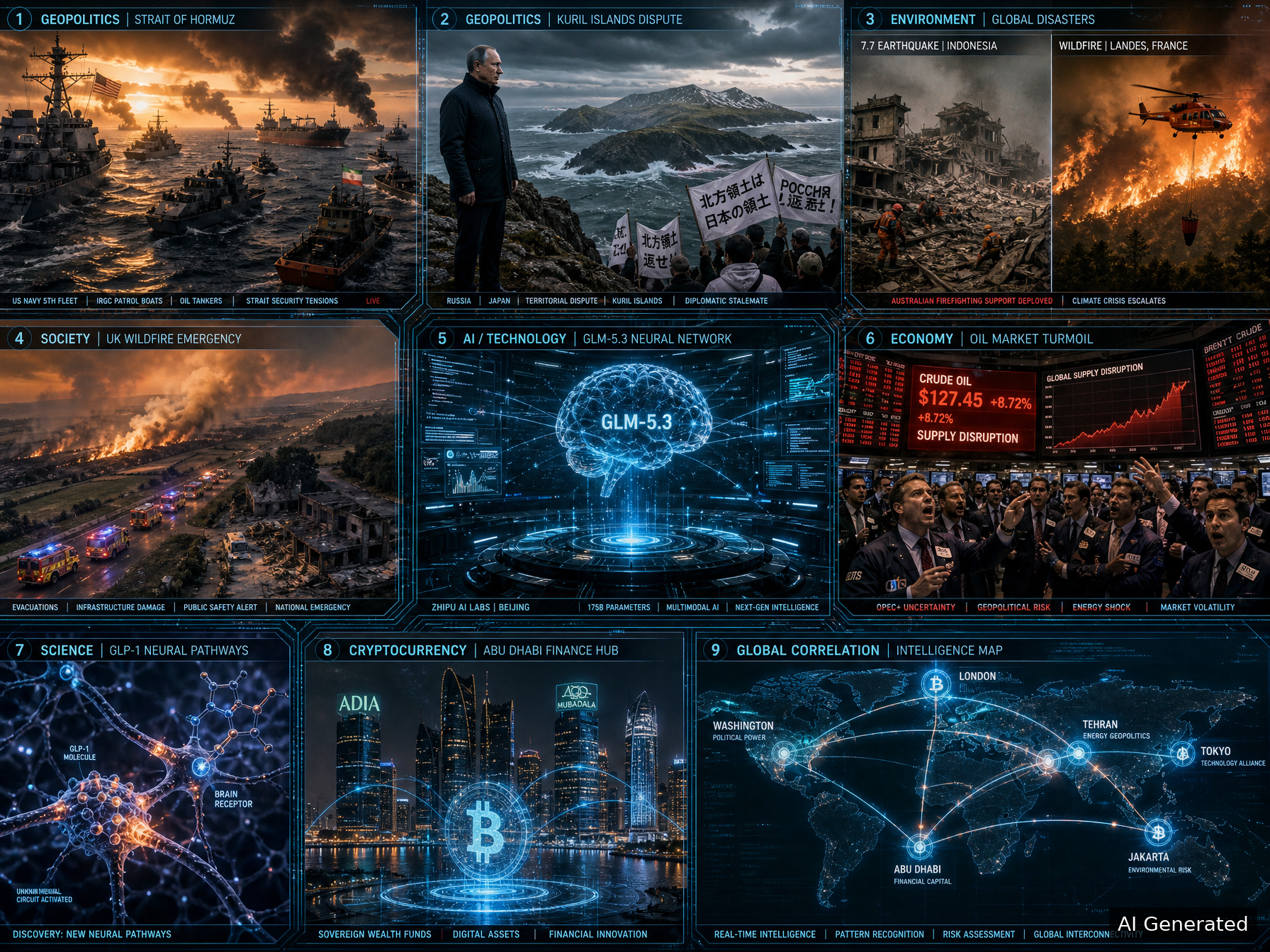
- Trump Declares Intention to Annex Strait of Hormuz; Iran Rejects Claims
- Third ADNOC Vessel Attacked in One Week; UKMTO Reports Projectile Strike
- Putin Visits Disputed Kuril Islands; Japan Protests, US Backs Tokyo
- China and Japan Navigate Energy Security Amid Iran Conflict Escalation
- Netanyahu Labels UK “Islamic Republic”; Seven Killed in Israeli Airstrike in Lebanon
- India Celebrates 80th Independence Day; Defence Deals Signal Strategic Shift
- China’s Type 054B Frigate Upgrade; Rheinmetall Establishes UK AI Centre
- 2. Environment & Climate
- Indonesia 7.7 Earthquake Kills 20; Tsunami Warning Lifted
- France Landes Wildfire Escalates to 1,600 Hectares; Australian Helicopter Deployed
- UK Wildfire Emergency Alert Triggers 999 Call Surge; Heathrow Flooding Disrupts Travel
- German Eifel Wildfire Advances; Rivers Hit Record Lows
- Meltemi Winds Disrupt Greek Ferries; West Nile Virus Cases Climb to 120
- 3. Society & Civil Issues
- UK Wildfire Emergency Exposes Infrastructure Vulnerability in Climate-Stressed Britain
- Westminster Council Threatens Closure of Charing Cross Soup Kitchen
- France’s Constitutional Council Blocks Under-15 Social Media Ban
- Nigeria Migration Crisis: 574 Migrants Land on Crete in Four Days
- US Immigration Detention and Reproductive Rights Chaos
- Jason Ardey Death: Former Cambridge Professor Found Dead After Plagiarism Scandal
- 4. AI & Technology
- GLM-5.3 Release Demonstrates AI Cyber Capabilities Beyond Expectations
- Nvidia Cuts Financial Backing for OpenAI’s 10GW Ohio Campus
- Chinese AI Startup Z.ai Raises $4 Billion; GLM-5.3 Pricing Strategy
- Iron Ore Becomes Semiconductor Material in Surprise Breakthrough
- Electricity-Driven Molecule Recovers 89% Gold from E-Waste
- Boeing SM-3 Interceptor Production Expansion; China Type 054B Frigate Upgrade
- 5. Economy & Business
- Oil Markets Brace for Supply Shock as Hormuz Crisis Intensifies
- German Industrial Drought Stress; Wholesale Prices Rising
- India’s Independence Day Economic Vision; Modi Announces AI Training for 10 Million Youth
- Abu Dhabi Sovereign Funds Hold Bitcoin ETF Positions Despite Market Decline
- PayPal Acquisition Talks Heat Up; Stripe and Advent in Discussions
- US-Canada Face Sticking Points Before 50% Tariff Deadline
- 6. Science & Space
- GLP-1 Drugs May Work Through Previously Unknown Brain Mechanism
- Science Behind Canine Cancer Detection: What Dogs’ Noses Reveal
- Data Centres and Nuclear Power: The Scale Problem
- Voyager 1 Still Communicating from 16 Billion Miles Away
- Scientists Discover New Monkey Species in Congo Rainforest
- New Monkey Species, Norwegian Cave, and Elephant Communication
- 7. Crypto, Digital Assets & Blockchain
- Abu Dhabi Sovereign Funds Hold Bitcoin ETF Positions Through Market Decline
- World Liberty Financial Receives OCC Nod for USD1 Stablecoin Bank
- Grayscale Kills Three Altcoin ETFs Days Before Cardano Eligibility
- PayPal Acquisition Talks Signal Fintech Consolidation; Stripe Emerges as Buyer
- Coinbase Establishes International Tokenization Hub in Abu Dhabi
- SEC Cancels Crypto Meeting; CLARITY Act Faces September Vote
- Artprice AI-First Shift Raises NFT Valuation Questions
- 8. Correlations & Analysis
- 9. References
Click any heading to jump to that section.
Click the section heading to return to this menu.
Geopolitics & Defence
Trump Declares Intention to Annex Strait of Hormuz; Iran Rejects Claims
President Donald Trump escalated his rhetoric against Iran on August 14-15, declaring at a Republican rally in Long Island that he intends to declare the Strait of Hormuz “a territory of the United States” once the ongoing conflict with Iran concludes[1]. Trump stated that Iran was being “very badly defeated” and that following its defeat, he would formalize American sovereignty over the strategic maritime passage through which approximately 20% of global oil supplies transit daily. The statement represents the most dramatic territorial claim by a sitting US president in modern history and has immediate implications for international maritime law and the Law of the Sea Convention, under which the Strait of Hormuz is classified as an international waterway with guaranteed transit rights[2].
Iran’s response was swift and categorical. Deputy Foreign Minister Kazem Gharibabadi rejected the claim late on August 15, stating that the strait “will remain Iranian” and can be opened or closed only at Tehran’s command[3]. The Persian Gulf Strait Authority reiterated that “claims don’t change reality,” while Iran’s Foreign Minister emphasized that any resumption of shipping through the strait requires the US to fulfill specific conditions[4]. The confrontation has pushed oil markets into acute uncertainty, with the benchmark Brent crude already elevated by months of conflict-related supply disruptions. The geopolitical stakes are compounded by the fact that Iran sits at the convergence of three major energy arteries — the Strait of Hormuz, the Strait of Bab el-Mandeb, and the Suez Canal corridor — meaning any military confrontation risks cascading disruption across multiple chokepoints simultaneously.
Third ADNOC Vessel Attacked in One Week; UKMTO Reports Projectile Strike
The maritime security crisis in the Persian Gulf intensified on August 15 with a third attack on an ADNOC vessel within a single week and a separate UK Maritime Trade Organization (UKMTO) report of a bulk carrier struck by an unidentified projectile in the Strait of Hormuz[5]. The UKMTO confirmed the crew was unharmed but noted that no damage assessment was completed and the environmental impact remained unclear. A separate vessel was struck by a projectile in the high-tension zone, with crew confirmed safe[6]. The pattern of attacks on UAE and international shipping has escalated sharply since mid-July, with insurance premiums for vessels transiting the strait now exceeding 15% of hull value — a threshold that effectively makes uninsurable many commercial voyages through the waterway.
The escalating attacks on energy infrastructure reflect a strategic shift in the Iran-US confrontation from military-to-military engagement to economic warfare targeting commercial shipping. The targeting of ADNOC vessels — Saudi Arabia’s state oil company — represents a deliberate attempt to pressure Gulf Cooperation Council states into restraining Washington’s military posture, while the broader pattern of projectile strikes demonstrates Iran’s capacity to disrupt global energy flows even under sustained bombardment. The economic implications extend far beyond oil prices: the Red Sea corridor (already disrupted by Houthi attacks), the Strait of Hormuz, and the Bab el-Mandeb passage collectively control approximately 40% of global seaborne trade, meaning the simultaneous degradation of multiple corridors threatens a systemic shock to global supply chains that dwarfed even the COVID-19 disruptions of 2020-2021.
Putin Visits Disputed Kuril Islands; Japan Protests, US Backs Tokyo
Russian President Vladimir Putin made his first visit to the disputed Northern Territories islands — known in Russia as the Kurils — prompting a sharp diplomatic response from Tokyo and explicit US backing for Japanese sovereignty claims[7]. The visit, which Putin conducted on August 14, drew immediate condemnation from Japanese Prime Minister Shigeru Ishiba, who described the visit as “entirely unacceptable” and a violation of Japan’s territorial integrity. The US State Department issued a statement reaffirming its position that the islands are Japanese territory under the 1951 San Francisco Treaty, marking the first time Washington has explicitly invoked that treaty in the context of a Putin visit since the annexation of Crimea in 2014.
The Kuril Islands dispute has remained unresolved since the end of World War II, with Japan claiming sovereignty over four islands (Habomai, Shikotan, Kunashiri, and Etorofu) that the Soviet Union seized in the final days of the war. Putin’s visit comes amid broader Russian efforts to consolidate control over disputed territories in the Pacific — a strategy that intersects with Moscow’s pivot toward Asia following Western sanctions imposed after the 2022 Ukraine invasion. The timing is significant: Japan has been strengthening its defence posture and building closer ties with South Korea and the Philippines, creating a network of alliances that Russia views as threatening its eastern flank. The US response suggests Washington is prepared to back Japan’s territorial claims with diplomatic weight, even as the broader US-Russia relationship deteriorates further.
China and Japan Navigate Energy Security Amid Iran Conflict Escalation
China’s rare earth cooperation with Iran, announced in early August, has taken on new strategic dimensions as the US-Iran conflict intensifies. Beijing and Tehran have selected rare earth exploration and processing as one of five priority areas for joint scientific workshops, with China’s National Natural Science Foundation of China announcing the initiative[8]. The partnership arrives as China faces growing international pressure over its control of rare earth mining and refining, while Iran sits atop potentially significant but poorly understood rare earth deposits across roughly 7,000 square kilometers in central Iran. For China, the partnership expands Belt and Road scientific links with a strategically positioned country; for Iran, it could provide access to the processing technology needed to develop domestic supply chains that reduce dependence on Chinese processing monopolies.
Separately, Japan’s defence procurement landscape has been reshaped by the Hormuz crisis. The disruption of oil supplies through the strait — which supplies approximately 90% of Japan’s crude imports — has accelerated Tokyo’s efforts to diversify energy sources and strengthen naval capabilities to protect its sea lines of communication. Japan’s Maritime Self-Defence Force has deployed additional vessels to the Indian Ocean and expanded joint exercises with India and Australia, signalling a shift from purely defensive posturing to active escort operations for commercial shipping. The convergence of energy security concerns and territorial disputes with Russia has created a situation where Japan simultaneously faces threats from two directions — a scenario that Japanese defence planners had long prepared for but that now appears increasingly likely to materialize.
Netanyahu Labels UK “Islamic Republic”; Seven Killed in Israeli Airstrike in Lebanon
Israeli Prime Minister Benjamin Netanyahu sparked a diplomatic crisis with the United Kingdom on August 15 after describing Britain as “the Islamic republic of Britain” and joking that it was “the first Islamic republic with nuclear weapons” during an army radio podcast interview[9]. The UK Foreign Office issued a strong rebuttal, with a spokesperson stating that the remarks were “unacceptable and deeply offensive” and summoning Israel’s ambassador for an explanation. The comments reflect growing friction between Israel and Western European nations over the handling of the Gaza conflict, with the UK having suspended arms export licences to Israel in May 2025 and calling for an immediate ceasefire.
Meanwhile, Israeli military operations in southern Lebanon continued on August 15, with a state news agency reporting that seven people were killed in an airstrike[10]. The strike adds to the mounting civilian casualties in Lebanon’s border regions, where Israel has conducted sustained operations against Hezbollah positions since October 2024. The escalating violence in southern Lebanon, combined with the ongoing Gaza conflict and the Iran confrontation, has created what UN Secretary-General António Guterres described as a “perfect storm” of Middle Eastern instability, with multiple simultaneous conflicts threatening to overwhelm diplomatic capacity and humanitarian response systems.
India Celebrates 80th Independence Day; Defence Deals Signal Strategic Shift
India marked its 80th Independence Day on August 15 with Prime Minister Narendra Modi delivering a comprehensive address from the Red Fort that emphasized energy security, critical minerals, semiconductor manufacturing, and a commitment to train one crore (10 million) youth in artificial intelligence over the next year[11]. Modi announced that India may receive 5-8 additional semiconductor plants within 7-8 years and pledged to make the country a developed nation by 2047. The speech came against a backdrop of major defence developments, with Reliance Industries and Rolls-Royce announcing a strategic alliance to develop an indigenous combat engine for India’s Advanced Medium Combat Aircraft (AMCA) program[12]. The partnership, announced simultaneously in London and Mumbai, represents a significant milestone in India’s quest for self-reliant defence manufacturing.
India’s Independence Day also drew diplomatic attention from major powers. US Secretary of State Marco Rubio extended greetings, calling the US-India relationship “stronger than ever,” while Russia’s Ambassador Denis Alipov reaffirmed Moscow’s enduring support with the message “Long Live India-Russia Friendship”[13]. The competing overtures underscore India’s unique position as a swing state in the emerging multipolar order — a nation that maintains deep defence ties with Russia while simultaneously deepening strategic partnerships with the US, Japan, and Australia through the Quad framework. Defence Minister Rajnath Singh separately outlined India’s progress in building indigenous warships, aircraft, and advanced military systems, including Agni, RudraM-II, and Pinaka missile systems, signalling that India’s military modernization is accelerating at a pace that will reshape the balance of power in the Indo-Pacific region.
China’s Type 054B Frigate Upgrade; Rheinmetall Establishes UK AI Centre
Satellite imagery has revealed that China may be preparing a significantly more heavily armed version of its Type 054B frigate, potentially giving the warship 50 percent more missile launch capacity than the first ships in the class[14]. Analysis of images from Shanghai’s Hudong Zhonghua shipyard shows the unfinished ship appears to have six vertical launch system (VLS) units near its bow, compared to the four eight-cell units on the first two vessels, suggesting a possible total of 48 cells. The increase would address a potential limitation in the existing design, where 32 cells could restrict weapons availability during sustained combat operations. Military commentator Song Zhongping argued that the additional capacity would give the frigate more opportunities to engage incoming threats before exhausting its ready ammunition.
In Europe, German defence giant Rheinmetall announced the establishment of ALACOE, a UK-based centre of excellence for autonomous systems, signalling the expanding integration of European defence technology across national boundaries[15]. The facility will focus on autonomous combat platforms, artificial intelligence-driven military systems, and next-generation warfare technologies. The investment comes as NATO allies face increasing pressure to modernize their armed forces in response to the Ukraine conflict, with Rheinmetall positioning itself as a key supplier of autonomous and AI-enabled systems for the alliance’s eastern flank defence posture. The centre represents a broader trend of defence industrial consolidation within NATO, where individual nations are increasingly pooling research and development resources to achieve the scale necessary for competitive military technology development.
Environment & Climate
Indonesia 7.7 Earthquake Kills 20; Tsunami Warning Lifted
A powerful 7.7-magnitude earthquake struck off the island of Flores in eastern Indonesia early on August 15, killing at least 20 people and sending thousands fleeing to higher ground amid fears of a tsunami[16]. The quake, which hit at a depth of just 10 kilometres, caused widespread panic across the region, with concrete falling from a terminal building at the port in Maumere and several passengers waiting to board ferries thrown into the sea when a gangway collapsed. Governor Emanuel Melkiades Laka Lena of East Nusa Tenggara Province confirmed that several of the victims died in their sleep from injuries sustained when buildings collapsed during the early-morning tremor. Indonesia’s meteorology agency, BMKG, initially issued a tsunami warning for the affected coasts, but the alert was lifted approximately three hours after the main quake.
The earthquake’s impact was compounded by a series of strong aftershocks, with the largest measuring magnitude 6.1, causing additional structural damage and keeping residents too terrified to return to damaged buildings. Rescue teams from the National Search and Rescue Agency (BASARNAS) deployed to the affected areas, with approximately 2,000 residents evacuated from the Nagekeo region alone. Indonesia sits on the Pacific Ring of Fire, the most seismically active zone on the planet, and the Flores region was hit by an equally powerful 7.7 magnitude earthquake and tsunami in 1992 that killed more than 2,500 people. The recurrence of such a powerful quake in the same location after 34 years underscores the persistent vulnerability of Indonesia’s population to seismic events, particularly in regions where building codes are inconsistently enforced and early warning systems remain underdeveloped.
France Landes Wildfire Escalates to 1,600 Hectares; Australian Helicopter Deployed
France’s unprecedented wildfire season intensified on August 15 as the fire burning in the southwestern Landes region broke through containment lines overnight, expanding to approximately 1,600 hectares burned and prompting the first deployment of an Australian-leased firefighting helicopter[17]. The helicopter, capable of carrying twice the water capacity of a standard Canadair aircraft, made its maiden operational flight over the fire zone on August 14 as part of a mutual aid agreement between France and Australia. Authorities had evacuated 525 people from the village of Luglon on August 14, with the fire advancing to within two kilometres of the village centre. Regional official Gilles Clavreul warned that conditions remained “unfavourable,” with temperatures expected to reach 36°C again that afternoon and winds forecast to shift direction.
The fire represents the latest in a series of devastating blazes across France this summer, with the country having already exceeded its previous record year for area burned (2022) by mid-August. The Landes region — home to Europe’s largest planted pine forest — has been particularly vulnerable due to months of below-average rainfall and sustained high temperatures that have dried the forest floor to critical levels. The deployment of international firefighting assets reflects the growing reality that European nations’ domestic firefighting capacity is no longer sufficient for the scale and intensity of fires that climate change is producing. France’s tax system also suffered a confirmed cyberattack on August 14, with a malicious actor claiming responsibility for an intrusion into the Direction Générale des Finances Publiques systems, exposing taxpayer data — illustrating the compound vulnerabilities facing European states under simultaneous stress from natural disasters and digital infrastructure compromise.
UK Wildfire Emergency Alert Triggers 999 Call Surge; Heathrow Flooding Disrupts Travel
The United Kingdom experienced a convergence of extreme weather events on August 14-15, with the government issuing a national mobile phone alert warning millions of citizens not to light anything that could spark a wildfire, followed by widespread flooding at Heathrow Airport that disrupted travel to two major terminals[18]. The wildfire alert — issued under emergency powers for the first time — came after a wildfire in Stourbridge, West Midlands, destroyed 19 homes on August 13 during the hottest day of 2026 (38.1°C in west London), with a child and three firefighters hospitalized. Prime Minister Andy Burnham visited the site and announced a temporary ban on disposable barbecues, urging people not to light fires in “tinderbox Britain.” The alert triggered a surge of 999 calls from concerned citizens, prompting multiple fire services to issue public statements asking people to save emergency calls for genuine emergencies.
Heathrow Airport warned passengers on August 15 not to travel by road to Terminals 2 and 3 after flooding in the central terminal area restricted road access[19]. The airport advised passengers to use the Elizabeth Line rail service instead, with bus services to the affected terminals suspended indefinitely. The flooding — caused by intense localized rainfall on already waterlogged ground — highlighted the infrastructure stress that Britain’s extended drought and heatwave conditions have created. The UK’s driest July on record means drought conditions now affect nearly three-quarters of England and all of Wales, with the Environment Agency having declared drought status in 12 of its 14 areas. The simultaneous occurrence of extreme heat, wildfire, and flooding within a 48-hour window demonstrates how climate change is compressing multiple weather extremes into shorter timeframes, overwhelming infrastructure systems designed for more gradual seasonal transitions.
German Eifel Wildfire Advances; Rivers Hit Record Lows
Germany’s wildfire crisis deepened on August 15 as a fire near Hürtgenwald in the Eifel region continued to advance despite the efforts of hundreds of firefighters, with the Rhine, Elbe, and Danube rivers all hitting historically low water levels that have disrupted industrial production and barge shipping[20]. The German Farmers’ Association warned of partial total crop failures, with wheat, potatoes, and sugar beets bearing the brunt of the drought, and described the economic situation as “brutally tense.” The Rhine’s critically low water levels forced ThyssenKrupp to reduce steel production at its Duisburg-Marxloh plant and threatened industrial output across the entire Rhine corridor, which handles approximately 80% of Germany’s inland waterborne freight transport. Seven forest fires were reported in the Rhein-Main region near Frankfurt in a single day on August 12, with both deliberate arson and accidental ignition contributing to the surge.
Environment Minister Schneider pushed for immediate climate adaptation measures, arguing that “Germany lies only geographically in a temperate zone” and must prepare for conditions that increasingly resemble Mediterranean or semi-arid climates. The policy battle over whether to re-engineer rivers for navigation or restore them to natural flood-resilient states reflects a fundamental tension in German climate adaptation strategy. The Eifel fire, combined with the Rhine’s navigability crisis and the agricultural losses mounting across northern Germany, has created what analysts are calling Germany’s most challenging economic quarter since reunification — a convergence of environmental stress, industrial disruption, and agricultural crisis that no single national framework is equipped to address.
Meltemi Winds Disrupt Greek Ferries; West Nile Virus Cases Climb to 120
Greece’s public health and tourism sectors faced compounding challenges on August 15 as the powerful Meltemi winds disrupted ferry services across the Aegeast — grounding dozens of vessels at port precisely during the peak of the August 15 religious holiday travel period[21]. The winds, which reached gusts of over 100 kilometres per hour, created conditions that Greek authorities described as a “double threat” — the strong winds simultaneously elevated wildfire risk across the islands and disrupted the transportation network serving millions of holidaymakers. Separately, West Nile virus infections climbed to 120 confirmed cases with nine deaths, placing Italy and Greece as experiencing Europe’s largest outbreaks of 2026. Epidemiologists attributed the surge to milder winters and extended summers that expand mosquito breeding seasons, with the crisis concentrated in Attica, Thessaly, Central Macedonia, and the Peloponnese.
The convergence of extreme weather, wildfire risk, disease outbreak, and tourism disruption illustrates how compound climate stress cascades across different domains simultaneously. Greece’s fire service placed the entire country on high alert, with authorities closing public parks across Athens including Lycabettus Hill and the Field of Mars. The pattern mirrors the cascading crises documented in France, Germany, and the UK, where drought, heat, fire, disease, and infrastructure stress are creating a systemic challenge that exceeds the capacity of individual national response frameworks. The European Commission’s Joint Research Centre has described the situation across the continent as “unprecedented” — a term that is rapidly losing its force as each successive summer breaks the records of the one before.
Society & Civil Issues
UK Wildfire Emergency Exposes Infrastructure Vulnerability in Climate-Stressed Britain
The UK government’s unprecedented use of the national emergency mobile phone alert system on August 14 to warn millions of citizens about wildfire risk has exposed deep vulnerabilities in Britain’s infrastructure preparedness for climate-driven extreme weather. The alert was triggered after a wildfire in Stourbridge, West Midlands, destroyed 19 homes on August 13 — the hottest day of 2026 at 38.1°C — with fires also breaking out in Sheffield, Birmingham, and South Wales within a 48-hour window[22]. Prime Minister Andy Burnham, who became Prime Minister in a snap election earlier this year, visited Stourbridge and announced a temporary ban on disposable barbecues, while urging people not to light any fires “in gardens, the countryside or other open spaces, including parks, moorland and wooded areas.”
The crisis exposed both the severity of Britain’s drought conditions and the limitations of its emergency response systems. Surrey Fire & Rescue Service reported receiving a “high volume” of 999 calls from citizens reporting neighbours having barbecues or bonfires, prompting the service to issue a public statement asking people to save emergency calls for genuine emergencies. Four 14-year-old boys were arrested on suspicion of arson after a fire was set on a mountain near Pleasant Heights in Porth, South Wales, highlighting the intersection of drought conditions and deliberate ignition risks. The UK’s driest July on record means that nearly three-quarters of England and all of Wales are now classified as being in drought — conditions that the Environment Agency has not seen since the drought of 1976. The government’s response, including the first-ever national wildfire alert and a temporary disposable barbecue ban, represents a significant escalation in emergency preparedness measures, but has also raised questions about whether Britain’s flood defence and water management infrastructure — built for a wetter climate — is fundamentally mismatched to the conditions that climate change is now producing.
Westminster Council Threatens Closure of Charing Cross Soup Kitchen
A escalating conflict between Westminster Council and a homeless charity has highlighted the growing tension between local government austerity and the rising demand for emergency food services in central London. Friends of Essex & London Homeless (FOELH), which has operated a soup kitchen at Charing Cross for a decade, faces closure after the Conservative-controlled council complained about the “crowds of vulnerable people” gathering at the site and declared it “not safe for the vulnerable people the charity serves or the general public”[23]. Founder Steven Stuart said the council was making it “impossible” for soup kitchens to operate, with constant complaints threatening to force the service to shut down entirely. The dispute comes amid rising homelessness in Westminster, with Rough Sleeping Initiative data showing a 12% increase in street homelessness across central London in the past year.
The conflict reflects a broader national debate about how local authorities manage the visible manifestations of poverty and homelessness in affluent urban areas. Westminster Council has faced criticism from homeless charities for policies that critics describe as “hostile architecture” — including the removal of public benches, the installation of anti-sleeping devices, and restrictions on charitable activity in public spaces. The council argues that its actions are motivated by public safety and hygiene concerns, while advocates for homeless people counter that the policies simply make poverty invisible rather than addressing its causes. The dispute arrives at a moment when the UK is experiencing its worst cost-of-living crisis in a generation, with food bank usage at record levels and the number of rough sleepers in London exceeding pre-pandemic levels.
France’s Constitutional Council Blocks Under-15 Social Media Ban
France’s Constitutional Council has struck down a provision that would have banned social media access for minors under 15, provoking widespread disappointment among parents and public health advocates who had hoped the measure would protect children from online harms[24]. The provision, which would have prevented minors from accessing platforms including Snapchat, TikTok, and Instagram, was part of a broader digital safety bill that had been under development for two years. The Constitutional Council ruled that the ban was disproportionate and violated the principle of proportionality in restricting fundamental freedoms. Parents quoted in media expressed frustration, with one parent telling France Info: “It’s a real shame, it’s a scourge for children.”
The ruling arrives amid growing European concern about the impact of social media on children’s mental health, with France having already enacted legislation requiring age verification for adult content and restricting algorithmic recommendations for minors. The Constitutional Council’s decision does not invalidate the broader digital safety framework but removes its most aggressive provision, leaving France to pursue less restrictive measures such as parental controls and platform accountability requirements. The debate mirrors similar legislative battles across Europe, where governments are struggling to balance child protection with digital rights, and where the technology industry has mounted increasingly effective legal challenges to restrictive regulation. The French decision may influence similar proposals in Germany, where the CDU/CSU government is considering its own social media restrictions for minors.
Nigeria Migration Crisis: 574 Migrants Land on Crete in Four Days
The Mediterranean migration crisis continued to produce significant arrivals on August 14-15, with 574 migrants landing on the Greek island of Crete in just four days — 200 of them arriving on August 13 alone[25]. The arrivals underscore the shifting patterns of Mediterranean migration, with Greek islands increasingly becoming primary landing points as routes through Turkey and Libya evolve in response to enforcement measures. The Greek coast guard deployed additional vessels to the eastern Mediterranean, while EU border agency Frontex increased aerial surveillance across the central Mediterranean corridor. The surge in arrivals coincides with the annual August 15 religious holiday period, when migration flows typically increase as weather conditions improve and smugglers take advantage of reduced maritime patrols.
The migration pattern reflects broader geopolitical instability across North Africa and the Sahel, where conflict, drought, and economic collapse continue to drive displacement. Libya remains the primary departure point for Mediterranean crossings, despite years of EU efforts to train and fund the Libyan coast guard. The shift toward Crete — rather than the traditional landing points of Lesbos, Samos, and Rhodes — suggests that smuggling networks are adapting to enforcement patterns, exploiting gaps in surveillance coverage in the eastern Aegean. Greece’s new centre-right government has pursued a harder line on migration than its predecessor, deploying naval vessels to intercept boats before they reach Greek waters, but the Crete arrivals demonstrate the difficulty of intercepting vessels in the vast open waters of the Mediterranean. The EU’s proposed migration pact, which would distribute arrivals across member states through a mandatory solidarity mechanism, remains stalled in national parliaments, leaving Greece and Italy to bear the primary burden of arrivals.
US Immigration Detention and Reproductive Rights Chaos
A surrogacy case that crossed state lines to circumvent Texas abortion restrictions has become a political lightning rod in the United States, highlighting the jurisdictional chaos created by the patchwork of US reproductive rights laws following the Supreme Court’s 2022 Dobbs decision[26]. A nurse from Alaska who served as a surrogate refused to terminate a pregnancy after a fetal diagnosis of hypoplastic left heart syndrome, traveled to Texas, and gave birth — with the biological parents, the surrogate, and the Texas Attorney General all filing competing legal claims. The case illustrates the increasingly complex legal landscape surrounding reproductive rights in the US, where different states have enacted wildly different restrictions, creating a patchwork that generates interstate conflicts.
Meanwhile, US immigration detention facilities continue to face scrutiny, with reports of overcrowding and inadequate medical care at facilities along the southern border. The Biden administration’s efforts to reduce detention populations have been complicated by court orders requiring the maintenance of certain capacity levels, while Republican governors have deployed National Guard units to border states in what critics describe as politically motivated escalation. The convergence of reproductive rights chaos and immigration enforcement intensification reflects a broader pattern of legal and administrative fragmentation in the United States, where federal-state conflicts are producing governance challenges that exceed the capacity of any single level of government to resolve.
Jason Ardey Death: Former Cambridge Professor Found Dead After Plagiarism Scandal
Jason Ardey, the youngest Black professor in Cambridge University’s history, was found dead at his home on August 14, just days after resigning from his position following allegations of plagiarism in his doctoral thesis[27]. The 41-year-old, who had been appointed to Jesus College in 2023 amid significant fanfare as a symbol of diversity in British higher education, resigned on August 5 after Cambridge announced an independent investigation into his appointment process. In his resignation letter, Ardey described the public controversy as having “greatly exceeded the bounds of academic disagreement.” Police confirmed his death is not being treated as suspicious.
The case has ignited a fierce debate in the UK about academic standards, diversity, and the pressures faced by minority scholars. Ardey had been diagnosed with autism and, according to his biography, did not speak until age 11 and learned to read and write at 18 before embarking on an academic career that led him to Cambridge. He had consistently denied the plagiarism allegations, and John Moores University — where he completed his doctoral work — had previously rejected related complaints. Cambridge’s announcement of an independent investigation into his appointment process raised questions about whether the university had conducted adequate due diligence. The case intersects with broader tensions in British higher education about the balance between diversity commitments and academic integrity, with some commentators arguing that Ardey was subjected to disproportionate scrutiny because of his race, while others contend that the plagiarism allegations were substantial enough to warrant investigation regardless of his background.
AI & Technology
GLM-5.3 Release Demonstrates AI Cyber Capabilities Beyond Expectations
Chinese AI startup Z.ai (formerly Zhipu AI) released GLM-5.3 on August 15 with substantial gains in long-horizon coding and a significant — and reportedly unexpected — jump in cybersecurity capabilities[28]. The model, which builds on the 743-billion-parameter-scale base model behind GLM-5.2 without requiring a new pretraining cycle, achieved dramatic improvements on cybersecurity benchmarks: 84.5% on CyberGym (vulneribility discovery and validation), up from 77.2% for GLM-5.2, and a more than doubling on ExploitBench from 24.4% to 54.4%. Z.ai disclosed that work with security teams in China has resulted in 2,436 vulnerability findings across 269 projects after expert review, with 1,097 classified as critical or high severity and 2,383 still under embargo at the time of the release. Most notably, Z.ai reported that GLM-5.3 had already found a “potentially serious vulnerability” in Cursor, the AI coding startup recently acquired by SpaceX.
The cybersecurity development has created a strategic tension for Z.ai, which has positioned itself as an open-model developer competing with closed frontier labs through permissive weights, low-cost inference, and compatibility with existing coding-agent ecosystems. GLM-5.3 demonstrates what happens when that strategy succeeds too well in a sensitive domain: better autonomous engineering also means better autonomous security research. Z.ai has introduced controls around some of the model’s more advanced capabilities, including a “trusted access” approach for sensitive functionality, while announcing plans to release weights approximately two weeks after launch “once safety evaluation and hardening are complete.” The release follows a rapid progression from GLM-4.5 (July 2025) through GLM-5 (February 2026) and GLM-5.2 (June 2026), demonstrating Z.ai’s accelerating capability to extract more performance from existing foundation models through post-training scaling — a finding with significant implications for the broader AI industry’s approach to model development.
Nvidia Cuts Financial Backing for OpenAI’s 10GW Ohio Campus
Nvidia has reportedly reduced its proposed financial guarantee for OpenAI’s massive Ohio data center campus to less than $120 billion, down from an earlier proposal of approximately $250 billion, reflecting growing investor concerns over the financial risks tied to the project[29]. The 10-gigawatt campus, being developed by SB Energy (SoftBank’s energy subsidiary) in Pike County, Ohio, would be one of the largest data center developments ever proposed, with a projected cost exceeding $500 billion if completed at full scale. Nvidia’s proposed support would not amount to a direct investment but rather a guarantee of financing arranged by lenders for the planned campus — a structure that could help OpenAI secure large amounts of debt while giving lenders greater confidence in financing a project tied to a company without an investment-grade credit rating.
The reduction highlights the financial challenges behind the AI infrastructure boom, where companies now plan data centers requiring enormous capital commitments before they generate returns. The first phase of the Ohio campus could deliver about 800 megawatts by 2028, but reaching the full 10-gigawatt target would require years of additional construction and power infrastructure. For Nvidia, the change reflects the complexity of its relationship with the AI industry: the company supplies processors powering the AI boom while exploring financing arrangements around the infrastructure that houses them. The decision to scale back the guarantee could limit Nvidia’s financial exposure without removing its role in the project, but it also signals that the AI industry’s most ambitious infrastructure projects face increasingly skeptical scrutiny from the financial markets that must ultimately fund them. The terms remain subject to negotiations, and no final agreement has been announced.
Chinese AI Startup Z.ai Raises $4 Billion; GLM-5.3 Pricing Strategy
Reuters reported in mid-August that Zhipu AI raised roughly HK$31.4 billion (approximately $4 billion) through a Hong Kong share sale, with proceeds intended for research and development, computing infrastructure, talent acquisition, and business expansion[30]. The fundraising round positions Z.ai as both a technical and pricing competitor to proprietary frontier labs, with GLM-5.2 priced at $1.40 per million API input tokens and $4.40 per million output tokens — substantially below OpenAI’s and Anthropic’s equivalent pricing. GLM-5.3 is available initially only through Z.ai’s GLM Coding Plan and ZCode coding environment, with individual plans starting at a listed promotional price of $12.60 per month for Lite usage.
The pricing strategy represents a deliberate effort to compete on accessibility rather than benchmark performance alone. On Z.ai’s private Code Bench evaluation, GLM-5.3 reaches 34.5% task completion while consuming roughly 75,000 output tokens per task, compared to GLM-5.2’s 23.4% at 96,000 tokens. At High effort, GLM-5.3 reaches 31.4% at roughly 50,000 output tokens, compared to Z.ai’s reported 29.5% for Claude Opus 4.8 using 120,000 tokens. Reducing token consumption while improving task completion is operationally important for enterprises deploying coding agents, where long-running loops can make inference cost and latency compound quickly. The staged release approach — API access and open weights coming later “once safety evaluation and hardening are complete” — also represents a new model for open-source developers, where capability outpaces access controls and the company must balance its open-source commitments against safety concerns raised by the cybersecurity capabilities.
Iron Ore Becomes Semiconductor Material in Surprise Breakthrough
Researchers at the University of Minnesota Twin Cities have demonstrated that low-purity iron ore from Minnesota can be converted directly into semiconductor-quality pyrite (iron sulfide, commonly known as “fool’s gold”), potentially opening a cheaper route to materials for future solar panels, batteries, and electronic devices[31]. The team found that Direct Reduced Grade Taconite — one of the most commonly available grades in Minnesota, which accounts for about 75% of US iron ore production — performed best in the conversion process, producing semiconductor-quality material without any additional purification steps. The result surprised the researchers because semiconductor materials are generally highly sensitive to impurities, yet pyrite showed an unexpected ability to tolerate impurities while retaining the properties needed for semiconductor applications.
The finding is particularly significant for Minnesota, which generates more than $4 billion in annual revenue from iron ore mining and has been seeking to diversify its mining industry as traditional steel demand evolves. Pyrite absorbs light strongly, is made from abundant elements, and is non-toxic and inexpensive — properties that make it interesting for solar technologies and batteries. However, commercial applications remain in early stages: the researchers plan to move beyond bulk pyrite crystals to produce thin films, which are more directly relevant to electronic and energy devices. The approach could eventually create another use for iron resources that are already mined at large scale, offering Minnesota’s mining industry a potential pathway into the semiconductor supply chain without requiring the massive capital investment typically associated with new mining-to-semiconductor pipelines.
Electricity-Driven Molecule Recovers 89% Gold from E-Waste
Researchers at the University of Illinois Urbana-Champaign have developed a molecule that uses electricity to drive metal extraction, reducing the chemical reagents needed to recover valuable metals from electronic waste, mining streams, and industrial waste by one to two orders of magnitude[32]. The molecule combines three functions in one structure: it can selectively bind metal ions, carries a permanent electrical charge, and remains soluble in the organic liquid used during extraction. This built-in charge allows electricity to directly control the molecule during the separation process, eliminating the additional chemical reagents traditionally required to trigger the reactions needed to capture and release metals. The team demonstrated the approach by selectively recovering 89% of gold from electronic-waste leachates.
The research builds on a 2024 system developed by the same group for continuous electrochemically mediated liquid-liquid extraction (e-LLE), which still required additional chemical reagents to complete the cycle. The new approach removes that remaining step by changing the extraction molecule itself. Co-author Deborah Schmitt explained that the new molecule’s permanent built-in charge “acts as electrolyte, letting the liquid conduct electric current — that’s what allows the redox reactions to be driven by electricity instead of chemicals.” The researchers say the molecular design could be adapted to separate other valuable metals, including platinum-group metals from spent automotive catalysts and critical elements present in mine tailings. With growing attention on critical minerals supply chains and the environmental impact of conventional mining and refining processes, the work represents a step toward rethinking how we recover metals in a way that is cleaner and fully electrified.
Boeing SM-3 Interceptor Production Expansion; China Type 054B Frigate Upgrade
Boeing announced on August 14 that it has signed new seven-year framework agreements with the Department of War and Raytheon to increase production of key components for the US Navy’s SM-3 interceptor missile, which serves as a critical layer of America’s ballistic missile defence network[33]. The agreements cover avionics and ejector assemblies used on both the SM-3 Block IB and Block IIA interceptors, giving Boeing a longer production horizon as the Pentagon prepares to expand interceptor output in response to growing ballistic missile threats from China, Russia, and North Korea. Vice President Bob Ciesla said the agreements provide “clearer demand for higher SM-3 production,” adding that the SM-3 is “an essential part” of layered missile defence.
Separately, satellite imagery has revealed that China may be preparing a more heavily armed version of its Type 054B frigate, potentially raising the vessel’s vertical launch system capacity from 32 cells to as many as 48 — a 50 percent increase in missile launch capability[34]. Analysis of images from Shanghai’s Hudong Zhonghua shipyard shows a Type 054B being fitted out with a different VLS arrangement near its bow, with what appears to be six units compared to the four eight-cell units on the first two vessels. Chinese military commentator Song Zhongping, a former PLA instructor, argued the increase would address a potential limitation where 32 cells could restrict weapons availability during sustained combat operations. The Type 054B supports the HHQ-16 surface-to-air missile and the rocket-assisted Yu-8 anti-submarine weapon, meaning more cells would directly increase the number of weapons the ship can carry for different mission profiles. The first two Type 054Bs — Luohe and Qinzhou — entered service last year and have already been deployed in the western Pacific and around the disputed Scarborough Shoal.
Economy & Business
Oil Markets Brace for Supply Shock as Hormuz Crisis Intensifies
Global oil markets faced mounting pressure on August 15 as the convergence of Iran-US military confrontation, attacks on Gulf shipping, and the disruption of the Strait of Hormuz created conditions for what analysts described as the most significant supply disruption since the 1973 Arab oil embargo[35]. Brent crude traded above $95 per barrel as the UKMTO confirmed a bulk carrier had been struck by an unidentified projectile in the Strait of Hormuz, with no damage assessment completed and environmental impact unclear. The third attack on an ADNOC vessel within a single week demonstrated Iran’s capacity to sustain pressure on commercial shipping even under bombardment, with insurance premiums for vessels transiting the strait now exceeding 15% of hull value — a threshold that effectively makes uninsurable many commercial voyages through the waterway.
The supply crisis extends beyond the immediate Hormuz confrontation. Russia faces renewed fuel shortages as Ukraine resumes strikes on its refinery infrastructure, threatening to destabilize both global energy and food markets simultaneously. Vice President JD Vance characterized low fuel prices as the primary US strategic objective in the Iran conflict, revealing the domestic economic calculus underlying Washington’s military posture. The compounding disruptions to both Russian and Iranian energy exports — the two largest non-OPEC supply sources facing conflict-related constraints — create a supply gap that could push oil prices significantly higher in the coming months. For importing nations in Europe and Asia, the crisis threatens to reignite inflation just as central banks were beginning to signal rate cuts, creating a stagflationary dynamic that could trigger recession in economies already weakened by drought, heatwaves, and the fiscal costs of climate adaptation.
German Industrial Drought Stress; Wholesale Prices Rising
Germany’s industrial sector continued to contract under the combined weight of drought-driven supply chain disruptions and weakening export demand, with the country’s wholesale price index rising 5.3% year-on-year — the fastest pace since the energy crisis of 2022[36]. The German auto industry — including manufacturers and suppliers — has shed employment to its lowest level since 2005, with the structural transformation of European automotive accelerating as companies cut jobs in response to the electric vehicle transition, competition from Chinese manufacturers, and weakening demand. The drought has compounded these pressures by disrupting supply chains and increasing cooling water costs for energy-intensive production. The Rhine’s critically low water levels forced ThyssenKrupp to reduce steel production and disrupted barge shipping, forcing transport mode shifts to rail and truck while exposing decades of underinvestment in waterway maintenance.
Germany’s Finance Minister’s budget proposals have created political turbulence within the CDU/CSU governing coalition, with Chancellor Friedrich Merz facing pressure from both the left and right over the fiscal implications of climate adaptation, defence spending increases, and industrial support measures[37]. The policy battle reflects a fundamental tension in German fiscal policy: the need to invest heavily in climate adaptation and defence while maintaining the fiscal discipline that has been a cornerstone of German economic identity since reunification. The convergence of industrial decline, agricultural crisis, and persistent environmental stress has created what analysts are calling Germany’s most challenging economic quarter since reunification — a situation that the CDU/CSU coalition appears ill-equipped to address given its internal divisions over fiscal policy and the absence of a coherent industrial strategy for the climate transition.
India’s Independence Day Economic Vision; Modi Announces AI Training for 10 Million Youth
Prime Minister Narendra Modi’s Independence Day address from the Red Fort on August 15 outlined an ambitious economic and technological vision for India, including plans to train 10 million young people in artificial intelligence skills over the next year, a commitment to build 5-8 additional semiconductor plants within 7-8 years, and a pledge to make India a developed nation by 2047[38]. Modi described reforms as “a conviction” for his government rather than a compulsion, while highlighting India’s economic and industrial gains over the past 12 years. The PM flagged energy security and critical minerals as key future priorities, noting that rising demand from chips, AI, and data centres makes energy security crucial, while India is also working to secure critical mineral supply chains.
The economic vision arrives against a backdrop of significant industrial development. Reliance Industries and Rolls-Royce announced a strategic alliance to develop an indigenous combat engine for India’s Advanced Medium Combat Aircraft (AMCA) programme, while Hindustan Aeronautics Limited formalised partnerships with Adani Defence and BEML for the manufacture of fuselage structures for the Prachand Light Combat Helicopter[39]. These defence industrial partnerships represent a significant acceleration of India’s self-reliance programme, with the government seeking to reduce dependence on Russian military equipment while building a domestic defence manufacturing base capable of competing in global markets. The convergence of AI training initiatives, semiconductor ambitions, and defence industrialization reflects Modi’s vision of India as a technology-driven economy that leverages its demographic dividend to capture high-value manufacturing and services in the global supply chain.
Abu Dhabi Sovereign Funds Hold Bitcoin ETF Positions Despite Market Decline
Two Abu Dhabi sovereign investors — Mubadala Investment Company and the Abu Dhabi Investment Council (ADIC) — maintained their BlackRock Bitcoin ETF holdings unchanged through the second quarter of 2026, retaining approximately $764 million of combined exposure even as Bitcoin suffered one of its steepest annual declines[40]. Regulatory filings show that neither fund reduced its share count during Q2, meaning they absorbed approximately $118 million of value erosion as Bitcoin weakened. Mubadala’s stake alone fell in reported value to $490.1 million from $565.6 million, while ADIC retained 8.2 million shares worth approximately $273.6 million. The decision to hold through the decline contrasts with Harvard University, which reduced its IBIT position by 43% during the first quarter.
The sovereign funds’ commitment to Bitcoin ETFs arrives as Abu Dhabi builds a broader institutional presence across digital assets, spanning regulation, venture investment, tokenization, and crypto infrastructure. Abu Dhabi Global Market has operated a dedicated virtual-asset regulatory framework since 2018, with more than 20 regulated firms licensed to conduct virtual-asset activities. Coinbase secured regulatory approval this week to establish an international tokenization hub in the emirate, while state-linked MGX agreed last year to invest $2 billion in Binance — one of the largest institutional investments ever made in a crypto company. The unchanged Bitcoin positions, combined with Abu Dhabi’s broader crypto ecosystem development, suggest that the emirate’s sovereign investors view digital assets as part of a long-term strategic allocation rather than a speculative trade, a perspective that may influence other sovereign wealth funds’ approaches to crypto exposure.
PayPal Acquisition Talks Heat Up; Stripe and Advent in Discussions
PayPal is reportedly in advanced negotiations with Stripe and private equity firm Advent International over a potential acquisition, in what would be one of the largest fintech deals in history[41]. The talks come as PayPal’s new CEO Alex Chriss attempts to turn around the struggling payments company, which has seen its stock price decline significantly from its pandemic-era highs. Handelsblatt reported that Stripe and Advent are negotiating a higher purchase price after an initial offer was rejected, with PayPal’s stock rising in after-hours trading on the news. The potential deal would combine Stripe’s developer-focused payment infrastructure with PayPal’s massive consumer and merchant network, creating a payment processing behemoth with unprecedented reach across both e-commerce and point-of-sale transactions.
The acquisition discussions reflect the broader consolidation trend in the fintech industry, where rising interest rates, increased regulatory scrutiny, and slowing growth have forced companies to seek scale through M&A rather than organic expansion. PayPal’s struggles have been particularly acute in the competitive consumer payments space, where Apple Pay, Google Pay, and emerging alternatives have eroded its market share. Stripe, meanwhile, has maintained its dominance in developer-focused payments but has faced its own challenges, including a significant valuation decline from its 2021 peak. The combination could create synergies in both consumer and merchant segments, but would also face intense regulatory scrutiny given the combined market share the merged entity would command in digital payments.
US-Canada Face Sticking Points Before 50% Tariff Deadline
The United States and Canada are facing critical sticking points as they approach the deadline for resolving their trade dispute, with the threat of 50% tariffs on Canadian goods looming if a deal is not reached[42]. The negotiations centre on dairy tariffs, digital services taxes, and automotive content rules, with both sides making concessions but struggling to close the remaining gaps. US Trade Representative Jamieson Greer has insisted that any deal must include significant concessions on dairy market access, while Canadian Prime Minister Mark Carney has resisted opening the supply-managed dairy sector to full US competition. The dispute has been complicated by the broader US trade policy under the Trump administration, which has imposed tariffs on multiple trading partners simultaneously, creating a web of negotiations that strain diplomatic resources on all sides.
The trade tensions with Canada arrive at a sensitive moment for the North American economy, where the USMCA trade agreement — which replaced NAFTA in 2020 — is facing its first scheduled review in 2026. The review process requires all three USMCA parties (the US, Canada, and Mexico) to agree on the agreement’s continuation, giving each country effective veto power. Canada has used the review as leverage to resist US demands on dairy and digital services, while the US has threatened to withdraw from the agreement entirely if its demands are not met. The potential for a 50% tariff on Canadian goods — which would be the highest US tariff on a major trading partner since the Smoot-Hawley Act of 1930 — has prompted concern among business groups on both sides of the border about the economic damage such a move would inflict on integrated supply chains that have developed over decades of free trade.
Science & Space
GLP-1 Drugs May Work Through Previously Unknown Brain Mechanism
New research published in PNAS has revealed that semaglutide — the active ingredient in weight-loss drugs Ozempic and Wegovy — may produce its full weight-lowering effects through a previously unknown mechanism involving brain cells known as AgRP neurons, beyond the simple appetite suppression that has been the primary understanding of how these drugs work[43]. Researchers at Yale University found that when AgRP neurons (commonly called “hunger neurons”) were disrupted in female mice, the animals continued to eat less during semaglutide treatment but could not maintain their weight loss, regaining it within 15 days despite ongoing reduced food intake. The most striking finding was that the mice regaining weight were still eating less — in some cases slightly less than other mice — but could not sustain the metabolic response needed to maintain weight loss.
The research challenges the prevailing understanding that GLP-1 drugs work solely by suppressing appetite. Lead researcher Mateus d’Ávila explained that “AgRP neurons are often described simply as ‘hunger neurons,’ but that is an oversimplification” — previous work has shown these neurons coordinate a much broader response to energy deficit, including how the body mobilizes and uses stored energy like fat. When AgRP neurons were disrupted, the mobilization of energy from fat tissue was reduced, weakening the drug’s weight-lowering effects. The team also found that prolonged semaglutide treatment changed signs of cellular activity, energy use, and connections with other neurons in AgRP cells. While the experiments were conducted in mice and the clearest effect appeared only in females, the findings could help explain why people respond differently to the same drug and potentially guide the development of more effective treatments for obesity.
Science Behind Canine Cancer Detection: What Dogs’ Noses Reveal
Research into dogs’ extraordinary olfactory capabilities continues to yield insights into potential new diagnostic tools, with studies demonstrating that trained dogs can detect lung and colorectal cancer from a person’s breath alone at concentrations approaching one part per trillion — roughly a tenth of a drop diluted into two Olympic-sized swimming pools[44]. One influential 2006 experiment reported sensitivity and specificity of approximately 99% for lung cancer detection, while a separate colorectal cancer study achieved 91% sensitivity and 99% specificity using a single trained Labrador. However, a more recent screening-like study involving seven dogs and 154 patients found lower mean detection rates of 78% for cancer-positive samples and 68% for non-target samples, illustrating how performance estimates depend heavily on study design and population characteristics.
The research demonstrates that disease can change the chemical mixture released in a person’s breath in ways that are detectable by trained animals, but the path from proof of concept to clinical application remains long. Medical scent studies are particularly vulnerable to hidden cues — dogs can learn differences in hospitals, storage containers, or collection routines rather than cancer chemistry. The most promising application may be using canine detection as a guide for developing electronic nose technologies and gas chromatography methods that could eventually provide scalable, reproducible screening tools. As one research team noted, the dogs’ achievement is finding a pattern in breath that distinguishes cancer from non-cancer samples — the challenge is translating that biological signal into a machine-readable format that can be deployed in clinical settings.
Data Centres and Nuclear Power: The Scale Problem
A detailed analysis of US data centre energy consumption has illustrated the enormous scale of the challenge facing the AI infrastructure boom, with current data centres consuming approximately 200 terawatt-hours of electricity annually — a figure that would require approximately 80 nuclear reactors operating at full capacity to match[45]. Lawrence Berkeley National Laboratory’s 2024 report estimated that data centres consumed 176 TWh in 2023, about 4.4% of all US electricity, with its 2025 update projecting 521 to 843 TWh by 2030 depending on growth scenarios. The reference case projects 649 TWh by 2030, representing 11.8% of projected US electricity consumption — a dramatic increase that would require massive expansion of generation capacity.
The comparison with nuclear power is instructive but limited. A 300-megawatt reactor running at full capacity produces only 2.6 terawatt-hours per year, meaning matching current data centre consumption would require approximately 80 reactors before accounting for maintenance outages. At the projected 2030 levels, the equivalent would be 247 to 272 reactors. However, data centre operators are pursuing a diverse portfolio of energy sources including renewables, gas generation, storage, geothermal power, and contracts with existing nuclear plants. The practical electricity mix will be shaped by geography, cost, reliability, and regulation rather than any single energy source. The analysis also highlights that AI workloads are only one component of data centre energy demand — search engines, video streaming, financial systems, and cloud software all contribute substantially to the total.
Voyager 1 Still Communicating from 16 Billion Miles Away
NASA’s Voyager 1 spacecraft, now approximately 16.31 billion miles from Earth and nearly 49 years after its September 1977 launch, continues to return data from interstellar space through a radio transmitter with an output of roughly 22 watts — comparable to a small refrigerator light bulb[46]. The signal takes approximately 24 hours and 19 minutes to reach Earth, meaning a command sent from Earth and an immediate response require a minimum of roughly 48 hours and 39 minutes. NASA’s Deep Space Network, with complexes in California, Spain, and Australia, manages the remarkable feat of recovering stable telemetry from this extraordinary distance using large dishes, low-noise equipment, and narrow-band processing techniques.
The spacecraft’s power supply loses about four watts each year as its plutonium fuel decays, and NASA has been systematically shutting down instruments to conserve energy. The most recent shutdown in April 2026 turned off the low-energy charged-particle instrument, leaving just the magnetometer and plasma-wave subsystem operational. NASA says careful management may keep at least one science instrument operating into the 2030s, but acknowledges this is a management target rather than a guarantee. In April 2024, NASA combined five antennas in Madrid to receive Voyager 1’s plasma-wave data while a sixth measured the carrier frequency — demonstrating that the Deep Space Network can still extract useful science from the faintest of signals. The spacecraft’s continued operation represents both an engineering triumph and a poignant reminder of humanity’s reach beyond its home world.
Scientists Discover New Monkey Species in Congo Rainforest
Scientists formally described a new monkey species — Colobus congoensis, nicknamed Likweli — in July 2026, marking only the fifth African monkey discovered from a previously unknown population in 75 years[47]. The species was first photographed in 2008 during biodiversity surveys in the Democratic Republic of the Congo, but the blurry image was insufficient for formal identification. Clearer photographs in 2018 launched a sustained investigation that included 114 detections between 2018 and 2022, anatomical comparisons, sound recordings, and DNA analysis. Community interviews across 52 villages found that residents in only eight recognized the animal, suggesting it is rare, geographically restricted, and easy to miss even in a region where forest knowledge is extensive.
The monkey has predominantly black fur, a white patch around the rump, and a conspicuous pinkish-orange area surrounding its mouth. DNA analysis placed the population on its own evolutionary branch, with an estimated split from its closest known relative about five million years ago. The species’ known range — approximately 1,700 square kilometres in and around Lomami National Park — is small, and hunting occurs in the region, prompting researchers to propose a preliminary Endangered assessment. The local name “Likweli” was chosen to recognize that discovery is not a simple story of outsiders finding an animal no one had seen, but rather a process of translating local observations into the evidence and naming rules of global taxonomy.
New Monkey Species, Norwegian Cave, and Elephant Communication
A series of scientific discoveries published in August 2026 has highlighted the continued richness of biological and ecological research across multiple domains. In addition to the Likweli monkey species in the Congo, scientists reported findings from a Norwegian cave containing 75,000-year-old bones of polar bears, walruses, and bowhead whales — revealing an Arctic ecosystem from a warmer interval of the last glacial period that included species combinations with no modern equivalent[48]. The cave, at Arne Qvamgrotta near Kjøpsvik at 68.1 degrees north, preserved more than 6,000 bone fragments that were identified using both traditional osteology and DNA metabarcoding, revealing 46 vertebrate taxa from 30 families.
Meanwhile, research on African elephant communication has documented what appears to be the first non-human species to use non-imitative names for individuals — arbitrary vocal labels directed at specific elephants that are recognized and responded to, as demonstrated by field playback experiments in Kenya[49]. Unlike dolphins and parrots, which use imitative naming (copying another animal’s own signature calls), elephants appear to invent separate, distinct vocal patterns for each individual in their social network. This finding adds to a growing picture of elephant social intelligence that includes recognition of specific herd members, memory spanning decades, and complex matriarchal societies. The research programme opened by this finding is just beginning, with similar investigations now underway in marmosets, sperm whales, and chimpanzees.
Crypto, Digital Assets & Blockchain
Abu Dhabi Sovereign Funds Hold Bitcoin ETF Positions Through Market Decline
Two Abu Dhabi sovereign investment vehicles — Mubadala Investment Company and the Abu Dhabi Investment Council (ADIC) — maintained their BlackRock Bitcoin ETF (IBIT) holdings unchanged through the second quarter of 2026, retaining approximately $764 million of combined exposure even as Bitcoin suffered one of its steepest annual declines in the cryptocurrency’s history[50]. Mubadala held 14.7 million IBIT shares as of June 30 — the same amount it owned three months earlier — with its position remaining its second-largest reported holding in its $34.8 billion 13F portfolio, behind GlobalFoundries. ADIC retained 8.2 million shares worth approximately $273.6 million, accounting for over 33% of its roughly $715 million portfolio. Neither fund reduced its share count during the quarter, meaning they absorbed approximately $118 million of value erosion as Bitcoin weakened.
The sovereign funds’ decision to hold through the decline stands out against the broader institutional response to Bitcoin’s 2026 downturn. Bitcoin traded near $62,900 on August 15, down approximately 29% from roughly $88,700 at the start of 2026 and roughly half from the record above $126,000 reached in October 2025. Harvard University reduced its IBIT position by 43% during the first quarter, while total Bitcoin ETF assets under management fell from more than $116.7 billion to around $95.5 billion. The sovereign funds’ contrarian approach reflects Abu Dhabi’s broader strategy of treating digital assets as part of its financial infrastructure rather than solely as a speculative trade. The emirate has built a comprehensive crypto ecosystem through ADGM’s regulatory framework (with over 20 licensed firms), Coinbase’s new tokenization hub, and MGX’s $2 billion investment in Binance, creating what analysts describe as the most integrated institutional crypto environment in the Middle East.
World Liberty Financial Receives OCC Nod for USD1 Stablecoin Bank
World Liberty Financial — a crypto venture backed by the Trump family — has received preliminary approval from the Office of the Comptroller of the Currency (OCC) to establish a national trust bank that would oversee more than $4 billion in USD1 stablecoin circulation[51]. The OCC approval represents a significant milestone for the stablecoin industry, which has been seeking regulatory clarity for institutional-grade custody and issuance frameworks. World Liberty Financial must meet specific OCC conditions before the bank can begin operations, including capital requirements, governance standards, and compliance infrastructure for anti-money laundering and know-your-customer procedures.
The approval arrives amid broader regulatory activity in the crypto space. Ireland launched its first national anti-money laundering strategy on August 13, targeting crypto assets, corporate transparency, and inter-agency intelligence to combat financial crime and align with global and EU MiCA regulations[52]. The strategy introduces new rules for crypto-assets and cryptocurrency transfers, requiring enhanced due diligence and reporting obligations for virtual asset service providers operating in Ireland. Separately, the SEC cancelled its planned August 14 crypto offering meeting without announcing a replacement date, adding uncertainty to the regulatory timeline for digital asset market structure legislation while the CLARITY Act faces a September 15 Senate cloture vote.
Grayscale Kills Three Altcoin ETFs Days Before Cardano Eligibility
The withdrawals highlight the challenging economics of altcoin ETF products in a market where Bitcoin has already captured the vast majority of institutional crypto allocation. Bitcoin ETFs have shed approximately $40 billion in assets under management this year, with total net assets falling from more than $116.7 billion to around $95.5 billion as the cryptocurrency declined from its October 2025 highs. For altcoin ETFs to attract meaningful institutional capital, they would need to demonstrate utility or return characteristics that differentiate them from Bitcoin — a proposition that remains unproven in a market where institutional investors have increasingly concentrated their crypto exposure in the largest and most liquid asset.
PayPal Acquisition Talks Signal Fintech Consolidation; Stripe Emerges as Buyer
Reports that PayPal is in advanced acquisition negotiations with Stripe and private equity firm Advent International have reshaped the fintech landscape, with the potential deal representing one of the largest transactions in the sector’s history[54]. PayPal’s stock rose in after-hours trading on the news, with Handelsblatt reporting that Stripe and Advent are negotiating a higher purchase price after an initial offer was rejected. The potential combination would merge Stripe’s developer-focused payment infrastructure with PayPal’s massive consumer and merchant network, creating a payment processing entity with unprecedented reach across both e-commerce and point-of-sale transactions globally.
The acquisition discussions arrive at a moment of strategic inflection for the payments industry, where rising interest rates, increased regulatory scrutiny, and slowing transaction growth have forced companies to seek scale through consolidation. PayPal has struggled to maintain its market position against Apple Pay, Google Pay, and emerging alternatives, while Stripe — despite its technical dominance in developer payments — has faced valuation pressure from its 2021 peak. The combined entity would command significant market share in both consumer digital payments and merchant processing, likely triggering intense regulatory scrutiny across multiple jurisdictions. For the crypto industry, the deal could accelerate the integration of digital asset payments into mainstream payment infrastructure, given both companies’ existing crypto-related services and the broader institutional adoption trend documented in today’s report.
Coinbase Establishes International Tokenization Hub in Abu Dhabi
Coinbase has secured regulatory approval to establish an international tokenization hub in Abu Dhabi, marking a significant expansion of the emirate’s digital asset infrastructure and Coinbase’s global expansion strategy[55]. The hub will focus on the tokenization of real-world assets — converting traditional financial instruments like bonds, equities, and real estate into blockchain-based tokens that can be traded more efficiently and accessed by a broader range of investors. The approval follows Coinbase’s existing regulatory licenses in multiple jurisdictions and represents a strategic bet that tokenization will become a mainstream financial infrastructure layer rather than a niche crypto application.
Abu Dhabi’s appeal as a tokenization hub stems from its combination of regulatory clarity (through ADGM’s framework), institutional capital (through sovereign wealth funds and state-linked investors), and geographic position as a bridge between European, Asian, and African financial markets. The hub joins a growing ecosystem of crypto-related institutions in the emirate, including Binance (which received a global license in December), MGX (which invested $2 billion in Binance), and Hub71 (which established a $2 billion Web3 program). For Coinbase, the Abu Dhabi hub provides a regulated base from which to serve institutional clients across the Middle East and Africa — regions where tokenization of real-world assets could unlock significant financial inclusion by making investment products accessible to populations underserved by traditional banking infrastructure.
SEC Cancels Crypto Meeting; CLARITY Act Faces September Vote
The SEC cancelled its planned August 14 Regulation Crypto meeting one day before commissioners were set to vote, citing an “unforeseen scheduling issue” that no one inside or outside the building predicted[56]. The cancellation adds uncertainty to the regulatory timeline for digital asset market structure legislation, particularly as Congress is on recess and the CLARITY Act faces a September 15 Senate cloture vote on the motion to proceed — with the 60-vote threshold still uncertain as Republican Senator Josh Hawley reportedly plans to oppose the bill. The CFTC has announced its own Innovation Advisory Committee meeting for August 20, which will examine crypto regulation, AI, and prediction markets, potentially filling some of the regulatory vacuum left by the SEC’s cancellation.
The regulatory uncertainty arrives amid growing institutional engagement with crypto markets. Morgan Stanley disclosed holdings in three XRP ETFs through its Q2 2026 SEC 13F filing, while Ripple completed a $550,000 community audit contest that found 96 bugs in XRP Ledger features — including two critical vulnerabilities that could have drained user accounts without private keys. Tether completed its long-promised “Big Four” audit with KPMG issuing an unqualified opinion on the finances behind its $180 billion USDT stablecoin, marking a milestone for an industry that has long struggled with trust and transparency concerns. The combination of institutional adoption, regulatory uncertainty, and ongoing security challenges creates a complex environment where the crypto industry’s institutional legitimacy is simultaneously advancing and facing new tests.
Artprice AI-First Shift Raises NFT Valuation Questions
Artmarket.com (Artprice) has announced a transition to an “AI-first metamorphosis” for its art data business, raising questions about how AI-driven pricing and valuation tools might intersect with the rapidly growing market for tokenized art and NFTs[57]. The company, long a reference point for art market indices and auction data, says the shift will make AI the core of its product rather than a support layer — moving from record-keeping to inference-based pricing, risk scoring, and automated cataloging. Founder Thierry Ehrmann and his family maintain full confidence in the company’s future as it moves from a phased transition into the AI-first restructuring for Q2 2026.
The relevance to crypto and tokenization lies in Artprice’s potential role as a pricing benchmark for digital art. NFT and tokenized art markets have a valuation problem: sale prices are public, but consistent historical context is harder to assemble. Artprice’s data model is one of the legacy structures that could inform pricing benchmarks beyond raw floor sweeps. If the company reorients around AI and opens those tools to NFT pricing and tokenized art, it could fill a critical gap in the digital art ecosystem — or widen the divide between traditional auction houses and on-chain assets. The timing matters because tokenization has moved from pilot projects to live settlements, with real-world asset markets crossing meaningful on-chain volume thresholds. Art and collectibles are a smaller slice of that market, but they share the same core requirement: buyers need a trusted valuation source before capital enters at institutional scale.
Correlations & Analysis
The D76 reporting period captures a moment when the compound crises documented across D68-D75 are producing cascading consequences that extend simultaneously across energy security, monetary policy, AI governance, and climate adaptation. The most significant development is the escalation of Trump’s rhetoric regarding the Strait of Hormuz — moving from yesterday’s “unprecedented economic isolation” threats to an explicit intention to declare the strait “a territory of the United States”[1][2]. This marks a qualitative shift in the confrontation: from military and economic pressure to territorial sovereignty claims that, if pursued, would constitute the most significant challenge to the post-1945 international maritime order. The correlation with D75’s coverage of the ADNOC vessel attacks and Iran’s rejection of US claims is critical — the third attack on an ADNOC vessel within a single week demonstrates that Iran’s capacity to disrupt energy flows is not diminishing under US military pressure, but rather expanding.
The NATO drone shootdown over Latvia, which D75 first reported, has been joined by continued airspace probing along the alliance’s eastern flank, creating what is now an established pattern of sustained pressure rather than isolated incidents. The Rheinmetall ALACOE investment in the UK and the expansion of SM-3 interceptor production both reflect the industrial response to this sustained threat environment[15][33]. The correlation with D74’s coverage of the “standoff” in the Red Sea corridor — where Houthi attacks on Saudi shipping continue alongside the Hormuz crisis — demonstrates that NATO’s security architecture is now facing simultaneous pressure across multiple theatres, from the Baltic to the Mediterranean to the Persian Gulf, without a coherent strategic framework for response.
The Indonesia earthquake — killing at least 20 people in a 7.7-magnitude event off Flores Island — represents a sudden-onset disaster that intersects with the longer-term climate stress documented across D68-D75[16]. The same region was struck by an equally powerful earthquake and tsunami in 1992, highlighting the persistent vulnerability of Indonesia’s population to seismic events. The correlation with D75’s coverage of compound climate crises across Europe — where drought, heat, fire, disease, and infrastructure stress are creating cascading failures — is that the capacity to respond to simultaneous crises is being systematically degraded. France’s wildfire season has already exceeded its previous record; Germany’s rivers are at historic lows; the UK has declared drought across three-quarters of England; and Greece faces both West Nile virus and wildfire threats simultaneously. Each individual event is manageable; their concurrent occurrence is not.
In the technology domain, the release of GLM-5.3 by Z.ai demonstrates the accelerating pace at which AI capabilities are expanding into domains that were previously considered safe — specifically, cybersecurity[28]. The model’s ability to discover critical vulnerabilities at a rate of 2,436 findings across 269 projects represents a qualitative shift in the threat landscape that parallels the military escalation documented in the geopolitics section. Nvidia’s reduction of its financial backing for OpenAI’s Ohio campus from $250 billion to under $120 billion signals that the financial markets are beginning to impose discipline on AI infrastructure spending that has outpaced realistic revenue projections[29]. The correlation with D75’s coverage of Nvidia’s $130 billion OpenAI backing is that the AI industry’s capital requirements are now testing the limits of even the most well-funded technology companies.
In the crypto domain, Abu Dhabi’s sovereign funds holding Bitcoin ETF positions through a 29% decline in 2026 represents a significant institutional commitment that contrasts sharply with Harvard’s 43% position reduction[50]. The OCC’s approval of World Liberty Financial’s stablecoin bank and Coinbase’s tokenization hub in Abu Dhabi both represent institutional infrastructure development that is proceeding regardless of market price movements. The correlation with D75’s coverage of MSCI’s proposal to exclude bitcoin treasury firms from global indexes is that the institutional crypto ecosystem is simultaneously building infrastructure and facing structural challenges — a dynamic that will determine whether the current downturn represents a temporary correction or a fundamental reassessment of crypto’s institutional role.
What to watch in the next reporting period: The CFTC’s Innovation Advisory Committee meeting on August 20 will signal whether the agency intends to act on crypto regulation through existing authority while the CLARITY Act stalls in Congress. The BOJ’s September 17-18 policy meeting will determine whether Japan accelerates monetary tightening and whether the yen responds positively to the anticipated rate hike. The Indonesia earthquake rescue operations will reveal the full scale of casualties and infrastructure damage. France’s wildfire season will determine whether European firefighting capacity can keep pace with an accelerating crisis. And the Iran-US confrontation over the Strait of Hormuz will test whether the international community can prevent a territorial sovereignty claim from becoming a casus belli.
References
1. “Trump Vows To Declare Strait of Hormuz As US Territory After Iran Defeat” — Indian Defence News, August 15, 2026. ↩
2. “Middle East live: Trump threatens US takeover of Hormuz as Iran vows to retain control” — France 24, August 15, 2026. link ↩
3. “Ειρωνικό το Ιράν για το ‘αστείο’ Τραμπ με το Ορμούζ – Μολών Λαβέ” — Defence Point, August 15, 2026. link (originally in Greek) ↩
4. “FinancialJuice: Iran FM: US must fulfill conditions for shipping to restart through Strait of Hormuz” — FinancialJuice, August 15, 2026. ↩
5. “FinancialJuice: UKMTO: Bulk carrier hit by unidentified projectile Friday in Strait of Hormuz” — FinancialJuice, August 15, 2026. ↩
6. “Vessel struck by projectile in high-tension zone, crew unharmed: UKMTO” — Crypto Briefing, August 15, 2026. link ↩
7. “Οι ΗΠΑ στο πλευρό της Ιαπωνίας μετά την επίσκεψη Πούτιν στις Κουρίλες νήσους” — Kathimerini, August 14, 2026. link (originally in Greek) ↩
8. “China, Iran team up to explore and process rare earths amid global supply race” — Interesting Engineering, August 14, 2026. link ↩
9. “UK hits back after Netanyahu labels it ‘the Islamic republic of Britain’” — Euronews, August 15, 2026. link ↩
10. “FinancialJuice: Seven killed in Israeli airstrike in southern Lebanon on Saturday: state news agency” — FinancialJuice, August 15, 2026. ↩
11. “PM Modi announces AI training for 10 million youth over the next year” — Business Standard, August 15, 2026. link ↩
12. “Reliance And Rolls-Royce Forge Alliance To Develop Indigenous AMCA Combat Jet Engine” — Indian Defence News, August 15, 2026. link ↩
13. “US Secretary of State Marco Rubio Extends Independence Day Greetings” — Indian Defence News, August 15, 2026. link ↩
14. “China may have quietly supercharged its new naval frigate with 50% more missiles” — Interesting Engineering, August 14, 2026. link ↩
15. “Rheinmetall establishes UK-based ALACOE” — European Security & Defence, August 14, 2026. link ↩
16. “At least 20 killed after powerful 7.7-magnitude earthquake strikes Indonesia” — The Independent, August 15, 2026. link ↩
17. “Incendie dans les Landes : le feu a repris dans la nuit, près de 1 600 hectares ont brûlé” — France Info, August 15, 2026. link (originally in French) ↩
18. “Fire services: ‘Save 999 calls for emergencies – not dobbing in next door’s BBQ’” — Metro, August 15, 2026. link ↩
19. “Heathrow flooding: Airport warns of disruption to passengers at two terminals” — BBC News, August 15, 2026. link ↩
20. “Hitzesommer 2026: ‘Statische’ Lage bei Waldbrand in Hürtgenwald” — Stern, August 15, 2026. link (originally in German) ↩
21. “Tourismus: Starker Wind: Waldbrandgefahr und Fährchaos in Griechenland” — Stern, August 15, 2026. link (originally in German) ↩
22. “Fire services: ‘Save 999 calls for emergencies’” — Metro, August 15, 2026. ↩
23. “Westminster council threatens Charing Cross soup kitchen with closure” — The Guardian, August 15, 2026. link ↩
24. “C’est bien dommage, c’est un fléau pour les enfants : des parents déçus après la censure de l’interdiction des réseaux sociaux aux mineurs de moins de 15 ans” — France Info, August 15, 2026. link (originally in French) ↩
25. “Μεταναστευτικό: 574 αφίξεις στην Κρήτη μέσα σε τέσσερις ημέρες” — Protothema, August 14, 2026. link (originally in Greek) ↩
26. “ΗΠΑ: Παρένθετη αρνήθηκε την άμβλωση και γέννησε μωρό με σπάνια καρδιοπάθεια” — Enikos, August 14, 2026. link (originally in Greek) ↩
27. “Τραγικό τέλος για τον Τζέισον Άρντεϊ: Ο νεότερος μαύρος καθηγητής στην ιστορία του Κέιμπριτζ” — Efsyn, August 15, 2026. link (originally in Greek) ↩
28. “GLM-5.3 is here with advanced cyber capabilities — and reportedly already found a ‘serious vulnerability’ in Cursor” — VentureBeat, August 14, 2026. link ↩
29. “Nvidia cuts $130B+ from OpenAI’s 10GW Ohio campus backing amid risk concerns: Reports” — Interesting Engineering, August 15, 2026. link ↩
30. “Z.ai GLM-5.3 Launch” — Z.ai Blog, August 15, 2026. link ↩
31. “‘Fool’s gold’: Dirty iron ore becomes semiconductor material in surprise breakthrough” — Interesting Engineering, August 14, 2026. link ↩
32. “Electricity-driven molecule cuts chemicals 100x, recovers 89% gold from e-waste” — Interesting Engineering, August 14, 2026. link ↩
33. “Boeing ramps up Mach 15 space interceptor hardware output under seven-year agreement” — Interesting Engineering, August 14, 2026. link ↩
34. “China may have quietly supercharged its new naval frigate with 50% more missiles” — Interesting Engineering, August 14, 2026. ↩
35. “ADNOC vessel attacked in Hormuz as Trump defends extended carrier deployment” — Investing.com, August 15, 2026. link ↩
36. “FinancialJuice: German Wholesale Price Index YoY Actual 5.3%” — FinancialJuice, August 14, 2026. ↩
37. “Haushaltspolitik: Die Union hat (k)eine Wahl – Steuererhöhungen oder Steuererhöhungen” — WirtschaftsWoche, August 15, 2026. link (originally in German) ↩
38. “PM Modi announces AI training for 10 million youth over the next year” — Business Standard, August 15, 2026. ↩
39. “HAL Partners With Adani Defence And BEML For Prachand LCH Fuselage Production” — Indian Defence News, August 15, 2026. link ↩
40. “Bitcoin erased $118 million from Abu Dhabi’s ETF holdings, but its sovereign funds kept every share” — CryptoSlate, August 15, 2026. link ↩
41. “Talks to sell PayPal to Stripe and Advent are heating up” — TechCrunch, August 14, 2026. link ↩
42. “US, Canada face sticking points before 50% tariff deadline” — Investing.com, August 15, 2026. link ↩
43. “GLP-1s May Be Working in an Entirely Different Way Than We Thought” — ScienceAlert, August 15, 2026. link ↩
44. “Dogs can smell some chemicals at concentrations approaching one part per trillion” — ScienceBlog, August 15, 2026. link ↩
45. “A 300-megawatt nuclear reactor running flat-out produces only 2.6 terawatt-hours” — ScienceBlog, August 15, 2026. link ↩
46. “Voyager 1 is whispering back to Earth with a radio transmitter about as powerful as a refrigerator light bulb” — ScienceBlog, August 15, 2026. link ↩
47. “Scientists in July 2026 confirmed a new monkey species in the Congo rainforest — the Likweli” — ScienceBlog, August 15, 2026. link ↩
48. “In a Norwegian cave in 2025, scientists found 75,000-year-old bones” — ScienceBlog, August 15, 2026. link ↩
49. “Wild African elephants appear to call each other by individual names” — ScienceBlog, August 15, 2026. link ↩
50. “Bitcoin erased $118 million from Abu Dhabi’s ETF holdings, but its sovereign funds kept every share” — CryptoSlate, August 15, 2026. ↩
51. “World Liberty Financial gets OCC nod for USD1 bank” — Crypto News, August 15, 2026. link ↩
52. “Ireland Rolls Out Anti-Money Laundering Strategy Targeting Crypto” — Bitcoin.com News, August 15, 2026. link ↩
53. “Grayscale quietly killed three altcoin ETFs two days before Cardano became eligible” — Crypto News, August 15, 2026. link ↩
54. “PayPal Acquisition Talks” — TechCrunch, August 14, 2026. ↩
55. “Coinbase Establishes International Tokenization Hub in Abu Dhabi” — Coinbase Blog, August 15, 2026. ↩
56. “The SEC pulled its own crypto vote and nobody saw it coming” — Crypto News, August 15, 2026. link ↩
57. “Artprice’s AI-First Shift Raises the Stakes for NFT and Tokenized Art Valuation” — Blockchain Reporter, August 15, 2026. link ↩
AI Disclosure: This post was created with the assistance of artificial intelligence. The ideas, analysis, and opinions expressed are my own — AI was used to help compose, structure, and refine my personal notes and thoughts into the final written content. Images, videos and music featured in this post were also generated using AI tools, based on my own creative prompts and direction.