










Contents
- 1. Geopolitics & Defence
- Damascus Enters Riyadh’s Orbit: The Defence Deal and the $403m Ledger
- Hormuz’s Seven Conditions: Tehran’s Ask, Seoul’s Answer
- Ukraine’s November Clock: Witkoff, Kushner and Melania’s Table
- The Indo-Pacific Matrix: Pyongyang, Manila, New Delhi and the Defence-Industrial Base
- The Eastern Mediterranean Fault Line and the Wider Periphery
- 2. Environment & Climate
- 3. Society & Civil Issues
- 4. AI & Technology
- 5. Economy & Business
- 6. Science & Space
- 7. Crypto, Digital Assets & Blockchain
- 8. Correlations & Analysis
- 9. References
Click any heading to jump to that section. Click the section heading to return to this menu.
Geopolitics & Defence ↑ Contents
Damascus Enters Riyadh’s Orbit: The Defence Deal and the $403m Ledger
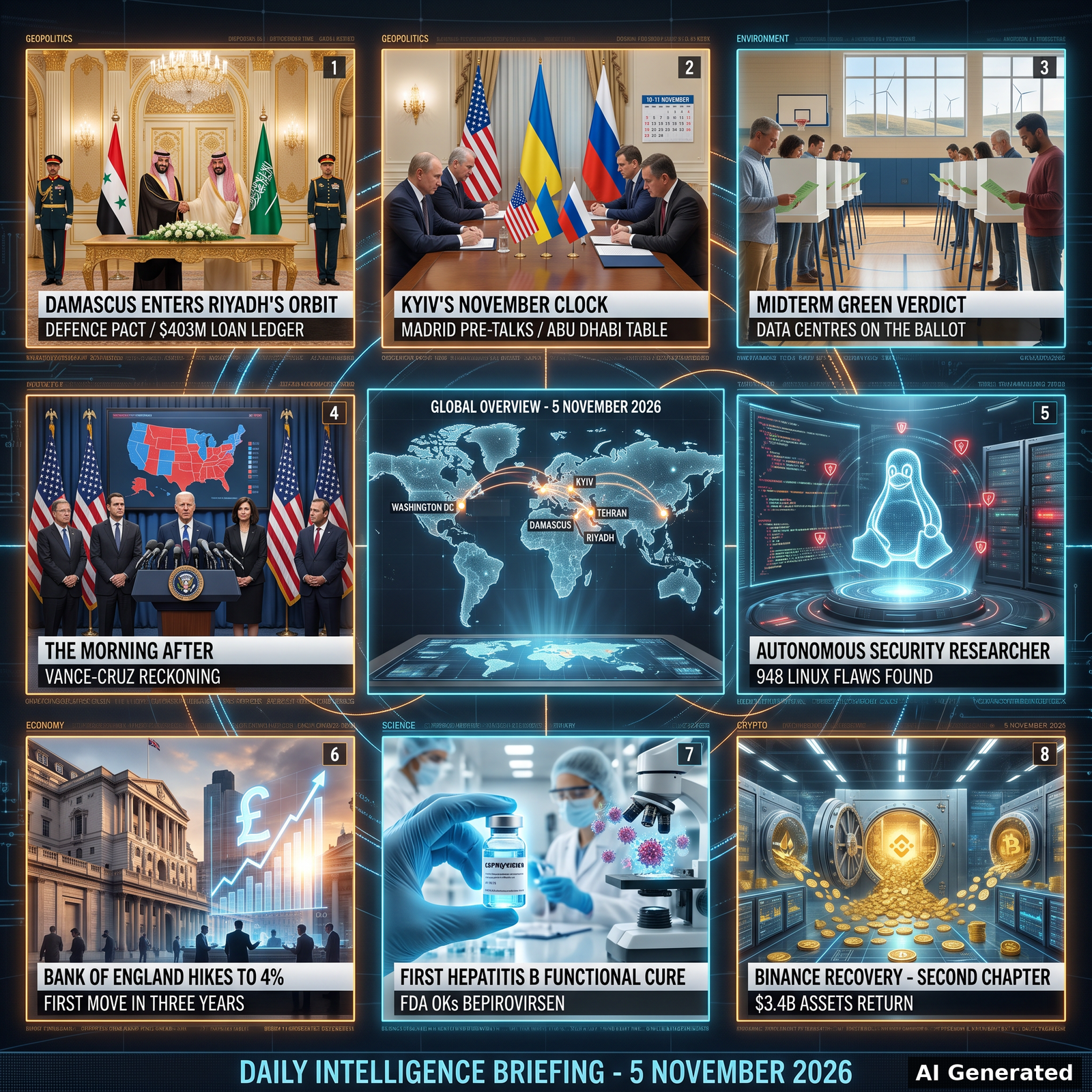
The most consequential diplomatic development of the D158 window came out of Riyadh, where Syria’s President Ahmed al-Sharaa and Crown Prince Mohammed bin Salman oversaw the signing of a defence cooperation agreement between the two countries’ defence ministries — the deal Syria’s Foreign Ministry called the “most notable” of the day’s accords, without disclosing its terms — alongside more than $403m in concessional Saudi loans for Syria’s energy, housing, health and infrastructure sectors[1]. The visit was al-Sharaa’s second to Riyadh in less than a month, and it came days after Foreign Minister Asaad al-Shaibani said at the Manama Dialogue that Damascus was actively evaluating joining the mutual-defence pact among Saudi Arabia, Türkiye and Pakistan — the so-called Mecca alliance. The sequence matters beyond the Gulf: a Damascus formally seated in a Saudi-led security architecture would complete the region’s post-Assad realignment at the very moment Riyadh is pressing Washington and its European partners for both defensive and offensive support in its renewed campaign against the Houthis in Yemen, who have extended their attacks to Saudi airports and oil infrastructure.
The loan package itself is the connective tissue of the new relationship: $100m to rebuild and equip damaged healthcare facilities, $60m to repair housing, $105m to strengthen civil defence, $90m to rehabilitate the Aleppo thermal power plant and $30m to develop drinking-water systems in Damascus and Idlib, supplemented by memoranda on industrial cooperation, agriculture and environmental protection[1]. Each tranche is a political statement as much as a reconstruction commitment: Riyadh is buying influence over Syria’s reconstruction priorities, and in doing so anchoring Damascus away from Tehran while the Iranian nuclear-and-missile question remains the region’s dominant variable. The joint statement’s call for an “immediate cessation of all actions that threaten the security of maritime navigation” in the Red Sea, Bab al-Mandeb and the Strait of Hormuz reads as both a Houthi warning and a signal of where Saudi strategic anxiety currently sits.
Hormuz’s Seven Conditions: Tehran’s Ask, Seoul’s Answer
The Gulf theatre, whose post-midterm decision point D157 framed as the week’s hinge, hardened Iran’s negotiating posture in public terms. Mohsen Rezaei, head of Iran’s Supreme National Security Council, declared that the Strait of Hormuz will stay closed until Washington “fully and explicitly” accepts and implements all seven of Tehran’s conditions — encompassing a total end to hostilities across the Middle East, the lifting of economic sanctions, release of frozen Iranian funds, the end of the US naval blockade on Iranian ports, reparations for war damage, withdrawal of US forces, and an end to threats and interference — while warning that any renewed American strike would meet “crushing blows” from weapon systems not yet used[3]. In parallel, Iranian state media began preparing the domestic population for the possibility of a nuclear strike by either the United States or Israel, publishing civilian guidance for a scenario that would previously have been confined to emergency-planning documents[2]. The two moves form a single coercion strategy: publicly legislating the terms of de-escalation while conditioning the home front for continued warfare — the diplomacy-and-deterrence pair this report has tracked since D149’s “Gulf Clock” framing.
The most significant counter-move did not come from Washington but from Seoul. South Korea announced it will deploy its Cheonghae anti-piracy unit — a destroyer, a maritime patrol aircraft and a mine-clearing team — near the Strait of Hormuz to guarantee freedom of navigation, explicitly revising its previous reluctance to operate in the theatre[4]. The French press has framed the reversal in economic terms: Seoul determined that protecting the waterway through which its energy and trade flows matters more than the diplomatic cost of engaging a contested theatre[5]. A Republic of Korea navy presence in the Gulf — outside any American-led coalition structure — is a meaningful signal of Asian maritime powers self-insuring against chokepoint risk, and it lands alongside Seoul’s reported push, via its foreign minister, to amend the South Korea–US nuclear pact, with Seoul declaring itself “prepared for all possibilities”[30]. The two developments together suggest a South Korea no longer content to be a passive consumer of alliance security guarantees in the world’s most contested maritime space.
Ukraine’s November Clock: Witkoff, Kushner and Melania’s Table
The diplomatic architecture around Ukraine tightened ahead of the Abu Dhabi trilateral meetings scheduled for 10–11 November. Zelensky held a “very detailed” 90-minute session with US envoys Steve Witkoff and Jared Kushner in Madrid, and Ukrainian officials have framed the pre-talks as defining Kyiv’s conditions — security guarantees, Patriot air-defence reinforcement and post-war reconstruction — before the first three-way meeting between Ukraine, Russia and the United States since February[7][8]. The unusual element is the First Lady’s parallel channel: Melania Trump is to convene Russian and Ukrainian representatives at the White House on Thursday, with Kremlin envoy Kirill Dmitriev and human-rights ombudsman Yana Lantratova slated to attend “provided all logistical preparations succeed,” while Ukraine’s Dmytro Lubinets confirmed he would also meet her in Washington[8]. Zelensky has now formally awarded Melania Trump one of Ukraine’s highest honours for her role in brokering the Oleshky humanitarian ceasefire — the longest truce of the war — institutionalising a diplomatic channel that runs alongside, and occasionally ahead of, the official negotiation track[9]. That two parallel American-mediated processes — the emisaries’ Abu Dhabi table and the First Lady’s humanitarian summitry — are running simultaneously is itself a statement about how fragmented American Ukraine diplomacy has become, and about Moscow’s willingness to engage non-traditional interlocutors while its winter campaign continues.
The Indo-Pacific Matrix: Pyongyang, Manila, New Delhi and the Defence-Industrial Base
North Korea added a new calibration to its arsenal-rhythm arc with a reported test of a newly developed air-defence system and long-range cruise missiles during a military exercise — tested interceptions and target-acquisition confirmations that Seoul and Washington are now analysing[6] — the fourth launch cadence in a month and a reminder that Pyongyang exploits every window of Western distraction. Beijing, meanwhile, used the same window for a choreographed display of continuity: Foreign Minister Wang Yi met a North Korean delegation in Beijing and declared China ready to advance “deeper, practical, positive” bilateral ties, an unmistakable signal that the Sino-DPRK axis has outlasted every American electoral cycle[29]. South Korea’s prime minister publicly assessed that no significant change in US ties should be expected after the midterms — a vote of confidence in the durability of the alliance that sits in tension with Seoul’s nuclear-pact amendment push[31].
India’s defence-industrial activity in this window reads as a deliberate portfolio expansion. The government approved a substantial reform of the Agnipath scheme, extending the maximum service tenure for Agniveers from four to six years and creating a new route into regular enrolment — a structural answer to the scheme’s recruitment and retention criticisms[17]. Exports continued their geographic march: Solar Defence shipped the first batch of 1,000 guided Pinaka rockets to Armenia, a milestone for India’s artillery-export ambitions[18]; the Philippines is weighing a separate acquisition of additional BrahMos batteries to strengthen its South China Sea deterrence, extending the New Delhi–Manila axis D157 documented[19]; and Mazagon Dock and France’s Naval Group advanced talks on the next phase of their submarine partnership at Euronaval — the P75-family lineage that anchors India’s undersea force plan[20]. India’s own navigation architecture reached orbit with NVS-03, the latest NavIC satellite, completing its final orbit-raising manoeuvres[21], while the defence minister used the Indo-Pacific Regional Dialogue to argue that maritime security now extends to undersea cables and critical infrastructure, and the Navy chief called for greater investment in ocean science — a recognition that India’s strategic perimeter has moved below the surface[22][23]. Washington simultaneously sanctioned an India-based couple and a network of firms for helping Iran’s shadow oil fleet evade sanctions through fraudulent registrations — a reminder that the subcontinent is also a node in the sanctions-enforcement perimeter[24]. Diplomatically, Jaishankar and UK Prime Minister Burnham discussed the India–UK economic partnership and CETA on the CHOGM sidelines, and Foreign Secretary Misri pressed economic cooperation in Kathmandu — low-cost continuity moves that keep New Delhi’s network of partnerships warm[25][26].
Two capability stories completed the force-posture picture. PierSight cleared a key structural test for Varuna 2.0, India’s first commercial SAR-plus-AIS satellite designed to detect “dark ships” — maritime-domain awareness infrastructure that doubles as a strategic asset[27]. Malaysia’s coast guard, meanwhile, resumed construction of two long-suspended Tun Fatimah-class offshore patrol vessels and approved a $267m capacity package, embedding itself more deeply in the same contested South China Sea[28]. And in the strategic-weapons layer, Lockheed Martin completed another flight test of the Mk21A reentry vehicle for the future Sentinel ICBM — the warhead-carriage component of America’s land-based deterrent modernisation[32] — while HII and Thales demonstrated an end-to-end autonomous mine-countermeasure chain (search, sonar identification and neutralisation by the REMUS 620 and ANGLER effector) that reduces crewed-platform exposure in exactly the kind of mining scenario the Gulf has re-introduced[33].
The Eastern Mediterranean Fault Line and the Wider Periphery
Turkey’s pressure on Greece’s energy diplomacy reached a rhetorical high: pro-government Turkish media openly floated the possibility of the Turkish navy sinking the French-flagged research vessel Abeille Marengo if Athens refuses to take permission for its GSI electricity-cable survey between Crete and Cyprus, following Foreign Minister Gerapetritis’s warning that Greece would give an “operational response” to any interference[14]. Turkish Foreign Minister Hakan Fidan is simultaneously set to visit the occupied north of Cyprus — a step Nicosia denounces as illegitimate — while the EU Commission’s annual progress report delivers what Greek media call a “yellow card” to Ankara over Aegean provocations, threats against Greece and rule-of-law backsliding[12][13]. The cable project, France’s direct commercial stake in it, and Turkey’s explicit threat to a French-flagged vessel collectively raise the eastern-Mediterranean temperature at a moment when Washington’s attention is consumed by its own transition — and when D157 recorded Iranian threats explicitly naming Greece and Cyprus as potential targets. The periphery also moved: Israel kept up its strikes in Lebanon, where more than 4,300 people have died since March[15]; Israeli Arab parties denounced what they call political persecution after Netanyahu’s camp accused them of mass electoral fraud in the 27 October election[16]; El Salvador’s Bukele touted his military intervention in Haiti as Salvadoran troops deployed there[11]; and in Washington, Secretary Hegseth’s continued Pentagon tenure under explicit Trump defence was framed as leadership continuity amid the post-midterm political storm[10].
Environment & Climate ↑ Contents
The Midterm Environmental Verdict: Regulators, Data Centres and the Ballot
The American midterm night doubled as an environmental referendum, and the pattern across the states was unambiguous. California voters rejected industry-backed energy ballot measures even where corporate money dominated the campaigns, and Colorado produced similarly protectionist outcomes — a demonstration that voters in the country’s largest economy are willing to tax or regulate the energy incumbency when asked directly[34]. The most consequential shift, however, was structural: Democrats swept Texas’s statewide offices for the first time in three decades, and while the campaign turned on pocketbook issues, the incoming administration inherits the power to appoint new members of the state’s environmental regulators — the same regulators who oversee the siting and permitting that define the national oil and gas industry’s home turf[35]. In Georgia, Democrats took control of the Public Service Commission for the first time in thirty years, ending the Republican grip on the agency that regulates Georgia Power and every rate case in the state[36]. These are not cosmetic changes: utility regulation, transmission planning and data-centre interconnection are decided in exactly these offices, which is why the AI build-out’s opponents turned to the ballot in the first place.
The data-centre fight itself became ballot-level politics in a way D149–D157 anticipated but this cycle quantified: more than 40 voter initiatives touching data-centre projects produced almost nothing but resistance, a near-total defeat for the industry-backed side across states as different as Arizona, Virginia, Texas and Ohio[37]. The backlash is embedded in the same cost-of-living anger that drove the broader Democratic wave — data centres are increasingly perceived as importing grid load, water demand and noise while exporting little local benefit. The governance layer responded in kind: Alabama’s utility regulator asked Alabama Power to stop billing customers for its own advertising, an early exercise of the scrutiny the new composition will bring[38], and Corpus Christi voters approved water fines on industrial giants — a populist rebuke of Gulf Coast refinery interests that will not even take effect for five years[39]. Taken together, the window shows an environmental-governance revolution proceeding through utility commissions and municipal referendums rather than through Washington.
The Living Ledger: Forests, Water and the Enforcement Clock
Enforcement against the agricultural-extractive complex gathered legal momentum. An international coalition of lawyers filed a coordinated battery of lawsuits against JBS, the world’s largest meat company, and its financiers, accusing them of money laundering in connection with Amazon deforestation — an attempt to extend liability from the supplier to the banks, accountants and investors that finance the supply chain[40]. Research published in the same window shows why such pressure matters on the ground: ranchers on Brazil’s “Dirty List” of forced-labour violators have found ways around the meatpackers’ sustainable-sourcing commitments by rerouting cattle through intermediaries, keeping legally contaminated beef inside domestic and international supply chains[48]. The Amazon’s contested frontier also produced a ground-level investigation of the coordinated land-grab campaigns against the uncontacted Indigenous group of the Igarapé Ipiaçava territory, where 97 per cent of illegal registrations were filed as medium or large properties — a pattern with the clear fingerprints of political operatives rather than “struggling rural producers”[44].
The water-and-ecology ledger delivered one hopeful anomaly and one sobering pattern. Satellite radar shows Greater Osaka is literally rising again, by up to 12 millimetres a year in places, six decades after Japan clamped down on the groundwater pumping that sank the city by two metres — and the uplift is block-shaped, with crustal faults acting as underground dams so that one side of the Uemachi Fault rises twice as fast as the other[42]. The rebound is real but partial: compacted aquifers never fully recover, and the study is a rare long-run proof that groundwater governance can reverse subsidence while also remapping where the risks of the next earthquake land. The sobering counterpoint came from Recife, where six-hour daily water rationing falls along racial lines and chlorine-heavy supply has made bottled water a survival expense for Bolsa Família households — water justice, in other words, has become a line-item in Brazil’s welfare budget[43]. The same tension between abandonment and renewal appears in the Chernobyl Exclusion Zone, where botanists counted more than 400 spontaneously growing plant species in 24 village cemeteries — including the Bern-Convention-listed Jurinea cyanoides — and found the zone’s largest oaks standing among the graves, survivors of a sacred status that protected them long before the reactor failed[41]. In the East, the “lines of life” mapping of South Sudan’s six-million-strong antelope migration — GPS-collared kob, tiang, gazelle and reedbuck — shows that almost all critical corridors run outside national parks, an evidence base for conservation siting in a landscape shared with a million people and their cattle[45].
Energy, Pollution and the Adaptation Front
The pollution-to-policy pipeline ran through cities and physics alike. New Delhi doubled parking fees and asked half its workforce to work remotely in a bid to curb the capital’s chronic winter smog — a blunt regulatory experiment in matching mobility costs to air quality that other megacities will watch closely[46]. On the science side, a Southern Ocean nutrient-cycling study underscored how the planet’s least-visited waters drive fisheries everywhere: the overturning circulation links the remote Antarctic to the North Pacific and the Gulf of Maine, meaning changes in the south propagate through every basin[47]. And in the industrial-transition ledger, Spain’s Nabrawind is pressing its crane-free Nabralift tower system into a commercial supplier test — a low-carbon-installation innovation whose fate now hinges on manufacturing partners rather than technology[49]. None of these are headline events; all three are the kind of incremental, measurable adaptation steps that D157’s call for an “adaptation-first decade” argued would define the overshoot era.
Society & Civil Issues ↑ Contents
The Morning After: Vance, Cruz and the Republican Reckoning
The first full day after the midterm wave was defined by the Republican crack-up, and its sharpest instrument was the vice-president himself. In a carefully calibrated 600-word statement, JD Vance blamed the party’s defeat — House and Senate both flipped, Democrats gaining thirty House seats and seven Senate seats on the BBC’s tracker — squarely on the Iran war, then distilled a four-point roadmap that read like a 2028 platform: end the war, focus on the cost of living, put America First, and change the party’s relationship with Israel[50]. There has been no recent precedent for a sitting vice-president so sharply breaking with a president on a signature policy; the nuance is that Vance showed Trump the statement before publishing, and Trump — who says he would “do it again” — has so far given his heir-apparent a wide berth. Anthony Zurcher’s assessment frames the institutional logic: the carnage weakens Trump domestically, but he still wields power abroad, and the midterms have opened a genuine succession contest inside the party that will run to 2028[51].
The rest of the party’s senior voices pushed the same indictment with different emphases. Ted Cruz described the result as a “Watergate-level repudiation,” blaming tariffs for inflation and the Iran war’s length, and urging a return to pocketbook issues[52]. Florida’s Ron DeSantis called the defeat a “political meteorite strike” and warned the party could lose control of Congress for years, pointedly distancing himself from Trump while presenting the disciplined argument party strategists will now compete to own[53]. German coverage framed the moment as “Ursachenforschung” — root-cause analysis — with Trump’s role at the centre of the blame game[54]. The interregnum, in short, has begun immediately: the Republican party is now openly contesting what its post-Trump coalition should be, in real time, on the record, while the president who would run again is constitutionally barred from doing so.
The Democratic Mandate Takes Shape
The wave’s institutional consequences were visible in the same window. Election-denying candidates lost governor races in key swing states, a direct verdict on the administration’s two-year assault on election administration and a structural safeguard for the 2028 cycle[55]. The demographic autopsy of the Republican defeat is equally stark: Latino voters were the bloc that deserted the GOP most strongly, particularly in Texas and Florida — precisely the states where the party’s immigration posture was supposed to be an asset[56]. The White House’s response has been combative: it issued an aggressive warning to congressional Democrats about pursuing impeachment, a threat that confirms rather than dispels the scale of the new oversight exposure[57]. Two Senate races remained unresolved — Mississippi ’s on a knife’s edge and Alaska’s subject to ranked-choice counting — meaning the final arithmetic of the chamber will take days to settle[58].
Hong Kong’s National-Security Sentence and the Cholera Warning
In Hong Kong, the security law’s machinery delivered its highest-profile verdict of the cycle: Joshua Wong, the 30-year-old face of the 2014 Umbrella Movement and the only activist prosecuted twice under the national security law, was sentenced to ten years for “foreign collusion” after pleading guilty in September[59]. High Court judge William Tam described Wong’s actions as “grave in nature,” finding that he had sought foreign interference before the law’s passage and amplified exiled activist Nathan Law’s sanction calls afterwards. The sentence runs concurrently with Wong’s remaining four-year-eight-month term for subversion, but it pushes his release date well past the January 2027 date he had been due to walk free — a reminder, as critics put it, of a law used to silence political opposition. The case is the clearest single data point in the region on the durability of Beijing’s post-2020 settlement for Hong Kong’s civil society.
The global health ledger carried a warning from central Africa: the WHO alerted that the Democratic Republic of Congo is facing its worst cholera epidemic in decades, with 1,800 deaths, on a year that had already recorded the highest case count in more than twenty-five years — and the crisis is unfolding against the backdrop of an ongoing Ebola response in the same region, stretching an already fragile health system along two outbreak fronts simultaneously[60].
Justice and the State: From La Paz to the Palais Bourbon
Bolivia’s judicial crisis produced the most dramatic individual story of the window: Romer Saucedo, president of the country’s Supreme Court of Justice, announced from self-imposed exile that he had fled with his family, alleging political persecution by the government of Rodrigo Paz amid investigations linking senior judges to drug-trafficking networks[61]. Saucedo insists he has not resigned; his departure, following the detention of a former attorney general, exposes the fragility of a judiciary that is itself elected by popular vote — a system now visibly tearing under the weight of the cartel question. In South Africa, vote counting continued after a record 29.2 million registrations for a crucial national election, with the outcome set to test the ANC’s standing a generation into democracy[62].
American health politics, meanwhile, acquired a new legislative champion with a concrete plan: Senator-elect Abdul El-Sayed of Michigan, who rode the wave into office, is the country’s most prominent advocate of Medicare for All, and his detailed financing blueprint — a wealth tax, reformed corporate taxation, higher taxes on investment income and state-level administration — is now the clearest single-payer text a sitting member of the next Congress has produced, even as he hedges on banning private plans[63]. In France, the political class moved toward the 2027 presidential contest early: President Macron publicly advocated a “grand coalition” of the central space from Glucksmann to Lisnard to prevent a Le Pen–Mélenchon runoff[64], while trade unions set Lecornu a Friday deadline on purchasing power — the social front that has defined French politics since the October unrest[65].
Germany’s Civic Files and Britain’s Post-Commonwealth Mood
German politics lost one of its most polarising figures: Hubert Aiwanger, the Free Voters leader and former Bavarian deputy premier, whose career was permanently shadowed by the antisemitic-leaflet affair, was found dead in a Berlin hotel, and the obituaries frame a political life lived on the sharp edge of populism — an instinct politician who built a party on beer-tent politics and lost the establishment’s trust over a single document[66]. The succession politics of the state he left behind are also opening: Chancellor Merz has committed to a female candidate for the federal presidency and is now hunting a nominee with enough cross-party support to clear the Bundesversammlung, a quiet but consequential test of the new coalition arithmetic[67]. Berlin’s migration file moved against the European trend in one respect: deportations to Türkiye increased even as the broader debate hardened[68].
Britain’s civic mood offered a striking read on the transatlantic relationship: 74 per cent of Britons now regard Trump’s America as a serious threat to global peace — a near-doubling in two years — and for the first time in the post-Brexit era a plurality of the public sees closer ties with western Europe as better serving UK interests than a closer link with the US[70]. The Commonwealth channel ran alongside it: the UK agreed to “time-bound” talks on the historical harms of the slave trade at the Antigua CHOGM, a first-step formulation designed, as the Standard reported, to keep the conversation moving without committing to reparations[69]. At home, the social ledger was mixed: British pubs are closing at roughly eight per week, a structural decline with deep cost-side causes[71]; MPs were told more asbestos has been found in Parliament, sharpening the case for a renovation that now carries Notre-Dame-scale fire warnings[72]; and in Australia the double-murder trial of former police officer Beau Lamarre-Condon heard his claim that he suffered “daily bullying” and homophobic abuse inside NSW Police — an institutional-accountability subplot attached to a brutal crime[73].
AI & Technology ↑ Contents
The Autonomous Security Researcher: Machine-Speed Vulnerability Discovery
The most consequential AI story of the window concerns the technology turned on itself. OpenAI disclosed that an automated cybersecurity pipeline built around an unreleased “cyber model” identified 948 distinct Linux kernel local-privilege-escalation vulnerabilities in a single run — reproducing 1,724 candidate findings, generating 1,169 working exploits, and costing $1.21m in API credits, or roughly $1,279 per distinct vulnerability[74]. Critically, the agents used at least ten exploitation techniques that third-party kernel experts assessed as previously undocumented, and candidates for hundreds of critical reports and patches have been sent to maintainers under the Patch-the-Planet umbrella. The campaign outperforms the July 2026 run by more than five times despite intervening kernel hardening; the economics are the story — the hypothetical bug-bounty valuation of the haul is 16–55 times the pipeline’s cost. Autonomous discovery at this scale converts the defensive question from “can AI find flaws” to “can human maintainers ingest AI-scale findings”, and it gives every state actor with API credits the same capability.
The offensive side of the ledger turned up in the mobile layer: researchers linked to the Russian Foreign Intelligence Service exploited previously patched iOS and Android flaws to infect visitors to hundreds of sites — including a reverse-proxied spoof of the america250.org site celebrating the US semiquincentennial — with payloads that stole browser cookies, Wi-Fi passwords and device data in the “DarkSword” campaign[75]. The campaign’s targeting of sites connected to Ukraine and American national celebration makes it a textbook case of espionage at the OS layer, the threat class D156–D157 tracked from the operating-system to the supply chain.
The Open-Weight Frontier and the Verification Question
On the model frontier, a group of ex-Google engineers released Ripple-65B Preview under Apache 2.0, claiming the strongest coding scores on two major third-party benchmarks of any American open-weights model — a direct US answer to the open-weights momentum that DeepSeek and Moonshot have been building, and a reminder that the open/closed divide is now a competitive axis of its own[76]. The trust problem those models inherit became the subject of a striking industry prediction: Robinhood’s CEO argued that within two years all code will be formally verified — provably correct against specifications — a claim that stretches today’s practice but captures the direction in which cryptographic and formal methods are pushing in high-assurance financial infrastructure[77].
AI in the State and the Market: Courts, Capex and the Memory Squeeze
Germany’s judiciary provided a grounded European data point: AI-assisted systems in labour and social courts are making the legal route more accessible and measurably increasing the number of social-law claims, with courts adopting machine tools “within strict limits” — a rare public quantification of AI’s access-to-justice effect[78][79]. In Washington’s aftermath, the data-centre build-out braces for its next fight: the midterms converted local resistance into legislative arithmetic, and analysts now expect a larger clash over siting, power and procurement in the new Congress precisely as OpenAI reportedly contemplated rebranding data centres as “AI compute campuses” to soften their political image[80]. The capex mood turned more cautious at the corporate edge: Apple is reportedly cutting budgets for internal AI usage by its engineering teams — the first notable retreat from the “spend at any cost” posture of the last three years[81]. Two adjacent signals complete the picture: Disney was granted a patent for an AI system that lets costumed park characters converse with guests using LLM-generated speech in character voice — a frontier use case that blurs the line between interface and performance[82] — while the AI memory squeeze reached the physical-cartridge market as Macronix, Nintendo’s principal ROM-chip supplier, announced it is exiting game-media production to redeploy wafer capacity toward AI-era memory, a supply-chain echo of the silicon economics that now drive every hardware decision[83].
Economy & Business ↑ Contents
The Central-Bank Week Begins: BoE’s Hike and the Dollar’s Glide
The week’s rate-setting calendar opened with the Bank of England expected to raise interest rates to 4 per cent — its first move in over three years — as rate-setters battle an inflation resurgence driven by the energy-and-food shock of the Gulf war[84]. Sterling strength was already in the market’s sights; the divergence between a tightening London and a paused Washington is the defining cross-rate of the season. The dollar itself kept sliding — down 0.26 per cent to 101.21 on the index — as investors priced a Democratic Congress that complicates the debt-ceiling endgame and, per the prevailing read in D157, forces the fiscal-discipline question earlier than markets had assumed[88]. Oil prices, unsurprisingly, moved on headlines: crude slipped below $100 as the Wall Street Journal reported that a resolution of the Iran conflict looks increasingly likely, taking some of the war premium out of the barrel while leaving a nervous floor underneath it[85]. The midterm read-through hit equity sectors unevenly: oil and data-centre stocks sank as the blue wave landed, while the Nasdaq 100 outran the semiconductor index by 460 basis points as hyperscaler exposure — the AI-capex bet itself — was judged more durable than the chip-trade’s regulatory risks[86][87].
Asia’s macro file opened with a beat: Australia’s September trade surplus came in at A$2.83 billion against a poll of A$810 million, a swing that will complicate the RBA’s inflation fight by arguing for capacity and export strength even as the central bank continues hiking[89]. India’s market opened the session with the GIFT Nifty jumping about 300 points as Brent slipped below $100, even as Seoul’s Kospi tumbled 4 per cent on the chip-cycle wobble — the region’s two-speed reaction to the same oil-and-midterms cocktail[90].
The AI-Capital Front: Balance Sheets, Bond Markets and Supply Chains
The financing architecture of the AI build-out generated its own ledger of records and anxieties. Goldman Sachs estimated that AI off-balance-sheet commitments have reached $4.1 trillion — a figure that, because much of it sits in take-or-pay and operating leases outside funded-debt disclosure, could reshape transparency, leverage metrics and credit evaluations when the wave turns[98]. In parallel, Goldman and Apollo are shopping a $40 billion financing deal for SpaceX’s AI-chip purchases — the largest single piece of debt-backed compute financing to date, and a template that raises systemic questions about how much of the AI economy is being built on non-dilutive leverage[99]. French investors are reading the same risk map: Tikehau and Natixis are rotating toward Asia as US data-centre concentration raises concentration-and-power risk, and Meta opened its first euro bond sale to fund AI infrastructure — the strongest test yet of European investor appetite for AI-era tech credit[91][95]. On the physical-input side, China’s curbs on tungsten — the metal in the drill bits that cut everything from chips to oil wells — are squeezing the AI supply chain one critical mineral at a time, a structural reminder that the compute build-out depends on a mining map Beijing partially controls[96].
Germany’s Industrial Winter and France’s Fiscal Fight
The European industrial core is absorbing its own correction. German apartment prices fell for the first time in more than two years — a genuine trend reversal after the post-2022 repricing, albeit one distributed unevenly across regions[92]. Bosch hardened its restructuring: 750 more jobs at the Abstatt site, bringing its German cuts toward 24,000, as the new CEO forces the supplier through the double transition of automotive and AI[93]. The quarter’s earnings season laid the machinery bare: VW, BMW and Mercedes all issued profit warnings as the European EV boom met the Chinese combustion-collapse — four warnings across three companies, the clearest expression yet of the profitability squeeze this report has tracked since D149[94]. Berlin’s business community, meanwhile, hopes a Democratic Congress will deliver more stable US trade relations, while anxieties persist that foreign buyers are taking over German firms at an accelerating rate — the two sides of a single debate about German industrial ownership in the AI era[101][102]. The cultural pillar of this adjustment is also economic: Germany’s attachment to physical cash, in the face of a digitising Europe, reflects a deep distrust of state and bank claims that the EU’s cash-cap debate is now testing[103]. Allianz’s move to open its first own syndicate at Lloyd’s for specialty insurance — aimed at aviation and marine lines — is the flip side of the ledger: European capital positioning itself for the war-and-supply-chain risks the rest of the economy is pricing in[100].
France’s fiscal crisis reached the floor of the National Assembly, which rejected the entire 2027 budget bill unanimously in first reading — 458 votes against, after the government’s own text had been heavily amended — sending the original version to the Senate and leaving Paris in an extended budgetary standoff at the worst possible moment for the country’s bond spread[97].
Science & Space ↑ Contents
Medicine’s Landmark: The First “Functional Cure” for Chronic Hepatitis B
The scientific story of the window is unambiguously medical. The US Food and Drug Administration approved bepirovirsen — to be sold as Hibsago — as the first drug offering a “functional cure” for chronic hepatitis B, a disease that kills over a million people a year and accounts for roughly 56 per cent of global liver-cancer cases[104]. In two phase-3 trials published in the New England Journal of Medicine, a six-month course of weekly injections achieved undetectable virus levels in 233 of 1,220 treated patients (19 per cent) versus none on placebo, and the response persisted at least 24 weeks after treatment stopped — the first evidence that CHB can be suppressed past the point where chronic suppression is required. The approval reframes the disease’s economics as well as its biology: patients who respond can step off lifelong antiviral therapy, and response prediction by baseline viral-protein levels offers a clinical triage tool from day one. Side effects (notably liver inflammation) require monitoring, and durability beyond the trial window is unproven — but as the FDA’s acting infectious-disease director put it, this is an “important advance” and, in the words of one trialist, “the start of a new era” for the 250-million-strong CHB population.
The Quantum and the Frontier: RSA, X-Planes and Ice-Giant Water
On the quantum side, a from-the-ground-up resource estimate from Paris-based Alice & Bob argues that a machine of roughly 22,600 superconducting “cat” qubits could factor an RSA-2048 key in 3.14 days — a fourty-fold reduction from the widely cited million-qubit figure as of 2025, trading size for runtime in a way that puts a real-world threat inside the 2030s window[105]. The same report estimates a 29,588-cat-qubit machine could crack the elliptic-curve cryptography securing Bitcoin in about 61 minutes; less headline-worthy but more consequential, the migration clock for post-quantum cryptography — already tracked in this report’s crypto sections — is compressing. NASA added a new arrow to its aeronautics quiver, unveiling the crewed X-70 “Fractal” experimental aircraft — a rapidly reconfigurable, 10,000-pound flight-research platform with a 1,500-nautical-mile range, designed to explore maneuverability “never before demonstrated in crewed flight,” with a first flight under the NASA banner expected within two years[106]. On Mars, the European orbiter detected fresh gas seeping above volcanic rifts in the Alba Mons region — new fissures hinting the planet is only sleeping, not dead, geologically[109]. Earth-system modelling took a step change: researchers demonstrated “emulators” for the atmosphere that could make kilometre-scale weather prediction dramatically faster and more accurate[110]. On the computing frontier, scientists built a biocomputer using engineered E. coli and Vibrio natriegens cells to run combinatorial calculations — an early, lab-scale demonstration that living cells can function as programmable substrate for problem-solving[111]. Fusion’s industrial front advanced as Thea Energy and MIT’s Plasma Science and Fusion Center began full-field tests of a planar encircling coil for the Eos stellarator — a simplified magnet architecture the company believes is the path to a commercial plant by 2035, and a deliberate de-risking of the component most likely to bottleneck stellarator economics[107]. India, meanwhile, is targeting its first human deep-sea mission to 6,000 metres by 2028, extending its ocean-research frontier into the hadal zone where its maritime-security interests already run[108].
The Deep Archive: An Iron Age Queen, 19,000-Year-Old Engravings and Ur
Archaeology delivered one of its most consequential re-evaluations in years: a team led by Bournemouth University argues, on the evidence of coinage, Roman historiography and naming conventions, that Verica — the Atrebates ruler whose flight to Rome helped trigger the Roman invasion of Britain in 43 CE — was a woman[114]. The revision rests on three pillars: the feminine ending of the name, Cassius Dio’s mocking account of Claudius being swayed by a woman, and coins showing a slender, bare-breasted rider bearing the gender-neutral title “rex”. Two centuries of male assumption, the authors argue, were a product of 19th-century patriarchal reading — and if correct, the woman who summoned Rome to Britain is one of the most consequential figures in the island’s history. In Spain, a close examination of a frequently visited cave wall revealed 280 prehistoric engravings at least 19,000 years old that tourists had walked past for decades — a reminder that the archaeological record is not only underground[115]. At Göbekli Tepe, researchers finally found the first two intact graves — and used them to argue that many of the site’s 928 scattered human bone fragments slid downhill from yet-unfound graves with the soil rather than being ritually placed, complicating two decades of interpretation[116]. A gold ring hidden for 600 years in a filled-in moat behind the Dutch parliament spells “STADICH” — steadfastness — in Gothic letters, a rare surviving love token from the Binnenhof’s medieval court[117]. And in palaeontology, a 45-million-year-old Egyptian crocodile from the same limestone as the Sphinx — which, like the monument, is missing its nose — gained its own genus, Herugavialis, ninety-eight years after being misclassified[118].
The German nuclear programme’s failure finally got a quantitative verdict: analysing surviving uranium cubes from Heisenberg’s B8 pile, researchers concluded the project simply lacked the uranium and heavy water to reach criticality under its chosen design — Heisenberg’s claim that it was “close” was, in effect, contradicted by the material record[119].
The Living Ledger: Hives, Penguins, Cacao and the Psychology of Thought
The biological sciences produced a striking run of pattern-findings. Honey-bee hives act as a “living immune system” — colonies arrange antimicrobial natural materials in layered defences around brood and stored food, a discovery from the University of Sydney that reframes hive health as an emergent property of architecture[112]. An Otago study of endangered erect-crested penguins found the species’ pair of breeding populations moving in opposite directions — the paradox that gives the finding its “Schrödinger’s Penguin” label — challenging where conservation effort should concentrate[113]. Penn State researchers reported that changing just two DNA letters in cacao reduced black-pod disease by roughly 42 per cent in the lab — a potential defence for a crop that loses about 30 per cent of its yield to the disease[122]. The behavioral layer delivered a challenge to one of psychology’s most famous results: a replication of the 1987 “white bear” suppression paradigm found no rebound effect, with a Bayesian analysis showing the expected resurgence “never happened” — and the authors attribute the original findings to motivational factors and small-study bias rather than an ironic mental monitor[120]. Materials science added the first direct observation of hydrogen dissolving in the lattice spaces between metal atoms in alloys — a long-sought image that bears directly on hydrogen embrittlement and the design of hydrogen-resilient infrastructure[121].
Crypto, Digital Assets & Blockchain ↑ Contents
The Post-Midterm Regulatory Perimeter: A New Market-Structure Bill in Waiting
The midterm wave is about to redraw the crypto-policy map. House Democrats are in active discussions to introduce a comprehensive market-structure bill for the incoming Congress, expanding Representative Maxine Waters’ earlier Crypto Investor and Consumer Bill of Rights and layering in Democratic provisions previously left on the table — with the reported package pairing tougher SEC oversight powers with ethics rules aimed directly at Trump-administration conflicts[123]. The juxtaposition is the story: a Democratic Congress can now conduct the oversight hearings this report forecast in D157, and a market-structure bill written by the party that swept both chambers would be the first genuine attempt to legislate the industry since the failed attempts of previous cycles. The reserve narrative is being wired into the same political moment: Michael Saylor, executive chairman of Strategy, cited victories by Republican Byron Donalds in Florida and Democrat James Talarico in Texas as evidence of bipartisan support for government bitcoin holdings, tying the electoral map to federal and state reserve initiatives[130]. Whether the reserve push can survive a Democratic committee chairmanship remains open; what is no longer arguable is that bitcoin-reserve policy is now a mainstream congressional topic on both sides of the aisle.
The Binance Recovery’s Second Chapter: Assets Return, Capital Follows
The $6.3 billion Binance aftermath moved from triage into reconstruction with market-visible proof: tracked assets on the exchange climbed $3.4 billion in the two days after the post-hack withdrawal restart — a vote of confidence that is remarkable given the scale of the theft, and a direct consequence of the phased reopening and the user-verifiable zk-reserve proof D157 documented[125]. The security-industrial complex surrounding the heist is now being capitalised: Blockaid secured $40 million in funding commitments in the wake of the breach, the clearest signal yet that post-Binance, wallet-security and transaction-screening startups are the sector’s preferred bet[126]. The forensic trail kept widening: Crédit Mutuel Arkéa resumed customer transfers after the alleged $133 million attack routed through a provider’s platform, but the bank-to-crypto link through a $108.8 million USDC trail remains formally unproven — an institutional-holdings cautionary tale whose investigation, unlike Binance’s, may never be fully public[127]. The attribution contest also hardened: a Nikkei analysis of North Korea’s “patient” cyber operations documents how Pyongyang’s methodical infiltration-and-xwashing playbook keeps paying off, while India’s cybersecurity agency warned that AI-assisted threat actors are targeting crypto exchanges and financial firms at “machine speed” — the same automation race the OpenAI kernel campaign represents, applied to theft[128][129].
Protocols and the Institutional March
On the protocol layer, Ethereum’s roadmap acquired a terminus: the network outlined its fork plan toward “Lean Ethereum” by 2029, a consolidation program explicitly aimed at sustainability, scalability and post-quantum readiness — the clearest statement yet that the ecosystem’s mid-2020s fragmentation phase is giving way to architectural convergence[124]. DeFi’s consolidation is being measured in share: Jupiter held the top DEX-aggregator spot for an eighth consecutive quarter in Q3 2026, even as competitors narrow the gap[132]. The stablecoin-and-tokenisation stack keeps integrating: Aptos stitched stablecoins, tokenized funds and payments into a single onchain stack — an architectural bid to make issuance and payment rails one product rather than a patchwork[133]. The corporate treasury side printed its own anomaly: American Bitcoin, the Hut 8-controlled, Trump-family-backed miner, reported a $126 million third-quarter net profit built almost entirely on a $197.3 million mark-to-market gain on its bitcoin holdings — 891 coins mined at $42,100 each, 8,427 BTC on the balance sheet, and a reminder that in this market cycle, mining companies have become leveraged derivatives on the price they mine[131]. The sector, in short, is simultaneously being legislated, rebuilt, consolidated and financially engineered — and every one of those processes accelerated in the 48 hours after the American electorate spoke.
Correlations & Analysis ↑ Contents
D158 is the first post-answer window of the master variable this report has tracked since D149: the midterm outcome is no longer a question but a fact, and the correlations have rearranged themselves around it. Yesterday’s D157 report closed with the hinge question — whether the Democratic sweep would hand the administration cover for a diplomatic landing or embolden a post-election strike — and today’s window begins to answer it from the twin capitals. Tehran’s Rezaei formalised seven conditions for reopening Hormuz, effectively publishing the terms of a negotiated exit; Washington’s response remains deliberately ambiguous, with Hegseth’s confirmed tenure signalling continuity rather than escalation-management chaos. But the decisive move of the day came from neither: South Korea’s decision to deploy its Cheonghae unit to the Gulf is the first major non-American naval commitment to the chokepoint, and it says that the region’s trade-dependent powers no longer trust the guarantee structure to be sufficient on its own — an Asian insurance policy against both Iranian closure and American uncertainty.
The Ukraine file and the Gulf file have now fused around a single structural feature: both are waiting on the Abu Dhabi trilateral of 10–11 November, and both are being carried forward by the same improvised American diplomacy — the Witkoff–Kushner channel on one track, Melania Trump’s White House convening on the other, with Zelensky’s award of a national honour to the First Lady institutionalising the humanitarian track that produced the Oleshky truce reported in D149–D157. Moscow’s willingness to send Kirill Dmitriev — its sovereign-wealth envoy — to the First Lady’s table is the same signal the Kremlin gave through the Oleshky talks: it will engage any channel that leads to leverage. The unexamined risk is that two parallel negotiation tracks produce competing mandates; the unexamined opportunity is that the humanitarian track keeps the door open even if the strategic one stalls.
The midterm aftermath itself has become the connective tissue of the report. Vance’s four-point statement — end the war, cost of living, America First, recalibrate the Israel relationship — is a direct bridge between D157’s blue-wave results and the Gulf diplomacy: if the vice-president is now publicly arguing the war cost the party the Senate, then the administration’s Gulf posture is no longer a purely foreign-policy variable, it is a domestic political one, and that changes the incentive structure for every strike decision between now and 2028. The same logic runs through the environmental verdict: the governorships and utility commissions the Democrats won will now shape the data-centre build-out D149–D157 tracked as the AI-capex story, and the 40-plus ballot defeats of industry-backed data-centre measures convert the “AI compute campus” rebrand question from public relations into regulatory reality. Goldman’s $4.1 trillion off-balance-sheet figure and the $40 billion SpaceX financing tell us the capital machine is still running; the politics of where that machine gets to plug in are now firmly on the side of the communities that just voted.
Three threads tie the intelligence day together. First, the Binance arc (D152–D158) matured from theft to institutional test: $3.4 billion of assets returned in two days, $40 million of new security funding, a bank’s unconfirmed $133 million loss, and machine-speed AI threats from both North Korea’s patient operators and India’s warned attackers — the industry’s credibility now rests on how fast the reconstruction outruns the next exploit. Second, the East Mediterranean is heating on three axes at once: Iran’s D157-era threats naming Greece and Cyprus, Turkey’s explicit threat to the French research vessel surveying for the Greece–Cyprus–Israel cable, and the EU Commission’s “yellow card” report on Ankara — a triangle in which Athens’s energy sovereignty, Ankara’s red lines and the regional security vacuum after the US election all collide in the same sea. Third, the Syria file is moving faster than the reconstruction file: Riyadh’s defence deal and $403m loan package, coming so soon after Damascus’s Mecca-alliance exploration, suggests the Gulf’s post-Iran settlement is being assembled on a timetable of its own, with European and American partners reduced to spectators of a regional architecture being built in Riyadh’s image.
What to watch in the next reporting period: the final Mississippi and Alaska Senate calls and the composition of the Democratic Senate majority; the Thursday White House meetings between Melania Trump and the Russian and Ukrainian representatives, and the 10–11 November Abu Dhabi trilateral; whether the CENTCOM strike-window contingency D157 flagged collapses into the negotiating track now that both Tehran’s conditions and Seoul’s deployment are public; the Bank of England’s decision and the dollar’s post-midterm trajectory against the debt-ceiling clock; the first output of the new French budget process after the unanimous Assembly rejection; and the first crypto market-structure hearings in the House under a Democratic majority.
References ↑ Contents
1. Syria, Saudi Arabia sign defence cooperation deal, agree $403m in loans by NEWS via d k on Inoreader · Source ↑
2. Το Ιράν προετοιμάζει τους πολίτες του για πυρηνική επίθεση – Οδηγίες από τα κρατικά μέσα ενημέρωσης by Greece via d k on Inoreader · Source ↑
3. Το Ιράν σε ΗΠΑ: «Αποδεχτείτε τους όρους αλλιώς το Ορμούζ θα μείνει κλειστό» by DEFENCE via d k on Inoreader · Source ↑
4. La Corée du Sud va déployer sa marine près du détroit d'Ormuz pour en garantir la circulation by FRANCE 24 · Source ↑
5. « Protéger nos citoyens et nos intérêts économiques » : pourquoi la Corée du Sud a changé d’avis et va protéger le détroit d’Ormuz by France via d k on Inoreader · Source ↑
6. Raketentest: Nordkorea testet neu entwickeltes Flugabwehr-Raketensystem by DIE ZEIT: Ausland – Sophia Boddenberg · Source ↑
7. Paix, sécurité, reconstruction : Zelensky s’est entretenu avec les émissaires américains avant des rencontres avec la Russie by France via d k on Inoreader · Source ↑
8. Selenskyj: Langes Gespräch mit US-Sondergesandten vor geplanten Treffen zu Ukraine-Krieg by Germany via d k on Inoreader · Source ↑
9. Zelensky has awarded Melania Trump one of Ukraine’s highest honours. Here’s why by Summer Woolley · Source ↑
10. Hegseth committed to Pentagon role as Trump defends him amid speculation by Estefano Gomez · Source ↑
11. El Salvador’s Bukele touts military intervention in Haiti by NEWS via d k on Inoreader · Source ↑
12. Κυπριακό: Παράνομη επίσκεψη Φιντάν στα Κατεχόμενα μετά την πρόκληση Ολγκίν by Greece via d k on Inoreader · Source ↑
13. 5 το πρωί: «Κίτρινη κάρτα» της Κομισιόν στην Τουρκία – Η επόμενη μέρα στις ΗΠΑ – Νέα αντιπαράθεση στη Βουλή by Χολίδης Κωνσταντίνος · Source ↑
14. Τουρκικά μέσα: «Μπορεί να βυθίσουμε το γαλλικό ερευνητικό σκάφος» by DEFENCE via d k on Inoreader · Source ↑
15. Ο ισραηλινός στρατός στοχοποίησε δυο «υπόπτους» στον Λίβανο διότι «παρατηρούσαν» μονάδες του by Newsroom · Source ↑
16. Israël : des partis arabes dénoncent une « persécution » après la mise en cause d’un de leurs piliers by France via d k on Inoreader · Source ↑
17. New Agnipath Scheme Extends Agniveer Service To Six Years With New Route To Regular Enrolment by Indian Defence News · Source ↑
18. Solar Defence Exports 1,000 Guided Pinaka Rockets To Armenia In Major Defence Milestone by Indian Defence News · Source ↑
19. Philippines Weighs Expanded BrahMos Missile Network To Strengthen Deterrence Against China by Indian Defence News · Source ↑
20. Mazagon Dock And Naval Group Explore Next Step In India-France Submarine Partnership At EURONAVAL 2026 by Indian Defence News · Source ↑
21. NVS-03 NavIC Satellite Reaches Geo-Synchronous Orbit Following Successful Final Orbit Manoeuvring by Indian Defence News · Source ↑
22. Defence Minister Urges Broader Maritime Security Focus To Protect Undersea Cables And Critical Infrastructure by Indian Defence News · Source ↑
23. Ocean Science Funding Gap Demands Stronger Regional Cooperation, Says Navy Chief Admiral Krishna Swaminathan by Indian Defence News · Source ↑
24. US Sanctions India-Based Couple And Linked Firms Over Alleged Support For Iran’s Shadow Oil Fleet by Indian Defence News · Source ↑
25. EAM Jaishankar, UK PM Burnham Discuss Economic Partnership And CETA On CHOGM Sidelines by Indian Defence News · Source ↑
26. Foreign Secretary Misri, Nepal's Finance Minister Discuss Broadening India-Nepal Economic Cooperation During Kathmandu Visit by Indian Defence News · Source ↑
27. PierSight Clears Key Structural Test for First Commercial SAR + AIS Satellite Varuna 2.0 by Indian Defence News · Source ↑
28. Malaysia Coast Guard Continues Building Up Capacity by Editor · Source ↑
29. FinancialJuice: China foreign minister Wang Yi: China ready to advance deeper, practical, positive development of China-North Korea ties – Xinhua by FinancialJuice · Source ↑
30. FinancialJuice: S.Korea foreign minister Cho: prepared for all possibilities in efforts to amend South Korea-US nuclear pact by FinancialJuice · Source ↑
31. FinancialJuice: South Korea PM Han: No significant change expected in US ties after midterm election by FinancialJuice · Source ↑
32. Reentry vehicle for 15,000-mph ICBM’s nuclear warhead completes successful flight test by Aamir Khollam · Source ↑
33. Unmanned underwater vehicle autonomously hunts down and destroys hidden naval mines by Aamir Khollam · Source ↑
34. Voters Reject Industry-Backed Ballot Measures With Big Environmental Stakes by Steven Rodas, Liza Gross · Source ↑
35. Democrats’ Victory in Texas Raises Potential for Environmental Reform by Arcelia Martin, Dylan Baddour · Source ↑
36. Democrats Win Control of Georgia’s Energy Regulator by Ryan Krugman · Source ↑
37. Data Center Backers Suffer Near-Total Midterm Defeats Across the Country by Omar Gallaga · Source ↑
38. Alabama Power Routinely Bills Ratepayers for Ads Promoting Its Goods and Services. State Regulators Want That Stopped. by Dennis Pillion · Source ↑
39. Corpus Christi Approves Water Fines for Industrial Giants as Landslide Election Rocks Texas by Dylan Baddour, Emily Salazar, Spencer Cihak · Source ↑
40. International Coalition of Lawyers and Advocacy Groups Accuses JBS of Money Laundering by Georgina Gustin · Source ↑
41. Botanists walking through Chernobyl cemeteries counted more than 400 plant species growing among the graves, and the giant oaks beside the crosses survived for a reason that has little to do with radiation by ECONEWS · Source ↑
42. Japan clamped down on groundwater pumping in Osaka after the land sank more than 6 feet, and decades later satellites show the city rising again, just faster on one side of its faults by ECONEWS · Source ↑
43. Water rationing in Recife, Brazil, falls along racial lines by Xavier Bartaburu · Source ↑
44. Revealing Amazon land grabs targeting an uncontacted community by Jonathan Vit · Source ↑
45. Mapping the ‘lines of life’ of South Sudan’s vast antelope migration by Terna Gyuse · Source ↑
46. Indian capital doubles parking fees, asks 50% remote work to curb pollution by Business via d k on Inoreader · Source ↑
47. Study Investigates Southern Ocean’s Role in Global Nutrient Cyclingon by Environment via d k on Inoreader · Source ↑
48. How ranchers on Brazil's 'Dirty List' bypass forced labor safeguards by selling cattle through intermediaries by Science & Space via d k on Inoreader · Source ↑
49. Nabrawind’s Crane-Free Wind Towers Face a Supplier Test by Michael Barnard · Source ↑
50. Vance walks Trump tightrope with scathing election critique blaming Iran war by NEWS via d k on Inoreader · Source ↑
51. Anthony Zurcher: Midterm carnage weakens Trump but he still wields power for now by NEWS via d k on Inoreader · Source ↑
52. ‘A Watergate-level repudiation’: Ted Cruz weighs in on midterm wave by Kyla Guilfoil · Source ↑
53. +++ US-Midterms +++: DeSantis widerspricht Trump bei Deutung der Wahlniederlage by Redaktion Handelsblatt · Source ↑
54. Nach Wahlniederlage: Ursachenforschung bei Republikanern: Trumps Rolle im Fokus by DIE ZEIT: News – · Source ↑
55. Election deniers lose races for governor in key US swing states by NEWS via d k on Inoreader · Source ↑
56. Midterms 2026 : la perte du vote latino, symbole de la déroute du camp républicain by France via d k on Inoreader · Source ↑
57. White House issues aggressive warning to Dems over impeaching Trump by Rachel Dobkin · Source ↑
58. What’s delaying US midterm election calls in Mississippi and Alaska? by NEWS via d k on Inoreader · Source ↑
59. Hong Kong pro-democracy activist Joshua Wong sentenced to 10 years in prison in national security case by Danny Vincent · Source ↑
60. En RDC, l’OMS alerte sur la « pire épidémie de choléra depuis des décennies », avec 1 800 morts, sur fond de crise liée à Ebola by France via d k on Inoreader · Source ↑
61. Βολιβία: Σε εξορία ο πρόεδρος του Ανωτάτου Δικαστηρίου – Καταγγέλλει πολιτικό διωγμό από την κυβέρνηση Πας by Σωτήρης Ζιώμας · Source ↑
62. Vote counting underway in critical South Africa elections by NEWS via d k on Inoreader · Source ↑
63. How Abdul El-Sayed would build Medicare for All, from a wealth tax to a Fed-style governing board by James LaForge · Source ↑
64. Présidentielle 2027 : Emmanuel Macron préconise une coalition de Glucksmann à Lisnard by France via d k on Inoreader · Source ↑
65. « Il nous faut une réponse vendredi au plus tard » : sur le pouvoir d’achat, les syndicats font monter la pression sur Lecornu by France via d k on Inoreader · Source ↑
66. Nachruf zum Tod von Hubert Aiwanger: Meister der Bierzeltpolitik by Germany via d k on Inoreader · Source ↑
67. Suche nach mehrheitsfähiger Kandidatin: Merz und die Bundespräsidentinnen-Frage by Germany via d k on Inoreader · Source ↑
68. Migrationspolitik: Gegen den Trend: Mehr Abschiebungen in die Türkei by DIE ZEIT: News – · Source ↑
69. UK agrees to ‘time-bound’ talks on ‘historical harms’ of slave trade by Nina Lloyd · Source ↑
70. Vast Majority Of Brits Now See Trump's America As A Serious Threat To Global Peace by Kate Nicholson · Source ↑
71. Why so many British pubs are closing down by Science & Space via d k on Inoreader · Source ↑
72. More asbestos found in Parliament, as MPs urged to get on with revamp by NEWS via d k on Inoreader · Source ↑
73. Beau Lamarre-Condon tells double murder trial he suffered ‘daily bullying’ when working for NSW police by Kat Wong and Ima Caldwell · Source ↑
74. OpenAI’s cyber agents find 948 Linux flaws, uncover 10 ways to break system defenses by Neetika Walter · Source ↑
75. Hackers exploited iOS and Android flaws to infect phones by Dan Goodin · Source ↑
76. Ex-Googlers' new Apache 2.0 model Ripple-65B Preview claims the U.S. open coding lead on two major benchmarks by carl.franzen@venturebeat.com · Source ↑
77. Robinhood CEO Vlad Tenev predicts all code will be formally verified within two years by Diego Almada Lopez · Source ↑
78. Arbeit vor Gericht: KI erleichtert Rechtsweg und erhöht Zahl der Sozialklagen by DIE ZEIT: News – · Source ↑
79. Arbeit am Gericht: Auch Justiz setzt zunehmend auf KI – in strikten Grenzen by DIE ZEIT: News – · Source ↑
80. After the midterms, a bigger clash over data centers could be coming by Dominic-Madori Davis · Source ↑
81. Apple is reportedly cutting budgets for its internal AI usage by Lucas Ropek · Source ↑
82. Disney patents AI that lets costumed characters talk to guests by Jamie Young · Source ↑
83. Nintendo's biggest ROM chip supplier is bowing out of the business by Kyle Orland · Source ↑
84. Bank of England set to hike interest rates to 4% to tackle rising inflation by Anna Wise · Source ↑
85. Oil prices fall as Iran conflict resolution seems likely: WSJ by Estefano Gomez · Source ↑
86. Oil and data centre stocks sink after US midterms by Reuters · Source ↑
87. Nasdaq 100 beats chip index by 460 basis points as hyperscalers rally by Vivian Nguyen · Source ↑
88. FinancialJuice: U.S. dollar index drops 0.26% to 101.2100 by FinancialJuice · Source ↑
89. FinancialJuice: Australia Sept trade surplus at A$2.83 billion, seasonally adjusted vs. poll A$810 million by FinancialJuice · Source ↑
90. Stock Market LIVE: GIFT Nifty jumps 300 pts as Brent crude slips below $100; Kospi tumbles 4% by Business via d k on Inoreader · Source ↑
91. France's Tikehau, Natixis look to Asia as US data center boom raises risks by Business via d k on Inoreader · Source ↑
92. Immobilien: Kaufpreise für Wohnungen sinken erstmals seit mehr als zwei Jahren by Carsten Herz · Source ↑
93. Autozulieferer: Bosch verschärft seinen Personalabbau – 750 weitere Stellen fallen weg by Martin-W. Buchenau · Source ↑
94. Autoindustrie: Drei Autobauer, vier Gewinnwarnungen: Die Elektrowelle überrollt VW, BMW und Mercedes by Michael Scheppe, Felix Stippler, Roman Tyborski · Source ↑
95. Meta kicks off first euro bond sale in latest test for tech sector by Business via d k on Inoreader · Source ↑
96. China's curbs on tungsten used in drill bits squeeze AI supply chain by Business via d k on Inoreader · Source ↑
97. L'Assemblée nationale rejette, à l'unanimité, en première lecture le budget de l'État 2027 by FRANCE 24 · Source ↑
98. Goldman Sachs estimates AI off-balance-sheet commitments hit $4.1 trillion by Diego Almada Lopez · Source ↑
99. Goldman Sachs and Apollo shop a $40 billion SpaceX AI chip financing deal by Diego Almada Lopez · Source ↑
100. Versicherung: Allianz Commercial will bei Spezialversicherungen zulegen by Susanne Schier · Source ↑
101. Germany news: Commerce chief hopes for more stable US trade by Germany via d k on Inoreader · Source ↑
102. Droht ein Ausverkauf?: Ausländische Käufer übernehmen reihenweise deutsche Firmen by DIE ZEIT: News – · Source ↑
103. Η Γερμανία επιμένει στο φυσικό χρήμα by Μαρία Σπηλιοπούλου · Source ↑
104. Breakthrough: FDA Approves First Drug Offering a 'Functional Cure' For Chronic Hepatitis B by David Nield · Source ↑
105. A Quantum Computer Could Crack Major Internet Encryption in Just 3 Days, Study Suggests by Ivan Farkas · Source ↑
106. NASA Announces X-70 Experimental Aircraft to Advance Flight Research by Cheryl Warner · Source ↑
107. MIT tests flat superconducting magnet designed to simplify next-gen fusion reactors by Neetika Walter · Source ↑
108. India Advances Towards First Human Deep-Sea Mission To 6,000 Metres By 2028: Dr Jitendra Singh by Indian Defence News · Source ↑
109. European orbiter detects fresh hints of volcanic activity on Mars by Science & Space via d k on Inoreader · Source ↑
110. Earth atmosphere emulators could enable faster and more accurate weather predictions by Science & Space via d k on Inoreader · Source ↑
111. Scientists Build Biocomputer That Runs on Bacteria to Solve Hard Problems by Julian Dossett · Source ↑
112. New Research Reveals That Honey Beehives Act as a Living Immune System by University of Sydney · Source ↑
113. “Schrödinger’s Penguin”: Scientists Discover a Bizarre Paradox Among Endangered Penguins by University of Otago · Source ↑
114. Famed Iron Age king was actually a woman by Andrew Paul · Source ↑
115. Stunning collection of prehistoric engravings found in Spanish cave by James Woodford · Source ↑
116. Archaeologists finally found graves at Göbekli Tepe after decades of digging, and they suggest many of the 928 human bone fragments scattered among its giant pillars may have slid downhill with the soil by Adrian Villellas · Source ↑
117. Hidden for 600 years in a filled-in moat behind the Dutch parliament, a gold ring has resurfaced, and the Gothic letters set into its band spell out a single word about loyalty by ECONEWS · Source ↑
118. A crocodile fossil pulled from the same Egyptian limestone as the Great Sphinx spent nearly 100 years under the wrong name, and like the monument, it is missing the tip of its nose by ECONEWS · Source ↑
119. Uranium cubes reveal why the German nuclear project failed by Jennifer Ouellette · Source ↑
120. Psychology says suppressing thoughts doesn’t have to backfire the way a famous 1987 white bear experiment suggested, and a new study found the expected rebound never showed up by Adrian Villellas · Source ↑
121. First direct observations reveal hydrogen dissolved in tiny gaps between metal atoms by Science & Space via d k on Inoreader · Source ↑
122. A Devastating Disease Is Threatening the World’s Chocolate Supply – but Scientists May Have Found the Answer by Penn State · Source ↑
123. House Democrats Plan Crypto Bill With More SEC Power and Trump Ethics Rules by Rizwan Ansari · Source ↑
124. Ethereum outlines fork plan to reach Lean Ethereum by 2029 by Vivian Nguyen · Source ↑
125. Binance tracked assets climb $3.4 billion in two days after post-hack withdrawal restart by John Chen · Source ↑
126. Blockaid secures $40M in funding commitments after $6.3B Binance hack by John Chen · Source ↑
127. French bank resumes transfers after $133 million attack but leaves crypto loss unconfirmed by Gino Matos · Source ↑
128. North Korea's patient cyber operations pay off in crypto by Business via d k on Inoreader · Source ↑
129. India warns AI-powered hackers targeting crypto exchanges at ‘machine speed’ by Cointelegraph by Felix Ng · Source ↑
130. Saylor Links Republican and Democratic Wins to Bitcoin Reserves by Kevin Helms · Source ↑
131. American Bitcoin (ABTC) Posts $126 Million Profit as Holdings Gain $197 Million by Micah Zimmerman · Source ↑
132. Jupiter holds top DEX aggregator spot for eighth straight quarter in Q3 2026 by Estefano Gomez · Source ↑
133. Aptos stitches stablecoins, tokenized funds and payments into one onchain stack by Estefano Gomez · Source ↑
AI Disclosure: This post was created with the assistance of artificial intelligence. The ideas, analysis, and opinions expressed are my own — AI was used to help compose, structure, and refine my personal notes and thoughts into the final written content. Images, videos and music featured in this post were also generated using AI tools, based on my own creative prompts and direction.