










Contents
- 1. Geopolitics & Defence
- 2. Environment & Climate
- 3. Society & Civil Issues
- 4. AI & Technology
- The Distillation Spiral: China, Export Controls and the Megaspeed File
- The Nvidia Aftermath and the Compute Frontier
- The AI Capital Cycle: IPOs, Unplanned Raises and the Cybersecurity Unicorn
- The Fragility Wave: Outages, Routers and the Complexity Ceiling
- Cybersecurity’s Autonomous Turn and the Justice Front
- Autonomy at the Edge and the Digital State
- 5. Economy & Business
- 6. Science & Space
- 7. Crypto, Digital Assets & Blockchain
- 8. Correlations & Analysis
- 9. References
Click any heading to jump to that section. Click the section heading to return to this menu.
Geopolitics & Defence ↑ Contents
The Gulf Clock and the Three-Carrier Invitation
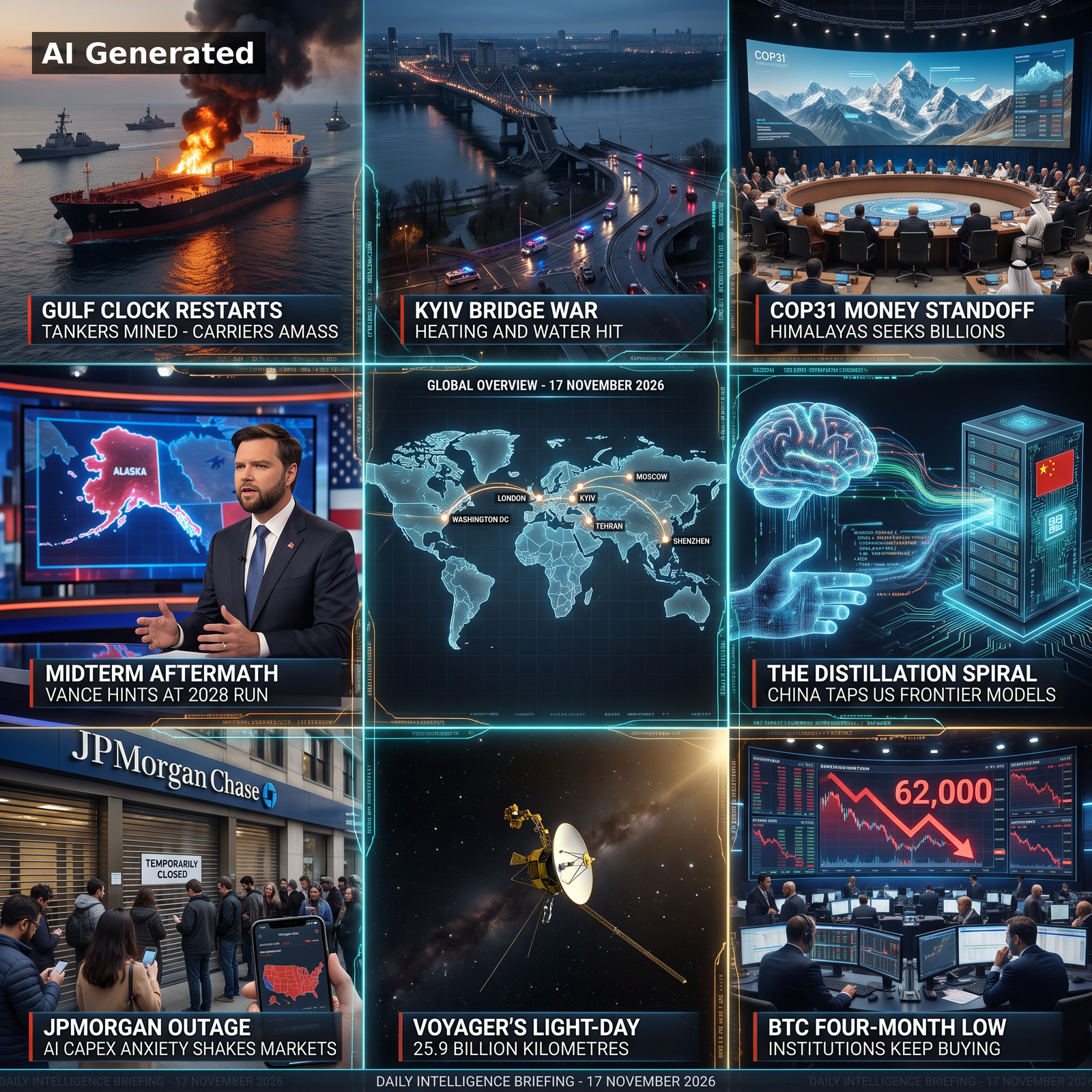
The D170 window opens with the Gulf conflict again testing the escalation ladder this series has tracked since D160. Tanker strikes resumed in the Strait of Hormuz as Iran reported fresh mine damage to commercial shipping, while a separate drone alert at an Iraqi gas field underscored how widely the threat geography has spread beyond the waterway itself[1]. The significant new variable is force posture: CENTCOM formally confirmed that the USS Theodore Roosevelt and its strike group have entered the area of responsibility, completing a three-carrier concentration alongside the George Washington and the George H.W. Bush that the D169 report identified as the critical threshold Washington had been assembling for weeks[2]. The confirmation was choreographed deterrence theatre: the group transited the Malacca Strait with its identification system silenced and remains under radio discipline, letting Tehran verify the navy’s presence but not its coordinates — a psychological-warfare instrument aimed at Iranian threat-assessment cycles as much as at global markets.
Washington’s alignment behind this posture is explicit: Vance declared there is “no daylight” between himself and the President on the war, a statement designed to close the fissures exposed when he blamed the midterm losses on voter frustration with the conflict[3]. The claim of unity matters because the second front is consolidating: Netanyahu, hosting the Czech premier in Jerusalem, warned that “Europe is not a spectator; Europe is a target,” framing Iranian missile ranges, terrorist networks and nuclear ambitions as a continental rather than regional problem[4]. The warning landed as Yemen’s government reported 661 attacks against Houthi positions and 173 casualties while repositioning to defend Aden — evidence that the Bab al-Mandab front D169 described as closing is now a fully synchronised pressure point against Gulf and Red Sea shipping simultaneously[5].
Ukraine’s Bridge War: Kyiv, Kerch and the Air-Defence Arithmetic
Russia’s overnight campaign against Ukrainian critical infrastructure reached the capital itself, with strikes hitting the Northern and Southern bridges over the Dnipro in Kyiv, damaging transit routes and knocking out heating and water services across parts of the city[6]. The attack vindicated the president’s warnings of an imminent missile wave, issued even as European and American negotiators held preparatory peace-framework talks. Ukraine’s response targeted the symbolic and logistical heart of the Russian occupation: the Kerch Bridge was struck twice in less than twenty-four hours, with the second attack confirmed by the Russian-installed head of Crimea and satellite imagery showing an arch damaged and tilted by an estimated 4.9 degrees[7][8]. The Kerch span is Putin’s signature project and the principal artery feeding the Crimean grouping; repeated damage at the same point suggests a shift in Ukrainian strike technology that Russian air defence has not neutralised.
The air war’s physics are also changing in Ukraine’s favour. Russian Su-30SM fighters have been visibly withdrawn from the Donetsk axis, a redeployment driven less by attrition than by the growing vulnerability of parked and transiting aircraft to Ukrainian long-range drones, which have already struck bases in Krasnodar and at Saki in Crimea[9]. Zelensky’s evening address exposed the wider resupply problem: Russia receives “dozens of ballistic missiles a month” from North Korea, which is using the war as a live-fire test range, before appealing to Germany, France, Britain and Italy for comparable weapons[10]. The human ledger remained brutal: the death of Rayana, the sole female fighter of the Chechen Sheikh Mansur battalion and a former Muay Thai instructor, drew tributes across Ukraine’s Muslim community[11]. Meanwhile, questions circulated in Greek and Ukrainian media whether Moscow’s reported policy shift on targeting Zelensky himself marks a genuine doctrinal change or a deliberate ambiguity campaign aimed at Kyiv and its Western backers[12]. On the diplomatic track, European negotiators have for the first time been formally instructing the representatives who will eventually sit opposite Moscow, a sign that the continent is moving from reaction to preparation ahead of any summit-driven ceasefire framework[13].
The Shenzhen Table: Trilateral Diplomacy and the Baltic Anxieties
All roads this week lead to Shenzhen. President Trump departed for Asia for what he billed as historic nuclear and strategic talks, including a planned trilateral with Xi Jinping and Vladimir Putin on nuclear issues and the war in Ukraine[14]. The run-up produced a high-profile bilateral as Canadian Prime Minister Carney met Xi ahead of the APEC summit — their second in-person meeting this year and the clearest signal yet that Beijing is working the summit periphery to lock in trade and diplomatic gains before the main event[15]. Trump further raised the possibility that Kim Jong Un could join the gathering for a “first-ever super summit,” an idea that would transform a trilateral about Iran and Ukraine into a four-power meeting covering the entire nuclear non-proliferation file[16].
The prospect unsettled the Baltic states, which fear a superpower bargain over Ukraine trading away US security guarantees. Estonia will close all three road border crossings with Russia from 1 December, and the concern reached the “coalition of the willing” in Dublin via Germany’s chancellor[17]. Beijing’s messaging is dual: Xi projects an “AI wonderland” of futuristic Shenzhen infrastructure, yet the BBC’s on-the-ground reporting stresses the property slump, youth unemployment and local-debt strains beyond the curated showcase[18]. In the wider Indo-Pacific, Taiwan’s local elections entered their final stretch with both major parties fighting over heartland districts, a vote Washington and Beijing will read as a fresh measure of the island’s political temperature[19].
The Defence-Industrial and Nuclear Ledger
The US defence budget has moved from stalemate to a concrete legislative vehicle: Senate appropriators unveiled a $1.1 trillion Pentagon spending bill that folds nearly $69 billion of White House reconciliation priorities into the base budget — a manoeuvre that protects the build-up from a single reconciliation vote and signals how the post-midterm Congress intends to fund the carrier surge and munitions replenishment simultaneously[20]. Yet the governance gap persists: the Pentagon failed its ninth consecutive audit, even as its comptroller claims a revised audit strategy points toward clean books by 2028[21]. The operational ledger is advancing: the first two F-15EX Eagle IIs arrived at Kadena, the fighter’s first permanent overseas deployment and a high-capacity companion to the stealth fleet; 25 jets are delivered against a programme that has roughly doubled to 267 airframes[22].
Uncrewed systems continue to define the next generation of ground combat: the Marine Corps Warfighting Laboratory is acquiring two Textron RIPSAW M3 robotic ground vehicles as testbeds for payload and sensor integration, part of a broader force-design experiment with 5,000-pound-capable robotic logistics platforms[23]. The Air Force is simultaneously betting on hybrid-electric transport, awarding AFWERX a $4.7 million contract to Flight-test the nine-seat Electra EL9 ultra-STOL aircraft, a platform designed to operate from 150-foot strips under contested-logistics conditions in the Pacific[24]. Nuclear modernisation returned to the spotlight from two directions: a new documentary series aired extremely rare footage of a B61-11 earth-penetrating gravity bomb being loaded onto a B-2’s rotary launcher, while the Senate’s proposed 2027 budget reportedly carries a $77.1 million line for a new bunker-busting weapon designated B94 — the first new US nuclear bomb designation since 1991[25][26]. On the alliance periphery, Macron’s two-day visit to Malaysia seeks to broaden defence and critical-minerals cooperation ahead of the France-Malaysia 70th-anniversary year, while Tokyo protested Russian aircraft incursions near Okinoshima — a reminder that the Pacific flank, not just the Atlantic and Gulf, is absorbing Russian pressure-testing[27][28].
Environment & Climate ↑ Contents
COP31’s Reckoning Week: Finance, Data Centres and the US Return
The climate summit in Antalya enters its decisive phase with the money question unresolved. Nepal, reeling from floods that destroyed entire mountain villages, pressed leaders for billions in dedicated disaster finance for the Himalayas — yet only about $20 million has been pledged, exposing the gap between loss-and-damage rhetoric and disbursement[29]. The energy-policy fight moved into the US Congress in real time: Al Gore warned that the bipartisan Baaja bill to fast-track gas projects and data centres would be a “serious mistake”[30]. A Democratic congressional delegation appeared at COP31 pledging to rebuild US credibility after the midterm sweep — a shift that could restore American weight in negotiations the administration has sidelined[31]. New research estimates the 400 largest US data centres emit as much heat-trapping gas in a year as Denmark, giving the “clean AI pledge” in Antalya its sharpest empirical edge[32]. Field trials of enhanced rock weathering at the University of California’s Sierra Foothill station show how crushed silicate rock on farmland can accelerate CO₂ capture while improving soil chemistry — a land-based wedge complementing industrial carbon removal[33].
The Energy Transition’s Corporate Front: Mergers, Methane and Hydrogen
America’s utility sector faces a structural test as the Virginia State Corporation Commission opens hearings on the Dominion–NextEra merger, which would create the largest utility in US history; the Sierra Club urges rejection on grounds of market-power concentration and weakened clean-energy obligations[34]. Simultaneously, environmental and public-health experts are testifying against the administration’s proposed rollback of federal methane pollution standards, casting the rule change as a direct threat to both the climate ledger and community air quality[35]. Positive signals come from distributed generation: Florida is converting stormwater ponds and other man-made water bodies into floating solar arrays, generating power without consuming scarce land while reducing evaporation — an increasingly cost-competitive model as panel prices fall[36]. The hydrogen economy, meanwhile, is confronting its after-sales reckoning: Cummins has told customers of its Hylyzer electrolysers to stop using the equipment, exposing the fragile economics of green-hydrogen plants once the original equipment manufacturer’s support ends, and raising hard questions about who keeps such infrastructure running over its full lifecycle[37]. In aviation, the DLR-led IGNITE-X campaign is flight-testing an Embraer E195-E2 burning low-sulphur fuel to measure contrail formation, targeting the non-CO₂ climate effects that the sector has only recently begun to price[38]. On the transport-policy side, a coalition of environmental, youth and operator groups is pressing the UK government to place international rail cooperation at the centre of next week’s UK–EU reset summit — a low-cost, high-leverage decarbonisation lever available without new legislation[39].
The Living Ledger: Whales, Wolves, Porpoises and Sacred Tanks
The biodiversity ledger delivered a mix of grief and discovery. Passengers aboard a BC Ferries vessel witnessed the fatal collision with a humpback whale named Notcho in October, an event now used by researchers to examine how ecological grief operates in a society that increasingly perceives individual animals as persons with biographies[40]. On the hopeful side, a University of Minnesota and Hope College study found that blueberry seeds recovered from wolf scat in northern Minnesota germinated at a 96 percent rate — significantly better than seeds taken straight from fruit — identifying wolves as effective long-distance dispersers for boreal berry patches and underscoring how predator populations shape entire ecosystems through their diets[41]. The vaquita’s endgame remains acute: after Mexican authorities in October rolled back no-fishing zones in the Gulf of California, Greenpeace Mexico and other groups filed a court injunction to halt the relaxation, warning that the last roughly ten individuals of the world’s smallest porpoise are one gillnet season from extinction[42]. Urban ecology also featured: in Mumbai, hundreds of fish again died in the sacred Banganga Tank after Pitru Paksha ritual immersions depleted dissolved oxygen — an annual mortality event that activists say has persisted for a decade without institutional remedy[43]. And in Scotland, a LiDAR survey of the Cairngorms counted more than six million trees and found young woodland regenerating across 5,200 hectares of land treeless for centuries, a direct consequence of sustained deer culling that offers one of the clearest demonstrations anywhere of nature-restoration monitoring at landscape scale[44].
Water, Waste and the Industrial Footprint
Transboundary water conflict sharpened in Southeast Asia, where Thailand’s foreign minister visited Naypyidaw to discuss mining pollution contaminating northern Thai rivers — yet the joint working group created by the August bilateral agreement has never met, and civil-society critics argue the accord was systematically weakened by the Myanmar side before it was ever signed[45]. Japan is experimenting with the opposite approach at the municipal level: in Osaki, farmers and local government have installed more than 5,000 small earthen dams in rice paddies to retain floodwater, part of a broader pivot toward “green infrastructure” that recognises abandoned agricultural land as a hidden flood-management asset as climate-driven rainfall intensifies[46]. The legacy-industrial ledger produced one of its largest settlements in years: Rio Tinto agreed to pay $250 million to begin repairing the toxic Panguna copper mine site on Bougainville, abandoned in 1989 after its environmental damage and profit inequity triggered a decade-long civil war — a payment that formally acknowledges the “devastation” the company left behind[47]. In California, communities around the Salton Sea are resisting a congressional fast-track bill that would accelerate geothermal and lithium extraction on their doorstep, questioning who benefits from the clean-energy transition and who absorbs its environmental costs[48]. Finally, a federal review of the wildfire that destroyed a historic lodge and dozens of structures at Grand Canyon National Park faulted leadership failures, poor preparation and communication breakdowns — a governance verdict with direct implications for how the park service manages the fire regime as the West’s flammable seasons lengthen[49].
Society & Civil Issues ↑ Contents
America’s Civic Ledger: Elections, Immigration and the Courts
The post-midterm settlement is taking shape: Vance told Fox News he will decide “sometime next year” whether to run in 2028, promising to be “all in” once decided — an early move shaping the Republican succession question[50]. The Alaska Senate race remains unresolved, with Democrat Mary Peltola ahead of incumbent Dan Sullivan as counting continues and the president claiming Alaskans “chose the wrong Dan Sullivan”[51]. In Alabama, reelected congressman Shomari Figures attributed his survival of a Republican redistricting carve-up to voter fury over affordability and delayed disaster relief rather than party identity[52]. The party is preparing to elect its first Black House speaker, consolidating the shift behind the midterm majority[53]. The administration’s immigration agenda suffered a judicial setback as a federal judge struck down visa restrictions on foreign students and journalists as “arbitrary,” with the government appealing while tightening green-card rules for skilled workers[54][55]. The enforcement front produced a striking symbol: former world boxing champion Jorge Linares was detained by ICE in the United States, a case that fuses the administration’s removal policy with the celebrity-adjacent optics that dominate American media cycles[56]. California honoured labour icon Dolores Huerta at a state-capitol ceremony, recalling the “Í sí, se puede!” cry she carried from the United Farm Workers founding into fifty years of civil-rights advocacy[57].
Germany’s Civic Square: Coalition, SPD and the Protest Law
Berlin’s coalition machinery returns to the centre of German political attention as the “Koalitionsausschuss” meets in the Chancellery amid budget, migration and social-policy disputes that threaten the government’s second-half agenda[58]. The SPD’s leadership question is now openly live: Berlin politician Franziska Giffey is reportedly weighing a joint candidacy for the party chair with labour minister Hubertus Heil, a ticket that would pitch the party’s modernising wing against the Left’s preference for a more combative leader ahead of the February congress[59]. In parallel, the justice minister intervened in the criminal-law debate over protest assemblies, clarifying that merely marching alongside a demonstration does not constitute breach of the peace (“Landfriedensbruch”) — a boundary-setting statement aimed at the heightened protest season around migration and the climate[60].
France’s Republic: Pensions, Migrants, Police and the Campaign
The Senate rejected the government’s proposed deindexation of pensions from inflation, declaring it “unacceptable to penalise two-thirds of pensions,” a defeat that constrains fiscal flexibility and hands the opposition an affordability platform[61]. On migration, Bruno Retailleau continued to harden the conservative position, endorsing return centres for irregular migrants in Rwanda and insisting that “an irregular foreigner must leave” — a stance that frames the campaign’s law-and-order flank[62]. The judiciary supplied its own reckoning: three police officers stand trial for the violent 2020 arrest of music producer Michel Zecler, with testimony from fellow officers failing to soften the prosecution’s case that the videos “speak for themselves”[63]. The candidates met in a Restos du Cœur warehouse for a televised debate on poverty, where Le Pen, Mélenchon, Glucksmann, Attal and Retailleau clashed over wages, housing and social minima[64]. Public-sector anger has a date attached: civil servants are called to mobilise on Tuesday over wages that have stagnated through the inflation cycle, threatening a test of the government’s industrial-relations management during the campaign window[65]. The Francophonie summit in Cambodia ended with the leadership election postponed a year amid DR Congo–Rwanda tension, leaving Secretary-General Louise Mushikiwabo in post as the organisation’s centre of gravity shifts to Africa[66].
The British and Commonwealth Civic Ledger
Prime Minister Burnham used the Lord Mayor’s banquet to argue that isolation caused by Brexit is precisely what the UK’s adversaries want, framing European rapprochement as a national-security question rather than an economic one ahead of next week’s reset summit[67]. The social-reform agenda returns with the publication of Alan Milburn’s long-awaited report on youth unemployment, which is expected to call for a “complete system reset” of employability support amid warnings that a generation is being locked out of the labour market[68]. Consumer-finance scrutiny produced its own warning: Which? calculated that pension “loyalty penalties” — staying with a default provider out of habit — can cost retirees tens of thousands of pounds, reviving the case for automatic switching in long-term savings[69]. Technology is creating new workplace-law frontiers in the Commonwealth: an Australian court heard of the first reported sacking for smartglasses use, after a Toll truck driver photographed equipment at an LPG terminal in what the company deemed an “intrinsically unsafe” incident — a ruling that will resonate well beyond Victoria as wearable computing enters industrial settings[70].
The Global Civic Periphery
Joe Biden’s memoir “Promise Me, America” lands at an awkward tangent to the current German debate about his 2024 decision to stay in the race, recounting his 2020 victory, the advice he took from Mitt Romney, and the tumultuous 2024 exit — a first-person contribution to the historical accounting of the Trump era[71]. In Pakistan, imprisoned former prime minister Imran Khan pleaded for urgent medical care, saying he fears he “may not return alive,” a claim that intensifies the crisis around his detention and the judiciary’s handling of his case[72]. Canada’s education system received a national report card showing consistent pandemic-era learning losses across every province and territory, with grade inflation masking the true scale of the setbacks — a finding with direct policy consequences for curriculum and testing policy[73]. In Greece, the 53rd anniversary of the Athens Polytechnic uprising returned to the centre of public debate, sharpened by controversy over a minister’s remarks about those killed in 1973 and the government’s retreat on building-coefficient changes that had mobilised civil society[74]. In Brazil, Pataxó Indigenous communities occupied a police station in Eunápolis to protest the arrest of vice-chief Uruba Pataxó on drug-trafficking charges that supporters call a political attempt to silence territorial leadership — the latest flashpoint in the long contest between Indigenous land rights and state enforcement in Bahia[75].
AI & Technology ↑ Contents
The Distillation Spiral: China, Export Controls and the Megaspeed File
The week’s defining technology story is the transformation of AI-model distillation from an efficiency technique into a national-security offence. Reuters documents show Chinese developers tapping US frontier models to train domestic rivals as chip-export restrictions bite — using American output as free training data for a competitor barred from buying the silicon[76]. US officials confronted Beijing over the practice at July talks, warning that distillation at this scale amounts to intellectual-property theft, and the enforcement response is now visible on three fronts: Washington is curbing Chinese remote access to AI chips hosted on US infrastructure — the channel the Nvidia scandal exposed — while Treasury and the NSC have reportedly bypassed Commerce to push through new restrictions[77][78][79]. The Commerce angles on enforcement are now documented: Nvidia added the Chinese AI firm Megaspeed to its no-sell list in June 2025, and Commerce investigators sought Nvidia’s records on direct or indirect sales to the company as early as May 2025 — meaning the compliance machinery was already moving months before the CEO scandal became public[80][81].
The Nvidia Aftermath and the Compute Frontier
Nvidia’s immediate governance question is settling: the company has apparently ruled out a return for Jensen Huang, dismissing comeback reports that nonetheless continue to move markets, while the wider chip industry — AMD, Qualcomm and their shareholders — openly calculate what a post-founder Nvidia means for the competitive order[82][83]. Under interim CEO Colette Kress the technical engine runs in parallel with the crisis: Nvidia leads seven MLPerf AI training benchmarks with first Vera Rubin results, and unveiled a quantum error-correction decoder (TCBP-JOBS) that it says accelerates research decoding up to 13,000-fold, cutting design studies from twelve weeks to 45 minutes while deepening its IBM and Fermilab collaboration[84][85]. The same stack is being pointed at science: Nemotron for Science couples open models with GPU-accelerated libraries that cut black-hole image correlation from a month to eight minutes and deliver reported 900-fold speed-ups in single-cell analysis, while Oak Ridge’s Lux supercomputer — 220.79 petaflops, ranked No. 14 on the TOP500 — opened to the DOE’s Genesis Mission[86][87].
The AI Capital Cycle: IPOs, Unplanned Raises and the Cybersecurity Unicorn
The funding layer is pricing in a maturing market. OpenAI’s CFO publicly welcomed the coming Anthropic IPO as a benchmark that would help set the valuation frame for OpenAI’s own eventual listing, while revealing that its own $1.25 trillion valuation raise “wasn’t planned” — an unplanned round that still found ready buyers, evidence that investor demand for frontier equity remains deep even as sentiment cools[88][89]. The fastest ascent belongs to cybersecurity: AI startup Corma reached a $1 billion valuation three months after product launch on a $125 million Series A led by NEA[90].
The Fragility Wave: Outages, Routers and the Complexity Ceiling
The systems-fragility theme that dominated D167–D169 is not abating. Microsoft 365, Outlook and Teams reported fresh service problems within days of the multi-hour global outage, with Downdetector again flagging rising complaints[91]. The FAA affair deepened when the FBI reportedly took the industrial-grade router at the centre of the nationwide ground stop into custody, while network experts publicly doubted the official story that a single device could flood the system — a widening discrepancy between the agency’s explanation and technical reality that analysts are treating as an unresolved incident[92][93]. United Airlines became the third transport operator in a week to suffer a systems failure, delaying 418 departures when pilot-facing applications and weight-and-balance calculations went offline; the airline insists none of the incidents are cyber-related[94]. The pattern is being read systemically: cybersecurity experts caution against doomsday theories but warn that society’s dependence on hyper-connected infrastructure has outrun the resilience of its critical components[95]. Honeywell’s CEO supplied the most precise diagnosis yet, arguing that fifty years of layered automation have made hospitals, refineries and data centres “too complex” for the humans supervising them — and that the industry’s answer, “physical AI,” is itself a bet on machines watching machines[96].
Cybersecurity’s Autonomous Turn and the Justice Front
The threat curve is shifting from opportunistic to autonomous: Google warned that campaigns run end-to-end by AI agents that discover vulnerabilities, write exploits and move laterally without human operators have effectively arrived[97]. The scale of weaponisation is visible in a sprawling malware operation that reportedly implanted credit-card and credential-stealing code across more than 170 major sites, including Zoom, CNN and Fox News[98]. Arion Kurtaj — the Lapsus$ member who leaked 90 Grand Theft Auto VI videos and conducted SIM-swap attacks against BT/EE — pleaded guilty in London, closing one of the highest-profile juvenile-hacker cases in UK legal history[99].
Autonomy at the Edge and the Digital State
Autonomous transport crossed commercial and regulatory thresholds simultaneously. AIR shipped its first runway-free AIR 120D cargo aircraft to Florida for demonstrations — a 550-pound-payload autonomous eVTOL classified by the US Department of War as a Group 4 uncrewed system, and one with obvious contested-logistics applications[100]. Uber added Amazon’s Zoox robotaxis to its app in Las Vegas, bringing boxy driverless vehicles into the mainstream ride-hailing funnel, while Tesla pushed ahead with plans for a $3.3 billion European expansion aimed at producing up to one million Cybercabs — stranded against the inconvenient reality that European regulation has not approved fully driverless operation anywhere near that scale[101][102]. Civic resistance to surveillance autonomy is hardening on American campuses, where students are pushing back against Flock Safety’s license-plate cameras[103]. The state is simultaneously being rebuilt with AI: US design chief Joe Gebbia recounted how a small team digitised the federal retirement application in six months for $1.5 million after two decades and $100 million in failed contractor efforts — the flagship case for the government-wide digital overhaul now being routed through the National Design Studio[104]. Senator John Hickenlooper, fresh from re-election, sketched the post-midterm Democratic line on frontier AI: race China on capability, but regulate the most powerful models with the same seriousness as nuclear weapons and commercial aviation, and put a fence around recursive self-improvement[105].
Economy & Business ↑ Contents
Markets, the AI Bubble Question and Nvidia’s First Post-Founder Quarter
The market’s central anxiety crystallises around a single question: how much of the equity market’s valuation rests on AI capex that has yet to earn its return. A former head of the US securities regulator warned investors to “be well protected against the weather,” predicting the AI bubble will burst[107]. The verdict arrives with Nvidia’s fiscal Q3 earnings on Tuesday, the first report since Jensen Huang’s departure. Consensus expects $109.3 billion in revenue, up 92 percent year-on-year, but the qualitative questions dominate: whether guidance survives without its founder, whether “circular financing” of customers’ debt continues, and whether the Singapore revenue line returns[115]. The analyst framing is blunt — “a complete evaporation of confidence” — making the call the first referendum on the post-Jensen order and, by extension, on the entire AI trade[115].
The Corporate and Banking Ledger
JPMorgan Chase, the largest US bank, suffered a nationwide outage attributed to a software bug in on-premise hardware, disrupting online access, in-person transactions and some Zelle payments before service was restored[113]. The failure completes a week-long cascade — FAA, Microsoft, United Airlines and now the banking system — that has made critical-infrastructure resilience the dominant US economic story of November. Retail and corporate distress elsewhere showed the cycle’s uneven geography: Australian department store David Jones collapsed into administration owing well over $400 million, including $180 million to suppliers and $11 million to staff, with 500 creditors hearing how an 188-year-old chain recorded a $228 million net loss[111]. In Latin America, Panama opened negotiations to restart the giant First Quantum copper mine closed after mass protests — a test of whether resource nationalism can be reversed without reigniting the social conflict that shut the operation[106].
Europe’s Capital-Markets Geography and the Sanctions Ledger
Europe’s IPO divide is widening into a structural story: the head of the Swiss exchange SIX notes twenty listings in Madrid and five in Zurich against a near-drought in Germany and Britain, attributing the divergence to regulation and investor appetite rather than economic fundamentals — a warning that the continent’s capital-markets union remains patchwork[108]. The sanctions ledger produced a discomforting German case: DB Cargo registered as a freight forwarder with the Russian transport ministry as recently as May, potentially channelling hundreds of millions of euros to the Russian state railway despite the war — an exposure that tests the credibility of Europe’s sanctions enforcement apparatus[109].
China’s Debt Machinery and Asia’s Rebound
Beijing’s fiscal engine is restarting at scale: the finance ministry will resume an 80-billion-yuan ten-year bond auction on 24 November, part of the longer-duration issuance programme designed to fund stimulus while lengthening the government’s maturity profile[110]. Foreign investors continue to deepen their yuan exposure, with holdings of interbank yuan bonds reaching 3.23 trillion yuan at the end of October, a measure of resilience in cross-border demand even as Western capital flows remain geopolitically constrained[112]. Asian equities, meanwhile, are repricing the US midterm shock: Indian stocks staged a rapid rebound from election-week volatility as investors bet that a Democratic Congress will moderate trade confrontation with New Delhi[114].
Science & Space ↑ Contents
The Cosmic Ledger: Voyager’s Light-Day, Anomalous Asteroids and Early Black Holes
Voyager 1, the first human-made object to leave the heliosphere, will cross one light-day of distance from Earth on 18 November at 10:16 UTC — 25.9 billion kilometres covered in nearly fifty years, with only two instruments still running as NASA manages the probe’s fading plutonium power[118]. A message sent from Earth now takes a full day to reach it. Closer to home, asteroid 1998 KY26 is confounding astronomers: it moves in ways that gravity alone cannot explain, and after years of observation no mechanism has been identified[122]. Simulations also examined how the black hole powering quasar J0313-1806 reached three billion solar masses when the universe was under 700 million years old, with “productive chaos” in gas accretion a plausible growth channel[126].
The Biomedical Ledger: Microbiomes, Brain Economics and the Research Court
Trinity College Dublin offered fresh evidence on the contested uterine microbiome: in 29 women with unexplained infertility, Lactobacillus-dominated endometrial profiles were associated with successful assisted reproduction, while more diverse profiles correlated with failure[119]. Brain energetics drew revisionist attention: the figure that the brain burns roughly 20 percent of resting calories is remarkably constant across mental states — hard thinking raises neuronal energy use by a few percent at most, and calorie-restricted mice show the cortex “saves energy by reducing coding precision”[121]. The US Supreme Court declined to intervene in a case over terminated research grants, letting lower-court rulings restoring several hundred awards stand[120].
Deep Time and the Archive: Ice-Age Macaques, Ancient Oceans and an Iron-Age Queen
A baby molar recovered at Schöningen shows a young macaque lived in northern Germany more than 300,000 years ago — the northernmost evidence of the species in continental Europe, 1,800 kilometres north of today’s range[128]. Geochemistry is rewriting another chapter: Earth’s most celebrated oxygen milestones may record events in the oceans rather than the atmosphere[124]. British prehistory received a gender shock: Bournemouth University analysis argues that Verica, whose exile helped trigger Rome’s invasion of Britain, may have been a woman[125]. Even wind science is getting a deep-time instrument: researchers are using the grain-size signatures of desert dunes as a proxy barometer for past wind strength, calibrating sand movement to reconstruct palaeo-climate wind fields[117].
Materials, Oceans and Life at the Limits
Materials science took a counterintuitive turn in Japan, where researchers found that simply flipping atom-thin layers upside down can steer heat through stacked computer chips — a low-cost thermal management lever for the vertical integration that will be required as conventional scaling stalls[127]. The flat-optics roadmap advanced in parallel, with nanotechnologists mapping how ultrathin engineered surfaces thinner than a wavelength of light can replace bulk lenses in imaging and sensing systems[123]. In the Arctic Ocean, a bacterium’s genome hints at an unexpected capacity to use sunlight and carbon dioxide in nutrient-poor waters, raising the possibility that similar survival strategies exist in oceans far beyond the poles — a reminder that the biosphere’s metabolic ingenuity continues to outpace laboratory expectation[116].
Crypto, Digital Assets & Blockchain ↑ Contents
Institutional Flows Hold While Price Discovery Fractures
The digital-asset complex is living through its most consequential divergence of the cycle: price discovery has broken to the downside — Bitcoin traded around $62,000, its lowest in four months — while institutional accumulation continues almost without pause[132]. Morgan Stanley increased its stake in BlackRock’s iShares Bitcoin Trust by 18 percent last quarter, from $549 million, one of several disclosures showing the marginal buyer of this sell-off is a regulated balance sheet rather than a retail trader[130]. The on-chain ledger tells a congruent story: Bitcoin’s short-term whale cohort sits on nearly $8 billion in unrealised losses — the largest on record — yet exchange inflows remain contained, suggesting the newest large holders have not rushed to capitulate[132]. That combination — falling price, unmoved holders — is exactly the configuration that precedes either a violent squeeze higher or a delayed but deeper flush, and the Fed’s December rate decision, itself hostage to the Gulf-driven inflation complex documented in earlier reports in this series, is the swing factor[130].
Protocol Mechanics: Tokenised-ETF Rails, Uniswap’s Freeze and Ethereum’s Audit
The capital-markets rails for digital assets are thickening at the product layer. Bitget launched rToken Earn, which allows eligible non-US holders of tokenised ETFs (rSPY and rQQQ) to earn variable on-chain yields without a dedicated DeFi wallet — a step that attaches traditional equity exposure to yield-bearing on-chain plumbing and tests the appetite for wrapping US index products into programmable finance[129]. On Ethereum proper, the governance-adjacent layer produced a notable technical episode: UNI holders saw Uniswap freeze roughly $300,000 in stranded protocol fees and halt automatic token burns, with a proposed auction now designed to raise the UNI claim payment and redirect more value toward the burn mechanism — a subtle re-engineering of fee capture that matters more for protocol incentive design than for any price narrative[131]. The compatibility review process, meanwhile, surfaced a concrete audit finding: developer-published simulations of Juicebox V6 under the “Glamsterdam” rules identified four missed-payment paths in which transactions can skip payments entirely — exactly the class of edge case the Ethereum compatibility review exists to catch before a mainnet activation[134].
The Mining Economy: Difficulty, Downtime and Fleet Refresh
Bitcoin’s automatic difficulty adjustment delivered the clearest market-structure signal of the week: at block 975,744 on 14 November the network cut difficulty by 9.13 percent to 134.82 trillion, the largest easing of the cycle and a direct response to hash-rate contraction as marginal miners powered down under dollar-cost pressure[137]. The adjustment mechanically improves expected returns per hash by roughly 10 percent, but the industry’s real arithmetic is more subtle: miners are responding with capital discipline rather than expansion, as PowerCompute’s third-quarter results show — production up 35.8 percent to 23.9 BTC while revenue fell to $1.9 million on lower average coin prices, with a roughly $1 million order of 600 Antminer S21++ units aimed at lifting active hash-rate by about 10 percent without adding power capacity, all while the company still reports an operating loss and a going-concern disclosure[133]. The mining-sector read-across is unambiguous: the survivors of this consolidation are those with cheap power, efficient fleets and balance-sheet financing[137].
Enforcement and Security: The North-Korean Webcam Scheme and the Malware Injection Front
State-actor crime remains the sector’s most expensive externality. The FBI disclosed that it seized more than 900 webcam recordings used by North Korean hackers to impersonate trusted contacts in a scheme linked to over $400 million in cryptocurrency theft, disrupting the infrastructure of a social-engineering apparatus that has evolved from phishing to deepfake-assisted account takeover[135]. At retail level, security researchers identified a sprawling injection campaign that served credit-card and crypto-stealing malware from more than 178 major websites — including the ledger-hardware vendor Ledger and exchange Coinpass — demonstrating that even crypto-native brands can be weaponised as malware delivery channels when third-party scripts are compromised[136]. The two events anchor the enforcement ledger for the period: billions in organised theft executed through identity forgery on one side, and a low-sophistication but mass-distributed skimming operation on the other — the full spectrum of the security problem that MiCA-era compliance frameworks in the EU and the reinvigorated US enforcement machinery are both being tested against[135][136].
Correlations & Analysis ↑ Contents
The D170 window’s master variable remains what it has been since D164: the Gulf war’s gravitational pull on every other system. D169 closed on the return to direct strikes after a forty-eight-hour naval-mining interlude and on Washington’s assembly of a three-carrier concentration. That configuration is now complete and verified — CENTCOM confirms the Theodore Roosevelt is in its area of responsibility, joining the George Washington and George H.W. Bush with AIS dark, while Iran advertises tanker mine strikes in Hormuz and a drone alert at an Iraqi gas field widens the theatre[1][2]. With government forces reporting 661 attacks and repositioning to defend Aden, the Yemen front validates the D169 correlation that the Gulf and Red Sea pressure points now move as one system[5]. For the oil market and the Fed’s December decision — the inflation constraint D168 identified as binding — the mined-Hormuz-plus-Houthi-Bab-al-Mandab configuration has held for a full cycle without a supply-shock spike, a signal that traders have priced a prolonged, contained conflict as the base case[1].
The second correlation converts the Nvidia affair into a structural test of the US technology-export regime. D169 framed the company as the case study for whether Washington can police its most valuable export while its most powerful firms lobby against enforcement. D170 hardens that frame: Commerce investigators were seeking Nvidia records on Megaspeed by May 2025 and added the firm to the no-sell list a month later, while Treasury and the NSC have now bypassed Commerce to tighten Chinese remote access to AI chips[76][77][79]. Tuesday’s earnings call is therefore no longer merely corporate: it is the first data point on whether revenue, guidance and financing commitments hold together without its founder, and whether the AI capex machine that underwrites the equity complex survives the enforcement era it helped create[115]. The AI-bubble warning from a former US securities-regulator chief adds the valuation question to the same weekly calculus[107].
The third through-line is the institutional-fragility argument this series has built since D161, now with a financial-infrastructure dimension. D167 documented the FAA’s nationwide ground stop; D169 the Microsoft outage and the legitimacy crisis in European public institutions. D170 adds JPMorgan Chase’s nationwide banking outage, United Airlines’ departure-system failure and a fresh Microsoft 365 fault to the same ledger, with the FBI taking the FAA router into custody and experts doubting the official single-device explanation[113][92][96]. Honeywell’s diagnosis — that fifty years of layered automation have exceeded human supervisory capacity — is the clearest engineering statement yet of the thesis: the binding constraint on Western systems is not capacity but the collapse of comprehension at the human-machine boundary. The banking element is the significant new fact: when the largest US bank’s on-premise software fails for hours, the fragility narrative moves from transport and cloud to the payments backbone itself[113].
The fourth correlation runs beneath the surface: the Shenzhen trilateral, scheduled for Thursday, is emerging as the clearing-house for everything else in this report. D169 called it the month’s highest-leverage event; D170 shows the run-up diplomacy working exactly as the poles intend — Xi meeting Carney in Shenzhen, Trump flying to Manila with a possible Kim invitation, the Baltics transmitting fears through the Dublin coalition[14][15][17]. If it produces any framework on Ukraine or nuclear arms, it resolves several open threads: the European negotiator positioning documented today, the Ukrainian anxiety over Starlink-style dependence from D167, and the Baltic security-guarantee question. If it fails, the Gulf escalation and the AI-export war default to their current trajectories.
A fifth correlation links the COP31 fight to the compute build-out: Al Gore’s warning against fast-tracking gas and data centres, the estimate that America’s 400 largest data centres emit as much as Denmark in a year, and the Democratic pledge to restore US climate credibility all arrive in the same window as the Nvidia-driven AI expansion[30][32][31]. The climate ledger and the AI capex cycle are becoming a single policy surface: the energy permitting bill that would accelerate gas supply for data centres is the same legislative vehicle environmentalists are fighting, and both sides are using COP31 as the stage. What to watch in the next reporting period: (1) the Shenzhen trilateral on Thursday and any Kim participation; (2) Nvidia’s earnings call on Tuesday, the Singapore revenue line, and whether Bessent’s ten-day clock produces new enforcement actions; (3) the Gulf’s next 48 hours, specifically any verified exchange around Qeshm and whether the three-carrier posture deters or provokes; (4) the Kyiv–Kerch bridge exchange, where Ukraine’s second strike in under 24 hours suggests a new strike capability that Moscow will be forced to answer; (5) the COP31 electrification negotiation and the methane-rollback hearings; and (6) whether the banking-outage pattern extends, which would force the US payments infrastructure question onto the congressional calendar[8][35].
References ↑ Contents
1. Tankers hit in Strait of Hormuz as drone raises alarm at Iraq gas field · Source ↑
2. CENTCOM announces arrival of USS Theodore Roosevelt in the Persian Gulf by DEFENCE via d k on Inoreader · Source ↑
3. Vance says there's 'no daylight' between him and Trump on the war in Iran by Allan Smith · Source ↑
4. Netanyahu: Europe is not a spectator, Europe is a target by DEFENCE via d k on Inoreader · Source ↑
5. Yemen army reports 661 attacks on Houthis amid Houthi push towards Aden · Source ↑
6. Live: Russian attacks target bridges in Kyiv, knocking out heating and water by FRANCE 24 · Source ↑
7. Ukraine hits Crimea Bridge halting traffic on key crossing to Russia by Suha Kidwai · Source ↑
8. Kerch Bridge Struck For The Second Time In Less Than 24 Hours: Russia by Howard Altman · Source ↑
9. The Russians 'disappeared' the Su-30SM from Donetsk and there is a reason for that by DEFENCE via d k on Inoreader · Source ↑
10. Zelensky: Russia receives dozens of ballistic missiles every month from North Korea by DEFENCE via d k on Inoreader · Source ↑
11. Rayana dead: why so much noise about her elimination by DEFENCE via d k on Inoreader · Source ↑
12. Has Russia changed its policy on the assassination of Zelensky? by Greece via d k on Inoreader · Source ↑
13. War against Ukraine: Europe's negotiators move into position by Germany via d k on Inoreader · Source ↑
14. Trump heads to Asia for historic nuclear talks with China and Russia by FRANCE 24 · Source ↑
15. Carney meets with President Xi in Shenzhen, China ahead of APEC summit by Globalnews Digital · Source ↑
16. Trump says Kim Jong Un may join him, Putin and Xi for first-ever super summit by Jessie Williams · Source ↑
17. 'What if they persuade him?': The 3 countries that fear the historic trilateral meeting by DEFENCE via d k on Inoreader · Source ↑
18. China is hosting the world's leaders in its AI wonderland. Here's what they won't see · Source ↑
19. Taiwan elections enter home stretch as parties fight for heartlands by Business via d k on Inoreader · Source ↑
20. Senate appropriators unveil $1.1T Pentagon spending bill, folding in reconciliation priorities by Ashley Roque, Michael Marrow and Carley Welch · Source ↑
21. Pentagon fails 9th audit, asserts path towards clean books in 2028 by Ashley Roque · Source ↑
22. First F-15EXs Arrive At Kadena Air Base In Japan, 25 Now Delivered To The USAF by Joseph Trevithick · Source ↑
23. US' uncrewed warfare capabilities to get boost with robotic vehicle that offers 5,000-lb payload capacity by Prabhat Ranjan Mishra · Source ↑
24. Air Force bets on hybrid-electric aircraft for transport by Lauren C. Williams · Source ↑
25. Rare Footage Shows B61 Nuclear Bomb on B-2 Stealth Bomber's Rotary Launcher by David Cenciotti · Source ↑
26. The US is building a new nuclear bomb to level underground bunkers by DEFENCE via d k on Inoreader · Source ↑
27. Macron visits Malaysia as France seeks closer defence and rare earths ties by FRANCE 24 · Source ↑
28. Japan beklagt Verletzung seines Luftraums durch russische Flugzeuge · Source ↑
29. At COP31, Nepal pushes for billions to help disaster survivors. So far, $20 million is promised by Niranjan Shrestha,Victoria Milko and Sibi Arasu · Source ↑
30. Passing bill to speed up gas projects and data centers would be 'serious mistake', Al Gore says by EHN Curators · Source ↑
31. Democrats signal US return to global climate talks by EHN Curators · Source ↑
32. Study estimates magnitude of US data center pollution as climate talks unveil clean AI pledge by EHN Curators · Source ↑
33. How enhanced rock weathering can speed up carbon capture by Science & Space via d k on Inoreader · Source ↑
34. As Hearings Begin, Sierra Club Virginia Calls for the SCC to Stop the Dominion NextEra Merger by Sierra Club · Source ↑
35. Environmental, Public Health Experts Testify During Public Hearings on Methane Pollution Rollback Proposal by Sierra Club · Source ↑
36. Florida's stormwater ponds become floating solar farms as costs fall and demand rises by Aya Diab · Source ↑
37. Cummins Told Electrolyser Customers to Stop. Who Keeps the Hydrogen Plants Running? by Michael Barnard · Source ↑
38. Embraer supports IGNITE-X research to advance more sustainable aviation through contrail reduction studies · Source ↑
39. Joint Letter Calling for International Rail to Be Central to the UK-EU Reset · Source ↑
40. Mourning Notcho: What one whale's death teaches us about ecological grief by Science & Space via d k on Inoreader · Source ↑
41. Wolves in northern Minnesota leave blueberry seeds in their scat, and when scientists planted them 96 percent sprouted by Adrian Villellas · Source ↑
42. Environmental groups challenge Mexico's rollback of protections for world's smallest porpoise by Bobbybascomb · Source ↑
43. Fish pay the price for sacred rituals at Mumbai's Banganga Tank by Shreya Dasgupta · Source ↑
44. A light aircraft scanning Scotland's Cairngorms with lasers counted more than 6 million trees by Adrian Villellas · Source ↑
45. Thailand-Myanmar river pollution agreement was weakened, then signed. China remains silent by Isabel Esterman · Source ↑
46. The power of the paddy: Japan looks to rice fields to help mitigate flooding by Nandithachandraprakash · Source ↑
47. Rio Tinto agrees to pay US$250m to begin repairing 'devastation' left by Panguna mine by Ben Doherty · Source ↑
48. Salton Sea communities push back on bill to fast-track development by EHN Curators · Source ↑
49. Federal review faults leadership failures in Grand Canyon fire that destroyed lodge by Susan Montoya Bryan · Source ↑
50. Vance says he will decide 'sometime next year' about 2028 US presidential run · Source ↑
51. Trump says Alaska voters chose the wrong Dan Sullivan. What does the data show? · Source ↑
52. How a Black Democrat Survived Redistricting in Alabama by Lee Hedgepeth · Source ↑
53. Aux États-Unis, les démocrates s'apprêtent à voter pour le premier président noir de la Chambre des représentants by France via d k on Inoreader · Source ↑
54. États-Unis : un juge annule les limites de visa pour étudiants et journalistes, Trump fait appel by FRANCE 24 · Source ↑
55. +++ USA unter Trump +++: Trumps Zustimmung verharrt laut Umfrage auf Tiefstand – Schumer verliert an Rückhalt by Redaktion Handelsblatt · Source ↑
56. « Complètement fou » : l'ex-champion du monde de boxe Jorge Linares est détenu par l'ICE aux États-Unis by France via d k on Inoreader · Source ↑
57. Dolores Huerta honored in ceremony at California state capitol by Associated Press · Source ↑
58. Spitzentreffen im Kanzleramt: Darum geht es im Koalitionsausschuss by DIE ZEIT: News – · Source ↑
59. Deutschland Liveblog: Franziska Giffey erwägt offenbar gemeinsame Kandidatur mit Heil by Germany via d k on Inoreader · Source ↑
60. Landfriedensbruch: Justizministerin: Bloßes Mitmarschieren ist nicht strafbar by DIE ZEIT: News – · Source ↑
61. « Insupportable de pénaliser deux tiers des pensions » : le Sénat rejette la désindexation des retraites sur l'inflation by France via d k on Inoreader · Source ↑
62. « Un étranger en situation irrégulière doit partir » : Bruno Retailleau en faveur du centre de retour pour migrants au Rwanda by France via d k on Inoreader · Source ↑
63. Au procès de l'interpellation violente de Michel Zecler par des policiers : « Les vidéos parlent d'elles-mêmes » by France via d k on Inoreader · Source ↑
64. Associations, salaires, logement… Sur la pauvreté, un débat riche en clivages by Frantz Durupt, Anne-Sophie Lechevallier · Source ↑
65. « Je ne pars pas en vacances » : la colère des fonctionnaires, appelés à se mobiliser ce mardi by France via d k on Inoreader · Source ↑
66. Francophonie : l'avenir du français se joue-t-il en Afrique ? by Cécile GALLUCCIO · Source ↑
67. Isolation caused by Brexit is what our enemies want, says Burnham in major speech by Alex Croft · Source ↑
68. Milburn calls for 'complete system reset' to tackle youth unemployment by Y. Áine Fox · Source ↑
69. Retirees warned that pension 'loyalty penalty' could cost thousands of pounds by Vicky Shaw · Source ↑
70. Truck driver fired for 'unsafe' use of smartglasses in first reported sacking over device in Australia by Josh Taylor Technology reporter · Source ↑
71. The advice Biden got from Mitt Romney, and other takeaways from his memoir by NEWS via d k on Inoreader · Source ↑
72. Imran Khan seeks urgent medical care fearing he 'may not return alive' · Source ↑
73. Report finds consistent pandemic learning loss and gaps between grades and test scores across Canada by Science & Space via d k on Inoreader · Source ↑
74. 5 το πρωί: 53 χρόνια από το Πολυτεχνείο by Μανιαδάκη Κατερίνα · Source ↑
75. Pataxó Indigenous people protest the arrest of a female vice-chief in Brazil's Bahia by Bobbybascomb · Source ↑
76. Exclusive-China taps US AI models to train homegrown rivals as chip curbs bite by Reuters · Source ↑
77. FinancialJuice: US officials confronted China over AI distillation at July talks, warning of possible intellectual property theft · Source ↑
78. US moves to curb China's remote access to AI chips after Nvidia scandal by Business via d k on Inoreader · Source ↑
79. Treasury, NSC bypass Commerce to restrict Chinese AI-chip access by Estefano Gomez · Source ↑
80. FinancialJuice: US Department of Commerce: Nvidia added Megaspeed to its no-sell list in June 2025 · Source ↑
81. FinancialJuice: US Department of Commerce: Investigators sought Nvidia records on direct or indirect sales to Megaspeed in May 2025 · Source ↑
82. Nvidia: Konzern schließt Rückkehr von Jensen Huang offenbar aus · Source ↑
83. Nach Huang-Affäre: Bald alles neu in der KI-Chipindustrie? by Germany via d k on Inoreader · Source ↑
84. Nvidia leads seven AI training benchmarks with Vera Rubin results by Diego Almada Lopez · Source ↑
85. NVIDIA claims 13,000x faster decoding for practical quantum computing research by Neetika Walter · Source ↑
86. NVIDIA speeds up cell analysis 900x, cuts black-hole data correlation to 8 minutes by Neetika Walter · Source ↑
87. Oak Ridge's Lux supercomputer breaks into world's top 15 to advance US Genesis Mission by Neetika Walter · Source ↑
88. OpenAI CFO sees Anthropic IPO as beneficial for future valuation by Estefano Gomez · Source ↑
89. OpenAI CFO Sarah Friar says a raise at a $1.25T valuation wasn't planned by Estefano Gomez · Source ↑
90. Cybersecurity AI startup Corma reaches $1B valuation in about 3 months by Julie Bort · Source ↑
91. Is Microsoft Outlook, Teams and Microsoft 365 Down Today Again? by Anjali Belgaumkar · Source ↑
92. FBI Reportedly Takes Problem FAA Router Into Custody by Mike Pearl · Source ↑
93. Did a Single Router Ground the Nation's Flights? Experts Express Doubt by Joe Supan · Source ↑
94. United Airlines system outage disrupts departures, leaving 418 flights delayed by Aamir Khollam · Source ↑
95. First Microsoft, then airplanes, now the banks. How worried should you be over rash of systems going down? by Rachel Dobkin · Source ↑
96. Honeywell Technologies CEO says 50 years of automation have gotten too complex for the humans running it by Nick Lichtenberg · Source ↑
97. Google warns autonomous cyberattacks have arrived by Diego Almada Lopez · Source ↑
98. Sprawling Malware Attack Reportedly Affects Zoom, CNN, Fox News, Peacock, and 170+ Others by Mike Pearl · Source ↑
99. Hacker behind 2022 GTA VI leaks pleads guilty by Jay Peters · Source ↑
100. Runway-free autonomous cargo aircraft carries 550 pounds without a pilot onboard by Aamir Khollam · Source ↑
101. Uber Adds Zoox's Robotaxis to Its App. Everything To Know by Abrar Al-Heeti · Source ↑
102. Tesla Wants to Build 1 Million Cybercabs in Europe. There's Just One Problem. by Bruce Gil · Source ↑
103. School Campuses Emerge as the Latest Battleground for Flock Safety Cameras by Omar Gallaga · Source ↑
104. How Airbnb cofounder and US Design Chief Joe Gebbia fixed a $100 million government problem for $1.5 million by Tatiana Sataua · Source ↑
105. Newly reelected Sen. John Hickenlooper sketches Democrats' AI line: race China, but regulate frontier models like nuclear weapons and airplanes by Catherina Gioino · Source ↑
106. Παναμάς: Ξεκινούν διαπραγματεύσεις για την επαναλειτουργία πελώριου χαλκωρυχείου by Greece via d k on Inoreader · Source ↑
107. « Soyez bien protégés contre les intempéries » : l'ancien chef du gendarme boursier des États-Unis prédit l'éclatement de la bulle de l'IA by France via d k on Inoreader · Source ↑
108. Schweizer Börse: «Die IPO-Schwäche ist eher ein deutsches und britisches Phänomen» by Jakob Blume · Source ↑
109. Sanktionen: 400 Millionen für Moskau: Wie die DB Cargo weiter Geschäfte in Russland macht by Jan Lutz · Source ↑
110. China finance ministry: to restart 80 bln yuan 10-year bond auction on Nov 24 · Source ↑
111. David Jones' total debt is over $400m including millions owed to staff, administrators confirm by Jonathan Barrett Business editor · Source ↑
112. Foreign holdings of yuan bonds in China's interbank market reached 3.23 trillion yuan at end-October: PBOC Shanghai office · Source ↑
113. Chase bank hit with nationwide outage by NEWS via d k on Inoreader · Source ↑
114. Indian stocks stage rapid rebound after US midterms by Business via d k on Inoreader · Source ↑
115. 'A complete evaporation of confidence' – 6 critical things Nvidia, and interim CEO Colette Kress, need to nail on the first Jensen-free earnings call by Amanda Gerut · Source ↑
116. Arctic Bacteria May Be Using Sunlight and CO2 in a Way Scientists Never Expected by Concordia University · Source ↑
117. Dünen-Tacho: Forscher nutzen Wüstensand als Anzeige für Windstärke by DIE ZEIT: News – · Source ↑
118. Voyager 1 Has Traveled Through Space at 38,000 Mph Since 1977. This Wednesday, It Will Finally Reach 1 Light-Day From Earth. by Fiona MacDonald · Source ↑
119. The Uterus May Have an Overlooked Microbiome, And It Could Affect Pregnancy by Carly Cassella · Source ↑
120. US Supreme Court rebuffs White House effort to cut research grants by Max Kozlov · Source ↑
121. Your brain is only about 2 percent of your body weight but uses about 20 percent of the calories your body burns at rest by Sanchana Charles · Source ↑
122. Scientists Are Stumped by This Strange Object in Space by Alexander Nazaryan · Source ↑
123. Flat optics roadmap charts path toward smaller imaging and sensing systems by Science & Space via d k on Inoreader · Source ↑
124. Earth's Ancient Oceans May Have Fooled Scientists About the Rise of Oxygen by Innovation Press · Source ↑
125. Rewriting History: New Research Reveals Ancient Iron Age King May Have Been a Woman by Bournemouth University · Source ↑
126. Early black holes may have grown through productive chaos by Science & Space via d k on Inoreader · Source ↑
127. Flip side: Upside-down atomic layers could steer heat in stacked computer chips by Science & Space via d k on Inoreader · Source ↑
128. A macaque tooth from northern Germany shows monkeys lived there more than 300,000 years ago by ECONEWS · Source ↑
129. Bitget Launches rToken Earn to Unlock Onchain Yield for rSPY and rQQQ Holders by Kritika Mehta · Source ↑
130. Corporate Bitcoin Buying Persists Amid BTC Price Selloff by Steve Muchoki · Source ↑
131. Uniswap freezes $300,000 in stranded fees, halting automatic token burns by Liam ‘Akiba’ Wright · Source ↑
132. Bitcoin Whales Sit on Record $8 Billion Losses—but They Aren't Selling by Emmanuel Musa · Source ↑
133. PowerCompute Orders 600 New Bitcoin Miners as Higher Output Meets Lower Revenue by NewsBTC Editorial Team · Source ↑
134. Ethereum test exposes flaw that lets transactions skip payments by Liam ‘Akiba’ Wright · Source ↑
135. FBI Seizes 900+ Webcam Videos in $400M North Korean Crypto Crime Scheme by Kevin Helms · Source ↑
136. Hackers inject credit card, crypto-stealing malware into 178 major websites · Source ↑
137. Bitcoin Mining Difficulty Falls 9.13%, Giving Active Miners Some Breathing Room by NewsBTC Editorial Team · Source ↑
AI Disclosure: This post was created with the assistance of artificial intelligence. The ideas, analysis, and opinions expressed are my own — AI was used to help compose, structure, and refine my personal notes and thoughts into the final written content. Images, videos and music featured in this post were also generated using AI tools, based on my own creative prompts and direction.