

Contents
- 1. Geopolitics & Defence
- 2. Environment & Climate
- 3. Society & Civil Issues
- 4. AI & Technology
- 5. Economy & Business
- 6. Science & Space
- 7. Crypto, Digital Assets & Blockchain
- 8. Correlations & Analysis
- 9. References
Click any heading to jump to that section. Click the section heading to return to this menu.
Geopolitics & Defence ↑ Contents
The Gulf Clock: Tehran’s Counters and the Undersea Threat
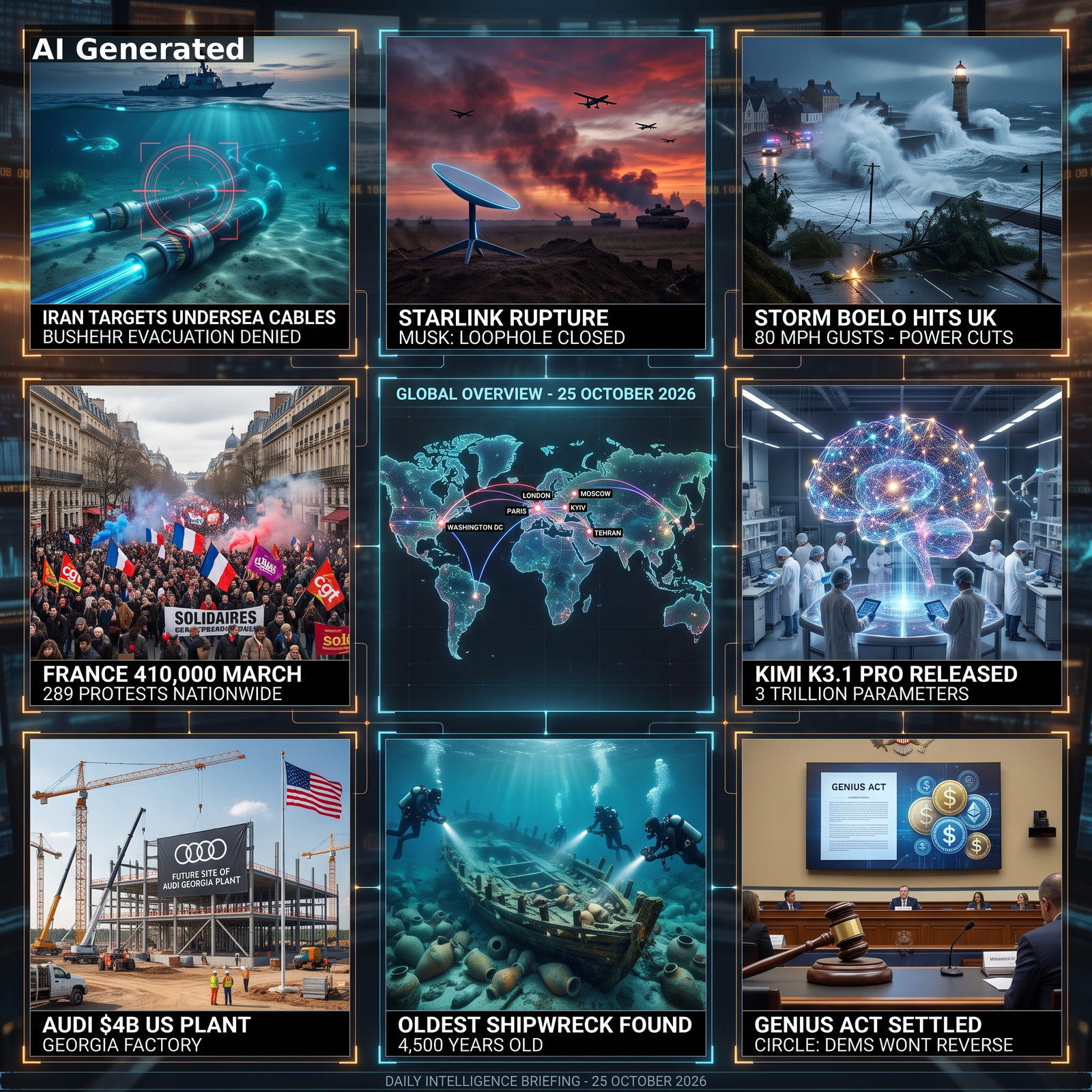
The Gulf file hardened through the weekend as Washington’s signals stayed deliberately ambiguous. Moscow denied any plan to evacuate its specialists from the Bushehr nuclear plant, insisting work continues normally and that the evacuation reports circulating across Western media are “fakes”[1]. More consequential, Reuters reported Tehran is preparing to strike undersea internet cables in response to any new American or Israeli offensive — a contingency that would carry a regional war into the global financial and communications systems far beyond the Middle East[2]. Iran cannot match the United States conventionally, but it can hold hostage the infrastructure layer on which the world’s banks and governments depend.
The economic instruments were already visible. Iran cut liquefied petroleum gas exports to Pakistan after Islamabad closed its border under American pressure, lifting the price of a twelve-kilogram cylinder from about 4,500 to 7,000 rupees and exposing Pakistani dependence on Iranian supply for roughly half its LPG imports[3]. In Hormuz, a very large crude carrier under Emirati connection was reportedly struck by Iranian fire as it exited the strait[4], and an oil slick from a tanker hit earlier in the month drifted toward the Naqa’a desalination plant that supplies water to roughly two million people in the northern emirates, forcing beach closures and containment work[5]. What D146 framed as a countdown is now producing decisions that treat escalation as the working assumption.
The Houthi-Saudi Arc and the Red Sea Front
Yemen’s Houthis escalated their missile campaign against Saudi Arabia to an intensity unseen in this phase of the war. Saudi civil defence intercepted two ballistic missiles and found debris in the Mecca-Medina region, with fragments reportedly landing less than twenty kilometres from the Grand Mosque; the Houthis denied targeting the holy cities and insisted their strikes were aimed at Aramco facilities and airports[6]. Video showed smoke rising from an Aramco site near Tabuk, alongside declared attacks on the King Khalid airport in Riyadh, King Fahd at Dammam, Najran and the Khamis Mushait airbase[7]. The group also announced missile strikes on the al-Nasr camp and a naval base in Aden, seat of the internationally recognised government[8]; the Saudi-led coalition confirmed intercepting at least two projectiles[9].
The barrage’s meaning is twofold. The Houthis are demonstrating range that reaches from the Red Sea to the Saudi interior, complicating any assumption the kingdom stays insulated from the wider Iran war. And the escalation arrives as Riyadh prepares to resume commercial operations at its main airport, which now carries an explicit security caveat. The pattern matches the D145-D146 finding that the Gulf’s defensive arithmetic has been inverted: the more Saudi Arabia invests in interception, the more the Houthis target civilian nodes.
Israel, the West Bank and a Pivotal Election
Israel’s Tuesday election will be held under acute tension. The military announced a lockdown across the occupied West Bank on polling day, barring Palestinian workers and closing land crossings, after weekend operations in roughly forty areas detained around forty Hamas and Islamic Jihad suspects[10]. The Hebron operation following the killing of two soldiers has already displaced thousands: the municipality counted about 1,200 Palestinians forced from their homes in Deir Baha, with the mayor warning a further 1,300 may be expelled, as residents described homes marked and demolished and families with no connection to the attack swept up[11]. The Palestinian Authority called it collective punishment, and the timing — days before a security-focused election — fuels accusations the campaign is as much about settlers’ votes as about militant cells.
Inside Israel, tens of thousands rallied in Tel Aviv against Benjamin Netanyahu in the campaign’s largest demonstration, with hostages’ families and Gadi Eisenkot demanding a state commission of inquiry into the October 7 failures[12]. The region deteriorated in parallel: the death toll from Friday’s attack on a Greek Orthodox church in Karak, Jordan rose to nine[13]. An unresolved West Bank campaign and an election fought over security make Tuesday a hinge for the Middle East file tracked since D138.
Ukraine’s Deep Strikes and the Starlink Rupture
The Starlink dispute moved from silent throttle to public rupture. Elon Musk accused the Ukrainian military of violating the service’s terms of use by using it for offensive drone strikes “to kill people,” claimed the loophole had been closed the previous week, and warned that were Starlink switched off the front line would collapse immediately — adding this was “not a threat”[14]. The episode completes the arc D142-D146 tracked: the collapse of announcement and event has reached the private infrastructure on which a European war depends, and the Greek press has framed it as evidence of Europe’s dependence on American satellite constellations[15].
The kinetic front showed no de-escalation. Russian strikes killed at least four people across Dnipropetrovsk and Kharkiv overnight[16]. Ukrainian drones struck the Omsky Kauchuk petrochemical plant in Omsk and an Ozon logistics hub in the same city — the second hit on a synthetic-rubber plant that day after a strike on Tolyattikauchuk in the Samara region[17]. The RAF scrambled to a distress alert from a Russian-linked tanker in the North Atlantic, a reminder that the shadow-fleet era has made every sea lane a potential incident site[18], and Britain and France conducted their largest airborne exercise in decades, dropping some 600 paratroopers in a 2,500-person drill framed around the Russian threat[19].
The Periphery’s Election Weekend and the Border Fronts
Three elections dominated the weekend. Brazil’s run-off between Lula and Flávio Bolsonaro was deadlocked at 51-49 in eve-of-poll surveys, with the economy the decisive battleground[20]. Bulgaria’s presidential vote ran under the shadow of Black Sea drone strikes on shipping, with socialist-backed Iliana Yotova leading on a platform of negotiating an end to the war against Atlanticist Andrey Gyurov[21]. Serbia’s snap election pitted the long-ruling Aleksandar Vucic — who resigned the presidency to seek the premiership — against the student movement Studentska Lista born from the Novi Sad canopy collapse protests[22]. Slovak regional elections completed the calendar as a signal ahead of next year’s parliamentary vote[23].
Beyond Europe, more than fifty people were killed in attacks on a camp in Mali[24] and at least twenty in a “bandit” attack in Nigeria’s north-east[25]. El Salvador’s Nayib Bukele denied that remains handed over at Haiti’s airport were those of four missing Salvadorans[26], and Aung San Suu Kyi’s son said the detained Nobel laureate is “sounding strong” but held in near-total isolation, calling the first call in five years a junta public-relations exercise[27]. On the Himalayan border, Indian sources told The Hindu that Chinese troops have pitched tents six to seven kilometres inside what New Delhi considers its territory in Arunachal Pradesh near Taksing, while India raises drone platoons and builds underground shelters[28]. Kim Jong Un made a rare day-trip to China to lay a wreath in Dandong for Korean War dead — a symbolic reaffirmation of the alliance at a moment of regional realignment[29].
The Defence-Industrial Base and the New Arsenal
Procurement reshaped the security map. Peru moved to acquire American MQ-9 Reaper drones for Amazon surveillance, citing the narcotics trade[30], and bought a Thales Ground Master 400 Alpha radar as part of a build-up including F-16 Block 70s[31]. Analysts argued Brazil could help fill Argentina’s submarine gap, deepening continental defence integration[32], while L3Harris confirmed it supplies power systems for the Virginia- and Columbia-class submarines at the heart of the American deterrent[33]. Kongsberg demonstrated a containerised Naval Strike Missile module fitting four canisters in a standard shipping container, deployable from trucks, ships or the ground[34]. Chinese designers proposed embedding early-warning radar inside aircraft wings for distributed coverage[35], and Colombian researchers presented a curved wing that could add fifty minutes of endurance to military drones[36]. Together these confirm the D146 trend: platforms are becoming modular, containerised and distributed.
Environment & Climate ↑ Contents
Storms and the Autumn Ledger
The United Kingdom spent the weekend under Storm Boelo, which brought 80 mph gusts, flooding, power cuts and a series of amber warnings covering much of the country, with the Met Office warning households across dozens of areas to prepare for outages as the system tore through[37]. The storm is the latest entry in an autumn ledger that this report has tracked since D144, in which each named system arrives against the background of a climate whose extremes are compounding. Far to the south, a magnitude 6.2 earthquake struck off the coast of Vanuatu, a reminder that the natural-disaster ledger is not confined to the North Atlantic[38].
The economic accounting of the summer’s heat became clearer with new data estimating that Europe’s 2026 heatwaves cost the continent’s GDP 17 billion euros and were associated with roughly 50,000 deaths — a loss two and a half times the average for comparable periods in the previous decade[39]. The figure matters less as a precise number than as evidence that climate impacts are now a first-order macroeconomic variable in Europe, not a distant externality. Analysts argued in parallel that the war on Iran has structurally broken the oil market’s normal mechanics, with failure points multiplying beyond Hormuz — including Bab al-Mandeb, the East-West pipeline and global refinery capacity — even as the market showed surprising resilience[40]. That resilience, however, rests on assumptions about demand that one analysis warns are being frozen into transition plans: energy-transition planners keep extrapolating today’s demand curves into tomorrow, which can make weak solutions and oversized investments look compelling[41].
Regulation’s Rollback and the Transition’s Arithmetic
Two regulatory fronts moved against the pace of decarbonisation this week. Canada and the European Union both signalled further slippage on vehicle-emission standards, with deadlines being deferred even as scientific pressure to cut transport emissions intensifies[42]. At the same time, a coalition of 57 countries calling itself the “coalition of the willing” advanced a roadmap for winding down fossil fuels, an initiative supporters argue can still grow despite obvious political headwinds[43]. The contradiction between these two signals — weaker near-term rules in the industrial core, stronger multilateral ambition at the margins — is characteristic of the moment: climate policy is being contested at the level of instruments even as the physical ledger deteriorates.
The physical ledger produced its own warnings. New research on uranium tailings at Australia’s Mount Painter mine found that microbes are mobilising uranium and rare-earth elements to the surface of waste piles once assumed safely locked away, converting them into colloidal forms that rain can carry into surrounding ecosystems — a finding with direct implications for how the mining industry must manage waste as demand for critical minerals surges[44]. In the United States, a study of 1.8 million drinking-water measurements concluded that conventional reporting understates PFAS concentrations by more than half, because results below laboratory limits are treated as zero when they are merely unquantified[45]. And in Beijing, concentrations of sulphur hexafluoride — the most potent greenhouse gas in existence — are surging even as other pollutants plateau or decline, driven by the expansion of the electric grid and the semiconductor industry[46].
The Living Ledger and the Biodiversity Question
Biodiversity governance advanced on multiple fronts. The California condor’s recovery from three decades ago — when the last wild bird was captured and the species declared extinct in the wild, only to be rebuilt to more than 300 birds today — offers a working example of how a global biodiversity treaty might decide which species to save and who should have a say[47]. The harder cases were visible in Asia: gibbon trafficking seizures hit an all-time high in 2025, with 336 individuals recorded between January and August alone, each capture often representing the annihilation of an entire family group[48], while Sri Lanka mourned the death of Kavantissa, one of its most iconic wild tuskers, after a gunshot injury, triggering an extraordinary wave of public grief and renewed calls to address human-elephant conflict[49].
On the energy-climate interface, a small Bavarian ski area at Kolben in Oberammergau became the latest casualty of the warming winters, ending fifteen years of winter operations after losses of more than a million euros in three seasons, with operators citing rain instead of snow and ever-shorter windows for snowmaking[50]. In the North Sea, the fate of the Rosebank oil field remained a political storm, with life on board the vessel awaiting its verdict as the UK government weighs its licensing future[51]. In the United States, new polling showed Black voters overwhelmingly rank the cost of living above climate among their voting priorities, yet a large majority still want elected officials to treat climate action as important — a gap between abstraction and lived cost that organisers increasingly see as the central challenge of climate politics[52]. The regulatory and data fronts were also active: a community-science project in North Carolina is mapping the previously secret locations of industrial poultry farms, a data gap the state has long resisted closing despite documented odour and water complaints[53], while in Germany prosecutors now count more than forty suspects in the “Boden NRW” toxic-waste scandal, in which polluted soil was illegally dumped across the state, including in the Garzweiler open-cast mine[54]. Finally, an intriguing idea is taking root in Poland’s Bialowieza Forest, where scientists argue that restoring the 12,000-year-old forest’s wetlands and rivers could both revive the ecosystem and create a natural military barrier against any ground advance from Belarus — a “warwilding” strategy the Polish military is taking seriously[55].
Society & Civil Issues ↑ Contents
France’s October: The Republic and the Street
France experienced its largest single day of mobilisation since the October 17 riots, with the Interior Ministry counting 410,000 people in 289 protests nationwide and the CGT union estimating nearly 800,000, as students, teachers and workers marched over school funding, teacher shortages, wages and the cost of living[56]. The day was mostly peaceful, but clashes erupted at the end of the Paris march at Porte de Vincennes and in Lyon, Marseille, Nantes and Nice, where far-right groups fought with demonstrators, and police made close to a thousand arrests; shopkeepers boarded up storefronts across the capital, Art Basel cancelled its weekend programme, and organisers announced a further mobilisation for 31 October[56]. The political scientist Jérôme Fourquet argues in a new book that the high-school protests illustrate a genuine anthropological and psychological shift in the West — a transformation in how young people relate to institutions, authority and the state that outlasts any single government[57]. The episode also exposed the state’s willingness to reach for digital instruments: investigative outlet Blast reported that the prime minister’s office asked France’s four main telecom operators to prepare the technical infrastructure for a temporary shutdown of TikTok, Instagram, Snapchat and X over the protest weekend, a step whose legality the Council of State’s earlier ruling on New Caledonia would likely test[58]. Beyond France, Gabon’s decision to restore social media after eight months of suspension — while simultaneously making formal identification mandatory for all users and ending online anonymity — showed how the same digital-control playbook is spreading across the Francophone world[59].
The American Midterm Crucible
The midterm campaign entered its final ten days with the institutions of the election itself under strain. Donald Trump cast his early ballot in Florida while continuing to attack Democrats and to agitate the spectre of electoral fraud, a message that Democrats are seeking to counterpoint with a focus on process and courts[60]. The ground war intensified: Barack Obama rallied in Detroit for Michigan Senate nominee Abdul El-Sayed, betting that the state’s substantial Black vote will decide a contest the Democrats cannot afford to lose[61], while in Ohio, Democrat Amy Acton pushed back after a Ramaswamy attack ad, telling Trump and Vance to “look at the facts” at a rally alongside the former president[62]. The legal front produced its own flashpoint: Senate Democrats and Alaska’s Mary Peltola moved to dismiss the Trump administration’s lawsuit seeking to block certification of the Alaska Senate race should Republican incumbent Dan Sullivan lose, an attempt to pre-empt a post-election constitutional confrontation[63]. Against that backdrop, a shooting near a university stadium in Florida with multiple reported victims returned the gun question to the national conversation in the campaign’s closing days[64].
Britain’s Civic Ledger: Housing, Mobility and the State’s Reach
The British civic file turned on housing and the state’s capacity to deliver. Greater Manchester mayor Andy Burnham reopened the Brexit settlement by calling for an “honest discussion” about a return of EU freedom of movement, drawing immediate fire from Conservatives and Reform as a “Brexit betrayal” while the prime minister said he was open to debating the idea[65]. On the housing front, the upcoming Budget is set to include a further £1 billion for social and affordable housing, taking the ten-year programme beyond £40 billion[66], even as early evidence from the Renters’ Rights Act shows students welcoming new tenancy freedoms while landlords warn the flexibility will push rents higher[67]. At the local level, the limits of the state were on display near the UK’s largest asylum camp, where women described living in fear after a council spent just £40,000 on police despite receiving £3.8 million from the Home Office since the site opened[68]. In Northern Ireland, thousands attended a support parade for the Portadown Orange Order after the organisation was blocked from marching down the Garvaghy Road, a reminder that the region’s communal fault lines remain close to the surface[69].
Justice, Press Freedom and the Balkan Fracture
Institutional accountability produced two striking results this week. The Archdiocese of New York agreed to an $800 million settlement with roughly 1,300 people who say they were sexually abused by clergy, the latest and largest in a series of American Catholic settlements that have reshaped the financial position of the Church’s northeastern institutions[70]. In Turkey, journalists marched in ten cities under the banner “we can no longer breathe” after the detention of two prominent reporters and the state takeover of the opposition broadcaster Halk TV; the unions say at least nineteen journalists are in prison and about ten television networks have been placed under state-appointed administrators in the past twenty months, with some 3,500 publications censored by court order in September alone[71]. In Albania, the “Flamingo Revolution” turned violent in Tirana, where protesters set fire to the Environment Ministry and attacked the offices of the governing party, with police responding with water cannons, tear gas and plastic bullets and at least eight people injured including a lawmaker and a journalist[72]. The three stories are connected by a common thread: in very different political systems, citizens are testing the state’s tolerance for dissent, and the state is answering with settlements, seizures and rubber bullets.
AI & Technology ↑ Contents
The Model Frontier: Open Weights and Europe’s Place
The model race produced its most significant open-weights moment since the summer. Chinese startup Moonshot released Kimi K3.1 Pro, a three-trillion-parameter post-trained model that challenges the frontier labs on capability while flirting with open-weights leadership — though the release was immediately shadowed by allegations of a paid-influencer marketing scandal that complicate the narrative of a clean open-source advance[73]. The timing is delicate: it lands precisely as European voices are warning that the continent risks becoming a consumer of models it does not control. Arthur Mensch, chief executive of French frontier lab Mistral, published a forceful argument that the “we lost the model race, let’s focus on applications” position is dangerous, insisting that shaping the technology rather than being subjected to it must remain Europe’s ambition[74]. The two stories frame the same structural question from opposite sides: capability is concentrating in a handful of firms, and the debate over open weights, compute access and sovereignty is now the central industrial-policy question of the decade.
The economics of compute are tightening in parallel. Rental costs for Nvidia’s H200 accelerators have risen roughly 160 percent since January, a surge that reflects both the AI build-out and the physical constraints on supply, and that is beginning to feed into the cost structure of every downstream application[75]. The scarcity is not merely commercial; it is becoming a strategic variable. As one analysis put it, the AI build-out is about to expose the rickety infrastructure of the internet itself — the power grids, data centres, cooling and network capacity — on which the entire edifice rests, and which were never designed for this load[76].
Authenticity, Regulation and the Content Question
The cultural consequences of the AI boom are surfacing in unexpected places. The BBC’s Blue Planet III is deliberately keeping the rough edges — the plankton, the boats in frame, the imperfect water — as a way of signalling authenticity in an age when artificially polished footage is indistinguishable from machine output, an aesthetic decision that is itself a form of AI response[77]. Regulation, meanwhile, moved with unusual speed: Handelsblatt reported that Meta faces a $25 billion penalty in the Cambridge Analytica scandal, the largest such figure yet associated with the case, while the US Justice Department is examining allegations against Trump campaign figure Corey Lewandowski and Canada barred its diplomats from contacting American candidates — a cluster of items that shows the legal and institutional perimeter tightening around the platforms and the campaign machine simultaneously[78].
Autonomy at the Physical Frontier
The autonomy race reached new milestones in the physical economy. Tesla’s robotaxi network passed Waymo in weekly driverless miles in Austin, and if its recent 20 percent weekly growth holds, the compounding mathematics would put it past Waymo nationally within roughly eleven weeks and at the scale of Uber and Lyft across three Texas metros by mid-February[79]. Waymo, for its part, extended its Las Vegas operation to Harry Reid International Airport, opening the airport-access market to driverless rides[80]. The two announcements are the visible surface of a deeper contest: the question is no longer whether autonomous vehicles will scale, but which company’s operational data, regulatory relationships and unit economics will define the standard. The D146 report’s observation that the frontier-control problem has gone institutional applies here with equal force — the battleground is shifting from the model to the physical deployment layer, where safety regimes, municipal permissions and fleet telemetry are the new moats.
Economy & Business ↑ Contents
Tariffs, Trade and the American Factory Floor
The tariff regime produced its most concrete industrial response yet when Audi announced it would build its first American plant, a $4 billion investment in Georgia announced at a Trump campaign rally, with the president presenting the decision as vindication of his tariff strategy even as the company itself has been squeezed by import duties on its German-built cars[81]. The investment is a double-edged signal: it demonstrates that tariffs can relocate production, but it also confirms that they are a tax on the global supply chains on which European industry depends. The commodity ledger told the same story in miniature: Quebec’s strategic maple-syrup reserve is nearly exhausted after Americans hoarded Canadian syrup last year to get ahead of the tariffs, with the stockpile expected to run dry by February — a vivid, small-scale illustration of how trade-war anticipation distorts even the most mundane markets[82].
The trade front also moved at the level of state policy. Beijing urged Washington to halt a proposed expansion of outbound investment curbs, the latest round in the escalating technology-finance standoff over capital flows between the world’s two largest economies[83]. Japan’s Prime Minister Takaichi, meanwhile, prepared to press Berlin for favourable treatment of Japanese electric vehicles inside the EU, an intervention that highlights how the EV tariff question is fragmenting the transatlantic and intra-European trading order[84].
The Auto and Aviation Transition
The automotive industry’s two-speed transition continued to define the sector. Mitsubishi Motors is making a risky pivot in Southeast Asia, squeezed by the onslaught of Chinese electric vehicles in a market that was once a Japanese stronghold[85]. In China itself, Volkswagen launched an electric Jetta with roughly 285 miles of CLTC-rated range for under $12,000, a price point that shows how far the EV cost curve has fallen in the world’s largest market and how acute the pressure on legacy foreign brands has become[86]. In aviation, Sydney’s new international airport opened to passengers, a major infrastructure milestone for Australia’s connectivity[87], while Australia exported its first “ecoganic” bananas — red-tipped fruit grown without synthetic inputs — in a niche push up the value chain[88]. The airline market, by contrast, was contracting: Ryanair cut twelve routes from Berlin’s BER airport in the winter schedule, eliminating direct connections for six destinations, a retreat that reflects both cost pressure and the volatile demand environment[89].
Energy, the Cost of Living and Germany’s Files
Europe’s energy-cost squeeze was visible in the household economy. Greece’s state power utility PPC is accelerating its transformation into a digital-infrastructure group, pushing into data centres — including a major planned facility in Western Macedonia and a partnership with Amazon — in a pivot from energy utility to digital-economy player[90]. In Germany, the heating season brought price relief in some corners and pain in others: municipal firewood prices in Rhineland-Palatinate are stable, but wood-pellet contract prices have jumped by about 111 euros per tonne year-on-year as the construction slowdown starves sawmills of the sawdust that feeds pellet production[91]. The agricultural ledger showed the climate’s toll: sugar-beet harvests have suffered sharp regional declines, an echo of the drought years that have repeatedly tested German farming[92]. On the frontier of food innovation, a German start-up is marketing insect protein as a climate-friendly answer to hunger — but reports that many customers are buying the mealworms as animal feed rather than human food capture the gap between sustainability rhetoric and consumer reality[93]. And in Berlin, the housing debate took a constitutional turn, with the capital’s peculiar history of demolishing then mourning its housing stock explaining the radicalism of the expropriation campaign that has made Berlin Europe’s most watched housing laboratory[94].
Capital Flows and the Market Ledger
Two market signals rounded out the week. A new generation of wealthy heirs — Gen Z and younger millennials inheriting family fortunes — is increasingly allocating capital to sports-team ownership, a shift that coincides with a thinning IPO pipeline and offers an alternative asset class with cultural prestige attached[95]. On the earnings front, seventeen of twenty industrial companies beat EPS estimates this week, a scorecard that suggests the industrial base is holding up better than the macro narrative of slowdown implies[96]. The combination is a reminder that beneath the geopolitical headlines, the market’s internal rotation — out of volatile public listings and into tangible, culture-adjacent and industrially solid assets — continues.
Science & Space ↑ Contents
The Human Body Ledger
Medical research this week produced a cluster of findings that refine how we understand the brain and the ageing body. A study published by McGill-affiliated researchers linked a weakened brain signal to several core schizophrenia symptoms, suggesting that the fragmented perceptions, disorganised thought and communication difficulties of the condition may share a single underlying disruption in brain activity rather than being independent deficits[97]. In reproductive science, a study of ovarian tissue from 28 women aged 50 to 75 found that ovaries continue to change for decades after menopause, with inflammatory changes and molecular similarities to ovarian cancer that challenge the assumption that the post-reproductive ovary is inert — with direct implications for how women age[98]. On the global-health front, a new model estimates snakebites may kill up to 513,000 people a year, far more than the official counts, because many fatalities occur in poor rural communities that health records miss — a finding that could redirect life-saving antivenom to where it is actually needed[99].
Two studies advanced the understanding of common conditions. Johns Hopkins researchers identified a distinct subtype of basal cell, dubbed WIF1+, that is enriched in the prostate’s transition zone and may explain why benign prostatic hyperplasia develops where it does — a step toward targeted therapies for the most common prostate problem in men over fifty[100]. And a Mayo Clinic-led study in Nature Communications argued that metabolic dysfunction-associated steatotic liver disease — formerly known as non-alcoholic fatty liver disease, affecting roughly 30 percent of the global population — should be treated as five distinct subtypes with different genetic, cardiac and liver-failure risk profiles, opening the door to personalised treatment[101].
Life’s Molecular Machinery
At the molecular frontier, cephalopods again proved to be the most alien intelligences on Earth. A study in Cell mapped the proteome of the longfin inshore squid and found that RNA editing — the capacity to alter protein instructions without changing DNA — affects protein activity, stability and localisation on a scale unmatched in any other lineage, with theoretical protein diversity beyond 10^248 variants, and may even make squid mitochondria more like our own[102]. Closer to the clinic, researchers at the Max Planck Institute for Terrestrial Microbiology and the University of Marburg reconstructed the evolution of GameXPeptides, insect-killing compounds produced by bacteria that live inside nematodes, showing how recombination and drift shape a family of nonribosomal peptides — the same class that yields penicillin and other antibiotics — and laying groundwork for discovering new antibiotics that overcome resistance[103]. In conservation science, a study of 865 humpback whales found that eastern Australian humpbacks grow extraordinarily fast, reaching about 10.9 metres by age five and 90 percent of adult size by six or seven, and that they have maintained their historical adult size despite decades of environmental change[104].
Physics, Materials and the Quantum Frontier
Physics produced one of the more provocative results of the year. Korean physicists demonstrated that a single-photon qubit can be made to evolve in two opposite temporal directions at once — effectively a “time qubit” whose quantum interaction can be reversed by adjusting the phase of the generating light — by reinterpreting data from experiments conducted as far back as 2018, a proof of concept with potential implications for fault-tolerant quantum computation[105]. At Auburn University, physicists used laser light to unlock a crystal’s hidden electrical order for about a trillionth of a second, opening a route to ultrafast information processing and storage[106]. And at the University of Nevada Las Vegas, squeezing water to pressures a million times atmospheric revealed that solid water becomes less ordered, not more, under extreme conditions — a surprise that matters for understanding the interiors of ice giants like Uranus and Neptune, where water may behave in ways no planet-formation model has captured[107]. Materials science added a corrective: tests explain why titanium additions do not fully prevent pitting corrosion in stainless steel in chloride environments, a finding with direct engineering consequences for marine and chemical infrastructure[108].
The Deep Archive and Spaceflight
The deep archive yielded one of its most significant finds yet: archaeologists believe they have located the world’s oldest shipwreck off the coast of Turkey, a roughly 4,500-year-old vessel whose storage jars still hold visible residues, offering a rare chance to identify what Mediterranean traders carried in the early Bronze Age[109]. Closer to home, the fossil quarry at Wattendorf near Bamberg reopened for a four-year scientific campaign; the site, a 154-million-year-old lagoon, is the only window in southern Germany offering such detailed views of Jurassic life, and researchers hope new digs might finally yield the mammals that the region’s famous plate limestones have never produced[110]. In spaceflight, an Electron launcher from New Zealand placed three reconnaissance satellites into low orbit at dusk, creating a luminous “jellyfish” effect visible across the sky — a striking demonstration of the commercial launch cadence that is now routine[111]. And in engineering biology, North Carolina State researchers unveiled a subaquatic robot that moves like a feather star, a biomimetic approach to underwater locomotion that could make ocean exploration quieter, more efficient and less disruptive[112].
Crypto, Digital Assets & Blockchain ↑ Contents
The Regulatory Perimeter: The GENIUS Act and the Investor-Protection Question
The regulatory architecture of the American stablecoin market is consolidating around the GENIUS Act, and Circle chief executive Jeremy Allaire has now argued explicitly that Democrats will not reverse the law even if the political balance shifts, on the strength of its bipartisan support[113]. The statement matters because it attempts to convert the GENIUS Act from a piece of legislation into a settled premise — a durable regulatory floor for the dollar-linked stablecoin corridor that this report has tracked since D141. The investor-protection debate, however, is intensifying alongside it. Ripple’s legal chief Stuart Alderoty has raised the alarm over losses in new crypto offerings, calling for clearer project promises and issuer accountability as the SEC considers new fundraising rules — a direct intervention in the design of the next generation of token sales[114]. The two items frame the central tension of the current cycle: the infrastructure is being regulated into existence, but the retail-facing layer that would feed it remains a regulatory vacuum that both the SEC and industry figures are jostling to define.
Institutional Rails and the Treasury-Company Playbook
The publicly listed crypto-treasury model continued its rapid evolution. Hyperliquid Strategies tripled its share-buyback programme to $100 million even as its stock trades at roughly 0.89 times net asset value, retiring discounted equity while it continues to accumulate and stake HYPE; the arithmetic is accretive only if the token holds, which makes the November 6 token unlock — worth roughly $760 million — the immediate test of the strategy[115]. Morgan Stanley-led creditors extended TeraWulf’s credit line to $400 million, giving the bitcoin miner and data-centre operator financial flexibility as it pivots into AI infrastructure[116]. On the institutional front, WhiteBIT’s W Group backed SwapGlobal’s push into pre-IPO derivatives, a product that would convey contractual exposure to private companies without share ownership — an extension of the derivatives model that has defined institutional crypto for a decade[117]. And Ripple partnered with Cryptescrow to smooth high-value real-estate closings for cryptocurrency holders, a practical step toward making digital assets usable in the property market while preserving the procedures of sellers, developers and title companies[118]. Each of these moves extends the same thesis: crypto is being integrated into the conventional financial system not through ideological conversion but through instruments that already exist — buybacks, credit lines, swaps and escrow.
The Protocol and Security Layer
At the protocol layer, privacy and resilience advanced together. Zcash activated the Ironwood upgrade, introducing a new shielded pool marked for quantum fund recovery — a design that reserves a mechanism to recover funds in a future quantum-threat scenario, even if it does not yet provide quantum-resistant transactions[119]. Aave clarified that its proposed V3.8 security upgrade would preserve flash-loan liquidations by excluding flash-loan entry points from a new reentrancy guard built on Ethereum’s transient storage, a compatibility decision that matters for every liquidation integration across DeFi[120]. The security ledger, however, delivered a reminder of the persistent attack surface: Electrum patched a flaw that let a malicious server quietly swap a legitimate bitcoin payment for a thief’s transaction hidden behind a fee increase, a social-engineering vector that had already been exploited to steal funds before version 4.8.3 closed the loophole[121]. The pattern — protocols hardening their internals while attackers shift to wallet- and interface-level deception — is the defining security dynamic of the current cycle.
Flows, Infrastructure and the AI-Mining Nexus
The flow data continued to tell a two-sided story. Bitcoin ETFs recorded $137.9 million in outflows while Ethereum funds gained $4.4 million, with BlackRock’s IBIT leading the outflows at $110.3 million — a reminder that the institutional bid remains sensitive to macro conditions and the midterm calendar[122]. Historical analysis of the 2022 midterms, when bitcoin fell 27 percent amid $635 million in ETF-equivalent outflows, is being invoked as the market braces for the same season; the comparison is imperfect because that drawdown was driven by the FTX collapse and rising rates rather than the election itself, but the seasonal anxiety is real[123]. On the infrastructure side, the most consequential development was Tether’s announcement that fifteen mining companies, ASIC manufacturers and pools — including Bitmain, MicroBT, Foundry and F2Pool — have committed to build on its open-source Mining Development Kit, turning a single vendor’s tool into a would-be industry standard as AI agents begin to operate bitcoin data centres rather than merely report on them; the open question is whether that standard stays open or becomes a Tether-shaped stack[124]. Finally, Solana added $472.4 million in tokenised funds in a single week, outpacing Stellar in the real-world-asset sector, as tokenisation of money-market and private-credit products continues its steady migration across chains[125]. Taken together, the week confirms that the institutionalisation of crypto is proceeding on every axis — regulatory, corporate, protocol and infrastructural — even as the retail price narrative remains hostage to macro politics.
Correlations & Analysis ↑ Contents
The D147 window completes the arc that D138 through D146 each named in turn: the collapse of the distinction between announcement and event has become the organising logic of the Iran file. Yesterday’s D146 report framed the Gulf clock as a strike window whose logistics, warning and rhetoric had converged on a near-term decision; the D147 window has not produced the strike, but it has produced the countdown’s material consequences. Tehran’s reported preparation to strike undersea internet cables, its LPG cutoff to Pakistan, the targeting of a VLCC in Hormuz and the oil slick drifting toward a desalination plant serving two million people are all decisions that treat escalation as the working assumption. The D145 observation that Washington’s diplomacy has become a series of announcements that are themselves events applies now to Tehran’s counters: the threat to the internet is a strategic signal priced by every government in the region simultaneously. The undersea-cable contingency extends the war’s blast radius to the global financial system in a way no previous item in this ledger has done.
The Starlink rupture brings the D143-D146 narrative to its logical terminus. D143 documented that one private citizen controls a choke-point of a European war; D146 recorded the restoration of service; the D147 window converts the throttle into doctrine. Musk’s public accusation that Kyiv violated Starlink’s terms of use by using it “to kill people,” and his warning that the front line would collapse were the service switched off, are no longer private leverage but declared policy. The Greek press framing of the episode as proof of Europe’s satellite dependency connects directly to the technology-sovereignty debate that runs through the AI & Technology section: the same week Mistral’s chief executive argued Europe must shape models rather than be subjected to them, Europe found itself unable to shape even the satellite connectivity its eastern flank’s war effort depends on.
This report’s election weekend is the most consequential clustering of democratic tests since D139-141 tracked the run-up to the American midterms. Brazil’s run-off, Bulgaria’s presidential vote and Serbia’s parliamentary election all take place within hours of each other, and Tuesday brings Israel’s most consequential vote in a generation. The through-line is striking: in each case the campaign is being fought over the state’s coercive capacity and its security posture, from the West Bank lockdown and Hebron displacements to the Black Sea drone strikes shadowing Bulgaria’s poll and the student movement challenging Vucic in Serbia. The D144-D146 midterm crucible pattern — courts, violence and the integrity of the vote itself under strain — has gone global. When democratic outcomes are decided under conditions of military escalation and perceived existential threat, the choices voters make are systematically distorted toward security over pluralism, a dynamic the Correlations sections of D144 and D146 both identified and which the coming week’s results will test empirically.
The European street remains a defining variable. France’s 410,000-strong mobilisation, the violent escalation of Albania’s Flamingo Revolution, and the Turkish press’s ten-city march under state pressure are three expressions of the civic fracture D139-141 tracked from Paris to the Balkans. What is new is the state’s answer: the reported French preparation to shut down TikTok, Instagram, Snapchat and X over the protest weekend, and Gabon’s restoration of social media with mandatory online identification, show the digital-control playbook migrating from authoritarian to democratic contexts. The New Caledonia precedent — where the Council of State struck down a TikTok ban as disproportionate — has not deterred the practice; it has merely refined it.
What to watch in the next reporting period: Sunday’s Brazilian, Bulgarian and Serbian results will set the tone for the week; Tuesday’s Israeli election and the West Bank lockdown will test whether the security campaign translates into votes for the right. The American midterms on 3 November remain the master variable for the Iran file — Trump has said he will not strike before the vote but has left open both a strike and a “big, beautiful agreement” immediately after. The 31 October French mobilisation will show whether the movement is consolidating or fading. In digital assets, the 6 November HYPE unlock (roughly $760 million) will test the treasury-company buyback thesis, and Tether’s MDK must reach a stable 1.0 release by year-end to convert its fifteen-name coalition into a shipped standard. Finally, the Starlink doctrine — whether the terms-of-use precedent becomes a template for other private infrastructure providers — is the single most consequential governance question this report has tracked since D138.
References ↑ Contents
1. Διαψεύδει η Μόσχα τα δυτικά ΜΜΕ περί «Αποχώρησης των πυρηνικών επιστημόνων της από το Ιράν» by DEFENCE via d k on Inoreader · DEFENCE via d k on Inoreader ↑
2. Ιράν: Θα χτυπήσει υποθαλάσσια καλώδια του Διαδικτύου αν δεχθεί νέα επίθεση από ΗΠΑ και Ισραήλ by DEFENCE via d k on Inoreader · DEFENCE via d k on Inoreader ↑
3. Το Ιράν διακόπτει τις εξαγωγές υγραερίου προς το Πακιστάν – Στα ύψη οι τιμές by DEFENCE via d k on Inoreader · DEFENCE via d k on Inoreader ↑
4. Mega-τάνκερ των ΗΑΕ κτυπήθηκε στα Στενά του Ορμούζ από ιρανικά βλήματα by DEFENCE via d k on Inoreader · DEFENCE via d k on Inoreader ↑
5. Η πετρελαιοκηλίδα στα Ηνωμένα Αραβικά Εμιράτα πλησιάζει μεγάλη μονάδα αφαλάτωσης by DEFENCE via d k on Inoreader · DEFENCE via d k on Inoreader ↑
6. Σαουδική Αραβία: «Συντρίμμια πυραύλων των Χούθι έπεσαν κοντά στη Μέκκα και τη Μεδίνα» (φώτο) by DEFENCE via d k on Inoreader · DEFENCE via d k on Inoreader ↑
7. Μεγάλο χτύπημα των Χούθι κατά των εγκαταστάσεων της ARAMCO στην Σαουδική Αραβία (βίντεο) by DEFENCE via d k on Inoreader · DEFENCE via d k on Inoreader ↑
8. Υεμένη: Οι Χούθι ανακοίνωσαν πλήγματα σε στρατιωτικές εγκαταστάσεις στο Άντεν by DEFENCE via d k on Inoreader · DEFENCE via d k on Inoreader ↑
9. Saudi-led coalition says it downed 2 missiles fired by Houthis by Business via d k on Inoreader · Business via d k on Inoreader ↑
10. Die Lage im Überblick: Israels Armee: Lockdown im Westjordanland am Wahltag by Germany via d k on Inoreader · Germany via d k on Inoreader ↑
11. Δυτική Όχθη: 1.200 Παλαιστίνιοι εκτοπίστηκαν από τα σπίτια τους στη Χεβρώνα by DEFENCE via d k on Inoreader · DEFENCE via d k on Inoreader ↑
12. Mass rally against Netanyahu ahead of pivotal Israeli election by NEWS via d k on Inoreader · NEWS via d k on Inoreader ↑
13. Survivor of Jordan church shooting recalls ‘crawling for his life’ in ‘terror attack’ by Ethan Davies · Ethan Davies ↑
14. Musk wirft ukrainischem Militär Verstoß gegen Starlink-Nutzungsbedingungen vor by Germany via d k on Inoreader · Germany via d k on Inoreader ↑
15. Starlink: Η Ευρώπη μένει πίσω στο διάστημα by Ευθύμιος Τσιλιόπουλος · Ευθύμιος Τσιλιόπουλος ↑
16. EN DIRECT, guerre en Ukraine : au moins quatre morts dans des frappes russes dans les régions de Dnipropetrovsk et de Kharkiv by France via d k on Inoreader · France via d k on Inoreader ↑
17. Ουκρανικά drones έπληξαν το πετροχημικό εργοστάσιο Omsky Kauchuk στη Ρωσία (βίντεο) by DEFENCE via d k on Inoreader · DEFENCE via d k on Inoreader ↑
18. RAF responds as Russian-linked tanker sends distress alert in North Atlantic by Emma O’Neill · Emma O’Neill ↑
19. British and French paratroopers in largest airborne drill for decades amid Russia fears by David Hughes · David Hughes ↑
20. Richtungsentscheidung in Brasilien: Stichwahl zwischen Lula und Flávio Bolsonaro by Germany via d k on Inoreader · Germany via d k on Inoreader ↑
21. Urnengang im Schatten von Drohnenangriffen: Bulgaren wählen Präsidenten by Germany via d k on Inoreader · Germany via d k on Inoreader ↑
22. Parlamentswahl in Serbien: Präsident Vucic will Ministerpräsident werden by Germany via d k on Inoreader · Germany via d k on Inoreader ↑
23. Wahlen: Regional- und Kommunalwahlen in der Slowakei zu Ende by dpa · dpa ↑
24. Πάνω από 50 νεκροί σε επιθέσεις στο Μαλί by Greece via d k on Inoreader · Greece via d k on Inoreader ↑
25. Nigeria : au moins vingt morts dans une attaque de « bandits » dans le Nord-Est by France via d k on Inoreader · France via d k on Inoreader ↑
26. El Salvador’s Bukele says bodies found in Haiti are not those of missing Salvadorans by Y. Yolanda Magaña and Danica Coto · Y. Yolanda Magaña and Danica Coto ↑
27. Myanmar’s Aung San Suu Kyi ‘sounds strong’ but is isolated, son says by Oliver Holmes in Bangkok · Oliver Holmes in Bangkok ↑
28. Ινδία: Κινέζοι στρατιώτες εγκαταστάθηκαν 7 χλμ. εντός της αμφισβητούμενης μεθορίου by DEFENCE via d k on Inoreader · DEFENCE via d k on Inoreader ↑
29. Ο Κιμ Γιονγκ Ουν επισκέφθηκε την Κίνα αυθημερόν για να καταθέσει στεφάνι για τους πεσόντες στην Κορέα by Greece via d k on Inoreader · Greece via d k on Inoreader ↑
30. Perú busca incorporar drones MQ-9 Reaper de EE.UU. para reforzar la vigilancia de la Amazonía by Redacción Zona Militar · Redacción Zona Militar ↑
31. La Fuerza Aérea del Perú fortalece su capacidad de vigilancia con la compra de un potente radar Thales Ground Master 400 Alpha by Mariano Germán Videla Solá · Mariano Germán Videla Solá ↑
32. La Armada Argentina necesita nuevos submarinos: cómo puede Brasil ser parte de la solución by Angelo Daniel Nicolaci Mota · Angelo Daniel Nicolaci Mota ↑
33. L3Harris supplies power systems for U.S. Navy’s Virginia- and Columbia-class submarines by admin-defence · admin-defence ↑
34. Container-based system launches missiles, can be deployed on land positions, vehicles, ships by Prabhat Ranjan Mishra · Prabhat Ranjan Mishra ↑
35. Chinese scientists explore wing-mounted radar to expand airborne surveillance by Bojan Stojkovski · Bojan Stojkovski ↑
36. Zona Militar desde el CEINNA: el ala que podría darle 50 minutos más de autonomía vuelo a los drones militares colombianos by Cesar Fernando Cepeda Bernal · Cesar Fernando Cepeda Bernal ↑
37. Storm Boelo: Full list of UK weather warnings and flood alerts this weekend by Paige Ingram · Paige Ingram ↑
38. Ισχυρός σεισμός 6,2 Ρίχτερ ανοιχτά των Βανουάτου by Άλκης Αποστολόπουλος · Άλκης Αποστολόπουλος ↑
39. Τι αποκάλυψαν για την Ευρώπη οι καύσωνες του 2026 by Greece via d k on Inoreader · Greece via d k on Inoreader ↑
40. Trump’s War on Iran Has Broken the Oil Market by Juan Diego Celemín Mojica · Juan Diego Celemín Mojica ↑
41. Energy Transition Plans Keep Freezing Today’s Demand Into Tomorrow by Michael Barnard · Michael Barnard ↑
42. Canada And EU Are Slip Sliding Away On Vehicle Emissions by Steve Hanley · Steve Hanley ↑
43. Yes, There Is Some Global Action on Phasing Out Fossil Fuels by Interview by Paloma Beltran, Living on Earth · Interview by Paloma Beltran, Living on Earth ↑
44. Uranium Waste From This Aussie Mine Was Safely Locked Away, But Microbes Had Other Plans by Jess Cockerill · Jess Cockerill ↑
45. US drinking water may contain double the reported levels of harmful ‘forever chemicals’ by Maria Mocerino · Maria Mocerino ↑
46. A Potent Climate Super-Pollutant Is Surging in Beijing by Phil McKenna · Phil McKenna ↑
47. Who should have a say in which species are saved? The California condor offers lessons for a global biodiversity treaty by Science & Space via d k on Inoreader · Science & Space via d k on Inoreader ↑
48. International Gibbon Day: Stories of threats and survival by Mongabay Editor · Mongabay Editor ↑
49. Sri Lanka mourns iconic tusker amid renewed calls to address human-elephant conflict by Dilrukshi Handunnetti · Dilrukshi Handunnetti ↑
50. Wintersport: Klimawandel und Energie: Skigebiet Kolben zieht Konsequenz by Germany via d k on Inoreader · Germany via d k on Inoreader ↑
51. Rosebank: Life on the oil field at the centre of a political storm by Science & Space via d k on Inoreader · Science & Space via d k on Inoreader ↑
52. For Black voters, climate action means little without relief from rising costs by Adam Mahoney, Capital B · Adam Mahoney, Capital B ↑
53. The Locations of North Carolina’s Industrial Poultry Farms Have Been a Secret—Until Now by Lisa Sorg · Lisa Sorg ↑
54. Umweltkriminalität: Skandal um Giftmüll-Entsorgung – schon über 40 Beschuldigte by Germany via d k on Inoreader · Germany via d k on Inoreader ↑
55. Restoring a 12,000-year-old forest to help defend Poland’s border by Lucia Torres · Lucia Torres ↑
56. French police use tear gas and water cannons after some protests turn violent as shopkeepers board up storefronts across Paris by Thomas Adamson, John Leicester, The Associated Press · Thomas Adamson, John Leicester, The Associated Press ↑
57. Jérôme Fourquet: How France’s High School Protests Illustrate a Psychological Shift in the West by France via d k on Inoreader · France via d k on Inoreader ↑
58. Γαλλία: Έτοιμοι να μπλοκάρουν TikTok, Instagram, Snapchat και X ενόψει των κινητοποιήσεων by DEFENCE via d k on Inoreader · DEFENCE via d k on Inoreader ↑
59. Le Gabon rétablit les réseaux sociaux après huit mois de suspension by France via d k on Inoreader · France via d k on Inoreader ↑
60. Donald Trump a voté par anticipation en Floride aux élections de mi-mandat by France via d k on Inoreader · France via d k on Inoreader ↑
61. Obama seeks to shore up Abdul El-Sayed with Black voters at Michigan rally by Allan Smith · Allan Smith ↑
62. Amy Acton says Trump, Vance should ‘look at the facts’ after Ramaswamy attack ad by NEWS via d k on Inoreader · NEWS via d k on Inoreader ↑
63. Democrats ask judge to dismiss Trump administration’s challenge to Alaska Senate race by Kyla Guilfoil · Kyla Guilfoil ↑
64. Πυροβολισμοί στη Φλόριντα κοντά σε γήπεδο πανεπιστημίου – «Υπάρχουν θύματα» by Σοφοκλής Αρχοντάκης · Σοφοκλής Αρχοντάκης ↑
65. Andy Burnham wants “honest discussion” over EU freedom of movement return by Ethan Davies · Ethan Davies ↑
66. Budget to include £1bn for social and affordable housing by NEWS via d k on Inoreader · NEWS via d k on Inoreader ↑
67. Students like new tenancy freedoms – but landlords warn of higher rents by NEWS via d k on Inoreader · NEWS via d k on Inoreader ↑
68. Women ‘terrified’ as council spends just £40,000 on police near UK’s largest asylum camp by Toby Codd · Toby Codd ↑
69. Thousands attend support parade for Portadown Orange Order by Mícheál Ó Scannáil · Mícheál Ó Scannáil ↑
70. New York’s archdiocese and survivors of clergy abuse agree to $800 million legal settlement by John Hanna · John Hanna ↑
71. «Δεν μπορούμε να αναπνεύσουμε!»: Ασφυκτικός ο κλοιός στον Τύπο της Τουρκίας – Στους δρόμους οι δημοσιογράφοι κατά της λογοκρισίας και των φυλακίσεων by Σωτήρης Ζιώμας · Σωτήρης Ζιώμας ↑
72. Αλβανία: Άγριες συγκρούσεις με μολότοφ, δακρυγόνα και πλαστικές σφαίρες – 8 τραυματίες by DEFENCE via d k on Inoreader · DEFENCE via d k on Inoreader ↑
73. Moonshot’s Kimi K3.1 Pro flirts with open weights leadership amid paid influencer scandal allegations by carl.franzen@venturebeat.com (Carl Franzen) · carl.franzen@venturebeat.com (Carl Franzen) ↑
74. Mistral-Chef: Mitgestalten oder ausgeliefert sein by Arthur Mensch · Arthur Mensch ↑
75. Nvidia H200 rental costs rise about 160% since January by Diego Almada Lopez · Diego Almada Lopez ↑
76. Will AI expose the rickety infrastructure of the internet? by Anthony Ha · Anthony Ha ↑
77. Blue Planet III is keeping the rough edges in the age of AI by Terrence O’Brien · Terrence O’Brien ↑
78. +++ USA +++: Trump hat Stimme für Midterms abgegeben by Redaktion Handelsblatt · Redaktion Handelsblatt ↑
79. If Tesla’s Robotaxi Miles Keep Compounding at 20% a Week, the Math Gets Interesting Fast by Paul Fosse · Paul Fosse ↑
80. Waymo — Now Arriving At Harry Reid International Airport by Press Release · Waymo Blog ↑
81. Audi baut für vier Milliarden Dollar eigenes Werk in den USA by Germany via d k on Inoreader · Germany via d k on Inoreader ↑
82. The world’s biggest producer of maple syrup has nearly exhausted its strategic reserves after Americans hoarded supplies ahead of Trump’s tariffs by Jason Ma · Jason Ma ↑
83. China urges US to halt proposed expansion of outbound investment curbs by Business via d k on Inoreader · Business via d k on Inoreader ↑
84. Japan PM Takaichi to urge Germany for favorable EV treatment in EU by Business via d k on Inoreader · Business via d k on Inoreader ↑
85. Pressed by Chinese EVs in Southeast Asia, Mitsubishi Motors makes risky pivot by Business via d k on Inoreader · Business via d k on Inoreader ↑
86. Volkswagen’s new electric Jetta offers 285 miles of range for under $12K by Jo Borrás · Jo Borrás ↑
87. Sydney’s new international airport opens to passengers by Business via d k on Inoreader · Business via d k on Inoreader ↑
88. Australia’s red-tipped bananas are its first ‘ecoganic’ export by Business via d k on Inoreader · Business via d k on Inoreader ↑
89. Luftfahrt: Ryanair streicht Angebot am BER deutlich zusammen by dpa · dpa ↑
90. ΔΕΗ: Από τις οπτικές ίνες στα data centers by Μαρία Μόσχου · Μαρία Μόσχου ↑
91. Wie viel kostet die Wärme?: Heizen mit Holz: Was Verbraucher in Rheinland-Pfalz zahlen by Germany via d k on Inoreader · Germany via d k on Inoreader ↑
92. Ernte: Teils drastische Einbrüche bei Zuckerrüben-Ernte by DIE ZEIT: News – · DIE ZEIT: News – ↑
93. Essbare Insekten: Klimafreundliche Snacks – oder Igelfutter by Susanne Preuß · Susanne Preuß ↑
94. Woher die Wohnungsnot?: Warum Berlin so gern enteignet by Ralph Bollmann · Ralph Bollmann ↑
95. Gen Z – Millennial: Οι νέοι κληρονόμοι ποντάρουν στον αθλητισμό by Business via d k on Inoreader · Business via d k on Inoreader ↑
96. Earnings scorecard: 17 out of 20 industrial companies beat EPS estimates this week by Economy via d k on Inoreader · Economy via d k on Inoreader ↑
97. Mysterious Brain Signal Linked to Several Schizophrenia Symptoms by McGill University · McGill University ↑
98. Scientists Discover That Ovaries May Be Doing Something Unexpected Decades After Menopause by Northwestern University · Northwestern University ↑
99. Snakebites Are Far Deadlier Than We Thought, New Study Reveals by Dileepa Ediriweera, Liverpool School of Tropical Medicine · Dileepa Ediriweera, Liverpool School of Tropical Medicine ↑
100. Scientists May Have Discovered Why Men’s Prostates Enlarge With Age by Carly Cassella · Carly Cassella ↑
101. Common Liver Disease May Actually Have 5 Distinct Types With Different Health Risks by David Nield · David Nield ↑
102. Squid Are Even More Alien-Like Than We Thought, With an Unmatched Ability to Change Genetic Expression by Ivan Farkas · Ivan Farkas ↑
103. Scientists uncover how insect-killing bacteria could lead to new antibiotics by Maria Mocerino · Maria Mocerino ↑
104. Scientists Studied 865 Humpback Whales and Found They Grow Faster Than Expected by Griffith University · Griffith University ↑
105. Physicists May Have Inadvertently Built a Qubit That Can Run Backward in Time by Michelle Starr · Michelle Starr ↑
106. Physicists Use Light To Unlock a Crystal’s Hidden Electrical Powers by Auburn University · Auburn University ↑
107. Crushed between diamonds, ice changes shape, a clue to what lies inside Neptune by Munis Raza · Munis Raza ↑
108. Tests reveal why titanium additions do not fully prevent pitting corrosion in stainless steel by Science & Space via d k on Inoreader · Science & Space via d k on Inoreader ↑
109. Archaeologists May Have Just Discovered the World’s Oldest Shipwreck by Karin Sowada, Macquarie University · Karin Sowada, Macquarie University ↑
110. Grabungen im Steinbruch: Das Fenster in die Urzeit öffnet sich erneut by Germany via d k on Inoreader · Germany via d k on Inoreader ↑
111. Une « méduse » dans le ciel de Nouvele-Zélande by France via d k on Inoreader · France via d k on Inoreader ↑
112. Subaquatic robot leverages biomimetics for natural movement by Maryna Holovnova · Maryna Holovnova ↑
113. Circle CEO Jeremy Allaire says Democrats won’t reverse the GENIUS Act by John Chen · John Chen ↑
114. Ripple Legal Chief Raises Alarm Over Losses in New Crypto Offerings by Kevin Helms · Kevin Helms ↑
115. Hyperliquid Strategies Triples Buyback to $100 Million as PURR Trades Below Net Asset Value by Tom Nyarunda · Tom Nyarunda ↑
116. Morgan Stanley-led credit line for TeraWulf grows to $400 million by John Chen · John Chen ↑
117. WhiteBIT’s W Group Backs SwapGlobal’s Push Into Pre-IPO Derivatives by NewsBTC Editorial Team · NewsBTC Editorial Team ↑
118. Ripple Targets High-Value Real Estate Deals With New Crypto Partnership by Kevin Helms · Kevin Helms ↑
119. Zcash activates Ironwood upgrade with new shielded pool, moves toward quantum fund recovery by Dr. Levent Kurt · Dr. Levent Kurt ↑
120. Aave Says V3.8 Security Proposal Preserves Flash-Loan Liquidations by NewsBTC Editorial Team · NewsBTC Editorial Team ↑
121. Electrum Wallet Attack Hid Bitcoin Theft Behind a Fee Increase by Jamie Redman · Jamie Redman ↑
122. Bitcoin ETF outflows hit $137.9 million, Ethereum funds gain $4.4 million by Onur Atam · Onur Atam ↑
123. Bitcoin fell 27% during 2022 US midterms, analysts track ETF outflows near $635 million by Dr. Levent Kurt · Dr. Levent Kurt ↑
124. 15 Mining Companies Back Tether’s MDK as AI Agents Move Into Bitcoin Data Centers by Samuel Edyme · Samuel Edyme ↑
125. Solana adds $472.4 million in tokenized funds, outpaces Stellar in RWA sector by Onur Atam · Onur Atam ↑
AI Disclosure: This post was created with the assistance of artificial intelligence. The ideas, analysis, and opinions expressed are my own — AI was used to help compose, structure, and refine my personal notes and thoughts into the final written content. Images, videos and music featured in this post were also generated using AI tools, based on my own creative prompts and direction.