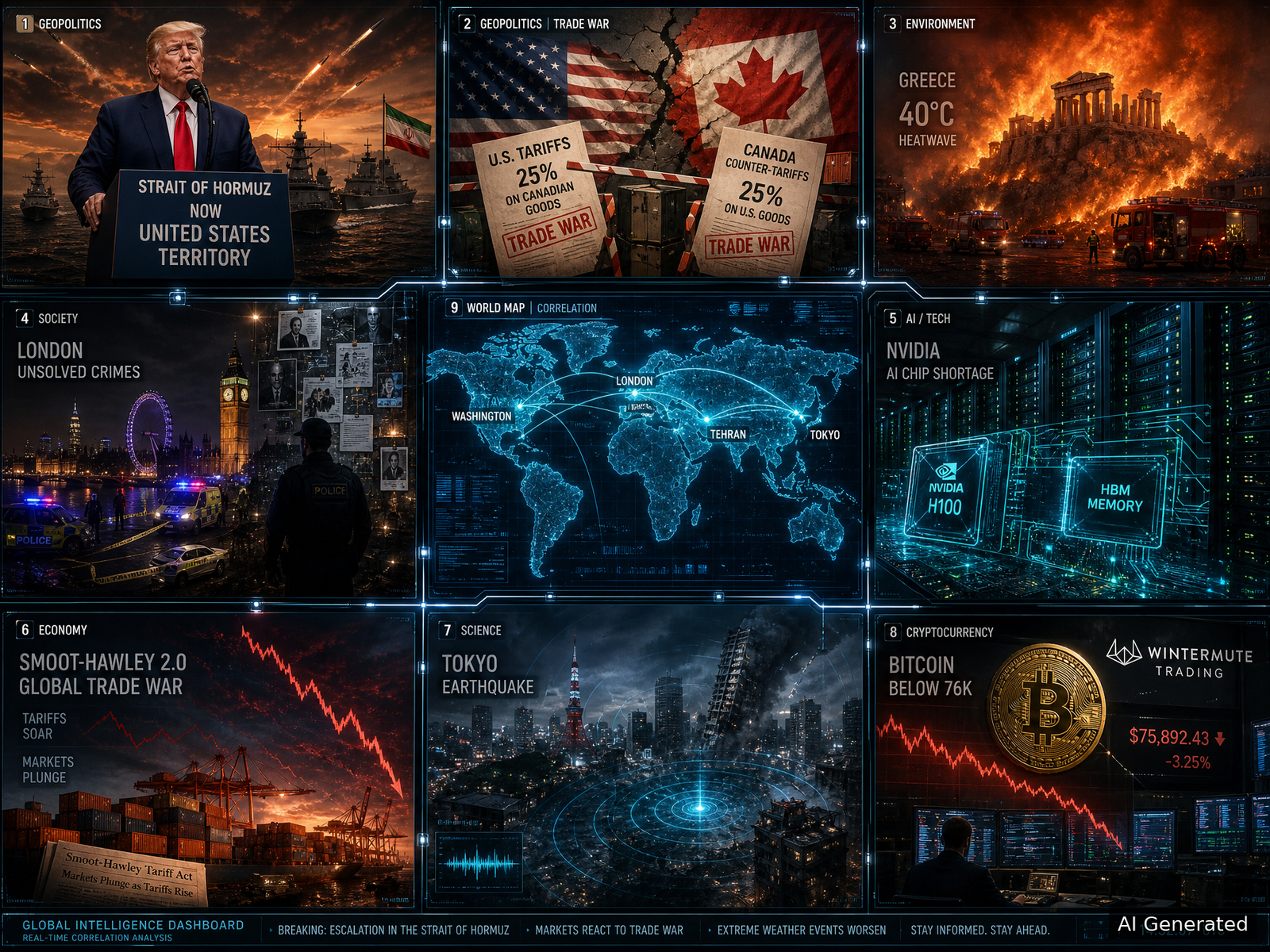


Daily Intelligence Briefing — 2026-08-23 (D84)
Contents
- 1. Geopolitics & Defence
- Iran-US Escalation: Trump Claims Hormuz as "New US Territory" While Iran Threatens "Earthquake-Like" Retaliation
- Macron Commits Missile Interceptors to Kyiv; France Expands Military Role Across Two Continents
- Israel Orders Expedited Destruction of Hezbollah Infrastructure; Turkey Develops Elite Forces in Smyrna
- US-Canada Trade War Erupts: Trump Imposes 50% Tariffs, Carney Responds Dollar-for-Dollar
- Spain's Wildfires Force 1,400 Evacuations Near Valencia; Climate-Driven Disaster Cycle Continues
- Kazakhstan Parliamentary Elections Begin Under Scrutiny
- 2. Environment & Climate
- 3. Society & Civil Issues
- 4. AI & Technology
- 5. Economy & Business
- 6. Science & Space
- 7. Crypto, Digital Assets & Blockchain
- 8. Correlations & Analysis
- 9. References
Click any heading to jump to that section. Click the section heading to return to this menu.
Daily Intelligence Briefing — 2026-08-23 (D84)
Geopolitics & Defence
↑ ContentsIran-US Escalation: Trump Claims Hormuz as “New US Territory” While Iran Threatens “Earthquake-Like” Retaliation
The Iran-US confrontation reached a dangerous new threshold as President Donald Trump posted a map on Truth Social marking the Strait of Hormuz with the label “NEW US TERRITORY,” his second such provocation within a week. The post signals an escalation beyond economic sanctions into territorial assertiveness, raising the spectre of direct military confrontation over one of the world’s most strategically vital maritime chokepoints[1].
Iran’s response was swift and severe. Mohsen Rezaei, Secretary of Iran’s Supreme National Security Council, declared on state television that “any country participating in the US economic war against us will be considered an enemy.” He explicitly threatened that if Washington continues to impose sanctions, Iran possesses the means to strike US oil companies and economic interests “around Iran and elsewhere.” Rezaei warned that if Trump “takes action, our response will be like an earthquake”[2].
The economic dimension of the conflict is tightening rapidly. The United Arab Emirates has suspended all trade and financial transactions with Iran until further notice, representing a significant diplomatic shift given the UAE’s historical role as a commercial intermediary in the Gulf[3]. China, meanwhile, has positioned itself against the sanctions, declaring that US “sanctions and pressure” will not resolve the Middle East conflict. This emerging split between Gulf states and Beijing over Iran presents Washington with both an opportunity to build a coalition and a risk of deepening geopolitical polarization[4].
Iran allowed several Iraqi oil tankers to transit the Strait of Hormuz following Baghdad’s formal request, a move that demonstrates Tehran’s continued control over the waterway while selectively permitting commerce. The episode underscores that the Hormuz bottleneck remains fully operational as an instrument of Iranian leverage, contradicting any assumption that military posturing alone could neutralize it[5]. Six months into the conflict, the pattern is clear: Trump escalates rhetorically, Iran responds with calibrated countermeasures, and the economic war creates cascading disruptions across energy markets and Gulf diplomacy.
Macron Commits Missile Interceptors to Kyiv; France Expands Military Role Across Two Continents
French President Emmanuel Macron committed to accelerating the delivery of missile interceptors to Ukraine during a nearly two-hour phone call with President Volodymyr Zelensky. The conversation followed Russia’s devastating double-tap strike on a shopping centre in Kryvyi Rih that killed at least 16 people. Zelensky confirmed the agreement on Telegram, stating: “We agreed to accelerate the delivery of French equipment and missiles”[6].
Macron’s statement framed Russia’s targeting of civilians as a sign of strategic weakness rather than strength: “By systematically targeting civilians and choosing intimidation and escalation, Russia is trying to demonstrate its power. In reality, however, it reveals mainly its own weakness.” The French president called on other nations with similar missile stocks to join the effort, expanding what has become an increasingly active French military posture that spans both Eastern Europe and the Middle East[6].
This commitment fits a broader pattern of French military activism that has accelerated markedly since the Iran-US conflict began. France has already deployed Patriot systems to Saudi Arabia in a defensive arrangement tied to European energy security, while simultaneously deepening its commitment to Ukrainian air defence. The dual deployment reflects a strategic calculation that France’s military credibility must be maintained across both theatres to preserve its influence in Gulf energy politics and European security architecture simultaneously.
Israel Orders Expedited Destruction of Hezbollah Infrastructure; Turkey Develops Elite Forces in Smyrna
Israel’s Defence Minister ordered the IDF to expedite the destruction of Hezbollah infrastructure in Lebanon, a move that reduces prospects for diplomatic resolution while reinforcing Jerusalem’s determination to shape the post-Gaza regional order unilaterally. The escalation comes amid Turkey’s parallel military buildup, with Ankara deploying its most elite Special Forces Command to a new sub-command headquarters in Smyrna[7][8].
The Turkish deployment is significant in scope and intent. The Special Forces Command sub-division, headquartered in Smyrna, falls under the Turkish General Staff’s elite command structure — the forces trained for infiltration operations in foreign territories during peacetime. Greek defence analysts note this represents a forward positioning capability that extends Turkey’s operational reach into the Eastern Mediterranean and Aegean[8].
The Israel-Turkey confrontation is emerging as the defining regional rivalry of the post-Gaza era. Analysis from Greek defence publications argues that only a Greece-Cyprus-Israel alliance can effectively contain Turkish expansionism, particularly as Turkey challenges Greek spatial planning for renewable energy installations and conducts barrages of airspace violations with armed F-16s and UAVs. Greek Foreign Minister Gerapetritis struck an assertive tone in a Sunday interview: “We are ready for every scenario. We want peace, but we want it from a position of strength. Any attempt to violate our sovereign rights will be met with whatever means are available”[9].
US-Canada Trade War Erupts: Trump Imposes 50% Tariffs, Carney Responds Dollar-for-Dollar
President Trump imposed sweeping 50% tariffs on Canadian goods after bilateral trade talks collapsed, invoking the Depression-era Smoot-Hawley tariff law in an unprecedented escalation against Washington’s closest economic partner. Canadian Prime Minister Mark Carney announced retaliatory tariffs “dollar-for-dollar” to be implemented from the Tuesday after Labour Day, targeting steel and dairy products among other sectors[10].
Carney’s response was notable for its rhetorical force. “We cannot accept what they’ve offered, and we will not give what they’ve asked,” he declared in a nationally televised address. Trump, for his part, suggested Canada wanted the “benefits” of being a US state. The trade war threatens to destabilize the integrated North American supply chain that both economies depend upon, with particularly severe implications for automotive manufacturing, energy exports, and agricultural trade[11].
The steelworkers’ union endorsed Canada’s tough stance, calling for an even stronger response to protect jobs and industry. The industrial dimension of the conflict ensures it will have lasting political consequences in both countries, extending well beyond the immediate tariff冲击 to reshape domestic political coalitions around trade policy and economic nationalism.
Spain’s Wildfires Force 1,400 Evacuations Near Valencia; Climate-Driven Disaster Cycle Continues
A wildfire burning approximately 30 kilometres from Valencia forced the evacuation of 1,400 residents as firefighters battled to contain the blaze amid temperatures exceeding 40 degrees Celsius. The evacuation came on the same day that heavy rainfall triggered flash flooding on the Costa Dorada, requiring the separate evacuation of a camping site[12].
Spain’s dual disaster — wildfire and flooding occurring simultaneously — illustrates the increasingly volatile weather patterns afflicting Southern Europe. The Mediterranean basin has experienced record-breaking heat throughout the summer of 2026, with multiple countries battling wildfires that have burned millions of hectares across the European continent. The simultaneous occurrence of extreme heat driving wildfires and extreme rainfall causing floods reflects the broader atmospheric instability that climate scientists have linked to warming sea surface temperatures in the Mediterranean.
Kazakhstan Parliamentary Elections Begin Under Scrutiny
Kazakhstan headed to the polls on August 23 for parliamentary elections closely watched for signs of genuine political reform. The Central Asian nation, which has been governed by a succession of authoritarian leaders since independence from the Soviet Union, faces scrutiny over whether the vote will represent a meaningful step toward pluralism or remain largely ceremonial[13].
Environment & Climate
↑ ContentsGreece Braces for 40C Heatwave as Wildfire Season Enters Critical Phase
Greece prepared for temperatures exceeding 40 degrees Celsius across multiple regions as the country’s brutal wildfire season entered what authorities described as its most dangerous phase. The Greek Fire Service’s analysis of wildfire causes reinforced a troubling pattern: approximately 90% of all fires originate from negligence, with roughly 30% attributable to agricultural machinery and rural activities. An additional 10 to 11% are deliberately set, representing a persistent arson challenge that complicates prevention efforts during periods of extreme heat and drought[14].
Fire Service officials highlighted the deployment of 22 thermal cameras covering 360 degrees at archaeological sites, following a pilot programme at Mycenae where the system detected and enabled immediate response to a fire outbreak on July 31. The technological investment represents an attempt to shift from reactive to preventive wildfire management in a country that has lost hundreds of thousands of hectares to fires in consecutive summers. Government spokesperson Pavlos Marinakis emphasized the scale of the state’s response, noting a dedicated ministry for civil protection, more than 18,000 firefighters compared to approximately 13,300 in recent years, and investment exceeding 2 billion euros in the AIGIS fire prevention programme. Marinakis attributed the difficulty of operations to the climate crisis itself: “The climate crisis explains to a large degree the difficulty of operations, without that being an excuse”[15].
The Copernicus data Marinakis cited reveals the continental dimension: by August 12, more than 5.7 million hectares had burned across the European Union, compared to approximately 305,000 hectares in Greece alone. While Greece’s share remains proportionally small relative to EU totals, the political and social impact of summer fires continues to shape domestic politics, with the opposition calling for greater accountability while the government points to infrastructure investment and personnel increases as evidence of a more capable response system.
Six EU Countries Push for Windfall Tax on Oil Companies Amid War-Driven Energy Profits
Six European Union member states, including Germany and Italy, moved to place a windfall tax on oil companies at the centre of a surge in energy profits driven by the Iran-US war and associated disruption to Middle East energy supplies. The group called for discussion of the levy at next month’s meeting of EU finance ministers in Dublin, citing the extraordinary profits being generated from elevated crude prices while consumers face spiraling energy costs across the continent[16].
The proposed levy reflects a growing political consensus in Europe that energy companies should not be permitted to extract windfall gains from a geopolitical crisis that has dramatically increased their revenues. Europe’s gas prices have approximately doubled since the Iran conflict began, and the broader economic impact of elevated energy costs has become a dominant political issue across the continent. The initiative is likely to face resistance from energy-producing member states and from industry groups arguing that the capital is needed for energy transition investments. The tension between taxing windfall profits and maintaining investment incentives for clean energy represents one of the central policy dilemmas facing European governments as they navigate the dual pressures of energy security and climate commitments.
North Sea Squid Boom Signals Marine Ecosystem Shifts
Scientists reported an unprecedented increase in squid populations across the North Sea, with the boom linked to warming waters that have expanded the range of species previously confined to more southerly Atlantic waters. The ecological transformation, documented by marine biologists tracking population distributions, represents one of the more visible indicators of ocean warming in European waters and carries implications for both commercial fisheries and marine food webs that have been organized around North Sea fish stocks for centuries[17].
Society & Civil Issues
↑ ContentsNine in Ten Unsolved London Murders Linked to Non-White Victims, Analysis Reveals
A landmark analysis of unsolved homicides in London between 2019 and 2023 revealed that 92.9% of cases in the capital were connected with a victim who was non-white, raising profound concerns about what researchers described as a perception of “unequal protection under the law.” The study found that non-white British people made up 61% of homicide victims in the period covered, but were dramatically overrepresented among those whose killers were never brought to justice[18].
The findings, published by The Guardian based on exclusive analysis of Metropolitan Police data, have triggered a broader debate about structural disparities in the UK criminal justice system. Advocates for victims’ families argue that the disparity reflects systemic failures in how investigations are resourced and prioritised, while others point to deeper socioeconomic factors that affect both the likelihood of victimisation and the effectiveness of police investigations in affected communities. The analysis covers a period during which London experienced significant fluctuations in violent crime rates and police resourcing challenges.
UK Onshore Wind Applications Surge to Decade High as Policy Shift Takes Effect
Plans for new onshore windfarms in England reached their highest annual level in a decade, with approximately 45 applications submitted in the year to March. The surge followed the Labour government’s reversal of the Conservatives’ de facto ban on onshore wind development introduced in 2015. The policy shift has unlocked a pipeline of projects that were previously frozen by planning restrictions, with developers responding rapidly to the removal of what had been a significant regulatory barrier to renewable energy expansion[19].
The wind farm surge intersects with the broader energy security crisis triggered by the Iran-US conflict and its disruption of Middle East energy supplies. European governments are under intense pressure to accelerate domestic renewable energy deployment while simultaneously managing the immediate economic impact of elevated fossil fuel prices. The UK’s onshore wind expansion represents one concrete policy response to the dual challenge of climate commitments and energy security.
Burnham Expected to Grant Mayors New Planning Powers
Greater Manchester Mayor Andy Burnham was expected to present proposals next week to give mayors across England new powers over local planning decisions, including the ability to “call in” and direct large-scale developments. The proposals would allow mayors to override council planning decisions and greenlight major projects, representing a significant centralization of development authority at the regional level[20].
AI & Technology
↑ ContentsNvidia Raises AI Server Prices Over 15% Amid Memory Chip Shortage
Nvidia alerted clients to AI-driven price increases exceeding 15%, effective on systems shipped early next year and affecting products built with its Vera Rubin and Grace Blackwell chips. The price hikes, driven by acute shortages in memory chip supply, signal a fundamental shift in the economics of AI infrastructure deployment. Memory chip manufacturers have gained unprecedented bargaining power in the global technology supply chain as demand for AI training and inference hardware has outstripped available production capacity[21].
The price escalation arrives at a moment of intensifying concern about the financial sustainability of AI investment. Investors are growing increasingly anxious about whether the billions being poured into AI infrastructure will generate sufficient returns to justify the expenditure. The combination of rising hardware costs and uncertain revenue timelines creates a potential squeeze on AI companies that have already committed to massive capital expenditure programmes. For hyperscalers and enterprise customers, the price increases translate directly into higher operational costs for AI workloads, potentially accelerating the search for more efficient model architectures and deployment strategies.
Enterprises Discover That Limiting AI Agent Autonomy Improves Performance
A significant shift in enterprise AI strategy emerged as companies discovered that the most successful deployments of agentic AI involve deliberately limiting how much autonomy the systems are granted. Research and industry surveys found that more than 40% of current agentic AI projects will be cancelled by end of 2027, driven not by model capability failures but by escalating costs, unclear business value, and inadequate risk controls[22].
The winning pattern involves four key architectural decisions: narrow-scope agents with tightly bounded mandates rather than general-purpose systems; human checkpoints at decision boundaries before high- stakes actions execute; full decision traceability as a design requirement; and data sovereignty exercised as active governance rather than passive paperwork. McKinsey’s 2026 AI Trust Maturity Survey found that average responsible-AI maturity sits at just 2.3 out of 4, with only about 30% of organisations reaching maturity level three or higher in governance and controls specifically. The gap between deployment speed and governance readiness represents the central challenge for the next phase of enterprise AI adoption.
Bacteria Discover Novel DNA Synthesis Pathway Using Protein as Template
In a finding published in Cell, researchers demonstrated that a bacterial immune system can produce double-stranded DNA without using DNA as a template — a completely novel pathway for biological information transfer. The DRT3 system in Escherichia coli uses two reverse transcriptases to independently generate complementary DNA strands: one copies RNA while the other uses amino acids in the protein itself to determine which DNA building blocks get added. The two strands then find each other and pair up to produce the double helix[23].
The discovery challenges fundamental assumptions about the direction of biological information flow. Lead researcher Samuel Sternberg of Columbia University described the finding as a “remarkable example of how inventive evolution can be with very familiar molecular building blocks.” Database searches recovered 195 depolymerase sequences from 66 animal species across nine phyla, suggesting the enzyme family is far more widespread than previously understood. The practical implications for understanding biological information storage and potential applications in synthetic biology remain to be explored.
Economy & Business
↑ ContentsUS-Canada Trade War Escalates to Smoot-Hawley Territory; Global Supply Chains Face Disruption
The imposition of 50% US tariffs on Canadian goods invoked the Smoot-Hawley Tariff Act of 1930 — the Depression-era legislation widely credited with deepening and prolonging the Great Depression through retaliatory trade barriers. Prime Minister Carney’s announcement of dollar-for-dollar retaliatory tariffs from early September has created the most serious bilateral trade confrontation between the two countries in modern history. The steelworkers’ union endorsed the tough stance, while economists warned of cascading effects across integrated North American supply chains[24].
Trump’s rhetoric elevated the confrontation beyond trade policy into national identity, suggesting Canada wanted the “benefits” of US statehood. The inflammatory language complicated diplomatic resolution and hardened political positions in Ottawa, where Carney framed the dispute as a test of Canadian sovereignty. The economic impact extends beyond bilateral trade: the USMCA trade agreement that governs North American commerce is effectively suspended, creating uncertainty for manufacturers across automotive, aerospace, and agricultural sectors that depend on tariff-free cross-border trade. South Korea’s decision to test the Northern Sea route by sending its first container ship through the Arctic to Europe further illustrates the reorganization of global trade patterns accelerated by tariff wars and geopolitical disruption[34].
Germany’s Private Investment Decline Raises Structural Concerns
New economic data revealed that private investment in Germany has declined 12% compared to 2019 levels, a worrying trend that signals structural erosion in Europe’s largest economy. The decline comes despite headline growth figures and reflects deeper challenges including energy cost competitiveness, demographic pressures, and the slow pace of digital and industrial transformation. German business leaders and economists have called for more aggressive policy intervention to reverse the investment drain that threatens long-term economic capacity[25].
The investment decline intersects with Germany’s broader political challenges as Chancellor Merz returns from summer recess facing three state elections and the need to implement reform commitments. The Ifo Institute’s latest assessment indicated that the skilled labour shortage has actually accelerated as economic recovery creates competing demands for limited human capital, compounding the investment challenge with a workforce constraint. Merz declared “growth and employment” as his government’s top priorities, but the structural headwinds facing German industry suggest that rhetoric alone will not reverse the trend of capital flight to more competitive jurisdictions.
India’s Export Resilience Under Trump Tariff Regime Demonstrates Supply Chain Entrenchment
Analysis of Indian trade data revealed that exports to the United States remained essentially unchanged after a year of Trump-era tariffs, suggesting that the tariff regime has had limited impact on India’s export competitiveness. The finding challenges assumptions about the effectiveness of tariff barriers in reshaping trade flows and suggests that India’s diversified manufacturing base and competitive pricing have provided resilience against protectionist measures. The stability also reflects the difficulty of replacing Indian goods in US supply chains for categories including pharmaceuticals, IT services, and manufactured components[26].
FPIs added 23,544 crore rupees to Indian equities in August, signalling renewed confidence driven by strong quarterly earnings and rupee stability. The inflow comes after FPIs invested 20,200 crore in July, marking a sharp turnaround from four consecutive months of heavy selling and suggesting that international capital is looking past the tariff rhetoric to India’s underlying economic fundamentals.
Science & Space
↑ ContentsMagnitude 5.9 Earthquake Strikes Japan’s Tokyo Region, Injuring Dozens
A magnitude 5.9 earthquake struck near Tokyo on Saturday, injuring at least 37 people and shaking buildings across the Japanese capital and surrounding prefectures. The Japan Meteorological Agency urged residents to exercise caution against possible moderate aftershocks for approximately one week following the initial event. The earthquake’s epicentre was located in the Ibaraki Prefecture region northeast of Tokyo, with strong shaking felt throughout the greater metropolitan area[27].
Japan sits at the intersection of four tectonic plates and experiences thousands of earthquakes annually, but events of this magnitude in the densely populated Tokyo metropolitan area always trigger heightened concern. Japan’s advanced early warning systems and some of the strictest building codes in the world — updated significantly after the 2011 Tōhoku earthquake and tsunami — generally perform well in limiting casualties from moderate seismic events. However, the psychological impact on residents and the economic disruption to the world’s largest metropolitan economy remain significant, particularly when aftershock sequences extend over several days.
Heart Failure Stem Cell Trial Shows 90% Improvement Rate
The largest clinical trial to date using stem cell-derived heart cells to treat severe heart failure reported that nine out of every ten patients showed significantly improved cardiac function a year after receiving injections of lab-grown heart muscle cells. The phase 2 HEAL-CHF trial, led by Nanjing Drum Tower Hospital and published in Nature Medicine, treated 10 patients with approximately 100 million cardiomyocytes injected directly into damaged heart tissue during coronary artery bypass surgery[28].
The approach uses induced pluripotent stem cells reprogrammed in the laboratory to become functioning heart muscle cells. Neither sustained irregular heart rhythms nor tumour growth appeared in either patient group throughout the study, meeting the trial’s primary safety endpoint while demonstrating measurable improvement in cardiac function. The team now plans larger-scale testing as they push the therapy toward wider clinical use, offering hope for the millions of heart failure patients worldwide for whom donor hearts remain unavailable.
Black Holes Tear Stars Apart Yet They Survive, Study Reveals
Astronomers documented stars that repeatedly skim past supermassive black holes, surviving each encounter while producing a new burst of light. The research revealed that in some systems, these flares mysteriously fade with each return pass. Scientists now believe the key may be stars that were already spinning extremely fast before being captured into orbit, with that rapid rotation explaining both the fading flares and how the stars ended up in such extraordinarily tight orbits around the black hole[29].
The findings, published in Science Daily, add significant nuance to the growing understanding of tidal disruption events — phenomena in which supermassive black holes capture and partially destroy passing stars. The discovery that some stars survive repeated encounters challenges earlier assumptions about the finality of tidal disruption and opens new questions about the long-term evolution of stars in extreme gravitational environments.
Quantum Experiment Breaks Long-Standing X-Ray Energy Limit
Researchers at the University of California San Diego and TU Wien demonstrated a new quantum regime that generates coherent X-rays at higher energies than conventional rules predict. When intense laser light strikes certain atoms, the atoms respond by producing laser pulses at far higher frequencies, reaching into the X-ray range beyond previously established theoretical limits[30].
Crypto, Digital Assets & Blockchain
↑ ContentsBitcoin Drops Below $76K as Wintermute Builds Massive Short Position
Bitcoin’s price suddenly dipped to $75,500 after failing to sustain levels above $77,000 during the weekend, wiping out nearly $100 million in long positions within a single hour. The correction came after one of Bitcoin’s most impressive rallies in years — a surge from $64,000 to almost $80,000 in less than 48 hours driven by massive spot ETF inflows. Most altcoins followed Bitcoin’s decline, with Ethereum dropping 5% below $2,400 and XRP falling 6.5%[31].
The trigger for the weekend sell-off appeared to be reports that Wintermute, one of crypto’s most prominent market makers, had established heavy short positions. Onchain analytics showed the company sent nearly $60 million in Bitcoin and Solana to Binance and Coinbase, likely intending to sell. More significantly, Wintermute built a massive futures position on Hyperliquid: while holding a $13.85 million long position, the lion’s share of its leveraged trade was shorting the market at $146.19 million. The combined unrealized loss stood at $3.66 million while earning $2.14 million in funding[31].
The correction highlights the vulnerability of highly leveraged positions to sudden sentiment shifts, particularly following rapid price appreciations. CoinGlass data showed more than $350 million in total liquidations over the 24-hour period, with more than 90,000 traders liquidated — an unusually high figure for a weekend session. The volatility underscores the ongoing tension between institutional accumulation through ETFs and the speculative leverage that dominates retail trading.
TRUMP Token Crashes 33% After Team Moves $6.2M to Exchanges
The Official Trump (TRUMP) meme coin crashed 33% from its local peak after on-chain data revealed the team behind the token transferred another 2.62 million coins to OKX exchange, worth approximately $6.2 million. The transfer followed a rally that had seen TRUMP surge from below $1.50 to above $3.60 — its highest price since March — before being rejected[32].
The pattern of team selling into rallies has become a recurring feature of the TRUMP token since its launch 48 hours before Donald Trump’s inauguration in January 2025. Despite Trump’s personal denials of profiting from the token, multiple US Senators have urged the SEC to investigate, arguing it may have facilitated fraud or unlawful enrichment at the expense of retail investors. The token trades 97% below its all-time high of over $73, with its latest all-time low of $1.37 set just last week. The case illustrates the fundamental governance challenges of meme coins linked to political figures, where insider selling can systematically extract value from speculative rallies.
Big Banks Demand Identity Checks for Secondary Stablecoin Markets
The Bank Policy Institute, representing the massive US banking lobby, filed a comment letter asking FinCEN to apply customer identification requirements to secondary stablecoin markets. The request extends the Know Your Customer provisions currently applied to stablecoin issuers to exchanges with direct relationships with retail customers. The move represents traditional finance’s effort to shape the regulatory framework for digital assets in ways that integrate crypto infrastructure into existing financial compliance systems[33].
Correlations & Analysis
↑ ContentsThe geopolitical landscape of late August 2026 is defined by three intersecting escalation dynamics that are mutually reinforcing and structurally destabilizing. The Iran-US conflict continues to radiate outward, reshaping Gulf diplomacy and global energy markets. The Russia-Ukraine war intensifies with each devastating Russian strike, drawing France into an ever-deeper military commitment. And the US-Canada trade war introduces a new axis of economic confrontation that threatens the foundations of North American economic integration. These three conflicts are not isolated; they interact in ways that compound risk across the global system.
The Iran-US confrontation, now six months old, has evolved from a military exchange into a comprehensive economic war with territorial dimensions. Trump’s “new US territory” claim over Hormuz moves the dispute beyond sanctions into a realm where claims to sovereign maritime space create risks that neither side can fully control. Iran’s threat to treat Gulf neighbours as enemies if they cooperate with US pressure forces regional states into impossible choices between their security guarantor and their immediate economic partner. The UAE’s suspension of Iranian trade demonstrates one possible resolution — pragmatic accommodation with Washington — but Beijing’s refusal to join the sanctions coalition ensures that Iran retains significant economic lifelines regardless of Gulf state compliance.
France’s dual military commitments to Ukraine and Saudi Arabia represent a strategic bet that maintaining credibility in both theatres preserves French influence in Gulf energy politics and European security architecture simultaneously. The pattern echoes France’s traditional Gaullist approach of independent action, but the scale of commitment — Patriot deployments to the Middle East and missile interceptors to Eastern Europe — tests the limits of French military capacity. As the D83 report noted, Macron’s rhetoric about Russian weakness is calibrated to justify continued escalation while managing domestic political costs of an increasingly expensive military posture.
The Canada-US trade war introduces economic uncertainty into a system already strained by energy price shocks from the Iran conflict. The invocation of Smoot-Hawley — the tariff law credited with deepening the Great Depression — is not merely historical parallel but economic warning. Canada supplies critical minerals, energy, and agricultural products to the US economy; disruption to these flows compounds the inflationary pressure already generated by Middle East energy disruptions. The political dynamics in both countries make de-escalation difficult: Trump has framed the confrontation as a test of American economic sovereignty, while Carney has staked Canadian political credibility on retaliation.
The intersection of these three conflicts creates a global environment in which economic disruption, military escalation, and political confrontation feed on each other. Energy prices driven up by Iran-US tensions exacerbate the economic pain of the Canada-US trade war; European military commitments to Ukraine strain budgets already stretched by wildfire response and climate adaptation costs; and the China-Russia-Iran alignment ensures that Western pressure campaigns face persistent resistance from alternative economic networks. The risk is not any single escalation but the compounding effect of multiple simultaneous crises reducing the policy space available for de-escalation. As NATO’s Baltic air policing operations demonstrate with 50-plus aircraft deployed near Kaliningrad, the Western alliance remains capable of projecting force, but each new commitment thins the reserve capacity that strategic planners depend upon. The convergence of military, economic, and environmental pressures across three continents within a single reporting period underscores how fragile the current international order has become.
What to watch in the next reporting period: Whether Iran’s threat to Gulf neighbours produces any diplomatic movement from Saudi Arabia or the UAE; whether the Canada-US trade war triggers broader retaliatory measures beyond steel and dairy; whether France’s dual military commitments strain domestic political support for continued engagement; and whether the Bitcoin correction extends into a broader crypto market rout as leveraged positions unwind.
References
↑ Contents1. Trump posts map marking Hormuz as new US territory by Various Greek/International sources · Source ↩
2. Iran’s Rezaei warns of ‘earthquake-like’ retaliation over US economic war by Dimokratia/FinancialJuice · Source ↩
3. UAE suspends all trade and financial transactions with Iran by Dimokratia · Source ↩
4. China opposes US sanctions on Iran by Dimokratia · Source ↩
5. Iran allows Iraqi oil tankers through Hormuz after request by FinancialJuice/IRNA · Source ↩
6. Macron commits to accelerating missile interceptor deliveries to Ukraine by Dimokratia/Flight.com.gr · Source ↩
7. Israel orders IDF to expedite destruction of Hezbollah infrastructure by CryptoBriefing · Source ↩
8. Turkey develops elite Special Forces in Smyrna by Defence Point · Source ↩
9. Gerapetritis: Ready for every scenario, peace from position of strength by Dimokratia · Source ↩
10. Trump imposes 50% tariffs on Canada by Stern.de/FAZ · Source ↩
11. Carney: Canada will match tariffs dollar for dollar by BBC/Euronews · Source ↩
12. 1,400 evacuated in Spain from wildfires and flooding by Spiegel · Source ↩
13. Kazakhstan parliamentary elections begin by Al Jazeera · Source ↩
14. Greek Fire Service: 90% of wildfires caused by negligence by Dimokratia · Source ↩
15. Marinakis: Government investing 2 billion+ euros in fire prevention by Iefimerida · Source ↩
16. Six EU countries push for windfall tax on oil companies by Euronews · Source ↩
17. Squid take over North Sea — what’s behind the squid boom by Euronews · Source ↩
18. Nine out of 10 unsolved murders in London linked to non-white victims by The Guardian · Source ↩
19. Onshore windfarm applications hit 10-year high in England by The Guardian · Source ↩
20. Burnham expected to give mayors new powers over planning by The Guardian · Source ↩
21. Nvidia raises AI prices over 15% due to memory chip costs by OT.gr/CryptoBriefing/CNBC · Source ↩
22. Enterprises winning with AI agents are limiting how much the agents can do alone by VentureBeat · Source ↩
23. Scientists discover a bizarre new way life can make DNA without DNA by ScienceAlert · Source ↩
24. Handelskrieg USA-Kanada: 50 Prozent Zölle für den alten Freund by FAZ · Source ↩
25. Germany private investment declines 12% versus 2019 by WiWo · Source ↩
26. India’s exports to US remain unchanged after a year of Trump tariffs by Business Standard · Source ↩
27. Magnitude 5.9 earthquake strikes Japan’s Tokyo region by Die Zeit/Independent · Source ↩
28. 90% of heart failure patients improved after largest stem cell trial by Interesting Engineering · Source ↩
29. Black holes keep tearing these stars apart, but they survive by ScienceDaily · Source ↩
30. Quantum experiment breaks a long-standing X-ray energy limit by SciTechDaily · Source ↩
31. BTC, ETH, XRP tumble as Wintermute builds heavy short positions by CryptoPotato · Source ↩
32. TRUMP crashes 33% as team moves $6.2M to exchanges after recent surge by CryptoPotato · Source ↩
33. Big banks demand identity checks for secondary stablecoin markets by Bitcoin.com · Source ↩
AI Disclosure: This post was created with the assistance of artificial intelligence. The ideas, analysis, and opinions expressed are my own — AI was used to help compose, structure, and refine my personal notes and thoughts into the final written content. Images, videos and music featured in this post were also generated using AI tools, based on my own creative prompts and direction.