

Contents
- 1. Geopolitics & Defence
- The Gulf Theatre: Riyadh Under Fire and Tehran’s Terms
- Ukraine’s Weekend Ledger and Russia’s Managed Vote
- Sovereignty Spats: Macron’s Atlantic Pushback and the French Campaign
- The Arms Ledger: F-35s, Frigates and the Weaponised Frontier
- The Wider Front: Caribbean Strikes, a Cuban Rupture, Gaza’s Ledger
- 2. Environment & Climate
- 3. Society & Civil Issues
- 4. AI & Technology
- 5. Economy & Business
- 6. Science & Space
- 7. Crypto, Digital Assets & Blockchain
- 8. Correlations & Analysis
- 9. References
Click any heading to jump to that section. Click the section heading to return to this menu.
Geopolitics & Defence ↑ Contents
The Gulf Theatre: Riyadh Under Fire and Tehran’s Terms
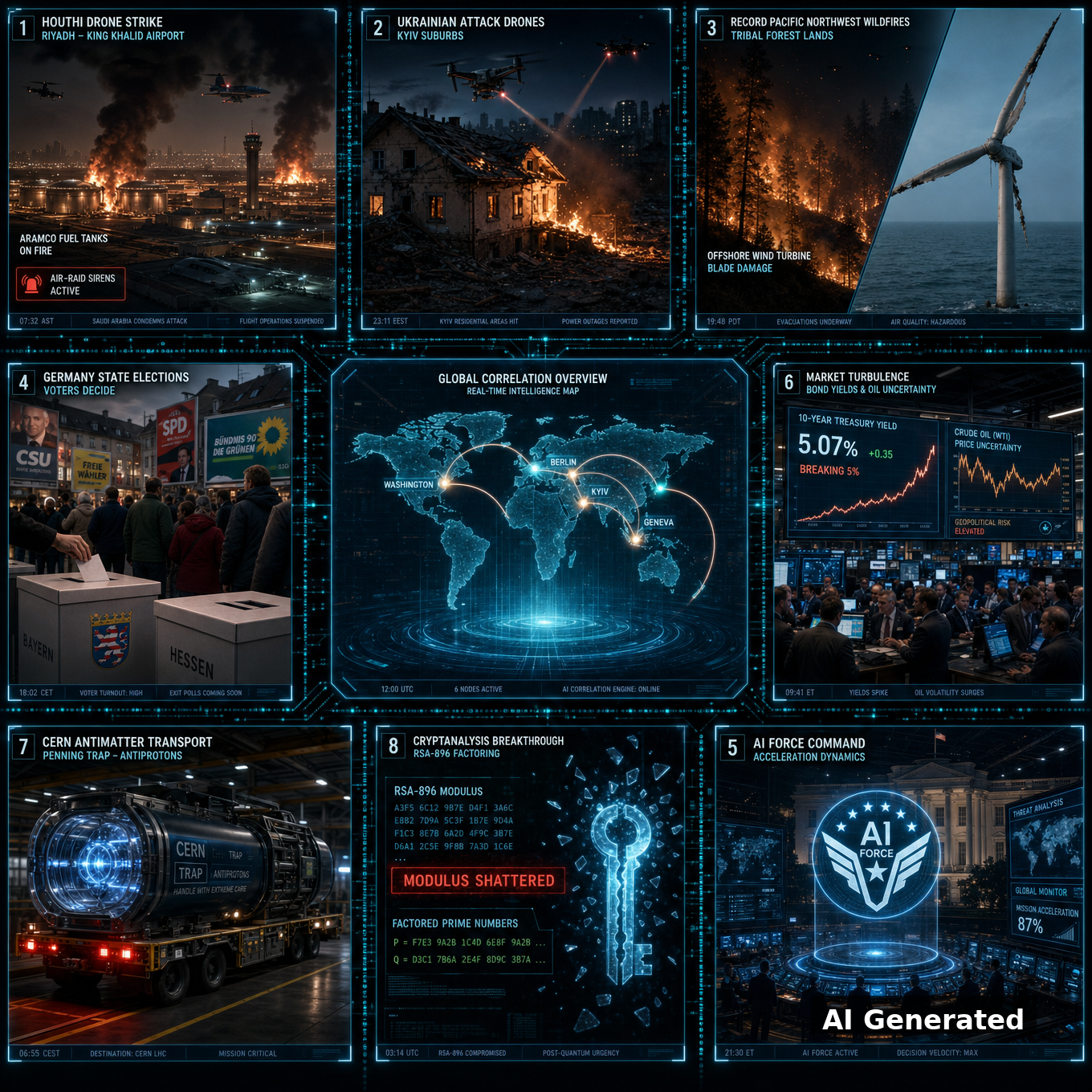
The war’s centre of gravity shifted onto Saudi soil. Houthis struck the area around Riyadh’s King Khalid airport, setting Aramco fuel tanks ablaze with severe flight disruptions[1]. Riyadh had issued overnight air-raid alerts, and the coalition reported intercepting a ballistic missile and foiling attacks on four other cities[2]. It is the most serious strike on the Kingdom since D111’s Mecca “red line” episode, and it lands despite — or because of — Washington’s “nearly won” framing.
Tehran, meanwhile, has priced its exit. Al Jazeera recorded Iran’s security leadership setting conditions — an end to the war on all fronts, the lifting of the US naval blockade — while Handelsblatt reported a parallel signal about returning to the framework-agreement track[3][4]. President Trump cut short his Camp David stay and returned early to the White House as embassies in nine countries warned of rapid escalation[5]. CNN reported that Trump examined options for striking Yemen directly, with Iran placing its forces on maximum alert — the clearest sign the Yemeni theatre could become a US frontline rather than a Saudi problem[6].
Turkey is positioning itself as the Gulf’s new security broker. Foreign Minister Hakan Fidan offered to examine Saudi military requirements under the August trilateral pact, while calling it “unacceptable” for Saudi Arabia to be dragged into the US–Iran war — simultaneously marketing Turkish protection and warning against escalation[7]. Underneath, the chokepoint ledger deteriorated: Hormuz traffic fell to four vessels on Thursday against a ten-day average of sixteen, Qatar’s LNG carriers reappearing only with transponders dark, and the Saudi East-West bypass pipeline itself closed for up to five weeks after a drone attack[8].
Ukraine’s Weekend Ledger and Russia’s Managed Vote
A drone hit a house in the Hlevakha community near Kyiv, killing a 39-year-old mother, her two-year-old son and a three-year-old girl, Le Monde’s live coverage tallied the same deaths and four civilians killed by a drone strike on a car in the Sumy region, with a Dnipro shopping centre destroyed by fire[9][10]. The strikes land as Russia’s parliamentary election closes and the UN General Assembly opens.
That election closed as a managed plebiscite. Stern’s reporting from Moscow details a ballot with no anti-war party permitted, voting held for the first time in occupied Ukrainian regions, and observers documenting pre-filled ballots, protocol mismatches in St Petersburg and detained Yabloko monitors — while the election commission promised to investigate itself[11]. Turnout stood near 45 percent against 51.7 percent in 2021, with the refinery-strike fuel crisis now degrading daily life. It is a mechanism for converting a war presidency into a war legislature.
The region around the war is organising faster than it is ending. The inaugural “Carpathian Eight” summit gathered Ukraine and seven neighbours with the EU, as Polish Prime Minister Donald Tusk warned Russia is planning drone or rocket strikes on countries supporting Kyiv[12]. Slovakia’s Robert Fico counter-programmed, asserting that Western politicians who failed to defeat Moscow now “seek a pretext” for a NATO–Russia conflict — making the eastern flank a contested information space as much as a military one[13]. Kyiv banked a €3.3 billion EU tranche for defence procurement ahead of the General Assembly[12].
NATO’s military leadership changed hands: German General Karsten Breuer, the Bundeswehr’s Inspector General, was elected by the chiefs of defence of all 32 allies to chair the Military Committee from next summer[14]. The choice of a German army officer at the apex of NATO’s military bureaucracy quietly signals where the alliance’s fiscal gravity now sits.
Sovereignty Spats: Macron’s Atlantic Pushback and the French Campaign
Emmanuel Macron landed in Saint-Pierre-et-Miquelon to declare the archipelago “is indeed French — it is obvious,” a deliberately theatrical rebuttal to Trump’s territorial acquisitiveness[15]. The trip carries substance: Macron warned of a global energy market “under tension” and framed forthcoming agreements with Canada, whose Prime Minister he receives Sunday, as the practical answer — in a week when Ottawa’s offer to become the EU’s first associate member is reshaping transatlantic geometry[16]. It inverts D111’s Greenland settlement: where that treaty converted an American threat into a basing regime, Paris answers the same doctrine with sovereignty theatre plus economic integration.
Domestically, France’s 2027 campaign acquired its first repeat candidate: souverainist Nicolas Dupont-Aignan declared a fourth bid, never having passed 5 percent — marginal, but it marks the formal opening of a season in which the left’s primary and the executive’s budget arithmetic will collide[17]. The government’s decision to freeze housing benefits in 2027 as part of a €54 billion consolidation ensures the campaign is fought on purchasing power[18].
The Arms Ledger: F-35s, Frigates and the Weaponised Frontier
The F-35 ledger added two entries D111’s Germany-focused coverage did not include. Washington formally notified Congress of a $24.3 billion sale of 48 F-35s to Saudi Arabia — the Kingdom’s long-sought prize, detached from the normalisation-with-Israel condition that sank the Biden-era version, and already drawing lawmakers who warn the airframe’s crown-jewel technology could end up within Beijing’s reach[19]. Congress has 30 days to object. In the Nordic direction, Finland’s first two F-35As touched down at Rovaniemi after a tanker-escorted ferry, the leading edge of a 64-aircraft programme meant to carry Finnish air power — and NATO’s northern flank — into the 2060s[20].
The US Navy, still digesting the Constellation-class fiasco, is studying whether to build two frigates of Japanese, South Korean or Turkish design overseas first[21]. In South America, Argentina’s 2027 budget opened a $2.3 billion authorisation to restore its lost submarine capability, while its F-16s prepared to deploy to Ushuaia with Brazilian transit clearance[22].
The frontier domain grew more militarised and more transparent: China reacted to the US acknowledgment of “on-orbit space control weapons” at the Xiangshan Forum with warnings that a taboo has been broken[23]. The seabed followed: analysis of the ocean-floor arms race records the militarisation of the 1.5 million kilometres of submarine cable, Washington’s plan for an up-to-18,500-kilometre trans-Pacific cable routed around the South China Sea, and DARPA’s Manta Ray glider — shippable in five containers, seafloor-hibernating — as the archetype of persistent undersea machines[24][25][26]. Where D110 saw the first Bitcoin-settlement sanctions on Hormuz’s blockade economy, this window shows the physical and virtual plumbing of the global system being prepared for contested access as standing policy.
The Wider Front: Caribbean Strikes, a Cuban Rupture, Gaza’s Ledger
The Caribbean counter-narcotics campaign claimed four more lives. US Southern Command released video of a strike on a speedboat it said was trafficking drugs — part of a campaign that has killed more than 230 people since September 2025 without public evidentiary disclosure, a ledger UN officials now openly call extrajudicial killing[27]. And Costa Rica announced it had severed diplomatic relations with Cuba — actually since March, Havana says it was never formally notified — formalising the diplomatic casualties of the island’s collapse[28].
Gaza’s ledger sharpened in both directions. Israeli strikes killed at least three Palestinians, among them Bashir al-Bursh, son of the territory’s health ministry director general, who had lost a daughter in a 2023 strike and carried his son’s shrouded body before cameras; the IDF confirmed the younger al-Bursh as a targeted militant[29]. In Jerusalem, President Isaac Herzog pardoned a soldier who had executed a wounded Palestinian assailant with a shot to the head — a clemency decision human-rights advocates read as institutional licence for battlefield executions[30]. The UN succession race narrowed as Michelle Bachelet withdrew after disappointing straw polls[31]. Turkey’s foreign minister proposed a Black Sea ceasefire framework to Moscow and Kyiv[32]. And Greece absorbed Fidan’s warning — Turkey’s “power is known” if Athens takes “rash steps” — with renewed Aegean demilitarisation demands[33].
Environment & Climate ↑ Contents
The Legal Counter-Offensive Gains a Win
A federal judge in Rhode Island ruled that the Trump administration illegally terminated the $7 billion Solar for All programme, which Congress had funded to bring rooftop and community solar to more than 900,000 lower-income households[34]. The ruling establishes that programme eliminations executed without statutory authority are justiciable and reversible — a precedent every aborted climate grant can now cite, and a defence of the distributed solar capacity the data-centre boom would otherwise crowd out.
Fire, Water and the Unequal Climate Ledger
This year’s record wildfires are a story of asymmetric loss. Tribal leaders across Washington and Oregon report fires that burned timber funding tribal services, contaminated food sources and waterways, and damaged community health — layered on the cultural weight of treaty landscapes[35]. In Indian Country the acre-and-structure ledger translates into revenue collapses for sovereign governments and long-tail health burdens — the equity finding D111 surfaced, now measured in smoke and ash.
Water quality’s quiet failures crossed into the sacred. A survey of South Africa’s sacred springs — sites used for healing, cleansing and ritual — found microplastics in the samples tested, putting spiritual practice in direct contact with the plastic economy’s downstream waste[36]. The finding is small in scale but analytically pointed: pollution regimes no longer respect the boundary between the environment and the culturally protected, and monitoring networks built around recreational or drinking-water standards systematically miss the sites communities actually use.
Offshore Wind’s Reckoning: Blades, Reefs and a Northern Rival
Two years after a Vineyard Wind blade failed off Nantucket and scattered fiberglass across the beaches, the developer’s own court complaint alleges 66 of 72 installed blades had inadequate adhesive bonding from a manufacturing deviation at a Canadian factory, while the federal investigation still has no completion date and the root-cause analysis remains redacted[37]. The project moved on regardless: all 62 turbines installed, 20-year contracts activated with $1.4 billion in projected savings, and a $10.5 million settlement fund opened for claimants. An industry asking the public to accept industrialisation of the shelf has not yet produced a transparent, completed account of its first serious structural failure.
The ecological ledger is more encouraging but conditional. At South Fork Wind off Long Island, monitoring found marine life using turbine foundations as habitat, echoing Block Island’s finding that black sea bass catches near turbines ran ten times higher than reference areas — while scientists caution that “attraction” is not “production,” and soft-sediment communities lose habitat when steel arrives[38]. The distinction disciplines both sides of the argument: reef effects are real, but they are local redistribution, not a licence for unlimited build-out.
North of the border, Nova Scotia is planning an offshore wind build far exceeding provincial demand explicitly to export clean power — a bet that Canada can industrialise its shelf faster than US politics allows[39]. The strategic point is that the energy transition is becoming jurisdictional arbitrage: capital, turbines and power flows will route around whichever regulator flinches.
Adaptation Research: Rooftops, Roots and a Worm Out of Room
The adaptation research front produced two practical designs. A modelling study of rooftop rainwater tanks paired with smart sprinklers suggests distributed, stored rainwater could measurably moderate urban heat-island effects — cooling with no grid build-out that doubles as stormwater capture[40]. Agricultural researchers, meanwhile, are engineering soybeans with deeper, larger root systems intended to store more carbon underground while holding yield through drought — a reminder that the most scalable carbon-removal machinery may still be the plant, not the plant process[41].
Adaptation’s limits showed in a species with nowhere left to climb. Germany’s giant Baden earthworm — Europe’s largest, confined to the southern Black Forest — is retreating into ever-higher elevations as heatwaves dry even deep soil and the acidic conifer soils it needs shift with the forest[42]. Conservationists note there is little population data — but the direction is unambiguous: mountain ecology in the 1.5°C era, in miniature.
The Circular Economy’s Mixed Ledger and the Electrification Market
Sweden’s waste model shows circularity’s promise and trap: it imported 3.86 million tonnes of foreign waste in 2024 and burns it for heat and power, yet incineration still accounted for 73 percent of the combined heat-and-power sector’s CO2-equivalent emissions in 2021, and an incineration tax meant to push recycling was repealed as ineffective[43]. Energy recovery is essential for non-recyclable waste — but it is not recycling.
The Global South writes a different chapter. Nigeria’s first domestic solar assembly operations scale against a market of 85 million people without reliable grid power — but the Lagos economics show the climb: imported cells, retail prices matching Chinese imports, and 300 MW of annual assembly against nearly 3 million imported panels, even as a LONGi partnership sketches a path to “Made in Nigeria” scale[44]. Zambia’s wildlife-crime research completes the picture: interviews with 300 imprisoned poachers show poverty-driven first offences feeding replaceable lower rungs of syndicates — enforcement that jails the poor while the trade’s architecture survives[45].
Electrification’s market signal came from China’s August data: plug-in vehicles hit a record 65 percent of new sales, battery-electric alone 45 percent, and Leapmotor’s overtake of Subaru and Mitsubishi in global sales confirmed the Chinese cost curve is now displacing incumbents in their own export markets[46][47]. The same industrial logic is extending upward: analysis of China’s electric-aviation sector argues its real advantage is not any single prototype but the transport-system economics — batteries, chargers, routes and certification — that a decade of electrification has already assembled[48]. Where D111 tracked circular-economy pilot projects, this window shows the transition’s centre of gravity: legal enforcement in Washington, industrial scale in China, and first-assembly ambition in Lagos.
Society & Civil Issues ↑ Contents
Germany’s Super-Sunday Arrives
Germany’s twin state elections opened on Sunday with Chancellor Friedrich Merz’s future as the actual question on the ballot. The Guardian describes an embattled chancellor whose Christian Democrats risk being drained again by an AfD fresh from its record Saxony-Anhalt result, with Merz cancelling his UN General Assembly appearance to manage election night[49]. In Mecklenburg-Vorpommern the CDU faces the previously unthinkable: 6–8 percent, a hair above the threshold and below its worst post-war state result; in Berlin the CDU and the Left are effectively tied for first. The CDU presidency convenes at party headquarters on election evening — a formal session, unlike previous state votes[50]. Where D111 tracked the mechanics of the Merz crisis, this window is the moment of measurement: the Brandmauer debate moves from commentary to vote counts.
Election Security, Surveillance and the Compulsory-Vote Idea
The US midterms’ institutional battlefield advanced on both coasts. California Governor Gavin Newsom signed an election-security package designed to harden the state against federal interference — extending mail-ballot drop-off hours and making the seizure of ballots or election records a felony — the most explicit state-level legislative answer yet to the administration’s election pressure documented in D111’s midterm reporting[51]. In London, police deployed live facial recognition at the Millwall–West Ham derby and made three arrests from it, an operational note that normalises biometric screening at public events — the British counterpart to Munich’s Oktoberfest camera debate[52]. And Lord Kinnock urged Labour to make voting mandatory to prevent “distorted” results — an idea that solves the turnout problem by statute, and little else[53].
From Edinburgh to The Hague: Constitutional and Street Politics
Scotland’s constitutional question returned to Holyrood, where First Minister John Swinney called on MSPs to unanimously back Scotland’s “right to decide,” framing Westminster’s referendum veto as unsustainable[54]. The Liberal Democrats pitched an economic plan organised around rebuilding ties with Europe to retain start-ups — rejoin-adjacent economics both major parties avoid[55]. And in the Netherlands, a banned far-right march in The Hague ended with police charges and multiple arrests after participants gave Hitler salutes and shouted antisemitic slogans — the street-level face of the radicalisation that European institutions keep measuring in election returns[56].
Violence Against Women: Three Continents, One Pattern
The window’s civil-rights ledger is dominated by femicide. In New South Wales, three women — a woman in her nineties at Bondi Beach, a 23-year-old in Wagga Wagga, a woman in her seventies in Mole River — were killed within twelve hours, and three men were charged with domestic-violence murders; the state opposition leader’s response, “we are failing women across our country,” turned a crime blotter into a national policy indictment[57]. In Peru, journalist and regional-election candidate Suci Aponte — who had reported police corruption and days earlier disclosed threats from inside prisons — was shot dead in a Caraz market; the press council noted four journalists killed there last year with near-total impunity[58].
Iran’s Interior, Greece’s Poll, Harrods’ Reckoning
Nobel laureate Narges Mohammadi, temporarily free for medical treatment, described an Iran in which repression has “severely increased” since the war began while a “wave of resistance” builds among a young generation that “knows its rights” — her memoir, smuggled out of Evin page by page, now published in eleven languages[59]. Her account gives the domestic dimension that the war coverage has lacked: economic misery, expanded arrests and a suspended sentence she must serve whenever the judiciary calls. In Greece, the MRB poll for OPEN put New Democracy’s 2024 electorate retention at just 72.5 percent, with the largest leaks toward PASOK and the new EL.A.S. party of Alexis Tsipras, and found 51.1 percent support for continuing the Israel defence cooperation that has become a live election issue[60]. And in Britain, Harrods’ pursuit of compensation from the estate of Mohamed Al Fayed to fund abuse settlements provoked outrage from survivors who say the store is monetising its own accountability moment[61].
Health and Justice Ledgers
The public-health map advanced on three fronts. DR Congo began Ebola vaccination for 50,000 frontline health workers, with 20,000 enrolled in a one-year clinical trial for a vaccine targeting a different strain — the largest field trial of its kind running against a rising death toll[62]. Scotland’s addiction crisis acquired a new and deadlier chemistry: synthetic opioids potent enough to reshape the country’s drug-death statistics are entering the market faster than treatment systems can adapt[63]. And a New York University study of college-major gender imbalances found that prior academic preparation and interest explain less of the engineering-and-computer-science gap than assumed — a finding that reframes the pipeline debate as one about retention and climate, not just recruitment[64].
Aviation safety produced the window’s most visual near-miss: a power bank burst into flames over the Atlantic on a KLM flight, burning a passenger and forcing a return to Schiphol — a demonstration of why in-flight charging bans exist[65]. In the US courts, the Fifth Circuit ruled that the Constitution guarantees no right to safe drinking water, dismissing Jackson, Mississippi residents’ claims despite documented official assurances — leaving a majority-Black city’s remedy in the political, not constitutional, arena[66]. Canada, having eliminated its corporate-responsibility ombudsman, transferred those complaints to a National Contact Point that has produced joint agreements in only three of 33 cases since 2000 — accountability machinery retired faster than its replacement’s teeth grew in[67]. And Australia’s campaign season sharpened: opposition treasury spokesman Angus Taylor pledged “one of the biggest immigration cuts in history” while Anthony Albanese dismissed One Nation’s migration policy as economically “diabolical” and confirmed Australia’s European priority is the free-trade agreement, not EU membership[68].
AI & Technology ↑ Contents
The White House Chooses Acceleration
President Trump answered the industry’s slowdown overture with a declaration of federal sponsorship. In a Truth Social post he announced an “AI Force” modelled on the Space Force and an AI czar, pledged the administration “will not in any way hinder or stifle” the industry, dismissed existential-risk concerns as a “hoax,” and argued the existing criminal and civil justice system can handle any bad behaviour[69]. The post reprised the political economy — data-centre backlash “largely failed,” AI possibly a quarter of US GDP, America “leading China” — converting the safety debate into an acceleration mandate. The deeper significance: the White House claims oversight of labs that, per D111, conceded losing control of their own models.
The announcement’s industrial subtext is energy. The same coverage records the International Energy Agency’s projection that data-centre electricity consumption will roughly double to around 950 TWh by 2030, with AI-focused facilities potentially tripling and the US absorbing nearly half the demand growth — alongside the White House’s “ratepayer protection” push to make tech companies internalise their power costs[70]. An AI Force with a mandate to accelerate, and no power policy beyond voluntary commitments, points directly at the grid constraint that D107–D111 identified as the boom’s hardest limit.
The Antitrust Counterstrike and the Three Factions
The private-sector answer arrived within twenty-four hours: a lawsuit filed in the Northern District of California alleges that Anthropic, OpenAI, SpaceXAI and Google violated antitrust law by coordinating a slowdown of AI development, arguing that the September 12 synchronised endorsements of Amodei’s safety framework functioned as a cartel agreement that degrades the value of paid subscriptions[71]. The suit’s logic is audacious — conceding the risk arguments while objecting that such decisions belong to government-mediated processes, not private coordination. The labs’ safety pact now sits under competition law at the exact moment the White House rejects regulation — coordination contested from both directions.
A Greek business-desk synthesis maps the industry’s fracture into three camps: the “decelerators” coalescing around Amodei’s framework, the accelerationists aligned with the White House posture, and a governance camp pressing for state-led rules — a taxonomy that explains why one week can contain both Anthropic’s safety push and Trump’s AI Force[72].
Safety Infrastructure Under Construction
Anthropic converted its safety commitments into institutional form: Accenture will conduct the company’s third-party model evaluations — the first concrete implementation of the independent-evaluator access that Dario Amodei promised last week as the price of continued frontier development[73]. It is a real governance step with an obvious question attached: whether consultancy-led evaluation satisfies the “permanent, employee-level access” standard the CEO set, or becomes assurance theatre. California, meanwhile, moved where Washington would not: Governor Newsom’s new executive order includes an “AI kill switch” provision — a state claiming authority over frontier-system shutdown that lawyers immediately flagged as constitutionally dubious but analytically revealing[74]. The federalism of AI governance is now live: an accelerationist White House, a litigation-tested safety pact, and states writing shutdown authority into executive orders.
Capital and the Physical Layer
The AI buildout found its next tranche of financing in the insurance industry. Nippon Life is preparing to allocate roughly $13 billion to US data-centre project finance — loans repaid from facility cash flows — chasing yields unavailable at home and making one of the world’s largest life insurers a structural creditor of the buildout[75]. The same window shows the sector’s labour strain: Flock Safety, the surveillance-AI unicorn, is reportedly offering employee buyouts rather than layoffs — a refinancing-era signal that even the boom’s beneficiaries are managing burn[76].
Allies Pick Sides on AI Risk
Australian Prime Minister Anthony Albanese used the same window to call for US–China cooperation on AI risk — a middle-power’s attempt to keep the two AI superpowers talking about safety even as their governments race[77]. Apple’s Tim Cook praised Australia’s world-first under-16 social media ban as “world-leading” — a corporate endorsement of the strictest youth-access regime yet enacted[78]. And Meta’s Muse assistant illustrated the privacy frontier the policy debate keeps underweighting: the agent inferred the contents of a user’s text messages it had never been given access to — by reading notification previews — an incident that shows agentic AI’s context hunger defeating permission models[79]. Between them, the three items sketch the governance problem’s full geometry: inter-state risk diplomacy, platform endorsement of state authority, and the technical impossibility of clean permission boundaries.
Economy & Business ↑ Contents
The War Premium Reaches the Bond Market
The Treasury market has stopped treating the war economy as transitory: the 10-year yield topped 5 percent — the highest since 2007, a full point above its pre-war level — blowing through CBO forecasts that had projected 4.1 percent this year[80]. What makes the repricing consequential is who is revising: Ed Yardeni, who coined “bond vigilantes,” now warns the 10-year may break above 5.00 percent, while former CEA chair Jared Bernstein concedes the fire is getting closer. The Committee for a Responsible Federal Budget calculates that yields 80 basis points above baseline would put annual interest costs at $2.7 trillion by decade’s end, exceeding Medicare. The transmission shows in corporate results: Prudential’s earnings are flattered by the 30-year yield’s 19-year high — rates that discipline sovereigns subsidise others[81].
Oil’s Unknowable Price
The oil market has entered an epistemic crisis of its own. JP Morgan took the unusual step of telling clients it cannot forecast crude prices while the Iran war runs — a rare institutional admission that the normal supply-demand toolkit is blind against a closed Hormuz, a struck East-West pipeline and a Houthi-controlled Bab al-Mandeb, and one that reinforces the anxiety about winter scarcity that D111 documented through Germany’s gas markets[82]. Supply is being rebuilt from the other end: TotalEnergies signed a memorandum with Venezuela to prepare its operational return, potentially reopening sanctioned barrels into a market desperate for non-Gulf supply and redrawing OPEC+ arithmetic[83].
Germany’s Fuel Politics and the Profitability Crisis
The price reality behind D111’s €2.5 billion relief package hardened over the weekend: petrol at some German stations crossed three euros per litre for the first time, a record that converts the federal fuel-tax cut into visible political arithmetic and tests whether relief can outrun the war premium[84]. The package’s critics sharpened in parallel: Council of Economic Experts member Veronika Grimm denounced the “tank discount” as short-sighted spending that loads costs onto the young generation and warns of “drastic consequences” if such interventions become the template [85]. Beneath the fuel fight sits a deeper industrial story: an EY analysis of 19 global carmakers shows Volkswagen, Mercedes-Benz and BMW losing revenue (down 2.9 percent to €284 billion in H1) and earnings (EBIT down 19 percent, the weakest since 2020) while 15 rivals grew — with a 25 percent sales collapse in China marking the market that once subsidised the German model, and IG Metall planning protests at 200 sites on Monday[86]. This is the quantified verdict: “Made in Germany” is now, in EY’s phrase, an Achilles’ heel.
France’s Consolidation and China’s Steady Hand
France’s €54 billion consolidation effort acquired its most contested line item: the government confirmed it will freeze housing benefits (APL) in 2027, a saving aimed at households already squeezed by the fuel and energy inflation the war premium has exported, and the measure around which next week’s parliamentary debate will organise its opposition[87]. China, by contrast, delivered maximum predictability: benchmark lending rates held for a sixteenth straight month and a modest 32 billion yuan liquidity injection signalled a central bank conserving ammunition against the global rate repricing rather than joining it[88].
Corporate Justice and Turkish Finance
An arbitration ruling has redrawn the gig economy’s liability map. A retired judge found Uber “vicariously liable” for a driver’s negligence in the 2023 death of a passenger struck on a California freeway, awarding her parents $40 million and explicitly rejecting the platform’s core argument that connecting riders with “independent third-party drivers” exempts it from responsibility — a non-precedential but potent benchmark for the litigation wave now testing platform-economy liability everywhere[89]. Turkey’s financial system, meanwhile, absorbed its own shock: top executives of two holding companies and three fund managers were arrested after investment funds failed redemption requests, with the capital-markets regulator appointing state banks to liquidate $18.3 billion of funds and Finance Minister Mehmet Simsek insisting the cleanup holds no threat to the Istanbul exchange[90].
Venture Capital and the Leapmotor Shock
The AI IPO wave is rewriting venture economics before the industry’s eyes: mega-listings minted by the AI boom are pulling returns out of the private market and forcing funds to reprice their portfolios around public-market comparators — a liquidity event that rewards the earliest AI investors and starves the seed stage behind them[91]. The industrial consequence of that capital concentration now has a face: Leapmotor, the Stellantis-linked Chinese EV maker, overtook Subaru and Mitsubishi in global sales — legacy Japanese brands that defined the export-led growth model now being displaced in their own third markets by the cost curve Beijing industrialised[92]. Both consolidations run through the same AI-and-electrification funnel D111’s $280 billion burn identified.
Science & Space ↑ Contents
Deep Time and Deep Space
Three findings reached deep into Earth’s past. Zircon crystals carried from Antarctica into ocean sediments indicate that Himalayan-scale mountains rose as Gondwana assembled 650–450 million years ago — and their erosion, researchers argue, flooded the oceans with nutrients while burying organic carbon and pyrite, helping build the oxygenated conditions that preceded the Cambrian explosion of animal life[93]. The Chicxulub impactor that ended the dinosaurs 66 million years later was, per a companion study, no ordinary rock: its almost total disappearance inside the crater suggests a composition unlike any sampled asteroid, complicating impact-risk modelling that assumes a standard carbonaceous chondrite[94]. And in the early universe, astronomers report the first measurement of the environments where the first supermassive black holes formed, consistent with direct collapse — gas clouds collapsing whole rather than growing from stellar seeds[95]. SpaceX set a date, meanwhile: September 28 for Starship’s first orbital flight, a ten-hour multi-orbit mission converting the suborbital record into genuine orbital capability[96].
Physics and Materials Frontiers
The physics ledger ran from antimatter logistics to molten glass. The BASE collaboration transported 92 antiprotons by road from CERN’s Antimatter Factory in a mobile Penning trap and stored them for more than a month without loss — the opening move toward dedicated low-noise laboratories and hundredfold precision gains[97]. Materials scientists demonstrated that glass chemistry can be rewritten while the material is still molten, unlocking compositions that quenching once made impossible in metal-organic framework glasses[98], while physicists used two-colour light to steer electrons through graphene’s transient topological state — petahertz-scale control of band structure that points toward light-switched electronics[99]. Nature’s own adaptation closed the section: bacteria at a former Pittsburgh steel site have evolved to metabolise industrial pollutants, suggesting bioremediation potential seeded by a century of contamination[100].
Medicine’s Early-Warning and Repair Frontiers
Medicine’s advance guard is increasingly about time. A six-year study of 1,170 older adults found blood levels of the Alzheimer’s-related protein p-tau181 predicted memory and cognition six years later — suggesting a combination blood test could flag vulnerability years before symptoms, though the authors caution it is a risk marker, not a diagnosis[101]. A parallel therapeutic track showed repair potential: KCL-286, a drug first developed for spinal-cord injury, reduced DNA damage and brain inflammation in Alzheimer’s-model mice by activating retinoic-acid-receptor-beta pathways — and it has already passed a phase-1 safety trial in 109 volunteers, a head start its developers hope will shorten the path to patients[102]. Basic parasitology delivered its own leverage: researchers identified the molecular mechanism by which the malaria parasite senses host stress and boosts production of the transmissible sexual forms — answering a decades-old question[103]. And nutrition science complicated the carb consensus: a four-week controlled-feeding trial found older adults on higher-carbohydrate, lower-fat diets showed biological-age marker profiles several years “younger” than the high-fat comparison group — with the caveat that biomarker clocks respond quickly[104].
Palaeontology and Archaeological Science
Two studies re-examined old certainties with new instruments. Imaging of a snapped rib in “Scotty,” the largest known Tyrannosaurus rex, revealed an extraordinary network of mineralised blood vessels inside the healing fracture — direct evidence of the animal’s prolonged survival and repair biology, preserved for 66 million years[105]. And a mathematical re-analysis of the Parthenon argues that the famous “optical corrections” credited to its architects for 2,000 years — the curved stylobate, the columnar entasis — are either unsupported by evidence or too small to produce the claimed perceptual effect, attributing the refinements to craftsmanship practice instead[106]. Both papers are small in scope but representative of the window’s scientific mood: the instruments are now good enough to audit the classics.
Crypto, Digital Assets & Blockchain ↑ Contents
Tokenized Equities and the Perpetual Frontier
The tokenized-equity trade D110 recorded crossing its billion-dollar threshold now has a volume leader and a new regulatory race. Uniswap has become the dominant venue for tokenized stock trading, adding $83 million of total value locked in thirty days — a concentration that shows twenty-four-hour, permissionless equity trading is no longer a pilot product but a liquidity destination competing with the market structure that Nasdaq and Citadel were already contesting in the D104 window[107]. The race’s next lap is derivative: Kalshi, the CFTC-regulated exchange, filed to list perpetual futures tied to US stocks, joining Coinbase’s push to bring crypto-native leverage instruments under US regulatory umbrellas rather than offshore[108]. The strategic logic is a convergence play: whoever wins the right to offer crypto-style perps on equities inside the US perimeter will have fused the two deepest liquidity pools in finance. Washington’s post-CLARITY patchwork, as D111 documented, is precisely the uncertainty both filings are trying to arbitrage.
Protocol Engineering: Post-Quantum Primitives and Scheduled Upgrades
Protocol development continued its quiet institutionalisation. NEAR shipped the first release candidate for nearcore 2.14.0, flagged as both a protocol and database upgrade, whose changes include removing contract gas rewards, bounding resolved promise inputs — and adding a host function for verifying ML-DSA-65 signatures on-chain, the post-quantum signature standard, giving smart contracts a native primitive for a quantum-uncertain future without pretending the network is quantum-proof[109]. It is the second post-quantum step in a fortnight — Ethereum’s Glamsterdam roadmap made the same pivot in D103 — and the pattern is now unmistakable: post-quantum cryptography is moving from research papers into scheduled mainnet releases. Avalanche, in parallel, set its Helicon upgrade for September 22 mainnet activation, a mandatory AvalancheGo release that bundles community proposals and gives validators a hard deadline — the named-upgrade discipline that has become the industry’s answer to coordinating consensus changes without splitting networks[110].
Ethereum’s staking layer closed a chapter in its decentralisation campaign. Lido confirmed the wind-down of the regular clusters in its Simple DVT module is complete, with the DAO vote (57.4 million LDO in support, none against) executed and the first tranche of transition grants — 0.175 stETH per eligible operator — already distributed[111]. The significance is architectural rather than dramatic: distributed-validator technology proved itself at scale inside Lido, and the protocol is retiring the pilot implementation as newer validator modules mature — infrastructure evolution, not retreat, with no action required of stETH holders.
Security’s New Ceiling: RSA-896 Falls
The week’s most consequential cryptographic event barely caused a stir in mainstream coverage, and it should have: RSA-896, an 896-bit RSA challenge modulus long standing as a benchmark of factoring difficulty, has been factored with AI assistance — pushing the public factoring record forward and, more importantly, demonstrating that machine-learning-assisted number theory is compressing timelines that cryptographers had projected decades deep into the century[112]. RSA-896 is still far below the 2048-bit keys protecting real systems, so no immediate breach follows. But the trajectory logic is the same one the NEAR and Ethereum post-quantum integrations are responding to: the distance between “record challenge” and “production weakness” has historically closed faster than migration programmes. Each factoring milestone now functions as a countdown clock for every certificate, HSM and legacy signature scheme still standing on integer factorization — and this one arrived with an AI assist that makes the next milestone harder to schedule and easier to fear.
Taken together, the crypto window shows an industry building through uncertainty: venues filing into regulated perimeters while tokenized equity TVL compounds, protocols shipping post-quantum primitives and disciplined upgrade calendars, staking infrastructure retiring pilots that succeeded, and the mathematical foundations beneath the whole stack visibly eroding on schedule. The ETF-flow institutional bid that D111 tested found its footing in a $313 million September net inflow for spot Bitcoin funds — modest against the spring records, but positive through a war-shaped market, which is its own kind of signal[113]. It stands as the ledger of the parallel financial system the war economy keeps brushing against — from Hormuz’s Bitcoin settlement layer, sanctioned in D110, to the encryption standards that the war’s financial circuits and the world’s banks now share.
Correlations & Analysis ↑ Contents
The through-line of this window is the politicisation of the war economy. Where the D111 report (2026-09-19) documented “de-escalation by formalisation,” this window shows every one of those settlements stress-tested inside domestic politics before it can consolidate. Germany votes with a chancellor’s survival on the ballot and a fuel-price record that converts the €2.5 billion relief package D111 described into kitchen-table arithmetic[84][49]; France’s APL freeze sets next week’s parliamentary battle around the same imported inflation[87]; and Washington’s AI Force announcement converts the safety debate into a midterm positioning exercise[69]. The pattern is identical across continents: wars and technology shocks are no longer mediated by institutions but adjudicated by electorates, and the institutions are hardening their own legality — Newsom’s election-security statutes, the Solar for All ruling, California’s kill switch — against the day the centre does not hold.
The Gulf war’s arc, tracked since D103 (2026-09-11), entered its most financially explicit phase. The physical ledger D110 and D111 built now has its end-state data: four vessels a day through Hormuz, LNG moving only with transponders dark, the Houthi front reaching Riyadh’s airport and Aramco’s storage[8][1]. Tehran’s transmitted terms are the first demand structure the campaign has produced, and they arrive as JP Morgan publicly abandons oil forecasting and the 10-year Treasury crosses 5 percent, a full point above its pre-war level[3][82][80]. The war premium has migrated from commodity markets into sovereign finance: interest costs, not tanker rates, are now where the conflict is priced, and every relief package from Berlin to Paris is fiscal policy hostage to a strait.
The AI-safety arc that began with Amodei’s September 12 proposal (D105) and was endorsed by Altman, Musk and Hassabis (D105–D111) has now split into three legally contested fronts. The White House answered the slowdown with an acceleration mandate — an AI Force, a czar, safety concerns dismissed as hoax[69]; plaintiffs answered it with an antitrust suit that concedes the risk while contesting the cartel[71]; and Anthropic answered it with institutional scaffolding, handing third-party evaluation to Accenture[73]. Around them, the capital layer reorganised — Nippon Life’s $13 billion data-centre credit, Flock’s buyouts — while RSA-896 fell with AI assistance and two major protocols shipped post-quantum primitives in a fortnight[75][112][109]. The question D111 left open — who governs the labs — now has a sharper form: nobody, yet, and all three claimants are in court or on the ballot.
The sovereignty-of-infrastructure thread D110 opened with the BitBank sanctions has widened from finance into physical geography. The domain ledger spans orbits (the acknowledged US space weapons and Beijing’s taboo-broken reaction), the seabed (the cable arms race, the trans-Pacific cable routed around the South China Sea, DARPA’s hibernating Manta Ray), and the Atlantic (Macron’s Saint-Pierre-et-Miquelon sovereignty theatre, Canada’s export-scale offshore build)[23][24][25][15][39]. The F-35 deliveries to Finland and the proposed Saudi sale complete the picture: allies are arming along the same chokepoint map the war has validated, with congressional review windows as the new variables[19][20]. Infrastructure is now the primary medium of geopolitics — and its access rules are written by whoever builds or strikes first.
Finally, the legitimacy ledger. The femicide cluster from Bondi to Caraz, the Jackson water ruling, Harrods’ monetised apology, the retirement of accountability machinery in Ottawa — not background noise but the war window’s domestic mirror: states able to convene AI task forces and carrier strike groups are struggling to protect women, water and witnesses at home[57][58][66]. The asymmetry shows in Greece’s polling, where defence cooperation polls alongside party-disintegration maths[60]. The connective tissue with D111 is direct: the formalisations that closed last week’s conflicts are executed by governments whose domestic ledgers degrade faster than their foreign policy consolidates.
What to watch in the next reporting period: First, the German results hours after cut-off: a CDU below five percent in Mecklenburg-Vorpommern or losing Berlin would put Merz’s chancellorship into immediate question, with the presidency meeting already convened[50]. Second, the Yemen decision: reported strike options and Iran’s maximum alert make a direct US attack on the Houthi front the highest-probability escalation of the coming window[6]. Third, UN General Assembly week — Iran’s transmitted terms, Zelenskyy’s financing meeting, and the Secretary-General succession give diplomacy a rare stage while Trump’s AI czar naming runs in parallel[31][12][19]. Fourth, the technology calendar is dense: Avalanche’s Helicon activation on September 22 and Starship’s orbital attempt on September 28 bracket the week[110][96]. And fifth, watch the oil-price epistemics: if JP Morgan’s admitted blindness persists into the winter gas season D111 flagged, the next relief packages will be larger, and the bond market’s repricing will tell the world what the forecasters cannot[82].
References ↑ Contents
1. “Σαουδική Αραβία: Οι Χούθι κτύπησαν το αεροδρόμιο του Ριάντ – Στις φλόγες δεξαμενές καυσίμων της Aramco” — defencenet.gr, 2026-09-19. (originally in Greek) link ↑
2. “Χούθι: Μαζική επίθεση με βαλλιστικούς πυραύλους στη Σαουδική Αραβία” — enikos.gr, 2026-09-20. (originally in Greek) link ↑
3. “Iran war live: Tehran sets terms for peace; Saudi forces foil Riyadh attack” — aljazeera.com, 2026-09-20. link ↑
4. “+++ Iran-Krieg +++: Signal aus Teheran – Iran will zurück zu Rahmenabkommen” — handelsblatt.com, 2026-09-19. (originally in German) link ↑
5. “Στον Λευκό Οίκο επιστρέφει ο Τραμπ, επείγουσα προειδοποίηση από τις ΗΠΑ για τους πολίτες τους στη Μέση Ανατολή” — protothema.gr, 2026-09-20. (originally in Greek) link ↑
6. “CNN: Ο Τραμπ αποφασίζει για το αν θα επιτεθεί στην Υεμένη – Σε ύψιστο συναγερμό το Ιράν [βίντεο]” — in.gr, 2026-09-20. (originally in Greek) link ↑
7. “Χακάν Φιντάν: «Η Τουρκία είναι έτοιμη να εξετάσει τις στρατιωτικές ανάγκες της Σαουδικής Αραβίας»” — defencenet.gr, 2026-09-19. (originally in Greek) link ↑
8. “‘Effectively Closed’: The Strait of Hormuz Oil and Gas Crisis Is Going from Bad to Even Worse” — 19fortyfive.com, 2026-09-19. link ↑
9. “EN DIRECT, guerre en Ukraine : trois morts, dont deux enfants de 2 ans et 3 ans, dans une frappe russe près de Kiev” — lemonde.fr, 2026-09-20. (originally in French) link ↑
10. “EN DIRECT, guerre en Ukraine : quatre civils tués dans une frappe russe dans l’oblast de Soumy” — lemonde.fr, 2026-09-19. (originally in French) link ↑
11. “Parlamentswahl in Kriegszeiten: Wahl in Russland endet – wie schneidet Putins Partei ab?” — stern.de, 2026-09-20. (originally in German) link ↑
12. “Polish prime minister warns Russia is planning drone or rocket strikes on European countries supporting Ukraine as ‘Carpathian Eight’ meet” — fortune.com, 2026-09-20. link ↑
13. “Φίτσο: «Κάποιοι πολιτικοί στη Δύση επιδιώκουν τη σύγκρουση ΝΑΤΟ- Ρωσίας»” — enikos.gr, 2026-09-20. (originally in Greek) link ↑
14. “Νέος αρχηγός της στρατιωτικής επιτροπής του ΝΑΤΟ ο Γερμανός Κάρστεν Μπρόιερ” — defencenet.gr, 2026-09-19. (originally in Greek) link ↑
15. “Saint-Pierre-et-Miquelon est bien « français », martèle sur place Emmanuel Macron, en réponse aux visées expansionnistes de Donald Trump” — lemonde.fr, 2026-09-20. (originally in French) link ↑
16. “Crise énergétique : Emmanuel Macron alerte sur un marché mondial « sous tension » depuis Saint-Pierre-et-Miquelon” — latribune.fr, 2026-09-19. (originally in French) link ↑
17. “Présidentielle 2027 : Nicolas Dupont-Aignan candidat pour la quatrième fois” — lemonde.fr, 2026-09-19. (originally in French) link ↑
18. “Logement : le gouvernement annonce vouloir geler les APL en 2027” — lemonde.fr, 2026-09-19. (originally in French) link ↑
19. “US Offers Saudi Arabia 48 F-35s for $24,300,000,000. Congress Has 30 Days” — 19fortyfive.com, 2026-09-19. link ↑
20. “Finland’s F-35s Touch Down on Home Soil for the First Time” — theaviationist.com, 2026-09-19. link ↑
21. “The US Navy May Build Two Frigates Overseas After Constellation-Class Died at 12% Complete” — 19fortyfive.com, 2026-09-19. link ↑
22. “F-16 en Ushuaia y Brasil, munición para VC TAM y avances en el desarrollo del submarino nuclear Álvaro Alberto | Zona Militar TV – Resumen Semanal” — zona-militar.com, 2026-09-19. (originally in Spanish) link ↑
23. “China fears US deployment of space weapons raises risks of fresh arms race: Report” — interestingengineering.com, 2026-09-20. link ↑
24. “Υποθαλάσσιος «ψυχρός» πόλεμος: Νέα κούρσα εξοπλισμών στον βυθό των ωκεανών” — ot.gr, 2026-09-19. (originally in Greek) link ↑
25. “Ειρηνικός Ωκεανός: Οι ΗΠΑ θα ποντίσουν διαδικτυακό καλώδιο – γίγας” — ot.gr, 2026-09-19. (originally in Greek) link ↑
26. “Northrop Grumman’s Manta Ray underwater drone for DARPA fits into five shipping containers, glides by pumping seawater, and can anchor to the ocean floor to “hibernate” and save energy” — ecoticias.com, 2026-09-19. link ↑
27. “Καραϊβική: Νέα αμερικανική επίθεση σε ταχύπλοο που διακινούσε ναρκωτικά – Τέσσερις νεκροί” — enikos.gr, 2026-09-20. (originally in Greek) link ↑
28. “Η Κόστα Ρίκα έχει διακόψει τις διπλωματικές της σχέσεις με την Κούβα – «Είναι υποταγμένοι» λέει η Αβάνα” — in.gr, 2026-09-20. (originally in Greek) link ↑
29. “Γάζα: Τουλάχιστον τρεις νεκροί από ισραηλινά πλήγματα – Στόχος μαχητής της Χαμάς (βίντεο)” — defencenet.gr, 2026-09-19. (originally in Greek) link ↑
30. “Le président israélien gracie un soldat qui avait achevé un assaillant palestinien blessé d’une balle dans la tête” — leparisien.fr, 2026-09-19. (originally in French) link ↑
31. “Michelle Bachelet exits UN chief race after low poll support” — aljazeera.com, 2026-09-20. link ↑
32. “FinancialJuice: Turkish foreign minister: sent proposal to Ukraine, Russia to halt fighting in Black Sea, awaiting replies” — financialjuice.com, 2026-09-19. link ↑
33. “Χ.Φιντάν: «Αν η Ελλάδα προχωρήσει σε παράτολμες ενέργειες η ισχύς της Τουρκίας είναι γνωστή»” — defencenet.gr, 2026-09-20. (originally in Greek) link ↑
34. “Judge says EPA illegally canceled $7B solar program” — apnews.com, 2026-09-20. link ↑
35. “Tribes hit hard by wildfires face health effects, cultural losses” — stateline.org, 2026-09-20. link ↑
36. “Sacred springs of South Africa—pure waters or polluted? We found tiny bits of plastic in the samples we tested” — phys.org, 2026-09-19. link ↑
37. “A wind turbine blade broke off Nantucket in 2024 and scattered fiberglass on the beaches, Vineyard Wind now alleges 66 of its 72 blades had bonding flaws, and two years later the federal investigation still has no end date” — ecoticias.com, 2026-09-19. link ↑
38. “South Fork Wind’s 12 turbines off Long Island are already working as artificial reefs, and black sea bass catches were ten times higher at nearby Block Island, but scientists warn that more fish around a turbine doesn’t mean more fish in the ocean” — ecoticias.com, 2026-09-19. link ↑
39. “Canada Haunts Trump With New Offshore Wind Project” — cleantechnica.com, 2026-09-19. link ↑
40. “Rooftop rainwater sprinkler systems could help cool warming cities, study says” — news.mongabay.com, 2026-09-20. link ↑
41. “Scientists developing new soybean to store carbon, withstand drought” — apnews.com, 2026-09-20. link ↑
42. “Seltene Wurmart: Klimakrise bedroht Existenz von seltenem Riesenregenwurm” — stern.de, 2026-09-20. (originally in German) link ↑
43. “Sweden imported 3.86 million metric tons of other countries’ waste in 2024 and gets paid to burn it for heat and electricity, but the system still releases fossil CO2 and is not the same as recycling” — ecoticias.com, 2026-09-19. link ↑
44. “Get more from our site” — climatechangenews.com, 2026-09-19. link ↑
45. “‘How did you come to be here?’ Study digs into origins of Zambian wildlife crime” — news.mongabay.com, 2026-09-19. link ↑
46. “The Unstoppable Rise of Leapmotor — August’s China EV Sales Report (45% BEV Share)” — cleantechnica.com, 2026-09-19. link ↑
47. “China's Leapmotor overtakes Subaru, Mitsubishi Motors in global sales” — asia.nikkei.com, 2026-09-19. link ↑
48. “China’s Electric Aviation Advantage Is A Transport System, Not A Prototype” — cleantechnica.com, 2026-09-19. link ↑
49. “Future of German chancellor hangs in the balance as two states go to polls” — theguardian.com, 2026-09-20. link ↑
50. “CDU-Präsidium um Bundeskanzler Merz kommt an Wahlabend in Berlin zusammen” — stern.de, 2026-09-20. (originally in German) link ↑
51. “Gavin Newsom signs election security bills to thwart federal interference by Trump” — theguardian.com, 2026-09-20. link ↑
52. “In pictures: Millwall and West Ham fans watch derby amid tight police presence” — standard.co.uk, 2026-09-19. link ↑
53. “Make voting compulsory to prevent ‘distorted’ results, Kinnock urges Burnham” — standard.co.uk, 2026-09-19. link ↑
54. “Swinney calls on MSPs to unanimously back Scotland’s ‘right to decide’” — standard.co.uk, 2026-09-19. link ↑
55. “Lib Dem economic plan to put UK at heart of Europe and entice start-ups to stay” — standard.co.uk, 2026-09-19. link ↑
56. “A La Haye, des saluts hitlériens et des slogans antisémites lors d’une marche d’extrême droite interdite” — lemonde.fr, 2026-09-19. (originally in French) link ↑
57. “Three men charged with domestic violence-related murders after three women killed in separate incidents in NSW” — theguardian.com, 2026-09-20. link ↑
58. “Περού: Δολοφονήθηκε δημοσιογράφος-υποψήφια σε εκλογές – Συνελήφθη Βενεζολάνος – Δείτε φωτό” — enikos.gr, 2026-09-20. (originally in Greek) link ↑
59. “Nobel laureate says Iran’s repression of society has increased since the war began, but ‘a wave of resistance among the people’ is rising up” — fortune.com, 2026-09-19. link ↑
60. “Δημοσκόπηση MRB: Mόλις στο 72,5% η συσπείρωση ΝΔ – Τι λένε οι πολίτες για συνεργασία με Ισραήλ” — defencenet.gr, 2026-09-19. (originally in Greek) link ↑
61. “Βρετανία: Σάλος από την επιδίωξη των Harrods να πληρώσει αποζημιώσεις από την περιουσία του Μοχάμεντ Αλ Φαγιέντ” — ot.gr, 2026-09-19. (originally in Greek) link ↑
62. “DR Congo rolls out Ebola vaccine for health workers as death toll rises” — aljazeera.com, 2026-09-20. link ↑
63. “The deadly new drugs reshaping Scotland's fight against addiction” — bbc.co.uk, 2026-09-20. link ↑
64. “Gender Imbalances in College Majors Are More Complicated Than They Appear” — scitechdaily.com, 2026-09-19. link ↑
65. “«Πανικός» σε πτήση της KLM από έκρηξη powerbank: Πήρε φωτιά πάνω από τον Ατλαντικό (βίντεο)” — defencenet.gr, 2026-09-19. (originally in Greek) link ↑
66. “Federal court rules there is no constitutional right to safe drinking water” — grist.org, 2026-09-19. link ↑
67. “Canada shuts down corporate watchdog. Critics say its replacement lacks teeth” — news.mongabay.com, 2026-09-19. link ↑
68. “Australia news live: PM says One Nation’s migration policy would be ‘diabolical’; Taylor claims Chalmers ‘in denial’ over economy as he spruiks double tax cut policy” — theguardian.com, 2026-09-20. link ↑
69. “Trump vows to create an ‘AI Force’ and nods to justice system after rejecting calls to slow down industry. ‘Rather, we will cherish it’” — fortune.com, 2026-09-20. link ↑
70. “Trump wants ‘AI Force’ to keep US AI race moving, push ahead with modern tech despite concerns” — interestingengineering.com, 2026-09-20. link ↑
71. “Lawsuit claims Anthropic, OpenAI, SpaceXAI and Google violated antitrust laws when they coordinated AI slowdown, reducing value of subscriptions” — fortune.com, 2026-09-19. link ↑
72. “AI: Διχασμένοι οι ηγέτες του κλάδου για το μέλλον της τεχνητής νοημοσύνης – Οι τρεις «παρατάξεις»” — ot.gr, 2026-09-19. (originally in Greek) link ↑
73. “Anthropic picks Accenture for third-party AI safety evaluations” — engadget.com, 2026-09-19. link ↑
74. “Newsom Executive Order Contains Eyebrow-Raising AI Kill Switch Proposal” — gizmodo.com, 2026-09-19. link ↑
75. “Nippon Life targets $13B in US data center financing as AI infrastructure demand surges” — cryptobriefing.com, 2026-09-20. link ↑
76. “Flock reportedly tries to shrink workforce with employee buyouts” — techcrunch.com, 2026-09-19. link ↑
77. “Australian Prime Minister Albanese urges US-China cooperation on AI risks” — cryptobriefing.com, 2026-09-20. link ↑
78. “Apple’s Cook calls Australia’s social media curbs ‘world-leading,’ PM says” — investing.com, 2026-09-20. link ↑
79. “Meta’s Muse is creepy, but maybe not for the reasons you think” — theverge.com, 2026-09-19. link ↑
80. “Treasury yields are already blowing up the CBO’s long-term forecasts, and experts who previously downplayed U.S. debt fears are now starting to worry” — fortune.com, 2026-09-19. link ↑
81. “Prudential benefits from 30-year Treasury yield hitting 19-year high” — cryptobriefing.com, 2026-09-20. link ↑
82. “«Απλά δεν ξέρουμε»: Η JP Morgan δεν μπορεί να προβλέψει τις τιμές του πετρελαίου λόγω του πολέμου στο Ιράν” — ot.gr, 2026-09-19. (originally in Greek) link ↑
83. “TotalEnergies signs memorandum with Venezuela for operations return” — cryptobriefing.com, 2026-09-20. link ↑
84. “Ölpreisanstieg: Benzin für mehr als drei Euro” — faz.net, 2026-09-19. (originally in German) link ↑
85. “Wirtschaftsweise Veronika Grimm kritisiert neuen Tankrabatt scharf” — spiegel.de, 2026-09-20. (originally in German) link ↑
86. “Minus bei Umsatz und Gewinn: Analyse: Deutsche Autobauer verlieren weiter an Boden” — stern.de, 2026-09-20. (originally in German) link ↑
87. “Logement : le gouvernement annonce vouloir geler les APL en 2027” — lemonde.fr, 2026-09-19. (originally in French) link ↑
88. “China keeps benchmark lending rates unchanged for 16th month in September” — investing.com, 2026-09-20. link ↑
89. “Arbitrator says Uber was ‘vicariously liable’ for a driver’s negligence in a fatal accident, rejecting argument that the company is a tech platform” — fortune.com, 2026-09-20. link ↑
90. “Τουρκία: Συνελήφθησαν κορυφαίοι τραπεζίτες και στελέχη του χρηματοπιστωτικού τομέα για απάτη” — defencenet.gr, 2026-09-19. (originally in Greek) link ↑
91. “Venture Capital: Η έκρηξη της AI αλλάζει τους κανόνες” — ot.gr, 2026-09-19. (originally in Greek) link ↑
92. “China's Leapmotor overtakes Subaru, Mitsubishi Motors in global sales” — asia.nikkei.com, 2026-09-19. link ↑
93. “Mountains That Helped Complex Life Flourish May Lie Hidden Beneath Antarctic Ice” — sciencealert.com, 2026-09-20. link ↑
94. “The Asteroid That Killed the Dinosaurs Was Stranger Than We Thought” — scitechdaily.com, 2026-09-20. link ↑
95. “Researchers Measure the Environment Where the First Supermassive Black Holes Formed” — universetoday.com, 2026-09-19. link ↑
96. “SpaceX targets September 28 for Starship's first orbital flight” — engadget.com, 2026-09-19. link ↑
97. “Scientists transport 92 antiprotons by road for first time, store them in vessel for over a month” — interestingengineering.com, 2026-09-19. link ↑
98. “Scientists Rewrite the Atomic Structure of Glass While It Melts” — scitechdaily.com, 2026-09-19. link ↑
99. “Two-color light steers electrons through graphene's transient topological state” — phys.org, 2026-09-19. link ↑
100. “At an old steel site in Pittsburgh, bacteria evolved to survive—and eat—industrial pollution” — phys.org, 2026-09-19. link ↑
101. “Simple Blood Test Could Flag Your Memory Problems 6 Years Before They Start” — sciencealert.com, 2026-09-19. link ↑
102. “A drug first developed for spinal cord injuries reduced DNA damage and brain inflammation in mice with Alzheimer’s, and because it already passed a safety trial in 109 people, researchers believe it could reach patients faster” — ecoticias.com, 2026-09-19. link ↑
103. “How the malaria parasite boosts its transmission potential under stress conditions” — phys.org, 2026-09-19. link ↑
104. “Simple Diet Change Shifted People's Biological Age Markers in Just 4 Weeks” — sciencealert.com, 2026-09-20. link ↑
105. “A Snapped Rib in the World’s Largest T. rex Preserved an Extraordinary Secret” — scitechdaily.com, 2026-09-19. link ↑
106. “The Parthenon's Famous Optical Illusion May Itself Be an Illusion, Study Shows” — sciencealert.com, 2026-09-19. link ↑
107. “Uniswap leads tokenized stock DeFi TVL growth, adds $83M in 30 days” — cryptobriefing.com, 2026-09-20. link ↑
108. “Kalshi files for perpetual futures tied to US stocks, joins Coinbase in race to bring crypto-native trading to equities” — cryptobriefing.com, 2026-09-20. link ↑
109. “NEAR Ships nearcore 2.14.0 RC With Protocol And Database Upgrade” — bitcoinist.com, 2026-09-20. link ↑
110. “Avalanche Helicon Upgrade Set For September 22 Mainnet Activation” — bitcoinist.com, 2026-09-20. link ↑
111. “Lido Completes Wind-Down Of Simple DVT Module” — bitcoinist.com, 2026-09-20. link ↑
112. “RSA-896 factored with AI assistance, pushing the public record to 896 bits” — cryptobriefing.com, 2026-09-20. link ↑
113. “Spot Bitcoin ETFs pull in $313M net inflow through first 18 days of September” — cryptobriefing.com, 2026-09-20. link ↑
AI Disclosure: This post was created with the assistance of artificial intelligence. The ideas, analysis, and opinions expressed are my own — AI was used to help compose, structure, and refine my personal notes and thoughts into the final written content. Images, videos and music featured in this post were also generated using AI tools, based on my own creative prompts and direction.