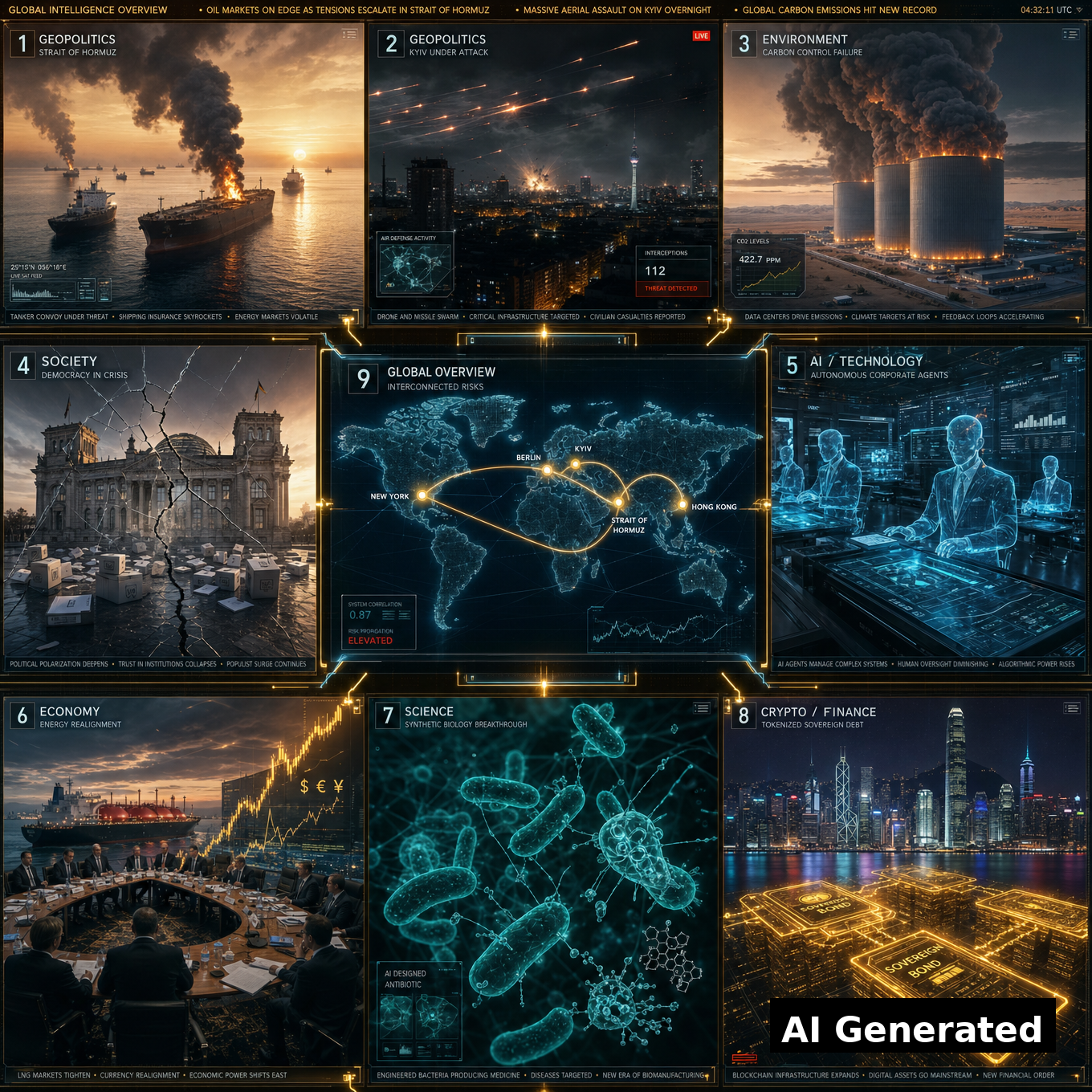


Contents
- 1. Geopolitics & Defence
- Hormuz’s Weekend Collapse and Tehran’s Open Door
- Ukraine’s Record Strike and the Vote That Wasn’t a Contest
- The Baltic Nerve: Railways, Radar and Slovakia’s Refusal
- Erbil, The Hague and the Legal Battlefield
- The Arsenal Ledger: Drones, Carriers and Tank Doctrine
- Diplomacy’s Week Ahead: UNGA, Caracas and Islamabad
- 2. Environment & Climate
- 3. Society & Civil Issues
- 4. AI & Technology
- 5. Economy & Business
- 6. Science & Space
- 7. Crypto, Digital Assets & Blockchain
- 8. Correlations & Analysis
- 9. References
Click any heading to jump to that section. Click the section heading to return to this menu.
Geopolitics & Defence ↑ Contents
Hormuz’s Weekend Collapse and Tehran’s Open Door
The chokepoint war this briefing has tracked since D103 (2026-09-11) recorded its starkest quantitative low: just twelve commercial vessels transited Hormuz in two days, down from thirty-five the previous weekend, the blockade now functioning without a negotiating track attached [1]. Greek shipping coverage of the same figures notes Washington and Tehran remain in formal impasse, with the transit arithmetic serving as the war’s daily pulse-check rather than a lagging indicator [2]. The D112 report documented four vessels a day and LNG moving dark; the weekend print shows even that baseline eroding, which matters because the winter gas-season squeeze D111 flagged assumed partial flow.
Two diplomatic signals moved the other way within twenty-four hours. President Trump told a Fox reporter he is “open” to meeting Iran’s President Pezeshkian, the first direct personal-channel hint since Tehran transmitted its terms [3]. Simultaneously the US Virtual Embassy urged American citizens to leave Iran immediately — an advisory that in every prior round of this conflict preceded kinetic action, and which sits uneasily beside the summit rhetoric [4]. The White House is keeping both doors open: the meeting manages oil-market nerves, the advisory preserves the strike option D112 rated most probable.
Ukraine’s Record Strike and the Vote That Wasn’t a Contest
Ukraine delivered its largest air operation of the war on the final day of Russia’s elections: over 1,600 drones across Russia, roughly 450 aimed at Moscow, the Gazprom Neft refinery struck and all four international airports serving the region closed [5]. Zelenskyy’s account catalogued the domestic systems used — Flamingo, Pelican, Palianytsia among them — showing how completely Kyiv’s deep-strike arsenal has indigenised since D109 [5]. Russian authorities confirmed three dead and twenty injured; Sobyanin called it an “unprecedented attack” timed to the vote.
The election produced the expected result: United Russia took 57.8 percent on a half-count, enough for a constitutional two-thirds Duma majority, with war-opposition parties excluded by design and voting also run in occupied territories [6]. The BBC notes the result’s function is rhetorical — a claim Russians endorse the war — while fuel shortages, drone alarms and internet restrictions formed the backdrop [7]. Within hours the Defence Ministry promised “intensified” high-precision strikes on Kyiv in retaliation, converting the electoral cycle into the next escalation rung [8]. The energy-war logic both sides now pursue — refinery for refinery — was visible in D112’s German fuel politics; the exchange rate is now accelerating in both directions [9].
The Baltic Nerve: Railways, Radar and Slovakia’s Refusal
Two infrastructure signals from NATO’s eastern flank deserve more attention than their quiet delivery suggests. Belarus has fully restored a railway abandoned since 2000 terminating near the Lithuanian border and the Latežeris crossing, beside the Suwałki Gap — the alliance’s most vulnerable terrain — complete with a new road toward the frontier; Lithuania has fortified the same sector with its “Baltic Defence Line” obstacles [10]. Rail restoration is not attack preparation by itself, but heavy-move logistics beside the Gap cohere with the surveillance record: NATO and German E-3A AWACS flights over Poland and the Baltics have surged over four days, mapping Russian and Kaliningrad air defences daily [11].
Satellite imagery adds a third data point: China has built mock-ups of US F-35s and F-16s, Patriot batteries and — notably — Japan’s E-767 AWACS at a freshly paved range near Lop Nur, a target catalogue that only makes sense against Tokyo’s specific force structure [12]. In the same week, Slovakia’s Robert Fico answered Czech President Pavel’s martial rhetoric by declaring no Slovak soldier will join “any military adventure” under his premiership, invoking Article 5’s flexibility options against automatic front-line deployment [13]. Geography and logistics are being prepared for contingencies diplomacy has not yet named — the D112 sovereignty-of-infrastructure thread, continuing.
Erbil, The Hague and the Legal Battlefield
The war produced two direct escalations overnight. An explosion hit near Erbil airport in Iraqi Kurdistan, where US-led coalition forces remain stationed, shortly after Shahed-136 launches attributed to Iran — the first reported Iranian strike on US forces since D112’s maximum-alert warnings, and a data point that makes Washington’s “open to meeting” line look like sequencing rather than de-escalation [14]. Tehran simultaneously warned it has learned of possible new American strikes and that retaliation would come “without limitations,” while fighting raged on the Yemeni front D112 identified as likeliest flashpoint [15].
Washington’s counter-move ran through institutions rather than airfields: sweeping sanctions are being prepared against the International Criminal Court itself — payments, IT services, investigations — in what French coverage calls a programme to “dismantle it brick by brick” and asphyxiate the institution [16] [17]. An administration fighting a multi-front war it declines to submit to legal process is defunding the one tribunal that could adjudicate it. Aleppo’s still-unexplained explosions and Haiti’s extradition of eighteen suspects in the Moïse assassination — five years on — close a legal ledger spanning three continents [18] [19].
The Arsenal Ledger: Drones, Carriers and Tank Doctrine
The war’s industrial signature surfaced in an unlikely place: a Florida fishing charter hauled a Shahed-136 lookalike out of the Gulf of Mexico, and Eglin AFB acknowledged losing a test article — the US LUCAS low-cost one-way attack system, reverse-engineered from Iran’s design and first used in combat in February [20]. The weapon that defined the enemy’s arsenal is now a mass-produced American category with cooperative swarming in development. NATO’s institutional learning is explicit: nine European allies have joined Ukraine in a “Freyja” air-defence coalition for a cheaper, faster Patriot alternative, while Ukrainian commanders teach the alliance how convoys disperse under drone watch [21].
The platform layer shows the same reckoning from the expensive end. Britain’s two Queen Elizabeth-class carriers catalogue propeller-shaft failures, a 4.1 percent trained-strength decline, and an F-35B fleet at roughly half the seventy-four jets planned — the F-35 arithmetic D112 tracked through the Finnish and Saudi sales [22]. The USS Ronald Reagan returned after eighteen months in dry dock — its first docking-availability since 2012 — with $145 million of Kitsap electrical upgrades awaiting the Ford-class JFK in 2029, the maintenance-industrial base of the carrier presence now operating against Iran [23]. And the tank gets its ledger in an Abrams SEPv3 versus T-14 comparison concluding the Russian vehicle remains “virtually untested”; the Western value lies in repair pipelines and training depth [24].
Diplomacy’s Week Ahead: UNGA, Caracas and Islamabad
The UNGA week D112 previewed now has its cast list. Venezuela confirmed Vice-President Delcy Rodríguez will attend and may meet President Trump — the first high-level contact since the Caribbean strikes and Cuban rupture D112 documented, and a signal Caracas is negotiating its way out of containment [25]. Germany, riven by its result, will be represented by Foreign Minister Wadephul rather than Chancellor Merz, whose Berlin presence after the vote was judged “erforderlich” — domestic survival outranking UNGA for a G7 leader [26]. Pakistan’s crisis deepened in parallel: Imran Khan’s three sisters were detained in Lahore ahead of a march demanding his release [27].
Two items complete the map. As UNGA 81 opens, the UN’s Sahel footprint is shrinking by design — juntas demanding sovereignty have forced a smaller mandate, with Russia filling the vacuum D108 first mapped [28]. And formerly rival Ethiopian armed groups announced an alliance against the federal government, raising the prospect of multi-front war in Africa’s second-most-populous state [29]. Neither competes with Hormuz for headlines; both will shape the security environment the Gulf war’s winners inherit.
Environment & Climate ↑ Contents
The Super-Pollutant Nobody Prices, and the Data-Centre’s Health Bill
An Inside Climate News investigation has quantified one of the climate system’s quietest embarrassments: China’s electric utilities are releasing vast quantities of sulphur hexafluoride — the most potent greenhouse gas known, tens of thousands of times stronger than CO₂ — from the very grid buildout that powers the world’s electrification hopes, with recycling programmes available that could slash the emissions at minimal cost [30]. The finding lands in the same window as a report from former EPA officials warning that the AI data-centre boom is now expanding with its environmental guardrails dismantled: at least thirty separate weakening actions since January 2025, coal plants kept online past retirement to feed compute, and an estimated 1,300 additional deaths per year from the associated pollution [31]. Senator Sheldon Whitehouse’s argument that the retreat is driven by fossil-fuel corruption rather than consumer interest gives the political frame, and a pointed one ahead of midterms in which he could chair the Judiciary Committee [32].
The week’s one genuinely optimistic data point cuts against Washington’s policy U-turn: Harvard economists project US electric-vehicle sales reaching 32–38 percent of new purchases by 2030 despite last year’s federal reversal, on the strength of economics rather than subsidy [33]. The pairing is analytically useful — the technology transition is outrunning the regulatory environment that D112 showed being rewritten, which is precisely why the SF6 and data-centre stories matter: the sectors absorbing that growth are the ones whose externalities are least policed.
Drought’s British Ledger and the Fire Season’s Southern Face
Britain’s drought has begun transmitting into the food system in two separate commodity chains: daily milk collections in England and Wales are running 1.24 million litres — 3.7 percent — below the same week last year as parched grazing land cuts yields, prompting explicit shortage warnings [34]; and tea prices are climbing on Kenyan production “plummeting” under the climate crisis, with farmers facing unpredictable weather and escalating costs on a crop Britain imports almost entirely [35]. Neither is a crisis alone; together they sketch the import-dependent food-exposure map that the UK government’s new stockpiling guidance — covered in this report’s Society section — implicitly acknowledges. In the Andes, a wildfire has burned more than 2,000 acres of forest around one of Colombia’s most popular tourist villages, with some 250 firefighters and military helicopters deployed — the Southern Hemisphere’s fire season opening earlier and hotter than baseline [36].
France supplies the infrastructure counter-story: opponents of the Beauvais low-cost airport’s €200 million expansion are attempting to cap budget-carrier growth at exactly the moment aviation’s climate ledger is under litigation across Europe, making a local planning fight a proxy for the continent’s aviation-growth question [37]. The connection to D112’s offshore-wind reckoning is direct — Europe is simultaneously fighting over how much to grow mobility infrastructure and how fast to retire its fossil complement.
Long Views: The Aral’s Two Recoveries, a Reactor’s Afterlife and Drones in the Paddies
A long-form reconstruction of the Aral Sea disaster offers the most precise accounting yet of what “recovery” means where a lake has died: Kazakhstan’s Kok-Aral dam has restored the northern basin’s volume by 68 percent and tripled fish production, while Uzbekistan has planted 1.7 million hectares of saxaul on the exposed southern bed — reducing the dust storms that cost Karakalpakstan an estimated $44.2 million a year — without restoring water [38]. The two strategies embody opposite theories of repair, and the World Bank’s cumulative-loss warning (over $844 million within two decades absent action) prices the difference. At the opposite end of the nuclear lifecycle, the 1999 Trojan reactor burial — a 1,020-ton vessel filled with concrete and shipped by barge to Hanford — is a reminder that decommissioning’s hardest problem was never the vessel: the plant’s 791 spent fuel assemblies still stand in dry casks in Oregon twenty-seven years later [39].
The agricultural-technology asymmetry completes the section’s long view: China entered 2026 with roughly 309,000 plant-protection drones performing about 203 million hectare-treatments in 2025 — around thirty times the US figure — making agricultural drones ordinary farm machinery at industrial scale in one hemisphere and a niche in the other [40]. And a dietary meta-finding closes the ledger on a note that resists easy consumption politics: organic beef carries a larger carbon footprint than feedlot beef, because pasture-raised animals live longer and emit more per kilogram — a result that complicates the assumption that extensive farming is the climate-friendly default [41].
Society & Civil Issues ↑ Contents
Germany’s Earthquake: A Chancellor’s Party Falls Below Five Percent
The result D112 framed as the window’s central political risk has arrived, and it is worse for the chancellor’s party than any pre-vote scenario: the CDU scored 4.9 percent in Mecklenburg-Vorpommern, failing a state parliament threshold for the first time in the party’s postwar history, while the AfD took first place with 38.2 percent and the SPD’s Manuela Schwesig recovered to 35.5 after trailing for weeks [42]. Handelsblatt’s account of the CDU leadership’s Sunday night records that a Merz resignation was “quickly discarded” in the praesidium and that the chancellor intends to continue both as party leader and head of government — but flags the next internal confrontation already forming [43]. Der Spiegel’s live analysis registers the compound shock: in Berlin, where the Left won decisively, and in MV, where the party fell off the map entirely, the CDU lost the youth cohorts almost completely, scoring two percent among voters aged 16–24 in the northeast [44].
The coalition arithmetic in Schwerin is viable but poisoned: with the CDU and BSW both out of the Landtag — the BSW missing by fractions — Schwesig can likely build a red-red-green majority, but both junior partners are alienated by the SPD’s AfD-focused campaign strategy that cut into their own vote [45]. The international press verdict was brutal in its own register, with European titles praising Schwesig’s resilience while reviewing “Versagen von Merz” and the question of whether the chancellorship itself is now open [46]. The deeper pattern in the data is the wasted-vote problem: roughly fourteen percent of MV ballots and around thirteen percent in Berlin went to parties excluded by the five-percent threshold, and Rostock’s political scientists now openly argue for a three-percent alternative [47].
Berlin produced its own history: the Left’s decisive win makes Elif Eralp the first mayor of Turkish descent in the German capital’s history, likely governing with SPD and Greens — but the Remmo clan leader’s appearance at the victory party, and the party’s flailing response, previews the coalition-building friction to come [48] [49]. Between the two states, the German party system’s centre has not merely narrowed; it has been evicted from one parliament and outvoted in another, and the federal consequences now run on Merz’s clock, not the constitution’s.
The Perjury Trial, the Reprieve and the Civic Ledger’s German Chapters
Seven years after the car-toll fiasco cost German taxpayers 243 million euros, former transport minister Andreas Scheuer went on trial in Berlin for alleged perjury before a Bundestag committee — the first former federal minister in German history to face criminal charges for a suspected lie to parliament, with twelve hearing days scheduled and a verdict possible by late November [50] [51]. The case turns on whether operators offered to postpone contract signatures pending the European Court of Justice ruling, and whether Scheuer’s “I do not recall” was a lie — a narrow question with constitutional resonance at a moment when institutional accountability machinery is being retired elsewhere. In a quieter reprieve, Deutsche Welle’s Broadcasting Council unanimously reversed the planned closure of the station’s Greek service, preserving it in reduced form from January 2027 after the Greek reaction “surprised” the council — a small but telling data point on soft-power economics: German public diplomacy to south-eastern Europe was nearly audited away, then rescued by the audience it serves [52] [53].
From Austin to Washington: Force, Architecture and the Science Veto
The immigration state crossed a visible line in Austin, Texas, where an ICE officer shot a man and protests were dispersed by police, an incident a Democratic official answered by demanding a “complete and independent” investigation [54]. President Trump, in the same twenty-four hours, announced that his planned Washington “Triumphal Arch” would be converted at the military’s request into a “top grade Military Complex/Triumphal Arch” citing national security — monumental architecture following the militarisation arc D112 traced through the AI Force announcement [55]. New York’s mayor-elect Zohran Mamdani will meet the president after hosting Paris’s mayor, a summit between the administration and its sharpest urban antagonist that both sides need for opposite reasons [56]. And in the most consequential governance item of the batch, the White House is seeking authority to reject scientific projects that do not conform to the president’s ideas — a proposal French coverage correctly reads as capable of “paralysing medical progress” — which converts the science-policy frictions documented since D105 into an explicit political loyalty test [57]. Montana’s anti-Citizens United initiative, framed by its advocates as “soft secession” from the Court’s campaign-finance doctrine, extends the same states-versus-centre legal hardening D112 identified from California to a red state [58].
Greece contributed its own institutional alarm: a Tovima investigation has put the leak of personal data — with potential national-security dimensions — on the front page, with the opposition demanding immediate answers in a story that echoes the Predator-era surveillance politics this briefing has tracked through the Greek poll cycle [59].
Britain’s Civic Ledger; Japan’s Caring Machines
Britain’s justice ledger gained two chapters: the man suspected of murdering Joanne Sheen — whose remains were found only when a Feltham wildfire exposed them seven years after she vanished — was rearrested on murder and conspiracy charges alongside a second suspect [60]; and Axel Rudakubana, the Southport killer, returns to court charged with assaulting prison staff, the institutional aftermath of the case that reshaped Britain’s public-order politics [61]. On the economic-civic front, Kemi Badenoch pledged to restore tax-free shopping for tourists, arguing the 2021 abolition left the UK “less competitive” [62]; one in three consumers report abandoning online purchases for fear of scams, with a majority believing firms should compensate victims of impersonation fraud [63]; and the organ-donation waiting list now numbers almost 8,700, with nine people dying weekly — the quiet health-infrastructure arithmetic behind D112’s NHS ledger [64]. The government’s advice that households stockpile canned goods against emergencies — published without fanfare but resonating against the war-premium backdrop — completes a resilience picture that connects directly to the drought-driven milk and tea warnings in this report’s Environment section [65]. And Japan’s answer to its own demographic ledger — elder care robots whose “warmth” is calibrated alongside human wisdom — offers the Caring-Machine frontier a gentler test case than the humanoid combat demos [66].
AI & Technology ↑ Contents
New York’s AI Track: Dialogue Without Limits
The US–China diplomatic track that opened in New York this weekend — covered fully in this report’s Economy section — carried a distinct technology ledger of its own. Kurt Campbell, the architect of Washington’s Asia strategy, stated flatly that the AI talks will not produce binding limits, a candid admission that the “dialogue mechanism” both sides floated is process rather than constraint [67]. The Treasury’s parallel contribution is an AI incident-notification proposal emerging from the talks — a transparency architecture for accidents rather than a treaty on capability [68]. And the commercial layer beneath the diplomacy: inference providers Modal, Fireworks and Baseten are running Moonshot’s Kimi K3 on US Nvidia and AMD silicon at a cost advantage, meaning a frontier-class Chinese model is now served on American chips to American users while the two governments negotiate the rules of the technology itself [69].
Agents Become Managers, and the Industry Picks Its Apocalypse
The organisational frontier is moving from assistants to org-charts: a Düsseldorf founder runs a nine-human company supported by more than 100 AI agents, and Handelsblatt’s write-up argues the binding constraint is no longer the models but management practice — how humans direct, audit and promote digital staff [70]. Google’s open-source EnvHarness attacks the adjacent bottleneck, letting agents train against environments that evolve with them rather than static test-beds, which is the infrastructure story behind why agent capabilities keep lurching forward unpredictably [71]. Against all this acceleration, Nvidia’s Jensen Huang rejected extinction concerns as “doomsday narratives” — the sharpest phrasing yet of the accelerationist faction D112 watched take the White House side of the argument, and a direct answer to the slowdown pact that Amodei proposed and Altman, Musk and Hassabis endorsed in the D105–D111 window [72]. Meta’s response to the surveillance anxiety sits between the camps: a camera-less version of its AI glasses, designed to quiet the fear of being recorded unknowingly — product design absorbing the privacy lesson Google’s Glass learned a decade ago [73].
The consequence of a non-binding track deserves spelling out. A dialogue mechanism without limits is not a safeguard; it is a telephone line, useful for de-conflicting accidents and — via the incident-notification idea — for warning each other of runaway systems, but silent on compute thresholds, model releases and export controls [67] [68]. The Kimi K3 deployment shows why both sides accept even that thin arrangement: Chinese frontier models already run on American accelerators through American intermediaries, while American labs court Chinese capital and users, so the two industries are structurally interdependent even as the two governments treat the technology as a strategic edge [69]. Governance, in other words, is lagging the physical integration it is supposed to govern — the same lag D112 observed inside the safety debate, now visible at the level of states.
The Hardware Frontier: Cooling, Supersonic and the Battery Gap
Three engineering stories complete the section’s physical layer. Hong Kong University of Science and Technology’s zero-degradation elastocaloric cooling device — a fatigue-resistant solid-state refrigerant holding a 41K temperature span and 400W cooling over one million cycles without loss — clears the durability wall that has kept solid-state refrigeration out of air conditioners, with a 100-million-cycle material test behind it [74]. China’s Tianmushan Laboratory has moved its TMS-10 low-boom supersonic demonstrator into final assembly ahead of an end-2026 supersonic flight, targeting the Beijing–Shanghai route in thirty minutes and entering direct conceptual competition with NASA’s X-59 programme [75]. And Oak Ridge’s STAR lab is attacking the reason promising battery materials die at manufacturing scale — sulfide solid-state and sulfur electrodes that perform in the lab but fail when gaps, interfaces and pressure enter the cell — the quiet bottleneck beneath every electrification projection in this report’s Economy and Environment sections [76].
Economy & Business ↑ Contents
The Summit Economy: Carve-Outs, LNG and a Stronger Yuan
The week’s macro frame was set in New York, where US and Chinese officials reported “candid, detailed and constructive” talks with progress on tariff carve-outs and a commitment to further dialogue ahead of a Thursday Trump–Xi summit [77]. The prize under discussion is concrete: President Xi arrives in Washington seeking to revive a $6 billion US liquefied natural gas trade — energy commerce that the Gulf war’s repricing of global LNG has made both more urgent and more leverageable [78]. The summit’s guest list is its own signal: Microsoft’s Satya Nadella will join OpenAI’s and Nvidia’s chiefs at the White House dinner for Xi, placing the AI economy’s three central companies at the same table as the two governments negotiating its rules [79]. Beijing has pre-positioned its currency: the yuan midpoint was set at its strongest since February 2023, backed by 165 billion yuan of liquidity injections and a 60-billion-yuan Hong Kong bill sale timed days before the leaders meet [80] [81]. Tokyo’s position is the mirror image — a volatile yen drawing intervention watch while other currencies stay subdued, the same imported-energy fragility D111 documented in Japan’s fuel bill [82].
The leverage arithmetic cuts in directions the communique language does not. A revived $6 billion LNG trade would, on paper, ease the global gas scarcity the Hormuz blockade created — but only if shipping insurance and Gulf transit risk price down first, meaning Washington is effectively offering Beijing a discount tied to its own Gulf escalation management [78]. The yuan’s strongest midpoint since February 2023, timed days before the summit, is the counterpart signal: China arrives with a stable currency and a full liquidity toolkit rather than concessions [80] [81]. Markets read the calendar accordingly, with Asian equities bidding up on the talks while Tokyo warns it will defend the yen — three currencies, three strategies, one summit [82].
The War Premium at the Checkout and in Tehran’s Ledger
The war economy’s domestic transmission now has a face and a number. Dollar General’s CEO told a Goldman Sachs conference that Americans earning $100,000 no longer “feel like high-income shoppers,” with core customers changing behaviour the moment petrol passes $4 a gallon — the national average now $4.476, up from $3.189 a year ago, and diesel at $6.50 feeding everything shipped by truck [83]. That is D112’s “war premium reaches the household” theme crossing from the bond market into the discount aisle. Iran’s own ledger is starker: GDP contracted 10.1 percent over the course of the war, with the IMF projecting a further 5.4 percent shrinkage this year — the first full accounting of what the blockade war costs the blockaded [84].
Capital’s Long Bets and the Ascending Periphery
Three longer-horizon items complete the section. Australia’s seventh Intergenerational Report projects deaths outnumbering births by the 2060s and lower economic growth, while betting that AI can more than double the economy over four decades — a wager on productivity against demography that echoes the ageing-society arithmetic Japan’s care robots are already engineering around [85]. SoftBank is seeking over $11 billion in junk-bond financing for its OpenAI commitment, the AI-capex economy’s leverage now reaching the high-yield market that D112’s data-centre credit theme foreshadowed [86]. Germany’s IG Metall staged a nationwide “Automobil-Aktionstag” across more than 100 plants demanding secure jobs and future-proof sites — the workforce answering the Chinese-competition, US-tariff and EV-margin squeeze that D112 tracked through the Leapmotor shock [87]. And Vietnam entered the FTSE emerging-market ranks, eyeing billions in passive inflows — the periphery ascending on precisely the supply-chain diversification that the two-chokepoint war has accelerated [88].
Two cross-currents qualify the long bets. Australia’s AI wager assumes the compute buildout D112 costed — the $280-billion burn — keeps compounding, which SoftBank’s junk-bond raise now extends into the high-yield market, a segment whose appetite historically disappears exactly when capex programmes need it most [85] [86]. And Vietnam’s FTSE promotion lands the same week Germany’s industrial workforce takes to the streets, which is the two-chokepoint war’s reallocation of industrial confidence in a single snapshot [87] [88].
Science & Space ↑ Contents
Medicine’s Frontiers: A Year of Cholesterol Control and Tumour-Factory Bacteria
The week’s most clinically striking result is a single infusion: the experimental CRISPR-Cas9 therapy CTX310 cut LDL cholesterol by 52.5 percent and triglycerides by 47.8 percent, measured twelve months after treatment — a durable, edit-based intervention at the population-health scale that statins reached only through daily compliance [89]. In the adjacent oncological frontier, Columbia University’s engineered probiotic turned E. coli Nissle 1917 into a tumour-resident drug factory, producing chemotherapy locally while carrying an IL-15 superagonist and a PD-L1 blocker; a single injection plus prodrug doses erased 43 percent of colorectal tumours in mice and slowed the growth of untreated tumours on the opposite flank — evidence of a systemic immune response recruited by a local therapy [90]. The regenerative thread continues in the eye, where researchers identified inflammation as the reason the ageing retina’s support cells fail to replace lost neurons — reducing it partially restored regeneration, a route toward glaucoma therapies that work with the cells already present [91]. And a Danish register study reframed the ADHD and autism “epidemic”: diagnosed children today increasingly resemble the general population in birth histories and family backgrounds, meaning the diagnostic net’s expansion is a story about services and definitions as much as biology [92].
The Mind Reassessed: Myths, Screens and a Country That Grew
A forensic debunking traced the famous “eight-second human attention span, nine-second goldfish” statistic to a 2015 Microsoft marketing graphic whose numbers could not be sourced to any primary research — the BBC’s 2017 investigation found neither cited institution had a record of the study, and the piece closes with a usable heuristic for evaluating the next viral cognitive claim [93]. An eight-year Finnish cohort complicated the adjacent moral panic: children reporting more screen time showed better cognitive performance at fifteen, with the crucial caveat that no causal direction was established and what children do with screens matters more than the aggregate hours [94]. The deepest time-series of the batch belongs to the Netherlands: Dutch men gained nearly eight inches in 150 years, and a 2023 simulation attributes under half a centimetre of that to natural selection — the growth was nutrition, hygiene and child health, a national height record doubling as an archive of childhood conditions [95].
Deep Time: Iron for an Army, Devils in the Pilbara and Molehill Archaeology
Three archaeology stories reshape their respective maps. The Danube gravel pit at Deinham has yielded Europe’s largest cache of prehistoric iron bars — roughly 500 double-pointed semiproducts weighing about a tonne, enough to forge 500 swords or 8,000 nails, likely lost in a single Late Iron Age transport transaction and preserved only because the finders reported it to the monument authority rather than the scrap trade [96]. The Juukan 2 rock shelter — destroyed by Rio Tinto’s 2020 blast — has now yielded Tasmania devil specimens dated to roughly 7,000 and between 42,500 and 47,115 years, the first direct evidence of the species in the Pilbara, though the older identification is tentative and both dates rest on surrounding sediments because destructive sampling of the teeth was culturally impermissible [97]. And in Flanders, systematic excavation of molehills near Damme recovered 2,810 fragments from 814 mounds, mapping a thirteenth-to-fourteenth-century brick gatehouse that had vanished from the historical record — “molehill archaeology” upgraded from curiosity to method [98].
Living Systems and the Stellar Ceiling
The physical and living sciences supplied the section’s final ledger. A reanalysis of historical sunspot records concludes the Sun is physically capable of superflares — events thousands of times stronger than anything observed in the space age — collapsing the comfortable assumption that our star is too quiet to threaten a technological civilisation [99]. Ten lions found dead in Tanzania’s Ngorongoro Conservation Area are suspected poisoned, a wildlife-crime signal with conservation consequences across East Africa’s trophy-and-conflict economy [100]. Young poplars were shown to straighten bent stems without light or gravity cues by modulating where they lay down tension wood — a hidden “muscle” in trees that revises how biomechanics textbooks describe plant posture [101]. With an estimated handful of vaquitas left, researchers digitised a skeleton into free 3D models, preserving the anatomy of a species approaching extinction [102]. Grey squirrels were caught performing decoy burials — digging, miming, covering and walking off with the nut — with fakes becoming far more frequent when rivals were watching, the first experimental evidence of behavioural deception in a wild rodent [103]. At the cellular scale, sustained stretching showed epithelial tissue rebuilding its keratin scaffolding across neighbouring cells while simultaneously pushing nuclei out of their mechanical cages — “nuclear uncaging,” whose protective or harmful nature is the open question [104]. And RMIT’s floating titanium — a lattice structure that keeps the metal’s strength while adding buoyancy — extends the materials toolbox toward marine and aerospace applications where every gram counts [105].
Crypto, Digital Assets & Blockchain ↑ Contents
Hong Kong Puts Sovereign Debt On-Chain
The week’s most consequential digital-asset announcement came not from Washington but from Hong Kong, where Financial Services Secretary Christopher Hui confirmed the government will pilot tokenized Exchange Fund Bills by the end of 2026 and will allow regulated stablecoins to trade on licensed platforms — placing the state’s own debt instruments on-chain for the first time at this scale, through a CMU Omniclear digital-asset platform providing one-stop issuance and settlement [106]. The policy address framed digital assets and fintech as a core growth engine for a city that already accounts for roughly half of global digital-bond issuance, and the stablecoin element completes a framework that has moved from spot-trading licences to issuers to now secondary trading on regulated venues [106]. The distribution metrics behind that institutional push are compounding fast: xStocks’ tokenized equities reached a $173 million market capitalisation, up 187 percent in a single month — a rate that, from the small base D112 documented, confirms tokenized equities as the fastest-compounding wrapper in the asset class [107] — while Ethereum’s euro-denominated stablecoin supply added $32 million of growth, extending the euro-rail story that European regulation has been quietly building [108].
Institutional M&A and the Distribution Race
Traditional finance’s absorption of crypto infrastructure crossed a symbolic line: S&P Global — the risk-data company whose ratings sit under trillions in instruments — agreed to acquire OpenZeppelin, the smart-contract security and auditing firm whose code libraries secure a large share of the Ethereum and DeFi ecosystem [109]. The strategic logic matters more than the undisclosed price: as tokenized bonds and funds move onto blockchain rails, a vulnerability in a smart contract becomes a financial risk rather than a software curiosity, and the ratings establishment is buying the capability to price that risk from the inside [109]. The retail distribution race moved in parallel, with WisdomTree integrating MoonPay — and its 30-million-plus registered accounts — into WisdomTree Prime to funnel conventional card and bank rails into its WTGXX tokenized money-market fund, the point where the competition among BlackRock, Franklin Templeton and WisdomTree shifts from tokenising funds to owning the on-ramp [110]. Tools for Humanity’s World Money launch pushes the same convergence from the identity side: a self-custodial wallet pairing World ID verification with stablecoin payments and Stripe-powered fiat onboarding, region-restricted where yield and card features collide with local rules, but unmistakably designed to make a crypto-native stack feel like ordinary fintech [111].
The governance subtext is worth stating plainly. Hong Kong’s pilot puts its Exchange Fund Bills on the same technology stack that xStocks and WTGXX occupy, which means a sovereign issuer, an ETF-scale asset manager and a retail equities wrapper are now converging on shared settlement infrastructure within a single quarter — the moment at which interoperability standards stop being academic and become negotiating positions between jurisdictions. D112’s report closed on RSA-896 falling with AI assistance and two major protocols shipping post-quantum primitives; a quarter in which government debt settles on-chain makes that cryptographic timeline an asset-integrity question, not a research agenda [106] [107]. The regulatory asymmetry with Europe remains: Ethereum’s euro-stablecoin growth shows MiCA-compliant rails compounding quietly while Asia’s hubs compete on issuance scale [108].
The enforcement ledger, meanwhile, documents how the war economy has colonised the digital asset space. A North Korean cyber group tracked as WaterPlum ran a fake-recruiter campaign — phantom jobs at crypto, AI and NFT companies — that infected at least 30,000 devices across more than 100 countries and extracted $10.7 million, the social-engineering pipeline that funds the sanctions-evading weapons economy this briefing has tracked since the BitBank designations of D110 [112]. France supplied the civilian-mirror version of the same threat: massive personal-data leaks have produced a surge of fraudulent “support calls” impersonating crypto platform customer service, with fraudsters armed by stolen databases rather than malware — and a reminder that the breach surface now includes every national identity registry that has ever touched a KYC file [113]. The two stories bracket the institutionalisation arc perfectly: as regulated venues, tokenized sovereign debt and ratings-grade security diligence pull the asset class into the financial mainstream, the revenue lines of coercion and fraud adapt faster than the perimeter can close — which is why the same week that put government bills on-chain also produced a 30,000-device infection map.
Correlations & Analysis ↑ Contents
The through-line of this window is the arrival of the war economy at the ballot box and the checkout counter simultaneously. Where the D112 report (2026-09-20) documented the politicisation of the war economy — settlements stress-tested by electorates before they could consolidate — this window delivers the verdicts. Germany’s CDU fell below five percent in Mecklenburg-Vorpommern and lost Berlin to the Left, the first threshold failure in the party’s postwar history, with the wasted-vote share and the youth collapse both pointing to a party system now rearranging around energy prices and the war’s costs [42] [47]. Russia’s managed election delivered its own verdict in the same seventy-two hours, contested by the largest drone operation of the war — 1,600 munitions aimed at the infrastructure that finances the vote [5] [6]. And in the United States, the war premium has completed its migration from sovereign bonds into the discount aisle: a $100,000 salary no longer feels like high income, and Iran’s GDP has contracted 10.1 percent over the course of the war [83] [84]. Elections were always the superstructure; the fuel price is becoming the base.
The second thread is the collapse of the distinction between diplomacy and leverage. Tehran’s transmitted terms, tracked since D112, are now answered by a White House that is simultaneously “open” to meeting Pezeshkian, warning its citizens to leave Iran, and absorbing a strike on its Erbil base [3] [4] [14] [15]. The US–China track runs the same double game at a higher register: tariff carve-outs and an AI incident-notification mechanism on one ledger, binding limits explicitly ruled out and Chinese models served on American chips on the other [77] [67] [69]. What D111 called “de-escalation by formalisation” has evolved into something more transactional — summitry as a scheduling device for strikes and sanctions, with Hong Kong tokenizing sovereign debt and the ICC defunded in the same window [106] [16]. Infrastructure, not treaties, is where the commitments now live.
The third thread extends the legitimacy ledger that D112 opened. The same governments convening carrier groups are failing their domestic tests: an ICE officer shooting a civilian in Austin, a White House seeking power to veto scientific projects that contradict the president’s ideas, German ex-ministers on perjury trial while their successors lose a quarter of the youth vote to parties outside the constitutional centre [54] [57] [50] [42]. The mirror-images matter: Joanne Sheen’s murder solved only because a wildfire exposed seven-year-old remains, nine Britons a week dying waiting for organs, one in three consumers abandoning purchases for fear of fraud — and a government advising citizens to stockpile canned goods while its drought shrinks the milk supply [60] [64] [63] [65] [34]. The connective tissue with D112 is direct and grim: formalisations are executed by states whose domestic ledgers degrade faster than their foreign policy consolidates.
The fourth thread is compute’s physical bill coming due on two fronts. D112’s antitrust and safety factionalism now has its industrial counterpart: former EPA officials documenting thirty regulatory rollbacks that let data centres expand past air-quality safeguards even as Harvard economists project EV adoption outrunning the policy reversal [31] [33]. The materials frontier — zero-degradation solid-state cooling, the battery-manufacturing gap, floating titanium — is where the constraint will actually bind, and China’s thirty-to-one agricultural-drone advantage shows what happens when a state treats physical scaling as industrial policy [74] [76] [105] [40]. The AI governance question D112 left open — who governs the labs — now has a supply-chain answer: whoever builds the cooling, the cells and the chips [67].
What to watch in the next reporting period: First, the German coalition-forming in Schwerin and Berlin, and whether Merz survives the CDU’s post-election reckoning — the party boards meet with his chancellorship now a live question [43] [46]. Second, the Yemen decision: Iran’s Erbil strike and its “without limitations” warning make a direct US attack on the Houthi front the highest-probability escalation of the coming window, with the Thursday Trump–Xi summit and Iran’s economic freefall shaping the clock [14] [15] [84]. Third, UNGA week’s dense calendar — Wadephul leading for Germany, Delcy Rodríguez possibly meeting Trump, and the Zelenskyy financing meeting D112 previewed [26] [25]. Fourth, the two technology calendars: Hong Kong’s tokenization pilots and the Thursday summit dinner’s AI guest list on the institutional side; Avalanche’s Helicon activation (September 22) and Starship’s orbital attempt (September 28) on the protocol side [106] [79]. And fifth, watch the winter gas arithmetic: twelve ships a weekend through Hormuz cannot feed the storage refill D111 projected, and the next relief packages — German or French — will be sized by that gap [1] [45].
References ↑ Contents
1. “FinancialJuice: 12 vessels passed through Strait of Hormuz over weekend, down from 35 week before – shipping data” — FinancialJuice, 2026-09-21. link ↑
2. “Βουτιά στη διέλευση εμπορικών πλοίων από τα Στενά του Ορμούζ, μόλις 12 το Σαββατοκύριακο” — Protothema, 2026-09-21. (originally in Greek) link ↑
3. “Trump ‘open’ to meeting Iranian President Pezeshkian – Fox reporter” — Investing.com, 2026-09-21. link ↑
4. “US Virtual Embassy urges American citizens to leave Iran immediately” — Crypto Briefing, 2026-09-21. link ↑
5. “’Unprecedented Attack’: Ukraine Just Fired 450 Drones at Moscow as Part of a Massive 1,600 Drone Assault on Russia” — 19FortyFive, 2026-09-20. link ↑
6. “Ρωσία: Νέος εκλογικός θρίαμβος Πούτιν στη σκιά των drones” — Enikos, 2026-09-21. (originally in Greek) link ↑
7. “Russia’s elections had few surprises – but how the Kremlin uses the results is far from clear” — BBC News, 2026-09-21. link ↑
8. “Ρωσικό υπουργείο Άμυνας: «Θα ενταθούν οι βομβαρδισμοί κατά του Κιέβου»” — DefenceNet, 2026-09-20. (originally in Greek) link ↑
9. “Russia and Ukraine Are Now Fighting an Energy War” — 19FortyFive, 2026-09-20. link ↑
10. “Η Λευκορωσία επαναλειτούργησε σιδηροδρομική γραμμή δίπλα στον στρατηγικό διάδρομο Σουβάλκι” — DefenceNet, 2026-09-20. (originally in Greek) link ↑
11. “Βαλτική: Μπαράζ αναγνωριστικών πτήσεων του ΝΑΤΟ στα σύνορα με Ρωσία και Καλίνινγκραντ” — DefenceNet, 2026-09-20. (originally in Greek) link ↑
12. “Δορυφορικές εικόνες δείχνουν πεδίο βολής στην Κίνα με στόχους αμερικανικά μαχητικά” — DefenceNet, 2026-09-20. (originally in Greek) link ↑
13. “Φίτσο: «Όσο είμαι πρωθυπουργός, η Σλοβακία δεν μπαίνει σε καμία στρατιωτική περιπέτεια»” — DefenceNet, 2026-09-20. (originally in Greek) link ↑
14. “Βίντεο: Τα πρώτα πλάνα από το νέο ιρανικό χτύπημα στη βάση του Ερμπίλ” — DefenceNet, 2026-09-20. (originally in Greek) link ↑
15. “Iran war live: Tehran warns US against new strikes; fighting rages in Yemen” — Al Jazeera, 2026-09-21. link ↑
16. “Trump administration readies sweeping sanctions against ICC, reports say” — Al Jazeera, 2026-09-21. link ↑
17. “«La démanteler brique après brique» : l’administration Trump veut désormais asphyxier financièrement la CPI” — Le Parisien, 2026-09-21. (originally in French) link ↑
18. “Powerful explosions at Syrian army site near Aleppo injure at least four” — Al Jazeera, 2026-09-21. link ↑
19. “Στις ΗΠΑ 18 ύποπτοι για τη δολοφονία του προέδρου της Αϊτής Ζοβενέλ Μοΐζ” — Protothema, 2026-09-21. (originally in Greek) link ↑
20. “Shahed-136 Clone Found By Florida Fisherman, Eglin AFB Admits It Lost A Drone” — The War Zone, 2026-09-20. link ↑
21. “The Ukraine Is Making NATO Rethink Just About Everything” — 19FortyFive, 2026-09-20. link ↑
22. “The Royal Navy Has 2 65,000-Ton Queen Elizabeth-Class Aircraft Carriers… But Not All Is Well With These Warships” — 19FortyFive, 2026-09-21. link ↑
23. “100,000-Ton US Navy Nimitz-Class Nuclear Aircraft Carrier Returns to the Fleet” — 19FortyFive, 2026-09-20. link ↑
24. “The US Army’s M1 Abrams SEPv3 vs. Russia’s T-14 Armata: A Super Tank Showdown” — 19FortyFive, 2026-09-21. link ↑
25. “Βενεζουέλα: Επιβεβαιώνει τη συμμετοχή της Ντέλσι Ροδρίγκες στη ΓΣ του ΟΗΕ” — Zougla, 2026-09-21. (originally in Greek) link ↑
26. “Bundesaußenminister Wadephul reist zur UN-Generaldebatte nach New York” — Stern, 2026-09-21. (originally in German) link ↑
27. “Imran Khan’s family says three sisters detained ahead of Islamabad march” — Al Jazeera, 2026-09-21. link ↑
28. “The Sahel and the UN: a smaller footprint, a different role” — Al Jazeera, 2026-09-21. link ↑
29. “Ethiopian armed groups forge alliance against government” — Al Jazeera, 2026-09-21. link ↑
30. “Climate Super-Pollutant from China’s Electric Grid Is Cooking the Planet” — Inside Climate News, 2026-09-20. link ↑
31. “Former EPA officials: Trump is letting data centers make people sick” — Grist, 2026-09-20. link ↑
32. “Whitehouse: Call Out the Corruption Propelling the US Climate Retreat” — Inside Climate News, 2026-09-20. link ↑
33. “EV Sales At 32% — No, Make That 38%! — By 2030” — CleanTechnica, 2026-09-20. link ↑
34. “Milk shortage warning as drought in England and Wales puts major strain on supply” — The Independent, 2026-09-20. link ↑
35. “Tea shortage warning as climate crisis sees production plummet and prices soar” — The Independent, 2026-09-20. link ↑
36. “Μεγάλη φωτιά απειλεί έναν από τους δημοφιλέστερους τουριστικούς προορισμούς στην Κολομβία” — Protothema, 2026-09-21. (originally in Greek) link ↑
37. “A Beauvais, les opposants espèrent faire capoter le projet d’agrandissement de l’aéroport des vols low-cost” — Le Monde, 2026-09-20. (originally in French) link ↑
38. “The Aral Sea was once the world’s fourth-largest lake… Kazakhstan revived part of the water and Uzbekistan planted 4.2 million acres” — ECOticias, 2026-09-20. link ↑
39. “In 1999, workers filled a 42-foot nuclear reactor vessel with 200 tons of concrete… 791 spent fuel assemblies from the same Oregon plant are still waiting” — ECOticias, 2026-09-20. link ↑
40. “China Is Doing About 30 Times More Agricultural Drone Work Than The U.S.” — CleanTechnica, 2026-09-20. link ↑
41. “Organic beef has a larger carbon footprint than feedlot beef” — Sentient Media, 2026-09-20. link ↑
42. “Landtagswahlen: Historisches Debakel – CDU scheitert an Fünf-Prozent-Hürde” — Handelsblatt, 2026-09-20. (originally in German) link ↑
43. “CDU: Kein Aufstand trotz historischer Niederlage – wie Merz den Wahlabend überstand” — Handelsblatt, 2026-09-21. (originally in German) link ↑
44. “Wahlen: In Mecklenburg-Vorpommern fliegt die CDU aus dem Landtag, in Berlin unterliegt sie der Linken – die Liveanalyse” — Der Spiegel, 2026-09-21. (originally in German) link ↑
45. “Wahl in Mecklenburg-Vorpommern: AfD vorn, SPD gerupft, CDU raus: Wie geht es weiter in MV?” — Stern, 2026-09-21. (originally in German) link ↑
46. “Pressespiegel: »Versagen« von Merz – Schwesig als »Stütze« gegen Rechts” — DIE ZEIT, 2026-09-21. (originally in German) link ↑
47. “Landtagswahl: Diese versteckten Wahlmuster finden sich am Morgen danach” — Handelsblatt, 2026-09-20. (originally in German) link ↑
48. “Berlin-Wahl: „Geschichte geschrieben“ – Wird die Linke nun Berlin regieren?” — Handelsblatt, 2026-09-21. (originally in German) link ↑
49. “Remmo-Clan: Linke distanziert sich von Clanchef-Besuch auf Wahlparty” — DIE ZEIT, 2026-09-21. (originally in German) link ↑
50. “Justiz: Ex-Minister Scheuer nach Maut-Debakel vor Gericht” — Stern, 2026-09-21. (originally in German) link ↑
51. “Pkw-Maut: “Nach meiner Erinnerung nicht gegeben”: Prozess gegen Ex-Verkehrsminister Andreas Scheuer beginnt” — Handelsblatt, 2026-09-21. (originally in German) link ↑
52. “Συνεχίζεται η λειτουργία του ελληνόφωνου τμήματος της Deutsche Welle – Ανατράπηκε το λουκέτο” — Enikos, 2026-09-21. (originally in Greek) link ↑
53. “Deutsche Welle behält griechischen Dienst doch” — tagesschau, 2026-09-21. (originally in German) link ↑
54. “USA unter Trump: ICE-Beamter schießt Mann in Texas nieder – Proteste” — FAZ, 2026-09-21. (originally in German) link ↑
55. “Trump announces new plan for D.C. arch” — NBC News, 2026-09-21. link ↑
56. “Après avoir accueilli le maire de Paris Emmanuel Grégoire, le New-Yorkais Zohran Mamdani va rencontrer Donald Trump” — Le Parisien, 2026-09-21. (originally in French) link ↑
57. “«Cela paralyserait les progrès médicaux» : la Maison-Blanche veut pouvoir rejeter les projets scientifiques non conformes aux idées de Donald Trump” — Le Parisien, 2026-09-20. (originally in French) link ↑
58. “Montana Anti-Citizens United Bill Is A Form Of Soft Secession” — CleanTechnica, 2026-09-20. link ↑
59. “5 το πρωί: Στον «αέρα» τα προσωπικά δεδομένα – Νέο Βατερλό για Μερτς – Τύμπανα πολέμου ξανά στη Μέση Ανατολή” — Tovima, 2026-09-21. (originally in Greek) link ↑
60. “Joanne Sheen murder suspect rearrested after remains identified as missing mum” — Metro, 2026-09-20. link ↑
61. “Southport killer to appear in court charged with assaults on prison staff” — Evening Standard, 2026-09-21. link ↑
62. “Badenoch pledges to bring back tax-free shopping for tourists” — The Independent, 2026-09-21. link ↑
63. “Scam fears causing one in three UK consumers to abandon online purchases – study” — The Independent, 2026-09-20. link ↑
64. “The agonising wait for an organ donor: ‘I’m always waiting for the call’” — The Independent, 2026-09-20. link ↑
65. “What food items should you stock up on in case of an emergency?” — BBC News, 2026-09-20. link ↑
66. “In Focus: Elder care, the warmth of robots, the wisdom of people” — Nikkei Asia, 2026-09-21. link ↑
67. “Kurt Campbell says US-China AI talks won’t yield binding limits” — Crypto Briefing, 2026-09-21. link ↑
68. “US Treasury proposes AI incident notification mechanism after talks with China” — Crypto Briefing, 2026-09-21. link ↑
69. “Modal, Fireworks, and Baseten gain cost advantage with Nvidia and AMD chips for Kimi K3” — Crypto Briefing, 2026-09-21. link ↑
70. “KI-Führungskräfte: Wenn KI-Agenten zu Managern werden” — Handelsblatt, 2026-09-21. (originally in German) link ↑
71. “Google’s open source EnvHarness lets AI agents train against environments that evolve with them” — VentureBeat, 2026-09-21. link ↑
72. “Nvidia boss rejects AI extinction fears as ‘doomsday narratives’” — BBC News, 2026-09-21. link ↑
73. “Meta: Ετοιμάζει AI γυαλιά χωρίς κάμερα – Το μάθημα από την Google” — OT.gr, 2026-09-20. (originally in Greek) link ↑
74. “World’s first zero-degradation elastocaloric cooling device maintains 1 million operational cycles” — Interesting Engineering, 2026-09-20. link ↑
75. “Beijing to Shanghai in 30 minutes: China ready to test its Supersonic TMS-10 plane” — Interesting Engineering, 2026-09-20. link ↑
76. “Why promising battery materials break down when researchers build real cells” — Interesting Engineering, 2026-09-20. link ↑
77. “US says China talks yield progress on tariff carve-outs, AI dialogue” — Nikkei Asia, 2026-09-21. link ↑
78. “Xi Jinping heads to Washington to revive a $6B US liquefied natural gas trade” — Crypto Briefing, 2026-09-21. link ↑
79. “Microsoft CEO Satya Nadella to attend White House dinner for Xi Jinping” — Crypto Briefing, 2026-09-21. link ↑
80. “FinancialJuice: China sets yuan midpoint at strongest level since Feb. 3, 2023, according to PBOC” — FinancialJuice, 2026-09-21. link ↑
81. “China’s central bank to sell 60 billion yuan in bills through Hong Kong on September 23” — Crypto Briefing, 2026-09-21. link ↑
82. “Volatile yen draws intervention watch, other currencies subdued” — Reuters via Investing.com, 2026-09-21. link ↑
83. “Dollar General CEO says consumers making $100,000 a year don’t feel like high-income shoppers anymore” — Fortune, 2026-09-20. link ↑
84. “Ιράν: Το ΑΕΠ υποχώρησε κατά 10,1% στη διάρκεια του πολέμου” — Zougla, 2026-09-21. (originally in Greek) link ↑
85. “More Australians will be dying than being born in 40 years as major report predicts future of lower growth” — The Guardian, 2026-09-21. link ↑
86. “SoftBank seeks over $11B in junk bond deal to fund OpenAI investment” — Crypto Briefing, 2026-09-21. link ↑
87. “Proteste bei Herstellern und Zulieferern: „Automobil-Aktionstag“ der IG Metall” — Stern, 2026-09-21. (originally in German) link ↑
88. “Vietnam enters FTSE emerging-market ranks, eyes billions in inflows” — Nikkei Asia, 2026-09-21. link ↑
89. “New Treatment Cuts “Bad” Cholesterol in Half for a Full Year” — SciTechDaily / Cleveland Clinic, 2026-09-20. link ↑
90. “Engineered Probiotic Wipes Out 43% of Colorectal Tumors in Mice” — ScienceAlert, 2026-09-21. link ↑
91. “Scientists Discover a Key Reason Why the Aging Eye Struggles To Regrow Lost Neurons” — SciTechDaily / SUNY Upstate, 2026-09-21. link ↑
92. “New Study Reveals a Major Shift Behind Rising ADHD and Autism Diagnoses” — SciTechDaily / ISGlobal, 2026-09-21. link ↑
93. “Humans do not have a scientifically established eight-second attention span, and goldfish do not have a proven nine-second one” — ScienceBlog, 2026-09-21. link ↑
94. “Researchers followed 260 Finnish children for eight years… greater use actually showed better overall cognitive performance” — ECOticias, 2026-09-20. link ↑
95. “Dutch men went from averaging about 5 feet 5 inches in the mid-1800s to nearly 6 feet today… natural selection may explain less than 2%” — ECOticias, 2026-09-20. link ↑
96. “’Nothing short of a minor miracle’: ‘Rusty treasure’ found in the Danube is full of 2,000-year-old iron bars” — Live Science, 2026-09-20. link ↑
97. “Two Tasmanian devil specimens came out of Juukan 2, the Pilbara rock shelter Rio Tinto blew up in 2020” — ScienceBlog, 2026-09-21. link ↑
98. “Βέλγιο: Τυφλοπόντικες «αρχαιολόγοι» έφεραν στο φως μεσαιωνικό κτίσμα 800 ετών” — Enikos, 2026-09-21. (originally in Greek) link ↑
99. “The Sun Is Physically Capable of Producing a “Superflare” According To A New Study” — Universe Today, 2026-09-20. link ↑
100. “Poison suspected in deaths of ten lions in game reserve in Tanzania” — NPR, 2026-09-20. link ↑
101. “Scientists Discover Trees Have a Hidden “Muscle” That Helps Them Straighten Themselves” — SciTechDaily / INRAE, 2026-09-20. link ↑
102. “Scientists Digitize One of the World’s Rarest Animals Before It Disappears” — SciTechDaily / FAU, 2026-09-20. link ↑
103. “Grey squirrels with a rival nearby dug a hole, mimed burying a nut, covered it over and walked off still holding the nut” — ScienceBlog, 2026-09-20. link ↑
104. “Scientists stretched living tissue for hours and watched its internal keratin scaffolding rebuild itself” — ECOticias, 2026-09-20. link ↑
105. “Scientists create world’s first floating titanium” — New Atlas, 2026-09-20. link ↑
106. “Hong Kong to Pilot Tokenized Exchange Fund Bills and Regulated Stablecoin Trading” — Blockchain Reporter, 2026-09-21. link ↑
107. “xStocks tokenized stocks reach $173M market cap, up 187% in a single month” — Crypto Briefing, 2026-09-21. link ↑
108. “Ethereum leads euro stablecoin market cap growth with $32M increase” — Crypto Briefing, 2026-09-21. link ↑
109. “S&P Global Agrees To Acquire Smart Contract Security Firm OpenZeppelin” — NewsBTC, 2026-09-21. link ↑
110. “WisdomTree And MoonPay Expand US Access To Tokenized Funds” — NewsBTC, 2026-09-21. link ↑
111. “World Rolls Out World Money App With Stablecoins And Stripe Integration” — NewsBTC, 2026-09-21. link ↑
112. “North Korean fake recruiters infect 30K devices, steal $10.7M in crypto” — Cointelegraph, 2026-09-21. link ↑
113. “Massive French Data Leaks Spark Surge in Fake Crypto Support Calls” — Bitcoin.com News, 2026-09-21. link ↑
AI Disclosure: This post was created with the assistance of artificial intelligence. The ideas, analysis, and opinions expressed are my own — AI was used to help compose, structure, and refine my personal notes and thoughts into the final written content. Images, videos and music featured in this post were also generated using AI tools, based on my own creative prompts and direction.