






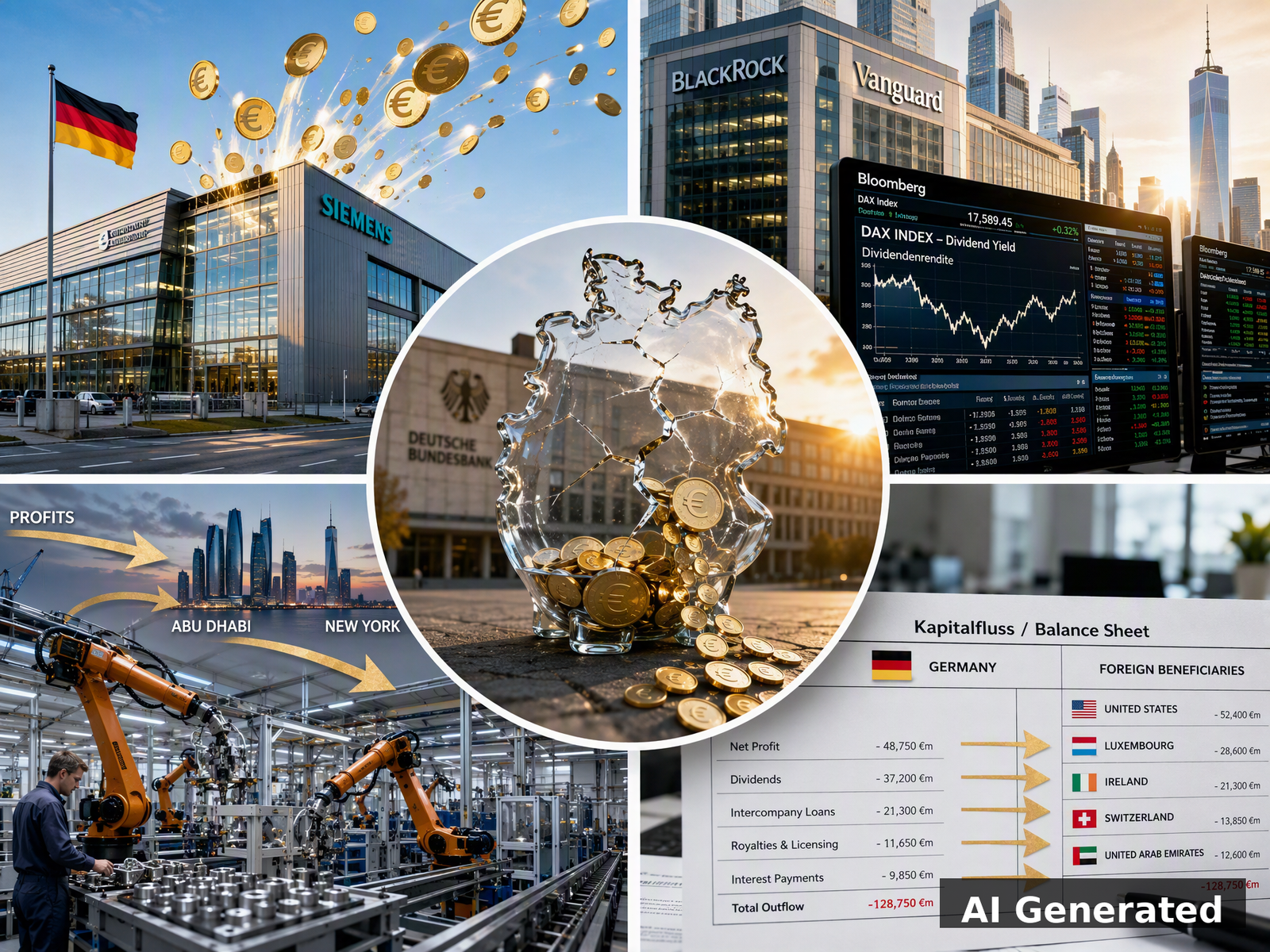

This article is part of the series: “Deutschland for Sale” — Tracking Germany’s industrial sell-off from survey to consequences
Part 1: The Survey · Part 2: The Hollowing-Out Test · Part 3: The Drivers and the Response · Part 4: Where the Money Goes
The first three parts of this series told a story of factories and ownership. Part 1 counted the record sales. Part 2 asked whether the plants actually leave. Part 3 explained why the owners sell. But there is a quieter, harder-to-see consequence of the whole pattern — and it may matter more than any single factory closure. It is the question of where the money goes.
When a German company is sold to a foreign owner, the manufacturing might stay in Mulfingen or Münster. But the profits of that company — year after year, for as long as the new owner holds it — no longer belong to Germany. They flow, in several distinct channels, toward the parent company’s home country. This is the capital-flow dimension of the sell-off: not the machines leaving, but the yield leaving. And the evidence suggests it is significant, structural, and growing.
The capital-flow dimension of Germany’s sell-off
The capital-flow dimension captures something that factory closures and employment statistics miss entirely. It is not about whether a plant physically moves — it is about where the value produced by that plant ends up. A German factory that remains in Bavaria but sends its profits to Abu Dhabi is, in economic terms, no longer financing the German economy. It is financing its new owner’s home country. The machines hum. The workers clock in. But the yield flows elsewhere.
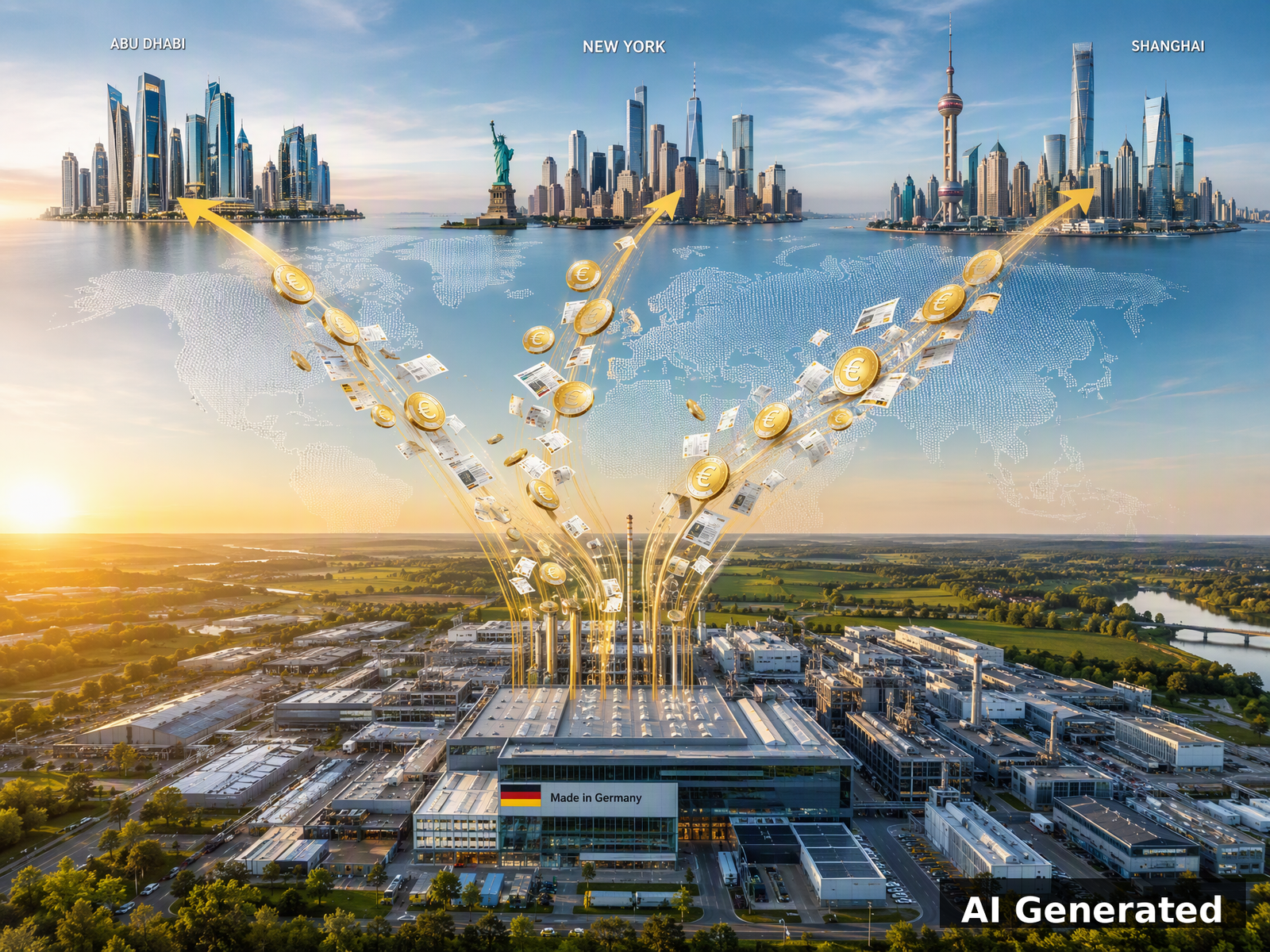
This is the fourth dimension of the sell-off series. Part 1 established the scale: a record wave of foreign acquisitions of German Mittelstand and listed companies. Part 2 tested whether foreign ownership actually leads to offshoring — and found that the economics, not the flag on the door, decides. Part 3 examined why German families are selling: succession crises, energy costs, regulatory burden, and the simple fact that the buyer’s offer is too good to refuse.
Now we follow the money. Because the most durable consequence of the sell-off is not the moment of transaction — it is the decades of capital outflow that follow.
First, the channels: how capital actually leaves
To understand what is happening, we have to map the ways capital flows out of a foreign-owned German company. There are at least seven.
1. Dividends and profit repatriation. The most direct channel. A German subsidiary earns profit, then pays it upward to its foreign parent as a dividend. This happens every year, and it is the single clearest mechanism by which German-produced value ends up abroad.
2. The purchase price itself. When a German company is sold, the proceeds go to the sellers. If those sellers are German families, the cash stays in German hands — but it leaves the company. If the sellers are already foreign — as with the private-equity funds that flip companies like Apleona and Stada — the proceeds leave the country entirely [5][6].
3. Debt-service drain. Many foreign buyers, especially private-equity firms, finance acquisitions with debt piled onto the target itself. The German company then carries interest and principal payments to foreign lenders for years — a slow, continuous outflow that never appears in the news.
4. Royalties, licensing and transfer pricing. A German subsidiary often pays its foreign parent for the right to use patents, brands and “management services.” These fees are priced internally, are hard to audit, and can be the largest hidden channel of all.
5. R&D and headquarters migration. The highest-value functions — engineering, strategy, patents, and the paychecks that go with them — tend to drift toward the parent’s home country over time. When the patents migrate, so do the future profits they generate.
6. Reinvestment decisions. Where do the retained profits go? A Chinese owner earning in Germany may reinvest those profits in another project — inside Germany, or, just as easily, abroad. This is the channel that decides whether the money stays or leaves in the long run.
7. Intra-group treasury flows. Intercompany loans, cash pooling and treasury movements inside a multinational group shift capital toward the parent’s centre of gravity.
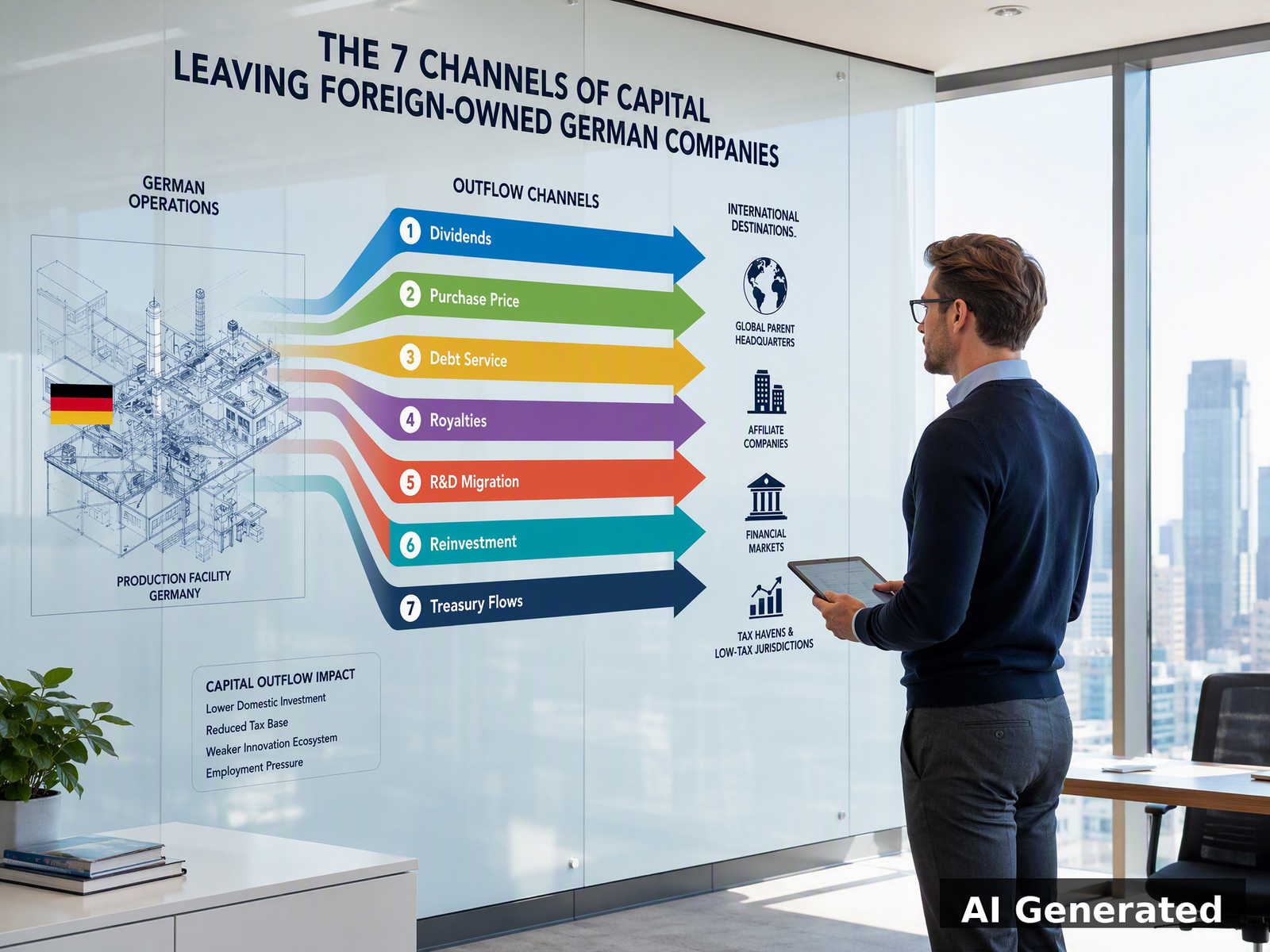
Each channel has a direction. And the data now shows which way the net flow is pointing.
The direction: German capital is leaving
The clearest macro signal comes from the Bundesbank. German companies have invested almost €1.7 trillion abroad cumulatively since 2010 [1]. And while German capital has been flowing out, inward foreign investment into Germany has collapsed. During 2020 and 2021, foreign firms put just over €100 billion of equity capital into Germany. From then to mid-2024, that figure fell to only €62 billion. The Bundesbank calls 2022 a “statistically significant structural break” in Germany’s ability to attract foreign capital [1].
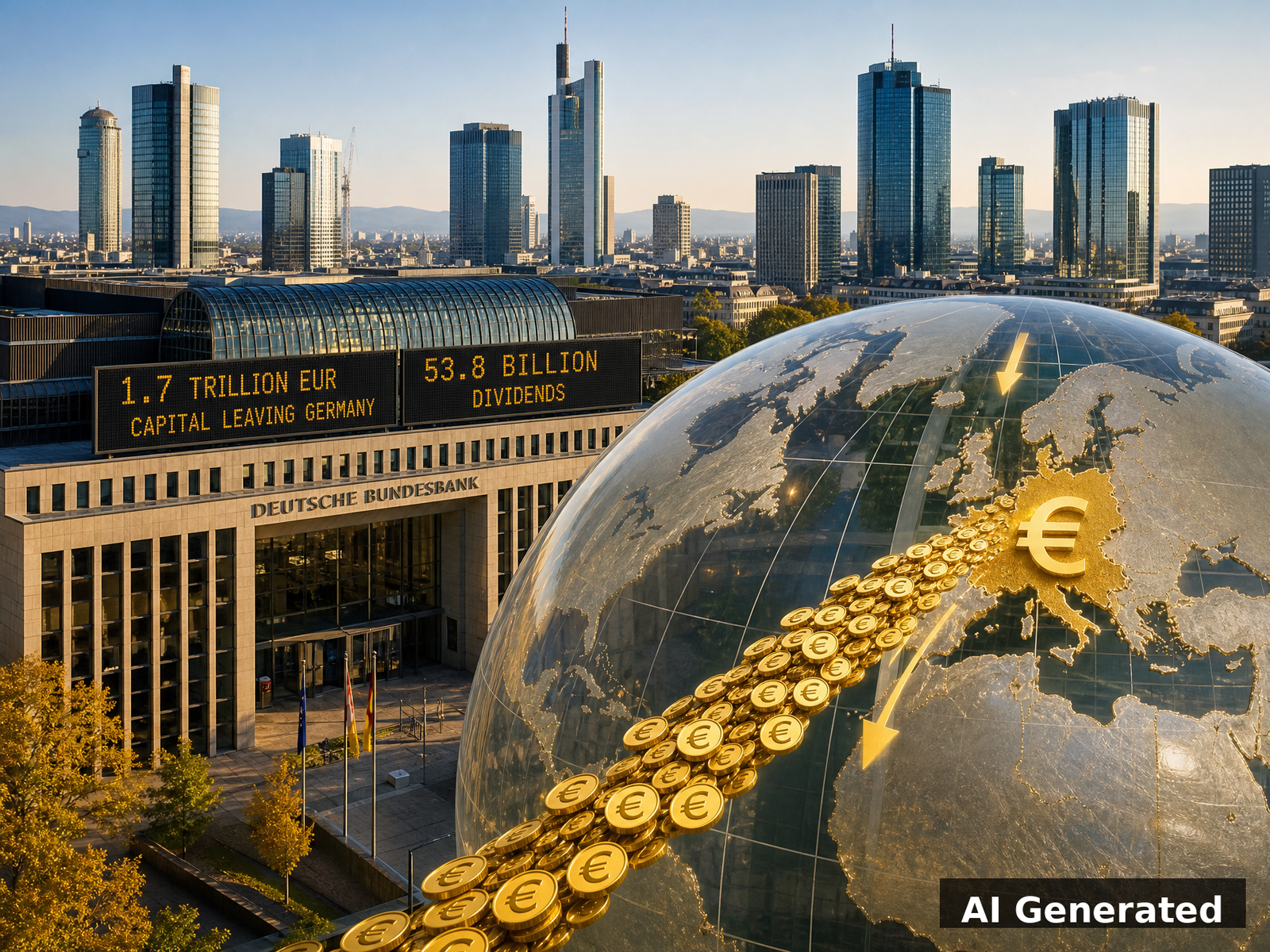
Even more telling is how foreign and German owners behave differently. The Bundesbank found that German companies expanding in China did so largely through reinvested profits — keeping the money in the business. Other foreign companies, by contrast, mostly withdrew their retained earnings, reducing their capital in China [1]. That is the behavioural signature of foreign ownership: extract rather than reinvest.
And the profit outflow is not hypothetical. The DAX companies — Germany’s 40 largest listed firms — paid out a record €53.8 billion in dividends for the 2023 financial year. Almost half of that, about €26 billion, went to foreign investors [2]. North American investors alone took 22.5 percent of all DAX dividends, and US investors held more than €200 billion in German stocks [2]. By 2026, the dividend total had risen to a new record of €55.3 billion — and the share going abroad had climbed to 49.8 percent, according to EY [3].
Let that sink in. Half of the profits distributed by Germany’s flagship companies now flows out of the country. That is the capital-flow dimension, in a number.
Previous in this series: Deutschland for Sale, Part 3: Why They Sell — The Drivers and the Policy Response — Why German families are selling their companies
The deeper shift: the end of the Deutschland AG
To grasp why this matters, you have to understand what it replaced. For most of the post-war era, Germany had a distinctive ownership structure — the so-called “Deutschland AG.” German banks and insurance companies, above all Deutsche Bank and Allianz, sat at the centre of a dense web of cross-shareholdings in German industry. Profits circulated inside the German system. German firms held German firms. The system was opaque to outsiders, but it kept capital — and control — national [4].
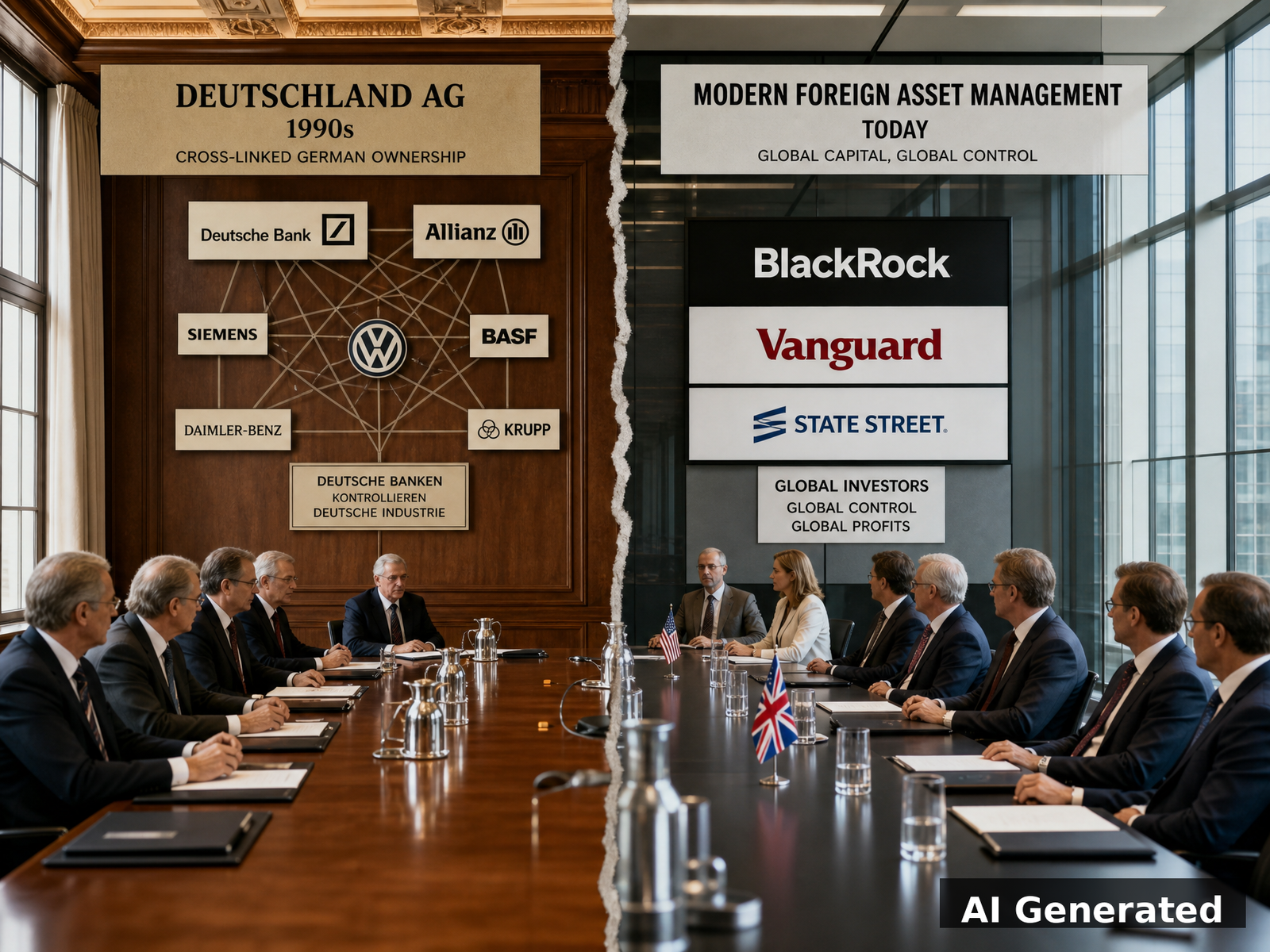
That system was deliberately dismantled. In the early 2000s, the Schröder government cut the capital-gains tax on selling corporate stakes, opening the German market to foreign investors [4]. The Deutschland AG broke apart. In its place came the age of asset management: Blackrock, Vanguard and State Street — the “Big Three” — now manage a combined €27.3 trillion and are the largest shareholders in many DAX companies. Blackrock alone holds about 11 percent of all DAX shares [4].
This is the deeper story behind the sell-off. It is not only that individual German companies are being bought. It is that the system that kept German capital and German ownership in German hands has been replaced by a system in which the largest owners of German industry are foreign asset managers and foreign acquirers. The profits, the dividends and the control increasingly flow outward.
What this means for the 2024–26 acquisitions
Now bring it back to the specific deals in this series. Each has a capital-flow signature:
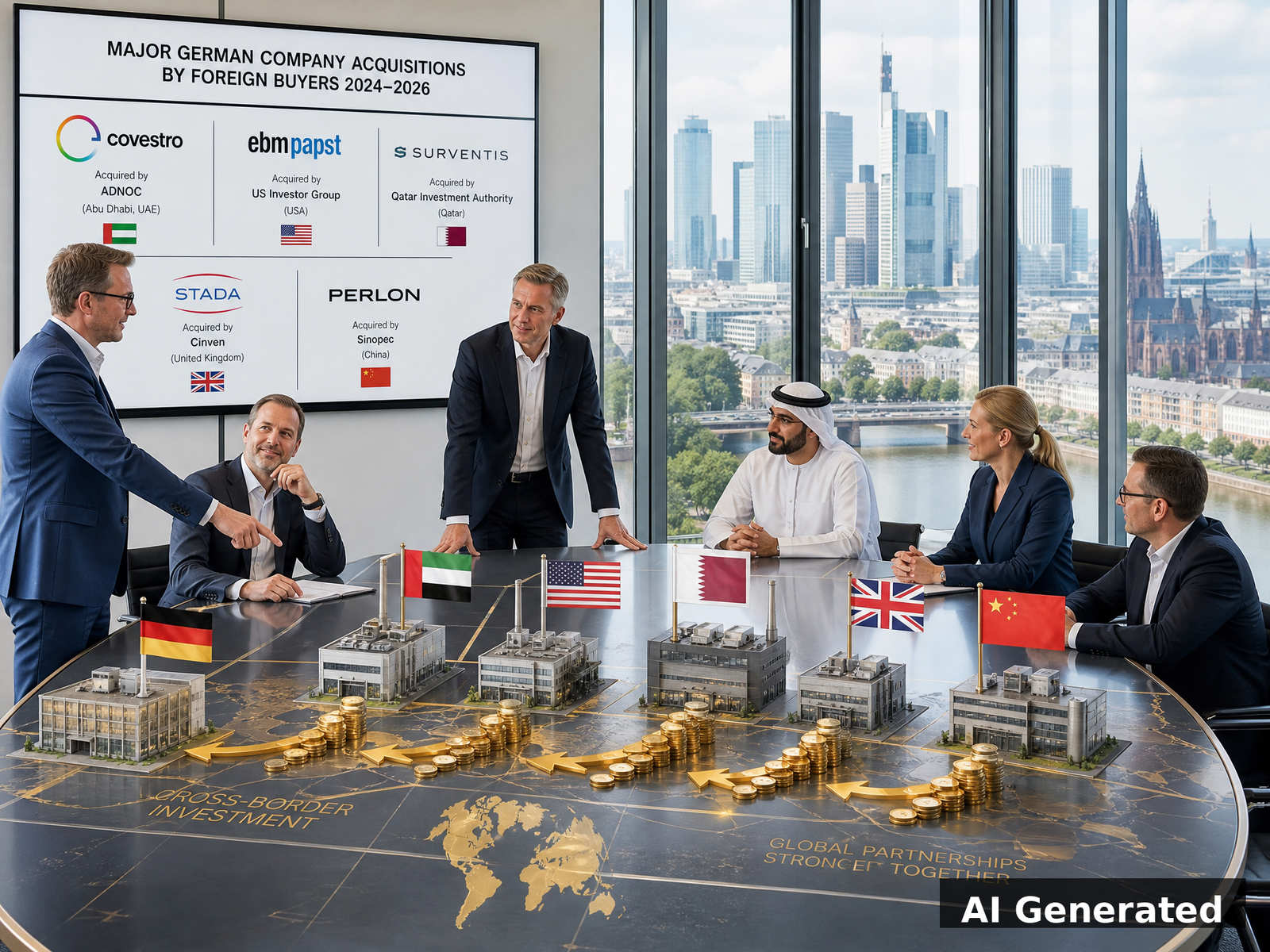
Covestro, taken over by Abu Dhabi’s Adnoc/XRG — a state-owned oil company — for roughly €15 billion [10]. The profits of a 17,600-person German chemicals champion now flow toward the Gulf, and the strategic direction of the company serves an Emirati state agenda.
EBM-Papst, sold to Madison Air for €5.1 billion. The owners promise Mulfingen stays a production site [8]. But the profits of one of the world’s leading ventilation firms will now be repatriated to an American parent.
Surventis, the reborn BASF Coatings business, majority-owned by Carlyle and Qatar’s sovereign fund [9]. PE and state capital now own the profits of a €3.9 billion German coatings leader.
Stada, taken by British buyout firm Capvest [11]. A leveraged acquisition — which means debt-service payments will flow to foreign lenders for years.
Perlon, the insolvent chemical champion bought by China’s Wuxi Yinda Nylon. All three German sites stay, the buyer promises investment — but 60 of 510 jobs are already gone [7]. The question is what happens to the profits: reinvested in Bobingen, or redeployed toward Shanghai?
None of these requires a single factory to close. The hollowing-out here is financial, not physical. The plants stay; the money goes.
The reinvestment question nobody can answer yet
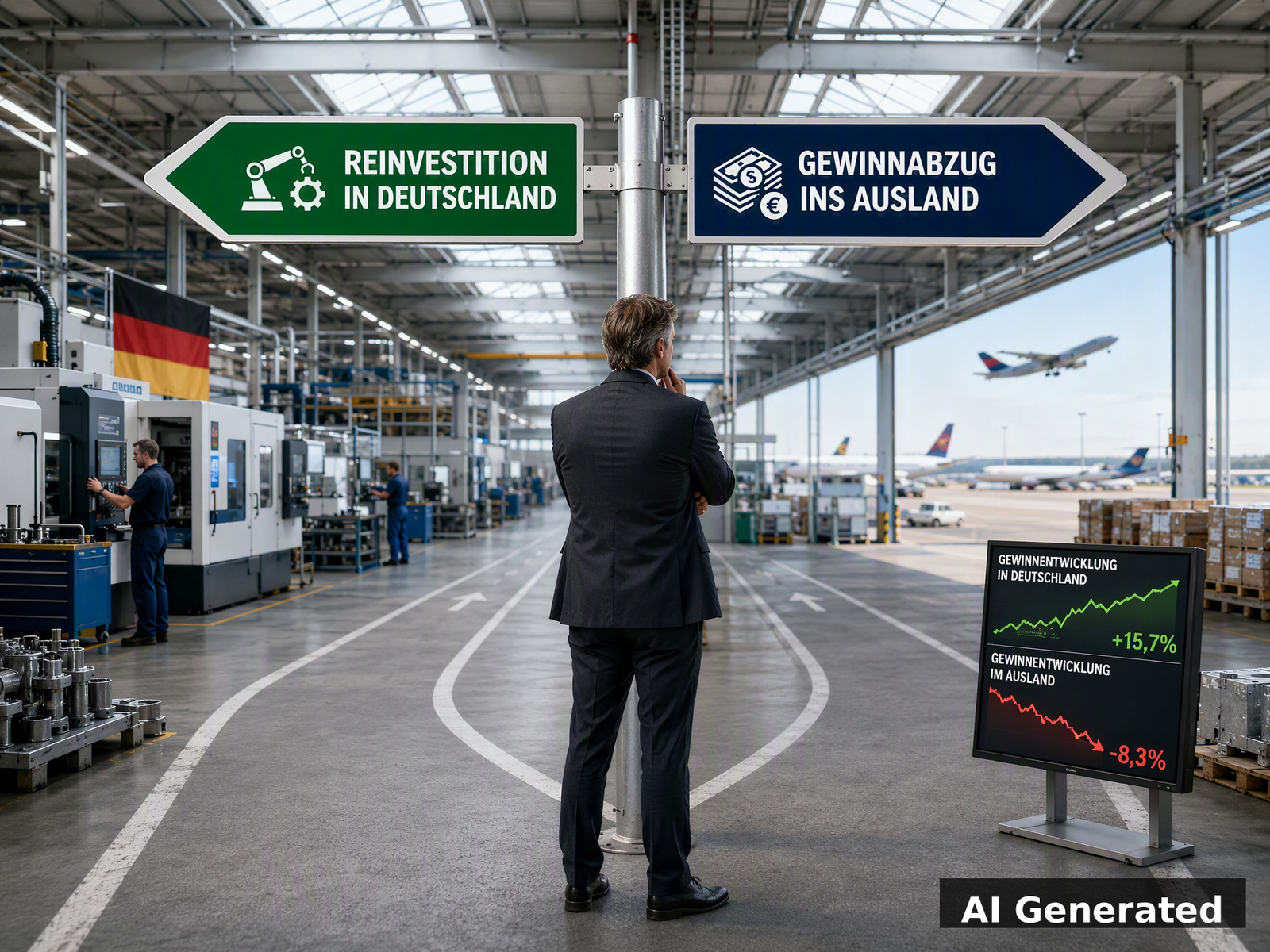
There is one channel that will decide how serious this all becomes, and it is the hardest to observe: what the new owners do with the retained profits. The Bundesbank’s China finding is the sharpest clue to how foreign and domestic owners differ. German companies in China grew their capital stock largely through reinvested profits — they kept the money working inside their Chinese operations. Other foreign investors, by contrast, mostly withdrew retained earnings, shrinking their capital base [1].
The same behavioural split applies in reverse, in Germany. A German family owner who sells has already made the decision to extract value. A foreign owner who buys is making a different calculation — and nothing guarantees it points inward. If Madison Air, Capvest or XRG choose to pay out rather than plough back, the German subsidiaries become cash generators for their parents: profitable on paper, German by location, but with their earnings stream wired abroad. That is why the next three to five years of financial statements from Covestro, EBM-Papst, Stada and Surventis will matter more than any press release about “long-term commitment” [8][9][10][11].
The policy blind spot
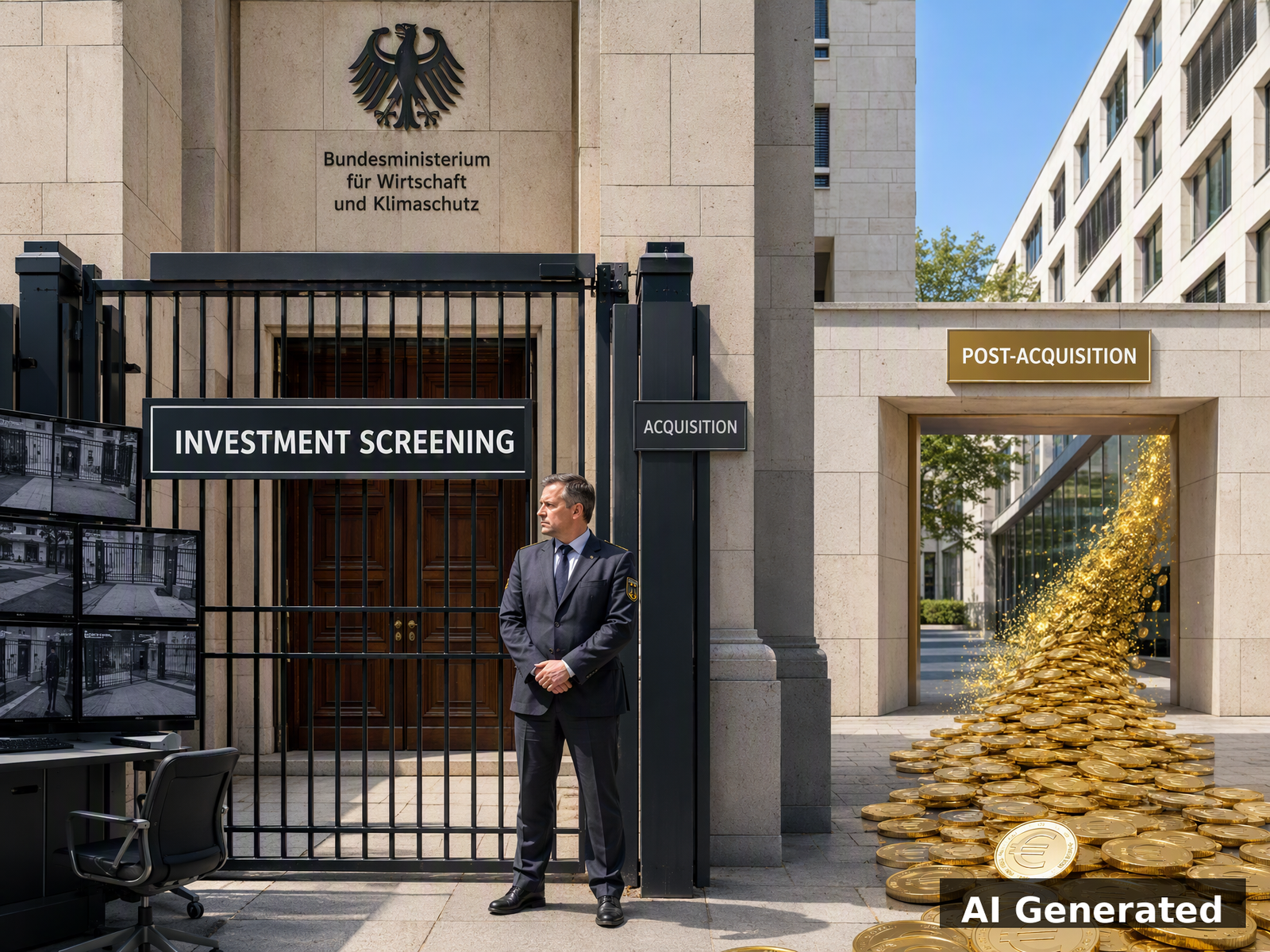
There is one more uncomfortable implication. Germany’s investment-screening regime — the “sharp sword” the economy ministry has wielded since 2004 — reviews the purchase: who is buying, and whether the acquisition threatens public order or security [12]. It has no mechanism over what happens afterwards. Screening cannot set dividend policy, cannot cap royalty payments, cannot order a foreign owner to reinvest in German plants. The capital drain flows through channels the screening law was never designed to touch. The state can block a Chinese bidder at the door — but it has no tool to keep the profits of a company it already approved from leaving the country a year later.
The honest caveat
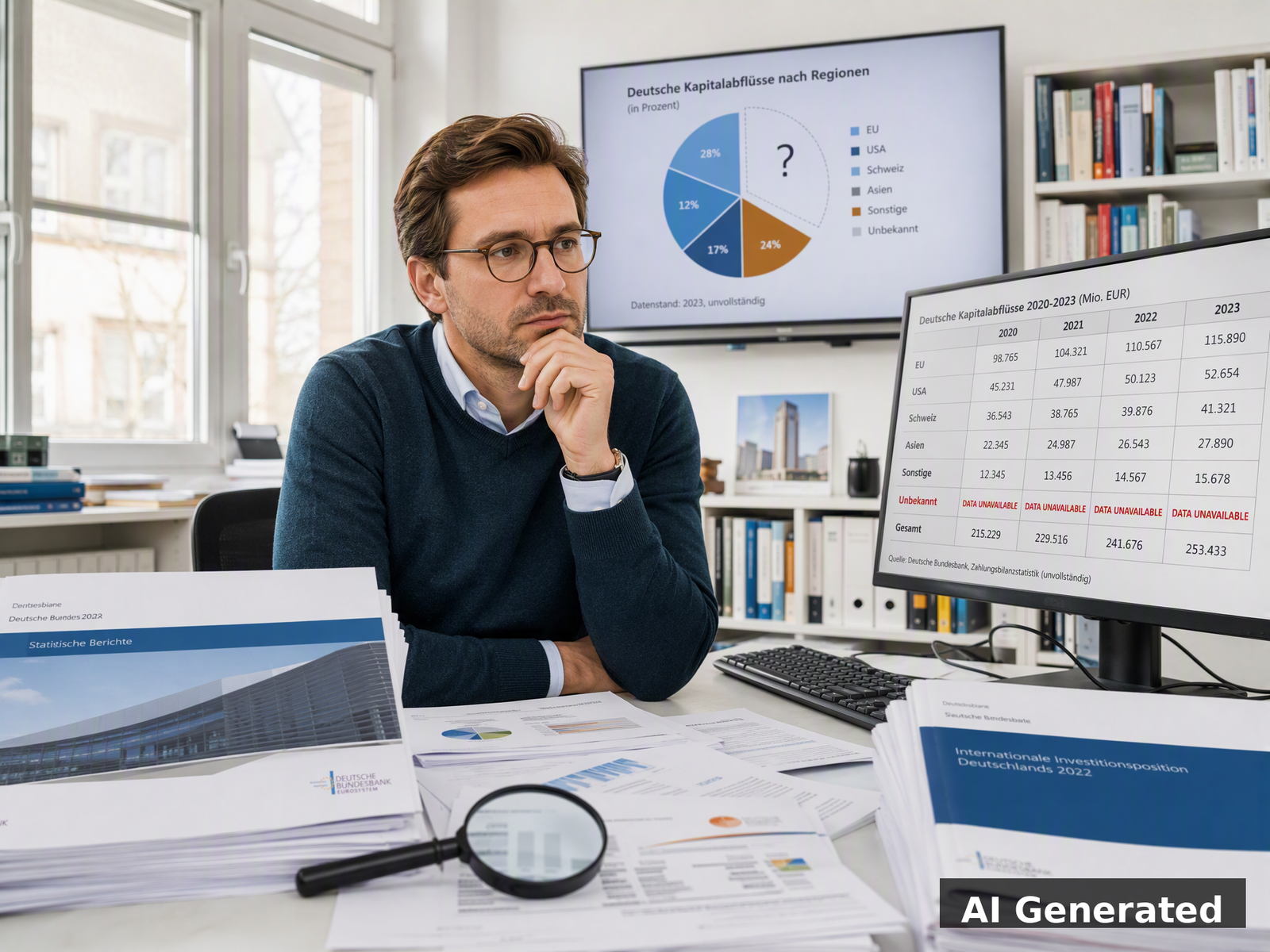
I need to be straight about the limits of the data. The DAX dividend figures measure the foreign shareholders of German listed companies — a related but not identical population to the foreign owners of acquired Mittelstand companies. And I have not yet found case-level public data on the exact dividend or royalty repatriation by Adnoc, Madison Air, Capvest or Carlyle from their German subsidiaries in 2025–26. That data is often not disclosed.
So the claim I can defend is this: the mechanism is real and well-documented; the direction is clear from the macro data; and the scale of the DAX dividend outflows gives us a strong sense of the order of magnitude at stake. What I cannot yet do is put a precise, audited number on how much of the 2024–26 acquisition wave specifically has left Germany. That would require company-level financial data that is not yet public.
A quick clarification: acquisitions are investments, but deal values are not capital inflows
One confusion is worth clearing up, because it trips up even careful readers. When a foreign buyer acquires a German company — Covestro, EBM-Papst, Stada — that purchase is counted as foreign direct investment (FDI). The OECD, the global standard-setter for FDI statistics, explicitly treats “acquisition” as one of the purposes of a direct investment, alongside building a new enterprise, expansion and restructuring [13]. The IMF puts it plainly: FDI is “often divided into two further categories: mergers and acquisitions, in which an existing concern is bought; and ‘greenfield’ investment” [14]. So the record sales in this series are, by definition, part of Germany’s inward investment picture.
But — and this is the point that resolves the apparent contradiction — a record M&A wave and falling FDI inflow figures can absolutely coexist. They measure different things. The M&A record ($107 billion in deal values) counts the announced price of companies sold [5][6]. The FDI inflow figure counts the actual equity capital transferred into Germany in a given period [1]. Those are not the same number. A €15 billion deal announced in 2024 may not transfer its equity until later, and a leveraged buyout — where a private-equity buyer finances most of the purchase with debt piled onto the target — transfers far less new foreign equity than its headline price suggests [6]. So Germany can register record sale values while its measured FDI inflows fall, because much of what is being “sold” is being financed with debt and deferred equity rather than fresh capital arriving from abroad.
The distinction matters for this series. It means the sell-off is real in ownership terms, and it is real in capital-flow terms — but a falling FDI-inflow statistic is not a sign that the sales are not happening. It is a sign that the sales are increasingly debt-financed and slow to convert into actual inbound capital.
What this means for the series’ thesis
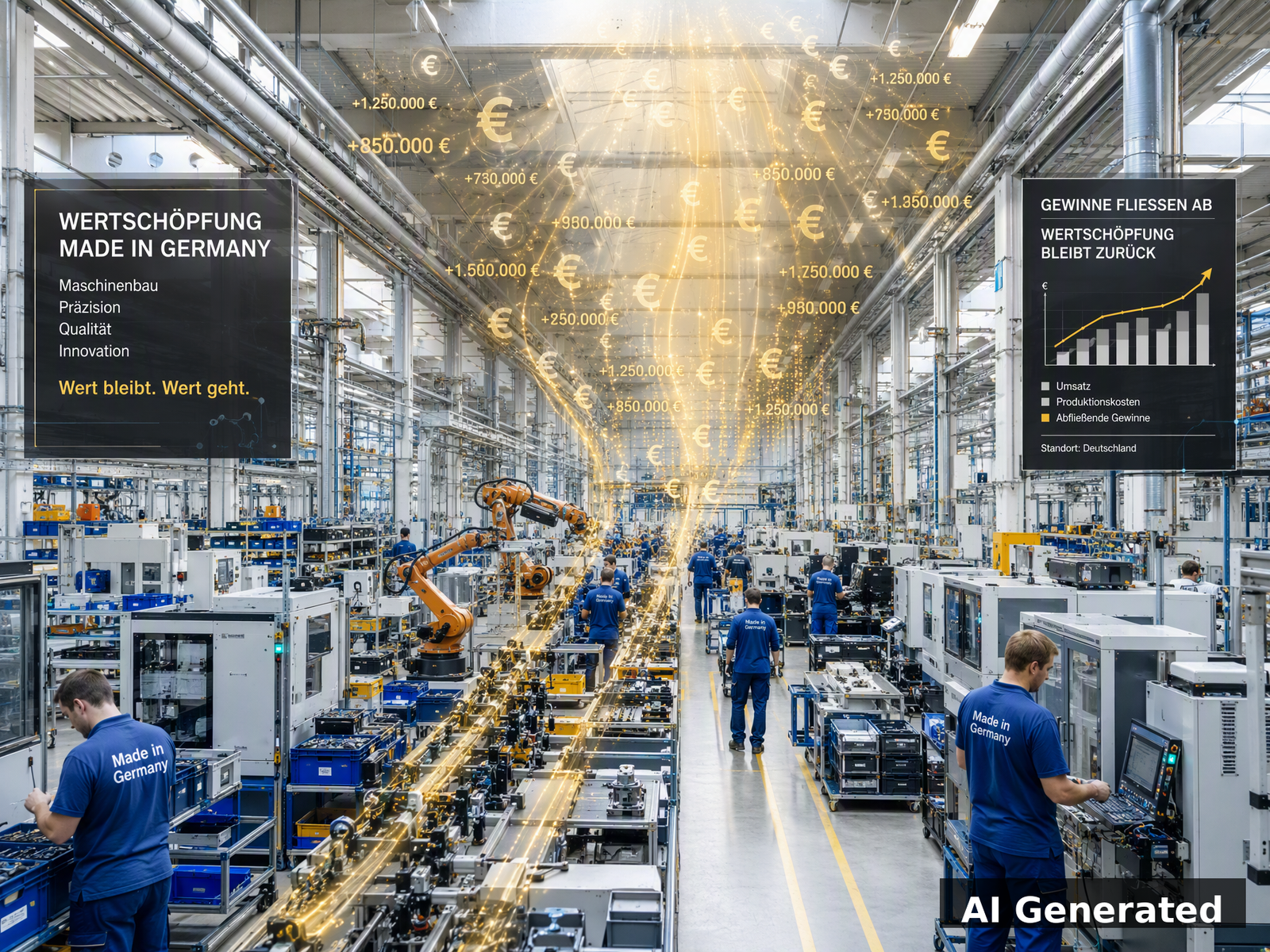
Part 2 argued that foreign takeover does not, by itself, empty out the factories — the economics does. The capital-flow evidence adds the sharper point: even if the factories never move, the value they generate increasingly leaves. A German company that stays in Germany but sends its profits to Abu Dhabi or to a US fund is, in a real sense, no longer funding Germany. It funds its new owners.
This is the quiet hollowing-out. It is harder to photograph than a closed plant, and it does not make the evening news the way a shutdown does. But it is the most systematic and durable consequence of the sell-off. Every foreign acquisition converts a stream of German-produced profit into a stream of outbound capital. Over a decade, that is not a trickle. It is a structural transfer of wealth.
Takeaway
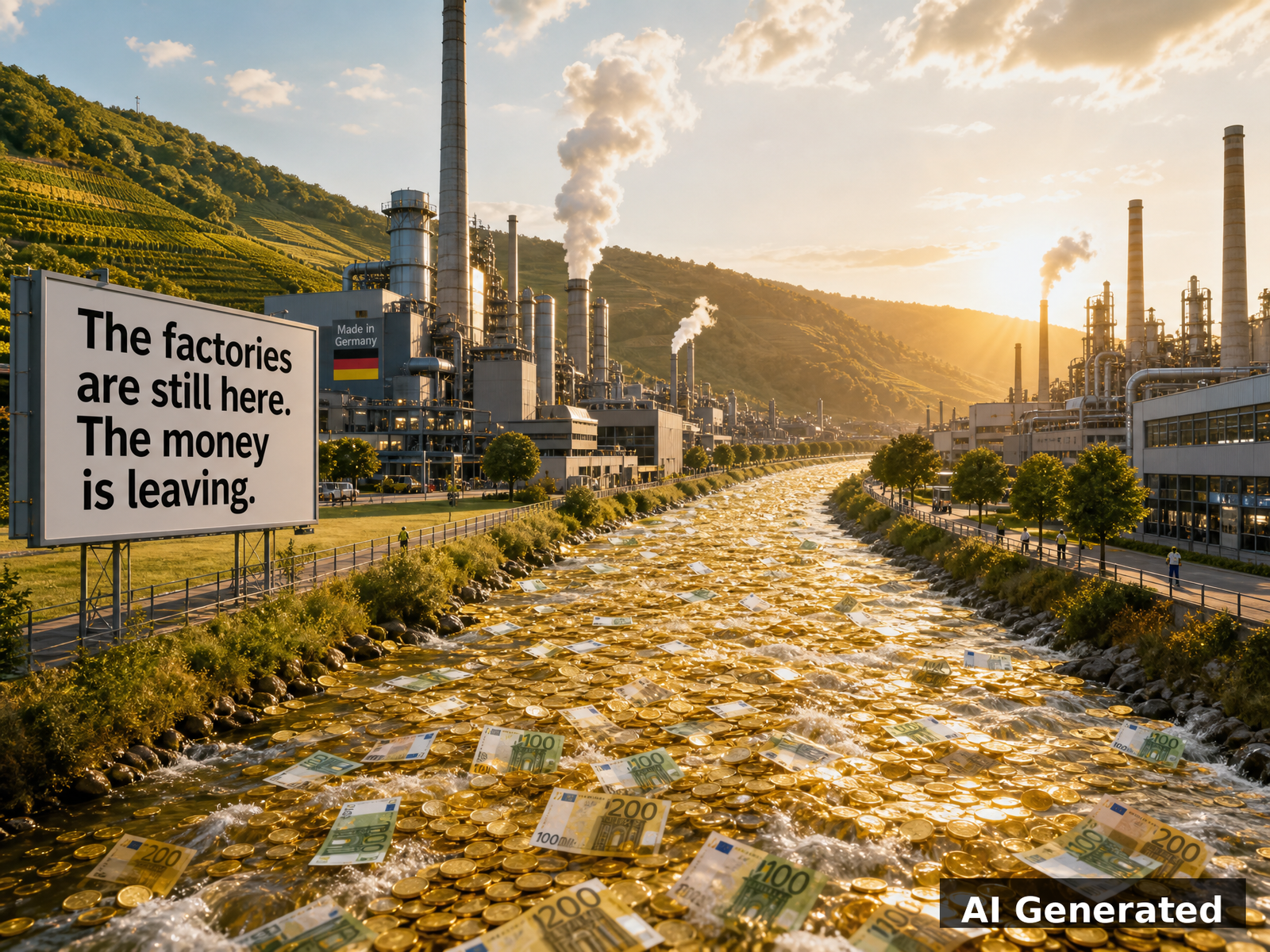
The factories are still here. The money is leaving. That is the real headline of the capital-flow dimension.
Germany’s ownership structure has been transformed in a generation — from the Deutschland AG, where German banks and insurers held German companies and kept the profits in the system, to a structure where foreign asset managers and foreign acquirers hold the dominant stakes and take the profits out [4]. The record sales of 2024–26 are the loudest symptom of a quieter, older process: the financial de-Germanization of German industry.
The answer to the question “does German-produced capital fly abroad?” is: yes, in significant and growing measure — through dividends, purchase proceeds, debt service, royalties and reinvestment decisions. The precise number attributable to the recent acquisition wave is not yet public. But the direction is not in doubt. And the direction, over time, is what hollows a country out.
📖 Explore the full series: “Deutschland for Sale” — Tracking Germany’s industrial sell-off
References
[1] Deutsche Bundesbank. (2024). Robuste deutsche Direktinvestitionen im Ausland – weniger Direktinvestitionszuflüsse nach Deutschland. Deutsche Bundesbank. Link
[2] Schipper, N. (2024). Wohin die deutschen Dividenden fließen (2024). DAS INVESTMENT. Link
[3] Schipper, N. (2026). Die Dax-Aktien mit dem größten Dividendenwachstum über 3, 5 und 10 Jahre. DAS INVESTMENT. Link
[4] Jürgens, J. (2025). Die Macht von Blackrock, Vanguard & Co. Max-Planck-Gesellschaft. Link
[5] Handelsblatt. (2025). Übernahmen: Investoren kaufen immer häufiger deutsche Unternehmen. Handelsblatt. Link
[6] PwC Deutschland. (2025). Destination Deutschland 2025: M&A-Aktivitäten ausländischer Investoren. PwC. Link
[7] Münchner Merkur. (2026). China-Konzern kauft deutschen Weltmarktführer. Münchner Merkur. Link
[8] Produktion. (2026). Madison Air kauft EBM-Papst für 5,1 Mrd. Euro. Produktion. Link
[9] Surventis. (2026). Surventis startet als eigenständiger, weltweit führender Anbieter für Automobillacke und Oberflächenbehandlung. Surventis/Chemetall. Link
[10] Covestro. (2024). Übernahmeangebot von ADNOC für Covestro erfolgreich. Covestro Investor News. Link
[11] STADA Arzneimittel AG. (2026). STADA erwirbt umfassendes Consumer-Healthcare-Portfolio von Orifarm. STADA / Presseportal. Link
[12] Sachs, B., & Rösch, D. (2024). Ausländische Investoren: Übernahme abgelehnt!. WirtschaftsWoche. Link
[13] OECD. (2025). Measuring foreign direct investment. Organisation for Economic Co-operation and Development. Link
[14] IMF. (n.d.). Foreign Direct Investment and the Exchange Rate. International Monetary Fund. Link
AI Disclosure: This post was created with the assistance of artificial intelligence. The ideas, analysis, and opinions expressed are my own — AI was used to help compose, structure, and refine my personal notes and thoughts into the final written content. Images and video featured in this post were also generated using AI tools, based on my own creative prompts and direction.
