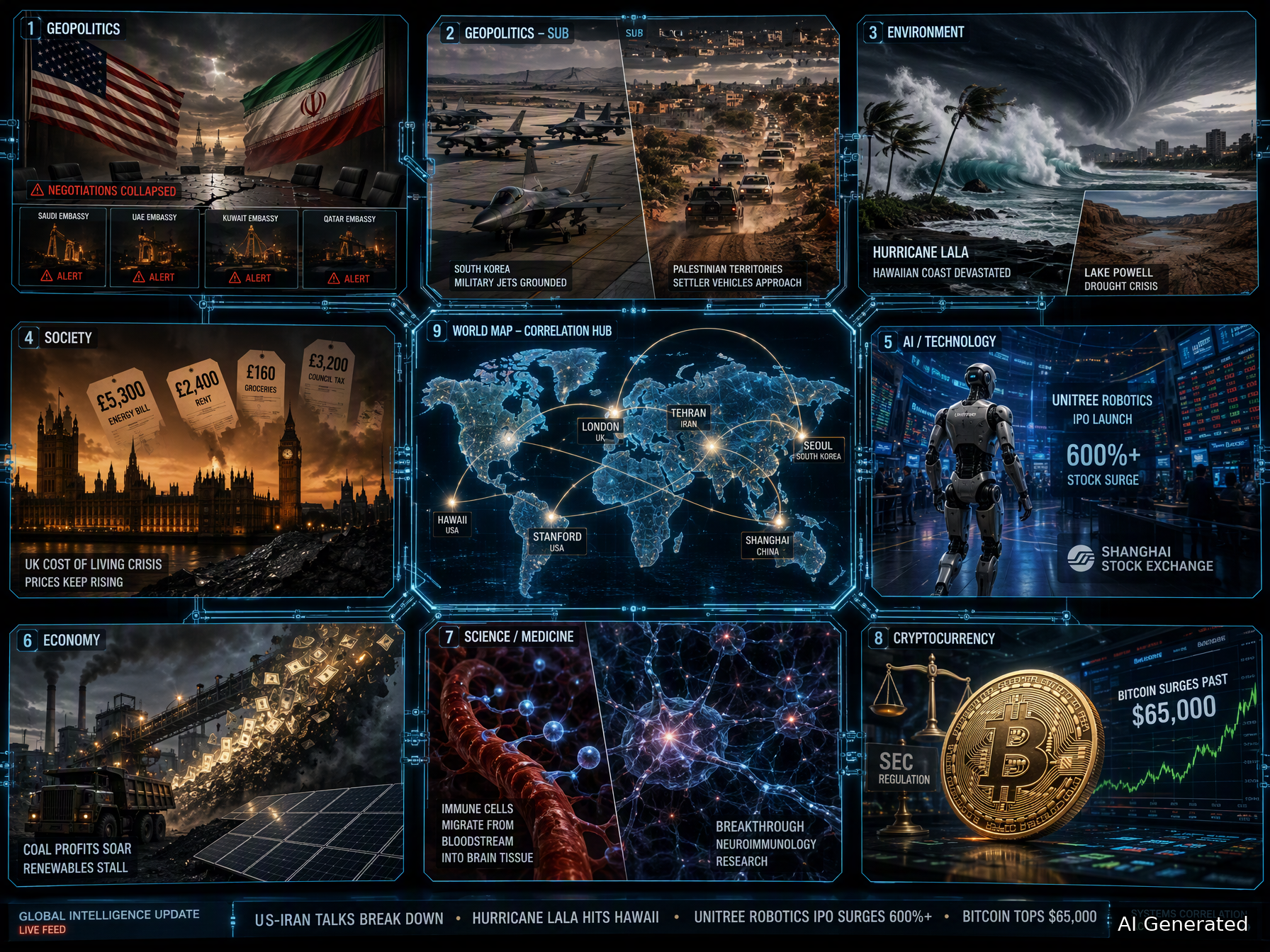


Daily Intelligence Briefing — 2026-08-19 (D80)
Contents
- 1. Geopolitics & Defence
- Iran-US Diplomatic Talks Suspended as Tehran Warns Gulf States and Threatens European Targets
- South Korea Cuts Joint Drills at Trump’s Request While Palestine Settler Siege Intensifies
- Ukraine Ousted Defence Minister Calls for Elections; French Filmmakers Detained in Togo; DR Congo Ebola Surges Past 5,000
- 2. Environment & Climate
- Belgium Wildfire "Encircled" but Situation Remains "Complicated" as France Faces Pyrocumulonimbus
- Hurricane Lala Devastates Hawaii; Lake Powell Hits Record Low; Solar Power Passes 3 Terawatts
- Thessaly Water Crisis Deepens; Sierra Club Challenges Roadless Rule Rollback; Mega Storms Reshape Tropical Rainfall
- 3. Society & Civil Issues
- UK Inflation Surges to 2.9% as Iran War Energy Costs Squeeze Households; Burnham Pledges to End Rough Sleeping
- Global Emotional Intelligence Scores Decline Across All Measured Skills; Social Isolation Accelerates Cognitive Decline
- Sugar-Sweetened Beverages Linked to Stomach Cancer for First Time in US Population
- 4. AI & Technology
- Unitree Humanoid Robot Maker Surges 600%+ in Shanghai IPO; Block Open-Sources Berd Agent Workspace
- GLM-5.3 Launches at $1.4/$4.4 Per Million Tokens; OpenAI Gives Investors Bad News on Profitability
- Ukrainian Drones Overwhelm Russian Arena-M Active Protection; RFK Jr Destroys Healthcare Research Agency
- 5. Economy & Business
- Coal Profits Surge During Iran War as Energy Transition Faces Paradox; UK Inflation Hits 2.9%
- German Industry Fears for Competitiveness as Ifo Reports Mounting Pressure; Greece Bond Yields Hit Record Decade Highs
- India’s Exports to US Unchanged After Year of Trump Tariffs; Indonesia Growth Target Faces Reality Check
- 6. Science & Space
- 7. Crypto, Digital Assets & Blockchain
- Bitcoin Surges Past $65,000 as SEC Proposes New Crypto Offering Rules with $75 Million Exemption
- Maya Protocol Suffers $1.7 Million Exploit and Halts Network; Bybit Intercepts $700 Million in Potential Losses
- Coinbase x402 Protocol Handles 14 Million AI Agent Payments; CLARITY Act Faces 10% Pre-Midterm Odds
- 8. Correlations & Analysis
Click any heading to jump to that section. Click the section heading to return to this menu.
Geopolitics & Defence
↑ ContentsIran-US Diplomatic Talks Suspended as Tehran Warns Gulf States and Threatens European Targets
The eight-month Iran-US conflict entered a new phase of diplomatic breakdown on Tuesday as President Trump confirmed that no talks with Iran are currently scheduled or being planned, directly contradicting envoy Jared Kushner’s claim of “very positive” ongoing discussions made just 24 hours earlier[1]. According to a French news agency source close to the American side, Trump ordered his teams to halt dialogue with Tehran until it accepts American positions, effectively collapsing the diplomatic architecture that had been advancing through Cairo channels[2]. Iran’s chief negotiator Mohammad Bagher Ghalibaf insisted the Strait of Hormuz will remain closed until the US implements commitments under the Islamabad memorandum of understanding signed by both presidents, declaring that Washington cannot “pull a rabbit out of a hat” by demanding concessions beyond the original agreement[3].
The diplomatic vacuum was dramatically compounded by Iran’s warning to Gulf states against facilitating US military operations, with Tehran’s Mehr news agency reporting that any country providing bases, logistics, or overflight rights for American strikes would be considered a legitimate target[4]. In the most alarming escalation signal, the Financial Times reported that Iran has examined the possibility of striking American military targets in Europe — including Cyprus — should Trump proceed with further military escalation[5]. Two sources with knowledge of internal Iranian discussions described contingency planning that would extend the conflict’s geographic scope beyond the Middle East, a scenario that European NATO planners had previously considered unlikely but are now treating with increased urgency.
The United Arab Emirates suspended all commercial and financial transactions with Iran after accusing Tehran of launching two ballistic missiles targeting international shipping in the Gulf region[6]. Iran categorically denied the missile launches, but the accusation triggered the most severe Gulf diplomatic rupture since the Hormuz crisis began in February. The UAE’s foreign ministry announced the suspension of all trade and financial dealings pending further developments, a move that eliminates one of the last remaining economic channels between Iran and its Gulf neighbours.
South Korea Cuts Joint Drills at Trump’s Request While Palestine Settler Siege Intensifies
South Korea abruptly shortened its joint military exercises with the United States at Trump’s request, with drills that were scheduled to run until August 27 now concluding on Friday[7]. The decision came as Trump signalled interest in renewed talks with Kim Jong Un, though North Korea condemned the drills without directly mentioning the American president. The move has created unease in Seoul, where President Lee Jae Myung — who has long advocated reduced military posturing toward the North — now faces pressure from defence hawks who argue the concession weakens South Korea’s deterrent posture without securing any concrete diplomatic commitment from Pyongyang[8].
In the occupied West Bank, a Palestinian-American citizen who flew from Ohio raised a US flag over his home in the village of Kusra near Nablus, which has been besieged by Israeli settlers for more than a week[9]. Luai Abu Ridi’s dramatic gesture drew international attention to the siege, which even US Ambassador Mike Huckabee — normally a staunch supporter of Israeli settlements — described as “terror acts” demanding “serious consequences.” Israeli forces拆除 one tent and arrested one settler, but witnesses reported settlers returning repeatedly and shaking hands with soldiers. Germany’s Vice Chancellor Lars Klingbeil called for the EU to examine sanctions against Israeli Police Minister Itamar Ben-Gvir, whose public call for the killing of Palestinians has generated condemnation across European capitals[10].
Ukraine Ousted Defence Minister Calls for Elections; French Filmmakers Detained in Togo; DR Congo Ebola Surges Past 5,000
Ukraine’s former Defence Minister Mykhailo Fedorov called for presidential elections during wartime — the first such demand by a major Ukrainian political figure since Russia’s full-scale invasion[11]. The call represents a significant internal challenge to President Zelensky’s authority and comes as the conflict with Russia approaches its fourth year, raising questions about democratic legitimacy under martial law. In West Africa, two French journalist-filmmakers have been detained in Togo since July 27, with the Quai d’Orsay confirming they are under judicial investigation by a examining magistrate[13]. Meanwhile, the Democratic Republic of Congo’s Ebola epidemic has surpassed 5,000 confirmed cases — the largest outbreak in the country’s history — with weak health infrastructure, community resistance, and regional instability hampering containment efforts[13]. In a separate development, Pakistan’s military issued a formal rebuttal to Discovery Channel India’s “Operation Sindoor” documentary, calling its claims of “100% mission success” factually inaccurate and rushing out a clarification at 2 AM local time[14].
Environment & Climate
↑ ContentsBelgium Wildfire “Encircled” but Situation Remains “Complicated” as France Faces Pyrocumulonimbus
Belgian Interior Minister Bernard Quintin announced that the wildfire devastating the Hautes Fagnes nature reserve has been “encircled” by firefighters, but warned that full extinguishment will take “weeks” yet[13]. The fire has ravaged approximately 3,000 hectares of protected peat bog ecosystem — a landscape that, once ignited, can smoulder for months beneath the surface. On the German side of the border, air quality monitoring near Aachen found fine particulate levels elevated but below health-risk thresholds, though authorities maintained precautionary advice to keep windows closed[15]. Across the border in France, firefighters confronted a phenomenon they had never before encountered: a pyrocumulonimbus — a thunderstorm generated by the fire’s own heat — raising the spectre of fire-induced weather that could spread embers across vast distances and create unpredictable new ignition points.
The Belgian blaze is the most visible manifestation of the drought emergency that has gripped European waterways since late June. As documented across multiple recent reports, groundwater levels across southwestern Germany have fallen to new August record lows, with the State Institute for the Environment conducting an unscheduled assessment because conditions deteriorated faster than models predicted. Container traffic on the Rhine at Strasbourg has collapsed from twenty barges per week to roughly one, threatening the economic viability of river-dependent communities across the continent’s industrial heartland.
Hurricane Lala Devastates Hawaii; Lake Powell Hits Record Low; Solar Power Passes 3 Terawatts
Hurricane Lala left a path of destruction across Hawaii over the weekend despite never making landfall, with strong winds, torrential rain, and mudslides damaging or destroying more than 100 homes on the Big Island[16]. More than three feet of rain fell in some areas, felling trees that blocked key roads and leaving thousands without power. The cyclone’s impact underscores how tropical weather systems can cause catastrophic damage through indirect mechanisms — rainfall, storm surge, and landslides — even when the storm’s centre remains offshore.
Meanwhile, Lake Powell, America’s second-largest reservoir, has fallen to a record low, dropping to just 30 feet above the threshold at which the dam’s turbines would cease generating hydroelectric power[17]. The Bureau of Reclamation’s proposed 10-year management plan includes major potential water cuts for Arizona, California, and Nevada, but seven states have yet to reach agreement on long-term allocation of the Colorado River system that supports more than 40 million people. In a contrasting development, global solar power capacity has surpassed the 3-terawatt milestone, with rapid deployment across China and emerging markets driving the surge even as fossil fuel profits soar from the Iran war’s energy disruptions[18].
Thessaly Water Crisis Deepens; Sierra Club Challenges Roadless Rule Rollback; Mega Storms Reshape Tropical Rainfall
A comprehensive study by the University of Thessalia has revealed that Greece’s Thessaly region faces an accelerating groundwater crisis, with the water table falling continuously since 1985 due to intensive agricultural irrigation that exceeds natural recharge rates[19]. Professor Maria Sakellariou-Makredondaki warned that in some areas, the deficit has reached 25-60 metres, with seawater intrusion contaminating coastal freshwater reserves. “Water will cease to be a renewable resource,” she cautioned, comparing future water scarcity to the strategic value of oil or gold. The crisis threatens the economic foundations of Greece’s most important agricultural region.
In the United States, the Sierra Club condemned the USDA’s announcement of plans to eliminate protections under the Roadless Area Conservation Rule, which has protected millions of acres of national forest since 2001[20]. The agency claimed the move was necessary to reduce wildfire risk, but environmental groups argued it would open pristine forests to logging and development. Separately, a study published in Nature Geoscience found that organised megastorm systems — mesoscale convective systems responsible for more than half of tropical rainfall in some regions — could form 10 to 15 days later and be 38 to 45 percent more intense under high-warming scenarios, potentially reshaping agricultural timing, flood risk, and water availability across the tropics[21].
Society & Civil Issues
↑ ContentsUK Inflation Surges to 2.9% as Iran War Energy Costs Squeeze Households; Burnham Pledges to End Rough Sleeping
UK consumer price inflation jumped to 2.9 percent in July, up from a 15-month low of 2.6 percent in June, as surging energy bills driven by the Iran war’s disruption of global oil supply chains triggered a renewed cost-of-living squeeze for British households[22]. The Office for National Statistics reported that gas and electricity prices were the primary drivers, with food costs also contributing to the increase. The rise moves inflation further above the Bank of England’s 2 percent target and complicates the monetary policy outlook for Andy Burnham’s new government, which had been positioning itself as capable of delivering both growth and social justice. Core CPI held steady at 2.6 percent, while services inflation edged down to 3.4 percent from 3.6 percent.
Against this inflationary backdrop, Prime Minister Burnham announced an additional £102 million for his national drive to end rough sleeping, bringing the total package to £442 million[23]. The funding will help local areas deliver more than 1,000 settled homes over the next three years alongside intensive wraparound support. Burnham drew a direct parallel to the pandemic response: “We did it in the pandemic. We can do it again.” However, the announcement drew scepticism from opposition parties, with Reform UK’s Richard Tice noting that homelessness in Greater Manchester — where Burnham was previously mayor — increased every year since 2021 despite similar pledges.
Global Emotional Intelligence Scores Decline Across All Measured Skills; Social Isolation Accelerates Cognitive Decline
A major global analysis of 28,000 emotional intelligence assessments from adults in 166 countries between 2019 and 2024 has revealed that average scores fell across every one of the eight competencies measured — a pattern the researchers termed an “emotional recession”[24]. Overall scores were 5.79 percent lower in 2024 than in 2019, with optimism and intrinsic motivation declining most sharply at 3.0 points each, while empathy fell by 1.6 points. The decline was concentrated earlier in the period, with later averages appearing to stabilise rather than accelerate. The authors, who work for the assessment provider Six Seconds, acknowledged the findings should be interpreted within the limitations of a single measurement framework and a non-representative sample skewed toward leadership and education professionals.
In a complementary finding with direct public health implications, a large US analysis using data from 30,421 adults aged 50 to 94 found that social isolation was linked to poorer cognitive trajectories even when loneliness was held constant[25]. Using the parametric g-formula to model the effects of reducing isolation, researchers found that loneliness accounted for only 6 percent of the total estimated effect — meaning that the structural consequences of having too little social contact, rather than the emotional experience of feeling alone, drove the vast majority of cognitive decline risk. The finding suggests that public health interventions targeting loneliness alone may miss the broader social disconnection that erodes cognitive function in ageing populations.
Sugar-Sweetened Beverages Linked to Stomach Cancer for First Time in US Population
In a study published in Gastro Hep Advances, researchers analysed data from more than 112,000 participants in the Nurses’ Health Study and Health Professionals Follow-Up Study, finding that people who consumed at least one sugar-sweetened beverage per day were 2.45 times more likely to develop gastric cancer compared to those who never consumed such drinks[26]. Senior author Andrew Chan of Massachusetts General Hospital called it “the first study to demonstrate an association between sugar-sweetened beverage intake and gastric cancer in a US population.” The risk was elevated among both men and women, with women consuming daily sugary drinks facing roughly three times the risk. Notably, no association was found between artificially sweetened beverages and gastric cancer, suggesting the mechanism may relate specifically to sugar metabolism rather than fluid consumption patterns. The authors proposed several potential mechanisms including weight gain, insulin resistance, inflammation, and DNA damage, but emphasised that future research is needed to confirm causation.
AI & Technology
↑ ContentsUnitree Humanoid Robot Maker Surges 600%+ in Shanghai IPO; Block Open-Sources Berd Agent Workspace
Chinese humanoid robot manufacturer Unitree Robotics shares soared more than 600 percent in their trading debut on the Shanghai Stock Exchange, briefly reaching a 629 percent gain before settling at approximately 500 percent above the IPO price[27]. The listing, which valued the company at approximately 445 billion yuan, represents one of the most dramatic market debuts in recent memory and underscores the enormous investor appetite for China’s robotics sector. However, the enthusiasm contrasts with Unitree’s actual revenue composition: 73.6 percent of humanoid robot revenue in the first nine months of 2025 came from research and education, with only 9 percent from industrial applications, suggesting the commercial deployment of humanoid robots remains years away from matching investor expectations.
In the enterprise AI workspace market, Block — the technology company behind Square and Cash App — open-sourced Berd, a desktop application designed as a unified environment for working with AI agents across different models, tools, and projects[28]. Available under the permissive Apache 2.0 license, Berd supports any model provider the user configures and communicates with agent frameworks through the Agent Client Protocol. Block’s Head of AI Capabilities Brad Axen described the product as addressing a practical internal problem: employees were already working with capable agents through Goose, Claude Code, and Codex, but the experience across them had become fragmented. Berd stores conversation history locally by default and disables telemetry unless users opt in, positioning the product as an alternative to cloud-dependent alternatives from OpenAI, Anthropic, and Anysphere.
GLM-5.3 Launches at $1.4/$4.4 Per Million Tokens; OpenAI Gives Investors Bad News on Profitability
Chinese AI startup z.ai released GLM-5.3 to its API at $1.40 per million input tokens and $4.40 per million output tokens — the same price as its predecessor GLM-5.2 despite claiming substantially stronger coding and long-horizon agent performance[29]. Artificial Analysis gave the model a score of 60 on its Intelligence Index, tying Kimi K3 as the top-performing open weights model and scoring seven points higher than GLM-5.2. The pricing positions GLM-5.3 well below premium frontier models like Grok 4.6 ($8/M combined), Kimi K3 ($18/M), Claude Opus 5 ($30/M), and GPT-5.6 Sol ($35/M), though Artificial Analysis noted the model was more verbose than its predecessor, meaning flat per-token rates do not necessarily translate to flat workload costs.
Meanwhile, OpenAI reportedly delivered disappointing news to investors regarding the company’s eventual path to profitability, according to Gizmodo[30]. The report comes as competition intensifies from Chinese models offering comparable performance at a fraction of the cost, with DeepSeek, Alibaba, and Moonshot making AI increasingly accessible. The dual narrative — Chinese open-weight models achieving frontier performance at commodity prices while the leading American AI company struggles with profitability — encapsulates the central tension in the AI industry’s commercial trajectory.
Ukrainian Drones Overwhelm Russian Arena-M Active Protection; RFK Jr Destroys Healthcare Research Agency
Russian tanks entered combat for the first time equipped with the Arena-M active protection system, designed to intercept incoming drones, but Ukrainian forces still destroyed at least seven T-72B3A tanks by attacking in overwhelming numbers[31]. Ukrainian soldiers reported requiring 15 to 20 drones to finish off each tank, suggesting that while the Arena-M system successfully shot down some incoming threats, it could not compensate for the sheer volume of drone attacks. The engagement illustrates how the drone warfare revolution continues to outpace defensive countermeasures, with the economics of mass-produced drones overwhelming expensive active protection systems.
In the United States, health policy experts warned that the Agency for Healthcare Research and Quality — the federal body tasked with studying ways to improve America’s healthcare system — is “on the brink” after the Trump administration cut its staff by 75 percent, cancelled grants en masse, and refused to spend tens of millions of dollars appropriated by Congress[32]. In an opinion piece published in the Annals of Internal Medicine, researchers Aaron Carroll and David Atkins characterised the destruction as “sabotage,” noting that the agency had previously enjoyed bipartisan support for its work on patient safety, healthcare quality, and care delivery improvement.
Economy & Business
↑ ContentsCoal Profits Surge During Iran War as Energy Transition Faces Paradox; UK Inflation Hits 2.9%
Coal companies across South Africa, Australia, and other major exporters are reporting dramatic profit increases as the Iran war’s disruption of oil and gas supply chains drives a global rush for alternative energy sources[33]. The paradox is striking: the same geopolitical crisis that has accelerated renewable energy deployment in some markets has simultaneously made fossil fuel alternatives more profitable than ever, creating a financial incentive structure that could slow the clean energy transition precisely when climate science demands its acceleration. Analysts note that while the global clean energy transition remains fundamentally on track, the short-term profit surge in coal complicates the investment calculus for utilities and governments weighing long-term decarbonisation commitments against immediate energy security needs.
The UK’s consumer price inflation surged to 2.9 percent in July — its highest level since March — driven primarily by energy costs linked to the Hormuz crisis[34]. The Office for National Statistics reported that gas and electricity prices were the dominant factor, with food costs also contributing. For the Bank of England, the data presents a dilemma: the jobs slowdown documented in previous reports — with vacancies at five-year lows and pay growth decelerating — would normally argue for rate cuts, but the energy-driven inflation spike pushes in the opposite direction. The European Central Bank’s Rehn weighed in from the other side of the Channel, noting that inflation expectations remained anchored and that wage growth had stayed moderate so far, suggesting the ECB may be more sanguine about the inflationary outlook than the UK[35].
German Industry Fears for Competitiveness as Ifo Reports Mounting Pressure; Greece Bond Yields Hit Record Decade Highs
Germany’s Ifo Institute reported that industrial firms are growing increasingly anxious about their competitiveness, with the business climate index reading at 86.6 — slightly above the forecast of 86 but reflecting persistent concern about competitive pressure both within the EU and from global rivals[36]. The automobile sector, already struggling with the transition to electric vehicles, faces particular strain. Industry analysts note that the drought’s impact on logistics, combined with elevated energy costs from the Hormuz crisis, has created a compounding pressure on German manufacturing margins that threatens to accelerate the offshoring trend already underway.
In Greece, government bond yields have reached their highest levels in a decade, driven by the combined pressures of expanding public debt, the Iran war’s inflationary impact, and additional borrowing requirements for AI infrastructure investments by major technology companies[37]. The rising cost of government borrowing threatens to squeeze both public investment and private sector access to credit, creating a fiscal tightening dynamic that could undermine the recovery momentum Greece had built in recent years. Japan is meanwhile reviewing its overtime work cap from September, according to the Yomiuri newspaper, in a move that could reshape labour market dynamics in the world’s fourth-largest economy[38].
India’s Exports to US Unchanged After Year of Trump Tariffs; Indonesia Growth Target Faces Reality Check
An analysis of Indian trade ministry data for the 12 months through July reveals that US-bound exports have remained essentially unchanged despite a year of Trump administration tariffs, with the United States continuing to account for approximately 20 percent of India’s total exports[39]. The finding suggests that either the tariffs have been absorbed through currency adjustments and supply chain rerouting, or that demand for Indian goods has proven more price-inelastic than protectionists anticipated. The stability of the bilateral trade relationship stands in contrast to the more volatile dynamics between Washington and other trading partners, including Canada — with which the US held last-minute negotiations to prevent the imposition of 50 percent tariffs.
Indonesia’s “ambitious” economic growth target is facing a reality check from the business community, with the Financial Times reporting that the country’s ambitious expansion plans may collide with structural constraints including bureaucratic complexity, infrastructure gaps, and the practical challenges of scaling up economic activity across the archipelago’s diverse regions[40]. The tension between political aspiration and economic reality mirrors a broader pattern across emerging markets, where ambitious growth targets frequently outrun the institutional capacity needed to deliver them.
Science & Space
↑ ContentsStanford Study Reveals Immune Cells Migrate from Blood into Human Brain During Ageing
A study published in Nature has overturned a decades-old assumption in neuroscience by demonstrating that immune cells from the bloodstream actively migrate into the human brain, beginning around middle age and becoming more pronounced with advancing years[41]. Led by Julia Belk with senior authors Siddhartha Jaiswal and Howard Chang at Stanford Medicine, the research used a technique borrowed from consumer ancestry testing — comparing shared naturally occurring mutations across blood and brain tissue samples — to trace the lineage of brain immune cells back to bone marrow stem cells. “We usually think of the brain as a closed system,” Belk said. “What we found is that actually a lot of immune cells enter the human brain during aging.”
The finding is notable not only for overturning textbook understanding but because the migration pattern appears to be specifically human: it has not been found in mice or in the nonhuman primates examined for comparison. Given that decades of microglia research have relied heavily on mouse models, the human-specific nature of this migration suggests that findings from those studies may not transfer to this particular question about brain immunity. The researchers emphasised that the study demonstrates a pattern of cell migration, not a measurement of harm — the arriving cells could represent normal immune renewal, beneficial adaptation, or potentially harmful processes. Determining which will require follow-up research tracking what these migrated cells do once they cross the blood-brain barrier.
Apollo 11 Guidance Computer Compared to Modern USB Chargers; IceCube Neutrino Observatory Gets Major Upgrade
A detailed comparison between the Apollo 11 Guidance Computer — which carried 4 kilobytes of erasable working memory and ran at approximately 1 megahertz — and modern electronics has revealed surprising parallels and stark contrasts[42]. A modern USB-C power delivery controller chip, such as Infineon’s EZ-PD CCG3PA, contains 64 kilobytes of flash memory and an Arm Cortex-M0 processor running at up to 48 MHz — technically surpassing the AGC on raw specifications. The comparison extends further: a smartphone processor running at 4.47 GHz with gigabytes of RAM represents not merely incremental improvement but a transformation in capability. Yet the comparison illuminates a deeper truth about engineering: the AGC’s achievement was not raw power but reliability under extreme constraints. Its 1201 and 1202 program alarms during Eagle’s descent demonstrated a recovery system that understood priorities — the software restarted, preserved critical state, and declined less important work while maintaining guidance functions. No AGC suffered a hardware failure during any Apollo mission.
Beneath the Antarctic ice, the IceCube Neutrino Observatory has received its first major upgrade since construction in 2010, with crews drilling new holes and installing more than 600 modern sensors packed far more tightly than the originals[43]. The upgrade aims to sharpen the detector’s view of lower-energy neutrinos and improve measurement of the ice itself, enabling reanalysis of more than a decade of accumulated data with better accuracy. IceCube, which uses 5,160 light sensors sealed in glacial ice between 1,450 and 2,450 metres depth, hunts neutrinos by looking downward through the Earth — using the planet itself as a filter that blocks everything except the ghostly particles. The observatory has produced landmark results including the first image of the Milky Way drawn in neutrinos and the identification of specific extragalactic neutrino sources.
Organised Megastorms Could Reshape Tropical Rainfall; Space Nuclear Programs Face Challenges
Research published in Nature Geoscience found that under high-warming scenarios, mesoscale convective systems — sprawling thunderstorm clusters responsible for more than half of tropical rainfall in some regions — could form 10 to 15 days later and be 38 to 45 percent more intense[44]. The shift is linked to changes in the Hadley cell circulation, the massive atmospheric system that moves heat and moisture between the tropics and subtropics. As the climate warms, the atmosphere develops greater “energetic inertia,” slowing the seasonal migration of these circulation cells and delaying rainfall onset. But when the rain arrives, it packs considerably more punch — a pattern with potentially profound consequences for agricultural timing, flood risk, and water availability across regions where hundreds of millions of people depend on predictable seasonal rainfall patterns.
In the space sector, industry officials warned that nuclear power programmes for spacecraft face both near-term challenges and longer-term concerns[45]. While interest in space nuclear systems is experiencing “a moment” driven by renewed lunar and Mars exploration ambitions, practical obstacles including regulatory frameworks, fuel qualification timelines, and international proliferation sensitivities threaten to slow deployment. The challenges mirror those facing terrestrial nuclear energy, where ambitious decarbonisation goals frequently collide with the extended timelines required for reactor design, safety review, and construction.
Crypto, Digital Assets & Blockchain
↑ ContentsBitcoin Surges Past $65,000 as SEC Proposes New Crypto Offering Rules with $75 Million Exemption
Bitcoin climbed above $65,000 on Tuesday, with spot Bitcoin ETFs in the United States recording $300 million in net inflows — the strongest single-day figure since May[46]. Chart analysts highlighted $76,000 as the next resistance level and signalled bullish momentum, though long-term holders dropped below 60 percent of circulating supply recently, a metric that has historically preceded periods of increased selling pressure. The price recovery came as markets parsed both the SEC’s proposed regulatory framework and ongoing Iran war tensions, with the cryptocurrency market finding support from institutional buying even as geopolitical uncertainty weighed on traditional risk assets.
The Securities and Exchange Commission proposed “Regulation Crypto Assets,” a comprehensive framework combining two registration exemptions with a conditional safe harbour for crypto asset offerings[47]. The first exemption would permit issuers to raise up to $5 million once every four years, while the second would allow offerings of up to $75 million per 12-month period — both requiring principles-based narrative disclosures. The conditional safe harbour addresses what happens when managerial effort underlying an investment contract has been completed or permanently stopped, potentially allowing tokens to shed their security classification under specified conditions. The proposal arrived one day after Treasury opened consultation on a GENIUS Act stablecoin proposal, signalling that US regulators are moving from broad crypto policy statements into detailed operating rules.
Maya Protocol Suffers $1.7 Million Exploit and Halts Network; Bybit Intercepts $700 Million in Potential Losses
Maya Protocol halted its cross-chain network after an attacker exploited six linked software flaws to steal an estimated $1.7 million in Bitcoin and other crypto assets[48]. A preliminary analysis found that a 23-message transaction drained 48.87 million CACAO tokens, sending the asset price down approximately 89 percent. The exploit illustrates the persistent vulnerability of cross-chain bridge architectures, which have been the target of some of the largest hacks in crypto history due to the complexity of maintaining security across multiple blockchain environments simultaneously.
In a contrasting narrative of security improvement, Bybit’s systems intercepted more than $700 million in potential user losses during the first half of 2026, following the exchange’s $1.46 billion hack in 2025[49]. The exchange expanded real-time blockchain monitoring and AI-assisted threat detection after the devastating 2025 breach, and the H1 2026 Risk and Security Report demonstrates that the enhanced security infrastructure has substantially reduced exposure to similar attacks. The juxtaposition of Maya Protocol’s vulnerability and Bybit’s improved defences illustrates the dual trajectory of crypto security — protocols remain susceptible to novel attack vectors while major exchanges invest heavily in monitoring and response capabilities.
Coinbase x402 Protocol Handles 14 Million AI Agent Payments; CLARITY Act Faces 10% Pre-Midterm Odds
AI agents initiated 14 million transfers through Coinbase’s x402 payment protocol over the past 30 days, with Base and Polygon handling the majority of activity and USDC accounting for virtually all transfers[50]. The volume suggests that autonomous software agents are emerging as a meaningful new source of stablecoin demand, potentially creating a structural bid for USDC that exists independently of human trading activity. The x402 protocol enables machine-to-machine payments using HTTP status codes, allowing AI agents to make micropayments for computational resources, data access, and API calls without human intervention.
Meanwhile, the CLARITY Act — the comprehensive crypto market structure bill — faces approximately 10 percent odds of passage before the midterm elections, according to the Solana Policy Institute’s CEO[51]. The Senate has scheduled a procedural cloture vote for September 15, but the motion requires 60 votes and senators will not be voting on the legislation itself on that day. The difficult path reflects the broader challenge of advancing complex regulatory legislation through a polarised Congress, even as individual agencies like the SEC and Treasury move forward with their own rulemaking processes. The White House is also scheduled to host a cryptocurrency meeting that could influence near-term market direction.
Correlations & Analysis
↑ ContentsThe D80 reporting period captures a moment of compounding strategic fragmentation across multiple domains simultaneously. The most consequential development is the complete collapse of the Iran-US diplomatic track, with Trump ordering an end to negotiations while Ghalibaf insists the Strait of Hormuz will remain closed until American commitments are honoured. This represents a qualitative deterioration from the pattern documented in D79 — where talks were strained but technically ongoing — into a state of formal deadlock. The UAE’s suspension of all trade and financial transactions with Iran eliminates one of the last economic channels between Tehran and its Gulf neighbours, while Iran’s warning to Gulf states against facilitating US military operations and its reported contingency planning for strikes on European targets dramatically raises the geographic stakes of the conflict. What began as a bilateral confrontation is metastasising into a multi-front crisis that threatens to draw in European NATO allies, Gulf monarchies, and Asian import-dependent economies.
The European drought emergency has crossed another threshold with the Belgian High Fens wildfire now requiring weeks to extinguish despite being technically “encircled.” The fire’s generating pyrocumulonimbus thunderstorms — a phenomenon French firefighters had never previously encountered — illustrates how the drought has created conditions where weather itself becomes an accelerant. Combined with the Thessaly groundwater depletion documented in today’s report, the Lake Powell record low in the American West, and the megastorm research showing tropical rainfall patterns shifting by 10-15 days, the pattern that emerged across D68-D78 has matured into evidence of a genuine climate regime shift. The same energy price spikes driving wildfire risk and degrading water supplies are simultaneously enriching coal exporters, creating a perverse economic feedback loop where the crisis generates profits for the industry that produced it.
In the technology sector, the juxtaposition of Unitree’s 600%+ IPO surge and OpenAI’s disappointing profitability news encapsulates the AI industry’s central paradox: investor enthusiasm for the technology’s potential continues to vastly outpace the commercial reality of deploying it profitably. Meanwhile, the Ukrainian drone overwhelm of Russia’s new Arena-M active protection system — requiring 15-20 drones per tank — demonstrates that the drone warfare revolution is not a future threat but a present operational reality that is reshaping military doctrine faster than defensive countermeasures can adapt. The RFK Jr destruction of the AHRQ represents a different kind of institutional erosion: the systematic dismantling of the research infrastructure that enables evidence-based healthcare improvement.
The UK’s inflation surge to 2.9 percent — its highest since March — and the ECB’s relatively sanguine assessment of inflation expectations reveal how the Iran war’s economic transmission mechanisms operate differently across economies. Britain’s direct energy import dependence makes it more vulnerable to Hormuz disruptions than the Eurozone, yet the Bank of England faces the opposite policy dilemma from the ECB: where Frankfurt can afford patience, London may be forced into a choice between rate cuts that fuel inflation and rate hikes that deepen the recessionary squeeze already visible in the jobs data.
What to watch in the next reporting period: Whether Trump’s suspension of Iran negotiations produces any back-channel diplomatic movement through intermediaries like Qatar or Oman. The trajectory of the High Fens wildfire and whether the pyrocumulonimbus phenomenon spreads to other European drought zones. The UK Bank of England’s response to 2.9% inflation in the context of five-year-low job vacancies. The SEC’s 60-day comment period on Regulation Crypto Assets and industry response to the $75 million exemption threshold. The September 15 CLARITY Act procedural vote and its implications for US crypto market structure. Unitree’s post-IPO trading pattern and whether humanoid robot commercial deployment timelines begin to compress.
References ↑ Contents
1. Διακόπηκε ο διάλογος ΗΠΑ-Ιράν by Defence Review · Source ↩
2. Διακόπηκε ο διάλογος ΗΠΑ-Ιράν: νέα αλλαγή στάσης της προεδρίας Τραμπ by flight.com.gr · Source ↩
3. ↩
4. Iran warns Gulf countries not to facilitate US military by FinancialJuice ↩
5. FT: Το Ιράν μπορεί να χτυπήσει στην Ευρώπη, στο στόχαστρο κι η Κύπρος by Defence Point · Source ↩
6. Διακόπηκε ο διάλογος ΗΠΑ-Ιράν by Defence Review ↩
7. South Korea cuts short joint drills at Trump’s request by The Independent · Source ↩
8. In cutting joint drills, Trump has given South Korea’s president what he wants by The Guardian · Source ↩
9. Belagerung durch Siedler: US-Palästinenser hisst US-Flagge an seinem Haus by Stern · Source ↩
10. Israels Polizeiminister: Klingbeil fordert Prüfung von EU-Sanktionen gegen Ben-Gvir by Die Zeit · Source ↩
11. Ukraine’s ousted defence minister calls for elections during war by Al Jazeera · Source ↩
12. Attempts to curb Ebola cases in DR Congo fail with more than 5,000 confirmed by France24 · Source ↩
13. Op Sindoor Documentary Rattles Pak by Indian Defence News · Source ↩
14. Deux Français arrêtés et détenus au Togo depuis le 27 juillet by Libération ↩
15. En Belgique, l’incendie est « encerclé » mais la situation « reste compliquée » by Le Monde · Source ↩
16. Sorgen der Anwohner: Hohes Venn: Keine gefährliche Luftbelastung im Raum Aachen by Stern · Source ↩
17. Hurricane Lala Pummels Hawaii—Despite Never Making Landfall by Despite Never Making Landfall” — Inside Climate News · Source ↩
18. Lake Powell hits record low, threatening key water and electricity supply for millions by Mongabay/Independent · Source ↩
19. Solar Power Passes 3 Terawatts! by CleanTechnica · Source ↩
20. « Στεγνώνει » η Θεσσαλία: Κατεβαίνει η στάθμη του υδροφόρου ορίζοντα by iefimerida.gr · Source ↩
21. Sierra Club Statement on USDA Announcement to Remove Roadless Rule Protections by CleanTechnica · Source ↩
22. Organized Megastorms Could Reshape Tropics’ Rainy Seasons by ScienceAlert · Source ↩
23. UK inflation rises to 2.9% as Iran war fuels living costs squeeze by The Guardian · Source ↩
24. Burnham Pledges To Give Rough Sleepers A ‘Route Off The Streets’ By Christmas by HuffPost UK · Source ↩
25. Psychologists have long known that empathy without enough support can turn into emotional exhaustion by ScienceBlog · Source ↩
26. Social isolation accelerated cognitive decline whether people felt lonely or not by ScienceBlog · Source ↩
27. Sugar-Sweetened Beverages Linked to Stomach Cancer For The First Time by ScienceAlert · Source ↩
28. Börsengang: Roboterbauer Unitree startet mit über 600 Prozent Kursplus by Wiwo · Source ↩
29. Block’s new Apache 2.0 agent workspace Berd works across models by VentureBeat · Source ↩
30. GLM-5.3 hits the API at $1.4/$4.4 per million tokens by VentureBeat · Source ↩
31. OpenAI Reportedly Just Gave Investors Bad News on Eventual Profitability by Gizmodo · Source ↩
32. Ukrainian drones overwhelm Russian tanks’ new active protection system by Ars Technica · Source ↩
33. Sabotage: Experts, lawmakers blast RFK Jr. for destroying healthcare research by Ars Technica · Source ↩
34. South Africa to Australia: Why coal profits are surging during Iran war by Al Jazeera · Source ↩
35. UK inflation rises to 2.9% year-on-year in July by Investing.com/Reuters · Source ↩
36. ECB’s Rehn sees no clear signs of second-round effects by FinancialJuice ↩
37. Ifo: Industrie bangt um Wettbewerbsfähigkeit by Handelsblatt · Source ↩
38. Ομόλογα: Οι αποδόσεις χτυπούν ρεκόρ δεκαετιών by Proto Thema · Source ↩
39. Japan to review overtime work cap from September by FinancialJuice ↩
40. India’s exports to US remain unchanged after a year of Trump’s tariffs by Business Standard · Source ↩
41. Indonesia’s ‘ambitious’ growth target faces business reality check by Nikkei Asia · Source ↩
42. For decades, biologists assumed the brain’s immune system replenished itself from birth by ScienceBlog/Nature · Source ↩
43. The computer that guided Apollo 11 to the Moon had only about 4 kilobytes by ScienceBlog · Source ↩
44. Two and a half kilometres beneath the Antarctic ice, a cubic kilometre of frozen water has been wired with 5,160 light sensors by ScienceBlog · Source ↩
45. Organized Megastorms Could Reshape Tropics’ Rainy Seasons by ScienceAlert · Source ↩
46. Space nuclear programs face near- and long-term challenges by SpaceNews · Source ↩
47. Bitcoin surges past $65,000, VanEck signals possible market bottom by Coin-Turk · Source ↩
48. SEC Proposes Crypto Offering Rules With $75M Exemption and Safe Harbor by Blockchain Reporter · Source ↩
49. Maya Protocol suffers $1.7 million exploit, halts network by Crypto.news/CoinTelegraph · Source ↩
50. Bybit intercepted over $700M in potential losses after $1.46B hack by Crypto.news · Source ↩
51. Coinbase’s x402 Handles 14 Million AI Agent Payments in 30 Days by Bitcoin.com · Source ↩
52. CLARITY Act faces 10% pre midterm odds by Crypto.news · Source ↩
AI Disclosure: This post was created with the assistance of artificial intelligence. The ideas, analysis, and opinions expressed are my own — AI was used to help compose, structure, and refine my personal notes and thoughts into the final written content. Images, videos and music featured in this post were also generated using AI tools, based on my own creative prompts and direction.