




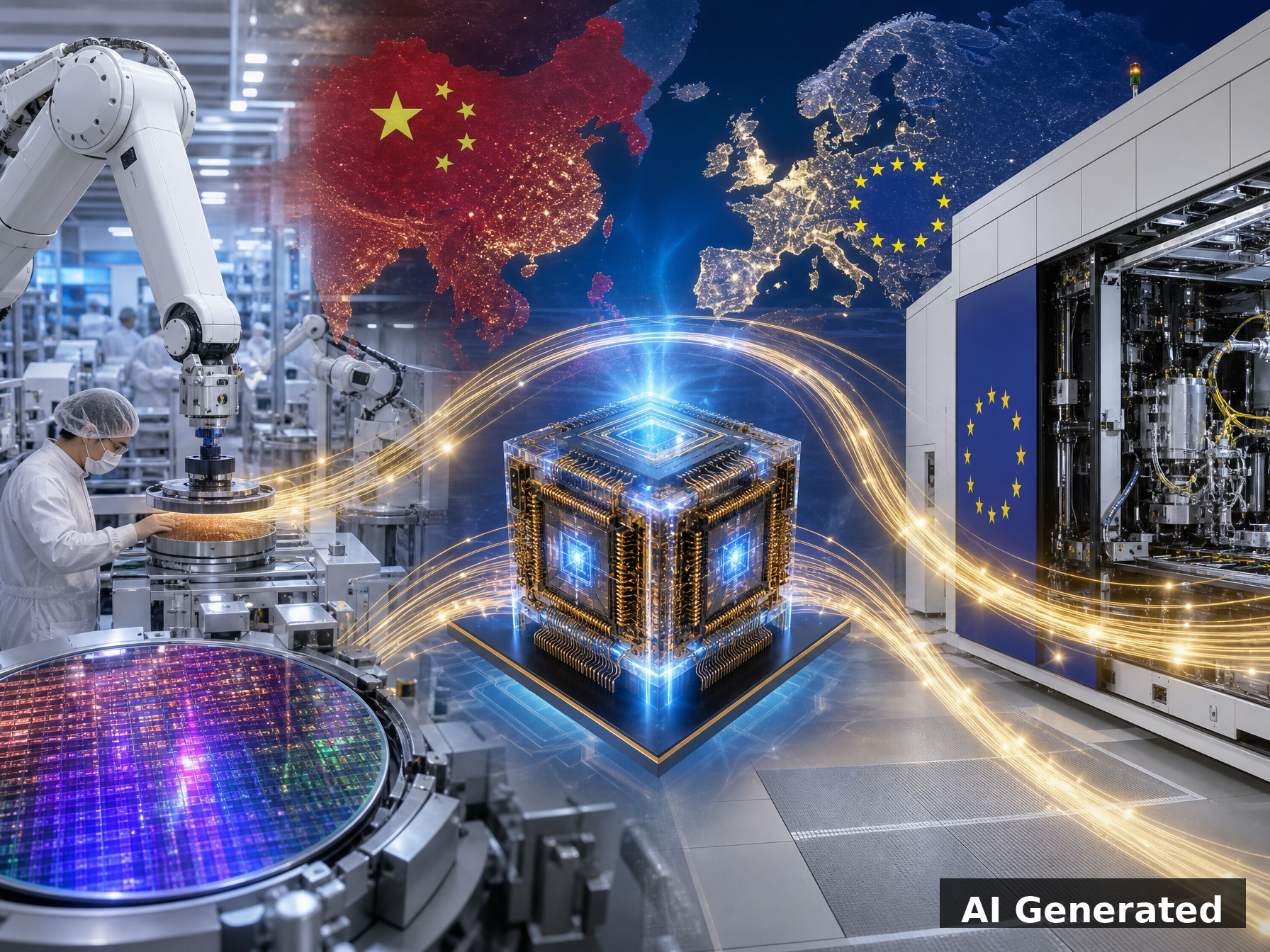


How a nation under siege built its own ladder over the wall — and what Europe must learn before the window closes.
Something happened in July 2026 that would have been unthinkable three years ago. Reuters reported that China had begun mass-producing its own immersion deep-ultraviolet lithography machines — the precision instruments that print circuit patterns onto silicon wafers. Until that moment, only one company on Earth had mastered this technology at commercial scale: ASML, the Dutch giant whose machines are the gateway to every advanced chip ever made [1].
You should understand what this means. Lithography is not just a step in chip manufacturing. It is the step — the bottleneck that determines whether a nation can build its own semiconductors or must beg, buy, or steal them from someone else. For decades, the United States and its allies used this bottleneck as a chokehold. Block access to ASML’s EUV machines, the reasoning went, and China’s semiconductor ambitions die in the dark.
They didn’t die. They mutated.
What we are watching is not a story about China catching up. It is a story about a nation deciding that the rules of the game were rigged, and building an entirely new playbook — one that spans classical silicon, quantum computing, and the architecture of power itself. And if you sit in Europe, watching from the continent that makes the machines everyone fights over, the question is not whether China will succeed. The question is whether you will move fast enough to matter when it does.
Let us be clear-eyed about what is real and what is not.
Silicon Under Siege
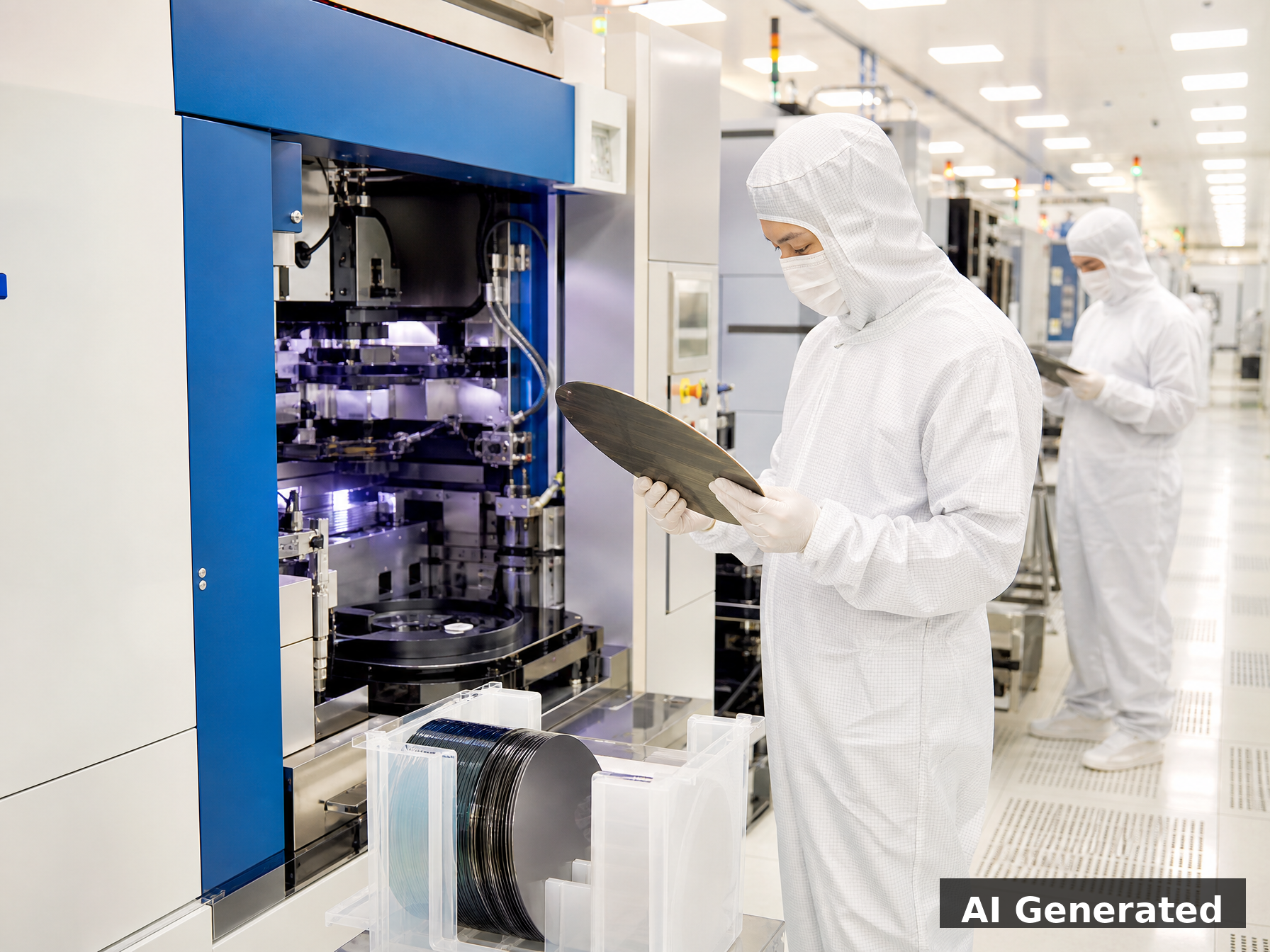
Start with what China has actually achieved in classical computing, because the picture is more nuanced than either the hype merchants or the dismissal artists would have you believe.
SMIC, China’s national champion foundry, has achieved volume production of a 5nm-class process node — called N+3 — without any EUV lithography tools. This was confirmed by TechInsights through a teardown of the Huawei Kirin 9030 SoC [2]. It is China’s most advanced semiconductor node, produced entirely with older DUV technology and a technique called self-aligned quadruple patterning — essentially exposing the same layer four times to shrink features beyond what the machine was designed for.
This is genuinely impressive engineering. It is also commercially painful. SMIC’s 5nm-class wafers cost approximately 40 to 50 percent more than TSMC’s EUV-based equivalents, with yields at roughly one-third of TSMC’s industry-standard 80 to 90 percent [3][4]. The node itself, when analyzed by TechInsights, turned out to have a transistor density of less than 125 million transistors per square millimeter — closer to TSMC’s 6nm than true 5nm [4]. SMIC remains three to five years behind TSMC at the leading edge.
But here is where you need to pay attention. In July 2026, a little-known Shanghai state-owned company called Aishengna Electronic Technology Group began mass-producing domestic immersion DUV lithography machines [1]. Aishengna was established in August 2023 with 7 billion yuan in registered capital. It absorbed teams from Yuliangsheng — the Huawei-affiliated startup that was testing a DUV prototype last year — and from SMEE, China’s oldest lithography maker [1]. The first machines are expected to be delivered to SMIC, Hua Hong, and CXMT this year. Production target: about five units in 2026, roughly twenty in 2027.
Five units versus ASML’s 130 is not competition. It is a fallback — a hedge against the day when Western governments further restrict exports or servicing of foreign tools. But it is a hedge that did not exist two years ago. And the trajectory matters.
Meanwhile, on the design side, China’s fabless ecosystem has exploded to over 3,600 companies — a sixfold increase since 2010 [3]. Huawei’s Ascend 910C delivers roughly 60 to 70 percent of the performance of NVIDIA’s H100 [3][5]. Cambricon’s Siyuan 590 reaches about 80 percent of the A100 [3]. These are not frontier chips. They are chips from five years ago, reproduced domestically. But they are being produced at scale — Huawei shipped approximately 810,000 Ascend chips in 2025 [4] — and they are good enough for the inference workloads that will dominate AI computing as models move from training to deployment.
And then there is RISC-V — the open-source processor architecture that gives China a path entirely free of Western IP restrictions. China leads with 50 percent of global RISC-V shipments. The architecture reached 25 percent global market share in early 2026 [6]. While the world argues about ARM versus x86, China is quietly building an alternative that neither the US nor Europe can restrict.
Now consider the EUV prototype.
In December 2025, Reuters reported that China had completed a working extreme-ultraviolet lithography prototype inside a high-security facility in Shenzhen [7]. The machine generates EUV light. It has not produced functional chips. Beijing targets 2028 for chip production; sources suggest 2030 is more realistic [7][8].
The effort has been compared to the Manhattan Project — thousands of engineers, coordinated by Huawei, with former ASML engineers recruited at signing bonuses of $420,000 to $700,000 [7][8]. Two parallel teams are developing EUV light sources. Lin Nan, a former ASML Research scientist and student of 2023 Nobel laureate Anne l’Huillier, published a paper showing 3.42 percent conversion efficiency — beating a comparable Western academic result from 2019 [8]. His team uses solid-state lasers rather than the CO₂ lasers that ASML sources exclusively from Trumpf in Germany, thereby bypassing an entire layer of Western patent control [8].
Tsinghua University is pursuing an even more radical approach: a 100-to-150-meter particle accelerator that would generate continuous EUV light at over 1,000 watts — nearly double ASML’s output. Rather than shrinking the lithography machine, the design co-locates multiple scanners around one central accelerator, effectively building a chipmaking campus around a single light source [4]. Construction began in Xiong’an in early 2025.
You should not overstate what any of this means. Generating EUV light is not the same as producing functional chips. ASML took eleven years from its first prototype in 2006 to its first commercial shipment in 2017 [4]. China’s mirrors achieve roughly 65 percent reflectivity versus Zeiss’s 70 percent — a gap that compounds across 10 to 14 bounces, meaning a Chinese system delivers only 35 to 50 percent as much light to the wafer [4]. EUV photoresist requires purity at parts-per-trillion levels, where China is “only in the nascent stages” [9]. The machine fills nearly an entire factory floor. It is, by all credible accounts, years from commercial viability.
But you should not understate it either. China went from zero domestic immersion DUV capability to mass production in under three years. The zero-to-one is the hard part. One-to-ten is engineering iteration — and if history is any guide, China iterates fast. Ask anyone in solar panels. Or electric vehicles. Or 5G.
The Other Race
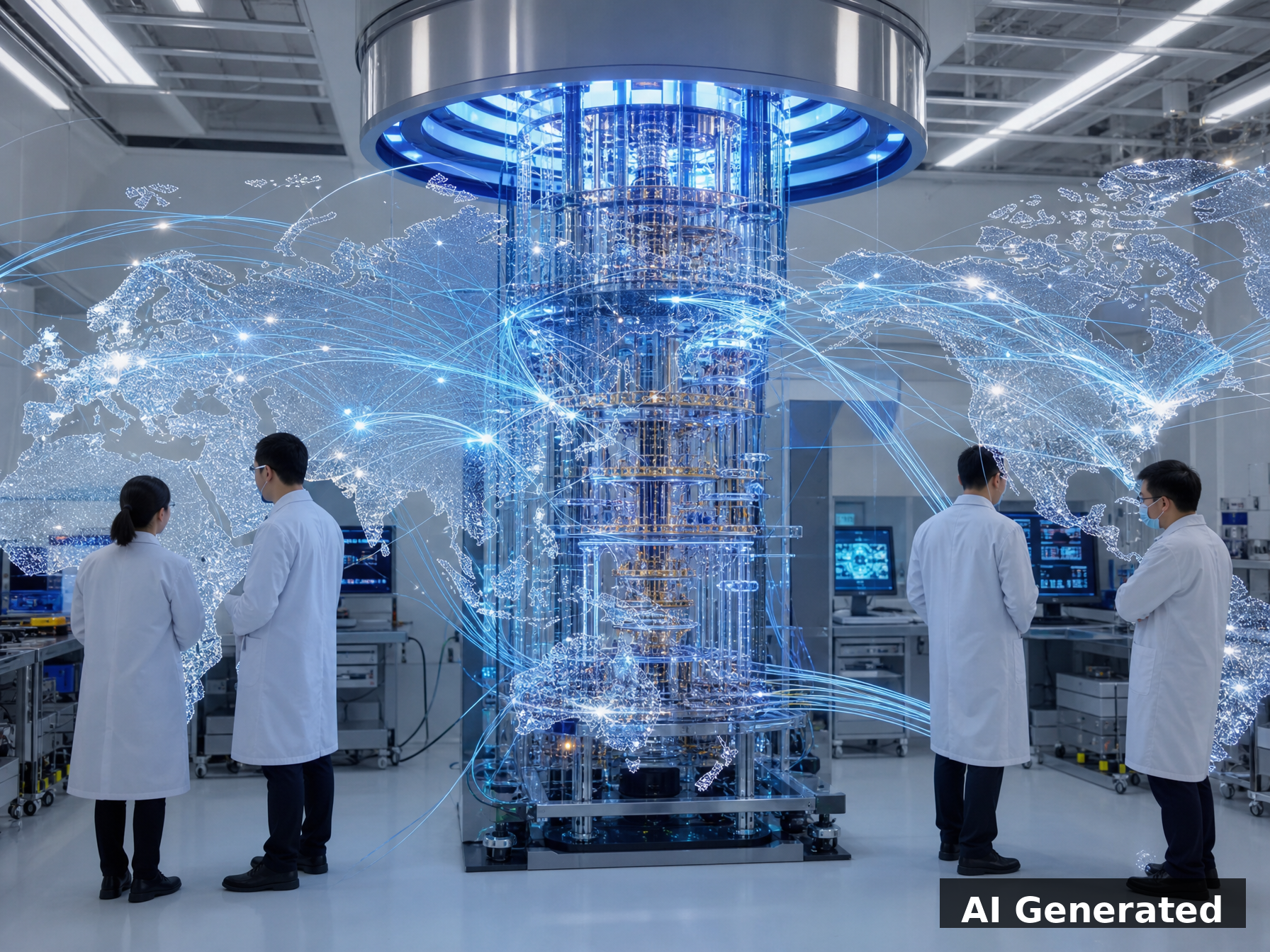
Now shift your gaze to quantum, because this is where the story takes a turn that most Western analysts are still struggling to read correctly.
China operates the world’s only carrier-grade quantum communication network — over 12,000 kilometers of fiber, 145 backbone nodes, 20 metropolitan networks, and six ground stations linked to the Micius satellite, launched in 2016 as the world’s first dedicated quantum communications satellite [10][11]. China Telecom’s quantum key distribution services have 5.5 million users and 3,000 service providers [11]. This is not a laboratory experiment. It is deployed infrastructure, and no other country has anything comparable.
On the computing side, USTC’s Jiuzhang 4.0 photonic processor — published in Nature in May 2026 — manipulated 3,050 photons through an 8,176-mode circuit, the largest Gaussian boson sampling experiment to date [12]. The Zuchongzhi 3.0 superconducting processor ran a random-circuit-sampling task estimated at 10^15 times faster than the leading classical supercomputer [12]. Zuchongzhi 3.2, released in December 2025, demonstrated a distance-7 surface-code logical qubit below the fault-tolerance threshold — a step from raw benchmarking toward error correction [12].
These are real results. They are also benchmark demonstrations, not commercial products. The sampling tasks have no direct commercial use. The United States has comparable or superior hardware: Google’s Willow processor with 105 error-corrected qubits, IBM’s 1,121-qubit chip, Atom Computing’s 1,180-qubit system [13]. The quantum computing race is closer to a tie than a Chinese lead.
But the funding trajectory is where you should feel the tension. China’s 15th Five-Year Plan, adopted in March 2026, names quantum technology first among seven future industries — above biomanufacturing, hydrogen, 6G, brain-computer interfaces [11]. Three regional quantum-focused venture funds were allocated $17.5 billion [11]. McKinsey estimates Chinese government quantum funding at approximately $15.3 billion — nearly double the EU’s $8.4 billion and more than quadruple US government spending of approximately $3.7 billion [11]. Even if actual spending is one-third of publicized figures, as USTC physicist Chao-Yang Lu himself has suggested, China’s quantum investment still exceeds US government investment [12].
And here is the detail that should keep security planners awake: China is positioning itself as a global quantum technology provider. Origin Quantum’s operating system is freely downloadable worldwide. The Hanyuan-1 neutral-atom quantum computer was exported to Pakistan. The Tianyan quantum cloud platform has drawn over 37 million visits from more than 60 countries [11][14]. This creates dependency pathways — third countries building their quantum infrastructure on Chinese platforms, much as the world built its telecommunications on Huawei.
The US-China Economic and Security Review Commission put it plainly: “Whoever leads in quantum (and AI) will control the encryption of the digital economy, enable breakthroughs in materials, energy, and medicine, and gain asymmetric and likely persistent advantage in intelligence and targeting” [13].
The Accelerator Effect
Now we arrive at the paradox that defines this entire story.
In June 2026, Brookings published an analysis with a verdict that should have sent shockwaves through every Western capital: “U.S. chip companies have exactly zero market share of the AI chip market in China and have no prospect of returning to their once-dominant position there. The ball game is over, and the U.S. has lost” [15].
This is not because US chips are inferior. It is because China’s government no longer considers American suppliers reliable business partners. When the Trump administration approved NVIDIA’s H200 chips for export to China in December 2025, Beijing blocked Chinese companies from buying them [15][5]. The reasoning is strategic: if China builds its AI infrastructure on US chips, Washington can cut the supply at any moment. So Beijing accepts less capable domestic chips today in exchange for sovereignty tomorrow.
The German management consultancy MHP put it even more bluntly: “External restrictions act as an accelerator, not as a paralysis” [16]. The US export controls since October 2022 accelerated the build-up of national champions like SMIC, YMTC, and CXMT. SMIC’s 7nm Kirin 9000S for Huawei’s Mate 60 Pro in September 2023 was “a turning point that surprised Western analysts” [16].
DeepSeek proved the logic. Its V4 model was optimized to run on Huawei’s Ascend chip for inference — not NVIDIA’s hardware [5][14]. Chinese AI models cost roughly one-sixth the price per token of US offerings [15]. China has twice the electricity generation of the United States [15]. The strategy is not to match NVIDIA chip for chip. It is to make the chip irrelevant by optimizing the entire stack — software, clustering, energy, pricing — around available domestic hardware.
But the bottleneck is real, and it is binding. China’s HBM stockpile — the high-bandwidth memory critical for AI accelerators — likely ran out in late 2025 [4]. CXMT, China’s memory champion, is three to four years behind global leaders in DRAM and is only now producing HBM3 samples at roughly 50 percent yields [4]. China specifically requested relaxed HBM restrictions in trade talks — not lithography tools, not TSMC access — signaling that memory is what most constrains domestic AI chipmaking [4].
Huawei’s “LogicFolding” architecture — which stacks chips vertically rather than shrinking transistors, aiming to match TSMC’s 1.4nm by 2031 — is an admission that conventional scaling is blocked [15][4]. It is an architectural workaround, not parity. When a company stops trying to follow the roadmap and starts inventing around it, you know the wall is real.
The honest synthesis is this: sanctions accelerated domestic substitution faster than anyone predicted, but they did not eliminate the fundamental manufacturing gap. They forced China to pay a “sanction tax” — higher costs, lower yields, architectural detours — in exchange for sovereignty. China decided the tax was worth paying. Whether it remains affordable depends on how fast the domestic toolchain matures.
Indispensability, Not Autarky
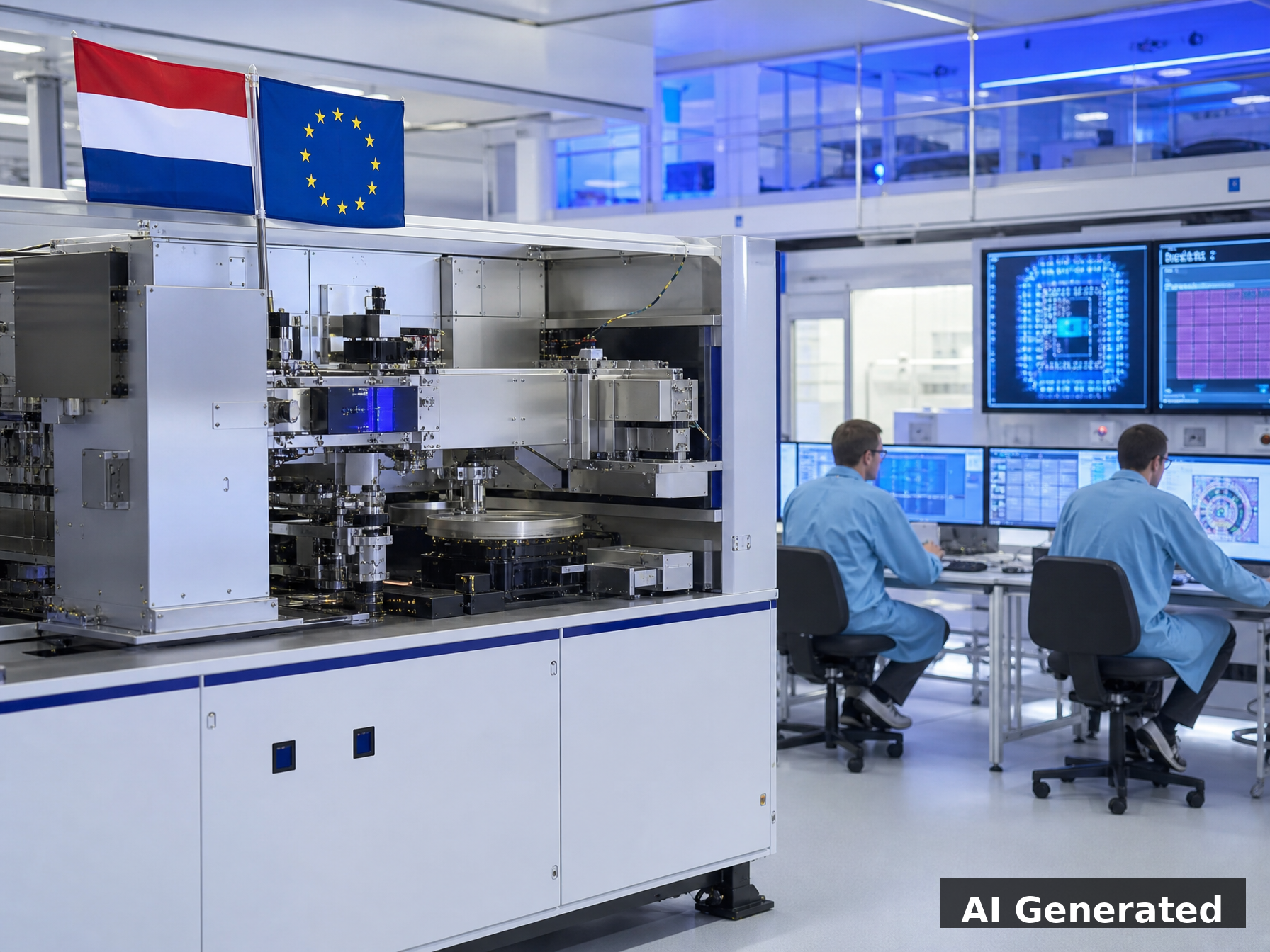
And so we arrive at Europe — the continent that makes the machines everyone fights over, and yet watches its own market share stagnate.
The EU Chips Act aimed for 20 percent of global semiconductor production by 2030. The European Court of Auditors found that Europe will reach approximately 11.7 percent under current plans [17]. Intel cancelled its Magdeburg megafab in July 2025 [17]. Hitting 20 percent would cost roughly €250 billion — more than currently available [17]. The Chips Act 2.0, presented by the European Commission on June 3, 2026, risks being too cautious to close the gap [16][17].
Meanwhile, ASML’s revenue from China dropped from approximately 33 percent in 2025 to 14 to 16 percent in the first half of 2026 [1][8]. Europe’s China policy is directly self-contradictory: the continent’s most valuable technology company is losing its largest market because of export controls that Europe itself helped impose.
What should Europe do? Not copy China. The whole-chain approach — trying to build every link from design to fabrication to packaging — has diminishing returns, as China’s own experience with costs and yields demonstrates. And Europe cannot match the scale of Chinese state capital, nor should it try.
The answer is what the Economy Research group calls “sovereignty through indispensability” [17]. Europe already holds chokepoints that no other nation can replicate. ASML is the world’s only EUV supplier. Zeiss makes the mirrors. imec leads collaborative R&D on sub-2nm processes. ARM dominates mobile processor IP. Infineon, NXP, and STMicroelectronics lead in automotive and power semiconductors [17][16].
Instead of spreading resources thin across the entire value chain, Europe should deepen these chokepoints. Make itself so irreplaceable that any power — the United States, China, Taiwan, South Korea — needs European technology to build its own chips. Not autarky. Indispensability.
The MHP analysis, written from inside the German industrial machine, offers four lessons from China’s approach that Europe should absorb [16]:
First, a cross-industry strategy rather than siloed thinking. China’s Big Fund III — $47.5 billion launched in May 2024 — invests across HBM, AI hardware, compound semiconductors, and mature nodes simultaneously, following the entire demand logic from telecom to mobile to AI to automotive to defense [16][3]. Europe’s approach remains fragmented by nation and by industry.
Second, real demand policy. China uses public procurement — from the military to state telecoms — to scale domestic semiconductors. Europe could do the same with its public sector, from defense to infrastructure to automotive.
Third, chip design competence as a standalone pillar. Europe has the research infrastructure — imec, Fraunhofer, CEA-Leti — but lacks the industrial pipeline that turns research into volume.
And fourth, speed. In the words of MHP’s analysts: “China has established in ten years what Europe is still searching for governance structures today. The question is not whether Europe can exist as an independent actor, but how fast we act” [16].
Admiration and Urgency

Let us end where we started — with honesty.
China is not at the cutting edge of classical computing. It is three to five years behind in logic, three to four years behind in memory, and a decade away from domestic EUV. Its quantum advantage demonstrations are benchmark exercises, not commercial products. Its commercial quantum layer is thinner than the United States’. Many of its claims lack independent verification.
But the trajectory is real. The zero-to-one breakthroughs — domestic DUV mass production, an EUV prototype that generates light, a 12,000-kilometer quantum network, RISC-V at 25 percent global market share — are genuine engineering achievements worthy of respect. Lin Nan’s conversion efficiency beating a Western academic result is not propaganda. The SSMB accelerator concept is not science fiction. The 5.5 million users on China Telecom’s quantum network are not a mirage.
We can admire the engineering while recognizing the strategic implication. China is reshaping the compute landscape faster than most expected. The bifurcation of the US and Chinese AI ecosystems is not a future possibility — it is happening now, and it is irreversible [15].
For Europe, the path is not to copy China’s whole-chain approach, which carries diminishing returns and enormous cost. Nor is it to pretend that self-sufficiency is achievable — it is not, at any realistic price. Europe’s path is to be irreplaceable: to hold and deepen the chokepoints that make the world need European technology, and to move fast enough that irreplaceability remains a choice rather than a relic.
The compute frontier is not a race with a finish line. It is a landscape being reshaped — by sanctions and by the reactions to sanctions, by open architectures and by closed ecosystems, by quantum uncertainty and by silicon certainty. China is reshaping it faster than most predicted. Europe needs to decide what it wants to be in the new topology.
And then it needs to build it. Before the window closes.
References
[1] Potkin, F. (2026). China starts production of home-grown immersion DUV chipmaking tools, source says. Reuters. Link
[2] Design & Reuse. (2025). Chinese SMIC achieves 5 nm production on N+3 node without EUV tools. Design & Reuse. Link
[3] Premia Partners. (2026). China’s path to domestic substitution and technology independence — Many breakthroughs, one challenge. Premia Partners. Link
[4] Blablová, V. (2026). Where China’s AI chip supply chain stands in 2026. The Substrate. Link
[5] Uko, E. (2026). Huawei could seize China’s AI chip crown in 2026 as Nvidia’s H200 shipments stall. Tom’s Hardware. Link
[6] EE Times. (2026). RISC-V pivots from academia to industrial heavyweight. EE Times. Link
[7] Pao, J. (2025). Made-in-China EUV machine targets AI chip output by 2028. Asia Times. Link
[8] CNBC. (2026). China’s reported chip breakthrough comes with some big caveats. CNBC. Link
[9] The Diplomat. (2026). China’s EUV lithography progress: Parsing signal from noise. The Diplomat. Link
[10] Tomoshige, H. & Singerman, P. (2026). Understanding China’s quest for quantum advancement. Center for Strategic and International Studies. Link
[11] PostQuantum. (2026). China’s 15th Five-Year Plan makes quantum an industrial imperative. PostQuantum. Link
[12] QuantumZeitgeist. (2026). China quantum computing companies: Complete 2026 guide. QuantumZeitgeist. Link
[13] USCC. (2025). Vying for quantum supremacy: U.S.-China competition in quantum technologies. U.S.-China Economic and Security Review Commission. Link
[14] Peng, T. (2025). China’s tech giants race to replace Nvidia’s AI chips. IEEE Spectrum. Link
[15] Brookings. (2026). Ball game’s over—the US is out of the AI chip market in China. Brookings Institution. Link
[16] Wehinger, J. & Wenner, M. (2026). Europas Halbleiterfrage: Warum jetzt entschieden wird und was wir von China lernen können. MHP. Link
[17] Economy Research. (2026). Sovereignty through indispensability: Europe’s realistic path in the global chip race. Economy.ac. Link
AI Disclosure: This post was created with the assistance of artificial intelligence. The ideas, analysis, and opinions expressed are my own — AI was used to help compose, structure, and refine my personal notes and thoughts into the final written content. Images and video featured in this post were also generated using AI tools, based on my own creative prompts and direction.
