




Europe’s AI Gap: The €200 Billion Illusion and the Brain Drain Nobody’s Fixing

In February 2025, European Commission President Ursula von der Leyen stood at the Paris AI Action Summit and declared that “from now on, it’s AI first.” She announced InvestAI, a €200 billion initiative to make Europe an “AI continent.” The headlines were impressive. The reality is considerably less so.
The United States invested $285.9 billion in private AI funding in 2025 alone [2]. Cumulative US private AI investment from 2013 to 2024 exceeded $470 billion; Europe managed roughly $50 billion in the same period [3]. The US Stargate project — a private-sector infrastructure build backed by OpenAI, Oracle, and SoftBank — committed $500 billion for AI data centers and compute [3]. Against this, the EU’s headline number looks less like a plan and more like a press release.
The Money That Isn’t There
The €200 billion figure is not a budget. It is a political mobilisation target that conflates three fundamentally different things: legally binding EU budget allocations, guarantees channelled through the European Investment Bank, and aspirational targets for private capital that has not materialised [4].
According to a July 2026 report by Open Future, a European think tank, the €50 billion InvestAI Facility — the centrepiece of the initiative — has a structure that is “still being finalised, with no private capital raised” [4]. The EU AI Champions Initiative, a consortium of over 110 organisations behind a €150 billion private investment pledge, has not publicly disclosed investor-by-investor allocations, making it impossible to verify whether the money represents genuinely new commitments or repackaged prior announcements [4].

The actual EU budget money already committed to AI — through programmes like Horizon Europe, the Digital Europe Programme, and the €2.1 billion EuroHPC AI factories — amounts to tens of billions, not hundreds [5]. The rest depends on private investors choosing to bet on a fragmented 27-member-state market with longer sales cycles, smaller deal sizes, and stricter regulation than the alternative across the Atlantic [5].
As the Organisation for Economic Co-operation and Development noted in a 2025 working paper, AI investment figures are “clouded by fragmented data, inconsistent methodologies, and a lack of standardised measurement frameworks” [4]. The EU’s headline number fits that description perfectly.
The Output Gap: Three Models Versus Forty
The investment gap translates directly into an output gap. In 2024, US-based institutions produced 40 notable AI models. China produced 15. All of Europe combined produced three [1].
By May 2026, Europe’s top 20 AI startups had a combined valuation exceeding $100 billion — a genuine achievement led by Mistral AI and Poolside AI (each valued at $14 billion), Helsing ($12 billion), and ElevenLabs ($11 billion) [7]. But these numbers, impressive as they are for a region dismissed as “over-regulated and under-funded” just four years ago, remain dwarfed by American peers. OpenAI, Anthropic, and xAI each individually command valuations that exceed any single European company [7].
The infrastructure gap is equally stark. US hyperscalers — Amazon Web Services, Microsoft Azure, and Google Cloud — control approximately 72 percent of the European cloud market. EU-based providers account for less than 20 percent [5]. The United States has 17 times Europe’s AI supercomputing capacity and controls 74 percent of global high-end AI compute [3]. When European AI companies need to train frontier models, they overwhelmingly rent capacity from American firms.
The Brain Drain: Europe Trains, America Employs
Perhaps the most painful dimension of Europe’s AI deficit is the talent paradox. Europe has approximately 30 percent more AI professionals per capita than the United States and nearly three times as many as China [6]. The continent’s universities — INRIA in France, ETH Zurich, the Technical University of Munich, Oxford and Cambridge — produce world-class researchers.
And then they leave.
Three out of four European international AI PhD students at American universities remain in the United States for at least five years [6]. A 2024 report by the research organisation Interface found that European countries are “losing significant AI talent, both national and international, to the United States” [6]. Net tech talent inflows to Europe fell sharply, from approximately 52,000 in 2022 to just 26,000 in 2024 [6].

The reasons are structural, not sentimental. AI salaries in the United States are typically 30 to 70 percent higher than in comparable European roles. Mid-to-senior AI engineers in the US earn base salaries of $140,000 to $210,000, with total compensation substantially higher due to bonuses and stock options. In Western and Northern Europe, the same roles pay $90,000 to $150,000; in Southern and Eastern Europe, salaries often fall well below $100,000 [6]. Equity compensation — the mechanism that created Silicon Valley’s middle-class millionaire — remains rare and less generous across most of Europe [6].
Beyond money, there is compute. For researchers who want to work on the biggest models, the largest datasets, and the most resource-intensive experiments, the frontier infrastructure is overwhelmingly American. Relocation is not a lifestyle choice; it is a professional necessity [6].
The EU’s response has been bureaucratic. The European Commission has launched a Talent Pool for non-EU workers, legal gateway offices, and the Marie Skłodowska-Curie Actions “Choose Europe” programme to co-fund the recruitment of international AI researchers [6]. These are well-intentioned administrative measures that do not address the compensation gap, the equity gap, or the compute gap that actually drive the exodus. Europe is treating a haemorrhage with a plaster.
Regulation: Real Barrier or Convenient Scapegoat?
The debate over whether Europe’s regulatory environment stifles AI innovation has produced more heat than light. The EU AI Act, which entered into force in August 2024, is the world’s first comprehensive, binding legal framework for artificial intelligence [8]. It classifies AI systems into four risk tiers, imposes heavy compliance obligations on high-risk applications, and carries penalties of up to €35 million or 7 percent of global annual turnover [8].
Critics argue this regulatory burden drives founders and investors away. Clark Parsons, leader of the European Startup Network, is blunt: “The EU should stop patting itself on the back for being the world’s regulator in technology. Stop thinking about how to regulate and start thinking about how to unleash incredible growth” [5]. European AI companies face enterprise sales cycles 30 percent longer than their US counterparts, deal sizes 50 percent smaller, and higher expansion costs due to regulatory fragmentation across 27 national markets [5].
Yet the counter-argument has substance. The Carnegie Endowment for International Peace argues that “the narrative of regulatory overreach stifling innovation is largely a strategic construct promoted by U.S. actors” [9]. The AI Act mainly regulates high-risk applications; most AI systems face minimal obligations [9]. More importantly, the real barriers to European AI leadership run deeper than regulation: fragmented digital markets, absence of risk-tolerant venture capital, dependence on foreign cloud providers, and chronic underinvestment [9].
The US itself is not the deregulated paradise Europeans imagine. American AI companies face a patchwork of state-level laws — Colorado, New York City, California, Illinois, and Texas each impose distinct requirements — creating compliance complexity that the EU AI Act’s unified framework actually avoids [8]. China imposes mandatory algorithmic filing, content controls aligned with “core socialist values,” and government security assessments before any generative AI service can be released to the public [8].
The honest assessment is that regulation is a factor, but not the primary one. The primary factors are money, markets, and infrastructure.
The ASML Paradox: Europe’s Hidden Leverage
There is one dimension of the global AI competition where Europe holds an extraordinary card — and is barely playing it.
ASML, headquartered in Veldhoven in the Netherlands, is the sole manufacturer of Extreme Ultraviolet (EUV) lithography machines — the equipment without which no advanced semiconductor chip on Earth can be produced [10]. TSMC in Taiwan, Samsung in South Korea, and Intel in the United States all depend on ASML’s machines. The company controls a genuine chokepoint in the global technology supply chain.
In September 2025, ASML led a €1.7 billion funding round for Mistral AI, securing an approximately 11 percent stake and signalling that Europe’s most valuable technology company sees its future as inseparable from European AI software [10]. The deal was described as “Europe’s answer” to Microsoft’s backing of OpenAI and Amazon’s partnership with Anthropic [10].
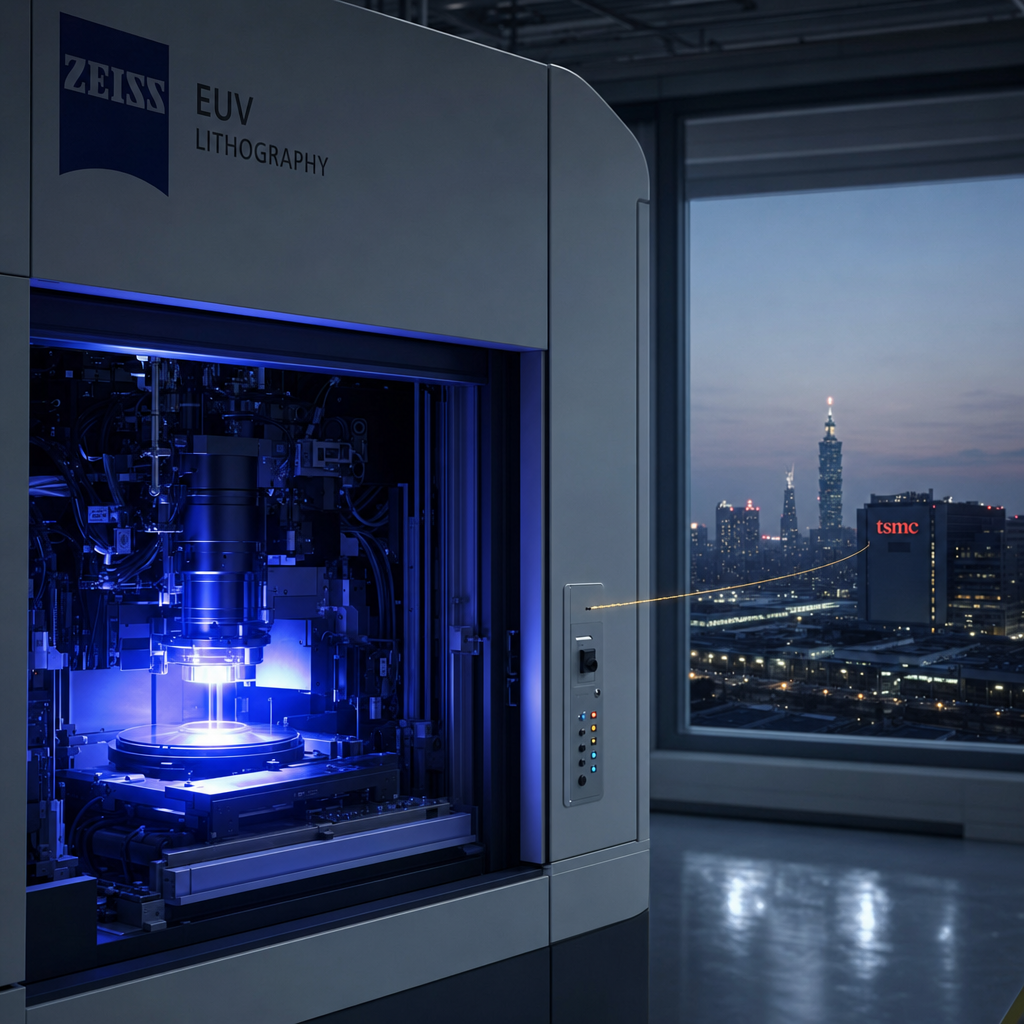
Yet here lies the paradox: ASML’s sales are 98 percent outside Europe — 35 percent to Taiwan, 27 percent to China, 19 percent to South Korea [10]. Europe owns the machine that makes all advanced chips possible and uses almost none of that capability domestically. The EU Chips Act has committed €43 billion in public investment to boost European semiconductor production, but the European Court of Auditors has found it “very unlikely” to meet its Digital Decade target of 20 percent global market share by 2030 [3]. Building fabrication capacity comparable to TSMC or Samsung would require decades and hundreds of billions of euros that Europe does not currently have.
The hardware gap is a structural constraint that software investment alone cannot overcome. The Trump administration understands this — its export controls on advanced AI chips to China, its Pax Silica international partnership on AI supply chains, and its leverage of TSMC’s dependence on US-designed equipment all reflect a strategy of controlling the physical foundation of AI [3].
Where Europe Actually Competes
None of this means Europe has no AI future. The picture is more nuanced than the headline numbers suggest.
Europe’s AI strengths are concentrated in open-source models, vertical specialisation, and enterprise software. Mistral AI’s open-weight foundation models have created a global developer community that reduces dependency on American proprietary systems [7]. ElevenLabs from Poland leads the world in AI voice synthesis. DeepL dominates professional translation for European languages. Helsing has become the leading European AI defence company, serving NATO members who need AI they can trust with sensitive operational data [7]. Hugging Face, headquartered in Paris, hosts over 500,000 AI models and functions as the de facto GitHub of the AI world [7].
These companies share a common strategy: they are building durable moats through vertical specialisation rather than trying to out-scale American foundation model labs. Legal AI, medical AI, defence AI, translation AI — in these domains, deep domain expertise, regulatory compliance, and European data residency create advantages that US competitors cannot easily replicate [7].
Germany leads with six of Europe’s top 20 AI companies, followed by the United Kingdom with five and France with four [7]. The geographic distribution is broader than the usual narrative of a France-and-UK-only story suggests.
The Clock Is Ticking
Europe’s AI window is not closed. But it is narrowing.
The structural advantages that European AI companies are building — open-source ecosystems, compliance-first architectures, vertical domain expertise — are real and potentially durable. The ASML-Mistral alliance suggests a path where Europe’s hardware leverage connects to its software ambitions.
But the fundamentals remain punishing. The €200 billion headline is largely aspirational. The brain drain continues because the structural causes — compensation, equity, compute access, market fragmentation — remain unaddressed. The regulatory environment is a factor but not the primary one; the primary obstacles are money and infrastructure. And on hardware, the gap may be insurmountable in the medium term.

Von der Leyen was right about one thing: the AI race is far from over. But the EU’s current approach — impressive announcements backed by modest commitments, bureaucratic talent programmes that do not touch the real drivers of exodus, and regulation that constrains without proportionate investment — risks producing something worse than defeat. It risks producing irrelevance.
The question is not whether Europe can build great AI companies. It already has. The question is whether it can build enough of them, fast enough, before the window closes for good.
References
[1] Stanford Institute for Human-Centered Artificial Intelligence (HAI). (2025). The 2025 AI Index Report. Stanford University. https://hai.stanford.edu/ai-index/2025-ai-index-report
[2] Stanford Institute for Human-Centered Artificial Intelligence (HAI). (2026). The 2026 AI Index Report. Stanford University. https://hai.stanford.edu/ai-index/2026-ai-index-report
[3] Executive Office of the President, Council of Economic Advisers. (2026). Economic Report of the President: Chapter 5 — The Revolution of Artificial Intelligence. The White House. https://www.whitehouse.gov/wp-content/uploads/2026/04/ERP-2026-5.-The-Revolution-of-Artificial-Intelligence.pdf
[4] Open Future. (2026). From Frameworks to Factories: Mapping EU AI Investment Architecture. European Digital Rights (EDRi). https://edri.org/our-work/the-eu-spends-billions-on-ai-but-can-anyone-track-the-money/
[5] Batista Cabanas, L., & Heinz, E. (2026). AI power play: Can Europe catch up with the US and China? Euronews. https://www.euronews.com/my-europe/2026/01/27/the-ai-race-can-europe-catch-up-to-the-us-and-china
[6] Kiorri, E. (2026). The AI brain drain: Why Europe can’t keep the talent it trains. Euronews. https://www.euronews.com/my-europe/2026/01/29/the-ai-brain-drain-why-europe-cant-keep-the-talent-it-trains
[7] Shrivastava, A. (2026). Top 20 Most Valuable AI Startups in Europe (2026). Foundevo. https://www.foundevo.com/top-most-valuable-ai-startups-in-europe/
[8] Legalithm. (2026). AI Regulation Compared: EU, US, UK, China (2026). Legalithm. https://www.legalithm.com/en/blog/ai-regulation-comparison-eu-us-uk-china-global
[9] Csernatoni, R. (2025). The EU’s AI Power Play: Between Deregulation and Innovation. Carnegie Europe. https://carnegieendowment.org/europe/research/2025/05/the-eus-ai-power-play-between-deregulation-and-innovation
[10] Patience, N. (2025). Is an ASML-Mistral Alliance the Blueprint for European AI? The Futurum Group. https://futurumgroup.com/insights/is-an-asml-mistral-alliance-the-blueprint-for-european-ai/
