





The Blank Cheque: How Germany Rewrote Its Constitution, Committed a Trillion Euros, and Remained an American Client.

The Day the Rulebook Changed
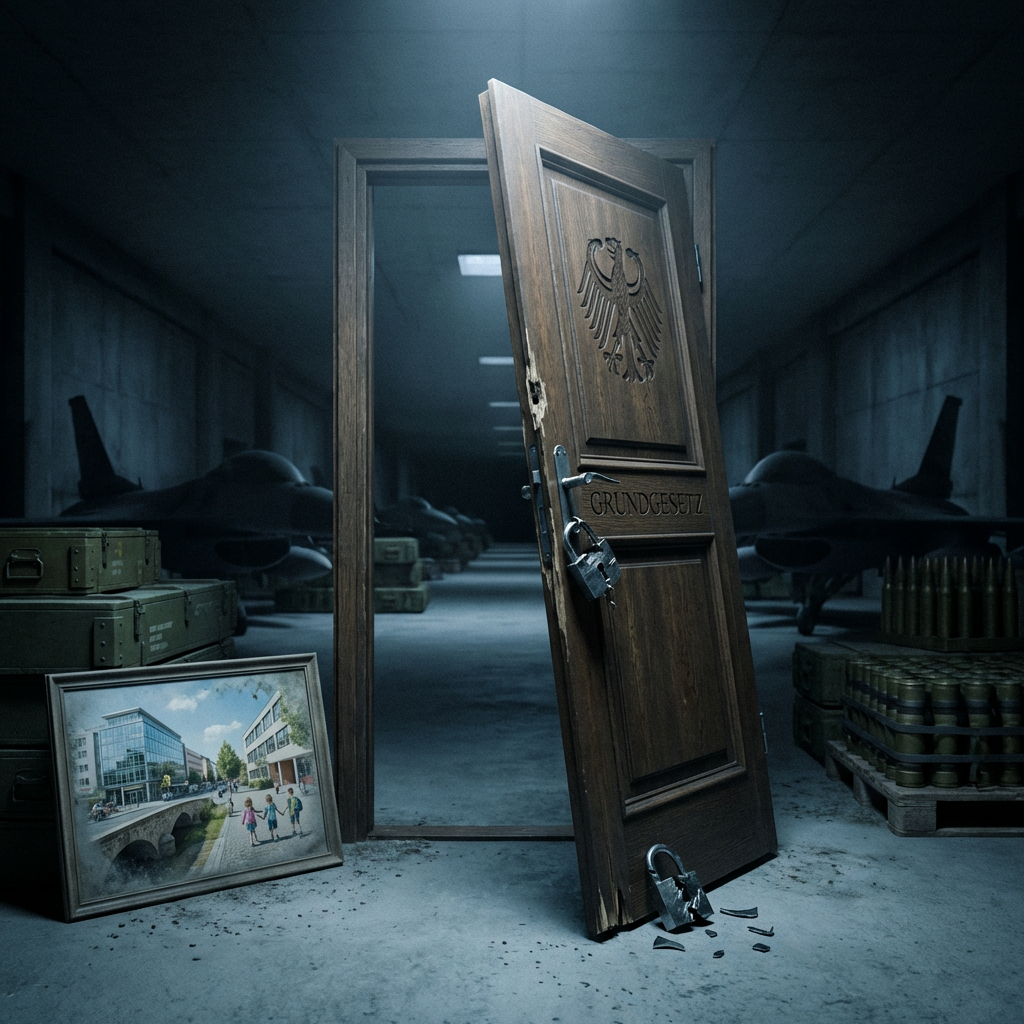
On March 18, 2025, the German Bundestag voted 517 to 207 to amend the Grundgesetz — Germany’s Basic Law, the foundational constitutional document that emerged from the rubble of the Second World War and has governed the republic ever since — to carve out an unlimited borrowing exemption for defence spending. Three days later, on March 21, the Bundesrat completed the constitutional process, giving the reform the force of law. Any military expenditure exceeding 1% of GDP would, from that moment forward, be entirely free of the Schuldenbremse — the debt brake — the fiscal rule that Germany had inscribed into its own constitution in 2009 and had held up to the rest of Europe as a model of budgetary discipline for a generation. Critically, the new law does not merely cover Bundeswehr procurement. It explicitly extends the borrowing exemption to cover military aid to “countries attacked in violation of international law” — a permanent, constitutionally shielded financing window for the war in Ukraine, written directly into the Basic Law.[1][2][3][4][5][6]
The official explanation was compelling in its simplicity: Germany faces the most dangerous security environment since the Cold War. Russia is on the march. NATO’s eastern flank is exposed. The Bundeswehr, hollowed out by three decades of post-Cold War neglect, needs urgent, sustained investment. Chancellor Friedrich Merz, standing before parliament in the confident posture of a statesman answering the call of history, spoke of building “the strongest conventional army in Europe”. The 2026 defence budget of €82.69 billion — approximately 15% of the entire federal budget — was presented not as a political choice but as a geopolitical necessity.[7][8][9]
It was a compelling narrative. It was also only part of the story.

What They Said — And What the Numbers Actually Show
Strip away the strategic vocabulary, the NATO commitments, the solemn invocations of Zeitenwende, and what remains is this: Germany has engineered a permanent, constitutionally protected mechanism to finance an open-ended war it never formally declared, never priced transparently, and never submitted to the parliament the German people had just elected. The rearmament narrative is the packaging. The content is something far more specific — a government that has been systematically transferring its military stockpiles to a conflict in Eastern Europe, depleting its own armed forces in the process, and has now rewritten its most fundamental law to ensure it can keep doing so indefinitely, without a spending ceiling, by rushing the vote through an outgoing parliament in the final days before its replacement was seated.
Since February 2022, Germany has transferred approximately €55 billion in military support to Ukraine, with a further €11.5 billion committed for 2026 alone. These are not supplementary aid packages financed from existing budgets. They are a sustained haemorrhage of equipment — howitzers, air defence systems, armoured vehicles, ammunition — directly out of Bundeswehr stockpiles. The Kiel Institute for the World Economy was unambiguous in its assessment: “The German government is barely managing to replace the weapons it is sending to Ukraine — the Bundeswehr’s stockpile of air defence systems and howitzers has actually plummeted”. At the procurement pace observed in mid-2024, their analysis concluded it would take a century to return German military inventory to its 2004 baseline.[10][11][12][13]
Now examine the €377 billion “modernisation” plan through that lens. The single largest budget line — €70.3 billion — is ammunition and stockpile replenishment. Not new weapons. Not transformative technology. Shells, missiles, and rifle rounds to replace what has been sent east. The PzH 2000 howitzer production line had to be reactivated because Germany gave its fleet to Ukraine. Patriot battery replacements are on order because, as Defence Minister Pistorius himself admitted, “we ourselves are waiting for replacements” for the systems transferred to Kyiv. The Leopard 2 tanks — 600 to 1,000 on order — are in no small part replacing the vehicles that rolled across borders with Ukrainian insignia. What is being marketed to the German public as a great leap forward in military capability is, to a considerable degree, a very expensive exercise in digging out of a very deep hole.[12][14][15][16]
The German Federal Court of Auditors — the Bundesrechnungshof — offered the starkest institutional warning: this constitutional amendment “puts sound public finances at risk” and opens the door to over €1 trillion in new borrowing by 2035, piled on top of a national debt that already stands at €1.8 trillion (federal debt) . Bloomberg’s headline captured the market’s verdict concisely: “Germany’s $1.2 Trillion Debt Bazooka Is Veering Off Target”. Germany borrowed €143.2 billion in 2025 alone. The Bruegel Institute confirmed it would breach EU fiscal rules regardless of how the numbers are structured. The Ifo Institute put it plainly: “Relying solely on debt is not a viable solution”.[5][17][18][19][20]
And critically — this constitutional amendment was not voted through by the newly elected parliament that had just received a fresh democratic mandate from the German people. It was rushed through the outgoing Bundestag, in the final days before the incoming parliament was seated on March 25 — specifically, analysts noted, because a two-thirds majority “would have been iffy after a new class of lawmakers is seated”. That is not how a constitutional democracy is supposed to function. That is a procedural manoeuvre to insulate a transformative fiscal decision from democratic accountability.[21][1]
The F-35 Problem: Europe’s New F-104 Moment
If the fiscal architecture is questionable, the strategic architecture is worse — and nowhere is this more visible than in the purchase of 35 F-35A Lightning II fighter jets.
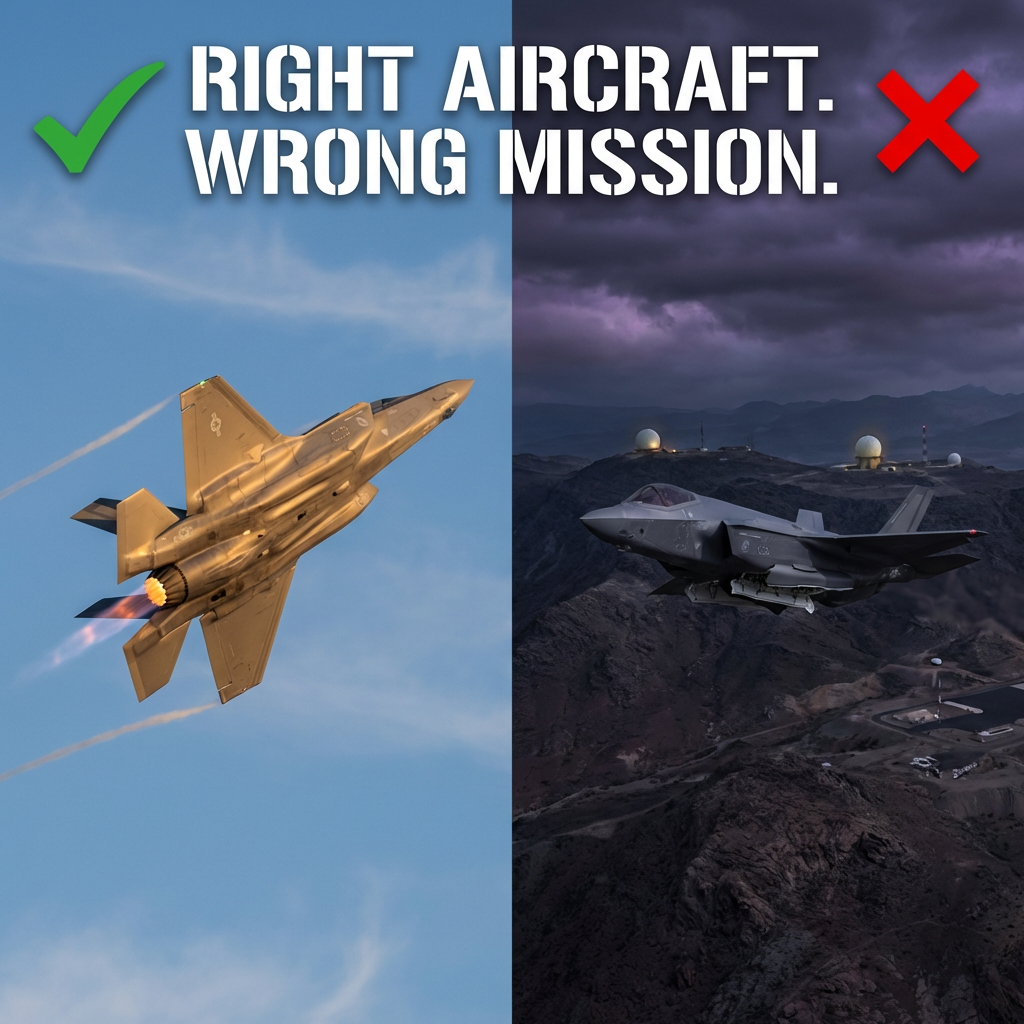
The F-35 is a single-engine, multi-role aircraft designed under a framework of brutal institutional compromise: one airframe forced to satisfy the contradictory requirements of the US Air Force, Navy, and Marine Corps simultaneously. The result is an aircraft that does many things adequately and very few things exceptionally. Its combat radius in stealth configuration is approximately 590 nautical miles — substantially shorter than the twin-engine legacy platforms it is meant to replace. It carries only four weapons internally before sacrificing its stealth advantage. Its mission-capable rate across the fleet hovered below 60% as recently as 2023. The US House Armed Services Committee found formally that it “lacks the range to strike enemy targets” without exposing vulnerable aerial refuelling tankers in contested airspace.[22][23][24][25][26]
The parallel to the F-104 Starfighter is uncomfortable but apt. Germany operated 916 F-104s, of which 292 were destroyed in accidents, and 116 German pilots were killed — not because the aircraft was incompetent in its original single-mission intercept role, but because it was force-fitted into a multi-role NATO requirement it was never designed to handle. Nearly one third of the entire German fleet was destroyed; the human and financial toll was catastrophic. The F-35 is not the F-104 in terms of airframe safety — it will not fall from the sky in peacetime at the same rate. But the institutional pathology is identical: a platform defined by political and industrial compromise rather than by rigorous operational requirements, bought at enormous cost, performing a role for which far more suitable alternatives exist.[27][28]
Germany’s stated rationale for the F-35 purchase is NATO nuclear sharing — the aircraft is certified to carry the B61-12 nuclear gravity bomb, and the Eurofighter is not. That much is technically true. What it conceals is the deeper question: why does Germany need to be in the nuclear delivery business at all, when the money spent on 35 F-35s could instead have been directed toward genuine capability gaps? Because the gaps are severe. Europe has no F-22 equivalent — no dedicated air superiority platform capable of denying adversary aircraft access to NATO airspace at long range. It has no independent strategic strike capability — nothing in the class of the Su-34, the B-2, or the F-117 — that could hold hostile command infrastructure, logistics nodes, and air bases at risk without American assets. Those are the capabilities that would constitute a genuine deterrent. Those are the capabilities the €8–10 billion spent on 35 nuclear-delivery aircraft could have helped build.[23][29][30][31][32][33]
The damage extends beyond the immediate purchase. Every euro committed to F-35 acquisition and sustainment is a euro not available for the European fighter programmes that could eventually close these gaps. The Franco-German-Spanish FCAS sixth-generation programme is effectively stalled, with Chancellor Merz stating that France’s conditions are incompatible with German requirements. The GCAP programme — the British-Italian-Japanese alternative that could offer Germany a genuine air-dominance platform by the early 2030s — has extended an invitation that Germany has yet to formally accept. Germany’s post-2040 air combat architecture is, as of today, entirely unresolved. The F-35 purchase has neither filled the capability gap nor preserved the strategic optionality to fill it through European means. It has simply spent the money.[34][35][36]
The Cost That Doesn’t Appear in the Budget
There is another ledger where these decisions register — one measured not in billions of euros but in the lived experience of German citizens, and in the political temperature of a society that has been asked to accept a great deal without being convincingly told why.
The debt that Germany is now accumulating at historic speed is not abstract. Every billion euros committed to ammunition replenishment, to replacing howitzers sent to a war in Eastern Europe, to sustaining a conflict with no defined endpoint or victory condition, is a billion euros not invested in the crumbling infrastructure of German cities, in a healthcare system under structural strain, in schools that are short of teachers, in an energy transition that requires enormous capital investment. These are not theoretical opportunity costs. They are the real daily experience of German citizens who voted for a CDU government that ran on fiscal prudence — and received, within weeks of its formation, the single largest peacetime borrowing expansion in the Federal Republic’s history.[37]
The political consequences of this are already visible, and they are serious. The populist right is now polling above 25% and rising precisely because it has seized on this fiscal and strategic incoherence with a simple, emotionally resonant message: this is not our war, this debt is not our debt, and the people who created this situation broke their own rules to do it. That message does not need to be geopolitically sophisticated. It only needs to be felt as true by enough people in enough constituencies — and in East Germany particularly, where resentment of the rearmament programme runs deep and the sympathy for negotiation over escalation is genuine and widespread. The constitutional amendment rushed through an outgoing parliament, deliberately timed to avoid the incoming democratic mandate, is precisely the kind of procedural transgression that populist movements survive on. It hands them not just an argument, but a legitimate grievance.[38][1][21]
The fiscal stability that Germany fought for over generations — the Schuldenbremse was not merely a technocratic rule, it was a declaration that Germany had learned the lessons of Weimar-era fiscal collapse — has been quietly dismantled through a constitutional vote timed to avoid democratic scrutiny. Future governments will inherit this framework. Future parliaments will be able to borrow without limit for any activity they choose to classify as defence-related. The window, once opened, does not close easily.[2][5]

The Dependency That Money Cannot Buy Away
The final irony — and perhaps the most consequential — is this: after all the billions borrowed, all the constitutional rules rewritten, all the political capital spent, Germany and Europe emerge from this exercise no more strategically independent from the United States of America than they were before.
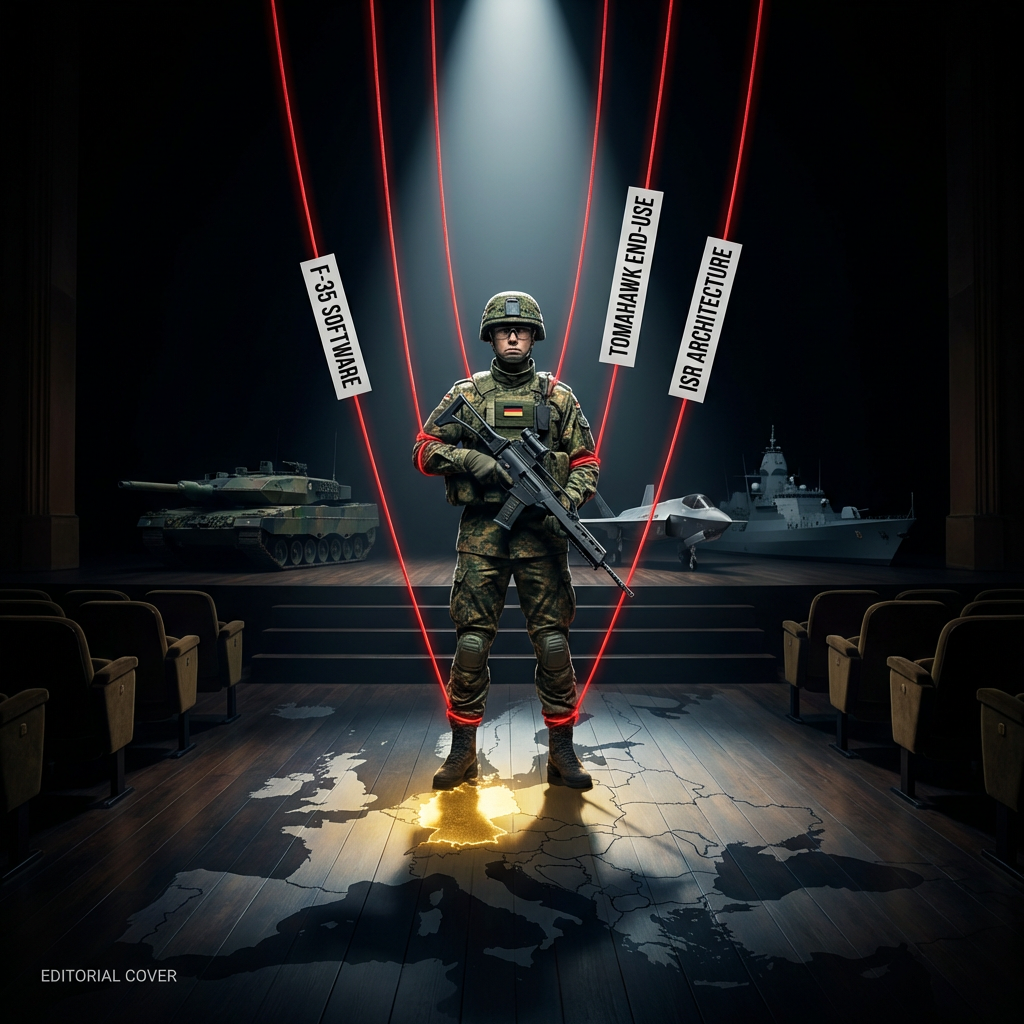
The F-35 is an American aircraft, maintained on American software, with avionics that require American certification and upgrades that require American approval. The Tomahawk cruise missiles under evaluation for German Navy and Army integration are American weapons, subject to American end-use agreements. The B61-12 nuclear bombs that justify the F-35 purchase are American munitions, stored at American discretion, deployable under American authorisation protocols. The intelligence architecture that ties all of this together runs overwhelmingly through American systems.[32][33][39]
The United States, under its current political direction, has made clear — with varying degrees of diplomatic subtlety — that the era of open-ended American security guarantees for Europe is closing. This is not primarily a matter of political will. It is a matter of structural reality: a superpower simultaneously managing Pacific deterrence, Middle Eastern commitments, profound domestic political fracture, and a national debt approaching $40 trillion cannot indefinitely serve as Europe’s default security guarantor. The Zeitenwende was supposed to be Europe’s answer to exactly this reality. Yet the spending decisions made under its banner — American aircraft, American missiles, American nuclear weapons — have deepened the dependency rather than reduced it.[33][40]
A Europe that cannot project air power independently, cannot hold adversary infrastructure at risk without American strike assets, and cannot sustain a naval campaign without American ISR and logistics support is not a Europe that has achieved strategic autonomy. It is a Europe that has spent a trillion euros to remain a very well-equipped American client. Germany deserved better than this from its government. The question now is whether its people will say so — and the answer to that question may prove to be the most consequential political development this continent has seen in a generation.
AI Disclosure: This post was created with the assistance of artificial intelligence. The ideas, analysis, and opinions expressed are my own — AI was used to help compose, structure, and refine my personal notes and thoughts into the final written content. Images, videos and music featured in this post were also generated using AI tools, based on my own creative prompts and direction.
References:
- Defense News, “Germany preps constitution change to finance historic defense uptick,” March 17, 2025. https://www.defensenews.com/global/europe/2025/03/18/germany-preps-constitution-change-to-finance-historic-defense-uptick/
- Noerr Law, “German Bundestag approves exemption from the debt brake for defence spending,” March 20, 2025. https://www.noerr.com/en/insights/bundestag-approves-exemption-from-the-debt-brake-for-defence-spending-and-special-funds-for-infrastructure
- DW, “Germany: Upper house signs off on landmark debt reform plan,” March 21, 2025. https://www.dw.com/en/germany-upper-house-signs-off-on-landmark-debt-reform-plan/a-71992709
- Deutsche Bank flow, “Germany update: breaking from the brake.” https://flow.db.com/Topics/macro-and-markets/germany-update-breaking-from-the-brake
- Bruegel Institute, “Can Germany afford to take most defence spending out of its debt brake?” March 10, 2025. https://www.bruegel.org/analysis/can-germany-afford-to-take-most-defence-spending-out-of-its-debt-brake
- DW, “€1 trillion impact: What easing debt brake means for Germany,” March 17, 2025. https://www.dw.com/en/1-trillion-impact-what-easing-debt-brake-means-for-germany/a-71949959
- DW, “Germany eyes strongest EU army by 2031,” May 18, 2025. https://www.dw.com/en/germany-armed-forces-bundeswehr-eu-defense-spending-nato-trump/a-72570394
- Nordic Defence Review, “Germany’s Historic Military Expansion: €83 Billion Defence Budget for 2026,” January 31, 2026. https://nordicdefencereview.com/germanys-historic-military-expansion-e83-billion-defence-budget-for-2026/
- Atlas Institute, “Germany’s Path to Kriegstüchtigkeit: The 2026 Defence Budget,” December 18, 2025. https://atlasinstitute.org/germanys-path-to-kriegstuchtigkeit-the-2026-defence-budget/
- Federal Government of Germany, “German aid for Ukraine,” February 12, 2026. https://www.bundesregierung.de/breg-en/news/germany-aid-for-ukraine-2192480
- UNN UA, “Germany increased military aid to Ukraine to 11.5 billion euros in 2026,” February 23, 2026. https://unn.ua/en/news/germany-increased-military-aid-to-ukraine-to-115-billion-euros-in-2026-merz
- Kiel Institute for the World Economy, “Germany is rearming too slowly to stand up to Russia,” September 9, 2024. https://www.kielinstitut.de/publications/news/germany-is-rearming-too-slowly-to-stand-up-to-russia/
- Kiel Institute for the World Economy, Fit for war in decades: Europe’s and Germany’s slow rearmament vis-à-vis surging Russian defence production, Kiel Report No. 1, 2024. https://www.econstor.eu/bitstream/10419/306225/1/Kiel-Report-no1.pdf
- Defense Magazine, “Germany to Invest €377 Billion to Modernize Its Armed Forces,” November 8, 2025. https://www.defensemagazine.com/article/germany-to-invest-eur377-billion-to-modernize-its-armed-forces
- Army Recognition, “Germany unveils new PzH 2000 A4 howitzer as KNDS restarts advanced artillery production,” November 19, 2025. https://armyrecognition.com/news/army-news/2025/germany-unveils-new-pzh-2000-a4-howitzer-as-knds-restarts-advanced-artillery-pro
- Reuters, “Germany set to boost Ukraine aid by 3 billion euros in 2026,” November 4, 2025. https://www.reuters.com/world/germany-plans-boost-ukraine-aid-by-some-3-bln-euros-2026-says-source-2025-11-04/
- German Federal Court of Auditors (Bundesrechnungshof), “Circumvention of debt brake puts sound public finances at risk,” April 4, 2025. https://www.bundesrechnungshof.de/SharedDocs/Kurzmeldungen/EN/2025/aenderung-grundgesetz-en/kurzmeldung-1.html
- Bloomberg Opinion, “Germany’s $1.2 Trillion Debt Bazooka Is Veering Off Target,” January 13, 2026. https://www.bloomberg.com/opinion/articles/2026-01-13/-1-2-trillion-german-debt-bazooka-is-veering-off-target
- Reuters, “Germany approves 2025 budget, ushering in new era of spending,” September 18, 2025. https://www.reuters.com/world/europe/germany-approves-2025-budget-ushering-new-era-spending-2025-09-18/
- Ifo Institute, “How Can Germany Strengthen Its Defense Capabilities Without Compromising Fiscal Sustainability?” January 27, 2025. https://www.ifo.de/en/opinion/2025-01-28/how-can-germany-strengthen-its-defense-capabilities
- Responsible Statecraft, “German leaders miscalculated popular will for war spending,” March 31, 2025. https://responsiblestatecraft.org/germany-defense-increase/
- Responsible Statecraft, “‘Flop’: Proponents of the F-35 can’t tell you that it works,” December 23, 2024. https://responsiblestatecraft.org/f-35/
- MiGFlug Aviation, “Lockheed Martin F-35 — As Bad as Critics Say?” https://migflug.com/jetflights/lockheed-martin-f-35-is-it-as-bad-as-some-say/
- Arms Control Association, “F-35 Joint Strike Fighter Fact Sheet,” December 2024. https://armscontrolcenter.org/wp-content/uploads/2022/11/F-35-Fact-Sheet-Dec-2024-Edit.pdf
- The Aviation Geek Club, “HASC report finds that F-35C lacks the range to strike enemy targets,” September 9, 2025. https://theaviationgeekclub.com/hasc-report-finds-that-f-35c-lacks-the-range-to-strike-enemy-targets/
- Bulgarian Military, “Boeing F-15 types beat F-35, F-22 in battle-ready showdown,” February 22, 2025. https://bulgarianmilitary.com/2025/02/23/boeing-f-15-types-beat-f-35-f-22-in-battle-ready-showdown/
- Wikipedia, “Lockheed F-104 Starfighter — German Service Record.” https://en.wikipedia.org/wiki/Lockheed_F-104_Starfighter
- Journal of Aviation Technology and Engineering, “An HFACS Analysis of German F-104 Starfighter Accidents,” Purdue University Press. https://docs.lib.purdue.edu/cgi/viewcontent.cgi?article=1218&context=jate
- Air & Space Forces Magazine, “Germany to Buy F-35 and Typhoon Fighters as It Boosts Defense Spending,” March 14, 2022. https://www.airandspaceforces.com/germany-to-buy-f-35-and-typhoon-fighters-as-it-boosts-defense-spending/
- RUSI Defence Systems, “German Decision to Split Tornado Replacement is a Poor One,” March 25, 2020. https://www.rusi.org/explore-our-research/publications/rusi-defence-systems/german-decision-split-tornado-replacement-poor-one
- The National Interest, “Raptors on Patrol: How F-22s Are Bolstering Europe’s Eastern Flank,” November 24, 2024. https://nationalinterest.org/blog/buzz/raptors-patrol-how-f-22s-are-bolstering-europes-eastern-flank-204047/
- NDU Press / Joint Force Quarterly, “The F-35 and the Future of Power Projection,” Issue 66. https://ndupress.ndu.edu/Portals/68/Documents/jfq/jfq-66/jfq-66_85-93_Laird-Timperlake.pdf
- Breaking Defense, “‘New status quo’: Germany reaches for European conventional military dominance,” March 5, 2026. https://breakingdefense.com/2026/03/new-status-quo-germany-reaches-for-european-conventional-military-dominance/
- Defence UA, “Germany Stalls FCAS Fighter Decision, Is It Building Plan B With Sweden’s Saab?” January 5, 2026. https://en.defence-ua.com/news/germany_stalls_fcas_fighter_decision_is_it_building_plan_b_with_swedens_saab-17069.html
- Defense News, “Airbus open to two-fighter option for FCAS to keep program alive,” February 19, 2026. https://www.defensenews.com/global/europe/2026/02/19/airbus-open-to-two-fighter-option-for-fcas-to-keep-program-alive/
- Le Monde, “Italy, the UK and Japan hope to bring Germany on board their next-generation fighter,” February 20, 2026. https://www.lemonde.fr/en/economy/article/2026/02/20/italy-the-united-kingdom-and-japan-hope-to-bring-germany-on-board-their-next-generation-fighter
- Clean Energy Wire, “Germany’s new budget plans see defence spending boost, energy cost cuts,” June 23, 2025. https://www.cleanenergywire.org/news/germanys-new-budget-plans-see-defence-spending-boost-energy-cost-cuts
- Kyiv Post, “‘Not Our Enemy’: Rush to Rearm Sparks Backlash in East Germany,” December 18, 2025. https://www.kyivpost.com/post/66566
- Air & Space Forces Magazine, “Air Force Confirms SEAD Role of F-35s in Operation Midnight Hammer,” December 2, 2025. https://www.airandspaceforces.com/air-force-sead-role-f-35s-midnight-hammer/
- Bruin Political Review, “The Real Zeitenwende: German Rearmament Amid Transatlantic Uncertainty,” June 12, 2025. https://bruinpoliticalreview.org/articles?post-slug=the-real-zeitenwende-german-rearmament-amid-transatlantic-uncertainty

[…] defendiendo las instituciones del estado contra una milicia rebelde que no responde a ninguna constitución y ninguna autoridad civil. El campamento del general al-Burhan argumenta —no sin razón— que las RSF son […]