





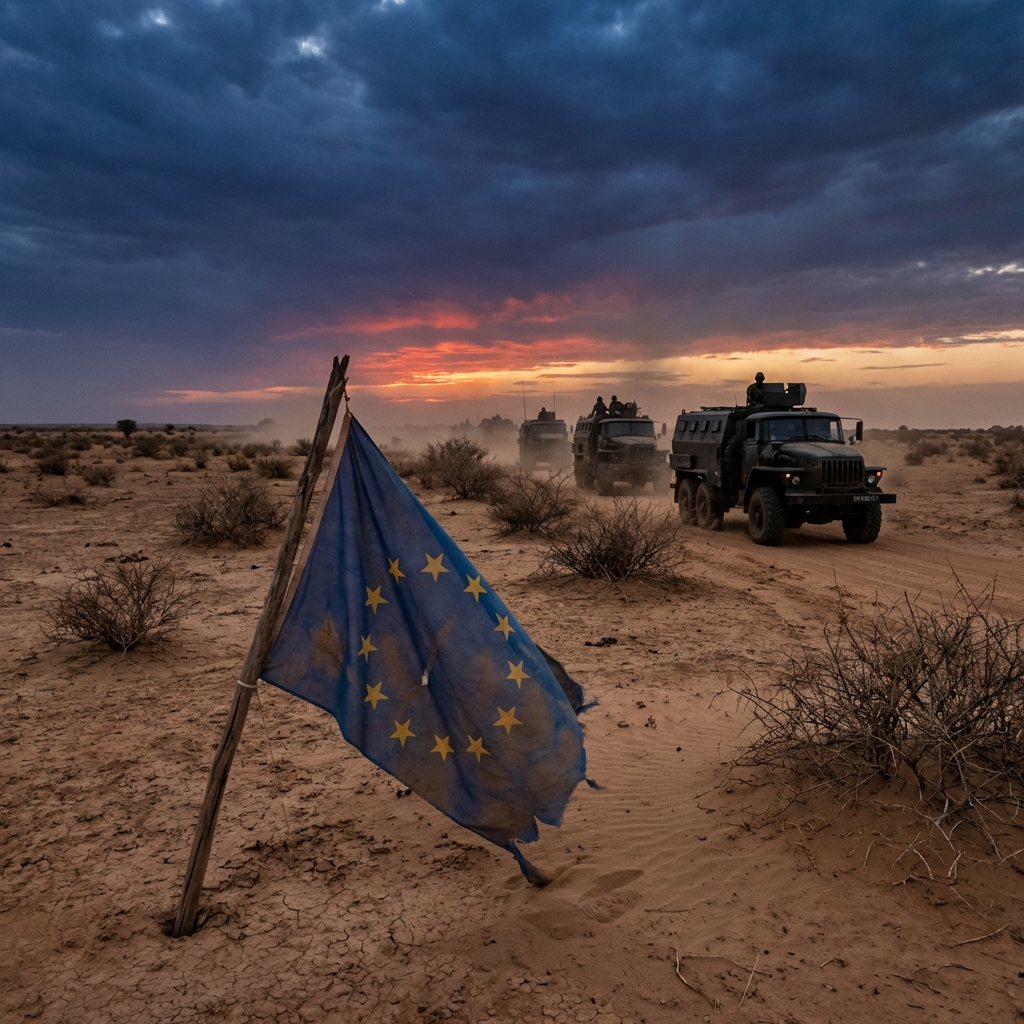
You were told Europe was a global actor, a normative power whose partnerships were built on values. So why, as you read this, does the Sahel—a region whose stability directly gates your own security—feel like a testament to Europe’s strategic absence? The coups in Mali, Burkina Faso, and Niger between 2020 and 2023 did not just topple governments; they severed the thread of European influence, creating a vacuum now filled by Russian mercenaries, Chinese deals, and a transactional American pragmatism. The result, as a stark analysis from the German Institute for International and Security Affairs confirms, is not stability but a deepening quagmire of jihadist violence and regional tension [1]. We are witnessing a failure not of intention, but of architecture and nerve.
The Withdrawal and the Vacuum
Let us be precise about what happened. Europe did not choose a strategic pivot; it was expelled. France, the traditional spearhead, saw its military and diplomatic dominance crumble under anti-colonial sentiment and operational overstretch [2]. The rest of the EU, long accustomed to following Paris’s lead in its former sphere, found itself without a playbook or the political will to write a new one. The void was inevitable. Russia’s Wagner Group (now rebranded but unchanged in method) moved in, offering security guarantees to juntas in exchange for resource concessions and geopolitical leverage [3]. This was not a masterstroke of Russian diplomacy; it was the predictable consequence of European retreat. The EU’s subsequent paralysis—exemplified by a stalled €195 million development fund for the Sahel, held hostage by French hopes of a comeback—reveals a union incapable of reconciling its own internal divisions with external realities [4]. The real negotiation is not in Brussels, but in the silent standoff between Paris’s pride and Berlin’s pragmatism.
The Case for Engagement: A Flawed Calculus
The strongest case for the EU’s new, tentative approach is this: security is indivisible, and economic root causes must be addressed. EU High Representative Kaja Kallas articulates this clearly, framing partnerships around development, jobs, and local value chains as the antidote to instability and the migration pressures it fuels [5]. The recent security pact with Ghana and a €820 million investment package for Nigeria under the Global Gateway Initiative are presented as evidence of a holistic strategy—one that contrasts its “balanced partnership” with the extractive transactionalism of other powers [6]. The logic is sound, even noble: create prosperity at home by fostering it next door.
And yet, this argument cannot explain why the strategy is failing where it matters most. The EU’s “different way,” as Kallas calls it, is being deployed not in the coup-ridden heart of the Sahel, but in its more stable periphery, like Ghana and Nigeria. It is a strategy of the edges, avoiding the core problem.
As Ulf Laessing of the Konrad Adenauer Foundation notes, the EU lacks a proper strategy for the Sahel itself, offering only vague position papers while the US engages pragmatically with the very juntas Europe shuns [4]. The noble case for holistic development rings hollow in Bamako or Ouagadougou, where the immediate need is for a credible security partner, not a lecture on economic governance from a bloc that cannot speak with one voice.
The Case Against: A Union at War with Itself
We must confront a harder truth. The EU’s Sahel policy is not just ineffective; it is a direct symptom of its foundational dysfunction. A foreign policy that requires 27 unanimous voices is not a policy—it is a prayer. In the Sahel, this has manifested as a geopolitical surrender disguised as principled non-engagement. We refuse to talk to the juntas, not because we hold a superior moral position, but because we cannot agree among ourselves on what to say [7]. The result is a void that Russia, with its singular, ruthless focus, fills with ease. You are told this is about defending democracy. In reality, it is about the EU’s inability to conduct realpolitik when its values and its interests diverge.
This paralysis has a direct cost, measured in human desperation. The Sahel is not an abstract security concept; it is a primary migration corridor to Europe. As Laessing outlines, routes run from Mali to the Canary Islands and from Niger through Libya to Italy [4]. Every day of strategic drift, every French veto on development funds, every summit that ends with another anodyne statement, pushes more people toward these lethal pathways. The EU’s internal discord—its 70% national interest and 30% external manipulation—is not a Brussels abstraction. It is a policy that, in its inaction, actively shapes the migration crises that then dominate our domestic politics and corrode our social fabric [8]. We are engineering the very problems we later claim to be powerless to solve.
Real People, Real Consequences
Translate this into the language of your daily life. The jihadist violence metastasizing in the Sahel does not respect borders. It fuels the networks of human trafficking and instability that periodically surge onto European news headlines in the form of a capsized boat or a terrorist attack planned from a lawless hinterland. The critical raw materials—uranium, cobalt, lithium—that power Europe’s green transition and digital future are increasingly negotiated by powers whose interests are not ours [9]. When the EU talks of “balanced partnerships” for resources, you should hear the quiet alarm: we are losing access, and with it, a measure of our future sovereignty. The prosperity Kallas speaks of is not just an African interest; it is a European necessity. A poor, unstable, and resentful neighborhood is not a buffer; it is a breeding ground for the crises that will, inevitably, wash up on our shores.
What Comes Next?
The path forward is not a mystery. It requires the EU to do what it fears most: choose. Will it continue to outsource its Sahel policy to a France that is no longer capable of leading it, thereby ceding the region to Moscow and chaos? Or will it muster the federal courage to forge a single, pragmatic, and yes, sometimes morally uncomfortable, engagement strategy that acknowledges the juntas as the de facto reality [10]? Federation or obsolescence. The choice is that stark.
The SWP study calls for resumed dialogue to reduce mutual mistrust. That is the bare minimum. The real question is whether Europe can overcome its own internal mistrust—between member states, between institutions, between values and interests—to act before the Sahel’s collapse becomes irreversible. Who benefits from the current dysfunction? Certainly not the people of the Sahel. Certainly not the European citizen seeking security. The beneficiaries are the external powers who prefer a divided Europe, and the internal factions who prize national sovereignty over collective survival.
So we are left with questions that hang in the air like dust over the Sahel. Will Europe choose the federation it needs but fears? Or will it drift, summit by summit, statement by statement, into a comfortable irrelevance nobody officially declared? And when the next crisis migrates from the Sahel to your city, who will you blame—the distant juntas, or the union next door that could not decide how to care?
AI Disclosure: This post was created with the assistance of artificial intelligence. The ideas, analysis, and opinions expressed are my own — AI was used to help compose, structure, and refine my personal notes and thoughts into the final written content. Images, videos and music featured in this post were also generated using AI tools, based on my own creative prompts and direction.
— REFERENCES —
[1] German Institute for International and Security Affairs (SWP), “European Sahel Policy: Back to Square One”, SWP Study, 2026
[2] European Council on Foreign Relations (ECFR), “The End of the Affair: Europe and the Sahel after France”, ECFR Policy Brief, 2023
[3] Paul Stronski “Russia’s Growing Footprint in Africa’s Sahel Region” https://carnegieendowment.org/research/2023/02/russias-growing-footprint-in-africas-sahel-region
[4] Laessing, U., “Interview on EU Sahel Strategy”, Konrad Adenauer Foundation Analysis, 2024
[5] Kallas, K., “Remarks on EU-Africa Partnership”, European Commission Press Conference, 2024
[6] European Commission, “Global Gateway: Nigeria Investment Package”, Fact Sheet, 2024
[7] Tschörner, L., “Diplomatic Stalemate: The EU’s Dialogue Deficit in the Sahel”, SWP Comment, 2026 (https://www.swp-berlin.org/en/publication/megatrends-afrika-why-should-europe-re-engage-with-the-sahels-military-led-states#:~:text=On%20today’s%20episode%2C%20we’re,the%20line%20today%20from%20Brussels.)
[8] International Crisis Group, “Sahel: Europe’s Migration Dilemma”, Crisis Group Report, 2023 ( https://www.crisisgroup.org/euw/global/watch-list-2023#:~:text=The%20uptick%20in%20arrivals%20in,help%20prevent%20and%20resolve%20conflict. )
[9] Bruegel Institute, “Critical Raw Materials and EU Geoeconomic Strategy”, Bruegel Policy Contribution, 2024
[10] The Economist, “Meet the victors in Africa’s coup belt”, The Economist, 2024 https://www.economist.com/middle-east-and-africa/2024/07/02/meet-the-victors-in-africas-coup-belt
