





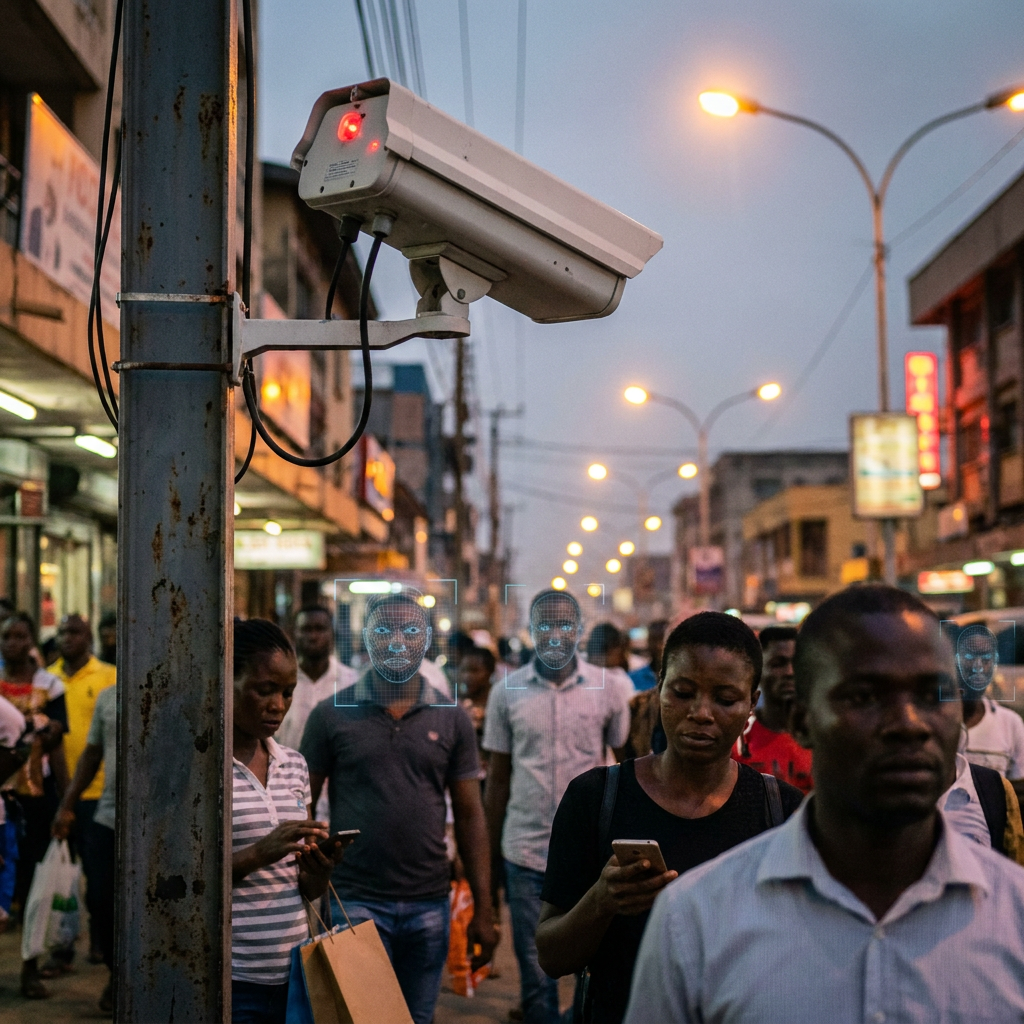
She stopped going to protests in Kampala last year. Not because she lost her conviction — she still believed everything she had always believed — but because she knew the cameras would remember her face long after the crowd dispersed. Aisha, not her real name, is a 29-year-old community organiser who spent years mobilising young Ugandans around land rights and government accountability. Then the surveillance cameras appeared on her streets, linked to a central command centre running facial recognition software. Her friends started getting visits from security officials after demonstrations. She started staying home [1]. We might think this is an isolated story from a distant place. It is not. It is a preview.
What Is Actually Happening
At least 11 African governments have invested over US$2 billion in Chinese-built AI-powered surveillance infrastructure — cameras, facial recognition, biometric data collection, and automatic number-plate recognition systems marketed as “smart city” solutions [1]. The countries include Algeria, Egypt, Kenya, Mauritius, Mozambique, Nigeria, Rwanda, Senegal, Uganda, Zambia, and Zimbabwe. Nigeria alone has spent over US$470 million; Mauritius, US$456 million; Kenya, US$219 million [2]. These are the figures we know. The real totals are almost certainly higher, because surveillance procurement is routinely classified and the report covers only 11 of Africa’s 55 nations [1].
What is being built here is not targeted security infrastructure. It is continuous, population-level monitoring of public spaces — rolled out over the past decade almost entirely without public debate, legal frameworks, or independent oversight [3]. The official narrative speaks of crime prevention and counter-terrorism. The structural reality speaks of something else entirely. As Wairagala Wakabi of CIPESA puts it, “the scale of surveillance far exceeds any actual or perceived security threat” [2]. The minister called it a smart city. The procurement contract told a different story.
The Case Being Made
The strongest argument for these systems is this: African cities are growing rapidly, crime rates in many urban centres are real, and governments need modern tools to manage complexity and protect citizens. Smart infrastructure — cameras linked to data analytics — can theoretically help allocate police resources, identify suspects, and reduce response times [4]. Some proponents point to efficiency gains in traffic management and urban planning as genuine benefits of integrated surveillance platforms [5].
And yet. There is no compelling evidence that these systems have reduced crime or improved public safety in any of the 11 countries studied [1]. In Senegal and Zambia, where terrorism threats are relatively low, governments have still invested heavily — which makes the security rationale difficult to sustain [2]. In Mozambique, smart CCTV systems have reportedly been installed disproportionately in areas of strong political opposition, suggesting the targeting is political, not neutral [1]. In Uganda and Zimbabwe, the technology is actively being used to identify and track activists, opposition leaders, and protesters — sometimes long after protests have ended [2]. The case for safety collapses when the evidence points to suppression.
Who Benefits and Who Pays
Follow the money. Chinese companies are the primary suppliers and financiers of these systems, offering end-to-end “smart city” packages that include hardware, software, training, and ongoing technical support [5]. Many projects are backed by loans from Chinese state-linked banks, making them financially attractive in the short term but creating long-term dependencies on external vendors for maintenance, upgrades, and system management [6]. This is not aid. It is a business model — one that locks governments into opaque procurement relationships while keeping civil society, parliaments, and the public entirely in the dark about how data is stored, who has access to it, and what it is used for [3].
The beneficiaries are clear: governments seeking to consolidate control, companies securing long-term revenue streams, and authoritarian tendencies gaining technological capability they could not have built alone [7]. The costs are borne by people like Aisha — citizens whose right to privacy, assembly, and free expression is being eroded without their consent or knowledge. The UN Special Rapporteur on the Right to Privacy has warned that mass facial recognition in public spaces is incompatible with international human rights standards when deployed without consent, legal limits, or independent oversight [8]. None of the 11 countries studied have a legal framework capable of balancing security needs with fundamental rights protections [1]. The problem was real. The solution was designed for someone else.
Real People, Real Consequences
You may not live in Kampala or Harare. But the architecture being tested there is not staying there. Facial recognition technology, biometric databases, and AI-driven behavioural analysis are being normalised globally — and the precedent being set in Africa will shape how these tools are deployed everywhere [4]. When activists self-censor because they know they are being watched, democracy does not die loudly. It dies quietly, one decision not to attend, one post not to write, one question not to ask at a time [7].
Civil society organisations across the continent report heightened anxiety among their members and partners [2]. Journalists are less willing to cover protests. Community leaders step back from public roles. This is the chilling effect — not a theoretical concept, but a lived reality measured in silence [9]. The structure was built before any of us arrived. That does not mean we cannot demand it be rebuilt with transparency and accountability at its foundation.
What Comes Next?
Governments must adopt clear regulations on surveillance, including restrictions on facial recognition and other AI tools, require independent human rights impact assessments before deploying new systems, and make procurement processes fully transparent [10]. Civil society must continue documenting abuses, raising public awareness, and supporting affected communities through digital security training and legal assistance [7]. Technology-exporting states — including China, Israel, South Korea, and the United States — must enforce stricter controls on the export and financing of surveillance tools and support rights-based approaches to digital governance [6].
None of this is naive idealism. It is the minimum standard that international law already demands. The question is whether we have the political will to enforce it — or whether we will continue to let billions of dollars flow into systems whose primary function is not safety, but control.
Are we content to merely treat the wounds of democracy while safeguarding the very systems that inflict them, or will we finally demand a dialogue that forces the powerful into the light and brings the invisible back into view? Knowing that this technology knows no borders, will we continue to treat these reports as isolated incidents rather than a global preview of our shared future? When we ask who the target of the next camera will be, are we brave enough to turn around and see that the red light is already blinking for us?
— REFERENCES —
[1] Wakabi, W. and Roberts, T. (eds). (2026). “Smart City Surveillance in Africa: Mapping Chinese AI Surveillance Across 11 Countries.” Institute of Development Studies (IDS). DOI: 10.19088/IDS.2025.068. https://www.ids.ac.uk/publications/smart-city-surveillance-in-africa-mapping-chinese-ai-surveillance-across-11-countries/
[2] Wakabi, W. (2026). “AI: ‘African Governments Are Using “Smart City” Systems to Monitor Dissent and Consolidate State Control’.” Inter Press Service (IPS), April 17, 2026. Interview conducted by CIVICUS. https://www.ipsnews.net/2026/04/ai-african-governments-are-using-smart-city-systems-to-monitor-dissent-and-consolidate-state-control/
[3] Collaboration on International ICT Policy for East and Southern Africa (CIPESA). (2024). “State of Internet Freedom in Africa 2024.” CIPESA. https://cipesa.org/
[4] West Point Modern War Institute. (2025). “Networked Sensors, Pervasive Surveillance, and AI-Powered Analytics: Urban Warfare in the Age of Smart Cities.” Modern War Institute at West Point, July 31, 2025. https://mwi.westpoint.edu/networked-sensors-pervasive-surveillance-and-ai-powered-analytics-urban-warfare-in-the-age-of-smart-cities/
[5] Fang, T. (2024). “China’s Digital Expansionism in Africa and the US Counter-Strategies.” Strategic Analysis, 48(1). SAGE Journals. https://journals.sagepub.com/doi/full/10.1177/09750878231217957
[6] Amnesty International. (2023). “Automated Apartheid: How facial recognition fragments, segregates and controls Palestinians in the OPT.” Amnesty International, May 2, 2023. https://www.amnesty.org/en/documents/mde15/6701/2023/en/
[7] CIVICUS. (2026). “State of Civil Society Report 2026: Technology, Innovation and Accountability.” CIVICUS, March 2026. https://publications.civicus.org/publications/2026-state-of-civil-society-report/
[8] United Nations Human Rights Office of the High Commissioner (OHCHR). (2021). “The Right to Privacy in the Digital Age.” Report of the United Nations High Commissioner for Human Rights, A/HRC/48/57. https://www.ohchr.org/en/hr-bodies/hrc/regular-sessions/session48/index
[9] Freedom House. (2025). “Freedom on the Net 2025: An Uncertain Future for the Global Internet.” Freedom House, November 2025. https://freedomhouse.org/report/freedom-net/uncertain-future-global-internet
[10] CIVICUS. (2025). “AI Governance: The Struggle for Human Rights.” CIVICUS Lens, September 11, 2025. https://lens.civicus.org/ai-governance-the-struggle-for-human-rights/
AI Disclosure: This post was created with the assistance of artificial intelligence. The ideas, analysis, and opinions expressed are my own — AI was used to help compose, structure, and refine my personal notes and thoughts into the final written content. Images, videos and music featured in this post were also generated using AI tools, based on my own creative prompts and direction.
