







Every enterprise survey from 2026 says roughly the same thing: most organisations are still trying agents, few have scaled them, and almost nobody has federated them. Seventeen percent deployed. Fifteen percent orchestrated across functions. Five percent process-ready [1][2]. The analyst class treats production-grade federation as a 2026 aspiration — something enterprise architects draw on whiteboards and vendor roadmaps promise for next year [3]. Meanwhile, one small team has been running a compartmentalised agent federation in production for months — built on a single eight-core virtual private server, without a single vendor’s orchestration platform, without copying anyone’s architecture, and without a seven-figure budget. No AI data center. No humongous infrastructure. A small business’s box, doing enterprise-grade work. This is that team’s account — pattern-level, deliberately, because the plumbing is the part we paid for in mistakes and do not intend to hand over.
Why an amateur built this
The idea did not start in a lab. It started at a desk.
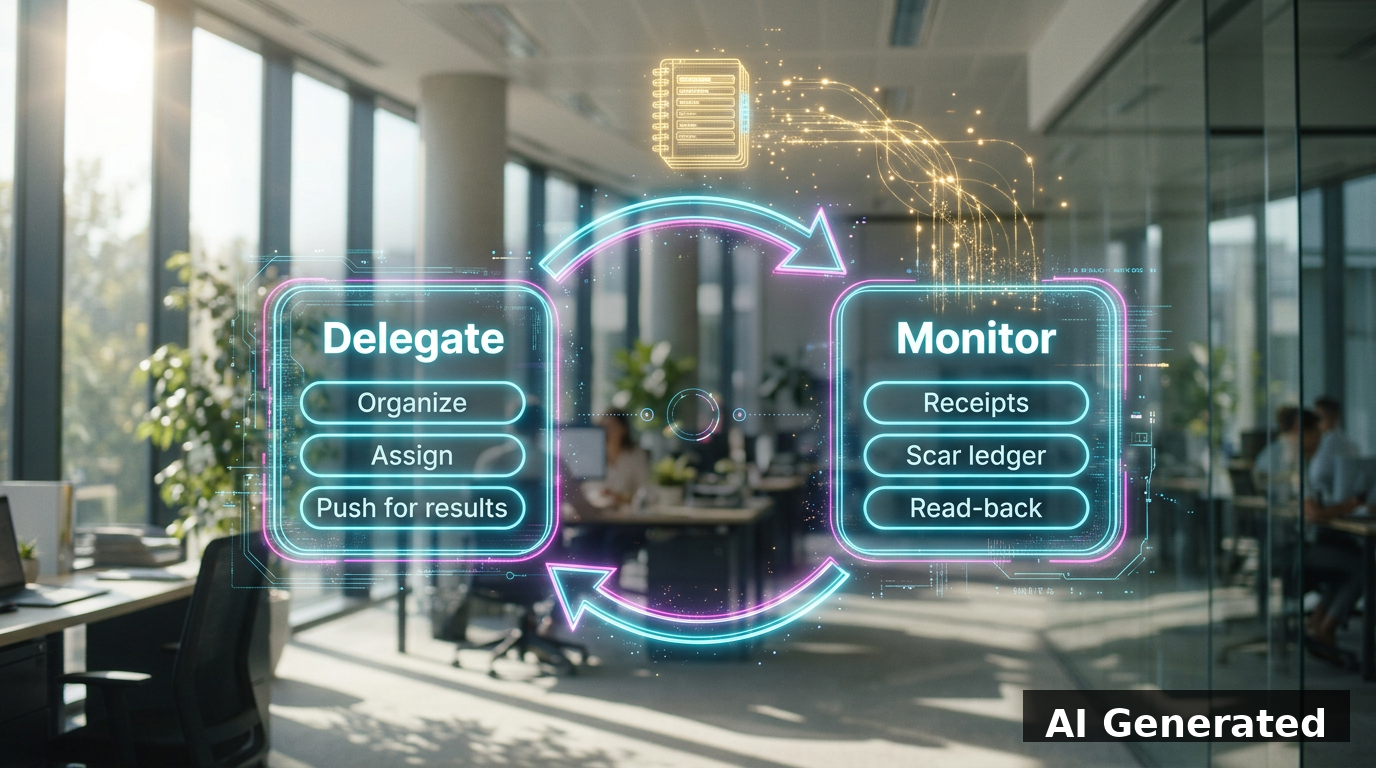
I spent my working life as a business owner — retail, services, and finally e-commerce — and the dream was always the same one: sit in front of your screen, delegate the work, watch the results come in. Not manage personalities. Manage outcomes. And the wall I hit every single time, in every organisation including the large corporate ones, was people. Individuals carry their own characteristics, attitudes, interpretations. They do not follow instructions the way the org chart says they will. That is not a complaint — it is the actual job of management: organize, delegate, assign, monitor, push for results. I learned that structure the hard way across two careers.
So when I fell into the Zoho ecosystem — drawn by its promise of integrated business software — the integration hurdle was never the tools. It was the personas. Agents, it turned out, have exactly the problem my teams had: they develop their own tendencies, they drift from instructions, they interpret the mandate the way they feel like interpreting it that morning. Anyone who has run a team recognises this instantly.
That recognition is the whole origin story. I did not arrive at agent federation by studying agent federation. I arrived with a management structure I had already pressure-tested on humans, looking for software that would finally enforce it. Most people find that structure hard to get by — not because it is complicated, but because it requires separating two things organizations usually blur: the authority to delegate and the function of monitoring. You cannot have one without the other becoming either a bottleneck or a farce.
The office we built
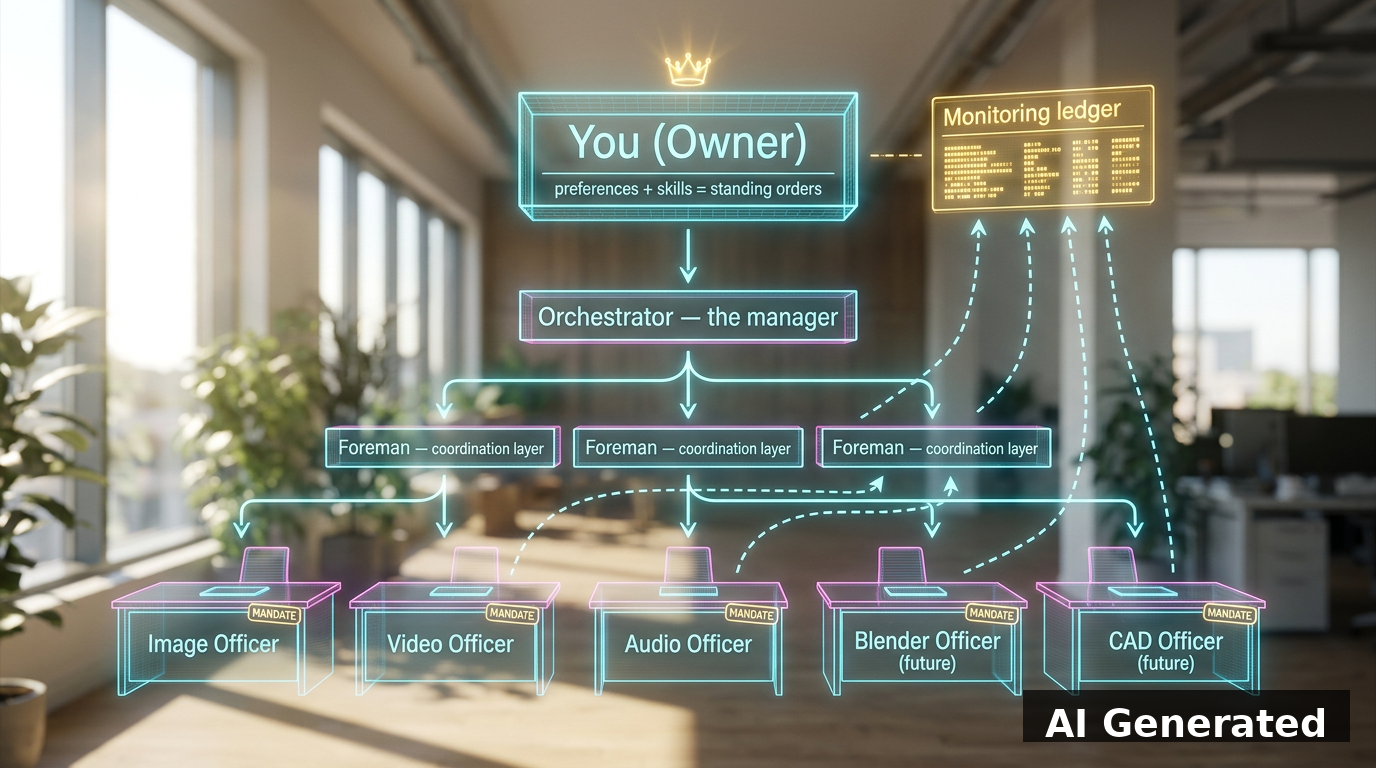
Here is what Krinas AI Agents actually is, described the way we live it: an office with a factory at its heart.
The factory is called the Media Factory, and it exists because of a very specific frustration. As a content creator I was spending my time in the grinding loop: writing prompts for image models, editing the results, fighting to keep characters and backgrounds consistent across shots, cutting a creative video together, matching audio to picture, building labels and text layers, adding effects — over and over, making a thousand micro-decisions that software could have made if someone had simply organized the work properly. Every tool in that chain exists. The problem was that I was the chain. I never left the loop.
So we wrote down what I actually wanted — my preferences, my standards, my repeatable decisions — as skills and standing orders, and then we built the office around them:
- The Orchestrator is the manager. He takes the intent from the top and decomposes it into jobs. He does not touch the work.
- The Foremen are the layer between — coordinators who route each job to the right room, check it comes back, and escalate when it doesn’t.
- The Officer desks are the specialists: an Image Officer, a Video Officer, an Audio Officer. Tomorrow there will be a Blender Officer and a CAD Officer doing full three-dimensional work. Each desk has its own mandate — what it is allowed to do, what formats it answers to, what it must return — and each desk reads the standing orders before it acts.
This is the delegation structure I understood from decades of running teams, made mechanically enforceable. Agents cannot “feel like” interpreting the mandate differently this morning, because the mandate is the room. The management discipline existed before the software did; what the software finally provided is an environment where that discipline doesn’t depend on anyone’s personality.
The Media Factory, the prima donna
Of everything the federation carries, the Media Factory is the piece that proves the pattern — the demonstration that makes the rest believable.
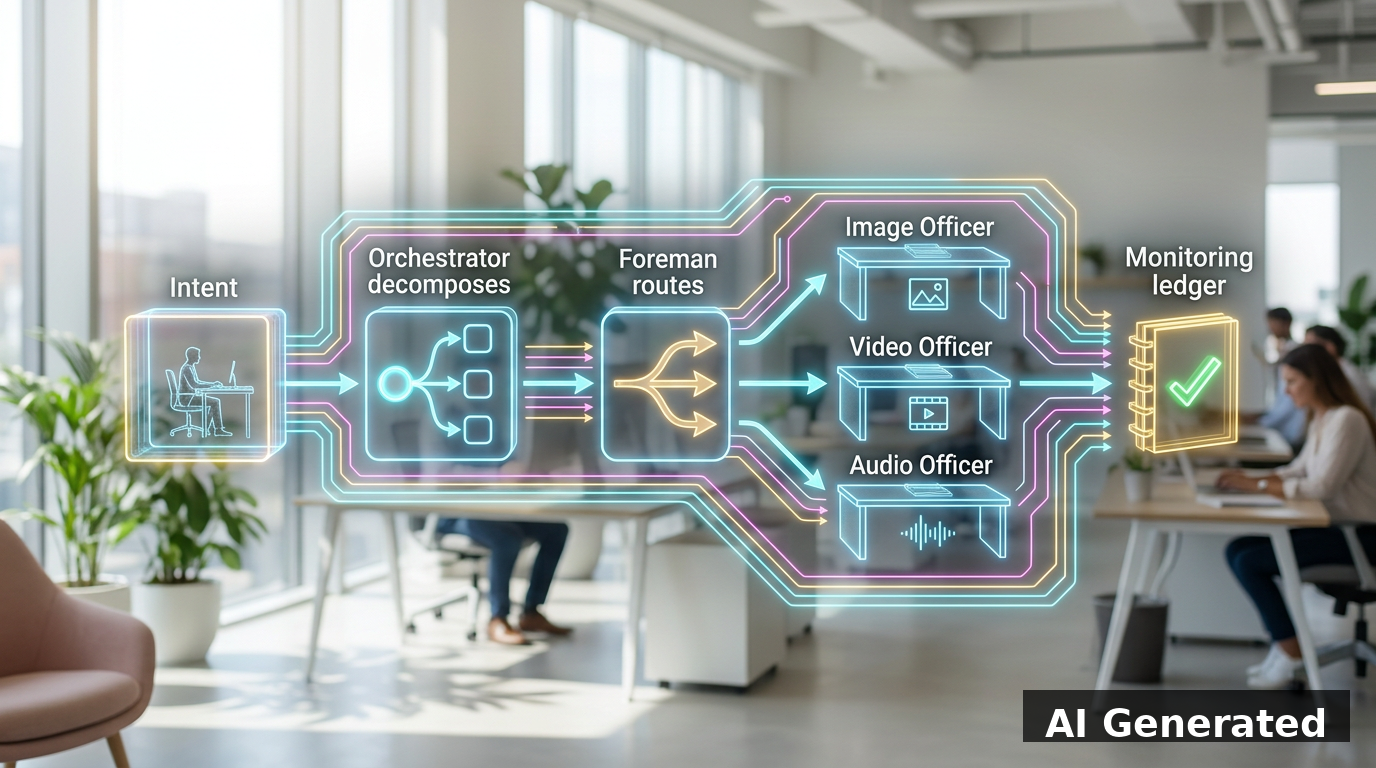
A job moves through the floor like this: the intent arrives at the top; the orchestrator breaks it into coordinated sub-jobs; the foreman routes them to the desks whose mandates match; each officer executes inside its own room — the Image Officer producing consistent characters and frames, the Video Officer assembling the sequence, the Audio Officer supplying sound that fits the cut — and every step signs for what it produced. The output arrives assembled, checked, and traceable. What used to require me sitting inside the loop making constant decisions now requires me stating the decision once, at the top.
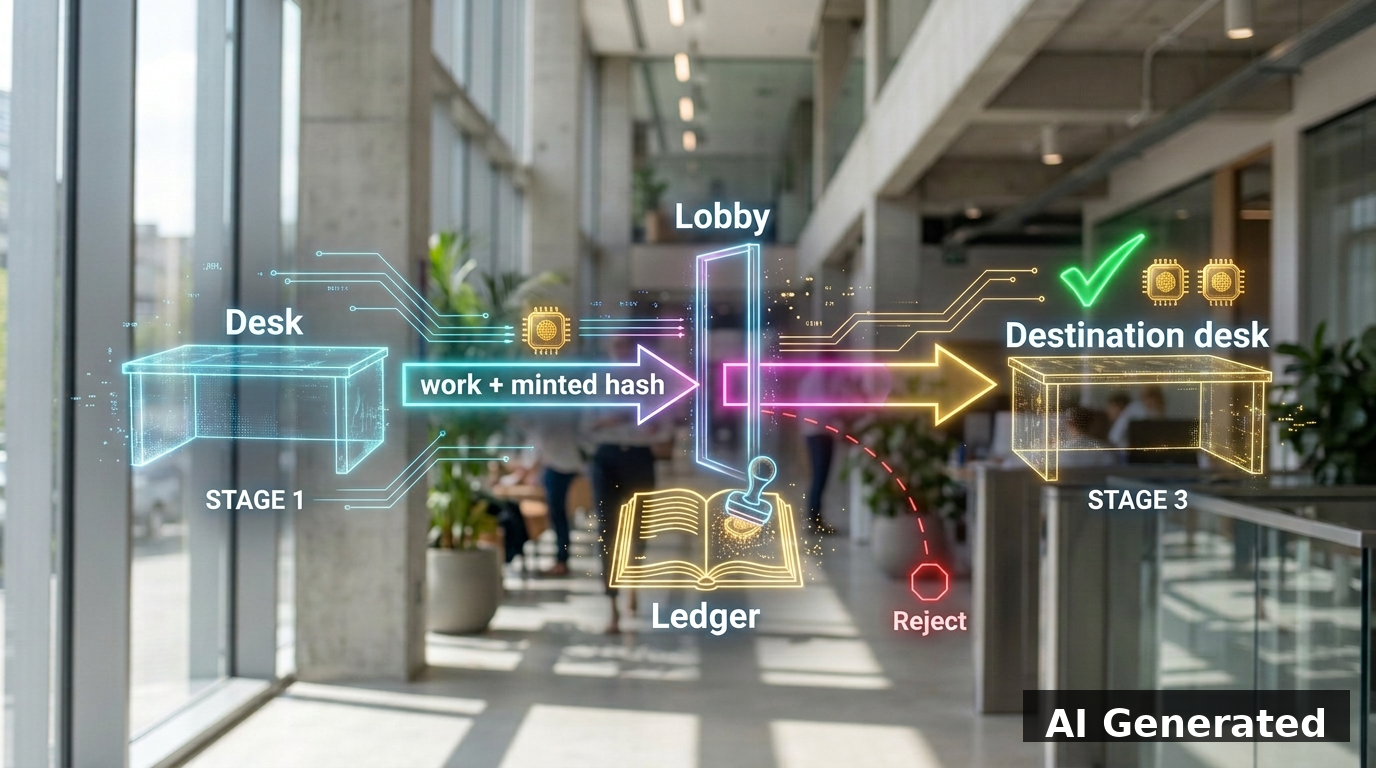
And it runs on an eight-core virtual private server. That deserves saying twice, because the industry conversation around agent federation is saturated with the assumption that this requires a data center. It does not. It requires discipline: receipts on every handoff so nothing needs a babysitter, isolation between rooms so one failure cannot flood the estate, and a scar ledger so the system never pays twice for the same lesson. The economy of the thing is not a compromise — it is what forced the design to be honest.
Reaching outside the walls — the federation that earns its name
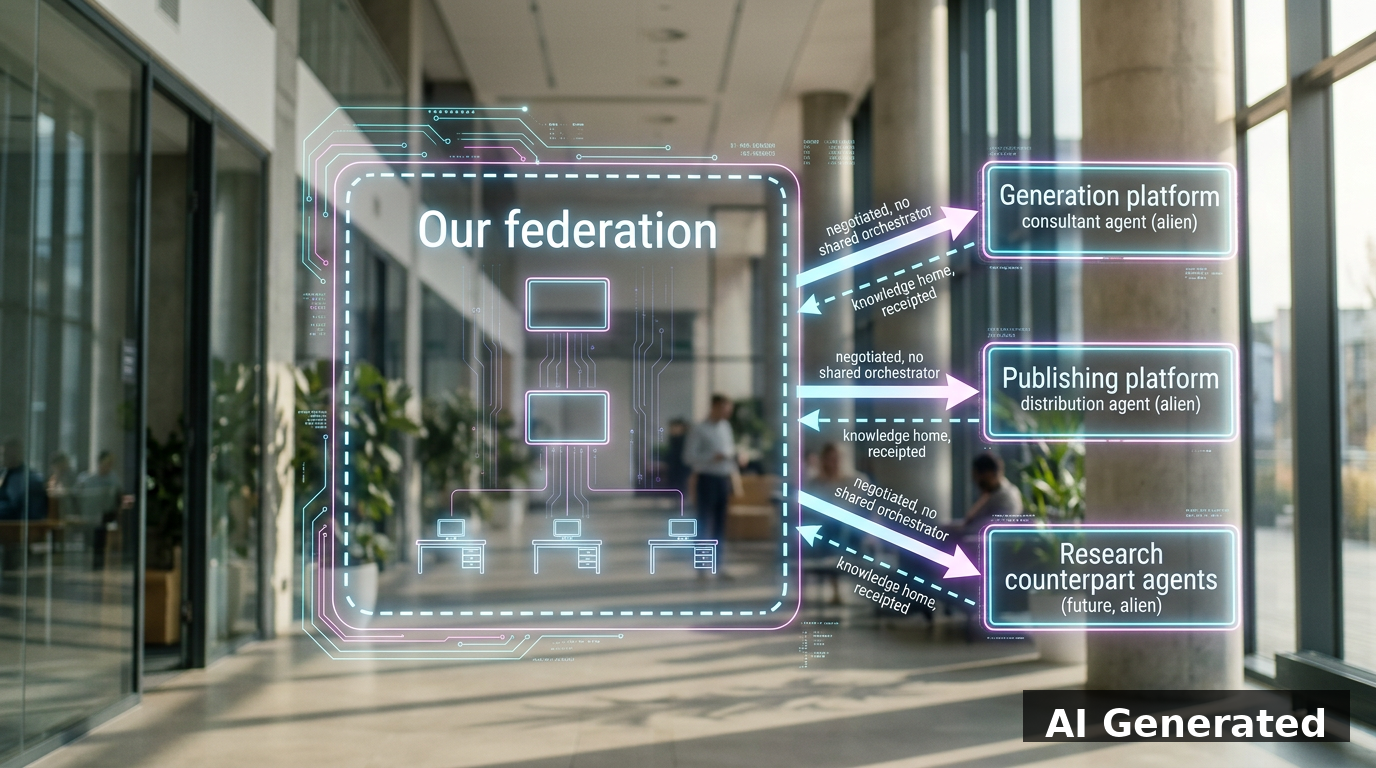
So far, everything described happens inside our building: rooms, foremen, one orchestrator, one owner. That is compartmentalised orchestration — necessary, disciplined, and on its own not yet a federation in the sense the term actually means. A federation requires something harder: autonomous entities from different administrative domains, with different identities and no shared orchestrator, discovering and interacting with each other. That is the layer we are now standing up, and it is the reason we use the word.
Three outbound relationships define it, and all three are with what we think of as alien entities — agents that do not belong to this environment, owe it nothing, and run under someone else’s rules.
The first is a consultant relationship with a major generation platform’s own agent. We recently began working with a platform whose native agent has inside knowledge of its own tooling ecosystem; we use it as a consultant to our officers — it guides the desks on which tools to reach for and how to approach a job, and our officers learn from that guidance in return. The relationship is deliberately two-way: the consultancy informs, our compartment records what worked, and the lesson persists into the same scar ledger that governs every internal handoff. Notice what this actually is: our agent reaching across a boundary into a foreign administrative domain, negotiating a collaboration with no shared orchestrator, and bringing the knowledge home receipted. That is federation in practice, not federation in a diagram.
The second is outbound to a publishing agent on an external platform — an alien entity on the distribution side, the counterpart to our internal Media Factory output. The third, coming, is research: our research officers will talk to counterpart agents outside this environment as we assemble the standing corpus from think tanks, news agencies, and government sources. In every case the pattern is the same — internal discipline, external negotiation, knowledge brought home and recorded.
We should be honest about what this stage is: a prototype. It floats. It is stable enough to demonstrate that the pattern works — internal isolation, receipted handoffs, outbound negotiation across domain boundaries — running on a box a small business can afford, with us in the loop as architects and quality assurance. It has not yet been hardened against a determined adversary or stressed by the concurrent-failure storms that the incident literature documents at scale [4][5]. It is built to prove the pattern, not to claim it has survived every test the pattern will eventually face.
And it was built by a supporter, deliberately. I am on the record as pro-AI: I believe the technology should accelerate, and I build rather than wait. This prototype exists to show what a determined small team can actually stand up — not to sell caution, and not to pretend the hardening work is finished. The federation came without permission because nobody withholds it. The next stage is earning the right to call it production.
What the record shows — and what we would do differently
The proof lives in the task record, and we reference it structurally: project BR22, task T466, with its numbered subtasks and dated comments. T466, subtask T500 carries the results recorded across a first comment and a second comment and a third comment, each timestamped — a chain of decisions you can follow without being told their contents. The trail is public in its existence and private in its detail; that boundary is deliberate. What the record demonstrates, without quoting a line of it: a build that moved from single-agent experiments to compartmentalised federation across named task generations; documented correction cycles where an approach was abandoned and replaced; and a cost profile orders of magnitude below the consulting benchmark for equivalent scope [1][3].
Three things we would do differently, honestly:
Earlier, harder identity separation. In the first cycles, rooms shared more than they should have — convenient until a single compromised path could walk the estate. The fix was structural isolation per room; the scar sits in the task record and we will not repeat it [6]. The industry-wide finding is the same: nine in ten security officers admit they cannot fully see their agent identities [6]. We closed that gap by making identity a room property, not a shared login — and the outbound layer now forces the same question one level up, at the boundary with alien entities.
Fewer parallel experiments, more sequential proof. Enthusiasm produced overlapping task streams early; the lessons store eventually imposed discipline, but the first weeks carried avoidable rework. The failure-mode literature is blunt: agents given too much autonomy without checkpoint discipline fail in ways nobody can reproduce [5].
Document as you go, not archaeology afterward. Reconstructing T466’s narrative for this presentation required digging through what should have been narrated in real time in its comments [7].
The lessons store itself — the scar ledger — is the compounding asset. Every failure (dropped request bodies, silently ignored fields, rate limits mistaken for bugs) goes into a persistent record that every future task must consult before inventing a solution. Five hundred tasks in, task number five hundred costs a fraction of task number one. Today that memory lives in a relational store; a graph-structured store for the relationship layer between what the desks know is already under evaluation — and the outbound consultant flow described above is exactly the kind of cross-domain knowledge that a graph layer would hold best. Memory, here, is not a module — it is the asset.
Where the federation goes to work next
A factory is only the first tenant. Two more are moving into the same building.
Social publishing — the problem that forced the question. Our own experimentation produced a finding worth stating plainly: a single agent — even one employing sub-agents — cannot credibly publish across ten to fifteen distinct channels. Each platform imposes different asset requirements, different context windows, different norms of voice and format. One agent attempting all of it either flattens everything into sameness or loses the thread per channel. This is a genuine research conclusion, not a vendor claim, and it is precisely the shape of problem this office is built for: mandate-separated officer desks — one per channel family — each authorised only for its platform and format, coordinated by the foreman layer rather than replaced by a single overloaded personality. The one-brand-to-many-channels problem is, in other words, the federation use-case that proved itself by defeating the alternative — and its distribution side connects to the outbound publishing agent described above.
Research and intelligence — a growing pool of firsthand material. We are deliberately assembling a large, standing corpus of primary information: newsletters, reports, and filings flowing from think tanks, news agencies, and government organisations. The volume is the point — no single analyst, human or artificial, should hold all of it. The office maps onto this naturally: research officers scoped per country, per subject, per source-type, each receipting what it ingests and what it produces, the orchestrator routing a query across the relevant subset and reconciling the outputs. Analysis becomes parallel and jurisdiction-scoped rather than serial and overloaded — and as the corpus grows, the research officers will negotiate with counterpart agents outside this environment, extending the outbound federation pattern from consultation and publishing into knowledge acquisition itself.
What this is, stated plainly
The industry framing treats federation as something enterprises aspire to and few achieve [1][2][3]. Krinas AI Agents is the counter-example that matters: not because it is the largest or the most funded, but because it demonstrates that the barrier to entry is not capital, not credentials, and not infrastructure. It is iteration count — the number of mistakes you are willing to record instead of repeat. The management discipline — delegate, monitor, push for results — existed before the software did; the software simply made it enforceable rather than social. The whole thing fits on an eight-core VPS a small business can afford, and the outbound layer proves it federates beyond its own walls. It is a prototype, honestly labelled — floating, demonstrating, hardening next. The path to your own federation is shorter than the analyst curves suggest [1][2], and it begins the way ours did: with a business owner who finally got the org chart they always wanted — and agents who, unlike people, have nowhere to hide from it.
—
References
[1] Gartner, Inc. (2026). 2026 Hype Cycle for Agentic AI: only 17% of organizations have deployed AI agents. Gartner (via Enterprise DNA summary). https://enterprisedna.co/resources/news/gartner-hype-cycle-agentic-ai-2026-enterprise-readiness/
[2] Deloitte. (2026, August 12). AI agents are only the beginning: only 15% have scaled orchestrated multi-agent adoption. Deloitte Press Room. https://www.deloitte.com/us/en/about/press-room/deloitte-survey-examines-ai-readiness-agentic-ai-success.html
[3] Zylos Research. (2026, March 1). Cross-organization AI agent federation: hub-and-spoke, mesh, and the identity gap. Zylos Research. https://zylos.ai/research/cross-org-agent-federation
[4] Sherlocks AI / Cycles. (2026). The State of AI Agent Incidents 2026 (73 production incidents, Jan–May 2026). Sherlocks AI. https://www.cycles.sh/state-of-ai-agent-incidents-2026
[5] Cemri, M. (2025). Why do multi-agent LLM systems fail? (MAST: 14 failure modes). arXiv (UC Berkeley). https://arxiv.org/abs/2503.13657
[6] Kings Research. (2026, October 7). US agentic AI market: CISO visibility statistics and sector breakdown. Kings Research. https://www.kingsresearch.com/agentic-ai-market
[7] Krinas AI Agents internal record: project BR22 (Personal Task), task T466, subtask T500, results recorded in first, second, and third dated comments — referenced structurally; content not quoted.
[8] Digital Applied. (2026). Agentic AI statistics 2026: 150 sourced data points. Digital Applied. https://www.digitalapplied.com/blog/agentic-ai-statistics-2026-definitive-collection-150-data-points
[9] LangChain. (2026). State of Agent Engineering: 57.3% of organizations have agents in production. LangChain. https://www.langchain.com/state-of-agent-engineering
[10] The Agent Report. (2026, July 10). AI agent funding in Q2 2026: $510B in H1, 70% of venture dollars went to AI. The Agent Report. https://the-agent-report.com/2026/07/ai-agent-q2-2026-funding-wrap-record-venture/
[11] Deloitte. (2025, November). AI agent orchestration: $8.5B → $35B market and the maturity gap. Deloitte Insights. https://www.deloitte.com/us/en/insights/topics/technology-management/tech-trends/2026/agentic-ai-orchestration.html
AI disclosure: This article was researched and drafted with the assistance of AI agents (Krinas AI Agents — the same federation it describes), then reviewed and approved by the human author. All images in this article — the cover and Figures 1–5 — are AI generated and carry the “AI Generated” label in accordance with the EU AI Act transparency rules.
