

Contents
- 1. Geopolitics & Defence
- 2. Environment & Climate
- 3. Society & Civil Issues
- 4. AI & Technology
- 5. Economy & Business
- 6. Science & Space
- 7. Crypto, Digital Assets & Blockchain
- 8. Correlations & Analysis
- 9. References
Click any heading to jump to that section. Click the section heading to return to this menu.
Geopolitics & Defence ↑ Contents
The Starlink Rupture Reaches Kyiv’s Satellites
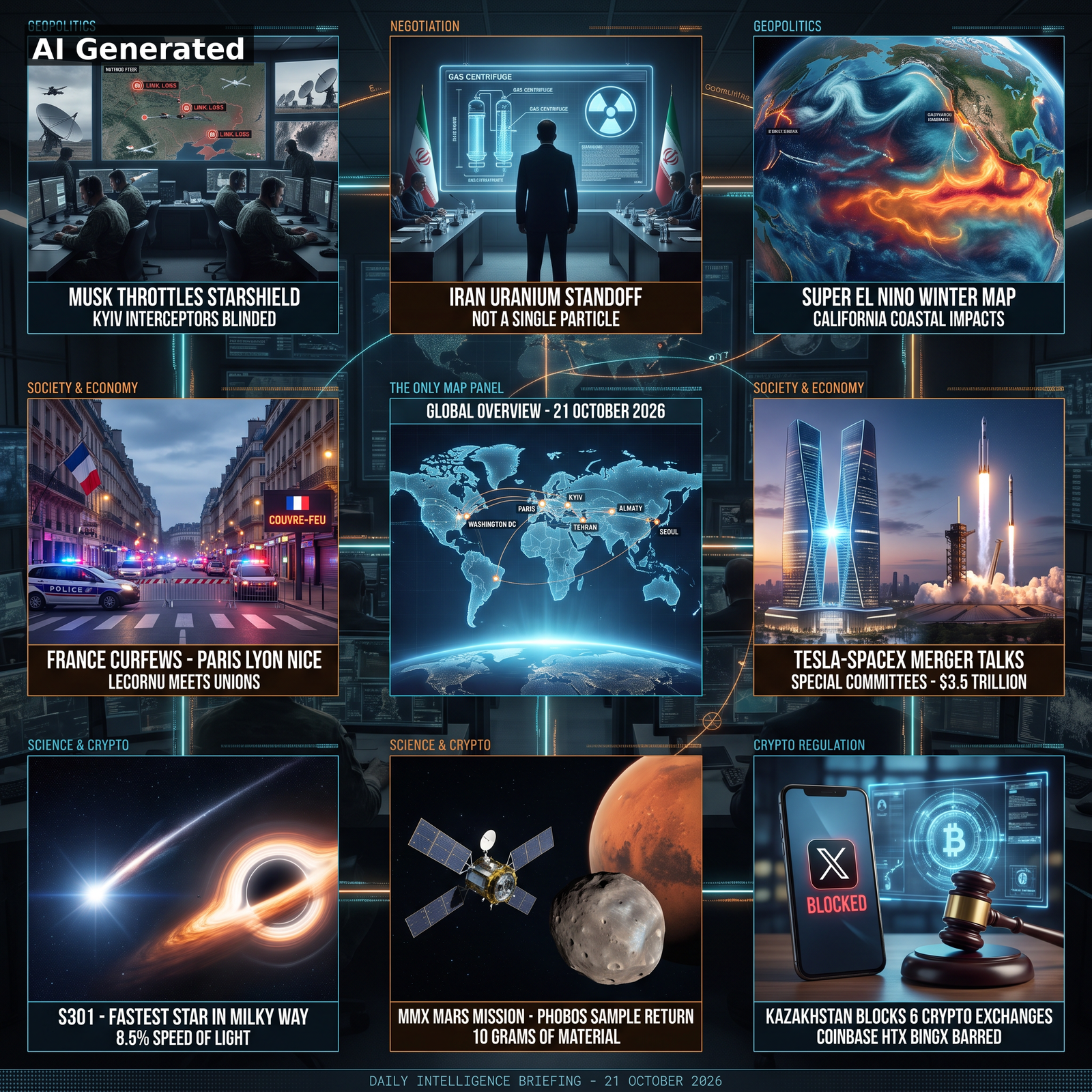
The reporting window of D143 converts the transatlantic rupture that D141 and D142 documented rhetorically into an operational fact at the level of battlefield infrastructure. The Wall Street Journal reports that Elon Musk personally ordered a throttling of the military Starshield service Ukraine depends on, imposing a speed cap under 130 km/h from 14 October that rendered Ukrainian attack and interceptor drones ineffective while allowing Russian missiles through air defences[1]. German and Greek coverage emphasises that Musk and President Trump spoke both before and after the restriction was imposed, even as Trump publicly denied knowledge of who was responsible, and that the White House was left confused by the decision[2]. The episode culminates a pattern tracked since D137: a private citizen now demonstrably holds the capacity to alter the tempo of a European war over a network the United States funds[1].
Trump has chosen this moment to escalate public pressure on Kyiv rather than walk back the satellite intervention. He described Russia as “a huge machine that keeps advancing,” conceded Moscow has captured “a very large part of the territory,” and declared it is time for Zelensky to end the war because Washington “has given a lot and received nothing back”[3]. The diplomatic choreography continues in parallel: special envoy Steve Witkoff met Zelensky in Oslo, where both sides saluted “a strong alignment between the United States, Ukraine and Europe,” and Witkoff is now travelling to Moscow[4]. Zelensky, for his part, insists Ukraine must participate in any eventual Trump-Putin-Xi summit, framing Oslo as a pre-negotiation rather than a settlement[2]. The simultaneity of coercion and dialogue suggests Washington is testing whether the satellite lever can yield a settlement without further escalation[3].
The war’s physical toll continues regardless: Russian drones killed two civilians in the Kharkiv region overnight, a reminder that Moscow calculates it can win more at the table by maintaining battlefield pressure, a calculation the Starlink throttling reinforces[5].
Iran’s Uranium Standoff and the Gulf’s Expanding Perimeter
Tehran has hardened its nuclear negotiating position to the point of absolute refusal. The secretary of Iran’s Supreme National Security Council, Mohsen Rezaei, told Pakistan’s army chief during a mediation visit that “not a single particle” of enriched uranium will leave Iranian territory, describing the stockpile as “strategic leverage and national wealth,” while parliament speaker Mohammad Bagher Ghalibaf said no negotiation is possible until Washington rebuilds trust on Iranian terms[6]. This is a direct rejection of the American demand that Iran’s high-enriched stocks be physically removed, leaving only in-country dilution as a theoretical compromise. The same coverage confirms the military track: US Defence Secretary Hegseth met Netanyahu in Israel, with the Israeli leader hinting at new joint attacks on Iran, while Pakistan’s army chief travelled to Tehran as mediator[6].
Inside the American decision layer, the war was not universally supported: Donald Trump Jr. opposed it, while Vance and CIA Director John Ratcliffe raised early concerns about its strategy and scope[7]. This explains the peculiar texture of the phase — a war prosecuted with reluctance even as the uranium file hardens[7]. British and Egyptian moves complete the picture of an expanding perimeter: the UK has deployed RAF Typhoon jets to bolster Saudi defences against Houthi attacks, and Cairo has signalled military support for Riyadh against the militia[8][9]. On the ground, Houthi bombardment of Taiz governorate wounded three young women in residential neighbourhoods[10].
The UAE has meanwhile completed development of the MK-82 Penetrator, a precision munition able to pierce more than a metre of reinforced concrete, compatible with Al Tariq and Thunder guidance kits — a signal that Gulf states are preparing for a long war of attrition rather than a quick resolution[11].
The Eastern Mediterranean Escalation: Libya, Ankara and Athens
A significant legal-diplomatic escalation has crystallised in the Eastern Mediterranean. Libya’s House of Representatives unanimously approved the 2019 Turkey-Libya maritime delimitation memorandum, a decision Athens immediately rejected as “illegal, invalid and non-existent,” arguing it contradicts the Law of the Sea and ignores Greek islands and their rights under UNCLOS[12]. Ankara welcomed the approval as “a significant step” and reiterated its commitment to its claims in the “Blue Homeland,” the doctrine underpinning Turkish maritime maximalism[13]. The Greek Foreign Ministry has informed allies and pledged “every appropriate action” to safeguard sovereign rights[12]. The approval now carries the imprimatur of one of Libya’s two rival parliaments, giving Ankara a documentary basis it previously lacked and forcing Athens to respond at the level of international law[12].
Greece’s response network is activating. Foreign Minister Georgios Gerapetritis spoke with his Egyptian counterpart Badr Abdelatty, with Cairo praising the strategic partnership and confirming an upcoming trilateral summit with Cyprus while discussing Libya and the Eastern Mediterranean[14]. Turkey, simultaneously, signed a defence-industry memorandum with Qatar, Pakistan and Indonesia, extending its cooperation network across the Gulf and South Asia just as the Libyan file moves[15]. On the domestic flank, the third phase of the Hellenic Armed Forces restructuring abolishes 56 units and 126 structures to fund pay rises and new unmanned systems across all three services, plus space operations[16].
Black Sea, Belarus and the Weaponisation of Uncertainty
Two developments north of the Aegean underline how uncertainty has itself become a weapon. In the Black Sea, 21 sailors are missing after drone attacks on four merchant ships inside Bulgaria’s exclusive economic zone on 6 and 13 October, two of which sank; a US Navy P-8 Poseidon has begun reconnaissance patrols at Sofia’s request, and NATO will discuss the attacks on 21 October, with Bulgaria also requesting air-defence and anti-drone equipment[17]. Separately, Ukrainian military intelligence reports that a 20,000-strong Wagner contingent in Belarus has “disappeared” from satellite and HUMINT view; a NATO spokesman noted it is practically impossible to move such a force secretly, suggesting it has been dispersed under tactical concealment[18]. Both episodes compel adversaries to defend against worst-case possibilities, consuming resources whether or not the feared event materialises[18].
The structural trend was articulated at the Global Security Forum in Doha, where diplomats, humanitarian officials and former intelligence chiefs — including ex-MI6 chief Sir John Sawers — described a world in which international norms are losing influence while military capabilities become easier to access, and the United States is eroding the rules-based system it designed, with Gulf states reconsidering their security relationships with Washington[19]. Lebanon’s Deputy Prime Minister Tarek Mitri captured the paradox: in an era of offensive war, alliances are increasingly defensive, and the war on Lebanon shows some states “do not need alliances”[19]. The Qatari deputy defence minister observed that his country, a traditional mediator, has itself been attacked by both Israel and Iran — “the first time a mediator has been attacked”[19].
Two items complete the strategic perimeter. Egypt’s President Abdel Fattah al-Sisi has announced he will leave power in 2030, while working to ensure his successors are selected and trained by the military hierarchy[20]. And a retired US Air Force KC-10 Extender tanker has been revived from the boneyard by private refuelling contractor Omega Air, the first of several ex-USAF aircraft to fly again for a private market absorbing tanker capacity[21], while France’s Aura Aero brings its ENBATA long-endurance unmanned maritime ISR aircraft to Euronaval, reflecting the European push toward sovereign naval surveillance[22].
Environment & Climate ↑ Contents
El Niño’s Winter Map and the Water Ledger
The super El Niño tracked since D139 is now generating concrete winter planning documents in the American West. A new analysis maps where the current El Niño is most likely to concentrate coastal impacts in California this winter, focusing on low-lying corridors such as Highway 37 in the San Francisco Bay Area, where sea-level roadways are already buffeted by marshland and are acutely vulnerable to storm surge and flooding[23]. It arrives alongside Colorado’s 2026 water-year report, called “ridiculously warm,” with temperatures up and water down[24]. The Colorado River basin, the lifeblood of the Southwest, now suffers two simultaneous water crises — one visible on the surface, one hidden underground as aquifers deplete — compounding the arithmetic facing the seven basin states[25].
Against this scarcity, a restoration story is gaining momentum: beavers are being deployed as watershed engineers across the drought-stricken West, their dams slowing water, creating year-round local availability, rebuilding habitat for native fish and acting as natural fire breaks[26]. The contrast between engineered infrastructure failing under a warming climate and biological infrastructure being rediscovered frames the adaptation challenge of the decade[26].
The Energy and Industrial Transition
The energy-policy paradox of the Trump administration is now explicit. An analysis in Grist argues that the president, who vowed to end the “energy emergency” by boosting oil and coal through executive power, has instead created a real one: the Iran war has disrupted supply chains and prices in ways no domestic production surge can fix, exposing the limits of supply-side-only energy policy[27]. The assessment connects to war-premium dynamics tracked since D137[27].
Meanwhile the industrial transition proceeds on a different timetable in Europe. A Transport & Environment study concludes that binding electrification targets on company fleets — with fiscal support limited to electric, Made-in-EU vehicles — could generate 344,000 additional EU jobs by 2030, with roughly €20 billion in economic gains and €18 billion in investment[28]. A University of Melbourne study finds that combining cleaner manufacturing with demand-side measures — longer battery life, limits on pack-size growth, ride-sharing and repurposing retired EV batteries — could cut lithium-ion supply-chain emissions by about 34 percent by 2050 and eliminate 6-7.2 billion tonnes of CO2 between 2024 and 2050[29]. The studies argue the electrification dividend is larger when policy shapes both supply and use[29].
At the marine interface, a paradox of the industrial ocean: shipwrecks can become thriving reefs, but German scientists studying a Second World War munitions dump in the Baltic have shown these structures can also contain toxic time bombs, with corrosion of ordnance threatening the very ecosystems the wrecks now host[30].
Biodiversity Governance and the Deep-Sea Frontier
As delegates gather in Yerevan for COP17 of the UN Convention on Biological Diversity, the first global review of the Kunming-Montreal framework is exposing a yawning gap between promise and delivery. A Global South commentary argues that nearly two decades of pledges have left biodiversity action underfunded while forest loss accelerates, and that progress depends on following women-led agroecology and community conservation rather than corporate-driven “false solutions”[31]. The funding fragility of frontline conservation is nowhere more vivid than in the search for the saola — the “Asian unicorn” — with the Saola Foundation reporting it could not confirm its field teams would return to the Annamite Mountains in October after a sharp funding contraction[32].
A governance challenge of a different magnitude is crystallising on the high seas. A Mongabay analysis finds that US deep-sea mining claims in the Pacific’s Clarion-Clipperton Zone now rival the area the International Seabed Authority has set aside for mining, as companies apply to the United States — outside the ISA framework — for rights to the international seabed following the 2025 executive order[33]. Several claims overlap, raising questions about the management of the international seabed and whether the US-led acceleration benefits American companies at the expense of the benefit-sharing the ISA is mandated to deliver to developing nations[33].
Climate Justice at the Margins
The uneven distribution of climate costs continues to sharpen. In Pakistan, factory workers in Karachi are sweltering in extreme heat intensified by climate change, while global brands fail to deliver on workplace-safety pledges[34]. In Bangladesh, where climate risk is highest, bank credit remains scarce: lending is concentrated in the commercial centre of Dhaka, leaving the most vulnerable regions without capital to adapt[35]. Both stories describe the same structural failure — the adaptation burden falling on those least able to finance it[35].
Even improvised adaptation carries new risks. Brazilian fire researchers have shown that Tetra Pak carton sheets, promoted online as cheap insulation for poor homes, are dangerously flammable: strips carried flames nearly six inches within 14 seconds from the cut edge and failed all three normative fire-safety criteria[36]. In the Arctic, the reverse problem is emerging: infrastructure in towns like Wainwright, Alaska, was built on permafrost that is now thawing, and researchers are turning to drones to map the hidden ground-ice that determines when buildings and roads will fail[37]. Together these stories frame the climate decade’s defining challenge: adaptation itself must be engineered safely, and the poorest communities are both the most exposed to climate extremes and the most likely to improvise dangerously[36].
Society & Civil Issues ↑ Contents
France’s 17 October: The State Tightens the Screw
The French state’s response to the 17 October unrest entered its most coercive phase. As Prime Minister Sébastien Lecornu prepared to receive the trade unions to discuss protest security, new curfews were imposed in Paris, Lyon, Bordeaux and Nice, along with six communes in Martinique, and the capital’s ban on demonstrating in certain sectors was extended until Wednesday morning[38][39]. The BBC’s analysis captures the deeper disagreement over blame and lessons, with the government blaming far-left groups while much of the public questions the state’s own failures[40]. The judicial response has been swift and punitive — the return of short sentences — with 149 people incarcerated and 800 brought before the courts, and the justice minister announcing firm prison terms even for some individuals not previously known to police[41].
The crackdown is spreading beyond France. Italy’s Giorgia Meloni, facing domestic criticism for deploying troops, has defended putting 500 soldiers on Milan’s streets as a necessary response to the weekend’s looting, declaring that “demonstrating is a right, destroying our cities is not,” and introducing a new offence of violent protest participation with sentences of up to five years and fines up to €20,000[42]. In Portugal, cost-of-living protesters poured back into the camps in Lisbon and Porto that police had just cleared, with 55 people arrested — a sign that the movement driving Europe’s autumn unrest is not extinguishing under pressure[43]. Beneath the visible crackdown, a darker Italian story has resurfaced: a parliamentary committee examining the death of Monte dei Paschi communications director David Rossi now hears testimony that he was hanged out of a window by mob-linked enforcers to intimidate him and accidentally fell to his death, having allegedly laundered millions for a ‘Ndrangheta-linked faction and planned to reveal the transactions[44]. The case frames the limits of the state’s coercive response when finance remains entangled with organised crime[44].
The American Midterm Crucible: Blue-Wave Maths and the Roll
Fourteen days before the US midterms, the Democratic “blue wave” is no longer an aspiration but a polling phenomenon. Comprehensive coverage shows Democrats leading by nearly ten points in the ABC/Washington Post ballot test and contesting Senate seats in Republican strongholds — Alaska, Iowa, Kansas, Texas, Ohio, Maine and North Carolina — while the Cook Political Report has shifted the South Carolina and Mississippi Senate races into more competitive categories[45][46]. The arithmetic is precise: Democrats need a net gain of four seats in both the House and Senate to control each body, a reachable target given the 218-214 House split and the 53-45 Republican Senate edge[45]. The stakes are existential for the Trump administration — losing either chamber would unleash oversight and block the legislative agenda — and the president is campaigning in traditionally safe states, a sign of how defensive the Republican posture has become[45].
At the integrity frontier, the machinery of the election is itself under contestation. Los Angeles County election officials have found the federal list of 20,000 “likely” noncitizens registered to vote in California to be “unreliable,” with some of those named appearing to be US-born citizens — the latest skirmish in the battle over voter-roll integrity flagged in D142 when the CISA was hollowed out[47].
Germany’s Civic Ledger: Coalition Fights and the Score
In Berlin, the prospective red-green-red coalition faces a new line of attack from the pro-Israel establishment. Volker Beck, president of the German-Israeli Society, has sharply criticised the Greens and SPD for negotiating with the Berlin Left party, arguing that “anti-Zionism is part of the success formula” of a party he says has failed to confront antisemitism in its own ranks, with the case of Berlin Left MP Vanessa Emde — who faces expulsion over statements questioning the right of states to exist — cited as evidence[48]. The controversy converts Berlin into a national test case for the limits of coalition politics around Israel[48].
Meanwhile Germany’s highest civil court is ruling on the transparency of the credit-scoring industry. The Federal Court of Justice will decide whether citizens can demand comprehensible disclosure of how their Schufa base score is calculated, after a lower court largely sided with plaintiffs who sought understandable information about the weighting of criteria[49]. The ruling touches the heart of the data-justice debate in a country where credit scoring shapes access to housing and finance[49].
Migration, Justice and the Platform Age
The human cost of migration enforcement was underscored by a US sentencing decision: a Guatemalan man was jailed for 30 years over a smuggling operation in which 53 migrants died in 2022, trapped inside an abandoned tractor-trailer in dangerously high heat[50]. On the other side of the enforcement ledger, UN experts have called on India to stop using “excessive force” against protesters and to conduct an independent investigation into the conduct of authorities[51].
Two developments advanced victim-centred justice in Europe. The French Senate adopted a bill obliging authorities to inform victims when their aggressor is released from prison, a text supported by the government and victims’ associations[52]. And an investigation into the TikTok legal case reveals how executives ignored internal child-safety warnings, with staff raising alarms about minors bypassing age restrictions and being sexually exploited on the platform — a finding that lands in the child-safety ledger tracked since D142[53]. In the same space, the trial of La France Insoumise MEP Rima Hassan for apologising for terrorism concluded with prosecutors requesting ten months’ suspended imprisonment and two years of ineligibility, with an overtly political defence reflecting the battle over the limits of free expression on Palestine[54].
Greece’s Civic Files and the Conservative Voice
Greek society is pushing back on cost-of-living pressures through the streets and the ballot box. A 24-hour education strike saw tents erected in Syntagma Square and actions across Thrace and Crete, with housing, inflation and transport costs as the flashpoints[55]. The electoral backdrop remains stable: an Opinion Poll survey shows New Democracy at 31.5 percent in Attica vote-estimation terms with a 14.6-point lead, even as 74.8 percent call the anti-inflation measures insufficient[56]. The gap between electoral stability and economic discontent is the defining tension of Greek politics[56].
Across the European spectrum, the American president has inserted himself into France’s electoral contest by declaring that Marine Le Pen is the “conservative voice” of France and has been “treated badly” — an endorsement that complicates the French far right’s attempts to position itself as a domestic phenomenon ahead of 2027[57].
The Anglo-Periphery: Australia and Canada
In Australia, the attack on independent MP Helen Haines has produced both a judicial outcome and a systemic warning. The alleged attacker, Brendan Nugent, was denied bail, and the head of the Australian Federal Police has condemned a “febrile” political environment in which a person has been charged every week over threats to MPs[58]. In Canada, Alberta voters rejected pursuing separation from Canada in the referendum, and Premier Danielle Smith called for unity, closing a chapter flagged in D138 when the referendum was scheduled[59].
AI & Technology ↑ Contents
AI Governance and Security at the Civic Edge
The governance contest over frontier AI sharpened on both sides of the Atlantic. Anthropic has pitched a draft AI-safety bill that on its face offers protections against catastrophic model releases — including blocking a model whose deployment could kill 50 or more people — but which would forbid federal agencies from blocking a release without a judge’s permission, a structure critics argue entangles the oversight it claims to create[60]. The proposal follows the pattern D140 and D141 tracked when Anthropic pivoted to a public-benefit structure ahead of its pre-IPO: the company is trying to write the rules of its own regulation at the moment of maximum leverage[60]. In parallel, the United Nations launched a new initiative on the military uses of artificial intelligence, aimed at addressing “dire concerns” about the threat the technology poses to humanity[61].
The security dimension is now biting in practice. A breach of OpenCode exposed API keys, and the incident highlights a paradoxical failure: AI guardrails designed to keep models helpful are also slowing the security tools defenders need, because models trained to refuse requests also refuse defensive triage[62]. In the corporate-legal domain, a US district judge dismissed the sexual-abuse lawsuit filed by Sam Altman’s sister against the OpenAI chief executive, ruling after a year in which she failed to appear for an independent medical examination; the family has called the claims “deeply hurtful and entirely untrue”[63]. The dismissal clears a legal cloud over the CEO at the moment the AI IPO calendar is most crowded[63].
Compute’s New Geographies: From Hanoi to the Moon
The geography of AI compute is expanding downward into the physical world and outward into space. Vietnam’s security ministry is seeking Samsung’s help on AI and chips, a partnership underscoring the expanding technology ambitions of the country’s powerful police agency — a signal that AI capability-building is now a national-security priority across Asia[64]. At the same time, Hewlett Packard Enterprise announced the Spaceborne Computer-4, which will travel aboard Astrolab’s FLIP rover under NASA’s CLPS programme to test high-performance computing on the Moon’s surface, running language models with retrieval-augmented generation, LiDAR-based mapping and the FLUID federated-learning experiment coordinating neural networks trained on Earth, the Moon and the ISS[65]. Edge AI is being pushed to the point where latency makes local inference not an optimisation but a necessity[65].
On Earth, the physical-AI frontier reached policing. Florida Polytechnic University has acquired a piloted electric vertical-takeoff aircraft, a Jetson ONE nicknamed “Astro” with a 63 mph top speed, for campus patrols and emergency response — pending FAA authorisation — positioning it as the first flying police vehicle in the United States[66]. The story sits in the autonomy-at-scale arc tracked since D140: the question is no longer whether autonomous systems will enter public space, but under what rules[66].
The Physical and Automotive Frontier
The attack surface of everyday technology is widening as cars become connected computers. A security analysis finds that the “smartest” features — infotainment, telematics, keyless entry, over-the-air updates — are opening doors for hackers, with thieves able to exploit vulnerabilities remotely[67]. It connects to the D137 and D138 reporting on the cybersecurity perimeter of everyday life: as more of the physical environment becomes software-defined, entry points grow faster than the patch cadence that secures them[67]. In agriculture, researchers at the University of Mississippi and Cornell find that AI could improve weed management by reducing reliance on herbicides and manual labour, but brings steep costs and new challenges — a reminder that even the most productive AI applications arrive with implementation burdens[68].
Economy & Business ↑ Contents
The Musk Empire’s Merger Question and the AI-Capital Test
The dominant corporate story of D143 is the formalisation of merger talks between Tesla and SpaceX. Independent board members of the two Musk-controlled companies have formed special committees to evaluate a potential combination, with Musk — excluded as a conflicted party — telling investors that a merged entity would be worth roughly $3.5 trillion and would bring together AI software, chip design, robotics, connectivity and the jointly developed Terafab plant[69]. The disclosure arrived as SpaceX reported its first operating profit since its June IPO: net income of $4.4 billion on revenue of $14.6 billion, up 161 percent year on year, with the AI business — renamed “Super Intelligence” — generating $7.56 billion and surpassing Starlink’s $5.25 billion for the first time[69]. A merger would concentrate extraordinary power — Musk would own roughly a third of the combined entity — and would require majority approval of Tesla’s outstanding shares[69].
The AI-capital test is visible across the sector. CoreWeave’s shares have fallen roughly 30 percent in October amid investor concerns over its debt-heavy growth strategy, a warning for the neocloud model of financing AI compute with borrowed capital[70]. By contrast, Super Micro rallied after strong preliminary sales, underscoring the bifurcation between hardware makers with real orders and leveraged financiers of capacity[71]. The political dimension is growing: Nvidia spent a record nearly $2.2 million on federal lobbying in the third quarter as Washington debates export controls and subsidies[72]. Market structure is more fragile: the S&P 500’s 15 largest stocks hold a record 46.7 percent of the index, making the market hostage to a handful of AI mega-caps[73].
Asia’s Export Machine and the Central-Bank Map
Asia’s September trade data paints a picture of a region running on chips. Asian stocks climbed as strong Wall Street earnings buoyed sentiment[74], while Japan’s exports rose 16.7 percent year on year, helped by chip demand[75]. South Korea’s customs data for October 1-20 shows exports up an extraordinary 105.4 percent year on year with a provisional $14.5 billion surplus[76]. China’s youth unemployment — 18.0 percent for 16-24 year olds in September, down from 18.9 percent — remains structurally elevated[77].
The monetary-policy map is diverging. Japan’s finance minister declared the country is shifting to a wage-driven inflation phase, coordinating closely with the Bank of Japan[78]. Australia’s RBA deputy described the inflation outlook as “materially worse,” a hawkish signal that buoyed the Aussie as the dollar slipped on falling US yields and crude prices[79][80]. The divergence — Japan normalising toward inflation, Australia bracing for worse, the US easing — is the cross-current against which the AI-capex cycle must refinance itself, connecting to the monetary map D142 drew[80]. In venture capital, Andreessen Horowitz topped the Strebulaev-Jackson AI ranking, confirming that a handful of firms dominate AI funding[81].
Germany, Europe and the Aviation Files
Germany’s most consequential economic experiment is taking shape in Berlin, where the prospective red-green-red coalition has agreed to socialise roughly 160,000 housing units from five private landlords — an unprecedented move capped at €16 billion in compensation, financed with loans and refinanced through rents[82]. Economists warn the plan creates no new housing, scares off investors and, in the DIW’s arithmetic, could force rents up to €9.78-11.21 per square metre to break even, above the current €8.26 average — making the flagship policy a potential own-goal[82].
In the European trade and aviation files, the UK is under pressure to align with EU duties on Chinese electric vehicles, with Turkey, Japan and South Korea also seeking exemptions from Europe’s localisation rules[83]. Boeing secured FAA certification for its largest 737 MAX 10 after nearly a decade of delays — the first aircraft certified under the 2020 Aircraft Certification, Safety, and Accountability Act — clearing deliveries from 2027 with 1,555 orders on the books[84]. And the UK government is preparing a decision on the Jackdaw gas field off Aberdeen, a call that will shape the North Sea’s future[85].
Britain’s Fiscal Squeeze and the AI Investment
Britain enters its autumn budget under intersecting pressures. September inflation is expected to have accelerated after the fuel surge, a figure that matters because it sets the uprating level for benefits[86]. A Uswitch survey finds nine million homes heading into winter in energy debt, with just 55 percent of billpayers in credit this year, down from 64 percent in 2022[87]. The CBI is warning Chancellor John Healey that tax hikes on the financial sector would be an “own goal,” calling for “business breathing space”[88]. Microsoft has meanwhile reaffirmed its £22 billion UK investment despite withdrawing from one data-centre project, publishing research showing rapid growth in AI adoption by British businesses[89] — the fiscal state strains while the AI investment wave continues[89].
Chips, Sovereign Debt and the De-Dollarisation Ledger
The semiconductor supply chain is now an instrument of state industrial policy in the United States itself. The Pentagon is to invest $1.5 billion in semiconductor chip production in North Carolina, a rare case of defence dollars explicitly driving domestic chip capacity[90]. In Greece, the economy is on track for fresh credit-rating upgrades, with S&P reviewing on Friday and Fitch on 6 November, despite mass selling of European bonds — a resilience story showing reformed peripheral sovereigns being repriced independently of the European core[91]. The de-dollarisation ledger advanced in Central Asia: Kazakh borrowers issued billions of yuan of debt as ties with China tighten, with low rates and the need to pay Chinese suppliers sparking a rush to panda and dim-sum bonds[92].
Science & Space ↑ Contents
The Cosmic Ledger: S301, the Roman Telescope and MMX
Astronomy delivered its most dramatic result of the autumn with the discovery of S301, the fastest known star in the Milky Way. Astronomers at the Max Planck Institute for Extraterrestrial Physics, using ESO’s GRAVITY interferometer, found a faint F-type star orbiting Sagittarius A* at up to 8.5 percent of the speed of light on an 8.7-year orbit that brings it within 12 times the Earth-Sun distance of the black hole — the shortest orbital period ever recorded around it — offering a path to measure how fast the black hole spins through frame-dragging[93]. Within ten years astronomers hope to measure the spin, and how the monster has grown[93].
Two spacecraft programmes reinforced the golden age in space science. NASA’s Nancy Grace Roman Space Telescope has achieved nearly 30 percent better optical performance than required after its precision-adjustment campaign[94]. And Japan’s Martian Moons eXploration (MMX) probe, launched aboard an H3 rocket, is en route to Phobos, where it will attempt two landings to collect at least 10 grams of material for return — the first lander-and-sample-return on a Martian moon — facing gravity 2,000 times weaker than Earth’s and a 44-minute communication delay demanding high autonomy[95]. A separate study adds to the ledger: magnetars, with magnetic fields 1,000 times stronger than average, can be born when two neutron stars touch, offering a formation channel for soft gamma-ray repeaters and fast radio bursts[96].
The Human Body and Mind Ledger
Psychiatry is moving toward a new diagnostic subtype. A large Australian study of more than 10,000 people with severe, recurrent depression identifies “circadian depression” as a distinct form: roughly a quarter of cases show body-clock dysregulation — being an evening type, severe seasonal mood swings, fatigue regardless of sleep quantity — and these patients respond poorly to standard SSRIs but may benefit from melatonin and behavioural strategies such as morning light exposure[97]. The finding connects to D142’s human-body ledger: the body clock is emerging as a central, modifiable axis of health[97]. In cardiovascular medicine, researchers have shown that a single ECG lead recorded during sleep, processed by a deep-learning model, can predict the 10-year risk of atrial fibrillation, stroke, heart failure and death, beyond established risk factors[98].
Two further findings refine the picture of how health is embedded socially and ecologically. A meta-analysis of five long-term studies covering 57,793 older adults across 24 countries confirms that social activity in old age is associated with better cognitive function, with volunteering and sports-club membership the most effective[99]. And a randomised trial in Melbourne suburbs shows that mosquito traps laced with larvicide and fungus cut mosquito egg counts by 70 percent and reduced Buruli ulcer cases in treated zones by 83 percent on the most informative day, though the authors caution the disease-prevention signal is promising rather than conclusive[100].
Materials, Physics and the Deep Archive
Physics produced a genuinely new form of temporal order. An international team led by the University of Amsterdam built a 3D-printed honeycomb metamaterial whose non-reciprocal interactions allow competing vibrations to fall into step spontaneously — a process called “wave coarsening” that yields a time crystal without any externally imposed rhythm[101]. In materials science, controlled vapour treatment has guided molecules into highly oriented soft quasicrystals, aperiodic structures that had resisted uniform large-area orientation[102].
Applied science met aviation safety: the most comprehensive dataset yet from Earth’s atmosphere during a rare solar radiation storm has given scientists their clearest picture of flight radiation risk[103]. On Mars, scientists have used ancient rains to map how formaldehyde — a key prebiotic molecule — may have reached the surface billions of years ago, a map that could guide future life-search missions[104]. And the deep archive continues to yield: sediment recovered from beneath a Cold War-era US military base in Greenland in the 1960s reveals the site was ice-free when summers were a few degrees warmer than today — a sobering analogue for the modern cryosphere[105]. Finally, a 75,000-year-old Neanderthal skeleton from Shanidar Cave in Iraqi Kurdistan preserves a round hole in the shoulder blade consistent with a wooden spear piercing the chest — possibly the earliest known evidence of a targeted spear attack aimed at the heart[106].
Crypto, Digital Assets & Blockchain ↑ Contents
The Regulatory Perimeter Widens: Kazakhstan and the GENIUS Act
The enforcement geography of digital assets is expanding beyond the Washington-Brussels axis. Kazakhstan has ordered Apple and Google to block mobile access to six major crypto exchanges, targeting services deemed unauthorised within the Astana International Financial Centre’s regime; the September orders bind the app stores themselves, and implementation remains unconfirmed, but the move signals that Central Asian regulators are now willing to use the platform choke-points that crypto depends on[107]. The decision is significant for two reasons. First, it demonstrates that the AIFC — long marketed as a crypto-friendly oasis — enforces its licensing regime through the same app-store levers that Western jurisdictions have hesitated to pull. Second, it arrives in the same reporting window in which Kazakh borrowers are rushing to issue yuan-denominated debt as ties with Beijing tighten, placing digital-asset policy inside a broader reorientation of the region’s financial architecture away from the dollar system[107]. The coincidence frames the regulatory landscape: a world of overlapping jurisdictional claims in which an exchange can be legal in one capital and extinguished at the app-store level in another.
The American regulatory frame is being filled in by the GENIUS Act, the stablecoin legislation passed earlier in the year that D142’s Treasury-rulebook reporting anticipated. A practical legal guide for businesses — the first part of a series by digital-asset counsel — lays out what companies must do now to comply, translating the statute’s requirements into operational checklists for issuers, distributors and enterprises holding stablecoin reserves[108]. The emergence of a compliance-practice industry around the GENIUS Act is itself the story: within roughly a year of passage, stablecoin oversight has migrated from speculation to the compliance architecture of mainstream finance, the same maturation path the EU’s MiCA travelled[108]. As the US builds a federal stablecoin regime with explicit reserve, disclosure and redemption rules, the competitive position of non-compliant offshore stablecoins erodes, and the Treasury’s rulemaking will determine how quickly the two-tier market consolidates[108].
Institutional Rails and Protocol Resilience
On the institutional side, the payments industry continues to harden its integration with blockchain infrastructure. MoonPay is pursuing a strategic collaboration with Dunamu — the parent of South Korea’s largest exchange, Upbit — to identify joint opportunities in stablecoin-based global payments, corporate treasury management, and expansion of Dunamu’s Ethereum layer-2 network, GIWA[109]. The tie-up sits within a consolidating Korean ecosystem in which Hana Bank has taken a 6.55 percent stake in Dunamu and the exchange is pursuing a stock-swap merger with Naver Financial, all under the shadow of South Korea’s forthcoming Digital Asset Basic Act, which will codify rules for won-pegged stablecoins[109]. What makes the announcement more than routine is the direction of travel: rather than crypto companies bolting on fiat rails, established payments firms are now importing blockchain settlement into their core products — the institutional-integration arc D142 and D135 tracked with Evernorth’s XRP treasury[109].
At the protocol layer, market-integrity engineering advanced with the activation of Aptos’ Encrypted Mempool by Decibel Trade. The encrypted mempool shields trader orders from public visibility until execution, materially reducing the front-running risk that has long been a structural tax on on-chain traders[110]. The significance lies in where the next phase of DeFi competition will occur: not in throughput or fee schedules, but in fairness infrastructure — the ability to prove orders were not seen and picked off before reaching the book[110].
The resilience ledger recorded both a failure and a recovery. Qubic has restarted its blockchain and launched a recovery process after a $1.4 million wallet exploit that affected 1,404 accounts, requiring users to update to wallet version 4.26.4 or later, with claims for lost tokens open until May 2027 on its reclaim platform[111]. The episode is the latest in the pattern tracked since D137’s hardware-trust crisis and D134’s XRP supply bug: the industry’s credibility depends less on avoiding exploits than on the speed and transparency of recovery, and Qubic’s restart with a published claims window is a costly demonstration of that discipline[111]. Across the section, the through-line is consistent: in stablecoins, payments, order flow and post-mortems alike, the sector is being disciplined toward institutional-grade practice[111].
Correlations & Analysis ↑ Contents
The defining structural theme of D143 is the completion of an arc named by every report since D138: the collapse of the distinction between announcement and event has now reached the physical infrastructure of the war itself. Yesterday’s D142 report documented the freeze on Patriot interceptors and negotiations without Zelensky; the D143 window has converted that rupture into a demonstration that one private citizen controls a choke-point of a European war. The WSJ report that Elon Musk personally ordered the throttling of Starshield — the speed cap on 14 October, conversations with the president, a public denial — is the logical terminus of the transatlantic fracture: when the reliability of the American guarantee is a function of a billionaire’s administrative discretion, the guarantee ceases to be an alliance and becomes a service contract[1].
The second convergence is economic: the AI-debt reckoning and the Musk-empire consolidation are fusing into a single question about who controls the capital that builds the future. The SpaceX-Tesla merger talks — begun by independent committees, valued near $3.5 trillion, with SpaceX reporting its first profit and its AI unit surpassing Starlink — sit atop a market in which the S&P 500’s fifteen largest stocks hold a record 46.7 percent of the index[69][73]. CoreWeave’s 30 percent decline and Super Micro’s rally define the two poles: leveraged capacity financing is being repriced while hardware with real orders is rewarded[70][71]. D142 warned the AI-earnings test was approaching; D143 shows it has arrived, administered through the capital markets at the moment the sector’s largest owner proposes to merge its two pillars[69].
A third thread connects the geopolitics and society sections: the state’s answer to disorder is hardening across Europe at the same moment its external guarantees are weakening. France’s curfews, mass arrests and “return of short sentences,” Italy’s new crime of violent protest and its troops on Milan’s streets, and Portugal’s cleared-and-reoccupied camps constitute the most aggressive reassertion of state authority since the unrest began[38][41][42][43]. Yet the Doha forum’s finding — military power rising as diplomacy falls, the United States eroding the system it designed, even mediators attacked — describes an order in which European states tighten internal control while the external framework that once underwrote their security dissolves[19]. The Eastern Mediterranean escalation over the Libya memorandum, with Ankara securing a parliamentary imprimatur for its maritime claims while Athens marshalled Cairo and Cyprus, is the same story at the level of law: when the rules-based order weakens, states reach for whatever instruments remain[12][14].
The narrative the past five reports have built — that the Trump administration treats announcements as the delivery mechanism of policy — now has controlling counter-evidence: the Starlink throttling shows that when announcement and event diverge, the event is decided in private. The question is no longer whether Washington will restrain Moscow or Tehran, but whether the instruments of restraint — satellites, interceptors, sanctions waivers — can be operated by anyone other than their owners’ private discretion[1]. The Kremlin’s incentive structure follows directly: if the Western guarantee is discretionary, Moscow’s bet that it can outlast the discretion is rational, and the “Russia is a machine that keeps advancing” framing from Washington only reinforces it[3].
Four watchpoints define the next period. First, the Starlink file: will the throttling be reversed, and does the Musk-Trump channel become a formal instrument of war policy? Second, the Iran uranium standoff — with Tehran refusing any removal of enriched material, Hegseth-Netanyahu hints of new strikes raise the probability of escalation before the midterms. Third, the AI-capital stress test: the SpaceX-Tesla merger process, the CoreWeave refinancing question and the pre-IPO calendar of OpenAI and Anthropic will tell us whether the AI-debt reckoning is a correction or a restructuring. And fourth, the European domestic order: with Saturday’s French demonstration and the Libyan memorandum escalating the Eastern Mediterranean, the capacity of states to manage internal unrest while their external alliances weaken will be tested simultaneously. The most consequential variable remains Washington: the midterm election on 3 November is the event against which every trajectory is being priced[45].
What to watch in the next reporting period: the fate of the Starlink restriction and any Witkoff-Moscow outcome; the Hegseth-Netanyahu track on Iran and whether Pakistan’s mediation moves the uranium file; the first output of the SpaceX-Tesla merger committees; France’s 24 October demonstration and the EU reaction to the Libya memorandum; and the first tranche of midterm early-vote data, which will reveal whether the “blue wave” polling is real or mirage[46].
References ↑ Contents
1. WSJ: «Μπλόκο» Μασκ στο Starlink της Ουκρανίας – Οργή για Ζελένσκι by DEFENCE via d k on Inoreader · DEFENCE via d k on Inoreader ↑
2. Liveblog Ukrainekrieg: Bericht: Musk ordnete Einschränkung der Starshield-Dienste an by Germany via d k on Inoreader · Germany via d k on Inoreader ↑
3. Τραμπ: «Η Ρωσία είναι μια μηχανή που προελαύνει – Ώρα να υπογράψει συμφωνία ο Ζελένσκι» by DEFENCE via d k on Inoreader · DEFENCE via d k on Inoreader ↑
4. « Un fort alignement entre les États-Unis, l’Ukraine et l’Europe » : Zelensky et les émissaires de Trump saluent des progrès by France via d k on Inoreader · France via d k on Inoreader ↑
5. FinancialJuice: Russian drones kill two in Ukraine’s Kharkiv region overnight: authorities by FinancialJuice · FinancialJuice ↑
6. +++ Iran-Krieg +++: Teheran will „nicht einen Partikel“ angereicherten Urans aushändigen by Redaktion Handelsblatt · Redaktion Handelsblatt ↑
7. Don Jr. opposed Iran war and told his dad not to start one: report by Jasmine Fernández · Jasmine Fernández ↑
8. UK deploys RAF Typhoon jets to bolster Saudi defense against Houthi attacks by Estefano Gomez · Estefano Gomez ↑
9. Κάιρο στηρίζει Ριάντ απέναντι στους Χούθι by Δρ. Αθανάσιος Ε. Δρούγος · Δρ. Αθανάσιος Ε. Δρούγος ↑
10. Τρεις νεαρές γυναίκες τραυματίστηκαν σε βομβαρδισμό των Χούθι στην Ταΐζ της Υεμένης by Newsroom · Newsroom ↑
11. Διαπερνά σκυρόδεμα πάχους άνω του ενός μέτρου – Το νέο πυρομαχικό των ΗΑΕ (φώτο) by DEFENCE via d k on Inoreader · DEFENCE via d k on Inoreader ↑
12. Μουδιασμένη αντίδραση από ΥΠΕΞ μετά το σοκ της Λιβύης by DEFENCE via d k on Inoreader · DEFENCE via d k on Inoreader ↑
13. Η Άγκυρα εκφράζει την ικανοποίησή της για την έγκριση του μνημονίου από την Λιβύη by DEFENCE via d k on Inoreader · DEFENCE via d k on Inoreader ↑
14. Επικοινωνία Γεραπετρίτη με το Αιγύπτιο υπουργό Εξωτερικών by DEFENCE via d k on Inoreader · DEFENCE via d k on Inoreader ↑
15. Η Τουρκία υπογράφει συμφωνία για την αμυντική βιομηχανία με Κατάρ, Πακιστάν και Ινδονησία by Greece via d k on Inoreader · Greece via d k on Inoreader ↑
16. Ένοπλες Δυνάμεις: Καταργούνται 56 μονάδες και 126 δομές – Νέες αυξήσεις στους ένστολους by Βάλια Νικολάου · Βάλια Νικολάου ↑
17. Θρίλερ με τους 21 αγνοούμενους ναυτικούς στη Μαύρη Θάλασσα: Έφτασε το αμερικανικό «P-8 Poseidon» by DEFENCE via d k on Inoreader · DEFENCE via d k on Inoreader ↑
18. Συναγερμός σε Κίεβο και ΝΑΤΟ: «Εξαφανίστηκαν» 20.000 μαχητές της Wagner από τη Λευκορωσία by DEFENCE via d k on Inoreader · DEFENCE via d k on Inoreader ↑
19. Military power rising as power of diplomacy falling, diplomats, crisis monitors, allies say by Patrick Tucker · Patrick Tucker ↑
20. En Egypte, le président assure qu’il quittera le pouvoir en 2030, mais œuvre à la pérennité de son régime militaire by France via d k on Inoreader · France via d k on Inoreader ↑
21. Retired KC-10 Extender Tanker Has Risen From Boneyard To Fly Again by Joseph Trevithick · Joseph Trevithick ↑
22. Aura M brings Enbata to Euronaval, targeting maritime operations by Γιάννης Ρέκκας · Γιάννης Ρέκκας ↑
23. Where El Niño may impact California coastal areas this winter by Science & Space via d k on Inoreader · Science & Space via d k on Inoreader ↑
24. ‘Ridiculously warm’: Colorado Climate Center releases 2026 water year report and the numbers are bleak by EHN Curators · EHN Curators ↑
25. Η μεγάλη κρίση νερού βρίσκεται και κάτω από τη γη – Τι συμβαίνει στον ποταμό Κολοράντο by Newsroom · Newsroom ↑
26. Beavers help heal watersheds in drought-stricken US West, experts say by EHN Curators · EHN Curators ↑
27. Trump vowed to stop an ‘energy emergency.’ Then he created a real one by EHN Curators · EHN Curators ↑
28. Rapid Transition to Electric Company Cars Could Generate 344,000 EU Jobs by 2030 — Study by Transport & Environment (T&E) · Transport & Environment (T&E) ↑
29. EV batteries could cut their carbon footprint 34% by 2050, new study reveals by Muskan Bhatia · Muskan Bhatia ↑
30. Shipwrecks can become thriving reefs, but may contain hidden toxic time bombs by Science & Space via d k on Inoreader · Science & Space via d k on Inoreader ↑
31. Delegates at biodiversity COP17 should follow the lead of Global South women (commentary) by Erik Hoffner · Erik Hoffner ↑
32. Search for the ‘Asian unicorn’ faces an uncertain future amid funding losses by Isabel Esterman · Isabel Esterman ↑
33. US deep-sea mining claims in Pacific’s high seas now rival the area set aside by international regulator by Rebecca Kessler · Rebecca Kessler ↑
34. Pakistan’s factory workers swelter in extreme heat as global brands fail on safety pledges by Victoria Milko · Victoria Milko ↑
35. Bank credit remains scarce in Bangladesh where climate risks are highest by EHN Curators · EHN Curators ↑
36. At a fire lab at Brazil’s Unisinos University, Tetra Pak carton strips carried flames nearly 6 inches in 14 seconds, and the 17.6°F they took off a test roof’s surface shrank indoors by ECONEWS · ECONEWS ↑
37. Arctic Infrastructure Was Built on Frozen Ground That’s Starting to Thaw — Drones Can Help Spot the Permafrost Changes Coming by Guest Contributor · Guest Contributor ↑
38. France en direct : Sébastien Lecornu reçoit les syndicats avant de nouvelles manifestations by FRANCE 24 · FRANCE 24 ↑
39. EN DIRECT, manifestations du 17 octobre : nouveaux couvre-feux mardi soir ; les partis se positionnent avant la réunion de jeudi à Matignon by France via d k on Inoreader · France via d k on Inoreader ↑
40. France is divided over who to blame for and what to learn from weekend riots by NEWS via d k on Inoreader · NEWS via d k on Inoreader ↑
41. 17 octobre : le retour des courtes peines by Cécile GALLUCCIO · Cécile GALLUCCIO ↑
42. Μετά τις εγχώριες αντιδράσεις η Τ.Μελόνι εξηγεί γιατί έβγαλε τον Στρατό στους δρόμους (βίντεο) by DEFENCE via d k on Inoreader · DEFENCE via d k on Inoreader ↑
43. Portugal cost-of-living protesters pour back into camps cleared by police by NEWS via d k on Inoreader · NEWS via d k on Inoreader ↑
44. Ιταλία: Κρέμασαν τραπεζικό στέλεχος από το παράθυρο για να τον τρομάξουν και έπεσε στο κενό by DEFENCE via d k on Inoreader · DEFENCE via d k on Inoreader ↑
45. Στην τελική ευθεία η μάχη για το Κογκρέσο: Οι Δημοκρατικοί βλέπουν «μπλε κύμα» και απειλούν τα προπύργια των Ρεπουμπλικάνων by Σωτήρης Ζιώμας · Σωτήρης Ζιώμας ↑
46. Cook Political Report shifts SC, MS Senate races to more competitive categories by Estefano Gomez · Estefano Gomez ↑
47. Some on DOJ’s 20,000 “likely” noncitizen list in Calif. appear to be U.S.-born by Miles Parks · Miles Parks ↑
48. Debatte um Linke in Berlin: Beck: Agieren von Grünen und SPD in Berlin „unverständlich“ by Germany via d k on Inoreader · Germany via d k on Inoreader ↑
49. Bundesgerichtshof urteilt über Auskunftsansprüche gegen Schufa by Germany via d k on Inoreader · Germany via d k on Inoreader ↑
50. US jails Guatemalan man for 30 years over deadly smuggling operation by NEWS via d k on Inoreader · NEWS via d k on Inoreader ↑
51. UN experts call on India to stop using ‘excessive force’ against protesters by NEWS via d k on Inoreader · NEWS via d k on Inoreader ↑
52. Violences sexuelles : le Sénat adopte la proposition de loi obligeant à informer les victimes lors de la libération de leur agresseur by France via d k on Inoreader · France via d k on Inoreader ↑
53. Investigation Reveals How TikTok Executives Ignored Internal Child-Safety Warnings by Omar Gallaga · Omar Gallaga ↑
54. Au procès de Rima Hassan pour apologie du terrorisme, la défense très politique de l’eurodéputée LFI by France via d k on Inoreader · France via d k on Inoreader ↑
55. Σήμερα η 24ωρη εκπαιδευτική απεργία: Σκηνές στο Σύνταγμα για τα ενοίκια και το κόστος σπουδών by Newsroom · Newsroom ↑
56. Δημοσκόπηση Opinion Poll: Υποχωρεί στο 31,5% η ΝΔ στην Αττική στην εκτίμηση ψήφου by DEFENCE via d k on Inoreader · DEFENCE via d k on Inoreader ↑
57. Τραμπ: Η Λεπέν είναι η «συντηρητική φωνή» στη Γαλλία by Greece via d k on Inoreader · Greece via d k on Inoreader ↑
58. No bail for alleged Helen Haines attacker as police chief warns of Australia’s ‘febrile’ political environment by Caitlin Cassidy, Henry Belot and Benita Kolovos · Caitlin Cassidy, Henry Belot and Benita Kolovos ↑
59. Danielle Smith calls for unity after separatism rejected in Alberta referendum by Karen Bartko · Karen Bartko ↑
60. Anthropic pitches AI safety bill that may block a model if 50+ people could be killed by Lucas Ropek · Lucas Ropek ↑
61. New UN initiative will aim to tackle the military uses of AI by Edith M. Lederer · Edith M. Lederer ↑
62. OpenCode breach exposes API keys as AI guardrails stall the defenders by Diego Almada Lopez · Diego Almada Lopez ↑
63. Judge dismisses Sam Altman’s sister’s sexual abuse lawsuit by Richard Lawler · Richard Lawler ↑
64. Vietnam security ministry seeks Samsung’s help on AI and chips by Business via d k on Inoreader · Business via d k on Inoreader ↑
65. NASA-backed lunar rover to test language models, laser mapping on Moon with fanless GPU by Neetika Walter · Neetika Walter ↑
66. Florida deploys America’s first flying police vehicle with 63 mph top speed by Aamir Khollam · Aamir Khollam ↑
67. Your car’s smartest features are opening doors for hackers by Mike McRae · Mike McRae ↑
68. Researchers study how AI could improve weed management by Science & Space via d k on Inoreader · Science & Space via d k on Inoreader ↑
69. Elon Musk says Tesla and SpaceX are weighing a $3.5 trillion merger—without him in the room by Amanda Gerut · Amanda Gerut ↑
70. CoreWeave shares drop 30% in October amid investor concerns over debt strategy by Estefano Gomez · Estefano Gomez ↑
71. Super Micro shares rally after strong preliminary sales results by Diego Almada Lopez · Diego Almada Lopez ↑
72. Nvidia spends a record nearly $2.2 million on federal lobbying in Q3 by Diego Almada Lopez · Diego Almada Lopez ↑
73. S&P 500’s 15 largest stocks now hold a record 46.7% of the index by Diego Almada Lopez · Diego Almada Lopez ↑
74. Asian stocks climb as strong earnings buoy Wall Street by Reuters · Reuters ↑
75. Japan’s September exports rise 16.7%, helped by chip demand by Reuters · Reuters ↑
76. FinancialJuice: S. Korea Oct 1-20 exports rise 105.4% y/y: customs agency by FinancialJuice · FinancialJuice ↑
77. FinancialJuice: China Sept survey-based jobless rate for 16-24 year olds excluding college students: 18.0% vs 18.9% in prior month – stats bureau by FinancialJuice · FinancialJuice ↑
78. Japan shifting to wage-driven inflation phase, finance minister says by Reuters · Reuters ↑
79. Australia inflation outlook ‘materially worse’, RBA deputy Hauser says by Investing.com · Investing.com ↑
80. Dollar on back foot as US yields, crude prices dip; Aussie buoyed by hawkish RBA by Reuters · Reuters ↑
81. Andreessen Horowitz tops the Strebulaev-Jackson AI venture ranking by Diego Almada Lopez · Diego Almada Lopez ↑
82. Regierungsbildung: Vergesellschaftung soll kommen – was könnte sie bringen? by Germany via d k on Inoreader · Germany via d k on Inoreader ↑
83. UK under pressure to align with EU duties on Chinese EVs by Business via d k on Inoreader · Business via d k on Inoreader ↑
84. Boeing’s 737 Max 10 finally wins FAA approval after years of delays by FRANCE 24 · FRANCE 24 ↑
85. Government’s long-awaited decision on Jackdaw gas field to be announced by David Lynch · David Lynch ↑
86. UK inflation expected to have accelerated in September after fuel surge by Anna Wise · Anna Wise ↑
87. Nine million homes heading into winter in energy debt, survey suggests by Josie Clarke · Josie Clarke ↑
88. Budget tax hikes for financial sector would be ‘own goal’, says CBI by Henry Saker-Clark · Henry Saker-Clark ↑
89. Microsoft still committed to £22bn UK investment despite data centre withdrawal by Henry Saker-Clark · Henry Saker-Clark ↑
90. FinancialJuice: Trump: Pentagon to invest $1.5 billion in semiconductor chip production in North Carolina by FinancialJuice · FinancialJuice ↑
91. Σε ρότα νέων αναβαθμίσεων η ελληνική οικονομία by Τάσος Δασόπουλος · Τάσος Δασόπουλος ↑
92. Kazakh borrowers issue billions of yuan debt as China ties tighten by Business via d k on Inoreader · Business via d k on Inoreader ↑
93. At the center of the Milky Way, astronomers found the fastest known star, S301, reaching about 15,900 miles per second near Sagittarius A*, and its 8.7-year orbit could reveal how fast the black hole spins by Adrian Villellas · Adrian Villellas ↑
94. NASA’s Roman Space Telescope Is Sharper Than Anyone Expected by NASA · NASA ↑
95. Japan’s Mars moon mission faces complex landings and communication challenges ahead by Muskan Bhatia · Muskan Bhatia ↑
96. A magnetar can be born when two neutron stars touch by Science & Space via d k on Inoreader · Science & Space via d k on Inoreader ↑
97. 1 in 4 cases of depression may be caused by off-kilter body clocks by Alice Klein · Alice Klein ↑
98. The Way You Sleep Can Reveal Your Risk of Heart Failure Up to 10 Years in Advance by Carly Cassella · Carly Cassella ↑
99. Wissenschaft: Studie: Soziale Aktivitäten im Alter fördern Gehirnleistung by Germany via d k on Inoreader · Germany via d k on Inoreader ↑
100. Six hundred backyard traps laced with larvicide and fungus cut mosquito eggs by 70% in Melbourne suburbs, and the treated zones later logged 1 case of flesh-eating Buruli ulcer to 6 in control zones among infections traced to the trial’s final day by Sanchana Charles · Sanchana Charles ↑
101. A Strange New Time Crystal Emerges From Synchronized Vibrations by Michelle Starr · Michelle Starr ↑
102. Controlled vapor treatment guides molecules into highly oriented soft quasicrystals by Science & Space via d k on Inoreader · Science & Space via d k on Inoreader ↑
103. Rare solar radiation storm gives scientists clearest picture yet of flight risks by Science & Space via d k on Inoreader · Science & Space via d k on Inoreader ↑
104. Scientists Use Ancient Rains to Map the Possible Origin Life on Mars by Matthew Williams (https://www.universetoday.com/authors/houseofwilliams) · Matthew Williams (https://www.universetoday.com/authors/houseofwilliams) ↑
105. Forgotten samples from Greenland’s Cold War base reveal warmer summers during ancient ice-free period by Science & Space via d k on Inoreader · Science & Space via d k on Inoreader ↑
106. 75,000-Year-Old Neanderthal Skeleton Reveals a Mysterious Spear Wound Aimed at the Heart by University of Cambridge · University of Cambridge ↑
107. Kazakhstan shuts down mobile access to 6 major crypto exchanges by Liam ‘Akiba’ Wright · Liam ‘Akiba’ Wright ↑
108. Stablecoins After the GENIUS Act, Part 1: What Businesses Need to Do Now by Guest Author · Guest Author ↑
109. MoonPay, Upbit parent Dunamu explore collaboration on stablecoin payments, GIWA expansion by Danny Park · Danny Park ↑
110. Decibel Trade switches on Aptos’ Encrypted Mempool to shield trader orders by Estefano Gomez · Estefano Gomez ↑
111. Qubic restarts blockchain, launches recovery after $1.4 million wallet exploit by İlayda Peker · İlayda Peker ↑
AI Disclosure: This post was created with the assistance of artificial intelligence. The ideas, analysis, and opinions expressed are my own — AI was used to help compose, structure, and refine my personal notes and thoughts into the final written content. Images, videos and music featured in this post were also generated using AI tools, based on my own creative prompts and direction.