










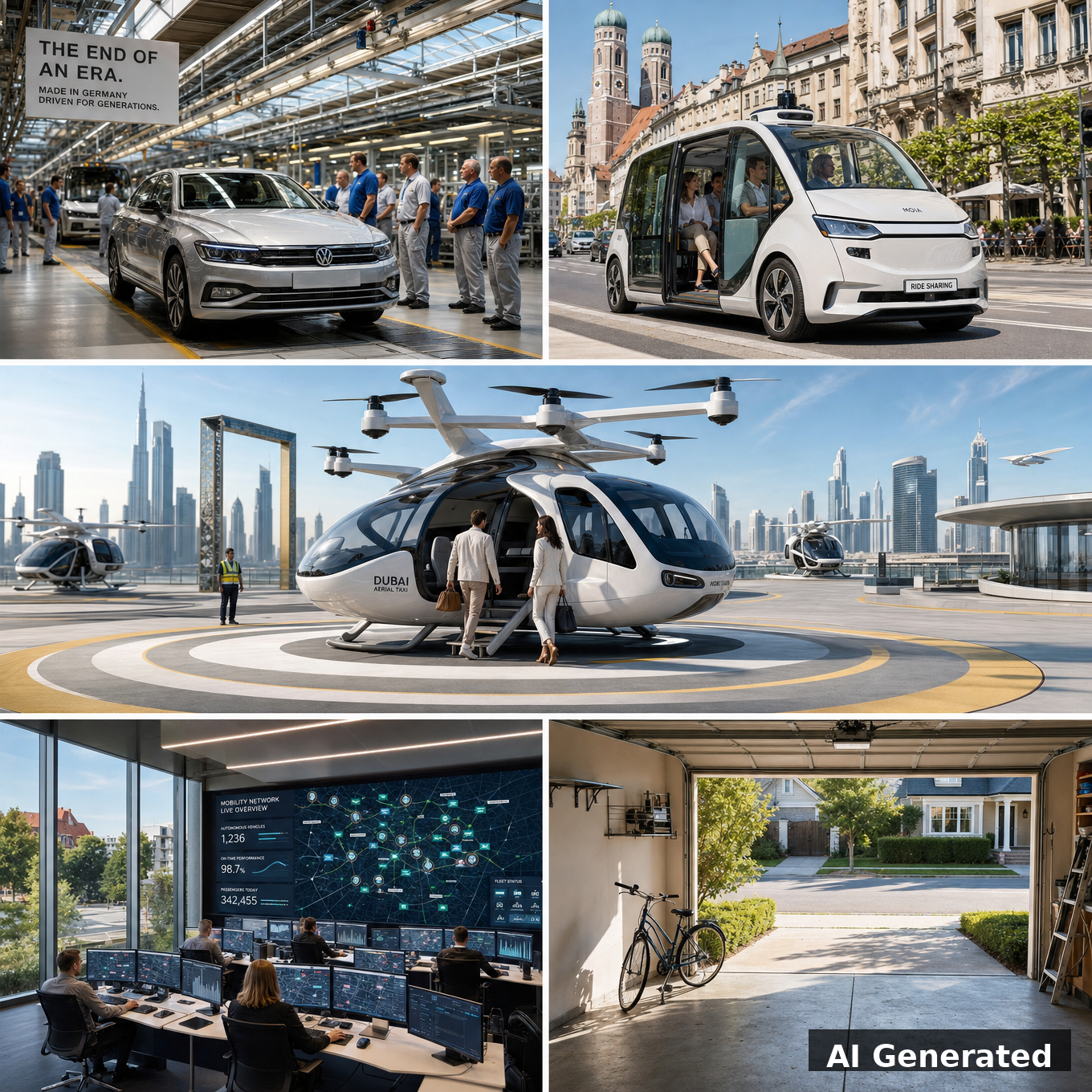


This article is part of the series: “The Last German Car” — how AI, energy, and autonomy are reshaping the automobile
The car did not replace the horse by being a better horse. It replaced the horse by making the horse irrelevant. The same thing is happening now — and the Germans are still perfecting the saddle.
There is a particular kind of denial that afflicts successful institutions. It is not the denial of facts — the facts are usually acknowledged, sometimes with impressive thoroughness. It is the denial of implication. The German automotive establishment knows that car production is falling, that profits are shrinking, that Chinese competitors are advancing, that energy costs are unsustainable. It knows all of this. What it cannot accept is what these facts mean: that the era of the German car — as a product, as an identity, as the engine of national prosperity — is ending.
This is not a failure of intelligence. Jan Wörner, the Acatech president who argues for integrating AI into German manufacturing, is a former Director General of the European Space Agency [1]. The engineers at Volkswagen, BMW, and Mercedes-Benz are among the best in the world. The problem is not competence. It is imagination. These institutions are optimising for a world that is being replaced by a different one.
The Habit Shift Has Already Begun
Consider what is already happening — not in laboratories or policy papers, but in the daily decisions of ordinary people.

In Dubai, 600 customers have pre-ordered flying cars from XPeng’s AEROHT division, now rebranded as ARIDGE [2]. The UAE aviation regulator is on track to certify air taxis by the third quarter of 2026 [2]. Dubai has unveiled its first commercial vertiport and is targeting 25% autonomous transportation by 2030 [2].
In the United States, Waymo’s membership programme — $29.99 per month for priority access to driverless rides — is already available [3]. Tesla’s robotaxi service charges $4.20 per ride in Austin [3]. Zoox, Amazon’s purpose-built autonomous vehicle, offers free rides on the Las Vegas Strip [3]. These are not pilots or demonstrations. They are commercial services operating today.
In China, Baidu Apollo Go is conducting more than 250,000 weekly driverless rides across 27 cities [3]. WeRide launched fare-charging robotaxi service in Dubai via Uber with no human onboard [3]. Pony.ai operates Europe’s first commercial robotaxi service in Zagreb [3].
The habit shift does not require everyone to abandon car ownership simultaneously. It requires only that enough people, in enough cities, discover that summoning a ride is cheaper, easier, and safer than owning a vehicle that sits idle 95% of the time. That threshold is being crossed now.
One Car Replaces Two

The arithmetic of car ownership is about to change in a way that the automotive industry has not priced in.
A two-car household — the backbone of suburban automotive demand — exists because both adults need independent transportation at overlapping times. But when a car can drive itself, the overlap disappears. One vehicle can serve the entire household: dropping one person at work, returning for the other, shuttling children to school, running errands between pickups. The second car becomes redundant.
For urban singles, the calculation is even simpler. Why pay for insurance, maintenance, parking, and depreciation on a depreciating asset when a fleet of autonomous vehicles is available on demand, priced per ride, and arrives in minutes? The car in the garage becomes a luxury item, like a horse in the countryside — kept by enthusiasts, not by necessity.
This is not a twenty-year projection. Waymo’s fleet of 3,500 vehicles is already conducting 500,000 paid rides per week [3]. Tesla is scaling its robotaxi service to new cities quarterly. Baidu is operating at volumes that dwarf both. The infrastructure for car-on-demand is being built now, and it will be operational in most major cities within five to seven years.
When that happens, global vehicle sales will decline. Not because people stop moving — they will move more — but because the same mobility can be delivered with fewer vehicles, each in near-constant use rather than sitting idle.
Previous in this series: The Last German Car — Part 2: The Autonomy Revolution — the robotaxi revolution that kills car ownership
AI Coordination Makes Public Transport Work

There is a second-order effect that few analysts discuss. Autonomous driving does not only change private car ownership. It transforms public transport.
Today, public transport suffers from a fundamental coordination problem. Buses run on fixed routes and schedules that do not adapt to real-time demand. Trains connect fixed points that may not align with where people actually need to go. The result is that public transport is inconvenient enough to push people toward private cars — even when those cars are expensive, environmentally damaging, and time-wasting in congested cities.
AI-powered coordination changes this equation. When autonomous vehicles can provide first-mile and last-mile connections to rail and bus networks — picking you up at your door, dropping you at the station, meeting you at the other end — the convenience gap between private and public transport closes. When AI algorithms can dynamically adjust bus routes and frequencies based on real-time demand patterns, the efficiency gap closes as well.
The result is not the end of cars. It is the end of the car as the default solution to every transportation need. A city where autonomous vehicles handle short trips, AI-coordinated buses handle medium trips, and rail handles long trips is a city that needs far fewer private vehicles than one designed around individual car ownership.
What Germany Must Do — And Probably Won’t
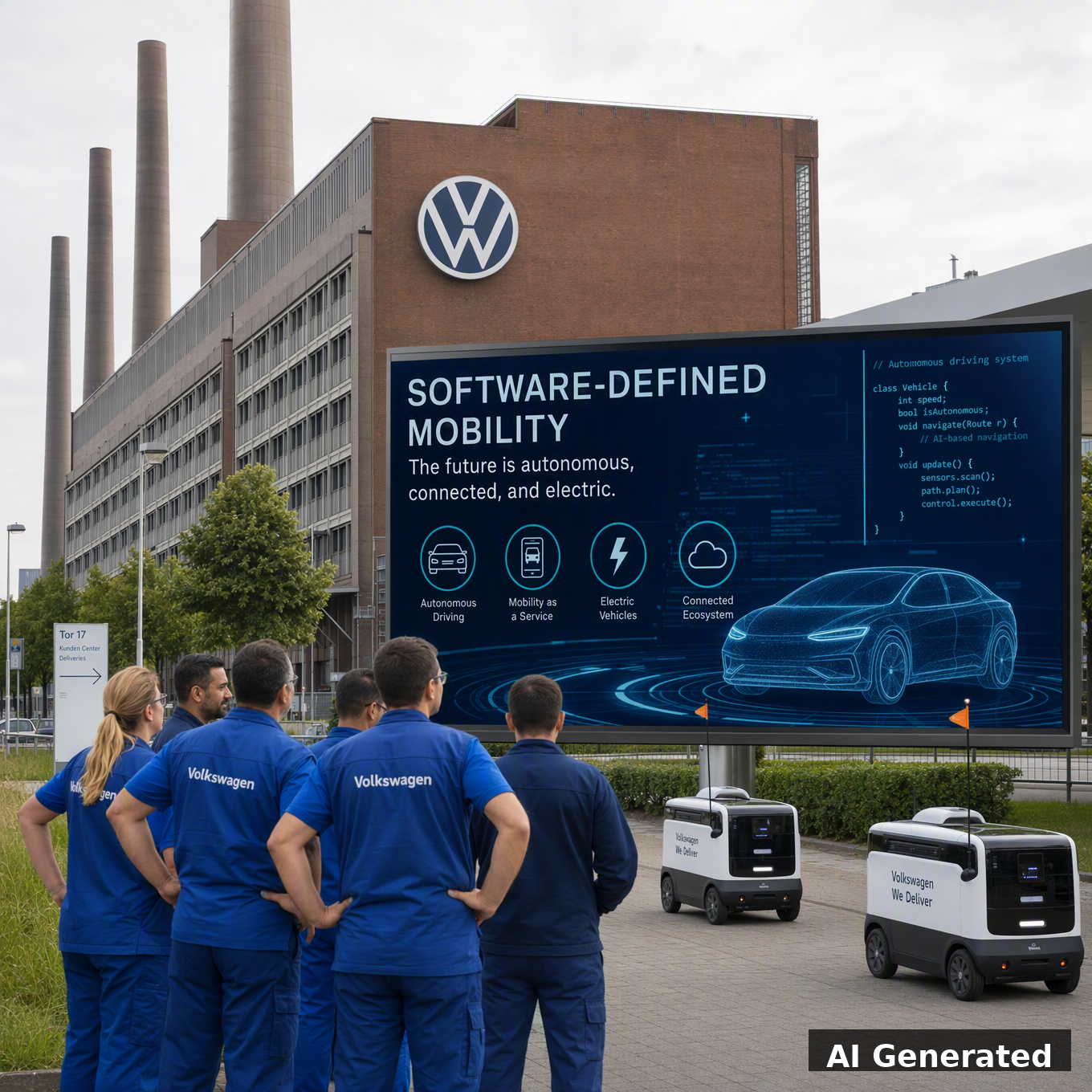
Germany’s automotive industry employs 780,000 people directly and supports millions more through its supply chain [4]. It generates roughly 6% of national GDP [4]. This is not an industry that can be abandoned without consequences.
But the choice facing Germany is not between saving the auto industry and destroying it. The choice is between adapting to the new mobility landscape and pretending the old one still exists. And the evidence suggests that the German establishment is choosing pretence.
Acatech’s framing — that the future depends on integrating AI into manufacturing — is technically correct but strategically insufficient [1]. Germany should absolutely integrate AI into its factories. But the question is not whether German factories can be made more efficient. The question is whether the world will need as many cars as those factories produce. And the answer, increasingly, is no.
What Germany should be building is not a better car. It should be building the software, AI systems, and service platforms that will define next-generation mobility. It should be the place where autonomous fleet management algorithms are developed, where mobility-as-a-service platforms are designed, where the coordination systems for integrated transport networks are engineered. This is high-value work that leverages Germany’s engineering talent without depending on the assumption that millions of individual vehicles will continue to be sold annually.
But this requires letting go. Letting go of the identity that says Germany’s greatness is built on the automobile. Letting go of the political structures that tie regional prosperity to factory employment. Letting go of the lobbying power that comes from being the biggest industry in the room. Letting go, in short, of the thing that made Germany Germany for seventy years.
That is a lot to ask of any country. It may be too much to ask of this one.
The Last German Car

Somewhere in Germany, on a factory line that has been producing automobiles for decades, there will be a last car. It will roll off the line, pass through quality control, and be loaded onto a carrier bound for a dealership where someone will buy it. It will be well-engineered, comfortable, and reliable — everything a German car has always been.
And it will be a relic. Not because it runs on petrol or batteries, but because the world that needed it — a world where mobility meant ownership, where transportation meant a private vehicle in every garage, where the automobile was the organising principle of cities and economies — that world is ending.
The energy collision described in Part 1 is slowing the EV transition. The autonomy revolution described in Part 2 is accelerating the shift away from ownership. Together, they are creating a future where fewer cars are needed, where mobility is a service rather than a product, and where the industrial logic that built Volkswagen, BMW, and Mercedes-Benz no longer applies.
Germany can lead this transition, or it can be consumed by it. But it cannot prevent it. The last German car will be built. The only question is whether it will be the last car Germany needed to build, or the last one it was capable of building.
References
[1] Acatech. (2024, November 19). Shaping future value creation: The influence of Industry 4.0. https://en.acatech.de/allgemein/shaping-future-value-creation/
[2] Integrator Media. (2026, May 4). XPENG reveals the future of AI mobility at the 2026 Beijing Auto Show. https://integratormedia.com/2026/05/04/xpeng-gx-ai-mobility-beijing-auto-show-2026/
[3] The Charge Port. (2026, July 24). Robotaxi tracker 2026 — US operators & live status. https://thechargeport.com/robotaxi-tracker
[4] Leggett, T. (2025, February 12). Germany’s once-mighty car industry is in crisis. What will it take to fix it? BBC News. https://www.bbc.com/news/articles/cz6pzwj6qq7o
AI Disclosure: This post was created with the assistance of artificial intelligence. The ideas, analysis, and opinions expressed are my own — AI was used to help compose, structure, and refine my personal notes and thoughts into the final written content. Images and video featured in this post were also generated using AI tools, based on my own creative prompts and direction.
