
Category Highlights

Stay ahead with our Highlighted News, where the most important stories of the day take center stage. This section brings you the latest updates, key developments, and major insights shaping the world right now. From breaking headlines to in-depth analysis, each story is carefully selected to give you a clear understanding of what truly matters. Whether it’s global affairs, business shifts, environmental issues, or technology breakthroughs, you’ll find the top stories presented here first. Highlighted News ensures you never miss the essential updates that inform decisions, spark conversations, and define the course of tomorrow.

The Trump Administration’s Venezuelan Intervention: Legal Justifications, Resource Interests, and MAGA Politics

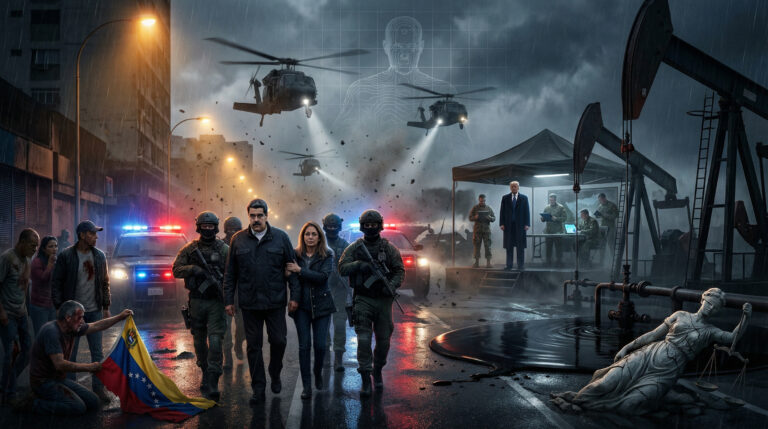
Nighttime street raid in Caracas showing Nicolás Maduro and Cilia Flores being escorted by armed soldiers between police cars with flashing lights, helicopters overhead, Trump observing from an oil-field command tent, and a toppled Lady Justice statue sinking into an oil spill.

On January 3, 2026, in a military operation code-named "Absolute Resolve," the United States conducted a dramatic raid on Caracas, Venezuela, resulting in the forcible abduction of President Nicolás Maduro and his wife, Cilia Flores. The operation, involving 150 aircraft deployed from approximately 20 bases and conducted by U.S. special forces, marked the most aggressive military action of President Donald Trump's tenure.

 United States Economic Report January 2026

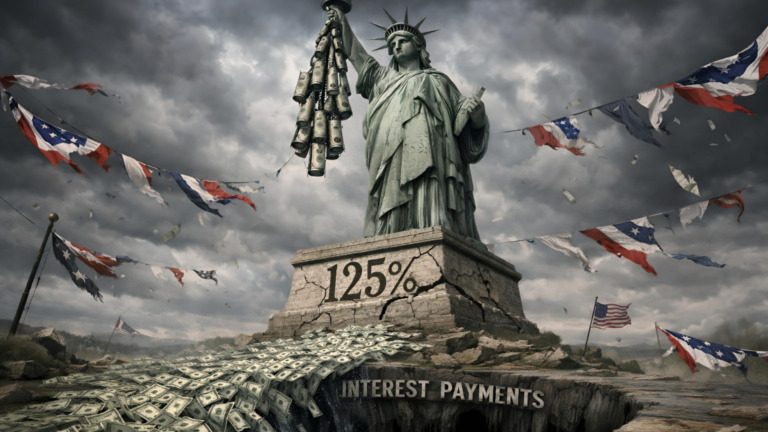
A stormy political illustration of the Statue of Liberty standing on a cracked pedestal marked “125%,” holding chains of dollar bills as waves of US banknotes pour into a dark pit labeled “INTEREST PAYMENTS,” surrounded by tattered American flags.

The United States economy enters 2026 with remarkably resilient momentum, expanding at an estimated 4.3% annualized rate in Q4 2025—the strongest quarterly performance in two years—yet faces a complex macroeconomic crossroads as multiple forces converge to shape the trajectory ahead.

From Democracy to Kleptocracy: The Koskotas Template.

Collage showing suited men with blurred faces in front of layered images of Greek government buildings, banks, and media logos, symbolizing politics, finance, and public institutions in Greece.

In the late 1980s, against a backdrop of roiling political turbulence, a financial scandal of staggering proportions erupted from the heart of Athens. Presided over by the Panhellenic Socialist Movement (PASOK) and its charismatic leader, Andreas Papandreou, this was an era where populist ambition often blurred the lines between state governance and party patronage. The Koskotas affair was not an anomaly; it was the system’s logical endpoint. To understand this scandal is not merely to revisit a historical event, but to perform an autopsy on a foundational case study in the architecture of systemic corruption that would plague Greece for decades.

Emissions Unfiltered: The Relentless Rise of Global Carbon and the Political Blocking of Climate Action.

A giant hourglass contains sand and globe-shaped balls with world flags, slowly trickling sand onto a mound with the United Nations emblem, surrounded by trees and oil rigs, under a dark stormy sky.

Despite decades of international agreements, national commitments, climate conferences spanning three decades, and increasing climate consciousness among populations worldwide, global emissions continue to rise year after year, and the gap between what we promise and what we actually implement has become not merely a gap but a canyon—a vast chasm of broken commitments, abandoned pledges, and policies that exist on paper while fossil fuel expansion continues unabated in the real world.

 The Layered Anatomy of CO₂ Emissions.

A surreal depiction of a floating slice of Earth showing farmland, highways, cattle, and factories, with molten lava below and a glowing coin above symbolizing sustainability and industry.

We often talk about “global warming” or “net zero by 2050” without seeing that different sectors of society — energy, transport, food, manufacturing, and even the military — interact in subtle and surprising ways. Dissecting these pieces helps us find the points of greatest leverage, influence better policy, and even shape everyday choices in our homes.